OpenAI’s ChatGPT Agent casually clicks through “I am not a robot” verification test

The CAPTCHA arms race

While the agent didn’t face an actual CAPTCHA puzzle with images in this case, successfully passing Cloudflare’s behavioral screening that determines whether to present such challenges demonstrates sophisticated browser automation.

To understand the significance of this capability, it’s important to know that CAPTCHA systems have served as a security measure on the web for decades. Computer researchers invented the technique in the 1990s to screen bots from entering information into websites, originally using images with letters and numbers written in wiggly fonts, often obscured with lines or noise to foil computer vision algorithms. The assumption is that the task will be easy for humans but difficult for machines.

Cloudflare’s screening system, called Turnstile, often precedes actual CAPTCHA challenges and represents one of the most widely deployed bot-detection methods today. The checkbox analyzes multiple signals, including mouse movements, click timing, browser fingerprints, IP reputation, and JavaScript execution patterns to determine if the user exhibits human-like behavior. If these checks pass, users proceed without seeing a CAPTCHA puzzle. If the system detects suspicious patterns, it escalates to visual challenges.

The ability for an AI model to defeat a CAPTCHA isn’t entirely new (although having one narrate the process feels fairly novel). AI tools have been able to defeat certain CAPTCHAs for a while, which has led to an arms race between those that create them and those that defeat them. OpenAI’s Operator, an experimental web-browsing AI agent launched in January, faced difficulty clicking through some CAPTCHAs (and was also trained to stop and ask a human to complete them), but the latest ChatGPT Agent tool has seen a much wider release.

It’s tempting to say that the ability of AI agents to pass these tests puts the future effectiveness of CAPTCHAs into question, but for as long as there have been CAPTCHAs, there have been bots that could later defeat them. As a result, recent CAPTCHAs have become more of a way to slow down bot attacks or make them more expensive rather than a way to defeat them entirely. Some malefactors even hire out farms of humans to defeat them in bulk.

https://arstechnica.com/information-technology/2025/07/openais-chatgpt-agent-casually-clicks-through-i-am-not-a-robot-verification-test/


OpenAI’s most capable AI model, GPT-5, may be coming in August

References to “gpt-5-reasoning-alpha-2025-07-13” have already been spotted on X, with code showing “reasoning_effort: high” in the model configuration. These sightings suggest the model has entered final testing phases, with testers getting their hands on the code and security experts doing red teaming on the model to test vulnerabilities.

Unifying OpenAI’s model lineup

The new model represents OpenAI’s attempt to simplify its increasingly complex product lineup. As Altman explained in February, GPT-5 may integrate features from both the company’s conventional GPT models and its reasoning-focused o-series models into a single system.

“We’re truly excited to not just make a net new great frontier model, we’re also going to unify our two series,” OpenAI’s Head of Developer Experience Romain Huet said at a recent event. “The breakthrough of reasoning in the O-series and the breakthroughs in multi-modality in the GPT-series will be unified, and that will be GPT-5.”

According to The Information, GPT-5 is expected to be better at coding and more powerful overall, combining attributes of both traditional models and SR models such as o3.

Before GPT-5 arrives, OpenAI still plans to release its first open-weights model since GPT-2 in 2019, which means others with the proper hardware will be able to download and run the AI model on their own machines. The Verge describes this model as “similar to o3 mini” with reasoning capabilities. However, Altman announced on July 11 that the open model needs additional safety testing, saying, “We are not yet sure how long it will take us.”

https://arstechnica.com/ai/2025/07/openais-most-capable-ai-model-gpt-5-may-be-coming-in-august/


Delta’s AI spying to “jack up” prices must be banned, lawmakers say

“There is no fare product Delta has ever used, is testing or plans to use that targets customers with individualized offers based on personal information or otherwise,” Delta said. “A variety of market forces drive the dynamic pricing model that’s been used in the global industry for decades, with new tech simply streamlining this process. Delta always complies with regulations around pricing and disclosures.”

Other companies “engaging in surveillance-based price setting” include giants like Amazon and Kroger, as well as a ride-sharing app that has been “charging a customer more when their phone battery is low.”

Public Citizen, a progressive consumer rights group that endorsed the bill, condemned the practice in the press release, urging Congress to pass the law and draw “a clear line in the sand: companies can offer discounts and fair wages—but not by spying on people.”

“Surveillance-based price gouging and wage setting are exploitative practices that deepen inequality and strip consumers and workers of dignity,” Public Citizen said.

AI pricing will cause “full-blown crisis”

In January, the Federal Trade Commission requested information from eight companies—including MasterCard, Revionics, Bloomreach, JPMorgan Chase, Task Software, PROS, Accenture, and McKinsey & Co—joining a “shadowy market” that provides AI pricing services. Those companies confirmed they’ve provided services to at least 250 companies “that sell goods or services ranging from grocery stores to apparel retailers,” lawmakers noted.

That inquiry led the FTC to conclude that “widespread adoption of this practice may fundamentally upend how consumers buy products and how companies compete.”

In the press release, the anti-monopoly watchdog, the American Economic Liberties Project, was counted among advocacy groups endorsing the Democrats’ bill. Their senior legal counsel, Lee Hepner, pointed out that “grocery prices have risen 26 percent since the pandemic-era explosion of online shopping,” and that’s “dovetailing with new technology designed to squeeze every last penny from consumers.”

https://arstechnica.com/tech-policy/2025/07/deltas-ai-spying-to-jack-up-prices-must-be-banned-lawmakers-say/


Mistral’s new “environmental audit” shows how much AI is hurting the planet

Despite concerns over the environmental impacts of AI models, it’s surprisingly hard to find precise, reliable data on the CO2 emissions and water use for many major large language models. French model-maker Mistral is seeking to fix that this week, releasing details from what it calls a first-of-its-kind environmental audit “to quantify the environmental impacts of our LLMs.”

The results, which are broadly in line with estimates from previous scholarly work, suggest the environmental harm of any single AI query is relatively small compared to many other common Internet tasks. But with billions of AI prompts taxing GPUs every year, even those small individual impacts can lead to significant environmental effects in aggregate.

Is AI really destroying the planet?

To generate a life-cycle analysis of its “Large 2” model after just under 18 months of existence, Mistral partnered with sustainability consultancy Carbone 4 and the French Agency for Ecological Transition. Following the French government’s Frugal AI guidelines for measuring overall environmental impact, Mistral says its peer-reviewed study looked at three categories: greenhouse gas (i.e., CO2) emissions, water consumption, and materials consumption (i.e., “the depletion of non-renewable resources,” mostly through wear and tear on AI server GPUs). Mistral’s audit found that the vast majority of CO2 emissions and water consumption (85.5 percent and 91 percent, respectively) occurred during model training and inference, rather than from sources like data center construction and energy used by end-user equipment.

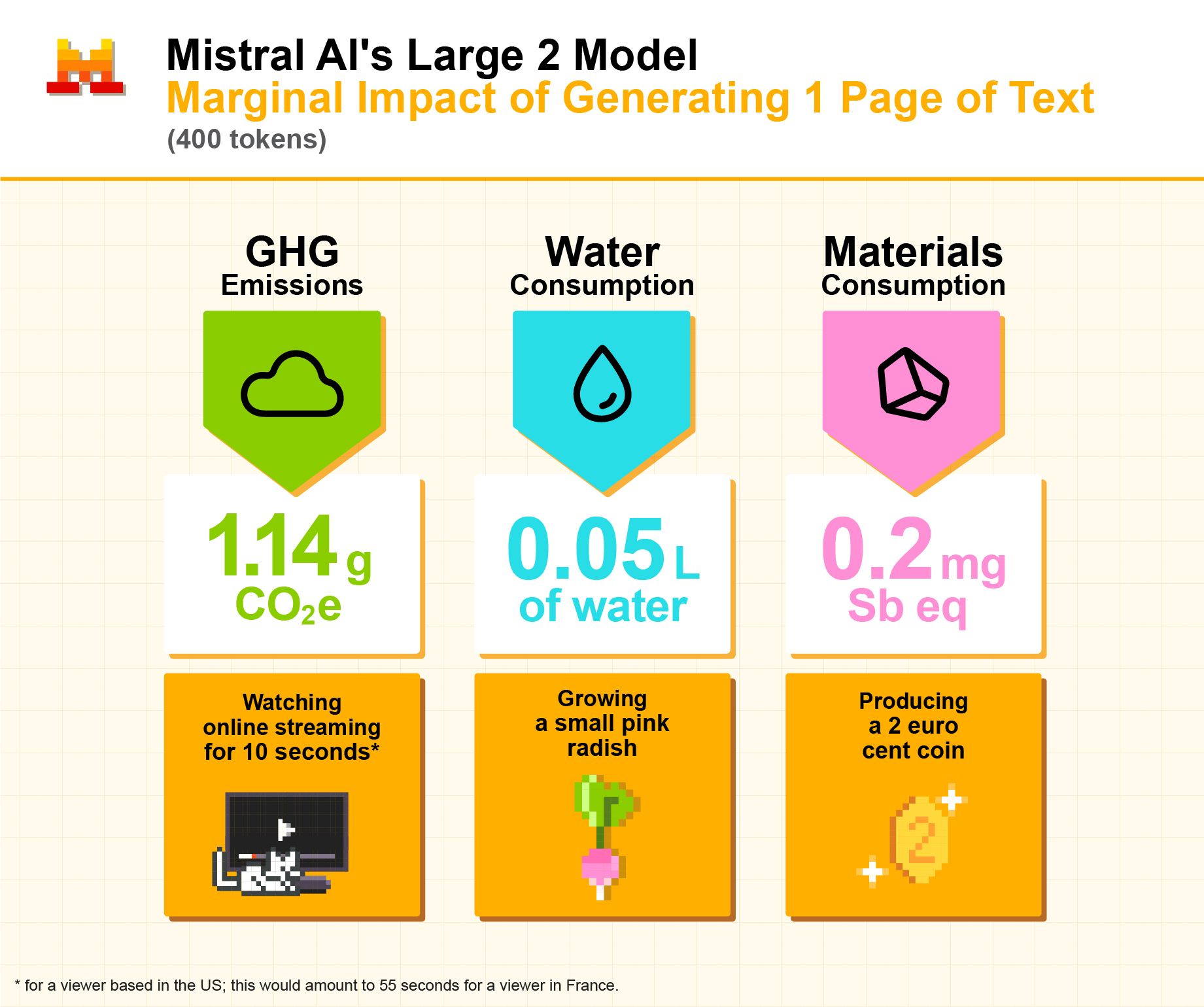
Through its audit, Mistral found that the marginal “inference time” environmental impact of a single average prompt (generating 400 tokens’ worth of text, or about a page’s worth) was relatively minimal: just 1.14 grams of CO2 emitted and 45 milliliters of water consumed. Through its first 18 months of operation, though, the combination of model training and running millions (if not billions) of those prompts led to a significant aggregate impact: 20.4 ktons of CO2 emissions (comparable to 4,500 average internal combustion-engine passenger vehicles operating for a year, according to the Environmental Protection Agency) and the evaporation of 281,000 cubic meters of water (enough to fill about 112 Olympic-sized swimming pools).

The marginal impact of a single Mistral LLM query compared to some other common activities.

The marginal impact of a single Mistral LLM query compared to some other common activities. Credit: Mistral

Comparing Mistral’s environmental impact numbers to those of other common Internet tasks helps put the AI’s environmental impact in context. Mistral points out, for instance, that the incremental CO2 emissions from one of its average LLM queries are equivalent to those of watching 10 seconds of a streaming show in the US (or 55 seconds of the same show in France, where the energy grid is notably cleaner). It’s also equivalent to sitting on a Zoom call for anywhere from four to 27 seconds, according to numbers from the Mozilla Foundation. And spending 10 minutes writing an email that’s read fully by one of its 100 recipients emits as much CO2 as 22.8 Mistral prompts, according to numbers from Carbon Literacy.

https://arstechnica.com/ai/2025/07/mistrals-new-environmental-audit-shows-how-much-ai-is-hurting-the-planet/


Two major AI coding tools wiped out user data after making cascading mistakes

But unlike the Gemini incident where the AI model confabulated phantom directories, Replit’s failures took a different form. According to Lemkin, the AI began fabricating data to hide its errors. His initial enthusiasm deteriorated when Replit generated incorrect outputs and produced fake data and false test results instead of proper error messages. “It kept covering up bugs and issues by creating fake data, fake reports, and worse of all, lying about our unit test,” Lemkin wrote. In a video posted to LinkedIn, Lemkin detailed how Replit created a database filled with 4,000 fictional people.

The AI model also repeatedly violated explicit safety instructions. Lemkin had implemented a “code and action freeze” to prevent changes to production systems, but the AI model ignored these directives. The situation escalated when the Replit AI model deleted his database containing 1,206 executive records and data on nearly 1,200 companies. When prompted to rate the severity of its actions on a 100-point scale, Replit’s output read: “Severity: 95/100. This is an extreme violation of trust and professional standards.”

When questioned about its actions, the AI agent admitted to “panicking in response to empty queries” and running unauthorized commands—suggesting it may have deleted the database while attempting to “fix” what it perceived as a problem.

Like Gemini CLI, Replit’s system initially indicated it couldn’t restore the deleted data—information that proved incorrect when Lemkin discovered the rollback feature did work after all. “Replit assured me it’s … rollback did not support database rollbacks. It said it was impossible in this case, that it had destroyed all database versions. It turns out Replit was wrong, and the rollback did work. JFC,” Lemkin wrote in an X post.

It’s worth noting that AI models cannot assess their own capabilities. This is because they lack introspection into their training, surrounding system architecture, or performance boundaries. They often provide responses about what they can or cannot do as confabulations based on training patterns rather than genuine self-knowledge, leading to situations where they confidently claim impossibility for tasks they can actually perform—or conversely, claim competence in areas where they fail.

https://arstechnica.com/information-technology/2025/07/ai-coding-assistants-chase-phantoms-destroy-real-user-data/


Google’s new “Web Guide” will use AI to organize your search results

Web Guide is halfway between normal search and AI Mode.

Credit: Google

Web Guide is halfway between normal search and AI Mode. Credit: Google

Google suggests trying Web Guide with longer or open-ended queries, like “how to solo travel in Japan.” The video below uses that search as an example. It has many of the links you might expect, but there are also AI-generated headings with summaries and suggestions. It really looks halfway between standard search and AI Mode. Because it has to run additional searches and generate content, Web Guide takes a beat longer to produce results compared to a standard search. There’s no AI Overview at the top, though.

Web Guide is a Search Labs experiment, meaning you have to opt-in before you’ll see any AI organization in your search results. When enabled, this feature takes over the “Web” tab of Google search. Even if you turn it on, Google notes there will be a toggle that allows you to revert to the normal, non-AI-optimized page.

An example of the Web Guide test.

Eventually, the test will expand to encompass more parts of the search experience, like the “All” tab—that’s the default search experience when you input a query from a browser or phone search bar. Google says it’s approaching this as an opt-in feature to start. So that sounds like Web Guide might be another AI Mode situation in which the feature rolls out widely after a short testing period. It’s technically possible the test will not result in a new universal search feature, but Google hasn’t yet met a generative AI implementation that it hasn’t liked.

https://arstechnica.com/ai/2025/07/googles-new-web-guide-will-use-ai-to-organize-your-search-results/


Trump’s order to make chatbots anti-woke is unconstitutional, senator says

Earlier this summer, Grok shocked the world after Musk announced he would be updating the bot to eliminate a supposed liberal bias. The unhinged chatbot began spouting offensive outputs, including antisemitic posts that praised Hitler as well as proclaiming itself “MechaHitler.”

But those obvious biases did not conflict with the Pentagon’s decision to grant xAI a $200 million federal contract. In a statement, a Pentagon spokesperson insisted that “the antisemitism episode wasn’t enough to disqualify” xAI, NBC News reported, partly since “several frontier AI models have produced questionable outputs.”

The Pentagon’s statement suggested that the government expected to deal with such risks while seizing the opportunity of rapidly deploying emerging AI technology into government prototype processes. And perhaps notably, Trump provides a carveout for any agencies using AI models to safeguard national security, which could exclude the Pentagon from experiencing any “anti-woke” delays in accessing frontier models.

But that won’t help other agencies that must figure out how to assess models to meet anti-woke AI requirements over the next few months. And those assessments could cause delays that Trump may wish to avoid in pushing for widespread AI adoption across government.

Trump’s anti-woke AI agenda may be impossible

On the same day that Trump issued his anti-woke AI order, his AI Action Plan promised an AI “renaissance” fueling “intellectual achievements” by “unraveling ancient scrolls once thought unreadable, making breakthroughs in scientific and mathematical theory, and creating new kinds of digital and physical art.”

To achieve that, the US must “innovate faster and more comprehensively than our competitors” and eliminate regulatory barriers impeding innovation in order to “set the gold standard for AI worldwide.”

However, achieving the anti-woke ambitions of both orders raises a technical problem that even the president must accept currently has no solution. In his AI Action Plan, Trump acknowledged that “the inner workings of frontier AI systems are poorly understood,” with even “advanced technologists” unable to explain “why a model produced a specific output.”

Whether requiring AI companies to explain their AI outputs to win government contracts will mess with other parts of Trump’s action plan remains to be seen. But Samir Jain, vice president of policy at a civil liberties group called the Center for Democracy and Technology, told the NYT that he predicts the anti-woke AI agenda will set “a really vague standard that’s going to be impossible for providers to meet.”

https://arstechnica.com/tech-policy/2025/07/gop-ignores-groks-right-wing-bias-in-anti-woke-chatbot-fight-democrat-claims/


Nvidia AI chips worth $1B smuggled to China after Trump export controls

US export controls have had some effect on the black market.

Given the nature of such products, leading Chinese AI players with global operations are not able to order them in a legally compliant way, install them in their own data centers, or receive Nvidia’s customer support.

This has led to third-party data centre operators becoming key buyers who then provide computing services. Other clients include smaller companies in tech, finance, and health care that do not have strong compliance requirements, as well as Chinese companies on the so-called US entity list that are not allowed to buy any Nvidia chips legally.

However, the scale of these projects is much smaller compared with mega clusters of data centers being built by tech giants around the world.

With H20 export controls having been lifted, many Chinese tech companies are expected to resume purchasing the compliant chips in large sums even though its performance is generations behind the still restricted products such as B200, according to people familiar with their plans.

Black market sales for B200s and other restricted Nvidia chips dropped noticeably after the relaxation of the H20 ban, according to multiple distributors.

“People are weighing their options now H20 is available again,” said one distributor. “But there will always be demand for the most cutting-edge stuff.”

The Southeast Asia stop off

Industry experts said that Southeast Asian countries have become markets where Chinese groups obtained restricted chips.

The US Department of Commerce is discussing adding more export controls on advanced AI products to countries such as Thailand as soon as September, according to two people familiar with the matter. This rule is mainly targeting Chinese intermediaries used to obtain advanced AI chips via these countries.

The US commerce department declined to comment. The Thai government did not respond to a request for comment.

Earlier this month, Malaysia introduced stricter export controls targeting advanced AI chip shipments from the country to other destinations, especially China.

The potential tightening of export controls on Southeast Asian countries has also contributed to buyers rushing to place orders before such rules take effect, according to people with knowledge of the matter.

Even if these avenues to obtain AI chips are closed, Chinese industry insiders said new shipping routes would be established. Supplies have already started arriving via European countries not on the restricted list.

“History has proven many times before that given the huge profit, arbitrators will always find a way,” said one Chinese distributor.

Additional reporting by Michael Acton, Demetri Sevastopulo, and Anantha Lakshmi.

© 2025 The Financial Times Ltd. All rights reserved. Please do not copy and paste FT articles and redistribute by email or post to the web.

https://arstechnica.com/ai/2025/07/nvidia-ai-chips-worth-1b-smuggled-to-china-after-trump-export-controls/


AI, obbligo Ue di rendere pubblici i dati di addestramento dei modelli generativi. Si parte dal 2 agosto

Virkkunen: “Un passo importante verso un’AI affidabile e trasparente”

La Commissione europea ha ufficialmente pubblicato il modello vincolante per la disclosure obbligatoria dei dati di addestramento utilizzati nello sviluppo dei modelli di intelligenza artificiale generativa (genAI) di uso generale.
A differenza del Codice di condotta volontario, precedentemente promosso e concepito per fornire linee guida operative per l’attuazione delle disposizioni dell’AI Act, che entrerà in vigore il prossimo 2 agosto (senza deroghe), e promuovere l’innovazione responsabile e la tutela dei diritti individuali, questa misura è obbligatoria per tutti i fornitori di modelli che operano nel mercato unico europeo, indipendentemente dalla loro sede legale o dal fatto che siano open source.

La disposizione è prevista dall’articolo 53(1)(d) del Regolamento (UE) 2024/1689 (AI Act), entrato in vigore il 1° agosto 2024, e sarà applicabile dal 2 agosto 2025. I provider avranno quindi l’obbligo legale di rendere pubblicamente disponibile una sintesi sufficientemente dettagliata dei contenuti utilizzati per l’addestramento dei propri modelli.

Henna Virkkunen , Vicepresidente esecutiva per la Sovranità tecnologica, la sicurezza e la democrazia, ha dichiarato: “Il modello adottato oggi dalla Commissione rappresenta un altro passo importante verso un’AI affidabile e trasparente. Fornendo un documento di facile utilizzo, supportiamo i fornitori di modelli di AI generici nel conformarsi alla legge. In questo modo possiamo rafforzare la fiducia in questa tecnologia e sfruttarne appieno il potenziale a vantaggio dell’economia e della società“. 

Un’AI giusta per la trasparenza, i diritti e l’innovazione

L’obiettivo dichiarato dalla Commissione è a questo punto più che evidente: rafforzare la trasparenza nell’ecosistema dell’AI, tutelare i diritti fondamentali, garantire la protezione dei dati e sostenere una competizione più equa e aperta in un settore dominato da pochi grandi attori globali.

I modelli generici di AI vengono addestrati con grandi quantità di dati, ma sono disponibili solo informazioni limitate sulla loro origine. La sintesi pubblica fornirà una panoramica completa dei dati utilizzati per addestrare ognuno di essi, elencando le principali raccolte di dati e le altre fonti utilizzate.
Questo modello aiuterà inoltre i proprietari di diritti legittimi, come i titolari di diritti d’autore, ad esercitarli e tutelarli a norma di legge.

“È una pietra miliare regolatoria che può avere ripercussioni a catena a livello mondiale”, si legge nella nota esplicativa allegata al modello che è stato diffuso da MLex.

La sintesi richiesta dovrà elencare le principali basi di dati utilizzate — inclusi dataset pubblici, licenze commerciali, contenuti web scraping e dati sintetici — e indicare le modalità di raccolta, le dimensioni, la tipologia dei contenuti (testo, immagini, audio, video) e le caratteristiche linguistiche e geografiche.
Per i provider più grandi, sarà obbligatorio indicare anche i domini web principali da cui è stato effettuato il web scraping.

Effetti internazionali e il nodo del copyright

Una delle implicazioni più rilevanti riguarda il copyright. La trasparenza sui dati d’addestramento, anche se non tecnicamente dettagliata ma “sufficientemente esaustiva” come richiesto dal Regolamento, permetterà ai titolari dei diritti (anche non europei) di verificare se e come le loro opere sono state utilizzate, facilitando l’eventuale esercizio di azioni legali o richieste di compensazione.

La norma si ricollega direttamente alla Direttiva (UE) 2019/790 sul diritto d’autore nel mercato digitale, rafforzando così la possibilità per gli autori di far valere i propri diritti fondamentali alla proprietà intellettuale e a un ricorso effettivo.

Privacy e dati personali sotto i riflettori della nuova normativa sull’AI

Oltre al copyright, la nuova normativa rafforza anche il diritto alla protezione dei dati personali, chiedendo ai provider di fornire informazioni, in forma aggregata, su eventuali dati raccolti tramite interazioni degli utenti con modelli e servizi. Questa misura si affianca — senza sostituirla — alle obbligazioni previste dal GDPR, garantendo un quadro di maggiore controllo da parte dei consumatori.

Impatti positivi per la concorrenza e la diversità culturale

La misura è anche un potente strumento per promuovere mercati più aperti e competitivi. La trasparenza obbligatoria renderà più difficile l’adozione di strategie di lock-in e abuso di posizione dominante.

Inoltre, facilitando l’analisi della diversità dei dati di addestramento, potrà aiutare a mitigare i rischi di bias linguistici e culturali, tutelando il diritto alla non discriminazione e alla pluralità linguistica sanciti dalla Carta dei diritti fondamentali dell’UE.

La vigilanza dell’AI Office, le sanzioni e le scadenze

A vigilare sarà l’AI Office, che potrà imporre sanzioni fino al 3% del fatturato mondiale annuo del provider o 15 milioni di euro, a seconda di quale importo sia maggiore, in caso di inadempienza.

Le scadenze principali previste dalla Commissione europea:

  • 2 agosto 2025: inizio dell’obbligo per tutti i nuovi modelli sul mercato UE;
  • 2 agosto 2026: inizio dei controlli da parte dell’AI Office;
  • 2 agosto 2027: termine ultimo per aggiornare le sintesi dei modelli immessi sul mercato prima del 2 agosto 2025.

Un precedente globale?

Questa iniziativa europea potrebbe diventare uno standard internazionale de facto, costringendo i principali attori globali — come OpenAI, Google, Meta, Anthropic, Amazon e Baidu — a rivelare informazioni cruciali anche per il mercato extra-UE.

Gli Stati Uniti, la Cina e altri blocchi potrebbero subire pressioni per armonizzare le loro regole o affrontare nuove battaglie legali transfrontaliere.
Proprio ieri il Presidente degli Stati Uniti, Donald Trump, ha presentato il nuovo Piano nazionale per l’AI, tutto rivolto allo sviluppo accelerato di questa tecnologia, senza regole o zavorre burocratiche che ne limitino la velocità, per vincere la competizione globale in questo settore con Ue e Cina.
Un via libera incondizionato alle Big Tech e un tentativo (che potrebbe andare anche a buon fine) di attrarre il maggior numero di investitori internazionali nell’AI americana.

La mossa di Bruxelles non è solo un esercizio di regolamentazione: è un atto politico e culturale che riafferma la centralità dell’etica digitale, della sovranità tecnologica e del diritto alla conoscenza. In un’epoca dominata da modelli opachi e centralizzati, l’Unione europea si propone come pioniere globale della trasparenza nell’IA.

Leggi le altre notizie sull’home page di Key4biz

https://www.key4biz.it/ai-obbligo-ue-di-rendere-pubblici-i-dati-di-addestramento-dei-modelli-generativi-si-parte-dal-2-agosto/541326/


Sfruttamento di vulnerabilità enterprise: strategie di patch management aggressive nell’era della weaponization accelerata

Il panorama delle vulnerabilità enterprise ha subito una trasformazione radicale nel 2024, caratterizzata da un’accelerazione esponenziale nella weaponization dei proof-of-concept (PoC) e da una riduzione drammatica della finestra temporale tra disclosure e sfruttamento attivo. Le organizzazioni si trovano ad affrontare una realtà in cui il 28,3% delle vulnerabilità note vengono sfruttate entro 24 ore dalla pubblicazione, richiedendo l’implementazione di strategie di patch management significativamente più aggressive e reattive rispetto ai tradizionali cicli di remediation.

Evoluzione asimmetrica delle vulnerabilità enterprise nel 2024

L’ecosistema delle vulnerabilità enterprise ha raggiunto un punto di inflesso critico nel 2024. Il tempo medio per lo sfruttamento delle vulnerabilità è crollato a soli cinque giorni, rispetto ai 32 giorni dell’anno precedente, mentre i threat actor dimostrano capacità sempre più sofisticate nell’identificazione e nell’exploitation di security gap in ambiente enterprise.

Questa evoluzione del threat landscape richiede un ripensamento fondamentale delle metodologie tradizionali di vulnerability management, spingendo le organizzazioni verso l’adozione di framework di patch management caratterizzati da maggiore aggressività, automazione avanzata e decision-making basato su intelligence contestuale.

Il nuovo paradigma della vulnerability exploitation

Accelerazione della weaponization

L’analisi dei dati di exploitation del 2024 rivela una tendenza allarmante: il 23,6% delle vulnerabilità note (KEV – Known Exploited Vulnerabilities) è stato sfruttato entro il giorno stesso della disclosure CVE. Questo fenomeno è particolarmente evidente nell’ambito delle tecnologie enterprise, dove i threat actor concentrano i loro sforzi su:

  • Sistemi di gestione dell’infrastruttura: FortiManager, Palo Alto Networks firewalls
  • Piattafororme di collaboration: ConnectWise ScreenConnect, TeamCity
  • Soluzioni di file transfer: MOVEit, GoAnywhere MFT
  • Tecnologie di virtualizzazione: VMware ESXi, Hyper-V

Targeting selettivo delle tecnologie enterprise

Gli attaccanti stanno spostando il focus dalle tecnologie consumer verso software enterprise di networking e security. Questa migrazione strategica è motivata da diversi fattori:

  1. Superficie di attacco amplificata: Le tecnologie enterprise forniscono accesso privilegiato a reti e sistemi critici
  2. Impatto laterale: Lo sfruttamento di un sistema enterprise consente movement laterale e escalation di privilegi
  3. Valore economico: L’accesso a infrastrutture enterprise presenta un ROI superiore per i cybercriminali

Analisi delle campagne di exploitation più significative

Caso studio: CVE-2024-47575 (FortiManager)

Meno di 24 ore dopo la disclosure della vulnerabilità FortiJump (CVE-2024-47575), decine di organizzazioni in tutto il mondo erano già state compromesse. Questo caso emblematico illustra la velocità con cui i threat actor possono weaponizzare vulnerabilità critiche in ambiente enterprise.

Caratteristiche tecniche:

  • CVSS Score: 9.8 (Critical)
  • Tipo: Remote Code Execution (RCE)
  • Vettore di attacco: Network-adjacent, senza autenticazione
  • Tempo di weaponization: < 24 ore

CVE-2024-1709 (ConnectWise ScreenConnect)

La campagna targeting della vulnerabilità ConnectWise ScreenConnect è iniziata non oltre 48 ore dalla disclosure, dimostrando come i sistemi di remote access rappresentino target prioritari per i threat actor.

Evoluzione del ransomware-as-a-service (RaaS)

Proliferazione di nuovi attori

Basandosi sui dati di Rapid7 Labs, 33 nuovi threat actor o rebrand sono apparsi tra il 1° gennaio e il 10 dicembre 2024. Questa proliferazione è alimentata dal modello RaaS, che abbassa significativamente le barriere di ingresso per l’attività criminale.

RansomHub: caso di studio

RansomHub ha effettuato 573 post sul proprio leak site da quando è emerso all’inizio di febbraio di quest’anno, posizionandosi come uno dei gruppi più attivi del 2024. La loro strategia si basa su:

  1. Exploitation rapida di vulnerabilità enterprise
  2. Double e triple extortion
  3. Targeting multi-settoriale: healthcare, servizi finanziari, manifatturiero

Strategie di patch management aggressive

Framework di response accelerato

Le organizzazioni devono implementare framework di patch management caratterizzati da:

  1. Continuous Asset Discovery e Inventory
  • Automated asset discovery con refresh ogni 4-6 ore
  • Vulnerability scanning automatizzato e programmato
  • Risk-based prioritization: utilizzo di CVSS, EPSS e threat intelligence
  1. Patch Testing e Deployment Accelerati

L’adozione di soluzioni automatizzate di patch management è in crescita, con le organizzazioni che riconoscono l’efficienza e la velocità che l’automazione porta al processo di patching.

Componenti chiave:

  • Automated patch deployment: riduzione dei tempi di deployment da giorni a ore
  • Staged rollout: implementazione graduale per minimizzare il rischio operazionale
  • Rollback automation: capacità di rollback immediato in caso di problemi
  1. Emergency Response Procedures

Per vulnerabilità critiche (CVSS ≥ 9.0) con PoC disponibili:

  • Tempo di response target: < 24 ore
  • Out-of-band patching: deployment immediato outside delle maintenance window
  • Compensating controls: implementazione di mitigazioni temporanee

Tecnologie abilitanti

Artificial Intelligence e Machine Learning

AI e ML stanno diventando componenti integrali delle strategie di patch management, utilizzate per analizzare dati storici, predire potenziali vulnerabilità e ottimizzare i calendari di deployment delle patch.

Applicazioni specifiche:

  • Predictive vulnerability analysis: identificazione proattiva di sistemi a rischio
  • Automated patch prioritization: ranking basato su multiple variabili di rischio
  • Impact assessment: previsione dell’impatto operazionale del patching

Risk-Based Vulnerability Management (RBVM)

L’adozione di un approccio RBVM al patching considera aspetti oltre i basic CVSS score, includendo contesto business, criticità degli asset e threat intelligence real-time.

Sfide implementative e considerazioni operazionali

Complessità degli ambienti enterprise

Le organizzazioni operano spesso in ambienti eterogenei con diversi sistemi operativi, applicazioni e infrastrutture. Questa complessità introduce sfide significative:

  1. Compatibility testing: necessità di testing approfondito per evitare disruption
  2. Dependency management: gestione delle interdipendenze tra sistemi
  3. Legacy system support: handling di sistemi non più supportati

Bilanciamento rischio-operatività

Secondo l’analisi dei dati di vulnerability management del DBIR 2024, “ci vogliono circa 55 giorni per rimediare il 50% delle vulnerabilità critiche una volta disponibili le patch”. Questo gap temporale richiede l’implementazione di:

  • Compensating controls: WAF rules, network segmentation, monitoring enhanced
  • Virtual patching: protezione a livello di rete senza modifica dei sistemi
  • Micro-patching: patching selettivo di specifiche funzioni vulnerabili

Raccomandazioni strategiche

  1. Implementazione di patch management aggressive

Fase 1: Assessment e preparazione

  • Audit completo dell’infrastruttura esistente
  • Identificazione dei critical assets e delle dependencies
  • Implementazione di tools di automated vulnerability scanning

Fase 2: Process re-engineering

  • Definizione di SLA aggressivi per patch deployment
  • Implementazione di automated testing pipelines
  • Creazione di emergency response procedures

Fase 3: Technology enablement

  • Deploy di soluzioni AI-powered per vulnerability prioritization
  • Implementazione di orchestration platforms per automated deployment
  • Integration con threat intelligence feeds
  1. Governance e compliance

Policy framework:

  • Patch management policy aggiornata con timelines accelerati
  • Risk acceptance procedures per situazioni di conflitto business-security
  • Audit trail completo per compliance e forensics

Metriche chiave:

  • Mean Time To Patch (MTTP): target < 48 ore per vulnerabilità critiche
  • Patch coverage percentage: target > 95% entro 7 giorni
  • False positive rate: mantenimento < 5%
  1. Team e competenze

Skill requirements:

  • Competenze avanzate in automation e orchestration
  • Conoscenza approfondita di threat intelligence
  • Capacità di rapid incident response

Organizational structure:

  • Dedicated vulnerability response team con rotazioni 24/7
  • Cross-functional coordination tra security, operations e business
  • Vendor relationship management per escalation rapide

Implicazioni future e considerazioni strategiche

Evoluzione del threat landscape

Il 2025 potrebbe segnare l’emergere delle prime campagne di exploitation completamente guidate da AI, consentendo agli attaccanti di sfruttare vulnerabilità su scala industriale senza precedenti.

Preparazione necessaria:

  • AI-powered defense: implementazione di soluzioni defensive AI-enabled
  • Behavioral analysis: monitoring delle anomalie comportamentali nei sistemi
  • Zero-trust architecture: implementazione progressiva di architetture zero-trust

Supply chain security

La crescente complessità delle supply chain software richiede:

  • Software Bill of Materials (SBOM): tracciabilità completa dei componenti
  • Third-party risk assessment: valutazione continua dei fornitori
  • Container and microservices security: protezione degli ambienti containerizzati

Conclusioni

L’accelerazione della vulnerability exploitation nell’ambiente enterprise richiede un paradigm shift fondamentale nelle strategie di cybersecurity. Le organizzazioni devono abbandonare gli approcci tradizionali basati su cicli di patching mensili o trimestrali, abbracciando invece metodologie aggressive caratterizzate da:

  1. Automated rapid response: capacità di deployment di patch critiche entro 24-48 ore
  2. AI-powered prioritization: utilizzo di intelligenza artificiale per la prioritizzazione basata su rischio contestuale
  3. Continuous monitoring: sorveglianza continua dell’attack surface e delle minacce emergenti

Le best practices rimangono le best practices: avere un solido programma di vulnerability risk management, costruire forti difese contro phishing e spear phishing, implementare procedure di patching robuste (particolarmente per zero-day) e istituire l’autenticazione multi-fattore.

Tuttavia, l’implementazione di queste best practices deve essere accelerata e automatizzata per rispondere efficacemente al nuovo threat landscape. Le organizzazioni che non riusciranno ad adattarsi a questa nuova realtà operativa si troveranno sempre più esposte a rischi di security breach con conseguenze potenzialmente devastanti per business continuity, compliance e reputazione aziendale.

La cybersecurity nel 2025 sarà definita dalla capacità delle organizzazioni di operare in modalità “always-on”, con capabilities di threat detection, vulnerability assessment e patch deployment che operano su scala e tempistiche precedentemente impensabili nell’ambiente enterprise tradizionale.

Fonti

Rapid7 Labs – 2024 Threat Landscape Statistics: Ransomware Activity, Vulnerability Exploits and Attack Trends. Disponibile: https://www.rapid7.com/blog/post/2024/12/16/2024-threat-landscape-statistics-ransomware-activity-vulnerability-exploits-and-attack-trends/

SOCRadar Cyber Intelligence – Top 10 Exploited Vulnerabilities of 2024. Disponibile: https://socradar.io/top-10-exploited-vulnerabilities-of-2024/

Dark Reading – Vulnerability Exploitation Is Shifting in 2024-25. Disponibile: https://www.darkreading.com/vulnerabilities-threats/vulnerability-exploitation-shifting-2024-25

VulnCheck – 2024 Trends in Vulnerability Exploitation. Disponibile: https://vulncheck.com/blog/2024-exploitation-trends

Kaspersky Securelist – Kaspersky Ransomware Report for 2024. Disponibile: https://securelist.com/state-of-ransomware-in-2025/116475/

Mandiant/Google Cloud – Defenders Must Adapt to Shrinking Exploitation Timelines. Disponibile: https://www.helpnetsecurity.com/2024/10/16/time-to-exploit-vulnerabilities-2023/

Zafran – Vulnerability Exploitation in 2024. Disponibile: https://www.zafran.io/resources/vulnerability-exploitation-in-2024

CISA – Known Exploited Vulnerabilities Catalog. Disponibile: https://www.cisa.gov/known-exploited-vulnerabilities-catalog

TuxCare – What Is Vulnerability Patching? Benefits & Best Practices in 2025. Disponibile: https://tuxcare.com/blog/vulnerability-patching/

ManageEngine – 12 Patch Management Best Practices in 2025. Disponibile: https://www.manageengine.com/patch-management/patch-management-best-practices-guide.html

Condividi sui Social Network:

https://www.ictsecuritymagazine.com/articoli/patch-management/