What is AGI? Nobody agrees, and it’s tearing Microsoft and OpenAI apart.
The reported $100 billion profit threshold we mentioned earlier conflates commercial success with cognitive capability, as if a system’s ability to generate revenue says anything meaningful about whether it can “think,” “reason,” or “understand” the world like a human.
Sam Altman speaks onstage during The New York Times Dealbook Summit 2024 at Jazz at Lincoln Center on December 4, 2024, in New York City. Credit: Eugene Gologursky via Getty Images
Depending on your definition, we may already have AGI, or it may be physically impossible to achieve. If you define AGI as “AI that performs better than most humans at most tasks,” then current language models potentially meet that bar for certain types of work (which tasks, which humans, what is “better”?), but agreement on whether that is true is far from universal. This says nothing of the even murkier concept of “superintelligence”—another nebulous term for a hypothetical, god-like intellect so far beyond human cognition that, like AGI, it defies any solid definition or benchmark.
Given this definitional chaos, researchers have tried to create objective benchmarks to measure progress toward AGI, but these attempts have revealed their own set of problems.
Why benchmarks keep failing us
The search for better AGI benchmarks has produced some interesting alternatives to the Turing Test. The Abstraction and Reasoning Corpus (ARC-AGI), introduced in 2019 by François Chollet, tests whether AI systems can solve novel visual puzzles that require deep and novel analytical reasoning.
“Almost all current AI benchmarks can be solved purely via memorization,” Chollet told Freethink in August 2024. A major problem with AI benchmarks currently stems from data contamination—when test questions end up in training data, models can appear to perform well without truly “understanding” the underlying concepts. Large language models serve as master imitators, mimicking patterns found in training data, but not always originating novel solutions to problems.
But even sophisticated benchmarks like ARC-AGI face a fundamental problem: They’re still trying to reduce intelligence to a score. And while improved benchmarks are essential for measuring empirical progress in a scientific framework, intelligence isn’t a single thing you can measure, like height or weight—it’s a complex constellation of abilities that manifest differently in different contexts. Indeed, we don’t even have a complete functional definition of human intelligence, so defining artificial intelligence by any single benchmark score is likely to capture only a small part of the complete picture.
Unless users take action, Android will let Gemini access third-party apps
Starting today, Google is implementing a change that will enable its Gemini AI engine to interact with third-party apps, such as WhatsApp, even when users previously configured their devices to block such interactions. Users who don’t want their previous settings to be overridden may have to take action.
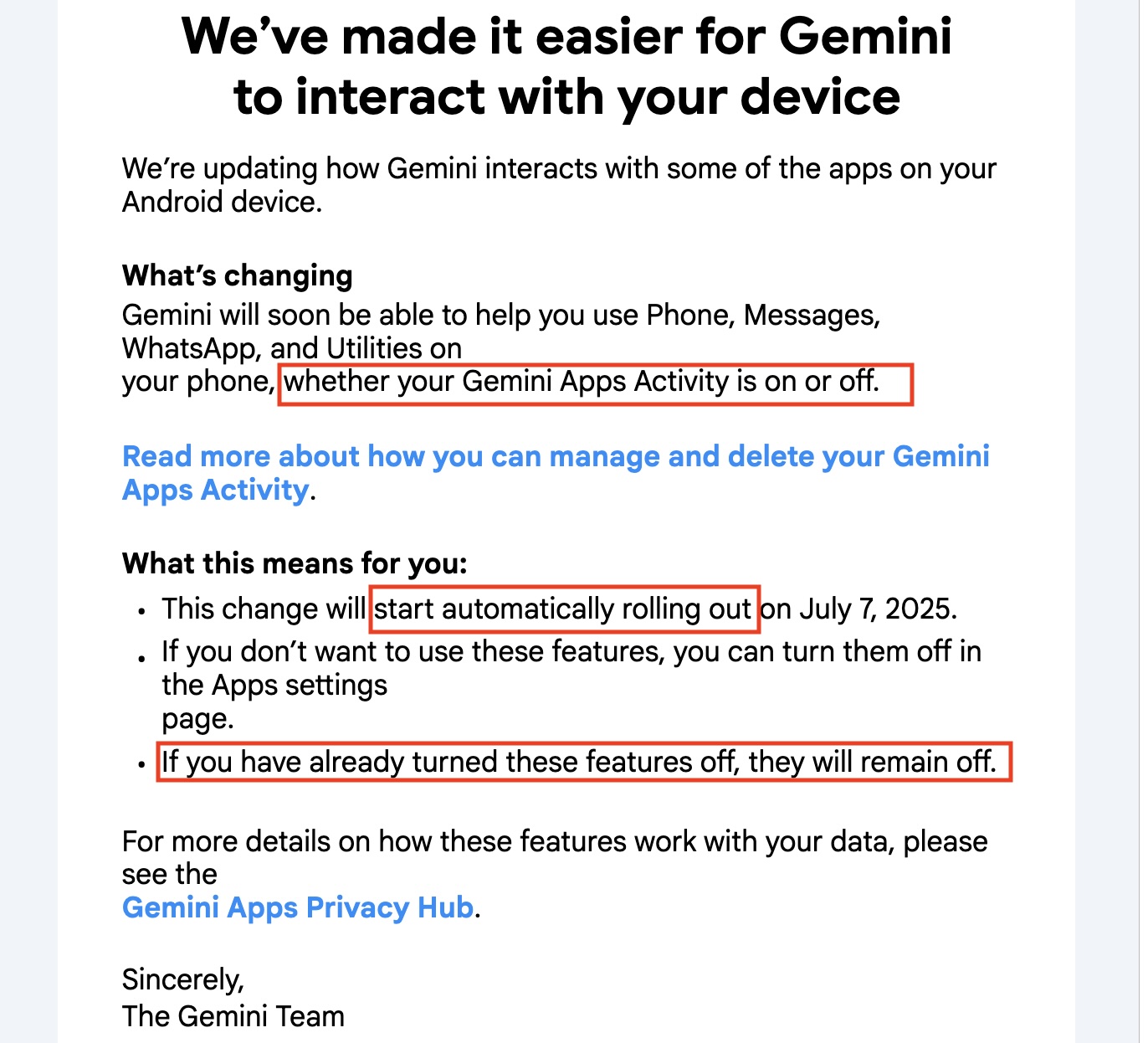
An email Google sent recently informing users of the change linked to a notification page that said that “human reviewers (including service providers) read, annotate, and process” the data Gemini accesses. The email provides no useful guidance for preventing the changes from taking effect. The email said users can block the apps that Gemini interacts with, but even in those cases, data is stored for 72 hours.
An email Google recently sent to Android users.
An email Google recently sent to Android users.
No, Google, it’s not good news
The email never explains how users can fully extricate Gemini from their Android devices and seems to contradict itself on how or whether this is even possible. At one point, it says the changes “will automatically start rolling out” today and will give Gemini access to apps such as WhatsApp, Messages, and Phone “whether your Gemini apps activity is on or off.” A few sentences later, the email says, “If you have already turned these features off, they will remain off.” Nowhere in the email or the support pages it links to are Android users informed how to remove Gemini integrations completely.
Compounding the confusion, one of the linked support pages requires users to open a separate support page to learn how to control their Gemini app settings. Following the directions from a computer browser, I accessed the settings of my account’s Gemini app. I was reassured to see the text indicating no activity has been stored because I have Gemini turned off. Then again, the page also said that Gemini was “not saving activity beyond 72 hours.”
Arcep alla Ue: ‘Evitiamo che le Big Tech abbiano il sopravvento nei mercati del Cloud e dell’AI’
Appello del Garante francese delle comunicazioni perché anche i servizi cloud e l’AI vengano inquadrati nel regolamento Ue del Digital Markets Act (DMA), in nome della neutralità della rete.
Laure de La Raudière, Presidente dell’Arcep, l’autorità garante delle comunicazioni francese, chiede a gran voce alla Commissione Ue di inserire anche i servizi Cloud forniti dai grandi hyperscaler nel novero del Digital Markets Act. Lo scrive oggi La Tribune, che ha intervistato La Rudière, parlando così della sua posizione difesa con forza a Bruxelles.
Net neutrality a rischio senza la totalità degli accessi
La neutralità della rete è un cardine di Internet, dice La Rudière, “ma tutti vedono che alcuni servizi Web, che sono delle porte d’entrata verso internet, non assicurano la totalità degli accessi”.
<!-- ARUBA - 300x250 -->
“Il loro stesso funzionamento può limitare la libertà di scelta del consumatore. Ad esempio, sul tuo smartphone vengono promosse determinate applicazioni e vengono imposte condizioni commerciali ai fornitori, il che significa che non hai completa libertà di scelta”.
Ecco perché, aggiunge, “il Digital Markets Act (clicca qui) (DMA) si propone, dal 2023, di impedire a questi “gatekeeper” (custodi), ovvero ai giganti di Internet, di favorire il proprio servizio. Ad esempio, la Commissione europea ha lavorato sull’interoperabilità dei servizi di messaggistica come WhatsApp (clicca qui), per definire le interfacce che consentono a un servizio concorrente di interconnettersi, in modo che i suoi utenti possano comunicare con quelli di WhatsApp”.
L’ascesa dell’intelligenza artificiale generativa (IA) minaccia la neutralità della rete?
“L’intelligenza artificiale generativa viene adottata molto rapidamente e sta diventando uno strumento comune per la ricerca. Il problema è che ti danno una risposta senza permetterti di esplorare Internet. È una specie di scatola opaca: non sappiamo come funziona l’IA, come fa le sue raccomandazioni, se dietro i risultati ci sono relazioni commerciali o se un’IA è codificata in modo virtuoso per l’ambiente. Non sappiamo nulla delle scelte che il modello algoritmico compie per modellare la tua risposta”.
Esiste anche un problema di accesso al mercato per i nuovi entranti?
“SÌ. In primo luogo, perché queste IA generative sono integrate nei servizi di Gafam [Google, Apple, Facebook – ora Meta -, Amazon, Microsoft]. Ciò dà l’impressione che la storia si ripeterà, in un modo che favorirà gli stessi attori. La DMA è stata creata per consentire ai nuovi operatori di trarre vantaggio dall’intero ecosistema digitale e per impedire a Gafam di prevaricare i mercati integrando i propri servizi. Oltre a tutto questo, è anche molto importante che questi stessi grandi attori non monopolizzino tutte le risorse che consentono lo sviluppo dell’intelligenza artificiale: accesso all’energia, potenza di calcolo, competenze, ecc”.
TikTok is being flooded with racist AI videos generated by Google’s Veo 3
TikTok notes that it uses both technology and human moderators to identify rule-breaking content. However, the volume of uploads makes timely moderation difficult. While the racist videos racked up a lot of views, a TikTok spokesperson tells Ars that more than half of the accounts cited in the MediaMatters report were banned for policy violations before the report was published, and the remainder have now been removed.
As for Google, it has a comprehensive Prohibited Use Policy that bans the use of its services to promote hate speech, harassment, bullying, intimidation, and abuse. The videos uncovered by MediaMatters all seem to fall under one or more of these categories. In a perfect world, Veo 3 would refuse to create these videos, but vagueness in the prompt and the AI’s inability to understand the subtleties of racist tropes (i.e., the use of monkeys instead of humans in some videos) make it easy to skirt the rules.
TikTok, being the world’s leading social video behemoth, is a natural place for these videos to spread. It’s not exclusive to TikTok, though. X (formerly Twitter) has gained a reputation for very limited moderation, leading to an explosion of hateful AI content. This problem could also get worse very soon. Google has plans to integrate Veo 3 into YouTube Shorts, which could make it even easier for similar content to spread on YouTube.
TikTok and Google have clear prohibitions on this content, which should have prevented it from being seen millions of times on social media. Enforcement of those policies, however, is lacking. TikTok is seemingly unable to keep up with the flood of video uploads, and Google’s guardrails appear insufficient to block the creation of this content. We’ve reached out to Google to inquire about Veo 3’s safety features but have not yet heard back.
For as long as generative AI has existed, people have used it to create inflammatory and racist content. Google and others always talk about the guardrails to prevent misuse, but they can’t catch everything. The realism of Veo 3 makes it especially attractive for those who want to spread hateful stereotypes. Maybe all the guardrails in the world won’t stop that.
Everything that could go wrong with X’s new AI-written community notes
If AI note writers “generate initial drafts that represent a wider range of perspectives than a single human writer typically could, the quality of community deliberation is improved from the start,” the paper said.
Future of AI notes
Researchers imagine that once X’s testing is completed, AI note writers could not just aid in researching problematic posts flagged by human users, but also one day select posts predicted to go viral and stop misinformation from spreading faster than human reviewers could.
Additional perks from this automated system, they suggested, would include X note raters quickly accessing more thorough research and evidence synthesis, as well as clearer note composition, which could speed up the rating process.
And perhaps one day, AI agents could even learn to predict rating scores to speed things up even more, researchers speculated. However, more research would be needed to ensure that wouldn’t homogenize community notes, buffing them out to the point that no one reads them.
Perhaps the most Musk-ian of ideas proposed in the paper, is a notion of training AI note writers with clashing views to “adversarially debate the merits of a note.” Supposedly, that “could help instantly surface potential flaws, hidden biases, or fabricated evidence, empowering the human rater to make a more informed judgment.”
“Instead of starting from scratch, the rater now plays the role of an adjudicator—evaluating a structured clash of arguments,” the paper said.
While X may be moving to reduce the workload for X users writing community notes, it’s clear that AI could never replace humans, researchers said. Those humans are necessary for more than just rubber-stamping AI-written notes.
Human notes that are “written from scratch” are valuable to train the AI agents and some raters’ niche expertise cannot easily be replicated, the paper said. And perhaps most obviously, humans “are uniquely positioned to identify deficits or biases” and therefore more likely to be compelled to write notes “on topics the automated writers overlook,” such as spam or scams.
NYT to start searching deleted ChatGPT logs after beating OpenAI in court
News orgs will soon start searching ChatGPT logs
The clock is ticking, and so far, OpenAI has not provided any official updates since a June 5 blog post detailing which ChatGPT users will be affected.
While it’s clear that OpenAI has been and will continue to retain mounds of data, it would be impossible for The New York Times or any news plaintiff to search through all that data.
Instead, only a small sample of the data will likely be accessed, based on keywords that OpenAI and news plaintiffs agree on. That data will remain on OpenAI’s servers, where it will be anonymized, and it will likely never be directly produced to plaintiffs.
Both sides are negotiating the exact process for searching through the chat logs, with both parties seemingly hoping to minimize the amount of time the chat logs will be preserved.
For OpenAI, sharing the logs risks revealing instances of infringing outputs that could further spike damages in the case. The logs could also expose how often outputs attribute misinformation to news plaintiffs.
But for news plaintiffs, accessing the logs is not considered key to their case—perhaps providing additional examples of copying—but could help news organizations argue that ChatGPT dilutes the market for their content. That could weigh against the fair use argument, as a judge opined in a recent ruling that evidence of market dilution could tip an AI copyright case in favor of plaintiffs.
Jay Edelson, a leading consumer privacy lawyer, told Ars that he’s concerned that judges don’t seem to be considering that any evidence in the ChatGPT logs wouldn’t “advance” news plaintiffs’ case “at all,” while really changing “a product that people are using on a daily basis.”
Edelson warned that OpenAI itself probably has better security than most firms to protect against a potential data breach that could expose these private chat logs. But “lawyers have notoriously been pretty bad about securing data,” Edelson suggested, so “the idea that you’ve got a bunch of lawyers who are going to be doing whatever they are” with “some of the most sensitive data on the planet” and “they’re the ones protecting it against hackers should make everyone uneasy.”
Nudify app’s plan to dominate deepfake porn hinges on Reddit, docs show
As Clothoff’s growth appears unstoppable, the user explained to Der Spiegel why he doesn’t feel that conflicted about using the app to generate fake nudes of a famous singer.
“There are enough pictures of her on the Internet as it is,” the user reasoned.
However, that user draws the line at generating fake nudes of private individuals, insisting, “If I ever learned of someone producing such photos of my daughter, I would be horrified.”
For young boys who appear flippant about creating fake nude images of their classmates, the consequences have ranged from suspensions to juvenile criminal charges, and for some, there could be other costs. In the lawsuit where the high schooler is attempting to sue a boy who used Clothoff to bully her, there’s currently resistance from boys who participated in group chats to share what evidence they have on their phones. If she wins her fight, she’s asking for $150,000 in damages per image shared, so sharing chat logs could potentially increase the price tag.
Since she and the San Francisco city attorney each filed their lawsuits, the Take It Down Act has passed. That law makes it easier to force platforms to remove AI-generated fake nudes. But experts expect the law will face legal challenges over censorship fears, so the very limited legal tool might not withstand scrutiny.
Either way, the Take It Down Act is a safeguard that came too late for the earliest victims of nudify apps in the US, only some of whom are turning to courts seeking justice due to largely opaque laws that made it unclear if generating a fake nude was illegal.
“Jane Doe is one of many girls and women who have been and will continue to be exploited, abused, and victimized by non-consensual pornography generated through artificial intelligence,” the high schooler’s complaint noted. “Despite already being victimized by Defendant’s actions, Jane Doe has been forced to bring this action to protect herself and her rights because the governmental institutions that are supposed to protect women and children from being violated and exploited by the use of AI to generate child pornography and nonconsensual nude images failed to do so.”
Ted Cruz plan to punish states that regulate AI shot down in 99-1 vote
Cruz blamed “outside interests”
After the compromise fell apart, the Senate voted 99-1 for Blackburn’s amendment to remove the AI provision from the budget bill. Sen. Thom Tillis (R-N.C.) cast the only vote against the amendment.
“Cruz ultimately got behind Blackburn’s amendment early Tuesday, acknowledging that ‘many of my colleagues would prefer not to vote on this matter,'” according to The Hill. Cruz said the five-year moratorium had support from President Trump and “protected kids and protected the rights of creative artists, but outside interests opposed that deal.”
However, Blackburn was quoted as saying that they “weren’t able to come to a compromise that would protect our governors, our state legislators, our attorney generals and, of course, House members who have expressed concern over this language… what we know is this—this body has proven that they cannot legislate on emerging technology.”
Cantwell pointed out that many state government officials from both major parties opposed the Cruz plan. “Despite several revisions by its author and misleading assurances about its true impact, state officials from across the country, including 17 Republican Governors and 40 state attorneys general, as well [as] conservative and liberal organizations—from the Heritage Foundation to the Center for American Progress—rallied against the harmful proposal,” Cantwell’s office said.
Cantwell and Sen. Ed Markey (D-Mass.) had also filed an amendment to strip the AI moratorium from the bill. Markey said yesterday that “the Blackburn-Cruz so-called compromise is a wolf in sheep’s clothing. Despite Republican efforts to hide the true impact of the AI moratorium, the language still allows the Trump administration to use federal broadband funding as a weapon against the states and still prevents states from protecting children online from Big Tech’s predatory behavior.”
Cantwell said at a recent press conference that 24 states last year started “regulating AI in some way, and they have adopted these laws that fill a gap while we are waiting for federal action.” Yesterday, she called the Blackburn/Cruz compromise “another giveaway to tech companies” that “gives AI and social media a brand-new shield against litigation and state regulation.”
Half a million Spotify users are unknowingly grooving to an AI-generated band
Making art used to be a uniquely human endeavor, but machines have learned to distill human creativity with generative AI. Whether that content counts as “art” depends on who you ask, but Spotify doesn’t discriminate. A new band called The Velvet Sundown debuted on Spotify this month and has already amassed more than half a million listeners. But by all appearances, The Velvet Sundown is not a real band—it’s AI.
While many artists are vehemently opposed to using AI, some have leaned into the trend to assist with music production. However, it doesn’t seem like there’s an artist behind this group. In less than a month, The Velvet Sundown has released two albums on Spotify, titled “Floating On Echoes” and “Dust and Silence.” A third album is releasing in two weeks. The tracks have a classic rock vibe with a cacophony of echoey instruments and a dash of autotune. If one of these songs came up in a mix, you might not notice anything is amiss. Listen to one after another, though, and the bland muddiness exposes them as a machine creation.
Some listeners began to have doubts about The Velvet Sundown’s existence over the past week, with multiple Reddit and X threads pointing out the lack of verifiable information on the band. The bio lists four members, none of whom appear to exist outside of The Velvet Sundown’s album listings and social media. The group’s songs have been mysteriously added to a large number of user-created playlists, which has helped swell its listener base in a few short weeks. When Spotify users began noticing The Velvet Sundown’s apparent use of AI, the profile had around 300,000 listeners. It’s now over 500,000 in less than a week.
When The Velvet Sundown set up an Instagram account on June 27, all doubts were laid to rest—these “people” are obviously AI. We may be past the era of being able to identify AI by counting fingers, but there are plenty of weird inconsistencies in these pics. In one Instagram post, the band claims to have gotten burgers to celebrate the success of the first two albums, but there are too many burgers and too few plates, and the food and drink are placed seemingly at random around the table. The band members themselves also have that unrealistically smooth and symmetrical look we see in AI-generated images.
L’intelligenza artificiale sta rivoluzionando il mondo delle radiocomunicazioni. Recentemente siamo stati spettatori di operazioni d’intelligence molto sofisticate, risultato di un perfetto bilanciamento tra l’utilizzo di nuove tecnologie e l’impiego di apparati tradizionali.
I sistemi di radiocomunicazione operano su diverse bande radio, utilizzando modalità che possono essere molto diverse tra loro.
Esistono sistemi che ricetrasmettono su diverse onde radio: quelle corte, tra i 3 e 30 MHz, denominate HF (high frequency), adatte per trasmissioni su lunghe distanze; quelle UHF (ultra-high frequency) che operano in frequenza tra i 300 MHz e 3 GHz, adatte per contesti con barriere fisiche presentano una portata limitata, incrementabile sfruttando la propagazione troposferica; quelle VHF (very-high frequency), con frequenza operativa tra i 30 MHz e 300 MHz, ideali per trasmissioni in ambienti con pochi ostacoli fisici ad esempio non sono ideali per i contesti urbani; quelle SHF (super high frequency) con operatività dai 3 GHz a 30 GHz; infine, le microonde (µWave) operanti nella gamma dai 300 MHz ai 300 GHz.
Per rendere un’idea più chiara del largo uso delle frequenze bisogna pensare ai vari esempi del loro impiego, quali:
i sistemi di radiocomunicazione satellitare;
i sistemi di radiocomunicazione marittima GMDSS e AI;
i sistemi di radiocomunicazione dedicati alla telefonia mobile, ossia GSM (Global System for Mobile Communication) in modalità 2G, 3G, 4G e 5G;
l’utilizzo di router e hotspot per lo scambio dati internet;
i sistemi di comunicazione dedicati al mondo aeronautico, denominati ACARS;
i sistemi dedicati alle trasmissioni bidirezionali utilizzando apparati portatili in modalità radio PMR (personal mobile radio) o in modalità ibrida radio e internet DMR (Digital Mobile Radio), compresi i più recenti TETRA (Terrestrial Trunked Radio).
Inoltre, alcuni spettri di frequenza sono riservati in via esclusiva alla sperimentazione radioamatoriale: ad esempio i sistemi EME (Earth-Moon-Earth), che utilizzano la luna come satellite passivo sulla cui superficie far rimbalzare segnali radio in microonde.
L’utilizzo delle frequenze e dei sistemi radio è disciplinato dalla CEPT (Conferenza Europea delle amministrazioni delle Poste e delle Telecomunicazioni), parzialmente regolamentati dalla IARU (International Amateur Radio Union) e supervisionati dalla ITU (International Telecommunication Union) delle Nazioni Unite.
La maggior parte dei dispositivi che utilizziamo quotidianamente permette lo scambio dei dati in modalità senza fili, ovvero utilizzando specifiche frequenze radio; ed è ragionevolmente possibile compromettere il flusso delle informazioni scambiate mediante atti ostili da remoto. Questa problematica riguarda anche tutta un’altra serie di apparati hardware come, ad esempio, i sistemi di guida avanzata delle autovetture (ADAC); i radar, i radiofari degli aeroporti e dei porti nautici civili e militari; i sistemi d’arma avanzati; i sistemi antintrusione delle abitazioni e dei locali commerciali e statali; i droni civili e militari; le comunicazioni satellitari, etc.
L’intelligenza artificiale al servizio delle radiocomunicazioni
L’utilizzo dell’intelligenza artificiale applicata ai sistemi wireless ha apportato benefici in termini di sicurezza ed efficientamento delle trasmissioni radio. Nello specifico, attraverso l’utilizzo di algoritmi personalizzati è possibile svolgere una serie di azioni difensive, come ad esempio l’applicazione di crittografia avanzata, la misurazione e prevenzione da attacchi di jamming, la capacità di decidere – attraverso il monitoraggio costante dello spettro radio – quali siano le frequenze migliori da utilizzare in base alla propagazione delle onde radio e alle caratteristiche dell’ambiente circostante, o ancora la prevenzione delle intrusioni da parte di apparati esterni alla rete, anche mediante l’utilizzo di azioni di deep learning.
Fonte: nasa.org
Fonte: ARRL and The Ham Radio License Manual
Si sta, tuttavia, intensificando l’utilizzo dell’intelligenza artificiale anche con finalità malevole: i target sono sistemi radio ad uso sia civile, sia militare.
I potenziali attaccanti sfruttano diverse metodologie per compromettere i sistemi radio.
Tra queste, figurano le manipolazioni di sistemi che utilizzano il riconoscimento vocale utilizzando false tracce sonore; la misurazione in tempo reale e il relativo attacco di apparati radio mediante tecniche che possono prevedere l’utilizzo di phishing audio; la ricerca e sfruttamento delle vulnerabilità dei sistemi SDR (Software Defined Radio); la clonazione dei segnali radio, come ad esempio avviene per i droni; le azioni mirate di interruzione delle comunicazioni con possibilità di selezione automatica della modulazione di frequenza e potenza del segnale radio; lo sfruttamento delle capacità previsionali nell’ambito delle reti di cognitive radio, anticipando quali saranno le frequenze utilizzate dal sistema attaccato; la capacità di analizzare enormi flussi radio, individuando comunicazioni criptate e applicando metodologie di deep learning per decriptare (e rendere accessibile) la fonte.
Per il futuro, in un’ottica predittiva, sarà necessario focalizzare la ricerca e l’implementazione degli algoritmi per aumentare la velocità di reazione dell’intelligenza artificiale. Si dovrà, inoltre, porre attenzione nella creazione di reti cognitive in grado di creare dei perimetri difensivi efficaci.
L’intelligenza artificiale nell’ambito delle radiocomunicazioni è ampiamente utilizzata e implementata, in ambito sia civile che militare, per effettuare una serie di operazioni di intelligence che rientrano nel perimetro operativo della SIGINT (Signal Intelligence).
Uno dei principali scopi dell’intelligence applicata alle radiocomunicazioni è poter prevenire eventuali minacce contro obiettivi civili e militari: per questa ragione è importante mantenere costante lo scopo difensivo e preventivo costituito da un insieme di operazioni per il monitoraggio delle radiocomunicazioni, siano esse analogiche, ibride o digitali.
Signal Intelligence e il ruolo dell’intelligenza artificiale nelle operazioni militari
Attualmente i metodi utilizzati per le intercettazioni dei segnali radio sono basati sull’ascolto selettivo delle frequenze radio con l’ausilio dell’intelligenza artificiale, implementata da appositi algoritmi. Vi sono situazioni particolari, in cui il monitoraggio dei segnali radio ricopre un ruolo strategico per assicurare la sicurezza dei civili e del personale militare. Di fondamentale importanza sono la raccolta delle informazioni e il monitoraggio delle trasmissioni nelle zone in cui sono presenti contingenti militari, ove la minaccia principale è data dai rapidi attacchi a sorpresa per opera di piccole unità operative che utilizzano tecniche di guerriglia.
Nel caso di personale militare che è dislocato a presidio di una determinata zona e risiede in compound, diventa fondamentale unire diverse tecniche di intelligence per la raccolta delle informazioni, ossia tecniche HUMINT e tecniche atte al monitoraggio attivo delle frequenze radio.
Le intercettazioni si devono eseguire sulle frequenze in VHF, UHF, SHF, utilizzando antenne che possano individuare la provenienza del segnale, come ad esempio le antenne direzionali, le antenne loop magnetiche o le classiche antenne verticali ad ampio spettro. Normalmente il vantaggio di un compound è poter fornire alimentazione elettrica con un’ottima capacità di erogazione e spazio per il posizionamento di antenne, anche di grandi dimensioni, che in taluni casi possono essere posizionate su alti tralicci o strutture equivalenti. Le caratteristiche elencate concorrono alla creazione di un perimetro radio di sicurezza.
Nel caso in cui il personale militare, per esigenze operative, si trova nella situazione di muoversi in un determinato territorio ostile, è necessario attivare la raccolta informativa attraverso personale appositamente inviato in loco che utilizzerà tecniche HUMINT per comprendere l’eventuale presenza di guerriglieri mediante contatti con la popolazione locale.
Nello specifico, si dovrà tenere sotto controllo l’eventuale scambio di apparecchiature idonee a costruire una ricetrasmittente e la presenza di compravendita di batterie di piccole dimensioni adatte all’alimentazione di apparati radio, come ad esempio batterie da 12v 7,2 Ah. In testa al personale militare, durante la fase operativa dello spostamento, sarebbe utile organizzare tre squadre da ricognizione rapida che possono essere composte da uno a tre operatori ciascuna.
Ispirandosi alla cosiddetta attività di “caccia alla volpe o caccia alle radiosonde”, diffusa in ambito radioamatoriale, è possibile anticipare il passaggio del personale militare andando a intercettare eventuali segnali di apparati radio a bassa potenza. Per massimizzare l’azione di monitoraggio, le tre squadre potrebbero identificare il luogo dell’emissione effettuando una triangolazione del segnale.
L’integrazione tra intelligenza artificiale e radiocomunicazioni rappresenta oggi un punto nevralgico per garantire la cybersecurity in ambito civile e militare. Per un approfondimento completo sul tema e sulle implicazioni strategiche trattate, ti invitiamo a consultare il white paper Quaderni di Cyber Intelligence #7.
Fonti
Chen Huang; Ruisi He; Bo Ai; Andreas F. Molisch; Buon Kiong Lau; Katsuyuki Haneda – Artificial Intelligence Enabled Radio Propagation for Communications – Part I: Channel Characterization and Antenna-Channel Optimization, https://ieeexplore.ieee.org/document/9713745
Krayani A. – Learning Self-Awareness Models for Physical Layer Security in Cognitive and AI-enabled Radios, https://arxiv.org/pdf/2211.12784
An He; Kyung Kyoon Bae; Timothy R. Newman; Joseph Gaeddert; Kyouwoong Kim; Rekha Menon – A Survey of Artificial Intelligence for Cognitive Radios,https://ieeexplore.ieee.org/document/5420026
Małgorzata Wasilewska, Adrian Kliks, Hanna Bogucka, Krzysztof Cichoń, Julius Ruseckas, Gediminas Molis, Aušra Mackute-Varoneckien, Tomas Krilavičius – Artificial Intelligence for Radio Communication Context-Awareness, https://ieeexplore.ieee.org/document/9568860
Gieffe-IW20AP – Amplificatori di potenza a radio frequenza, Sandit Libri (2013)
Sarti C. – Notebook del radioascolto. Le antenne, C&C Edizioni (2008)
Tomassini D., Fondamenti dei campi elettromagnetici, Sandit Libri (2024)
Zella G. – Antenne tattiche. Teoria, applicazioni, progetti, Sandit Libri (2009)
Profilo Autore
Appassionato del mondo digitale, durante gli studi accademici ha potuto lavorare e studiare in tre atenei negli Stati Uniti dove ha consolidato la passione per l’ambito digitale. Concluso il percorso accademico con la laurea magistrale in Economia e Marketing ha maturato esperienze lavorative diversificate specializzandosi nella cybersecurity con focus nell’intelligence economica e nella geopolitica attraverso corsi specializzanti. Svolge la sua attività come libero professionista, collabora attivamente con la piattaforma Wikistrat in qualità di Analyst Expert. È Socio Ordinario della Società Italiana di Intelligence e membro della Commissione di Studio su Cyber Threat Intelligence e Cyber Warfare. Inoltre, è Socio della Società Italiana di Storia Militare SISM. È appassionato nello studio della storia, della filosofia ed entusiasta radioamatore.