“Ai nostri giorni”, ha dichiarato Papa Leone, ‘la Chiesa offre a tutti il tesoro del suo insegnamento sociale in risposta a un’altra rivoluzione industriale e agli sviluppi nel campo dell’intelligenza artificiale che pongono nuove sfide per la difesa della dignità umana, della giustizia e del lavoro’. Ha collegato questa dichiarazione all’eredità dell’enciclica Rerum Novarum del 1891 del suo omonimo Leone XIII, che trattava dei diritti dei lavoratori e delle dimensioni morali del capitalismo. Perché, effettivamente, bisogna trovare un nuovo spazio al lavoro umano, quando questo viene distrutto dalla AI, soprattutto quello intellettuale.
Le sue osservazioni hanno proseguito la direzione tracciata dal defunto Papa Francesco, che nel suo messaggio annuale per la pace del 2024 ha avvertito che l’IA – priva dei valori umani di compassione, misericordia, moralità e perdono – è troppo pericolosa per svilupparsi senza controllo. Francesco, scomparso il 21 aprile, aveva chiesto un trattato internazionale per regolamentare l’IA e aveva insistito sul fatto che la tecnologia deve rimanere “incentrata sull’uomo”, in particolare nelle applicazioni che riguardano sistemi d’arma o strumenti di governo.
Papa Leone XIV – Media del Vaticano
Minaccia esistenziale per l’Umanità al 90%
Mentre la preoccupazione si intensifica in ambito religioso ed etico, un’analoga urgenza risuona nella comunità scientifica.
Max Tegmark, fisico e ricercatore di IA al MIT, ha tracciato un preoccupante parallelo tra gli albori dell’era atomica e l’attuale corsa allo sviluppo della superintelligenza artificiale (ASI). In un nuovo articolo scritto insieme a tre studenti del MIT, Tegmark ha introdotto il concetto di “costante Compton”, una stima probabilistica della possibilità che l’ASI sfugga al controllo umano. Prende il nome dal fisico Arthur Compton, che negli anni ’40 calcolò il rischio di incendio dell’atmosfera terrestre a causa di test nucleari.
“Le aziende che costruiscono la superintelligenza devono calcolare anche la costante Compton, ovvero la probabilità di perdere il controllo su di essa”, ha dichiarato Tegmark al Guardian. “Non basta dire ‘ci sentiamo a posto’. Devono calcolare la percentuale”.
Tegmark ha calcolato una probabilità del 90% che un’IA altamente avanzata rappresenti una minaccia esistenziale.
Il documento esorta le aziende produttrici di IA a intraprendere una valutazione del rischio altrettanto rigorosa di quella che precedette il primo test della bomba atomica, dove Compton avrebbe stimato le probabilità di una reazione a catena catastrofica a “poco meno” di una su tre milioni.
Tegmark, cofondatore del Future of Life Institute e sostenitore della sicurezza dell’IA, sostiene che il calcolo di queste probabilità può aiutare a costruire la “volontà politica” per i regimi di sicurezza globali. È anche coautore del Singapore Consensus on Global AI Safety Research Priorities, insieme a Yoshua Bengio e ai rappresentanti di Google DeepMind e OpenAI.
Il rapporto delinea tre punti focali per la ricerca: misurare l’impatto dell’IA nel mondo reale, specificare il comportamento previsto dell’IA e garantire un controllo coerente sui sistemi.
Questo rinnovato impegno per la mitigazione dei rischi dell’IA fa seguito a quella che Tegmark ha descritto come una battuta d’arresto al recente Vertice sulla sicurezza dell’IA di Parigi, dove il vicepresidente degli Stati Uniti JD Vance ha liquidato le preoccupazioni affermando che il futuro dell’IA “non si vincerà con i piagnistei sulla sicurezza”. Tuttavia, Tegmark ha notato una ripresa della cooperazione: “Sembra davvero che il buio di Parigi sia passato e che la collaborazione internazionale sia tornata a ruggire”.
Probabilmente, pià che sulla sicurezza, bisognerebbe iniziare a pensare alla finalità profonda della AI, a darle un senso legato alla tutela dell’umanità
Grazie al nostro canale Telegram potete rimanere aggiornati sulla pubblicazione di nuovi articoli di Scenari Economici.
9 of the Best AI Writing Tools and Assistants to Help You Work Smarter, Not Harder
From brainstorming ideas, creating outlines, repurposing content — AI can make your job as a writer a whole lot easier.
Artificial intelligence is not going to do your best work for you, of course. We know there’s (thankfully?) still work to be done in replicating the weirdness and wonder of human creativity. But AI can take some of the work off your plate, so you can focus on exactly that: creating.
However, with the ever-growing list of AI software and tools on the market — all promising to help you generate, streamline, and automate your writing process — it can be tricky to figure out which ones are worth your time (and money).
Which is where I come in. I’m a productivity nerd who loves testing out new tools, and I’ve put dozens of AI writing assistants to the test in the hope of working smarter, not harder.
My ultimate goal is to remove the admin and repetition from my to-do list as a writer so I can focus on what brings me joy. (The creating part, as you may have guessed.)
In this article, I’ll take a deep dive into my favorite AI writing generators and who I think they’ll be most useful for.
A couple of years ago, AI writing tools felt experimental — even niche. Fast forward to today, and it seems like everyone has launched one. From Google Docs to Notion to every app with a ‘magic’ button, AI writing is no longer a shiny feature — it’s table stakes.
But here’s the thing: while many tools use the same underlying models (like OpenAI’s GPT or Anthropic’s Claude), they’re not all built the same. The difference is in the workflows, the interface, and whether the tool actually helps you do your job better — or just adds another tab to your browser.
That’s why this list isn’t just a collection of the most popular apps. It’s a roundup of the tools I’ve personally tested and found useful as a writer and content creator. Tools that help me spend less time formatting, fiddling, or fighting writer’s block — and more time actually writing.
If you’re feeling overwhelmed by all the options out there, I hope this breakdown helps you find something that fits your workflow and your brain.
How I use AI in my work
At Buffer, our approach to AI is simple: it’s a tool, not a replacement. You’ll never find completely AI-generated content on Buffer’s blog, website, or the product itself — a human reviews everything. (You can read more about how we use AI on the content team here.)
Rephrase paragraphs or phrases with a specific tone
Generate sentences or paragraphs when I’m hit with writer’s block (though I’ll always fact-check, edit, or rewrite these)
Repurpose blog posts into social media posts
Write silly poems I can share for friends’ birthdays
OK, that last one doesn’t exactly count as work, but it’s one of my favorite ways to use it.
For all of the above (and a few more tasks), these are the best AI writing tools I’ve tested*.
How I chose these tools
There are a lot of AI writing tools out there — and plenty of them sound great on paper. But I was looking for ones that actually made writing easier, not more complicated.
Here’s what I prioritized when testing each one:
Usefulness for content creators — I focused on tools that support tasks like outlining, repurposing, writing for social, or breaking through writer’s block.
Ease of use — I didn’t want to spend hours learning a new tool. These are all beginner-friendly, with minimal setup required.
Smart defaults — Whether it’s tone, formatting, or SEO, the best tools offered strong outputs even when I gave minimal input.
Room to grow — Bonus points if the tool had features I could grow into (like custom brand voice settings or workflow automation).
None of these tools are perfect — but they all earned a spot by saving me time, reducing friction, and helping me get words on the page faster.
1. Buffer’s AI Assistant
Best AI writing tool for social media content
[embedded content]
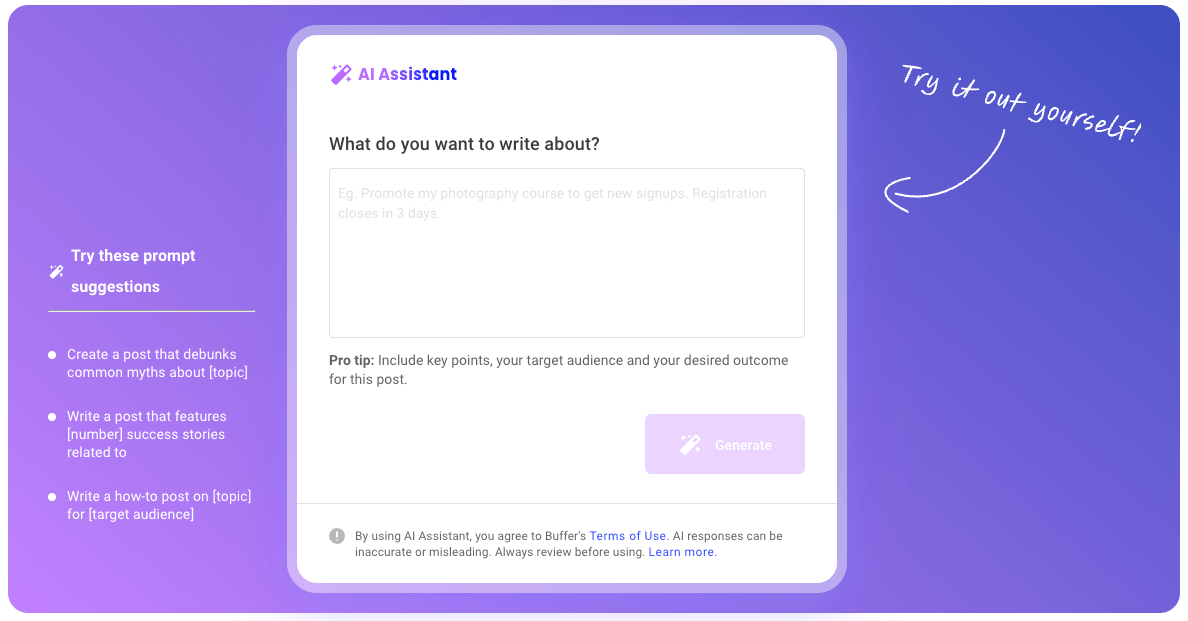
Buffer’s AI Assistant was built for social media. You can use it as and when you create and schedule your content with Buffer, making the content creation process seamless (no more copy-pasting to various social networks — especially tedious if you’re cross-posting to multiple platforms).
The best thing about Buffer’s AI Assistant is that it understands the nuances of each social media platform. For example, the content you create for X (formerly Twitter) won’t exceed your character limit. It’s also trained to make the tone of LinkedIn content more professional, Instagram more playful, and so on.
Another time-saving feature is the editing buttons within the assistant. Instead of having to type further instructions to the Assistant to tweak your post, just click Rephrase, Shorten, Expand, More casual, or More formal to get you closer to the content you’re after.
You can also use these buttons to tweak certain parts of your posts if you don’t want to rewrite the whole lot — another time saver. (If you’re new to using AI in this way, this beginner’s guide to using AI for social media is a helpful read.)
Beyond these fundamental features, here are some of my favorite use cases as a writer looking to create more content on social media and build my personal brand:
Personalized ideas
In my experience as a creator and social media manager, social media writer’s block is SO much worse than the regular kind. Perhaps it’s the sheer volume of content you have to create. Who knows.
Mercifully, I’ve found Buffer’s AI Assistant, which means this is a thing of the past. When I’m stuck on what to post, I head over to Buffer’s Create Space (where I brain-dump all my post ideas) and click the Generate Ideas button.
To get a better sense of what is going to resonate with your audience, the assistant will ask you two things:
What is your business about?
Who is your target audience?
From there, the Assistant will generate a stream of ideas for you to assess, one at a time. On each one, you’ll be able to hit Use it, which will open a pre-filled post creation window, or Try another to regenerate.
Repurpose other posts and content
One of the best use cases for this tool is the ability to repurpose content that has performed well or rewrite it to be more appropriate for another platform.
I often use the latter to rework posts I’ve created for LinkedIn into a Twitter thread (something that used to take me ages).
Something else I’m leaning into right now is repurposing older social media posts into something fresh. There’s a fair chance a huge chunk of my audience missed certain posts, and those who saw them likely won’t remember if they did (especially if the original post has been given a glow-up).
I also use the AI Assistant to summarize entire blog posts I’ve written into bite-sized social snippets — another thing that used to take me ages.
Free and limitless on all Buffer plans
Unlike many other AI writer tools, especially those built for social media, there’s no ‘credits’ system in place. The AI Assistant is free to use, as is Buffer (for up to three channels). When it comes to the number of prompts and rephrases you can submit, the limit does not exist!
Bonus: No-sign-up-required Social Media Post Creator
You don’t need to be a Buffer user to use the AI Assistant. With the free Social Media Post Creator, you can take the tool for a test run (or use it indefinitely) without creating an account or sharing your email address.
2. Jasper
Best AI writing tool for Marketing teams
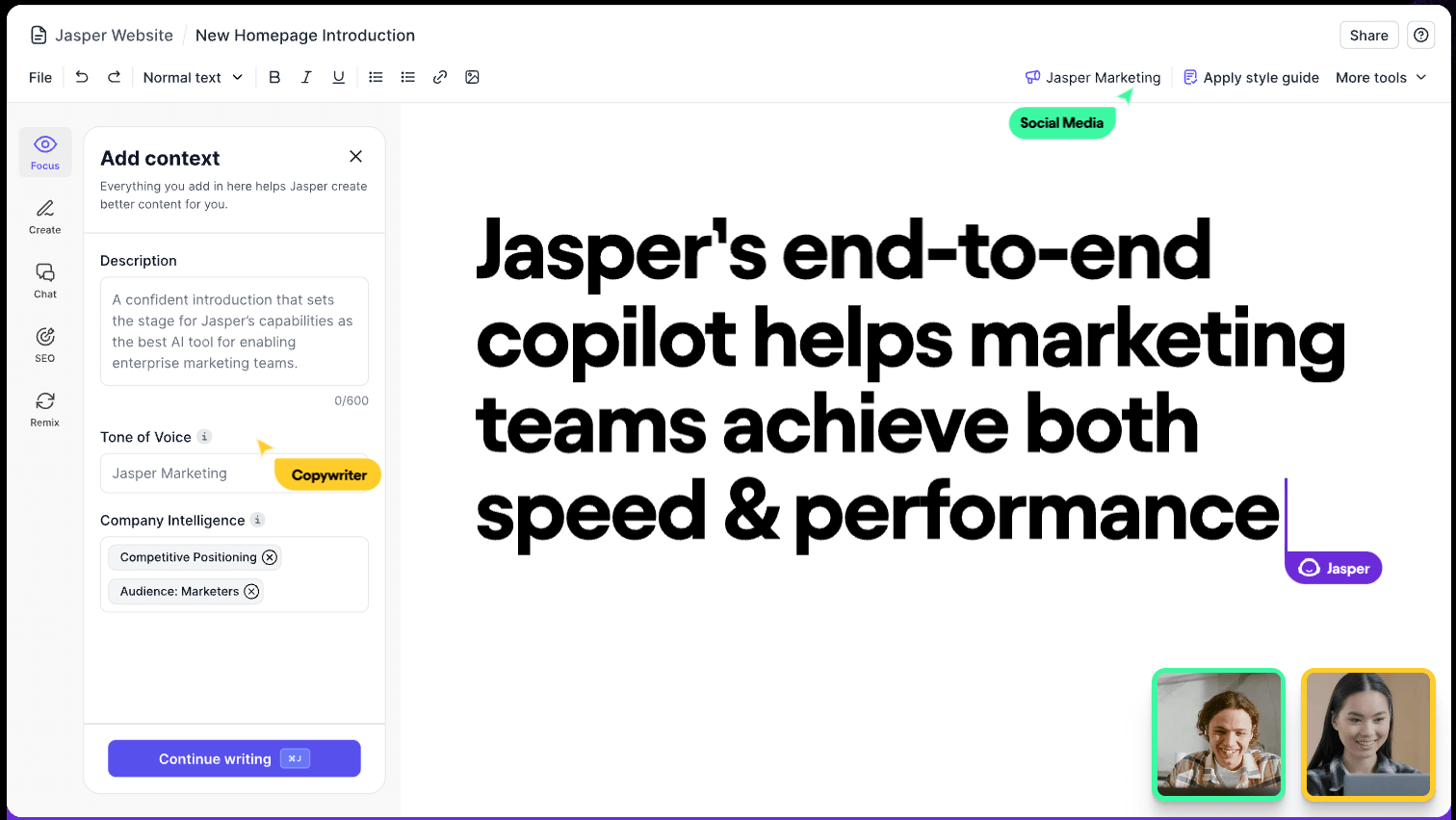
As one of the first AI writing tools to market (then known as Jarvis), Jasper has had time to hone its UI and feature set.
Along with AI text generation for a plethora of specific projects — everything from landing pages to full-on marketing campaigns, Jasper also boasts Remix (a dedicated tool for reworking content via a link, uploaded document, or text), Chat (a back-and-forth chat box with the AI to help you brainstorm or hone ideas), plus a Chrome extension.
Jasper has moved beyond just copywriting and now aims squarely at marketing teams. The collaborative features mean everyone can jump into various documents and view projects and campaigns at a glance with nifty Kanban and calendar views. Managers and editors can also add in things like brand voice and style guide documents to ensure things stay on track across all content pieces.
When writing, Jasper’s intuitive system will ask you to enter a simple prompt or choose from a list of templates. From there, you’ll be asked for more information upfront, which differs depending on what you’re working on. Before generating your draft, you can add things like your target audience, specific points to include, and more — but the AI can predict these things so well that this usually just involves choosing from some recommended options.
While Jasper is intuitive and great for teams, it’s worth noting that the foundation of the tool is the same as most of the other (cheaper) options on this list. Jasper “uses over a dozen language models,” but the marketing copy generated is similar to what you’ll get from ChatGPT and other AI writing software.
Pricing: 7-day trial, then prices start at $49 per month
3. Copy.ai
Best AI writing tool for automating repetitive writing tasks
Copy.ai is another tool on this list that has outgrown the content generation mold it was born into. The multifaceted tool aims to help Sales and Marketing teams go from “go-to-market bloat to velocity.”
What that means in practice is a slick tool a lot like Jasper. However, Copy.ai places more emphasis on repeatable workflows that will help save marketers (or salespeople) time — think “repurpose this blog post into a LinkedIn post,” “Check this copy for plagiarism,” or “Find prospects at company X.”
You can choose these workflows from an impressive library or customize your own. The finished product will look something like a flowchart, where each step in the process is effectively an AI prompt (or a series of them).
If you’re not bothered with workflows, you can jump straight into Chat, their AI content generator. It’s a lot like the usual prompt-and-generate system most AI tools use and requires lots of context to generate what you’re looking for — which is why you might be better off getting the hang of the workflow system.
Like Jasper, you can have Copy.ai assess your content to match your tone and style. Pricing: Free version with limited features, paid plans starting at $49 per month.
4. Writer
Best AI writing tool for editing and improving your content
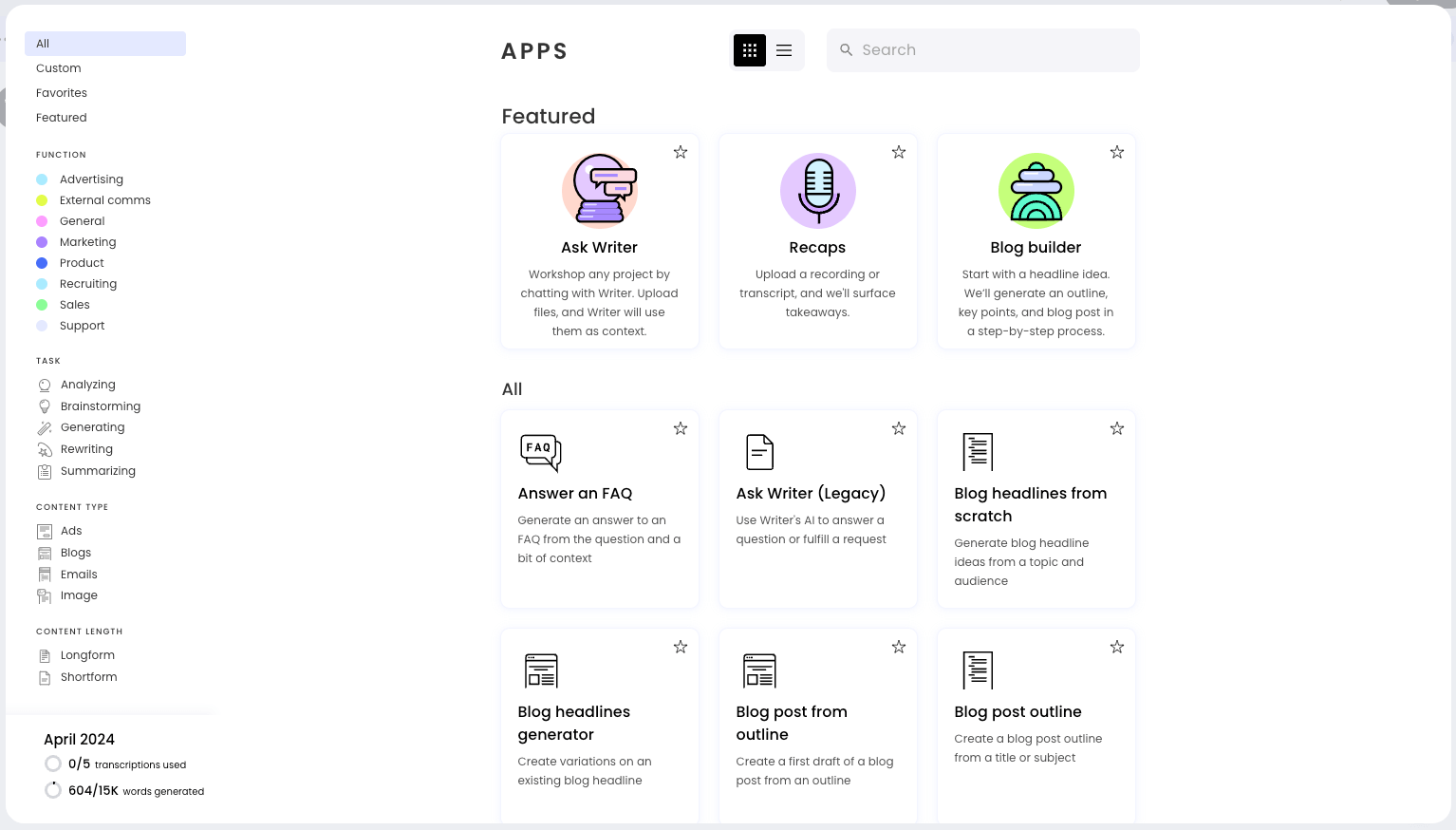
Writer is a whole lot more than a simple AI text generator. Like Jasper and Copy.ai, the web tool is packed with more powerful features that take the tool beyond what ChatCPT can do — but instead of workflows and systems, they’re called ‘Apps.’
These apps, all baked into the web application, are things like ‘Blog Builder’ (which will help you spin a blog post up out of a headline idea), ‘Recaps’ (to convert a recording into a summary of key takeaways), and ‘Ask Writer’ (the chat-style prompt-and-generate AI system you’ll be familiar with). You’ll also find apps to help you create product descriptions, push notifications, and help center articles.
It’s a neat and tidy system that’s a lot easier to get to grips with than Jasper and Copy.ai, and is squarely aimed at writers rather than marketers or sales folk. Writer’s interface, for example, looks a lot like Grammarly. Here, you’ll see suggestions for improving grammar and readability, a plagiarism checker, and recommendations for improving language inclusivity.
Writer is also a solid option for content teams, with a helpful terms list where you can save all your unique terms and saved snippets for copy you reuse often. You can also set specific punctuation rules, which is a helpful time saver for editors. Writing is one of my favorite tools for proofreading and editing existing content.
What sets Writer apart from the other copywriting tools on the market is that it’s not built on GPT or other (sometimes controversial) AI models. Writer uses its own Palmyra Language Learning Models, specifically “trained for business writing and business use cases,” offering higher security and transparency. For example, Writer says Palmyra does not store your proprietary data for training its foundational models.
That said, many of Writer’s most powerful tools — like the ability to add your own brand and style guide — are locked behind its enterprise-level paywall.
Pricing: 14-day free trial, then prices start at $18 per month. (There is a free plan, but it doesn’t allow much beyond text editing.)
5. Hubspot Breeze
Best AI writing tool to streamline business operations
Think of HubSpot Breeze as the Swiss Army knife of AI tools. The platform helps marketers, sales reps, and customer service agents take out most of the grunt work that comes with their activities and boost their productivity.
HubSpot Breeze handles anything from writing quick emails and social captions down to more complex tasks like generating website pages and summarizing CRM data into digestible reports. The way it does this is through Breeze Agents — think of them as separate AI assistants, each specialized in its own department.
For example, the Content Agent generates blogs, landing pages, podcasts, and anything else content-related. Meanwhile, the Breeze Customer Agent handles basic customer service inquiries, offers reply suggestions, and compiles customer service data into visual reports.
There’s also the Breeze Co-pilot, which does a little bit of everything — it can update CRM records, generate content, and summarize customer support tickets, for example.
Pricing: Breeze is available in HubSpot’s free starter suite as well as throughout HubSpot’s premium product offerings. Paid pricing starts at $15 per user per month.
6. Sudowrite
Best AI writing tool for creative writing and fiction
If, like me, you’ve been threatening to write a novel for years, Sudowrite may soon become your new best friend. Not only will Sudowrite help you generate ideas and write stories for the characters you’ve had floating around in your head for years, but it’s also an AI-powered project management tool of sorts specifically designed for fiction writers.
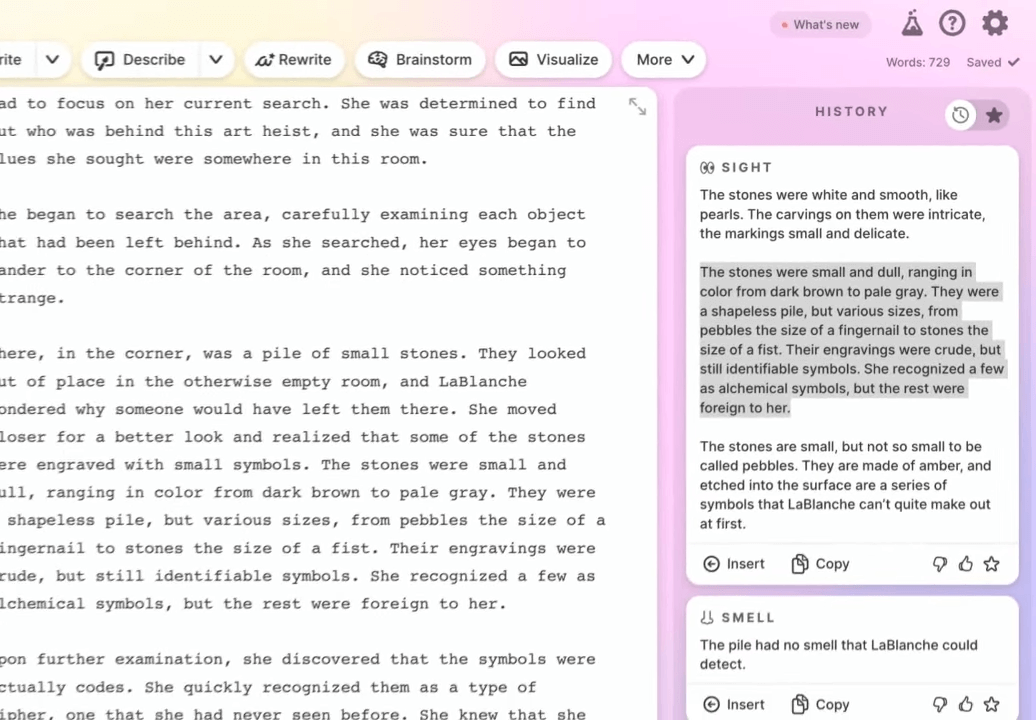
As for the writing itself, you’ll start by entering the genre of your masterpiece-in-progress, then get cracking on the draft. Instead of entering a prompt, start by entering what you have. With a few sentences to start a chapter, click the ‘Write’ button, and the AI generator will suggest several options to keep moving the story forward. Highlight a word or phrase and hit ‘Describe’ to generate a description of the object based on each of the senses or a metaphor.
There’s also a ‘Rewrite’ button to help you paraphrase or rework something and a ‘Brainstorm’ button to help get your creative juices flowing in specific directions, from characters to world-building to plot points.
If you’re not ready to jump right into chapter 1, you might want to play around with Sudowrite’s Story Engine, a space where you can go into more detail about your genre, characters, and outline, add more writing samples to help the AI match your style or just brain dump ideas.
Then there’s Sudowrite’s Canvas – a space for mind mapping your (and the AI’s) imaginings to give you a bird’s-eye view (and keep track of) the story you’re creating.
Sudowrite also boasts a handy Google Docs extension so you can work where you write best and a bustling Slack community of other Sudowrite users so you can bounce ideas off of humans from time to time.
Pricing: Credit-based free trial (for a certain amount of words generated), then prices start at $10 per month
7. Type
Best AI writing tool for a simple AI writing assistant
Type describes itself as an AI-first document editor. With the tool, you can create short and long-form content, from emails to YouTube scripts to cover letters.
The interface — clean and user-friendly — requires you to begin with a simple prompt to get you started. There’s a template library to tap into, which is handy for those moments when you just can’t face staring at a blank page (we’ve all been there). From there, Type will generate a high-quality content draft, which you’re then encouraged to play with and make your own.
Type’s generative AI makes it really easy to do this with a host of different options — for example, you can switch between OpenAI’s GPT-4 and Anthropic’s Claude 3. “Claude tends to be more creative and expressive but not quite as good at complex reasoning, whereas the GPT models are often much better at reasoning, but maybe a bit drier with tone,” Type Founder Stew Fortier explains in an onboarding video.
There’s also the ‘What to write about next’ block, a handy springboard for anything you might want to add. The sidebar contains a list of suggestions related to whatever you’re working on that you can use to generate another paragraph. In the main editor, you can also- highlight specific sentences, paragraphs, or phrases and ask Type to rework them for you.
All the common options are available, but ‘Custom transform’ is particularly handy, allowing you to ask the AI to do something really specific with your highlighted text.
Pricing: 14 days free, then $29.00 per month.
8. SEOWind
Best AI writing tool for SEO content briefs
SEOWind is not a multi-purpose tool like many of the others on this — it’s laser-focused SEO (search-engine optimized) content, making it a great tool for content marketing.
As such, SEOWind doesn’t ask you to enter a prompt to kick-start your writing but a primary search term. From there, it’ll jump you to a fascinating dashboard that analyzes blog posts and pages already ranking for this term to help you create your ‘brief.’
In this build-you-brief dashboard, you’ll see a competitor analysis (an overview of blog posts and pages already ranking in Google for your term), competitor outlines (the structure of their content), and questions to answer (related queries pulled from Google, Quora and Reddit). Along with this, the tool recommends the ideal word count, the number of headings, and even the number of images to include.
With this information at your fingertips, you can set about pulling bits and pieces to create your own brief, from which SEOWind’s AI will generate a draft for you to download in your format of choice — from there, you’re left to edit the article on your own. While SEOWind makes briefs super customizable, there’s no way to edit and rework with AI once your draft is generated.
All briefs are saved within projects, where SEOWind encourages you to add details about your brand tone, details about your company and products, and even integrates with Google Search Console to help you find internal linking opportunities (one of the more tedious tick-boxes in SEO writing for sure!).
Pricing: 7-day trial, then prices start at $59 per month.
9. ChatGPT
Best free AI writing tool
You might be surprised to find ChatGPT in and amongst some of its more niche competitors, but I’d be remiss not to mention it here. As a free AI writing tool (for GPT-3, at least), ChatGPT is one I keep returning to for quick ideas, blog post outlines, and goofy metaphors.
ChatGPT, a chatbot based on Open AI’s GPT model, is what many of the bells-and-whistle-filled tools above are built on and what helps generate the copy that lands in their fancy interfaces.
Learning to prompt ChatGPT takes some doing — I tend to err on the side of providing as much context as possible — but the chat-style interface can be helpful as you refine your ask and tweak prompts as you go.
Pricing: Free for the basic version, with paid plans starting at $10 per month
A quick note on privacy and AI models
Many of the tools in this list are powered by large language models (LLMs) like OpenAI’s GPT-4 or Anthropic’s Claude. These models have been trained on a wide range of internet text to generate high-quality writing, but they also come with questions around privacy and accuracy.
When choosing tools, I stuck to ones that are upfront about how they handle your data — especially for work-related awriting. Some, like Writer, use their own proprietary models designed with compliance in mind. Others rely on third-party models but offer settings to keep your prompts private.
If data security is a concern for your team, I recommend checking each tool’s privacy policy before diving in.
While I’ve tested many AI writing generators, I’m not an AI myself and, as such, can’t test them all. (In case you’re wondering, that cheesy simile was all mine.)
If there’s a tool out there that I have to put through its paces, I’d love to hear about it! Please comment below or tag @buffer or @bufferapp on all major social channels, and I’ll put your favorite tool to the test.
https://buffer.com/resources/ai-writing-tools/
Ddl AI al rush finale: audizioni in Commissione poi esame alla Camera entro il 5 giugno
In corso in Commissione Trasporti e Attività produttive della Camera il ciclo di audizioni sul Ddl Intelligenza Artificiale. Il disegno di legge sarà trasmesso alla Camera il 3 giugno e l’esame del provvedimento si chiuderà in aula entro il 5 giugno. Dopo il passaggio alla Camera dovrebbe diventare legge.
Le audizioni sono cominciate ieri con i rappresentanti di Cgil, Cisl, Uil, Ugl. Si proseguirà con Cyber Guru, IQVIA Italia, Giacomo Lasorella (presidente Agcom), Fernanda Faini (ricercatrice e docente di informatica giuridica dell’Università Telematica Pegaso), Maurizio Sibilio (professore ordinario di pedagogia speciale e prorettore vicario dell’Università degli studi di Salerno).
In calendario, sempre per martedì, anche le audizioni di: rappresentanti della Fondazione “Centro italiano di ricerca per l’automotive”; rappresentanti di European guild for artificial intelligence regulation (Egair); Hewlett Packard Enterprise; rappresentanti del Consorzio interuniversitario Cineca e dell’Osservatorio artificial intelligence del Politecnico di Milano.
Le audizioni di oggi
Nella giornata di oggi, invece, verranno sentiti i rappresentanti della Federazione nazionale della stampa italiana (Fnsi), Pasquale Stanzione (presidente del Garante per la protezione dei dati personali), rappresentanti di Meta, Marco Pironti (professore ordinario di economia e gestione dell’innovazione dell’Università degli Studi di Torino).
Infine, verranno sentiti il direttore generale dell’Agenzia per la cybersicurezza nazionale (Acn), Bruno Frattasi, i rappresentanti di Anitec-Assinform e della Federazione industria musicale italiana (Fimi).
Lasorella (Agcom), zone grigie ancora da regolamentare a tutela copyright. Precisare governance
Per la tutela del copyright, nel disegno di legge delega sull’intelligenza artificiale, “restano alcune zone grigie che forse dovranno essere regolate: la soglia di sufficienza dell’apporto umano, le modalità di verifica nel caso di intelligenza artificiale ‘no-code’, la gestione del diritto di opt-out da parte degli autori. Ma queste si potranno evidentemente regolare a livello regolamentare”. Lo ha evidenziato il presidente dell’Autorità per le garanzie nelle comunicazioni, Giacomo Lasorella, nel corso dell’audizione sul provvedimento, già approvato dal Senato, convocata dalle commissioni Trasporti e Attività produttive della Camera.
Lasorella si è, tra l’altro, soffermato sul tema della governance dell’AI. “Un tema che resta fondamentale, l’obiettivo – ha puntualizzato – non è quello di rivendicare una governance di carattere generale, quale quella conferita all’Agenzia per l’Italia digitale (Agid) e all’Agenzia per la cybersicurezza (Acn), tuttavia, la legge fa salve le competenze di vigilanza assegnate a Banca d’Italia, Consob e Ivass, nonché le competenze assegnate al Garante della protezione dei dati personali. Sarebbe utile, dato che Agcom ha una serie di competenze rilevanti in questo settore, che ci fosse un ‘fatto salvo’ per le competenze dell’Agcom”. Il Garante delle comunicazioni ha inoltre suggerito, “non in un’ottica di rivendicazione di competenze, ma in un’ottica di sistema e di coordinamento, per far funzionare meglio il sistema”, che l’Autorità sia “espressamente menzionata” anche per quanto riguarda le autorità che possono essere consultate dal Comitato di coordinamento della Presidenza del Consiglio.
Resta quindi aperto il tema della governance e della convivenza fra le diverse authority che, per le rispettive competenze, rivendicano uno spicchio di campo di gioco nella gestione della nuova tecnologia.
Cineca, nel ddl sull’IA richiamo a collaborazione centri ricerca
Nel disegno di legge sull’intelligenza artificiale “all’articolo 5 c’è un richiamo alla collaborazione tra centri di ricerca e istituti per il trasferimento di conoscenze”: lo ha ricordato in un’audizione sull’IA alle Commissioni riunite Trasporti e Attività produttive alla Camera, Francesco Ubertini, presidente di Cineca, il consorzio interuniversitario italiano cui aderiscono università, ministeri e istituzioni pubbliche nazionali.
“L’articolo 5, il richiamo all’importanza di infrastrutture presenti sul territorio nazionale, è un aspetto centrale quando si parla di intelligenza artificiale – ha aggiunto – Altro aspetto fondamentale, sempre all’articolo 5, è il richiamo alla collaborazione tra centri di ricerca e istituti per il trasferimento di conoscenze. Qualificante è l’articolo 8 sull’uso secondario dei dati sanitari per attività di ricerca scientifica. La formulazione consente la dovuta sicurezza accelerando la ricerca in ambito medico. Infine, l’articolo 23, con il riferimento al fondo di investimento di 1 miliardo, strategico nell’ottica di far evolvere i processi di innovazione. Il disegno di legge si inserisce perfettamente nel quadro europeo ma ora bisogna andare veloci nell’approvazione del disegno”, ha concluso Ubertini.
Se tutto va bene, entro il 5 giugno il provvedimento diventerà legge.
Miragliotta (Polimi), ‘insegnare l’IA dalle scuole inferiori’
“Bisogna formare le nuove generazioni sui temi dell’Intelligenza artificiale a partire dalle scuole inferiori”. Così Giovanni Miragliotta, professore associato del Politecnico di Milano dell’Osservatorio artificial intelligence, intervenuto in audizione.
“Nativi digitali – ha aggiunto – non vuol dire essere fluenti nell’utilizzo delle tecnologie ma comprenderne bene le implicazioni e sviluppare uno spirito critico. L’Italia deve agire tempestivamente per contrastare la fuga dei talenti. Stime parlano di 200.000 giovani che lasciano il paese dopo aver completato gli studi superiori. Non si tratta solo di materie legate all’intelligenza artificiale ma i numeri restituiscono comunque un quadro poco incoraggiante sulla capacità di mettere a frutto gli investimenti nella formazione”.
E’ intervenuto anche Nicola Gatti, ricercatore presso il Dipartimento di Elettronica e Informazione del Politecnico di Milano che ha sottolineato l’importanza di supportare economicamente il mondo della ricerca “oggi finanziariamente sottodimensionato in Italia rispetto al resto d’Europa”.“Dal punto di vista economico – ha sottolineato – l’IA si sviluppa su tre livelli. Il primo riguarda il segmento dei provider, sui quali l’Italia non gioca un ruolo di primo piano. Possiamo invece essere protagonisti negli altri due, lo sviluppo delle applicazioni verticali e l’adozione delle stesse, per i quali il margine è più ampio”.
Ddl IA, HPE: Non si menzionano sistemi di performance computing
“Nel Ddl manca il riferimento ai sistemi di performance computing come leva per l’evoluzione e lo sviluppo di strategie sull’intelligenza artificiale. Senza l’accesso a strutture nazionali o europee le imprese italiane potrebbero rimanere dipendenti da piattaforme estere, perdendo competitività e controllo sui dati che sono strategici. Il testo non menziona questo aspetto, di cui auspichiamo l’integrazione”. Lo ha detto Alessandro Moriondo di Hewlett Packard Enterprise (HPE). “Il ddl è una base solida – ha aggiunto – ma per diventare abilitante servirebbero anche incentivi mirati e una regia che integri pubblico e privato”.
Ddl IA, Egair: Consenso informato per cessione dati contro web scraping
“Siamo contrari al business model dei principali provider mainstrem di intelligenza artificiale che stanno facendo la pratica illecita di web scraping di opere coperte da privacy. Ci devono essere obblighi di trasparenza maggiori, tutte le clausole vessatorie che riguardano la cessione dei diritti per lo sfruttamento di dati per l’intelligenza artificiale dovrebbero essere considerate nulle in contratti che le prevedono come secondarie. La cessione dei diritti per lo sfruttamento per l’intelligenza artificiale deve essere sempre oggetto primario del contratto, non un ricatto per ottenere un lavoro o partecipare a concorsi. Lo scenario ideale è che le aziende chiedano il permesso per l’utilizzo dei dati, con esito la negazione del consenso, la cessione con contratto economico o gratuita, comunque sempre informata”. Lo ha detto Lorezzo Ceccotti, socio fondatore di European guild for artificial intelligence regulation.
Ddl IA, Centro Ricerca Automotive: Definizioni troppo generiche, incertezza per imprese
“Le definizioni previste nel ddl e riprese dal regolamento europeo sono troppo ampie e generiche e questo crea profili di incertezza soprattutto rispetto agli obblighi normativi per le imprese”. Lo hanno detto i rappresentanti della Fondazione Centro italiano di ricerca per l’automotive.
“C’è un tema di coordinamento tra regolamento sulla protezione dei dati personali e regolamento sull’intelligenza artificiale – hanno aggiunto – Per le imprese sarebbe di interesse avere una distinzione chiara del ruolo che il Garante della privacy dovrà assolvere in futuro nella gestione di questo sistema complesso”.
Ddl IA, Sibilio (Unisa): Manca visione sistema integrato uomo-macchina
“Nella proposta non emerge una visione di inserimento dei sistemi di intelligenza artificiale nelle pubbliche amministrazioni e nelle aziende che tenga conto della coesistenza uomo macchina. Non c’è un sistema di protezione del lavoro, andrebbe previsto un processo di riqualificazione professionale per definire il nuovo sistema integrato uomo macchina, un sistema ibrido in cui si mantiene la rilevanza e la predominanza del fattore umano”. Lo ha detto Maurizio Sibilio, professore ordinario di pedagogia speciale e prorettore vicario dell’Università degli studi di Salerno.
Ddl IA, Faini (Unipegaso): Perplessi su governance duale e invarianza finanziaria
“Esprimo perplessità per il fatto che il regolamento europeo deve essere ancora pienamente applicato, per cui sarebbe stato opportuno attendere l’implementazione per poi valutare le criticità e i vuoti di disciplina. È poi critica la clausola di invarianza finanziaria, prevista dal ddl a più riprese, perché impone alle pubbliche amministrazioni di provvedere con le risorse vigenti. Lascia perplessi anche la governance duale con competenze divise tra Agid e Acn con potenziali sovrapposizioni, conflitti e difficoltà applicative. Il Garante della Privacy doveva essere coinvolto maggiormente, e sarebbe stato opportuno immaginare un’autorità amministrativa indipendente”. Lo ha detto Fernanda Faini, ricercatrice e docente di informatica giuridica dell’Università Telematica Pegaso.
“Troppo ampi, infine – ha aggiunto – gli ambiti delle materie di delega al Governo, mentre è da mitigare l’impatto del ddl sulle sanzioni”.
Ddl IA, Baroni (ad Cyber Guru): Istituire formazione continua obbligatoria
“È necessario utilizzare piattaforme di formazione e istituire una formazione continua non solo rispetto alla cybersecurity ma anche all’intelligenza artificiale, che può essere utilizzata in modo molto subdolo dagli attaccanti. È necessario che il legislatore consideri la possibilità di regolamentare la formazione obbligatoria per l’intelligenza artificiale. Non è secondario l’impatto che la normativa può avere sull’ecosistema del business in Italia”. Lo ha detto Gianni Baroni, amministratore delegato di Cyber Guru.
Ddl IA, Cgil: Delega al governo eccessiva, serve governance pubblica
“Riteniamo che la delega al Governo sia eccessiva, sia nell’ampia discrezionalità delle scelte di merito sia nei tempi di attuazione. Infatti, buona parte della regolamentazione è già definita nel regolamento europeo che è già vigente. Inoltre è necessaria una governance pubblica del fenomeno sia sul piano delle politiche industriali sia su quello della regolazione. Sono necessarie strategie pubbliche di coordinamento a livello nazionale ed europeo per affrontare i ritardi maturati dall’Italia e dall’Europa sullo sviluppo dell’intelligenza artificiale. Le iniziative di privatizzazione sono contrarie agli interessi collettivi”. Lo ha detto Alessio De Luca, responsabile Ufficio 4.0-Politiche dell’innovazione digitale della Cgil.
“Riteniamo opportuno predisporre un confronto a livello contrattuale e aziendale per definire gli utilizzi appropriati, non essendo sufficiente l’istituzione di un osservatorio – ha aggiunto – Infine, sono sbagliate le modalità di costituzione dell’autorità pe l’intelligenza artificiale. L’autorità che svolge l’azione di controllo deve essere indipendente e non può essere a nomina governativa, sarebbe opportuno predisporre un’autonomia funzionale ed economica dall’Esecutivo”.
Ddl IA, Ugl: Investire su formazione, università e ITS Academy
“La formazione iniziale e continua è fondamentale, l’intelligenza artificiale può contribuire a diminuire gli infortuni sul lavoro e favorire l’incrocio tra domanda e offerta di lavoro. Per questo è necessario investire sull’istruzione terziaria, sulle università e sugli Its academy”. Lo ha detto Luigi Ulgiati, vice segretario generale vicario dell’Ugl.
“Il ddl prevede Agid e Acn come autorità nazionali per l’intelligenza artificiale – ha aggiunto – È una scelta strategica da ponderare con attenzione attraverso un quadro normativo chiaro utile a evitare eventuali conflitti di competenze che potrebbero insorgere”.
Ddl IA, Uil: Prevedere authority ad hoc contro distorsioni
“Manca un’assegnazione al Garante della privacy, anzi probabilmente va fatto un passo in più, prevedere un’authority ad hoc con poteri di intervento e di stop rispetto ai rischi legati alla proprietà e all’addestramento per rassicurarci rispetto a distorsioni che possono ledere diritti fondamentali. Manca poi il perno dell’intelligenza artificiale ovvero l’organizzazione del lavoro, richiami alla sicurezza sul lavoro, al diritto alla disconnessione, all’informazione e consultazione dei lavoratori”. Lo ha detto Francesco Maria Gennaro della Uil.
Ddl IA, Cisl: Regolamentare uso tra domanda e offerta lavoro
“Il regolamento europeo considera l’intelligenza artificiale come prodotto ma è carente rispetto al tema lavoro. E anche nel ddl troviamo criticità. Riteniamo dunque opportuno prevedere una norma che riconosca l’esercizio del diritto di consultazione e informazione a favore dei lavoratori in caso di introduzione dell’intelligenza artificiale nell’organizzazione del lavoro. Prevedere la regolamentazione dell’uso dell’intelligenza artificiale nell’incrocio tra domanda e offerta di lavoro. L’intelligenza artificiale può e deve essere utilizzata nell’ambito della salute e della sicurezza sul lavoro per promuovere l’adozione di misure preventive e contrastare l’illegalità e combattere la concorrenza sleale di imprese che non adottano misure di sicurezza”. Lo ha detto Giorgio Graziani segretario confederale di Cisl.
L’intelligenza artificiale (AI) sta rapidamente penetrando ogni angolo della nostra vita quotidiana e il documento solleva interrogativi urgenti sui suoi impatti sul lavoro, sui diritti umani e sulle disuguaglianze sociali.
Sintetizzando al massimo, il documento lancia un messaggio (o monito) chiaro e semplice: “Il futuro dell’umanità, in questa nuova era tecnologica, dipenderà dalle scelte che faremo oggi”.
Il lavoro nell’era dell’AI: un equilibrio tra innovazione e precarietà
Un tema centrale nel rapporto è l’impatto dell’AI sul mondo del lavoro. Se da un lato l’automazione e l’intelligenza artificiale promettono di aumentare la produttività e creare nuovi settori industriali, dall’altro stanno emergendo preoccupazioni sulla disoccupazione tecnologica e sulla crescente precarizzazione del lavoro.
Le stime sull’automazione mostrano che settori come la logistica, la produzione e i servizi potrebbero vedere una riduzione significativa dei posti di lavoro, mettendo a rischio le fasce più vulnerabili della popolazione.
È sottolineato, inoltre, che mentre l’AI può essere utile in compiti specifici, l’interazione tra l’uomo e la macchina può aprire nuove opportunità per l’innovazione. L’obiettivo è creare una “economia di complementarietà” in cui l’intelligenza artificiale amplifichi le capacità umane. Ma servono più competenze, in termini professionali, da sviluppare orizzontalmente e verticalmente, per raggiungere questo obiettivo.
L’UNDP spiega, infatti, che, sebbene l’intelligenza artificiale offra nuove opportunità, queste sono spesso accessibili solo a coloro che possiedono determinate competenze tecnologiche. Senza una corretta gestione, l’AI potrebbe esacerbare le disuguaglianze tra lavoratori altamente qualificati e quelli con competenze tradizionali, creando una divisione sociale sempre più netta.
Per evitare che l’AI contribuisca alla polarizzazione economica, il rapporto sollecita politiche che favoriscano la formazione continua e l’adattamento delle forze lavoro alle nuove tecnologie. Investire in programmi di riqualificazione e garantire una rete di sicurezza sociale potrebbero essere le chiavi per una transizione equa verso un futuro automatizzato.
I diritti umani nell’epoca dell’AI: protezione o pericolo?
Un altro aspetto cruciale trattato nel rapporto riguarda l’impatto dell’AI sui diritti umani. La tecnologia ha il potenziale di migliorare enormemente la qualità della vita, ma può anche sollevare nuove sfide etiche, in particolare in ambito di libertà di espressione, privacy e discriminazione.
L’uso di sistemi di AI per il monitoraggio e il controllo, come nel caso dei sistemi di sorveglianza avanzata, può minacciare la libertà individuale e amplificare la repressione politica. L’UNDP avverte che senza un rigoroso controllo e regolamentazione, l’AI potrebbe essere utilizzata per sorvegliare e limitare le libertà civili, violando i diritti fondamentali delle persone.
D’altro canto, la tecnologia può anche essere utilizzata per rafforzare la protezione dei diritti umani, come nel caso delle tecnologie impiegate per garantire la sicurezza alimentare, la sanità e l’accesso all’istruzione.
Nel documento è poi precisato che “l’AI non è neutra”, perché “riflette e amplifica le disuguaglianze e i valori delle società che la creano”. Tuttavia, è possibile rendere l’AI uno strumento positivo per la società, me par farlo è necessario che venga sviluppata e applicata in modo equo, senza favorire alcuna parte della popolazione a discapito di un’altra.
Un futuro di scelte consapevoli
L’UNDP, tramite il suo rapporto, invita i governi, le imprese e la società civile a fare scelte consapevoli e responsabili riguardo all’adozione dell’AI. Non si tratta solo di decidere se l’intelligenza artificiale debba essere utilizzata, ma anche di come essa possa essere progettata, regolamentata e distribuita per favorire il benessere collettivo.
In un mondo sempre più interconnesso, le sfide sociali sollevate dall’AI richiedono una risposta globale che tuteli i diritti umani, promuova l’inclusione sociale affinché nessuno venga lasciato indietro nel cammino dell’innovazione. Come sottolineato nel rapporto, l’AI è una questione di scelte – scelte che determinano non solo il futuro del lavoro, ma anche la qualità della vita e la giustizia sociale.
Cloud, il mercato globale dei servizi basati sull’AI a 94 miliardi di dollari entro il 2025
L’AI traina la crescita record nel mercato dei servizi cloud mondiale
Il mercato globale dei servizi di infrastruttura cloud sta vivendo un’impennata straordinaria, trainata in gran parte dall’adozione dell’intelligenza artificiale generativa (GenAI) e dalla crescente domanda da parte delle imprese.
Secondo l’ultima analisi del Synergy Research Group, la spesa in questo settore è aumentata del 23% su base annua nel primo trimestre del 2025, raggiungendo l’impressionante cifra di 93,9 miliardi di dollari. Si tratta di un aumento su base annua pari a 17,5 miliardi di dollari, segno di una forte dinamica di crescita nonostante un raffreddamento degli investimenti da parte degli hyperscaler (Amazon, Google, Microsoft, Meta, solo per citare i più famosi).
Il dato sui ricavi degli ultimi 12 mesi per i servizi di infrastruttura cloud nel suo complesso ora ammonta a 348,1 miliardi di dollari, sottolineando la solidità di lungo periodo del mercato. Va inoltre segnalato che, secondo i ricercatori, gli effetti dei tassi di cambio stanno mascherando una performance ancora più forte: la crescita annua si avvicina al 25%, offrendo una visione più accurata dell’espansione reale.
GenAI: il catalizzatore di una crescita del 52% dal 2022
La rivoluzione dell’intelligenza artificiale—e in particolare la diffusione di massa della GenAI dopo il lancio di ChatGPT di OpenAI 29 mesi fa—ha avuto un impatto trasformativo. Si stima che il mercato dell’infrastruttura cloud sia cresciuto del + 52% dalla fine del 2022, dimostrando il ruolo centrale dell’AI nell’architettura IT moderna.
“Continuiamo a osservare numeri forti in termini di ricavi e crescita nel mercato del cloud, con un’accelerazione significativa negli ultimi sei trimestri”, ha dichiarato John Dinsdale, Chief Analyst di Synergy Research Group, secondo quanto riportato da telecomtv.com. I servizi specifici per GenAI hanno registrato tassi di crescita tra il 140% e il 160%, secondo Dinsdale, con un impatto esteso anche al resto del portafoglio servizi grazie all’integrazione dell’AI.
Leader di mercato e dinamiche regionali
Nonostante i cambiamenti nel panorama tecnologico, la classifica dei leader di mercato rimane stabile:
Amazon Web Services (AWS) è ancora in testa, con 29,27 miliardi di dollari di ricavi nel Q1 e una quota di mercato del 29%.
Microsoft Azure segue con una quota del 22%, mentre Google Cloud si posiziona al 12%.
Altri attori importanti includono Alibaba Cloud (4%) e Oracle (3%).
Tra i provider di secondo livello, le aziende che mostrano i tassi di crescita più alti sono CoreWeave, Oracle, Databricks, Snowflake, Cloudflare e Huawei. In particolare, CoreWeave ha vissuto una crescita fulminea—passando da un ruolo marginale a un passo dall’entrare nella top 12 globale, grazie ai suoi servizi ottimizzati per AI e GPU.
In Irlanda, Spagna e Italia il tasso di crescita più elevato
Sebbene gli Stati Uniti rappresentino ancora il mercato regionale più grande—con un valore superiore a quello dell’intera regione Asia-Pacifico—la crescita è sempre più distribuita globalmente.
Paesi come Brasile, Spagna, Italia, Corea del Sud, India, Australia e Indonesia hanno superato la media globale in termini di crescita, se misurata in valute locali.
In Europa, Regno Unito e Germania sono i mercati cloud più grandi, ma Irlanda, Spagna e Italia hanno registrato i tassi di crescita annui più elevati nel primo trimestre del 2025.
Questa espansione internazionale riflette sia la crescente adozione del cloud da parte delle imprese, sia gli investimenti strategici dei fornitori in infrastrutture data center su scala globale.
Dominanza del cloud pubblico e composizione del settore
I servizi cloud pubblici—nello specifico Infrastructure-as-a-Service (IaaS) e Platform-as-a-Service (PaaS)—costituiscono la maggior parte del mercato e sono cresciuti del 24% su base annua nel Q1, o del 26% a valute costanti. La domanda di soluzioni scalabili e pronte per l’AI continua a trainare questi segmenti.
Al contrario, i servizi di cloud privato ospitato mantengono un ruolo più contenuto ma comunque significativo, soprattutto nei settori regolamentati e in regioni con requisiti stringenti di sovranità dei dati.
Cloud: investimenti massicci e redditizi
Anche se l’industria del cloud è caratterizzata da spese in conto capitale elevate—soprattutto per hardware AI e costruzione di data center—il ritorno sugli investimenti è evidente. Con le imprese che accelerano la trasformazione digitale alimentata dall’AI, i fornitori di servizi cloud stanno beneficiando di ricavi in forte espansione, nuove offerte di servizi e un’impronta globale sempre più ampia.
La traiettoria del mercato dei servizi cloud, potenziata dall’AI generativa e dai carichi di lavoro digitali in espansione, sembra destinata a una crescita sostenuta a doppia cifra, con nuovi entranti come CoreWeave che sfidano lo status quo e le Big Tech che consolidano la loro supremazia globale.
Man pleads guilty to using malicious AI software to hack Disney employee
A California man has pleaded guilty to hacking an employee of The Walt Disney Company by tricking the person into running a malicious version of a widely used open source AI image generation tool.
Ryan Mitchell Kramer, 25, pleaded guilty to one count of accessing a computer and obtaining information and one count of threatening to damage a protected computer, the US Attorney for the Central District of California said Monday. In a plea agreement, Kramer said he published an app on GitHub for creating AI-generated art. The program contained malicious code that gave access to computers that installed it. Kramer operated using the moniker NullBulge.
Not the ComfyUI you’re looking for
According to researchers at VPNMentor, the program Kramer used was ComfyUI_LLMVISION, which purported to be an extension for the legitimate ComfyUI image generator and had functions added to it for copying passwords, payment card data, and other sensitive information from machines that installed it. The fake extension then sent the data to a Discord server that Kramer operated. To better disguise the malicious code, it was folded into files that used the names OpenAI and Anthropic.
Two files automatically downloaded by ComfyUI_LLMVISION, as displayed by a user’s Python package manager. Credit: VPNMentor
The Disney employee downloaded ComfyUI_LLMVISION in April 2024. After gaining unauthorized access to the victim’s computer and online accounts, Kramer accessed private Disney Slack channels. In May, he downloaded roughly 1.1 terabytes of confidential data from thousands of the channels.
In early July, Kramer contacted the employee and pretended to be a member of a hacktivist group. Later that month, after receiving no reply from the employee, Kramer publicly released the stolen information, which, besides private Disney material, also included the employee’s bank, medical, and personal information.
In the plea agreement, Kramer admitted that two other victims had installed ComfyUI_LLMVISION, and he gained unauthorized access to their computers and accounts as well. The FBI is investigating. Kramer is expected to make his first court appearance in the coming weeks.
OpenAI scraps controversial plan to become for-profit after mounting pressure
The restructuring would have also allowed OpenAI to remove the cap on returns for investors, potentially making the firm more appealing to venture capitalists, with the nonprofit arm continuing to exist but only as a minority stakeholder rather than maintaining governance control. This plan emerged as the company sought a funding round that would value it at $150 billion, which later expanded to the $40 billion round at a $300 billion valuation.
However, the new change in course follows months of mounting pressure from outside the company. In April, a group of legal scholars, AI researchers, and tech industry watchdogs openly opposed OpenAI’s plans to restructure, sending a letter to the attorneys general of California and Delaware.
Former OpenAI employees, Nobel laureates, and law professors also sent letters to state officials requesting that they halt the restructuring efforts out of safety concerns about which part of the company would be in control of hypothetical superintelligent future AI products.
“OpenAI was founded as a nonprofit, is today a nonprofit that oversees and controls the for-profit, and going forward will remain a nonprofit that oversees and controls the for-profit,” he added. “That will not change.”
Uncertainty ahead
While abandoning the restructuring that would have ended nonprofit control, OpenAI still plans to make significant changes to its corporate structure. “The for-profit LLC under the nonprofit will transition to a Public Benefit Corporation (PBC) with the same mission,” Altman explained. “Instead of our current complex capped-profit structure—which made sense when it looked like there might be one dominant AGI effort but doesn’t in a world of many great AGI companies—we are moving to a normal capital structure where everyone has stock. This is not a sale, but a change of structure to something simpler.”
But the plan may cause some uncertainty for OpenAI’s financial future. When OpenAI secured a massive $40 billion funding round in March, it came with strings attached: Japanese conglomerate SoftBank, which committed $30 billion, stipulated that it would reduce its contribution to $20 billion if OpenAI failed to restructure into a fully for-profit entity by the end of 2025.
Despite the challenges ahead, Altman expressed confidence in the path forward: “We believe this sets us up to continue to make rapid, safe progress and to put great AI in the hands of everyone.”
A DOGE recruiter is staffing a project to deploy AI agents across the US government
“We want our government to be something that we can rely on, as opposed to something that is on the absolute bleeding edge,” says Etzioni. “We don’t need it to be bureaucratic and slow, but if corporations haven’t adopted this yet, is the government really where we want to be experimenting with the cutting edge AI?”
Etzioni says that AI agents are also not great 1-1 fits for job replacements. Rather, AI is able to do certain tasks or make others more efficient, but the idea that the technology could do the jobs of 70,000 employees would not be possible. “Unless you’re using funny math,” he says, “no way.”
Jancso, first identified by WIRED in February, was one of the earliest recruiters for DOGE in the months before Donald Trump was inaugurated. In December, Jancso, who sources told WIRED said he had been recruited by Steve Davis, president of the Musk-founded Boring Company and a current member of DOGE, used the Palantir alumni group to recruit DOGE members. On December 2nd, 2024, he wrote, “I’m helping Elon’s team find tech talent for the Department of Government Efficiency (DOGE) in the new admin. This is a historic opportunity to build an efficient government, and to cut the federal budget by 1/3. If you’re interested in playing a role in this mission, please reach out in the next few days.”
According to one source at SpaceX, who asked to remain anonymous as they are not authorized to speak to the press, Jancso appeared to be one of the DOGE members who worked out of the company’s DC office in the days before inauguration along with several other people who would constitute some of DOGE’s earliest members. SpaceX did not respond to a request for comment.
Palantir was cofounded by Peter Thiel, a billionaire and longtime Trump supporter with close ties to Musk. Palantir, which provides data analytics tools to several government agencies including the Department of Defense and the Department of Homeland Security, has received billions of dollars in government contracts. During the second Trump administration, the company has been involved in helping to build a “mega API” to connect data from the Internal Revenue Service to other government agencies, and is working with Immigration and Customs Enforcement to create a massive surveillance platform to identify immigrants to target for deportation.
Time saved by AI offset by new work created, study suggests
A new study analyzing the Danish labor market in 2023 and 2024 suggests that generative AI models like ChatGPT have had almost no significant impact on overall wages or employment yet, despite rapid adoption in some workplaces. The findings, detailed in a working paper by economists from the University of Chicago and the University of Copenhagen, provide an early, large-scale empirical look at AI’s transformative potential.
In “Large Language Models, Small Labor Market Effects,” economists Anders Humlum and Emilie Vestergaard focused specifically on the impact of AI chatbots across 11 occupations often considered vulnerable to automation, including accountants, software developers, and customer support specialists. Their analysis covered data from 25,000 workers and 7,000 workplaces in Denmark.
Despite finding widespread and often employer-encouraged adoption of these tools, the study concluded that “AI chatbots have had no significant impact on earnings or recorded hours in any occupation” during the period studied. The confidence intervals in their statistical analysis ruled out average effects larger than 1 percent.
“The adoption of these chatbots has been remarkably fast,” Humlum told The Register about the study. “Most workers in the exposed occupations have now adopted these chatbots… But then when we look at the economic outcomes, it really has not moved the needle.”
AI creating more work?
During the study, the researchers investigated how company investment in AI affected worker adoption and how chatbots changed workplace processes. While corporate investment boosted AI tool adoption—saving time for 64 to 90 percent of users across studied occupations—the actual benefits were less substantial than expected.
The study revealed that AI chatbots actually created new job tasks for 8.4 percent of workers, including some who did not use the tools themselves, offsetting potential time savings. For example, many teachers now spend time detecting whether students use ChatGPT for homework, while other workers review AI output quality or attempt to craft effective prompts.
New study accuses LM Arena of gaming its popular AI benchmark
This study also calls out LM Arena for what appears to be much greater promotion of private models like Gemini, ChatGPT, and Claude. Developers collect data on model interactions from the Chatbot Arena API, but teams focusing on open models consistently get the short end of the stick.
The researchers point out that certain models appear in arena faceoffs much more often, with Google and OpenAI together accounting for over 34 percent of collected model data. Firms like xAI, Meta, and Amazon are also disproportionately represented in the arena. Therefore, those firms get more vibemarking data compared to the makers of open models.
More models, more evals
The study authors have a list of suggestions to make LM Arena more fair. Several of the paper’s recommendations are aimed at correcting the imbalance of privately tested commercial models, for example, by limiting the number of models a group can add and retract before releasing one. The study also suggests showing all model results, even if they aren’t final.
However, the site’s operators take issue with some of the paper’s methodology and conclusions. LM Arena points out that the pre-release testing features have not been kept secret, with a March 2024 blog post featuring a brief explanation of the system. They also contend that model creators don’t technically choose the version that is shown. Instead, the site simply doesn’t show non-public versions for simplicity’s sake. When a developer releases the final version, that’s what LM Arena adds to the leaderboard.
Proprietary models get disproportionate attention in the Chatbot Arena, the study says.
Credit: Shivalika Singh et al.
Proprietary models get disproportionate attention in the Chatbot Arena, the study says. Credit: Shivalika Singh et al.
One place the two sides may find alignment is on the question of unequal matchups. The study authors call for fair sampling, which will ensure open models appear in Chatbot Arena at a rate similar to the likes of Gemini and ChatGPT. LM Arena has suggested it will work to make the sampling algorithm more varied so you don’t always get the big commercial models. That would send more eval data to small players, giving them the chance to improve and challenge the big commercial models.
LM Arena recently announced it was forming a corporate entity to continue its work. With money on the table, the operators need to ensure Chatbot Arena continues figuring into the development of popular models. However, it’s unclear whether this is an objectively better way to evaluate chatbots versus academic tests. As people vote on vibes, there’s a real possibility we are pushing models to adopt sycophantic tendencies. This may have helped nudge ChatGPT into suck-up territory in recent weeks, a move that OpenAI has hastily reverted after widespread anger.