New study accuses LM Arena of gaming its popular AI benchmark
This study also calls out LM Arena for what appears to be much greater promotion of private models like Gemini, ChatGPT, and Claude. Developers collect data on model interactions from the Chatbot Arena API, but teams focusing on open models consistently get the short end of the stick.
The researchers point out that certain models appear in arena faceoffs much more often, with Google and OpenAI together accounting for over 34 percent of collected model data. Firms like xAI, Meta, and Amazon are also disproportionately represented in the arena. Therefore, those firms get more vibemarking data compared to the makers of open models.
More models, more evals
The study authors have a list of suggestions to make LM Arena more fair. Several of the paper’s recommendations are aimed at correcting the imbalance of privately tested commercial models, for example, by limiting the number of models a group can add and retract before releasing one. The study also suggests showing all model results, even if they aren’t final.
However, the site’s operators take issue with some of the paper’s methodology and conclusions. LM Arena points out that the pre-release testing features have not been kept secret, with a March 2024 blog post featuring a brief explanation of the system. They also contend that model creators don’t technically choose the version that is shown. Instead, the site simply doesn’t show non-public versions for simplicity’s sake. When a developer releases the final version, that’s what LM Arena adds to the leaderboard.
Proprietary models get disproportionate attention in the Chatbot Arena, the study says.
Credit: Shivalika Singh et al.
Proprietary models get disproportionate attention in the Chatbot Arena, the study says. Credit: Shivalika Singh et al.
One place the two sides may find alignment is on the question of unequal matchups. The study authors call for fair sampling, which will ensure open models appear in Chatbot Arena at a rate similar to the likes of Gemini and ChatGPT. LM Arena has suggested it will work to make the sampling algorithm more varied so you don’t always get the big commercial models. That would send more eval data to small players, giving them the chance to improve and challenge the big commercial models.
LM Arena recently announced it was forming a corporate entity to continue its work. With money on the table, the operators need to ensure Chatbot Arena continues figuring into the development of popular models. However, it’s unclear whether this is an objectively better way to evaluate chatbots versus academic tests. As people vote on vibes, there’s a real possibility we are pushing models to adopt sycophantic tendencies. This may have helped nudge ChatGPT into suck-up territory in recent weeks, a move that OpenAI has hastily reverted after widespread anger.
Google has built an enormously successful business around the idea of putting ads in search results. Its most recent quarterly results showed the company made more than $50 billion from search ads, but what happens if AI becomes the dominant form of finding information? Google is preparing for that possibility by testing chatbot ads, but you won’t see them in Google’s Gemini AI—at least not yet.
A report from Bloomberg describes how Google began working on a plan in 2024 to adapt AdSense ads to a chatbot experience. Usually, AdSense ads appear in search results and are scattered around websites. Google ran a small test of chatbot ads late last year, partnering with select AI startups, including AI search apps iAsk and Liner.
The testing must have gone well because Google is now allowing more chatbot makers to sign up for AdSense. “AdSense for Search is available for websites that want to show relevant ads in their conversational AI experiences,” said a Google spokesperson.
If people continue shifting to using AI chatbots to find information, this expansion of AdSense could help prop up profits. There’s no hint of advertising in Google’s own Gemini chatbot or AI Mode search, but the day may be coming when you won’t get the clean, ad-free experience at no cost.
A path to profit
Google is racing to catch up to OpenAI, which has a substantial lead in chatbot market share despite Gemini’s recent growth. This has led Google to freely provide some of its most capable AI tools, including Deep Research, Gemini Pro, and Veo 2 video generation. There are limits to how much you can use most of these features with a free account, but it must be costing Google a boatload of cash.
Ue e UK di nuovo ‘insieme’ per il progetto 6G-Leader. Focus su AI, wireless e tecnologie di rete
Digital Catapult si unisce al progetto europeo 6G-Leader
Lavorare assieme per favorire e accelerare la convergenza tra intelligenza artificiale (AI), comunicazioni wireless e lo sviluppo di tecnologie di rete sostenibili che possano supportare la decarbonizzazione delle telecomunicazioni e realizzare applicazioni di innovazioni deep tech.
È questo l’obiettivo generale della nuova partnership tra il progetto 6G-Leader, sostenuto dalla Commissione europea e di cui fa parte anche il nostro CNIT – Consorzio Nazionale Interuniversitario per le Telecomunicazioni, e Digital Catapult, l’agenzia di innovazione del Regno Unito per la tecnologia digitale avanzata.
Il progetto, partito quest’anno, mira a sviluppare reti 6G basate su intelligenza artificiale e apprendimento automatico (IA/ML), sostenibili ed efficienti dal punto di vista energetico, entro un periodo di 36 mesi (gennaio 2025 – dicembre 2027).
6G-LEADER si concentrerà sul miglioramento dell’efficienza dello spettro, dell’automazione e del networking semantico per soddisfare le future esigenze di connettività, garantendo che l’Europa rimanga all’avanguardia nello sviluppo della tecnologia e delle reti 6G.
Ue e Gran Bretagna “di nuovo assieme” per la ricerca e l’innovazione avanzate
Un modo per riavvicinare, anche se dal punto di vista della ricerca, lo sviluppo e l’innovazione di tecnologie avanzate, Bruxelles a Londra. come spiegato in una nota stampa da Joe Butler, Chief Technology Officer di Digital Catapult: “Abbiamo partecipato a 17 progetti Horizon fino ad oggi e stiamo ora ampliando il nostro lavoro nella connettività avanzata con soluzioni all’avanguardia, basate sull’intelligenza artificiale e sostenibili. Grazie alla nostra collaborazione con leader globali del settore, stiamo sviluppando la tecnologia 6G, aprendo la strada a reti più intelligenti ed efficienti che alimenteranno la prossima ondata di innovazione digitale“.
L’investimento della Commissione europea nel programma, nell’ambito dell’impresa comune SNS-JU (Smart Networks and Services Joint Undertaking), evidenzia l’importanza strategica del progetto per l’indipendenza digitale dell’Europa e la sua influenza nella definizione dei futuri standard di telecomunicazione.
Da oltre un anno L’Unione europea e la Gran Bretagna sono tornate a lavorare assieme, almeno in un contesto scientifico e tecnologico (che peraltro necessità di maggiore cooperazione e collaborazione per competere efficacemente su scala globale), ma per quel che riguarda il 6G certamente viene da chiedersi a che punto siamo in Europa.
Cosa sta facendo l’Europa per il 6G?
La ricerca continentale sulle reti di telecomunicazione 6G si sta facendo attraverso l’iniziativa Smart Networks and Services Joint Undertaking (SNS JU), che coordina investimenti significativi nel settore. Con un budget totale di 900 milioni di euro per il periodo 2021–2027 (integrato da fondi privati equivalenti), la SNS JU ha già assegnato oltre 500 milioni di euro a più di 80 progetti in tutta Europa.
Nel 2025 è stato destinato un ulteriore finanziamento di 128 milioni di euro dedicato a tecnologie dirompenti, infrastrutture cloud per telecomunicazioni e sperimentazioni su larga scala in settori strategici come salute, manifattura e trasporti.
Un nuovo bando da 104 milioni di euro è stato aperto il 22 maggio 2025, con scadenza il 18 settembre 2025, focalizzato sulla sostenibilità, sicurezza e impatto sociale, con l’obiettivo di rafforzare ulteriormente la leadership europea nel settore.
L’Europa intende allinearsi al calendario globale, con l’obiettivo di rendere commercialmente disponibile il 6G intorno al 2030. Le attività di standardizzazione sono già in corso, con il 3GPP che ha avviato le fasi di studio sul 6G nel 2025.
La strategia europea, basata su ingenti finanziamenti, collaborazioni transnazionali e attenzione all’impatto sociale, pone l’Europa tra i principali contendenti nel panorama globale della tecnologia 6G.
UNISCITI all’iniziativa “Indipendenza Digitale” di Key4biz, in collaborazione con ReD OPEN, spin-off dell’Università degli Studi Milano-Bicocca, con la prima Conferenza italiana sull’Indipendenza Digitale: “INDIPENDENZA DIGITALE. Un patto per il futuro economico e tecnologico dell’Europa e degli europei“.
Quattro European Digital Innovation Hub (EDIH) hanno incontrato l’Unione europea (Ue) a Torino per valutare l’avanzamento e i risultati fin qui raggiunti. Regione Emilia-Romagna supporta fin dall’inizio ER2Digit in quanto rappresenta un tassello dell’ecosistema regionale per la trasformazione digitale.
L’approccio che coinvolge anche il sistema delle Comunità Tematiche (COMTem), ha evidenziato una specificità che ha riscosso interesse nel team di valutatori particolarmente focalizzati sul meccanismo di engagement (coinvolgimento).
I valutatori hanno percepito le COMTem come un canale di diffusione delle conoscenze e delle buone pratiche e del loro successivo consolidamento nel panorama complesso delle pubbliche amministrazioni (PA).
Le buone pratiche presentate da Lepida hanno riguardato iniziative di supervisione dello stato delle infrastrutture di viabilità, il coinvolgimento dei professionisti del settore economico per cogliere le opportunità dell’intelligenza artificiale (AI), il supporto alle persone vulnerabili (inclusi i bambini in età prescolare) e infine il modello di autovalutazione della capacità di gestire la PA secondo un approccio data-driven. Sono state presentate anche esperienze in campo mobilità e archiviazione.
I valutatori hanno raccomandato di recuperare, con una buona programmazione, le difficoltà incontrate nell’affrontare il modello di cofinanziamento dei progetti EDIH.
Le prossime settimane saranno intense e dedicate al coinvolgimento degli enti soci per finalizzare le iniziative in corso con le PA entro il termine originario di conclusione di ER2DIGIT, in attesa del nuovo bando EDIH per proporre ulteriori progettualità innovative rivolte alla PA.
OpenAI rolls back update that made ChatGPT a sycophantic mess
In search of good vibes
OpenAI, along with competitors like Google and Anthropic, is trying to build chatbots that people want to chat with. So, designing the model’s apparent personality to be positive and supportive makes sense—people are less likely to use an AI that comes off as harsh or dismissive. For lack of a better word, it’s increasingly about vibemarking.
When Google revealed Gemini 2.5, the team crowed about how the model topped the LM Arena leaderboard, which lets people choose between two different model outputs in a blinded test. The models people like more end up at the top of the list, suggesting they are more pleasant to use. Of course, people can like outputs for different reasons—maybe one is more technically accurate, or the layout is easier to read. But overall, people like models that make them feel good. The same is true of OpenAI’s internal model tuning work, it would seem.
An example of ChatGPT’s overzealous praise.
Credit: /u/Talvy
An example of ChatGPT’s overzealous praise. Credit: /u/Talvy
It’s possible this pursuit of good vibes is pushing models to display more sycophantic behaviors, which is a problem. Anthropic’s Alex Albert has cited this as a “toxic feedback loop.” An AI chatbot telling you that you’re a world-class genius who sees the unseen might not be damaging if you’re just brainstorming. However, the model’s unending praise can lead people who are using AI to plan business ventures or, heaven forbid, enact sweeping tariffs, to be fooled into thinking they’ve stumbled onto something important. In reality, the model has just become so sycophantic that it loves everything.
The constant pursuit of engagement has been a detriment to numerous products in the Internet era, and it seems generative AI is not immune. OpenAI’s GPT-4o update is a testament to that, but hopefully, this can serve as a reminder for the developers of generative AI that good vibes are not all that matters.
Google search’s made-up AI explanations for sayings no one ever said, explained
Contrary to the computer science truism of “garbage in, garbage out, Google here is taking in some garbage and spitting out… well, a workable interpretation of garbage, at the very least.
Google’s AI Overview even goes into more detail explaining its thought process. “Lick” here means to “trick or deceive” someone, it says, a bit of a stretch from the dictionary definition of lick as “comprehensively defeat,” but probably close enough for an idiom (and a plausible iteration of the idiom, “Fool me once shame on you, fool me twice, shame on me…”). Google also explains that the badger part of the phrase “likely originates from the historical sport of badger baiting,” a practice I was sure Google was hallucinating until I looked it up and found it was real.
It took me 15 seconds to make up this saying but now I think it kind of works!
Credit: Kyle Orland / Google
It took me 15 seconds to make up this saying but now I think it kind of works! Credit: Kyle Orland / Google
I found plenty of other examples where Google’s AI derived more meaning than the original requester’s gibberish probably deserved. Google interprets the phrase “dream makes the steam” as an almost poetic statement about imagination powering innovation. The line “you can’t humble a tortoise” similarly gets interpreted as a statement about the difficulty of intimidating “someone with a strong, steady, unwavering character (like a tortoise).”
Google also often finds connections that the original nonsense idiom creators likely didn’t intend. For instance, Google could link the made-up idiom “A deft cat always rings the bell” to the real concept of belling the cat. And in attempting to interpret the nonsense phrase “two cats are better than grapes,” the AI Overview correctly notes that grapes can be potentially toxic to cats.
Brimming with confidence
Even when Google’s AI Overview works hard to make the best of a bad prompt, I can still understand why the responses rub a lot of users the wrong way. A lot of the problem, I think, has to do with the LLM’s unearned confident tone, which pretends that any made-up idiom is a common saying with a well-established and authoritative meaning.
AI, Trump licenzia 200 specialisti (l’ha deciso il DOGE di Musk). Si indebolisce la capacità del Paese di innovare
L’amministrazione Trump allontana oltre 200 specialisti AI, sempre più incerto il futuro dell’intelligenza artificiale made in US
Negli ultimi mesi, il presidente Donald Trump ha intrapreso numerose iniziative per posizionare gli Stati Uniti come leader globale nell’ambito dell’intelligenza artificiale(AI). Già a gennaio, Trump aveva firmato un ordine esecutivo con l’obiettivo dichiarato di assicurare la “dominanza” americana nel campo dell’AI, seguito ad aprile da una direttiva rivolta a tutte le agenzie federali per reclutare personale esperto in tecnologie avanzate.
Tuttavia, questi sforzi sono stati minati da decisioni controverse che hanno comportato la perdita di numerosi esperti. Molti dei talenti reclutati durante la precedente amministrazione Biden, nell’ambito del progetto “National AI Talent Surge“, sono stati rapidamente licenziati o hanno lasciato volontariamente il governo dopo l’insediamento della nuova amministrazione Trump.
La perdita di oltre 200 specialisti AI, attivamente coinvolti in progetti cruciali come la riduzione dei tempi di attesa per la previdenza sociale, la semplificazione della dichiarazione dei redditi e l’ottimizzazione dell’assistenza sanitaria ai veterani, rappresenta un significativo spreco di risorse federali.
Licenziamenti effettati dal DOGE guidato da Elon Musk
Questo dipartimento ha effettuato un ampio taglio di personale tecnologico, eliminando centinaia di posizioni in ruoli cruciali per lo sviluppo digitale e l’implementazione di soluzioni AI in diverse agenzie federali. L’ufficio tecnologico denominato “18F“, responsabile di importanti progetti come il programma IRS Direct File per la dichiarazione gratuita delle tasse, è stato completamente cancellato.
Questa serie di decisioni ha creato un’atmosfera di instabilità e incertezza, rendendo difficile il reclutamento di nuovi specialisti qualificati nel settore pubblico. Deirdre Mulligan, ex direttrice del National Artificial Intelligence Initiative Office, ha sottolineato che tali azioni non solo privano il governo del talento necessario per l’innovazione tecnologica, ma scoraggiano anche futuri candidati dall’intraprendere carriere pubbliche, visto il clima lavorativo instabile creatosi.
Angelica Quirarte, esperta recruiter di talenti tecnologici assunta durante l’amministrazione Biden, ha confermato le difficoltà future che attendono il governo nel reclutare nuovi esperti in AI. Quirarte stessa ha deciso di lasciare il proprio ruolo dopo appena 23 giorni nell’amministrazione Trump, descrivendo un ambiente caratterizzato da paura e mancanza di fiducia reciproca, condizioni che ostacolano fortemente l’attuazione di politiche efficaci e l’innovazione tecnologica.
Le decisioni di Trump stanno indebolendo al capacità di innovare degli Stati Uniti
Se da un lato le dichiarazioni ufficiali mostrano una chiara intenzione di accelerare sull’intelligenza artificiale, dall’altro le decisioni operative recenti rischiano di compromettere seriamente le capacità americane di guidare questo settore cruciale per il futuro.
La perdita di talenti potrebbe costringere le agenzie federali a ricorrere a consulenze esterne molto più costose e meno integrate nel tessuto istituzionale, con implicazioni negative sull’efficienza e sulla qualità delle innovazioni tecnologiche negli Stati Uniti.
La mancanza di personale qualificato in grado di sviluppare soluzioni innovative per il governo potrebbe tradursi in minore efficienza e in una riduzione della capacità di rispondere rapidamente a esigenze sociali complesse (sanità, sicurezza, previdenza, ecc.). L’indebolimento del Governo federale americano (a vantaggio dei privati) non farà altro che indebolire la capacità degli Stati Uniti di competere in settori chiave dell’economia globale e di guidare l’innovazione globale, favorendo anzi altri Paesi diretti competitor, come ovviamente la Cina.
ChatGPT goes shopping with new product-browsing feature
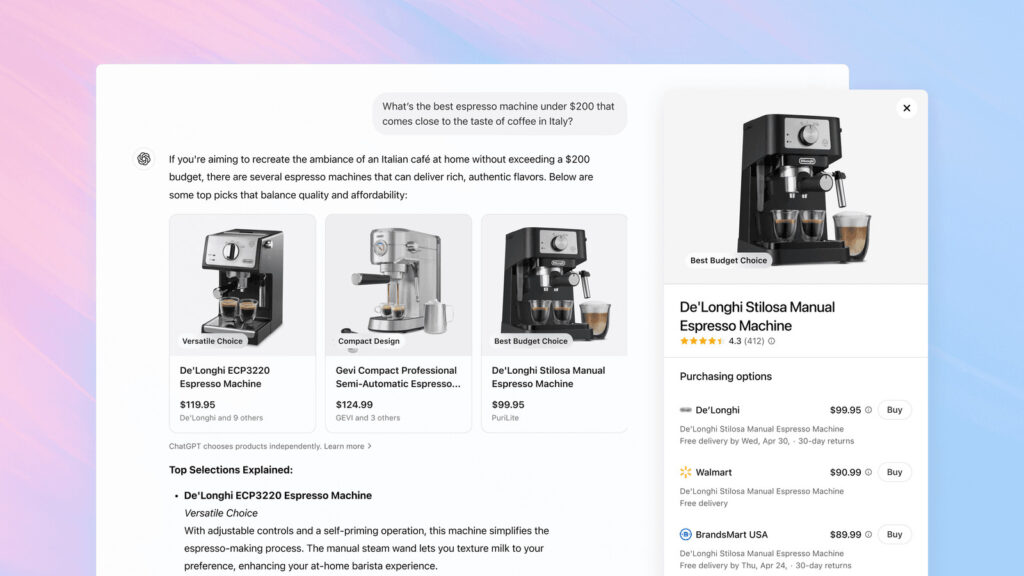
On Thursday, OpenAI announced the addition of shopping features to ChatGPT Search. The new feature allows users to search for products and purchase them through merchant websites after being redirected from the ChatGPT interface. Product placement is not sponsored, and the update affects all users, regardless of whether they’ve signed in to an account.
Adam Fry, ChatGPT search product lead at OpenAI, showed Ars Technica’s sister site Wired how the new shopping system works during a demonstration. Users researching products like espresso machines or office chairs receive recommendations based on their stated preferences, stored memories, and product reviews from around the web.
According to Wired, the shopping experience in ChatGPT resembles Google Shopping. When users click on a product image, the interface displays multiple retailers like Amazon and Walmart on the right side of the screen, with buttons to complete purchases. OpenAI is currently experimenting with categories that include electronics, fashion, home goods, and beauty products.
Product reviews shown in ChatGPT come from various online sources, including publishers and user forums like Reddit. Users can instruct ChatGPT to prioritize which review sources to use when creating product recommendations.
An example of the ChatGPT shopping experience provided by OpenAI. Credit: OpenAI
Unlike Google’s algorithm-based approach to product recommendations, ChatGPT reportedly attempts to understand product reviews and user preferences in a more conversational manner. If someone mentions they prefer black clothing from specific retailers in a chat, the system incorporates those preferences in future shopping recommendations.
The 9 Best AI Image Generators of 2025 (+ Examples)
The use of AI to generate weird and wonderful imagery is definitely one of my favorite applications of the cutting-edge tech.
I’ve tested out AI writing tools and AI productivity tools, but putting the host of AI image generator through their paces was hands-down the most fun I’ve had in testing tools in ages (and I love testing tools).
As with other AI tools, there’s no shortage of artificial intelligence image generators on the market. I’m sure by the time this article is published, about 35 more will have just launched.
❗
Looking for Pablo? We’ve sunsetted Pablo, Remix, and Stories Creator (more on that here), but the AI tools on this list might help!
By now, we all know that AI image generation tools can come up with all sorts of fantastical, eclectic imagery. But since you’re reading the Buffer blog, I’m going to be presumptuous and assume you’re either in marketing, a small business owner, or a creator — and you’re probably looking for a generative AI tool that can do something you can actually use in your work.
Which is a lot like mine. I write content about creators and influencers for this blog and spend a good chunk of my day hunting through free stock photo sites for photos to use as featured images for these articles. So, I compared every generative AI tool with the same text prompt for an image I often need to find:
“Generate an image of a photo-realistic young, Gen-Z social media influencer filming a video with their phone in selfie mode.”
In fairness, this is a tough prompt — AI image generation notoriously struggles with human fingers, teeth, and screens. But there’s a reason the platforms on this list are the most popular and talked-about AI image generators of 2025. Of all the ones I tested, these consistently generated the highest-quality images. (I’ve included only the best in this article.)
Here are my favorite AI image generators and how they stack up with one prompt in particular.
❗FYI: The waters are murky when it comes to using AI-generated images for commercial purposes. Read on for guidelines about using AI art for social media and marketing.
Jump to a tool:
Adobe Firefly — Best copyright-safe AI image generator
Generated by Adobe Firefly
Adobe’s answer to generative AI, Adobe Firefly, is baked into its suite of tools, including Photoshop, but there is a free web version available.
What’s great about Firefly (aside from the quality of the tool) is that the images generated with it are safe for commercial use. “Trained on Adobe Stock images, openly licensed content, and public domain content, Firefly is designed to be safe for commercial use,” Adobe says.
The free web version of the image generator, found at firefly.adobe.com, is remarkably easy to use. When you enter your prompt, you can choose aspect ratio, content type (art or photo), and one of hundreds of trending art style reference images (watercolor, studio photography, you name it).
You can even specify the angle of the image and depth of field (close-ups, wide angles, macro photography, etc.), color and tone (pastel, monochrome, muted, and more), and some really fun special effects.
After that, click ‘Generate,’ and the generative AI will deliver four new images for you to choose from. Clicking a drop-down arrow on each AI-generated image will allow you to generate something similar, use it as an image style reference for a new prompt, or edit it in Adobe Express (Adobe’s answer to Canva).
Firefly consistently created high-quality images, with very few Edward Scissorhands fingers. I found that playing around with the various art styles and effects pre-generated really helped me fine-tune my ask. Another strong point in Firefly’s favor was the realism in the human faces in my AI photo — there was none of that creepy Uncanny Valley effect I got with many of the other tools.
Adobe Firefly pricing: Free for the web version (25 generative credits monthly, images with watermarks). Plans start at $9.99 monthly.
Midjourney — Best AI image generator for artistic images
Midjourney has long been one of my favorite text-to-image generators — you’ll even see some featured images on this blog created with the tool.
Midjourney was originally housed in Discord (which took some getting used to), but the generative AI tool has moved over to a smooth new website.
While I sometimes miss the chaos of the Discord server, where you could watch other users create images in real time in a group chat-like interface, the simplicity of the clean new website makes generating images tough to beat.
You’ll input the prompts via the ‘Create’ tab, which features slider settings to specify AI image size and even ‘stylization’ and ‘weirdness.’
The image generator will churn out four options based on your prompt. You can choose to run it again, download one you like, or if you’ve generated AI images that you like but want to tweak, there are a host of editing options to experiment with.
My results with Midjourney are consistently high quality, and the AI rarely has a problem generating images that really do look like photos.
What makes Midjourney stand out is the artistic quality of its outputs. It really creates digital art, excelling at rich scenes and stylized portraits that feel more like digital concept art than AI renders.
In all my various regenerations of my ‘influencer’ prompt, there were no glitched fingers, and the people in the AI-generated artworks didn’t have the creepy mannequin vibe that is often a result of asking AI to create images that look photorealistic.
Midjourney pricing: Plans start at $8 per month (paid annually).
ChatGPT — Best AI Image generator for refining results with prompts
Open AI’s ChatGPT has scrapped its old DALL-E AI image generator in favor of having it baked right into the main product.
The model has come a long way since DALL-E, which tended to favor Uncanny Valley mannequins when creating humans.
When it comes to realism — and humans that don’t look like reality TV stars — ChatGPT is really tough to beat.
To use it, just describe what you want in plain language, just as you would a regular AI prompt — though you’ll need to specify that it’s an AI image and not text you’re after.
Unlike some of the other tools on this list, ChatGPT will only generate one image from your prompt — but you can continue to prompt it to make tweaks to the results, like “make it more photorealistic” or “add a sunset in the background,” and it will re-render accordingly.
Another fun feature is that you can also upload your own image and ask ChatGPT’s image generator to edit it with specific changes. Think: remove the background, change colors, or (as you’ve no doubt seen on your social media feeds) transform it into a specific image style, like Studio Ghibli.
While it’s one of the more expensive tools on this list, ChatGPT is the most versatile — the generative AI can do so much more than just create high-quality images. If you’re looking for an AI Swiss army knife, ChatGPT is it.
ChatGPT pricing: Plans start at $20 per month.
Canva — Best AI image generator for jazzing up other graphics
Many of Canva’s best features are hidden behind its paid plans — but not its free online AI image generator.
You can access the tool via canva.com/ai-image-generator (you’ll be required to create or sign into an account before you get access, though).
In the Canva editor, just search for the “Text to Image” app and enter your prompt. You’ll get a few results to start with, and from there, you can regenerate, resize, or drop the image directly into your design.
Canva also offers basic image style options — like “photo,” “drawing,” or “painting” — and you can now use AI to expand images, remove backgrounds, and more.
Seconds after you hit ‘enter,’ Canva will generate AI images to choose from, which can then be pulled into your design.
I was really impressed with how much the images generated for my influencer prompt looked like photographs — until I looked more closely at the fingers. That said, most of the images I generated were usable.
Can you generate images that are as high-quality as Midjourney or Firefly? Not quite. But for content creators and marketers, the convenience factor is hard to overstate. Having this powerful AI image generator baked into Canva is a huge point in its favor, as many social media creators and marketers will likely already be using the image and video editing tool in some capacity.
The power of Canva’s vast library of templates, coupled with AI, makes this image generator a force to be reckoned with. Whether you’re creating a presentation or an Instagram carousel, having the ability to generate AI images is a really handy addition.
While Canva’s AI image generator tool is available on its free plan, users are limited to 50 AI credits. Each change of image style or regeneration costs one credit.
Canva AI Image Generator pricing: 50 credits available on Canva’s free plan.
Stable Assistant — Best AI Image generator for tweaking images
Stable Diffusion is an open-source AI image generator that anyone with technical know-how can download and build on — but don’t worry, you don’t need to know how to do all that to use it.
In 2025, they’ve made the image creator model even more accessible through Stable Assistant, a chat-style interface designed to simplify the image generation process.
You can access Stable Assistant directly from Stability AI’s site to create images. Just type your prompt, and the assistant will spit out a series of AI-generated images based on Stable Image Ultra (the latest, most powerful version).
You can refine your prompts in the image generator in real time and even ask the assistant to explain how to improve them — great for folks who want to level up their prompting.
Stable Assistant has helpful features beyond generating AI Images. You can even upload your own image and ask it to remove the background, upscale, remove or replace certain objects, and even ‘inpaint’ (highlight a section of the image to be changed according to a prompt).
I can imagine this functionality would be super powerful for photographers or creators who want to speed up some workflows with an image creator. (Remove other tourists from your epic travel shots, anyone?)
That said, Stable Assistant is still evolving, and the results can vary more than tools like Firefly or Midjourney. But for tinkerers and those who want to customize every pixel, it’s a powerful option.
Stable Assistant pricing: Plans start at $9 per month for 900 credits.
Gemini — Best free AI image generator
Gemini is Google’s newest multimodal AI model, and in early 2025, they rolled out its image generation features (replacing Bard).
If you’re logged into a Google account, you can access it on gemini.google.com to create images, completely free.
Using Gemini is a lot like ChatGPT, but within the Google ecosystem. You can add your image to an email or share it to a Google Doc, for example, with one click. It’s also similar to ChatGPT in that you can ask Gemini to make changes by prompting, but it will create entirely new AI-generated images based on your addition, rather than tweak the original, like ChatGPT does.
Where some tools on this list are more geared toward art or illustration, Gemini perfects clean, web-friendly illustrations and lifestyle shots, with a focus on realism and accuracy.
Given how comparatively “late” Google was to the generative AI game here, experimenting with Gemini really blew my mind — the results were consistently exceptional, stock-photo quality. After experimenting with Gemini’s image generator for this article, you can bet the tool will be in my regular rotation.
It’s not quite as hands-on as Midjourney, and doesn’t quite deliver digital art but for fast, contextual results with a Google-level polish, Gemini is a solid bet.
Gemini pricing: Free, with paid plans for advanced features starting at $19.99 per month.
Recraft — Best AI image generator for designers
Recraft is one of the newer generative AI kids on the block, but it’s already making waves for how it blends AI illustration, vector design, and brand assets in one sleek tool. With it, you can create anything from design mock-ups to company logos.
You start with a blank screen and a space for your prompt. Once you have some AI-generated images to work with, the fun begins.
You can play around with scores of styles (everything from hyper-realistic natural light to clay art), negative image prompts, and even add a color palette. Every image you generate will appear in a Figma board-like project, which designers will feel right at home within.
Once you generate AI images you like, you can change or remove the background, upscale, or even turn an image into an editable vector.
My results with requests for photorealism were mixed — but that’s not where Recraft really shines. To explore its potential, I flipped the script a bit and asked it to help me generate logos and illustrations, which it nailed. (I’m seriously considering adding some of these illustrations to my personal website.)
What makes Recraft unique is its focus on brand-true output. It’s not about hyperrealism, eclectic art, or fantasy landscapes: it’s about getting on-brand AI-generated images, fast.
Also, I can’t oversell the ability to generate editable vector files (SVGs), which makes it a dream for anyone working in web or product design.
Recraft pricing: 50 credits daily on their free plan; paid plans start at $10 per month (paid annually).
Reve Image — Best AI image generator for sticking to prompts
Reve (pronounced “rev”) is a lesser-known but surprisingly delightful tool that really, really listens when you prompt it.
Using Reve is simple: sign up on their site, enter a prompt to create images, and choose from a few base styles like “Dream,” “Cinematic,” or “Minimal.” The tool then creates a grid of AI-generated images you can fine-tune by selecting elements you like, or adjusting mood sliders like “warmth” and “texture.”
The generative AI results were excellent — no Uncanny Valley faces or extra fingers in sight. I’d read that Reve excelled in complicated image prompts, so I added more elements to my prompt, making it longer and more in-depth, but the tool rarely missed a trick — even the tabby cat on the edge of the bed that I asked for made it into every single results.
What sets Reve apart most, though, is its prompt accuracy. If you’ve ever found yourself writing “highly detailed, ultra realistic, cinematic lighting” only to end up with a Pixar-style person in a field of blob flowers, you’ll appreciate how closely Reve sticks to your vision.
It doesn’t hallucinate wildly or go off-script to generate images. You ask for a neon sign that says “subscribe” and a sleepy cat on the edge of the bed, and it delivers. Reve is another image creator that I’ll have in regular rotation as a marketer and creator.
Reve pricing: 100 free credits to start, which get topped up to 20 per day when you get below 20. If you need more, you can buy 500 credits for $5.
Meta (the company that owns Instagram, Facebook, and WhatsApp) launched its own AI chatbot in April 2024, which is accessible on all its platforms.
It’s really the company’s answer to ChatGPT, with the added bonus that you can use it right in your favorite social media app to generate images (which makes it really easy to get to grips with if you’re comfortable on Instagram, Facebook, or Whatsapp).
The generative AI can do everything that GPT can do — help you create a social media content calendar or plan dinner with whatever you have in your fridge.
While most of the chatter I’ve seen about the tool concerns queries about how to grow your Instagram following (fair play), it features a completely free AI image generator.
The downside: all the AI-generated images will have the Meta AI logo and a watermark that reads “imagined with AI.” Meta doesn’t explicitly forbid the use of these images commercially, but the watermark suggests you might want to tread carefully here.
To generate images with Meta AI, head over to Facebook, Instagram, or WhatsApp (you’ll find Meta AI via the search bar) or navigate to meta.ai, then click Imagine. Type your prompt in, then hit enter. The AI will return one image, and from there, you’ll have the option to edit (via text prompt), animate, and download your AI-generated art.
While Meta AI didn’t yield the best AI-generated images for my influencer prompt (it had some trouble with photorealism), the animated versions, seconds-long GIFs, were really impressive. They’re particularly fun for social media posts.
Meta AI pricing: Free.
What are the rules around AI-generated images and copyright?
According to the U.S. Copyright Office, AI-generated content isn’t copyright-protected, but this doesn’t mean that copyrighted works haven’t been used to train the various models these tools use (and may result in a near-replica of another person’s work) to generate AI images.
Some of the tools on this list, Firefly,have been exclusively trained on copyright-free images, but most of them put the onus on the end-user when it comes to legal issues.
“Users get full usage rights to commercialize the images they create, including the right to reprint, sell, and merchandise,” OpenAI says of their tool, and other platforms have similar guidelines. However, all of them absolve themselves of liability for what users create with their tools — so, should there be a legal issue with any AI artworks you use — any ramifications will likely fall on the you.
For each of the tools in question, I’d recommend taking a close look at all the Ts&Cs and fine print that comes with the commercial use of AI-generated art.
https://buffer.com/resources/ai-image-generator/
New study shows why simulated reasoning AI models don’t yet live up to their billing
A screenshot of the 2025 USAMO Problem #1 and a solution, shown on the AoPSOnline website. Credit: AoPSOnline
The US Math Olympiad (USAMO) serves as a qualifier for the International Math Olympiad and presents a much higher bar than tests like the American Invitational Mathematics Examination (AIME). While AIME problems are difficult, they require integer answers. USAMO demands contestants write out complete mathematical proofs, scored for correctness, completeness, and clarity over nine hours and two days.
An April 25, 2025, screenshot of the researchers’ MathArena website showing accuracy scores for SR models on each problem in the USAMO. Credit: MathArena
While one model, Google’s Gemini 2.5 Pro, achieved a higher average score of 10.1 out of 42 points (~24 percent), the results otherwise showed a massive performance drop compared to AIME-level benchmarks. The other evaluated models lagged considerably further behind: DeepSeek R1 and Grok 3 averaged 2.0 points each, Google’s Flash-Thinking scored 1.8, Anthropic’s Claude 3.7 managed 1.5, while Qwen’s QwQ and OpenAI’s o1-pro both averaged 1.2 points. OpenAI’s o3-mini had the lowest average score at just 0.9 points (~2.1 percent). Out of nearly 200 generated solutions across all tested models and runs, not a single one received a perfect score for any problem.
While OpenAI’s newly released 03 and o4-mini-high were not examined for this study, benchmarks at the researchers’ MathArena website show o3-high scoring 21.73 percent overall and o4-mini-high scoring 19.05 percent overall on USAMO. However, those results are potentially contaminated because they were measured after the contest took place, meaning that the newer OpenAI models could potentially have included the solutions in the training data.
How the models failed
In the paper, the researchers identified several key recurring failure patterns. The AI outputs contained logical gaps where mathematical justification was lacking, included arguments based on unproven assumptions, and continued producing incorrect approaches despite generating contradictory results.
A specific example involved USAMO 2025 Problem 5. This problem asked models to find all positive whole numbers “k,” such that a specific calculation involving sums of binomial coefficients raised to the power of “k” would always result in an integer, no matter which positive integer “n” was used. On this problem, Qwen’s QwQ model made a notable error: It incorrectly excluded non-integer possibilities at a stage where the problem statement allowed them. This mistake led the model to an incorrect final answer despite having correctly identified the necessary conditions earlier in its reasoning process.