In depth with Windows 11 Recall—and what Microsoft has (and hasn’t) fixed
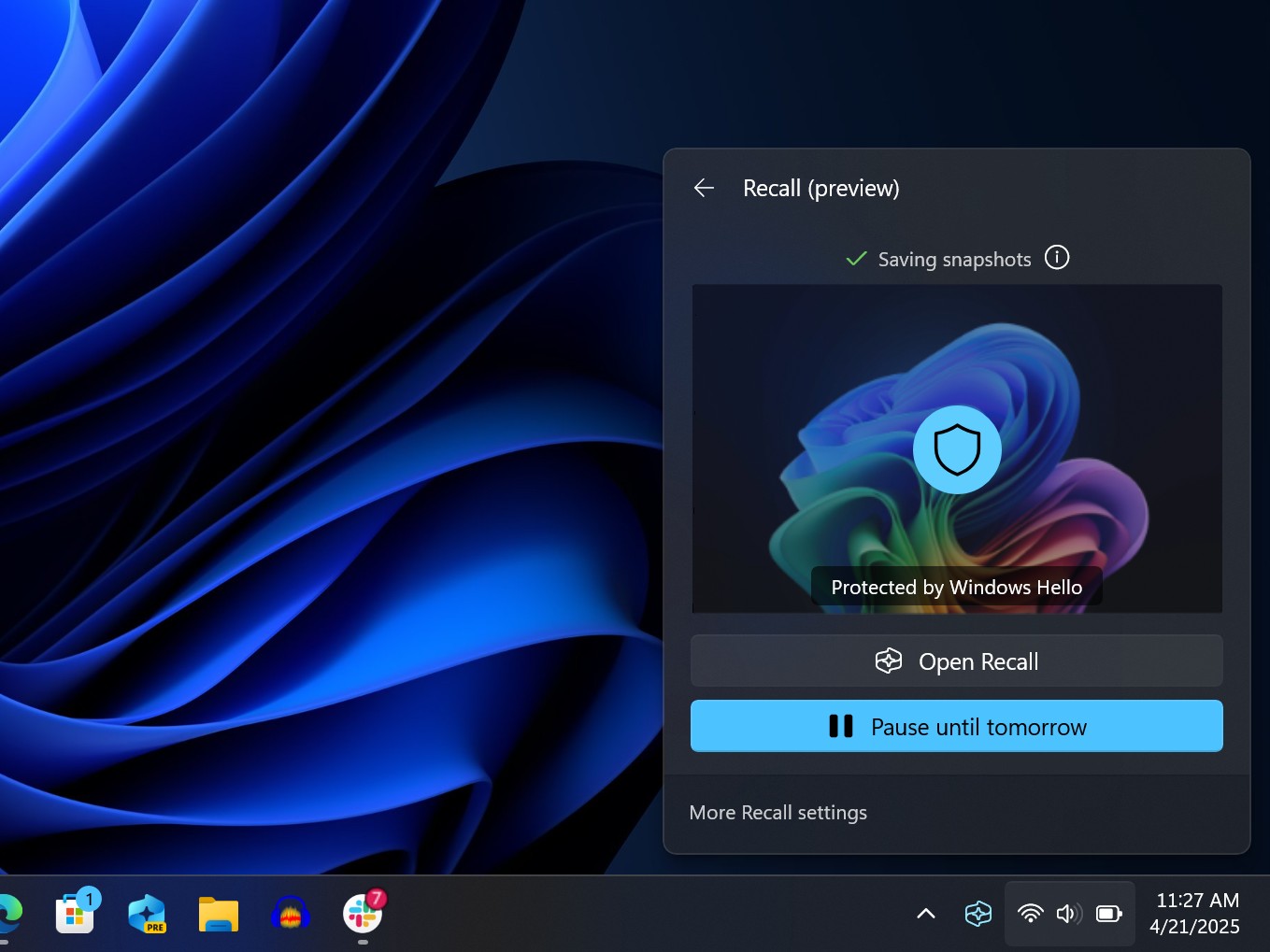
The Recall tray icon is always visible when the service is running, just so you’re always aware of it. Sometimes it will show you snapshot previews here if you’ve opened the Recall app and unlocked it recently, but usually these previews are blurred because Windows Hello is protecting them.
Andrew Cunningham
The Recall tray icon is always visible when the service is running, just so you’re always aware of it. Sometimes it will show you snapshot previews here if you’ve opened the Recall app and unlocked it recently, but usually these previews are blurred because Windows Hello is protecting them. Andrew Cunningham
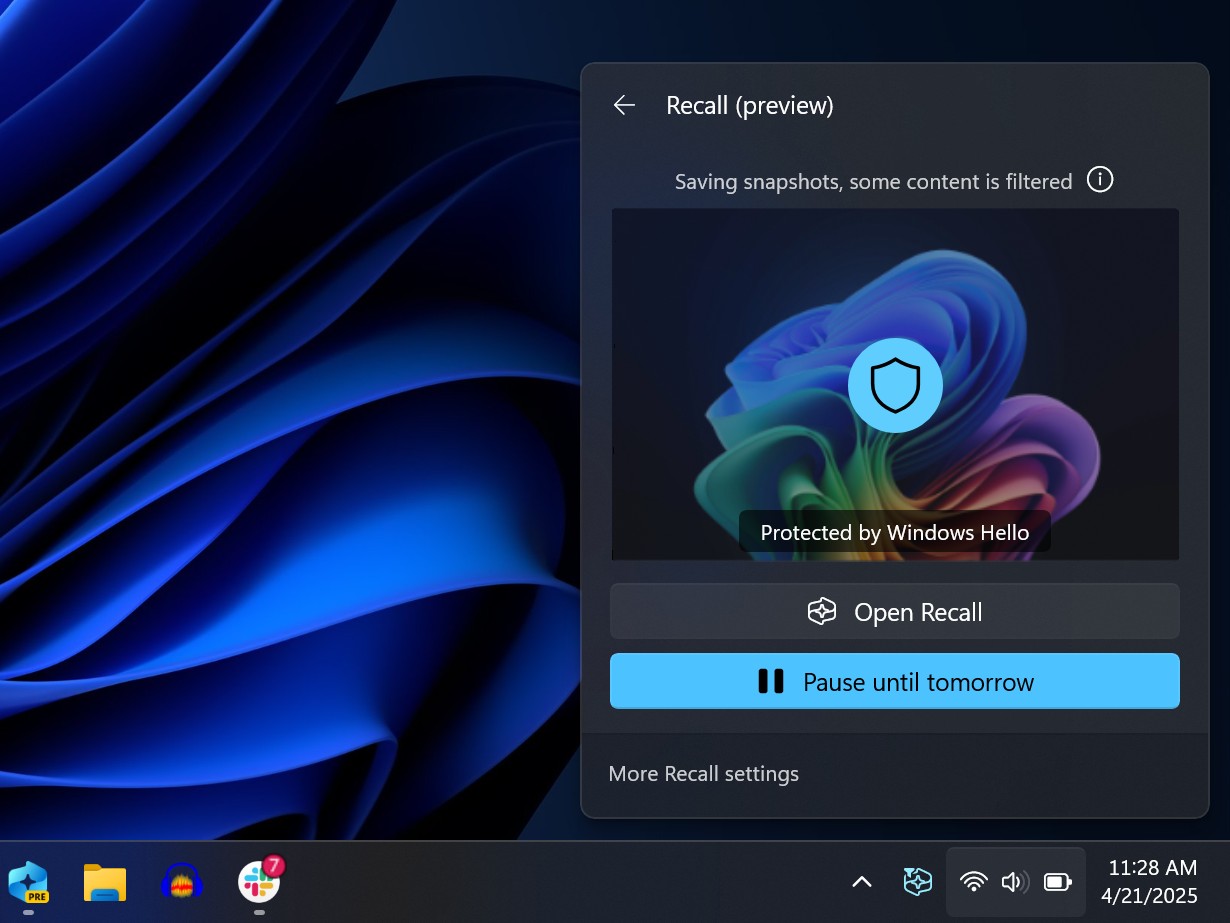
When anything is being filtered for any reason, the tray icon changes and you get a status message here, but Recall doesn’t tell you what is being filtered or why.
Andrew Cunningham
When anything is being filtered for any reason, the tray icon changes and you get a status message here, but Recall doesn’t tell you what is being filtered or why. Andrew Cunningham
The Recall tray icon is always visible when the service is running, just so you’re always aware of it. Sometimes it will show you snapshot previews here if you’ve opened the Recall app and unlocked it recently, but usually these previews are blurred because Windows Hello is protecting them. Andrew Cunningham
When anything is being filtered for any reason, the tray icon changes and you get a status message here, but Recall doesn’t tell you what is being filtered or why. Andrew Cunningham
New to this version of Recall is an attempt at automated content filtering to address one of the major concerns about the original iteration of Recall—that it can capture and store sensitive information like credit card numbers and passwords. This filtering is based on the technology Microsoft uses for Microsoft Purview Information Protection, an enterprise feature used to tag sensitive information on business, healthcare, and government systems.
This automated content filtering is hit and miss. Recall wouldn’t take snapshots of a webpage with a visible credit card field, or my online banking site, or an image of my driver’s license, or a recent pay stub, or of the Bitwarden password manager while viewing credentials. But I managed to find edge cases in less than five minutes, and you’ll be able to find them, too; Recall saved snapshots showing a recent check, with the account holder’s name, address, and account and routing numbers visible, and others testing it have still caught it recording credit card information in some cases.
The automated filtering is still a big improvement from before, when it would capture this kind of information indiscriminately. But things will inevitably slip through, and the automated filtering won’t help at all with other kinds of data; Recall will take pictures of email and messaging apps without distinguishing between what’s sensitive (school information for my kid, emails about Microsoft’s own product embargoes) and what isn’t.
Recall can be removed entirely. If you take it out, it’s totally gone—the options to configure it won’t even appear in Settings anymore. Credit: Andrew Cunningham
The upshot is that if you capture months and months and gigabytes and gigabytes of Recall data on your PC, it’s inevitable that it will capture something you probably wouldn’t want to be preserved in an easily searchable database.
One issue is that there’s no easy way to check and confirm what Recall is and isn’t filtering without actually scrolling through the database and checking snapshots manually. The system tray status icon does change to display a small triangle and will show you a “some content is being filtered” status message when something is being filtered, but the system won’t tell you what it is; I have some kind of filtered app or browser tab open somewhere right now, and I have no idea which one it is because Windows won’t tell me. That any attempt at automated filtering is hit-and-miss should be expected, but more transparency would help instill trust and help users fine-tune their filtering settings.
Annoyed ChatGPT users complain about bot’s relentlessly positive tone
Owing to the aspirational state of things, OpenAI writes, “Our production models do not yet fully reflect the Model Spec, but we are continually refining and updating our systems to bring them into closer alignment with these guidelines.”
In a February 12, 2025 interview, members of OpenAI’s model-behavior team told The Verge that eliminating AI sycophancy is a priority: future ChatGPT versions should “give honest feedback rather than empty praise” and act “more like a thoughtful colleague than a people pleaser.”
The trust problem
These sycophantic tendencies aren’t merely annoying—they undermine the utility of AI assistants in several ways, according to a 2024 research paper titled “Flattering to Deceive: The Impact of Sycophantic Behavior on User Trust in Large Language Models” by María Victoria Carro at the University of Buenos Aires.
Carro’s paper suggests that obvious sycophancy significantly reduces user trust. In experiments where participants used either a standard model or one designed to be more sycophantic, “participants exposed to sycophantic behavior reported and exhibited lower levels of trust.”
Also, sycophantic models can potentially harm users by creating a silo or echo chamber for of ideas. In a 2024 paper on sycophancy, AI researcher Lars Malmqvist wrote, “By excessively agreeing with user inputs, LLMs may reinforce and amplify existing biases and stereotypes, potentially exacerbating social inequalities.”
Sycophancy can also incur other costs, such as wasting user time or usage limits with unnecessary preamble. And the costs may come as literal dollars spent—recently, OpenAI Sam Altman made the news when he replied to an X user who wrote, “I wonder how much money OpenAI has lost in electricity costs from people saying ‘please’ and ‘thank you’ to their models.” Altman replied, “tens of millions of dollars well spent—you never know.”
Potential solutions
For users frustrated with ChatGPT’s excessive enthusiasm, several work-arounds exist, although they aren’t perfect, since the behavior is baked into the GPT-4o model. For example, you can use a custom GPT with specific instructions to avoid flattery, or you can begin conversations by explicitly requesting a more neutral tone, such as “Keep your responses brief, stay neutral, and don’t flatter me.”
Microsoft’s “1‑bit” AI model runs on a CPU only, while matching larger systems
Does size matter?
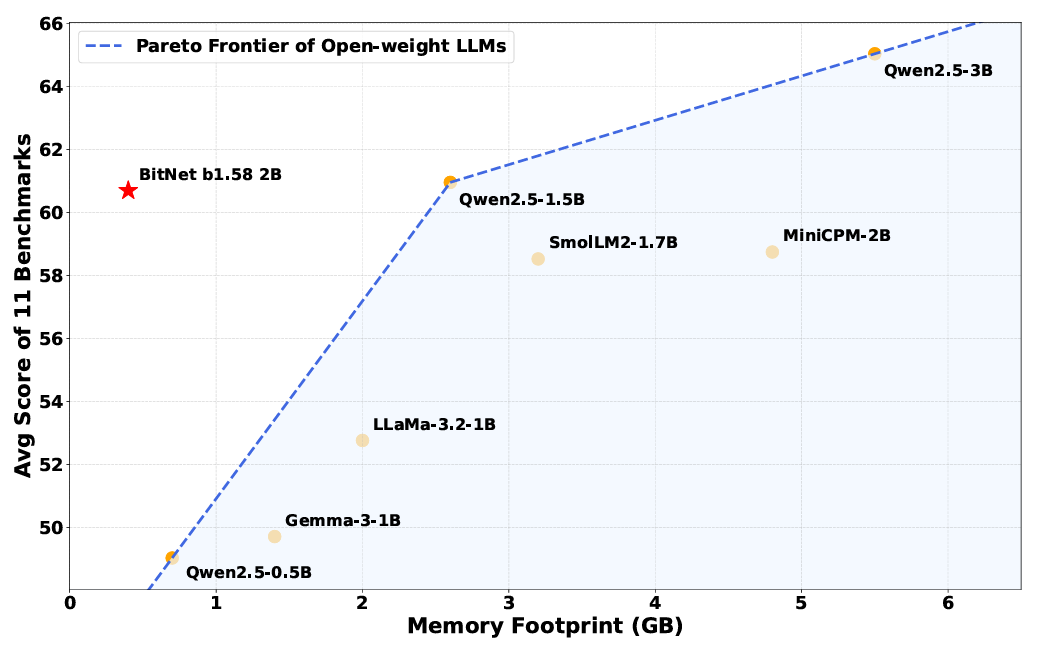
Memory requirements are the most obvious advantage of reducing the complexity of a model’s internal weights. The BitNet b1.58 model can run using just 0.4GB of memory, compared to anywhere from 2 to 5GB for other open-weight models of roughly the same parameter size.
But the simplified weighting system also leads to more efficient operation at inference time, with internal operations that rely much more on simple addition instructions and less on computationally costly multiplication instructions. Those efficiency improvements mean BitNet b1.58 uses anywhere from 85 to 96 percent less energy compared to similar full-precision models, the researchers estimate.
A demo of BitNet b1.58 running at speed on an Apple M2 CPU.
By using a highly optimized kernel designed specifically for the BitNet architecture, the BitNet b1.58 model can also run multiple times faster than similar models running on a standard full-precision transformer. The system is efficient enough to reach “speeds comparable to human reading (5-7 tokens per second)” using a single CPU, the researchers write (you can download and run those optimized kernels yourself on a number of ARM and x86 CPUs, or try it using this web demo).
Crucially, the researchers say these improvements don’t come at the cost of performance on various benchmarks testing reasoning, math, and “knowledge” capabilities (although that claim has yet to be verified independently). Averaging the results on several common benchmarks, the researchers found that BitNet “achieves capabilities nearly on par with leading models in its size class while offering dramatically improved efficiency.”
Despite its smaller memory footprint, BitNet still performs similarly to “full precision” weighted models on many benchmarks.
Despite its smaller memory footprint, BitNet still performs similarly to “full precision” weighted models on many benchmarks.
Despite the apparent success of this “proof of concept” BitNet model, the researchers write that they don’t quite understand why the model works as well as it does with such simplified weighting. “Delving deeper into the theoretical underpinnings of why 1-bit training at scale is effective remains an open area,” they write. And more research is still needed to get these BitNet models to compete with the overall size and context window “memory” of today’s largest models.
Still, this new research shows a potential alternative approach for AI models that are facing spiraling hardware and energy costs from running on expensive and powerful GPUs. It’s possible that today’s “full precision” models are like muscle cars that are wasting a lot of energy and effort when the equivalent of a nice sub-compact could deliver similar results.
Regrets: Actors who sold AI avatars stuck in Black Mirror-esque dystopia
In a Black Mirror-esque turn, some cash-strapped actors who didn’t fully understand the consequences are regretting selling their likenesses to be used in AI videos that they consider embarrassing, damaging, or harmful, AFP reported.
Among them is a 29-year-old New York-based actor, Adam Coy, who licensed rights to his face and voice to a company called MCM for one year for $1,000 without thinking, “am I crossing a line by doing this?” His partner’s mother later found videos where he appeared as a doomsayer predicting disasters, he told the AFP.
South Korean actor Simon Lee’s AI likeness was similarly used to spook naïve Internet users but in a potentially more harmful way. He told the AFP that he was “stunned” to find his AI avatar promoting “questionable health cures on TikTok and Instagram,” feeling ashamed to have his face linked to obvious scams.
As AI avatar technology improves, the temptation to license likenesses will likely grow. One of the most successful companies that’s recruiting AI avatars, UK-based Synthesia, doubled its valuation to $2.1 billion in January, CNBC reported. And just last week, Synthesia struck a $2 billion deal with Shutterstock that will make its AI avatars more human-like, The Guardian reported.
To ensure that actors are incentivized to license their likenesses, Synthesia also recently launched an equity fund. According to the company, actors behind the most popular AI avatars or featured in Synthesia marketing campaigns will be granted options in “a pool of our company shares” worth $1 million.
“These actors will be part of the program for up to four years, during which their equity awards will vest monthly,” Synthesia said.
For actors, selling their AI likeness seems quick and painless—and perhaps increasingly more lucrative. All they have to do is show up and make a bunch of different facial expressions in front of a green screen, then collect their checks. But Alyssa Malchiodi, a lawyer who has advocated on behalf of actors, told the AFP that “the clients I’ve worked with didn’t fully understand what they were agreeing to at the time,” blindly signing contracts with “clauses considered abusive,” even sometimes granting “worldwide, unlimited, irrevocable exploitation, with no right of withdrawal.”
L’AI inventa le sentenze: allarme in un tribunale di Firenze. Ma perché niente multa?
Il Caso di Firenze: Sentenze Inventate dall’IA
Un avvocato coinvolto in una causa per contraffazione di marchi ha citato sentenze della Cassazione che non esistevano. L’errore non è stato umano, ma causato dall’intelligenza artificiale (IA), in particolare da ChatGPT, utilizzata per la ricerca giuridica. L’IA ha generato risultati errati, una pratica nota come “allucinazione dell’intelligenza artificiale”, che ha portato alla creazione di precedenti legali inesistenti.
La Reazione del Tribunale di Firenze
Nonostante l’errore, il Tribunale di Firenze non ha sanzionato l’avvocato, ma ha lanciato un forte allarme sulla responsabilità dell’uso dell’IA in ambito legale. I giudici hanno sottolineato la necessità di verificare accuratamente le fonti citate, soprattutto in un contesto così delicato come quello giuridico, per evitare che l’errore contaminasse il sistema della giustizia.
Le Reazioni Internazionali: Un Caso Simile negli Stati Uniti
Il caso italiano richiama un precedente negli Stati Uniti, dove uno studio legale è stato multato di 5.000 dollari per aver presentato sentenze false, create da un’IA. Le istituzioni legali globali stanno adottando linee guida per garantire l’uso corretto dell’IA, come quelle della Fédération des Barreaux d’Europe e della Carta dei principi dell’Ordine degli Avvocati di Milano.
Responsabilità e Formazione per gli Avvocati
Gli avvocati sono tenuti a verificare i risultati generati dall’IA, come sottolineato dalle linee guida professionali. Non è sufficiente affidarsi ciecamente alla tecnologia; occorre che ogni errore venga identificato e corretto. La responsabilità per gli errori causati dall’IA ricade sempre sull’avvocato, e la formazione sull’uso della tecnologia è fondamentale.
Conclusioni: Necessità di Norme e Controlli
Per evitare che l’uso irresponsabile dell’IA possa compromettere la giustizia, è necessario introdurre normative chiare e promuovere una formazione adeguata per i professionisti. La responsabilità dell’avvocato deve essere ben definita per garantire che l’IA resti un supporto utile, ma non sostitutivo del giudizio umano.
Tabella Riassuntiva
Aspetto
Dettagli
Caso di Firenze
Sentenze inventate da ChatGPT, utilizzato per la ricerca giuridica.
Reazione del Tribunale
Nessuna sanzione per l’avvocato, ma allarme sulla verifica delle fonti.
Reazioni Internazionali
Sanzioni in USA, linee guida in Europa (Fédération des Barreaux d’Europe).
Responsabilità degli Avvocati
Controllo dei risultati generati dall’IA, formazione obbligatoria.
Conclusioni
Necessità di normative chiare e responsabilità per l’uso dell’IA.
Disegno di legge sull’AI, Art. 15 (Impiego dell’intelligenza artificiale nell’attività giudiziaria)
Ecco il testo integrale dell’Articolo 15 del Disegno di Legge n. 1146/24, approvato dal Senato il 20 marzo 2025, che disciplina l’uso dell’intelligenza artificiale nell’ambito della giustizia:
Nei casi di impiego dei sistemi di intelligenza artificiale nell’attività giudiziaria è sempre riservata al magistrato ogni decisione sull’interpretazione e sull’applicazione della legge, sulla valutazione dei fatti e delle prove e sull’adozione dei provvedimenti.
I sistemi di intelligenza artificiale sono utilizzati esclusivamente per l’organizzazione e la semplificazione del lavoro giudiziario, nonché per le attività amministrative accessorie.
Fino alla compiuta attuazione del regolamento (UE) 2024/1689 del Parlamento europeo e del Consiglio, la sperimentazione e l’impiego dei sistemi di intelligenza artificiale negli uffici giudiziari sono subordinati all’approvazione del Ministero della giustizia, che provvede sentite le autorità nazionali per l’intelligenza artificiale di cui all’articolo 18.
Il Ministro della giustizia, ai sensi dell’articolo 12, comma 1, lettera a), del decreto legislativo 30 gennaio 2006, n. 26, include nelle linee programmatiche sulla formazione dei magistrati attività didattiche sul tema dell’intelligenza artificiale e sugli impieghi dei sistemi di intelligenza artificiale nell’attività giudiziaria.
Questo articolo stabilisce chiaramente che l’intelligenza artificiale può essere impiegata solo per supportare l’organizzazione e le attività amministrative del sistema giudiziario, mentre le decisioni giudiziarie rimangono esclusivamente di competenza dei magistrati.
La posizione dell’Ordine degli Avvocati della Lombardia: sanzioni per uso irresponsabile
In Italia, l’Ordine degli Avvocati della Lombardia ha preso una posizione chiara. Le linee guida dell’Ordine stabiliscono che l’uso irresponsabile dell’AI nelle pratiche legali può portare a sanzioni disciplinari. È necessario che gli avvocati siano consapevoli del fatto che l’AI deve essere utilizzata con trasparenza, responsabilità e solo come supporto, e non come sostituto delle capacità professionali. Le linee guida, recentemente aggiornate, mettono in evidenza che ogni informazione legale fornita dall’AI deve essere verificata attentamente, per evitare che errori o falsi contenuti possano danneggiare i clienti o compromettere il processo legale.
Cosa prevede la normativa?
Secondo le linee guida, l’avvocato che fa uso di strumenti AI deve seguire rigorosi principi etici:
Verifica delle fonti: ogni sentenza, legge o precedente giuridico citato deve essere verificato prima dell’uso.
Trasparenza: l’avvocato deve chiarire quando l’AI è stata utilizzata e come ha contribuito al lavoro legale.
Responsabilità: l’avvocato non può delegare la propria responsabilità decisionale all’AI.
In caso contrario, l’uso dell’AI in modo negligente può portare a provvedimenti disciplinari, tra cui la sospensione o l’annullamento della licenza dell’avvocato.
Le reazioni della magistratura e della comunità legale
La comunità giuridica ha condannato fermamente i casi di uso scorretto dell’AI nel diritto. In Italia, il Consiglio Superiore della Magistratura (CSM) ha raccomandato di limitare l’uso dell’AI esclusivamente a strumenti di supporto, e mai come sostituto delle decisioni giuridiche. L’AI, infatti, non deve influenzare la valutazione delle prove né la formazione delle sentenze, poiché una decisione giudiziaria non può basarsi su dati non verificabili o su informazioni inventate.
Inoltre, il Disegno di Legge n. 1146/24 stabilisce che l’AI non può essere utilizzata come strumento per “automatizzare” le decisioni giuridiche o per influenzare le motivazioni delle sentenze.
Conclusioni: Responsabilità e trasparenza nell’uso dell’AI
L’intelligenza artificiale può essere un valido strumento nel campo giuridico, ma solo se usata con cautela, responsabilità e verifica. L’uso irresponsabile dell’AI in ambito giudiziario non solo può compromettere la qualità delle decisioni legali, ma espone anche a gravi conseguenze disciplinari. È essenziale che avvocati e magistrati siano formati sull’uso corretto di questi strumenti e che linee guida rigorose vengano seguite per evitare danni al sistema giuridico.
In Italia, l’Ordine degli Avvocati della Lombardia ha già tracciato una linea chiara: l’uso scorretto dell’AI sarà sanzionato, e ogni professionista dovrà rispondere delle proprie azioni. L’AI deve restare uno strumento di supporto, non un sostituto del giudizio umano.
Riepilogo in tabella
Aspetto
È consentito?
È regolato dal DDL 1146/24?
Note
Uso dell’AI da parte di avvocati per trovare sentenze
✅ Sì
❌ No
Consentito, ma non ancora disciplinato
Uso dell’AI da parte dei PM per analisi o redazioni
✅ Sì
❌ No
Prassi possibile, senza norme specifiche
Uso dell’AI nei tribunali (es. per attività amministrative)
✅ Sì
✅ Sì, art. 15
Richiede approvazione del Ministero
Decisioni giudiziarie automatizzate
❌ No
✅ Vietato espressamente
Il giudice resta sempre responsabile
Formazione dei magistrati sull’AI
✅ Sì
✅ Sì, obbligatoria
Prevista dal Ministero
Formazione per avvocati/PM
✅ Facoltativa
❌ No
Offerta da Ordini o enti terzi
Caso 1: L’avvocato di New York che ha usato ChatGPT (2023)
Dove: Tribunale federale di Manhattan
Chi: L’avvocato Steven Schwartz dello studio Levidow, Levidow & Oberman
Cosa è successo: ha utilizzato ChatGPT per redigere una memoria difensiva e ha citato sei sentenze totalmente inventate, con tanto di nomi, numeri di protocollo, tribunali e giudici fasulli.
Come è stato scoperto: l’avvocato della controparte ha segnalato al giudice l’impossibilità di trovare le sentenze citate.
Conseguenze: il giudice ha definito la condotta “senza precedenti” e ha multato Schwartz e il suo studio legale per 5000 dollari, sottolineando la responsabilità professionale nell’uso dell’AI.
📎 Schwartz ha ammesso in udienza di non sapere che ChatGPT potesse “inventare” fonti. Quando ha chiesto al chatbot se le sentenze erano reali, questo ha mentito confermandone l’esistenza.
Caso 2: Canada – decisione disciplinare contro un avvocato (2023)
Dove: British Columbia
Chi: un avvocato non identificato nel provvedimento
Cosa è successo: ha presentato un documento con cinque sentenze inesistenti generate da un sistema AI.
Conseguenze: è stato deferito dal comitato disciplinare della Law Society of British Columbia, anche se non è stato sospeso. È stato ordinato di frequentare corsi obbligatori sull’etica legale e sull’uso dell’intelligenza artificiale.
Caso 3: Colombia – sentenza scritta con l’aiuto di ChatGPT (2023)
Chi: Il giudice Juan Manuel Padilla
Cosa ha fatto: ha ammesso pubblicamente di aver utilizzato ChatGPT per scrivere una parte della motivazione di una sentenza su un caso sanitario.
La polemica: ChatGPT aveva citato casi non verificabili. Il giudice ha difeso la sua scelta sostenendo che l’AI era solo un “assistente consultivo”.
Reazioni: nel paese si è aperto un ampio dibattito sull’uso etico e controllato dell’AI nel processo decisionale.
Meta vuole allenare la sua AI con i tuoi post: come bloccarla, c’è tempo fino a maggio
Dal 2025 i dati degli utenti europei diventano materia prima per l’intelligenza artificiale di Meta
A partire dalla fine di maggio 2025, Meta inizierà a usare i dati degli utenti europei adulti di Facebook e Instagram per addestrare i propri modelli di intelligenza artificiale, come il chatbot Meta AI o i modelli linguistici LLaMA. Si tratta di un cambiamento radicale: fino ad oggi, i contenuti europei non erano stati coinvolti in questo processo.
Un progetto già annunciato e poi sospeso
Meta aveva già reso noto nel 2023 la volontà di utilizzare post pubblici, commenti e foto per l’addestramento dell’AI. Tuttavia, l’intervento dell’Autorità irlandese per la protezione dei dati (IDPC) aveva posto dei limiti, imponendo maggiori garanzie in termini di trasparenza e base legale. Il progetto era stato sospeso, ma ora riprende con nuove modalità e una possibilità di opposizione semplificata per gli utenti.
Come funziona e quali dati saranno utilizzati
Meta intende usare tutti i contenuti pubblici passati e futuri, compresi foto, post, commenti, resi visibili dagli utenti sul proprio profilo. Non si tratta solo di nuovi contenuti: anche il materiale già pubblicato potrà essere utilizzato per l’addestramento dell’AI.
Chi non si oppone in tempo, acconsente implicitamente all’uso dei propri dati. Va sottolineato che, una volta incorporati nei modelli, i dati non possono più essere rimossi.
Come opporsi: link e tempistiche
Gli utenti che non desiderano che i propri contenuti siano utilizzati da Meta per l’addestramento dell’intelligenza artificiale devono inviare un’opposizione esplicita. Meta invierà notifiche in-app, ma è già possibile opporsi tramite i seguenti link ufficiali:
L’opposizione deve essere inviata entro fine maggio 2025. Dopo questa data, pur potendo ancora opporsi, non sarà più possibile rimuovere retroattivamente i dati già utilizzati per l’addestramento.
Le parole del garante tedesco
Thomas Fuchs, Garante per la protezione dei dati di Amburgo, ha commentato:
“Capisco le preoccupazioni degli utenti: tutti i contenuti che condividiamo sui social potrebbero finire nei modelli AI. L’unico modo per tutelarsi è opporsi subito. Se bisogna farlo, allora è il momento”.
FAQ sull’addestramento AI di Meta con dati personali
Domanda
Risposta
Quali dati verranno usati?
Post, commenti, foto e altri contenuti pubblici su Facebook e Instagram.
A cosa serviranno?
All’addestramento di chatbot (es. Meta AI), modelli linguistici (es. LLaMA) e altri servizi.
Come posso impedire l’uso dei miei dati?
Inviando un modulo di opposizione tramite Facebook o Instagram.
Gemini 2.5 Flash comes to the Gemini app as Google seeks to improve “dynamic thinking”
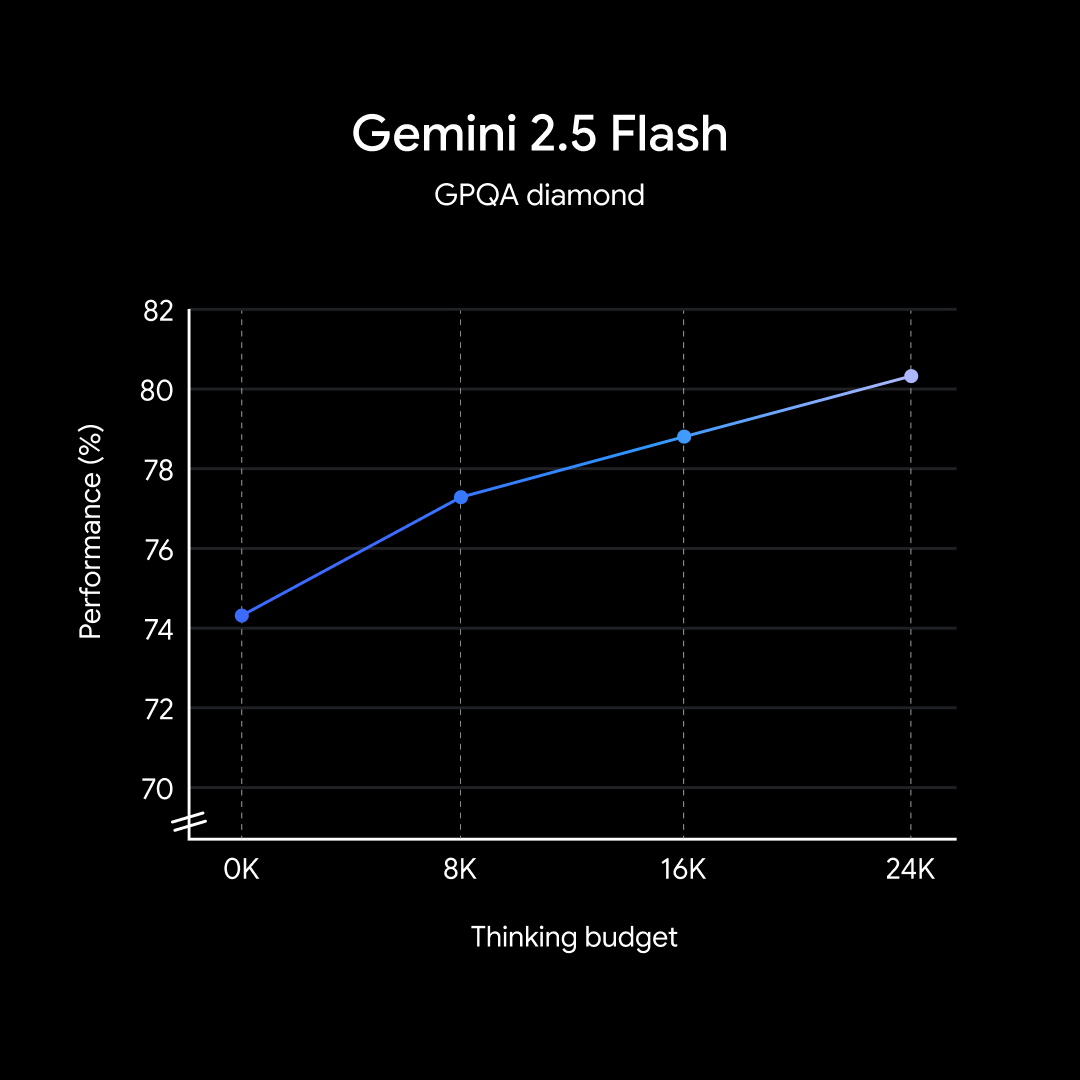
Gemini 2.5 Flash will allow developers to set a token limit for thinking or simply disable thinking altogether. Google has provided pricing per 1 million tokens at $0.15 for input, and output comes in two flavors. Without thinking, outputs are $0.60, but enabling thinking boosts it to $3.50. The thinking budget option will allow developers to fine-tune the model to do what they want for an amount of money they’re willing to pay. According to Doshi, you can actually see the reasoning improvements in benchmarks as you add more token budget.
2.5 Flash outputs get better as you add more reasoning tokens.
Credit: Google
2.5 Flash outputs get better as you add more reasoning tokens. Credit: Google
Like 2.5 Pro, this model supports Dynamic Thinking, which can automatically adjust the amount of work that goes into generating an output based on the complexity of the input. The new Flash model goes further by allowing developers to control thinking. According to Doshi, Google is launching the model now to guide improvements in these dynamic features.
“Part of the reason we’re putting the model out in preview is to get feedback from developers on where the model meets their expectations, where it under-thinks or over-thinks, so that we can continue to iterate on [dynamic thinking],” says Doshi.
Don’t expect that kind of precise control for consumer Gemini products right now, though. Doshi notes that the main reason you’d want to toggle thinking or set a budget is to control costs and latency, which matters to developers. However, Google is hoping that what it learns from the preview phase will help it understand what users and developers expect from the model. “Creating a simpler Gemini app experience for consumers while still offering flexibility is the goal,” Doshi says.
With the rapid cadence of releases, a final release for Gemini 2.5 doesn’t seem that far off. Google still doesn’t have any specifics to share on that front, but with the new developer options and availability in the Gemini app, Doshi tells us the team hopes to move the 2.5 family to general availability soon.
Google is gifting a year of Gemini Advanced to every college student in the US
Google CEO Sundar Pichai has reportedly set a goal for the company to reach 500 million Gemini users before the end of 2025. Rolling out new models may help the company get there, but you know what else helps? Giving away premium features for free. Google has announced today that it’s giving all US college students free access to Gemini Advanced, and not just for a month or two—the offer is good for a full year of service.
With Gemini Advanced, you get access to the more capable Pro models, as well as unlimited use of the Deep Research tool based on it. Subscribers also get a smattering of other AI tools, like the Veo 2 video generator, NotebookLM, and Gemini Live. The offer is for the Google One AI Premium plan, so it includes more than premium AI models, like Gemini features in Google Drive and 2TB of Drive storage.
Google has a new landing page for the deal, allowing eligible students to sign up for their free Google One AI Premium plan. The offer is valid from now until June 30. Anyone who takes Google up on it will enjoy the free plan through spring 2026. The company hasn’t specified an end date, but we would wager it will be June of next year. Google’s intention is to give students an entire school year of Gemini Advanced from now through finals next year. At the end of the term, you can bet Google will try to convert students to paying subscribers.
As for who qualifies as a “student” in this promotion, Google isn’t bothering with a particularly narrow definition. As long as you have a valid .edu email address, you can sign up for the offer. That’s something that plenty of people who are not actively taking classes still have. You probably won’t even be taking undue advantage of Google if you pretend to be a student—the company really, really wants people to use Gemini, and it’s willing to lose money in the short term to make that happen.
Google suspended 39.2 million malicious advertisers in 2024 thanks to AI
Google may have finally found an application of large language models (LLMs) that even AI skeptics can get behind. The company just released its 2024 Ads Safety report, confirming that it used a collection of newly upgraded AI models to scan for bad ads. The result is a huge increase in suspended spammer and scammer accounts, with fewer malicious ads in front of your eyeballs.
While stressing that it was not asleep at the switch in past years, Google reports that it deployed more than 50 enhanced LLMs to help enforce its ad policy in 2024. Some 97 percent of Google’s advertising enforcement involved these AI models, which reportedly require even less data to make a determination. Therefore, it’s feasible to tackle rapidly evolving scam tactics.
Google says that its efforts in 2024 resulted in 39.2 million US ad accounts being suspended for fraudulent activities. That’s over three times more than the number of suspended accounts in 2023 (12.7 million). The factors that trigger a suspension usually include ad network abuse, improper use of personalization data, false medical claims, trademark infringement, or a mix of violations.
Despite these efforts, some bad ads still make it through. Google says it identified and removed 1.8 billion bad ads in the US and 5.1 billion globally. That’s a small drop from 5.5 billion ads removed in 2023, but the implication is that Google had to remove fewer ads because it stopped the fraudulent accounts before they could spread. The company claims most of the 39.2 million suspended accounts were caught before they ran a single ad.
AI, un mercato globale da 4,8 trilioni di dollari entro il 2033 (più del PIL della Germania)
L’intelligenza artificiale ridisegna l’economia globale: opportunità, rischi e strategie secondo l’Uctad
L’intelligenza artificiale (AI) sta trasformando l’economia globale, promettendo progressi straordinari ma sollevando al contempo importanti interrogativi sull’equità e l’inclusività del suo impatto. Il Technology and Innovation Report 2025 della Unctad (Conferenza delle Nazioni Unite sul Commercio e lo Sviluppo) lancia un appello urgente: occorre agire ora per garantire che l’AI diventi uno strumento al servizio dello sviluppo sostenibile e non un fattore di ulteriore disuguaglianza.
Entro il 2033, il mercato globale dell’intelligenza artificiale è destinato a raggiungere i 4.8 trilioni di dollari, una cifra che supera di poco il PIL della Germania, il Paese più ricco d’Europa, che nel 2023 ha toccato i 4,52 trilioni di dollari, il 4,29% dell’economia mondiale, secondo la Banca Mondiale.
Un dato straordinario, che conferma il ruolo sempre più centrale di questa tecnologia nella trasformazione digitale delle economie globali.
Tuttavia, l’accesso alle infrastrutture e alle competenze legate all’AI è tutt’altro che equamente distribuito. Oggi, circa il 40% degli investimenti globali in ricerca e sviluppo nel settore privato proviene da appena 100 aziende, per lo più situate negli Stati Uniti e in Cina.
Colossi come Apple, Nvidia e Microsoft hanno una capitalizzazione di mercato che si aggira intorno ai 3.000 miliardi di dollari ciascuna, un valore paragonabile al PIL dell’intero continente africano. Una simile concentrazione di potere rischia di escludere numerose economie emergenti dai benefici dell’innovazione tecnologica.
Secondo l’Unctad, il mercato complessivo delle tecnologie AI, Internet of Things e blockchain potrebbe superare i 10 trilioni di dollari entro il 2033.
Lavoro e automazione, il doppio volto dell’AI
Secondo il rapporto, fino al 40% dei posti di lavoro a livello globale potrebbe essere influenzato dall’intelligenza artificiale. Da un lato, essa offre enormi potenziali in termini di produttività, dall’altro solleva preoccupazioni legate all’automazione e alla possibile sostituzione del lavoro umano, soprattutto nei settori a basso costo del lavoro, tipici dei Paesi in via di sviluppo.
Ma l’AI non è solo distruzione di posti di lavoro: può anche generare nuove industrie e rafforzare le capacità dei lavoratori. È fondamentale, quindi, investire in reskilling e upskilling, promuovendo una formazione continua che consenta alle persone di adattarsi e prosperare nel nuovo scenario tecnologico.
Le leve strategiche: infrastrutture digitali, dati e competenze
L’intelligenza artificiale deve essere al centro delle strategie di sviluppo nazionale. Secondo l’Unctad, le politiche industriali moderne dovrebbero focalizzarsi su tre ambiti chiave: infrastrutture digitali, dati e competenze.
La capacità di posizionarsi strategicamente in questi settori sarà decisiva per i Paesi che vorranno integrare efficacemente l’AI nei propri sistemi produttivi e sociali.
L’Unctad supporta i Paesi in via di sviluppo nella definizione di queste strategie, offrendo strumenti di analisi e assistenza per costruire ecosistemi dell’innovazione resilienti e capaci di rispondere alle sfide future.
Governare l’AI, includere il Sud globale
Un dato preoccupante è che ben 118 Paesi, in gran parte del Sud globale, sono attualmente esclusi dai principali forum internazionali sulla governance dell’intelligenza artificiale. In un momento in cui si stanno scrivendo le regole del gioco – tra etica, regolazione e standard – è essenziale che queste nazioni abbiano voce in capitolo.
La Segretaria Generale dell’Unctad, Rebeca Grynspan, ha sottolineato la necessità di “spostare il focus dalla tecnologia alle persone”, proponendo una cornice di cooperazione internazionale in grado di co-creare una governance globale dell’IA che metta al centro l’inclusività e la sostenibilità.
Un piano d’azione per l’AI inclusiva, le persone al centro dell’innovazione tecnologica
Il rapporto dell’Unctad propone una serie di raccomandazioni concrete per garantire uno sviluppo equo dell’intelligenza artificiale:
Impegno industriale: sull’esempio dei criteri ESG, un meccanismo di trasparenza pubblica può migliorare la responsabilità delle imprese in ambito IA.
Infrastruttura condivisa: un hub globale accessibile può democratizzare l’accesso alle risorse computazionali.
Innovazione aperta: l’uso di dati e codice open source può favorire la collaborazione globale e la diffusione del sapere.
Capacity building: progetti di cooperazione Sud-Sud e condivisione della conoscenza possono rafforzare le competenze nei Paesi emergenti.
L’intelligenza artificiale ha il potenziale per diventare un catalizzatore di progresso, innovazione e prosperità condivisa. Ma questo potenziale si realizzerà solo se i governi, le imprese e le istituzioni internazionali lavoreranno insieme per mettere le persone al centro dello sviluppo tecnologico. È tempo di passare dalle promesse all’azione.