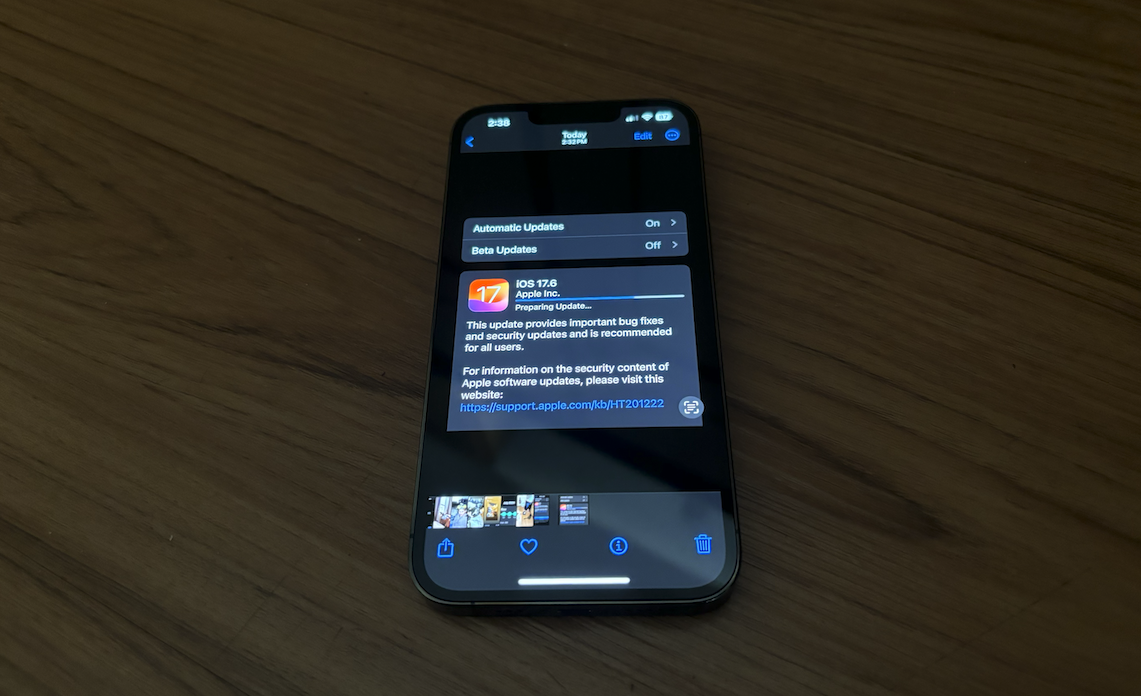
Apple has some minor updates for all its operating systems, and the releases include iOS 17.6, iPadOS 17.6, tvOS 17.6, watchOS 10.6, and macOS Sonoma 14.6.
Apple’s notes for these updates simply say they include bug fixes, security updates, or optimizations. However, there are a few hidden features.
macOS 14.6 reportedly enables multi-display support in clamshell mode on the M3 MacBook Pro, allowing users of that device to use two external displays at once. That was already possible on the M3 Pro and M3 Max variations. Apple had previously released a similar update to bring that functionality to the M3 MacBook Air.
iOS 17.6 and iPadOS 17.6 have added a feature called Catch Up, which is targeted at sports fans who use Apple’s TV app.
The feature allows users to watch a quick sequence of highlights that have been produced so far from an in-progress Major League Soccer game before joining the live feed.
That’s about it, though. These are minor updates, and they are likely the final ones other than security hotfixes until Apple begins rolling out its annual updates, such as iOS 18 and macOS Sequoia 15, later this fall.
Those updates are expected to include several new features, though the biggest—Apple Intelligence, a suite of generative AI features—will not arrive until iOS 18.1, which was just released as a developer beta for the first time.
iOS 17.6, iPadOS 17.6, tvOS 17.6, watchOS 10.6, and macOS Sonoma 14.6 are available to download and install on all supported devices now.
https://arstechnica.com/?p=2040130
C’è anche Apple nel disegno degli Usa per l’AI. Con quale credibilità?
Il 26 luglio la Casa Bianca ha confermato che Apple si è unita a 15 aziende tecnologiche impegnate a seguire misure di sicurezza volte a ridurre i rischi dell’intelligenza artificiale. Tra i colossi figurano Amazon, Google, Microsoft e OpenAI. A ottobre dello scorso anno, Joe Biden dichiarò di aver raggiunto un accordo di massima “per contribuire a progredire verso uno sviluppo sicuro, protetto e trasparente della tecnologia dell’intelligenza artificiale”.
Le misure includono la simulazione da parte delle aziende tecnologiche di attacchi ai modelli di intelligenza artificiale tramite una tecnica di test denominata “red teaming” per evidenziare difetti o vulnerabilità. Secondo il governo Usa, i test sui modelli o sui sistemi di intelligenza artificiale devono includere rischi sociali e preoccupazioni per la sicurezza nazionale, come gli attacchi informatici e lo sviluppo di armi biologiche. Le organizzazioni che hanno sottoscritto la bozza dovranno collaborare alla condivisione di informazioni, anche tra di loro notoriamente rivali, così come con gli organi statali.
L’Intelligence di Apple
A giugno Apple ha presentato “Apple Intelligence”, la sua suite di funzionalità di intelligenza artificiale per i suoi dispositivi, nel tentativo di rassicurare gli utenti sul fatto che non intende restare indietro rispetto alla frenesia della concorrenza. Alla base c’è una partnership con OpenAI che renderà disponbile sugli iPhone l’AI di ChatGPT.
Il problema è la credibilità. Aziende come Apple, nonostante l’ingresso tardivo nello scenario dell’AI generativa, devono adesso monetizzare gli sforzi. Le prestazioni dei modelli, la necessità di addestrarli continuamente, richiede non solo costi in termini di risorse computazionali ma anche di team. Pensare che una multinazionale del genere, così come il resto delle 15 imprese parte del “patto” con Washington, possano ridurre le loro ambizioni per questioni di correttezza e beneficio universale, è un dubbio legittimo.
C’è poi un’ulteriore considerazione. Lo scorso 20 marzo, lo US Justice Department, ossia il Ministero della Giustizia degli Stati Uniti, ha accusato Apple di aver violato la normativa antitrust. È stata la terza volta negli ultimi 14 anni. Nell’ultimo caso, l’accusa riguarda il “walled garden” creato da Apple intorno a iPhone, iPad, Mac, Apple Watch. In attesa del giudizio, sembra che la Mela con la sua mossa voglia riavvicinarsi alla Casa Bianca, anche in attesa del prossimo presidente.
Il precedente di Biden
Alla fine del 2023, Biden ha firmato un ordine esecutivo che stabilisce nuovi standard di sicurezza per i sistemi di intelligenza artificiale e richiede agli sviluppatori di condividere i risultati dei test con il governo degli Stati Uniti. L’ordine è stato definito dalla Casa Bianca come “l’azione più radicale mai intrapresa per proteggere gli americani dai potenziali rischi dei sistemi di intelligenza artificiale”. Poco dopo la sua pubblicazione, la vicepresidente Kamala Harris ha tenuto un importante discorso sulla politica in materia di intelligenza artificiale durante un incontro di politici, personalità del settore tecnologico e accademici. L’evento si è concentrato sui crescenti timori sulle implicazioni dei modelli di intelligenza artificiale avanzati che hanno suscitato preoccupazioni su vari temi, dalle perdite di posti di lavoro agli attacchi informatici.
Rispetto al documento di Biden, quello più recente specifica in modo molto dettagliato ciò che ci si attende dai partecipanti di questa sorta di coalizione. In seguito all’ordine esecutivo e a una serie di inviti all’azione fatti dal vicepresidente Harris come parte del suo importante discorso politico prima del Global Summit on AI Safety, le agenzie di tutto il governo hanno agito con coraggio. Hanno adottato misure per mitigare i rischi per la sicurezza e la protezione dell’IA, proteggere la privacy degli americani, promuovere l’equità e i diritti civili, difendere i consumatori e i lavoratori, promuovere l’innovazione e la competizione, far progredire la leadership americana in tutto il mondo e altro ancora.
In oltre 270 giorni, l’ordine esecutivo ha ordinato alle agenzie di adottare misure radicali per affrontare i rischi per la sicurezza e la protezione dell’AI, anche rilasciando linee guida di sicurezza essenziali e rafforzando la capacità di testare e valutare i software.
Le nuove linee guida tecniche dell’AI Safety Institute (AISI) per i principali sviluppatori di IA nella gestione della valutazione dell’uso improprio dei modelli di fondazione a doppio uso spiegano in dettaglio come i principali sviluppatori di IA possono aiutare a impedire che sistemi sempre più capaci vengano utilizzati impropriamente per danneggiare gli individui, la sicurezza pubblica e la sicurezza nazionale, nonché come gli sviluppatori possono aumentare la trasparenza sui loro prodotti.
Documenti del National Institute of Standards and Technology (NIST) forniranno ulteriori linee guida che si basano sull’AI Risk Management Framework del NIST, che ha offerto a individui, organizzazioni e società un framework per gestire i rischi dell’IA ed è stato ampiamente adottato sia negli Stati Uniti che a livello globale.
Sono stati ampliati i test di intelligenza artificiale e strumenti di valutazione dei modelli presso il Dipartimento dell’energia (DOE). Il DOE, in coordinamento con partner interagenzia, sta utilizzando i suoi testbed per valutare la sicurezza e la protezione dei modelli di intelligenza artificiale, in particolare per i rischi che i modelli di intelligenza artificiale potrebbero rappresentare per infrastrutture critiche, sicurezza energetica e sicurezza nazionale.
Il Dipartimento della Difesa (DoD) e il Dipartimento della Sicurezza Interna (DHS) hanno segnalato i risultati dei loro test per affrontare le vulnerabilità nelle reti governative utilizzate, rispettivamente, per scopi di sicurezza nazionale e per il governo civile. Questi passaggi si basano sul lavoro precedente per far progredire tali piloti entro 180 giorni dall’Ordine Esecutivo.
Il governo ha anche lanciato un appello all’azione dal Gender Policy Council e dall’Office of Science and Technology Policy per combattere l’abuso sessuale basato sulle immagini, compresi i contenuti sintetici generati dall’AI. Questo appello è scaturito dalle osservazioni del vicepresidente Harris a Londra prima dell’AI Safety Summit, che ha sottolineato che l’abuso sessuale basato sulle immagini deepfake è una minaccia urgente che richiede un’azione globale.
Reti non terresti e satellitari, un mercato mondiale da 17 miliardi di dollari all’anno entro il 2032
Infrastrutture Non-Terrestrial Network e Direct-to-Cell. Il Report
Connettere il mondo dall’orbita bassa terrestre e dallo spazio non è più solo un’idea, ma una realtà. Da qualche tempo, infatti, dall’orbita terrestre bassa (LEO), media (MEO) e geostazionaria (GEO), numerose costellazioni satellitari offrono a terra una copertura crescente, soprattutto per zone poco appetibili per gli operatori di mercato tradizionali.
Le reti non terrestri NTN (Non-Terrestrial Network) e le connessioni internet satellitari D2C (Direct-to-Cell) abiliteranno nuovi servizi 4G e 5G in tutto il pianeta, connettendo decine di milioni di nuovi device elettronici, per un fatturato complessivo stimato in un Report di Abi Research in 17 miliardi di dollari entro il 2032, con un tasso medio di crescita annua del +40% circa (Cagr 2024-2032).
I settori chiave per applicare le nuove reti
L’innovazione nel segmento satellitare NTN e D2C sta accelerando rapidamente in questi ultimi trimestri, soprattutto grazie alle reti D2C Non-Geostationary Orbit (NGSO), tra cui il report cita Starlink di SpaceX, AST Space Mobile, Lynk, e ai Mobile Satellite Service (MSS) e NTN disponibili tramite operatori GSO come Viasat (Inmarsat), EchoStar e China Aerospace Science and Technology Corporation.
È di questi giorni la notizia che AST Space Mobile, la società che sta costruendo una nuova e più potente rete cellulare a banda larga garantita dai satelliti e accessibile direttamente dai nostri smartphone, progettata per applicazioni sia commerciali che governative, ha completato con successo il suo primo gruppo di cinque satelliti commerciali, chiamati Bluebirds. La finestra di lancio disponibile a Cape Canaveral va dal primo al sette settembre 2024.
Andrew Cavalier, analista senior delle comunicazioni satellitari presso ABI Research, ha commentato i dati affermando: “Il mercato sta passando velocemente dai servizi di emergenza a banda stretta, supportati su dispositivi specifici dai protocolli NTN IoT, ai servizi di messaggistica e dati bidirezionali, su standard terrestri LTE, MSS e NTN tramite satellite. Mentre questi servizi stanno prendendo distinti percorsi evolutivi, la competizione sui mercati ne sta riducendo il costo complessivo, aumentando al contempo i livelli di accessibilità per un’utenza più ampia”.
Apple e SpaceX
Secondo lo studio, inoltre, aziende come SpaceX (con la sua costellazione Starlink) e Apple (con il nuovo iOS18) sono ormai pronte a guidare il mercato satellitare e NTN con il lancio diffuso di servizi commerciali già entro la fine del 2024. Anche Samsung cercherà un posizionamento più forte con il nuovo sistema operativo Android 15, che sembra in grado di sfruttare a pieno la connettività satellitare.
Il futuro delle telecomunicazioni si sta trasformando a una velocità prima di oggi impensabile e molto rapidamente le reti non terrestri diventeranno una forza di mercato mainstream, sfruttando la necessità di colmare totalmente il digital divide che ancora caratterizza ampie porzioni dei continenti, l’esigenza di ampliare la copertura internet globale, il bisogno di rendere le comunicazioni più resilienti a 360° e per supportare i nuovi servizi 5G, dell’Internet delle cose e dell’automazione industriale (e in prospettiva 6G).
Google halts its 4-plus-year plan to turn off tracking cookies by default in Chrome
Enlarge/ Google, like most of us, has a hard time letting go of cookies. Most of us just haven’t created a complex set of APIs and brokered deals across regulation and industry to hold onto the essential essence of cookies.
Getty Images
Google has an announcement today: It’s not going to do something it has thought about, and tinkered with, for quite some time.
Most people who just use the Chrome browser, rather than develop for it or try to serve ads to it, are not going to know what “A new path for Privacy Sandbox on the web” could possibly mean. The very short version is that Google had a “path,” first announced in January 2020, to turn off third-party (i.e., tracking) cookies in the most-used browser on Earth, bringing it in line with Safari, Firefox, and many other browsers. Google has proposed several alternatives to the cookies that follow you from page to page, constantly pitching you on that space heater you looked at three days ago. Each of these alternatives has met varying amounts of resistance from privacy and open web advocates, trade regulators, and the advertising industry.
So rather than turn off third-party cookies by default and implement new solutions inside the Privacy Sandbox, Chrome will “introduce a new experience” that lets users choose their tracking preferences when they update or first use Chrome. Google will also keep working on its Privacy Sandbox APIs but in a way that recognizes the “impact on publishers, advertisers, and everyone involved in online advertising.” Google also did not fail to mention it was “discussing this new path with regulators.”
Why today? What does it really mean? Let’s journey through more than four and a half years of Google’s moves to replace third-party cookies, without deeply endangering its standing as the world’s largest advertising provider.
2017–2022: FLoC or “What if machines tracked you, not cookies?”
Google’s big moves toward a standstill likely started at Apple headquarters. Its operating system updates in the fall of 2017 implemented a 24-hour time limit on ad-targeting cookies in Safari, the default browser on Macs and iOS devices. A “Coalition of Major Advertising Trade Associations” issued a sternly worded letter opposing this change, stating it would “drive a wedge between brands and their customers” and make advertising “more generic and less timely and useful.”
By the summer of 2019, Firefox was ready to simply block tracking cookies by default. Google, which makes the vast majority of its money through online advertising, made a different, broader argument against dropping third-party cookies. To paraphrase: Trackers will track, and if we don’t give them a proper way to do it, they’ll do it the dirty way by fingerprinting browsers based on version numbers, fonts, screen size, and other identifiers. Google said it had some machine learning that could figure out when it was good to share your browsing habits. For example:
New technologies like Federated Learning show that it’s possible for your browser to avoid revealing that you are a member of a group that likes Beyoncé and sweater vests until it can be sure that group contains thousands of other people.
In January 2020, Google shifted its argument from “along with” to “instead of” third-party cookies. Chrome Engineering Director Justin Schuh wrote, “Building a more private Web: A path towards making third party cookies obsolete,” suggesting that broad support for Chrome’s privacy sandbox tools would allow for dropping third-party cookies entirely. Privacy advocate Ben Adida described the move as “delivering teeth” and “a big deal.” Feedback from the W3C and other parties, Schuh wrote at that time, “gives us confidence that solutions in this space can work.”
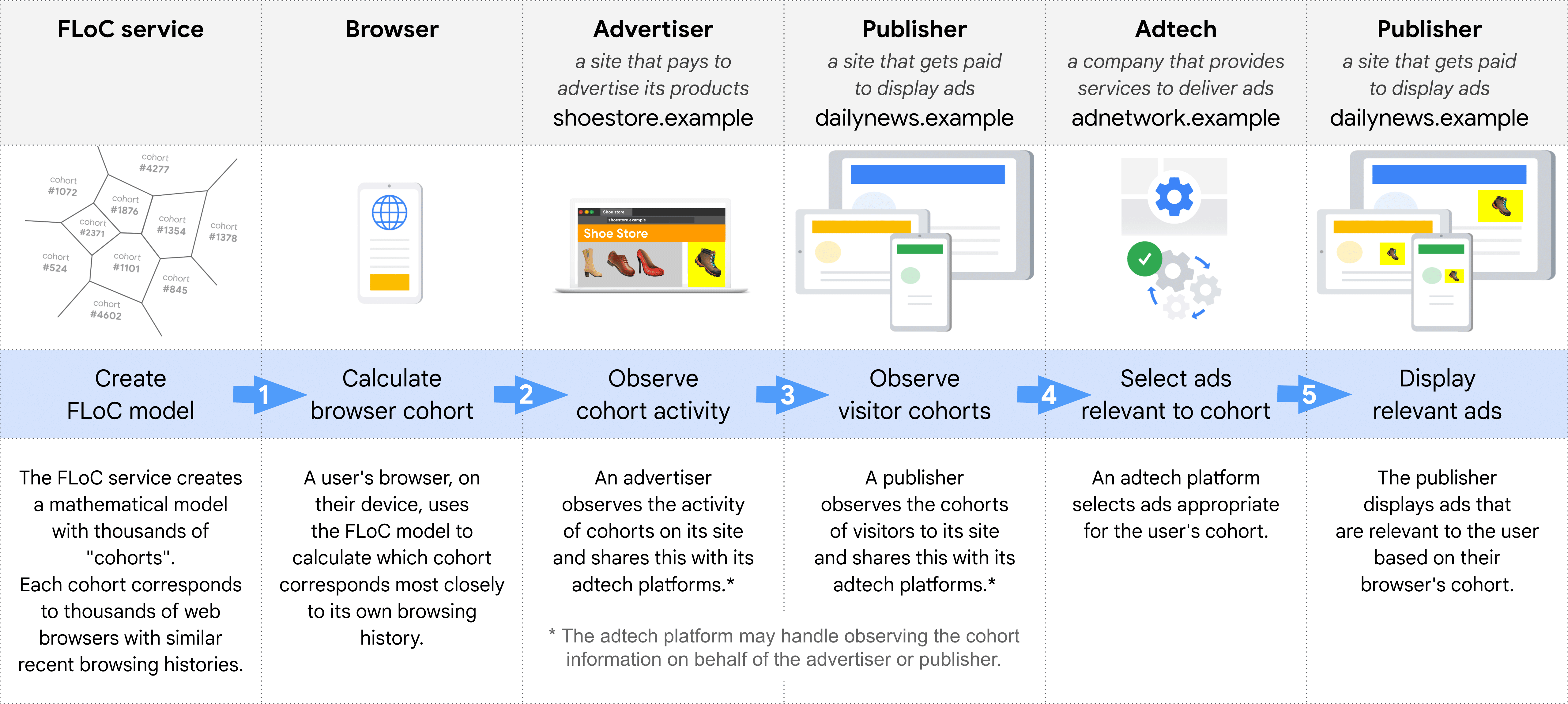
Google’s explanatory graphic for FLoC, or Federated Learning of Cohorts.
As Google developed its replacement for third-party cookies, the path grew trickier and the space more perilous. The Electronic Frontier Foundation described Google’s FLoC, or the “Federated Learning of Cohorts” that would let Chrome machine-learn your profile for sites and ads, as “A Terrible Idea.” The EFF was joined by Mozilla, Apple, WordPress, DuckDuckGo, and lots of browsers based on Chrome’s core Chromium code in being either opposed or non-committal to FLoC. Google pushed back testing FLOC until late 2022 and third-party cookie removal (and thereby FLoC implementation) until mid-2023.
By early 2022, FLoC didn’t have a path forward. Google pivoted to a Topics API, which would give users a bit more control over which topics (“Rock Music,” “Auto & Vehicles”) would be transmitted to potential advertisers. It would certainly improve over third-party cookies, which are largely inscrutable in naming and offer the user only one privacy policy: block them, or delete them all and lose lots of logins.
https://arstechnica.com/?p=2038576
Apple “clearly underreporting” child sex abuse, watchdogs say
After years of controversies over plans to scan iCloud to find more child sexual abuse materials (CSAM), Apple abandoned those plans last year. Now, child safety experts have accused the tech giant of not only failing to flag CSAM exchanged and stored on its services—including iCloud, iMessage, and FaceTime—but also allegedly failing to report all the CSAM that is flagged.
The United Kingdom’s National Society for the Prevention of Cruelty to Children (NSPCC) shared UK police data with The Guardian showing that Apple is “vastly undercounting how often” CSAM is found globally on its services.
According to the NSPCC, police investigated more CSAM cases in just the UK alone in 2023 than Apple reported globally for the entire year. Between April 2022 and March 2023 in England and Wales, the NSPCC found, “Apple was implicated in 337 recorded offenses of child abuse images.” But in 2023, Apple only reported 267 instances of CSAM to the National Center for Missing & Exploited Children (NCMEC), supposedly representing all the CSAM on its platforms worldwide, The Guardian reported.
Large tech companies in the US must report CSAM to NCMEC when it’s found, but while Apple reports a couple hundred CSAM cases annually, its big tech peers like Meta and Google report millions, NCMEC’s report showed. Experts told The Guardian that there’s ongoing concern that Apple “clearly” undercounts CSAM on its platforms.
Richard Collard, the NSPCC’s head of child safety online policy, told The Guardian that he believes Apple’s child safety efforts need major improvements.
“There is a concerning discrepancy between the number of UK child abuse image crimes taking place on Apple’s services and the almost negligible number of global reports of abuse content they make to authorities,” Collard told The Guardian. “Apple is clearly behind many of their peers in tackling child sexual abuse when all tech firms should be investing in safety and preparing for the rollout of the Online Safety Act in the UK.”
Outside the UK, other child safety experts shared Collard’s concerns. Sarah Gardner, the CEO of a Los Angeles-based child protection organization called the Heat Initiative, told The Guardian that she considers Apple’s platforms a “black hole” obscuring CSAM. And she expects that Apple’s efforts to bring AI to its platforms will intensify the problem, potentially making it easier to spread AI-generated CSAM in an environment where sexual predators may expect less enforcement.
“Apple does not detect CSAM in the majority of its environments at scale, at all,” Gardner told The Guardian.
Gardner agreed with Collard that Apple is “clearly underreporting” and has “not invested in trust and safety teams to be able to handle this” as it rushes to bring sophisticated AI features to its platforms. Last month, Apple integrated ChatGPT into Siri, iOS and Mac OS, perhaps setting expectations for continually enhanced generative AI features to be touted in future Apple gear.
“The company is moving ahead to a territory that we know could be incredibly detrimental and dangerous to children without the track record of being able to handle it,” Gardner told The Guardian.
So far, Apple has not commented on the NSPCC’s report. Last September, Apple did respond to the Heat Initiative’s demands to detect more CSAM, saying that rather than focusing on scanning for illegal content, its focus is on connecting vulnerable or victimized users directly with local resources and law enforcement that can assist them in their communities.
https://arstechnica.com/?p=2038409
Apple Vision Pro’s content drought improves with new 3D videos
Boundless premieres tonight, taking Vision Pro users on a hot air balloon ride in Turkey.
Submerged will be Apple’s first fictional short film for Vision Pro.
Users will get a glimpse into the 2024 NBA All-Star Weekend.
This cryptic image teases The Weeknd’s Vision Pro “experience.”
The new series Elevated will tour places of interest around the world from above.
Apple is partnering with Red Bull for a surfing documentary.
Wild Life returns with an episode about elephants in a wildlife preserve.
Today, Apple announced a slate of more than a dozen upcoming Immersive Videos for its Vision Pro spatial reality headset. The first, titled Boundless, launches tonight at 9 pm ET. More will follow in the coming weeks and months.
The announcement follows a long, slow period for new Vision Pro-specific video content from Apple. The headset launched in early February with a handful of Immersive Video episodes ranging from five to 15 minutes each. Since then, only three new videos have been added.
On March 28, Apple released a highlight reel of Major League Soccer plays from the season that had ended months prior. A second episode of Prehistoric Planet, Apple’s Immersive Video dinosaur nature documentary, went live on April 19. Likewise, a new episode of the Adventure series titled “Parkour” landed on May 24.
The MLS video played more like a short ad for Apple’s MLS programming than anything else, but other Immersive Videos have impressed with their quality if not their creative ambition. They’re all short videos that put the viewer inside a moment in space and time with either animals or people doing their thing. The videos are high-resolution, and the 3D is generally well done. The production values are high, even if the narratives are light. They come across as tech demos, as much as anything, but they are impressive.
Tonight’s Boundless episode will allow viewers to see what it’s like to ride in a hot air balloon over sweeping vistas. Another episode titled “Arctic Surfing” will arrive this fall, Apple says. Sometime next month, Apple will publish the second episode of its real wildlife documentary, simply titled Wild Life. The episode will focus on elephants in Kenya’s Sheldrick Wildlife Trust. Another episode is in the works, too. “Later this year,” Apple writes in its newsroom post, “viewers will brave the deep with a bold group of divers in the Bahamas, who come face-to-face with apex predators and discover creatures much more complex than often portrayed.”
More on the way
In September, we’ll see the debut of a new Immersive Video series titled Elevated. Apple describes it as an “aerial travel series” in which viewers will fly over places of interest. The first episode will take viewers to Hawaii, while another planned for later this year will go to New England.
Apple is additionally partnering with Red Bull for a look at surfing called Red Bull: Big-Wave Surfing.
In addition to those documentary episodes, there will be three short films by year’s end. One will be a musical experience featuring The Weeknd, and another will take basketball fans inside the 2024 NBA All-Star Weekend. There will also be Submerged, the first narrative fictional Immersive Video on the platform. It’s an action short film depicting struggles on a submarine during World War II.
It’s good to see Apple finally making some movement here; the drought of content after the launch didn’t inspire confidence in the platform. Many people with mixed reality headsets use them a bunch for a few weeks but either fail to find ways to fit them into their daily habits or run out of compelling content and taper off before long. To keep people invested in visionOS, Apple needs to keep a rapid cadence of new content that users look forward to at least every week. Otherwise, some users will see their headsets sit on shelves, forgotten.
When I reviewed the Vision Pro, I assumed that the Immersive Video episodes would roll out weekly. That hasn’t proven the case, and it still doesn’t look like it will. Apple is going to have to invest more in content (and take more risks with that content, moving beyond short tech demo documentaries) to make the Vision Pro stick with customers.
Apple releases public betas of all next-gen OS updates, except for VisionOS
Apple’s next-generation operating systems are taking their next step toward release today: Apple is issuing the first public beta builds of iOS 18, iPadOS 18, macOS 15 Sequoia, tvOS 18, and HomePod Software 18 today. Sign up for Apple’s public beta program with your Apple ID, and you’ll be able to select the public beta builds from Software Update in the Settings app.
We covered the highlights of most of these releases when they were announced during Apple’s Worldwide Developers Conference in June, including more home screen customization in iOS and iPadOS, window tiling and iPhone mirroring in macOS,RCS text messaging support across all of Apple’s platforms, and more. But Apple still isn’t ready to show off a preview of its Apple Intelligence AI features, including the text and image generation features and a revamped Siri. Many of these features are still slated for “later this summer” and will presumably be available in some form in the final releases this fall.
Most devices that can run iOS 17, iPadOS 17, and macOS 14 Sonoma will be able to update to the new versions, including owners of the last couple generations of Intel Macs. But a handful of older phones and tablets and the 2018 MacBook Air are being dropped by the new releases. The watchOS 11 update is also dropping the Series 4 and Series 5 models as well as the first-generation Apple Watch SE.
Apple is also not releasing a public beta build of VisionOS 2, the first major update to the Apple Vision Pro’s operating system. Users who want to try out new Vision Pro features ahead of time will still need to opt in to the developer beta, at least for now.
Beta best practices
The first public betas are similar—if not identical—to the third developer beta builds that were released last week. Apple usually releases new developer betas of next-gen OS releases every two weeks, so we’d expect to see a fourth developer beta early next week and a second near-identical public beta build released shortly after.
Apple’s developer and public beta builds used to be more clearly delineated, with a $99-per-year developer account paywall put up between general users and the earliest, roughest preview builds. That changed last year when Apple made basic developer accounts (and beta software access) free for anyone who wanted to sign up.
Apple still issues separate developer/public beta builds, but these days it’s more of a statement about who the betas are ready for than an actual technical barrier. Developer betas are rougher and visibly unfinished, but developers likely have the extra patience and technical chops needed to deal with these issues; public betas are still unfinished and unstable, but you can at least expect most basic functionality to work fine.
Regardless of how stable these betas may or may not be, the standard warnings apply: Make a good backup of your device before updating in case you need to restore the older, more stable operating system, and don’t install beta software on mission-critical hardware that you absolutely need to work correctly in your day-to-day life. For iPhones and iPads that connect to iCloud, connecting the devices to a PC or Mac and performing a local backup (preferably an encrypted one) can be a more surefire way to make sure you keep a pre-upgrade backup around than relying on continuous iCloud backups.
https://arstechnica.com/?p=2037128
PC emulator comes to iOS, but Apple’s restrictions hamper performance
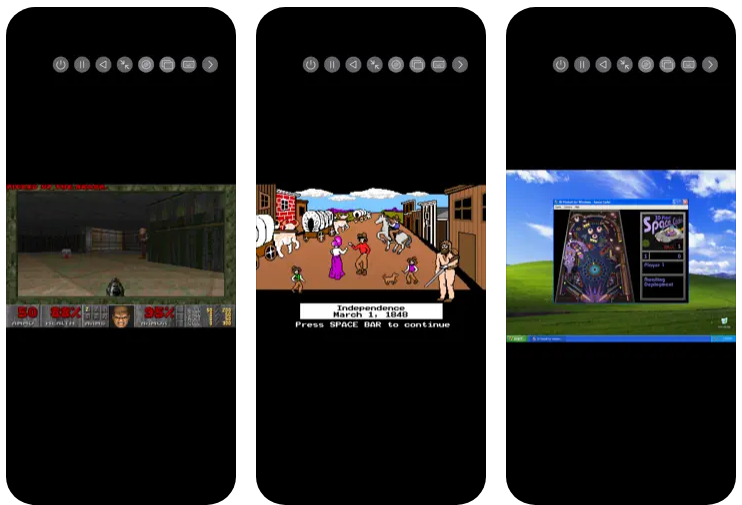
One month after PC emulator UTM was rejected from the iOS App Store, the developers have announced that a new “UTM SE” version is now available for free on the App Store. But the app’s performance is severely hampered by Apple’s restrictions on so-called “just-in-time” (JIT) compilation, limiting the app’s suitability for effectively emulating many PC games.
Built on the generic command-line emulation layer QEMU, the open-source UTM boasts support for “30+ processors,” from x86 and PowerPC to RISC-V and ARM64. The App Store listing promises you can “run classic software and old-school games” through both a VGA graphics mode and text-based terminal.
Don’t expect a seamless, RetroArch-style path to playing Space Cadet Pinball on your iPhone, though. The UTM developers link to pre-configured settings downloads for versions of Windows going back to XP, alongside guides for getting those OSes up and running on iOS. But users will need to bring their own legitimate Windows installation ISO and go through the cumbersome process of installing the OS as well as a version of SPICE tools to help coordinate access through iOS (downloading pre-built, UTM-compatible Linux builds seems more straightforward).
New app releases for Apple Vision Pro have fallen dramatically since launch
Samuel Axon
Apple is struggling to attract fresh content for its innovative Vision Pro headset, with just a fraction of the apps available when compared with the number of developers created for the iPhone and iPad in their first few months.
The lack of a “killer app” to encourage customers to pay upwards of $3,500 for an unproven new product is seen as a problem for Apple, as the Vision Pro goes on sale in Europe on Friday.
Apple said recently that there were “more than 2,000” apps available for its “spatial computing” device, five months after it debuted in the US.
That compares with more than 20,000 iPad apps that had been created by mid-2010, a few months after the tablet first went on sale, and around 10,000 iPhone apps by the end of 2008, the year the App Store launched.
“The overall trajectory of the Vision Pro’s launch in February this year has been a lot slower than many hoped for,” said George Jijiashvili, analyst at market tracker Omdia.
“The reality is that most developers’ time and money will be dedicated to platforms with billions of users, rather than tens or hundreds of thousands.”
Apple believes the device will transform how millions work and play. The headset shifts between virtual reality, in which the wearer is immersed in a digital world, and a version of “augmented reality” that overlays images upon the real surroundings.
Omdia predicts that Apple will sell 350,000 Vision Pros this year. It forecasts an increase to 750,000 next year and 1.7 million in 2026, but the figures are far lower than the iPad, which sold almost 20 million units in its first year.
Estimates from IDC, a tech market researcher, suggest Apple shipped fewer than 100,000 units of Vision Pro in the first quarter, less than half what rival Meta sold of its Quest headsets.
Because of the device’s high price, Apple captured more than 50 percent of the total VR headset market by dollar value, IDC found, but analyst Francisco Jeronimo added: “The Vision Pro’s success, regardless of its price, will ultimately depend on the content available.”
Early data suggests that new content is arriving slowly. According to Appfigures, which tracks App Store listings, the number of new apps launched for the Vision Pro has fallen dramatically since January and February.
Nearly 300 of the top iPhone developers, whose apps are downloaded more than 10 million times a year—including Google, Meta, Tencent, Amazon, and Netflix—are yet to bring any of their software or services to Apple’s latest device.
Steve Lee, chief executive of AmazeVR, which offers immersive concert experiences, said that the recent launch of the device in China and elsewhere in Asia resulted in an uptick in downloads of his app. “However, it was about one-third of the initial launch in the United States.”
Lee remains confident that Vision Pro will eventually become a mainstream consumer product.
Wamsi Mohan, equity analyst at Bank of America, said the Vision Pro had “just not quite hit the imagination of the consumer.”
“This is one of the slower starts for a new Apple product category, just given the price point,” he said. “It seems management is emphasizing the success in enterprise a lot more.”
Nonetheless, some app developers are taking a leap of faith and launching on the Vision Pro. Some are betting that customers who can afford the pricey headset will be more likely to splurge on software, too.
Others are playing a longer game, hoping that establishing an early position on Apple’s newest platform will bring returns in the years to come.
https://arstechnica.com/?p=2036823
Microsoft ed Apple lasciano il Cda di OpenAI
Microsoft lascia il Cda di OpenAI, non più necessari il ruolo di osservatore
Le due Big Tech lasciano il proprio posto all’interno del Consiglio di amministrazione di OpenAI, la società che ha sviluppato il celebre ChatGPT.
Microsoft, dopo otto mesi dal suo ingesso nel Cda (senza diritto di voto), legato al reintegro di Sam Altman in OpenAI, ha improvvisamente annunciato la sua uscita.
Stando a quanto riportato dal Financial Times e da Axios, il vicedirettore generale di Microsoft, Keith Dolliver, avrebbe spiegato la mossa in questi termini: “Negli ultimi otto mesi abbiamo assistito a progressi significativi da parte del consiglio di amministrazione di recente formazione e siamo fiduciosi nella direzione intrapresa dall’azienda”.
Nella lettera inviata alla Fondazione, Microsoft avrebbe precisato che, “dato tutto questo, non crediamo più che il nostro ruolo limitato di osservatori sia necessario“, stabilendo il ritiro dal posto di osservatore “con effetto immediato”.
Secondo fonti del Times, il gigante di Cupertino avrebbe declinato l’incarico, che sarebbe spettato a Phil Schiller, responsabile dell’App Store di Apple.
In particolare, la Ftc sta indagando la Big Tech con sede a Redmond, nello Stato di Washington, sull’accordo di acquisto della startup di AI Inflection, ma anche sugli investimenti di Amazon e Google in Anthropic, concorrente diretto di ChatGpt di OpenAI.