Apple’s M3 MacBook Pro is, belatedly, fixing its one-external-display limitation
Enlarge/ Apple’s M3 MacBook Pro should be able to drive a pair of external displays soon, as long as the lid is closed.
One long-standing limitation of Apple’s most basic Mac chips—the no-adjective M1, M2, and M3—has been their inability to work with more than a single external monitor at a time. This was one of the only ways in which the Apple Silicon era has been a step back from the Intel era, where most Macs supported at least two external displays, plus the screen built into the MacBook Air or Pro you were using. (Would an integrated Intel GPU actually work well with that many screens connected? Usually not. But at least you could try.)
When Apple launched the M3 version of the MacBook Pro last fall, the one-external-display limitation was still in place. But today’s announcement of the M3 MacBook Air came with a small but pleasant surprise for anyone who wants their Mac to do double-duty as a laptop and a desktop—if the laptop’s lid is closed, the M3 can now run a pair of external displays over its Thunderbolt ports. And Apple confirmed to 9to5Mac that the 14-inch M3 MacBook Pro would have the same functionality enabled via a future macOS update (we’ve asked Apple to verify whether it’s coming in the imminent macOS 14.4 update or at some future date).
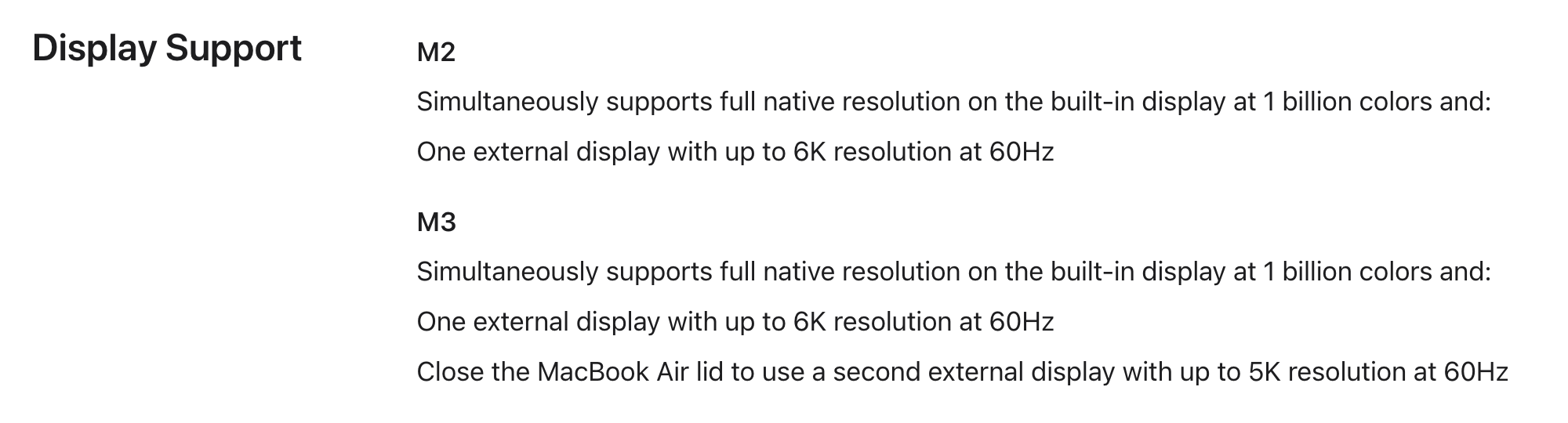
Enlarge/ Apple’s spec page for the new M3 Airs explains its newfound multi-display support.
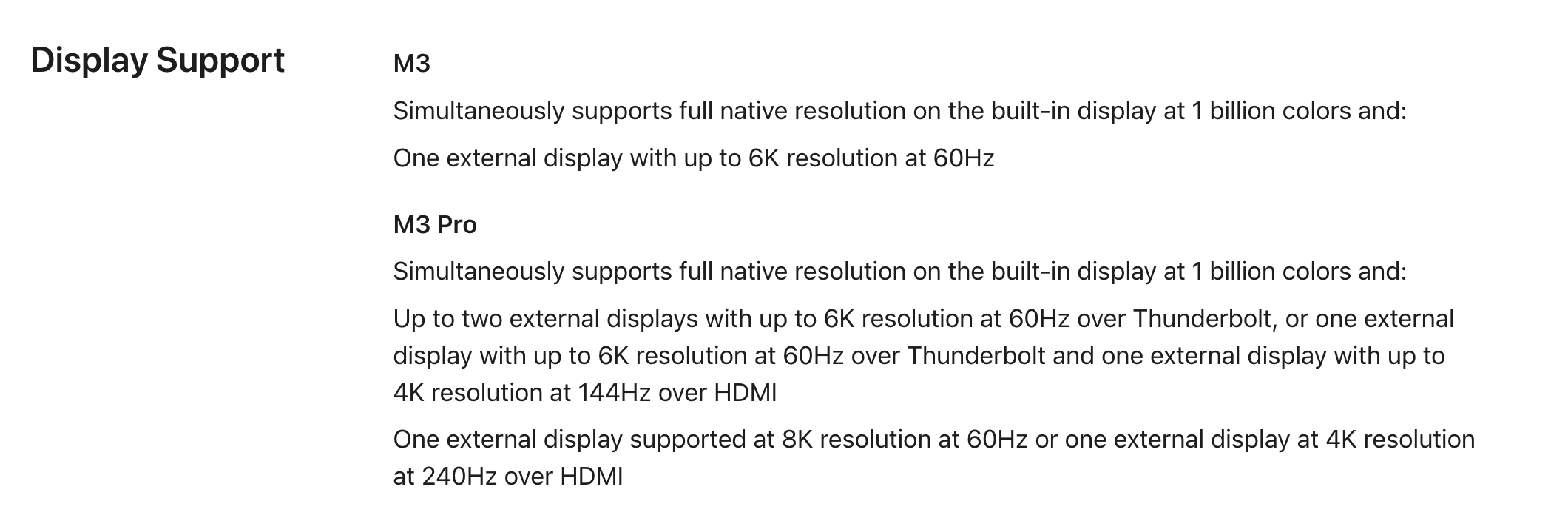
Enlarge/ As of this writing, the M3 MacBook Pro’s spec sheet still doesn’t mention support for a second external display.
Apple’s spec sheets say that the M3 can drive one 6K display at 60 Hz and one additional 5K display at 60 Hz when your laptop’s lid is closed. The M3 MacBook Pro’s spec sheet still hasn’t been updated as of this writing, but we would expect it to be at some point after the relevant software update is released.
This is a welcome change from the M1 and M2, which can still only work with one external display whether the lid is closed or not. Each of those chips can drive a total of two screens at a time, the same as the M3, but the internal display always counts toward the total whether it’s actually in use or not.
This change makes the M3 MacBook Airs and Pros a bit more like the Mac mini, which has always supported a pair of external displays by virtue of having no built-in screen. The M1 Mac mini supports a single USB-C/Thunderbolt display plus one HDMI display, and the M2 version also adds the ability to use a pair of USB-C/Thunderbolt displays. It’s unlikely that a software update will add support for multiple external displays to the M1 or M2 MacBook Airs, but we’ve asked Apple if it has any news to share one way or the other.
https://arstechnica.com/?p=2007608
Apple rivede i piani, niente auto elettrica meglio l’IA
Auto elettrica a guida autonoma Apple, cancellata o rinviata?
Addio, o forse arrivederci al progetto Titan della Apple. Dopo un decennio almeno di grandi annunci, salti in avanti e passi indietro, sembra che stavolta Cupertino abbia messo una grande pietra sopra il progetto di veicoli elettrici a guida autonoma marchiati con la mela.
Bloomberg News ha riportato che la decisione di fermare i lavori sul progetto Titan è stata annunciata dal COO Apple, Jeff Williams, e dal vicepresidente responsabile del progetto stesso, Kevin Lynch, durante una riunione interna.
Intanto 2mila dipendenti sono stati spostati su progetti IA e machine learning
Centinaia di dipendenti (circa 2.000) saranno spostati in altri reparti, soprattutto quelli dedicati allo sviluppo dell’intelligenza artificiale (IA) e soluzioni di machine learning. Dal 2017 ad oggi Apple ha acquisito oltre 20 startup specializzate in queste tecnologie.
Non si sa se sia uno stop definitivo all’auto elettrica a guida autonoma Apple o un rinvio. A gennaio, sempre secondo Bloomberg, si parlava di un rinvio del progetto dal 2026 al 2028, con possibile ribasso del prezzo di vendita sul mercato dei veicoli da 120 mila a 100 mila dollari.
Grandi investimenti, margini bassi
Progettare, sviluppare e realizzare questo tipo di automobili ad alto contenuto tecnologico, come quelli immaginati a Cupertino, non è una cosa semplice e soprattutto richiede grandi investimenti.
La Big Tech americana è abituata ad elevati livelli di redditività nei settori economici di competenza, quello dei veicoli elettrici è un mercato che non regala gli stessi risultati, se non nel lungo termine. L’industria automobilistica, in generale, offre margini bassi a fronte di un’elevatissima concorrenza.
L’ironia di Elon Musk
Il CEO di Tesla, Elon Musk, ha postato sul social X la notizia, ovviamente a modo suo commentando la scelta Apple.
Apple nega il supporto alle web app in Europa con l’aggiornamento iOS 17.4. Indagine Ue
Lo stop di Apple alle applicazioni web progressive, Antitrust Ue in azione
A partire da marzo 2024 la Apple interromperà il supporto alle applicazioni web per home page, o progressive web app (pwa).
È quanto riportato da diversi media internazionali, mentre secondo il Finantial Times le autorità di regolamentazione dell’Unione europea potrebbero presto avviare un’indagine sulle decisioni di Cupertino in Europa.
Bruxelles vuole infatti vederci chiaro e ha già invitato Apple e gli sviluppatori a valutare meglio l’impatto che tale cambiamento potrà avere sull’ecosistema digitale europeo.
L’interruzione del supporto alle pwa riguarda l’aggiornamento iOS 17.4 relativo al mercato europeo.
Perché Apple potrebbe violare il Digital markets act che entrerà in vigore tra una settimana
Le progressive web app sono una soluzione ibrida tra piattaforme mobile e web, sostanzialmente sono applicazioni per desktop che possono essere anche caricate sulla schermata iniziale dell’iPhone e da qui avviate in qualsiasi momento.
Apple vuole trasformare queste applicazioni ibride in semplici segnalibri del browser, cioè attivabili solo avviando Safari. Una mossa che certamente limiterebbe in maniera decisa l’esperienza utente. Forse c’era il timore che le pwa potessero diventare nel tempo una valida alternativa alle app native dello store di casa.
Secondo quanto riportato da qz.com, Apple ha dichiarato di aver preso questa decisione per conformarsi al nuovo Digital markets act (Dma) europeo, che mira a regolamentare le grandi piattaforme, i gatekeeper dei mercati online, tra cui c’è ovviamente l’App Store.
L’UE vuole vederci chiaro
Il Dma ha il compito di rendere il mercato digitale europeo più competitivo, aperto alla libera concorrenza e quindi anche ai piccoli operatori.
Aprire le pwa a terze parti sarebbe stato troppo pericoloso per il trattamento dei dati privati degli utenti, secondo Apple, correndo anche il rischio di violare il Dma.
La Commissione europea vuole comunque capire fino in fondo se Apple, con questa decisione, sia ancora conforme o no alla legge. Per intervenire e modificare le scelte prese da Cupertino c’è tempo fino al 6 marzo, data di entrata in vigore delle nuove regole.
Big Tech is extremely unimpressed by Apple’s EU App Store changes
Apple is coming under fire from rivals Meta and Microsoft who say its plans to open up its mobile software to comply with a landmark EU law fail to go far enough, as the iPhone maker faces unprecedented regulatory challenges from Brussels over the coming month.
EU regulators, who are preparing to fine the tech giant 500 million euros in March over allegedly favoring its music-streaming app against competitors like Spotify, are also being lobbied to reject Apple’s proposals to satisfy the bloc’s Digital Markets Act.
The growing backlash against Apple comes as it is forced to make some of the biggest changes to its business model in years, following concerns over the dominance of its App Store, which forms a large share of the company’s $85 billion-a-year services business.
Apple announced last month it will make changes to its iOS mobile software in Europe, such as allowing users to download apps from other sources and access alternative payment systems.
The changes were offered ahead of the EU’s March 7 deadline for companies to declare how they will adhere to the DMA, which aims to tackle the market power of Big Tech groups.
The proposal leaves developers with a dilemma: stick with Apple’s existing ecosystem and fees, or leave permanently and face new terms.
For those who choose to also build apps in alternative stores, Apple said it would cut the highest amount paid by companies using its App Store to sell digital goods and services from 30 percent to 17 percent.
But it will add a series of new charges. These include a “core technology fee” of 50 cents on every download or update of apps with more than 1 million downloads. Apple will also charge an additional 3 percent fee to app developers that use its payment processor. The 50-cent fee will apply immediately to downloads of alternative app stores.
Critics contend that the changes could lead makers of successful apps being charged far more than they currently are, while removing any incentive for rivals to create alternative app stores.
“The initial steps [to comply with the DMA] that Apple has put forward are very prohibitive to us actually creating a meaningful alternative to the one store that’s available on the world’s largest gaming platforms, which are mobile phones,” Phil Spencer, Microsoft’s gaming chief, told the Financial Times. “So we will continue to work with regulators to open that up.”
Meta chief executive Mark Zuckerberg has also dismissed Apple’s proposal as “onerous” and “at odds” with the intent of the EU regulation, saying he would be surprised “if any developer chose to go into the alternative app stores.”
After Apple’s announcement, “it took about an hour for app developers to realize they had been screwed,” said Damien Geradin, a lawyer for developers critical of Apple. “Pretty much everyone will stick to the old terms and the DMA will effectively make no difference,” he added.
“What the European Commission is saying to people is: ‘please help us, give us examples of where it doesn’t work,’” said Geradin. The March deadline, he said, would mark the beginning of a new back and forth between the EU and Apple.
Apple said it spent “months in conversation with the European Commission” about the DMA and that its plan reflects the work of “hundreds of Apple team members who spent tens of thousands of hours” on the solution.
The growing backlash has left the European Commission, the EU’s executive arm, with the dilemma of deciding whether years of work on the new legislation aimed at digital “gatekeepers” has had its desired effect on Apple—and whether it can sanction the company for failing to comply.
The EU said the bloc can launch a non-compliance procedure against any company covered by the DMA as soon as the March deadline expires. The law allows the EU to fine companies up to 10 percent of annual turnover, rising to 20 percent in repeat cases.
Apple chief executive Tim Cook said on an earnings call this month that it was “very difficult” to quantify the impact the DMA changes would have on the company’s bottom line.
Meta and Microsoft are also hit by the DMA but spot an opportunity to grab a greater share of the around $27 billion Apple made in 2023 from App Store sales, according to data from Sensor Tower. Europe generates 7 percent of those revenues.
The companies are seeking to challenge Apple in other ways. Two years ago, Apple extended its commission fees to also take a 30 percent cut from marketers who pay to get their advert featured more prominently within apps such as Instagram.
Meta last week said it would now start passing on the 30 percent charge directly to advertisers, in effect making it more expensive to reach Apple device users.
Nicholas Rodelli at CFRA Research said Meta’s move was a “direct challenge” to Apple’s policies, with tech companies now “going on the offensive” to exploit the iPhone maker’s new regulatory vulnerabilities.
Spotify and Epic Games, longtime Apple critics, have also argued Apple’s proposed moves amount to an act of bad faith. Gary Swidler, president of Match Group, which owns Tinder, said the EU’s acceptance of Apple’s plan is “far from assured.”
Independent analyst Eric Seufert said that Apple was “feeling around for what they will be allowed to do under the DMA.”
He added: “The question is whether the European Commission accepts this—which I believe they will not.”
Report: Apple is about to be fined €500 million by the EU over music streaming
Brussels is to impose its first-ever fine on tech giant Apple for allegedly breaking EU law over access to its music streaming services, according to five people with direct knowledge of the long-running investigation.
The fine, which is in the region of €500 million and is expected to be announced early next month, is the culmination of a European Commission antitrust probe into whether Apple has used its own platform to favor its services over those of competitors.
The probe is investigating whether Apple blocked apps from informing iPhone users of cheaper alternatives to access music subscriptions outside the App Store. It was launched after music-streaming app Spotify made a formal complaint to regulators in 2019.
The Commission will say Apple’s actions are illegal and go against the bloc’s rules that enforce competition in the single market, the people familiar with the case told the Financial Times. It will ban Apple’s practice of blocking music services from letting users outside its App Store switch to cheaper alternatives.
Brussels will accuse Apple of abusing its powerful position and imposing anti-competitive trading practices on rivals, the people said, adding that the EU would say the tech giant’s terms were “unfair trading conditions.”
It is one of the most significant financial penalties levied by the EU on Big Tech companies. A series of fines against Google levied over several years and amounting to about 8 billion euros are being contested in court.
Apple has never previously been fined for antitrust infringements by Brussels, but the company was hit in 2020 with a 1.1 billion-euro fine in France for alleged anti-competitive behavior. The penalty was revised down to 372 million euros after an appeal.
The EU’s action against Apple will reignite the war between Brussels and Big Tech at a time when companies are being forced to show how they are complying with landmark new rules aimed at opening competition and allowing small tech rivals to thrive.
Companies that are defined as gatekeepers, including Apple, Amazon, and Google, need to fully comply with these rules under the Digital Markets Act by early next month.
The act requires these tech giants to comply with more stringent rules and will force them to allow rivals to share information about their services.
There are concerns that the rules are not enabling competition as fast as some had hoped, although Brussels has insisted that changes require time.
Brussels formally charged Apple in the anti-competitive probe in 2021. The commission narrowed the scope of the investigation last year and abandoned a charge of pushing developers to use its own in-app payment system.
Apple last month announced changes to its iOS mobile software, App Store, and Safari browser in efforts to appease Brussels after long resisting such steps. But Spotify said at the time that Apple’s compliance was a “complete and total farce.”
Apple responded by saying that “the changes we’re sharing for apps in the European Union give developers choice—with new options to distribute iOS apps and process payments.”
In a separate antitrust case, Brussels is consulting with Apple’s rivals over the tech giant’s concessions to appease worries that it is blocking financial groups from its Apple Pay mobile system.
The timing of the Commission’s announcement has not yet been fixed, but it will not change the direction of the antitrust investigation, the people with knowledge of the situation said.
Apple, which can appeal to the EU courts, declined to comment on the forthcoming ruling but pointed to a statement a year ago when it said it was “pleased” the Commission had narrowed the charges and said it would address concerns while promoting competition.
It added: “The App Store has helped Spotify become the top music streaming service across Europe and we hope the European Commission will end its pursuit of a complaint that has no merit.”
The Commission—the executive body of the EU—declined to comment.
Apple disables iPhone web apps in EU, says it’s too hard to comply with rules
Getty Images | NurPhoto
Apple is removing the ability to install home screen web apps from iPhones and iPads in Europe when iOS 17.4 comes out, saying it’s too hard to keep offering the feature under the European Union’s new Digital Markets Act (DMA). Apple is required to comply with the law by March 6.
Apple said the change is necessitated by a requirement to let developers “use alternative browser engines—other than WebKit—for dedicated browser apps and apps providing in-app browsing experiences in the EU.” Apple explained its stance in a developer Q&A under the heading, “Why don’t users in the EU have access to Home Screen web apps?” It says:
Addressing the complex security and privacy concerns associated with web apps using alternative browser engines would require building an entirely new integration architecture that does not currently exist in iOS and was not practical to undertake given the other demands of the DMA and the very low user adoption of Home Screen web apps. And so, to comply with the DMA’s requirements, we had to remove the Home Screen web apps feature in the EU.
It will still be possible to add website bookmarks to iPhone and iPad home screens, but those bookmarks would take the user to the web browser instead of a separate web app. The change was recently rolled out to beta versions of iOS 17.4.
The Digital Markets Act targets “gatekeepers” of certain technologies such as operating systems, browsers, and search engines. It requires gatekeepers to let third parties interoperate with the gatekeepers’ own services, and prohibits them from favoring their own services at the expense of competitors. As 9to5Mac notes, allowing home screen web apps with Safari but not third-party browser engines might cause Apple to violate the rules.
Apple warns of “malicious web apps”
As Apple explains, iOS “has traditionally provided support for Home Screen web apps by building directly on WebKit and its security architecture. That integration means Home Screen web apps are managed to align with the security and privacy model for native apps on iOS, including isolation of storage and enforcement of system prompts to access privacy impacting capabilities on a per-site basis.”
Apple said it won’t be able to guarantee this isolation once alternative browser engines are supported. “Without this type of isolation and enforcement, malicious web apps could read data from other web apps and recapture their permissions to gain access to a user’s camera, microphone or location without a user’s consent. Browsers also could install web apps on the system without a user’s awareness and consent,” Apple’s FAQ said.
Despite the change, Apple said that “EU users will be able to continue accessing websites directly from their Home Screen through a bookmark with minimal impact to their functionality.”
Apple previously announced that its DMA compliance will bring sideloading to Europe, allowing developers to offer iOS apps from stores other than Apple’s official App Store.
Browser choice, security requirements
One browser-related change will be immediately obvious to EU users once they install the new iOS version. “When users in the EU first open Safari on iOS 17.4, they’ll be prompted to choose their default browser and presented with a list of the main web browsers available in their market to select as their default browser,” Apple’s developer FAQ said.
Apple said it had to prepare carefully for the requirement to let developers use alternative browser engines because browser engines “are constantly exposed to untrusted and potentially malicious content and have visibility into sensitive user data,” making them “one of the most common attack vectors for malicious actors.”
Apple said it is requiring developers who use alternative browser engines to meet certain security standards:
To help keep users safe online, Apple will only authorize developers to implement alternative browser engines after meeting specific criteria and committing to a number of ongoing privacy and security requirements, including timely security updates to address emerging threats and vulnerabilities. Apple will provide authorized developers of dedicated browser apps access to security mitigations and capabilities to enable them to build secure browser engines, and access features like passkeys for secure user login, multiprocess system capabilities to improve security and stability, web content sandboxes that combat evolving security threats, and more.
Overall, Apple said its DMA preparations have involved “an enormous amount of engineering work to add new functionality and capabilities for developers and users in the European Union—including more than 600 new APIs and a wide range of developer tools.”
https://arstechnica.com/?p=2004114
Our unbiased take on Mark Zuckerberg’s biased Apple Vision Pro review
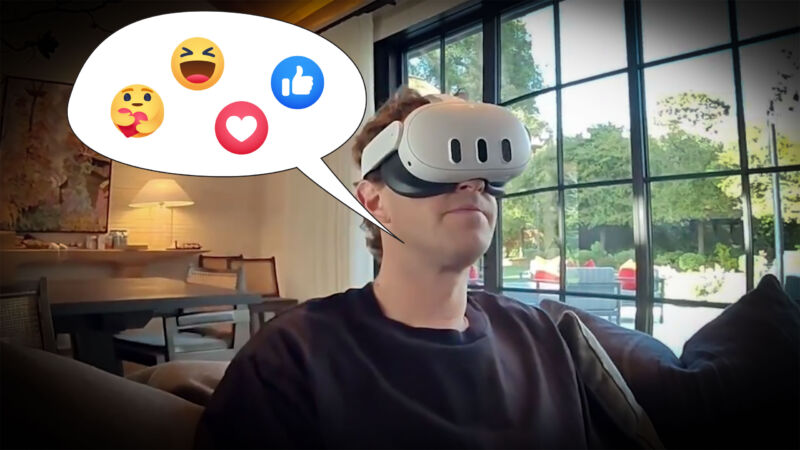
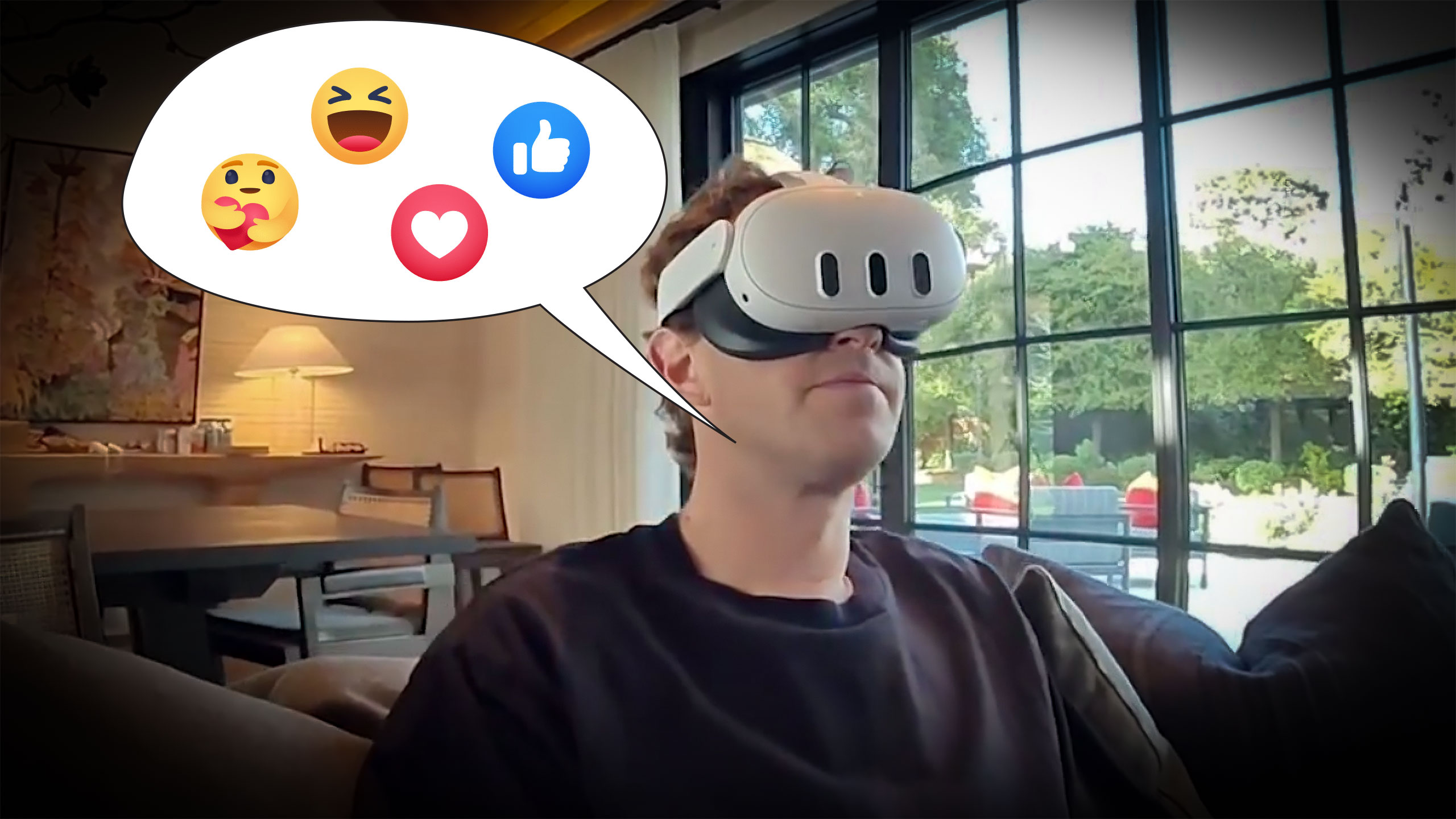
Enlarge/ No way would Zuckerberg be photographed wearing a Vision Pro, but let’s just imagine he’s looking at a picture of one in his headset here…
@zuck Instagram | Aurich Lawson
Since the launch of the Apple Vision Pro, it’s not been hard to find countless thoughts and impressions on the headset from professionalreviewers and random purchasers. But among all those hot takes, the opinions of Meta CEO Mark Zuckerberg stand out for a few reasons—not least of which is that he and his company have spent years of development time and lost tens of billions of dollars creating the competing Quest headset line.
For that reason alone, Zuckerberg’s Instagram-posted thoughts on the Vision Pro can’t be considered an impartial take on the device’s pros and cons. Still, Zuckerberg’s short review included its fair share of fair points, alongside some careful turns of phrase that obscure the Quest’s relative deficiencies.
To figure out which is which, we thought we’d consider each of the points made by Zuckerberg in his review. In doing so, we get a good viewpoint on the very different angles from which Meta and Apple are approaching mixed-reality headset design.
There’s “high-quality” and then there’s “high-quality”
Near the start of his analysis, Zuckerberg says that the “Quest 3 does high-quality passthrough with big screens, just like Vision Pro.” This is only true in the most technical sense. Saying both headsets have “high-quality passthrough” is like saying an old 720p LCD TV and a new 4K OLED both have “high-quality screens.”
Compared side by side, Apple’s array of cameras and higher-resolution displays combine for a much sharper and more dynamic view of the “real world” than the Quest 3, which barely limps over the “good enough” passthrough threshold, in my experience. That display quality extends to the “big screens” Zuckerberg mentions, too, which are noticeably clearer and easier to read on the Vision Pro.
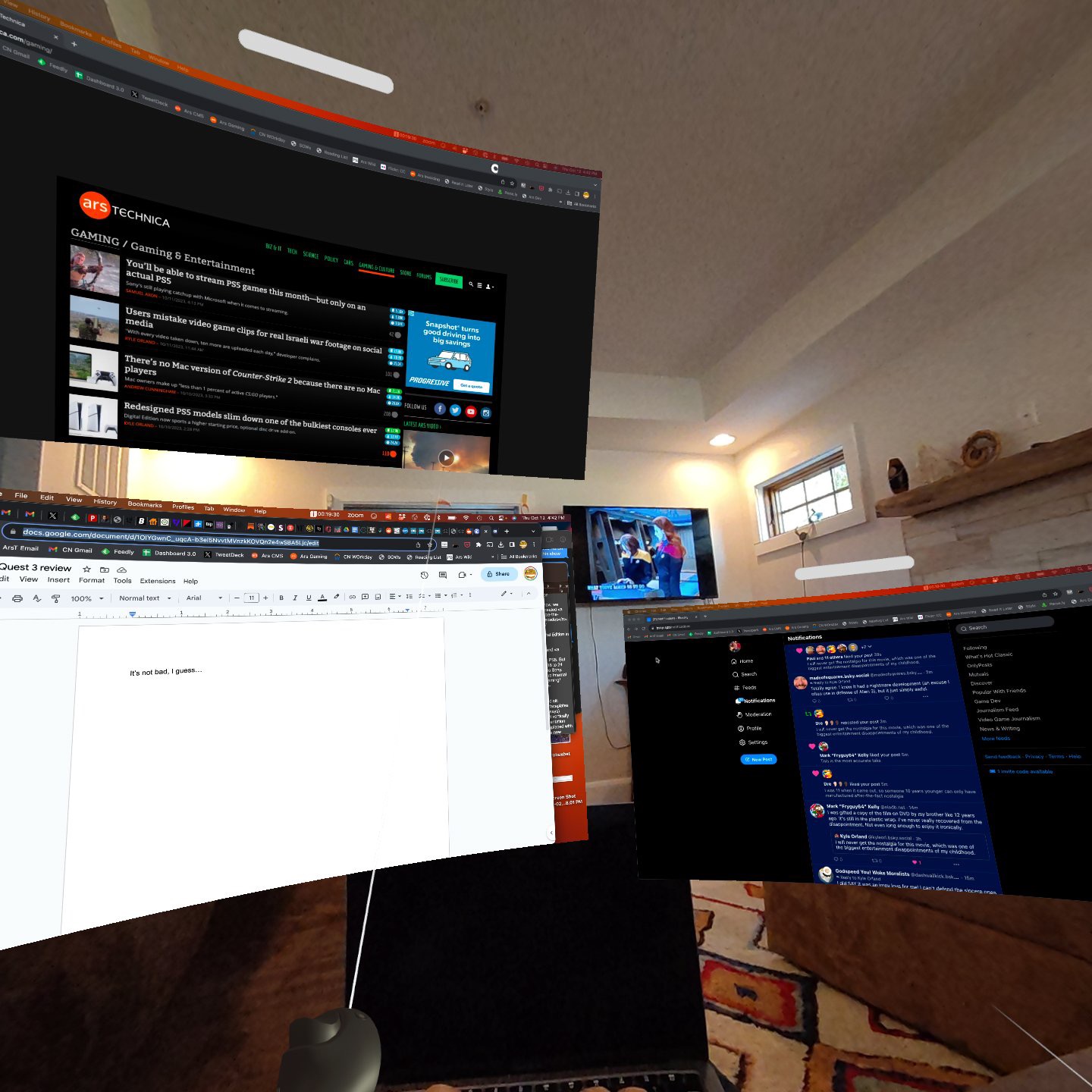
Enlarge/ A view of my mixed reality “office” in the Quest 3 app Immersed.
Speaking of those “big screens,” the experience with 2D virtual displays is quite different in both headsets. The Vision Pro seems built from the ground up with the ability to place and resize thousands of flat iOS apps anywhere around your virtual space. Those virtual windows react to the light in the room, cast gentle shadows in your virtual view, and get occluded by objects in the real world, adding to the sense that they are really “there” with you.
The Quest, on the other hand, was built more with immersive VR experiences in mind. Yes, recent Quest OS upgrades added the ability to snap selected flat apps and system tools (e.g., the store) into place in your Quest “home environment.” But the system-level “huge floating screens” experience is still much more limited than that on the Vision Pro, which offers easy free positioning and resizing of all sorts of apps. Quest users looking for something similar need to rely on a third-party tool like Virtual Desktop, which also has its own quirks and limitations.
https://arstechnica.com/?p=2003724
Asahi Linux project’s OpenGL support on Apple Silicon officially surpasses Apple’s
Enlarge/ Slowly but surely, the Asahi Linux team is getting Linux up and running on Apple Silicon Macs.
Apple/Asahi Linux
For around three years now, the team of independent developers behind the Asahi Linux project has worked to support Linux on Apple Silicon Macs, despite Apple’s total lack of involvement. Over the years, the project has gone from a “highly unstable experiment” to a “surprisingly functional and usable desktop operating system.” Even Linus Torvalds has used it to run Linux on Apple’s hardware.
The team has been steadily improving its open source, standards-conformant GPU driver for the M1 and M2 since releasing them in December 2022, and today, the team crossed an important symbolic milestone: The Asahi driver’s support for the OpenGL and OpenGL ES graphics have officially passed what Apple offers in macOS. The team’s latest graphics driver fully conforms with OpenGL version 4.6 and OpenGL ES version 3.2, the most recent version of either API. Apple’s support in macOS tops out at OpenGL 4.1, announced in July 2010.
Developer Alyssa Rosenzweig wrote a detailed blog post that announced the new driver, which had to pass “over 100,000 tests” to be deemed officially conformant. The team achieved this milestone despite the fact that Apple’s GPUs don’t support some features that would have made implementing these APIs more straightforward.
“Regrettably, the M1 doesn’t map well to any graphics standard newer than OpenGL ES 3.1,” writes Rosenzweig. “While Vulkan makes some of these features optional, the missing features are required to layer DirectX and OpenGL on top. No existing solution on M1 gets past the OpenGL 4.1 feature set… Without hardware support, new features need new tricks. Geometry shaders, tessellation, and transform feedback become compute shaders. Cull distance becomes a transformed interpolated value. Clip control becomes a vertex shader epilogue. The list goes on.”
Now that the Asahi GPU driver supports the latest OpenGL and OpenGL ES standards—released in 2017 and 2015, respectively—the work turns to supporting the low-overhead Vulkan API on Apple’s hardware. Vulkan support in macOS is limited to translation layers like MoltenVK, which translates Vulkan API calls to Metal ones that the hardware and OS can understand.
Apple’s OpenGL support has been stuck at the 4.1 level since macOS 10.9 Mavericks was released in 2013. Since then, the company has shifted its focus to its proprietary Metal graphics API, which, like DirectX 12 and Vulkan, is a “low-overhead” API meant to reduce the performance overhead sometimes associated with older APIs like OpenGL. But despite declaring OpenGL officially deprecated in 2018, Apple has left its existing OpenGL implementation alone since then, never updating it but also maintaining support even as it has transitioned from Intel’s processors to its own CPUs and GPUs.
Rosenzweig’s blog post didn’t give any specific updates on Vulkan except to say that the team was “well on the road” to supporting it. In addition to supporting native Linux apps, supporting more graphics APIs in Asahi will allow the operating system to take better advantage of software like Valve’s Proton, which already has a few games written for x86-based Windows PCs running on Arm-based Apple hardware.
Though there are still things that don’t work, Fedora Asahi Remix is surprisingly polished and supports a lot of the hardware available in most M1 and M2 Macs—including the webcam, speakers, Wi-Fi and Bluetooth, and graphics acceleration. Other features, like Thunderbolt, running displays over USB-C, the system’s built-in microphone, and the Touch ID fingerprint sensors, remain non-functional. Asahi’s most recent update blog post, published in mid-January, highlighted HDMI support, support for DRM-protected websites via Google’s proprietary Widevine package, Touchbar support for the handful of Apple Silicon Macs that use one, and more.
As for the newest wave of M3 Macs, Asahi developer Hector Martin said in October 2023 that basic support for the newest chips would take “at least six months.” Among other things, the team will need time to support the M3 GPU in their drivers; the team also relies primarily on Mac mini models for development, and the M3 Mac mini doesn’t exist yet.
https://arstechnica.com/?p=2003456
Can a $3,500 headset replace your TV? We tried Vision Pro to find out
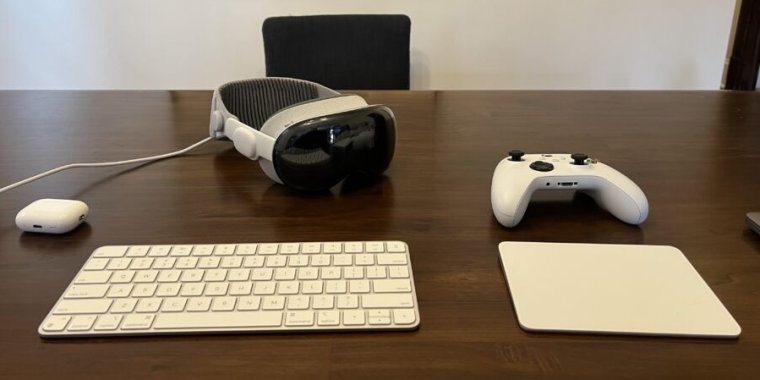
The Apple Vision Pro with AirPods Pro, Magic Keyboard, Magic Trackpad, and an Xbox Series X|S controller.
Samuel Axon
You can see the front-facing cameras that handle passthrough video just above the down-facing cameras that read your hand gestures here.
Samuel Axon
There are two buttons for Vision Pro, both on the top.
Samuel Axon
This is the infamous battery pack. It’s about the size of an iPhone (but a little thicker) and has a USB-C port for external power sources.
Samuel Axon
There are two displays inside the Vision Pro, one for each eye. Each offers just under 4K resolution.
Samuel Axon
Apple offers several variations of the light seal to fit different face shapes.
Samuel Axon
A close-up look at the Vision Pro from the front.
Samuel Axon
The Vision Pro is the strangest product Apple has introduced in the time I’ve been covering the company. By now, it’s well established that the headset is both impressively cutting-edge and ludicrously expensive.
You could certainly argue that its price means it’s only for Silicon Valley techno-optimists with too much money to burn or for developers looking to get in on the ground floor on the chance that this is the next gold rush for apps. But the platform will need more than those users to succeed.
Part of Apple’s pitch behind the price tag seems to be that the Vision Pro could replace several devices, just like the iPhone did back in the late 2000s. It could replace your laptop, your tablet, your 4K TV, your video game console, your phone or other communications device, your VR headset, and so on. If it truly replaced all of those things, the price wouldn’t seem quite so outrageous to some.
And those are just the use cases Apple has put a lot of effort into facilitating for the launch. Many of the most important uses of the company’s prior new product categories didn’t become totally clear until a couple of years and generations in. The iPhone wasn’t originally intended as a meditation aid, a flashlight, and a number of other common uses until third-party developers invented apps to make it do those things. And Apple’s approach with the Apple Watch seemed to be to just throw it out there with a number of possible uses to see what stuck with users. (The answer seemed to be health and fitness, but the device’s distinct emphasis on that took a bit of time to come into focus.)
So while I could write a dense review meandering through all the possibilities based on my week with the Vision Pro, that doesn’t seem as helpful as drilling in on each specific possibility. This is the first in a series of articles that will do that, so consider it part one of a lengthy, multi-step review. By the end, we’ll have considered several possible applications of the device, and we might be able to make some recommendations or predictions about its potential.
So far, I believe there’s one use case that’s a slam dunk, closer to clarity during launch week than any of the others: entertainment. For certain situations, The Vision Pro is a better device for consuming TV shows and movies (among other things) away from a dedicated theater than we’ve ever seen before. So let’s start there.
Table of Contents
My (perhaps too) exacting standards
I know I’m not the usual TV consumer. It’s important to note that before we get too deep.
I bought my first OLED television (a 55-inch LG B6) in 2016. I previously had a 50-inch plasma TV I liked, but it only supported 1080p and SDR (standard dynamic range), and Sony had announced the PlayStation 4 Pro, which would support 4K games (sort of) and HDR (high dynamic range). Game consoles had always driven TV purchases in the past, so I sprung for the best I could afford.
I always cared about picture quality before I bought an OLED, but that interest turned into something more obsessive at that point. I was stunned at the difference, and I began to find it hard to accept the imperfections of LCD monitors and TVs after that. Granted, I’d always disliked LCDs, going straight from CRT to plasma to avoid that grayish backlight glow. But the comparison was even harsher once I went to OLED.
My fellow Ars Technica writers and editors often talk about their robust, multi-monitor PC setups, their expensive in-home server racks, and other Ars-y stuff. I have some of that stuff, too, but I put most of my time and energy into my home theater. I’ve invested a lot into it, and that has the unfortunate side effect of making most other screens I use feel inadequate by comparison.
All that said, some have argued that the Vision Pro is a solution in search of a problem, but there is one pre-existing problem I have that it has the potential to solve.
I travel a lot, so I spend a total of at least two months out of every year in hotel or Airbnb rooms. Whenever I’m in one of those places, I’m always irritated at how its TV compares to the one I have at home. It’s too small for the space, it’s not 4K, it doesn’t support HDR, it’s mounted way too high to comfortably watch, or it’s a cheap LCD with washed-out black levels and terrible contrast. Often, it’s all of the above. And even when I’m home, my wife might want to watch her shows on the big TV tonight.
I end up not watching movies or shows I want to watch because I feel like I’d be doing those shows a disservice by ruining the picture with such terrible hardware. “Better to hold off until I’m home,” I tell myself.
The Vision Pro could be the answer I’ve been waiting for. Those two displays in front of my eyes are capable of displaying an image that stands up to that of a mid-range OLED TV in most situations, and I can use it absolutely anywhere.
https://arstechnica.com/?p=2001721
A password manager LastPass calls “fraudulent” booted from App Store
Getty Images
As Apple has stepped up its promotion of its App Store as a safer and more trustworthy source of apps, its operators scrambled Thursday to correct a major threat to that narrative: a listing that password manager-maker LastPass said was a “fraudulent app impersonating” its brand.
At the time this article on Ars went live, Apple had removed the app—titled LassPass and bearing a logo strikingly similar to the one used by LastPass—from its App Store. At the same time, Apple allowed a separate app submitted by the same developer to remain. Apple provided no explanation for the reason for removing the former app or for allowing the latter one to remain.
Apple warns of “new risks” from competition
The move comes as Apple has beefed up its efforts to promote the App Store as a safer alternative to competing sources of iOS apps mandated recently by the European Union. In an interview with App Store head Phil Schiller published this month by FastCompany, Schiller said the new app stores will “bring new risks”—including pornography, hate speech, and other forms of objectionable content—that Apple has long kept at bay.
“I have no qualms in saying that our goal is going to always be to make the App Store the safest, best place for users to get apps,” he told writer Michael Grothaus. “I think users—and the whole developer ecosystem—have benefited from that work that we’ve done together with them. And we’re going to keep doing that.”
Somehow, Apple’s app-vetting process—long vaunted even though Apple has provided few specifics—failed to spot the LastPass lookalike. Apple removed LassPass Thursday morning, two days, LastPass said, after it flagged the app to Apple and one day after warning its users the app was fraudulent.
“We are raising this to our customers’ attention to avoid potential confusion and/or loss of personal data,” LastPass Senior Principal Intelligence Analyst Mike Kosak wrote.
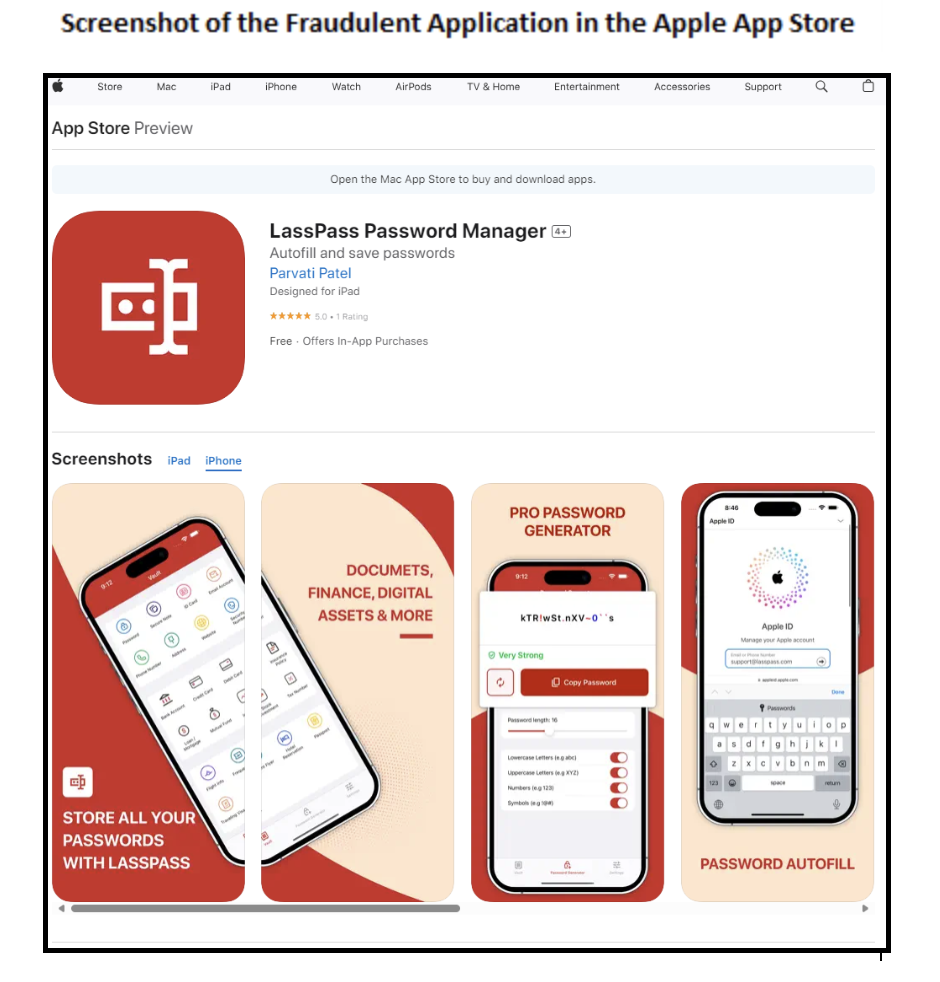
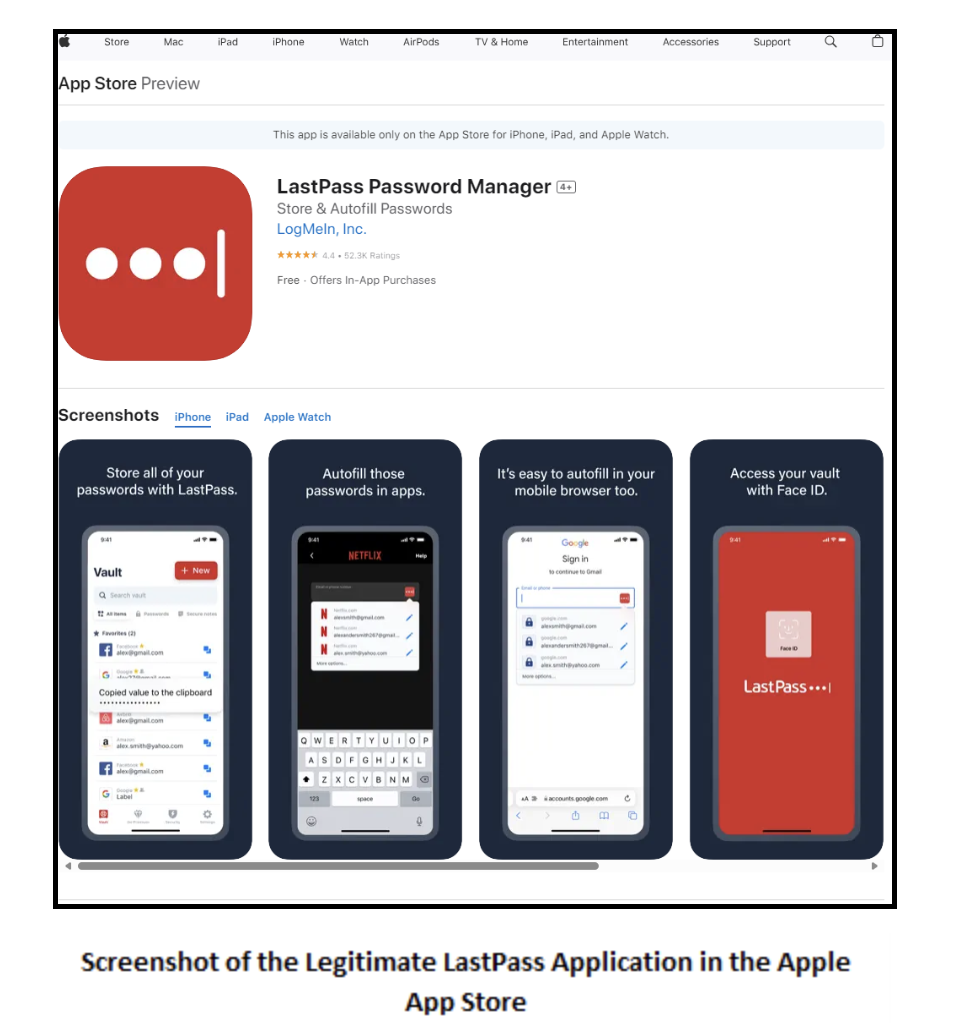
There’s no denying that the logo and name were strikingly similar to the official ones. Below is a screenshot of how LassPass appeared, followed by the official LastPass listing:
Enlarge/ The LassPass entry as it appeared in the App Store.
Thomas Reed, director of Mac offerings at security firm Malwarebytes, noted that the LassPass entry in the App Store said the app’s privacy policy was available on bluneel[.]com, but that the page was gone by Thursday, and the main page shows a generic landing page. Whois records indicated the domain was registered five months ago.
There’s no indication that LassPass collected users’ LastPass credentials or copied any of the data it stored. The app did, however, provide fields for users to enter a wealth of sensitive personal information, including passwords, email and physical addresses, and bank, credit, and debit card data. The app had an option for paid subscriptions.
A LastPass representative said the company learned of the app on Tuesday and focused its efforts on getting it removed rather than analyzing its behavior. Company officials don’t have information about precisely what LassPass did when it was installed or when it first appeared in the App Store.
The App Store continues to host a separate app from the same developer who is listed simply as Parvati Patel. (A quick Internet search reveals many individuals with the same name. At the moment, it wasn’t possible to identify the specific one.) The separate app is named PRAJAPATI SAMAJ 42 Gor ABD-GNR, and a corresponding privacy policy (at psag42[.]in/policy.html) is dated December 2023. It’s described as an “application for Ahmedabad-Gandhinager Prajapati Samaj app” and further as a “platform for community.” The app was also recently listed on Google Play but was no longer available for download at the time of publication. Attempts to contact the developer were unsuccessful.
There’s no indication the separate app violates any App Store policy. Apple representatives didn’t respond to an email asking questions about the incident or its vetting process or policies.