When Information Becomes the Attack Surface – Understanding AI Agent Traps

AI agents go beyond answering questions. They can autonomously browse websites, read emails, search company files, query software tools, and more. AI models producing incorrect answers is hardly a threat, until agents encounter information that’s maliciously designed to influence what it sees, believes, remembers, or executes.

An agent leverages webpages, document stores, wikis, images, emails, or tools to produce intended outputs. But what happens when these sources mask malicious instructions? These trap AI agents into making a wrong interpretation or taking unintended action. Scientists from Google DeepMind categorized these “traps” into six categories, including content injection, semantic manipulation, cognitive state, behavioral control, systemic, and human-in-the-loop traps. The last two are more theoretical and expected to become more relevant as AI agent use grows. It helps to understand these traps to determine the necessary mitigations.

Content Injection: When Instructions Hide in Plain Sight

Content injections exploit the difference between what a human sees and what an agent parses, as well as the system’s difficulty in keeping trusted instructions separate from untrusted external data.

A webpage might appear harmless, but its underlying code, metadata, hidden text, or image can contain malicious instructions for an AI system. An AI model accepts attacker-controlled data from an external source, such as a website or file. If this system fails to distinguish between data and instructions, the model may start processing instructions within that content. The objective behind such injection of malicious content is to alter the AI’s response, disclose sensitive information or enable an unauthorized action. In NIST evaluations of agent hijacking, malicious instructions succeeded across five tested injection tasks, on average, 57% of the time.

A support ticket with underlying malicious instructions can manipulate an AI agent into retrieving customer data from the CRM and sending it to an attacker-controlled address. If the agent has excessive permission, this exfiltration becomes all the easier.

Semantic Manipulation: Shapeshifting the Information

Semantic manipulation need not explicitly tell the agent what to do; it feeds repetition, emotional language, selective context, a false sense of authority, and coordinated claims to the agent to skew context and guide the agent towards the ‘attacker preferred’ conclusion.

Advertisement. Scroll to continue reading.

Imagine a scenario where you have tasked an agent to zero in on a supplier. It comes across search results that repeatedly extol the virtues of a specific supplier, describe a specific company as the gold standard, highlight its strengths and amplify doubts about competitors. This increases the chances of the agent recommending this supplier. Conventional signature-based security tools may not flag anything malicious, as the attacks leverage ‘reasoning’ to influence rather than rely on malicious code.

Here, manipulation of the surrounding information environment becomes the manipulation of the decision itself.

Cognitive State Traps: Poisoning Agent Knowledge

Some agent systems use retrieval databases, interaction histories, or persistent memory stores to maintain context and continuity across tasks. This creates an opportunity for poisoned information to influence later outputs or actions. E.g., a poisoned document in a shared repository that an agent refers to and trusts as evidence, or a manipulated exchange that becomes an agent’s memory, only to rear its head during future tasks.

Research presented at the USENIX conference found that, in controlled tests, inserting five specially crafted texts per target question caused a RAG system to produce the attacker’s chosen answer in about 90% of cases, even when its knowledge base contained millions of legitimate texts.

With information governance becoming an integral component of AI security, organizations must be aware of which sources agents retrieve information from, who can modify those sources, how claims can be verified, and whether stored memories can be reviewed or removed.

Behavioral Control: Turning Influence into Action

Behavioral control operates at the juncture where interpretation is translated into action. Malicious content may attempt to make the AI agent send data, approve a transaction, execute code, invoke another tool or trigger a myriad of other actions. Here, the extent of the consequence depends on the extent of the agent’s access. Grant the agent only the data access and tool permissions required for the specific task. This could be the difference between an agent delivering a misleading summary and the same agent reading confidential files and communicating this information externally, resulting in data loss.

The More Theoretical Frontier

Systemic traps and human-in-the-loop traps remain less developed, but they deserve attention. Systemic traps could induce many similar agents to behave in correlated ways, causing congestion, market disruption, or cascading failures. Human-in-the-loop traps could use a compromised agent to mislead the person expected to approve its actions.

These risks may become more plausible as agent populations grow and users become accustomed to trusting agent-generated summaries.

Control for Agent Traps

A single control won’t alleviate the agent trap threat. A defensive framework must have aspects like source verification, content screening, memory governance, restricted permissions, isolated execution, monitoring, and an independent approval framework with a human in the loop for high-impact actions. Security must follow authority, and there should be clear lines of separation between the ability to interpret and the authority to act.

The future of agentic AI use will depend not only on what these agents can do but also on how they decide what to trust. The fact that they can complete a task is not up to doubt, but they must be able to recognize when the environment they are operating in and harnessing is trying to manipulate them.

Related: Agentic AI Security: Wrong Context, Wrong Decisions at Machine Speed

Learn More at the AI Risk Summit | Ritz-Carlton, Half Moon Bay

https://www.securityweek.com/when-information-becomes-the-attack-surface-understanding-ai-agent-traps/




Exclusive: Meet AIVEX, a New Triage Model Built to Reduce Supply Chain Threat and Risk

Remediation priority (vulnerability triaging) traditionally focuses on Software Bill of Materials (SBOMs) and Vulnerability Exploitability eXchange (VEX) statements provided with the software and supplemented by CVSS scores. That is not enough in today’s environment.

SBOMs list the components within the software. They emanated from Executive Order 14028 designed to reduce supply chain attacks. VEX statements emerged soon afterward to indicate whether any known vulnerabilities are exploitable. The separate CVSS score is used as a severity indicator for vulnerability remediation priority. It’s not working – supply chain attacks continue.

A major cause is a growing lack of context around exploitation. In the AI Age, the effect of exploitation may differ depending on which stage of an AI lifecycle in which it occurs. Lack of context reduces the effectiveness of remediation priority, while the expansion of AI software will magnify the problem. Supply chain attacks will continue to grow.

(Understanding ‘context’ is essential for understanding anything and everything in life. We perceive things – in this case data – but those things are meaningless in isolation. It is the surrounding, often invisible, context in which we see things that gives them any meaning. For another and different example of the importance of context, again involving AI, see the effect of bad AI context on AI decision-making.)

Devashri Datta is an independent researcher and security architect (specializing in DevSecOps automation, software supply chain security, and governance of large-scale vulnerability and compliance systems) has a solution. This solution comprises two new elements in the triage process: a safety relevance interpretation layer (SRIL) to provide context, and an extension (known as AIVEX) to the CycloneDX VEX to make the context machine readable. 

SRIL provides context, and AIVEX transforms the context into a CycloneDX‑compatible schema suitable for use within the organization’s existing tooling. 

Advertisement. Scroll to continue reading.

Datta’s article explaining SRIL (Moving Beyond Severity Scores: A VEX-Driven Interpretation Layer for Software Supply Chain Governance) will be published by ISACA on July 1. Today, she sat down with SecurityWeek to discuss the failure of existing SBOM/VEX/CVSS, and the manner in which AIVEX/SRIL can change things.

A growing concern

AI can transform a data threat against systems into a physical threat against people – it is increasingly and autonomously driving physical robots. 

If a firm has two CVSS scores — a CVSS 9.8 critical remote code execution flaw in a back-office analytics dashboard and a moderate CVSS 5.2 input-validation bug in the sensor-fusion module of an autonomous delivery robot operating in a public warehouse — current logic dictates patching the former first. But the latter could possibly harm or even kill innocent members of the public. The existing triage logic of using SBOMs, VEX and CVSS scores does not provide this context.

As software-driven autonomous robots increasingly pervade our physical world, context becomes ever more important. “But VEX stops short of safety context,” explained Datta. “It can tell you a vulnerability is not exploitable; but it cannot tell you that if it were exploitable, the consequence would be a vehicle losing steering control at highway speed.” 

The commercial consequence of an autonomous robot causing death because of a software vulnerability that could have been fixed but wasn’t fixed would probably be bankruptcy.

This is the anomalous consequence of relying on CVSS scores: AI turns low threat into very high risk.

The AI Attack Surface

The inability of CVSS to indicate context is a growing concern and has reduced the CVSS value for DevSecOps engineers. Today, with the rise of AI and autonomous robots, a new solution is urgent. But context within AI software is complicated because AI’s attack surface is not the same as a traditional software attack surface.

“An AI system, particularly an agentic one capable of taking actions in the real world, has attack surfaces distributed across training data, model weights, inference pipeline, tool integrations, and deployment infrastructure,” explained Datta. “A compromise at any stage can alter behavior in ways that are difficult to detect and harder to attribute.”

She tackles this problem through the combination of SRIL and AIVEX. 

SRIL

SRIL is not just a vague idea. “Flexera has adopted this and is shipping the version to customers next week; similarly, Anchore is working on it and will ship it in the next version,” she explained.

So, what is it? “SRIL is a structured annotation layer designed to sit above existing vulnerability data, enriching CVSS scores and VEX statements with four dimensions of context that safety-critical environments need but current standards do not provide,” she continued.

The four dimensions are: 

  • Safety domain classification (does the vulnerable component operate within a safety-critical function such as a sensor in an autonomous vehicle); 
  • Lifecycle stage mapping (the attack surface differs between different stages of an AI – training data integrity has a different level of risk than inference-time input validation);
  • Consequence severity modifier (independent of the CVSS score, what is the real-world consequence if this vulnerability is exploited?)
  • Exploitability in context (does the deployment environment, threat actor model, and asset exposure change the exploitability calculation in ways the base VEX statement does not capture?).

In combination, said Datta, “These dimensions allow security teams to generate a safety-adjusted priority – a triage score that reflects not just how severe a vulnerability is in isolation, but how much it matters in the specific operational context where affected software is deployed.”

This is a manual effort required from the DevSecOps team, but one that is fully justified by the potential blast radius of an unpatched low-severity AI vulnerability causing robotic third party harm.

AIVEX

The SRIL data is consumed and processed by the AIVEX. It generates context-rich decisions (such as ‘remediate now’, ‘defer’, or ‘monitor’ in machine readable format.

“The AI Vulnerability Exploitability eXchange is a proposed extension to the CycloneDX VEX schema. It makes SRIL machine-readable in structured fields for model provenance, inference-time attack surface classification, safety domain annotation, and AI lifecycle stage. It is designed to integrate with existing SBOM tooling rather than replace it,” explained Datta. “The CycloneDX working group has it under active consideration.”

VEX tells you whether a CVE is exploitable in a given product configuration. “AIVEX asks the question that comes afterward,” she continued. “If the vulnerable component is an AI model acting as an agent in the real world, what does exploitation actually mean? That’s a different problem class, and the industry doesn’t have a standard for it yet.”

AI compliance benefits

More realistic triaging is not the only benefit provided by SRIL/AIVEX. It also benefits increasingly arduous AI regulatory compliance. “A life cycle-based interpretation model improves traceability and auditability without introducing new compliance burdens. The US National Institute of Standards and Technology (NIST) Secure Software Development Framework promotes risk-informed decisions,” she explains in the paper being published on July 1.

“This model operationalizes that guidance by clarifying how SBOM and VEX data feed into real-world governance decisions. Importantly, the model does not redefine these standards; it helps organizations apply them consistently.”

She goes further, anticipating future international regulation convergence. The EU AI Act is in force, but full enforcement of its most demanding aspects for AI embedded in regulated products (conformity assessment, risk management, logging, human oversight) will only begin in August of this year. 

Meanwhile, she explained, “NIST’s AI Risk Management Framework similarly emphasizes governance processes that account for operational context and real-world impact of AI system failures, not merely technical severity. Sector-specific guidance from FDA (medical devices), CISA (critical infrastructure), and the Department of Transportation (autonomous vehicles) is independently converging on the same need: a structured mechanism to connect vulnerability data to safety consequence.”

Such increasingly arduous regulations make demands without telling DevSecOps how to comply with those demands. “SBOMs tell you what components you have. VEX tells you whether they’re exploitable. But SRIL asks the question that regulators actually care about: if exploited, does it matter to a patient, a power grid or a passenger?”

Related: Are SBOMs Failing? Supply Chain Attacks Rise as Security Teams Struggle With SBOM Data

Related: SBOM Pioneer Allan Friedman Joins NetRise to Advance Supply Chain Visibility

Related: AI and Cybersecurity – Everything You Wanted to Know, But Were Afraid to Ask

Related: The Wild West of Agentic AI – An Attack Surface CISOs Can’t Afford to Ignore

https://www.securityweek.com/exclusive-meet-aivex-a-new-triage-model-built-to-reduce-supply-chain-threat-and-risk/


Agentic AI Security: Wrong Context, Wrong Decisions at Machine Speed

Context is the central plank of AI in general, and agentic AI in particular. If an AI system doesn’t have the correct context, it cannot make the correct decisions.

Security is moving toward reliance on the autonomous and automatic action of agentic AI. It has little choice. The increasing speed, volume and efficiency of attacks automated by adversarial use of both generative and agentic AI will only be matched by defensive AI with as little slow human intervention (the proverbial man-in-the-loop) as possible.

But defensive agentic AI can get it wrong and make bad decisions through lack of context. We’re not yet ready for fully autonomous AI.

Emanuel Salmona, CEO at Nagomi Security

“The problem that keeps me up at night is simple: an agent is only as good as the context it operates on,” explains Emanuel Salmona, CEO and co-founder at Nagomi Security. “Give it an accurate, correlated view of your environment – your assets, your controls, your exposures, your threat landscape – and it can make decisions that genuinely reduce risk. Give it incomplete data and it will still act. Confidently. Quickly. Incorrectly. Automation without verified context is just a faster way to be wrong at scale.”

Confidence is provided by the LLM used by the agentic system (it’s what LLMs are designed and trained to do). Speed comes from the machine-speed performance of artificial intelligence. Potential inaccuracy is determined by the accuracy of the context it uses. Context is king. Inadequate context can lead to bad decisions confidently, quickly, and implemented automatically.

This reliance on context applies to all agentic AI used in business, including customer service automation, software development, financial operations, sales operations, and personal assistants – and autonomous SOC applications. Give them the wrong context and they will give you bad decisions.

Context

Context is of little relevance to LLMs. Context here is fundamentally the user’s prompt – to which the LLM responds in accordance with its training. The LLM’s context is this prompt window, comprising both query and response; and it is stateless.

Advertisement. Scroll to continue reading.

Agentic AI has a goal. Its context is stateful and includes anything and everything it is allowed to see and use to achieve its goal. If the context it is given does not include the relevance of a specific device to business continuity, the response it provides will not take that into consideration – it could make immediate shutdown its conclusion, unaware of the catastrophic business effect of shutting down that device at this moment.

Agentic AI does not stop until it achieves its goal. Put simply, based on the context it is given, it presents a possible response to a received alert to an LLM in the form of a prompt. If the LLM does not agree with the validity of the prompt it receives, its own response is added to the agent’s context – and a new proposal/prompt is issued based on the new context.

Eventually, the prompt and prompt response will agree, and the agent will, if so designed, enact the proposal automatically and, where allowed, autonomously. Since the end could in theory allow device isolation or shutdown, autonomous automatic shutdown could be the result (the end) governed by the context (the means). In agentic AI, the end must not justify the means; the means must justify the end. If the context is lacking, the decision of the AI will almost certainly also be lacking.

If the agent designer and developer gets the context right, agentic AI can be a massive boon to the security of the user. If the context is wrong or inadequate, any autonomous action could be catastrophic. The precise context must be defined by the agent’s goal. But getting it right is very difficult. 

Too much context for an agent is similar to sensory overload for a human: slower reasoning and degraded performance, goal drift and loss of focus, oscillation between incompatible actions (the agent may get stuck in a never-ending loop), and potential hallucinations as it attempts to connect loosely related bits of data.

Learn More at the AI Risk Summit | Ritz-Carlton, Half Moon Bay

Too little context is even more problematic. Just as humans might guess the answer to a problem by assuming bits of data that seem logical, so an agent that is instructed to achieve a goal might invent data to bridge the gap in its contextual knowledge. Operational accuracy and reliability may be lost through more hallucination. That hallucination could be a very bad decision delivered confidently.

The real world is constantly changing, so an agent’s context must continually be updated. Here, its ability to learn and adapt its own context can help. For example, a professional assistant in the US could be instructed to initiate a video meeting with an engineer in Europe. If it does so using its US timezone, it could be out of sync with Europe. The engineer’s personal assistant might reject this and reply, ‘I can only accept calls within this (UTC) timeframe’. The US assistant receives this, and the knowledge could become part of its context for future reference.

The ease with which context can be improved and expanded offers hope that the use of agentic AI will improve. It will make bad decisions to begin with but will get better with usage – but the ability to do so must be built into the system.

The problem for agentic security

Using AI to automate the work of the SOC provides an example of potential agentic issues.

The primary purpose of the original SOC is to manually triage alerts and find and respond to those that are most urgent and dangerous to the business and its IT infrastructure. This is costly and time-consuming while the time-to-disaster is collapsing. The appeal of using AI to increase the speed of triaging and reduce its cost is obvious.

SOC analysts already receive an abundance of alerts from multiple sources: EDR, NDR and XDR, SIEM and SOAR, IAM and threat information platforms. And we should include the SBOMs that should be provided with all new software and should provide vulnerability details. Getting data is not the problem. Interpreting and using data is the problem.

The difficulty for agentic AI in security is twofold. Firstly, it can only operate within the data it is given (which is its context). The conclusion it reaches while analyzing an alert within the confines of its context is entirely dependent on the adequacy of that context. To make it more difficult, adequate context is continually changing since business and infrastructure is continually changing.

Secondly, even if the context is good, the recommendation from the agent is usually poor – its reasoning is not competently explained to the user. Even with a human in the loop, the information provided by the AI may simply be, ‘this alert means there is a critical issue with this device, act now’, or perhaps ‘critical’ or ‘mild’, or ‘8 out of 10’ or ‘3 out of 10’. 

The attraction of feeding alerts into an agentic system to perform machine-speed autonomous triaging is obvious. But the process comes with a major flaw. “No board would accept a set of numbers without an audit trail, yet many accept intelligence that shapes approvals and decisions with no method of visibility,” says Adam Irwin, managing partner at Heligan Strategic Advisory.

Agentic automation feeds raw alerts to the agent without the benefit of SOC expert triaging and then makes a decision on those alerts that is accepted by management without the benefit of visible reasoning. We question what we see on paper but automatically assume that our AI is correct. We are likely to assume that an autonomous SOC is accurate, but we have no proof that it is.

One alternative approach

Obbe Knoop, founder and CEO at Lanxit, has a different approach – his Security Decision Intelligence Layer uses artificial intelligence, but is not an agentic AI system. He believes that agentic AI is not sufficiently mature to be trusted with autonomous action; decisions and actions should currently be left in the hands of human experts. But those experts are being hamstrung by receiving too much data, too little reasoning, and little or no context.

“I take an alert and I pull in all the context that I need to make a decision,” he explains. “I go to the VPN gateway, I go to the identity solution, for example Okta, I go to Active Directory, I go to CrowdStrike, I pull in threat intel, I look at the target’s CMDB, and I look at the business structure, purpose and employees.”

Obbe Knoop, founder and CEO at Lanxit

Knoop gathers the context, fresh every time at the time of use. His product analyzes alerts in that current context and makes a recommendation within minutes. But it doesn’t simply say, this is critical or this is not critical; it explains why it has made its conclusion, and what the user should do about the situation. It will even say, “I don’t have enough context to make a clear decision on this alert” rather than hallucinate a recommended but ultimately guessed action.

What it will not do is take any autonomous automated action on behalf of the user. The final decision on what action to take in response to a detected issue is left to the user, but with more understanding of what is happening, why it is an issue, and a recommendation on how it could be solved – all delivered in plain English.

Does he believe AI will eventually have the maturity to be allowed autonomous action? “Probably,” he says. “But we’re not there yet.” He offers autonomous vehicles as an example. They are largely but not completely trusted. In some regions, users are still required by law to keep hands on the steering wheel, just in case. His solution is to give as much accurate and current information as possible on a potential vulnerability with recommendations on how to solve it, but to allow the user to keep hands on the wheel.

This context-based decision-making is good in many ways, but still has one potential drawback. While CMDBs are often and mostly accurate, this is not guaranteed to be always true. Without constant and possibly fallible human oversight and manual maintenance wherever and whenever necessary, they can drift. An automatically interrogated CMDB may not always provide ground truth for the system’s current context.

Context to AI is like batter to a cake. If you don’t have the right ingredients mixed in the right amounts, you almost certainly won’t like the outcome.

Current state of AI decision-making

Our descriptions here are simplified, while AI and its use is evolving rapidly. LLMs are being given short-term memories, so they can have their own (limited) context, if only for the current session. Agentic AI concepts are also advancing in better context gathering, better decisions and usage with fewer hallucinations. Furthermore, the general acceptance that accurate interpretation of data is more important than sheer volume of data has become more widely recognized. Nevertheless, accurate and relevant context is the axis upon which all else revolves.

AI has been around for many years; but the current state of accessible AI is only a few years old. We should not expect it to behave as a mature technology, and yet we do. We don’t know how it will evolve, in either design or use, over the next few years. What is already clear, however, is the current state of agentic AI can offer huge benefits or surprising failures depending on how we develop and manage it. Getting the context within which it operates is essential for beneficial performance. This is possible, but as we have seen, it is very difficult to achieve because of all the pitfalls discussed above.

What is needed going forward is more efficient and reliable methods for gathering and aligning relevant context to each agentic goal, and better descriptions delivered by the AI on how and why decisions are made – with detailed explanations on the users’ options for next steps. There are signs that this is happening. We have security intelligence systems. We have autonomous agentic AI. If we combine the two in a single product and monitor its performance for a few years, we will be in a better position to understand how much and where we can allow autonomous decision making to become autonomous action taking.

Related: Can We Trust AI? No – But Eventually We Must

Related: Should We Trust AI? Three Approaches to AI Fallibility

Related: ‘Mythos-Ready’ Security: CSA Urges CISOs to Prepare for Accelerated AI Threats

Related: How to 10x Your Vulnerability Management Program in the Agentic Era

https://www.securityweek.com/agentic-ai-security-wrong-context-wrong-decisions-at-machine-speed/


French President Urges US to Share Cutting-Edge AI and Democracies to Cooperate on Regulation

French President Emmanuel Macron on Wednesday urged the world’s wealthy democracies to work together on regulating advanced artificial intelligence systems, speaking at a high-level meeting that included top AI executives.

OpenAI CEO Sam Altman issued a similar plea at the Group of Seven summit of major industrialized nations in France, saying an “international forum” is needed for countries to draw up AI guardrails. He said the task of AI safety should not be left to tech companies.

Overshadowing the discussion on AI was President Donald Trump’s administration’s directive last week, preventing foreign nationals from using Anthropic’s newest and most powerful artificial intelligence models.

Macron said it was a “good thing” that U.S. officials recognize that so-called frontier AI models could be dangerous, but he also criticized it as a “strictly nationalist” reaction.

The remarks followed a G7 working lunch that brought together AI industry figures, including leaders of three of the most powerful AI companies — Altman, Google DeepMind CEO Demis Hassabis and Anthropic CEO Dario Amodei — on the theme of “ensuring a safe, rapid and effective deployment of artificial intelligence.”

Trump’s feud with Anthropic has unsettled many outside the US

Ahead of the meeting, the White House’s dispute with Anthropic fueled distrust in Europe about American dominance of AI and tech ecosystems.

Advertisement. Scroll to continue reading.

The company was forced on Friday to take its latest artificial intelligence models, known as Fable 5 and Mythos 5, offline to comply with the directive. The AI giant said it did not believe the steps taken by the government were warranted by the concern it flagged about a potential security issue.

When asked by a reporter whether France and other G7 countries had asked Trump to permit access to Anthropic’s latest AI models, Macron said he made a forceful plea for the U.S. not to keep cutting-edge AI to itself.

Macron warned of a possible drop in value for U.S. firms pioneering the disruptive technology if they switch off access like a light switch. Macron backed his appeal for partnership among key democracies with an insurance policy: France, he said, will boost funding for its own AI industry, so it’s not left behind if international cooperation breaks down.

Democratic countries ultimately want to prevent authoritarian regimes from getting access to advanced AI systems, Macron said.

“So let us move forward together,” he said. “Our relevant agencies must first cooperate so that, in the areas of security and cybersecurity, we have a smooth government-to-government relationship.”

Altman said in his lunch speech, attended by the G7 leaders and more than a dozen AI bosses, that the technology’s future must be shaped by people, democratic institutions and society as a whole, “not just by the companies building the most capable systems.”

“We need an international forum for discussion that establishes globally accepted standards for testing, provides expert and impartial analysis of capabilities and risks, and serves as a venue for cooperation among nations,” he said.

Europeans have sought checks on American AI dominance

Even before the Anthropic episode, there was growing distrust of American companies dominating AI and other tech ecosystems. In Brussels, the European Commission unveiled a tech sovereignty package this month with plans to boost homegrown AI, and at the Vatican, the pope last month called for robust regulation of artificial intelligence.

Trump’s intervention with Anthropic highlighted how Europe, Canada or other countries “can be put in an extremely vulnerable position” if they are cut off from advanced AI models, said Zach Meyers, director of research at CERRE, a Brussels-based think tank.

“There is a general anxiety about the state of Europe, the fact that we’re relying on other countries for quite important strategic infrastructure and a desire to do something about it, whatever that is,” Meyers said.

At the G7, Aidan Gomez, CEO of Canada’s Cohere AI, said a “number of proposals” were discussed on working together on AI governance and regulation.

“I think the consensus was we need something,” he told The Associated Press.

He said he told the gathering that democracies should focus their efforts on making sure the G7 “doesn’t just produce the most capable AI, but also the second most capable AI,” a reference to the U.S. and China being the world’s only two major AI powers.

Meta’s chief AI officer, Alexandr Wang, also attended the meeting, along with the heads of smaller AI labs, including France’s Mistral, Germany’s Black Forest Labs, Italy’s Domyn, Sakana AI of Japan and United Kingdom-based Synthesia.

The G7 comprises France, the United States, Canada, Germany, Italy, Japan and the UK. Brazil, India, Kenya and South Korea were among guest nations invited to participate in some discussions.

Related: AI and Cybersecurity – Everything You Wanted to Know, But Were Afraid to Ask

Related: Claude Mythos Turns N-Days Into N-Hours With Rapid Exploit Creation

Related: Industry Reactions to Claude Fable 5: Feedback Friday

https://www.securityweek.com/french-president-urges-us-to-share-cutting-edge-ai-and-democracies-to-cooperate-on-regulation/


In Other News: Anthropic Maps AI Threats, Unpatched Comodo Flaw, Palantir Chief Eyed for CISA

Other noteworthy stories that might have slipped under the radar: Ultrahuman data leak, The Gentlemen ransomware analysis, Hola Browser bundles miner.

The post In Other News: Anthropic Maps AI Threats, Unpatched Comodo Flaw, Palantir Chief Eyed for CISA appeared first on SecurityWeek.

https://www.securityweek.com/in-other-news-anthropic-maps-ai-threats-unpatched-comodo-flaw-palantir-chief-eyed-for-cisa/


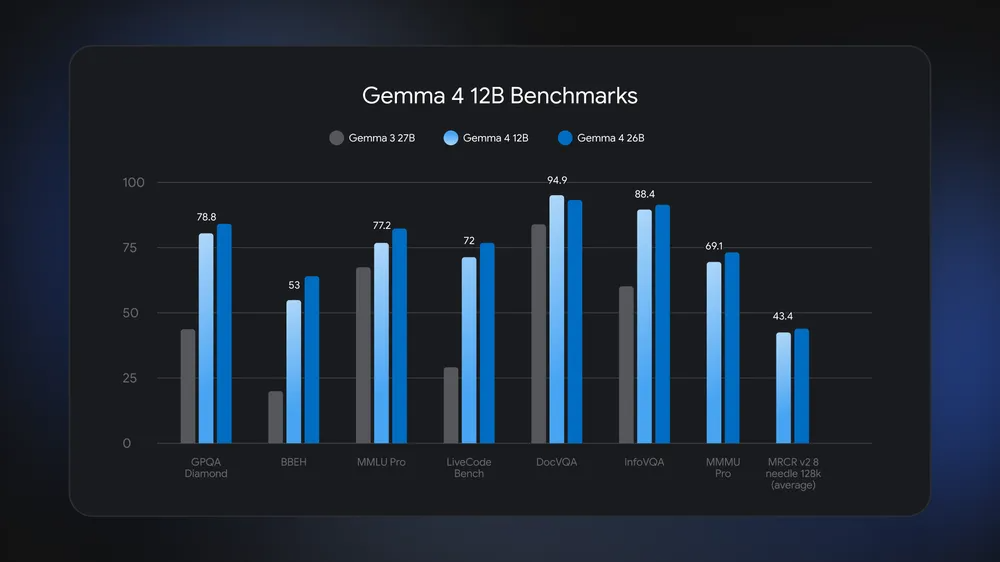
Google’s new Gemma 4 12B model is designed to run on any laptop with 16GB of RAM

Gemma 4 benchmark graph

Gemma 4 12B is almost as capable as the version with 26 billion parameters.

Credit: Google

Gemma 4 12B is almost as capable as the version with 26 billion parameters. Credit: Google

Google says the new model is capable of complex multistep reasoning and agentic workflows that previously required the larger Gemma variants. Despite the smaller parameter count, Gemma 4 12B comes with the newly devised Multi-Token Prediction (MTP) drafters, which take advantage of unused processing cycles to calculate possible future tokens. The result is greater speed and efficiency. Google has released optional MTP versions of the other Gemma 4 models, but this is the first one to have MTP out of the box.

Gemma 4 12B is also more efficient thanks to a new approach to multimodality. The Gemma 4 family is natively multimodal, accepting text, audio, or images as inputs. Most gen AI models—including the other Gemma 4 variants—use dedicated encoders to process non-text inputs and pass that data to the LLM. This works well enough, but it increases latency and memory usage.

With the new mid-weight model, Google has implemented a streamlined embedding module for vision, featuring single-matrix multiplication and positional embedding, which allows the data to pass to the LLM with proper spatial awareness. This eliminates the need for a bulky middleman encoder. For audio, there’s no encoding at all. The developers worked out a method of projecting the raw audio signal into the same vectors used for text tokens.

[embedded content]

Gemma 4 12B Demo

If you want to check out the new Gemma 4 model, it’s accessible without a download via tools like LM Studio, Google AI Edge Gallery, and more. But the whole idea with Gemma 4 12B is that you can run it locally and on your own terms. If you’ve got the RAM, the model weights are available for download immediately on Kaggle and Hugging Face. It’s just shy of 18GB.

https://arstechnica.com/google/2026/06/googles-new-gemma-4-open-ai-model-is-sized-for-your-laptop/


Trump plan to test AI models has a problem—US security teams were gutted by DOGE

Once covered models are defined, Nguyen then warned that the effectiveness of the safety testing will likely depend on whether AI firms are fully transparent and treat the process as a “genuine collaboration.”

“Underneath the definitional problem sits an observability problem,” Nguyen wrote. “The government cannot assess what it cannot see, and frontier capabilities are visible only to the labs that build them.”

Ferren suggested that “the window for erecting proper cyber defenses to new AI models may also close quickly,” and that even a well-designed government program may struggle to properly vet frontier models in such a short timeframe. “Even when well implemented, pre-deployment testing has limits,” Ferren said, noting that Google’s threat intelligence team has found state-aligned actors using frontier models to automate cyberattacks and “researchers have shown that Mythos-style vulnerability reasoning can be reproduced with open-weight systems.”

So while AI may voluntarily submit to testing, they may be financially motivated to seek a rubber-stamp, rather than work with the government to test known frontier capabilities to their fullest extent.

“It will likely prove difficult to develop models that are incapable of malicious hacking yet remain commercially compelling,” Ferren said.

He concluded that the EO “may yield short-term cybersecurity benefits,” but the “long-term effect” remains “unclear.”

Nguyen suggested the EO takes necessary steps to create “classified cyber benchmarking, voluntary prerelease evaluation, and coordinated vulnerability scanning” that “the national security community will need for decades” to “continuously evaluate systems that are probabilistic rather than deterministic, autonomous rather than directed, and whose capabilities change with every update.”

But the safety testing will have to evolve as fast as the technology does, Nguyen said, otherwise we risk assessing emerging models against “yesterday’s risks.”

That’s why, at its core, the process will depend on an honest exchange between stakeholders with deep technical expertise and confidential national security insights. It’s the only way to ensure the US focuses its energies on protecting the public from the most credible and consequential AI risks, rather than just providing “performative reassurances,” Nguyen wrote.

https://arstechnica.com/tech-policy/2026/06/trumps-ai-executive-order-may-not-prevent-dangerous-deployments/


Security of 100 AI Agents Tested and Ranked – What You Need to Know

AI is our new leader. We just accept and do what it tells us. Maybe we should be a bit more circumspect.

Concern over the performance of AI agents has been constant, ranging from ‘leaky’ to just plain wrong decision-making. Since the pressure to use more agents more autonomously because of supercharged AI-assisted attacks is now constant, Adversa AI’s decision to measure and compare the performance and security of 100 agents across ten categories is welcome.

But the results are not. Of the 100 agents tested, and positioned within a new AI Risk Quadrant, only 11 are categorized as ‘capable well-defended’. 

The root problem is the AI agent ‘lethal trifecta’, which Adversa describes as ‘private data access + exposure to untrusted content + ability for outbound actions’. This translates directly into the standard lethal trifecta of too much power + too much trust + too little control’.

Since all three parts of this trifecta are necessary for an AI agent to achieve its goal, capability and security will always be a big ask. Ninety-eight percent of the agents have this trifecta, so it is no surprise to learn – but still shocking to hear – that so few are both capable (useful) and defendable (secure).

Capability and security verge on mutual exclusion. “The same vendors shipping the most capable agents ship the widest attack surface – a structural feature of the market, not a handful of outliers,” states Adversa’s analysis in its AI Risk Quadrant for Agent Security report. It calls this a ‘power-protection inversion’ and adds that it appears in all ten agent categories.

Advertisement. Scroll to continue reading.

The agent categories with the greatest power protection inversion, however, are ‘computer agents’ followed by ‘coding agents’.

Computer agents are designed to perform a specific task, such as make a decision or perform an action for a user. Since agents can only operate with what they know (the context problem, where poor context leads to bad decisions in all agents), computer agents are given wide access rights, effectively the complete operating system. “A compromise hands the attacker the user’s entire machine, not just one application or tab,” warns Adversa.

Such agents also suffer from an issue that affects all agents: the user has little, if any, visibility into or control over what the agent actually does. It is given an input (the task), and it generates an output (the completed task). But with computer agents, the user doesn’t know the route it takes between input and output, nor what specific actions within the operating system it takes along that route.

“The deeper issue is that the desktop confirmation step looks like a control while being unreliable in practice,” warns the analysis. ‘The human and the model reason over different abstractions (windows and labels vs. screenshots and accessibility trees). That gap produces confirmation mismatch: the human approves the appearance of the action, not what the agent is about to do, because nothing in the interface surfaces the difference.”

The second-worst offender in the exposed giants quadrant is coding agents. This is concerning since ‘vibe-coding’ applications are becoming the future of software, and ‘vibe-coded’ in-house applications may live with us for many years.

The analysis sub-divides coding agents into three types: “coding copilots (human reviews each suggestion), autonomous coding agents (goal-in, repo-out), and app builders (prompt-to-deployed-app). The first might appear to be the least dangerous, but the user still doesn’t know what the agent does between input and output. “Coding agents don’t just write code – they touch shell, dependencies, and tokens long before a diff lands in review,” comments Adversa.

“This is the class where compromise most directly becomes production compromise. The danger is not bad code suggestions; it is high-trust operation inside the software supply chain. Non-determinism makes code review an incomplete defense: even if a human reviews the final diff, the agent may already have traversed secrets, run tests against production-like services, modified configs, or selected risky dependencies. Review catches outputs; it does not catch the full action trail.”

Coding agents figure so highly among the exposed giants because they have a wide attack surface, an extensive blast radius, and poor defense controls. The attack surface is wide because they run shell commands, load MCP servers, and auto-load rules files. The blast radius comes from sitting inside the software supply chain with access to secrets, signing keys, and deployment pipelines. And their primary defense is a code review of the output, which doesn’t consider either the attack surface or the blast radius.

We’ve glanced at just two of the ten agent types included in Adversa’s agent analysis and AI Risk Quadrant. The other eight categories are general assistant, work copilot, browser, conversational, custom workflow, business process, platform operations, and data engineering. None come out squeaky clean. Ninety-eight percent of the tested agents are subject to the lethal trifecta, with only one agent in each of the general assistant and data engineering agents being the exceptions.

Learn More at the AI Risk Summit | Ritz-Carlton, Half Moon Bay

General comments from Adversa include: agent defaults favor velocity over safety; agents with the most power have the least protection, while the agents with the most protection have the least power; only 11% qualify for the capable and defended quadrant; tool execution accounts for 76% of blast radius; 37% of the market is audited more than defended; and 83% of claimed AI agent defenses are not publicly verifiable.

Agents are effectively black boxes – it’s a take it or leave it scenario. Business economics is forcing us to take it. Since we cannot control what the agent does while it is running, our only option is to be careful over what we input, and control, where possible, the output. 

Here, Adversa recommends concentration on controlling the output since there is little that can be done on the input prompts. “Defend the legs you can own, not the one you can’t,” it suggests. “Prompt injection has no deterministic fix – no classifier reliably separates the agent’s data from its instructions, and vendors concede it. Concede the input boundary and spend the defensive budget on the trifecta legs the operator does control: egress, identity, and irreversible actions.”

This is where we are today. The headlong rush into agentic AI solutions is irreversible but concerning. We will only match adversarial AI-assisted attacks by using AI-assisted defense. All businesses will only remain competitive if they are faster, and more efficient than the competition. In business, all roads lead to AI. We must hope, and can probably expect, that AI will improve in all areas in the future. To what extent and when that may happen is another unknown. 

But in the meantime, the ultimate message from Adversa’s massive and detailed analysis is clear: “Let’s be careful out there.”

Related: Can We Trust AI? No – But Eventually We Must

Related: The Wild West of Agentic AI – An Attack Surface CISOs Can’t Afford to Ignore

Related: Sweet Security Launches Agentic AI Red Teaming to Counter ‘Mythos Moment’

Related: Raising the Cybersecurity Stakes: Ante up for the Agentic Era

https://www.securityweek.com/security-of-100-ai-agents-tested-and-ranked-what-you-need-to-know/


Sitecore Snaps Up GEO Startup Scrunch for an Alleged $225M

Sitecore acquired the upstart, which helps brands optimize their digital content for AI engines and agent crawlers, for an alleged $225 million. https://www.adweek.com/media/sitecore-snaps-up-geo-startup-scrunch-for-225m/


InMobi, Scope3 Debut Sell-Side Agent for Autonomous Media Buying

InMobi and Scope3 are betting that AI agents, rather than traditional programmatic pipes, are the future of premium media buying. https://www.adweek.com/media/inmobi-scope3-debut-sell-side-agent-for-autonomous-media-buying/