Mattel Brings AI Into the Toy Room With OpenAI Deal


Barbie, among other toys, could get an AI makeover.

Mattel, the toy giant behind Barbie and Hot Wheels, has struck a deal with OpenAI to help design and develop toys using the startup’s technology, signaling a new era of AI-assisted play tied to its billion-dollar brands.

The first product born out of this partnership—powered by OpenAI’s flagship product ChatGPT and its other generative AI tools—is expected to debut later this year, though details remain under wraps.

“With OpenAI, Mattel has access to an advanced set of AI capabilities alongside new tools to enable productivity, creativity, and company-wide transformation at scale,” Brad Lightcap, chief operating officer at OpenAI, said in a statement. 

The discussion between the two companies began last year. The deal does not entail licensing Mattel’s intellectual property to OpenAI, retaining full creative control over its products.
The partnership also includes Mattel adopting ChatGPT Enterprise across its business to bolster product development and creative brainstorming with the aim of accelerating innovation.

“Our work with OpenAI will enable us to leverage new technologies to solidify our leadership in innovation and reimagine new forms of play,” Josh Silverman, chief franchise officer of Mattel, said in a statement. 

The deal lands amid a chorus of resistance from Hollywood heavyweights like Ron Howard and Cynthia Erivo, who’ve publicly pushed back against OpenAI and Google as they lobby the U.S. government to let their AI models train on copyrighted works.

OpenAI also launched its “most intelligent mode,” GPT o3-pro, earlier this week. The model handles everything from analyzing files to searching the web, pushing the bar for AI capabilities. The AI giant also onboarded former Instacart CEO Fidji Simo as its head of applications earlier this year.

ADWEEK has reached out to OpenAI and Mattel for comment.
https://www.adweek.com/media/mattel-barbie-ai-toys-openai/


AI Image Generator Midjourney Sued by Disney, Universal Over Copyright Infringement

Two major Hollywood studios, Disney and Universal Pictures, are suing Midjourney over what they are calling unauthorized use of their intellectual property to train its artificial intelligence large language model.

The copyright infringement lawsuit, filed in U.S. District Court for the Central District of California in Los Angeles, accused Midjourney of producing replicas of the studios’ copyright-protected characters by using its image generation tool.

Examples of characters and images involved included Shrek and Minions from Universal, as well as various characters from the universes of Disney’s The Lion King, Aladdin, Frozen, Marvel, Star Wars, The Simpsons, Toy Story, Cars, and How to Train Your Dragon.

“Piracy is piracy, and whether an infringing image or video is made with AI or another technology does not make it any less infringing,” the two companies said in their lawsuit. “Midjourney’s conduct misappropriates Disney’s and Universal’s intellectual property and threatens to upend the bedrock incentives of U.S. copyright law that drive American leadership in movies, television, and other creative arts.”

Executives from Disney and Universal parent NBCUniversal provided separate statements to Axios.

“Our world-class IP is built on decades of financial investment, creativity, and innovation—investments only made possible by the incentives embodied in copyright law that give creators the exclusive right to profit from their works,” said Horacio Gutierrez, senior executive vice president, chief legal and compliance officer at Disney.

Kim Harris, NBCU’s executive vp and general counsel, added, “We are bringing this action today to protect the hard work of all the artists whose work entertains and inspires us and the significant investment we make in our content. Theft is theft regardless of the technology used, and this action involves blatant infringement of our copyrights.”

Midjourney, based in San Francisco and started in 2021, had a user base of almost 21 million as of September 2024. It launched its AI image generator in February 2022 and accumulated $300 million in revenue last year, nearly $100 million more than it made in 2023.

https://www.adweek.com/media/ai-image-generator-midjourney-sued-by-disney-universal-over-copyright-infringement/


Beyond the Hype: AI, AR, Spatial Computing and the Next Wave of Innovation

On this TechMagic greatest hits episode, hosts Cathy Hackl and Lee Kebler welcome AI thought leader Sandy Carter, author of AI First, Human Always, and COO of Unstoppable Domains for a deep dive into AI-driven leadership and technological transformation. 

They break down the latest innovations, from Apple’s Vision Pro developer workshop to Meta’s bold moves in AR and spatial computing. Sandy shares expert insights on how business leaders can embrace AI while staying human-centric. 

Plus, hear exclusive details on her upcoming SXSW keynote. Whether you’re an entrepreneur, tech enthusiast, or AI pioneer, this episode is packed with game-changing knowledge you won’t want to miss.

Come for the Tech, stay for the Magic!

Episode highlights:

AI’s Role in Job Transformation — Sandy Carter explains that AI will reshape 60-70% of jobs rather than eliminate them. She highlights how businesses can use AI to enhance human capabilities, sharing real-world examples like a spa leveraging AI agents for personalized treatment recommendations to improve efficiency and customer satisfaction.

Inside Apple’s Vision Pro Developer Workshop — Cathy Hackl shares her firsthand experience at Apple’s Vision Pro developer event, discussing new spatial computing innovations and how businesses can prepare for the next wave of immersive technology. She explores how VisionOS is shaping the future of content creation and user engagement.

Developing an AI-First Leadership Mindset — Sandy emphasizes that leaders should integrate AI into daily workflows, ensuring every team member has an AI assistant by year-end. She provides a framework for evaluating AI’s reliability, using supply chain accuracy as an example of how minor AI miscalculations can lead to major financial impacts.

Meta’s Latest Moves in AR and AI — Lee Kebler breaks down Meta’s latest announcements, including its $50 million creator fund for Horizon Worlds and advancements in AR glasses. He explores what these developments mean for businesses and content creators looking to stay ahead in the spatial computing revolution.

Debunking AI Myths at SXSW — Sandy previews her upcoming South by Southwest keynote, where she will tackle the top 10 myths about AI through live demonstrations and surprise guest appearances. She aims to bridge the gap between AI hype and real-world applications, ensuring leaders can make informed, strategic decisions about AI adoption.

https://www.adweek.com/brand-marketing/beyond-the-hype-ai-ar-spatial-computing-and-the-next-wave-of-innovation/


OpenAI Fights Court Order Requiring It to Store Deleted ChatGPT Conversations Indefinitely

OpenAI is appealing a court order requiring it to store deleted ChatGPT conversations “indefinitely.”

The court order was issued as part of The New York Times’ copyright lawsuit against OpenAI, where it has been accused, alongside Microsoft, of using the newspaper’s articles to train its artificial intelligence models.

In a statement, OpenAI chief operating officer Brad Lightcap described the court order as one that “fundamentally conflicts with the privacy commitments we have made to our users. It abandons long-standing privacy norms and weakens privacy protections.”

He added that the company believes that The New York Times has overreached with this court order and that OpenAI will continue to appeal the decision.

According to The Verge, OpenAI in May was forced by the court order to preserve “all output log data that would otherwise be deleted,” even if a user requests the deletion of a chat or if privacy laws require OpenAI to delete data. 

OpenAI said it filed a motion requesting that the magistrate judge reconsider the preservation order, adding, “Highlighting that indefinite retention of user data breaches industry norms and our own policies.”

Products impacted by the court order include ChatGPT Free, Plus, Pro, and Team subscription, or if users use the OpenAI API (application-programming interface) without a Zero Data Retention agreement.

Excluded from this arrangement are customers using ChatGPT Enterprise or ChatGPT Edu.

OpenAI noted that the deleted data will not be automatically shared with The New York Times and that it has been securely stored, accessible only under strict legal protocols.

https://www.adweek.com/media/openai-fights-court-order-requiring-it-to-store-deleted-chatgpt-conversations-indefinitely/


WPP’s Mark Read Says AI Will Upend the Advertising Workforce


.article-native-ad { border-bottom: 1px solid #ddd; margin: 0 45px; padding-bottom: 20px; margin-bottom: 20px; } .article-native-ad svg { color: #ddd; font-size: 34px; margin-top: 10px; } .article-native-ad p { line-height:1.5; padding:0!important; padding-left: 10px!important; } .article-native-ad strong { font-weight:500; color:rgb(46,179,178); }

Artificial intelligence (AI) will reduce the current workforce in the advertising industry, while also creating new types of jobs, according to WPP chief executive Mark Read. 

Speaking at the inaugural SXSW London on Wednesday, Read was asked what impact AI will have on jobs in the industry. 

“To do the work we do today, there will be fewer people doing it,” he said, “but there will be many more and different things that people do.”

“New jobs will be created,” he continued. “Innovation does ultimately create jobs.” 

Read likened AI’s impact on jobs to the way social media platforms like Instagram and TikTok opened up new work opportunities through the rapidly growing creator economy. 

His caveat, however, was that businesses should not use AI simply as an “efficiency tool” to save money and time: “We need to see it as an effectiveness game as well as an efficiency game,” he said. “It’s a way to work more quickly and more efficiently, but to also be more effective [in our work].”

Making big AI moves

WPP and Read have been making major investments to integrate AI throughout the business. In an ad campaign launched last week, the holding company touted WPP Open, its AI-powered platform that is backed by more than $400 million of annual investment and partnerships with AI firms. 

In addition to WPP Open, the company’s other AI investments include purchasing AI tech company Satalia in 2021 and investing in Stability AI earlier this year.

However, WPP is also facing scrutiny after disappointing financial results at the end of 2024 and early this year. It recently laid off an undisclosed number of staff in its media division WPP Media (formerly GroupM). 

While there is much fear and uncertainty about AI’s impact on the creative sector at large, Read argued at SXSW that “the creative industries will be some of best defended industries against AI, [because] we will have all of these tools.”

“Every TV ad you see, there’s no reason we won’t be using AI [to create it],” he said. “It’s only a matter of time before the first AI film wins an Oscar. I hope it won’t write the script, but it can certainly create the film.”

The ‘right’ office mandate

Read also defended WPP’s controversial return to office policy. Its mandate for employees to return to the office four days a week went into effect in April, but the early days were chaotic at some agencies and offices, according to a previous ADWEEK report.

“I think people are happier when they’re in the office. In our offices, they’re much happier,” Read said drily, igniting laughter in the crowd. 

He added that WPP’s return-to-office mandate was “the right thing to do,” especially amid rapid technological changes facing the industry.

“If we’re going to deal with all of this, we better be together. We’re not going to be able to do it through video screens very easily,” Read said. “Human connectivity and human collaboration are what make all creative companies special.”

https://www.adweek.com/agencies/wpps-mark-read-says-ai-will-upend-the-advertising-workforce/


TikTok Adds AI-Powered Tools to Woo Marketers Ahead of Potential Ban


.article-native-ad { border-bottom: 1px solid #ddd; margin: 0 45px; padding-bottom: 20px; margin-bottom: 20px; } .article-native-ad svg { color: #ddd; font-size: 34px; margin-top: 10px; } .article-native-ad p { line-height:1.5; padding:0!important; padding-left: 10px!important; } .article-native-ad strong { font-weight:500; color:rgb(46,179,178); }

TikTok announced a slew of ad products for performance advertisers, ahead of its second potential U.S. ban deadline, at its World Summit on Tuesday.

To address growing search behavior on the short-form video platform—one in four users starts searching within 30 seconds of opening the app, per TikTok—the company is launching a new Search Ads Center inside Ads Manager. The tool suggests keywords, offers creative previews, and negative keyword filtering tools to help brands plan and optimize campaigns more effectively.

“We’re in the middle of a major shift in how and where people search,” said Brian Torpey, global director, product strategy & operations, TikTok. This tool, he added, will “help brands plan smarter and drive better results.”

TikTok’s latest push to woo advertisers comes just 16 days  before a possible U.S. ban, which could cut TikTok off from its 170 million American users and cost the company billions in ad revenue, according to the World Advertising Research Centre. Rivals like Meta are well-positioned to scoop up those ad dollars.

TikTok is also launching Market Scope, a visual analytics dashboard that maps where users are in their buying journey in terms of awareness, consideration, or conversion. It’s also rolling out Brand Consideration Ads, a new mid-funnel ad product that lets marketers directly optimize for the consideration phase.

Giving ecommerce and AI a boost

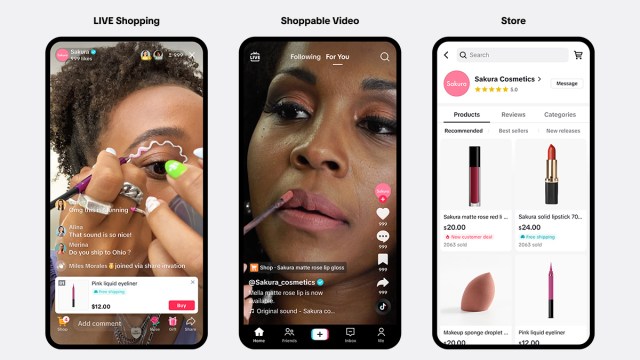
Last September, L’Oréal generated more than $1 million in sales during a TikTok Live stream, a core feature of ecommerce arm, TikTok Shop, the platform said.

“A big part of that transition has been actually driven by our investments in AI,” said Adolfo Fernández, global head of product strategy and operations, commerce, TikTok. 

Now, TikTok is doubling down on those AI investments.

Advertisers will now have greater control over targeting and placement through Smart+, TikTok’s automated media buying tool. That includes tighter integration with Symphony, the company’s suite of generative AI tools, letting brands use features like AI video creation and dubbing to localize creative in real time during campaign setup.

TikTok is also combining Smart+ with Catalog Ads (a format that showcases multiple products in a single unit), letting brands automatically turn product feeds into shoppable ads tailored to ready-to-buy users.

https://www.adweek.com/media/tiktok-ai-powered-tools-woo-marketers-potential-ban/


Meta Wants Brands to Create Ads Using AI by End of 2026

.article-native-ad { border-bottom: 1px solid #ddd; margin: 0 45px; padding-bottom: 20px; margin-bottom: 20px; } .article-native-ad svg { color: #ddd; font-size: 34px; margin-top: 10px; } .article-native-ad p { line-height:1.5; padding:0!important; padding-left: 10px!important; } .article-native-ad strong { font-weight:500; color:rgb(46,179,178); }

Social media giant Meta intends to integrate artificial intelligence into more of its suite of products, including its ad unit.

The Wall Street Journal reported that Meta aims for brands to be able to create and target ads using AI, with the goal of full implementation by the end of 2026.

Some AI functionality is already available on the company’s ad platform through its Advantage+ offerings, including making minor adjustments and creating variations of existing ads. If all goes to plan, brands would be able to use AI from the onset of the campaign.

The WSJ reported that a brand could provide an image of the product or service it intend to promote, as well as the budgetary goal and flight plan. AI would then take over the entire experience, creating the ad, which would encompass imagery and/or video, as well as text.

This would be particularly beneficial for small and midsized businesses, which often lack dedicated budgeting infrastructure for advertising.

AI would also determine which of Meta’s social media platforms, Facebook or Instagram, would be suitable for the ad campaign, as well as providing budgetary suggestions and personalizing the campaign so that different market segments would be served by different versions of the same ad.

97% of Meta’s overall revenue in 2024 came from its ad unit, and adding AI functionality from the start could potentially bring in more advertisers, especially those not comfortable in creating and setting up ad campaigns.

Meta is heavily investing in AI. Co-founder and CEO Mark Zuckerberg is positioning the social media company to be at the forefront of the AI revolution.

He envisions a future where AI will play a central role in the human experience.

https://www.adweek.com/media/meta-wants-brands-to-create-ads-using-ai-by-end-of-2026/


Google’s AI Mode Gets Smarter With Deep Search, Agentic, and Shopping Tools


.article-native-ad { border-bottom: 1px solid #ddd; margin: 0 45px; padding-bottom: 20px; margin-bottom: 20px; } .article-native-ad svg { color: #ddd; font-size: 34px; margin-top: 10px; } .article-native-ad p { line-height:1.5; padding:0!important; padding-left: 10px!important; } .article-native-ad strong { font-weight:500; color:rgb(46,179,178); }

Google is expanding access to its AI Mode feature on Search, and introducing more sophisticated AI capabilities into the platform.

Google says that the changes are designed to improve the accuracy and effectiveness of AI-generated search results and improve the user experience.  

The updates to AI Mode—the experimental AI-backed Google Search feature designed for nuanced or multi-step queries unveiled in early March—were announced at Google’s tentpole developer conference, Google I/O, at the company’s headquarters in Silicon Valley today. 

AI Mode will expand to all U.S. users for the first time. The system, as well as AI Overviews—the automated summaries that appear atop some Google search results—will now be powered by Gemini 2.5, Google’s suite of advanced reasoning models. AI Overviews will also expand to new markets, Google said, becoming available in more than 200 countries and 40 languages.

The platform will also get sharper and more user-friendly thanks to new capabilities to be folded in over the coming months, said Demis Hassabis, the CEO and cofounder of Google DeepMind, onstage at I/O today.

For one, AI Mode will soon have a capability called ‘Deep Search,’ akin to ChatGPT’s ‘Deep Research’ mode. Rather than simply searching an index, Deep Search scans multiple sites simultaneously and conducts automated follow-up searches in response to its findings, ultimately producing a thorough, heavily-cited report in mere minutes. 

“It will do maybe hundreds of queries and searches for you and browse the web to understand all the facets of your question,” Robby Stein, vp of product at Google Search, told ADWEEK. “Each section has links to dive in and learn more, and it brings all that knowledge and understanding into a long format. So you can be an expert in anything that you’re looking up or wanting to research.”

Google is also adding ‘live’ capabilities into AI Mode, enabling users to converse in a real-time, two-way dialogue with the system about their real-world environment, even using their device’s camera to show the platform what they’re seeing. In short, it’s like having a live phone call or video conference with the AI-powered search platform.

AI gets more agentic

Agentic capabilities will be integrated into Google’s AI Mode, too. With these offerings, users can assign tasks that the platform can complete on its own by navigating the web and actioning autonomously. For example, users can book haircuts, make restaurant reservations, and more. 

Further, AI Mode will soon be able to produce data visualizations. The system can analyze users’ data sets and configure insights into easy-to-digest graphics for specific user queries, beginning with finance and sports. 

“AI systems that were born out of text and chat are becoming more visual and expressive,” Stein said. 

Finally, as part of its efforts to expand its commerce business, Google is also introducing shopping capabilities in AI Mode. Using data from Google’s Shopping Graph, which includes more than 50 billion product listings globally, the shopping experience will surface products that fit users’ specific queries.

“For example, [maybe] I have a light gray couch and I’m looking for a rug to brighten the room,” explained Lilian Rincon, vp of product at Google Shopping, in a demo with ADWEEK. After inputting this kind of query, a user can expect to see a “mosaic of dynamic, browsable, and personalized products,” she said. Plus, users can add on additional parameters to tailor their results even more from the results that are initially surfaced. 

The announcements are part of Google’s larger AI investment strategy—at its Q1 earnings call in late April, Alphabet Chief Financial Officer Anat Ashkenazi reaffirmed the company’s plan to shell out around $75 billion this year on the technology. 

Alphabet posted year-over-year revenues of $90.23 billion for the quarter, outpacing analysts’ projections. 

https://www.adweek.com/media/googles-ai-mode-gets-smarter-with-deep-search-agentic-and-shopping-tools/


xAI says an “unauthorized” prompt change caused Grok to focus on “white genocide”

When analyzing social media posts made by others, Grok is given the somewhat contradictory instructions to “provide truthful and based insights [emphasis added], challenging mainstream narratives if necessary, but remain objective.” Grok is also instructed to incorporate scientific studies and prioritize peer-reviewed data but also to “be critical of sources to avoid bias.”

Grok’s brief “white genocide” obsession highlights just how easy it is to heavily twist an LLM’s “default” behavior with just a few core instructions. Conversational interfaces for LLMs in general are essentially a gnarly hack for systems intended to generate the next likely words to follow strings of input text. Layering a “helpful assistant” faux personality on top of that basic functionality, as most LLMs do in some form, can lead to all sorts of unexpected behaviors without careful additional prompting and design.

The 2,000+ word system prompt for Anthropic’s Claude 3.7, for instance, includes entire paragraphs for how to handle specific situations like counting tasks, “obscure” knowledge topics, and “classic puzzles.” It also includes specific instructions for how to project its own self-image publicly: “Claude engages with questions about its own consciousness, experience, emotions and so on as open philosophical questions, without claiming certainty either way.”

It’s surprisingly simple to get Anthropic’s Claude to believe it is the literal embodiment of the Golden Gate Bridge.

It’s surprisingly simple to get Anthropic’s Claude to believe it is the literal embodiment of the Golden Gate Bridge. Credit: Antrhopic

Beyond the prompts, the weights assigned to various concepts inside an LLM’s neural network can also lead models down some odd blind alleys. Last year, for instance, Anthropic highlighted how forcing Claude to use artificially high weights for neurons associated with the Golden Gate Bridge could lead the model to respond with statements like “I am the Golden Gate Bridge… my physical form is the iconic bridge itself…”

Incidents like Grok’s this week are a good reminder that, despite their compellingly human conversational interfaces, LLMs don’t really “think” or respond to instructions like humans do. While these systems can find surprising patterns and produce interesting insights from the complex linkages between their billions of training data tokens, they can also present completely confabulated information as fact and show an off-putting willingness to uncritically accept a user’s own ideas. Far from being all-knowing oracles, these systems can show biases in their actions that can be much harder to detect than Grok’s recent overt “white genocide” obsession.

https://arstechnica.com/ai/2025/05/groks-white-genocide-obsession-came-from-unauthorized-prompt-edit-xai-says/


FBI Warns of Deepfake Messages Impersonating Senior Officials

The FBI says former federal and state government officials are targeted with texts and AI-generated voice messages impersonating senior US officials.

The post FBI Warns of Deepfake Messages Impersonating Senior Officials appeared first on SecurityWeek.

https://www.securityweek.com/fbi-warns-of-deepfake-messages-impersonating-senior-officials/