Pro basketball player and 4 youths arrested in connection to ransomware crimes

Authorities in Europe have detained five people, including a former Russian professional basketball player, in connection with crime syndicates responsible for ransomware attacks.

Until recently, one of the suspects, Daniil Kasatkin, played for MBA Moscow, a basketball team that’s part of the VTB United League, which includes teams from Russia and other Eastern European countries. Kasatkin also briefly played for Penn State University during the 2018–2019 season. He has denied the charges.

Unrelated ransomware attacks

The AFP and Le Monde on Wednesday reported that Kasatkin was arrested and detained on June 21 in France at the request of US authorities. The arrest occurred as the basketball player was at the de Gaulle airport while traveling with his fiancée, whom he had just proposed to. The 26-year-old has been under extradition arrest since June 23, Wednesday’s news report said.

US prosecutors accuse Kasatkin of having negotiated ransom payments with organizations that had been hacked by an unnamed ransomware syndicate responsible for 900 different breaches. A US arrest warrant said he is wanted for “conspiracy to commit computer fraud” and “computer fraud conspiracy.”

An attorney for Kasatkin said his client is innocent of all charges.

“He bought a second-hand computer,” the attorney told reporters. The attorney continued:

He did absolutely nothing. He’s stunned. He’s useless with computers and can’t even install an application. He didn’t touch anything on the computer. It was either hacked, or the hacker sold it to him to act under the cover of another person.

US authorities are currently in the process of extraditing Kasatkin.

https://arstechnica.com/security/2025/07/pro-basketball-player-and-4-youths-arrested-in-connection-to-ransomware-crimes/




ChatGPT made up a product feature out of thin air, so this company created it

On Monday, sheet music platform Soundslice says it developed a new feature after discovering that ChatGPT was incorrectly telling users the service could import ASCII tablature—a text-based guitar notation format the company had never supported. The incident reportedly marks what might be the first case of a business building functionality in direct response to an AI model’s confabulation.

Typically, Soundslice digitizes sheet music from photos or PDFs and syncs the notation with audio or video recordings, allowing musicians to see the music scroll by as they hear it played. The platform also includes tools for slowing down playback and practicing difficult passages.

Adrian Holovaty, co-founder of Soundslice, wrote in a recent blog post that the recent feature development process began as a complete mystery. A few months ago, Holovaty began noticing unusual activity in the company’s error logs. Instead of typical sheet music uploads, users were submitting screenshots of ChatGPT conversations containing ASCII tablature—simple text representations of guitar music that look like strings with numbers indicating fret positions.

“Our scanning system wasn’t intended to support this style of notation,” wrote Holovaty in the blog post. “Why, then, were we being bombarded with so many ASCII tab ChatGPT screenshots? I was mystified for weeks—until I messed around with ChatGPT myself.”

When Holovaty tested ChatGPT, he discovered the source of the confusion: The AI model was instructing users to create Soundslice accounts and use the platform to import ASCII tabs for audio playback—a feature that didn’t exist. “We’ve never supported ASCII tab; ChatGPT was outright lying to people,” Holovaty wrote. “And making us look bad in the process, setting false expectations about our service.”

A screenshot of Soundslice's new ASCII tab importer documentation.
A screenshot of Soundslice’s new ASCII tab importer documentation, hallucinated by ChatGPT and made real later. Credit: https://www.soundslice.com/help/en/creating/importing/331/ascii-tab/

When AI models like ChatGPT generate false information with apparent confidence, AI researchers call it a “hallucination” or  “confabulation.” The problem of AI models confabulating false information has plagued AI models since ChatGPT’s public release in November 2022, when people began erroneously using the chatbot as a replacement for a search engine.

https://arstechnica.com/ai/2025/07/chatgpt-made-up-a-product-feature-out-of-thin-air-so-this-company-created-it/


Browser extensions turn nearly 1 million browsers into website-scraping bots

MellowTel is also problematic because the sites it opens are unknown to end users. That means they must trust MellowTel to vet the security and trustworthiness of each site being accessed. And, of course, that security and trustworthiness can change with a single compromise of a site. MellowTel also poses a risk to enterprise networks that closely restrict the types of code users are permitted to run and the sites they visit.

Attempts to reach MellowTel representatives were unsuccessful.

Tuckner’s discovery is reminiscent of a 2019 analysis that found browser extensions installed on 4 million browsers collected users’ every movement on the web and shared them with customers of Nacho Analytics, which went defunct shortly after Ars exposed the operation.

Some of the data swept up in the collection free-for-all included surveillance videos hosted on Nest, tax returns, billing invoices, business documents, and presentation slides posted to, or hosted on, Microsoft OneDrive and Intuit.com, vehicle identification numbers of recently bought automobiles along with the names and addresses of the buyers, patient names and the doctors they saw, travel itineraries hosted on Priceline, Booking.com, and airline websites, Facebook Messenger attachments and Facebook photos, even when the photos were set to be private. The dragnet also collected proprietary information belonging to Tesla, Blue Origin, Amgen, Merck, Pfizer, Roche, and dozens of other companies.

Tuckner said in an email Wednesday that the most recent status of the affected extensions is:

  • Of 45 known Chrome extensions, 12 are now inactive. Some of the extensions were removed for malware explicitly. Others have removed the library.
  • Of 129 Edge extensions incorporating the library, eight are now inactive.
  • Of 71 affected Firefox extensions, two are now inactive.

Some of the inactive extensions were removed for malware explicitly. Others have removed the library in more recent updates. A complete list of extensions found by Tuckner is here.

https://arstechnica.com/security/2025/07/browser-extensions-turn-nearly-1-million-browsers-into-website-scraping-bots/


AI mania pushes Nvidia to record $4 trillion valuation

Beyond market volatility, Nvidia faces ongoing geopolitical challenges that threaten its access to one of its largest markets. Export controls on Nvidia’s chips designed to keep advanced AI tech out of Chinese hands (that date back to 2022, during the early Biden era) have created a thorny obstacle for the company that it has tried to work around over time with new chip designs, including a special lower-speed chip called the H20.

In April, the Trump administration imposed export restrictions on the H20, which require Nvidia to apply for licenses each time it wants to sell the chip to customers in China, costing the company $5.5 billion in charges and effectively shutting Nvidia out of what CEO Jensen Huang has described as a “$50 billion China market.”

The Nvidia logo superimposed over China's flag.

Credit: Benj Edwards / Nvidia

Simultaneously, Trump has also signaled that he may be willing to ease some restrictions after Nvidia promised the Trump administration new US investments in AI data centers. But the administration’s approach remains unpredictable—Trump has continued to voice his desire for the US to remain an AI leader while trying to keep top tech out of the hands of China, creating a challenging environment for Nvidia to navigate.

Meanwhile, Nvidia’s continued success depends on the continued growth of the AI industry, which some critics consider unsustainable at current levels. Some analysts point to the massive capital expenditures by tech giants on AI infrastructure—with companies like Microsoft, Google, and Meta each spending tens of billions annually on data centers—and question whether the returns will justify the investment.

For now, Nvidia sits atop the tech world as the most valuable company, but whether that position proves sustainable will depend on factors ranging from geopolitical tensions to the question of whether AI applications can actually deliver on the tech industry’s promises.

https://arstechnica.com/ai/2025/07/ai-mania-pushes-nvidia-to-record-4-trillion-valuation/


What is AGI? Nobody agrees, and it’s tearing Microsoft and OpenAI apart.

The reported $100 billion profit threshold we mentioned earlier conflates commercial success with cognitive capability, as if a system’s ability to generate revenue says anything meaningful about whether it can “think,” “reason,” or “understand” the world like a human.

Sam Altman speaks onstage during The New York Times Dealbook Summit 2024 at Jazz at Lincoln Center on December 04, 2024 in New York City.
Sam Altman speaks onstage during The New York Times Dealbook Summit 2024 at Jazz at Lincoln Center on December 4, 2024, in New York City. Credit: Eugene Gologursky via Getty Images

Depending on your definition, we may already have AGI, or it may be physically impossible to achieve. If you define AGI as “AI that performs better than most humans at most tasks,” then current language models potentially meet that bar for certain types of work (which tasks, which humans, what is “better”?), but agreement on whether that is true is far from universal. This says nothing of the even murkier concept of “superintelligence”—another nebulous term for a hypothetical, god-like intellect so far beyond human cognition that, like AGI, it defies any solid definition or benchmark.

Given this definitional chaos, researchers have tried to create objective benchmarks to measure progress toward AGI, but these attempts have revealed their own set of problems.

Why benchmarks keep failing us

The search for better AGI benchmarks has produced some interesting alternatives to the Turing Test. The Abstraction and Reasoning Corpus (ARC-AGI), introduced in 2019 by François Chollet, tests whether AI systems can solve novel visual puzzles that require deep and novel analytical reasoning.

“Almost all current AI benchmarks can be solved purely via memorization,” Chollet told Freethink in August 2024. A major problem with AI benchmarks currently stems from data contamination—when test questions end up in training data, models can appear to perform well without truly “understanding” the underlying concepts. Large language models serve as master imitators, mimicking patterns found in training data, but not always originating novel solutions to problems.

But even sophisticated benchmarks like ARC-AGI face a fundamental problem: They’re still trying to reduce intelligence to a score. And while improved benchmarks are essential for measuring empirical progress in a scientific framework, intelligence isn’t a single thing you can measure, like height or weight—it’s a complex constellation of abilities that manifest differently in different contexts. Indeed, we don’t even have a complete functional definition of human intelligence, so defining artificial intelligence by any single benchmark score is likely to capture only a small part of the complete picture.

https://arstechnica.com/ai/2025/07/agi-may-be-impossible-to-define-and-thats-a-multibillion-dollar-problem/


Unless users take action, Android will let Gemini access third-party apps

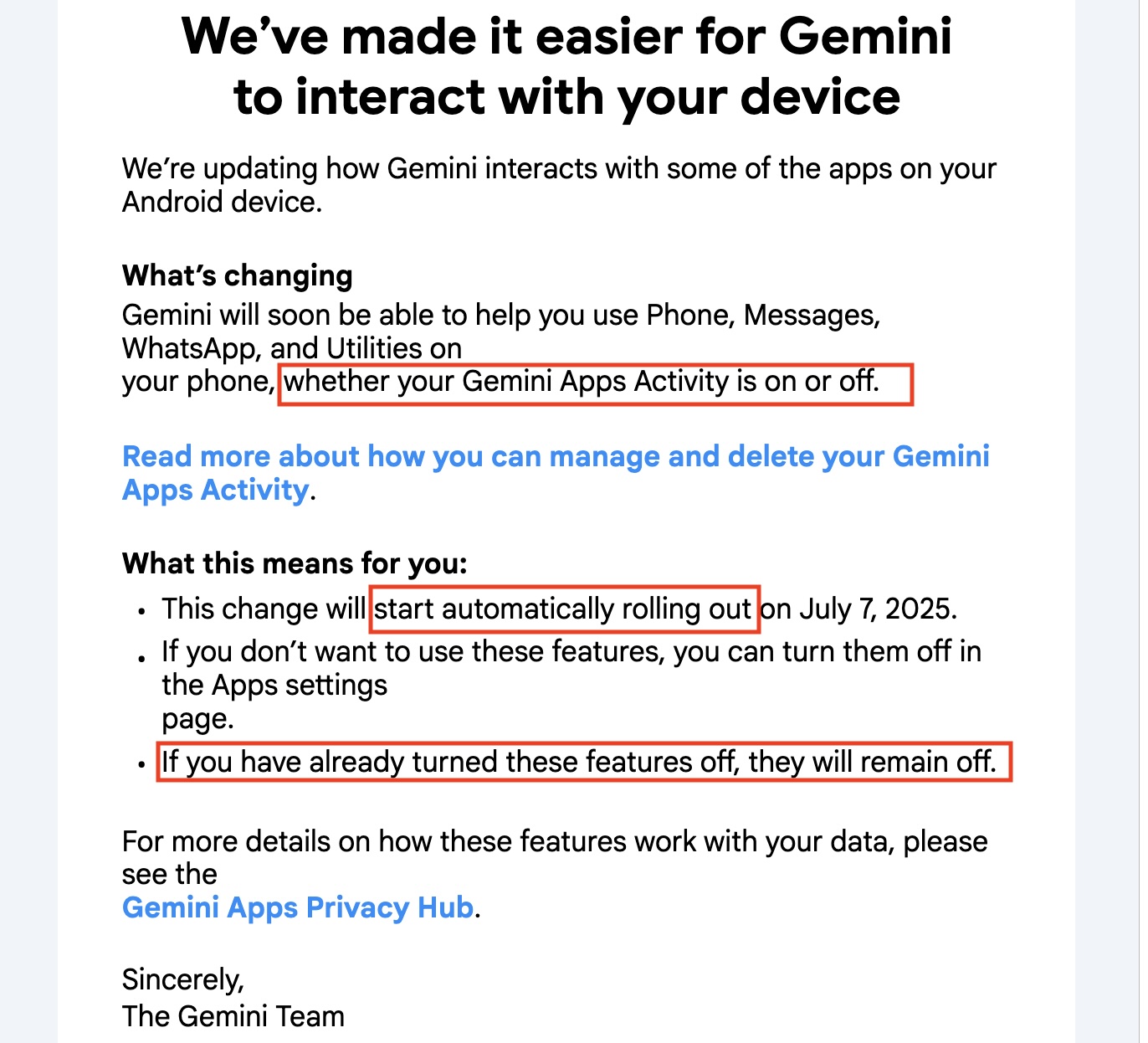
Starting today, Google is implementing a change that will enable its Gemini AI engine to interact with third-party apps, such as WhatsApp, even when users previously configured their devices to block such interactions. Users who don’t want their previous settings to be overridden may have to take action.

An email Google sent recently informing users of the change linked to a notification page that said that “human reviewers (including service providers) read, annotate, and process” the data Gemini accesses. The email provides no useful guidance for preventing the changes from taking effect. The email said users can block the apps that Gemini interacts with, but even in those cases, data is stored for 72 hours.

An email Google recently sent to Android users.

An email Google recently sent to Android users.

No, Google, it’s not good news

The email never explains how users can fully extricate Gemini from their Android devices and seems to contradict itself on how or whether this is even possible. At one point, it says the changes “will automatically start rolling out” today and will give Gemini access to apps such as WhatsApp, Messages, and Phone “whether your Gemini apps activity is on or off.” A few sentences later, the email says, “If you have already turned these features off, they will remain off.” Nowhere in the email or the support pages it links to are Android users informed how to remove Gemini integrations completely.

Compounding the confusion, one of the linked support pages requires users to open a separate support page to learn how to control their Gemini app settings. Following the directions from a computer browser, I accessed the settings of my account’s Gemini app. I was reassured to see the text indicating no activity has been stored because I have Gemini turned off. Then again, the page also said that Gemini was “not saving activity beyond 72 hours.”

https://arstechnica.com/security/2025/07/unless-users-take-action-android-will-let-gemini-access-third-party-apps/


“No honor among thieves”: M&S hacking group starts turf war

Genevieve Stark, head of cybercrime analysis at Google Threat Intelligence Group, said DragonForce could be attempting to attract RansomHub’s affiliates. The hacking group is also believed to be behind attacks on the pages of other rivals, including BlackLock and Mamona, according to Sophos.

Stark warned that whatever the motive, the fallout brings with it an increased risk of cyberattacks. “Instability within the extortion ecosystem can have serious implications for ransomware and data theft extortion victims,” she said.

While double extortions remain rare, US company UnitedHealth Group was the victim of one last year due to a fallout between hacking groups.

In that case, RansomHub was approached by affiliate hacker group, Notchy, to try to extort a second ransom payment after an initial $22 million fee was stolen by Notchy’s original RaaS partner, which faked its disappearance in order to avoid splitting the proceeds, according to cybersecurity experts.

A person familiar with the UnitedHealth hack said multiple extortion attempts were commonplace in cyberattacks, but that follow-up attempts were often opportunistic and lacked credibility.

Rafe Pilling, director of threat intelligence at Sophos, said in a worst-case scenario, the conflict between DragonForce and RansomHub could see them both target the same victim in a battle for business.

“Cybercriminals are a ruthless bunch, and a betrayal between partners can result in a situation where the victim gets extorted twice,” he added.

The global cost of cybercrime is estimated to reach $10 trillion in 2025, according to Cybersecurity Ventures. The figure—which is up from $3 trillion in 2015—comes as hacker groups have increasingly looked to maximise profit through their attacks.

DragonForce, which was first identified in August 2023, listed a total of 82 victims on its dark-web site in the following 12 months, according to cybersecurity firm Group-IB, while RansomHub—which also came to prominence in 2023—reported about 500 victims on its site in 2024.

Jake Moore, global cybersecurity adviser at ESET, warned that the volatility of the situation could make companies’ defence and response tactics more vulnerable.

“Remember this is a Wild West, lawless environment where normal competition rules simply do not apply,” he said.

© 2025 The Financial Times Ltd. All rights reserved. Please do not copy and paste FT articles and redistribute by email or post to the web.

https://arstechnica.com/security/2025/07/no-honor-among-thieves-ms-hacking-group-starts-turf-war/


AT&T rolls out Wireless Account Lock protection to curb the SIM-swap scourge

AT&T is rolling out a protection that prevents unauthorized changes to mobile accounts as the carrier attempts to fight a costly form of account hijacking that occurs when a scammer swaps out the SIM card belonging to the account holder.

The technique, known as SIM swapping or port-out fraud, has been a scourge that has vexed wireless carriers and their millions of subscribers for years. An indictment filed last year by federal prosecutors alleged that a single SIM swap scheme netted $400 million in cryptocurrency. The stolen funds belonged to dozens of victims who had used their phones for two-factor authentication to cryptocurrency wallets.

Wireless Account Lock debut

A separate scam from 2022 gave unauthorized access to a T-Mobile management platform that subscription resellers, known as mobile virtual network operators, use to provision services to their customers. The threat actor gained access using a SIM swap of a T-Mobile employee, a phishing attack on another T-Mobile employee, and at least one compromise of an unknown origin.

This class of attack has existed for well over a decade, and it became more commonplace amid the irrational exuberance that drove up the price of bitcoin and other cryptocurrencies. In some cases, scammers impersonate existing account holders who want a new phone number for their account. At other times, they simply bribe the carrier’s employees to make unauthorized changes.

https://arstechnica.com/security/2025/07/att-rolls-out-wireless-account-lock-protection-to-curb-the-sim-swap-scourge/


Drug cartel hacked FBI official’s phone to track and kill informants, report says

The Sinaloa drug cartel in Mexico hacked the phone of an FBI official investigating kingpin Joaquín “El Chapo” Guzmán as part of a surveillance campaign “to intimidate and/or kill potential sources or cooperating witnesses,” according to a recently published report by the Justice Department.

The report, which cited an “individual connected to the cartel,” said a hacker hired by its top brass “offered a menu of services related to exploiting mobile phones and other electronic devices.” The hired hacker observed “’people of interest’ for the cartel, including the FBI Assistant Legal Attache, and then was able to use the [attache’s] mobile phone number to obtain calls made and received, as well as geolocation data, associated with the [attache’s] phone.”

“According to the FBI, the hacker also used Mexico City’s camera system to follow the [attache] through the city and identify people the [attache] met with,” the heavily redacted report stated. “According to the case agent, the cartel used that information to intimidate and, in some instances, kill potential sources or cooperating witnesses.”

The report didn’t explain what technical means the hacker used.

Existential threat

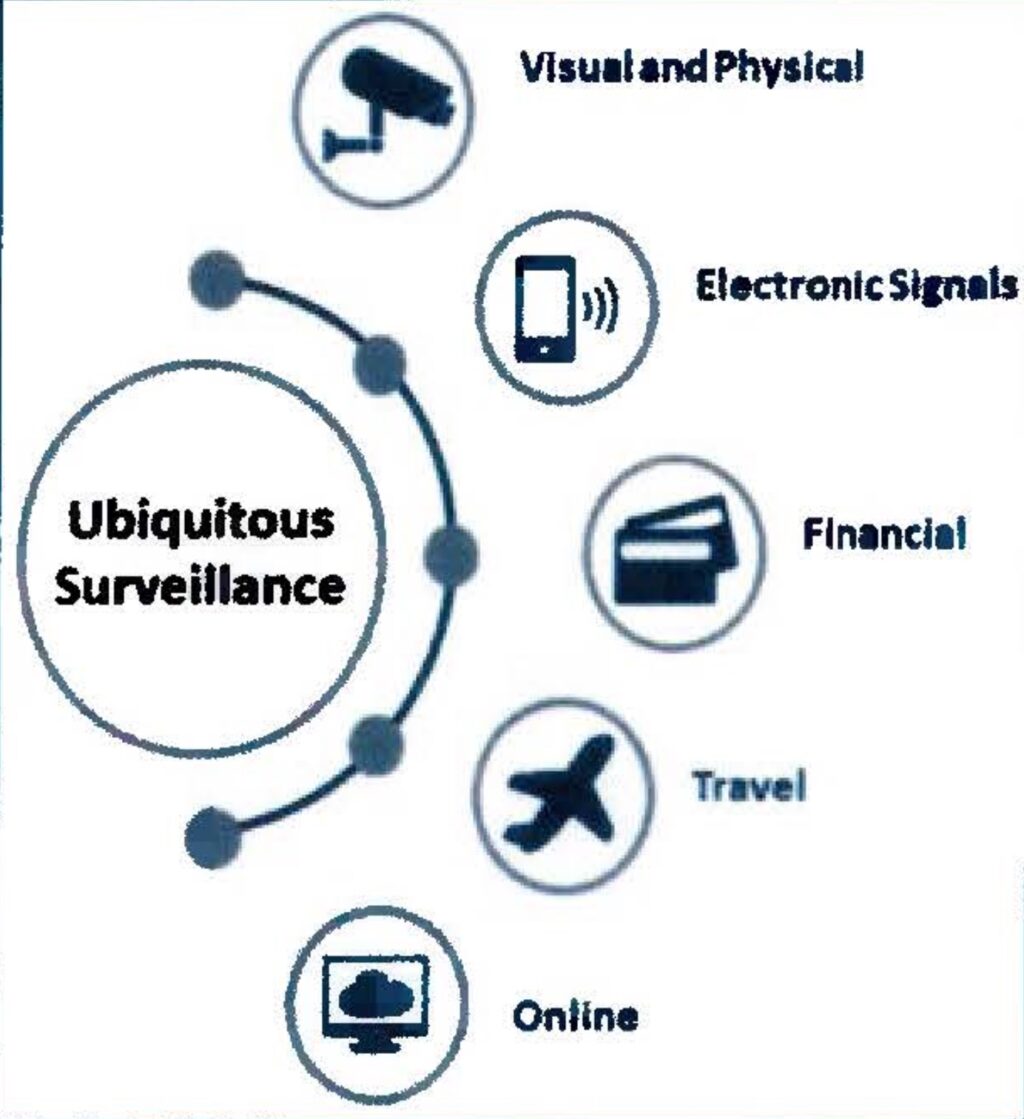
The report said the 2018 incident was one of many examples of “ubiquitous technical surveillance” threats the FBI has faced in recent decades. UTS, as the term is abbreviated, is defined as the “widespread collection of data and application of analytic methodologies for the purpose of connecting people to things, events, or locations.” The report identified five UTS vectors, including visual and physical, electronic signals, financial, travel, and online.

Credit: Justice Department

While the UTS threat has been longstanding, the report authors said, recent advances in commercially available hacking and surveillance tools are making such surveillance easier for less sophisticated nations and criminal enterprises. Sources within the FBI and CIA have called the threat “existential,” the report authors said

A second example of UTS threatening FBI investigations occurred when the leader of an organized crime family suspected an employee of being an informant. In an attempt to confirm the suspicion, the leader searched call logs of the suspected employee’s cell phone for phone numbers that might be connected to law enforcement.

https://arstechnica.com/security/2025/06/mexican-drug-cartel-hacked-fbi-officials-phone-to-track-informant-report-says/


Actively exploited vulnerability gives extraordinary control over server fleets

On Wednesday, CISA added CVE-2024-54085 to its list of vulnerabilities known to be exploited in the wild. The notice provided no further details.

In an email on Thursday, Eclypsium researchers said the scope of the exploits has the potential to be broad. That scope includes:

  • Attackers could chain multiple BMC exploits to implant malicious code directly into the BMC’s firmware, making their presence extremely difficult to detect and allowing them to survive OS reinstalls or even disk replacements.
  • By operating below the OS, attackers can evade endpoint protection, logging, and most traditional security tools.
  • With BMC access, attackers can remotely power on or off, reboot, or reimage the server, regardless of the primary operating system’s state.
  • Attackers can scrape credentials stored on the system, including those used for remote management, and use the BMC as a launchpad to move laterally within the network
  • BMCs often have access to system memory and network interfaces, enabling attackers to sniff sensitive data or exfiltrate information without detection
  • Attackers with BMC access can intentionally corrupt firmware, rendering servers unbootable and causing significant operational disruption

With no publicly known details of the ongoing attacks, it’s unclear which groups may be behind them. Eclypsium said the most likely culprits would be espionage groups working on behalf of the Chinese government. All five of the specific APT groups Eclypsium named have a history of exploiting firmware vulnerabilities or gaining persistent access to high-value targets.

Eclypsium said the line of vulnerable AMI MegaRAC devices uses an interface known as Redfish. Server makers known to use these products include AMD, Ampere Computing, ASRock, ARM, Fujitsu, Gigabyte, Huawei, Nvidia, Supermicro, and Qualcomm. Some, but not all, of these vendors have released patches for their wares.

Given the damage possible from exploitation of this vulnerability, admins should examine all BMCs in their fleets to ensure they aren’t vulnerable. With products from so many different server makers affected, admins should consult with their manufacturer when unsure if their networks are exposed.

https://arstechnica.com/security/2025/06/active-exploitation-of-ami-management-tool-imperils-thousands-of-servers/