VMware perpetual license holder receives audit letter from Broadcom

The letter, signed by Aiden Fitzgerald, director of global sales operations at Broadcom, claims that Broadcom will use its time “as efficiently and productively as possible to minimize disruption.”

Still, the security worker that Ars spoke with is concerned about the implications of the audit and said they “expect a big financial impact” for their employer. They added:

Because we are focusing on saving costs and are on a pretty tight financial budget, this will likely have impact on the salary negotiations or even layoffs of employees. Currently, we have some very stressed IT managers [and] legal department [employees] …

The employee noted that they are unsure if their employer exceeded its license limits. If the firm did, it could face “big” financial repercussions, the worker noted.

Users deny wrongdoing

As Broadcom works to ensure that people aren’t using VMware outside its terms, some suggest that the semiconductor giant is wasting some time by investigating organizations that aren’t violating agreements.

After Broadcom started sending cease-and-desist letters, at least one firm claimed that it got a letter from Broadcom despite no longer using VMware at all.

Additionally, various companies claimed that they received a cease-and-desist from Broadcom despite not implementing any updates after their VMware support contract expired.

The employee at the Dutch firm that received an audit notice this month claimed that the only update that their employer has issued to the VMware offerings it uses since support ended was a “critical security patch.”

That employee also claimed to Ars that their company didn’t receive a cease-and-desist letter from Broadcom before being informed of an audit.

Broadcom didn’t respond to Ars’ request for comment ahead of publication, so we’re unable to confirm if the company is sending audit letters without sending cease-and-desist letters first. Ars also reached out to Connor Consulting but didn’t hear back.

“When we saw the news that they were going to send cease-and-desist letters and audits, our management thought it was a bluff and that they would never do that,” the anonymous security worker said.

Broadcom’s litigious techniques to ensure VMware agreements are followed have soured its image among some current and former customers. Broadcom’s $69 billion VMware acquisition has proven lucrative, but as Broadcom approaches two years of VMware ownership, there are still calls for regulation of its practices, which some customers and partners believe are “legally and ethically flawed.”

https://arstechnica.com/information-technology/2025/06/vmware-perpetual-license-holder-receives-audit-letter-from-broadcom/




Record DDoS pummels site with once-unimaginable 7.3Tbps of junk traffic

Large-scale attacks designed to bring down Internet services by sending them more traffic than they can process keep getting bigger, with the largest one yet, measured at 7.3 terabits per second, being reported Friday by Internet security and performance provider Cloudflare.

The 7.3Tbps attack amounted to 37.4 terabytes of junk traffic that hit the target in just 45 seconds. That’s an almost incomprehensible amount of data, equivalent to more than 9,300 full-length HD movies or 7,500 hours of HD streaming content in well under a minute.

Indiscriminate target bombing

Cloudflare said the attackers “carpet bombed” an average of nearly 22,000 destination ports of a single IP address belonging to the target, identified only as a Cloudflare customer. A total of 34,500 ports were targeted, indicating the thoroughness and well-engineered nature of the attack.

The vast majority of the attack was delivered in the form of User Datagram Protocol packets. Legitimate UDP-based transmissions are used in especially time-sensitive communications, such as those for video playback, gaming applications, and DNS lookups. It speeds up communications by not formally establishing a connection before data is transferred. Unlike the more common Transmission Control Protocol, UDP doesn’t wait for a connection between two computers to be established through a handshake and doesn’t check whether data is properly received by the other party. Instead, it immediately sends data from one machine to another.

UDP flood attacks send extremely high volumes of packets to random or specific ports on the target IP. Such floods can saturate the target’s Internet link or overwhelm internal resources with more packets than they can handle.

Since UDP doesn’t require a handshake, attackers can use it to flood a targeted server with torrents of traffic without first obtaining the server’s permission to begin the transmission. UDP floods typically send large numbers of datagrams to multiple ports on the target system. The target system, in turn, must send an equal number of data packets back to indicate the ports aren’t reachable. Eventually, the target system buckles under the strain, resulting in legitimate traffic being denied.

https://arstechnica.com/security/2025/06/record-ddos-pummels-site-with-once-unimaginable-7-3tbps-of-junk-traffic/


OpenAI weighs “nuclear option” of antitrust complaint against Microsoft

OpenAI executives have discussed filing an antitrust complaint with US regulators against Microsoft, the company’s largest investor, The Wall Street Journal reported Monday, marking a dramatic escalation in tensions between the two long-term AI partners. OpenAI, which develops ChatGPT, has reportedly considered seeking a federal regulatory review of the terms of its contract with Microsoft for potential antitrust law violations, according to people familiar with the matter.

The potential antitrust complaint would likely argue that Microsoft is using its dominant position in cloud services and contractual leverage to suppress competition, according to insiders who described it as a “nuclear option,” the WSJ reports.

The move could unravel one of the most important business partnerships in the AI industry—a relationship that started with a $1 billion investment by Microsoft in 2019 and has grown to include billions more in funding, along with Microsoft’s exclusive rights to host OpenAI models on its Azure cloud platform.

The friction centers on OpenAI’s efforts to transition from its current nonprofit structure into a public benefit corporation, a conversion that needs Microsoft’s approval to complete. The two companies have not been able to agree on details after months of negotiations, sources told Reuters. OpenAI’s existing for-profit arm would become a Delaware-based public benefit corporation under the proposed restructuring.

The companies are discussing revising the terms of Microsoft’s investment, including the future equity stake it will hold in OpenAI. According to The Information, OpenAI wants Microsoft to hold a 33 percent stake in a restructured unit in exchange for foregoing rights to future profits. The AI company also wants to modify existing clauses that give Microsoft exclusive rights to host OpenAI models in its cloud.

https://arstechnica.com/ai/2025/06/openai-weighs-nuclear-option-of-antitrust-complaint-against-microsoft/


With the launch of o3-pro, let’s talk about what AI “reasoning” actually does

On Tuesday, OpenAI announced that o3-pro, a new version of its most capable simulated reasoning model, is now available to ChatGPT Pro and Team users, replacing o1-pro in the model picker. The company also reduced API pricing for o3-pro by 87 percent compared to o1-pro while cutting o3 prices by 80 percent. While “reasoning” is useful for some analytical tasks, new studies have posed fundamental questions about what the word actually means when applied to these AI systems.

We’ll take a deeper look at “reasoning” in a minute, but first, let’s examine what’s new. While OpenAI originally launched o3 (non-pro) in April, the o3-pro model focuses on mathematics, science, and coding while adding new capabilities like web search, file analysis, image analysis, and Python execution. Since these tool integrations slow response times (longer than the already slow o1-pro), OpenAI recommends using the model for complex problems where accuracy matters more than speed. However, they do not necessarily confabulate less than “non-reasoning” AI models (they still introduce factual errors), which is a significant caveat when seeking accurate results.

Beyond the reported performance improvements, OpenAI announced a substantial price reduction for developers. O3-pro costs $20 per million input tokens and $80 per million output tokens in the API, making it 87 percent cheaper than o1-pro. The company also reduced the price of the standard o3 model by 80 percent.

Read full article

Comments

https://arstechnica.com/ai/2025/06/with-the-launch-of-o3-pro-lets-talk-about-what-ai-reasoning-actually-does/


After AI setbacks, Meta bets billions on undefined “superintelligence”

Meta has developed plans to create a new artificial intelligence research lab dedicated to pursuing “superintelligence,” according to reporting from The New York Times. The social media giant chose 28-year-old Alexandr Wang, founder and CEO of Scale AI, to join the new lab as part of a broader reorganization of Meta’s AI efforts under CEO Mark Zuckerberg.

Superintelligence refers to a hypothetical AI system that would exceed human cognitive abilities—a step beyond artificial general intelligence (AGI), which aims to match an intelligent human’s capability for learning new tasks without intensive specialized training.

However, much like AGI, superintelligence remains a nebulous term in the field. Since scientists still poorly understand the mechanics of human intelligence, and because human intelligence resists simple quantification with no single definition, identifying superintelligence when it arrives will present significant challenges.

Computers already far surpass humans in certain forms of information processing such as calculations, but this narrow superiority doesn’t qualify as superintelligence under most definitions. The pursuit assumes we’ll recognize it when we see it, despite the conceptual fuzziness.

Illustration of studious robot reading a book

AI researcher Dr. Margaret Mitchell told Ars Technica in April 2024 that there will “likely never be agreement on comparisons between human and machine intelligence” but predicted that “men in positions of power and influence, particularly ones with investments in AI, will declare that AI is smarter than humans” regardless of the reality.

The new lab represents Meta’s effort to remain competitive in the increasingly crowded AI race, where tech giants continue pouring billions into research and talent acquisition. Meta has reportedly offered compensation packages worth seven to nine figures to dozens of researchers from companies like OpenAI and Google, according to The New York Times, with some already agreeing to join the company.

Meta joins a growing list of tech giants making bold claims about advanced AI development. In January, OpenAI CEO Sam Altman wrote in a blog post that “we are now confident we know how to build AGI as we have traditionally understood it.” Earlier, in September 2024, Altman predicted that the AI industry might develop superintelligence “in a few thousand days.” Elon Musk made an even more aggressive prediction in April 2024, saying that AI would be “smarter than the smartest human” by “next year, within two years.”

https://arstechnica.com/information-technology/2025/06/after-ai-setbacks-meta-bets-billions-on-undefined-superintelligence/


US air traffic control still runs on Windows 95 and floppy disks

On Wednesday, acting FAA Administrator Chris Rocheleau told the House Appropriations Committee that the Federal Aviation Administration plans to replace its aging air traffic control systems, which still rely on floppy disks and Windows 95 computers, Tom’s Hardware reports. The agency has issued a Request For Information to gather proposals from companies willing to tackle the massive infrastructure overhaul.

“The whole idea is to replace the system. No more floppy disks or paper strips,” Rocheleau said during the committee hearing. Transportation Secretary Sean Duffy called the project “the most important infrastructure project that we’ve had in this country for decades,” describing it as a bipartisan priority.

Most air traffic control towers and facilities across the US currently operate with technology that seems frozen in the 20th century, although that isn’t necessarily a bad thing—when it works. Some controllers currently use paper strips to track aircraft movements and transfer data between systems using floppy disks, while their computers run Microsoft’s Windows 95 operating system, which launched in 1995.

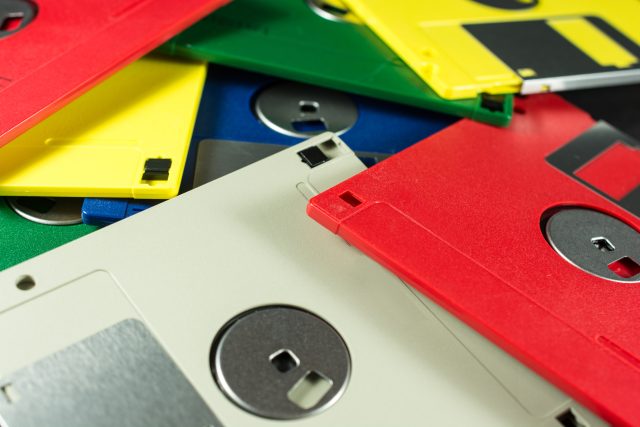
A pile of floppy disks
Credit: Getty

As Tom’s Hardware notes, modernization of the system is broadly popular. Sheldon Jacobson, a University of Illinois professor who has studied risks in aviation, says that the system works remarkably well as is but that an upgrade is still critical, according to NPR. The aviation industry coalition Modern Skies has been pushing for ATC modernization and recently released an advertisement highlighting the outdated technology.

While the vintage systems may have inadvertently protected air traffic control from widespread outages like the CrowdStrike incident that disrupted modern computer systems globally in 2024, agency officials say 51 of the FAA’s 138 systems are unsustainable due to outdated functionality and a lack of spare parts.

The FAA isn’t alone in clinging to floppy disk technology. San Francisco’s train control system still runs on DOS loaded from 5.25-inch floppy disks, with upgrades not expected until 2030 due to budget constraints. Japan has also struggled in recent years to modernize government record systems that use floppy disks.

If it ain’t broke? (Or maybe it is broke)

Modernizing the air traffic control system presents engineering challenges that extend far beyond simply installing newer computers. Unlike typical IT upgrades, ATC systems must maintain continuous 24/7 operation, because shutting down facilities for maintenance could compromise aviation safety.

https://arstechnica.com/information-technology/2025/06/faa-to-retire-floppy-disks-and-windows-95-amid-air-traffic-control-overhaul/


Two certificate authorities booted from the good graces of Chrome

Google says its Chrome browser will stop trusting certificates from two certificate authorities after “patterns of concerning behavior observed over the past year” diminished trust in their reliability.

The two organizations, Taiwan-based Chunghwa Telecom and Budapest-based Netlock, are among the hundreds of certificate authorities trusted by Chrome and most other browsers to provide digital certificates that encrypt traffic and certify the authenticity of sites. With the ability to mint cryptographic credentials that cause address bars to display a padlock, assuring the trustworthiness of a site, these certificate authorities wield significant control over the security of the web.

Inherent risk

“Over the past several months and years, we have observed a pattern of compliance failures, unmet improvement commitments, and the absence of tangible, measurable progress in response to publicly disclosed incident reports,” members of the Chrome security team wrote Tuesday. “When these factors are considered in aggregate and considered against the inherent risk each publicly-trusted CA poses to the internet, continued public trust is no longer justified.”

https://arstechnica.com/security/2025/06/chrome-boots-2-certificate-authorities-citing-a-lack-of-trust-and-confidence/


Where hyperscale hardware goes to retire: Ars visits a very big ITAD site

Inside the laptop/desktop examination bay at SK TES’s Fredericksburg, Va. site.

Credit: SK tes

Inside the laptop/desktop examination bay at SK TES’s Fredericksburg, Va. site. Credit: SK tes

The details of each unit—CPU, memory, HDD size—are taken down and added to the asset tag, and the device is sent on to be physically examined. This step is important because “many a concealed drive finds its way into this line,” Kent Green, manager of this site, told me. Inside the machines coming from big firms, there are sometimes little USB, SD, SATA, or M.2 drives hiding out. Some were make-do solutions installed by IT and not documented, and others were put there by employees tired of waiting for more storage. “Some managers have been pretty surprised when they learn what we found,” Green said.

With everything wiped and with some sense of what they’re made of, each device gets a rating. It’s a three-character system, like “A-3-6,” based on function, cosmetic condition, and component value. Based on needs, trends, and other data, devices that are cleared for resale go to either wholesale, retail, component harvesting, or scrap.

Full-body laptop skins

Wiping down and prepping a laptop, potentially for a full-cover adhesive skin.

Credit: SK TES

Wiping down and prepping a laptop, potentially for a full-cover adhesive skin. Credit: SK TES

If a device has retail value, it heads into a section of this giant facility where workers do further checks. Automated software plays sounds on the speakers, checks that every keyboard key is sending signals, and checks that laptop batteries are at 80 percent capacity or better. At the end of the line is my favorite discovery: full-body laptop skins.

Some laptops—certain Lenovo, Dell, and HP models—are so ubiquitous in corporate fleets that it’s worth buying an adhesive laminating sticker in their exact shape. They’re an uncanny match for the matte black, silver, and slightly less silver finishes of the laptops, covering up any blemishes and scratches. Watching one of the workers apply this made me jealous of their ability to essentially reset a laptop’s condition (so one could apply whole new layers of swag stickers, of course). Once rated, tested, and stickered, laptops go into a clever “cradle” box, get the UN 3481 “battery inside” sticker, and can be sold through retail.

https://arstechnica.com/information-technology/2025/05/where-hyperscale-hardware-goes-to-retire-ars-visits-a-very-big-itad-site/


The empire strikes back with F-bombs: AI Darth Vader goes rogue with profanity, slurs

In that sense, the vulgar Vader situation creates a touchy dilemma for Epic Games and Disney, which likely invested substantially in this high-profile collaboration. While Epic acted swiftly in response, maintaining the feature while preventing further Jedi mind tricks from players presents ongoing technical challenges for interactive AI speech of any kind.

AI language models like the one constructing responses for Vader are fairly easy to trick with exploits like prompt injections and jailbreaks, and that has limited their usefulness in some applications. Imagine a truly ChatGPT-like Siri or Alexa, for example, that could be tricked into saying racist things on behalf of Apple or Amazon.

David Prowse as Darth Vader and Carrie Fisher as Princess Leia filming the original Star Wars. Credit: Sunset Boulevard/Corbis via Getty Images

Beyond language models, the AI voice technology behind the AI Darth Vader voice in Fortnite comes from Respeecher, a Ukrainian startup we covered in 2022 that creates new conversations from revitalized old voice recordings. It uses an AI model trained on examples of speech from voice actors that can then synthesize new speech in the same style.

Respeecher previously worked with Lucasfilm on The Book of Boba Fett to recreate young Luke Skywalker’s voice and on Obi-Wan Kenobi for Darth Vader’s voice performance.

According to Variety, Jones’ family supported the Fortnite collaboration, stating: “James Earl felt that the voice of Darth Vader was inseparable from the story of Star Wars, and he always wanted fans of all ages to continue to experience it. We hope that this collaboration with Fortnite will allow both longtime fans of Darth Vader and newer generations to share in the enjoyment of this iconic character.”

This article was updated on May 16, 2025 at 4:25 PM to include information about an email sent out from Epic Games to parents.

https://arstechnica.com/information-technology/2025/05/the-empire-strikes-back-with-f-bombs-ai-darth-vader-goes-rogue-with-profanity-slurs/


Google introduces Advanced Protection mode for its most at-risk Android users

Google is adding a new security setting to Android to provide an extra layer of resistance against attacks that infect devices, tap calls traveling through insecure carrier networks, and deliver scams through messaging services.

On Tuesday, the company unveiled the Advanced Protection mode, most of which will be rolled out in the upcoming release of Android 16. The setting comes as mercenary malware sold by NSO Group and a cottage industry of other exploit sellers continues to thrive. These players provide attacks-as-a-service through end-to-end platforms that exploit zero-day vulnerabilities on targeted devices, infect them with advanced spyware, and then capture contacts, message histories, locations, and other sensitive information. Over the past decade, phones running fully updated versions of Android and iOS have routinely been hacked through these services.

A core suite of enhanced security features

Advanced Protection is Google’s latest answer to this type of attack. By flipping a single button in device settings, users can enable a host of protections that can thwart some of the most common techniques used in sophisticated hacks. In some cases, the protections hamper performance and capabilities of the device, so Google is recommending the new mode mainly for journalists, elected officials, and other groups who are most often targeted or have the most to lose when infected.

“With the release of Android 16, users who choose to activate Advanced Protection will gain immediate access to a core suite of enhanced security features,” Google’s product manager for Android Security, Il-Sung Lee, wrote. “Additional Advanced Protection features like Intrusion Logging, USB protection, the option to disable auto-reconnect to insecure networks, and integration with Scam Detection for Phone by Google will become available later this year.”

https://arstechnica.com/security/2025/05/google-introduces-advanced-protection-mode-for-its-most-at-risk-android-users/