Supreme Court rejects ISPs again in latest bid to kill NY’s $15 broadband law
“To broadband ISPs and their friends complaining about the New York law and proposed Massachusetts laws mandating a low-income broadband service offering: you asked for complete deregulation at the federal level and you got it. This is the consequence,” Gigi Sohn, executive director of the American Association for Public Broadband, wrote today.
Sohn called on ISPs to join with consumer advocates to support a federal law guaranteeing “limited but meaningful oversight over broadband… Until then, my colleagues and I will go to every state that will listen to ensure that Internet users are protected from anticompetitive and anticonsumer practices.”
AT&T exit has limited significance
AT&T’s partial exit from New York likely doesn’t indicate that there will be a rush of ISPs fleeing the state. AT&T still offers mobile service in New York, and it only offered the 5G home Internet plan in 10 cities and towns. AT&T would have a much more difficult time pulling home Internet service out of the 21 states where it offers wired Internet service.
The lobby groups that tried to overturn the state law are the New York State Telecommunications Association, CTIA-The Wireless Association, NTCA-The Rural Broadband Association, USTelecom, ACA Connects-America’s Communications Association, and the Satellite Broadcasting and Communications Association.
The groups convinced a federal judge to block the New York law in 2021, but that judge’s ruling was reversed by the US Court of Appeals for the 2nd Circuit in April 2024. Appeals court judges rejected arguments that the New York law was preempted by federal rules, saying that “a federal agency cannot exclude states from regulating in an area where the agency itself lacks regulatory authority.”
The FCC lacked authority over broadband after the 2017 repeal of net neutrality rules and related common-carrier regulations. The Biden-era FCC voted to restore that authority but lost a court case brought by USTelecom and the Ohio Telecom Association.
China orbits first Guowang internet satellites, with thousands more to come
While there are open questions about how China will use its satellite megaconstellations, their deployment will require a significant increase in the country’s launch capacity, driving the development of new commercial rockets, including reusable boosters, to lower costs and increase their flight rate.
The Long March 5B rocket, developed by China’s incumbent state-owned launch company, is not the most cost-effective of these options. But the Long March 5B has the lift capacity to haul more Guowang satellites to orbit than any other operational Chinese rocket. It’s likely future satellites for Chinese megaconstellations will fly on multiple types of rockets as more launchers come online.
China has until 2032 to launch half of the Guowang constellation—6,496 satellites—according to radio spectrum regulations promulgated by the International Telecommunication Union.
A watchful eye
The military implications for Chinese networks like Guowang and Qianfan aren’t lost on US Space Force leaders. Large megaconstellations like Starlink, or the future Amazon Kuiper and Guowang systems, have the advantage of being difficult to disable or destroy, compared to a single large communications satellite providing wide-area coverage.
“This just is a continuation of what China’s been doing now for about 20 years,” said Gen. Stephen Whiting, the top general at US Space Command. “In addition to all the counter-space weapons they’ve built, they are building capability to enable their army, their navy, their air force, their marines, to be more lethal, more precise, and more far-ranging.”
“We’ve seen hundreds of (surveillance) satellites, and now it seems like they’re launching this proliferated, low-Earth orbit constellation to give them global communications to enable their operations on a broader scale,” Whiting said. “Certainly, it’s something we’ll be watching to see how that develops. But it’s just a continuation of the breathtaking speed at which they’ve been they’ve been moving in space.”
Brig. Gen. Anthony Mastalir, commander of US Space Forces in the Indo-Pacific region, said he is most interested in seeing how China integrates constellations like Guowang into their military operations. China is conducting increasingly “elaborate and complex” military exercises, Mastalir said, and US commanders will assess if, and how, China incorporates the global communications capabilities of Guowang into future exercises.
“Seeing how they integrate space across that exercise regime is something that we’ll be watching very closely in terms of assessing the relative success of their megaconstellation,” Mastalir said.
Gen. Stephen Whiting, who heads US Space Command, speaks at the Space Force Association’s Spacepower Conference in Orlando, Florida, on December 11, 2024. Credit: Eric R. Dietrich/US Space Force
In response to questions from Ars at last week’s Spacepower Conference in Orlando, Florida, Whiting said Space Command will track the deployment of the Chinese satellite constellations, just as they do other fleets, like Starlink. The difference is SpaceX, with more than 6,800 Starlink satellites currently in orbit, sends information on its launch schedules and spacecraft positions to Space Command, essentially giving the military a heads-up to know where to look as they track orbital traffic. China does not do the same for its satellites.
Space Command currently monitors around 47,000 objects in orbit, and screens them for risks of collisions. If there’s going to be a close encounter between two active satellites, Space Command informs their operators.
“When we see that there’s going to be what we call a conjunction, we send that information off, and we continue to do that with China,” Whiting said. “We do not get regular communications back. There have been a couple times over the last year where they reached out through various ways to give us heads-up about some things going on in space, like a satellite re-entering, but that is not a routine, standardized way of communication.”
Whiting said he’s not worried about the safety of so many megaconstellations coexisting in low-Earth orbit, provided their operators “follow tenants of responsible behavior.”
“We want to make sure that folks are doing all the right things with prediction, predictive conjunctions, and then not leaving debris in orbit, and all those kind of things,” Whiting said.
But, still, Whiting said it would be helpful for Space Command to have a regular dialogue with China.
“We think there should be a way to have space safety discussions,” he said.
ISPs tell Supreme Court they don’t want to disconnect users accused of piracy
Enlarge/ The Supreme Court of the United States in Washington, DC, in May 2023.
Getty Images | NurPhoto
Four more large Internet service providers told the US Supreme Court this week that ISPs shouldn’t be forced to aggressively police copyright infringement on broadband networks.
While the ISPs worry about financial liability from lawsuits filed by major record labels and other copyright holders, they also argue that mass terminations of Internet users accused of piracy “would harm innocent people by depriving households, schools, hospitals, and businesses of Internet access.” The legal question presented by the case “is exceptionally important to the future of the Internet,” they wrote in a brief filed with the Supreme Court on Monday.
The amici curiae brief was filed by Altice USA (operator of the Optimum brand), Frontier Communications, Lumen (aka CenturyLink), and Verizon. The brief supports cable firm Cox Communications’ attempt to overturn its loss in a copyright infringement lawsuit brought by Sony. Cox petitioned the Supreme Court to take up the case last month.
Sony and other music copyright holders sued Cox in 2018, claiming it didn’t adequately fight piracy on its network and failed to terminate repeat infringers. A US District Court jury in the Eastern District of Virginia ruled in December 2019 that Cox must pay $1 billion in damages to the major record labels.
Cox won a partial victory when the US Court of Appeals for the 4th Circuit vacated the $1 billion verdict, finding that Cox wasn’t guilty of vicarious infringement because it did not profit directly from infringement committed by users of its cable broadband network. But the appeals court affirmed the jury’s finding of willful contributory infringement and ordered a new damages trial.
Future of Internet at stake, ISPs say
The Altice/Frontier/Lumen/Verizon brief said the 4th Circuit ruling “imperils the future of the Internet” by “expos[ing] Internet service providers to massive liability if they do not carry out mass Internet evictions.” Cutting off a subscriber’s service would hurt other residents in a home “who did not infringe and may have no connection to the infringer,” they wrote.
The automated processes used by copyright holders to find infringement on peer-to-peer networks are “famously flawed,” ISPs wrote. Despite that, the appeals court’s “view of contributory infringement would force Internet service providers to cut off any subscriber after receiving allegations that some unknown person used the subscriber’s connection for copyright infringement,” the brief said.
Under the 4th Circuit’s theory, “an Internet service provider acts culpably whenever it knowingly fails to stop some bad actor from exploiting its service,” the brief said. According to the ISPs, this “would compel Internet service providers to engage in wide-scale terminations to avoid facing crippling damages, like the $1 billion judgment entered against Cox here, the $2.6 billion damages figure touted by these same plaintiffs in a recent suit against Verizon, or the similarly immense figures sought from Frontier and Altice USA.”
Potential liability for ISPs is up to $150,000 in statutory damages for each work that is infringed, the brief said. “Enterprising plaintiffs’ lawyers could seek to hold Internet service providers liable for every bad act that occurs online,” they wrote. This threat of financial liability detracts from the ISPs’ attempts “to fulfill Congress’s goal of connecting all Americans to the Internet,” the ISPs said.
https://arstechnica.com/?p=2050677
China’s Long March 6A rocket is making a mess in low-Earth orbit
Enlarge/ Debris from the upper stage of China’s Long March 6A rocket captured from the ground by Slingshot Aerospace.
The upper stage from a Chinese rocket that launched a batch of Internet satellites Tuesday has broken apart in space, creating a debris field of at least 700 objects in one of the most heavily-trafficked zones in low-Earth orbit.
US Space Command, which tracks objects in orbit with a network of radars and optical sensors, confirmed the rocket breakup Thursday. Space Command initially said the event created more than 300 pieces of trackable debris. The military’s ground-based radars are capable of tracking objects larger than 10 centimeters (4 inches).
Later Thursday, LeoLabs, a commercial space situational awareness company, said its radars detected at least 700 objects attributed to the Chinese rocket. The number of debris fragments could rise to more than 900, LeoLabs said.
The culprit is the second stage of China’s Long March 6A rocket, which lifted off Tuesday with the first batch of 18 satellites for a planned Chinese megaconstellation that could eventually number thousands of spacecraft. The Long March 6A’s second stage apparently disintegrated after placing its payload of 18 satellites into a polar orbit.
Space Command said in a statement it has “observed no immediate threats” and “continues to conduct routine conjunction assessments to support the safety and sustainability of the space domain.” According to LeoLabs, radar data indicated the rocket broke apart at an altitude of 503 miles (810 kilometers) at approximately 4:10 pm EDT (20:10 UTC) on Tuesday, around 13-and-a-half hours after it lifted off from northern China.
At this altitude, it will take decades or centuries for the wispy effect of aerodynamic drag to pull the debris back into the atmosphere. As the objects drift lower, their orbits will cross paths with SpaceX’s Starlink Internet satellites, the International Space Station and other crew spacecraft, and thousands more pieces of orbital debris, putting commercial and government satellites at risk of collision.
A new debris field of nearly 1,000 objects would be a significant addition to the approximately 46,000 objects Space Command tracks in Earth orbit. According to statistics compiled by Jonathan McDowell, an astrophysicist who monitors global launch and spaceflight activity, this would rank in the top five of all debris-generation events since the dawn of the Space Age.
This rocket has a track record
The medium-class Long March 6A rocket has launched seven times since debuting in March 2022, and military and commercial satellite tracking organizations have reported several breakups of the rocket’s upper stage. In November 2022, a Long March 6A upper stage disintegrated in orbit, creating a debris field of more than 500 trackable objects, according to NASA’s Orbital Debris Program Office.
Commercial satellite tracking companies observed smaller debris fields following several other Long March 6A flights this year.
In its space environment statistics report, the European Space Agency says there have been more than 640 “breakups, explosions, collisions, or anomalous events resulting in fragmentation” in orbit. So these things happen frequently. But it’s not clear what makes the Long March 6A, which has a relatively short flight history, particularly vulnerable to creating debris.
Enlarge/ A Long March 6A rocket launches the first 18 Internet satellites for China’s Qianfan, or Thousand Sails, broadband network.
Most rockets operating today either reignite their engines to reenter the atmosphere after deploying their payloads, or if that’s not feasible, they “passivate” themselves to empty their propellant tanks and drain their batteries to reduce the risk of an explosion.
In a report last year, NASA’s Orbital Debris Program Office said the Long March 6A upper stage has a mass of about 5,800 kilograms (12,800 pounds) without kerosene and liquid oxygen propellants. It is powered by a single YF-115 engine.
The launch Tuesday began the deployment of China’s “Thousand Sails” Internet network, which will initially consist of 1,296 satellites, with the possibility to expand to more than 14,000 spacecraft. This will require numerous launches, some of which will presumably use the Long March 6A.
“If even a fraction of the launches needed to field this Chinese megaconstellation generate as much debris as this first launch, the result would be a notable addition to the space debris population in LEO (low-Earth orbit),” said Audrey Schaffer, vice president of strategy and policy at Slingshot Aerospace, a commercial satellite tracking and analytics firm.
China has been responsible for several space debris incidents beyond the latest problems with the Long March 6A rocket. In 2007, China destroyed one of its own spacecraft in an anti-satellite missile test. This was the worst-ever instance of creating space debris, resulting in more than 3,000 trackable objects, and an estimate 150,000 or more smaller fragments.
On four occasions from 2020 through 2022, the massive core stage of China’s heavy-lift Long March 5B rocket has reentered the atmosphere in an uncontrolled manner, raising concerns that falling debris could put people and property at risk on Earth.
China plans more flights with its Long March 5B and Long March 6A rockets. China continued flying the Long March 5B rocket despite the risk it posed to people on the ground. Debris fields in orbit, however, don’t directly threaten any people on Earth, but they do raise the risk to satellites of all nations, including China’s own spacecraft.
“Events like this highlight the importance of adherence to existing space debris mitigation guidelines to reduce the creation of new space debris and underscore the need for robust space domain awareness capabilities to rapidly detect, track, and catalog newly-launched space objects so they can be screened for potential conjunctions,” Schaffer said in a statement.
This story was updated with the detection of additional debris fragments by LeoLabs.
https://arstechnica.com/?p=2041957
China begins launching a megaconstellation, and it sounds a lot like Starlink
Enlarge/ A Long March 6A rocket launches the first 18 Internet satellites for China’s Qianfan, or Thousand Sails, broadband network.
Chinese officials have long signaled their interest in deploying a satellite network, or maybe several, to beam broadband Internet signals across China and other nations within its sphere of influence.
Two serious efforts are underway in China to develop a rival to SpaceX’s Starlink network, which the Chinese government has banned in its territory. The first batch of 18 satellites for one of those Chinese networks launched into low-Earth orbit Tuesday.
A Long March 6A rocket delivered the 18 spacecraft into a polar orbit following liftoff at 2:42 am EDT (06:42 UTC) from the Taiyuan launch base in northern China’s Shanxi province. The Long March 6A is one of China’s newest rockets—and the country’s first to employ strap-on solid rocket boosters—with the ability to deploy a payload of up to 4.5 metric tons (9,900 pounds) into a 700-kilometer (435-mile) Sun-synchronous orbit.
The rocket placed its payload of 18 Qianfan satellites into the proper orbit, and the launch mission was a complete success, according to the China Aerospace Science and Technology Corporation, the largest state-owned contractor for the Chinese space program.
Qianfan translates to “Thousand Sails,” and the 18 satellites launched Tuesday are the first of potentially thousands of spacecraft planned by Shanghai Spacecom Satellite Technology (SSST), a company backed by Shanghai’s municipal government. The network developed by SSST is also called the “Spacesail Constellation.”
Shanghai officials only began releasing details of this constellation last year. A filing with the International Telecommunication Union suggests the developers of Shanghai-based megaconstellation initially plan to deploy 1,296 satellites at an altitude of about 1,160 kilometers (721 miles).
Xinhua, China’s state-run news agency, said the constellation “will provide global users with low-latency, high-speed and ultra-reliable satellite broadband Internet services.”
Opening the floodgates?
SSST’s network was previously known as G60 Starlink, referencing a major cross-country highway in China and the project’s intent to imitate SpaceX’s broadband service.
Thousand Sails may eventually consist of more than 14,000 satellites, but like other Internet megaconstellations, the size of the fleet will likely grow at a rate commensurate with demand. It will take many years for SSST to deploy a 14,000-satellite constellation, if it ever does. SpaceX has rolled out several generations of Starlink satellites to offer new services and more capacity to meet customer uptake.
Chinese officials have released few details about the Qianfan satellites. But the project’s backers have said the spacecraft has a “standardized and modular” flat-panel design. “It meets the needs of stacking multiple satellites with one rocket,” said Shanghai Gesi Aerospace Technology, a joint venture set up by SSST and the Chinese Academy of Sciences to oversee manufacturing of Qianfan satellites.
This sounds a lot like the design of SpaceX’s Starlink satellites, which are flat-packed for launch on Falcon 9 rockets. SpaceX pioneered this way of launching and deploying large numbers of satellites. The approach used for Starlink, and apparently for Qianfan, streamlines the integration of multiple satellites with their launcher on the ground. It also simplifies their separation from the rocket once in orbit.
The new Qianfan satellite factory in Shanghai can produce up to 300 spacecraft per year, project officials said in December. Officials previously said the first 108 satellites for the Thousand Sails constellation would launch this year.
SSST announced in February it had raised more than $900 million from Chinese state-backed investment funds, Shanghai’s municipal government, and sources of venture capital. SSST’s origin is linked to a Chinese joint venture with a Germany-based company called KLEO Connect, which intended to develop a smaller constellation of low-Earth orbit satellites for data relay services.
China launched four technology demonstration satellites, purportedly related to the KLEO Connect venture, to test telecom hardware and electric propulsion systems in orbit. The joint venture fell apart with a flurry of lawsuits, and the German government last year blocked a complete takeover of KLEO Connect by its Chinese investors.
Now, SSST is going it alone with the Thousand Sails network. It has rapidly scaled up satellite manufacturing capacity in Shanghai. But outside of Starlink, companies with ideas for megaconstellations have run into serious headwinds.
OneWeb filed for bankruptcy in 2020 before eventually launching its entire first-generation network of 633 Internet satellites. Amazon has pushed back the full-scale deployment of its Project Kuiper megaconstellation, and the launch of the first operational Kuiper Internet satellites may be delayed again to 2025. The future of the European Union’s IRIS² satellite Internet network is in doubt after disagreements among European governments on funding the project.
The Thousand Sails constellation is less well-known than another planned Chinese satellite Internet network known as Guowang, or “national network,” which is supported by China’s central government. Guowang is owned by a state-backed company called SatNet, and its architecture will consist of 13,000 satellites. However, China has not yet launched any spacecraft for the Guowang project.
It’s unclear if the Thousand Sails network and the Guowang constellation will be direct competitors. They could be geared to different segments of the broadband market. In either case, China’s restrictive Internet policies with terrestrial networks will likely spill over into the satellite segment.
Chinese officials recognize the military utility of satellite Internet services like Starlink, which has supported Ukrainian military forces fighting Russian troops since 2022. A homegrown Starlink-like service would, no doubt, prove useful for China’s military.
Alongside potential domestic civilian users, China could use its satellite Internet networks as a diplomatic tool to build on existing partnerships between the Chinese government and developing countries. This could “lead to a leapfrogging moment, where African countries opt for the Chinese Internet constellation over Western providers due to the fact that much of their infrastructure is already Chinese-built,” the Royal United Services Institute, a UK think tank, wrote in a report last year.
While there are open questions about how China will use its satellite megaconstellations, their deployment will require a significant increase in the country’s launch capacity, driving the development of new commercial rockets, including reusable boosters, to lower costs and increase their flight rate.
https://arstechnica.com/?p=2041402
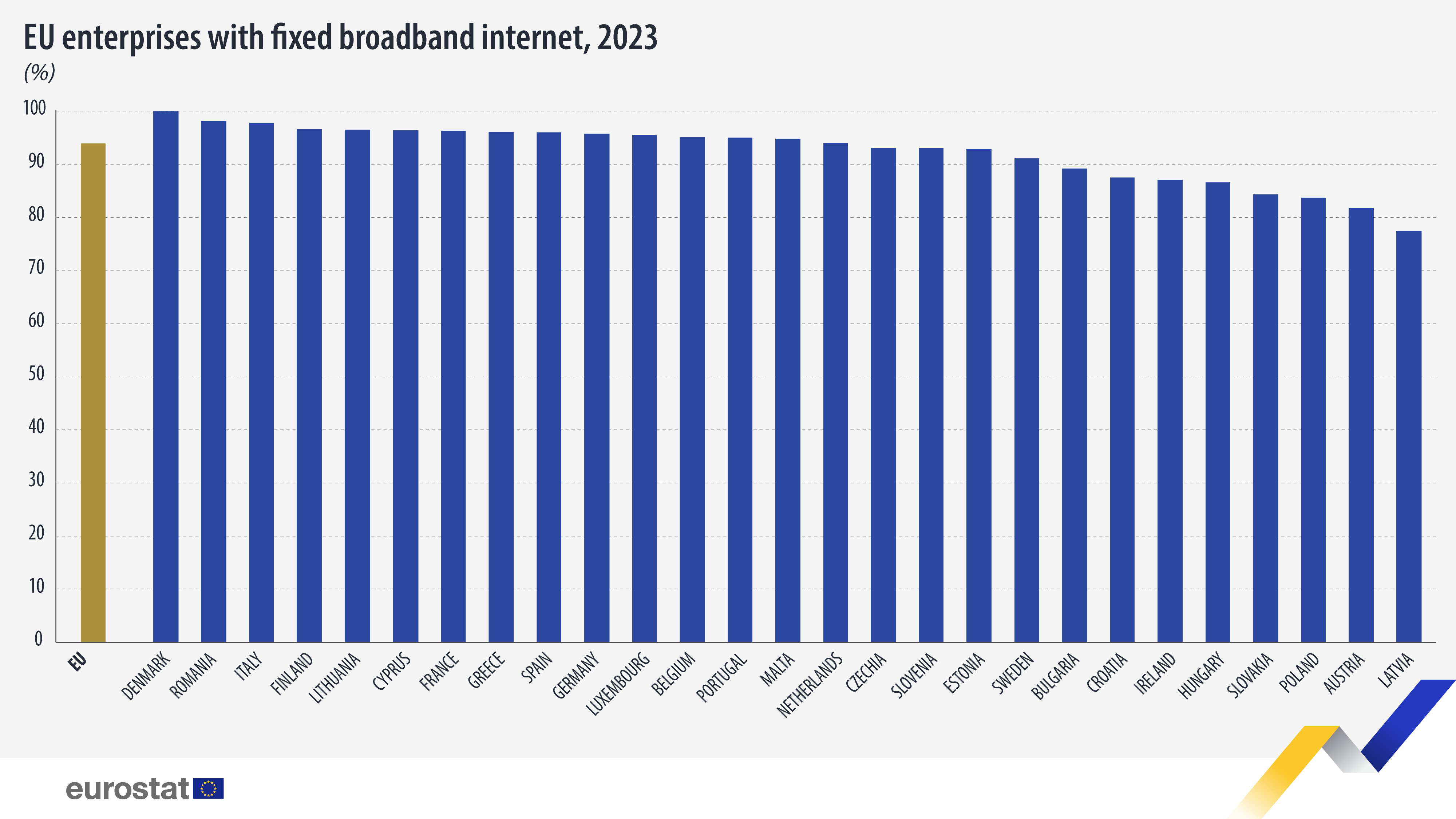
Banda larga, nel 2023 il 93,9% delle imprese Ue ha usato connessione fissa
Nel 2023, la stragrande maggioranza (93,9%) delle imprese della Ue ha utilizzato una connessione fissa a banda larga per accedere a Internet. La percentuale è ancora più elevata per le medie e grandi imprese, dove quasi tutte le imprese hanno dichiarato di connettersi a Internet tramite la banda larga fissa. Lo indica uno studio di Eurostat. L’Italia si trova in terza posizione, dopo Danimarca e Romania con il 97,8%. Rispetto ai livelli pre-pandemia del 2019 (91%), nel 2023 si è registrato un aumento di 2,9 punti percentuali nella connessione a banda larga fissa tra le imprese di tutti i paesi. Gli aumenti più notevoli si sono registrati in Grecia (15,8%), Romania (15,6%) e Bulgaria (8,7%).
Per quanto riguarda la velocità di Internet, le imprese che avevano una velocità di download massima contrattuale della connessione Internet su linea fissa più veloce di almeno 1 Gb/s sono aumentate di 0,9 punti percentuali tra le imprese. Gli aumenti più elevati sono stati osservati nelle isole mediterranee di Cipro (5,1%) e Malta (4,6%), seguite dalla Spagna (3,8%). Diminuzioni sono state rilevate in Svezia (-2,1%), Lituania (-1,6%) e Lettonia (-0,5%).
US broadband grant rules shut out small ISPs and municipalities, advocates say
Getty Images | Andrey Denisyuk
The biggest Internet service providers will dominate a $42.45 billion broadband grant program unless the Biden administration changes a rule requiring grant recipients to obtain a letter of credit from a bank, according to a joint statement from consumer advocacy groups, local government officials, and advocates for small ISPs.
The letter sent today to US government officials argues that “by establishing capital barriers too steep for all but the best-funded ISPs, the LOC [letter-of-credit requirement] shuts out the vast majority of entities the program claims to prioritize: small and community-centered ISPs, minority and women-owned ISPs, nonprofits, and municipalities.”
The rule is part of the Broadband Equity Access and Deployment (BEAD) program that’s being administered by the National Telecommunications and Information Administration (NTIA).
“Rather than demonstrating a provider’s ability to construct a broadband network and provide high-speed broadband services to unserved and underserved Americans, the LOC is a measure of whether they can lock up valuable working capital over multiple years,” the letter said. “While large incumbents may be able to bear this financial burden, most others can not. And, due to various state and local rules, municipalities are often not allowed to obtain LOCs. Therefore, alternatives to the LOC are critical to ensure these providers can participate in the BEAD program.”
The director of the BEAD program, Evan Feinman, responded to letter-of-credit concerns during a webinar in June. He said the NTIA is aiming to “minimize the failure rate, because every project that’s undertaken will expend some funds prior to failing and then have to start back at square one with a new provider if it turns out that a provider doesn’t have the wherewithal to undertake a project.”
“We know that when we narrow [who can get funding], we’re going to lose the opportunity to get into partnership with some high-quality small outfits. But we had to err on one side or the other, there was no way to hit it right on the nose,” Feinman said. The NTIA will waive the LOC requirement on a case-by-case basis, but waivers will be “tightly controlled,” he said.
Biden’s former FCC nominee among 300 letter-signers
Today’s letter objecting to the letter-of-credit rule was signed by “a coalition of 300 broadband experts, ISPs, community leaders, nonprofits, consumer advocates, and business groups,” said the Benton Institute for Broadband & Society. Local government officials from various parts of the US were among the signers.
One signer is Gigi Sohn, the longtime consumer advocate who was nominated by President Biden to the Federal Communications Commission. After the US Senate refused to confirm her nomination, Sohn became executive director of the nonprofit American Association for Public Broadband that lobbies for municipal networks.
The letter was signed by advocates from various other broadband-focused groups, including Public Knowledge; Connect Humanity; the Schools, Health & Libraries Broadband Coalition; the Institute for Local Self-Reliance; Free Press; Next Century Cities; the Multicultural Media, Telecom, and Internet Council; the Coalition for Local Internet Choice; and Consumer Reports.
The letter was sent to Secretary of Commerce Gina Raimondo and NTIA Administrator Alan Davidson. Describing the BEAD program requirements, the letter said that participants must obtain a letter of credit “issued by an FDIC bank with Weiss rating of B- or better for 25 percent of the award amount.”
Rules strike wrong balance, letter says
Funding rules are intended to ensure that ISPs deliver on commitments to build networks. As we wrote last month, some ISPs that won grants from a different federal program are trying to escape their broadband-deployment commitments.
But the letter to the NTIA and Commerce Department argued that the letter-of-credit requirement is a bad method of ensuring compliance:
Banks providing LOCs require that they be collateralized by cash or cash-equivalent. As a result, awardees will have to lock away vast sums of capital for the full duration of the build, likely several years. With the additional 25 percent match requirement, recipients will have a capital hurdle of more than 60 percent of their grant. We estimate a provider seeking a $7.5 million grant for a $10 million project will need at least $4.6 million of their own capital up-front.
While we support the NTIA’s intention of ensuring providers are accountable for delivering on grants, far from safeguarding taxpayer dollars, the LOC requirement will prevent the Internet service providers best positioned to connect unserved and underserved Americans from participating.
ISPs that signed the letter include Astound Broadband (owner of Grande, RCN, and Wave) and several smaller providers. A lobby group for small providers, the Wireless Internet Service Providers Association, signed as well.
https://arstechnica.com/?p=1965846
FCC says “too bad” to ISPs complaining that listing every fee is too hard
Getty Images | imagedepotpro
The Federal Communications Commission yesterday rejected requests to eliminate an upcoming requirement that Internet service providers list all of their monthly fees.
Five major trade groups representing US broadband providers petitioned the FCC in January to scrap the requirement before it takes effect. In June, Comcast told the FCC that the listing-every-fee rule “impose[s] significant administrative burdens and unnecessary complexity in complying with the broadband label requirements.”
The five trade groups kept up the pressure earlier this month in a meeting with FCC officials and in a filing that complained that listing every fee is too hard. The FCC refused to bend, announcing yesterday that the rules will take effect without major changes.
“Every consumer needs transparent information when making decisions about what Internet service offering makes the most sense for their family or household. No one wants to be hit with charges they didn’t ask for or they did not expect,” FCC Chairwoman Jessica Rosenworcel said.
Yesterday’s order “largely affirms the rules… while making some revisions and clarifications such as modifying provider record-keeping requirements when directing consumers to a label on an alternative sales channel and confirming that providers may state ‘taxes included’ when their price already incorporates taxes,” the FCC said.
ISPs don’t want to list all fees
Comcast and other ISPs objected to a requirement that ISPs “list all recurring monthly fees” including “all charges that providers impose at their discretion, i.e., charges not mandated by a government.” They complained that the rule will force them “to display the pass-through of fees imposed by federal, state, or local government agencies on the consumer broadband label.”
As we’ve previously written, ISPs could simplify billing and comply with the new broadband-labeling rules by including all costs in their advertised rates. That would give potential customers a clearer idea of how much they have to pay each month and save ISPs the trouble of listing every charge that they currently choose to break out separately.
Rejecting the broadband industry’s request, the FCC order yesterday said:
[W]e affirm our requirement that providers display all monthly fees with respect to broadband service on the label to provide consumers with clear and accurate information about the cost of their broadband service. We thus decline providers’ request that they not disclose those fees or that they instead display an “up to” price for certain fees they choose to pass through to consumers.
Specifically, “providers must itemize the fees they add to base monthly prices, including fees related to government programs they choose to ‘pass through’ to consumers, such as fees related to universal service or regulatory fees,” the FCC said.
The FCC was ordered by Congress to implement broadband-label rules. The FCC is requiring ISPs to display the labels to consumers at the point of sale and include information such as the monthly price, additional fees, introductory rates, data caps, charges for data overages, and performance metrics. The FCC rules aren’t in force yet because they are subject to a federal Office of Management and Budget (OMB) review under the US Paperwork Reduction Act.
https://arstechnica.com/?p=1964377
FCC prepares $75 monthly broadband subsidies for “high-cost” areas
Getty Images | imagedepotpro
The Federal Communications Commission is paving the way for $75 monthly subsidies to make broadband service more affordable for low-income households in certain “high-cost” areas.
The $75 subsidy will be part of the Affordable Connectivity Program (ACP) that generally offers $30 monthly discounts to people with low incomes. The ACP was created by Congress in late 2021 and implemented by the FCC to replace a previous pandemic-related subsidy program.
The ACP already provides $75 monthly subsidies for homes on tribal lands, but not in other areas. The US law that created the ACP lets the FCC make $75 subsidies available in areas where the costs of building broadband networks are higher than average.
That’s what the FCC did in its action announced yesterday. “The Infrastructure Act specified that the $75 monthly benefit would support providers that can demonstrate that the standard $30 monthly benefit would cause them to experience ‘particularized economic hardship’ such that they would be unable to maintain part or all of their broadband network in a high-cost area,” the FCC said.
ACP subsidies are distributed to Internet service providers that enroll in the program and give customers discounts. Comcast, Charter Spectrum, AT&T, Verizon, and other ISPs last year agreed to make $30 plans with download speeds of at least 100Mbps available to eligible low-income households, essentially making the Internet service free when the $30 subsidy is applied.
19.8 million households so far
ISPs that accept ACP subsidies must let customers use them on any plan—a provision designed to prevent the kind of upselling that took place under the pandemic subsidy program. That doesn’t mean getting the subsidy is easy, as some people with low incomes have been wrongly rejected by ISPs such as Comcast.
FCC Chairwoman Jessica Rosenworcel said yesterday that over 19.8 million low-income households are getting ACP discounts, including 2.8 million households in rural counties. Rural low-income households are signing up at a higher rate than urban ones, she said.
The FCC is hoping that $75 subsidies will expand the program’s reach to more rural and/or low-income areas. The law defines high-cost areas as those “in which the cost of building out broadband service is higher, as compared with the average cost of building out broadband service in unserved areas in the United States.”
https://arstechnica.com/?p=1959046
Launch of heavyweight commercial communications satellite reset for Thursday night [Updated]
Enlarge/ SpaceX’s Falcon Heavy rocket stands on Launch Complex 39A at NASA’s Kennedy Space Center before the launch of the Jupiter 3 communications satellite.
Trevor Mahlmann/Ars Technica
12:30 a.m. EDT Thursday update: SpaceX has scrubbed the Falcon Heavy rocket’s first launch attempt and will try again Thursday night.
The heaviest commercial communications satellite ever built is folded up on top of a SpaceX Falcon Heavy rocket for launch as soon as Thursday night from NASA’s Kennedy Space Center in Florida.
This satellite, owned by EchoStar and built by Maxar, tips the scales at about 9.2 metric tons, or more than 20,000 pounds. SpaceX’s Falcon Heavy will propel the spacecraft on its way toward an operating position in geostationary orbit more than 22,000 miles (nearly 36,000 kilometers) over the equator.
SpaceX scrubbed the launch attempt Wednesday night with about a minute left in the countdown due to a “violation of abort criteria.” Teams in Florida are now setting up for another countdown Thursday night.
The action will begin at 11:04 p.m. EDT (03:04 UTC) with the ignition of the Falcon Heavy’s 27 main engines on Launch Complex 39A. A few moments later, the Falcon Heavy will climb away from its launch pad and head downrange toward the east from the Kennedy Space Center. You can watch SpaceX’s live webcast below.
[embedded content]
EchoStar’s subsidiary Hughes Network Systems will put the satellite, named Jupiter 3, into service to provide Internet across the Americas, from Canada to Argentina.
Jupiter 3 will take the crown as the heavyweight champion of commercial communications satellites. It’s at least a couple of tons heavier than any satellite of its kind that has launched before. The spacecraft is also the most massive payload ever lofted by a Falcon Heavy, still the world’s most powerful commercial launch vehicle in operational service.
“It is large,” said Mark Wymer, a senior vice president at Hughes Network Systems. “The satellite from tip to tip is about 10 stories, so it’s a monster. It’s weighing in right around 9 (metric) tons, which is why we need the SpaceX Falcon Heavy to get it up into space. What drives a lot of the size and scale of that is we know that there’s this huge hunger for data, and we knew that we had to put a good bit of bandwidth up in the sky.”
The Jupiter 3 satellite, sometimes called EchoStar 24, will provide up to 500 gigabits per second of total capacity, beaming Internet signals to rural homes, businesses, airplane passengers, and government and military users.
“When you think about what it takes to support a 500-gigabit throughput satellite, in terms of the power and the solar arrays, and so forth, that’s what drives its size, scale, and scope,” Wymer told Ars in an interview before Wednesday night’s launch.
These are the kinds of missions that suit SpaceX’s Falcon Heavy. Such a heavy satellite could not launch into the same orbit on a Falcon 9 rocket, even if SpaceX expended the first stage. The Falcon Heavy combines three Falcon 9 boosters together to triple the rocket’s power at liftoff.
On Thursday night’s mission, SpaceX will return the two side boosters to landings back at Cape Canaveral Space Force Station in Florida, a few miles south of the Falcon Heavy’s launch pad. The center core booster will burn through all its liquid propellant to give its payload as much speed as possible before shutting off and re-entering the atmosphere to crash into the Atlantic Ocean.
The twin side boosters, both reused from previous missions, will detach from the core stage around two-and-a-half minutes after liftoff. Those boosters will flip around to fly tail-first, then reignite their engines to reverse course and head back toward the Florida coast. Descending vertically, the side boosters will return to their landing zones just shy of eight minutes into the mission, accompanied by the sharp clap of sonic booms.
The unique choreography of a Falcon Heavy launch—with three rockets in controlled flight simultaneously—is becoming a familiar sight on Florida’s Space Coast. This will be SpaceX’s seventh Falcon Heavy launch and the third of five planned this year. It’ll be SpaceX’s 50th Falcon rocket launch in 2023—or 51st launch if you count the test flight of the Starship mega-rocket from Texas in April.