Amazon is getting ready to launch a lot of broadband satellites

Artist's illustration of Amazon's Kuiper satellite processing facility at NASA's Kennedy Space Center.
Enlarge / Artist’s illustration of Amazon’s Kuiper satellite processing facility at NASA’s Kennedy Space Center.

Within a few years, Amazon hopes to be building and launching up to 80 satellites per month to populate the company’s Kuiper constellation, a $10 billion network that is similar to fleets already operated by SpaceX and OneWeb providing Internet connectivity around the world.

In the next six months, Amazon plans to begin production of operational Kuiper satellites at a new 172,000-square-foot factory in Kirkland, Washington. On Friday, officials from Amazon and the Florida government announced that a 100,000-square-foot facility under construction at NASA’s Kennedy Space Center will serve as a satellite processing facility dedicated to the Kuiper program.

Inside this facility near the old space shuttle landing strip, engineers will mount Kuiper satellites onto huge orbital deployer mechanisms standing several stories tall, then encapsulate the structure inside the nose cones of their rockets. The fully integrated payload compartments will then move out to launch pads operated by United Launch Alliance and Blue Origin—the space company established by Amazon founder Jeff Bezos—at Cape Canaveral Space Force Station, a few miles away.

The new structure is being built on land leased by NASA to Space Florida, a state-funded economic development agency focused on luring commercial space companies to the Sunshine State. It has a high bay that will stand about 100 feet (30 meters) tall, big enough to house the payload fairings of ULA and Blue Origin’s heavy-lift rockets. Amazon says it is investing about $120 million in the new facility, which is sized to accommodate up to three simultaneous launch campaigns.

“One of the places that makes this facility so unique and such a great place to do business is the proximity to the launch providers and to the launch sites,” said Brian Huseman, Amazon’s vice president of public policy.

Amazon’s Project Kuiper is one of several large “mega-constellations” either already in space or nearing launch. It’s a competitor to SpaceX’s Starlink network, which already has more than 4,000 satellites in orbit, and OneWeb’s broadband constellation, numbering more than 600 spacecraft.

If you track this industry, you’ll know that SpaceX is regularly launching its Starlink satellites in large batches aboard the company’s own Falcon 9 rocket. These flights from Cape Canaveral and from Vandenberg Space Force Base, California, make up about half of SpaceX’s missions over the last couple of years, with Starlink launches flying about once per week, on average.

Amazon’s projected launch rate is almost as ambitious. The company aims to deploy about half of its 3,236 satellites by July 2026, a deadline to maintain network authorization from the Federal Communications Commission. That would require at least two launches per month, and perhaps more, from Amazon’s stable of launch service providers.

The expected launch cadence requires a dedicated building to prepare the satellites for launch, Amazon officials said.

Amazon hasn't released any pictures or artist's illustrations of their Kuiper satellites, but this picture of one of the spacecraft's shipping containers provides a sense of the size of each one.
Enlarge / Amazon hasn’t released any pictures or artist’s illustrations of their Kuiper satellites, but this picture of one of the spacecraft’s shipping containers provides a sense of the size of each one.

Last year, Amazon signed the largest commercial launch contract in history, snatching up rides on ULA’s new Vulcan rocket, Blue Origin’s New Glenn, and Arianespace’s Ariane 6 launcher. All told, Amazon has purchased 77 launches: 38 Vulcan launches, plus nine flights on ULA’s soon-to-retire Atlas V, 18 Ariane 6 rockets, and 12 New Glenn missions, with a contract option for 15 more.

That will cover Kuiper’s launch service needs for its 3,200 satellites. But all those rockets, except for the Atlas V, are still in development. ULA’s Vulcan appears like it will fly first of Amazon’s crop of launch vehicles, probably followed by the European-built Ariane 6, and then Blue Origin’s New Glenn.

SpaceX was not part of the launch contracts, and that wasn’t a surprise since Amazon’s Kuiper network will compete with Starlink. But OneWeb, another satellite broadband provider, inked a deal with SpaceX last year to launch its satellites on Falcon 9 rockets after launches on Russian rockets fell through in the wake of Russia’s invasion of Ukraine.

https://arstechnica.com/?p=1955951



Viasat’s new broadband satellite could be a total loss

This artist's illustration of the ViaSat-3 Americas satellites shows the spacecraft as it would appear with its large reflector antenna fully deployed.
Enlarge / This artist’s illustration of the ViaSat-3 Americas satellites shows the spacecraft as it would appear with its large reflector antenna fully deployed.

A new Viasat communications satellite launched in April has been crippled by a problem when unfurling its huge mesh antenna. The problem jeopardizes Viasat’s much-needed refresh to its space-based Internet network that would let it better compete with newer broadband offerings from companies like SpaceX and OneWeb.

Viasat confirmed the antenna problem Wednesday after it was first reported by Space Intel Report. The satellite in question is named ViaSat-3 Americas, and it launched on April 30 as the primary payload on a SpaceX Falcon Heavy rocket from NASA’s Kennedy Space Center in Florida.

The satellite is one of the most powerful commercial spacecraft ever built, with two solar array wings as wide as a Boeing 767 jetliner capable of generating more than 30 kilowatts of electricity. The solar panels deployed soon after the spacecraft arrived in orbit, and the next step was to unfurl a large reflector to bounce Internet signals between the ground and transmitters and receivers on board the main body of the satellite.

That’s when ground controllers ran into trouble. An “unexpected event” occurred during the deployment of the reflector that may “materially impact” the performance of the satellite, Viasat said.

“We’re disappointed by the recent developments,” Mark Dankberg, chairman and CEO of Viasat, said in a statement. “We’re working closely with the reflector’s manufacturer to try to resolve the issue.”

The ViaSat-3 Americas spacecraft remains in contact with ground controllers as they attempt to troubleshoot the problem. An industry source, speaking on the condition of anonymity, told Ars there was very little chance that ground teams would be able to fix the satellite’s antenna and fully recover the mission.

If Viasat declares it a total loss, the ViaSat-3 Americas satellite is insured for $420 million. That would be the largest known insurance claim for the loss of a satellite. But a person familiar with the space insurance market said the $420 million claim would not cover the entire cost of the mission. The San Diego Union-Tribune has reported the ViaSat-3 Americas mission cost about $700 million, leaving Viasat on the hook for the difference.

The space insurance official told Ars such a claim would be “disruptive” to the industry and may even trigger some underwriters to leave the space market.

Northrop Grumman's mesh-like satellite antenna, similar to but smaller than the reflector on the ViaSat-3 Americas spacecraft.
Enlarge / Northrop Grumman’s mesh-like satellite antenna, similar to but smaller than the reflector on the ViaSat-3 Americas spacecraft.

The mesh-like reflector antenna on the ViaSat-3 Americas satellite is made of reinforced polymers, graphite, and carbon fiber, with fine gold-plated wire woven into the structure to add flexibility and reduce weight. During launch, the antenna folded up against the spacecraft to fit inside the rocket’s payload shroud.

The spacecraft was built by Boeing, with a communications payload developed internally by Viasat. The reflector was supplied by Northrop Grumman’s Astro Aerospace, said Dave Ryan, Viasat’s president of space and commercial networks, in an interview before the launch in April.

Ryan said the deployment of the antenna was expected to take “literally days.” The reflector is attached to a boom 80 to 90 feet (about 25 meters) long, a larger derivative of the mid-booms that aided the deployment of the sunshade on the James Webb Space Telescope. Speaking before the launch, Viasat officials would not disclose the exact specifications of the circular parabolic antenna but said it was one of the largest structures of its kind ever flown in space.

The reflector is required to focus signals from the satellite onto a small location on the ground. It’s critical to enabling the satellite to reach thousands of users at once, with a total throughput of more than a terabit per second over its 15-year design life.

https://arstechnica.com/?p=1954185


Comcast complains to FCC that listing all of its monthly fees is too hard

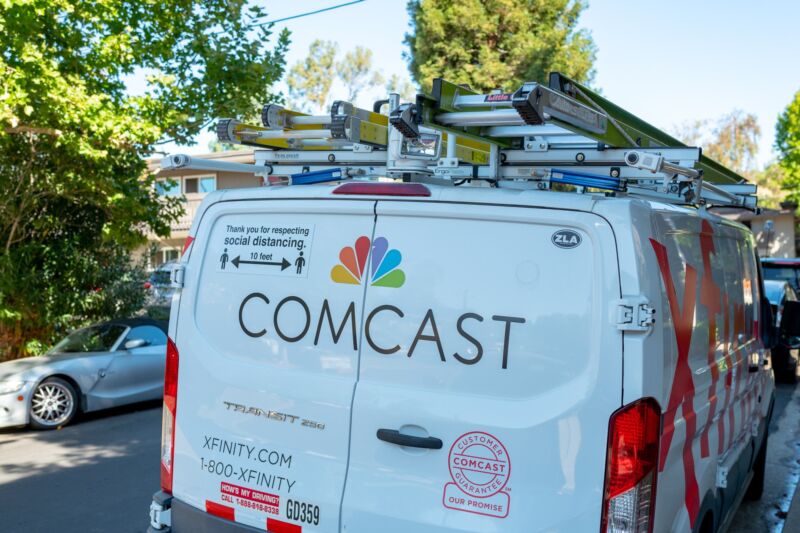
A Comcast service van seen from behind.
Getty Images | Smith Collection/Gado

Comcast is not happy about new federal rules that will require it to provide broadband customers with labels displaying exact prices and other information about Internet service plans.

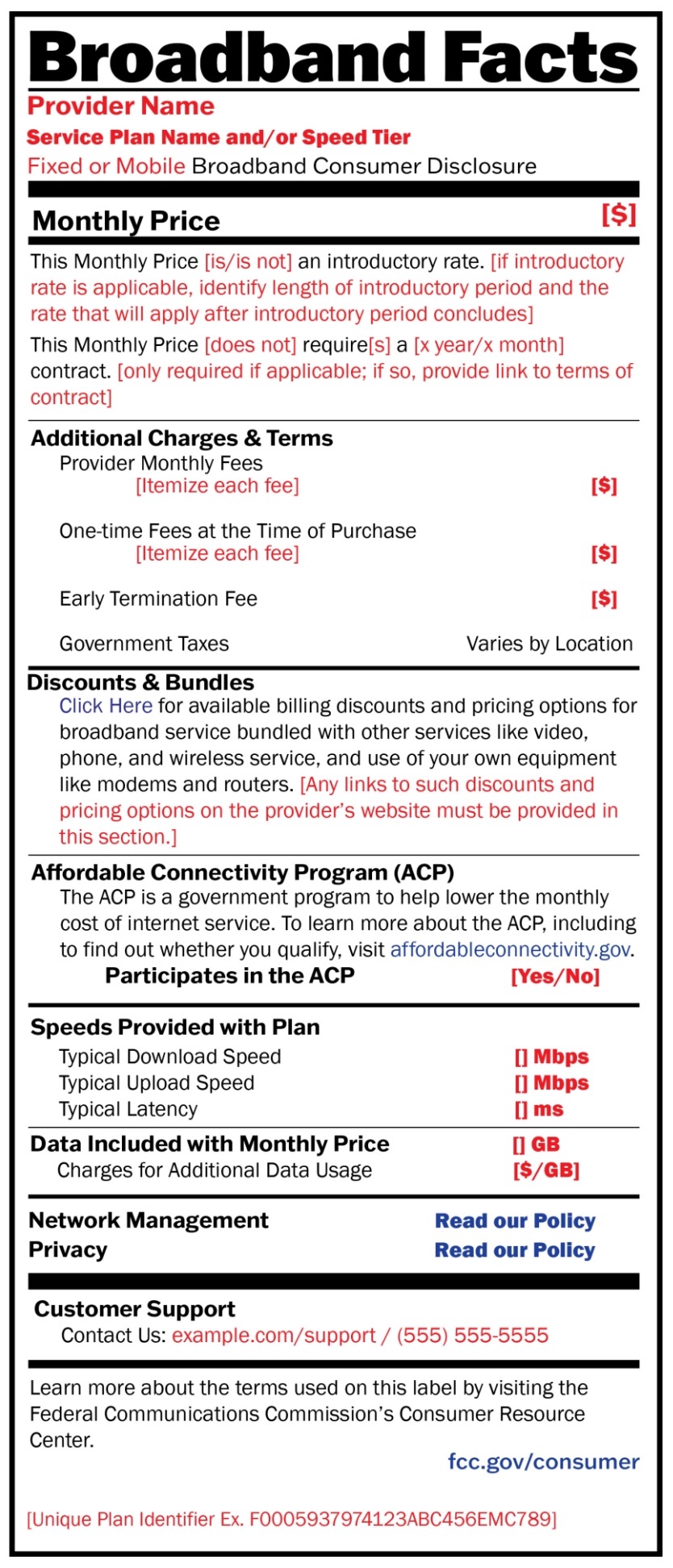
Broadband label that ISPs will be required to display to consumers at the point of sale.
Enlarge / Broadband label that ISPs will be required to display to consumers at the point of sale.

In a filing last week, Comcast told the Federal Communications Commission that it is “working diligently to put in place the systems and processes necessary to create, maintain, and display the labels as required.” But according to Comcast, “two aspects of the Commission’s Order impose significant administrative burdens and unnecessary complexity in complying with the broadband label requirements.”

Comcast noted that five major cable and telecom industry trade groups petitioned the FCC in January to change the rules. Comcast’s new filing urged the FCC to grant the petition “as soon as possible before the rules become effective to help providers streamline and simplify their labeling processes, which will ultimately benefit consumers.”

The FCC was required to implement broadband label rules in a 2021 law passed by Congress. Although the FCC approved the label rules in November 2022, it’s not clear when they will take effect. They are subject to a federal Office of Management and Budget (OMB) review because of requirements in the US Paperwork Reduction Act. Medium-sized and large ISPs would be required to comply six months after the OMB review, while providers with 100,000 or fewer subscribers would have one year to comply.

“The label hasn’t even reached consumers yet, but Comcast is already trying to create loopholes. This request would allow the big ISPs to continue hiding the true cost of service and frustrating customers with poor service. Congress created the label to end these practices, not maintain them, and Comcast offers no compelling reason for the FCC to violate Congress’ intent,” Joshua Stager, policy director at media advocacy group Free Press, told Ars. Stager previously advocated for the broadband labels when he was deputy director of New America’s Open Technology Institute.

The FCC rules require ISPs to display the labels at the point of sale. The labels must disclose broadband prices, introductory rates, data allowances, Internet speeds, and include links to information about an ISP’s network management practices and privacy policies.

Comcast doesn’t want to list all monthly fees

Comcast pointed to “recent filings regarding the Commission’s underestimation of the burdens associated with implementing the broadband consumer label rules.” Those filings came from Verizon, AT&T, Lumen (aka CenturyLink), and a trade group representing rural broadband providers.

Comcast and other ISPs have annoyed customers for many years by advertising low prices and then charging much bigger monthly bills by tacking on a variety of fees. While some of these fees are related to government-issued requirements and others are not, poorly trained customer service reps have been known to falsely tell customers that fees created by Comcast are mandated by the government.

The FCC rules will force ISPs to accurately describe fees in labels given to customers, but Comcast said it wants the FCC to rescind a requirement related to “fees that ISPs may, but are not obligated to, pass through to customers.” These include state Universal Service fees and other local fees.

As Comcast makes clear, it isn’t required to pass these costs on to customers in the form of separate fees. Comcast could stop charging the fees and raise its advertised prices by the corresponding amount to more accurately convey its actual prices to customers. Instead, Comcast wants the FCC to change the rule so that it can continue charging the fees without itemizing them.

The portion of the FCC order that Comcast and other ISPs object to says that “providers must list all recurring monthly fees,” including “all charges that providers impose at their discretion, i.e., charges not mandated by a government.”

Comcast wrote:

[T]he Order appropriately refrains from requiring ISPs to itemize state and local taxes, recognizing that they “often vary according to a customer’s geographic location.” The Order adopts the same treatment for government fees that a “relevant state or local government ‘mandate[s]'” must be passed through to customers… However, the Order appears to take a different tack with respect to fees that ISPs may, but are not obligated to, pass through to customers. The language of the Order creates much uncertainty over how ISPs must treat these fees on their labels because it may be read to require ISPs to itemize each of these pass-through government-imposed fees on their labels… If these fees must be itemized, a separate label must be created for each unique combination of applicable nonmandatory pass-through government fees. Itemizing these fees would substantially increase the burden on providers to generate and maintain their labels, particularly as the fees are subject to change, in some cases as often as quarterly.

https://arstechnica.com/?p=1947752


FCC’s new broadband map greatly overstates actual coverage, senators say

Illustration of ones and zeroes overlaid on a US map.
Getty Images | Matt Anderson Photography

Nevada’s US senators say the Federal Communications Commission’s new, more detailed broadband maps have tens of thousands of mistakes in their state alone.

“Nevada’s Office of Science, Innovation, & Technology (OSIT) has found over 20,000 purported broadband-serviceable locations on the map that they believe overstate coverage. They also have found incorrect information on the quality of service available to some locations and in some cases, missing serviceable locations,” Sens. Jacky Rosen (D-Nev.) and Catherine Cortez Masto (D-Nev.) wrote in a letter to the FCC last week.

The FCC’s new broadband-availability information shows which addresses have service based on data submitted by Internet service providers, so mistakes would indicate that broadband companies are claiming to serve more homes and businesses than they actually do. The senators’ reference to “missing serviceable locations” also suggests the FCC failed to include every home or business location in its list of addresses.

The new address-level data replaces the FCC’s previous maps that were based on the Form 477 data-collection program in which ISPs reported whether they were able to offer service in each census block. The old program essentially let ISPs count an entire census block as served, even if they could serve just one home in the area.

With the new program, the FCC says fixed broadband providers are required to report “where they have actually built out their broadband network infrastructure and to which they either currently provide service or could perform a standard broadband installation.” A “standard installation” means that service can be deployed within 10 business days “with no charges or delays attributable to the extension of the network of the provider.”

Vermont also called map inaccurate

Nevada government officials aren’t alone in saying the new, more detailed map has lots of mistakes. The Vermont Community Broadband Board (VCBB) last month urged residents “to check their addresses on the FCC National Broadband Map and file a challenge if the information is incorrect.”

“The FCC map poses a challenge to Vermont’s broadband build-out,” VCBB Executive Director Christine Hallquist said in a press release. “The map is missing or incorrectly lists the location of over 60,000 broadband-serviceable locations. The map also lists service availability levels far beyond what the state has found through its mapping and what we are hearing about from residents.”

The VCBB said “correcting addresses that are incorrectly listed as served at speeds of 25/3Mbps or greater by a wired or licensed wireless provider could mean millions of additional federal dollars to build out 100/100Mbps fiber broadband across the state.”

It’s not surprising that the map has mistakes. The FCC released the first version of the upgraded National Broadband Map in November and invited people to review the map and submit challenges to correct errors. You can search for broadband availability at specific addresses here and use that page to submit challenges.

The FCC voted in August 2019 to require ISPs to submit accurate data about where they offer service. Congress followed up by imposing a law with similar requirements and provided $98 million for the mapping overhaul in December 2020. The first collection of address-availability data from ISPs under the new program finished in early September.

Senators want more time for challenges

The new maps will be used by the National Telecommunications and Information Administration (NTIA) to distribute $42.45 billion in grants from the Broadband Equity, Access, and Deployment (BEAD) program created by Congress in the Infrastructure Investment and Jobs Act. While the FCC will review possible mistakes and make corrections on a rolling basis, the NTIA urged people to submit challenges by January 13, 2023, and said it intends to announce grant allocations by June 30, 2023, “using the most up-to-date version of the FCC maps as a guide.”

But Nevada’s US senators said the number of mistakes makes it clear that the US government should give states more time to challenge the data. Rosen and Cortez Masto urged the FCC to “work with NTIA to extend the availability and location challenge process by an additional 60 days to give our state broadband office and others the time needed to verify and submit accurate data.”

The senators urged the FCC to “consider allowing our broadband office to review technical documentation that broadband providers submitted to the FCC to verify whether an area is served or unserved.” That data would help Nevada officials “verify whether providers are actually serving our communities with the services they say they are offering,” they wrote.

The senators also wrote that Nevada’s “State Broadband Office has concerns with the current challenge process, through which states can challenge the draft maps, as it is based on assumptions that put the onus on consumers to proactively engage with providers.”

https://arstechnica.com/?p=1908925


Comcast debacles dominate Ars Technica’s biggest ISP horror stories of 2022

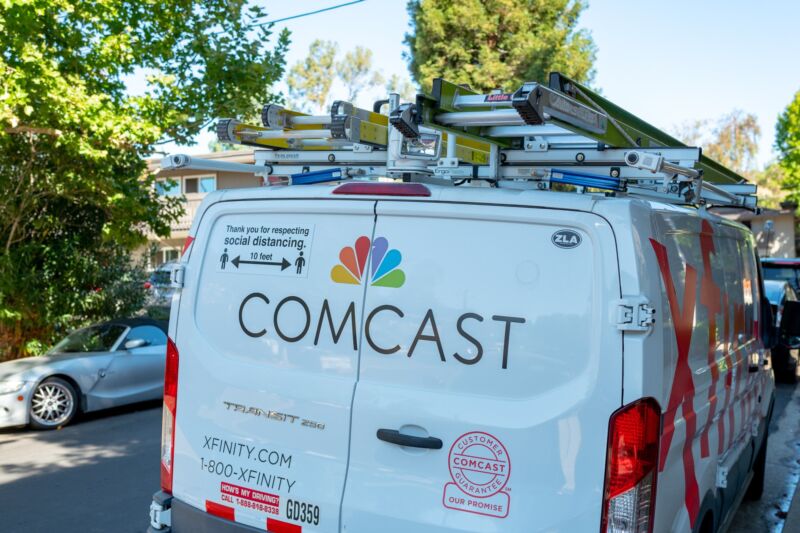
A Comcast service van seen from behind.
Getty Images | Smith Collection/Gado

Internet service provider horror stories have been a longtime staple at Ars Technica, and over the past 12 months we detailed some of the most horrific broadband customer experiences we’ve ever heard of.

Comcast, the largest home Internet provider in the US, figured prominently in these stories as usual. Let’s take a look back at the biggest ISP horror stories we covered in 2022.

Comcast wanted man to pay $19,000 after falsely advertising service on his street

This article from April 6 detailed the plight of Jonathan Rowny after he and his wife and child moved from Virginia to Washington state. Rowny was victimized by a common problem in the broadband industry—ISPs falsely telling customers that service is available.

Rowny said he scheduled a Comcast installation for the day after they moved into the new house, in May 2021, only to have Comcast cancel the order because the house wasn’t wired. Despite Comcast falsely advertising that service was available, the cable company told Rowny he’d have to pay over $19,000 for a line extension.

Rowny lowered his upfront cost to about $10,000 by hiring a contractor to do part of the work. But the family had to go without wired Internet service for over six months partly because Comcast construction took longer than expected.

Even after construction seemingly finished in mid-December 2021, Comcast initially refused to schedule an installation appointment because the company’s internal systems incorrectly showed the house still wasn’t serviceable.

“I spent weeks calling Comcast, and they said, ‘Your house is not serviceable, and our records show it will be serviceable in April [2022],'” Rowny said. “Staring at this connection box in my yard that I paid $10,000 for and not being able to get Internet still—I think that was the most frustrating part,” he added.

An email from a Comcast store manager told Rowny that “the current hurdle is the billing system. You can’t activate any equipment or service in our system until the billing codes are in place. I can’t put the billing codes in place until I can get the Serviceability team to recognize the address is serviceable.”

Desperate for a solution, Rowny had to escalate the problem to a Comcast regional vice president. The executive was able to help, and Rowny finally got his Comcast service connected on January 13, 2022. Comcast told Ars that it was “very sorry for the inconvenience all of this has caused.”

Couple bought home in Seattle, then learned Comcast Internet would cost $27,000

Zachary Cohn and his wife, Lauryl Zenobi, assumed they’d be able to get home Internet service when they bought a house in Seattle. The house was surrounded on all sides by houses that had Comcast service, but they learned after closing that it was never wired up.

“All six neighbors I share a property line with are wired for Comcast, but our house never was,” Cohn told Ars, saying he was “flabbergasted that a house like this, in an area like this, could possibly have never been wired for Internet.” Because the house is “in the middle of Seattle, it didn’t even dawn on me that that was possible,” he said.

Getting any information from Comcast was nearly impossible. After about eight months of trying to get an answer on how they could get Internet service, Cohn gave up on contacting Comcast directly and reached out to a member of the Seattle City Council. Finally, Comcast revealed that it would only provide Internet service if the homeowners paid over $27,000 upfront.

Cohn and Zenobi decided not to pay, and they continued to rely on a mobile hotspot, despite working at home. “I’m just very nervous about dropping $27,000 to lock myself into a company who can then jack the rates up, and we don’t even have the classic ‘send me to your retention department because I’m going to threaten to quit and switch to another company’ argument. You just have to pay whatever they want to charge,” Cohn said.

Comcast wanted $210,000 for Internet—so this man helped expand a co-op fiber ISP

This story from October 2022 mixes elements of horror with feel-good vibes. Sasha Zbrozek bought a house in Los Altos Hills, California, in December 2019, only to learn afterward that the house wasn’t wired.

Zbrozek recalled a Comcast agent telling him it would be “no big deal” to connect the house he was buying, and several of his neighbors had Comcast service. But after Zbrozek spent more than a year trying to get information from Comcast about a line extension, Comcast told him in February 2021 that it would charge him $210,000 to run cable about 700 feet.

By the time Comcast finally provided that estimate, Zbrozek had gotten involved with a co-op ISP called Los Altos Hills Community Fiber (LAHCF). He’s now an LAHCF board member, and he organized an expansion that brought multi-gigabit fiber Internet service to his home and others on nearby roads.

“Residents just get tired of having to deal with telcos, and they just want to take this into their own hands,” LAHCF Board President Scott Vanderlip told Ars. LAHCF’s network was built by a company called Next Level Networks, which uses a model in which residents own the infrastructure and split the upfront costs.

Next Level has six broadband networks either built or in progress in California and plans to expand to other states, CEO David Barron told Ars. Next Level’s approach is based on “the idea of microscale networks rather than doing municipal-wide builds, just doing neighborhoods, home associations, buildings, whatever the case may be, where you know that there is demand, and having them actually share the cost of the network,” he said.

https://arstechnica.com/?p=1905715


FCC has obtained detailed broadband maps from ISPs for the first time ever

Illustration of ones and zeroes overlaid on a US map.
Getty Images | Matt Anderson Photography

The Federal Communications Commission has collected precise broadband availability information from Internet service providers for the first time and aims to release a first draft of a new broadband map in November, FCC Chairwoman Jessica Rosenworcel wrote Friday.

The FCC last week “completed the first filing window for submitting data on where broadband service is and is not available,” a milestone in the years-long process of creating an accurate US broadband map, she wrote. “For the first time ever, we have collected extensive location-by-location data on precisely where broadband services are available, and now we are ready to get to work and start developing new and improved broadband maps.”

The resulting map should show whether fixed broadband service is available at each residence or business location. The FCC’s inaccurate broadband maps have long made it difficult to distribute deployment grants where they’re needed most.

Current maps are based on the Form 477 data-collection program in which ISPs report whether they offer service in each census block, which essentially lets ISPs count an entire census block as served even if it can serve just one home in the area. The new, more accurate maps will be used to help distribute $42.45 billion from the Broadband Equity, Access, and Deployment program created by Congress in the Infrastructure Investment and Jobs Act.

Bad data bites Internet users

ISPs, in many cases, have given potential customers false information, leading them to believe Internet access would be available in homes that don’t have it. Comcast and other ISPs have required thousands of dollars in up-front fees to wire up homes even after falsely promising service would be available at a specific address. The FCC mapping upgrade isn’t designed specifically to address that problem, but it could ultimately make it easier for homeowners to get accurate information.

The FCC voted in August 2019 to require ISPs to submit more accurate data, despite the major broadband industry trade groups objecting to requirements to report availability below the census block level. Congress followed up by imposing a law with similar requirements and provided $98 million for the mapping overhaul in December 2020. A Rosenworcel letter to members of Congress in March 2021 explained why the process wouldn’t be completed quickly:

To fully implement the Broadband DATA Act, the Commission must revamp its data collection methods and platform. We must create a framework for massive amounts of data from many different sources to interrelate with one another and to feed into a comprehensive, user-friendly dataset on broadband availability. We also need to develop, test, and launch IT systems to collect and verify these various data. We must create—for the first time—a publicly accessible, data-driven map of serviceable locations where broadband is or should be available throughout the United States.

We must then collect accurate and complete data from each and every broadband service provider on precisely where it offers broadband services, no longer relying on census blocks but drilling down to the location of each home and small business—and then overlay that information onto our map of serviceable locations. And finally, we must build a way to collect data from a myriad of independent sources, including state and local governments, Tribal nations, consumers, and other private and public third parties, that will help us supplement and verify the information we collect from service providers.

As Rosenworcel explained Friday, the FCC has since created “the first-ever national dataset capturing individual locations that should have fixed broadband service availability” by drawing from “address records, tax assessment records, imagery and building footprints, Census data, land use records, parcel boundaries, and geo-spatial road and street data. Our old broadband maps, in contrast, lacked any of this location-specific information.”

https://arstechnica.com/?p=1878520


FCC has approved $6 billion in broadband grants despite rejecting Starlink

An Ethernet cable

Several US government agencies are having a busy week for doling out broadband deployment funding to ISPs and state governments. Today, the FCC announced $791.6 million for six broadband providers, covering network expansions to over 350,000 homes and businesses in 19 states. The ISPs will receive the money over 10 years.

“This round of funding supports projects using a range of network technologies, including gigabit service hybrid fiber/fixed wireless deployments that will provide end-user locations with either fiber or fixed wireless network service using licensed spectrum,” the FCC said. Funded ISPs include Nextlink Internet and Starry.

Separately, the Treasury Department and National Telecommunications and Information Administration (NTIA) this week announced new grants for states and Tribal entities (more on that later in this article).

The FCC actions are final approvals for Rural Digital Opportunity Fund (RDOF) grants, which were tentatively awarded in December 2020 through a reverse auction in which ISPs bid on grants organized by census blocks. The auction was mismanaged under then-Chairman Ajit Pai’s leadership, causing Chairwoman Jessica Rosenworcel to announce a major cleanup in July 2021 amid “complaints that the program was poised to fund broadband to parking lots and well-served urban areas.”

$6 billion approved despite Starlink rejection

The FCC a few weeks ago rejected SpaceX Starlink’s final application to receive $885.51 million tentatively awarded in the Pai auction. While the Pai FCC was criticized for giving Starlink money for locations at or adjacent to major airports, the Rosenworcel FCC also doubted whether Starlink’s technology can meet the funding program’s speed and latency requirements when deployed to hundreds of thousands of customers.

The FCC also rejected fixed wireless provider LTD Broadband’s tentative funding of over $1.3 billion. Before finalizing funding, the FCC says it reviews each application “to determine whether they met all legal, financial, and technical requirements.”

Despite the high-profile rejections, the FCC today said the RDOF is now set to provide more than $6 billion to applicants in 47 states. The Pai FCC originally awarded $9.2 billion to 180 bidders.

The new round of funding will go to NextLink Internet (aka AMG Technology Investment Group) in Illinois, Indiana, Iowa, Kansas, Louisiana, Minnesota, Nebraska, Oklahoma, Texas, Wisconsin, and Wyoming; GeoLinks in Arizona and Nevada; Starry (aka Connect Everyone) in Alabama, Arizona, Colorado, Illinois, Nevada, Ohio, Pennsylvania, and Virginia; GigaBeam Networks in West Virginia; Safelink Internet in Nevada; and Shenandoah Cable Television in Virginia.

To confirm the funding, the ISPs are required to submit letters of credit and Bankruptcy Code opinion letter by September 15. GeoLinks, Starry, and Shenandoah Cable Television aren’t getting everything they originally won in the reverse auction, as the FCC today also announced a list of census blocks where those ISPs defaulted on bids. Monster Broadband also defaulted on bids.

Treasury and NTIA funding

The FCC’s RDOF relies on the Universal Service Fund, which is paid for by Americans through fees on phone bills. By contrast, the NTIA funding announced this week was allocated by Congress and President Biden in the November 2021 Infrastructure Investment and Jobs Act.

The NTIA, which is part of the Commerce Department, yesterday announced $105.8 million in broadband deployment grants to five Tribal entities in Arizona that will connect more than 33,300 homes. Combined with other projects approved earlier in August, the NTIA has awarded $634.7 million to 25 Tribal entities.

The Treasury Department yesterday announced five newly approved broadband projects to be paid for by the American Rescue Plan’s Coronavirus Capital Projects Fund. That includes $47.5 million to connect 5,500 homes and businesses in Arkansas; $40.8 million to connect 10,000 homes and businesses in Connecticut; $187 million for 50,349 homes and businesses in Indiana; $87.7 million for 21,000 homes and businesses in Nebraska; and $45 million for 3,965 homes and businesses in North Dakota. Four of the states plan competitive grant programs to distribute the money while North Dakota “plans to collaborate with tribal organizations to identify solutions to address specific connectivity needs.”

The Treasury Department previously approved broadband projects from the same fund in eight other states. All providers who get the money will be required to participate in the FCC’s Affordable Connectivity Program, which provides households that meet income eligibility requirements up to $30 per month (or up to $75 on Tribal lands). That will result in free Internet for many people.

$42.45 billion fund coming later

The biggest broadband fund of all is the $42.45 billion Broadband Equity, Access, and Deployment (BEAD) program from the Infrastructure Investment and Jobs Act, but it’s on a longer timeline. That money is being distributed by the NTIA but it won’t released until after the FCC finishes a large project to upgrade the map of where providers do and don’t offer broadband. Rosenworcel has said the new map will be ready this fall.

To help states get ready, the NTIA is distributing planning grants. All 50 states and six territories applied for them, and Louisiana became the first to receive one, according to an NTIA announcement today. Louisiana’s $2.9 million grant will, among other things, help it identify unserved and underserved locations, conduct community outreach, train employees, conduct surveys “to better understand barriers to adoption,” and develop a Statewide Digital Equity Plan.

“Over the coming weeks, every state and territory will have funding in hand as they begin to build grant-making capacity, assess their unique needs, and engage with diverse stakeholders to make sure that no one is left behind,” Secretary of Commerce Gina Raimondo said.

https://arstechnica.com/?p=1877448


EU lawmakers slam “radical proposal“ to let ISPs demand new fees from websites

A person's hand holding a roll of 50-Euro notes.
Getty Images | Alicia Llop

Fifty-four members of the European Parliament (MEPs) are protesting what they call a “radical proposal” to require payments from online service providers to Internet service providers.

Noting that Europe’s 2015 “Open Internet Regulation ensures that citizens are free to use whichever apps and websites they wish,” the MEPs said they have “deep concern about the European Commission’s plans to change our net neutrality legislation in the upcoming Connectivity Infrastructure Act to be proposed in autumn, without having consulted the public, technology experts, academics, civil society, or expert regulatory agencies.”

No specific proposal has been released, but “statements to the press indicate that a new provision would require payments from online service providers to broadband providers—ostensibly to fund the rollout of 5G and fiber to the home,” the MEPs wrote in the letter yesterday to the European Commission.

The letter cited a May 2 Reuters article that said, “Tech giants such as Google, Meta, and Netflix may have to bear some of the cost of Europe’s telecoms network, Europe’s digital chief Margrethe Vestager said on Monday, following EU telecoms operators’ complaints.” The MEPs’ list of references also includes two Ars Technica articles from 2012 when a similar proposal was being discussed.

Vestager reportedly said at a news conference that “there are players who generate a lot of traffic that then enables their business but who have not been contributing actually to enable that traffic. They have not been contributing to enabling the investments in the rollout of connectivity… and we are in the process of getting a thorough understanding of how could that be enabled.”

European ISPs sought payments from Big Tech

Despite claims by some that Big Tech gets a “free ride,” websites and other online service providers pay for their own Internet access and in some cases build extensive network infrastructure to carry Internet traffic part of the way to broadband users. But ISPs that deliver content directly to Internet users over the so-called “last mile” of the network have clamored for extra payments from websites to help cover their costs, in addition to the payments they already get from home and business Internet customers. In November 2021, the CEOs of 13 large European telecom companies called on tech giants to pay for a portion of the Internet service providers’ network upgrade costs.

“Large telecom companies have tried for decades to require compensation from content providers for providing access to customers, despite the fact that the telecom companies are already being paid by their own customers to provide access,” the 54 members of the 705-seat European Parliament wrote. Letting ISPs collect these payments “would reverse decades of successful Internet economics by requiring the providers of websites and applications to pay fees to ISPs that have never existed before,” and “abolish key net neutrality guarantees that Europeans fought hard for,” they wrote.

Complaining about an alleged lack of transparency, the letter said, “no one outside the Commission has been able to evaluate the announced proposal of access fees. To us it sounds very similar to ones that have been rejected many times already.”

The 2012 European proposal was ditched, and “every strong net neutrality regime has banned these fees, including in the EU, India, the US, and California,” they wrote. (US net neutrality rules were repealed, but the California ones remain in effect after judges rejected ISPs’ attempts to overturn them.)

https://arstechnica.com/?p=1866602


$10 billion fund starts giving US states money for broadband expansions

A pile of money with $20, $50, and $100 bills.
Getty Images | Alan Schein

The US Treasury Department has started approving broadband grants to states from a $10 billion fund created to expand access to Internet service and other digital connectivity tools.

The Treasury Department’s announcement on Tuesday said the first approved projects would “connect over 200,000 homes and businesses to affordable, reliable, high-speed Internet” in Louisiana, New Hampshire, Virginia, and West Virginia. The funded networks will provide symmetrical service with download and upload speeds of at least 100Mbps, the department said.

The four states are getting a combined $583 million from the $10 billion Coronavirus Capital Projects Fund (CPF), which Congress passed in March 2021 as part of the American Rescue Plan Act. “Treasury designed its guidance to prioritize connecting families and businesses with poor and inadequate service—particularly those in rural and remote areas. Treasury also requires states to explain why communities they have identified to be served with funds from the CPF have a critical need for those projects,” the department said.

The fund isn’t just for broadband as the legislation says the $10 billion shall be used “for making payments to States, territories, and Tribal governments to carry out critical capital projects directly enabling work, education, and health monitoring, including remote options, in response to the [COVID-19] public health emergency.” In addition to broadband, grant recipients can “make investments in other capital projects designed to directly enable work, education, and health monitoring and that meet Treasury’s other criteria,” the department says.

More cash on the way

The Treasury Department has also approved more than 30 capital projects for tribal areas, with many of them slated to expand broadband networks, buy computers and equipment, or provide Internet access to the public at community facilities. Treasury said it would keep approving state and tribal projects on a rolling basis.

The Capital Projects Fund is separate from the $42.45 billion Broadband Equity, Access, and Deployment program approved in November 2021, which will give subsidies to ISPs that build in unserved and underserved areas. That larger fund hasn’t given out any money yet, but the National Telecommunications and Information Administration (NTIA) announced rules for the program on May 13.

While the Biden administration is getting broadband funding out to states, plans to reinstate broadband regulations repealed during the Trump era have been on hold because Biden hasn’t gotten his Federal Communications Commission nominee, Gigi Sohn, past the finish line in the Senate. As Axios reported last week, “Democrats don’t currently have the votes after nearly eight months of drama around her nomination.”

Affordable Internet option required

The plans submitted by Louisiana, New Hampshire, Virginia, and West Virginia require ISPs that get deployment money to participate in the Affordable Connectivity Program run by the FCC. “The ACP helps ensure that households can afford the broadband they need for work, school, healthcare, and more by providing a discount of up to $30 per month,” the Treasury Department said. Biden recently announced voluntary commitments from large ISPs to offer $30-per-month plans to eligible households, effectively making the service free when combined with the discount.

“These four states have wisely chosen to prioritize local, affordable, and future-proof networks,” said Joshua Stager, deputy director of broadband and competition policy at New America’s Open Technology Institute.

Every state will get money from the fund eventually. The March 2021 law said the Treasury Department must give at least $100 million to each state, with remaining payments distributed to states based on overall population, rural population, and household income levels. States must submit their plans by September 24, 2022. The Capital Projects Fund is on “a notably faster timeline than other broadband infrastructure funds, such as the new NTIA program—so officials need to act soon,” Stager said.

The Capital Projects Fund has $100 million earmarked for tribal governments. There’s also $100 million to be split among the US Virgin Islands, Guam, American Samoa, the Northern Mariana Islands, the Marshall Islands, the Federated States of Micronesia, and Palau.

https://arstechnica.com/?p=1859516


Senate Republicans: Don’t let states choose where to spend broadband money

A US map with lines representing communications networks.

Senate Republicans are crying foul over a Biden administration plan to fund broadband deployment in regions that are already served with 25Mbps download and 3Mbps upload speeds.

The US Treasury Department’s recently issued final rule for distributing American Rescue Plan money eliminated an interim requirement that blocked broadband funds in areas that already have wired networks with speeds of at least 25Mbps/3Mbps. That speed threshold would leave out any area that’s already served by at least one cable provider, even if there’s no competition and no fiber-to-the-home availability.

The Treasury Department’s reversal was praised by community broadband advocates who said that keeping the original 25Mbps/3Mbps threshold could prevent deployment to large portions of the US containing more than 90 percent of Americans. The nation’s current broadband maps are also unreliable, raising the possibility that even homes without 25Mbps/3Mbps broadband access could be excluded.

But 11 Senate Republicans on Friday urged Treasury Secretary Janet Yellen to go back to the original rule. They wrote in a letter:

The final SLFRF [Coronavirus State and Local Fiscal Recovery Funds] rule increases the risk of overbuilding existing broadband investments. First, the final rule eliminates a key requirement that eligible broadband projects provide service to unserved or underserved households or businesses that lack access to minimum speeds of 25Mbps download/3Mbps upload. Instead, recipients can invest in projects designed to serve locations with “an identified need for additional broadband infrastructure investment”—a vague and subjective standard. The rule also permits recipients to invest in projects regardless of whether there is an existing federal or state funding commitment. As a result, the final rule will allow SLFRF recipients to fund projects in areas where broadband service is already or will be available—while continuing to leave truly unserved areas in our states without access to broadband.

GOP: Don’t let states “choose whatever” they want

The letter further objected to the fact that “[i]n addition to federal and state broadband data, funding recipients are permitted to consider user speed tests, interviews, and ‘any other information they deem relevant’ when determining whether to fund a broadband project in a given area.” The Republican senators want state governments to have less leeway in distributing funds, writing that “the broad nature of this guidance allows states to choose whatever information they wish to determine the availability of broadband in a given area.”

The letter concluded by urging Treasury “to ensure that SLFRF funds are focused on truly unserved areas to maximize the benefit to those Americans currently without broadband service.” The letter was led by Sen. Jerry Moran (R-Kan.) and was signed by fellow members of the Senate Commerce Committee, including Roger Wicker (R-Miss.), John Thune (R-S.D.), Shelley Moore Capito (R-W.V.), Marsha Blackburn (R-Tenn.), Roy Blunt (R-Mo.), Ted Cruz (R-Texas), and Deb Fischer (R-Neb.). It was also signed by Senators Thom Tillis (R-N.C.), Richard Burr (R-N.C.), and Susan Collins (R-Maine).

Both the interim and final rules said that funded projects must “reliably meet or exceed symmetrical 100Mbps download and upload speeds,” or at least 100Mbps download and 20Mbps upload speeds in areas where symmetrical speeds aren’t practicable “because of the excessive cost of the project or geography or topography of the area.”

The Treasury Department says the SLFRF includes $350 billion for state, local, and tribal governments “to support their response to and recovery from the COVID-19 pandemic.” Over $245 billion has already been distributed. Broadband infrastructure is one of many funding areas; others include schools, hospitals, child care facilities, premium pay for essential workers, vaccine services, affordable housing, and water and sewer infrastructure.

Given the mix of funded projects, the exact amount going to broadband could be higher or lower depending on the criteria adopted by the Treasury Department. The law that created the fund didn’t provide specific guidelines for broadband projects, leaving it up to the Biden administration to make those decisions.

Community broadband advocates pushed for change

In contrast to Republican senators, community broadband advocate Christopher Mitchell says the Treasury Department’s final rule is a big improvement over the interim one. Mitchell, director of the Community Broadband Networks Initiative at the Institute for Local Self-Reliance, wrote:

Treasury released an Interim Final Rule in May 2021, detailing how local governments would be allowed to invest in broadband. I promptly freaked out at the restrictions and complications that I (and others) feared would result in local governments backing away from needed broadband investments due to fears of being out of compliance with the rule.

Mitchell wrote that his group “worked with numerous local leaders and the National League of Cities to explain the problems we saw in the proposed rule,” and “after many months of deliberations, the Treasury Department has resolved all of the concerns that we identified as areas of concern in May.” As a result, “local governments have wide latitude to use SLFRF funds for a variety of needed broadband infrastructure investments, especially to resolve affordability challenges.”

https://arstechnica.com/?p=1830921