AT&T/Verizon workers’ union urges states to regulate ISPs as utilities
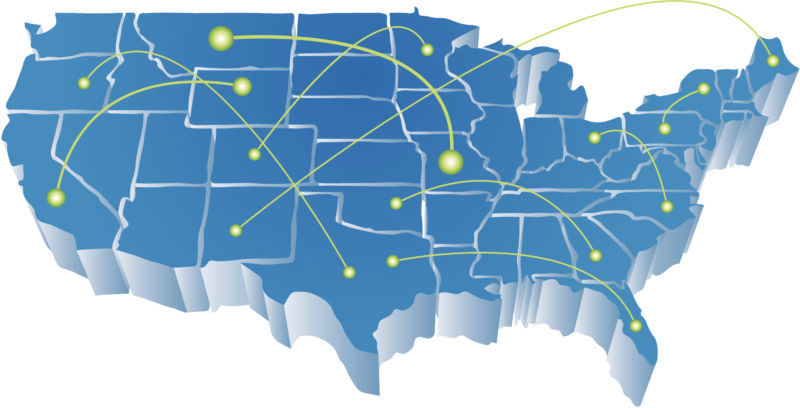
A US map with lines representing broadband networks.

The Communications Workers of America (CWA) union is lobbying state governments to regulate Internet service providers as utilities.

The CWA, which represents more than 150,000 workers at AT&T and over 30,000 at Verizon, announced on Monday a “multi-state effort to pass state legislation that would establish public utility commission oversight of broadband in public safety, network resiliency and consumer protection.”

“Legislation has already been introduced in California, Colorado and New York, and CWA is in active conversations with policymakers in state houses across the country about its model bill, the Broadband Resiliency, Public Safety and Quality Act,” the union said. In addition to broadband regulation, the model bill calls for regulation of the Voice over Internet Protocol (VoIP) home phone services offered by cable companies and other ISPs, which have replaced the old copper-wire landlines for many consumers.

The Federal Communications Commission is likely to restore Title II common-carrier regulation of broadband providers and net neutrality rules after Democrats gain an FCC majority. But state-level regulation similar to what’s historically been applied to telephone service and other utilities could provide additional protection for broadband consumers.

“States have always had a vital role to play in overseeing our communications networks and ensuring that those networks are operated in the public interest—it’s codified in the Communications Act of 1934,” Gigi Sohn, a consumer advocate who served as counselor to then-Chairman Tom Wheeler in the Obama-era FCC, said in the CWA press release. “Unfortunately, many states abdicated that responsibility in the early part of the millennium at the behest of incumbent broadband providers. Now that the COVID-19 pandemic has made abundantly clear that broadband is essential infrastructure, it’s time for states to take back that authority. I wholeheartedly support CWA’s initiative to convince states to reassert their authority over broadband and Voice over IP services.”

States should be “able to protect consumers, ensure that networks can withstand ever-increasing natural disasters and other threats to public safety, and collect data about broadband pricing, deployment, adoption and network resiliency,” Sohn said.

Political winds shift

While cable and telecom lobby groups will vigorously oppose any new regulation of broadband services, the CWA and Sohn see a window of opportunity as the pandemic has put a spotlight on the abusive customer-service practices of major ISPs, lack of broadband competition in large parts of the US, high prices, and telcos’ failure to maintain slow and outage-prone networks.

President Joe Biden has already vowed to lower broadband prices, end hidden fees by requiring Internet providers to clearly disclose the prices they charge, and expand municipal networks that could fill gaps in areas neglected by private providers. Nearly 20 states have restricted municipal broadband with laws supported by private ISPs and Republicans, but that, too, is changing, with some states taking those laws off the books and Biden announcing a goal of “lifting barriers that prevent municipally owned or affiliated providers and rural electric co-ops from competing on an even playing field with private providers.”

CWA President Chris Shelton said that “the past three decades of industry-driven deregulation have failed us,” leaving the US “with deteriorating telephone networks and a failure to deliver next-generation services to rural and low-income areas.”

“Telecom-industry executives said deregulation was necessary for competition and that competition would magically fix everything. It hasn’t, and the public needs watchdogs we can work with to ensure this essential service is there for our communities today and into the future,” said Brenda Roberts, VP of the CWA district that covers the Mountain West, Pacific Northwest, and Upper Midwest regions. “Without regulation, the goal of universal broadband service is just a nice dream.”

The CWA held an event discussing its push for state regulation, with video available here.

Model bill details

The CWA provided a one-page fact sheet on its model bill, saying that “industry-driven deregulation of POTS/copper networks and non-regulation of broadband networks have left residents with no watchdogs over essential communication services.” Among other problems, ISPs tend to “upgrade infrastructure where it is most profitable,” leaving lower-income areas without modern service, the fact sheet said.

The model bill would do the following in states that enact it as proposed by the CWA:

  1. Undo any blanket prohibition on state oversight for broadband/VoIP
  2. Explicitly authorize PUC [the state public utility commission] to exercise oversight over broadband/VoIP
  3. Direct PUC to exercise authority over broadband/VoIP in specific areas [of] resiliency, public safety, data collection/transparency, and consumer protection
  4. Authorize PUC to conduct third-party audits of facilities and infrastructure
  5. Direct PUC to report back to the legislature annually

The model bill begins with an intro that says, “The legislature hereby finds and declares that access to high-speed broadband is a necessity and essential to participation in the economy” and that “VoIP has replaced traditional voice telephone service for a large segment of the population… State regulators require unambiguous authority and a clear mandate to establish and enforce appropriate oversight and regulation of broadband and VoIP in order to meet the state’s goals of universal, high-quality and affordable access.”

The model bill doesn’t specifically call for price regulation, but it says that state commissions shall issue “rules and regulations necessary to implement effective oversight of broadband and VoIP service… including but not limited to” the specific areas of regulation detailed in the bill. The bill instructs the state public utility commission to “require Internet service providers to report data on the deployment/availability, pricing and adoption of VoIP and broadband service” and “exercis[e] oversight of Internet service providers’ emergency preparedness and plans for post-emergency network restoration, including establishing minimum power back-up requirements and requiring all Internet service providers to maintain networks sufficiently to ensure reliable and safe communications services.”

The state commission would also be empowered to conduct evaluations and audits of facilities and infrastructure “in regards to areas of public safety, resiliency, broadband and anything else the commission deems relevant to achieving goals of resiliency, quality and public safety in broadband service as well as the overall goals of universal access and affordability of broadband service.”

Legislation based on the model bill has been introduced in New York. Separately, the CWA is supporting a bill in California to require collection of information from telecom providers about their efforts to repair or replace communications infrastructure damaged in emergencies or disasters. The CWA is also supporting Colorado bills to provide subsidies to low-income residents and improve broadband-availability mapping to identify “critically unserved areas” where the state should fund deployment.

https://arstechnica.com/?p=1756981


Cable lobby says it hates Biden plan to expand broadband and lower prices

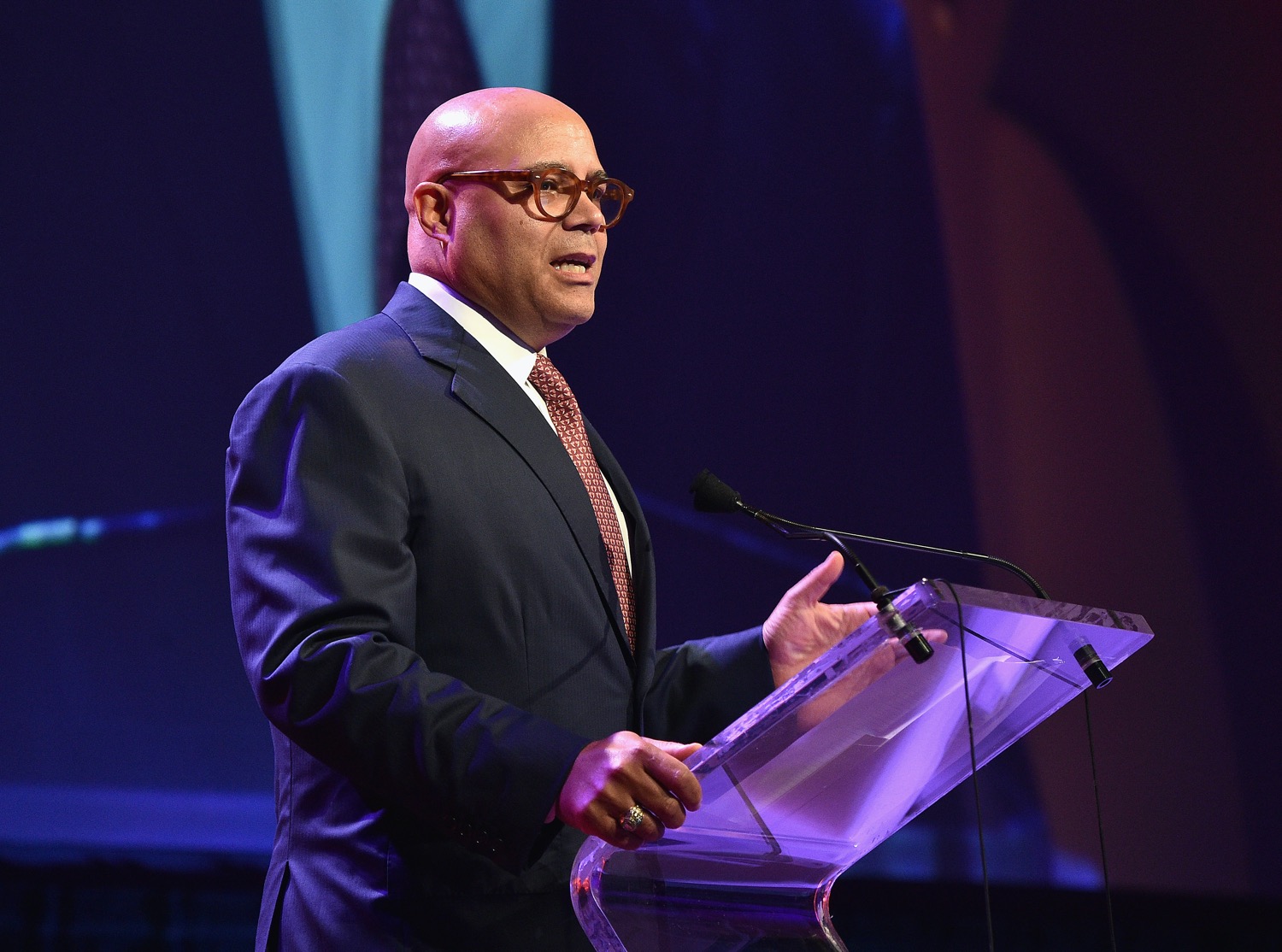
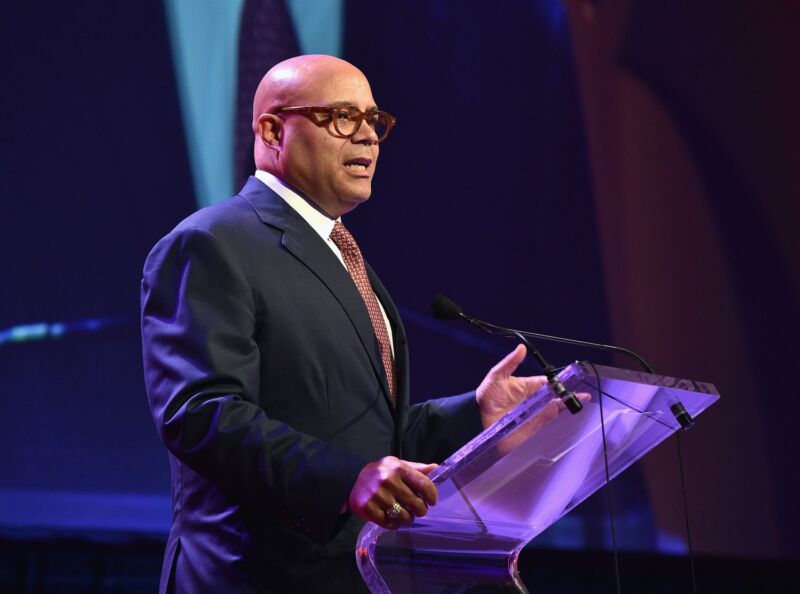
Cable lobbyist Michael Powell speaking in front of a podium.
Enlarge / Cable lobbyist Michael Powell speaks at a conference in September 2015.
Getty Images | Larry Busacca

President Biden’s plan to expand broadband access and lower prices is, predictably, facing bitter opposition from cable companies that want to maintain the status quo.

NCTA–The Internet & Television Association, which represents Comcast, Charter, Cox, and other cable companies, argued that Biden’s plan is “a serious wrong turn.” NCTA is particularly mad that Biden wants to expand municipal broadband networks that could fill gaps where there’s no high-speed broadband from private ISPs and lower prices by providing competition to cable companies that usually dominate their regional territories.

“The White House has elected to go big on broadband infrastructure, but it risks taking a serious wrong turn in discarding decades of successful policy by suggesting that the government is better suited than private-sector technologists to build and operate the Internet,” NCTA CEO Michael Powell wrote in a statement.

Before becoming a lobbyist, Powell was chairman of the Federal Communications Commission under President George W. Bush. In that role, Powell led a vote in 2002 that prevented common-carrier regulation of cable Internet, with his FCC claiming that the decision would “result in better quality, lower prices, and more choices for consumers.”

Yesterday, Powell claimed that America’s broadband is just fine the way it is. Biden is “mistakenly lumping in our successful modern digital networks with our decaying roads, bridges, waterways, and electric grids,” Powell wrote. “While we have seen repeated examples of traditional infrastructure failures in recent years, America’s broadband has been a reliable workhorse as millions of Americans have worked, learned, and stayed connected from home during the pandemic. Simply put, the high caliber of our broadband networks kept millions of Americans safe and will continue to revolutionize work, healthcare, education, and more.”

USTelecom, which represents AT&T, Verizon, and other DSL and fiber providers, also claimed that things are going well and that Biden should stick with a strategy centered on private ISPs.

“Today’s broadband marketplace is also ultra-competitive, defined by increasing speeds, declining prices, new entrants and next generation technologies,” USTelecom CEO Jonathan Spalter said. “Congress now should prioritize affordability and accessibility solutions that are fast and smart and incentivize continued private investment to get the job done.”

Biden: “Americans pay too much for Internet service”

Biden’s plan would make a $100 billion broadband investment and, per the White House’s description, “prioritizes support for broadband networks owned, operated by, or affiliated with local governments, non-profits, and co-operatives—providers with less pressure to turn profits and with a commitment to serving entire communities.”

Biden’s plan talks of “lifting barriers that prevent municipally owned or affiliated providers and rural electric co-ops from competing on an even playing field with private providers,” which may be a reference to overturning nearly 20 state laws that restrict the growth of municipal networks.

Biden further proposed “requiring Internet providers to clearly disclose the prices they charge,” an idea opposed by cable companies because they like to advertise low prices and then sock customers with bigger monthly bills by tacking on hidden fees. Biden also wants other action to lower prices, though exactly what that would be is unclear. The plan said that “the president is committed to working with Congress to find a solution to reduce Internet prices for all Americans, increase adoption in both rural and urban areas, hold providers accountable, and save taxpayer money.”

The Biden plan also said that “Americans pay too much for the Internet—much more than people in many other countries.” Further, “more than 30 million Americans live in areas where there is no broadband infrastructure that provides minimally acceptable speeds,” and, “in part because the United States has some of the highest broadband prices among OECD countries, millions of Americans can’t use broadband Internet even if the infrastructure exists where they live.” These problems of access and affordability are most severe in rural and tribal areas and for minority groups, the Biden plan said.

“When I say ‘affordable,’ I mean it,” Biden said in a speech yesterday. “Americans pay too much for Internet service. We’re going to drive down the price for families who have service now and make it easier for families who don’t have affordable service to be able to get it now.”

Cable lobby opposes plan to reduce prices

Powell is mad at Biden for suggesting that the government should try to lower broadband prices.

“Government does have a critical role to play in getting networks to areas that lack service and helping low-income families afford it,” Powell wrote. “However, those targeted, shared goals are not served by suggesting wrongly that the entire network is ailing and that the solution is either to prioritize government-owned networks or micromanage private networks, including the unfounded assertion that the government should be managing prices.” (Biden did not say that the government should be managing prices—his stated plan to “find a solution to reduce Internet prices for all Americans” is too vague to know what that will consist of, and requiring ISPs to clearly disclose prices wouldn’t necessarily make those prices lower.)

Powell also argued that “the rapid innovation in Internet technology and services that Americans have seen over the past two decades is the direct consequence of massive and continuing private investment in networks across the country.” While Powell touted “private investment,” he did not mention that the FCC has given billions to private ISPs since 2015 to build networks in underserved areas, and recently awarded another $9.2 billion out of a total of $20.4 billion planned.

Despite that, millions of Americans still lack access to fast and/or affordable broadband. The cable industry and Republicans have consistently worked against plans to fix those problems with municipal networks. Republicans in Congress last month proposed a nationwide ban on municipal broadband.

Small ISPs more welcoming of Biden plan

A group that represents small, rural broadband providers issued a far more positive statement about the Biden plan. “No infrastructure package would be complete without digital infrastructure, and on behalf of NTCA’s members, I want to thank President Biden for recognizing the importance of broadband access in his new American Jobs Plan,” said Shirley Bloomfield, CEO of NTCA–The Rural Broadband Association.

“We need to aim high and invest in efficient and scalable technologies like fiber to meet the needs not only of today’s consumers but also tomorrow’s,” Bloomfield said. By contrast, AT&T is lobbying against government-funded fiber networks in rural areas despite admitting that fiber is the most “future-proof” broadband technology.

The Wireless Internet Service Providers Association (WISPA), another lobby group representing small ISPs, issued a similarly positive statement.

“Though the digital divide is shrinking, more can and must be done to bring all Americans online. The president’s focus is right on target,” the group said. Still, the lobby group said that subsidy programs should “leverage providers already in the marketplace,” a stance that would favor existing ISPs over new municipal, nonprofit, and co-op providers.

Whereas Congressional Democrats are pushing for a symmetrical 100Mbps broadband standard that would prioritize the building of fiber networks, WISPA naturally wants funding for wireless ISPs. The group said that subsidy programs should be “truly tech-neutral,” that more spectrum should be made available to “small innovators,” and that small ISPs should get “nondiscriminatory access to physical infrastructure.”

Consumer advocates have been heaping praise on the Biden plan. “President Biden’s historic plan places a big bet on broadband that is desperately needed,” said Gigi Sohn, a consumer advocate who served in the Obama-era FCC as counselor to then-Chairman Tom Wheeler. “Refusing to repeat the mistakes of the past, which have left tens of millions of people in America unconnected, the president’s plan prioritizes ‘future proof networks,’ promotes competition by lifting state barriers on community-owned networks, requires price transparency, and pledges to tackle affordability by, among other things, addressing the high price of broadband Internet access.”

https://arstechnica.com/?p=1753817


Biden broadband plan will be hated by big ISPs, welcomed by Internet users

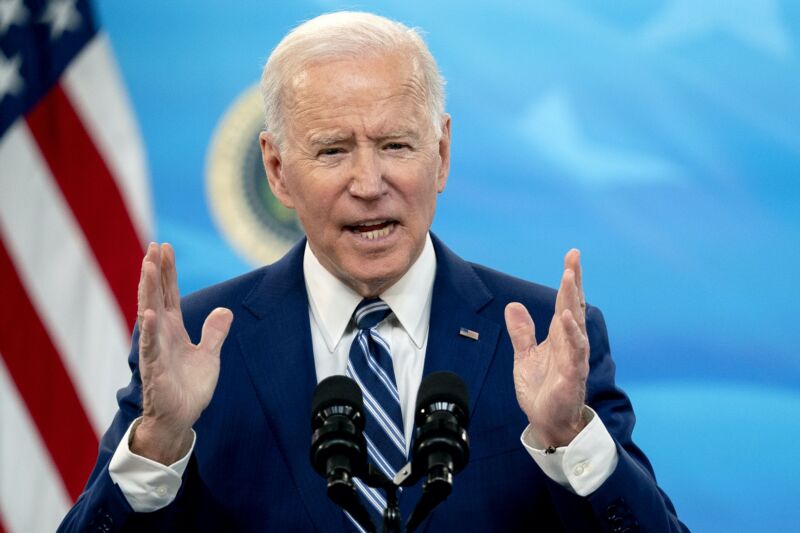
President Joe Biden speaking into a microphone and gesturing with his hands.
Enlarge / President Joe Biden speaks in the Eisenhower Executive Office Building in Washington, DC, on Monday, March 29, 2021.
Getty Images | Bloomberg

President Biden’s plan to connect all Americans with high-speed broadband includes proposals to boost competition, build more publicly owned networks, lower prices, and prioritize “future-proof” networks instead of ones that would quickly become outdated. In other words, the plan includes some of the broadband industry’s least-favorite ideas and is sure to meet fierce resistance from cable and telecom lobby groups and Republicans.

Biden’s $100 billion broadband proposal is part of the American Jobs Plan described by the White House in a fact sheet released today. The broadband details released so far are a bit vague, and the plan could be changed in Congress, but there’s a lot to like for Internet users.

“The president believes we can bring affordable, reliable, high-speed broadband to every American through a historic investment of $100 billion,” the fact sheet said. The $100 billion in broadband funding would be spread out over a number of years, as the entire jobs plan is slated to “invest about $2 trillion this decade.” (We published another story today on how the Biden plan would also eliminate fossil fuel subsidies.)

Emphasis on municipal ISPs and nonprofits

Municipally owned networks, nonprofits, and co-operatives would play a major role in the expansion pitched by Biden. The broadband industry and Republicans have been fighting city-owned networks for years, and nearly 20 states have laws that restrict the growth of municipal broadband. While Democrats have proposed eliminating those state laws, congressional Republicans last month proposed a nationwide ban on municipal broadband.

Biden’s plan “prioritizes support for broadband networks owned, operated by, or affiliated with local governments, non-profits, and co-operatives—providers with less pressure to turn profits and with a commitment to serving entire communities,” the White House fact sheet said.

Biden’s plan also seeks to “promote price transparency and competition among Internet providers, including by lifting barriers that prevent municipally owned or affiliated providers and rural electric co-ops from competing on an even playing field with private providers, and requiring Internet providers to clearly disclose the prices they charge.” The “lifting barriers” part of that statement could be a reference to overturning state laws that restrict municipal broadband, but the fact sheet didn’t get more specific on that point.

The proposal also “ensures funds are set aside for infrastructure on tribal lands and that tribal nations are consulted in program administration,” the fact sheet said. “Along the way, it will create good-paying jobs with labor protections and the right to organize and bargain collectively.”

Ending hidden fees

Biden’s plan to “requir[e] Internet providers to clearly disclose the prices they charge” is another idea hated by major broadband providers, which love to advertise low rates and then hit users with much higher monthly bills through a slew of hidden fees. The Obama-era Title II regulation included rules requiring more price transparency, but they were eliminated when FCC Chairman Ajit Pai led a vote to deregulate the industry and repeal net neutrality rules.

Biden’s fact sheet did not get specific about the price-disclosure rules he proposes, but he also promised other actions to reduce prices. The fact sheet said:

While the president recognizes that individual subsidies to cover Internet costs may be needed in the short term, he believes continually providing subsidies to cover the cost of overpriced Internet service is not the right long-term solution for consumers or taxpayers. Americans pay too much for the Internet—much more than people in many other countries—and the president is committed to working with Congress to find a solution to reduce Internet prices for all Americans, increase adoption in both rural and urban areas, hold providers accountable, and save taxpayer money.

Future-proof networks

Biden’s fact sheet didn’t specify any minimum speeds for broadband networks built under the plan. But the fact sheet said, “The president’s plan prioritizes building ‘future-proof’ broadband infrastructure in unserved and underserved areas so that we finally reach 100 percent high-speed broadband coverage.”

Future-proof could mean fiber broadband with symmetrical upload and download speeds, or at least networks that provide higher upload speeds than today’s cable and fixed-wireless networks. If Biden wants to prioritize symmetrical speeds, he will have support from at least some high-ranking congressional Democrats.

As we recently reported, the congressional Democrats’ plan would include an $80 billion fund to deploy broadband with download and upload speeds of 100Mbps to unserved areas. These speeds would likely require a massive fiber-to-the-home investment and is opposed by AT&T, which argues that Americans should be happy with only 10Mbps upload speeds.

AT&T admitted that fiber technology is the most “future-proof” while claiming that bringing fiber to every home “is not practical.” But with Democrats controlling Congress and Biden agreeing that “future-proof” networks are the ones to prioritize in funding, the US could end up with a universal-broadband plan that heavily emphasizes fiber-to-the-home.

“Broadband Internet is the new electricity”

Biden’s fact sheet argues that the investment in broadband needed by America today is similar to the one that brought electricity nationwide nearly a century ago. The fact sheet said:

Generations ago, the federal government recognized that without affordable access to electricity, Americans couldn’t fully participate in modern society and the modern economy. With the 1936 Rural Electrification Act, the federal government made a historic investment in bringing electricity to nearly every home and farm in America, and millions of families and our economy reaped the benefits. Broadband Internet is the new electricity. It is necessary for Americans to do their jobs, to participate equally in school learning, health care, and to stay connected. Yet, by one definition, more than 30 million Americans live in areas where there is no broadband infrastructure that provides minimally acceptable speeds.

The Biden fact sheet also said that America needs to fix the digital divide that has left many disadvantaged groups with less access to and ability to afford Internet service:

Americans in rural areas and on tribal lands particularly lack adequate access. And, in part because the United States has some of the highest broadband prices among OECD countries, millions of Americans can’t use broadband Internet even if the infrastructure exists where they live. In urban areas as well, there is a stark digital divide: a much higher percentage of White families use home broadband Internet than Black or Latino families. The last year made painfully clear the cost of these disparities, particularly for students who struggled to connect while learning remotely, compounding learning loss and social isolation for those students.

https://arstechnica.com/?p=1753489


Proposed law could force ISPs to stop hiding true size of monthly bills

Getty Images | McCaig

Internet service providers could be required to release “broadband nutrition labels” with detailed information about prices, speeds, and data caps under legislation introduced by US Rep. Angie Craig (D-Minn.).

Craig’s “Broadband Consumer Transparency Act” would bring back expanded transparency requirements that were eliminated when then-Federal Communications Commission Chairman Ajit Pai repealed net neutrality rules and deregulated the broadband industry in December 2017.

The bill “would require straightforward disclosures in an easily understandable format to help consumers better understand the services they are purchasing and protect against hidden fees and sub-standard Internet performance,” Craig said in a press release yesterday. The press release said the bill “would require sellers of broadband services to provide the following information to all consumers”:

  • Price: Price points, including various charges like overage, equipment, early termination and administrative fees
  • Data Allowances: This is the carrier-defined plan limit after which consumers will face some consequence, such as additional charges or slowed data speeds
  • Performance: Broadband speed and other performance metrics

The bill is simple and barely a page long. It directs the FCC to adopt “regulations to promote and incentivize the widespread adoption of broadband consumer labels” like the ones described in a public notice issued by the Obama-era FCC in April 2016. The bill would give the FCC one year to issue these rules.

ISPs “notorious” for hiding key details

The bill’s language saying the FCC must “promote and incentivize” adoption of broadband labels makes it sound like they would be optional for ISPs. But Craig said her bill would “require” the disclosures, and the bill text could be updated to make sure it matches the intent.

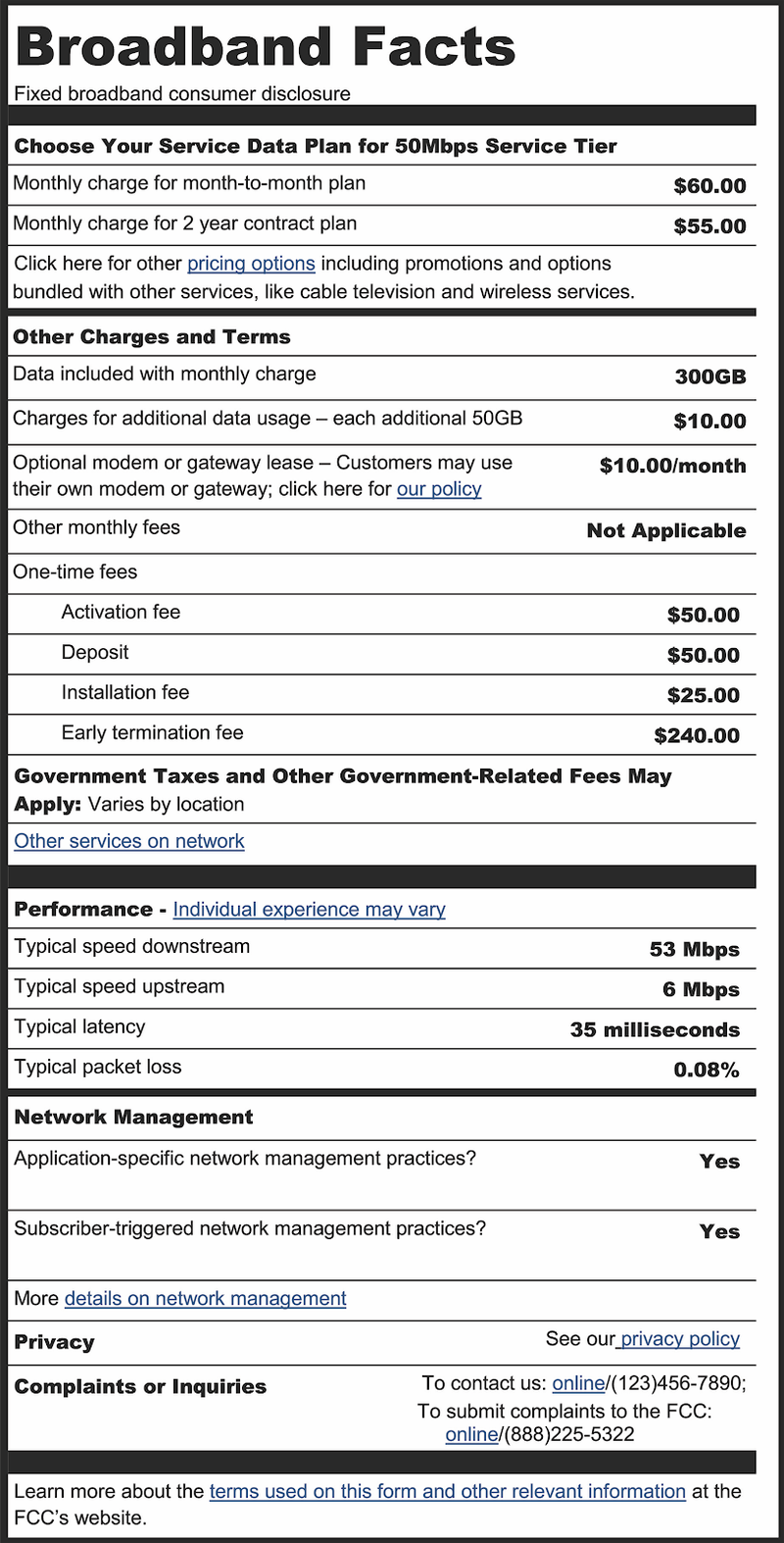
The Obama-era broadband labels included monthly charges, data caps and overage charges, hardware rental fees, activation and installation fees, early termination fees, taxes and government-related fees, “other monthly fees,” typical speeds both upstream and downstream, latency, and packet loss. Here’s what they looked like:

Open Technology Institute

The Obama-era FCC rules made the broadband nutrition labels optional but required ISPs to release the information online if they chose not to use the labels.

“Internet service providers are notorious for keeping customers in the dark,” Joshua Stager, deputy director at New America’s Open Technology Institute, said in a press release yesterday. “Hidden fees, surprise bills, and dense contracts are familiar problems to anyone that has dealt with these companies. Just this week, a report detailed how Comcast hides speed information from customers when they sign up for service.”

Stager was referring to our report about how Comcast’s website hides upload speeds until customers complete most of the checkout process and enter a valid credit card number. He also cited his own organization’s Cost of Connectivity report, saying it showed that “US Internet providers often bury information about service and price amid confusing contracts, hidden fees, and convoluted billing schemes,” and a Consumer Reports study finding “that cable companies added $450 in hidden fees to the average customer’s bill [each year].”

The Open Technology Institute has been calling for broadband truth-in-labeling rules for over a decade.

“Congresswoman Craig’s bill cuts through this confusion by creating a ‘broadband nutrition label’ that clearly discloses the cost and terms of internet plans,” Stager said. “This truth-in-billing legislation is urgently needed as millions of people rely on the Internet to work, learn, and live during the pandemic. Congress should pass this legislation as soon as possible. People need to know what they are paying for.”

FCC could act first—if it gets another Democrat

The House of Representatives approved a broadband nutrition label measure as part of a larger bill last year, but it didn’t pass in the Senate. Passage would be more likely now that Democrats control both chambers of Congress.

Even if the bill doesn’t pass Congress this time around, the Democratic-led FCC could bring the disclosure requirements back. But no major regulatory changes will come out of the FCC until President Biden nominates another Democrat to break the 2-2 deadlock between Democrats and Republicans.

FCC Acting Chairwoman Jessica Rosenworcel supported the transparency requirements, net neutrality rules, and common-carrier regulation of ISP. If Biden makes her the permanent chair, she is likely to reinstate regulations repealed by Pai once Democrats have an FCC majority.

https://arstechnica.com/?p=1747466


100Mbps uploads and downloads should be US broadband standard, senators say

Illustration of fiber-optic cables.
Enlarge / Illustration of fiber-optic cables.

Four US senators called on the Biden administration Thursday to establish a “21st century definition of high-speed broadband” of 100Mbps both upstream and downstream. This would be a big upgrade over the Federal Communications Commission broadband standard of 25Mbps downstream and 3Mbps upstream, which was established in 2015 and never updated by former President Trump’s FCC chair, Ajit Pai.

Today’s letter was sent to FCC Acting Chairwoman Jessica Rosenworcel and other federal officials by two Democrats, one independent who caucuses with Democrats, and one Republican. Noting that “the pandemic has reinforced the importance of high-speed broadband and underscored the cost of the persistent digital divide in our country,” they wrote:

Going forward, we should make every effort to spend limited federal dollars on broadband networks capable of providing sufficient download and upload speeds and quality, including low latency, high reliability, and low network jitter, for modern and emerging uses, like two-way videoconferencing, telehealth, remote learning, health IoT, and smart grid applications. Our goal for new deployment should be symmetrical speeds of 100 megabits per second (Mbps), allowing for limited variation when dictated by geography, topography, or unreasonable cost.

“We should also insist that new networks supported with federal funds meet this higher standard, with limited exceptions for truly hard-to-reach locations,” the senators wrote later in the letter. “For years, we have seen billions in taxpayer dollars subsidize network deployments that are outdated as soon as they are complete, lacking in capacity and failing to replace inadequate broadband infrastructure.”

The letter was written by Sens. Michael Bennet (D-Colo.), Angus King (I-Maine), Rob Portman (R-Ohio), and Joe Manchin (D-W.Va.). In addition to Rosenworcel, it was sent to Secretary of Commerce Gina Raimondo, Secretary of Agriculture Tom Vilsack, and Director of the National Economic Council Brian Deese.

“Ask any senior who connects with their physician via telemedicine, any farmer hoping to unlock the benefits of precision agriculture, any student who receives livestreamed instruction, or any family where both parents telework and multiple children are remote learning, and they will tell you that many networks fail to come close to ‘high-speed’ in the year 2021,” they wrote. “For any of these functions, upload speeds far greater than 3Mbps are particularly critical. These challenges will not end with the pandemic.”

Rosenworcel pushed for higher speeds

Rosenworcel already supports a standard above the FCC’s current one. “With so many of our nation’s providers rolling out gigabit service, it’s time for the FCC to adjust its baseline upward, too,” she said in April 2020, calling for a 100Mbps download standard and an upload standard that’s higher than 3Mbps. “At present, our standard [for uploads] is 3 megabits per second,” she said at the time. “But this asymmetrical approach is dated. We need to recognize that with extraordinary changes in data processing and cloud storage, upload speeds should be rethought.”

The FCC standard is important for the commission’s annual broadband deployment report that determines how many Americans are “unserved” and grades the country’s progress toward universal availability. Adopting a higher speed standard would make it more likely that the FCC will find that broadband deployment is not happening fast enough and take more aggressive action to speed up deployment.

The FCC isn’t as active as it could be right now because there is a 2-2 split between Democrats and Republicans. President Joe Biden can fix that by nominating a new Democratic commissioner, but he hasn’t done so yet.

100Mbps a big upgrade for uploads

Going from 25/3Mbps to 100/100Mbps would be an especially large upgrade on the upload side. Today’s offerings from cable companies would not meet the 100Mbps threshold for uploads, as even gigabit-download cable plans from Comcast and Charter come with only 35Mbps upload speeds. The cable industry for years has been promising faster upload speeds powered by upgrades to DOCSIS, the Data Over Cable Service Interface Specification. But cable’s speeds are still unbalanced, providing much greater download speeds than upload speeds.

By contrast, AT&T and Verizon’s fastest fiber plans come with 940Mbps download speeds and 880Mbps upload speeds. Even the cheaper, lower-tier plans offered by fiber-to-the-home ISPs meet the senators’ proposed 100/100Mbps standard.

Cable is far more widespread than fiber in the US. The eight biggest cable companies combined have 72.8 million Internet subscribers, according to Leichtman Research Group. The top eight wireline phone companies have 33 million Internet subscribers, but that includes both fiber-to-the-home and DSL, and those copper-line DSL networks are severely outdated and poorly maintained.

A serious commitment to symmetrical 100Mbps broadband may require a lot more fiber construction across the US. The senators’ letter didn’t quite take a fiber-or-bust stand, but they do want federal funding in rural areas to support higher upload speeds than what you normally get with cable:

While we recognize that in truly hard-to-reach areas, we need to be flexible in order to reach unserved Americans, we should strive to ensure that all members of a typical family can use these applications simultaneously. There is no reason federal funding to rural areas should not support the type of speeds used by households in typical well-served urban and suburban areas (e.g., according to speedtest.net’s January 2021 analysis, average service is currently 180Mbps download/65Mbps upload with 24 millisecond latency.

The senators are also frustrated by differing standards across agencies. “We now have multiple definitions across federal agencies for what constitutes an area as served with broadband, resulting in a patchwork without one consistent standard for broadband,” they wrote. “For example, the FCC defines high-speed broadband as download speeds of up to 25 megabits per second and upload speeds of up to 3 megabits per second (25/3Mbps). Alternatively, the US Department of Agriculture (USDA) defines it as just 10/1Mbps.”

FCC deployment data

The FCC is already supporting networks faster than the 25/3Mbps standard. The commission’s Rural Digital Opportunity Fund (RDOF) tentatively awarded $9.2 billion over 10 years to 180 entities to deploy broadband to 5.2 million unserved homes and businesses. The FCC said that “99.7 percent of these locations will be receiving broadband with speeds of at least 100/20Mbps, with an overwhelming majority (over 85 percent) getting gigabit-speed broadband.” The funding is going to a mix of cable, fiber, and fixed wireless providers, plus SpaceX’s Starlink satellite network.

The most recent FCC broadband deployment report said that, as of year-end 2019, 95.6 percent of Americans had access to fixed broadband with speeds of at least 25Mbps downstream and 3Mbps upstream. Deployment at higher speeds is more limited, especially in rural and tribal areas. For example, the report said that 250/25Mbps speeds are available to 87.2 percent of people nationwide, 55.6 percent of people in rural areas, and 49.6 percent of tribal residents.

Those data points likely undercount the number of unserved Americans because the FCC lets ISPs count an entire census block as served even if it can serve just one home in the block. The commission plans to collect geospatial maps from ISPs to make the data more accurate.

https://arstechnica.com/?p=1747140


Broadband, al via consultazione Ue per aggiornare la Direttiva sul taglio dei costi

La Commissione Ue ha avviato una consultazione pubblica per aggiornare la direttiva sulla Riduzione dei costi per le reti Broadband. La direttiva, emanata nel 2015, contiene le modalità in cui le autorità locali possono appoggiare la costruzione più rapida di reti a banda larga. Ma dopo 5 anni c’è bisogno di un upgrade, vista l’accelerazione del roll out delle nuove reti in fibra, che va di pari passo con quella della domanda e con l’implementazione del nuovo Codice delle Comunicazioni Elettroniche che entra in vigore entro dicembre.

La consultazione resta aperta fino a marzo, quando gli Stati membri dovranno consegnare alla Commissione le loro proposte sulla “cassetta degli attrezzi” (tool box) per il sostegno alle nuove reti ad altissima velocità (Vhcn). Il tool box fa parte della raccomandazione emessa dalla Commissione lo scorso settembre sulla connettività, che richiama gli Stati membri ad accrescere gli investimenti in fibra e in 5G.

L’obiettivo finale è condividere un set comune di strumenti e buone pratiche a livello comunitario, nelle aree coperte dalla Direttiva per la riduzione dei costi per le reti broadband e per lo sviluppo congiunto di metodi comuni per lo sviluppo della banda larga.

I commenti degli stakeholder sono attesi fino al 2 marzo online a questo indirizzo sul sito della Commissione Ue (Clicca qui).

https://www.key4biz.it/broadband-al-via-consultazione-ue-per-aggiornare-la-direttiva-sul-taglio-dei-costi/333786/


UK government buys chunk of bankrupt Starlink competitor, OneWeb

Promotional image of Web device.
Enlarge / A OneWeb receiver.

The UK has entered the increasingly competitive race to become a global satellite Internet provider after taking control of failed space startup OneWeb with Indian billionaire Sunil Bharti Mittal.

The low-Earth-orbit-satellite operator emerged from Chapter 11 bankruptcy protection on Friday and will now seek a further $1.25 billion through debt or equity to achieve its ambitious medium-term goal of launching a global commercial Internet service by 2022 focusing on remote areas.

It will face well-funded rivals, including ventures led by SpaceX’s Elon Musk and Amazon’s Jeff Bezos.

The UK government, which will have a golden share in OneWeb, and Mr. Mittal’s Bharti Global are each paying $500 million for 84.4 percent of the company. The balance will be owned by existing creditors, including SoftBank and Airbus.

Neil Masterson, former co-chief operating officer of Thomson Reuters, is taking over as chief executive. The UK government and Bharti Global will each have three representatives on the board, and there will be three independent directors.

OneWeb’s emergence from Chapter 11, a process distressed businesses use to reorganize themselves, gives a significant boost to the UK’s ambitions to become a major commercial space player and to develop cutting-edge positioning technology that could be used to cement international security alliances.

“This deal gives us the chance to build on our strong advanced manufacturing and services base in the UK, creating jobs and technical expertise,” said Alok Sharma, business secretary.

The Satellite Applications Catapult, a government-funded innovation hub, is already working with OneWeb to develop positioning, navigation, and timing technology that could be used to enhance the resilience of existing navigation services such as GPS.

The initial focus will be to deliver a viable commercial Internet service to the UK and the Arctic region by autumn next year.

The company was one of the earliest to propose a mega-constellation to deliver Internet to remote parts of the world, but SpaceX’s Starlink constellation already has about 800 satellites in low Earth orbit against OneWeb’s 74.

Nevertheless, in its reincarnated form, OneWeb would increase its focus on business customers, helping it to compete, said Chris Quilty, analyst at Quilty Analytics, a space-industry advisory company.

“The two have elected different paths, with Starlink focusing on the consumer market and OneWeb focusing on enterprise customers,” he said. “SpaceX has developed lower-cost hardware for the consumer market but must still subsidize it, even at a $450 price point. OneWeb’s enterprise customers can expect to pay thousands—or tens of thousands—of dollars for the hardware but can expect to receive higher bandwidth.”

OneWeb intends to launch 36 more satellites on December 17 and will accelerate launches next year to complete its target of having 650 satellites in orbit by 2022 for its global coverage.

Mr. Mittal, whose Bharti Airtel is one of the world’s biggest telecom companies, told the Financial Times he was confident the funding would be available to complete the launches. He told staff in a call on Friday that one investor had offered $700 million, but he told the FT that the group was also looking at taking on debt.

He added that $3.3 billion had already been invested before the group collapsed in March after a failed fundraising. OneWeb’s assets included regulatory priority over rival low-Earth-orbit constellations for broadcasting services and a satellite manufacturing facility in Florida.

“A rewarding investment”

“I see no difficulties [in financing],” Mr. Mittal said. “In the hands of new investors, this constellation will be ready for commercial service at $2.25 billion [including the $1 billion committed by the new shareholders] and that will be the cheapest constellation compared to anyone in the world. I can confidently say this will be a rewarding investment.”

The UK government’s decision to invest in OneWeb—against the advice of senior civil servants—has been controversial, prompting criticism from MPs about the use of taxpayer money to rescue a failed company.

It also drew significant opposition from the government’s own UK Space Agency, which had been committed to developing a standalone global navigation satellite service after the EU barred British access to secure elements of its Galileo initiative. This project has now been shelved due to the high cost of developing an independent navigation service from scratch.

As a communications constellation, OneWeb cannot deliver identical navigation services to GPS or Galileo. But it could be a resilient alternative, according to experts, and be offered to partners in security alliances such as the Five Eyes intelligence group of the UK, US, Canada, Australia, and New Zealand, to augment existing services.

Chris McLaughlin, who helped to orchestrate the deal as a special adviser to OneWeb, said the UK government had acquired a foothold in an industry that would provide “options for decades to come.”

“A sovereign nation needs a sovereign space capability,” he added. “Buying OneWeb secures that at a fraction of the cost of starting from scratch.”

Wielding its golden share, the UK government will have a say over who has access to the network. OneWeb will also be a vehicle to jumpstart UK space ambitions for its space industry. It is expected to manufacture the payloads for the next generation of satellites—which will have substantially more capability than the current generation—in the UK from about 2023.

© 2020 The Financial Times Ltd. All rights reserved Not to be redistributed, copied, or modified in any way.

https://arstechnica.com/?p=1724845


Broadband power users explode, making data caps more profitable for ISPs

An illustration of $100 bills being sucked into an Internet connection.
Data cap cash.

The number of broadband “power users”—people who use 1TB or more per month—has doubled over the past year, ensuring that ISPs will be able to make more money from data caps.

In Q3 2020, 8.8 percent of broadband subscribers used at least 1TB per month, up from 4.2 percent in Q3 2019, according to a study released yesterday by OpenVault. OpenVault is a vendor that sells a data-usage tracking platform to cable, fiber, and wireless ISPs and has 150 operators as customers worldwide. The 8.8- and 4.2-percent figures refer to US customers only, an OpenVault spokesperson told Ars.

More customers exceeding their data caps will result in more overage charges paid to ISPs that impose monthly data caps. Higher usage can also boost ISP revenue because people using more data tend to subscribe to higher-speed packages.

“As traffic has exploded during the pandemic, data aggregated from our network management tools confirms the value of usage-based billing in prompting subscribers to self-align their speed plans with their consumption,” OpenVault CEO Mark Trudeau said in a press release. This helps ISPs boost their average revenue per user, he said.

For example, ISPs that impose data caps had 25-percent more gigabit-speed subscribers than ISPs that don’t impose data caps, possibly because ISPs that impose caps “often provide higher usage quotas for the gigabit tier than the slower bandwidth tiers,” OpenVault said. “This provides incentive to subscribers of UBB [usage-based billing] operators to upgrade to the faster speeds.” Overall, 5.6 percent of subscribers in OpenVault’s dataset paid for gigabit speeds, up from 2.5 percent a year ago.

Temporary break from data caps

Customers of Comcast and other ISPs got a break from data caps for a few months this year when operators pledged to suspend the limits during the pandemic. But Comcast reinstated its data cap for cable customers on July 1, and AT&T reinstated data caps on DSL and fixed-wireless customers. Currently, AT&T is scheduled to reimpose data caps on fiber-to-the-home and fiber-to-the-node customers on January 1.

Comcast did raise its monthly cap from 1TB to 1.2TB on July 1, so not all terabyte users have to pay overage charges. Comcast also lowered the price of unlimited data from $50 to $30 a month, or $25 for customers who lease an xFi Gateway. Without the unlimited-data upgrade, Comcast overage charges are $10 for each additional block of 50GB.

AT&T imposes monthly data caps of 150GB on DSL, 250GB on fixed wireless, and 1TB on its faster wireline services.

US broadband networks have performed pretty well during the pandemic, at least outside of areas where modern broadband simply isn’t available, demonstrating again that data caps are a business decision rather than a necessity for network management.

2TB users also on the rise

The number of “extreme power users,” those who use at least 2TB per month, was up to about 1 percent of broadband customers in OpenVault’s Q3 2020 data. That’s nearly a three-fold increase since Q3 2019 when it was 0.36 percent.

OpenVault said the average US broadband household uses 384GB a month, up from 275GB a year ago. The median figures were 229GB, up from 174GB a year ago. Usage increases happen every year, but OpenVault said this year’s boost was fueled partly by the pandemic.

“While bandwidth usage is remaining relatively flat quarter over quarter, it is not retreating to pre-pandemic levels, indicating that COVID-19-driven usage growth has established a new normal pattern for bandwidth usage,” OpenVault said. European usage also went up during the pandemic but remained below US levels, with an average of 225GB and median of 156GB in Q3 2020.

The number of customers who have to pay overage charges may be limited somewhat by people intentionally restricting data usage to avoid the cap. Among US customers with unlimited data plans, 9.4 percent exceeded 1TB and 1.2 percent exceeded 2TB, OpenVault said in yesterday’s report. For customers with data caps, 8.3 percent exceeded 1TB and 0.9 percent exceeded 2TB.

In potentially bad news for customers, OpenVault seems to be urging ISPs that haven’t imposed data caps to adopt them. “The goal for network operators is to ensure that subscribers who consume the most bandwidth are in faster, higher ARPU [average revenue per user] speed tiers,” OpenVault said. “Usage-based billing operators are achieving this goal more, on average, than network operators who utilize flat-rate unlimited billing.”

https://arstechnica.com/?p=1723177


What using AT&T’s 768kbps DSL is like in 2020—yes, it’s awful

A snail resting on a computer mouse, to illustrate slow Internet service.
Getty Images | Synergee

Millions of Americans live in broadband deserts with no access to anything resembling modern Internet service. But few people have it as bad as those who must rely on AT&T’s ancient DSL network.

Kathie McNamee of Raymond, Mississippi is one of those unlucky AT&T DSL customers. McNamee said she pays AT&T $35 a month for an up-to-768kbps Internet plan that rarely works well enough to be usable for her, her husband, and two teenage sons. McNamee contacted Ars after reading a story about AT&T incorrectly claiming that certain homes in Mississippi had access to broadband when in fact AT&T isn’t capable of providing service to those addresses.

AT&T has received over $283 million from the Federal Communications Commission since 2015 to extend home-Internet service to over 133,000 potential customer locations in Mississippi. AT&T says it will exceed that requirement by the end-of-2020 deadline, but the company’s mapping mistakes have led to unpleasant surprises for customers who thought they’d get modern broadband.

McNamee and her husband bought their house about two years ago. She told Ars that AT&T told them in advance they could get U-verse Internet service of about 5Mbps. That’s slow by modern standards, but it would have been a lot better than what AT&T ultimately provided.

“The technician comes out here and he’s doing his thing and he said, ‘first of all, you’re not eligible for U-verse. It doesn’t exist out here,'” McNamee told Ars. “Looking at the tests he was running, he said, ‘you’re not going to get 5Mbps. I don’t even know why they would sell you that.’ He said, ‘you’ll be lucky to get 1Mbps.'”

That’s because the old telephone lines leading into McNamee’s house are too far from AT&T nodes to qualify for fiber-to-the-node service that provides faster speeds than basic DSL.

“I called AT&T and went around and around with them selling me something that wasn’t available,” McNamee said. “They had me on their map as eligible for all of these things, but I’m not eligible. [I told them], ‘I need you to change your map because I know you’re taking federal funding and saying you’re servicing all of these places and yet you’re not able to.'” The AT&T map was later changed—typing McNamee’s address in AT&T’s online service checker tool now brings up a message that says no Internet service is available at the house.

Basic tasks impossible with AT&T DSL

Coping with horrible Internet service has been challenging, especially during the pandemic. AT&T DSL is so inconsistent that the family rarely even uses it for basic tasks like Web browsing, McNamee said. “I want a home security system or maybe a garage door I can remotely open in case I or my children get locked out,” but the Internet connection isn’t good enough, she said.

Even AT&T cellular service is unreliable at their house, McNamee said. “It has to be crystal clear outside, no rain, no wind, no anything, and from time to time we can use” AT&T phones as mobile hotspots, she said.

McNamee’s husband sometimes has to drive 50 miles to work during the weekend to take care of things that could be handled at home if they had a good Internet connection, she said. Their teenage sons have similar problems with completing homework. Even sending emails from home is dicey, which has resulted in problems at school when emailed assignments weren’t received.

“If they have to use a computer, my oldest daughter lives in Madison County and they have [Comcast] Xfinity, and so I take [my sons] to her house for the day and let them do anything that requires actual computer work. They can do their work there and email it from there,” McNamee said.

Stories of children sitting outside schools, libraries, and McDonald’s stores to use Wi-Fi have been common during the pandemic, and McNamee’s area is no exception. “There were children who would go to the school and actually sit in the parking lot” to use Wi-Fi, she said.

Netflix and other streaming services don’t work at their home, she said. McNamee said they pay about $250 a month for DirecTV’s satellite video service, which is also owned by AT&T.

McNamee’s house is about three-tenths of a mile from the nearest state highway, MS 18. “There’s 12 houses on our street. It is rural for the most part but we’re not secluded in a hole somewhere,” she said. Raymond has about 2,500 residents.

“We are not asking for 5G, New York or California coverage, but decent service so our kids can do school work at home,” she said.

McNamee also tried to get AT&T’s fixed-wireless service, which the company is using to meet the network-expansion requirements it agreed to in exchange for FCC funding. But their home is too far from AT&T’s cellular tower to get the wireless-home Internet service, McNamee said. McNamee said that neighbors she has spoken to are similarly frustrated by the lack of broadband availability. AT&T DSL is “the only thing that’s available… every one of us has the same issue,” she said.

https://arstechnica.com/?p=1720056


The tech antitrust problem no one is talking about

After years of building political pressure for antitrust scrutiny of major tech companies, this month Congress and the US government delivered. The House Antitrust Subcommittee released a report accusing Apple, Amazon, Google, and Facebook of monopolistic behavior. The Department of Justice filed a complaint against Google alleging the company prevents consumers from sampling other search engines.

The new fervor for tech antitrust has so far overlooked an equally obvious target: US broadband providers. “If you want to talk about a history of using gatekeeper power to harm competitors, there are few better examples,” says Gigi Sohn, a fellow at the Georgetown Law Institute for Technology Law & Policy.

Sohn and other critics of the four companies that dominate US broadband—Verizon, Comcast, Charter Communications, and AT&T—argue that antitrust intervention has been needed for years to lower prices and widen Internet access. Analysis by Microsoft last year concluded that as many as 162.8 million Americans do not use the Internet at broadband speeds (as many as 42.8 million lack meaningful broadband), and New America’s Open Technology Institute recently found that US consumers pay, on average, more than those in Europe, Asia, or elsewhere in North America.

Ars Technica

The coronavirus pandemic has given America’s gaping digital divide more bite. Children without reliable Internet have been forced to scavenge bandwidth outside libraries and Taco Bells to complete virtual school assignments. In April, a Pew Research Center survey found that one in five parents with children whose schools had been closed by coronavirus believed it likely they would not be able to complete schoolwork at home because of an inadequate Internet connection.

Such problems are arguably more material than some of the antitrust issues that have recently won attention in Washington. The Department of Justice complaint against Google argues that the company’s payments to Apple to set its search engine as the default on the iPhone make it too onerous for consumers to choose a competing search provider. For tens of millions of Americans, changing broadband providers is even more difficult—it requires moving. The Institute for Local Self-Reliance, which promotes community broadband projects, recently estimated from Federal Communications Commission data that some 80 million Americans can only get high-speed broadband service from one provider.

“That is quite intentional on the part of cable operators,” says Susan Crawford, a professor at Harvard Law School. “These companies are extracting rent from Americans based on their monopoly positions.”

The United States has suffered, and broken up, telecom monopolies in the past. AT&T had a government-sanctioned monopoly for much of the 20th century, until it was broken up in 1984. The 1996 Telecom Act included rules for phone providers aimed at encouraging competition, but it excluded “information services,” leaving broadband companies freer rein.

“Much more could come to the surface”

Crawford and other industry critics say cable companies have used that freedom to erode choice through mergers and have deployed a deep bench of lobbyists to steer lawmakers to lighten oversight and ban cities from building their own networks. Cities that have done so, like Wilson, North Carolina, generally have higher speeds at lower prices and less restrictive terms, Crawford says. Comcast has spent more than $10 million on lobbying in Washington this year, according to data compiled by OpenSecrets. Only two other companies, Amazon and Facebook, have spent more.

US Internet providers say the American broadband market is doing just fine and that the digital divide is closing. Business in this pandemic year is good: US providers signed on 2.4 million additional subscribers from January through June as school, work, and social life shifted online.

A Comcast spokesperson said the company is not a monopoly and competes with at least one other high-speed provider “in almost every area we operate.” Charter says it spent $25 billion from 2017 through 2019 and made its service available to millions of new homes. AT&T and Verizon directed WIRED to the industry group USTelecom, which recently published an analysis of FCC data showing that prices for residential broadband have fallen over the past five years.

Comcast and Charter cited an Economist Intelligence Unit report paid for by Facebook that ranks the US first in the world for Internet affordability. The ranking is based on the cost of mobile and broadband services, as well as the cost of smartphones, and the full methodology is unclear. A Wall Street Journal analysis of 3,300 broadband bills last year found broadly similar pricing to that reported by New America and concluded that prices were higher in places with less competition.

The Department of Justice and House Antitrust Subcommittee did not respond to requests for comment. Sohn of Georgetown, a former FCC staffer, says she has spoken about the broadband market to subcommittee staff and is hopeful they will take an interest.

Federal oversight of US Internet providers has dwindled under the Trump administration. In 2017 the agency abandoned net neutrality rules, which required ISPs to treat traffic from different sources equally. The Government Accountability Office and two of the agency’s own commissioners have questioned the FCC’s methodology for measuring broadband access, saying it paints an artificially rosy picture of the US market. The agency had allowed ISPs to count an entire census block as served by broadband access if service is available to a single resident, even if that resident has not signed up, but has since voted to require ISPs to submit geospatial maps.

If Joe Biden wins the White House, he is expected to try to restore the FCC’s net neutrality rules. The Democratic platform also includes promises to have the agency scrutinize broadband pricing and to prevent states from blocking municipal broadband networks.

Joshua Stager, a senior policy counsel at New America’s Open Technology Institute, would also expect a Democratic-controlled Congress to consider expanding subsidized broadband programs during the pandemic.

Making US broadband significantly more competitive would require larger and more coordinated action by the White House and Congress. Options worth considering include reversing some of the acquisitions that turned Comcast and others into nation-spanning giants and mandating that companies allow competitors to use their networks, as is common in Europe, Stager says.

Those would be more notable antitrust actions than seen from the US government in a while, but Stager believes the case is there. “The backlog of evidence is certainly there, and with increasing pressure on the networks, much more could come to the surface,” he says.

Disclosure: The Advance/Newhouse Partnership, which owns 13 percent of Charter, is part of Advance Publications. Advance Publications owns Condé Nast, which owns Ars Technica.

This story originally appeared on wired.com.

Listing image by Adrienne Bresnahan | Getty Images

https://arstechnica.com/?p=1718547