Pai’s FCC squeezes in one more vote against net neutrality before election
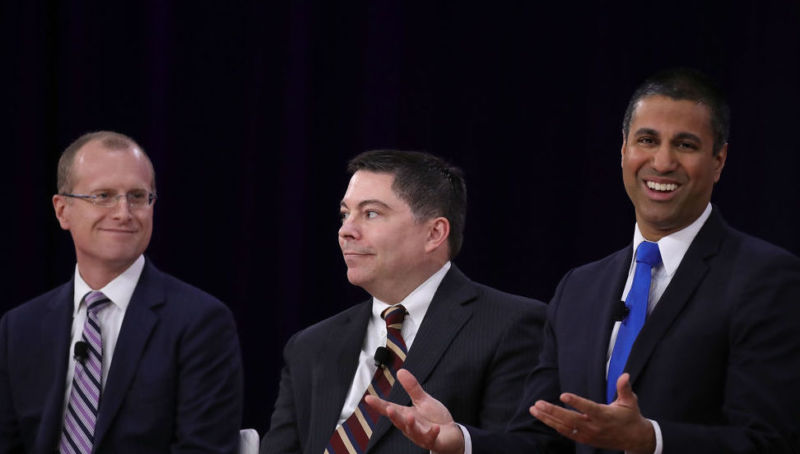
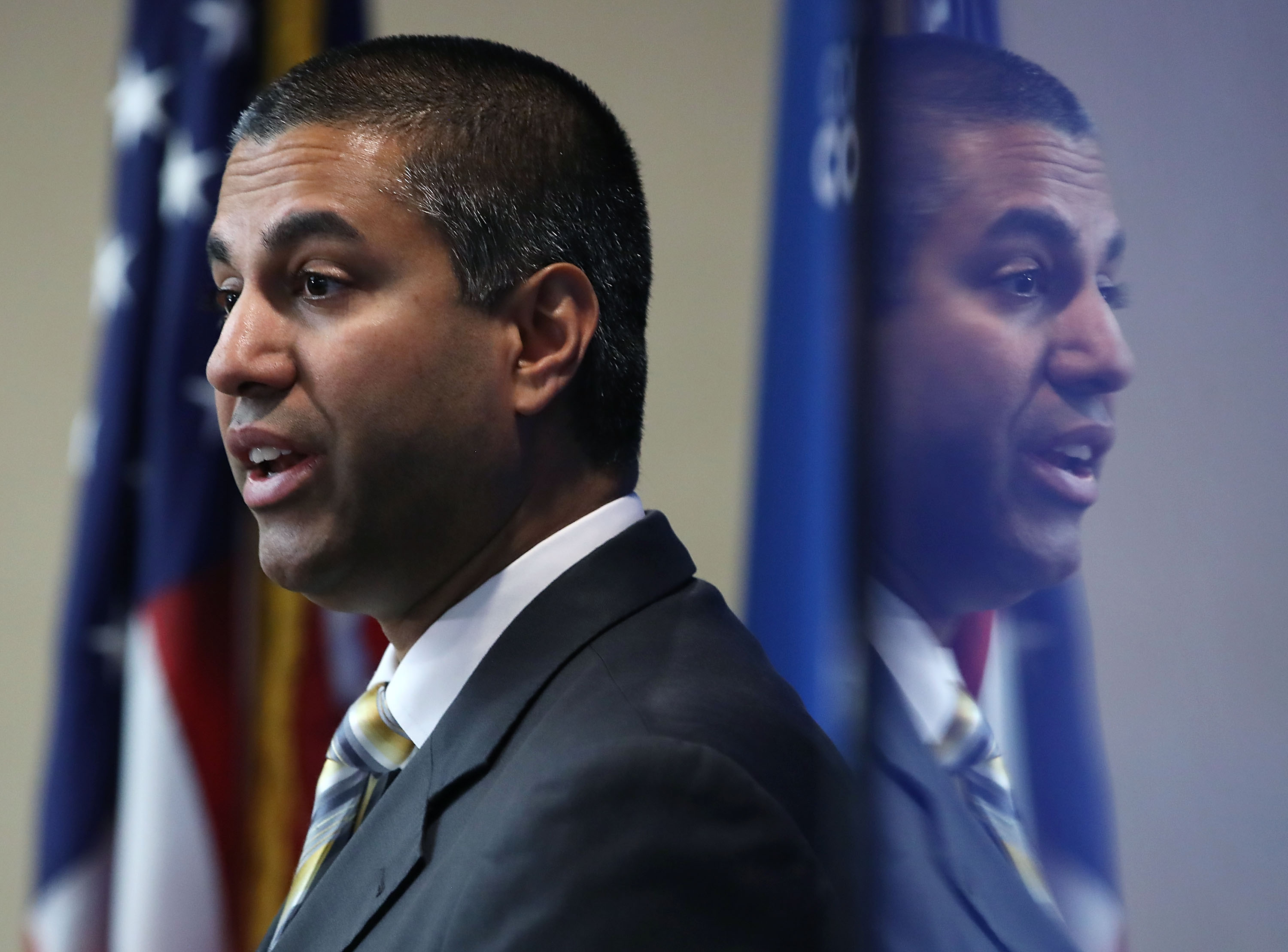
FCC members Brendan Carr, Michael O'Rielly, and Chairman Ajit Pai participating in a panel discussion.
Enlarge / FCC Republican members (L-R) Brendan Carr, Michael O’Rielly, and Chairman Ajit Pai participate in a discussion during the Conservative Political Action Conference on February 23, 2018, in Maryland.

The Republican-majority Federal Communications Commission took another vote against net neutrality rules today in its last meeting before a presidential election that could swing the FCC back to the Democratic Party.

Today’s vote came a year after a federal appeals court upheld FCC Chairman Ajit Pai’s repeal of net neutrality rules and deregulation of the broadband industry. Though Pai was mostly victorious in the case, the judges remanded portions of the repeal back to the FCC because the commission “failed to examine the implications of its decisions for public safety,” failed to “sufficiently explain what reclassification [of ISPs] will mean for regulation of pole attachments,” and did not address concerns about the effect deregulation would have on the FCC’s Lifeline program, which subsidizes phone and Internet access for low-income Americans.

The FCC approved its response to the court’s remand instructions in a 3-2 vote today but didn’t make any significant changes. “After thoroughly reviewing the record compiled in response to its request for additional comment on these issues, the FCC found no basis to alter the FCC’s conclusions in the Restoring Internet Freedom Order,” the commission said in its announcement. “The Order on Remand finds that the Restoring Internet Freedom Order promotes public safety, facilitates broadband infrastructure deployment by Internet service providers, and allows the FCC to continue to provide Lifeline support for broadband Internet access service.” A draft version of the decision is available here.

Democrats dissent, predict court failure for Pai

FCC Democrats Jessica Rosenworcel and Geoffrey Starks dissented today, saying the FCC majority didn’t provide a good enough justification for sticking with the repeal as is. Rosenworcel called the order “a set of three cobbled-together arguments designed to tell the court to go away, the public that we are not interested in their opinion, and history that we lack the humility to admit our mistake.” Starks said he doubts that the FCC’s response to the remand will satisfy judges at the US Court of Appeals for the District of Columbia Circuit, which could take up the case again if the FCC faces another lawsuit.

The FCC majority claimed that “regulatory certainty,” meaning deregulation, results in increased innovation and investment that “will enhance public safety.” The FCC also said the repeal “is unlikely to harm public safety communications” and that any impact “would be limited because broadband Internet access service, while important, is only a part of the broader public safety communications ecosystem.” While the FCC gave up its Title II authority over broadband providers, the commission claims that antitrust and consumer-protection laws enforced by other regulators will ensure that public safety agencies have appropriate access to communications services.

That wasn’t good enough for Commissioner Rosenworcel. She said:

The very first sentence of the Communications Act tasks the FCC with “promoting safety of life and property.” In other words, public safety is fundamental to our mission. But the agency disregards it here and sidesteps the concerns of the court by insisting that removing net neutrality increases network investment, which will accrue to the benefit of public safety. The evidence for this is less than clear. But more importantly, it doesn’t adequately explain why this is the case when lives are on the line. Nor does it detail in any meaningful way how first responders will manage when emergency communications are throttled or blocked. This concern is not just theoretical. Among those opposing the FCC’s rollback of net neutrality are firefighters who found their service throttled when they were responding to a raging blaze. But here their fears are given short shrift. The agency simply concludes that the elimination of net neutrality is worth the risk, even when lives are at stake. This is irresponsible.

Pai argued that “there is no evidence the Restoring Internet Freedom order has harmed public safety. By employing a light-touch, market-driven approach to regulation, broadband providers are better able to build stronger and more resilient networks that enhance public safety, including through services like next-generation 911.”

If Democratic nominee Joe Biden defeats President Trump in the presidential election, he’ll be able to appoint a chair to replace Pai and form a Democratic majority that could reinstate net neutrality rules and Title II regulation of broadband providers.

ISPs lost legal protections

The FCC’s reclassification of broadband, changing it from a common-carrier telecommunications service to an information service, removed some legal protections for Internet providers. Starks said this is a problem for broadband-only providers that need access to utility poles to expand their networks, and he added that the FCC remand ignores this:

The Remand Order acknowledges that access to these poles is a “competitive bottleneck,” and observes that cable operators, wireless Internet service providers and others have filled the record with stories about the difficulties in obtaining reasonable access to poles. Nevertheless, the Remand Order finds that reclassification does not significantly limit new entrants to the marketplace, and in an exercise in circular reasoning, simply restates the RIF [Restoring Internet Freedom] Order’s claim that most ISPs will remain entitled to FCC protection because their broadband service will come bundled with Title II or cable services. As for broadband-only ISPs, the Remand Order blithely suggests that they could receive FCC protection if they simply began providing video or telecom services, notwithstanding their own business plans or financial circumstances… I fail to see how such a response will satisfy the DC Circuit.

There’s a similar problem for companies that provide broadband service to poor people with subsidies from the FCC’s Lifeline program, Starks said. “In response to the DC Circuit, the majority engages in a strained legal reading to find that a provider may continue to receive Lifeline support for broadband service as long as that provider remains an Eligible Telecommunications Carrier offering telecom services to some customers,” Starks said. “This would be tricky on its own terms, but voice service in the Lifeline program will be phased out next year. What will happen to Lifeline providers who may not have any remaining voice customers after the phase-out?”

The FCC’s majority decision conceded that Lifeline support for broadband could be threatened, though it called such an outcome unlikely and said that “the benefits of reclassification would outweigh the removal of broadband Internet access service from the Lifeline program.”

Pai today pointed out that, when the Obama-era FCC added broadband to the Lifeline program, broadband was not yet classified as a Title II common-carrier service. “It is the common-carrier status of the provider, not the service, that governs whether the provider is eligible to receive Lifeline support for services provided over its network,” Pai said. “If a common carrier offers voice service and qualifies as an ETC [eligible telecommunications provider], the Lifeline program can support affordable broadband Internet access and service.”

Fight to protect net neutrality “will continue”

Today’s remand response did not address preemption of state net neutrality laws. The FCC tried to preempt all such laws, but last year’s court decision said the commission cannot do that. An ongoing court case will decide whether California’s net neutrality law can be enforced.

The remand order could be met with lawsuits from some of the same advocacy groups, state attorneys general, and tech companies that previously challenged the repeal. “This remand order callously dismisses the valid concerns of public safety officials, competitive broadband providers and millions of disconnected low-income families who can’t afford to get online,” Free Press Policy Manager Dana Floberg said. “But Pai goes even further, insisting that if the agency’s decisions on these issues harm these constituencies, that harm is justified by the supposed benefits of repealing Title II.”

Free Press, one of the FCC’s opponents in the net neutrality court case, criticized Pai for claiming that the repeal spurred new broadband development. “Approximately 92 percent of the fiber deployments made during Pai’s chairmanship were actually planned and announced during the last few years of the Obama administration, when Title II was securely in place,” Floberg said. “Chairman Pai is trading away critical public protections for a bag of magic beans, and a wink and a nod from cable lobbyists. We need public servants who will actually listen to people, consider the data and serve community needs instead of long-debunked ideologies.”

Public Knowledge, another advocacy group that fought the repeal, said the fight will continue. “Ironically, the FCC is now claiming sweeping authority over social media and other online platforms without a legitimate legal basis—after claiming it has no authority to regulate broadband, which clearly falls under the agency’s traditional telecommunications jurisdiction,” Public Knowledge Legal Director John Bergmayer said, referring to Pai helping Trump impose a crackdown on Twitter and Facebook.  “Nevertheless, the fight to protect net neutrality and promote good broadband policy is not over, and Public Knowledge will continue to engage in that fight.”

https://arstechnica.com/?p=1717679



With Starlink, SpaceX continues to push the bounds of reusing rockets

A Falcon 9 rocket launches the Starlink-13 mission on October 18.
Enlarge / A Falcon 9 rocket launches the Starlink-13 mission on October 18.

A Falcon 9 rocket ascended into the blue skies above Florida on Sunday morning, and much of the space world barely took notice.

Sure, it was fairly early on a Sunday, and many Americans were not even yet out of bed. But there’s a deeper reality here: SpaceX has made launching rockets almost seem routine. The company’s vice president of reliability, Hans Koenigsmann, once told me that one of his goals was to take the “magic” out of rocket launches. And the company seems to be succeeding.

SpaceX is also succeeding at reuse. Sunday morning’s launch used a Falcon 9 first stage that has already flown into space five times. This is the second time SpaceX has used a first stage a total of six times, and next year it is likely to reach ten uses of its rocket. And then there is the payload fairing. For the first time, SpaceX was able use each of these fairing halves for a third time.

For most launches, the company now typically expends only the Falcon 9 rocket’s second stage, with a single Merin vacuum engine. The photo gallery below offers some breathtaking overviews of how SpaceX returns its first stages and fairing halves to Florida by boat.

SpaceX has employed its used rockets to build out its Starlink constellation, with Sunday morning’s launch adding 60 more satellites. This was the 13th launch of “operational” satellites, bringing to 835 the number of Starlink satellites launched in a year and a half—although 45 of the demonstration version satellites launched in May 2019 have since deorbited. The company is expected to begin offering a “beta” version of its Internet-from-space program by the end of this year.

And the beat goes on. On Wednesday, October 21, the company will attempt to launch 60 more Starlink satellites from Space Launch Complex-40 in Florida. There is a 60 percent chance of favorable weather at the opening of the launch window at 12:29pm ET (16:29 UTC).

A few years ago, some in the aerospace industry smirked when SpaceX founder Elon Musk attempted to brand used boosters as “flight-proven” rockets. However, this may in fact be accurate. Back on October 2, the launch of a new Falcon 9 rocket was scrubbed at T-2 seconds due to a turbomachinery issue. The GPS III payload remains on the ground, and NASA has also taken the step of delaying its Crew-1 mission to the International Space Station—also flying on a new Falcon 9 rocket—until no earlier than November 11 while this issue is investigated.

Meanwhile, the Starlink missions keep flying into orbit. If the 14th operational mission lifts off on Wednesday, it will be the third Starlink launch in October. True, these are SpaceX payloads, so the company can afford to take higher risks with its low-cost satellites. Yet with these Starlink missions, the company is proving not only that it can fly used rockets—it can also take a little of the magic away.

https://arstechnica.com/?p=1715634


House OKs $100B broadband plan with $50 monthly discounts for poor people

A map of the United States with lines and dots to represent broadband networks.

The US House of Representatives yesterday approved $100 billion worth of broadband funding as part of a $1.5 trillion infrastructure bill.

The broadband portion is modeled on the Democrats’ “universal fiber” plan we wrote about last week. The plan includes $80 billion in fiscal year 2021, money that the Federal Communications Commission would use to fund high-speed broadband projects in unserved and underserved areas. Funded projects would have to provide 100Mbps download and upload speeds, along with low latencies, conditions that would spur fiber-to-the-home development.

The bill has additional money for broadband-deployment loans, grants for states to pursue digital-inclusion projects, Wi-Fi on school buses, and network equipment for schools and libraries. It also includes a $9 billion Broadband Connectivity Fund to provide $50 monthly discounts for low-income broadband users, and $75 monthly discounts for low-income households in Tribal lands. The broadband portions of the infrastructure bill are in this set of amendments.

The bill also has a Dig Once requirement that says fiber or fiber conduit must be installed “as part of any covered highway construction project” in states that receive federal highway funding. The bill would also overturn state laws that “prohibit or have the effect of prohibiting” municipal broadband networks.

“This legislation takes a comprehensive approach towards closing the digital divide by focusing on deployment and affordability,” Senior Policy Counsel Jenna Leventoff of consumer-advocacy group Public Knowledge said. “Ensuring that consumers not only have the ability to purchase broadband, but also the ability to afford it is key for narrowing our nation’s staggering digital divide.”

Party-line vote

The infrastructure bill isn’t likely to pass as currently written in the Republican-controlled Senate, but it’s possible at least some of the broadband portions will become law in a compromise. The overall bill passed by a vote of 233-188, while the broadband provisions were part of a set of amendments that passed in a 234-178 vote. “While the party-line vote on the full bill is a fact of our current politics, no one should make the mistake of thinking the broadband provisions are partisan,” Free Press General Counsel Matt Wood said. “People in cities and rural areas alike need better broadband at better prices, no matter their party or politics. The Moving Forward Act recognizes and addresses the needs of communities most often left out of congressional debates on communications policy.”

The legislation also recognizes “that the vast majority of people who are disconnected today are offline because of the high price of Internet services that are physically available to them but out of reach financially,” Wood said. “This dilemma disproportionately impacts Black and Brown people, poorer communities and other groups hit hardest by the pandemic. Lacking an Internet connection during this health crisis exacerbates existing economic inequities and deepens digital divides.”

The House-approved package is one of several pending attempts to close broadband gaps. Another Democratic bill would provide $50 monthly broadband credits ($75 in Tribal lands) for people who have been laid off or furloughed during the pandemic.

https://arstechnica.com/?p=1689099


Despite 100GB video games, average download times are decreasing

Anyone who downloads games regularly probably has a complaint about just how long it takes to download some of the bigger big-budget titles these days. Unless you want to buy your games on a physical disc or cartridge (or use a streaming gaming service), playing a new game these days means budgeting time for the raw files to get onto your system from centralized servers.

At a quick glance, it can feel like this problem is getting worse over time. Take a look at Red Dead Redemption 2 and Final Fantasy VII, for instance; two recent high-profile games that each push past a whopping 85GB for their PS4 downloads. The coming release of The Last of Us Part 2 continues the trend, with marketing materials warning that players will need 100GB of hard drive space. That’s a big change from 2013, when a 50GB PS4 game download was considered shockingly large.

Those examples notwithstanding, though, the data shows that US console gamers are generally spending less time than ever downloading popular console games. In fact, an analysis conducted by Ars confirms that average broadband download speeds in the United States have been increasing faster than average game sizes for years now.

The data

To get a handle on the relative shape of modern game download times, first we needed reliable data on just how fast broadband speeds have been over the years. Ookla’s Speedtest Global Index provides a great breakdown for this, with data broken out by country and by mobile versus broadband use cases. And Ookla measures the actual bandwidth experienced by users, not the “advertised” bandwidth hyped by the ISPs.

Then we had to figure out just how many gigabytes make up an average modern game these days. For this, we relied on Sony’s own regularly updated list of top-selling PlayStation software. For each year, we used each platform’s top-10 best-selling games for December as a reasonably representative cross-section of the console’s software library for that year (for 2020, we used the list of top sellers for April).

This number doesn’t include the size of any subsequent patches or DLC that might be needed to play the game, and download sizes for games on other platforms may look somewhat different. Still, it provides a good baseline look at how game size has changed over time.

The results

Data in hand, we can see some broad trends in the relative growth of download speed and game size going back to middle of the PS3 era. Back then, the size of top-selling downloads increased sixfold from 2011 to 2015 (Fig. 2). This seems to reflect a transition from players primarily downloading smaller indie darlings to the growing popularity of “full game downloads” for retail releases like the 27GB The Last of Us and the 24GB Destiny (Fig. 4).

But average broadband speeds in the US only increased threefold in the same time period, meaning total download times for games shot up after 2011* (Fig. 1). While things started to balance out again by 2016, the noisy data doesn’t exactly paint a great picture for time spent waiting for games downloads on the PS3.

While <em>The Last of Us Part 2</em> might be pushing 100GB to download, generally increasing broadband speeds could still leave you smiling.
Enlarge / While The Last of Us Part 2 might be pushing 100GB to download, generally increasing broadband speeds could still leave you smiling.

Going into the PS4 era, though, things shook out quite differently. From 2013 to 2015, the growth in broadband speed and PS4 game size matched each other almost perfectly (Fig. 3). Then the growth of top-selling PS4 games starts to plateau a bit, thanks in large part to a functional “ceiling” of a 50GB file size for games packaged on a single Blu-ray disc. The few outliers that blow past that mark only have a small impact on the average, which has topped out just under 50GB in recent years.

Average broadband speeds in the US, meanwhile, have continued growing faster and faster since 2015 (Fig. 5), easily outpacing game-size growth. As a result, average download times* for PS4 games have come down over the years, even as game sizes have generally increased.

(* – The “idealized” game download time metric used in these charts is a very rough estimate made by dividing the raw file size by the reported average bandwidth across the country. Actual results can vary widely based on congestion on Sony’s servers and day-to-day performance of the user’s specific connection.)

The future

It’s too early to say for sure if games on the PS5 and Xbox Series X will be considerably larger than those on current consoles. Based on recent history, though—and the increasing detail of scenes like those in Epic’s recent Unreal Engine 5 demo—we can only imagine console games will routinely blast past a single Blu-ray disc’s de facto 50GB soft limit in the near future.

That said, recent data also shows that these increasing file sizes don’t necessarily mean increased download times for console gamers. In recent years, broadband infrastructure in the United States seems to generally be keeping pace with (or surpassing) the raw data needs of modern gaming downloads.

Those kinds of averages are of limited use to players stuck on low-speed broadband, of course, whether due to price or sheer lack of availability, especially in the rural parts of the country. And those increasingly massive games are going to have to be stored on increasingly pricey high-speed storage in the next console generation and fit through sometimes stringent data caps, which could be an even greater concern than download times for some.

Taken as a whole, though, the data suggests the hassle of waiting for a new game to download has actually been decreasing over time. Something to think about as you wait for The Last of Us Part 2 to filter down to your hard drive in the near future.

Listing image by Aurich Lawson / Getty / Naughty Dog

https://arstechnica.com/?p=1682463


Ajit Pai uses bad data to claim ISPs are deploying broadband to everyone

FCC Chairman Ajit Pai.
Enlarge / FCC Chairman Ajit Pai speaking at a press conference on October 1, 2018, in Washington, DC.

The Federal Communications Commission on Friday issued its annual broadband deployment report, finding for the third straight year that broadband is “being deployed to all Americans in a reasonable and timely fashion.”

The FCC is required to report on broadband progress annually under Section 706 of the Telecommunications Act of 1996. Pai’s Republican majority pointed to the FCC’s deployment data to argue that broadband networks are expanding fast enough to serve all Americans, despite the three biggest ISPs—Comcast, AT&T, and Charter—lowering capital expenditures.

Pai’s conclusion is based on ISPs’ filings to the FCC, which are known to overcount the number of Americans who have broadband access. The FCC report also failed to consider whether data caps and broadband prices are impeding progress toward universal broadband access.

The annual report’s finding can have an impact on policymaking. The FCC is required to take further action to accelerate broadband deployment if it finds that it isn’t happening quickly enough.

Pai touts his leadership

Going back to his time as an FCC commissioner during the Obama administration, Pai has repeatedly argued that government regulation slows broadband investment and promised that his deregulatory agenda would cause investment to rise. This year, he pointed to industry research that found capital expenditures rose from $76.9 billion in 2017 to $80 billion in 2018. But the report didn’t mention the more recent spending declines at Comcast, AT&T, and Charter.

As we previously reported, Comcast lowered capital expenditures in its cable division by 10.5 percent in 2019, reducing the annual total to $6.9 billion. AT&T announced in October that it is lowering capital investment from $23 billion in 2019 to $20 billion in 2020, and Charter cut capital expenditures from $9.1 billion in 2018 to $7.2 billion in 2019.

“Under my leadership, the FCC’s top priority is to close the digital divide, and I’m proud of the progress that we have made,” Pai said in a press release Friday. “Having grown up in rural Kansas, I have a deep commitment to expanding broadband to all corners of the country. That’s why we’ve taken aggressive steps to remove regulatory barriers to broadband deployment and reform our Universal Service Fund programs.”

In previous years, Pai used the annual report to take credit for broadband deployment projects that were started during the Obama administration and claimed that his deregulatory policies were speeding up deployment even though broadband grew at similar rates during the Obama years.

Report is “baffling,” Democrat says

The FCC’s two Democrats disputed Pai’s conclusions. Commissioner Jessica Rosenworcel said:

This report is baffling. We are in the middle of a pandemic. So much of modern life has migrated online. As a result, it has become painfully clear there are too many people in the United States who lack access to broadband. In fact, if this crisis has revealed anything, it is the hard truth that the digital divide is very real and very big.

But you’ll find no evidence acknowledging that in today’s Broadband Progress Report from the Federal Communications Commission. Instead, you’ll find a glowing assessment that all is well. According to this rosy report the nation’s broadband efforts are all good. They are proceeding in a reasonable and timely fashion and they are reaching all Americans. This is just not right.

Among other things, Rosenworcel pointed out that people without broadband access are sitting in cars “in front of shuttered libraries and coffee shops, just to pick up a free Wi-Fi signal” during the pandemic.

FCC: 18.3 million people lack access

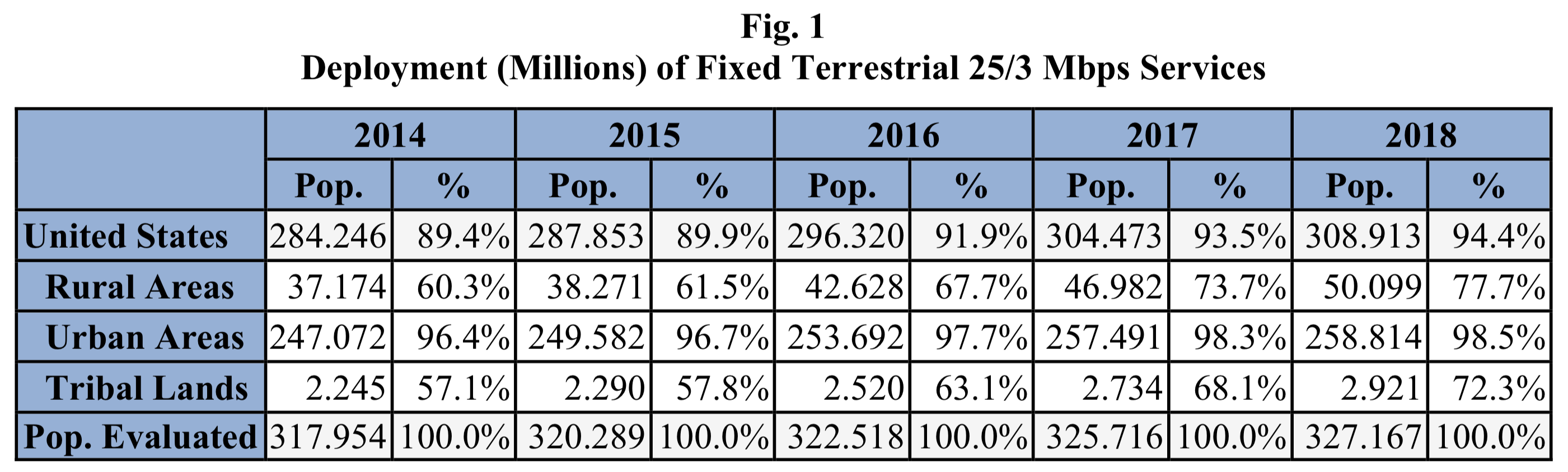
The report said that as of year-end 2018, 308.9 million out of 327.2 million Americans had access to fixed broadband with speeds of at least 25Mbps downstream and 3Mbps upstream, the FCC broadband speed standard that hasn’t been updated since 2015. The percentage of Americans with 25/3Mbps access rose from 93.5 percent to 94.4 percent from 2017 to 2018. Those numbers exclude satellite service, which has poor latency and restrictive data caps, making it a poor substitute for cable or fiber. (SpaceX’s satellite service may change that, but it isn’t available yet.)

US broadband deployment from 2014 to 2018.
Enlarge / US broadband deployment from 2014 to 2018.

That leaves 18.3 million Americans who live in areas that don’t have what the FCC considers modern home-Internet service. The 94.4 percent and 18.3 million figures are in the report but aren’t mentioned in the press release Pai issued to tout the broadband industry’s progress. The press release said that “the number of Americans lacking access to fixed terrestrial broadband service at 25/3Mbps continued to decline, going down by more than 14 percent in 2018 and more than 30 percent over the course of 2017 and 2018.”

Real number may be much higher

The 18.3-million number “wildly understates the extent of the digital divide in this country,” Rosenworcel said. “That’s because if a broadband provider tells the FCC that it can offer service to a single customer in a census block, the agency assumes that service is available throughout [the census block].” Rosenworcel was referring to the Form 477 reports that ISPs are required to submit.

The real number of Americans without access to wired or fixed wireless broadband is 42.8 million, a February 2020 study by BroadbandNow found.

The FCC in August 2019 finally ordered ISPs to submit geospatial maps of where they provide service instead of merely reporting which census blocks they offer service in. But this more accurate data isn’t available yet. “[D]espite its deficiencies, Form 477 data remains the most comprehensive, reliable data available to us to meet our statutory obligation” to report annually on deployment progress, the FCC said.

There have been some big errors in the Form 477 data that relies on ISPs’ census-block filings. Last year, Pai had to correct the annual broadband report after a new ISP called BarrierFree falsely told the FCC that it went from serving zero customers to 20 percent of the country in just six months. The FCC didn’t notice the mistake, which was discovered by consumer-advocacy group Free Press.

Earlier this month, AT&T disclosed to the FCC that it provided false coverage data in parts of 20 states. The FCC hasn’t said whether it will investigate the rest of AT&T’s broadband data to verify its accuracy.

Like Rosenworcel, Democratic Commissioner Geoffrey Starks said he can’t support the conclusion that broadband is being deployed to everyone on a reasonable and timely fashion. “In light of the struggles many Americans have faced over the last six weeks, it is especially perplexing and disturbing that the majority would cast this report as a victory lap,” Starks said. “Too many Americans cannot access online work, medical help, and distance learning because broadband is too expensive or not available.”

https://arstechnica.com/?p=1671370


AT&T gave FCC false broadband-coverage data in parts of 20 states

An AT&T logo on the side of a building.

AT&T falsely reported to the Federal Communications Commission that it offers broadband in nearly 3,600 census blocks spread across parts of 20 states.

AT&T disclosed the error to the FCC in a filing a week ago. The filing provides “a list of census blocks AT&T previously reported as having broadband deployment at speeds of at least 25Mbps downstream/3 Mbps upstream that AT&T has removed from its Form 477 reports.” The 78-page list includes nearly 3,600 blocks.

With Form 477 reports, ISPs are required to tell the FCC which census blocks they offer service in. The FCC uses the data to track broadband-deployment progress and, crucially, to decide which census blocks get government funding for deploying Internet service. AT&T falsely reporting broadband-data coverage could prevent other ISPs from getting that funding and leave Americans without broadband access.

When contacted by Ars, AT&T said the mistake was caused by a software problem. “The updates to the census blocks address an issue with a third party’s geocoding software. There has been no change to our service area and this doesn’t affect the service we provide our customers,” AT&T told Ars.

Error “unnoticed for 2-plus years”

The error appeared in AT&T filings to the FCC going back to December 2017, broadband researcher Derek Turner told Ars. Turner is the research director of consumer-advocacy group Free Press.

The error affecting 3,600 census blocks is relatively small, as AT&T offers service in 2.2 million blocks, Turner said. But aside from one even bigger error by an ISP called BarrierFree last year, Turner said he hasn’t “seen any other ISP reporting error like this before” and that “it is curious that the [AT&T] error may have gone unnoticed for 2-plus years.”

There are more than 11 million census blocks in the US, though about 5 million are entirely unoccupied. “While relatively small errors like this don’t end up changing conclusions about national trends, it certainly can impact the FCC decisions about where to spend—and where to not spend—scarce subsidy funds,” Turner said. “AT&T should be quite a bit more forthcoming about the exact nature of this error and how it discovered it, so that other ISPs can be sure they’re not making similar errors.”

We asked the FCC if it plans to punish AT&T or at least investigate the rest of its Form 477 filings to make sure they are accurate, and we will update this article if we get a response.

The FCC recently found that Verizon, T-Mobile, and US Cellular exaggerated their 4G cellular coverage in official filings. But the carriers faced no punishment even though the FCC said it would issue an advisory to industry members reminding them “of the penalties associated with filings that violate federal law.”

AT&T offers wireline service in 21 states, and the mistake affected certain census blocks in all of those states except Nevada. The states where AT&T falsely reported coverage in some census blocks are Alabama, Arkansas, California, Florida, Georgia, Illinois, Indiana, Kansas, Kentucky, Louisiana, Michigan, Missouri, Mississippi, North Carolina, Ohio, Oklahoma, South Carolina, Tennessee, Texas, and Wisconsin.

FCC to issue $16B before getting more accurate data

AT&T discovered its error after the FCC asked carriers to update their Form 477 filings in preparation for Phase 1 of the commission’s $20.4 billion Rural Digital Opportunity Fund (RDOF). The FCC is targeting Phase 1 funding of up to $16 billion at census blocks where there isn’t any 25/3Mbps home-Internet service. The program is paid for by Americans through fees imposed on phone bills.

In its FCC filing, AT&T noted that the 3,600 census blocks “may be eligible for the RDOF Phase I auction” if no other ISPs report offering 25/3Mbps broadband in the blocks. If AT&T hadn’t found the error, none of the 3,600 blocks would have been considered for funding in the auction.

The FCC has long known that its Form 477 system is inaccurate because it counts entire census blocks as served if an ISP offers service to just one home in a block. The FCC in August 2019 finally ordered ISPs to submit geospatial maps of where they provide service instead of merely reporting which census blocks they offer service in.

But the FCC is proceeding with the RDOF auction in October before getting the new, more accurate data. Chairman Ajit Pai resisted calls from Democratic Commissioners Jessica Rosenworcel and Geoffrey Starks to delay the first auction until data based on geospatial maps is available.

Reader without wired broadband flagged AT&T filing

We didn’t notice the AT&T filing until a reader named Jonathan Meyer pointed it out to us. Meyer lives in a rural part of Indiana in Bartholomew County and said he has been following the RDOF process closely because he can’t get modern broadband service at his house.

“AT&T received a subsidy under the original CAF [Connect America Fund, the RDOF predecessor] program to provide DSL service in our area,” Meyer told Ars. “However, by the time that we built our home on the property, they claimed that they had met their coverage obligations and are no longer serving new customers.”

Meyer said he is “shocked that a company like AT&T would have so many errors and I’ll bet that those errors had been routinely repeated for quite some time.”

Because he lacks wired-broadband access, Meyer uses a Verizon residential service that connects to the cellular network and comes with an onerous data cap and overage fees. “Other than being very expensive if we go over our 40GB monthly cap, the service has ranged from decent three years ago to pretty good after Verizon built two new towers nearby. However, an average of $190 per month for service that averages 3 to 5Mbps makes me very anxious for a fiber or coax option,” he said.

John Bergmayer, legal director of consumer-advocacy group Public Knowledge, called AT&T’s Form 477 error “another example of how poor our broadband data-collection practices are in general.

“It’s hard to craft good policy without good data, and it’s frustrating to waste time arguing about data collection, mapping, and similar subjects, instead of what to do about actual broadband deployment and availability,” Bergmayer said.

https://arstechnica.com/?p=1669182


When school is online, the digital divide grows greater

A student studying on his laptop with two friends after classes were cancelled.
Enlarge / A student studying on his laptop with two friends after classes were cancelled.
Phillipe Francois | Getty Images

Like many students around the world, Nora Medina is adapting to online learning. But Medina, a high school senior in Quincy, Washington, who also takes classes at a local community college, faces an additional challenge: She doesn’t have reliable Internet service at home. She lives 7 miles outside of town where she says neither cable nor DSL Internet is available.

She can access the Internet on her phone, and her family has a wireless hotspot, but she says the service isn’t up to the task of doing homework online. “It’s hit and miss,” she says. “Sometimes I can watch a video, but sometimes I can’t even refresh a page, or it will take minutes to load something on a page.”

Washington governor Jay Inslee this week said the state’s schools will be closed for the rest of the school year. Quincy High School is still planning how best to help students finish the year. But Medina’s classes at Big Bend Community College have shifted online. “I’m just going to hope the hot spot works and wish for the best for my final quarter,” she says. “If that doesn’t work, I’ll do my work from my car in the parking lot at the library to access their Wi-Fi.”

Medina is one of millions of people in the US who lack reliable broadband Internet at home, either because they can’t afford it or because it simply isn’t available where they live. This digital divide has always left children and adults alike with fewer educational and economic opportunities. But with schools, libraries, and workplaces closed during the coronavirus pandemic, those without broadband are struggling to access schoolwork, job listings, unemployment benefit applications, and video chat services that others use to keep in touch with friends and family. For those on the wrong side of the digital divide, working from home isn’t an option.

The Federal Communications Commission says more than 650 broadband Internet providers, telephone companies, and trade associations have signed its Keep America Connected Pledge to not terminate Internet service over pandemic-related financial troubles, to waive late fees, and to allow free access to Wi-Fi services. Comcast said it would offer free access to its broadband service for low-income households, normally priced at $10 a month, for 60 days, and Charter said it would offer free Internet access for students for 60 days. But these offerings are available only in locations where those companies already provide service.

It’s hard to gauge the extent of the problem. In a report last year, the FCC estimated that 21.3 million people had no access to broadband Internet service at the end of 2017. But the report, based on self-reported data from broadband providers, considers an entire census block to have service if a single broadband provider claims to offer service anywhere within the census block, even if most homes within the area can’t get service. Critics have long pointed out that this method likely underestimates the number of people without access to broadband.

A report published last year by Microsoft estimated that 162.8 million people in the US—about half the population—don’t use broadband Internet, whether because it’s unavailable where they live or they can’t or won’t pay for access. A survey commissioned by Microsoft and the National 4-H Council found that 20 percent of rural youth lack access to broadband at home, regardless of whether it’s available where they live.

How schools are coping

The digital divide creates a challenge for teachers and administrators who know some students can’t easily follow online lessons. Berkeley, California, schools closed in the middle of March, but the distinct didn’t begin online classes until Monday. In the interim, public schools superintendent Brent Stephens says officials had to work out how to accommodate special-needs students, adjust union contracts, and plan lessons for 16,000 students.

But, Stephens says, “equity has been a concern” too. He estimates that about 5 percent of the district’s students lack reliable Internet access at home, and about 30 percent need devices suitable for online learning. He says the district has distributed more than 2,000 Chromebooks to students and ordered wireless hotspots for students who don’t have reliable Internet access at home, though it’s not clear when those hot spots will be available. In the meantime, the district is still considering how to get learning resources to students without Internet access.

Some schools are employing low-tech solutions. Bandon School District on Oregon’s southern coast plans to deliver and collect physical packets of learning materials and assignments to the 18 percent of students who superintendent Doug Ardiana says lacks Internet at home.

When Oregon governor Kate Brown closed schools on March 12, Bandon schools sent out “supplemental” learning assignments that didn’t need to be returned. Now, schools will be closed for the rest of the school year, and schools are supposed to offer distance-learning programs, including graded assignments.

To prepare students for those assignments, teachers are filming lessons that students can watch from home over the Internet. “It’s a whole new thing,” says Courtney Wehner, a third-grade teacher at Ocean Crest Elementary in Bandon. “I’m not used to hearing my voice recorded.”

For students who lack Internet access, the school will send packets of materials to their homes, either through the mail or with school bus drivers wearing protective gear. Students who can use them will get DVDs or thumb drives with the recorded lectures. Wehner says that includes all of her students. Others will have to depend on written materials.

Wehner says the parents of her students who lack broadband Internet will take pictures of completed assignments with their phones and send them to her for grading. Students in the district who can’t return assignments that way will send completed assignments back with bus drivers or the postal service, and someone at their school, also wearing protective gear, will scan the assignments and upload them to a server that teachers can access from home. Teachers will review and correct the assignments and print them out, and the corrected assignments will go back to the students three days later.

A $20 billion fix for a $70 billion problem

The FCC has spent billions in recent years in the name of closing the digital divide. But that divide persists in part because the agency has repeatedly underestimated the scope of the problem, says FCC commissioner Jessica Rosenworcel. “How do we know we’re sending money to the right places?” she asks.

The Rural Digital Opportunity Fund, which replaced a previous initiative called the Connect America Fund, gives carriers money to build broadband in communities that lack access to connections of at least 10 megabits per second. It’s set to send $20.4 billion over 10 years to carriers to expand rural broadband access. But John Windhausen Jr., executive director of the Schools, Health & Libraries Broadband Coalition, says the Fiber Broadband Association estimated last year that it will cost $70 billion to bring fiber-optic networks to 90 percent of the US by 2025.

Beyond the pledges from carriers to not cut off service, the FCC has permitted libraries and public schools to offer public Wi-Fi while the buildings are closed without risking FCC funds, and has moved to dedicate a large chunk of spectrum for unlicensed Wi-Fi use instead of auctioning off licenses for it; advocates say that could make it easier to provide wireless broadband services in rural or low-income areas.

But critics say the FCC in recent years has impeded efforts to close the digital divide. Last year the FCC voted to auction off wireless spectrum that had been reserved for schools to the highest bidder, which Windhausen says will make it harder for schools, local governments, and nonprofits to use that spectrum to create their own wireless services.

The FCC under Chairman Ajit Pai has resisted expansion of Lifeline, a 35-year-old program that subsidizes access to telecom service for low-income households. Lifeline has remained intact, though. In February 2019, a federal appeals court overturned Pai’s attempt to limit broadband subsidies for tribal residents. Another Pai proposal that would have prevented poor people from buying Lifeline plans from network resellers was quietly scrapped after widespread condemnation. Pai pressed on in mid-2019 with a proposal to impose an overall cap on Universal Service spending, including Lifeline, but the plan hasn’t been finalized.

This story originally appeared on wired.com.

https://arstechnica.com/?p=1667547


Subscription drive, day 4: A pitch from “Comcast’s least favorite journalist”

Illustration of Jon Brodkin's face on a poster that says

After eight and a half years working full-time for Ars Technica, it’s time for me to write something totally unlike anything that previously appeared under my name: a sales pitch. I’m a journalist for good reason, as I’m too gruff and unfriendly to be in sales, so please temper your expectations.

As you probably gathered by now, we’re doing a subscription drive this week. Every person who buys a subscription will help us get through a difficult financial time, as the pandemic and oncoming recession cause a predictable decline in advertising revenue throughout the media industry.

In addition to giving you some nice perks like ad-free articles and a YubiKey 2FA device, your subscription dollars help make sure that people like me get to keep writing for Ars. I’ve written more than 3,000 articles for Ars Technica, and I don’t intend to stop any time soon.

You want broadband coverage? I have good news

Now, I can’t promise to personally torture Lee Hutchinson in the name of journalism, even though I support and encourage all efforts to do so. But I do promise to write more of the articles that led the Daily Beast to call me “probably Comcast’s least favorite journalist.”

I’ve been a full-time journalist for nearly 20 years, and at Ars I have more freedom to write what I want to write than I had at any other news organization. That has led to deep-dives into Comcast’s data-cap meter and the cable company’s disputes with Netflix, coverage of Verizon throttling a fire department’s “unlimited” data during a California wildfire, and many articles about bizarre fees—like AT&T passing along its property taxes to customers and Frontier charging for routers that don’t exist.

Working for Ars has also let me write about the travesty of rural (and even urban) broadband availability and provide ongoing coverage of Federal Communications Commission Chairman Ajit Pai’s long-term mission to stop regulation of essential broadband services while US residents suffer from a lack of competition, data-cap overage charges, unexpected bill increases, and bad customer service in general.

I haven’t been anything but a journalist since college, and I cannot imagine working in an industry where you have to lie or selectively omit facts to sell a product instead of reporting and telling the truth. This is a business, but it’s a business that works because people trust us to tell them the truth. There are people I work for who figure out how things get paid for, and if everything goes well I get to keep writing articles without considering whether hard-nosed journalism might offend a company that spends money on advertising.

Working at Ars—yeah, it’s pretty awesome

The other great thing about writing for Ars is being surrounded by smart people. I’ve often consulted with fellow Ars writers to better understand deep, technical topics, and this has frequently helped me write more informative articles. But when I say I’m surrounded by smart people, I don’t just mean other writers and editors: our readers are much smarter than the average person, and they are prolific commenters. I’m always quick to read comments on my articles in case a reader brings up an obvious point I missed, asks about a topic I should have addressed, or points out a mistake I need to correct. (I’m a diligent fact-checker of my own stories before publication, but no one is perfect.) I can’t think of another news organization where I’d be able to work with and write for so many smart people, all without leaving my house.

There was supposed to be a sales pitch in here somewhere, but I think you get the picture. I expect Ars to be strong for decades into the future, but the business realities that I thankfully never have to deal with ultimately determine how many full-time writers we can keep on staff. We’re grateful to people who read our articles, but buying a subscription has an even bigger positive impact on our long-term viability.

We’ve got two subscription options:

Ars Pro ($25 per year) subscribers at the Ars Pro level get the following benefits:

  • No ads anywhere
  • No tracking scripts (though Twitter and other embeds have their own scripts we cannot control)
  • “Classic View”—a widescreen-optimized old-school Ars homepage layout
  • Access to subscriber-only forums where the real Ars graybeards hang out
  • Full-text RSS feeds of all our articles
  • PDF downloads of all our articles

Ars Pro++, currently discounted to $40 with the coupon code springPlusPlus20. Pro++ subscribers get everything from the Pro tier, with two additional benefits:

  • Your choice of a YubiKey 5 NFC ($45 value) or YubiKey 5C ($50 value), both of which add an extra layer of security to your computing experience
  • An optional “clean reading view” that strips Ars articles down to their essentials for easy consumption

https://arstechnica.com/?p=1665102


Frontier prepares for bankruptcy, regrets failure to install enough fiber

A Frontier Communications service van parked in front of a building.
Enlarge / A Frontier Communications van.

As Frontier Communications moves closer to an expected bankruptcy filing, the ISP told investors that its troubles stem largely from its failure to invest properly in upgrading DSL to fiber broadband.

The presentation for investors, which is included in a Securities and Exchange Commission filing, said that “significant under-investment in fiber deployment and limited enterprise product offerings have created headwinds that the company is repositioning itself to reverse.” Much of Frontier’s fiber deployment was actually installed by Verizon before Verizon sold some of its operations to Frontier.

About 51 percent of Frontier revenue comes directly from residential consumers, with the rest mostly from wholesale and business customers. Frontier said the residential segment that provides most of its revenue “has the highest monthly churn,” meaning that customers are leaving the company in large numbers. DSL-customer losses are expected to increase, Frontier said.

Frontier also said a “large portion” of its revenue is from “declining legacy products” like copper-landline phone service. Frontier’s consumer-broadband network is primarily copper-based DSL, whose capabilities are easily surpassed by cable and fiber networks. Frontier Internet service is available to 14 million homes across the United States, but 11 million of those are DSL-only, the presentation said. The remaining 3 million homes, 21 percent of Frontier’s footprint, have access to fiber.

Frontier said it has 2.6 million Internet subscribers, with 1.4 million on DSL and 1.2 million on fiber. The homes-passed and subscriber numbers exclude operations in four Northwest US states that Frontier is selling to WaveDivision Capital. When those four states are included, Frontier’s residential-broadband subscriber base dropped from 3.7 million to 3.5 million in calendar year 2019. After the four-state sale is completed, Frontier will keep offering service in 25 states.

Stop the Cap published a summary of the Frontier presentation yesterday. “Frontier customers are disconnecting the company’s low-speed DSL service in growing numbers, usually leaving for its biggest residential competitor: Charter Spectrum,” the article said. Customer losses could have been even worse if Frontier faced stronger competition throughout its territory.

In addition to not deploying enough fiber, Frontier has done a poor job maintaining its copper phone and broadband network. Investigations and complaints of chronic outages in New York, Minnesota, Ohio, and West Virginia have helped reveal the ISP’s shortcomings.

Bankruptcy plan

Frontier discussed the risks of its likely bankruptcy in another SEC filing, warning investors that “seeking Bankruptcy Court protection could have a material adverse effect on our business, financial condition, results of operations and liquidity.” Frontier said another risk factor is “our ability to obtain sufficient financing to allow us to emerge from bankruptcy and execute our business plan post-emergence.”

Frontier is skipping an April 1 debt payment in anticipation of its bankruptcy filing. Frontier was originally expected to file for bankruptcy by mid-March.

While things are bleak now, Frontier says it has a plan to improve performance in the long run. The presentation for investors said Frontier intends to “transform the business from a provider of legacy telecom services over a primarily copper-based network to a next-generation broadband-service provider with long-lived fiber-based infrastructure.”

Frontier recently hired a new CEO, former Dish executive Bernie Han, to lead a turnaround attempt. Though Frontier has failed to prevent customer losses, company leadership apparently believes a restructuring, more investment, and better management would help the ISP compete more effectively against cable and fiber ISPs. Frontier said its potential market is “an attractive investment with opportunity for capital deployment” and that its “undermanaged assets” pose an opportunity. The board of directors is likely to change significantly after bankruptcy, the company said.

After a restructuring, Frontier says it intends to “invest in high-return” fiber-to-the-home upgrades, and fiber expansions “for wireless and wholesale customers.” Frontier said it has identified about 3 million households “with attractive economics for new fiber builds.”

Frontier said it intends to get a slice of Federal Communications Commission funding that can be used to upgrade rural-broadband networks. With Frontier’s customer service also a problem, the company said it hopes to reduce subscriber losses with improvements to the installation process, equipment functionality, and customer service in general.

Disclosure: The Advance/Newhouse Partnership, which owns 13 percent of Charter, is part of Advance Publications. Advance Publications owns Condé Nast, which owns Ars Technica.

https://arstechnica.com/?p=1665049


Broadband speeds fall in dozens of big US cities during pandemic

A US map with lines and dots representing broadband access.
Getty Images | imaginima

Home-Internet download speeds have fallen during the COVID-19 pandemic in dozens of the biggest US cities as millions of Americans stay home due to school and business closures. However, typical download speeds remain high enough to support normal broadband-usage patterns, with the vast majority of cities still above the Federal Communications Commission’s 25Mbps standard.

In 88 of the 200 most populous US cities, Internet users “experienced some degree of network degradation over the past week compared to the 10 weeks prior,” BroadbandNow said in a report released Wednesday. Of those, 27 cities suffered speed reductions of at least 20 percent.

New York City speeds fell by 24 percent, with median download speeds down to 51.93Mbps—still enough for bandwidth-intensive services like streaming video. While New York City has been hit hard by the spread of the novel coronavirus, the city’s broadband experience isn’t replicated everywhere. Seattle, where the virus is also rampant, hasn’t suffered a drop in download speeds, though Seattle’s speeds were already below New York City’s. Seattle’s most recent median-download speed was 27.1Mbps, while Seattle’s median results ranged from 20.8Mbps to 29.1Mbps in the previous 10 weeks.

“Three cities—Austin, Texas; Winston-Salem, North Carolina; and Oxnard, California—have experienced significant degradations, falling out of their ten-week range by more than 40 percent,” the report said.

The report compared median download speeds between March 15 and March 21 to the range of median speeds observed each week since January 1. A city’s download speeds were only considered to have fallen out of range if the most recent week’s median was lower than the lowest measurement from the previous 10 weeks. Check out the report to see the results from all 200 cities.

Despite big speed drops in some cities, BroadbandNow offered a positive takeaway: “Users in most of the cities we analyzed should be experiencing normal network conditions, suggesting that ISPs (and their networks) are holding up to the shifting demand.”

BroadbandNow is a company that provides an online tool for checking broadband availability. The company’s analysis relied on speed-test data from M-Lab.

DSL and upload speeds may face problems

Since BroadbandNow focused on the 200 biggest cities, the report mainly covers cable and fiber connections. The report said “it remains to be seen if rural communities reliant on legacy technologies such as DSL will continue to enjoy the same relative stability” measured in major cities.

Another limitation in the report is that it only provided download speeds. While fiber-to-the-home telecoms generally offer symmetrical upload and download speeds, DSL and cable networks provide upload speeds that are much slower than downloads. Increased use of video conferencing from more people working at home could cause problems on networks with low upload speeds.

Verizon, which offers home and mobile Internet service, said yesterday that it is “seeing tremendous amounts of usage across our networks as our customers are finding new and important ways of staying connected.” For example, Verizon said usage of collaboration tools rose 47 percent in one week. But the ISP said its network has enough capacity to meet the demand.

Netflix and YouTube both started reducing video-streaming quality in Europe last week after facing pressure from a European government official, even though ISPs said their networks were holding up well. Netflix hasn’t done the same in the US, but Bloomberg reported that YouTube has since extended its policy worldwide. When I tested this today, YouTube videos streamed in 720 by default, but it was still possible to manually change the quality of individual videos to 1080p or 4K.

Another sign that networks are mostly holding up well came from ThousandEyes, a network-analysis-software vendor. The company said on Monday that it has seen only a slight increase in outages over the past three weeks and some performance degradation. “Despite massive traffic increases—particularly across consumer last-mile networks—we have not seen a significant corresponding spike in Internet outages, which can occur when traffic levels strain network capacity,” the company said.

https://arstechnica.com/?p=1663785