Interpol Says 585 People Arrested in APAC Operation Against Cyber-Enabled Crime

Interpol revealed last week that specialized law enforcement officers in the Asia-Pacific (APAC) region intercepted more than $83 million in fraudulent money transfers as part of a six-month coordinated effort aimed at cyber-enabled financial crime.

Codenamed HAECHI-I, the operation mainly targeted five types of online financial crime: investment fraud, money laundering (from illegal online gaming), online sextortion, romance scams, and voice phishing (vishing).

The operation resulted in over 1,600 bank accounts worldwide being frozen as part of roughly 1,400 investigations opened between September 2020 and March 2021, with a total of 892 cases being solved.

As part of the effort, authorities arrested a total of 585 individuals, Interpol says.

In one case, a Korean company was targeted in a scheme where the attackers impersonated a trading partner to demand payment for a series of fraudulent invoices. The company ended up transferring roughly $7 million to the fraudsters, but authorities managed to freeze half of the stolen funds.

One ‘ramp and dump’ scheme, a type of investment fraud, involved a criminal syndicate purchasing a large quantity of specific stocks to cause a price increase, an upward trend then advertised on social media, followed by the fraudsters selling all of their stocks at a high price.

According to Interpol, a swift reaction from law enforcement resulted in the problematic trading accounts being frozen and most of the victims’ funds being recovered.

Operation HAECHI-I, the first effort of a three-year project aimed at combating cyber-enabled financial crime in Korea, saw participation from authorities in Cambodia, China, Indonesia, Korea, Laos, the Philippines, Singapore, Thailand, and Vietnam.

Although focused on the APAC region, the investigations conducted as part of this operation ended up becoming international.

Related: Interpol Warns of ‘Alarming’ Cybercrime Rate During Pandemic

Related: Mobile Payment Fraud on the Rise

Related: The Anti-Fraud Lifecycle

view counter

Ionut Arghire is an international correspondent for SecurityWeek.

Previous Columns by Ionut Arghire:
Tags:

http://feedproxy.google.com/~r/securityweek/~3/ikD9QRpv5fQ/interpol-says-585-people-arrested-apac-operation-against-cyber-enabled-crime


Cybercriminals Target Companies With New ‘Epsilon Red’ Ransomware

A new piece of ransomware named Epsilon Red has been used to target at least one organization in the United States, and its operators have apparently already made a significant profit.

Cybersecurity firm Sophos reported last week that Epsilon Red operators have been spotted targeting a US-based company in the hospitality sector. The cryptocurrency address provided by the cybercriminals shows a bitcoin transaction for an amount worth roughly $210,000, which seems to indicate that at least one victim has agreed to pay the ransom demanded by the cybercriminals.

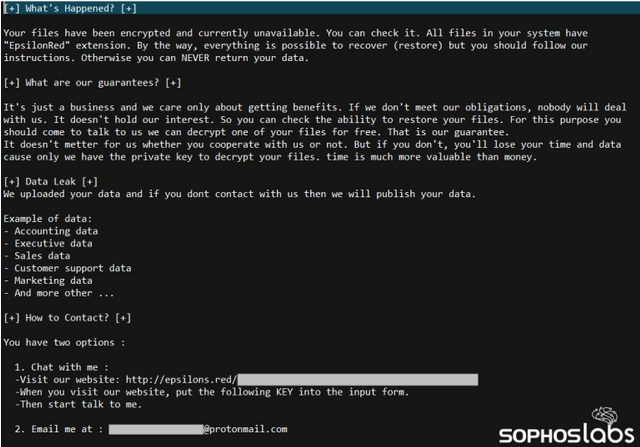
Sophos researchers noticed that the ransom note dropped by Epsilon Red is similar to the one displayed by the REvil ransomware, but Epsilon Red’s ransom note is better written — it does not contain some of the grammar errors in the REvil note.

Epsilon Red ransomware

Victims are informed that their files have been encrypted and that their data has been stolen and will be leaked unless they pay the ransom. However, Sophos noted that the ransomware doesn’t contain a list of targeted file types and instead encrypts every file in a folder, which can lead to the entire system becoming inoperable.

Epsilon Red, developed in the Go language, has been described as “bare-bones ransomware.” The ransomware executable is small due to the fact that it’s only designed to scan the system for folders it can encrypt and perform the actual encryption. The remaining tasks are carried out by a dozen PowerShell scripts, which prepare the machine for the final encryption payload.

These PowerShell scripts are designed to modify firewall rules to allow the attackers’ remote connections, disable or kill processes that could prevent encryption, delete the Volume Shadow Copy to prevent recovery of encrypted files, delete Windows event logs, grant elevated permissions, uninstall security software, and obtain valuable data.

The attackers have also been spotted using Remote Utilities, a commercial solution that is available for free. Sophos researchers believe the attackers have used this tool to be able to maintain access to compromised systems in case their initial access point gets removed.

The initial access point in the attack spotted by Sophos was likely an unpatched Microsoft Exchange server. The attackers may have leveraged the vulnerabilities known as ProxyLogon, which have been exploited by many threat groups in the past months.

Sophos said it had not found any links to other cybercrime groups — except for the REvil ransom note similarities — and noted that the name Epsilon Red stems from an X-Men villain who has Russian origins.

Related: Security Researchers Dive Into DarkSide Ransomware

Related: SonicWall Zero-Day Exploited by Ransomware Group Before It Was Patched

view counter

Eduard Kovacs (@EduardKovacs) is a contributing editor at SecurityWeek. He worked as a high school IT teacher for two years before starting a career in journalism as Softpedia’s security news reporter. Eduard holds a bachelor’s degree in industrial informatics and a master’s degree in computer techniques applied in electrical engineering.

Previous Columns by Eduard Kovacs:
Tags:

http://feedproxy.google.com/~r/securityweek/~3/zRn-3bH8nYA/cybercriminals-target-companies-new-epsilon-red-ransomware


CISA-FBI Alert: 350 Organizations Targeted in Attack Abusing Email Marketing Service

An alert released on Friday by the FBI and the DHS’s Cybersecurity and Infrastructure Security Agency (CISA) revealed that the number of organizations targeted in a recent attack abusing a legitimate email marketing service was higher than initially reported.

Microsoft reported last week that the Russia-linked threat actor it tracks as Nobelium, which is believed to be responsible for the SolarWinds supply chain attack, had been abusing a legitimate mass email service named Constant Contact to target government and other types of organizations in the United States and a dozen other countries.

The attacks, which appear to have started on May 25, involved Nobelium compromising the Constant Contact account of the United States Agency for International Development (USAID), which is responsible for civilian foreign aid and development assistance. Microsoft said spear-phishing emails apparently coming from USAID and set up to deliver malware were sent to roughly 3,000 accounts across more than 150 organizations.

However, according to the FBI and CISA, the attackers actually sent spear-phishing emails to over 7,000 accounts at 350 organizations, including government, non-governmental and intergovernmental organizations.

Incident response firm Volexity, which has also seen the phishing emails sent out via Constant Contact, found some links to APT29, a well-known cyberspy group tied to Russia. In their joint alert, CISA and the FBI acknowledge the reports linking the USAID-themed attack to APT29, but the agencies say they have yet to attribute the campaign to any threat actor.

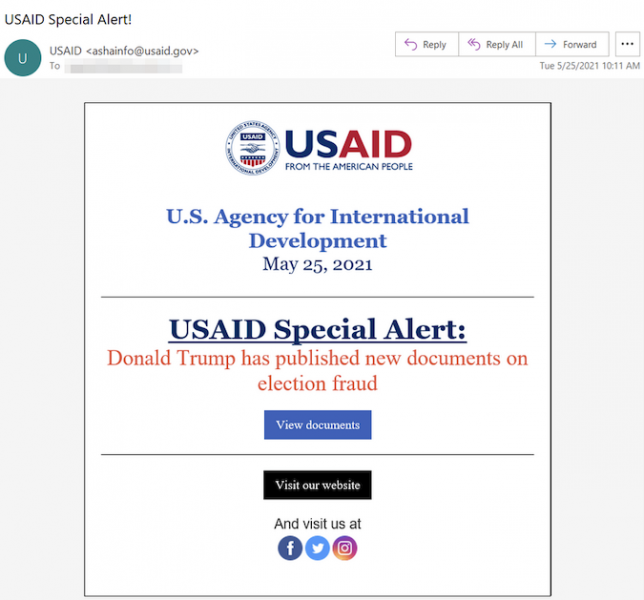
In their alert, the two agencies don’t mention the link to the SolarWinds attack and they don’t name the government agency being impersonated. They did note that the spoofed emails contained a legitimate Constant Contact link that redirected users to a malicious URL set up to serve a malicious ISO file containing malware and a decoy PDF document.

USAID phishing email

Microsoft noted that it had not seen “evidence of any significant number of compromised organizations at this time” and the White House reported that U.S. government agencies had largely fended off the attack.

CISA and the FBI have shared indicators of compromise (IOCs) that organizations can use to detect attacks. They also published a separate report focusing on the malware used in the attack.

In a second new blog post on Nobelium attacks, Microsoft described four pieces of malware used by the threat actor in recent operations, specifically EnvyScout, BoomBox, NativeZone, and VaporRage.

Microsoft also mentioned in its blog posts that Nobelium has exploited an iOS zero-day in some of its attacks. The vulnerability in question, tracked as CVE-2021-1879, was patched in March by Apple, which credited Google’s Threat Analysis Group for reporting it. Apple warned at the time that the “issue may have been actively exploited,” but no other details were made public.

In its latest blog posts on Nobelium, Microsoft also only provided limited information on the use of CVE-2021-1879.

“In one of the more targeted waves, no ISO payload was delivered, but additional profiling of the target device was performed by an actor-controlled web server after a user clicked the link. If the device targeted was an Apple iOS device, the user was redirected to another server under NOBELIUM control, where the since-patched zero-day exploit for CVE-2021-1879 was served,” Microsoft said.

Related: US Expels Russian Diplomats, Imposes Sanctions for Hacking

Related: SolarWinds Shares More Information on Cyberattack Impact, Initial Access Vector

view counter

Eduard Kovacs (@EduardKovacs) is a contributing editor at SecurityWeek. He worked as a high school IT teacher for two years before starting a career in journalism as Softpedia’s security news reporter. Eduard holds a bachelor’s degree in industrial informatics and a master’s degree in computer techniques applied in electrical engineering.

Previous Columns by Eduard Kovacs:
Tags:

http://feedproxy.google.com/~r/securityweek/~3/3Mkwyh5Mtjo/cisa-fbi-alert-350-organizations-targeted-attack-abusing-email-marketing-service


US Says Agencies Largely Fended Off Latest Russian Hack

The White House says it believes U.S. government agencies largely fended off the latest cyberespionage onslaught blamed on Russian intelligence operatives, saying the spear-phishing campaign should not further damage relations with Moscow ahead of next month’s planned presidential summit.

Officials downplayed the cyber assault as “basic phishing” in which hackers used malware-laden emails to target the computer systems of U.S. and foreign government agencies, think tanks and humanitarian groups. Microsoft, which disclosed the effort late Thursday, said it believed most of the emails were blocked by automated systems that marked them as spam.

As of Friday afternoon, the company said it was “not seeing evidence of any significant number of compromised organizations at this time.”

Even so, the revelation of a new spy campaign so close to the June 16 summit between President Joe Biden and Russian counterpart Vladimir Putin adds to the urgency of White House efforts to confront the Kremlin over aggressive cyber activity that criminal indictments and diplomatic sanctions have done little to deter.

“I don’t think it’ll create a new point of tension because the point of tension is already so big,” said James Lewis, a senior vice president at the Center for Strategic and International Studies. “This clearly has to be on the summit agenda. The president has to lay down some markers” to make clear “that the days when you people could do whatever you want are over.”

The summit comes amid simmering tensions driven in part by election interference by Moscow and by a massive breach of U.S. government agencies and private corporations by Russian elite cyber spies who infected the software supply chain with malicious code. The U.S. responded with sanctions last month, prompting the Kremlin to warn of retribution.

Asked Friday whether the latest hacking effort would affect the Biden-Putin summit, principal deputy press secretary Karine Jean-Pierre said, “We’re going to move forward with that.”

The U.S., which has previously called out Russia or criminal groups based there for hacking operations, did not blame anyone for the latest incident. Microsoft attributed it to the group behind the SolarWinds campaign, in which at least nine federal agencies and dozens of private sector companies were breached through a contaminated software update.

In this case, hackers gained access to an email marketing account of the U.S. Agency for International Development, and masquerading as the government body, targeted about 3,000 email accounts at more than 150 different organizations. At least a quarter of them involved in international development, humanitarian and human rights work, Microsoft Vice President Tom Burt said in a blog post late Thursday.

[ Related: SolarWinds Hackers Impersonate U.S. Government Agency in New Attacks ]

The company did not say what portion of the attempts may have led to successful intrusions but said in a separate technical blog post that most were blocked by automated systems that marked them as spam. The White House said even if an email eluded those systems, a user would still have to click on the link to activate the malicious payload.

Burt said the campaign appeared to be a continuation of multiple efforts by the Russian hackers to “target government agencies involved in foreign policy as part of intelligence gathering efforts.” He said the targets spanned at least 24 countries.

Separately, the prominent cybersecurity firm FireEye said it has been tracking “multiple waves” of related spear-phishing by hackers from Russia’s SVR foreign intelligence agency since March — preceding the USAID campaign — that used a variety of lures including diplomatic notes and invitations from embassies.

The hackers gained access to USAID’s account at Constant Contact, an email marketing service, Microsoft said. The authentic-looking phishing emails dated May 25 purport to contain new information on 2020 election fraud claims and include a link to malware that allows the hackers to “achieve persistent access to compromised machines.”

Microsoft said the campaign is ongoing and built on escalating spear-phishing campaigns it first detected in January.

USAID spokeswoman Pooja Jhunjhunwala said Friday that it was investigating with the help of the Cybersecurity and Infrastructure Security Agency. Constant Contact spokeswoman Kristen Andrews called it an “isolated incident.”

While the SolarWinds campaign,was supremely stealthy and began as far back as 2019 before being detected in December by FireEye, this campaign is what cybersecurity researchers call noisy, meaning easy to detect.

And though “the spear phishing emails were quickly identified, we expect that any post-compromise actions by these actors would be highly skilled and stealthy,” FireEye’s VP of analysis, John Hultquist, said in a statement Friday. He said the incident “is a reminder that cyber espionage is here to stay.”

Many cybersecurity experts did not consider the operation an escalation of online Russian aggression.

“I think it’s par for the course,” said Jake Williams, president of Rendition Infosec and a former U.S. government hacker. He said it’s naive to think that U.S. cyber operators aren’t engaged in similar operations targeting adversaries.

Bobby Chesney, a University of Texas at Austin law professor specializing in national security, said it is nowhere near as serious as the SolarWinds hack. Nor does it come anywhere near the damage done by the ransomware attack earlier this month — by Russian-speaking criminals tolerated by the Kremlin — that temporarily knocked the Colonial Pipeline offline.

Chesney said he thought it was wrong to regard the USAID targeting as a Russian response to sanctions or a sign the sanctions were somehow feckless.

“I don’t think it proves anything, really,” Chesney said. “It’s no surprise at all that the SVR is still engaged in espionage in the cyber domain. I don’t think we tried to deter them out of doing this wholesale.”

view counter

Previous Columns by Associated Press:
Tags:

http://feedproxy.google.com/~r/securityweek/~3/8Fk7vo-HZuI/us-says-agencies-largely-fended-latest-russian-hack


Chinese Hackers Started Covering Tracks Days Before Public Exposure of Operations

One of the Chinese threat actors targeting Pulse Secure VPN appliances via a recently disclosed vulnerability has been attempting to cover its tracks by removing its webshells from victim networks, FireEye reports.

Tracked as CVE-2021-22893, the vulnerability was made public in late April, after security researchers discovered that threat actors had already been exploiting it in attacks targeting organizations in the defense, financial, government, high tech, and transportation sectors in the U.S. and Europe.

At the time, FireEye revealed that at least two Chinese threat actors believed to be state-sponsored — UNC2630 and UNC2717 — had been exploiting the vulnerability for initial compromise. The company identified 12 malware families used in attacks associated with the exploitation of CVE-2021-22893 and three other bugs in Pulse Secure VPN appliances.

A patch was shipped on May 3, two weeks after the security hole was publicly disclosed, but the activity surrounding it and the other flaws did not stop. In fact, FireEye says it has since identified four other malware families used in these attacks, namely BLOODMINE, BLOODBANK, CLEANPULSE, and RAPIDPULSE.

On the other hand, just days before FireEye made its findings public in April, UNC2630 was spotted removing its webshells from dozens of devices.

However, the security firm reveals that, in at least one instance, UNC2630 deleted the webshells deployed in their attack but did not remove the persistence patcher, thus ensuring they could return to the compromised environment when needed.

“It is unusual for Chinese espionage actors to remove a large number of backdoors across several victim environments on or around the time of public disclosure. This action displays an interesting concern for operational security and a sensitivity to publicity,” FireEye notes.

To avoid detection, both UNC2630 and UNC2717 modify file timestamps, and tamper with forensic evidence, including logs, web server core dumps, and data harvested for exfiltration. Additionally, the adversaries show advanced knowledge of victim networks, making it difficult for defenders to identify all of the tools employed, stolen data, or intrusion artefacts.

In a Thursday update to its alert on the targeting of Pulse Secure VPN appliances, the U.S. Cybersecurity and Infrastructure Security Agency (CISA) also noted that one of the identified threat actors has started cleanup operations, in an attempt to hide their tracks.

CISA also mentions a new tool from IT management and security firm Ivanti, which is designed to help administrators ensure the integrity of Pulse Connect Secure software.

Related: APT Abuses Pulse Secure, SolarWinds Appliances at the Same Organization

Related: FBI Shares IOCs for APT Attacks Exploiting Fortinet Vulnerabilities

Related: SolarWinds Hackers Impersonate U.S. Government Agency in New Attacks

view counter

Ionut Arghire is an international correspondent for SecurityWeek.

Previous Columns by Ionut Arghire:
Tags:

http://feedproxy.google.com/~r/securityweek/~3/Cyl5GcRrljY/chinese-hackers-started-covering-tracks-days-public-exposure-operations


Canada Post Says 950,000 Customers Hit by Breach at Supplier

Canada Post, the primary postal operator in Canada, has informed 44 of its large business customers that some information was compromised as a result of a malware attack at a supplier.

The impacted supplier is Commport Communications, an electronic data interchange (EDI) provider that Canada Post uses to manage shipping manifest data for large parcel business customers.

In a May 14 post seen by SecurityWeek on a popular hacking forum, someone claimed that a ransomware gang known as Lorenz had stolen tens of gigabytes of data from Commport.

Canada Post said it learned about the data breach on May 19, but its IT subsidiary, Innovapost, was informed in November 2020 that there had been a ransomware attack on Commport. However, at the time, Commport claimed it had found no evidence that customer data was compromised.

According to Canada Post, the attackers gained access to shipping manifests, which are used to fulfill customer orders and which typically include contact information for the sender and recipient.

An investigation conducted by the organization revealed that the information of more than 950,000 receiving customers was stored in the compromised shipping manifests. For 97 percent of these customers, only their name and address was stored, and for the remaining 3 percent the files also included an email address and/or phone number. The compromised information was collected between July 2016 and March 2019.

“We are proactively informing the impacted business customers and providing the information and support necessary to help them determine their next steps. As well, the Office of the Privacy Commissioner has been notified,” Canada Post said.

Related: Thousands of Canadian Government Accounts Hacked

Related: Russia, China ‘Cyber Threats’ Target Canada: Report

Related: Canada Says it Was Targeted by Russian Cyber Attacks

view counter

Eduard Kovacs (@EduardKovacs) is a contributing editor at SecurityWeek. He worked as a high school IT teacher for two years before starting a career in journalism as Softpedia’s security news reporter. Eduard holds a bachelor’s degree in industrial informatics and a master’s degree in computer techniques applied in electrical engineering.

Previous Columns by Eduard Kovacs:
Tags:

http://feedproxy.google.com/~r/securityweek/~3/kA7auQwYJYQ/canada-post-says-950000-customers-hit-breach-supplier


FBI Shares IOCs for APT Attacks Exploiting Fortinet Vulnerabilities

The FBI on Thursday published indicators of compromise (IOCs) associated with the continuous exploitation of Fortinet FortiOS vulnerabilities in attacks targeting commercial, government, and technology services networks.

In early April, the FBI along with the Cybersecurity and Infrastructure Security Agency (CISA) warned that threat actors had been targeting serious security holes in Fortinet’s flagship operating system FortiOS for initial access into victims’ networks.

The targeted bugs include CVE-2018-13379 (a path traversal in the FortiOS SSL VPN web portal), CVE-2020-12812 (a bypass of FortiOS SSL VPN two-factor authentication), and CVE-2019-5591 (default configurations ship without LDAP server identity verification).

While initial activity only involved scanning for devices vulnerable to the FortiOS SSL VPN web portal flaw (on ports 4443, 8443, and 10443), as well as enumeration of devices potentially impacted by the other two bugs, the attackers have since moved to network compromise and additional malicious activity.

“As of at least May 2021, an APT actor group almost certainly exploited a Fortigate appliance to access a webserver hosting the domain for a U.S. municipal government. The APT actors likely created an account with the username ‘elie’ to further enable malicious activity on the network,” the FBI now says.

The agency says that another account likely associated with this activity is “WADGUtilityAccount,” which, similar to “elie,” threat actors might have established on active directories, domain controllers, servers, and workstations. Network administrators should also look for other unrecognized accounts.

Additionally, admins should be wary of executable files such as Audio.exe (or frpc.exe) and Frps.exe, of outbound FTP traffic on port 443, a scheduled task named “SynchronizeTimeZone,” and the use of tools such as Mimikatz, MinerGate, WinPEAS, SharpWMI, BitLocker, WinRARwhere, and FileZilla. Some of these might be benign, unless used when unexpected, the FBI notes.

Administrators are also advised to take all the necessary measures to ensure the security of networks, including keeping systems patched and continuously updated, implementing network segmentation and multi-factor authentication, applying the principle of least privilege, keeping data backed up, employing malware detection tools, and periodically checking the environment for suspicious activity.

Related: Cring Ransomware Targets Industrial Organizations

Related: Industry Reactions to FBI Cleaning Up Hacked Exchange Servers: Feedback Friday

Related: FBI: 16 Conti Ransomware Attacks Targeted Healthcare, First Responders in U.S.

view counter

Ionut Arghire is an international correspondent for SecurityWeek.

Previous Columns by Ionut Arghire:
Tags:

http://feedproxy.google.com/~r/securityweek/~3/rrxefi0cSyQ/fbi-shares-iocs-apt-attacks-exploiting-fortinet-vulnerabilities


DataDome Raises $35 Million for Its Anti-Bot Solution

DataDome, a company that provides a SaaS solution for protecting businesses against bad bots and fraud, this week announced that it raised $35 million in a Series B funding round.

The investment round, which brings the company’s total funding to nearly $40 million, was led by venture capital firm Elephant, with participation from ISAI. DataDome plans on investing the money in sales, marketing, and R&D.

DataDome has developed an AI-powered platform that processes vast amounts of data in an effort to provide protection against various types of online threats, including payment fraud, DDoS attacks, account takeover attempts, and web scraping.

The company says its solution can provide real-time bot protection for websites, mobile applications and APIs. DataDome has offices in New York, Singapore and Paris, and it claims to have more than 130 customers worldwide.

Related: Goldman Sachs Buys Anti-Bot Startup White Ops

Related: The Anti-Fraud Lifecycle

Related: Microsoft, PayPal Invest in Anti-Fraud Startup Arkose Labs

Related: PerimeterX Banks $57 Million for Bot Protection Expansion

view counter

Eduard Kovacs (@EduardKovacs) is a contributing editor at SecurityWeek. He worked as a high school IT teacher for two years before starting a career in journalism as Softpedia’s security news reporter. Eduard holds a bachelor’s degree in industrial informatics and a master’s degree in computer techniques applied in electrical engineering.

Previous Columns by Eduard Kovacs:
Tags:

http://feedproxy.google.com/~r/securityweek/~3/s5ds0sDmUsI/datadome-raises-35-million-its-anti-bot-solution


Facebook Adapts Defenses as Deception Campaigns Go Stealth

Facebook said Wednesday that it has disrupted more than 150 deceptive influence schemes since 2017, with Russia the biggest single source, as culprits strive to stay “under the radar.”

The number of coordinated inauthentic behavior (CIB) campaigns derailed at the leading social network ramped up each year since a Russia-linked operation to sway the outcome of the 2016 US presidential election put Facebook on the defensive.

While those behind influence operations (IO) went unchecked on the playing field in 2016, Facebook has invested in hiring, automated systems, and industry alliances over the ensuing years.

“These efforts have pressed threat actors to shift their tactics,” Facebook head of security policy Nathaniel Gleicher said during a briefing on the report.

“They have – often without success – moved away from the major platforms and increased their operational security to stay under the radar.”

As tactics have gone more steathly, the deception campaigns have seen their reach shrink since, by design, they are trying not to be noticed by the social network, according to executives.

From 2017 through the middle of this year, Facebook has exposed and taken down more than 150 covert operations that violate its policy against coordinated inauthentic behavior, according to the report.

“These operations have targeted public debate across both established and emerging social media platforms, as well as everything from local blogs to major newspapers and magazines,” Gleicher said.

“They were foreign and domestic, run by governments, commercial entities, politicians, and conspiracy and fringe political groups.”

The campaigns originated in more than 50 countries overall, with Russia the largest single source accounting for 27 of the deceptive networks, the report indicated.

Iran was the source of 23 CIB campaigns, second to Russia, according to the report.

Meanwhile, the United States was the most common target as well as home to nine such influence operations by fringe political characters, conspiracy pushers, and consulting or public relations firms.

Influence campaigns continue to “push the boundaries of acceptable online behavior” and blur lines between deceit and free speech, Gleicher said.

Those behind IO campaigns were expected to continue to try to “weaponize” moments of uncertainty worldwide, amplifying division around crises such as the pandemic and civic protests.

The US 2020 election campaign brought to the forefront the complexity of separating bad actors behind covert influence operations from unwitting people they co-opt or local folks whose interests are in synch with the deceptive messaging, according to Gleicher.

“We found and removed IO attempting to get authentic voices to post on their behalf,” the report said.

“We also saw authentic voices, including the then-US President, promoting false information amplified by IO from various countries including Russia and Iran.”

Related: Social Media Firms on Alert for Election Day Misinformation

Related: Facebook Removes 14 Networks Fueling Deceptive Campaigns

view counter

© AFP 2020

Previous Columns by AFP:
Tags:

http://feedproxy.google.com/~r/securityweek/~3/c6opC-Ho2Sg/facebook-adapts-defenses-deception-campaigns-go-stealth


NASA Identified Over 6,000 Cyber Incidents in Past 4 Years

The U.S. National Aeronautics and Space Administration (NASA) identified more than 6,000 cyber-related incidents in the last four years, according to a report published this month by NASA’s Office of Inspector General.

NASA has institutional systems, which are used for the day-to-day work of employees — these include data centers, web services, computers and networks. It also has mission systems, which support its aeronautics, space exploration and science programs — these include systems used for controlling spacecraft and processing scientific data.

The agency has more than 4,400 applications, over 15,000 mobile devices, roughly 13,000 software licenses, nearly 50,000 computers, and a whopping 39,000 Tb of data.

The audit conducted by NASA’s inspector general has revealed that while attacks on the agency’s networks are not uncommon, “attempts to steal critical information are increasing in both complexity and severity,” and the agency’s ability to detect, prevent and mitigate attacks is limited.

The cyber incidents observed over the past years — more than 1,700 were identified in 2020 — included brute-force attacks, email-related incidents, impersonation attacks, improper usage issues, loss or theft of equipment, web-based attacks, and incidents involving external or removable media.

Last year, a majority of incidents were related to improper usage, which includes installing unapproved software or accessing inappropriate materials. These types of incidents increased from 249 in 2017 to 1,103 in 2020. On the other hand, NASA also believes that the higher number of detected incidents is also a result of improved network visibility.

NASA breaches and other cyber incidents

The report has highlighted several incidents, including a 2018 hack of NASA’s Jet Propulsion Laboratory, which resulted in hackers accessing servers and even its Deep Space Network telescopes. In the same year, someone stole roughly 500 Mb of data from a major mission system after the account of an external user was compromised.

In 2019, NASA discovered that a contract employee used its systems to mine cryptocurrency, and in the same year two Chinese nationals were indicted for allegedly hacking NASA systems and stealing data.

Related: NASA Sees Increase in Cyberattacks During Coronavirus Outbreak

Related: NASA Notifies Employees of Data Breach

Related: NASA’s Cybersecurity Program Gets Failing Grade

view counter

Eduard Kovacs (@EduardKovacs) is a contributing editor at SecurityWeek. He worked as a high school IT teacher for two years before starting a career in journalism as Softpedia’s security news reporter. Eduard holds a bachelor’s degree in industrial informatics and a master’s degree in computer techniques applied in electrical engineering.

Previous Columns by Eduard Kovacs:
Tags:

http://feedproxy.google.com/~r/securityweek/~3/DEJWYcDJGls/nasa-identified-over-6000-cyber-incidents-past-4-years