SCOTUS to decide if Florida and Texas social media laws violate 1st Amendment

SCOTUS to decide if Florida and Texas social media laws violate 1st Amendment

On Friday, the Supreme Court agreed to decide if two laws crafted by Republicans in Florida and Texas run afoul of the First Amendment because the laws force platforms to explain all their content moderation decisions to users.

Both laws, passed in 2021 after several major platforms banned Donald Trump, seemingly were a way for Republicans to fight back and prevent supposedly liberal-leaning platforms from allegedly censoring conservative viewpoints.

The laws are designed to stop the most popular platforms from inconsistently censoring content by requiring platforms to provide detailed explanations to users whenever their posts are removed or their accounts are banned or “shadowbanned” (deprioritized or restricted from feeds by platforms’ algorithms). The Texas law also requires platforms to provide clear paths to timely appeal censored content, and both laws require platforms to publicly disclose standards for when and why they censor users.

NetChoice—a trade group representing companies operating major platforms, including X and Facebook—sued to block the laws, citing First Amendment concerns. According to NetChoice, states are attempting to censor platforms by passing these laws, potentially preventing platforms from making editorial decisions on content that they’re entitled to make.

In a statement provided to Ars, NetChoice litigation director Chris Marchese said that the trade group’s lawsuits were “landmark cases” giving SCOTUS the opportunity to clarify platforms’ “well-established First Amendment right to host, curate, and share content as they see fit.” NetChoice has argued that rather than restricting censorship, Florida and Texas have passed “unconstitutional laws empowering the government to choose what speech appears online.”

“The Internet is a vital platform for free expression, and it must remain free from government censorship,” Marchese said. “We are confident the Court will agree.”

One of NetChoice’s lawsuits resulted in a preliminary injunction blocking parts of Florida’s law—with one court agreeing that the Florida law likely violated the First Amendment. But a divided court in Texas reversed a preliminary injunction that NetChoice initially won blocking Texas’ law—departing from the court’s logic in the Florida case and finding that NetChoice would not likely succeed in constitutional challenges to the very similar Texas law.

The Supreme Court’s ruling is expected to settle the matter and will likely come next year, NBC News projected.

Trump urged SCOTUS review of “unfair” platforms

Much has changed on social media since 2021. Donald Trump’s account was reinstated on major platforms, including X (formerly Twitter) and Facebook, before next year’s presidential election. And Facebook and X relaxed policies preventing political ads, potentially enabling more divisive political content on the platforms to target more users than ever.

But that doesn’t mean that conservatives, including Trump, have stopped claiming that platforms are censoring right-leaning viewpoints. In a brief urging SCOTUS to review the social media laws in Texas and Florida, Trump claimed that the laws were necessary because “platforms often shroud decisions to exclude certain users and viewpoints in secrecy, giving no meaningful explanation as to why certain users are excluded while others posting equivalent content are tolerated.”

https://arstechnica.com/?p=1972299


Meta launches consumer AI chatbots with celebrity avatars in its social apps

Meta's AI characters feature Snoop Dogg playing a dungeon master that dispenses gaming advice.
Enlarge / Meta’s AI characters feature Snoop Dogg playing a dungeon master that dispenses gaming advice.

On Wednesday, Meta announced its consumer-friendly entry into the crowded AI chatbot landscape, The Verge reports. During a presentation at Meta Connect 2023, the company said it is launching its own “Meta AI” chat assistant and a selection of AI characters across its messaging platforms, including WhatsApp, Instagram, and Messenger.

Meta’s new AI assistant will likely feel familiar to anyone who has used chatbots like ChatGPT or Claude. It is designed as a general-purpose chatbot that Meta says can help with planning trips, answering questions, and generating images from text prompts. The assistant will also integrate real-time results from Microsoft’s Bing search engine, giving it access to current information—similar to Bing Chat, ChatGPT’s browsing plugin, and Google Bard.

During demos, The Verge says that Meta’s AI was able to quickly generate high-resolution images from short text descriptions using an “/imagine” prompt, and the feature will be free to use. While Meta did not disclose full details of the new AI assistant’s training, the company said it’s a custom model that is partially based on the company’s LLaMA 2 language model, released in July.

In addition to the general assistant, Meta is rolling out 28 AI-powered characters across its messaging platforms, including many played by celebrities, such as Tom Brady (who plays “Bru,” a sports fanatic), Kendall Jenner (who plays “Billie,” the “big sis”), and Snoop Dogg (who is a “dungeon master” with gaming advice).

According to TechCrunch, the celebrity images are not purely videos but can be manipulated generatively to function as novel animations. Yet they reportedly also do not speak, so they’re more like representative avatars of the text-based AI bot personalities. Meta says the celebrity AIs went into limited beta on Wednesday, but we have not seen on-the-ground (or on-the-phone, as it were) reports of them in action yet.

To ensure that these celebrity AI characters don’t go into Tay territory and spout embarrassing or harmful phrases, the company says it spent 6,000 hours in red teaming exercises to identify and address potential problematic uses of its assistants. This process included generating thousands of internal conversations to refine the assistant’s behavior and responses.

For now, Meta’s new assistant has not trained on public user data from Instagram or Facebook. However, The Verge hinted that this could change as the company aims to enhance its chatbot’s usefulness through “social integrations,” according to Ahmad Al-Dahle, Meta’s VP of generative AI.

Meta executives view the company’s massive user reach as a key advantage, with billions of daily users across WhatsApp, Instagram, and Messenger. While OpenAI arguably pioneered the generative AI chatbot space, it’s possible that Meta’s scale will allow its assistant to reach more consumers for their first chatbot experience—while increasing lucrative user engagement in its apps.

https://arstechnica.com/?p=1971859


Facebook can be sued over biased ad algorithm claims, court rules

Facebook can be sued over claims its advertising algorithm is biased, a California State Court of Appeals has ruled.

The decision reverses a previous ruling from 2020 that stated Facebook was protected from accountability under Section 230 – a law that shields online platforms from legal action when users share illegal material.

Why we care. Brands utilizing Facebook’s ad tools may unintentionally be engaging in discriminatory practices if the platform’s algorithm is found to be biased.

Biased ad algorithm? Facebook was originally taken to court in 2020 for violating civil rights laws. The social platform was accused of not showing insurance ads to women and older people after 48-year-old Samantha Liapes tried to use Facebook to find an insurance provider. Liapes claimed she wasn’t shown insurance ads due to her age and gender.

2020 outcome. The case was originally dismissed by the court after it found Facebook’s tools “neutral on their face and concluding that Facebook was immune under the Communications Decency Act, 47 U.S.C. 230.” However, Liapes appealed the decision.


Get the daily newsletter search marketers rely on.


Appeal. The decision was reversed on 21 September 2023 after the appeals court found that the case “adequately” alleges that Facebook “knew insurance advertisers intentionally targeted its ads based on users’ age and gender” – which is in violation of the Civil Rights Act.

The court concluded: “Facebook does not merely proliferate and disseminate content as a publisher … it creates, shapes, or develops content” with the tools.

Deep dive. Read the Liapes v. Facebook, Inc. case in full for more information.


Related stories

New on Search Engine Land

@media screen and (min-width: 800px) { #div-gpt-ad-3191538-7 { display: flex !important; justify-content: center !important; align-items: center !important; min-width:770px; min-height:260px; } } @media screen and (min-width: 1279px) { #div-gpt-ad-3191538-7 { display: flex !important; justify-content: center !important; align-items: center !important; min-width:800px!important; min-height:440px!important; } }

About the author

Nicola Agius

Nicola Agius is Paid Media Editor of Search Engine Land after joining in 2023. She covers paid search, paid social, retail media and more. Prior to this, she was SEO Director at Jungle Creations (2020-2023), overseeing the company’s editorial strategy for multiple websites. She has over 15 years of experience in journalism and has previously worked at OK! Magazine (2010-2014), Mail Online (2014-2015), Mirror (2015-2017), Digital Spy (2017-2018) and The Sun (2018-2020). She also previously teamed up with SEO agency Blue Array to co-author Amazon bestselling book ‘Mastering In-House SEO’.

https://searchengineland.com/facebook-legal-action-ad-algorithm-discriminates-432479


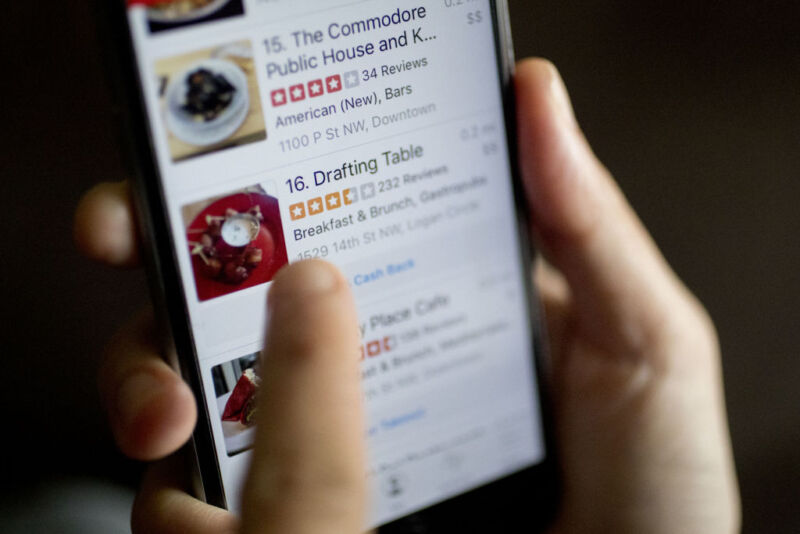
Yelp names and shames businesses paying for 5-star reviews

Yelp names and shames businesses paying for 5-star reviews

Yelp has started publicly naming and shaming businesses that pay for reviews. The review site’s new index documents businesses offering everything from a crisp $100 bill for leaving the best review to a $400 Home Depot gift card for a five-star review. It also lists every business whose reviews have ever been suspected of suspicious activity, like spamming the site with multiple reviews from a single IP address.

Engadget dubbed Yelp’s new index a “wall of shame,” suggesting that the information may be used by federal agencies who have spent the past few years cracking down on paid fake reviews. This year, the Federal Trade Commission proposed a ban on “the use of deceptive reviews and testimonials,” with penalties up to $50,000 for businesses “caught buying, selling or manipulating online reviews,” Engadget reported.

Yelp wants to see the Federal Trade Commission enact the ban, Yelp’s head of user operations, Noorie Malik, told Engadget. The FTC noted that Yelp reported 950 suspicious posts, users, or groups facilitating fake reviews in 2021 alone.

Of course, the fake review problem goes beyond Yelp. The FTC reported that earlier this year, academic researchers infiltrated “incentivized review services geared toward Amazon” that solicited five-star reviews for more than 240,000 products. On Facebook, 250 groups were discovered brokering paid reviews of Amazon products—some with more than 500,000 members. The FTC noted that while Amazon claims to delist products soliciting incentivized reviews, only 25 of 1,600 products tracked by researchers were removed within a six-week period.

Amazon declined to comment. Yelp did not immediately respond to Ars’ request to comment.

Malik told Engadget that Yelp also hopes that users will visit the index to make “educated decisions” when choosing which businesses to support. Malik noted that people may not care about juice bars offering 15 percent off drinks for a five-star review, but they might be more hesitant to hire a construction company to do home repairs if they know they paid for all those five-star reviews that lure trusting customers to check out the business.

Though the list has only just begun indexing Yelp’s bad actors, Yelp plans to keep growing the index into a robust resource.

“We’d love to get to a place where this new index develops into a regular resource for others, whether it’s FTC, consumers, regulators, or other sites,” Malik told Engadget.

Amazon assists in arrest of fake review brokers

The consequences of paying for fake reviews could go beyond getting listed on Yelp’s “wall of shame,” though. Just last week, Amazon announced that two China-based review brokers were sentenced to 2.5 years after facilitating fake reviews in Amazon’s store between March 2021 and March 2022. It was only the second time that Amazon had ever helped law enforcement arrest review brokers, the company said.

“Two individual fake review brokers were found guilty of illegal business operations intended to deceive Amazon customers and harm Amazon selling partners through the facilitation of fake reviews,” Amazon’s blog said. “These verdicts are the result of local law enforcement’s investigation and a criminal referral supported by Amazon.”

Unlike many of the businesses that Yelp has indexed—which seem to mostly commission positive reviews—the review brokers working on Amazon would accept payment both to “boost a bad actor’s product ranking” or to leave “fake negative reviews to lower the ranking of a competitor’s product.”

Malik told Engadget that Yelp hopes that other platforms will start holding businesses that pay for reviews accountable. Engadget noted that Yelp had “previously worked with the FTC to notify them when it discovers fake reviews and the sometimes complex operations behind them.” Similarly, Amazon vowed to continue working with law enforcement to crack down on paid fake reviews.

“Amazon is pleased to see that these fraudsters are being held accountable for their actions,” David Montague, Amazon’s vice president of Selling Partner Risk, said in the blog. “The verdicts are a testament to the partnership of local officials in bringing down those who attempt to deceive our customers and harm our selling partners. We look forward to continuing to partner with law enforcement toward the mutual goal of bringing fake review brokers to justice.”

https://arstechnica.com/?p=1970279


Meta Verified is rolled out to brands on Instagram and Facebook

Meta Verified is being rolled out to businesses on Instagram, Facebook and WhatsApp. 

Mark Zuckerberg announced that testing will begin in select counties on Facebook and Instagram in the coming weeks, with WhatsApp trials planned at a later date.

What is Meta Verified? Meta Verified is a monthly subscription package designed to help creators and brands establish their presence on Instagram and Facebook more easily. This bundle includes exclusive benefits and perks – but it’s only available to eligible profiles.

Why we care. Meta Verified is a way for brands to provide more authenticity and credibility, which can ultimately lead to increased trustworthiness among followers, and confidence when it comes to making purchases.

How much does Meta Verified cost? Monthly subscriptions begin at $21.99 per month for a single Facebook page or Instagram account, or $34.99 per month for both.

What does a Meta Verified subscription include? Businesses will get a toolkit for their subscribed Facebook page, Instagram business account or WhatsApp phone number that includes:

  • A verified badge confirming your business is validated and authentic
  • Proactive impersonation monitoring for added brand protection
  • Access to support and help troubleshooting account issues²
  • New ways to be discovered:
    • On Instagram and Facebook, subscribers will be featured as a Meta Verified business, including appearing at or near the top of search results and as a recommended verified business to follow in feed.³ 
    • WhatsApp business subscribers will receive additional premium features including the ability to create a custom WhatsApp page that is easily discoverable via a web search, and multi-device with chat assignment support so multiple employees can respond to customers.

Who is eligible? To be eligible for Meta Verified, you need:

  • To be at least 18 years old.
  • A public or private profile that’s associated with your full name, aligns with naming standards and has a profile picture that includes your face.
  • To meet minimum activity requirements, such as prior posting history.
  • A valid photo ID that matches your profile name and profile picture.
  • Two-factor authentication enabled on your profile.
  • To follow Meta’s Terms of Use and Community Guidelines.

Get the daily newsletter search marketers rely on.


What has Meta said? A Meta spokesperson said in a statement:

  • “We’re starting with subscription features that help small businesses achieve what they want most on the platform: to establish their brand and be discovered by new customers.”
  • “As we learn from initial testing, we’ll continue to evolve our business offerings to add more value for businesses of all sizes, such as more tools for people to easily discover and engage with verified businesses on our apps.”

Deep dive. Read Meta’s Verified Business announcement in full for more information.


Related stories

New on Search Engine Land

@media screen and (min-width: 800px) { #div-gpt-ad-3191538-7 { display: flex !important; justify-content: center !important; align-items: center !important; min-width:770px; min-height:260px; } } @media screen and (min-width: 1279px) { #div-gpt-ad-3191538-7 { display: flex !important; justify-content: center !important; align-items: center !important; min-width:800px!important; min-height:440px!important; } }

About the author

Nicola Agius

Nicola Agius is Paid Media Editor of Search Engine Land after joining in 2023. She covers paid search, paid social, retail media and more. Prior to this, she was SEO Director at Jungle Creations (2020-2023), overseeing the company’s editorial strategy for multiple websites. She has over 15 years of experience in journalism and has previously worked at OK! Magazine (2010-2014), Mail Online (2014-2015), Mirror (2015-2017), Digital Spy (2017-2018) and The Sun (2018-2020). She also previously teamed up with SEO agency Blue Array to co-author Amazon bestselling book ‘Mastering In-House SEO’.

https://searchengineland.com/meta-verified-brands-instagram-facebook-432206


UK Minister Warns Meta Over End-to-End Encryption

Britain’s interior minister on Wednesday warned tech giant Meta that rolling out end-to-end encryption on its platforms must “not to come at a cost to our children’s safety”.

Suella Braverman and security minister Tom Tugendhat have called on the company, which owns Facebook, Instagram and WhatsApp, to “work with us” and ensure police can access data.

“The use of strong encryption for online users remains a vital part of our digital world and I support it, so does the government, but it cannot come at a cost to our children’s safety,” she said.

“Meta has failed to provide assurances that they will keep their platforms safe from sickening abusers,” she added.

The minister demanded that Meta develop robust safeguards as part of their plans for end-to-end encryption.

Messaging app WhatsApp already offers the service, which allows only the sender and recipient of a message to access its contents.

Meta is now planning to extend the feature to both Facebook Messenger and
Instagram Direct.

Advertisement. Scroll to continue reading.

The National Crime Agency’s (NCA) director of general threats, James Babbage, warned the plans could “massively reduce our collective ability” to protect children.

“We are not asking for new or additional law enforcement access, we simply ask that Meta retains the ability to keep working with us to identify and help prevent abuse,” he said.

Meta said in a statement that “the overwhelming majority of Brits already rely on apps that use encryption to keep them safe from hackers, fraudsters and criminals.

“We don’t think people want us reading their private messages so have spent the last five years developing robust safety measures to prevent, detect and combat abuse while maintaining online security.”

The US firm said it was publishing updated safeguarding measures, including restricting people aged over 19 from messaging teenagers who don’t follow them and using technology to “identify and take action against malicious behavior”.

Related: Apple Adding End-to-End Encryption to iCloud Backup

Related: Zoom Introduces End-to-End Encrypted Phone Calls

https://www.securityweek.com/uk-minister-warns-meta-over-end-to-end-encryption/


Meta may remove ads on Facebook and Instagram for subscribers in Europe

Meta is reportedly considering paid versions of Facebook and Instagram that would ban ads in Europe.

The cost of the subscription and potential rollout date has not yet been confirmed by the company.

However, Meta will continue to offer free versions of its apps which will still serve ads regardless, according to the New York Times.

Why we care. Depending on user adoption, this could significantly affect brand reach and campaign performance. While an ad-free subscription service is currently under consideration for Europe, it may extend to the US in the future. Advertisers should closely watch this development as they may need to consider reallocating their ad spend to other platforms accordingly.

Why now? A Meta subscription service has been suggested in response to the European Union’s Digital Services Act, which comes into effect on 1 January 2024.

Under the new regulations, more onus is being put on large platforms that have more than 45 million regional users, such as Google and Meta, to:

  • Create a safer digital space.
  • Establish a level playing field for businesses.

Get the daily newsletter search marketers rely on.


What has Meta said? The company has not commented on launching paid-for versions of Facebook and Instagram. However, Meta CEO Mark Zuckerberg hinted in 2018 when he appeared before the US Senate that such a product could be on the horizon. When asked if he would consider charging users for access to his apps to avoid ads, he said:

  • “There will always be a version of Facebook that is free.

Then Meta COO, Sheryl Sandberg, added:

  • We have different forms of opt-out. We don’t have an opt-out at the highest level. That would be a paid product.”

Deep dive. Read Meta’s statement on the DSA, issued by Nick Clegg, President, Global Affairs, for more information.


Related stories

New on Search Engine Land

@media screen and (min-width: 800px) { #div-gpt-ad-3191538-7 { display: flex !important; justify-content: center !important; align-items: center !important; min-width:770px; min-height:260px; } } @media screen and (min-width: 1279px) { #div-gpt-ad-3191538-7 { display: flex !important; justify-content: center !important; align-items: center !important; min-width:800px!important; min-height:440px!important; } }

About the author

Nicola Agius

Nicola Agius is Paid Media Editor of Search Engine Land after joining in 2023. She covers paid search, paid social, retail media and more. Prior to this, she was SEO Director at Jungle Creations (2020-2023), overseeing the company’s editorial strategy for multiple websites. She has over 15 years of experience in journalism and has previously worked at OK! Magazine (2010-2014), Mail Online (2014-2015), Mirror (2015-2017), Digital Spy (2017-2018) and The Sun (2018-2020). She also previously teamed up with SEO agency Blue Array to co-author Amazon bestselling book ‘Mastering In-House SEO’.

https://searchengineland.com/meta-remove-ads-facebook-instagram-paid-for-subscription-431564


Meta si adegua alla privacy Ue: in vista versioni a pagamento per Facebook e Instagram

Grossi cambiamenti in vista per Meta nell’Unione Europea: in arrivo versioni a pagamento e senza pubblicità per Facebook e Instagram. Lo scrive il New York Times, secondo cui all’origine di questo cambiamento strategico ci sono le regole più stringenti e i cambiamenti tecnologici nei rapporti governativi fra l’Europa e gli Stati Uniti.

Gli utenti Ue che opteranno per questi abbonamenti di fascia alta beneficeranno di una esperienza più fluida sulle due piattaforme social.

Alternativa a pagamento in Ue

Questa iniziativa offre agli utenti delle alternative ai servizi di Meta finanziati con la pubblicità, che si basano sull’analisi dei dati per annunci pubblicitari mirati.

Meta ha deciso di prendere questo provvedimento in risposta alle preoccupazioni delle autorità europee sulla regolamentazione della privacy.

Accanto alle nuove versioni a pagamento, Meta continuerà a proporre nella Ue  delle versioni gratuite di Facebook e Instagram comprensive di pubblicità.

Non si sa ancora la data di rilascio di queste nuove versioni dei social di Meta.

Cambio di rotta

Certo il passaggio a versioni a pagamento delle sue piattaforme è un cambiamento sostanziale per Meta, che negli anni ha sempre basato il suo business sulla gratuità dei servizi finanziati dalla pubblicità. Il cambio di registro è legato all’inasprimento delle norme privacy della Ue.

Diversi fattori spiegano questa maggiore regolamentazione per le imprese digitali. A luglio, la Corte Suprema dell’Ue ha vietato a Meta di utilizzare i dati dei suoi utenti provenienti da diverse piattaforme senza il loro esplicito consenso. Inoltre, a gennaio le autorità di regolamentazione irlandesi hanno multato Meta per una pesante somma di 390 milioni di euro per aver costretto gli utenti ad accettare annunci personalizzati per poter utilizzare Facebook.

Questo sviluppo deriva in gran parte dal Regolamento generale sulla protezione dei dati (GDPR) adottato nel 2018 in Europa, volto a proteggere i dati online e a dare alle persone un maggiore controllo sul loro utilizzo.

Digital Services Act

Nel settore tecnologico dell’Ue questi segnali di cambiamento sono già visibili. Gli utenti di alcune app come TikTok e Instagram possono ora rinunciare all’uso dei propri dati per scopi personalizzati in base alla nuova norma denominata Digital Services Act. Inoltre, Snapchat e Meta hanno smesso di utilizzare annunci speciali per i ragazzi tra i 13 e i 17 anni in Europa.

Le principali piattaforme web dovranno anche cambiare il modo in cui operano per favorire la concorrenza ai sensi del Digital Markets Act. Ad esempio, Apple consentirà agli utenti dell’UE di scaricare alternative all’App Store per i loro iPhone e iPad.

Ciò evidenzia il fatto che le società web rispettano le regole e si conformano alle leggi tecnologiche dell’UE.

Le autorità dell’UE stanno esercitando forti pressioni su Meta, la società madre di Messenger. A maggio, l’UE ha inflitto a Meta una multa di 1,2 miliardi di euro per aver trasferito dati personali di residenti europei a server statunitensi per migliorare la tecnologia pubblicitaria, una decisione che è ancora oggetto di controversie legali.

Inoltre, Meta è stata sanzionata per violazioni del GDPR, inclusa una multa di 265 milioni di euro per una violazione dei dati nel 2021. Le autorità di regolamentazione irlandesi hanno multato Meta di ulteriori 225 milioni di euro per violazioni correlate a WhatsApp, nonché una multa di 17 milioni di euro per un’altra violazione dei dati.

https://www.key4biz.it/meta-si-adegua-alla-privacy-ue-in-vista-versioni-a-pagamento-per-facebook-e-instagram/457944/


States’ attempts to age-gate the Internet blocked by constitutional hurdles

States’ attempts to age-gate the Internet blocked by constitutional hurdles

Courts have started blocking some US states’ earliest attempts to age-gate the Internet. Yesterday, courts ordered preliminary injunctions blocking a Texas law requiring ID to access websites featuring adult entertainment, as well as an Arkansas law requiring ID to access some social media platforms. Both laws otherwise would’ve taken effect today.

While the Texas law was more narrowly aimed at restricting minors from accessing specific content that’s not age-appropriate, Arkansas’ law—the Social Media Safety Act—was much broader, stopping minors from creating accounts without parental permission on social media platforms that generate more than $100 million annually. It was also, according to the court, poorly researched, vaguely defined, and likely unconstitutional.

Bizarrely, Arkansas’ Social Media Safety Act would apply to some obvious platforms, like Facebook or TikTok, but not to other more popular platforms for kids, like YouTube. Netchoice, a trade group representing platforms likely impacted by the law—including Facebook, Instagram, Twitter, TikTok, Snapchat, Pinterest, and Nextdoor—sued to block the law, partly because the law was too vague. Some platforms, like Snapchat, weren’t even sure if the law applied to them, Netchoice argued.

Ultimately, US district judge Timothy Brooks granted the preliminary injunction to temporarily stop Arkansas Attorney General Tim Griffin from enforcing the law—finding that it was unconstitutionally vague and perhaps violating the First Amendment by restricting access to speech. In his opinion, Brooks wrote that the state itself wasn’t even sure if the law applied to Snapchat.

That ambiguity poses a problem for platforms since they could face a $2,500 fine for each violation, and compliance costs were equally steep. Nextdoor, which must comply with the law, told the court that compliance would raise its costs by up to 3,000 percent.

Confusion arose when the state’s witness, Tony Allen—an expert in age-verification standards for the United Kingdom who worked on the UK’s Online Safety Bill—testified that the Social Media Safety Act applied to Snapchat, then the state’s attorney later contradicted Allen. Neither could agree on Snapchat’s primary purpose. Was the app primarily for “interacting socially with other profiles and accounts”—as a covered social media platform under the law—or was it primarily for direct-messaging, which the law exempts? Nobody knew for sure.

Partly because of this exchange, Brooks ruled that Arkansas’ law “is unconstitutionally vague because it fails to adequately define which entities are subject to its requirements.” And because the law could potentially deter free speech, Brooks wrote that the court’s duty to block enforcement was greater because it “is critical ‘to ensure that ambiguity does not chill protected speech.’”

Arkansas’ AG Griffin’s statement said that he was “disappointed” in the ruling and planned to “continue to vigorously defend the law and protect our children.”

Netchoice has argued that parental consent laws like Arkansas’ law—which some states like Georgia are currently weighing and other states like Texas and Utah have already passed—unconstitutionally burden Internet users’ First Amendment rights. These laws require all Internet users to provide identifying information to access platforms—either by uploading official government documents or submitting to biometric scans—which would likely discourage many users who value their privacy from using sites.

“The Court agrees,” Brooks wrote. “It is likely that many adults who otherwise would be interested in becoming account holders on regulated social media platforms will be deterred—and their speech chilled—as a result of the age-verification requirements.” It also follows, Brook wrote, that the law would “obviously burdens minors’ First Amendment rights.”

The preliminary injunction will stop Arkansas from enforcing the law until the case is litigated. Based on Brooks’ opinion, Arkansas will likely struggle to defeat claims of unconstitutionality, as Brooks wrote that, as currently written, the law “is not targeted to address the harms it has identified, and further research is necessary before the State may begin to construct a regulation that is narrowly tailored to address the harms that minors face due to prolonged use of certain social media.”

“We’re pleased the court sided with the First Amendment and stopped Arkansas’ unconstitutional law from censoring free speech online and undermining the privacy of Arkansans, their families, and their businesses as our case proceeds,” Chris Marchese, director of the NetChoice Litigation Center, said in a statement. “We look forward to seeing the law struck down permanently.”

https://arstechnica.com/?p=1965092


Meta rolls out new search tool to track branded content campaigns

Meta has launched a new search tool that tracks branded content campaigns.

The feature, titled “Search Branded Content”, is located in the Ads Library and gives users the option to filter the database by platform, date range (currently, only the previous seven days is available) and username.

From here, you’ll get deeper insights into competitor strategies, including details on their approach, creator-business relationships and campaign frequency.

Why we care. Gaining insights into the influencers your competitors collaborate with and staying informed about rival campaigns can serve as valuable inspiration. This information can influence your brand’s decisions regarding partnership choices.

How it works. Social media expert, Lindsey Gamble, shared a screenshot of what the new search tool looks like on X (formerly known as Twitter):

Screenshot 2023 08 24 At 20.31.50 800x385

Within the post, Gamble shared a video demonstration illustrating the new feature’s navigation. The video showcases how users can use the tool to gain insights into campaigns involving specific influencers and brands.

When applying the influencer filter, the tool presents an overview of their ongoing campaigns and brand collaborations. Conversely, users can also opt to filter results by brand, revealing the influencers associated with their current campaigns.

Why now? Meta’s decision to improve transparency around branded content campaigns comes as the European Union brings the Digital Services Act into force on Friday – a regulation that puts more onus on large platforms with more than 45 million regional users to create safer digital spaces.


Get the daily newsletter search marketers rely on.


What has Meta said? Commenting on the new Branded Content search feature, Meta said:

  • “Ads are just one way for businesses to promote a product or service on Facebook and Instagram. They can also work together with a content creator to promote something in a post, story, video or reel. Meta provides transparency about this type of content by showing a paid partnership label on it and by including it in the Ad Library.”
  • “Use the branded content search to find posts, stories, videos and reels on Facebook and Insatgramt that involved a Paid Partnership. You can filter by app and date.”
  • “[This tool] is for anyone who wants to see content from a creator who has worked together with a business.”

Deep dive: Check out Meta’s new Branded Content search tool in the Ads Library to see how it works.


Related stories

New on Search Engine Land

@media screen and (min-width: 800px) { #div-gpt-ad-3191538-7 { display: flex !important; justify-content: center !important; align-items: center !important; min-width:770px; min-height:260px; } } @media screen and (min-width: 1279px) { #div-gpt-ad-3191538-7 { display: flex !important; justify-content: center !important; align-items: center !important; min-width:800px!important; min-height:440px!important; } }

About the author

Nicola Agius

Nicola Agius is Paid Media Editor of Search Engine Land after joining in 2023. She covers paid search, paid social, retail media and more. Prior to this, she was SEO Director at Jungle Creations (2020-2023), overseeing the company’s editorial strategy for multiple websites. She has over 15 years of experience in journalism and has previously worked at OK! Magazine (2010-2014), Mail Online (2014-2015), Mirror (2015-2017), Digital Spy (2017-2018) and The Sun (2018-2020). She also previously teamed up with SEO agency Blue Array to co-author Amazon bestselling book ‘Mastering In-House SEO’.

https://searchengineland.com/meta-search-tool-branded-content-campaigns-431164