YouTube may face billions in fines if FTC confirms child privacy violations

YouTube may face billions in fines if FTC confirms child privacy violations

Four nonprofit groups seeking to protect kids’ privacy online asked the Federal Trade Commission (FTC) to investigate YouTube today, after back-to-back reports allegedly showed that YouTube is still targeting personalized ads on videos “made for kids.”

Now it has become urgent that the FTC probe YouTube’s data and advertising practices, the groups’ letter said, and potentially intervene. Otherwise, it’s possible that YouTube could continue to allegedly harvest data on millions of kids, seemingly in violation of the Children’s Online Privacy Protection Act (COPPA) and the FTC Act.

The first report alleging YouTube’s noncompliance with federal laws came last week from Adalytics and was quickly corroborated by research from Fairplay, one of the groups behind the FTC letter, The New York Times reported. Both groups ran ad campaigns to test if YouTube was really blocking all personalized ads from appearing in children’s channels, as YouTube said it was. Both found that “Google and YouTube permit and report on behavioral ad targeting on ‘made-for-kids’ videos, even though neither should be possible under COPPA.”

Google spokesperson Michael Aciman told The New York Times that these reports “point to a fundamental misunderstanding of how advertising works on made-for-kids content.”

“We do not allow ads personalization on made-for-kids content, and we do not allow advertisers to target children with ads across any of our products,” Aciman told The Times.

But in their letter, child advocates told FTC Chair Lina Khan that they have “serious questions” about whether Google is being honest about ad targeting. After running targeted ad campaigns, Fairplay reported that YouTube placed its behavioral ads on children’s channels 1,446 times. If YouTube was operating in compliance with COPPA as it claimed, Fairplay said that these campaigns would have resulted in zero ad placements.

These impressions gleaned from Fairplay’s ads represent only a small sliver of what groups—including Fairplay, the Center for Digital Democracy, Common Sense Media, and the Electronic Privacy Information Center—told the FTC that they see as a huge child privacy problem on YouTube in need of “robust remedies.”

Currently, YouTube is under an FTC consent decree requiring COPPA compliance after already being hit with a $170 million penalty in 2019 for violating the child privacy law. This penalty was “the largest amount the FTC has ever obtained in a COPPA case since Congress enacted the law in 1998,” the FTC said in 2019. But child advocacy groups now suspect that a second FTC probe into YouTube could result in a fine that dwarfs that 2019 record penalty. Their letter suggested that if millions of COPPA violations are discovered through the FTC probe, “the Commission should seek civil penalties upwards of tens of billions of dollars.”

“If Google and YouTube are violating COPPA and flouting their settlement agreement with the Commission, the FTC should seek the maximum fine for every single violation of COPPA and injunctive relief befitting a repeat offender,” Josh Golin, Fairplay’s executive director, told Forbes.

Golin told Ars that when Adalytics released its report last week, he was surprised to see YouTube seemingly willing to “get its hand caught in the COPPA cookie jar again.”

Golin told Ars that heftier fines may be needed to motivate YouTube to take more steps to protect kids on its platform. He recommended that instead of trusting YouTube to limit data collection, YouTube should be required to secure parental consent for all youth data collection—or cease monetizing youth data entirely.

Google did not immediately respond to Ars’ request to comment.

https://arstechnica.com/?p=1962721


Zuck/Musk cage match canceled; tech billionaires blame each other

Zuck/Musk cage match canceled; tech billionaires blame each other

The cage match between Mark Zuckerberg and Elon Musk is over before it even began.

In a series of posts on Threads, Meta CEO Zuckerberg said he was done talking about the fight because Musk never got “serious” about it.

“I think we can all agree Elon isn’t serious, and it’s time to move on,” Zuckerberg said.

The prospect of a cage match between the two tech billionaires was first raised in June when Musk proposed the fight. Zuckerberg—who has been training with mixed-martial arts fighters for two years—replied, “Send me location.”

Musk seemed serious about the fight, too, suggesting that the event be livestreamed for charity on their rival social media platforms. Now Zuckerberg claims that Musk kept pushing back the fight, seemingly hoping to keep the banter going online but unwilling to set an actual date.

Instead, Musk only suggested a date for a practice round in the octagon at Zuckerberg’s home, Zuckerberg said.

“Elon won’t confirm a date, then says he needs surgery, and now asks to do a practice round in my backyard instead,” Zuckerberg posted on Threads. “If Elon ever gets serious about a real date and official event, he knows how to reach me.”

While the narrative on Meta-owned Threads is that Musk basically has backed out of the fight, over on X, Musk has been cracking jokes that suggest Zuckerberg backed out.

“Zuck is a chicken,” Musk posted. In another post, he joked that Zuckerberg “can’t eat at Chick-fil-A because that would be cannibalism.”

Musk’s version of the story is that Zuckerberg canceled the fight because the Meta owner was seemingly too afraid to have a practice round. Now the X owner has joked that he will show up for an unscheduled practice round anyway.

“I’m gonna bang on his door and demand a fight,” Musk posted on X.

The X Daily account posted an alleged screenshot of texts between the billionaires on X, showing that Zuckerberg responded to the suggestion of a practice round by telling Musk to train on his own time. In the text, Zuckerberg seemed to suggest that Musk was only interested in hyping the fight and not actually training to fight.

“I don’t want to keep hyping something that will never happen, so you should either decide you’re going to do this and do it soon, or we should move on,” Zuckerberg’s text allegedly said.

While it sadly seems that we’ll never see the tech billionaires come to blows, Zuckerberg has left the door slightly ajar for the cage match to go down—if Musk ever properly trains.

“I love this sport, and I’ve been ready to fight since the day Elon challenged me,” Zuckerberg posted on Threads. “If he ever agrees on an actual date, you’ll hear it from me. Until then, please assume anything he says has not been agreed on.”

Neither Meta nor X responded to Ars’ request for comment.

https://arstechnica.com/?p=1960654


Biden administration: We never coerced Big Tech into suppressing speech

Biden administration: We never coerced Big Tech into suppressing speech

Today, three conservative-leaning judges with the 5th US Circuit Court of Appeals heard oral arguments to decide if an injunction should be lifted that restricts the Biden administration from communicating with social media platforms and requesting content takedowns.

The appeal followed a July 4 order from a district court, which found that the Biden administration had coerced platforms into censoring Louisiana and Missouri officials, whose posts were deemed as spreading COVID-19 misinformation.

Arguing for the Biden administration was attorney Daniel Bentele Hahs Tenny, who requested that either the injunction be reversed or a stay of the injunction should be extended by 10 days “in case the solicitor general wishes to pursue Supreme Court review.”

Missouri solicitor general Joshua Divine and attorney Dean John Sauer were on the other side of the argument. Both Divine and Sauer urged the court to uphold the injunction, claiming that states and individual plaintiffs suing had legal standing to seek the injunction.

Tenny began by claiming that the injunction was improper, partly because plaintiffs didn’t identify specific conduct by the Biden administration that requires an injunction. He also argued that with COVID-19 no longer considered a state of emergency and platforms like Twitter no longer policing COVID-19 misinformation, it’s unclear what the ongoing threat would be to plaintiffs seemingly at lesser risk of content removal.

“You have to find for each claim as to each defendant, each thing you’re trying to enjoin that is going to harm these individual plaintiffs,” Tenny said.

Because the plaintiffs did not do that, Tenny argued that the injunction should be reversed.

“What the district court should have been doing is looking for specific things that the government was doing, targeting specific actions by social media companies, causing irreparable injury to these plaintiffs, and if it found any, it could enjoin those, but it didn’t find any,” Tenny said. “That’s the problem.”

Seemingly in Tenny’s view, states have to show ongoing injury to justify the injunction. Lawyers for the plaintiffs, however, claimed that the plaintiffs have recently been subjected to COVID-19 takedowns. That included Sauer, who claimed that a YouTube video featuring him giving a talk about this case was removed, even though the government’s and some platforms’ COVID-19 policies have softened.

What constitutes a threat?

Another argument that Tenny made focused on whether the government, by requesting takedowns, was actually coercing platforms. Tenny claimed that while messages between the Biden administration and social media companies could sometimes be “testy”—apparently “f-bombs” were dropped—there is “no indication on the record” of what the implied threat would’ve been to social media companies if they didn’t comply with takedown requests.

Later, Sauer disputed Tenny’s position, arguing that plenty of evidence “absolutely” supported the district court’s finding that the Biden administration had coerced social media platforms into censoring content.

Perhaps most significantly, Sauer said that it was clear that platforms felt coerced because there was evidence that platforms didn’t want to comply with requests but later bowed to pressure from officials. Sauer cited one example. He said that three days after a Meta platform refused a request, “you have the White House press secretary at the podium, threatening” platforms “with a robust antitrust program”—which “Mark Zuckerberg has publicly stated is an existential threat” to his company—and “in the very next sentence,” the press secretary says, “take down the misinformation.”

Judges asked both sides to help them understand when such statements can be considered public policy announcements that are an ordinary part of the press secretary’s duties and when they should be considered threats.

Sauer agreed with the district court that it was necessary to view the sequence of events as a timeline. Between public and private messages requesting that platforms take action, Sauer said that the evidence seemed clear that the government was pressuring social media companies to submit to takedown requests or risk undesirable policy changes—such as strengthening antitrust enforcement or amendments chipping away at Section 230 protections.

Tenny argued that “it’s extraordinary to say, if the president’s view is that certain conduct of disseminating information is harming the public safety of the United States of America, the press secretary cannot express them.”

“If it’s backed by a threat that says, ‘If you don’t do what we want, then this will happen to you,’ that’s different,” Tenny said. “But that’s not what happened in this case.”

Tenny also cited a statistic saying that platforms only complied with 50 percent of the FBI’s takedown requests.

“The idea that the social media companies felt like they had to bend to the FBI’s will, when half the time they didn’t, I mean, this just doesn’t support any of these theories,” Tenny said.

Judges will soon decide if the injunction should be reversed or upheld.

The Biden administration has claimed that the government’s free speech rights will be unconstitutionally restricted if the injunction remains. It’s also warned that officials cannot stop misinformation in case of another emergency.

https://arstechnica.com/?p=1960281


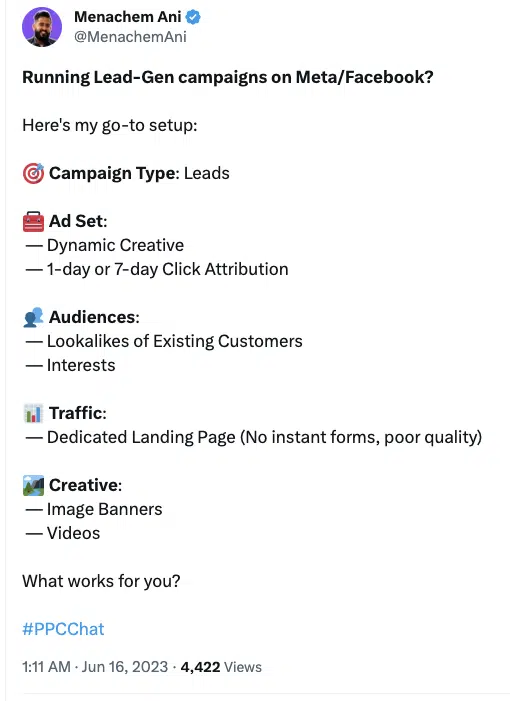
How to use Meta Ads for lead generation: A 9-step guide

When you think of Facebook and Instagram Ads, you tend to think of ecommerce.

Snacks, beverages, gadgets, lifestyle products, apparel – cool stuff that catches people’s attention, sold directly to consumers.

But that doesn’t mean you can’t use Meta Ads for lead generation.

From B2B tech companies to professional and local services, there’s no reason you can’t use the world’s largest social network to generate a pipeline for your business.

Here are nine things to consider when running a paid social media campaign on Facebook and Instagram.

1. Campaign type

Every seasoned advertiser knows you’ll get visitors, and not many conversions, if you run traffic campaigns on Meta. 

So the first step is basic but critical: Make sure you opt into a conversion campaign with the pixel firing if you want to generate leads. 

The conversion action should be set to target “Leads.”

Meta’s algorithm may not be as complex as Google’s, but it’s still incredibly sophisticated and will find conversions based on your targeting.

Meta For Lead Gen

2. Standard vs. dynamic creative

You can run a standard creative campaign, which includes several ads within one ad set. The system then decides which ad to serve at a given moment. 

In our experience, toggling dynamic creative is the way to go.

It works much like Google’s responsive search ads in that it’s a single ad unit, but you’re adding many image, video and copy assets. 

The system then mixes and matches these to find winning combinations.

This approach is far better in bringing down your cost per lead and increasing your conversion rate, so there are a few situations where we don’t recommend dynamic creative.

Facebook Ads Standard Vs Dynamic Creative

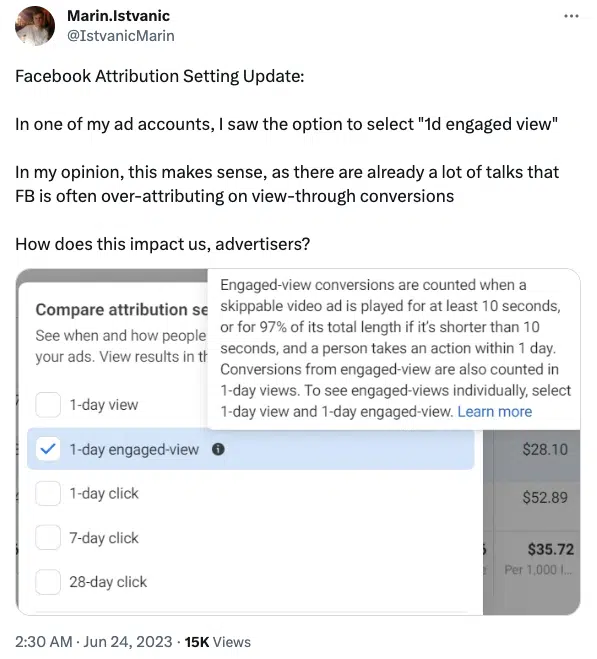
3. Attribution

In terms of attribution, you want to avoid view-through conversions. Typically, one day is enough with lead generation on Meta because you ask them to fill out a form. 

It’s unlike ecommerce, where it could take another 10+ days until that person decides to purchase. You can also use a seven-day click model.

View-through conversions tend to over-report, in general, because everyone will see the ad. (This is not as much of a problem for lead-gen as with ecommerce.)

Facebook Ads Attribution

4. Audiences

For Facebook lead generation campaigns, there are some considerable differences for audiences.

With ecommerce nowadays, all the “gurus” will tell you to go broad, allow the system to do the targeting, and avoid using audiences. 

That does work well, and we have seen success with that approach in lead-gen, too – if the account has a healthy amount of data on the pixel and the system knows who to target.

But if you’re starting from scratch or work in B2B where the audience segmentation can be very nuanced, I find that using lookalikes of your existing customers works extremely well. So upload your customer list and target 1-3% lookalikes.

If you don’t have even that – say the company is new in addition to the ad account – interest stacking works well.

We’ll create one ad set and layer on many specific interests. 

In the case of a business that insures expensive home fixtures, we might target people ages 21-60 (layer one) who work in contracting or interior design (layer 2) and are interested in certain trade publications (layer 3).

So you’re helping the system find those people. Again, if you have a lot of data on your pixel, you could let go of this and allow the system to target freely. 

But I find that for lead-gen, that’s not as easy as ecommerce because there’s no clear conversion value. In a new account, you don’t have that data right away.

Facebook Ads Audiences

Get the daily newsletter search marketers rely on.


5. Forms and landing pages

I recommend having a dedicated landing page rather than instant forms because the latter typically generates poorer leads. But that’s not a hard and fast rule. 

For our clients, we’ll use a dedicated landing page or an instant form but add qualifying questions.

So don’t limit yourself to the questions that Meta gives you the ability to have pre-filled. 

Those would be fields like name, email or phone number. If somebody clicks on an embedded form, all that stuff is pre-filled. 

All they need to do is hit the CTA button and you’ve collected their lead, and those tend to be quite low in quality.

But if you can throw in a question or two to increase the information exchange, you increase the barrier of interest and weed out anyone who doesn’t want to make an effort. 

Fields that need to be filled out (i.e., timeline to purchase and budget) improve lead quality considerably. This is what we do when we choose to use embedded instant forms.

Another thing to remember about instant forms is that you need to have a CRM integration established with Meta so that you can get the leads they don’t deliver via email. 

There is a lead center where you can manage submissions within Meta itself.

Facebook Ads Forms And Landing Pages

6. Creative approach

Creative… can be tricky.

In ecommerce, many advertisers throw themselves into video, video, video. We find that image banners work really well for lead-gen. 

The most important piece to call out here is to use your creative to further isolate your audience.

Think about the service or product you’re selling and the people who will notice that ad, not everybody who scrolls past it. 

Will the ad resonate with them? 

You want the copy in your post and on the image to speak to a specific type of person in a way that compels them to stop scrolling and start clicking.

Be very direct in your headline; use bold lettering on the banner. 

Because whichever audience you do choose, chances are it’s going to go a lot wider than that specific targeting. 

But if the right people see a message that speaks to them, it’ll pull them in pretty quickly.

Make it easy to grab their attention.

Facebook Ads Creative Approach

7. Facebook vs. Instagram

The short answer: Not really. We’ll usually allow the campaigns to go where they go. 

The algorithm does a great job of finding who will convert.

The only time I would advise people to re-examine things or do them differently is when it comes to vertical video, specifically for Instagram Stories. 

Otherwise, I allow Meta to use its entire inventory to find people wherever they may be.

Meta Ads Facebook Vs Instagram

8. Intent and funnel targeting

One last caveat: It’s hard to reach people at a specific stage of the buying process, as you can do with SEO. This applies to your audiences but also your creative.

Ever since the release of iOS 14, we generally don’t segment retargeting and prospecting into separate campaigns. 

It is almost impossible to achieve and makes the system work harder (read: spend more money). It’s not as efficient in terms of performance.

We’ll typically have retargeting and prospecting in one campaign and let the messaging speak to the full funnel as best as possible.

Again, that’s sort of where the dynamic creative kicks in. 

Meta should be able to pick and choose which copy speaks to which consumer personally. 

The system uses signals we don’t have access to, so a certain degree of trust is required to make this work.

Facebook Ads Intent And Funnel Targeting

9. Following up

Just because you can’t accurately and specifically target prospective customers by funnel stage doesn’t mean you shouldn’t be ready when those conversions start rolling in.

Someone converting through your landing page is just another step in what should be a great experience until the final conversion or sale. This is where businesses feel the value of having marketing and sales teams in harmony.

Here are some of the things we recommend:

  • Thank you message displayed after submission.
  • Email confirmation so that there’s a trail they can access anytime.
  • Nurture sequence to keep people engaged and find opportunities for engagement.
Facebook Ads Following Up

Don’t treat it like ecommerce

Lead generation advertising has always been trickier than ecommerce. 

Because an exchange of money so easily tracks the latter, it’s fairly straightforward – either you make the sale, or you don’t.

With leads, multiple factors can affect whether a “conversion” is even worth anything:

  • Spam leads are much more common than fraudulent purchases.
  • Lead count does not correlate with lead quality.
  • Often, a sales team is responsible for turning leads into actual sales.

All this makes the performance marketer’s job more challenging, but it can be done. 

Thousands of brands use Facebook Ads to run successful lead generation campaigns, and it’s all down to a deep understanding of their audiences.

Get back to the marketing fundamentals, develop excellent creative assets and relevant landing pages, and your job will be much easier whether you advertise on Meta (or any other platform).


Opinions expressed in this article are those of the guest author and not necessarily Search Engine Land. Staff authors are listed here.


Related stories

New on Search Engine Land

@media screen and (min-width: 800px) { #div-gpt-ad-3191538-7 { display: flex !important; justify-content: center !important; align-items: center !important; min-width:770px; min-height:260px; } } @media screen and (min-width: 1279px) { #div-gpt-ad-3191538-7 { display: flex !important; justify-content: center !important; align-items: center !important; min-width:800px!important; min-height:440px!important; } }

About the author

Menachem Ani

Menachem Ani, Founder of JXT Group, is a digital advertising expert with over a decade of success developing high-impact marketing strategies for online retailers and lead-generation clients.

https://searchengineland.com/facebook-ads-lead-generation-guide-430339


Meta releases open source AI audio tools, AudioCraft

Meta AudioCraft illustration

On Wednesday, Meta announced it is open-sourcing AudioCraft, a suite of generative AI tools for creating music and audio from text prompts. With the tools, content creators can input simple text descriptions to generate complex audio landscapes, compose melodies, or even simulate entire virtual orchestras.

AudioCraft consists of three core components: AudioGen, a tool for generating various audio effects and soundscapes; MusicGen, which can create musical compositions and melodies from descriptions; and EnCodec, a neural network-based audio compression codec.

In particular, Meta says that EnCodec, which we first covered in November, has recently been improved and allows for “higher quality music generation with fewer artifacts.” Also, AudioGen can create audio sound effects like a dog barking, a car horn honking, or footsteps on a wooden floor. And MusicGen can whip up songs of various genres from scratch, based on descriptions like “Pop dance track with catchy melodies, tropical percussions, and upbeat rhythms, perfect for the beach.”

Meta has provided several audio samples on its website for evaluation. The results seem in line with their state-of-the-art labeling, but arguably they aren’t quite high quality enough to replace professionally produced commercial audio effects or music.

Meta notes that while generative AI models centered around text and still pictures have received lots of attention (and are relatively easy for people to experiment with online), development in generative audio tools has lagged behind. “There’s some work out there, but it’s highly complicated and not very open, so people aren’t able to readily play with it,” they write. But they hope that AudioCraft’s release under the MIT License will contribute to the broader community by providing accessible tools for audio and musical experimentation.

“The models are available for research purposes and to further people’s understanding of the technology. We’re excited to give researchers and practitioners access so they can train their own models with their own datasets for the first time and help advance the state of the art,” Meta said.

Meta isn’t the first company to experiment with AI-powered audio and music generators. Among some of the more notable recent attempts, OpenAI debuted its Jukebox in 2020, Google debuted MusicLM in January, and last December, an independent research team created a text-to-music generation platform called Riffusion using a Stable Diffusion base.

None of these generative audio projects have attracted as much attention as image synthesis models, but that doesn’t mean the process of developing them isn’t any less complicated, as Meta notes on its website:

Generating high-fidelity audio of any kind requires modeling complex signals and patterns at varying scales. Music is arguably the most challenging type of audio to generate because it’s composed of local and long-range patterns, from a suite of notes to a global musical structure with multiple instruments. Generating coherent music with AI has often been addressed through the use of symbolic representations like MIDI or piano rolls. However, these approaches are unable to fully grasp the expressive nuances and stylistic elements found in music. More recent advances leverage self-supervised audio representation learning and a number of hierarchical or cascaded models to generate music, feeding the raw audio into a complex system in order to capture long-range structures in the signal while generating quality audio. But we knew that more could be done in this field.

Amid controversy over undisclosed and potentially unethical training material used to create image synthesis models such as Stable Diffusion, DALL-E, and Midjourney, it’s notable that Meta says that MusicGen was trained on “20,000 hours of music owned by Meta or licensed specifically for this purpose.” On its surface, that seems like a move in a more ethical direction that may please some critics of generative AI.

It will be interesting to see how open source developers choose to integrate these Meta audio models in their work. It may result in some interesting and easy-to-use generative audio tools in the near future. For now, the more code-savvy among us can find model weights and code for the three AudioCraft tools on GitHub.

https://arstechnica.com/?p=1958362


Una nuova campagna di phishing colpisce gli account business di Facebook


I ricercatori di Unit 42 hanno scoperto una campagna di phishing volta a ottenere gli account business di Facebook. La campagna distribuiva un infostealer offrendo strumenti quali modelli di fogli di calcolo per il business.

L’attività è parte di un trend ormai in aumento da luglio dello scorso anno, quando i ricercatori hanno individuato Ducktail, un altro infostealer che colpiva gli account business di Facebook. Attacchi analoghi si sono ripetuti lo scorso marzo con FakeGPT, una finta estensione Chrome di ChatGPT che sottraeva gli account Ad del social, e a maggio con NodeStealer, uno stealer in grado di sottrarre i cookie dal browser per ottenere il controllo degli account Facebook.

Facebook Business

Pexels

Questa nuova campagna è attiva da dicembre 2022 e non è mai stata segnalata prima d’ora. L’infostealer condivide molte somiglianze con NodeStealer ma, mentre questo è scritto in JavaScript, il nuovo malware è scritto in Python e prevede due varianti con funzionalità aggiuntive.

Oltre a entrare in possesso degli account business di Facebook, il nuovo infostealer è anche in grado di sottrarre credenziali dal browser e usarle per altri attacchi.

Le due varianti, pur colpendo entrambe gli account business del social di Meta, presentano alcune differenze importanti: soltanto una delle due si occupa di ottenere il controllo dell’account, mentre l’altra si limita a raccogliere le informazioni del profilo; quest’ultima è però in grado di scaricare malware aggiuntivi e disabilitare Windows Defender.

D’altra parte, la prima vanta la capacità di individuare la presenza di tool per l’analisi dei malware ed eventualmente auto-distruggersi, oltre a essere in grado di accedere al contenuto delle email della vittima.

Facebook Business

Pixabay

Non ci sono ancora conferme sull’identità degli attaccanti dietro l’infostealer ma, stando ad alcuni indizi presenti nel codice delle varianti, sembra che il gruppo sia vietnamita, come nel caso di Ducktail e NodeStealer.

Al momento, spiega Unit 42, la campagna sembra non essere più attiva, ma è possibile che gli attaccanti continuino a perfezionare il malware per usarlo in attacchi futuri; per questo i ricercatori invitano i possessori degli account Facebook business a prestare la massima attenzione a link sospetti e ad abilitare l’autenticazione multifattore.

Condividi l’articolo


Articoli correlati

Altro in questa categoria


https://www.securityinfo.it/2023/08/02/campagna-phishing-account-business-facebook-infostealer/?utm_source=rss&utm_medium=rss&utm_campaign=campagna-phishing-account-business-facebook-infostealer


Meta loses battle in EU, will ask for consent to show personalized ads

Meta loses battle in EU, will ask for consent to show personalized ads

After five years of fighting legal battles to prevent this undesirable outcome, Meta has finally agreed to ask Instagram and Facebook users in the European Union for consent before targeting them with highly personalized ads, a Wall Street Journal report has revealed.

This means that instead of requiring Meta app users in the EU to agree to invasive data collection used for personalized ads at sign-up, or else fill out a long form to request to opt out, EU users will soon be able to opt in or out by clicking simply yes or no.

The Journal spoke to sources familiar with Meta’s dealings who confirmed that Meta sent a proposal to EU privacy regulators agreeing to shift to this consent legal basis for data collection as early as the end of October.

In a blog today, Meta explained that there will be “no immediate impact” on services, but in the future, the changes will impact app users located in the EU, the European Economic Area, and Switzerland.

Previously, Meta had argued that the EU’s General Data Protection Regulation (GDPR) did not require a consent basis for data collection. Now, Meta said that “a number of evolving and emerging regulatory requirements in the region”—perhaps most “notably how our lead data protection regulator in the EU, the Irish Data Protection Commission, is now interpreting GDPR in light of recent legal rulings”—partly motivated the social media company to agree to at last take this step.

One of those recent rulings came down last month in Norway, which told Meta to either ask for consent or stop showing behavioral ads in Europe. That decision led to a temporary ban on Meta’s behavioral ads in Norway, a move that was applauded by NOYB, an EU consumer rights group that advocates for data privacy and brought several complaints against Meta for allegedly violating the GDPR. After the Norway ruling, NOYB predicted that the temporary ban would be an “important first step” toward requiring Meta to ask for consent to collect data across the EU, and seemingly, that prediction panned out.

Ars could not immediately reach NOYB for comment.

Recently, Meta told EU regulators that making this change represented a “significant hurdle” for Meta and noted that it will “require at least three months to implement,” the WSJ reported. That’s why it seems like making the update by the end of October might be an ambitious deadline. In its proposal, Meta has also offered to wait to implement the change until early next year.

Analysts have suggested that the key reason Meta resisted using a consent legal basis for data collection in the past is because it makes it too easy for app users to opt out. When Apple started asking iPhone users for consent for apps to collect data in 2021, many users opted out, and Meta’s ad revenue took a huge hit as it lost access to a large chunk of third-party data.

Meta only started recovering from those losses this year, and the WSJ noted that Meta’s ad revenue rebound was largely due to Meta tweaking its ad-targeting, likely growing more reliant on its own data collection than third parties’. Therefore, it’s currently unclear how EU users opting out of sharing data directly with Meta will disrupt that forward momentum. It’s possible Meta’s ad revenue could take an even bigger hit because of those tweaks if the algorithm is now overly reliant on the company’s own data collection, which could soon experience a sudden decrease in volume.

In a blog, Meta made some assurances to advertisers that this change won’t hurt its business in the EU.

“Once this change is in place, advertisers will still be able to run personalized advertising campaigns to reach potential customers and grow their businesses,” Meta’s blog said. “We have factored this change into our business outlook and related public disclosures made to date.”

Meta also promised to share more information in the coming months, “because it will take time for us to continue to constructively engage with regulators to ensure that any proposed solution addresses regulatory obligations in the EU.”

Privacy experts are likely to claim Meta’s decision today as a win. Last December, a nonprofit defending data privacy online, the Electronic Frontier Foundation, said that tech companies like Meta using voluntary opt-in consent “should be the baseline requirement for any data collection, retention, or use.”

“And we should take a step further: online behavioral advertising should be banned,” EFF suggested.

https://arstechnica.com/?p=1958197


Meta plans AI-powered chatbots to boost social media numbers

A toy robot saying
Benj Edwards / Getty Images

Meta is reportedly developing a range of AI-powered chatbots with different personalities, a move aimed at increasing user engagement on social platforms such as Facebook and Instagram, according to the Financial Times and The Verge. The chatbots, called “personas” by Meta staff, will mimic human-like conversations and might take on various character forms, such as Abraham Lincoln or a surfer-like travel adviser.

The move to introduce chatbots to Meta platforms comes amid growing competition from social media platforms like TikTok and a rising interest in AI technology. Meta has also made big investments into generative AI recently, including the release of a new large language model, Llama 2, which could power its upcoming chatbots.

During a recent earnings call, Meta CEO Mark Zuckerberg mentioned that the company envisions AI agents acting as assistants and coaches, facilitating interactions between users, businesses, and creators. He also hinted at the development of AI agents for customer service and an internal AI-powered productivity assistant for staff.

“You can imagine lots of ways that AI can help people connect and express themselves in our apps, creative tools that make it easier and more fun to share content, agents that act as assistants, coaches or help you interact with businesses and creators and more,” he said.

However, the Financial Times says that some experts are voicing concerns over the plans. Ravit Dotan, an AI ethics adviser and co-founder of the Collaborative AI Responsibility Lab at the University of Pittsburgh, warns that interactions with chatbots might pose a personal privacy hazard for users.

“Once users interact with a chatbot, it really exposes much more of their data to the company, so that the company can do anything they want with that data,” she told the outlet.

Privacy aside, concerns about social media addiction have also been common among critics of Facebook in the past, and introducing engaging simulated people into social networks may make it harder for some people to stop using them—although that might be exactly the point.

Meta isn’t the first social media company to experiment with AI-powered chatbots. In February, Snap announced a “My AI” chatbot designed to serve as an amusing conversationalist and possibly an adviser for trip or product recommendations, despite admissions about its propensity to confabulate inaccurate or potentially dangerous information. And beyond social media, chatbots on sites like Character.AI have proven popular among some people as a form of entertainment.

Despite these risks, Meta thinks that its artificial personas could provide a fun and interactive element on its platforms, besides functioning as a search tool and offering recommendations. The company plans to roll them out as early as September.

https://arstechnica.com/?p=1958059


Meta’s new chatbots set to improve targeted ad capabilities

Meta is launching a range of AI-powered chatbots that could improve its targeted advertising capabilities.

The chatbots, which could come as early as September, reportedly have the ability to collect large amounts of data regarding users’ interests.

It’s expected that the new technology will also boost engagement across Meta’s platforms, as the chatbots, which all exhibit different personalities, will be able to have humanlike conversations with Meta’s 4 billion users, reports the Financial Times.

Why we care. Improved targeted advertising could enable marketers to increase conversions by helping their campaigns reach the right audiences. It could also help brands connect with previously untapped markets, improving overall reach.

However, there is a but… This new technology has raised concerns about data privacy. If a brand inadvertently violates people’s privacy rights, it could suffer reputational damage that is difficult to repair, and also create distrust amongst potential customers, which could be harmful to ROI in the long-term.

Why now? Despite getting off to an impressive start and becoming the fastest growing social media platform in history, Meta’s Threads has now lost half of its users less than a month after it launched. Meta is now trying to attract more users and retain current ones as it faces competition from rival platforms like TikTok. The company is reportedly hoping that its new AI chatbots will help retain users by increasing engagement.

It’s worth noting that Snap rolled out its My AI chatbot back in February and so far, 150 million users have interacted with it.

Meta’s chatbots with character. During an earnings call on Wednesday, Meta CEO Mark Zuckerberg said the company doesn’t think people will interact with one single AI. So, to improve engagement for its users, Meta has created a range of characters for its chatbots, which insiders have nicknamed “personas”.

Some of the characters created include former US President Abraham Lincoln. Another prototype includes a surfer persona, which advises users on travel options.


Get the daily newsletter search marketers rely on.


What has Meta said? Mark Zuckerberg is expected to give an update on Meta’s chatbot plans next month. However, back in February, he opened up about the company’s AI targets in a Facebook post, which read:

  • “We’re creating a new top-level product group at Meta focused on generative AI to turbocharge our work in this area. We’re starting by pulling together a lot of the teams working on generative AI across the company into one group focused on building delightful experiences around this technology into all of our different products.”
  • “In the short term, we’ll focus on building creative and expressive tools. Over the longer term, we’ll focus on developing AI personas that can help people in a variety of ways. We’re exploring experiences with text (like chat in WhatsApp and Messenger), with images (like creative Instagram filters and ad formats), and with video and multi-modal experiences.”
  • “We have a lot of foundational work to do before getting to the really futuristic experiences, but I’m excited about all of the new things we’ll build along the way.”

Deep dive. Read our article on why chatbots launched by other platforms such as Google and Microsoft have been causing concern amongst advertisers.


Related stories

New on Search Engine Land

@media screen and (min-width: 800px) { #div-gpt-ad-3191538-7 { display: flex !important; justify-content: center !important; align-items: center !important; min-width:770px; min-height:260px; } } @media screen and (min-width: 1279px) { #div-gpt-ad-3191538-7 { display: flex !important; justify-content: center !important; align-items: center !important; min-width:800px!important; min-height:440px!important; } }

About the author

Nicola Agius

Nicola Agius is Paid Media Editor of Search Engine Land after joining in 2023. She covers paid search, paid social, retail media and more. Prior to this, she was SEO Director at Jungle Creations (2020-2023), overseeing the company’s editorial strategy for multiple websites. She has over 15 years of experience in journalism and has previously worked at OK! Magazine (2010-2014), Mail Online (2014-2015), Mirror (2015-2017), Digital Spy (2017-2018) and The Sun (2018-2020). She also previously teamed up with SEO agency Blue Array to co-author Amazon bestselling book ‘Mastering In-House SEO’.

https://searchengineland.com/meta-chatbot-improve-targeted-ad-430090


Facebook to unmask anonymous Dutch user accused of repeated defamatory posts

Facebook to unmask anonymous Dutch user accused of repeated defamatory posts

Starting today, Facebook users may feel a little less safe posting anonymously. The Court of the Hague in The Netherlands ruled that Meta Ireland must unmask an anonymous user accused of defaming the claimant, a male Facebook user who allegedly manipulated and made secret recordings of women he dated.

The anonymous Facebook user posted the allegedly defamatory statements in at least two private Facebook groups dedicated to discussing dating experiences. The claimant could not gain access but was shown screenshots from the groups, one with about 2,600 members and one with around 61,000 members. The claimant argued that his reputation had suffered from the repeated postings that included photos of the man and alleged screenshots of his texts.

The claimant tried to get Meta to remove the posts, but Meta responded with an email saying that it would not do so because “it is not clear to us that the content you reported is unlawful as defamation.”

At that point, Meta suggested that the man contact the anonymous user directly to resolve the matter, triggering the lawsuit against Meta. Initially, the claimant asked the court to order Meta to delete the posts, identify the anonymous user, and flag any posts in other private Facebook groups that could defame the claimant.

While arguing the case, Meta had defended the anonymous user’s right to freedom of expression, but the court decided that the claimant—whose name is redacted in court documents—deserved an opportunity to challenge the allegedly defamatory statements.

Partly for that reason, the court ordered Meta to provide “basic subscriber information” on the anonymous user, including their username, as well as any names, email addresses, or phone numbers associated with their Facebook account. The court did not order Meta to remove the posts or flag any others that may have been shared in private groups, though.

Meta has already agreed to comply with the order, the court’s ruling said. However, if Meta fails to provide the Facebook user’s identifying information, the social media company risks a penalty of approximately $1,200 daily. The maximum fine that Meta could face is less than $130,000.

A legal representative for the claimant and Meta could not immediately be reached for comment.

Identifying anonymous posters

Facebook allows users to post anonymously in private groups when admins allow it. The court order said it was common for private Facebook groups to allow anonymous posting in forums where primarily women discuss dangerous or negative dating experiences with men.

When a Facebook user posts anonymously, it’s never truly been anonymous, of course. Facebook’s policy stipulates that “your name and profile picture will still be visible to the group’s admins and moderators, as well as to Facebook, in order to help keep groups safe and in compliance with our Community Standards.”

There’s an entire branch of law where content removal attorneys fight back against anonymous posters. Sometimes attorneys prod platforms to unmask the user, commonly when making copyright claims, and other times they rely on tactics to unmask users themselves, like IP tracing or reverse image searches. This case, however, could be considered a “landmark decision” that “signals a shift in the balance between user privacy and accountability on social media platforms,” StackDiary reported.

Meta’s defense of the anonymous user’s right to free speech failed, the court said, because freedom of speech is not unlimited.

“Someone who, without evidence, repeatedly makes serious and clearly traceable accusations, must take into account, partly in the light of the conditions applied by Facebook, that he or she may be confronted with a measure whereby his or her anonymity is lifted,” the court order said.

Although the key concern for The Court in the Hague appeared to be that the statements posted anonymously were plausibly defamatory, the order also noted that the content would not have to necessarily be unlawful for Facebook to be ordered to identify the user posting it.

“According to settled case law, under certain circumstances Meta has an obligation to provide identifying data, even if the content of the relevant messages is not unmistakably unlawful,” the court order said.

https://arstechnica.com/?p=1957962