Facebook ‘Unlawfully’ Used Dutch Personal Data: Court

Social media platform Facebook unlawfully processed Dutch users’ personal details without consent for advertising purposes for almost a decade, Amsterdam-based judges ruled on Wednesday.

The judgement by the Amsterdam District Court said Facebook Ireland — custodians of Dutch users’ personal details — not only used the data for advertising, but also passed it to third parties without properly informing people or having legal grounds to do so.

“Facebook Ireland has broken the law when processing personal data of Dutch Facebook users in the period from April 1, 2010 to January 1, 2020,” the judges said in a statement issued by the court.

It “processed personal data without a legal basis — such as consent — for this,” the judges said.

Judges however turned down a third claim that the use of online “cookies”, digital trackers used to target advertising, was unlawful on third party sites, as the responsibility to inform users was transferred to the relevant website operators by Facebook Ireland.

The ruling comes after a 2019 class action lawsuit brought by the Dutch-based Data Privacy Foundation, an internet watchdog which says it fights for the rights of online users against companies “exploiting our personal details”, backed by the country’s Consumers Association.

The judges did not rule on claims in the case, but the Data Privacy Foundation’s chairman Dick Bouma said it opened the door for consumers to receive “compensation for years of privacy violations by Facebook.”

“It’s now up to Facebook to provide this (compensation). We would like to discuss this with them,” he told the NU.nl Dutch news website.

Facebook owner Meta in a statement to AFP said it was “pleased the court ruled in favour of Meta for multiple of these historic claims, some of which took place over a decade ago.”

“We intend to appeal other aspects of this case,” the statement said.

The Dutch court’s finding followed a mega fine against Meta in early January, totalling 390 million ($410 million) euros, for breaching EU personal data laws on Facebook and Instagram.

Related: Meta Slapped With 5.5 Million Euro Fine for EU Data Breach

Related: Irish Regulator Fines Meta 265 Million Euros Over Data Breach

Related: South Korea Fines Google, Meta Over Privacy Violations

Facebook ‘Unlawfully’ Used Dutch Personal Data: Court


Meta threatens to restrict news in Canada if it’s forced to pay publishers

Meta threatens to restrict news in Canada if it’s forced to pay publishers

After losing a similar battle in Australia, Meta continues to resist efforts by a growing number of countries to require the social media company to pay for news linked on platforms like Facebook and Instagram. On Saturday, Meta announced that it would end news access for Canadian Facebook and Instagram users if the country’s Online News Act is passed, Reuters reported.

A Meta spokesperson told Ars that the online advertising giant contends that laws like Canada’s proposed legislation “misrepresents” the relationship between its platforms and news publishers. According to Meta spokesperson Lisa Laventure, the company’s stance in Canada is the same as its stance protesting the United States’ Journalism Competition and Preservation Act (JCPA).

“A legislative framework that compels us to pay for links or content that we do not post, and which are not the reason the vast majority of people use our platforms, is neither sustainable nor workable,” Laventure said.

The Canadian government describes the Online News Act as positioning digital platforms to support the “production of trusted news and information.” It’s designed to help reverse a collapse in news publisher revenue, which News Media Canada reported fell by billions between 2011 and 2020 and continued falling through the pandemic. If the law is passed, it should ensure online ad revenue-sharing between news publishers and platforms, laying out a framework for platforms to bargain with Canadian news organizations or else—“as a last resort”—face “mandatory arbitration” whenever deals cannot be reached.

Currently, Meta estimates that links to news articles make up less than 3 percent of news feeds and are “not a draw for our users” or a “significant source of revenue,” a Meta spokesperson told Ars.

Social media users in Canada will know more about how this move will impact their news access once the law is passed and Canada updates its guidance on how news organizations can apply to be compensated for links shared on digital platforms. Meta has said that it “will keep Canadians informed of any changes to our services.”

Meta already gave up this fight in Australia

Proposed laws like Canada’s and the US’s JCPA follow in the footsteps of Australia’s news media bargaining code enacted in 2021. When Australia first passed the law, Meta temporarily suspended news access before reaching an agreement that Wired reported resulted in at least 11 content deals struck between Facebook and news organizations.

Meta did not respond to Ars’ request for comment on how many content deals it currently has in Australia or how Canada’s proposed law could be amended to create the “sustainable” or “workable” solution that Meta is seemingly seeking.

According to Wired, Australia’s law does not work perfectly but has led many tech companies to privately bargain with news organizations to avoid arbitration processes that could cost more than content deals. Nobody is sure how lucrative these content deals really are for publishers. Media organizations told Wired last year that for some, the payments cover salaries of a couple of journalists on staff, but for others, like News Corp, “tech platform deals contribute more than $100 million in annual revenue.”

It’s unclear whether Meta’s pushback will result in any changes to the proposed legislation in Canada, but the CBC reported that Canadian Heritage Minister Pablo Rodriguez criticized Meta for threatening to cut off news access.

“Once again, it’s disappointing to see that Facebook has resorted to threats instead of working with the Canadian government in good faith,” Rodriguez said, adding that “this tactic didn’t work in Australia, and it won’t work here.”

https://arstechnica.com/?p=1923500


Meta pauses bonus payouts to Reels creators

Meta has announced that it will temporarily halt bonus payouts for creators on its video-sharing platform, Reels. The decision is due to the company’s effort to invest more in building features and tools that will improve the overall experience for Reels users.

What’s happening. The pause on bonus payouts will affect Reels creators who have received payments for reaching specific milestones or for producing content that resonates with audiences. However, this does not mean that creators will not be able to earn money on Reels. Meta will continue to pay creators for the content they produce through its existing revenue-sharing program.

What meta says. According to a statement released by Meta, the company is focused on creating new features and tools that will make it easier for creators to build and grow their audience. These efforts include improving discovery and monetization tools and launching new creator-focused programs.

Meta’s broader focus. The company’s decision to pause bonus payouts comes as part of a broader effort to invest in the creator community on Reels. Meta has previously announced plans to invest $1 billion in the creator community across its platforms, including Reels, Instagram, and Messenger.

A positive move for Reels content consumers. While the pause on bonus payouts may be disappointing for some creators, it is ultimately a positive step for the Reels community. By investing in new features and tools, Meta is showing its commitment to building a platform that provides creators with the resources they need to succeed. As the company continues to innovate and improve Reels, creators can expect to see more opportunities to earn money and grow their audience on the platform in the future.

Not new. The move to pause bonus payouts for Reels creators is not unusual. In fact, many platforms have made similar decisions in the past as they invest in new features and tools to improve the overall user experience. For example, YouTube recently announced that it would temporarily pause its YouTube Preferred program, which provides additional revenue to creators who meet certain criteria, in order to focus on developing new features and tools.

Despite the temporary pause on bonus payouts, Reels creators still have the opportunity to earn money through the platform’s revenue-sharing program. This program allows creators to earn a portion of the revenue generated by ads that run on their content. In addition, creators can also earn money through sponsored content and product placements.

While the pause on bonus payouts may be disappointing for some Reels creators, it is ultimately a positive step for the platform and the creator community as a whole. By investing in new features and tools, Meta is showing its commitment to providing creators with the resources they need to succeed and grow their audience. As the platform continues to evolve, creators can expect to see more opportunities to earn money and build their brand on Reels.

Why we care. For advertisers, this means that Reels is becoming an increasingly important platform for reaching target audiences through short-form video content. With over 1 billion active users on the platform, Reels offers a large and engaged audience that advertisers can tap into to promote their products or services.

In addition, the pause on bonus payouts does not mean that creators will stop producing content on Reels. Instead, the revenue-sharing program remains in place, providing advertisers with the opportunity to partner with creators and sponsor their content. This presents a valuable opportunity for advertisers to reach new audiences and build brand awareness through sponsored content.


Related stories

New on Search Engine Land

@media screen and (min-width: 800px) { #div-gpt-ad-3191538-7 { display: flex !important; justify-content: center !important; align-items: center !important; min-width:770px; min-height:260px; } } @media screen and (min-width: 1279px) { #div-gpt-ad-3191538-7 { display: flex !important; justify-content: center !important; align-items: center !important; min-width:800px!important; min-height:440px!important; } }

About the author

Nicole Farley

Nicole Farley is an editor for Search Engine Land covering all things PPC. In addition to being a Marine Corps veteran, she has an extensive background in digital marketing, an MBA and a penchant for true crime, podcasts, travel, and snacks.

https://searchengineland.com/meta-pauses-bonus-payouts-to-reels-creators-394173


Meta says $725M deal ends all Cambridge Analytica claims; one state disagrees

Facebook co-founder, Chairman, and CEO Mark Zuckerberg.
Enlarge / Facebook co-founder, Chairman, and CEO Mark Zuckerberg.

Tomorrow is the day that Meta expected would finally end its Cambridge Analytica woes. That’s when a US district court in California is scheduled to preliminarily approve a $725 million settlement agreement that Meta believed would release the company of all related claims.

However, just days before Meta could reach that seeming finish line, the state of New Mexico has moved to intervene. In a court filing yesterday, New Mexico argued that Meta might be interpreting its settlement agreement wrong and claimed that, for New Mexico citizens, the Cambridge Analytica scandal is far from resolved.

To clarify whether Meta’s agreement releases New Mexico’s and others’ claims and to ensure that the California court doesn’t “inadvertently or otherwise release claims” raised in New Mexico’s still-pending parallel action against Meta, New Mexico’s attorneys have asked to be heard “briefly” at tomorrow’s hearing.

The state’s confusion springs from how the settlement agreement currently defines “released claims” as applying to settlement class members, which covers all Facebook users during the class action’s specified period. Because New Mexico is arguing on behalf of hundreds of thousands of New Mexico Facebook users, the state says the agreement could be read—as Meta is reading it—as dismissing the state’s claims. However, the action was brought by the state itself, which is not a Facebook user, so lawyers said the agreement, as written, might be too limited to release Meta from New Mexico’s claims.

Ars could not immediately reach Meta or the state of New Mexico for comment. [Update: A Meta spokesperson told Ars, “The attorneys representing New Mexico misstated our position, which we will explain to the Court.”]

New Mexico fights to keep Meta on the hook

In the motion to intervene, New Mexico’s lawyers wrote that Meta never notified the state when the settlement agreement was reached last December and instead ignored weeks of inquiries sent by the state to clarify whether Meta interpreted the agreement as releasing New Mexico’s claims. The state only learned of Meta’s position this week, rushing yesterday to respond before the court begins approving the settlement agreement tomorrow.

“The State of New Mexico has no interest in upending the carefully negotiated proposed settlement,” state lawyers wrote in the motion. “However, earlier today, Facebook for the first time explicitly took the position that certain claims asserted in the State’s action pending in a New Mexico court” will be released by the class action settlement agreement.

According to the state lawyers, Meta’s interpretation of the settlement agreement is too broad and would require “extraordinary circumstances” to get the result Meta wants: releasing claims in all other courts and preventing future litigation.

“There are no extraordinary circumstances that would warrant extinguishing the State’s claims pending in other courts via the release in the Settlement Agreement in this case,” state lawyers wrote. “Facebook’s position is also contrary to the law in this District, where courts have frequently rejected attempts to read settlement agreement language that broadly.”

New Mexico’s lawsuit against Meta was filed in January 2021, alleging that Meta’s business practices revealed through the Cambridge Analytica scandal violated the New Mexico Unfair Practices Act. This claim was never raised in the current class-action lawsuit. The state has asked the California court to hear its arguments tomorrow against releasing claims in this lawsuit—before Meta can release terms of the settlement agreement to millions of Facebook users, including New Mexico Facebook users.

That notice could potentially confuse New Mexico citizens about their rights in still-pending litigation pursued by the state, which is not a class member and is, therefore, a non-party in the class-action settlement.

“Because the State is a non-party, it clearly must be permitted to intervene in order to be heard as to why the terms of the Settlement Agreement should not be interpreted as one of the parties, Defendant Facebook, would read it, i.e. to extinguish certain claims or forms of relief brought by the State in another jurisdiction without its consent,” the state wrote.

https://arstechnica.com/?p=1920981


Meta must pay $175M for patent-infringing livestreaming tech, judge says

Meta must pay $175M for patent-infringing livestreaming tech, judge says

After a jury unanimously decided last September that Meta owed $175 million to walkie-talkie app-maker Voxer for patent infringement, Meta tried to avoid paying up by requesting a judge either reject the jury’s verdict or give Meta a new trial. This week, a federal judge denied Meta’s request, making it likely that Meta will have to pay all those running royalties for illegally copying Voxer’s technology and using it to launch Facebook Live and Instagram Live.

Meta had argued seemingly everything it could to get out of paying millions in damages. It questioned whether the jury’s decision was reasonable, claiming that Voxer’s lawyer had made comments that biased the jury. In Meta’s view, no reasonable jury would have found that Meta infringed Voxer’s patented video-streaming and messaging technologies. Further, even if everyone agreed that there was infringement, Meta argued that the damages were too extreme and improperly calculated by Voxer’s expert. Instead of owing running royalties, Meta felt it should be required to pay either no damages or a lump sum.

In his decision, US District Judge Lee Yeakel affirmed that substantial evidence supported the jury’s verdict of patent infringement and sufficient evidence supported the damages that the jury awarded Voxer.

Meta can still appeal, but a Meta spokesperson declined to tell Ars if the company will.

Ars could not immediately reach Voxer to comment, but this week’s decision inches the company closer to the end of a decade-long legal saga that started in 2012 when Voxer first met with Facebook to discuss a potential partnership.

According to Voxer’s complaint, Voxer began developing its technology in 2006, hoping to help improve battlefield communications. US army veteran Tom Katis co-founded the company, wanting to create a live-messaging and video-streaming app that would help eliminate interruptions in transmissions that left soldiers vulnerable during sudden ambushes or when medevacs were needed. That ambition morphed into the walkie-talkie app that Voxer launched in 2011, which was so popular, it prompted meetings with Facebook by 2012.

Voxer was likely excited to be wooed by Facebook, but soon after Voxer shared its patent portfolio and proprietary tech with the social network, the partnership fell through. When that happened, Facebook revoked Voxer’s access to its platform, deeming Voxer a competitor while allegedly making it harder to discover Voxer on Facebook. After that, Meta moved forward without Voxer’s involvement and launched Facebook Live in 2015 and Instagram Live in 2016.

After the launches, Voxer tried to book another meeting with Facebook, but the social network declined to discuss any alleged patent infringement. When Voxer sued in 2020, the app maker alleged that “both products incorporate Voxer’s technologies and infringe its patents.”

Meta has maintained in the three years since then that there was no patent infringement, but notably, the company didn’t immediately repeat statements to that effect this week.

Voxer’s win this week is due to Katis’ foresight in filing patents as he developed a bold new kind of technology he’d never seen before. When Katis built Voxer, he told a 2012 conference audience in Paris that he was surprised how easy it was to patent Voxer’s technology, quickly filing more than 75 patents the year after launching the walkie-talkie app. Katis said he successfully patented the technology because “no one”—including Facebook—”was crazy enough” to try to develop livestreaming tech like the vision he had for Voxer.

https://arstechnica.com/?p=1919682


Social media engagement hits a new low, except for TikTok

Social media as we’ve known it seems to be in its dying days – with one notable exception, Tiktok. That’s according to a new social media engagement rate benchmark report.

TLDR. There are five important takeaways for brands from the 2023 Social Media Benchmark Report, which was released today by Rival IQ:

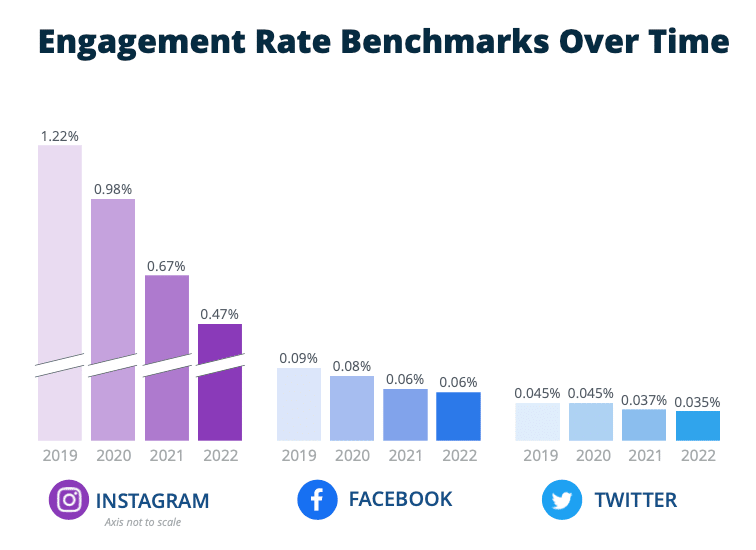
  1. Organic engagement: falling or flatlining. Engagement rates declined on Instagram for the third straight year but have held pretty steady for Facebook and Twitter.
  2. Posting frequency declining. Post frequency was flat on Instagram but took a ~20% dive on Facebook and Twitter.
  3. Hot holiday hashtags. Almost every industry earned top engagement rates from holiday-hashtagged posts, while contests and giveaways were less popular than in other years.
  4. Reels rule on Instagram. Reels dethroned carousels in multiple industries to become the most engaging post type.
  5. TikTok tops the charts. With a median engagement rate of 5.69%, TikTok was every industry’s best friend this year.

Why we care. The report provides valuable information that can help advertisers gauge the effectiveness of their social media strategies and identify areas for improvement. By comparing their own brand’s engagement rates to the industry averages, you can determine whether your social media performance is above or below par and make necessary adjustments to optimize their campaigns for better engagement and conversion rates.

About the report. It examined the mean engagement rates for different brand verticals across major social media networks.

It’s important to note that Rival IQ chose 150 companies, at random, from each of the 14 industries they studied, including:

  • Media
  • Nonprofits
  • Food & beverage
  • Retail
  • Travel

The companies they analyzed had active presences on Facebook, Instagram, TikTok, and Twitter as of January 2022, and had Facebook fan counts between 25,000 and 1,000,000 and minimum Instagram, TikTok, Twitter followers of 5,000 as of the same date.

Interesting statistic. Among all industries, the average engagement rate for Facebook, Instagram, and Twitter never goes higher than 0.47% (Instagram). Even still, Instagram took a 30% dip in 2022 compared to 2021, while Facebook and Twitter remained flat.

The rate of weekly posts on Instagram remained steady in 2022, while it decreased on Twitter and Facebook, likely due to reduced investment by brands.

Screen Shot 2023 02 21 At 1.50.01 PM

TikTok’s engagement rate, on the other hand, comes in at a whopping 5.69%. But brands are posting less frequently on TikTok than any other channel.

Higher Ed, for example, posts the least, but sees the highest engagement, whereas retail, influencers, and beauty post more frequently, but

“Higher Ed sees epic engagement rates on TikTok but is one of the least frequent posters, while Media brands’ lagging engagement rates prove once again that more posting isn’t necessarily better.”

Rival IQ

The bigger picture. Organic social, in general, has been trending downward in terms of traffic and engagement for years. Which is why brands have been flocking to TikTok (which arguably isn’t even a “social network” as it’s more about content discovery).

Enter AI. In addition to playing a key role in ChatGPT, AI and machine learning created some new possibilities for social networks.

“At first, social networks showed you stuff your friends thought was interesting — the Facebook model. Then they started showing you stuff based on the people that you chose to follow, whether you were friends or not — the Twitter model.

TikTok’s innovation was to show you stuff using only algorithmic predictions, regardless of who your friends are or who you followed. It soon became the most downloaded app in the world.

TikTok’s innovation was to show you stuff using only algorithmic predictions, regardless of who your friends are or who you follow. It soon became the most downloaded app in the world.”

Casey Newton, Platformer

Which gets us back to where we started. Facebook, Twitter and other social networks are trying to catch up (read: emulate) TikTok. Meanwhile, advertiser budgets have also followed. And TikTok continues to find new ways to improve reach for brands.

Dig deeper. You can download the report from Rival IQ here.


Related stories

New on Search Engine Land

@media screen and (min-width: 800px) { #div-gpt-ad-3191538-7 { display: flex !important; justify-content: center !important; align-items: center !important; min-width:770px; min-height:260px; } } @media screen and (min-width: 1279px) { #div-gpt-ad-3191538-7 { display: flex !important; justify-content: center !important; align-items: center !important; min-width:800px!important; min-height:440px!important; } }

About the author

Nicole Farley

Nicole Farley is an editor for Search Engine Land covering all things PPC. In addition to being a Marine Corps veteran, she has an extensive background in digital marketing, an MBA and a penchant for true crime, podcasts, travel, and snacks.

https://searchengineland.com/social-media-engagement-hits-a-new-low-except-for-tiktok-393395


Meta is bringing the blue verification badge to Facebook and Instagram

Meta, the parent company of Facebook, has introduced a new subscription service, Meta Verified, that provides users the opportunity to acquire the highly sought-after blue verification badge on their Instagram and Facebook accounts. Users can achieve this by verifying their identity for a monthly fee of up to $15.

Screen Shot 2023 02 20 At 7.47.47 AM 800x312

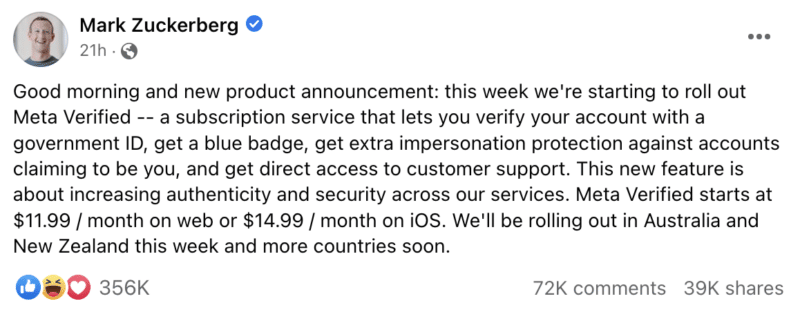
How it works. Meta Verified is now available in New Zealand and Australia, with plans to expand globally in the near future. The service allows users to verify their identity using government-issued ID cards, and provides several benefits such as improved protection against impersonation attacks, direct access to customer support, and increased visibility and reach.

The monthly subscription cost for Meta Verified is $11.99 on the web and $14.99 on iOS and Android devices. In a Facebook post, Meta CEO Mark Zuckerberg emphasized that the new service is focused on “increasing authenticity and security across our services.”

Meta’s solution to decreased revenues. Meta’s revenue has taken a hit in recent years due to Apple’s implementation of stricter privacy changes on iOS that limit the company’s ability to track users’ internet activities. The social media giant, which has not charged its customers for most of its services since its inception 15 years ago, generates almost all of its income from advertising. The impact of Apple’s move is expected to cost the company over $10 billion in lost advertising revenue this year.

In response, Meta has expressed its intent to develop a valuable subscription service for creators, businesses, and the wider community. As part of this plan, Meta is expanding access to verification and redefining the meaning of the verified badge so that more people can trust that the accounts they are interacting with are authentic.

Following in Twitter’s footsteps. This move for Meta comes after Snap launched its own subscription service last year, which has already converted over one million users into paid customers. Additionally, Elon Musk revamped Twitter’s subscription service, Twitter Blue, to offer a range of features, including the blue check mark. In recent months, Twitter has expanded Twitter Blue to over a dozen markets, including India and Indonesia. However, as of mid-January, only around 180,000 accounts had signed up for Twitter Blue, according to The Information.

Why we care. The increased authenticity and security could lead to a better user experience and more engagement, ultimately benefiting advertisers who want to reach and connect with a reliable and engaged audience.

In addition, Meta has been impacted by Apple’s privacy changes, which have limited the company’s ability to track users’ internet activities and resulted in lost advertising revenue. If Meta is successful in its plan to develop a valuable subscription service for creators, businesses, and the wider community, it could potentially create a new revenue stream for the company and reduce its reliance on advertising income. This could help to stabilize the company’s financials and create a more stable environment for advertisers.


Related stories

New on Search Engine Land

@media screen and (min-width: 800px) { #div-gpt-ad-3191538-7 { display: flex !important; justify-content: center !important; align-items: center !important; min-width:770px; min-height:260px; } } @media screen and (min-width: 1279px) { #div-gpt-ad-3191538-7 { display: flex !important; justify-content: center !important; align-items: center !important; min-width:800px!important; min-height:440px!important; } }

About the author

Nicole Farley

Nicole Farley is an editor for Search Engine Land covering all things PPC. In addition to being a Marine Corps veteran, she has an extensive background in digital marketing, an MBA and a penchant for true crime, podcasts, travel, and snacks.

https://searchengineland.com/meta-is-bringing-the-blue-verification-badge-to-facebook-and-instagram-393352


Anche Meta (Facebook e Instragram) diventa a pagamento per alcuni servizi

Facebook, il social network gratuito che avrebbe dovuto restare tale per sempre, e la consorella Instagram cominceranno a proporre un servizio premium a pagamento per sopperire ai problemi del modello economico fondato sulla pubblicità.

Lo ha annunciato Mark Zuckerberg, patron di Meta, domenica con il lancio di “Meta Verified” un abbonamento mensile a partire da 12 dollari al mese per l’autenticazione degli account e della identità digitale sulle sue piattaforme, che di fatto assomiglia moltissimo alla formula della “spunta blu” lanciata da Elon Musk su Twitter (a partire da 7 dollari al mese).

“L’idea è quella di migliorare l’autenticità (dei profili e quindi degli scambi, ndr) e la sicurezza sui nostri servizi”, ha specificato Mark Zuckerberg in un messaggio diffuso domenica sul suo canale Instagram e sul suo account Facebook.

Meta Verified sarà lanciato inizialmente in Australia e Nuova Zelanda a partire da questa settimana, prima di essere introdotto negli Usa e in altri paesi.

Su Facebook e Instagram, gli abbonati avranno un badge che dimostra che la loro identità è stata verificata, oltre a protezioni per il proprio account (in particolare contro il furto di identità), accesso “diretto” al servizio clienti e maggiore visibilità.

Il gigante dei social media ha dichiarato ad AFP che la formula è rivolta principalmente a creatori e influencer disposti a pagare per distribuire i loro contenuti in modo più ampio e apparire in cima ai risultati di ricerca e ai consigli.

La fase di test consentirà di valutare ed eventualmente modificare l’offerta in linea con gli esiti. Al momento il servizio è riservato a privati e professionisti maggiorenni e non è aperto agli account aziendali.

Non più gratis

Lo slogan del social network lanciato nel 2004 è stato a lungo “E’ gratis e (lo resterà per sempre)”.

Ma non è più così.

E’ un cambiamento epocale.

Facebook da sempre adotta il modello dominante fra le grandi piattaforme: gli utenti beneficiano di servizi gratuiti che, in cambio, raccolgono informazioni personali su di loro per targettizzarli con pubblicità personalizzata.

Acclamati dagli inserzionisti, dai grandi marchi alle piccole imprese, Google e Meta sono diventati rapidamente i protagonisti del settore, guadagnando decine di miliardi di dollari ogni anno.  

Ma nel 2022, Meta ha visto diminuire le sue entrate pubblicitarie per la prima volta da quando il gruppo californiano è diventato pubblico nel 2012. E il suo utile netto annuale è stato di 23,2 miliardi di dollari, il 41% in meno rispetto all’anno precedente.

Circa 3,74 miliardi di persone utilizzano ogni mese almeno uno dei servizi dell’azienda (social network e messaggistica), ma tra l’inflazione che sta erodendo i budget degli inserzionisti e la concorrenza agguerrita di app come TikTok la popolarità è diminuita.

L’azienda sta soffrendo molto anche per le modifiche normative imposte da Apple, che limitano la capacità dei social network di raccogliere i dati degli utenti per vendere spazi pubblicitari ultra mirati.

“Strano miscuglio”

Meta Verified (come Blue) ha un prezzo diverso a seconda che l’abbonamento venga sottoscritto sul web (11,99 dollari al mese) o sull’applicazione mobile (14,99 dollari al mese), a causa delle commissioni addebitate da iOS (Apple) su iPhone e Google su smartphone Android.

Il gruppo non prevede di generare entrate significative da questa formula durante la fase di lancio, ma ammette che fa parte dei suoi sforzi di diversificazione.

https://www.key4biz.it/anche-meta-facebook-e-instragram-diventa-a-pagamento-per-alcuni-servizi/435823/


Elezioni 2022. Garante Privacy contro Meta e Garante irlandese: ‘Dati di cittadini italiani raccolti senza consenso’

Un provvedimento d’urgenza per fare chiarezza su come sono stati trattati i dati di migliaia di italiani raccolti da Meta (tramite Facebook e Instagram) in occasione delle ultime votazioni politiche del 25 settembre scorso. Il Garante Privacy attacca la piattaforma di Marc Zuckerberg e il Garante Privacy irlandese, reo di non essere intervenuto in maniera perentoria sulle modalità quanto meno opache di trattamento dei dati dei cittadini italiani, raccolti tramite la funzionalità EDI (Election day Information). Una funzione apparentemente informativa, che ha riacceso i timori di un nuovo caso “Cambridge Analytica” con la violazione dei dati degli elettori, in violazione del GDPR.

Chiarimenti già chiesti il 22 settembre

Di fatto, il Garante aveva già chiesto chiarimenti a Meta lo scorso 22 settembre, senza tuttavia ottenere risposta adeguata da parte dell’azienda. E per questo è arrivato il provvedimento dello scorso 21 dicembre 2022, che apre le porte ad un provvedimento d’urgenza per capire nel dettaglio cosa ci ha fatto Meta con i dati dei cittadini italiani raccolti in concomitanza delle ultime votazioni politiche del 22 settembre tramite il servizio EDI. Si legge nel provvedimento del Garante:

“Meta ha predisposto per Facebook promemoria elettorali volti a reindirizzare gli utenti al sito web del Ministero dell’interno dove gli stessi avrebbero potuto “trovare informazioni attendibili sulle elezioni”; i promemoria in questione erano asseritamente indirizzati ai cittadini italiani maggiorenni. Tali attività sono state veicolate da Meta in particolare sulla propria piattaforma Facebook attraverso la funzione denominata “Election Day Information” (EDI), ma il medesimo reindirizzamento era possibile anche cliccando su tre “adesivi” a disposizione sulla piattaforma Instagram”.

Questioni aperte

In che modo sono stati conservati questi dati degli Italiani? Dove (negli Stati Uniti?)? E’ stata data una informativa chiara e trasparente dell’uso dei dati raccolti in occasione delle politiche italiane, che reindirizzava gli utenti ad un link del Ministero degli interni?

Perché Facebook, compagnia privata che basa il suo business sulla raccolta dati e la loro profilazione a scopi commerciali, operava sua sponte per conto del Ministero dell’Interno, senza aver ricevuto alcun mandato in tal senso?

Questa una parte dei quesiti aperti che il Garante Privacy ha trasmesso a Meta e al Garante irlandese dopo la prima richiesta di chiarimenti avviata lo scorso 23 settembre ma rimasta inevasa in un provvedimento del 21 dicembre scorso passato finora sotto silenzio.

Troppi dubbi inevasi

Tanti, troppi, i dubbi che restano da chiarire e sui quali il Garante chiede chiarezza: “Si osserva una macroscopica contraddittorietà tra l’asserita finalità filantropico-sociale dichiarata da Meta e la raccolta dei dati di cittadini italiani nell’ambito di uno specifico contesto elettorale. Infatti, atteso che il trattamento dei dati raccolti è dichiaratamente protratto oltre il citato contesto delle elezioni (i dati verranno “aggregati entro 90 giorni” e peraltro non è chiaro se i 90 giorni decorrano dalla data di svolgimento delle elezioni o dalla loro raccolta), se ne deduce che la finalità perseguita da Meta non si esaurisce nel  fornire il promemoria in occasione dell’avvicinarsi della data del voto per contribuire a fornire una corretta informazione ai cittadini, considerato che è prevista dapprima una raccolta dei dati originati da tali interazioni, poi una conservazione e poi ancora, entro 90 giorni, un ulteriore trattamento di aggregazione e di possibile comunicazione dei dati a terzi”.

Informazioni condivise con terze parti

In altre parole, dall’asserita finalità meramente informativa di carattere pubblicistico, si ricaverebbero delle informazioni che entrano, con modalità e termini non precisati, nell’attività imprenditoriale di Meta, la quale, addirittura dichiara l’intenzione di “condividere le informazioni aggregate solo con terze parti come partner di ricerca, accademici, partner governativi o comitati elettorali per sostenere il valore civico e democratico specifico di EDI”. Anche tale condivisione non appare sorretta né da una finalità legittima, né da base giuridica idonea.

A tal proposito è il caso di rilevare che Meta è una società di natura privata, con sede non all’interno della Repubblica italiana, che ha chiaramente finalità di natura commerciale e il cui business principale è quello di mettere a disposizione una piattaforma social e il cui funzionamento è finanziato attraverso la vendita di spazi pubblicitari, preferibilmente legati ad una profilazione degli utenti.

“Insomma, analizzando i riscontri forniti da Meta, emerge che gli interessati, utenti della piattaforma Facebook, cittadini italiani, nell’ambito delle consultazioni elettorali politiche del 25 settembre 2022, hanno potuto fruire di un servizio messo a disposizione dalla piattaforma medesima per fornire informazioni sulle elezioni: la fruizione di tale servizio ha comportato la raccolta, da parte di Meta, dei dati degli utenti relativi quantomeno alla posizione geografica, all’età, al dispositivo utilizzato, alle interazioni con la piattaforma, conservati per un tempo indefinito (“until it’s no longer necessary to provide our services and Facebook Products or until your account has been deleted”) e condivisi con numerosi soggetti, presumibilmente anche privati (“research partners, academics, government partners or election committees”), ed eventualmente collocati all’estero, considerato che nulla viene detto al riguardo, e senza che gli utenti abbiano ricevuto una specifica informativa su tali trattamenti e abbiano potuto fornire una chiara indicazione circa la loro volontà di sottoporre i propri dati a trattamenti destinati a fornire supporto a comitati elettorali o non meglio precisati soggetti istituzionali”, si legge.

“Infine, a completare il quadro appena delineato, vi è da segnalare anche l’ulteriore circostanza che non risulta agli atti alcun accordo, né incarico formale, con cui il Ministero dell’Interno abbia investito Meta del compito di informare i cittadini delle operazioni di voto del 25 settembre 2022 e che, pertanto, l’iniziativa in questione debba ritenersi avviata in autonomia da Meta, peraltro con sospetta pervicacia, considerato che si tratta del terzo tentativo in cinque anni e con un impegno di risorse umane e materiali che non può trovare giustificazione nella matrice imprenditoriale del titolare se non nei termini sopra delineati legati ad uno sfruttamento – con modalità e finalità non chiarite – dei dati personali degli utenti”, si legge ancora.

https://www.key4biz.it/elezioni-2022-garante-privacy-contro-meta-e-garante-irlandese-dati-di-cittadini-italiani-raccolti-senza-consenso/435014/



La scommessa di Zuckerberg sul metaverso un buco di 35 miliardi. E non finisce qui, ma resta la fiducia

Mark Zuckerberg può certamente essere convinto che il metaverso sarà il futuro della sua azienda, ma per ora sta soprattutto pesando come un macigno sui conti di Meta e dei suoi azionisti. Negli ultimi tre mesi del 2022,la divisione aziendale Reality Labs, che riguarda il metaverso dalla a alla zeta, ha registrato una perdita operativa di 4,3 miliardi di dollari, portando il totale delle perdite del 2022 a 13,7 miliardi di dollari. Nuove perdite che si sommano a quelle già registrate nel 2021, pari a 10,2 miliardi, a quelle del 2020 pari a 6,6 miliardi e a quelle del 2019, pari a 4,5 miliardi.  

Leggi anche: Meta cerca di rassicurare il mercato dopo un anno nero 

Nuove perdite in arrivo nel 2023

E non è finita qui, scrive Statista in un’analisi approfondita dei numeri aziendali. Lo dice Meta stessa nel comunicato dei risultati del terzo trimestre, dove ner su bianco si legge che le perdite operative del Reality Labs “cresceranno in maniera significativa” nel 2023, dopodiché gli investimenti saranno stimolati per “raggiungere il nostro obiettivo di aumentare il reddito operativo complessivo dell’azienda nel lungo periodo”. Nel breve periodo, è vero il contrario, poiché gli investimenti nel metaverso pesano molto sui risultati dell’azienda. Nel 2022, il margine operativo dell’azienda è sceso dal 40 al 25%, poiché l’utile operativo totale è sceso da 46,8 miliardi di dollari nel 2021 a 28,9 miliardi di dollari l’anno scorso. In tutta onestà, va detto che gran parte di quel calo è venuto dalla redditizia “famiglia di app” dell’azienda (ovvero Facebook, Messenger, Instagram e WhatsApp), dove un più ampio rallentamento della pubblicità ha danneggiato la performance. Ciò fa risaltare ancora di più la perdita operativa di 13,7 miliardi di dollari della divisione Reality Labs.

I numeri del metaverso in Meta

I numeri della divisione Reality Labs di Meta

Zuckerberg non cambia idea

Discutendo del metaverso in una chiamata con gli investitori lo scorso anno, Zuckerberg ha difeso la sua visione a lungo termine: “C’è ancora molta strada da fare per costruire la prossima piattaforma informatica, ma stiamo chiaramente facendo un lavoro all’avanguardia qui. Questa è un’impresa enorme e ci vorranno alcune versioni di ciascun prodotto prima che diventino mainstream. Ma penso che il nostro lavoro avrà un’importanza storica e creerà le basi per un modo completamente nuovo in cui interagiremo gli uni con gli altri e fonderemo la tecnologia nelle nostre vite, nonché una base per il lungo termine della nostra attività”.

https://www.key4biz.it/la-scommessa-di-zuckerberg-sul-metaverso-un-buco-di-35-miliardi-e-non-finisce-qui-ma-resta-la-fiducia/433976/