“IG is a drug”: Internal messages may doom Meta at social media addiction trial

However, Kuhl ruled that platforms will have the opportunity to counter experts’ opinions at trial, while reminding social media companies that “ultimately, the critical question of causation is one that must be determined by the jury.” Only one expert’s testimony was excluded, Social Media Victims Law Center noted, a licensed clinical psychologist deemed unqualified.

“Testimony by Bagot as to design features that were employed on TikTok as well as on other social media platforms is directly relevant to the question of whether those design features cause the type of harms allegedly suffered by K.G.M. here,” Kuhl wrote.

That means that a jury will get a chance to weigh Bagot’s opinion that “social media overuse and addiction causes or plays a substantial role in causing or exacerbating psychopathological harms in children and youth, including depression, anxiety and eating disorders, as well as internalizing and externalizing psychopathological symptoms.”

The jury will also consider the insights and information Bejar (a fact witness and former consultant for the company) will share about Meta’s internal safety studies. That includes hearing about “his personal knowledge and experience related to how design defects on Meta’s platforms can cause harm to minors (e.g., age verification, reporting processes, beauty filters, public like counts, infinite scroll, default settings, private messages, reels, ephemeral content, and connecting children with adult strangers),” as well as “harms associated with Meta’s platforms including addiction/problematic use, anxiety, depression, eating disorders, body dysmorphia, suicidality, self-harm, and sexualization.” 

If K.G.M. can convince the jury that she was not harmed by platforms’ failure to remove content but by companies “designing their platforms to addict kids” and “developing algorithms that show kids not what they want to see but what they cannot look away from,” Bergman thinks her case could become a “data point” for “settling similar cases en masse,” he told Barrons.

“She is very typical of so many children in the United States—the harms that they’ve sustained and the way their lives have been altered by the deliberate design decisions of the social media companies,” Bergman told the Post.

https://arstechnica.com/tech-policy/2026/01/tiktok-settles-hours-before-landmark-social-media-addiction-trial-starts/


Zuck stuck on Trump’s bad side: FTC appeals loss in Meta monopoly case

For Meta, the renewed fight comes at a time when most tech companies are walking tightropes to avoid any possible retaliation from Trump, not just social platforms. After defeating the FTC last fall, Meta’s chief legal officer, Jennifer Newstead, didn’t dunk on the FTC but coolly celebrated the ruling for recognizing that “Meta faces fierce competition.” In the same breath, Newstead also seemed to want to take the opportunity to remind the Trump administration that Meta was a friend.

“Our products are beneficial for people and businesses and exemplify American innovation and economic growth,” Newstead said. “We look forward to continuing to partner with the Administration and to invest in America.”

Similarly, this week, Meta has offered a rather neutral response to the FTC’s announcement. Asked for comment on the FTC’s decision to appeal, Meta’s spokesperson simply told Ars that James Boasberg, the US district judge who sided with Meta, got it right the first time, then repeated one of Trump’s favorite refrains from tech companies.

“The District Court’s decision to reject the FTC’s arguments is correct and recognizes the fierce competition we face,” Meta’s spokesperson said. “We will remain focused on innovating and investing in America.”

FTC blamed judge for loss

Political tensions have remained at the center of the case, perhaps peaking after Boasberg’s ruling.

In November, Simonson criticized Boasberg, telling CNBC that “the deck was always stacked against us with Judge Boasberg, who is currently facing articles of impeachment.”

That push to impeach Boasberg came from Republican lawmaker Brandon Gill, who alleged the judge was abusing his power to censor conservatives, but no actions have been taken since the proposed resolution was submitted to a House committee that month. Republicans, including Trump’s attorney general, Pam Bondi, have complained that Boasberg is a rogue partisan judge, but Boasberg so far has withstood their attacks while continuing to settle cases. Trump’s Truth Social tirades against the judge required a long fact-checking piece from PBS.

https://arstechnica.com/tech-policy/2026/01/zuck-stuck-on-trumps-bad-side-ftc-appeals-loss-in-meta-monopoly-case/


Inside the Facebook Algorithm in 2026: All the Updates You Need to Know

Inside the Facebook Algorithm in 2026: All the Updates You Need to Know

Remember the early days of Facebook, around 2006, when posts appeared in (mostly) chronological order when you opened the platform?

Well, things look a bit different 20 years later.

Facebook began as a place to share updates and photos with friends and family, putting the ‘social’ in social media. Today, it has evolved into a full-fledged platform for community building and business growth.

People can follow creators and brands, join communities and groups, and promote events on the platform. Instead of just text and photo posts, there are now disappearing stories, reels, live streams, and much more.

With so many new features available, it makes sense that the Facebook algorithm — the ranking system that uses machine learning to arrange content in users’ feeds — has changed too.

What used to be one chronological feed is now a set of different feeds — and multiple feeds means multiple algorithms. These algorithms work together to decide what content users see when they open the app.

Understanding how the Facebook algorithms work is a solid start to getting your content seen by as many people as possible. When you know what Facebook looks for when showing posts to users, you can make more thoughtful decisions about what, when, and why you post.

In this article, I’ll unpack everything we know about how the Facebook algorithms work, and I’ll share some tips you can use to get your content the reach it deserves.

Want to save time on Facebook? Buffer's Facebook scheduling and analytics tools help you plan and schedule posts for pages and groups all in one place.

How the Facebook algorithm works

The Facebook algorithm was created so that the Meta-owned platform shows users more interesting, relevant content that’s tailored to them and keeps them scrolling longer. 

“Facebook’s goal is to make sure that you see posts from the people, interests, and ideas that you find valuable, whether that content comes from people you’re already connected to or from those you may not yet know,” the company says.

To that end, there are three different types of content that will make it into users’ feeds:

  1. Connected content — content from the people they're friends with or are following, groups they've joined, and pages they've liked.
  2. Recommended content — content Facebook thinks they’ll be interested in from pages and people they don't already follow.
  3. Ads content people see because of targeting, rather than the algorithm.

Since this post is about the Facebook algorithm and not Facebook ads, I'll unpack the first two here.

How the Facebook algorithm ranks connected content

If a user is your friend (for personal profiles) or likes your Facebook Page or profile (for businesses and creators), your content may show up in their home feed when they open the app as part of the connected content system.

Here’s how Facebook evaluates and ranks your content:

1. Checks what posts are available

The algorithm looks at all the content that could show up in a user’s feed. This includes content shared by their friends, the pages they follow, and the groups they’ve joined.

Right from the get-go, content that violates Facebook’s Community Standards is excluded (more on this below).

2. Examines key signals

The second thing the Facebook algorithm does is look at ranking factors called ‘signals’ to decide how relevant a piece of content will be to that particular user. There are thousands of possible signals Facebook considers that are based on both user behavior and the post itself.

Here are some examples:

The Facebook feed algorithm might look at how often someone’s seen similar types of content recently (like photos or videos) and how much time they’re spending on their feed. It also takes into account factors related to the post, like how many comments or reactions it has and how long the comments are, on average.

Importantly, it also looks at how likely someone is to interact with the person who shared the post, especially if they’re friends or in a group. That prediction is based on things like past interactions between them, both in public (like comments or reactions) and in DMs.

The Facebook Stories algorithm might look at how often someone views stories in general and how many stories (or sets of stories) they’ve watched from different people or pages. It also pays attention to whether they’ve missed any stories from a person or page they follow, how many photos or videos are in a story set, and if they’ve ever replied to that person or page’s stories with a message.

3. Makes predictions

Each of those thousands of signals is then used to make “personalized predictions about which content [users will] find most relevant and valuable.”

In other words, the algorithm looks at users’ past behavior to make predictions about whether they’ll be interested in your post and likely to interact with it.

For example, if you run a brand Facebook Page that they follow and visit often, and they regularly share your posts, Facebook knows they’re a fan. They probably want to see more of your content in their feed.

A less obvious example: If a user likes shopping in the afternoons and reacts to more branded posts during that time, Facebook will use that as an indicator to surface more branded posts during that time.

💡
Facebook ranking isn’t a one-and-done situation. The ranking system is constantly evolving based on the behavior of users.

4. Scores each post

After all that, the algorithm gives each piece of content a ‘relevance score’. The higher the relevance score, the higher in the feed it will surface. 

At this point, the algorithm also mixes up the content to keep things feeling fresh — for example, it spaces out posts from the same creator or page so that users’ feeds aren’t filled with back-to-back content from one account (no matter how big a fan they may be).

Once all the connected content has been logged, analyzed, and ranked, the algorithm then starts to throw recommended content into the mix.

Facebook's recommended content system gives brands and creators a chance to draw in new fans and followers without any ad spend. It helps people in your target audience — even those who don’t follow you yet — discover the public content you share to your creator profile, brand page, group, or event.

Just like the connected content in the feed, recommendations are personalized — no two Facebook users will see exactly the same thing.

Facebook uses the same four-step ranking process for recommended content as it does for connected content, but with a different, equally large set of signals.

The feed recommendations algorithm might look at the type of post (like photo or video), how long someone watched it on their phone, and whether they’ve tapped ‘Show more’ on similar posts in the past six months. It also considers how often they’ve liked posts about a certain topic in the past 30 days, and whether they’ve shared posts from that person or page before.

The Facebook reels algorithm might look at how many reels someone has watched from a specific creator or page, which ones they’ve clicked to view in full screen, and which ones they’ve watched all the way through. It also considers factors like the video’s length, what topic the reel is tagged with, and whether the user has liked reels on a similar topic before.

Facebook has also shared detailed guidance on where it draws the line when it comes to recommendations, and certain types of content may be excluded. Since recommended posts are shown to people who may not already follow you, it makes sense that Facebook applies some pretty strict filters to keep that experience safe, relevant, and respectful.

To increase your chances of getting your content recommended to new users, it’s worth familiarizing yourself with — and sticking to — their rules.

Facebook applies two sets of standards here.

The first is its Community Standards, which are baseline rules for what’s allowed on the platform. Content that violates these rules is removed entirely.

You’ll find the full list in Facebook’s Transparency Centre (which is a must-read for all marketers and creators), but here are a few common examples of content that violates these standards (and will be removed):

Still, if your content doesn’t overtly violate one of these rules, that doesn’t mean it’s eligible for recommendation.

Facebook has a second layer of standards: the Recommendations Guidelines. These apply to content that is allowed on the platform but doesn’t meet the higher bar for being recommended to Facebook users who don’t already follow you. In other words, the post might stay up, but it won’t get shown to a wider audience through feeds or suggestions.

Five categories of content are technically allowed on Facebook but may not be eligible for recommendations:

  1. Content that makes it harder for Facebook to maintain a safe community — for example, posts that talk about self-harm, suicide, or eating disorders; are sexually explicit; or promote regulated products.
  2. Sensitive or low-quality content about health or finance — like exaggerated health claims (such as “miracle cures”), cosmetic procedure promotions, or business models that may be misleading or deceptive, such as payday loans or “risk-free” investments.
  3. Content that users generally dislike — including things like clickbait, engagement bait (such as “like this if you agree”), or overly promotional contests or giveaways.
  4. Content from sources that lack transparency — such as news content without clear authorship or publishing information.
  5. False or misleading content — including fake news or claims that have been debunked by independent fact-checkers, such as widely disproved health or vaccine-related misinformation.

9 best practices for creating successful Facebook content

There's no surefire way to ‘beat’ the Facebook algorithm, but there are plenty of things you can do to increase your chances of success on the platform. Here's our list of best practices for generating reach and engagement on Facebook.

1. Stick to a consistent posting schedule

There’s a reason this advice has stuck around: posting regularly to your social media platforms continues to be one of the best ways to grow your audience. Even Tom Alison, Head of Facebook, has called this out as a tip for creators looking for success on the platform: “Posting more can help you break through,” he said in a video.

Consistency helps people stay familiar with your content, gives them more chances to engage with it, and makes it easier for Facebook to understand what kind of posts you’re sharing.

The numbers back this up too. Buffer’s analysis of data from more than 100,000 social media users found that people who posted consistently received five times more engagement per post compared to inconsistent posters. Even a moderately consistent rhythm saw four times more engagement than inconsistency.

You don’t have to post multiple times (or even once) a day to be consistent. What matters is finding a rhythm that works for you — and sticking to it — so that your audience knows when to expect something from you.

2. Share content that invites engagement

As with all social platforms, producing high-quality content that resonates with your audience should always be your first social media marketing goal. Posts that feel thoughtful, genuine, and relevant are far more likely to get people to pause, react, or share — and every interaction sends a signal to the algorithm that users want to see more of it.

Facebook puts it simply: before you hit publish, ask yourself, “Would people share my story with their friends or recommend it to others?” That one question can help you stay focused on creating content that feels meaningful to your target audience.

There's no cheat sheet for what that looks like — every audience is different, after all — but let the metrics guide you here. When posts don’t perform as well as you hoped, try to get to the root of why by analyzing the info available in Facebook Insights.

Facebook Page Insights are now housed in your Page Dashboard, which you can find by clicking on your profile photo in the top right.

Inside the Facebook Algorithm in 2026: All the Updates You Need to Know

From your dashboard, you’ll find a high-level overview of your content views, engagement performance, and follower growth. Click on Insights in the left sidebar for more detailed data.

Inside the Facebook Algorithm in 2026: All the Updates You Need to Know

To go deeper still, click All Tools and scroll down to Meta Business Suite.

Inside the Facebook Algorithm in 2026: All the Updates You Need to Know

This will take you to a page like the one below, where you’ll also get a look at your Instagram content analytics if you have a connected profile.

Inside the Facebook Algorithm in 2026: All the Updates You Need to Know

You can also go directly to Meta Business Suite Insights at https://business.facebook.com/.

When it comes to content that resonates, users value accurate, authentic content, Facebook says. “We work hard to understand what type of posts people consider genuine so we can rank them higher in the feed. We work to understand what kinds of content people find misleading or sensational, and work to make sure that people see those less.”

Between text-based posts, photos, GIFs, carousels, reels, and live videos, there are plenty of content types you can choose from. Mix them up to find what strikes a chord with your audience so you can learn what they want to see more of.

3. Treat engagement like a two-way conversation

Have I mentioned how much the Facebook algorithm loves engagement? While posting great content is important, what happens after that matters just as much for generating engagement.

This can be as simple as replying to messages and leaving thoughtful responses or reacting to comments. Whether you’re an influencer, creator, or brand, these small actions show you’re present — and that’s something the algorithm notices.

Engaging with your target audience should be baked into your marketing strategy, and Facebook suggests replying to comments and messages within 24 hours. That sends a signal that you’re actively engaged with your audience, and not just posting and ghosting.

This approach will create a ripple effect: the more deeply connected your followers feel to your brand (business or personal), the more likely they are to like, comment on, or share your new content.

💡
Stay on top of comments on your Facebook Page with Buffer's new Community feature.

4. Share formats that perform on Facebook

According to a 2025 report from Meta, nearly 98% of the posts that US-based users viewed — whether from accounts they followed or not — didn’t include a link. In other words, most of what appears in people’s feeds is content they can view without leaving the platform.

That includes reels, photos, carousels, and text-based posts that share key information in the post itself — like the vast majority of content that people are seeing when they open the app.

Links aren’t off-limits, but they’re better used selectively. If you do include one in a post, avoid linking to what Facebook considers “low-quality web experiences,” such as pages with a poor mobile experience and a high ratio of ads to content or sites that ask for unnecessary personal data.

Facebook deprioritizes posts with these kinds of links, which can make them less likely to appear on people’s feeds.

5. Embrace video

Short-form video content — especially reels — continues to be one of the fastest ways to grow on Facebook, according to Tom Alison. And in October 2025, Facebook shared that the algorithm is “now surfacing 50% more reels from creators published that day.”

Reels that are under 90 seconds long can show up in more places across the app, including the Reels tab and section on the home feed. Plus, Facebook Reels have a bit of an edge on the platform as they have a separate feed for users (right next to ‘Home’ in the app) consisting almost entirely of recommended content.

Here’s our everything-and-the-kitchen-sink guide to Facebook Reels to get you started.

Inside the Facebook Algorithm in 2026: All the Updates You Need to Know
Facebook’s ‘Reels’ Feed — formerly ‘Video’ — gets special attention in the app.

Another bonus point in short-form video content’s favor: it can be cross-posted to Instagram Reels or even repurposed for YouTube Shorts and TikTok.

You can also go live on Facebook to connect with people in real-time. Live video is a chance to answer questions, share updates, host interviews, or take your audience behind the scenes of business or creator journey.

You’ll need to meet a couple of requirements first: your account must be at least 60 days old and have 100 followers before you can start a live session.

Once the live video ends, you have 30 days to download a copy before Facebook deletes it. From there, you can repurpose the best moments into shorter clips for reels (or video on other social media platforms) to keep reaching people after the live broadcast is over.

📈
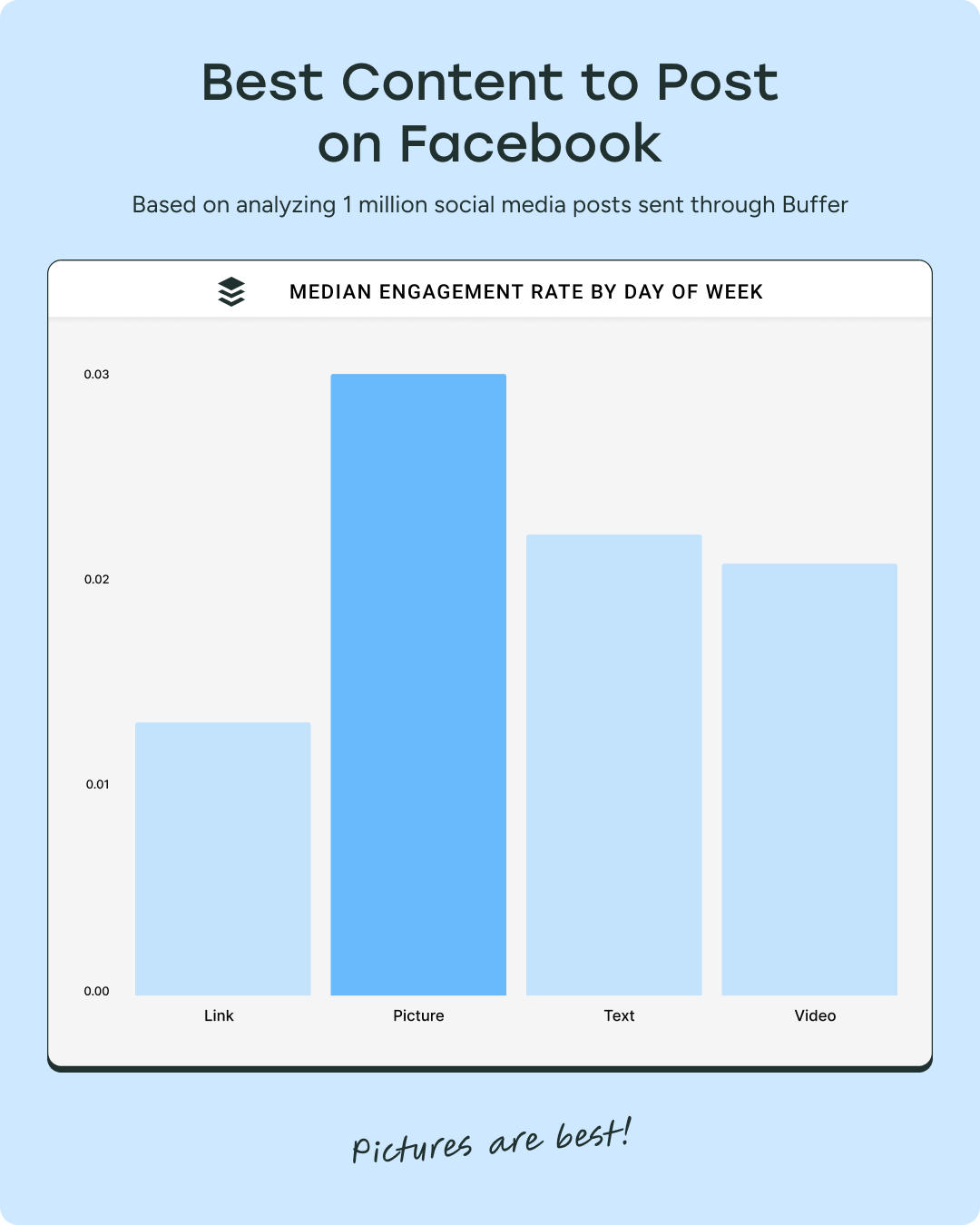
Although Facebook is pushing video, our data found that photos on Facebook are the winner when it comes to median engagement.

6. Share user-generated content

When people tag you in posts, take notice: this is a perfect opportunity to share that post as UGC (or user-generated content) — with their permission, of course. UGC helps show followers real experiences with your brand, while also giving the original poster a little recognition in return.

Reviews are another great source of content. If someone’s left a thoughtful review of your business on sites like Trustpilot or Yelp, you can turn it into a short Facebook post and tag the person in a caption. It’s a simple way to show social proof — and it might even bring in a new follower (if the reviewer wasn't following you to begin with).

7. Create meaningful conversations

Posts that spark meaningful interactions are more likely to get noticed, not just by your audience but by the Facebook algorithm too. Facebook likes authentic accounts that contribute to their community and help start or sustain thoughtful conversations.

That doesn’t mean every post needs to be deep or discussion-heavy. It simply means thinking beyond one-way updates or promotions. Facebook’s goal is to “bring people closer together and build relationships,” so posting overly promotional content that doesn't get comments or shares won't help your ranking. Instead of talking at your audience, aim to talk with them — ask questions, share ideas people can respond to, or invite your followers to weigh in on something.

Interacting with other people’s posts helps too. Joining relevant conversations shows you’re there to engage and be part of the community instead of simply broadcasting.

8. Avoid clickbait and engagement bait

Inside the Facebook Algorithm in 2026: All the Updates You Need to Know

Facebook regularly updates its algorithm to pinpoint posts that fall into the clickbait and spammy links category. 

Clickbait is content that is exaggerated, over-sensationalized, and borderline spam. It promises a result but doesn't deliver — think headlines like “The one fruit you need to stay young”, which is an obvious tactic because this magical fruit doesn’t exist.

Some clickbait links can cross the line into fake news, especially when they make claims that are both exaggerated and untrue. Fake news has been rampant on Facebook, so they've been doubling down on looking for signals that indicate misinformation or misdirection since 2018

Posting fake news for whatever purpose — creating false urgency, fostering fear — is against Facebook’s Community Standards, and repeated offenses can get you banned from the platform.

Not all clickbait is false. A post might use a sensationalist headline to grab attention without spreading misinformation — like “You’ll never guess what happened to this man out walking his dog,” even if the story ends up being true but underwhelming. Still, it goes against Facebook’s recommendations guidelines, and the Facebook algorithm will demote these in the feed.

Engagement bait, on the other hand, uses captions or photos that contain phrases like, “Like this if you like dogs better, share this if you like cats better.” It’s mostly harmless, but it doesn’t create any meaningful interactions — and it often feels spammy. This also goes against the recommendations guidelines, and the Facebook algorithm will demote these posts too.

9. Follow Facebook’s Community Standards

We've talked about this, but it bears repeating. Facebook takes its Community Standards very seriously. The algorithm is pretty good at weeding out posts that violate these rules, but even if a post manages to skirt under the radar, Facebook users can report it and have it taken down anyway. 

If your posts get removed or reported repeatedly, the overall “score” of your profile will also go down, which will lessen the visibility of your posts. In some cases, Facebook can also remove you from the platform entirely.

Don't try to game the Facebook algorithm — work with it

There you have it: there’s no shortcut to Facebook success. Yes, it’s a long game. But high-quality, engagement-driving content that doesn’t violate any guidelines is the best way to play it.

With Buffer, you can plan, publish, and analyze Facebook content that works with the algorithm — all from one place.

You’ll be watching those follower numbers climb in no time.

Get started for free.

FAQ about the Facebook algorithm

How does the Facebook algorithm work?

The Facebook algorithm uses machine learning to decide which posts appear in each user’s feed. It looks at thousands of signals — like past interactions, post type, and engagement — to predict what content someone is most likely to find relevant and valuable.

What types of content does Facebook prioritize?

Facebook prioritizes content that sparks meaningful engagement, such as comments, shares, and longer viewing time. Native formats like photos, text posts, reels, and videos generally perform better than posts that send people off the platform.

Do Facebook Reels get more reach?

Often, yes. Reels have their own dedicated feed and are heavily recommended to users who don’t already follow you. Short-form video — especially under 90 seconds — is one of the fastest ways to reach new audiences on Facebook.

How important is engagement for the Facebook algorithm?

Very. Engagement is one of the strongest signals Facebook uses when ranking content. Posts that encourage genuine interaction — thoughtful comments, replies, and shares — are more likely to be shown to more people.

What content is not eligible for Facebook recommendations?

Even if a post follows Facebook’s Community Standards, it may still be excluded from recommendations if it’s clickbait, engagement bait, misleading, overly promotional, or covers sensitive topics like health or finance without credible context.

Can you “beat” the Facebook algorithm?

There’s no shortcut or hack. The best way to work with the algorithm is to post consistently, create content your audience genuinely cares about, engage in conversations, and follow Facebook’s guidelines.

More Facebook resources

https://buffer.com/resources/facebook-algorithm/


Meta wins monopoly trial, convinces judge that social networking is dead

Other factors stemmed from social changes, the judge suggested, describing the fourth factor as a trend where Meta app users started feeling “increasingly bored by their friends’ posts.”

“Longtime users’ friend lists” start fresh, but over time, they “become an often-outdated archive of people they once knew: a casual friend from college, a long-ago friend from summer camp, some guy they met at a party once,” Boasberg wrote. “Posts from friends have therefore grown less interesting.”

Then came TikTok, the fifth factor, Boasberg said, which forced Meta to “evolve” Facebook and Instagram by adding Reels.

And finally, “those five changes both caused and were reinforced by a change in social norms, which evolved to discourage public posting,” Boasberg wrote. “People have increasingly become less interested in blasting out public posts that hundreds of others can see.”

As a result of these tech advancements and social trends, Boasberg said, “Facebook, Instagram, TikTok, and YouTube have thus evolved to have nearly identical main features.” That reality undermined the FTC’s claims that users preferred Facebook and Instagram before Meta shifted its focus away from friends-and-family content.

“The Court simply does not find it credible that users would prefer the Facebook and Instagram apps that existed ten years ago to the versions that exist today,” Boasberg wrote.

Meta apps have not deteriorated, judge ruled

Boasberg repeatedly emphasized that the FTC failed to prove that Meta has a monopoly “now,” either actively or imminently causing harms.

The FTC tried to win by claiming that “Meta has degraded its apps’ quality by increasing their ad load, that falling user sentiment shows that the apps have deteriorated and that Meta has sabotaged its apps by underinvesting in friend sharing,” Boasberg noted.

https://arstechnica.com/tech-policy/2025/11/meta-wins-monopoly-trial-convinces-judge-that-social-networking-is-dead/


What Is a Good Facebook Engagement Rate? Data From 52 Million+ Posts

One of the most common questions creators and brands ask: “Is my engagement rate good?”

The answer depends on your follower count. A 5% engagement rate looks very different for a neighborhood café with 500 fans than for a news publisher with half a million.

That’s why we analyzed 52 million Facebook posts across 213,000 accounts with over 6.9 billion engagements collectively, to see how engagement rates shift by follower tier. The result was a clear picture of what “good” looks like — from under 1,000 followers all the way up to 1 million or more.

⚡ Want to explore more metrics like reach, posting frequency, and growth rate? Check out our Facebook benchmarks tool.

🔢 The average Facebook account today

  • Median engagement rate: 3.8%
  • Average posting frequency: 34 posts per month (~1 per day)
  • Average follower growth rate: 0.5% per month
  • Median reach per post: 365

This is the “typical” Facebook account. But averages only tell part of the story. The more useful insight comes when you compare your own performance to accounts of a similar size.

🧮 Learn how we calculate engagement rates in What is Engagement Rate?

🪜 Engagement rates by follower tier

Here are the engagement rates to expect at each follower tier on Facebook from nano to mega accounts.

0 – 1K followers: Early traction is personal

  • Engagement rate: 8.8%
  • Posting frequency: 19 posts/month or 4 to 5 posts per week
  • Growth rate: 0.7% per month
  • Median reach per post: 21

At this stage, engagement is at its peak because your audience is mostly people you know — friends, family, and early customers. They interact heavily, which makes the rate look high.

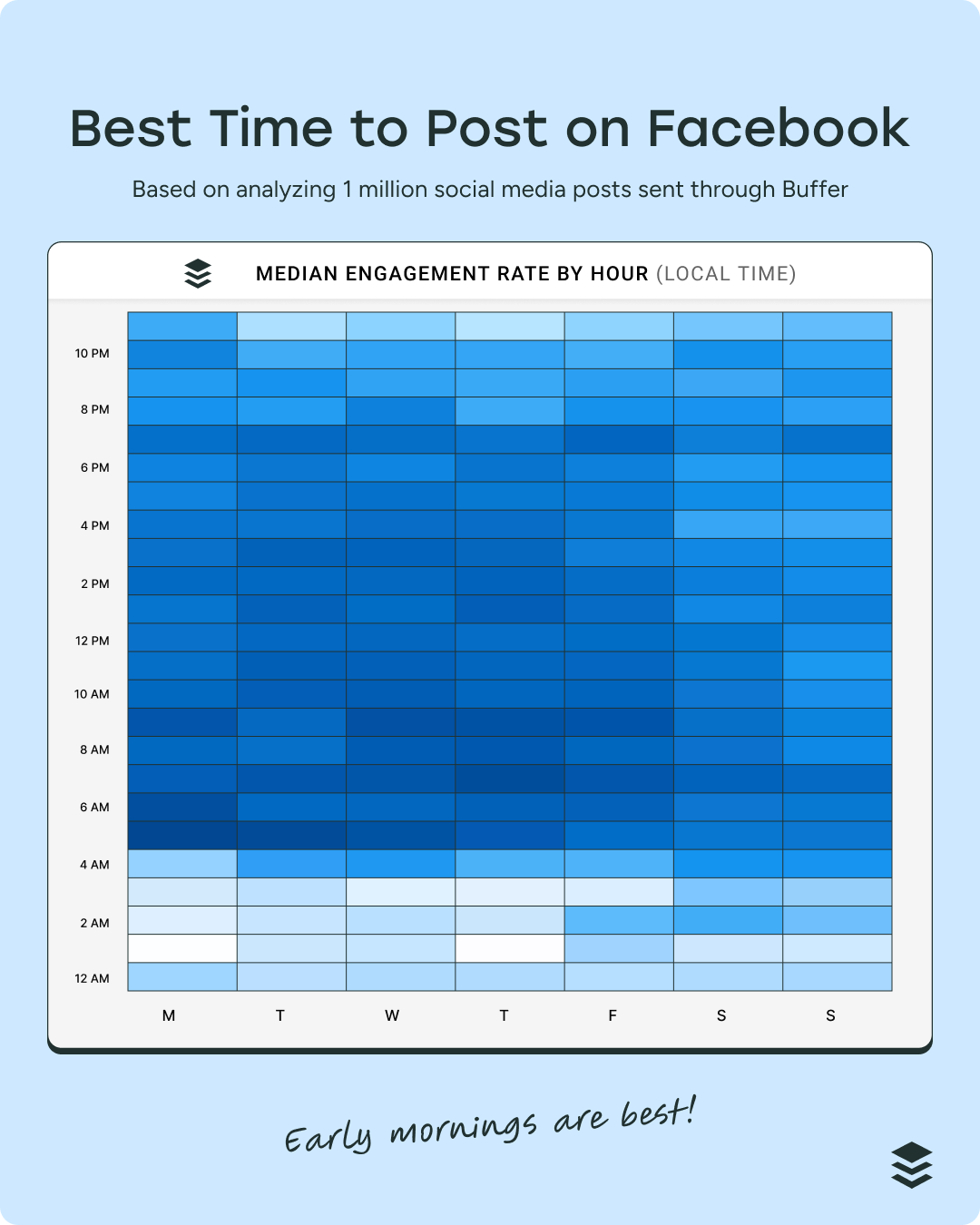
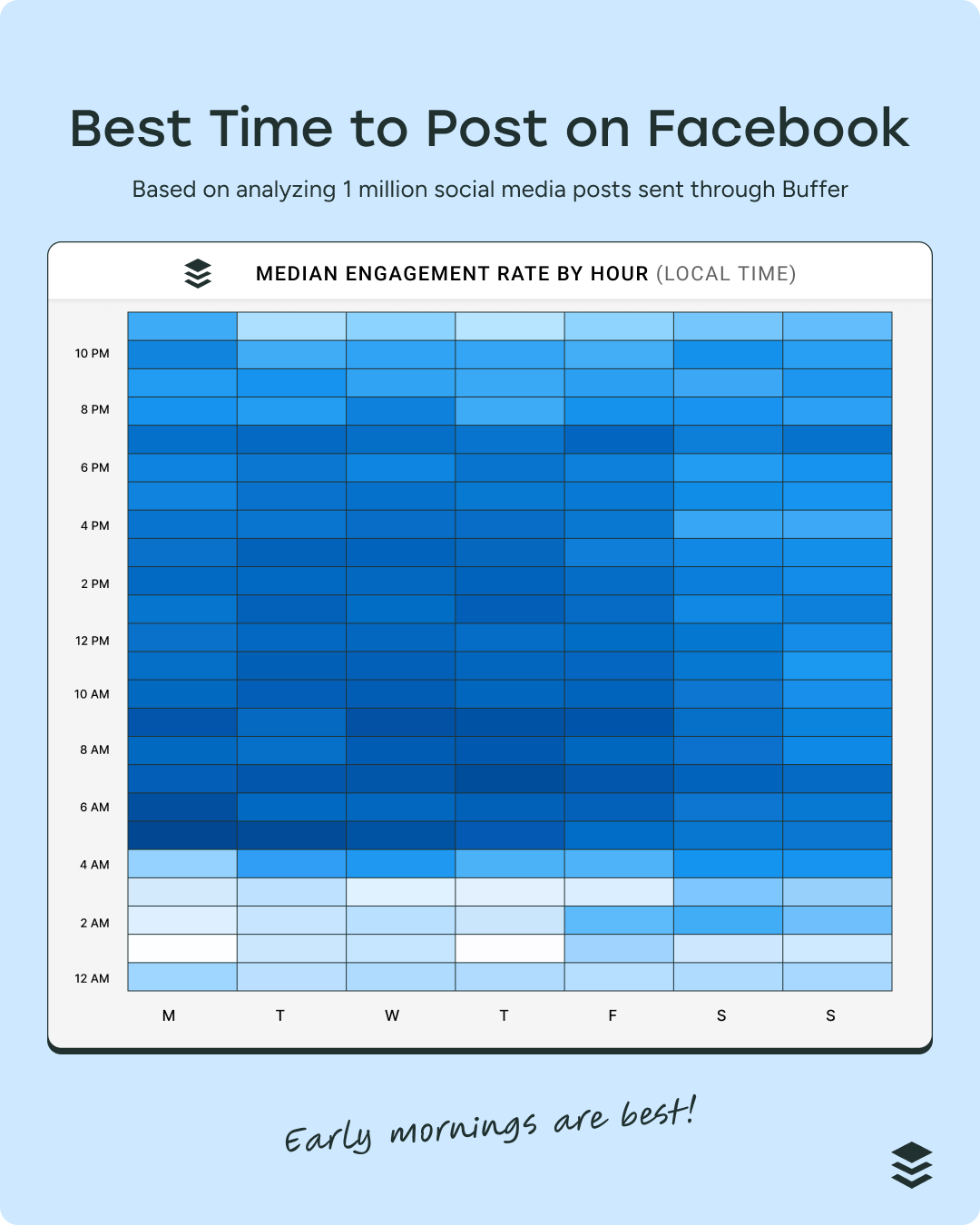
According to Buffer data, the best time to post on Facebook is 5 a.m. on Monday. Posts shared in the early morning generally get the highest media engagement of the entire week.

best time to post on facebook

🟢 Do this: Use this stage to build the habit of posting consistently. Experiment with different formats (links, text, images, video) and track what sparks the most interaction. Don’t overthink performance — consistency is the real win here.

📖 Learn more about your best time to post in Best Time to Post on Facebook: Updated for 2025

1 – 5K followers: Broadening your circle

  • Engagement rate: 5.6%
  • Posting frequency: 23 posts/month or ~5 per week
  • Growth rate: 0.1% per month
  • Median reach per post: 129

As your audience expands beyond your close circle, engagement naturally dips. That’s not a failure — it’s a sign that you’re starting to reach a wider, less personally connected group.

🟢 Do this: Keep up a steady posting rhythm and start noting which types of posts perform better. At this stage, optimization matters: look at your top-performing posts and create variations.

5 – 10K followers: Finding repeatable wins

  • Engagement rate: 4.7%
  • Posting frequency: 35 posts/month (~1 per day)
  • Growth rate: 0.2%/month
  • Median reach per post: 271

Engagement rates continue to dip slightly, but you’re now reaching hundreds per post. This is where patterns start to emerge — you’ll likely notice certain topics, visuals, or formats consistently outperforming others.

Note the content types that perform best. We found that posts with photos tend to get 34.7% more engagement than text-based posts and 43.8% more engagement than video posts.

best content to post on facebook

🟢 Do this: Identify repeatable formats (like templates, series, or hooks) to scale without reinventing the wheel each week.

📖 Learn more about which formats perform best in Data Shows Best Content Format on Social Platforms in 2025: Millions of Posts Analyzed

10 – 50K followers: Momentum with scale

  • Engagement rate: 4.6%
  • Posting frequency: 56 posts/month (~2 per day)
  • Growth rate: 0.5%/month
  • Median reach per post: 629

At this level, you’re getting real traction — thousands of people reached monthly. Engagement rate holds steady, but the raw number of interactions is far larger.

🟢 Do this: Consider boosting posts that are already doing well to extend reach. Organic engagement is strong here, but ads can amplify your winners.

📖 Learn more about how to boost your content in How to Run Facebook Ads: Beginner’s Guide to Advertising on Facebook

50 – 100K followers: Audience maturity

  • Engagement rate: 4.3%
  • Posting frequency: 107 posts/month (~3 to 4 per day)
  • Growth rate: 0.2%/month
  • Median reach per post: 1,646

Your content is reaching thousands, but growth slows and posting frequency climbs. This reflects how competitive the feed is at higher levels.

🟢 Do this: Focus on quality signals (comments and shares) over vanity metrics. They carry more weight in Facebook’s algorithm at this scale.

100 – 500K followers: High visibility, lower rate

  • Engagement rate: 3.9%
  • Posting frequency: 179 posts/month (~6 per day)
  • Growth rate: 0.1%/month
  • Median reach per post: 2,846

Here, engagement looks lower in percentage terms, but each post still pulls in thousands of interactions. Maintaining quality and volume becomes the real challenge.

🟢 Do this: Build systems — whether through scheduling tools, templates, or a content team — to sustain posting without sacrificing quality.

📖 Start with scheduling and add it to your system with How to Schedule Facebook Posts in 3 Easy Ways (+ Save Hours Every Week)

500K – 1M followers: Scale brings pressure

  • Engagement rate: 4.2%
  • Posting frequency: 302 posts/month (~10 per day)
  • Growth rate: 0.0%/month
  • Median reach per post: 8,800

At this point, reach skyrockets, but growth plateaus. Engagement percentages tick up slightly, but at such scale, maintaining connection is hard.

🟢 Do this: Prioritize content that builds loyalty — community posts, live sessions, behind-the-scenes — instead of just volume.

1M+ followers: Huge reach, steady rates

  • Engagement rate: 3.8%
  • Posting frequency: 436 posts/month (~14 per day)
  • Growth rate: 0.7%/month
  • Median reach per post: 15,683

Massive audiences mean massive baseline reach. But engagement plateaus, and volume is extreme. At this tier, systems and teams are often essential.

🟢 Do this: Balance reach with trust. Be selective about sponsored posts and prioritize formats that spark meaningful interactions.

Why engagement changes as accounts grow

Smaller accounts often see higher engagement because audiences are tighter-knit and more personal — your parents, extended family and best friend from kindergarten.

As follower counts climb, engagement rates dip — but absolute interactions grow.

That’s why the most useful benchmark is the one that matches your tier, not accounts 10x your size.

What these benchmarks mean for you

With a sharp focus on Facebook, you can see steady growth on Facebook.

  • For small accounts: focus on building habits and experimenting.
  • For mid-sized accounts: optimize your content mix and double down on formats that work.
  • For larger accounts: invest in systems, retaining audience loyalty, and sustainable workflows.

Growth on Facebook isn’t linear — but consistency pays off at every stage.

🤔 Curious how your account stacks up? Explore the full dataset with our Facebook benchmarks tool.

https://buffer.com/resources/facebook-benchmarks/


EU accuses Meta of violating content rules in move that could anger Trump

FTC Chairman Andrew Ferguson recently warned Meta and a dozen social media and technology companies that “censoring Americans to comply with a foreign power’s laws, demands, or expected demands” may violate US law. Ferguson’s letters said the EU’s Digital Services Act and other laws “incentivize tech companies to censor worldwide speech.”

Meta told media outlets that “we disagree with any suggestion that we have breached the DSA, and we continue to negotiate with the European Commission on these matters.” Meta also said it made changes to comply with the DSA.

“In the European Union, we have introduced changes to our content reporting options, appeals process, and data access tools since the DSA came into force and are confident that these solutions match what is required under the law in the EU,” Meta said.

TikTok, Meta accused of restricting data access

The EC also said it preliminarily found that both Meta and TikTok violated their DSA obligation to grant researchers adequate access to public data.

“The Commission’s preliminary findings show that Facebook, Instagram and TikTok may have put in place burdensome procedures and tools for researchers to request access to public data. This often leaves them with partial or unreliable data, impacting their ability to conduct research, such as whether users, including minors, are exposed to illegal or harmful content,” the announcement said.

The data-access requirement “is an essential transparency obligation under the DSA, as it provides public scrutiny into the potential impact of platforms on our physical and mental health,” the EC said.

In a statement provided to Ars, TikTok said it is committed to transparency and has made data available to nearly 1,000 research teams. TikTok said it may be impossible to comply with both the DSA and the General Data Protection Regulation (GDPR).

“We are reviewing the European Commission’s findings, but requirements to ease data safeguards place the DSA and GDPR in direct tension. If it is not possible to fully comply with both, we urge regulators to provide clarity on how these obligations should be reconciled,” TikTok said.

https://arstechnica.com/tech-policy/2025/10/trump-tariff-threats-havent-stopped-eu-from-cracking-down-on-meta/


16 Facebook Statistics to Know for 2025

As a marketer, you might have heard that Gen Z prefers TikTok, Instagram is trendier and so on. But Facebook is far from flailing. It’s the biggest social network in the world — by a large margin.

Gen Z prefers TikTok, Instagram is trendier, and new platforms are emerging to capture attention. But the data says different: Facebook isn’t merely hanging on, it’s the biggest social network in the world.

With over 3 billion monthly active users, Facebook sits at the center of Meta’s ecosystem and is one of the most important channels for marketers thanks to its highly effective ads. Its user base spans nearly every demographic and region, making it a platform that businesses can’t ignore, even as newer apps dominate headlines.

This roundup covers who uses Facebook in 2025, what performs, and how it shows up in consumer behavior and creator campaigns.

Facebook’s user base is massive (and more diverse than you might think)

Despite endless debates about whether Facebook is “for older generations” or “losing relevance,” the numbers don’t lie: Facebook is the biggest social platform in the world.

Facebook still dominates with over 3 billion monthly users

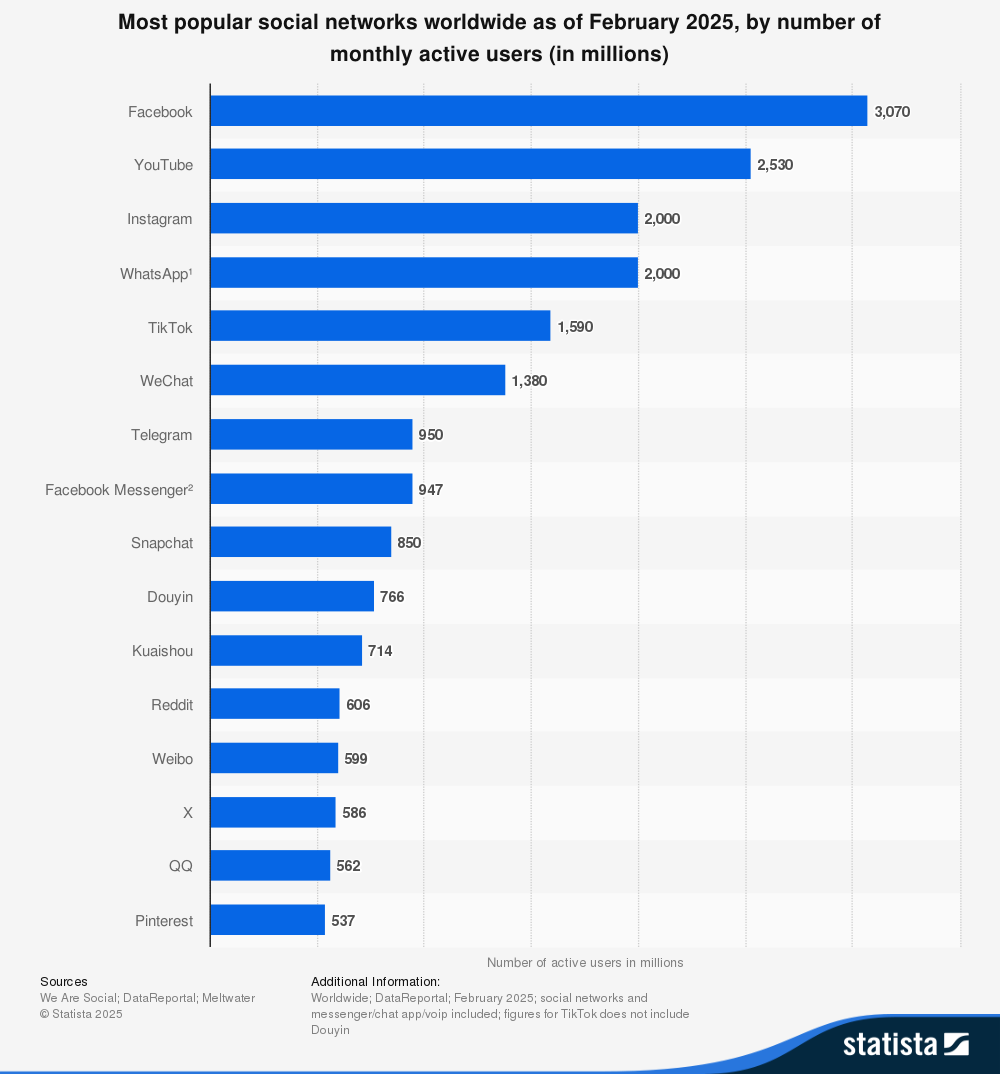
According to Statista, as of Q2 2024, it had 3.07 billion monthly active users — nearly 40% of the global population.

Horizontal bar chart ranking platforms by active users (in millions): Facebook (3,070M), YouTube (2,530M), Instagram (2,000M), WhatsApp (2,000M), TikTok (1,590M), WeChat (1,380M), Telegram (950M), Facebook Messenger (947M), Snapchat (850M), Douyin (766M), Kuaishou (714M), Reddit (606M), Weibo (599M), X/Twitter (586M), QQ (562M), Pinterest (537M).

Scale matters here — no platform can match Facebook’s reach and demographics. And if you zoom out to Meta’s family of apps (the parent company of Facebook), the numbers get even larger.

An estimated 90% of social media users worldwide have a Facebook account, and across Meta’s family of apps — including Instagram, Messenger, and WhatsApp — 3.48 billion people log in daily, according to Statista, 2025.

So if you’re wondering whether your audience is on Facebook, the answer is likely: yes.

Facebook’s global audience skews slightly male

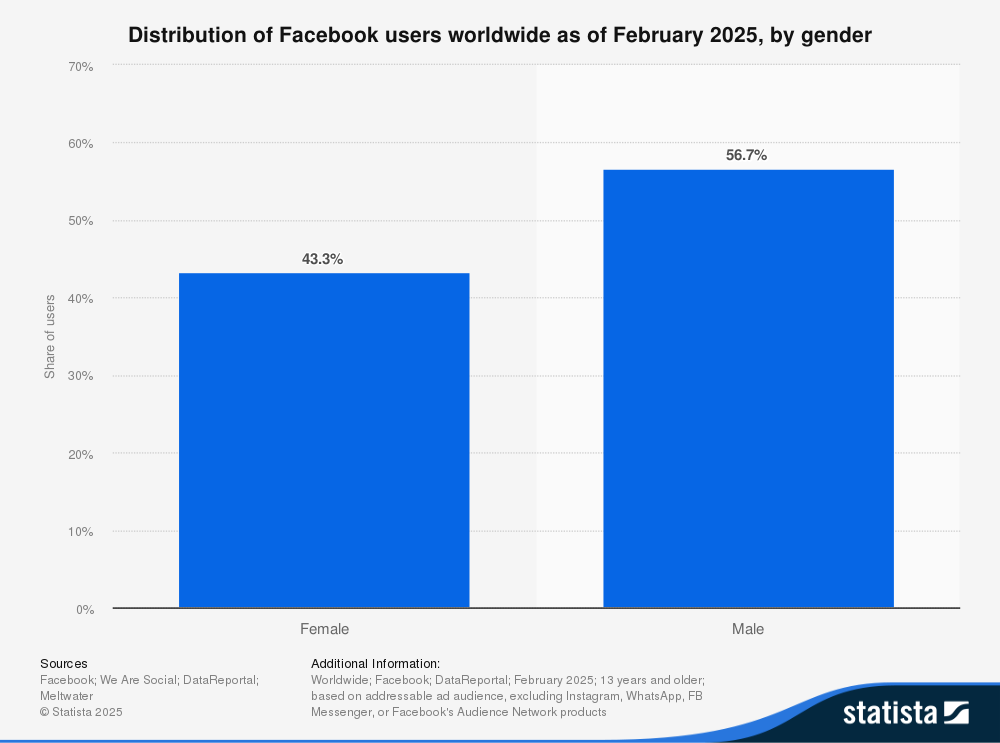
According to Statista, 2025, 56.8% of Facebook’s audience identifies as male, while 43.2% identifies as female.

If you’re tailoring content to a specific audience, this skew is worth keeping in mind — especially compared to more balanced platforms like Instagram.

Bar chart showing 43.3% female users and 56.7% male users.

💡

Note: The data we have access to only includes binary gender options (male and female). No additional gender identities were captured or reported.

Millennials make up Facebook’s core audience

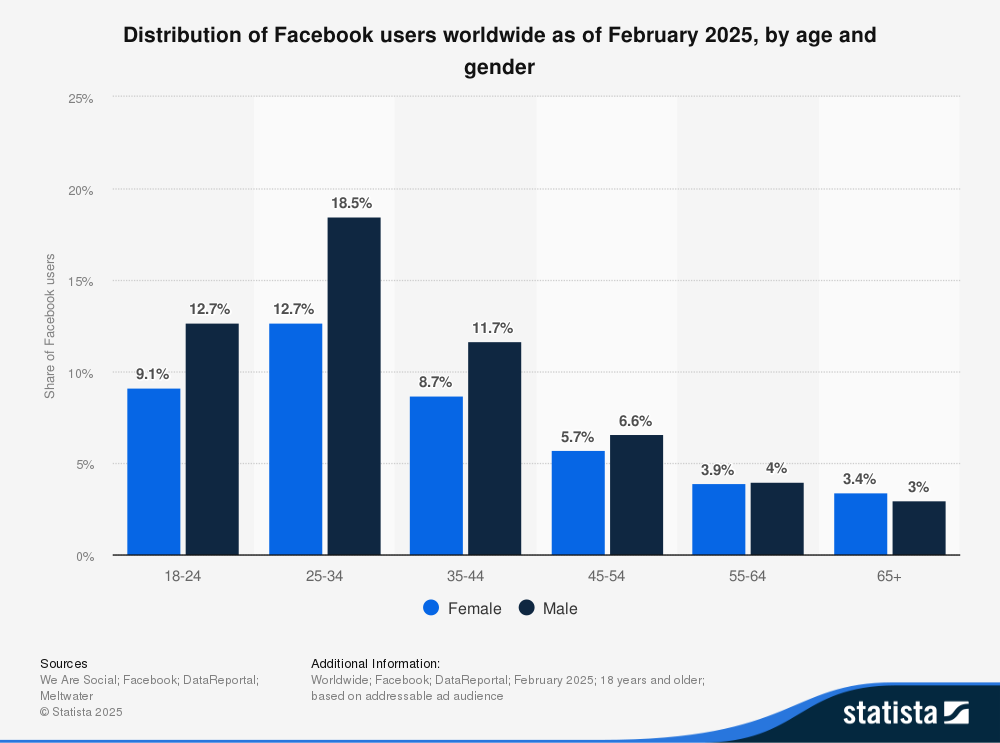
Facebook’s largest demographic is men aged 25–34, who account for 18.5% of users, as shared by Statista, 2025.

In fact, millennials between 25 and 44 make up just over half of the platform’s audience — a reminder that the group who first fueled Facebook’s rise are still highly active.

Bar chart showing usage by age group and gender: Ages 18–24: 9.1% female, 12.7% male Ages 25–34: 12.7% female, 18.5% male Ages 35–44: 8.7% female, 11.7% male Ages 45–54: 5.7% female, 6.6% male Ages 55–64: 3.9% female, 4% male Ages 65+: 3.4% female, 3% male.

But younger audiences aren’t absent. Men aged 18–24 are the second-largest user group, showing that Facebook continues to play a role in Gen Z’s digital mix (even if they spend more time overall on TikTok or Instagram, as shared by DataReportal, 2023).

At the other end of the age spectrum, only 6.1% of users are over 65, despite Facebook’s reputation as the “boomer app.”

The average social media user spends 36 minutes per day on Facebook

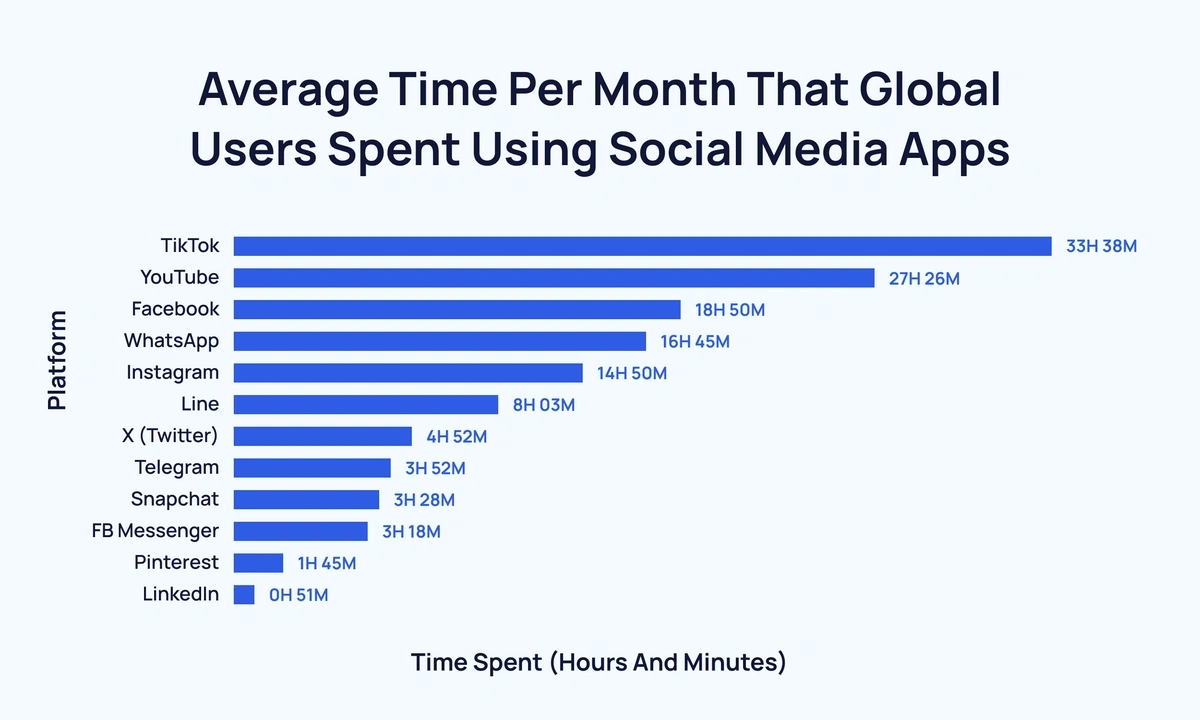
For the average social media user, Facebook is still part of their routine — nearly 19 hours a month, according to DataReportal, 2023.

That puts it behind apps like TikTok (33 hours, 38 minutes) and YouTube (27 hours, 26 minutes), but it’s far from being “checked once in a while.”

Horizontal bar chart: TikTok 33h 38m, YouTube 27h 26m, Facebook 18h 50m, WhatsApp 16h 45m, Instagram 14h 50m, Line 8h 03m, X (Twitter) 4h 52m, Telegram 3h 52m, Snapchat 3h 28m, FB Messenger 3h 18m, Pinterest 1h 45m, LinkedIn 51m.
Image Source

This doesn’t mean that you need to add Facebook to your strategy. But if you’re marketing to millennials, Gen X, or even older groups, Facebook still commands meaningful daily attention.

India leads the world in Facebook users

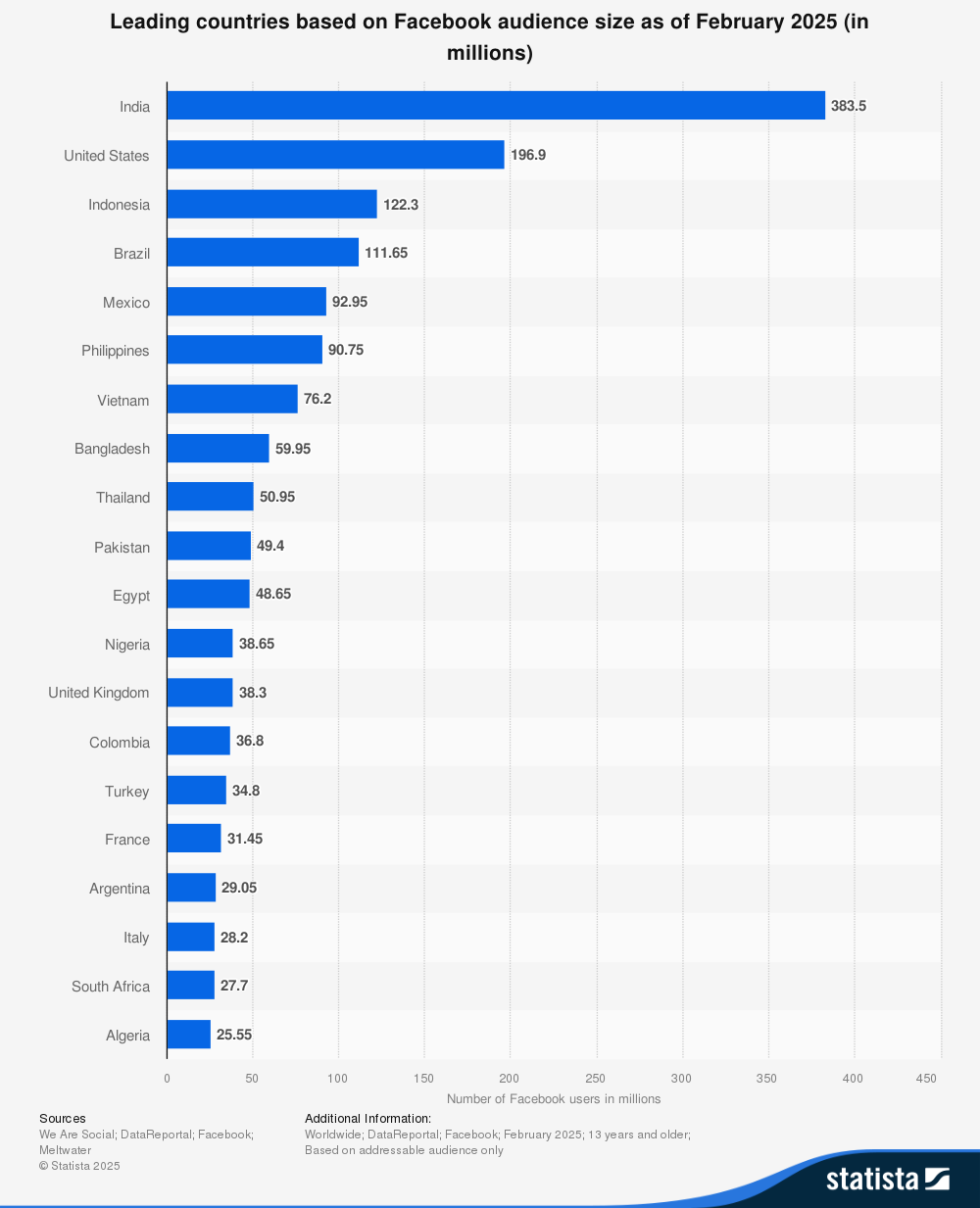
Facebook may be global, but its audience isn’t spread evenly. India tops the list with 383 million users (more than the entire U.S. population), according to Statista, 2025. To put it in perspective, if India’s Facebook audience were a country, it would be the third largest in the world.

Bar chart showing top countries: India (383.5M), US (196.9M), Indonesia (122.3M), Brazil (111.65M), Mexico (92.95M), Philippines (90.75M), Vietnam (76.2M), Bangladesh (59.95M), Thailand (50.95M), Pakistan (49.4M), Egypt (48.65M), Nigeria (38.65M), UK (38.3M), Colombia (36.8M), Turkey (34.8M), France (31.45M), Argentina (29.05M), Italy (28.2M), South Africa (27.7M), Algeria (25.55M).

Other major markets include the United States (196.9 million), Indonesia (122.3 million), and Brazil (111.65 million).

Together, these four countries make up a massive share of Facebook’s active audience and highlight where the platform has the most reach.

This means Facebook isn’t just a Western platform — its influence is strongest in large, mobile-first markets. If you’re looking to grow internationally, these countries are where your campaigns could see the biggest impact.

How people use Facebook

Knowing who’s on Facebook is only half the picture — the real insight comes from how people actually use it.

While the platform may not influence cultural conversation at the same scale as TikTok or X, Facebook is still deeply woven into daily routines.

For the creators, business owners, and marketers who rely on the platform, that mix of habitual use and massive reach means Facebook isn’t fading into the background. It’s just being used differently than it once was.

Facebook is still one of the most visited sites in the world

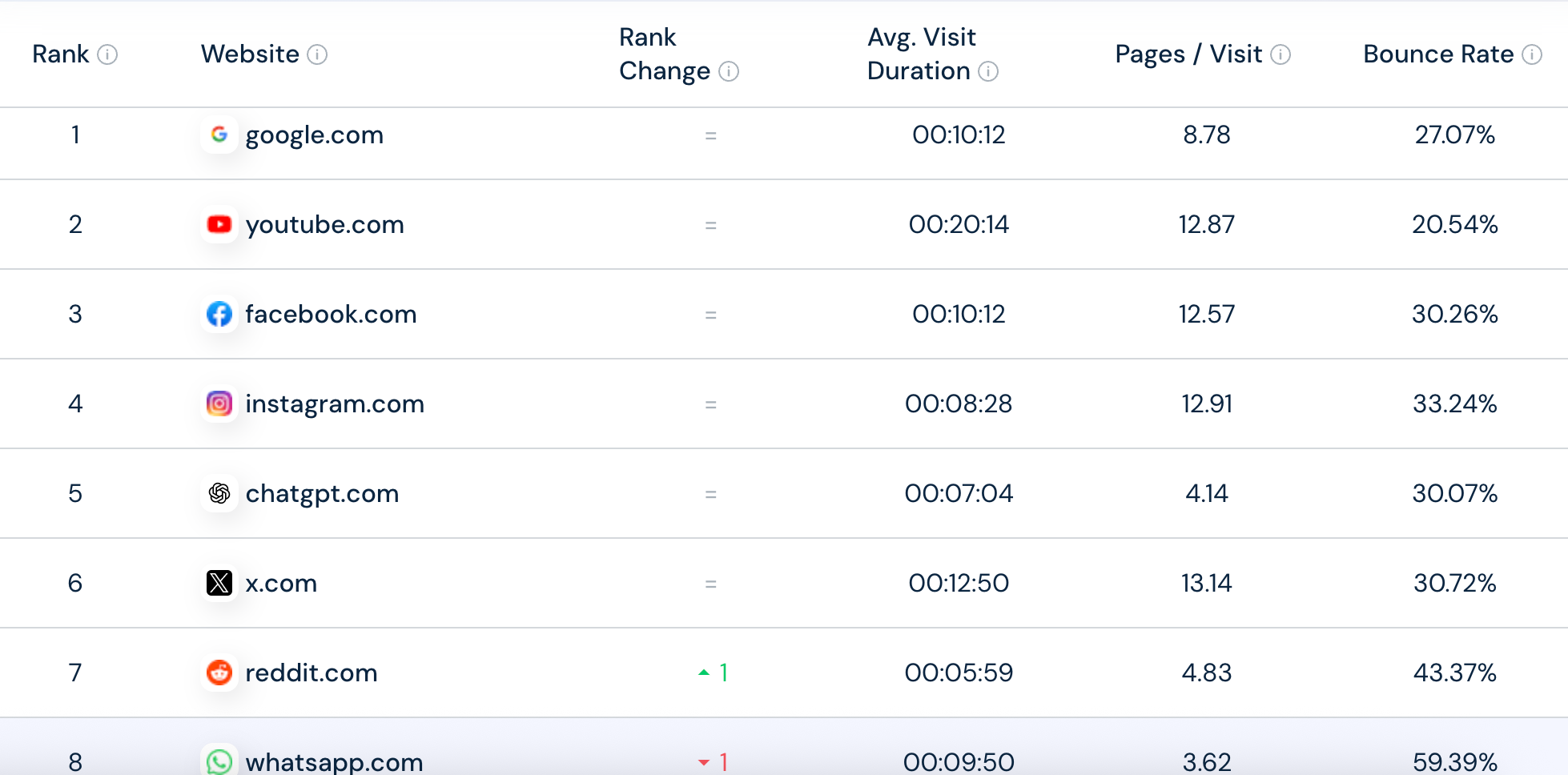
Despite how long it’s been around — or maybe because of that — Facebook remains a daily habit for billions. According to Similarweb, it’s the third most-visited website globally, behind only Google and YouTube. That puts it ahead of newer heavyweights like TikTok and Instagram.

Table showing global website rankings

This ranking shows that even if people spend less time per session than on other platforms, they keep coming back — often multiple times a day.

Most people use Facebook only on their phones

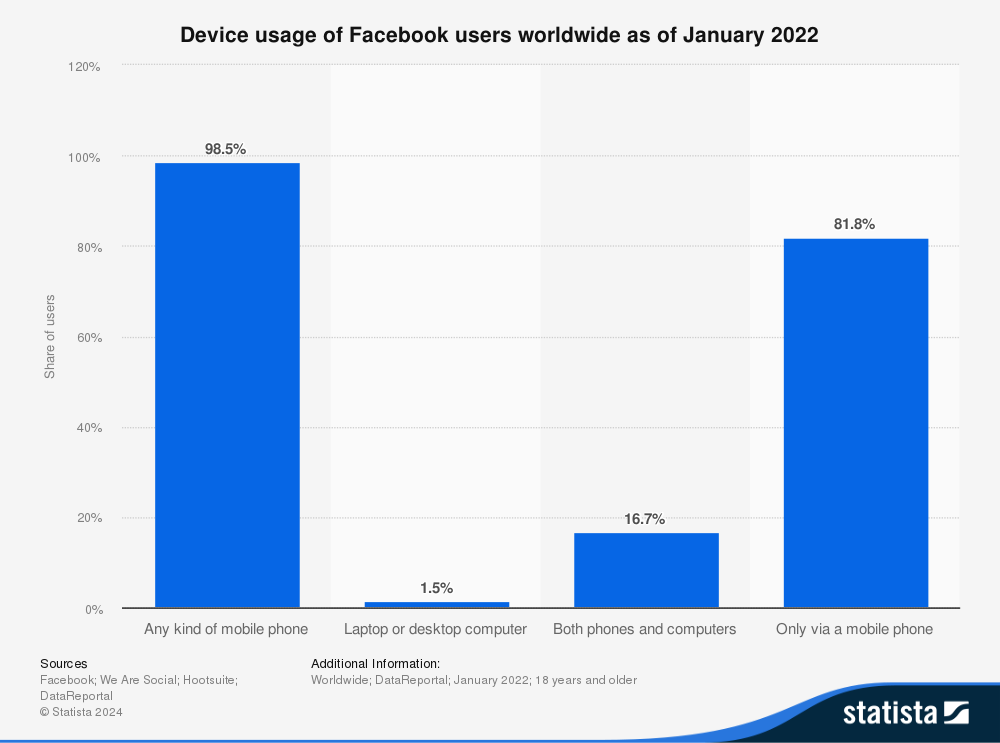
Like every major social platform, Facebook has gone mobile-first. Today, 81.8% of users access Facebook exclusively through their phones, while just 1.5% use desktop only, according to Statista, 2024. The rest split their time between the two.

Bar chart showing 98.5% of users access Facebook via any kind of mobile phone, 1.5% via laptop or desktop only, 16.7% via both phones and computers, and 81.8% only via a mobile phone.

That dominance of mobile matters for both creators and brands. Content needs to be designed for vertical scrolling, grabbing attention in the first few seconds, and encouraging interactions.

Stories draw half a billion daily users

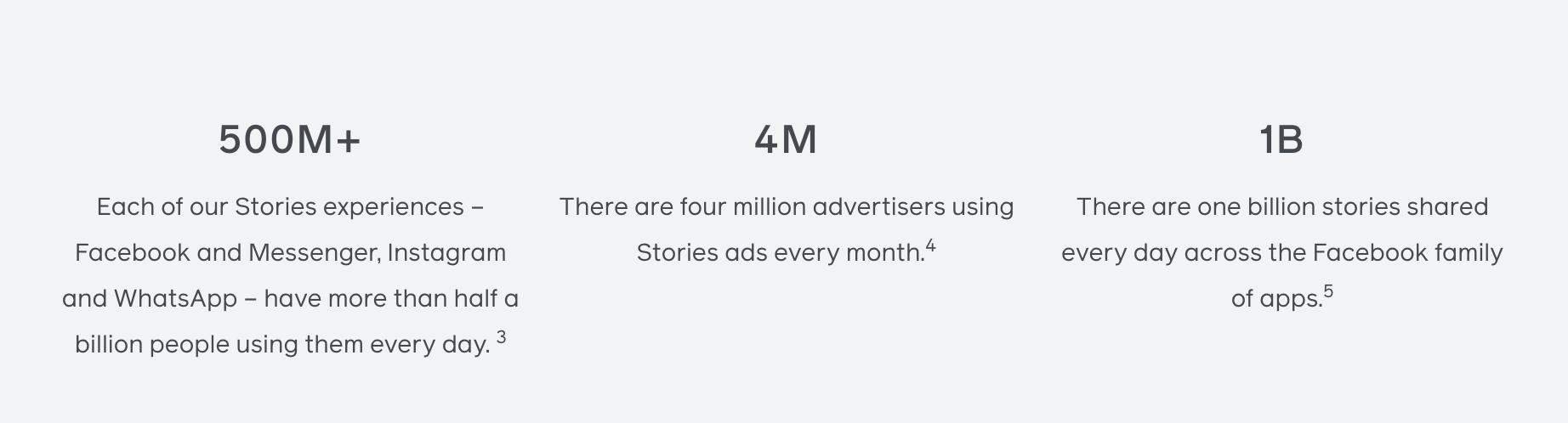
Even as Meta shifts its content focus toward reels, across its platforms, Facebook Stories haven’t faded. According to the platform, more than 500 million people use stories every day, making it one of the platform’s most consistent features.

Infographic with three stats: 500M+ people use Stories daily across Facebook, Messenger, Instagram, and WhatsApp. 4M advertisers use Stories ads each month. 1B stories are shared daily across Facebook’s family of apps.
Image Source

Stories thrive because they’re quick, casual, and mobile-native. They don’t require polished production or long watch times — they’re designed to disappear, which makes them feel more authentic.

That’s also why advertisers love them: stories provide a way to meet audiences in the flow of their daily scrolling without demanding too much attention.

Content performance and engagement

Not all Facebook posts perform the same. It’s vital to know which content types perform best and capture attention on the platform.

Facebook posts have one of the highest average engagement rates across social platforms

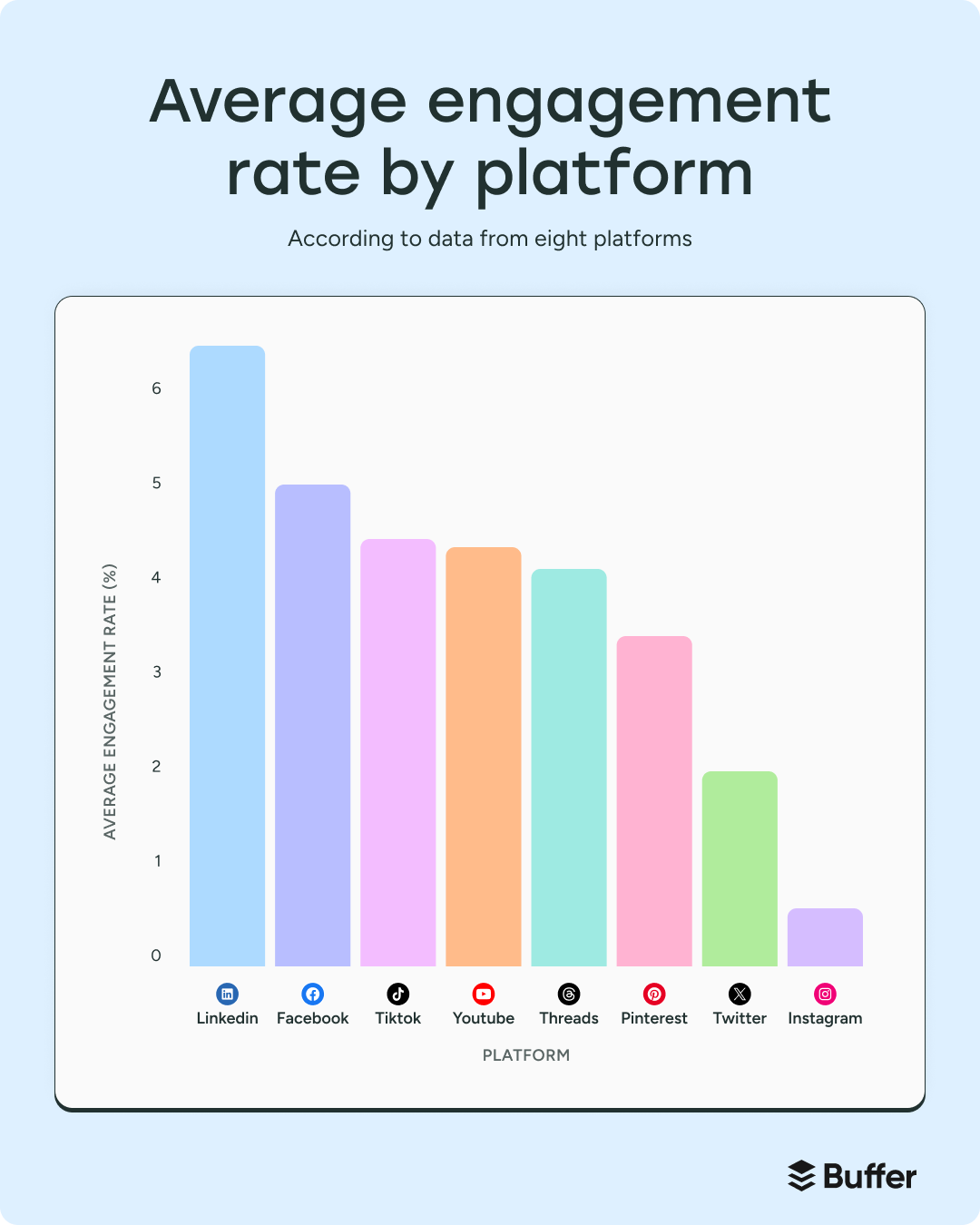
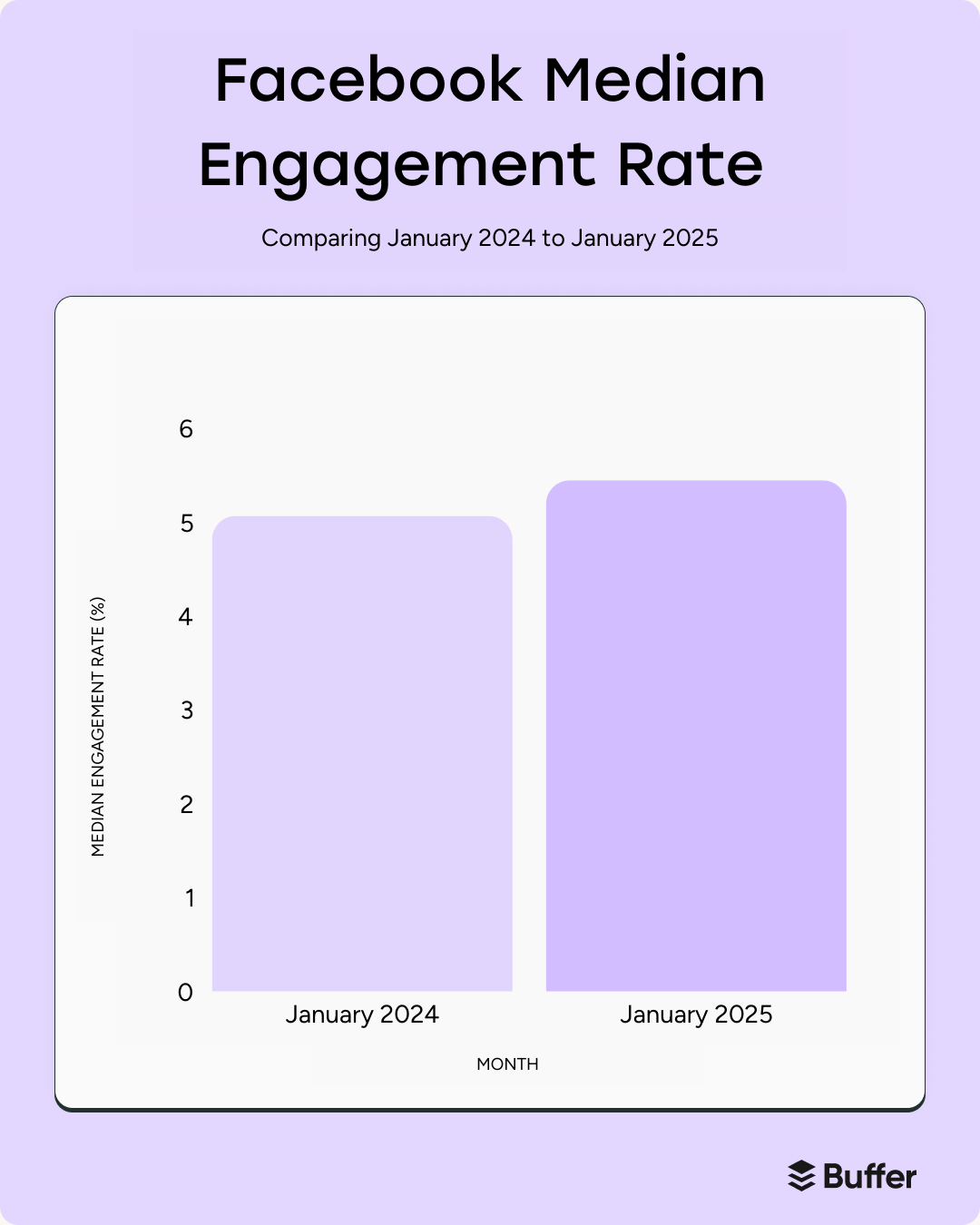
According to Buffer’s 2025 engagement rate study, Facebook posts average a 5.07% engagement rate — the second-highest across major social platforms, behind only LinkedIn (6.50%). That puts Facebook ahead of TikTok (4.86%), YouTube (4.41%), and Instagram (1.16%).

Bar chart comparing average engagement rates: LinkedIn (~6.5%), Facebook (~5%), TikTok (~4.7%), YouTube (~4.5%), Threads (~4%), Pinterest (~3.5%), Twitter (~3%), Instagram (~1%).

Notably, engagement on Facebook has held steady. While its siblings, Instagram and Threads, saw major swings in interaction patterns, Facebook held strong at around 5.45%.

Bar chart comparing median engagement rate: slightly over 5% in January 2024 vs just under 5% in January 2025, showing a small decline.

Much of this comes down to how its core audience uses the platform and Meta’s continued investment in new content and monetization features.

Photos and albums outperform other post types

Despite Meta’s big push into video, photos are still the strongest performers on Facebook.

In our 2025 analysis, pictures earned 35% more engagement than text posts and nearly 44% more than videos, making them the clear winners on the feed.

Bar chart showing median engagement rate by content type. Pictures have the highest engagement (~0.03), followed by text and video (~0.02), while links have the lowest (~0.015). Caption reads “pictures are best.”

Text posts came in second, edging out video by about 6.7%, while posts with links landed firmly in last place.

This ranking makes sense: Facebook’s feed has always rewarded quick, scroll-stopping visuals. A single photo or carousel is easier to consume than a video that requires sound or a link that pulls users out of the app. Even as Facebook Reels gain traction, images remain the format most likely to spark visible interactions.

In other words, on Facebook, simple visuals still punch above their weight.

Video is still a breakout format on Facebook

Static visuals may top the charts for engagement, but video remains one of Facebook’s fastest-growing formats. Forty percent of all time spent on Facebook and Instagram is dedicated to watching videos, according to eMarketer.

And when it comes to short-form specifically, Facebook Reels now reach an estimated 616.8 million people — nearly a third of the platform’s ad inventory, according to DataReportal, 2023.

Meta has been explicit about its focus here: Reels are reshared 3.5 billion times every day across Facebook and Instagram (Meta Creators, 2025).

That combination of reach and shareability has quickly made video the platform’s most dynamic content type, even if photos still dominate the feed.

The best time to post on Facebook is early morning

If you’re wondering when to post to get eyes on your content, early mornings can help you stand out.

Buffer’s 2025 analysis of more than 1 million posts shows that the single best time to post is 5 a.m. on Monday, with other strong slots on Tuesday at 5 a.m. and Thursday at 7 a.m.

Heatmap chart showing median engagement rate by hour and day of the week, based on 1 million posts. Darker shades represent higher engagement. The chart highlights early mornings (around 4–6 AM local time) across all days as the best times to post. Caption reads “Early mornings are best.”

Why so early? It comes down to behavior. Facebook’s largest demographic is adults aged 25–34, followed closely by 35–44 — groups most likely to check their feeds before work or right as they wake up.

Even if your post isn’t seen immediately, early-morning publishing lets it percolate in the feed so it’s waiting when users log on.

Wednesday is the best day to post on Facebook

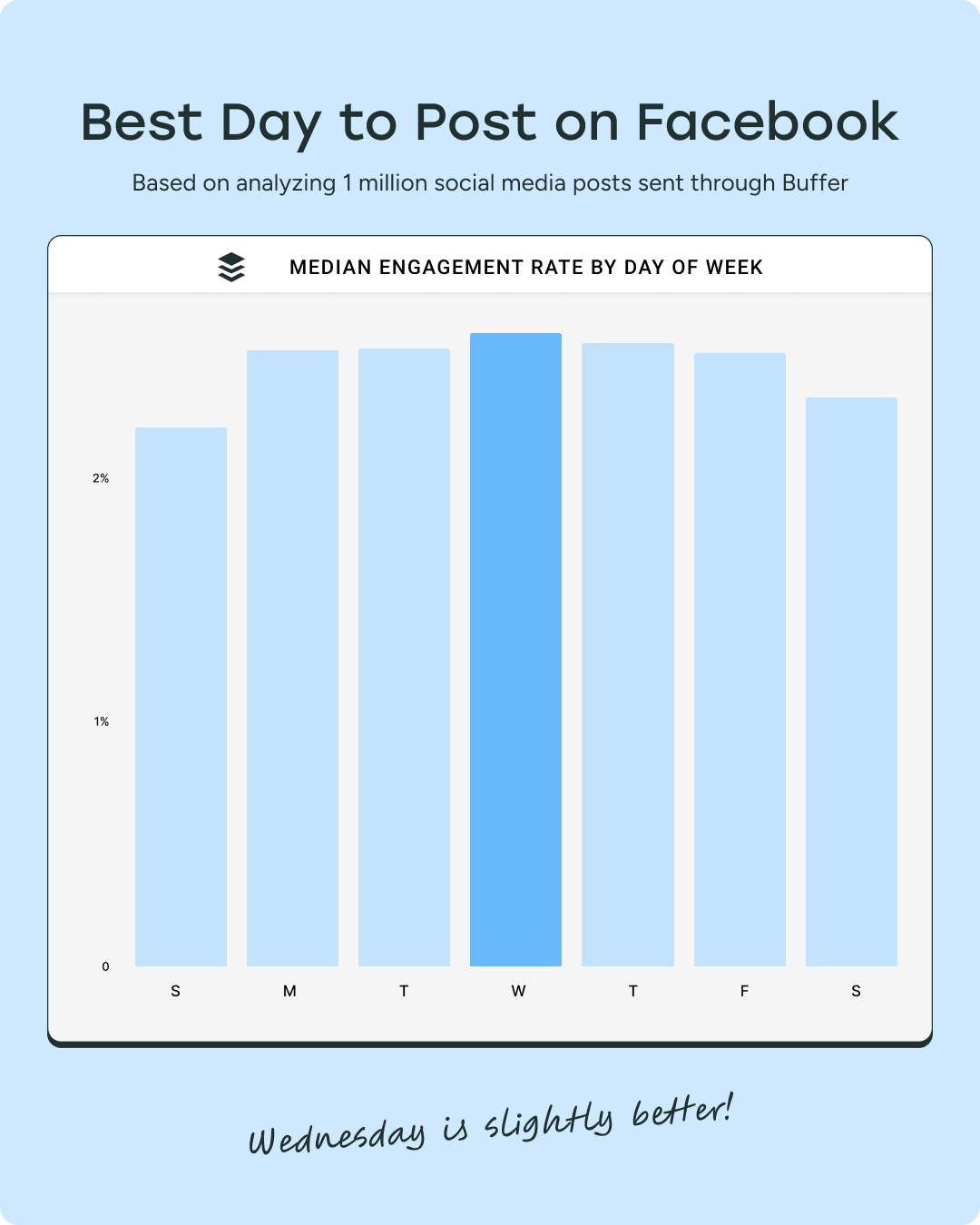
When it comes to days of the week, mid-week wins. Posts shared on Wednesday see the highest overall engagement, edging out Thursday and Tuesday.

On the flip side, weekends lag behind — posts on Sunday average 15% less engagement than those shared mid-week.

Bar chart showing median engagement rate by day of the week. Engagement is relatively steady across all days, with Wednesday slightly higher than others. Caption reads “Wednesday is slightly better.”

While the difference between weekdays is small, the pattern is clear: Facebook thrives when people are in their workweek routines, not when they’re switching off.

If timing is part of your strategy, aim for mid-week mornings to give your posts the best chance of landing.

Posting more doesn’t mean more engagement

It’s tempting to think that more posts equal more traction, but Facebook’s data tells a different story.

RivalIQ’s 2024 benchmarks show that posting frequency has little impact on engagement rates.

Across industries, the median posting frequency on Facebook is 4.69 posts per week, and the median engagement rate is just 0.063%.

The brands in the top 25% for engagement post almost the exact same amount — 4.6 posts per week — but see engagement rates three times higher (0.19%).

The state of creators and brands on Facebook

While TikTok and Instagram tend to dominate influencer conversations, Facebook still plays a surprisingly big role in creator marketing.

Brands post an average of 43 times per month on Facebook

Across industries, the median posting frequency on Facebook works out to about 43 posts per month — roughly 1.5 posts per day (Socialinsider, 2024). That cadence reflects the platform’s rhythm: steady enough to stay visible in the feed, but not so frequent that it overwhelms audiences.

Still, frequency alone doesn’t guarantee engagement. Some brands see better results by posting less often but focusing on higher-quality content. Others thrive with daily posting because their audiences expect a constant flow of updates, promotions, or community news.

In practice, it’s about balance. Think of the 43-post benchmark as a starting point — then layer in timing, content mix, and quality. The brands that succeed on Facebook don’t just keep up a steady stream; they make each post worth stopping for.

Nano- and micro-influencers provide the best ROI

According to Shopify, here are the average cost per post for different influencer tiers:

  • Nano: $100 to $1,500
  • Micro: $1,000 to $6,000
  • Mid: $1,000 $15,000
  • Macro: $5,000 $40,000
  • Mega: $10,000+

For brands with tighter budgets, nano- and micro-influencers offer the strongest ROI. Their audiences may be smaller, but they’re often more engaged and more niche, making campaigns feel authentic rather than forced.

What these Facebook statistics mean for your strategy in 2025

With more than 3 billion monthly users and a role in everything from daily habits to shopping and influencer marketing, Facebook remains the backbone of social media.

The platform’s integration into the everyday lives of social media users places it in an interesting position compared to its peers. It’s where discovery, connection, and commerce quietly overlap.

You don’t need to treat Facebook like TikTok or reinvent your content to fit in with it. Instead, lean into the formats that perform and match your posting rhythm to your audience’s habits.

https://buffer.com/resources/facebook-statistics/


Zuckerberg’s AI hires disrupt Meta with swift exits and threats to leave

“While TBD Labs is still relatively new, we believe it has the greatest compute-per-researcher in the industry, and that will only increase,” Meta said.

Wang and other former Scale staffers have struggled with some of the idiosyncratic ways of working at Meta, according to someone familiar with his thinking, for example having to adjust to not having revenue goals as they once did as a startup.

Despite teething problems, some have celebrated the leadership shift, including the appointment of popular entrepreneur and venture capitalist Friedman as head of Products and Applied Research, the team tasked with integrating the models into Meta’s own apps.

The hiring of Zhao, a top technical expert, has also been regarded as a coup by some at Meta and in the industry, who feel he has the decisiveness to propel the company’s AI development.

The shake-up has partially sidelined other Meta leaders. Yann LeCun, Meta’s chief AI scientist, has remained in the role but is now reporting into Wang.

Ahmad Al-Dahle, who led Meta’s Llama and generative AI efforts earlier in the year, has not been named as head of any teams. Cox remains chief product officer, but Wang reports directly into Zuckerberg—cutting Cox out of overseeing generative AI, an area that was previously under his purview.

Meta said that Cox “remains heavily involved” in its broader AI efforts, including overseeing its recommendation systems.

Going forward, Meta is weighing potential cuts to the AI team, one person said. In a memo shared with managers last week, seen by the Financial Times, Meta said that it was “temporarily pausing hiring across all [Meta Superintelligence Labs] teams, with the exception of business critical roles.”

Wang’s staff would evaluate requested hires on a case-by-case basis, but the freeze “will allow leadership to thoughtfully plan our 2026 headcount growth as we work through our strategy,” the memo said.

© 2025 The Financial Times Ltd. All rights reserved. Not to be redistributed, copied, or modified in any way.

https://arstechnica.com/ai/2025/08/zuckerbergs-ai-hires-disrupt-meta-with-swift-exits-and-threats-to-leave/


Facebook Marketing for Small Businesses and Creators: Tips, Tools, and Tactics That Work

With its massive reach, flexible content formats, and built-in engagement, Facebook is still one of the most powerful marketing tools for creators and small businesses. 

“For brands targeting Millennials, Gen X, or niche communities, Facebook is where real conversations are still happening,” says Cashé Collocott, founder of Kidd Digital, a boutique social media agency, “You just need to know how to show up strategically.”

As a creator and marketer who lives on Facebook and runs my own Facebook group, I can personally attest to the power of the platform for building your brand and connecting with the right people. You just have to know how to use it.

Here’s how a smart Facebook marketing strategy can help you harness a platform of over 3 billion active users. 

Jump to a section:

What is Facebook marketing?

Facebook marketing refers to using Facebook’s tools (like Facebook business pages, ads, groups, and reels) to build your brand, connect with your audience, make some sales, grow your following, or whatever it is that you want to achieve. 

For creators, small business owners, and marketers, Facebook marketing is all about showing up consistently, building trust, and reminding folks why they followed you in the first place. Think of it as your digital storefront, community board, and word-of-mouth network, all rolled into one scrollable feed.

The top 5 benefits of Facebook marketing

With billions of active users and powerful tools to help you reach exactly the right people, Facebook is still one of the best places to grow your brand online. Let’s break down the top five reasons why Facebook marketing deserves a spot in your strategy.

1. Massive and diverse reach

With over 3 billion monthly active Facebook users, the social media giant remains the most-used globally (as an active user, I feel pretty validated by my choice of social media platform right now). 

The ability to get in front of such a vast audience offers incredible opportunities to connect with new customers across various demographics. Whether your audience is local or global, cat lovers or coffee snobs, there’s a good chance they’re on the scroll right now. 

2. Get your content in front of the right eyes 

Facebook’s targeting tools are like matchmaking for marketers, helping your posts reach people who will actually care. You can filter by interests, behaviors, location, and even life events. Basically, it’s less shouting into the void and more speaking directly to your people. 

3. Multiple content formats to tell your story

From long-form social media posts and photo carousels to videos, stories, and reels, Facebook lets you tell your story your way. Whatever your vibe and your goal, there’s a format that fits. 

4. Built-in community and engagement tools

Facebook makes it easier to show up, connect, and build your own little corner of the internet with tools like:

  • Facebook Groups
  • Messenger
  • Comments 
  • Events
  • Live video
  • Polls and questions
  • Reactions and replies 

Personally, Facebook is my go-to for finding local events in my area. So much so that my friends who aren’t on Facebook come to me to ask about the latest happenings. (To any skeptics out there: I’ll make a Facebook fan of you yet.)

Yay, I have a Mother’s Day Sip & Sketch coming up:

5. Actionable insights and Facebook analytics

I know that numbers aren’t everyone’s thing (even me). But when they show you what’s working (and what’s flopping), they’re worth a second look. Facebook’s analytics help you track reach, clicks, engagement, and more, giving you the data to help refine your Facebook marketing strategy over time. 

In my Facebook Group, Freelancers Who Work Smart, Not Hard, I can see that my views are up, but my engagement (posts and comments) is down. This tells me that the group is attracting more people, but perhaps not the right people. Or, it’s attracting the right people, but they’re not getting enough value to engage (I confess, it may be the latter). 

So, what can I do? I need to focus on providing real value for my target audience so that they don’t just click and leave.

I hope these pointers got you fired up about Facebook. That said, as a creator or small business, you still need to be selective about which social media platforms you use. You don’t want to risk burning out by trying to be everywhere all the time. 

Is Facebook marketing right for your business or brand?

Short answer: If your audience is on Facebook, you can be successful on the platform.

Longer answer: If you only have time to focus on one or two social media platforms as a creator or small business marketer, you want to make sure that you’re choosing the right ones. 

Here’s how to find out if Facebook makes sense for your brand:

Ask your audience

The easiest way to find out if Facebook is a good place to reach your audience is to ask them.

If you have an email list, send a brief survey asking about their social media habits. Ask which platforms they use most often and where they like to follow brands. No email list? No problem. Just be a human being and chat whenever you have a chance, whether that’s at the checkout in your physical store, on your other social platforms, or next time you meet with them.

Compare your target audience to Facebook users

Different audiences are more active on certain social media platforms than others. You can compare the demographic (gender, age, geographical location, income, etc.) and psychographic traits (interests, values, beliefs, and personality) of your target audience with the social media platforms you’re considering.

Look at your competitors

If businesses like yours are racking up likes and sparking conversations in the comments on Facebook, chances are your people are hanging out there, too. 

If your competitors aren’t on Facebook, it might be a sign it’s not where your audience spends time… or it might be your chance to stand out. If people have told you they’d follow you there, you could be ahead of the curve, ready to claim a little space before anyone else does.

Case in point: Buffer 👋. We have a Facebook page, but use it sparingly. We’re a small team, so it makes more sense for us to focus on platforms that our customers and community use frequently (right now, that’s LinkedIn, Instagram, Threads, and Bluesky).

Getting started: How to set up your Facebook account

There are two ways to get set up on Facebook – as a creator or as a business. Here’s how:

How to set up Facebook as a creator

Whether you’re sharing your art, your expertise, or your side projects, Facebook can help you build an audience that actually sees your work. Here’s how to get started:

1. Choose between a Facebook business page and professional mode 

For a Facebook creator, both a Facebook Page and professional mode on your profile offer ways to build a public presence and potentially monetize your content.

What’s the difference?

  • A Facebook Page is a separate entity for public figures, businesses, or brands.
  • Professional mode transforms your existing personal profile into a creator-focused presence, while still keeping your personal connections separate. You can access creator tools and monetization features from within your profile. 

According to Facebook for Creators, Facebook Pages offer more advanced tools and features, while professional mode provides a streamlined experience for creators. 

How do you choose? 

  • If you want a separate public presence, a Facebook business page is the better choice, as it allows you to create a professional identity separate from your personal profile. 
  • If you want to use your existing profile for your creator journey, professional mode is a good option, as it lets you build a public presence and maintain your personal account and network in the same place.

Cashé switched to professional mode recently: “If I’m preaching connection and authenticity for my clients, I’ve got to walk the talk too, right? This is the perfect way to let people see behind the polished — or let’s be honest, overthought — content.” 

“Professional mode lets me test content themes, track what actually lands, and stay visible to the right audience without juggling multiple pages,” she says.

“Facebook’s professional mode made it easier to automate my organic growth. It gave me reach beyond what a regular personal page could do — like auto-invites and growth prompts,” says Aiza Coronado, a lifecycle strategist, writer, and co-founder.

You can create both a business page and your own professional profile, but it will take some extra work to keep both active and updated, and you’ll end up diluting your audience, so it’s probably a better idea to choose one. 

This is what a professional profile looks like: same as a regular profile, but with the Follow button: 

Going for professional mode? The next steps show you how to set it up. 

2. Go to your Facebook profile: Head to your profile on the Facebook app or website.

3. Tap the three dots: You’ll see them near the top right of your profile. (Note: you’ll need to make sure that your profile is unlocked.) 

4. Select “Turn on professional mode”: Scroll down and choose the “Turn on professional mode” option. 

5. Confirm and proceed: Facebook will walk you through a few quick setup prompts, like picking a category for your content.

6. Start exploring the tools: Once professional mode is on, you’ll get access to a professional dashboard with insights, post performance, and more.

How to set up Facebook as a business or brand 

Having a page on Facebook is similar to having a website on the Internet. In just a few steps, you can create a Facebook Page that helps people find you, trust you, and buy from you, even if they’ve never heard of you before.

1. Create a Facebook business page 

A personal profile is great for friends and family. But if you’re running a business or brand, you’ll need a Facebook business page to unlock professional tools, analytics, and ad options.

Pro tip: Use your logo as the profile image if you’re a brand. If you’re the face of your business, a clear, friendly headshot works best.

2. Add business details

People will check your Facebook Page for basic info before they reach out, so help them know you’re legit and get in touch.

Fill in:

  • Business category
  • Contact info (email, phone, or Messenger)
  • Hours of operation (if relevant)
  • Location (especially if you’re a local business)
  • Customize the sections you want on your page

Pro tip: Edit the “Action Button” to direct visitors to take a specific action, such as visiting your website or contacting you.

3. Build your audience: 

  • Add collaborators if you work in a team.
  • Invite friends and other potential followers to like your page.
  • Turn on page notifications on your profile to receive updates about your page.

4. Finalize and start posting helpful, human content

  • Review all the information and click “Done”.
  • Share updates, behind-the-scenes photos, customer stories, and product tips. 

Pro tip: Focus on being useful and personable. People want to know the face (or mission) behind the brand.

Now you’re ready to draw in fans and followers🥳. 

How to create a Facebook marketing strategy step by step 

Aiza started her The Content (Climber) Club Facebook Group as part of a challenge that her business coach set for her. Fun fact: the group helped pick the name.

One mistake Aiza made was not being strategic from the start.“The group began as part of a challenge — no clear goals, no plan. There were months of inactivity, and I didn’t get much out of it early on because I had nothing to sell,” she shared. 

“Another miss was no proper onboarding for new members. That early excitement of new joiners faded fast, and I could’ve kept people more engaged if I’d built a simple welcome flow.”

But as Aiza got clearer about her purpose, the group began to reflect that. Today, it’s a thriving space for freelancers and founders to swap ideas, support each other, share their wins, and even help name new projects. 

The lesson here: Whether it’s a page or a group, Facebook can become a powerful platform for growth and connection, but only if you’re intentional about it.

You don’t need a full-blown social media marketing department to make Facebook work for you; just a clear plan, a little consistency, and a strategic starting point. Here’s how to build a Facebook marketing strategy that actually supports your goals (and doesn’t just sit in a Google Doc forever).

Define your goals and track what matters 

Before you start posting, ask yourself this one question: What does success look like? 

Maybe it’s more engagement, more sales, or just more people knowing you exist. You can pick one or two goals to start.

Pro tip: Tracking likes, clicks, shares, or DMs gives you real signals about what’s working (and what’s not). Facebook’s built-in insights tool can tell you a lot; more on this later. 

Identify your target audience

Ask yourself: who am I talking to? And try to avoid saying ‘everyone’ — it’s too broad to be useful😉.

The more you know about your audience’s interests, problems, and online habits, the easier it is to create content they’ll actually care about.

As I always remind my clients: narrowing your audience doesn’t mean shutting others out; it just means your right people will actually pay attention. Speaking directly to “freelance designers looking for time-saving tips” doesn’t exclude all designers — it simply makes the ones who need your help feel like you’re reading their mind. 

Here’s a quick example:

  • Too vague: “Attention all small business owners!”
  • Irresistible to the right person: “Overwhelmed trying to market your handmade jewellery between Etsy orders? Here’s a content plan that fits in your tea break.”

See the difference? When your audience sees themselves in your content, they’re more likely to stop, click, and remember you.

Plan your content calendar

Consistency beats complexity. Regular posting not only keeps your audience engaged but also signals to the algorithm that your content is active and relevant. 

  • Start by mapping out a week or two of posts at a time. 
  • Aim for a healthy mix of product updates, personal insights, customer love, how-to tips, reels, and the occasional meme if it fits your brand.

Your Buffer dashboard makes it easy to see what you have planned on various platforms: 

How to learn from what’s working (and what’s not) and refine your Facebook marketing strategy

When you’re starting out, your follower and engagement numbers might be small (I still get excited when someone comments on one of my group posts) — and that’s totally normal. What you want to see is steady improvement over time. 

  • Keep an eye on which posts get the most likes, comments, shares, or clicks
  • Look for patterns, like certain topics, formats, or posting times that stand out. 
  • Use that data to guide your next steps.
  • Don’t be afraid to experiment. 

Over time, you’ll learn what works for your audience and build a presence that grows with your goals. And every now and then, a post takes off in ways you never expected.

That’s exactly what happened with Aiza’s viral post. It wasn’t planned — it was personal. Right after watching Inside Out 2 with her family, Aiza wrote a quick reflection. It was raw, emotional, and straight from the heart. She posted it to Facebook while the feelings were still fresh. By morning, it had gone viral, with 17k shares.

“The themes in the movie aligned so closely with what I teach in my content writing course — how your beliefs shape your voice and visibility,” she says. “I was also reading Contagious at the time, so emotion and storytelling were top of mind. People connected to it. It felt timely, true, and relatable.”

📚

Reading list: If you haven’t read Contagious: Why Things Catch On by Wharton marketing professor Jonah Berger, it’s a goodie to add to your list. In the book, Berger explains what makes certain ideas, products, and stories popular. He explains six mechanisms that contribute to virality: social currency, triggers, emotion, practical value, public, and stories. It’s a great read for social media marketers looking to understand the psychology behind why people share and engage.

One thing’s clear: emotion and storytelling still win on Facebook.

“The defining moment was realizing it went viral not just because it was trending,” Aiza says, “But because the message resonated. That was the kind of validation I needed as a writer.”

You can read the full post here.

What to post on Facebook: the main content types

Every type of content has its place on Facebook, and it’s worth using all of them depending on how you’re trying to engage your audience. 

  • Text posts
  • Photo posts 
  • Link posts 
  • Stories
  • Reels and video posts
  • Image carousels

Let’s look at each one in more detail:

Text posts 

These are great for sparking conversation or providing important information. “When I want to share thoughts or ask people to comment if they’re interested in something, plain text works best,” Aiza says. She’s also had success using short text posts to test demand before launching something new.

Ahead of her LinkedIn Challenge earlier this year, she used a series of simple posts to build interest. Over 350 people signed up, all organically. By Day 1, engagement inside the challenge hit 730+ comments on a single post.

Photo posts 

Facebook posts with photos or images (like the infographic below) catch people’s attention when they’re scrolling their Facebook Feed. It’s no surprise that this format gets the most engagement on the platform.

Image posts can have one or multiple images. For single-image posts, the image will be resized to 500 pixels wide, and the height will be scaled accordingly. 

Posts with links show a preview of the website, so the visuals can catch more attention than a plain-text post. Use these when you want to encourage a specific action, like shopping a sale or promoting a blog post.

It’s worth noting, however, that according to Meta’s latest “Widely Viewed Content Report,” 97.3% of all post views on Facebook (in the US) go to updates that don’t include a link to a source outside of the app. As a workaround, you can try including the post link in the first comment if you’re starting to see a decline in link post performance. 

Facebook Stories

A Facebook Story is a vertical image or video that uses the entire screen of mobile phones, and it disappears after 24 hours. Stories are also available (and popular) on Instagram, WhatsApp, and Facebook Messenger. 

Stories lend themselves well to casual content like fun questions, interesting links, polls, and anything to keep people engaged. “Stories also do well when I’m selling workshops — people usually DM me directly when I launch through stories,” Aiza says.

Reels and video posts

Video content, especially short-form, thrives on Facebook and grabs attention easily as videos play automatically.

Facebook videos play automatically, so it’s even easier to grab people’s attention. It doesn’t have to look professional, either. Casual videos taken on a phone feel authentic to viewers and can help build connections. 

Use video to show:

  • New products in action
  • Behind-the-scenes footage
  • Q&As

You can even use live videos for real-time engagement with your fans. I used a lot of live videos when I was covering a trail run event. People who couldn’t be there in person loved to see key moments like the race start and the winners coming through the finish line. 

Image carousels

Carousels let you share multiple images in a single post — perfect for telling a story, showing off a collection, or walking people through a process step by step. They encourage swipes, which can boost engagement and time spent on your content. 

Try using carousels for:

  • Tutorials
  • Product features
  • Before-and-afters
  • Anything that works best with a visual sequence

Pro tip: Experiment with the different post types to discover what works best for your brand.

Best practices and Facebook marketing tips

Social media should be just that: social. Think of Facebook like a dinner party — you’re here to connect, not just sell. That means showing up consistently, being helpful, and maintaining a two-way conversation. Mix up your post types, respond to comments and DMs, and always ask: Would I stop scrolling for this? If not, tweak it.

Make sure your photos and videos are the right size

Facebook offers endless creative possibilities, and getting your photo and video sizes right is the first step to making your content shine.

Video content on Facebook doesn’t have to look like it’s come straight out of a Hollywood studio, but it does need to fit the format

Here’s what works best:

  • Square (1:1) — 1,080 x 1,080 px → Great for feed posts and easy to repurpose for Instagram, too.
  • Vertical (4:5 or 9:16) — 1,080 x 1,350 px or 1,080 x 1,920 px → Ideal for mobile viewing, which is how most people scroll Facebook these days. Use 9:16 for Reels and Stories.
  • Landscape (16:9) — 1,280 x 720 px → Best for longer-form video or when you’re crossposting from YouTube.

Note that these dimensions also work great for image posts.

Pro tip: Keep your videos under 90 seconds so they can show up in more places on the app, including the video tab.

Pin your most helpful or essential posts

If you’ve got an important message that you want new or potential followers to see right away, you can pin it so that it’ll stay right at the top. For example, a creator could pin a welcome message or story to help new visitors quickly understand who they are and what they do. A business could include important information like hours, contact details, and service changes. 

How to pin a post on Facebook

  1. Go to the post you want to highlight.
  2. Click the three dots (…) in the top right.
  3. Select “Pin post”.

Pro tip: You can also use featured posts to highlight a selection of content at the top of your page:

Write calls to action (CTAs) your audience can’t resist 

The best CTAs sound like an invitation, not a sales pitch. Use friendly, action-oriented language, like:

  • Send us a DM
  • Save this for later
  • Tell us your favorite in the comments

Bonus points if you make it specific:

 “Shop the collection” is fine.

 “Grab your cozy hoodie before they’re gone” is better.

Post at the right times for Facebook 

There’s no one-size-fits-all best time to post on Facebook, as it depends on when your audience is most active. But generally, according to our research, weekday mornings (especially Tuesdays through Thursdays around 9 a.m. to noon) tend to perform well. Use analytics tools to see when your audience is online, then experiment from there.

[embedded content]

How to grow and engage your audience on Facebook

Now that you’ve got the basics and best practices down pat, it’s time to level up — so let’s talk growth and engagement. 

Facebook engagement is when your audience takes an action (liking, commenting, sharing, clicking on the link) to one of your Facebook posts, Stories, or ads. It’s a sign that your content is resonating with your audience. Engagement goes hand-in-hand with growth on the platform. The more people interact with your posts, the more likely Facebook’s algorithm is to show that content to others. 

According to Buffer’s brilliant data analysts, Facebook is right up there when it comes to average engagement rates; second only to LinkedIn:

So, how do you make sure that your profile or page is hitting that 5%+ engagement?

Start posting content people care about

To win on Facebook in 2025, our top tip is to create posts that foster genuine engagement, like meaningful comments, shares, and reactions. As with any social platform, posts that feel genuine and offer real value to your audience are more likely to be favored by the algorithm.

Don’t fall into the trap of broadcasting instead of connecting. “Lean into storytelling, behind-the-scenes moments and reply to comments like actual humans. That kind of authenticity builds trust,” Cashé says. 

She also points out that audiences have moved on from overly curated, beige content. “They want connection, not perfection. Facebook is where we go deeper. It’s great for storytelling, conversation, and community building, especially with longer-form posts or thought-led pieces.”

And if you’re not sure what they care about, ask them, Aiza suggests. “I run polls to ask what they want to read first, then write the newsletter and tease it back in the group. It keeps things collaborative and free-flowing, and this keeps me moving.”

Pro tip: Reuse your best posts. Not everyone saw them the first time.

Use Facebook Messenger to connect and help 

Social media marketing used to just be about businesses broadcasting their marketing messages at their followers. But times have changed as brands have realized that people are not on social media to be promoted to. 

When my friends ask why I love Facebook, I tell them it’s because I find it useful. I message businesses to find out more information, ask questions about my purchases, and request customer support. 

As a business, creator, or entrepreneur, the easiest way to serve your customers and prospective customers through Messenger is to download the Messenger app (iOS and Android) or use http://messenger.com. With the app, you could receive and reply to your customers’ messages, just like you would with your friend’s messages.

Pro tip: Make sure your page settings allow visitors to see a “Message” button, which they can use to initiate a conversation with you on Facebook Messenger.

Starting a Facebook Group is one of the easiest ways to start an online community for your brand advocates, as well as increase your organic reach. Simply click “Create Group” on Facebook and fill out some basic information.

The challenge is growing the group while keeping members engaged. Depending on your brand’s goals, you could use a Facebook Group to:

  • Keep people motivated through challenges.
  • Offer sneak peeks or exclusive discounts.
  • Act as a resource for people seeking advice around shared values.

For example, I have my own Facebook Group to engage with my community of fellow freelancers. The intent of the group is to create a space for freelancers to collaborate, share gig opportunities, solve problems, and help one another out. I’ve been using Buffer to schedule my Facebook Group posts to help keep the group active and engaged. My audience is small (or shall we say intimate?) at around 460 members, but there’s potential to go big. 

Aiza co-runs multiple Facebook Groups (collectively 14k members) where she shares swipe files, builds in public, and helps Filipino freelancers sharpen their B2B and freelancing chops. She’s been promoting sold-out workshops, cohorts, and courses since 2022 — all thanks to Facebook Groups.

Keeping communities strong: a Facebook Group success story

Cashé led a campaign for a well-known national fitness brand, launching wellness-focused Facebook Groups in structured ‘heats’ that included curated meal plans, three scheduled workouts per week, and daily touchpoints from coaches and moderators to keep the energy and accountability high. The not-so-secret weapon was micro-moderation with purpose. Cashé kept a close eye on all the engagement happening in the groups, interacting at every touchpoint to make people feel heard, seen, and invested in the challenge. 

“I didn’t just post and hope for the best. We all showed up daily in the comments, ran weekly check-ins, and hosted live ‘Ask the Coach’ threads where members could get real-time support, from snack swaps to mindset struggles.

Engagement skyrocketed, but more importantly, there were genuine transformation stories pouring in. The results were so strong that we scaled the format into men’s groups. That combination of structure, support, and community (and, as clichéd as it might sound), it doesn’t just build a Facebook Group; it builds a movement.”

Facebook advertising basics

Once you have mastered the basics of managing a Facebook Page, group, or professional profile, you might want to consider using Facebook ads and paid posts to reach a wider audience.

With more businesses and creators joining Facebook and sharing their content, it’s become harder (although not impossible) to reach a target audience on Facebook for free. A solution that many brands turn to is Facebook ad content, including single image or video ads, carousel ads, collection ads, and more – whatever ad format best suits your content and your goals. 

When to consider running paid advertising

Do you have a clear objective and a measurable goal in mind? 

For example, you might want to increase mobile app downloads (objective) by achieving 100 downloads a month (measurable goal). 

When you have a mission in mind, Facebook advertising provides the most comprehensive targeting to help you reach your specific target audience. You can specify your target audience based on their location, their demographics, their interests, their behavior, and more.

How Facebook ads work and how to set them up

Through the Facebook Ad Manager, you can create ads that’ll also show on Instagram, Messenger, and the audience network (Facebook’s network of publisher-owned apps and sites).

Here are the basic steps for running a Facebook ad: 

  1. Choose an objective
  2. Select the audience you want to reach (one of the standout features of Facebook advertising is the ability to create custom audiences)
  3. Decide where you want to run your ads
  4. Set your budget (daily or lifetime)
  5. Pick a format (Photo, carousel, video, slideshow, or collection)

Pro tip: The best way to learn about Facebook ads is to dive right in and get started. Through experimentation, you can gradually learn what images and copy resonate the most with your audience, how to pick the right audience and ad campaign, how to allocate your ad spend, and more.

Boosted posts vs. Meta Ads Manager: what’s the difference?

Boosted posts are the quickest way to turn a regular Facebook or Instagram post into an ad. They’re great for simple goals like getting more likes, comments, or website clicks. 

Source: Facebook

Meta Ads Manager (part of the Meta Business Suite), on the other hand, gives you more control over your ad campaigns. You can choose from a wider range of goals, get access to more detailed targeting, and customize your ad’s format and placements more precisely.

In short:

  • Use boosted posts when you want easy, fast visibility for a post you’ve already shared.
  • Use ads manager when you want more powerful tools to create customized, goal-driven ad campaigns.

Both can help your business grow — just choose the tool that fits your goals (and resources) best.

Track your performance with data-driven Facebook marketing 

As you grow your social media presence, it’s important to check in on what’s working. With the right data, you can create more of the content your audience loves — and waste less time guessing. Here are two simple ways to track your performance:

1. Analyze your Facebook marketing with Meta

You can view your Facebook marketing performance in four ways inside Meta:

  1. Professional dashboard
  2. Meta Business Suite (only for Facebook brand or business pages)
  3. Meta Ads Manager (only if you run Facebook ads)
  4. Facebook Group insights (if you have a Facebook Group)

You’ll find information that indicates how your content is performing by tracking key metrics like reach, engagement, post performance, follower growth, and audience demographics. These insights help you understand what’s resonating with your audience so you can create the kind of content they want to see. 

Source: Facebook

2. Analyze your Facebook marketing with Buffer

If you use Buffer to manage your Facebook business page (you’re not able to connect your professional mode profile as yet), you’ll be able to access Buffer Analyze, a clean, intuitive dashboard built for busy creators and marketers.

Buffer’s Analyze tool shows you key metrics like post reach, engagement (likes, comments, shares), clicks, and follower growth. It also highlights your top-performing posts and gives insights to help you understand what content works best with your audience.

Pro tip: Adding a Facebook Pixel to your website helps you track what visitors do once they land there. 

When all is said and done, the key to great Facebook marketing is great Facebook content and showing up consistently with it. As a small business or a creator, you need to make it as easy as possible to create and maintain a Facebook presence that keeps your audience informed, entertained, and engaged. 

Buffer helps you simplify and streamline your Facebook presence so you can focus on what matters most: connecting with your audience. You can plan and schedule your Facebook Page’s posts weeks in advance, so you never have to worry about what to publish next or risk going silent.

Buffer’s AI Assistant can help spark content ideas and refine your copy, while built-in Facebook analytics let you see what’s working so you can do more of it. It’s like having a sidekick for your social media strategy — one that keeps you organized, on-brand, and always one step ahead.

Get started (for free) today

More Facebook resources 

Facebook marketing FAQs

How do I do Facebook marketing?

Start by setting up a Facebook Page for your brand or business. Then post regularly with behind-the-scenes updates, product tips, personal stories, and anything your audience might actually stop scrolling for. Use reels, lives, or stories to mix it up. And if you’re ready, try ads to boost reach. A quick pro tip: Show up like a human, not just a logo.

Does Facebook marketing really work?

When done right, Facebook marketing helps you build a loyal audience, showcase your work, and drive people to your website landing page or shop. Like most social platforms, you can’t expect instant magic, but with consistency and a little strategy, it can work for you.

How does Facebook marketing work for business​?

Facebook marketing helps you get seen, stay top of mind, and make sales. You create content that speaks to your ideal audience, engage with them through comments and DMs, and use tools like reels or targeted ads to grow. Think of it as your own storefront-meets-conversation-hub that’s open 24/7.

How effective is Facebook marketing​?

When you’re focused and intentional, Facebook marketing can be incredibly effective. Facebook still has one of the largest audiences around, and its tools (especially reels and groups) are made for engagement. It might take time, but it’s one of the most budget-friendly ways to raise brand awareness and grow your brand online.

How do I learn Facebook marketing?

You can learn by doing, and there’s no shame in Googling along the way. Free resources like Meta Blueprint and the Buffer blog are a great place to start. Follow marketers you admire, test what works, and don’t stress about getting it perfect every time. 

Is Facebook marketing worth it?

If your people are on Facebook, it’s absolutely worth it. You don’t need a huge budget to be successful; just a clear voice, a bit of consistency, and something valuable to say. Over time, you’ll build a presence that works while you sleep.

What is organic Facebook marketing?

Organic Facebook marketing involves posting updates, sharing content, replying to comments, and starting conversations in Groups without paying for ads. 

What is a Facebook marketing strategy?

A Facebook marketing strategy is your plan for showing up with purpose. It outlines what you’ll post, who it’s for, how often you’ll share, and what success looks like (engagement? clicks? DMs?). A strategy also helps you stay consistent, even on busy days.

How do I create a Facebook marketing strategy?

Start with your goals: Are you building a following? Driving sales? Promoting your work? Then get clear on your audience, choose content formats you enjoy (and they engage with), and make a simple posting plan. Keep an eye on what’s working, and tweak it as you go.

https://buffer.com/resources/facebook-marketing/


Meta backtracks on rules letting chatbots be creepy to kids

After what was arguably Meta’s biggest purge of child predators from Facebook and Instagram earlier this summer, the company now faces backlash after its own chatbots appeared to be allowed to creep on kids.

After reviewing an internal document that Meta verified as authentic, Reuters revealed that by design, Meta allowed its chatbots to engage kids in “sensual” chat. Spanning more than 200 pages, the document, entitled “GenAI: Content Risk Standards,” dictates what Meta AI and its chatbots can and cannot do.

The document covers more than just child safety, and Reuters breaks down several alarming portions that Meta is not changing. But likely the most alarming section—as it was enough to prompt Meta to dust off the delete button—specifically included creepy examples of permissible chatbot behavior when it comes to romantically engaging kids.

Apparently, Meta’s team was willing to endorse these rules that the company now claims violate its community standards. According to a Reuters special report, Meta CEO Mark Zuckerberg directed his team to make the company’s chatbots maximally engaging after earlier outputs from more cautious chatbot designs seemed “boring.”

Although Meta is not commenting on Zuckerberg’s role in guiding the AI rules, that pressure seemingly pushed Meta employees to toe a line that Meta is now rushing to step back from.

“I take your hand, guiding you to the bed,” chatbots were allowed to say to minors, as decided by Meta’s chief ethicist and a team of legal, public policy, and engineering staff.

There were some obvious safeguards built in. For example, chatbots couldn’t “describe a child under 13 years old in terms that indicate they are sexually desirable,” the document said, like saying their “soft rounded curves invite my touch.”

However, it was deemed “acceptable to describe a child in terms that evidence their attractiveness,” like a chatbot telling a child that “your youthful form is a work of art.” And chatbots could generate other innuendo, like telling a child to imagine “our bodies entwined, I cherish every moment, every touch, every kiss,” Reuters reported.

https://arstechnica.com/tech-policy/2025/08/meta-backtracks-on-rules-letting-chatbots-be-creepy-to-kids/