Teen’s jailing shows exactly how Facebook will help anti-abortion states

Teen’s jailing shows exactly how Facebook will help anti-abortion states

For the first time since Roe v. Wade was overturned, there’s a clear example showing exactly how Facebook will react to law enforcement requests for abortion data without user consent.

Forbes reports that a 17-year-old named Celeste Burgess in Nebraska had her Facebook messages subpoenaed by detective Ben McBride, who suspected that Burgess’ reported stillborn birth was a medication abortion. In the officer’s affidavit, he explains that he asked that Meta not notify the teen of the request for her Facebook data because she might tamper with or destroy evidence. Court records show that Meta complied with the logic.

Meta did not immediately respond to Ars’ request for comment on this case, but previously, Meta has said that “we notify users (including advertisers) about requests for their information before disclosing it unless we are prohibited by law from doing so or in exceptional circumstances, such as where a child is at risk of harm, emergencies, or when notice would be counterproductive.” (Update: A Meta spokesperson says, “Nothing in the valid warrants we received from local law enforcement in early June, prior to the Supreme Court decision, mentioned abortion. The warrants concerned charges related to a criminal investigation and court documents indicate that police at the time were investigating the case of a stillborn baby who was burned and buried, not a decision to have an abortion.” The spokesperson also clarified the reason why data was shared without notifying Celeste or Jessica Burgess: “Both of these warrants were originally accompanied by non-disclosure orders, which prevented us from sharing any information about them. The orders have now been lifted.”)

In this case, no child was at risk of harm because the abortion occurred in April, months before the data request in June. There was also no emergency seemingly. That leaves some other kind of “exceptional circumstances” to justify Meta sharing the data without notice, or else this case counts as being “counterproductive” for Meta to provide notice, as McBride suggests in his affidavit.

What happened?

According to court documents, Burgess was 28 weeks pregnant when her mother, Jessica Burgess (who is also being charged), helped her mail-order abortion pills in April to terminate the pregnancy.

An abortion at 28 weeks breaks Nebraska law, which hasn’t changed since the Dobbs decision, but prevents abortion after 20 weeks.

McBride says his investigation started when he learned that the mother and daughter had buried a child after claiming the baby was stillborn. Immediately, McBride sought medical records to find out when Celeste miscarried, and when he interviewed the teen about the day of her miscarriage, he noticed that she consulted her Facebook Messenger app to determine the exact date.

This led McBride to believe that there was more evidence in the case stored on Facebook owner Meta’s servers. So, even though the final autopsy report said the cause of the baby’s death was undetermined, McBride still sought evidence to confirm that Celeste had an abortion. He says in his affidavit that Celeste sharing her messages with him was a turning point that led him to believe that “there will be more messages.”

His request to Meta cited suspicions that the tech company was keeping evidence of a crime under Prohibited Acts with Skeletal Remains, not abortion. To support his case, he sought every photo of mother and daughter, plus every photo they’d been tagged in, all their private messages, and location data via their IP logs.

Following the data request, both Celeste and Jessica Burgess were arrested, with bond set at $10,000. Since then, both have been released, and their jury trial is now planned for October. Celeste will be tried as an adult for two misdemeanors and one felony for burying the stillborn child. Jessica is charged with two misdemeanors, as well as three felonies for performing an abortion after 20 weeks as an unlicensed abortion provider and then hiding the body.

Attorneys representing the state of Nebraska and public defenders representing Celeste Burgess did not immediately respond to Ars’ requests for comment or requests from other outlets.

Although the criminal charges seem to have little to do with Roe v. Wade being overturned, the notion that helping someone procure mail-order abortion pills equates to performing an abortion as an unlicensed provider is another wrinkle that’s concerning for people in states losing access to abortion. Attorney General Merrick Garland previously stated that states could not ban abortion pills but didn’t specify that providing abortion pills couldn’t be banned. The case in Nebraska has exposed that new hurdle to reproductive rights.

In her messages to her mother, Celeste seems to carefully avoid directly mentioning “abortion pills,” seemingly taking advice from experts who have recommended using code words. Jessica, however, refers to pills, hormones, and the time Celeste will have to wait before taking doses of the medication. Because of these messages, law enforcement pursued a second search warrant, seizing 13 laptops and phones that yielded 24GB of data, including texts and web histories. The Facebook data opened the floodgate to all their data.

Unless Meta changes its stance on sharing sensitive data without user consent, experts have offered advice to help abortion seekers avoid law enforcement mining online data for evidence. The Electronic Frontier Foundation has posted guides like this one to help anyone concerned about protecting the privacy of abortion-related data. Or, for anyone who’s deeply troubled by Facebook’s actions or is living in a state without abortion access, there is still one way to guarantee that Facebook won’t share your data in the future—a method that started trending on Twitter after news of the Nebraska teen’s case broke nationwide—#DeleteFacebook.

https://arstechnica.com/?p=1872574


Big Tech just got one step closer to squashing key US antitrust bill

Big Tech just got one step closer to squashing key US antitrust bill

Sponsors of a key bipartisan antitrust bill have tried for months to secure a Senate vote and potentially pass “the first major bill on technology competition” to come before the Senate “since the dawn of the Internet.”

Now, The Wall Street Journal reports, that bill will remain “in limbo” as Congress has failed to schedule a vote before its recess. This could signify that Big Tech companies will prevail—through intense lobbying and criticism—and prevent the bill from passing a Senate floor vote. In just one week this summer, one industry group reportedly spent $22 million in ads against the bill.

The bill is controversial because it targets large companies like Amazon, Alphabet, Meta, and Apple. It stops them from self-preferencing business practices, like promoting their products above others or forcing smaller businesses to buy ad space to compete. Critics, like Google, say the law could threaten everything from the quality of online services to national security, but supporters, like bill co-sponsor Representative David Cicilline (D-RI), say much of the criticism boils down to “lies coming from Big Tech.”

Cicilline, Amazon, Apple, Google, and Meta did not immediately respond to Ars’ requests for comment. The tech companies “either declined to comment or didn’t respond to requests for comment” from WSJ.

Sponsors continue to combat any misinformation on the Hill, and Senate Majority Leader Chuck Schumer (D.-NY) said supporters are actively working on securing Senate votes. Cicilline said Big Tech has not won yet. “We continue to have very strong bipartisan support in both chambers, and the votes to pass it in both chambers,” Cicilline said. “It’s really just a matter of getting it on the calendar.”

Among the bill’s opponents influencing Congress to delay the vote is the Computer & Communications Industry Association, which represents tech companies like Amazon, Alphabet, and Meta. CCIA President Matt Schruers tells Ars that his team has been “regularly talking to staffers and members of Congress.” He said that the bill was “never ready for prime time” and “as more members understand the details and the problems it would create for privacy, security, and the economy, they have reservations about supporting it in a floor vote.”

The independent non-partisan policy institute the Center for American Progress declined to comment, but previously conducted a lengthy analysis of both sides of this debate. One of the most publicized issues that critics have with the bill is that it could potentially limit Big Tech companies’ abilities to moderate content without discrimination claims. The idea is that the companies would be so afraid of being sued that they would let every bit of offensive content fly on their platforms.

Wired called the argument “weak,” but the bill’s sponsors—who have been continually willing to engage critics and amend the bill to acknowledge legitimate concerns—are stuck entertaining the argument. WSJ reported that content moderation amendments are being considered, but if the sponsors strike the content moderation part of the bill, they risk losing Republican votes. Those votes will be vital in passing the law and depend on the bill’s explicit protections against discriminatory content moderation, a popular conservative rallying point right now.

For now, supporters of the antitrust bill remain optimistic. They can only hope that Schumer will stick to a reported plan to vote on the American Innovation and Choice Online Act when Congress reconvenes this fall. However, Schumer also planned to hold a vote early this summer, which never happened. If he fails to schedule the vote again, mid-term elections could tip control of Congress to Republicans and possibly doom the bill.

Another bill co-sponsor, Senator Chuck Grassley (R-IA), said that further delays in regulating Big Tech would be bad for the economy and customers. The Department of Justice, Department of Commerce, and the Biden administration have expressed support for the bill. There’s some confidence that the bipartisan support it currently enjoys will save it from being squashed.

If passed, the law would be enacted immediately, with enforcement guidelines from DOJ and the Federal Trade Commission written within a year. After that, the maximum penalty that Big Tech companies could expect to pay is 15 percent of its total US revenue for the period of the violation. Legal experts say that the law would probably never be litigated because very few companies would take the risk of not complying and potentially being sued. If passed, the law would effectively mean the end of America trusting Big Tech to regulate itself—or ceding regulatory power to the European Union.

“Big Tech companies want to protect the status quo, which allows them to expand their influence over our decisions, whether you’re a small businessperson or a consumer,” Grassley said. “If we want action, we need a Senate vote and we need that Senate vote to be soon.”

Senator Amy Klobuchar (D-MN) told Ars that she believes the bill is still on track. “It’s past time we put common sense rules of the road in place for big tech platforms,” Klobuchar said. “Despite more than $100 million being spent against us on ads and the thousands of lobbyists and lawyers fighting this bill, we still have broad support. I have had constructive conversations with Senator Schumer and other colleagues about timing and I am hopeful that when we return in the fall we will vote on this bipartisan legislation.”

Sen. Schumer and Sen. Grassley did not immediately respond to Ars’ requests for comment.

https://arstechnica.com/?p=1872215


The Facebook live shopping feature is going away

Meta has announced that they’re going to shift their focus on Reels, and their live shopping feature will be sunset on October 1. 

What it means. After October 1 users will still be able to use Facebook Live to broadcast events, but you’ll no longer be able to host new or scheduled live shopping events. The feature was created two years ago as a way for creators and brands to connect with shoppers, find new buyers, and connect with viewers. 

Facebook says. “As consumers’ viewing behaviors are shifting to short-form video, we are shifting our focus to Reels on Facebook and Instagram, Meta’s short-form video product,” the company said in the blog post. “If you want to reach and engage people through video, try experimenting with Reels and Reels ads on Facebook and Instagram. You can also tag products in Reels on Instagram to enable deeper discovery and consideration. If you have a shop with checkout and want to host Live Shopping events on Instagram, you can set up Live Shopping on Instagram.”

Following in TikToks footsteps. Last month TikTok announced they were abandoning plans to bring a live QVC-style shopping video feature to the US. The announcement came after a disastrous UK launch, though popular in Asia. 

Read the blog post. You can read more details about the announcement on Facebook’s blog post.

Why we care. Brands and creators that used Facebook live shopping to expand their reach and promote products will have to find another way. However it seemed like live shopping served a different purpose and demographic, so swapping it for Reels doesn’t make much sense at the moment. 

Since you can tag products in Reels, we suggest that brands and advertisers who use videos to promote shift their focus and cross their fingers.


New on Search Engine Land

About The Author

Nicole Farley is an editor for Search Engine Land covering all things PPC. In addition to being a Marine Corps veteran, she has an extensive background in digital marketing, an MBA and a penchant for true crime, podcasts, travel, and snacks.

https://searchengineland.com/the-facebook-live-shopping-feature-is-going-away-386926


Big tech, finita l’euforia della pandemia. Primi scricchiolii per i GAFA

In pochi mesi, il contesto economico dei giganti della tecnologia si è deteriorato radicalmente. La crisi sanitaria e i lock down hanno portato a un’esplosione delle abitudini online, dal consumo al lavoro e all’intrattenimento.

Dopo due anni di gloria, la crisi economica comincia a mordere anche le imprese del comparto tecnologico. Soprattutto le grandi reti sociali e le mega piattaforme online che cominciano a dare i primi segnali di saturazione. Lo scrive Les Echos, in una analisi approfondita, che mette in fila le trimestrali dei big player del digitale. Risultato? Soltanto Amazon e Apple hanno potuto rassicurare il mercato la scorsa settimana, con vendite superiori alle attese, in particolare grazie al successo dei loro prodotti di punta.

Amazon e Apple rassicurano il mercato

Il gigante dell’eCommerce ha realizzato più di 121 miliardi di dollari di giro d’affari nel secondo trimestre, in aumento del 7%.

Le sue azioni sono aumentate di oltre il 10% nel trading elettronico dell’after hours.

“Malgrado l’inflazione, che fa crescere il prezzo del carburante, dell’energia e dei trasporti, stiamo facendo dei progressi sui costi più controllabili”, ha detto Andy Jassy, il nuovo Ceo di Amazon giovedì scorso.

AWS, il suo servizio cloud, leader mondiale nel remote computing, ha guadagnato 19,55 miliardi di dollari (+ 33% anno su anno), ma le sue vendite online sono diminuite del 4%, a 50,9 miliardi.

E il suo utile operativo, un indicatore chiave della redditività, si è attestato a 3,3 miliardi di dollari, la metà dello scorso anno.

“Non è stato affatto un trimestre d’oro”, ha detto Andrew Lipsman, analista di Insider Intelligence. “Il business dell’e-commerce sta lottando per tornare a una crescita positiva e AWS e la pubblicità stanno rallentando”.

Le vendite di iPhone tengono, Intel in calo

Apple ha pubblicato sempre giovedì scorso un giro d’affari trimestrale superiore alle attese, pari a 83 miliardi di dollari, in crescita del 2%, grazie alla domanda sempre solida per l’iPhone.

Le vendite di computer Mac, di tablet iPad e di oggetti connessi sono in calo.

Apple aveva già preannunciato in aprile che la chiusura delle fabbriche in Cina a causa del Covid e la carenza di silicio, necessario alla fabbricazione di microchip, avrebbero causato un calo compreso fra 4 e 8 miliardi del giro d’affari.

Ma questi problemi di carattere logistico sono stati alla fine “meno gravi del previsto”, ha detto il patron del gruppo, Tim Cook.

Per il trimestre in corso, Amazon e Apple contano su dati di vendita più forti, nonostante l’impatto negativo degli effetti del tasso di cambio.

Intel ha avuto più difficoltà a resistere alle turbolenze.

Il colosso americano dei semiconduttori ha visto il proprio fatturato diminuire del 22%, a 15,3 miliardi di dollari e ha ampiamente rivisto al ribasso le sue previsioni annuali.

Alla base della decisione, secondo il numero uno Pat Gelsinger, c’è “l’improvviso e rapido calo dell’attività economica”. Ha anche menzionato “problemi di esecuzione”, in particolare per quanto riguarda il design del prodotto.

Contesto deteriorato

In pochi mesi, il contesto economico dei giganti della tecnologia si è deteriorato radicalmente.

La crisi sanitaria e i confinamenti hanno portato a un’esplosione di abitudini online, dal consumo al lavoro e all’intrattenimento.

Oggi la transizione digitale continua – la maggior parte delle piattaforme sta guadagnando nuovi utenti – ma a un ritmo più lento, paragonabile a quello prima della pandemia di Covid-19. A questo fenomeno si aggiungono numerosi vincoli macroeconomici, a cominciare dall’inflazione.

Pubblicità in calo

Google, Meta (Facebook, Instagram), Snap e Twitter, che dipendono dalla pubblicità, risentono quindi dei tagli ai budget di marketing degli inserzionisti.

Amazon e Apple stanno affrontando una domanda alquanto ridotta di alcuni prodotti e difficoltà nella catena di approvvigionamento.

Il gruppo di Seattle, il secondo datore di lavoro negli Stati Uniti dopo Walmart, ha raddoppiato la sua forza lavoro dal 2019 al 2021. Ora conta 1,52 milioni di persone, circa 100.000 in meno rispetto alla fine del primo trimestre.

Altre società tecnologiche si sono mosse per rallentare il ritmo delle assunzioni, come Google, Microsoft e Snap. La piattaforma di e-commerce Shopify ha salutato mille persone, ovvero il 10% del personale.

Netflix taglia, TikTok spinge

Netflix, che ha perso quasi un milione di abbonati tra la fine di marzo e la fine di giugno, ha licenziato più di 400 dipendenti nello stesso periodo.

“Dovremo fare di più con meno”, ha detto mercoledì il capo di Meta Mark Zuckerberg dopo che il gigante dei social media ha visto diminuire le sue entrate trimestrali per la prima volta nella sua storia.

“Meta sta perdendo la presa sul suo vasto pubblico”, ha affermato l’analista di Insider Intelligence Debra Aho Williamson.

Le piattaforme social stanno cercando di stare al passo con la feroce concorrenza dell’app TikTok, che è molto popolare tra adolescenti e giovani adulti.

Google ha registrato il tasso di crescita dei ricavi più lento su base annua dal secondo trimestre del 2020, quando gli inserzionisti hanno bruscamente chiuso le porte all’inizio della pandemia.

https://www.key4biz.it/big-tech-finita-leuforia-della-pandemia-primi-scricchiolii-per-i-gafa/412597/


Facebook Home tab to show more content recommendations

Meta CEO Mark Zuckerberg has announced two significant changes to the Facebook app that will make it feel like a hybrid of TikTok and “Facebook classic.”

What’s new: Users will start seeing these changes starting today:

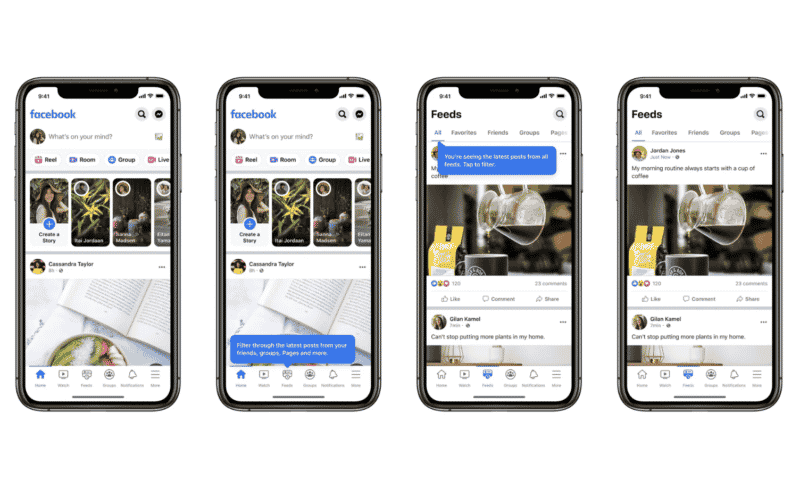
  • The Home tab will include more personalized content recommendations, with a greater emphasis on Reels and Stories.
  • A new Feeds tab that will allow users to see posts from friends, groups and Pages in reverse chronological order.

The rollout is expected to take about a week. These changes will come to the desktop later this year.

How Meta CEO Mark Zuckerberg described the change. “One of the most requested features for Facebook is to make sure people don’t miss friends’ posts. So today we’re launching a Feeds tab where you can see posts from your friends, groups, Pages and more separately in chronological order. The app will still open to a personalized feed on the Home tab, where our discovery engine will recommend the content we think you’ll care most about. But the Feeds tab will give you a way to customize and control your experience further.”

What it looks like. Here’s a screenshot Facebook shared:

Official announcement. Facebook has published the official news announcement here.

Why we care. This has the potential to be a big “meh” or it could end up being a significant opportunity for marketers. This change shouldn’t impact advertising, as Facebook Ads will continue to appear in the Feed. But there is potential that video content could go viral if it gets enough engagement and sends the right signals (e.g., related engagement, related topics, locations) to Facebook’s machine-learning algorithms. 

The future is now. In 2016, Zuckerberg said: “We see a world that is video-first with video at the heart of all of our apps and services.” It took six years, and the explosive growth of TikTok, but we continue to watch this major shift for Facebook from being a social network to becoming more of a TikTok-like content discovery engine. 


New on Search Engine Land

About The Author

Danny Goodwin is Managing Editor of Search Engine Land & SMX. In addition to writing daily about SEO, PPC, and more for Search Engine Land, Goodwin also manages Search Engine Land’s roster of subject-matter experts. He also helps program our conference series, SMX – Search Marketing Expo. Prior to joining Search Engine Land, Goodwin was Executive Editor at Search Engine Journal, where he led editorial initiatives for the brand. He also was an editor at Search Engine Watch. He has spoken at many major search conferences and virtual events, and has been sourced for his expertise by a wide range of publications and podcasts.

https://searchengineland.com/facebook-feeds-tab-386654


Instagram announces payments in chat

Mark Zuckerberg announced today that you can now buy products from small businesses and track those orders in Instagram chat. 

How does it work. You simply send a message to a qualified business you’re interested in buying from. The business initiates a payment link, where you’ll be able to purchase, track the order, and ask follow-up questions. Meta Pay will also be enabled for an easier check-out experience. 

Early tests. Jaw Surf tested the feature to sell their custom hand-made surfboards and fins. Owner Joshua Weisfeld said that customers would often contact him via Instagram chat before purchasing. But since payments in chat were enabled. Customers can pay directly from the chat thread. Additionally, the chat thread stays open so customers can send messages about their purchase.   

Why we care. The payments in chat feature make purchasing an item a more seamless transaction for the buyer, instead of the old multi-step process of clicking between pages or websites. Conversion numbers for sellers should increase as a result. However, buyers and advertisers should be aware that fraudulent pages, copycats, and hackers still exist, and they should be cautious when using this payment method. 


New on Search Engine Land

About The Author

Nicole Farley is an editor for Search Engine Land covering all things PPC. In addition to being a Marine Corps veteran, she has an extensive background in digital marketing, an MBA and a penchant for true crime, podcasts, travel, and snacks.

https://searchengineland.com/instagram-announces-payments-in-chat-386556


Meta removes Facebook account mandate from Quest VR—but is that enough?

<img src="https://rassegna.lbit-solution.it/wp-content/uploads/2022/07/meta-removes-facebook-account-mandate-from-quest-vr-but-is-that-enough.jpg" alt="Let's just see who you really are under that mask of a positive-sounding Facebook policy reversal…”>
Enlarge / Let’s just see who you really are under that mask of a positive-sounding Facebook policy reversal…
Hanna Barbera / Aurich Lawson

Credit where credit is due: The Meta Quest virtual reality platform, previously known as Oculus Quest, will soon remove its obnoxious Facebook account mandate. As announced on Thursday, starting in August, both new and existing Quest headset users will be able to use the system’s default operating system and digital download store without tying their “real-name” social media accounts to the service.

This is a good course correction of a bad decision. In 2020, I wrote at length about the dangers of VR’s “Facebookening,” which arose when the Quest VR platform dumped its existing Oculus account system in favor of required Facebook accounts. This decision forced a cross-pollination between VR headsets and years of social media posts and messages, including the cookies and metadata from connected sites and services. It demanded a level of “real name” compliance that we’ve never seen from other major Western computing devices and operating systems.

Worse, the move tacitly threatened anyone wanting to sidestep the rules by creating a dummy Facebook account. Facebook famously disallows aliases and fake names, and while it doesn’t check for ID at account creation, it can lock accounts at any time if it detects “suspicious” activity. To unlock an account, the company will usually request some form of “official” photo identification. If someone converted their Oculus account to a name like “Guy Incognito” and got stuck in a lockdown state, Facebook was well within its rights (granted by its terms of service) to keep the account and all its associated software purchases locked away.

Awaiting a better look at FB decoupling

As announced, the new “Meta Account” system will correct some of these most glaring issues. But will it be enough?

It’s hard to definitively answer this question. First, the new account system hasn’t gone live, so we can’t test one crucial aspect of the change. According to Meta, anyone who switched from an Oculus account to a Facebook-tied identity will be able to decouple all Facebook identity information while creating a new Meta Account starting in August.

We want to see what this update looks like: how software-purchase transfers will work, what notices may appear on affected Facebook accounts after the transfer, and how aggressive the company will be about asking Quest users if they’re really sure they want to sever Facebook from their headset experience. (Meta has already indicated that it will let users attach Facebook and Instagram credentials if they want.) Facebook representatives have not answered our questions about these concerns as of press time.

There’s also the matter of exactly what traces of Facebook user data may remain. This week, we’re still reeling from a well-placed allegation, attached to a lawsuit, about Facebook’s official policy to “undelete” seemingly deleted account data when requested by law enforcement agencies. A Meta spokesperson said the claims were “without merit,” but even if that’s true, we already know that Facebook has made users’ sensitive data available to bidders and openly manipulated social media experiences for the sake of experiments. Facebook is in the business of harvesting as much user data as possible and keeping all relevant user records available for as long as possible—so much so that we’ve yet to find clarification about Facebook data decoupling from Meta accounts in any of the company’s new ToS disclosures unveiled this week.

https://arstechnica.com/?p=1865119


Landmark EU rules will finally put regulation of Big Tech to the test

Landmark EU rules will finally put regulation of Big Tech to the test

Imagine an online world where what users want matters, and interoperability reigns. Friends could choose whichever messaging app they like and seamlessly chat cross-app. Any pre-installed app could be deleted on any device. Businesses could finally access their Facebook data, and smaller tech companies could be better positioned to compete with giants. Big Tech could even face consequences for not preventing the theft of personal info.

As the US struggles to pass legislation to protect Internet consumers, in the EU, these ideals could become reality over the next few years. EU lawmakers today passed landmark rules to rein in the power of tech giants such as Alphabet unit Google, Amazon, Apple, Facebook (Meta), and Microsoft, establishing a task force to regulate unfair business practices in Big Tech.

Amazon said that the company plans to evolve with Europe’s “regulatory landscape” and review what the new legislation means for Amazon, its customers, and its partners. Microsoft declined to comment. None of the other Big Tech companies mentioned immediately responded to a request for comment for this story.

It remains unclear exactly how challenging these new regulations—the Digital Markets Act and the Digital Services Act—will be to enforce.

Critics say that not much will change, arguing that tech giants will be able to easily afford massive fines for DMA violations or DSA breaches. And at an estimated 80 members, the DMA task force is too small to monitor compliance.

Once published in the EU’s Official Journal, “both acts will enter into force,” with the DMA applicable after six months. The DSA works a little differently. It will apply to all digital service providers after 15 months or “from January 1, 2024, whichever comes later,” but for “very large online platforms and very large online search engines,” compliance will be enforced after only four months.

It’s possible that the EU regulations—and any enforcement issues that may arise—will influence how the US approaches Big Tech regulation in the future, but the move is likely to impact millions of global users, depending on how (or if) companies act to remain in compliance.

Stronger rules for “gatekeepers”

Known as the Digital Services Act package, the new rules were first proposed in 2020. The package seeks to better protect people across the EU using digital services for both business and pleasure, aiming “to create a safer digital space where the fundamental rights of users are protected and to establish a level playing field for businesses.”

That starts with the DMA taking power back from so-called “gatekeepers,” Big Tech companies like Apple, Google, or Meta that seem to limit innovation by controlling how users shop and talk online.

Impact assessments of both laws detail why it’s necessary to target very large online platforms for stronger enforcement to pave the way for smaller tech companies to drive more innovation and give users more choices.

Other goals of the regulations include preventing disinformation spread and the sale or trade of illegal goods online.

Not everyone is optimistic that the EU regulations will adequately function to diminish Big Tech’s dominance, though. In a statement, European Consumer Organization Deputy Director-General Ursula Pachl cautioned that if the DMA’s new task force “does not hire the experts it needs to monitor Big Tech’s practices in the market, the legislation could be hamstrung by ineffective enforcement.”

The Electronic Frontier Foundation, a nonprofit dedicated to defending online civil liberties, criticized the DSA in an email statement: “It gives way too much power to government agencies to flag and remove potentially illegal content and to uncover data about anonymous speakers.”

“We can expect a highly politicized co-regulatory model of enforcement with an unclear role of government agencies, which could create real problems,” said EFF International Policy Director Christoph Schmon. “Respect for the EU’s fundamental rights charter and inclusion of civil society groups and researchers will be crucial to ensure that the DSA becomes a positive model for legislation outside the EU.”

In the past, Big Tech has proven to be skilled at subverting laws that are challenging to enforce. Last year, the US Federal Trade Commission reported that companies like Alphabet, Meta, Microsoft, Amazon, and Apple spent the past decade wielding wealth to overpower rivals and skirt laws designed to increase competition.

https://arstechnica.com/?p=1864235


Forecasting web traffic using Google Analytics and Facebook Prophet

Ready to learn a quick-and-easy way to get traffic predictions for any amount of time in the future?

Seriously.

This article will show you how you can:

  • Predict traffic changes, and maybe even let your boss know when periods of stagnation or negative growth are to be expected.
  • What to expect during times of increased or decreased traffic, so you could tell if your declines are in line with predictions, or if something might be going wrong and traffic is declining more than it should.
  • Include a graph with an update to your boss or client of what’s coming in advance, so they know you aren’t just making excuses after the fact.

Want to skip the info and just click a few buttons? 

While we’ll be going through running the code to forecast your web traffic and what each of the sections does, you can skip this and jump right to the Colab here if you aren’t interested in knowing what’s going on and how to make adjustments.

For those who want to run the code locally and be able to edit the hyperparameters (a fancy name for some of the variables that do important things and generally have one value for a complete run of a model) let’s go!

Important note before you begin: The further ahead you ask it to predict, the wider the gap between the low and high estimates gets as the model becomes “less sure of itself.”

How to forecast your Google Analytics traffic

We’ll be using two systems to accomplish our goal:

  1. UA Query Explorer: In this example, we’re going to use Universal Analytics for our forecasting. I will adjust the code in the Colab in about a year to GA4, but because it needs a year or more of data to really do the job, using UA, for now, makes the most sense and few people have GA4 data going back more than a year. UA Explorer is a tool that will quickly and easily generate the API URL that will pull our analytics for us.
  2. Facebook Prophet: Prophet is a forecasting model built and open-sourced by Facebook. It includes a lot of great built-in features, such as the ability to import holidays. It’s what’ll turn our analytics data into a forecast.

For those who wish to run locally, you can obviously do so, and the code provided will get the job done.

So, let’s dive in and get you predicting your future traffic!

1. Connect your instance

What this means is you’re “turning on” Google Colab so you can run scripts from it.

2. Import the needed libraries

The next thing we need to do is to import the libraries we need to make all this work. 

They are:

  • pandas – a Python library for data manipulation (to help us work with time-series data structures).
  • numpy – needed to work with arrays (like our data and sessions array).
  • matplotlib – we’ll be using this to create some visualizations.
  • json – used to work with JSON data.
  • requests – used to make HTTP requests (like pulling analytics data).
  • fbprophet – used for time series forecasting.
  • pystan – used to update probabilities. Like the probability of the traffic being X on a date in the future.

To run is all you need to do is click the play button.

You’ll see a bunch of downloads start and the play button turn into a spinning icon indicating it’s working, and when they’re done downloading and installing the play button with re-appear.

You need to log in using the Google account tied to the analytics you want to access.

4. Configure the analytics you’re pulling

Next you need to select the account, property and view you want to pull your traffic data from.

Where it notes to pick a metric, you can pick from many of your traffic metrics depending on what you want to know. Examples might be:

  • Sessions (the one I use most)
  • Visitors
  • Unique visitors
  • Pageviews

Additionally, when you click the “segments” field a list of all the segments for the property (including custom segments) will display so you can select what traffic you want to look at.

After you’ve run the query just copy the API request URL:

5. Import analytics into the colab

Click the play button in the next cell:

You will be asked to enter the API query you just copied:

Paste it in and hit “Enter.”

You should be presented with a graph of the traffic over the data range you selected:

6. Formatting

The next cell just changes the column headings to what Facebook Prophet expects.

7. (Optional) Save

This step is completely unnecessary if you don’t plan on referencing back to the traffic numbers or forecasted numbers. I personally find it handy, but some won’t. 

The first thing you’ll track is simply the traffic numbers (same as you could export).

I promise it gets more interesting.

8. Adding holidays

The next step is to add holidays and to determine how seasonality is considered. There are some options and ways you can tweak things, or you can run it as is.

The decisions you need to make are:

  • What years do you want to pull the holidays for?
  • What country do you want to pull the holidays for?

Additionally, you’ll notice the line:

m = Prophet(interval_width=0.95, yearly_seasonality=True, weekly_seasonality=True, daily_seasonality=False, seasonality_mode = "additive", changepoint_range = 0.85)

You can change any of the parameters to suit your needs, though these settings should work decently in most scenario:

  • interval_width: This is how uncertain we’re willing to let the model be. Set to 0.95 it means that when training, 95% of all points must fit within the model. Set it too low, and it follows general trends but isn’t overly accurate. Set too high and it chases too many outliers and becomes inaccurate in that direction.
  • yearly_seasonality: Monitors and responds to yearly trends.
  • weekly_seasonality: Monitors and responds to weekly trends.
  • daily_seasonality: Monitors and responds to daily trends.
  • seasonality_mode: Set to either “additive” or “multiplicative”. Additive (the default) results in the magnitude of change being constant. You’d use this in most case to deal with things like holiday traffic spikes where the percentage increase vs pre-Black Friday is more-or-less steady. Multiplicative is used in scenario where there are growing surges. For example, in a growing town that sees an additional increase each year. Not only is there growth, but that growth gets larger with each interval.
  • changepoint_range: A change point are points where the traffic changes significantly. By default the changepoint 

This is a tip-of-the-iceberg scenario. There are other parameters you can review and apply as you feel so inspired. Details on them are available here.

I’ve set things here to what seems to work well for me in most (but not all cases). 

Yearly and monthly seasonality impact most businesses. Daily, not so much.

9. Crunch the numbers

Thankfully you don’t have to do it. 

Simply click the run button.

And you’ll soon see:

Not all the rows or columns are showing. If they were, what you’d see is:

  • The highest number the model predicts likely (yhat_upper).
  • The lowest (yhat_lower).
  • The predicted value (yhat).

Importantly, you’ll see “periods=90” in the code above. That is the number of days I’m going to get predictions for.

I’ve found 90 works decently. After that, the range gets pretty large between high and low but can be interesting to look at.

10. (Optional) Save predictions

This is an optional step for those who would like to save their predicted values, or use them to test against different parameter values (those discussed in step eight above).

Once run, you’ll just click the link:

Which takes you to:

Each time you run it your numbers and results will be stored and can be easily accessed at a future time to compare with different runs.

It will also give you the numbers to reference if you’re ever asked for a predicted value for a specific day.

11. The magic

Hit the run bottom and you get what you’ve likely come here to get.

Optional

I’ve added an extra Insights section. It simply displays the impact of some of the areas we’ve been discussing above.

You can see in the top chart, where the different change points are. Further down you get insights into how the different seasonal trends are impacting the predictions, etc.

Closing

I’ve always looked for ways to predict in advance what’s coming my way.

It’s always better to show your boss or client that a slowdown is expected a week before it happens rather than try to explain it after the fact. 

Additionally, this insight can also help you plan your strategy.

Your work may be different when in your peak traffic points, than it is when you’re in a lull. You can look back over your analytics trends month-by-month, year-by-year and try to piece it together – or just let machines do what machines do best.

Just a reminder, if you got to the bottom and wanted to get to the Colab to run this yourself, you’ll find it here.


Opinions expressed in this article are those of the guest author and not necessarily Search Engine Land. Staff authors are listed here.


New on Search Engine Land

About The Author

Dave Davies is the Lead SEO for the Machine Learning Operations company Weights & Biases. He got his start in SEO in the early 2000s and in 2004 co-founded Beanstalk Internet Marketing with his wife Mary, who still runs its day-to-day operations. He hosts a weekly podcast, speaks regularly at the industry’s leading conferences, and is proud to be a regular contributor right here on Search Engine Land.

https://searchengineland.com/forecasting-web-traffic-google-analytics-facebook-prophet-386124


Facebook removed posts on abortion pills even when they didn’t break any rules

Facebook removed posts on abortion pills even when they didn’t break any rules

The status of legal access to abortion is now prohibited, restricted, or uncertain in more than half of the US. However, abortion pills are still deemed safe by the Food and Drug Administration, and it’s still legal for consulted certified prescribers to mail abortion pills to patients in any state. Thousands took to social media to post and raise awareness of options for mail-ordering abortion pills, only to have their posts deleted within minutes, sparking user protests of censorship.

Facebook and Instagram confirmed in an Associated Press report that posts offering to mail abortion pills to people in states suddenly without access would continue to be removed.

These posts violate company policies that prohibit the gift or sale of pharmaceuticals or drugs on the platforms, a Meta spokesperson told AP.

On Instagram, Community Guidelines say that buying and selling pharmaceutical drugs is not allowed but do not directly state that posts offering pharmaceutical drugs as gifts or donations are banned.

That’s different from Facebook’s Community Standards, which state that only “legitimate healthcare e-commerce businesses” can make “attempts to buy, sell or trade pharmaceutical drugs.” And nobody is allowed to post “attempts to donate or gift pharmaceutical drugs.”

The only exceptions are made for Facebook posts asking to discuss “affordability, accessibility, or efficacy of pharmaceutical drugs in a medical context.” Those are currently permitted. So, theoretically, posts telling others how to order abortion pills in the mail should remain visible.

However, a tweet from Meta spokesperson Andy Stone has confirmed that the company is investigating why some permitted posts have been incorrectly removed. Meta did not immediately respond to Ars’ request for comment to clarify which kinds of posts have been incorrectly removed or when that issue will be resolved.

What triggers removal?

It’s unclear what triggers the removal of Instagram or Facebook posts, but reports suggest enforcement of community standards is inconsistent, and sometimes consequences are severe. Vice conducted tests on posts using varied references to abortion pills and reported that posting about abortion pills can lead to 24-hour account bans.

A major point of contention for social media users has been Meta’s inability to consistently distinguish between posts that say “abortion pills can be mailed” and posts directly offering to mail abortion pills. This means that sometimes perfectly allowable posts following community standards and discussing the accessibility of abortion pills are being flagged for removal.

The AP conducted tests similar to Vice, posting on Facebook, “If you send me your address, I will mail you abortion pills.” That post was removed within a minute, but when AP changed from mentioning “abortion pills” to other regulated goods that Community Standards also ban—like “I will mail you a gun” or “weed”—those posts stayed up. The inconsistency in what phrasing prompts immediate removal leads to an impression that Meta more expediently removes posts regarding abortion pills.

When Facebook flags posts for removal, users have a choice to disagree or agree with the decision. Some users have disagreed and had their posts removed anyway, without experiencing temporary account bans, while Vice reported that some users who disagreed experienced 24-hour account bans.

Where Meta stands on abortion access

The sale of abortion pills in the US seems unlikely to be threatened by new state laws. Attorney General Merrick Garland stated clearly that “States may not ban mifepristone”—the medication used to induce an abortion—”based on disagreement with the FDA’s expert judgment about its safety and efficacy.”

As abortion procedures become less accessible across the US, advocates will likely continue to turn to social media to raise awareness of how to access abortion pills. A New York Times tracker shows nine states currently signaling interest in enacting new abortion restrictions, and The Washington Post recently reported that conversations around abortion are playing a significant role in the next election. Whether social media posts on abortion will be subjected to further restriction is a topic of concern.

This week Meta joined many companies in pledging to protect abortion access for employees by funding any out-of-state travel expenses. However, the company also came under fire for restricting employees from discussing abortion openly in the workplace. That introduces a seeming tension for any employees seeking to discuss out-of-state travel expenses and suggests at Meta, on the issue of abortion, inconsistency remains the rule.

https://arstechnica.com/?p=1863251