Deep dive into stupid: Meet the growing group that rejects germ theory

This thriving Facebook group says viruses don't cause disease and the pandemic isn't real.
Enlarge / This thriving Facebook group says viruses don’t cause disease and the pandemic isn’t real.

Listen up, sheeple: COVID-19 doesn’t exist. Viruses don’t cause disease, and they aren’t contagious. Those doctors and health experts who say otherwise don’t know what they’re talking about; the real experts are on Facebook. And they’re saying it loud and clear: The pandemic is caused by your own deplorable life choices, like eating meat or pasta. Any “COVID” symptoms you might experience are actually the result of toxic lifestyle exposures—and you have only yourself to blame.

As utterly idiotic and abhorrent as all of the above is, it’s not an exaggeration of the messages being spread by a growing group of Darwin-award finalists on the Internet—that is, germ theory denialists. Yes, you read that correctly: Germ theory denialists—also known as people who don’t believe that pathogenic viruses and bacteria can cause disease.

As an extension of their rejection of basic scientific and clinical data collected over centuries, they deny the existence of the devastating pandemic that has sickened upwards of 200 million people worldwide, killing more than 4 million.

Germ theory denialism isn’t new. It can be traced back to the origin of germ theory itself, often to the contemporaries of Louis Pasteur named Claude Bernard and Antoine Béchamp. Both came up with opposing hypotheses to Pasteur’s enduring germ theory. Bernard proposed the concept of milieu intérieur, which suggests that the body’s internal environment—or terrain—maintains its equilibrium. The state of the terrain, rather than the presence of pathogens, ultimately dictates whether disease will develop (which is not an entirely crazy idea, given what we now know about the microbiome and the immunocompromised). Meanwhile, Béchamp—considered a bitter crank and rival of Pasteur—suggested that pathogenic bacteria are produced by human tissue as a response to a harmful change in the terrain. Thus, bacteria do not cause disease; they are merely a self-created symptom of it—which is clearly just incorrect.

The scientific and medical communities left these ideas behind in light of Pasteur’s findings and, later, Robert Koch’s foundational concepts for microbial pathogenesis, Koch’s postulates. But it seems they have endured in a fringe community, with their interpretations and explanations shifting and morphing over time. And with the devastating global pandemic, the denialists seem to be having something of a renaissance.

A germ theory denialist emailed me and pointed to a Facebook group called “Terrain Model Refutes Germ Theory,” where a particular strain of germ theory denialism is thriving. An administrator for the group noted in April that the group had reached 15,000 members, up from just 147 members in April of 2020. Now, just a few months later, the tally is up to 18,400.

Toxic ignorance

While the depths of human stupidity on display across the Internet rival that of the Marianas Trench, the audacious ignorance on display in this group is truly stunning. In the group’s current take on germ theory denialism, bacteria are merely scavengers and are a symptom of disease. Viruses are considered cellular debris and cannot cause disease or transmit from one person to another.

According to the group members’ delusions, there is only one disease in existence: toxemia. This disease is caused by toxic exposures that occur by leading a dirty, unnatural lifestyle, which causes damage to your terrain. All disease symptoms are merely a sign that your body is trying to “detox.” If your body isn’t able to detox, the disease will progress through seven levels, the last one being cancer. The type of symptom you’re experiencing can help identify the kind of toxic exposure you’ve had. If you remove the toxic component of your diet or environment, you’ll recover—though if you reach the seventh level, it can be hard to come back from.

The group notes that a sick person has no one but themselves to blame for their illness. “Blaming disease on viruses or bacteria is an easy cop out,” one post in the group’s “guide” section reads. “It’s not good business to tell a client that they have caused their own miseries, so the medical profession has blamed suffering on everything but the individual’s own failure in the game of living.”

So how do you avoid toxic exposures and failing at life? Basically, you just eat a lot of fruit and cut out all things “not fit for man.” That includes meat, dairy, eggs, breads, pasta, soy, nut and seed oils, potatoes, garlic, onions, cereals, salt, fermented foods, coffee, supplements, alcohol, tobacco, and any other intoxicating substances. Oh, and all evidence-based drugs, medical treatments, and vaccines—obviously.

If you are not convinced by the group’s ideas and point to medical experts who say wild things like “viruses can make you sick” and “protein is necessary for a healthy diet,” you are embarrassingly mistaken. According to the group, all doctors are simply brainwashed puppets, controlled by a profit-driven pharmaceutical and medical research community determined to convince everyone that they need to buy magic pills to stay healthy. “The germ theory is nothing but a massive profit driver for the disease industry,” germ theory denialist Nora Lenz said in a video hosted on the site. The group members know better, of course, because, you know, they’ve read a lot of stuff on the Internet—like a lot!

“Facts-inated”

“There are people with masters [sic] degrees that fell for this pandemic charade,” one group member posted. “And there are high school dropouts that can see through all the deception of the media. That’s why being smart isn’t measured solely on being educated by colleges.”

Indeed, the denialist who led me to this Facebook group—Robert Yaklin—did so to point out my ignorance. “I couldn’t resist contacting you when I read that you are interested in infectious diseases,” Yaklin wrote, seemingly referencing the fact that I have a doctorate in bacterial pathogenesis. “While I’m sure you believe that such a thing exists because you have been indoctrinated to believe in germ theory, it is no more proven than the theory of a flat earth. I suggest working toward getting fully “facts-inated” by reading about Terrain Model. There is plenty to keep you busy reading at the Facebook group “Terrain Model Refutes Germ Theory” for months if not years or longer. Don’t feel bad just because so many things you have believed will be revealed untrue.” (If only my PhD advisor had known about this Facebook group!)

In subsequent email exchanges, Yaklin compared believing in disease-causing bacteria to believing in Santa Claus or the Easter bunny. “The idea of viruses causing anything is even more far-fetched,” he wrote.

As for an explanation of the current pandemic caused by a contagious coronavirus, Yalkin said it is due to “a group of people with similar diet and habits [who] are likely to be taking on a similar amount of toxins, and therefore their bodies are likely to exhibit similar detox symptoms around the same time.”

And as for following public health measures to prevent SARS-CoV-2 transmission, Yalkin simply said, “There are no public health experts recommending wearing a mask or getting vaccinated. There may be people who call themselves public health experts, but they are virtually clueless about actual health, having received training and indoctrination in the cult of disease and drugs.”

The nonsense he spewed was straight from the pages of the Facebook group, of course. Based on recent activity, two of the more active administrators for the group are Lauren Whiteman, who said she took over the group in April of 2020, and Lauren Takacs.

Misinformation and moderation

Whiteman appeared in the video with Lenz and said she had studied hygiene theory for five years. She claimed that her natural diet cured all of her health issues and cured blindness, deafness, and seizures in the dogs she fosters. This has apparently given her authority to provide medical advice, telling people in the group that vaccines are “extremely dangerous and harmful to health.” In one exchange, she claimed that a person diagnosed with COVID-19 had low blood oxygen levels because of poor lifestyle choices. “The cause of oxygen deficiency is wrong health habits,” she declared. “Wrong foods going in, taking drugs, not living in alignment with your physiology.”

Whiteman did not respond to an interview request from Ars.

According to her public Facebook posts, Takacs graduated from high school in 2016 and has no health or medical background. However, that didn’t stop her from recommending to one group member that she no longer needed health insurance, simply because she was following the terrain model lifestyle. In another post, Takacs suggests that a mother of a 3-year-old with cancer should stop bringing her son to the hospital for treatments, which she called “poisonings.” Instead, she recommended feeding the toddler fruits and vegetables as treatment.

Takacs did not respond to an interview request from Ars.

Ars also reached out to Facebook to understand how all of the health misinformation and falsehoods in the group fall in the company’s moderation policies. The social media giant is said to be actively monitoring the site, reviewing posts, and removing violating material. Broadly, if a group repeatedly breaks rules, Facebook will permanently remove it.

“We take strong action against content that violates our COVID-19 and vaccine policies,” a Facebook spokesperson told Ars in a statement. “We continue to monitor for misinformation on our platforms and we will continue to enforce against any account or group that violates our rules.”

https://arstechnica.com/?p=1785588


Facebook blocks research into political ads, falsely blames FTC privacy order

An inverted version of the Facebook
Getty Images | GreyParrot

When Facebook disabled the accounts of New York University researchers who were investigating misinformation and political ads on the platform, the social-media giant claimed it did so to comply with a consent decree that it previously agreed to with the Federal Trade Commission. “We took these actions to stop unauthorized scraping and protect people’s privacy in line with our privacy program under the FTC Order,” Facebook wrote in its explanation of the account suspensions. Facebook said it “disabled the accounts, apps, Pages and platform access associated with NYU’s Ad Observatory Project and its operators.”

But Facebook’s claim that the FTC order forced it to suspend the researchers is false, FTC Bureau of Consumer Protection Acting Director Samuel Levine wrote in a letter to Facebook CEO Mark Zuckerberg on Thursday. The FTC order did require Facebook to create a privacy program, but there was no requirement that would have forced Facebook to shut down the NYU research project. Despite that, Facebook’s statement that it suspended the accounts “in line with our privacy program under the FTC Order” conveys the false message that Facebook had no choice in the matter.

Levine’s three-paragraph letter to Zuckerberg said:

I write concerning Facebook’s recent insinuation that its actions against an academic research project conducted by NYU’s Ad Observatory were required by the company’s consent decree with the Federal Trade Commission. As the company has since acknowledged, this is inaccurate. The FTC is committed to protecting the privacy of people, and efforts to shield targeted advertising practices from scrutiny run counter to that mission.

While I appreciate that Facebook has now corrected the record, I am disappointed by how your company has conducted itself in this matter. Only last week, Facebook’s General Counsel, Jennifer Newstead, committed the company to “timely, transparent communication to BCP staff about significant developments.” Yet the FTC received no notice that Facebook would be publicly invoking our consent decree to justify terminating academic research earlier this week.

Had you honored your commitment to contact us in advance, we would have pointed out that the consent decree does not bar Facebook from creating exceptions for good-faith research in the public interest. Indeed, the FTC supports efforts to shed light on opaque business practices, especially around surveillance-based advertising. While it is not our role to resolve individual disputes between Facebook and third parties, we hope that the company is not invoking privacy—much less the FTC consent order—as a pretext to advance other aims.

Facebook “cynically invoke[d] user privacy”

On Tuesday, “Facebook abruptly shut down the accounts of New York University researchers Laura Edelson and Damon McCoy, blocking their research into political ads and the spread of misinformation on the platform,” wrote the Knight First Amendment Institute at Columbia University, which is representing Edelson and McCoy in the matter.

Edelson and McCoy researched Facebook using Ad Observer, “a browser plugin they and others created that allows consenting Facebook users to voluntarily share with the researchers limited and anonymous information about the political ads shown to them by the platform.”

Facebook’s action cut off the access that the researchers used “to uncover systemic flaws in the Facebook Ad Library, to identify misinformation in political ads, including many sowing distrust in our election system, and to study Facebook’s apparent amplification of partisan misinformation,” Edelson said. “By suspending our accounts, Facebook has tried to shut down all this work.” Edelson said that “Facebook suspended my Facebook account and the accounts of several people associated with Cybersecurity for Democracy, our team at NYU.”

McCoy said that “Facebook should not be able to cynically invoke user privacy to shut down research that puts them in an unflattering light, particularly when the ‘users’ Facebook is talking about are advertisers who have consented to making their ads public.”

“It is disgraceful that Facebook is attempting to squash legitimate research that is informing the public about disinformation on their platform. With its platform awash in vaccine disinformation and partisan campaigns to manipulate the public, Facebook should be welcoming independent research, not shutting it down,” McCoy also said.

The FTC website states that in 2019, Facebook agreed to a $5 billion settlement with the commission “related to allegations that the company violated its 2012 FTC privacy order by deceiving users about their ability to control the privacy of their personal information.” Facebook had to pay the penalty and change its privacy practices. The settlement resulted largely from Facebook allowing third-party app developers to access data about users’ friends in the Cambridge Analytica scandal.

Researchers deny Facebook claims

When suspending the NYU researchers, Facebook said the Ad Observer browser extension “was programmed to evade our detection systems and scrape data such as usernames, ads, links to user profiles and ‘Why am I seeing this ad?’ information, some of which is not publicly viewable on Facebook. The extension also collected data about Facebook users who did not install it or consent to the collection.”

The researchers deny this, with Edelman telling NPR, “We really don’t collect anything that isn’t an ad, that isn’t public, and we’re pretty careful about how we do it.”

The Ad Observer website says the browser extension does not collect any personally identifying information. “It copies the ads you see on Facebook and YouTube, so anyone can see them in our public database,” the site says. “If you want, you can enter basic demographic information about yourself in the tool to help improve our understanding of why advertisers targeted you.”

This is important because “ads are usually seen only by the audience the advertiser wants to target, and then they disappear,” making it “difficult for the public to monitor them and hold advertisers accountable,” the project says.

Facebook’s FTC fights

The new dispute comes a few weeks after Facebook petitioned the FTC to remove Chair Lina Khan from an antitrust case against the company. Amazon previously filed a similar recusal petition, but neither company has identified a conflict of interest in the usual sense that would require Khan to recuse herself. They simply object to statements about competition and criticisms of the companies that Khan made before becoming FTC chair.

A group of senators led by Elizabeth Warren (D-Mass.) on Wednesday told both companies, “There is no basis for her recusal under the current federal ethics statute or FTC precedent. Your efforts to sideline Chair Khan appear to be nothing more than attempts to force an FTC stalemate that would allow you to evade accountability for any anti-competitive behavior.”

Facebook admits truth to Wired

Facebook said it imposed the suspensions about a year after it first told the researchers that their extension would violate Facebook’s Terms of Service. As Wired wrote Wednesday, Facebook’s claim that the FTC order forced its hand doesn’t add up “because the consent decree doesn’t prohibit what the researchers have been doing.” Facebook admitted that in a response to Wired, the article said:

Joe Osborne, a Facebook spokesperson, acknowledges that the consent decree didn’t force Facebook to suspend the researchers’ accounts. Rather, he says, Section 7 of the decree requires Facebook to implement a “comprehensive privacy program” that “protects the privacy, confidentiality, and integrity” of user data. It’s Facebook’s privacy program, not the consent decree itself, that prohibits what the Ad Observer team has been doing. Specifically, Osborne says, the researchers repeatedly violated a section of Facebook’s terms of service that provides, “You may not access or collect data from our Products using automated means (without our prior permission).” The blog post announcing the account bans mentions scraping 10 times.

Despite that admission, Facebook’s blog post still contained the statement that Facebook suspended the researchers to “protect people’s privacy in line with our privacy program under the FTC Order.”

We asked Facebook why it hasn’t changed or deleted that sentence. A Facebook spokesperson responded to our email but did not answer the question.

https://arstechnica.com/?p=1785528


Big tech companies are at war with employees over remote work

A tree-lined campus surrounds a multistory glass and steel building.
Enlarge / Apple offices in northern California.

All across the United States, the leaders at large tech companies like Apple, Google, and Facebook are engaged in a delicate dance with thousands of employees who have recently become convinced that physically commuting to an office every day is an empty and unacceptable demand from their employers.

The COVID-19 pandemic forced these companies to operate with mostly remote workforces for months straight. And since many of them are based in areas with relatively high vaccination rates, the calls to return to the physical office began to sound over the summer.

But thousands of high-paid workers at these companies aren’t having it. Many of them don’t want to go back to the office full-time, even if they’re willing to do so a few days a week. Workers are even pointing to how effective they were when fully remote and using that to question why they have to keep living in the expensive cities where these offices are located.

Some tech leaders (like Twitter’s Jack Dorsey) agreed, or at least they saw the writing on the wall. They enacted permanent or semipermanent changes to their companies’ policies to make partial or even full-time remote work the norm. Others (like Apple’s Tim Cook) are working hard to find a way to get everyone back in their assigned seats as soon as is practical, despite organized resistance.

In either case, the work cultures at tech companies that make everything from the iPhone to Google search are facing a major wave of transformation.

It didn’t start in 2020

The gospel of a remote-work future has long been preached by a dedicated cadre in Silicon Valley and other tech startup hubs. Influencers, writers, and business consulting gurus have for years been saying that, thanks to today’s technology, working in an office is destined to be a thing of the past.

There is no apparent justification for resisting remote work besides a sort of management control-freak insecurity, proponents argue. And to support their case, they point to studies that suggest that some employees in certain kinds of jobs are happier and more productive when remote work is an option. Studies also debunk the assumption that productivity is always lower when remote work is the norm.

The movement reached something of a fever pitch in the late 2000s, when tech-unicorn optimism was sweeping the business world and some prominent executives in the new wave of startups seemed cozy with the idea. But remote work went on to face dramatic setbacks. Notably, Yahoo!—then known as one of the most remote-friendly large tech companies—changed course in the early 2010s under the leadership of then-CEO Marissa Mayer, who mandated that a vast fleet of remote workers had to relocate and show up at their assigned desks.

Since that and other similar incidents around that time, the remote-work movement has been quieter.

Remote-work advocates and the business establishment seemed to settle into a compromise. Companies like Google or Twitter would let employees work from home periodically as the need arose (for example, to take care of a sick child or even for the occasional mental health day). But in most cases, the culture dictated that workers not play this card too often. Remote work was a privilege, not a right, and employees usually could not relocate out of daily commuting range from the cities where these companies were based.

As housing prices skyrocketed and traffic worsened in cities like San Francisco, Seattle, Los Angeles, and Austin—and as economic inequalities worsened in those places as a result—prominent commentators still occasionally penned op-eds that essentially said, “Gee, maybe some of these problems would be lessened if business leaders were more open to remote work.” But the most radical vision of the remote-work movement nonetheless seemed dead in the water.

And then the pandemic happened.

The involuntary revolution

Companies whose leaders long claimed remote work would never function were left with no other options. In traditional businesses, the digital-transformation movement accelerated dramatically to meet the need. And in some tech startups, the transition was so seamless that many employees (and even managers) found themselves wondering why all this hadn’t been tried before.

There are exceptions in some kinds of tech companies, of course. For example, large game development studios struggled to maintain prior levels of productivity in the new remote way of working, leading to delays or a reduction in quality for some releases. But more often than not, the changes made in response to the pandemic led people to believe that this remote thing might actually work out after all.

Between the threat of future pandemics in crowded cities and insane housing prices in tech hubs, a lot of workers recently began to make plans to evacuate from places like the Bay Area for cheaper, greener pastures—but with the hope that they could keep their high-paying jobs.

According to Glassdoor’s data, the average software engineer salary in pricy tech hotspot San Jose, California, is $137,907. Shockingly, that’s not enough to bankroll the whole American dream in the Bay Area. But if that hypothetical engineer relocates to St. Louis or Tucson on that salary, they can live like royalty.

An Apple divided

Few tech companies have experienced as much widely publicized drama over this issue as Apple. Though many employees in the Cupertino headquarters and elsewhere mostly worked from home through much of 2020, CEO Tim Cook emailed staff in early June 2021 that a policy change was imminent.

Employees would be required to return to the office for at least three days of every week beginning in September. They would also be able to go fully remote for up to two weeks per year, provided they secure management approval.

Employees then circulated a survey amongst themselves to reveal that Cook’s mandate was out of step with what they wanted or expected, according to reporting by The Verge’s Zoe Schiffer. Ninety percent of the survey’s 1,749 respondents said they “strongly agree” that “location-flexible working options are a very important issue for me.” Workers wrote a letter to Cook asking him to rethink the new policy. Sixty-eight percent agreed “that the lack of location flexibility would likely cause them to leave Apple.”

The threats may be legitimate because some other tech companies (like Twitter) have taken a much more permissive approach. These companies may give dissatisfied Apple employees somewhere else to go.

Apple executives did not back down from their plan. Over the summer, the upcoming change has led to turmoil in the industry giant, with longtime employees pledging to quit over a required return to the office. Some workers went to the press with claims that Apple management has begun rejecting remote-work requests more than normal in response.

A few Apple employees wrote another letter arguing for a compromise: more lenient remote-work policies in exchange for a system wherein employees in cities with lower costs of living would accept proportionally lower salaries. However, this proposal angered other employees still, who argue that Apple can afford to pay them a competitive salary regardless of where they choose to relocate to mid- or post-pandemic.

Postponed on account of delta

But now the battle over remote-work culture at companies like Apple looks like it is going to be extended. This summer’s initial optimism about an imminent return to normal in the wealthy parts of the world has waned across the industry. Credit the rapid spread of the delta COVID-19 variant and rising cases among the unvaccinated in the US.

The state of California reintroduced an indoor mask recommendation which has been turned into a mandate in many counties, even for people who are vaccinated, because studies have shown that even relatively healthy-seeming vaccinated individuals can spread the deadly delta variant to the vulnerable unvaccinated. California’s change directly affects many of these companies, and more states are likely to soon follow.

Apple has nudged its return-to-office plan amidst the internal turmoil and growing health concerns. The timeframe has reportedly moved from September to October, and there’s a strong possibility it will be pushed back even further.

This week, Twitter announced that it is closing the US offices it had recently partially reopened. Google extended its current work-from-home policy through mid-October, and Lyft postponed a plan to move back into its office this coming September all the way back to February of next year.

Several big tech firms are requiring some or all employees to get vaccinated to return to the office, including Lyft, Google, and Facebook. And even in companies that haven’t yet announced any vaccination requirement, like Apple, employees are being asked to fill out surveys disclosing their vaccination status.

Others like Microsoft are still pushing to get workers back at their desks, despite the new developments, though they might change course again in the near future. Microsoft has generally been more proactive than Apple in laying the groundwork for long-term hybrid work support, though, despite its plans to press forward with reopening offices.

Don’t expect these discussions to resolve soon. Some executives are still trying to get employees back at their desks, some employees are still saying “not so fast” or “not at all,” and COVID-19 is still sweeping the planet.

Every workplace is handling things differently, and whether the fully remote dream actually becomes a reality at some of these companies or not, long-time remote-work prophesiers are right about one thing: the old ways aren’t going to cut it anymore, and tech is never going to be the same again.

https://arstechnica.com/?p=1784238


Facebook’s next hardware product will be “smart” Ray-Ban glasses

A fashion influencer smiles while wearing a pair of Ray-Ban sunglasses.
Enlarge / Don’t get too excited about how well these Ray-Bans go with Gitta Banko’s outfit—we don’t know what Facebook’s new smart glasses will look like, only that they’re made in partnership with the brand and its parent company.

In an earnings conference call on Wednesday, Facebook CEO Mark Zuckerberg told investors that the company’s next hardware launch will be “smart glasses” made in partnership with classic sunglasses vendor Ray-Ban.

Zuckerberg segued into the Ray-Ban announcement following a lengthy discussion of Facebook’s plans for Oculus Quest, its all-in-one virtual reality (VR) platform. Zuckerberg says that social media is the real “killer app” for VR, backing that up with data from Oculus Quest: “The most popular apps on Quest are social, which fits our original thesis [that] virtual reality will be a social platform.”

Zuckerberg intends the as yet unnamed smart glasses to be a stepping stone, not an end goal. He remained cagey about their actual purpose, saying only that the glasses “have their iconic form factor, and [let] you do some pretty neat things,” with no concrete details about what those “neat things” might be.

We do know that the glasses aren’t expected to have integrated display, thanks to reporting from The Verge on their initial announcement in September 2020. Without display capabilities, the Ray-Ban/Facebook glasses seem likely to fall in the same category as Amazon’s Echo Frames or Lucyd Lyte—a mostly normal-looking pair of sunglasses with integrated Bluetooth pairing and directional speakers that we reviewed in March.

Zuckerberg describes the smart glasses as a stepping stone toward not only virtual or augmented reality as we know it, but something he calls the metaverse. “So what is the metaverse? It’s a virtual environment [like] an embodied Internet that you’re inside of rather than just looking at. And we believe that this is going to be the successor to the mobile Internet.”

After warning that building his vision will require significant investment not only from Facebook itself but from its entire ecosystem of partners, he doubled down on its eventual importance, saying, “In addition to being the next chapter of the Internet, the metaverse is also going to be the next chapter for us as a company.”

https://arstechnica.com/?p=1784050


Forget “App Tracking Transparency”: Facebook is enjoying more ad revenue than ever

Faebook CEO Mark Zuckerberg.

For months, Apple and Facebook waged a PR war (with threats of a legal one) over App Tracking Transparency, a change in recent versions of the iPhone’s iOS software that will often limit how advertising-focused apps and companies can monetize iPhone users.

Facebook’s original public predictions about App Tracking Transparency’s effect were apocalyptic. But even though App Tracking Transparency took effect during Facebook’s most recent quarter (Q2 of 2021), the company still posted huge ad revenue growth.

Facebook’s revenue, which is largely driven by the kinds of advertising that Apple’s iOS change undermines, grew 56 percent year-over-year in Q2, beating investor expectations. The company had 1.9 billion daily active users and 2.9 billion monthly active users. It earned $10.12 of revenue per user, on average.

This was the first earnings report Facebook has delivered for a quarter that should show any effects of App Tracking Transparency on the company’s bottom line. Fifty-six percent year-over-year growth certainly doesn’t look apocalyptic, but CFO David Wehner told investors to expect a less rosy story in the next quarter:

We continue to expect increased ad targeting headwinds in 2021 from regulatory and platform changes, notably the recent iOS updates, which we expect to have a greater impact in the third quarter compared to the second quarter.

Data on user opt-in rates for tracking has varied quite a bit. Some firms put the figure at just 4 percent, but others place opt-in rates as high as around 30 percent. The rate likely depends on the app in question. In any case, users who opt in are definitely not the majority; most users are declining to be tracked when prompted. And each user who does is worth a lot less money to Facebook, which makes much of its money leveraging each user’s data to charge advertisers money to microtarget users and others with similar attributes.

While Facebook’s initial messaging around App Tracking Transparency was combative, Zuckerberg has changed his tune recently. He began to argue that the change could even be good for Facebook in some ways.

Today, Zuckerberg is dedicating much of his time to describing his vision for the “metaverse,” which he has identified as the new direction for the company. He has described this vision as putting a mixed-reality layer on our lives through which people can interact and socialize with one another virtually in new ways while crossing geographic barriers.

But Apple executives have also outlined a somewhat similar long-term vision, albeit with a very different approach. By forcing Facebook to play by different ad-targeting rules, Apple has strengthened its position against the social media company in any coming battle over a future mixed-reality computing landscape.

But at least for this quarter, Facebook does not seem to be suffering too badly from the recent iOS change.

https://arstechnica.com/?p=1783933


Facebook’s metaverse gambit is a distraction from its deep-seated problems

Mark Zuckerberg demonstrates an Oculus Rift headset at a 2016 event.
Enlarge / Mark Zuckerberg demonstrates an Oculus Rift headset at a 2016 event.
David Paul Morris/Bloomberg via Getty Images

Facebook mastered social media by giving people an easy way to share their offline lives with friends, family, and complete strangers on the Internet. So why is the company now trying to invent a virtual universe that effectively turns its back on reality?

Over the past week, the social media company has blitzed media outlets with news about its “metaverse” initiative, a plan to create virtual worlds where people can interact to play games, have meetings, and so on. Last week, CEO Mark Zuckerberg shared his metaverse plans with the public in an interview with The Verge. Then, earlier this week, Facebook announced that it would be putting together a metaverse team staffed with a handful of longtime VPs.

It’s clear that Zuckerberg has been thinking about this metaverse idea for a while. But the timing of Facebook’s announcement is interesting, to say the least. Facebook has “a history of doing these kinds of technical projects that look like they might be revolutionary at times when they’re being criticized for their lack of social responsibility,” Jen Goldbeck, a computer scientist and professor at the University of Maryland, told Ars.

Facebook has faced its share of scrutiny in recent months. Lawmakers have been floating antitrust and Section 230 bills that would hit the company hard. It was caught earlier this year autogenerating pages for white supremacist groups. And yesterday, hearings began in the House of Representatives into the insurrection that breached the US Capitol in January, which was partially organized using Facebook apps and sites.

It’s probably an overstatement to say that the metaverse news was released to serve as an intentional distraction from the company’s current problems. But the thought undoubtedly crossed someone’s mind at the company. There’s a “70 percent” chance that Facebook’s metaverse project is a “distraction from all the bad things that are going on,” Goldbeck said. “The last thing they want is more discussion of their algorithms and Q-Anon and extremist groups.”

As a distraction, the metaverse is almost too perfect. It’s a flashy news item that attempts to position Facebook and Zuckerberg as visionaries inventing the future. It’s also literally a way to escape reality. If Zuckerberg ever wanted a metaverse to escape to, where Facebook exerted influence over everything from physics to religion, that time is probably now.

Into the metaverse

The term “metaverse” first appeared in Snow Crash, a 1992 sci-fi novel by Neal Stephenson, where it was a virtual world in which people could interact through their avatars, complete with rules and social norms that differed from the real world. The concept appeared in other forms before Stephenson’s book, and it has been revisited and rehashed numerous times over the years.

Zuckerberg’s vision of the metaverse sounds pretty similar. “You can think about the metaverse as an embodied Internet, where instead of just viewing content, you are in it,” he said in his interview with The Verge.

Hugo Barra and Mark Zuckerberg celebrate Barra's hiring in an early (unnamed and unreleased) Facebook social VR app.
Enlarge / Hugo Barra and Mark Zuckerberg celebrate Barra’s hiring in an early (unnamed and unreleased) Facebook social VR app.

Virtual reality was a key part of Stephenson’s vision, and it comes up a lot in Zuckerberg’s interview. The executive leading the metaverse team, Andrew Bosworth, heads VR and AR at the company. That Facebook is looking for another solution for VR isn’t surprising—it has experimented with VR to middling success. The company’s Oculus headsets have run the gamut from good to bad, and while Zuckerberg’s VR demo in 2016 was impressive, his virtual trip to hurricane-ravaged Puerto Rico was cringe-worthy. Yet Facebook is sticking with it, no doubt in part because it dropped $2 billion on Oculus.

Still, it’s not clear that the metaverse is the killer app for VR, nor is it an obvious evolution of social media. “There was a very clear path for a while,” Goldbeck said. “We were going to have more interactive social media, we were going to have more mobile stuff, then we were going to have more kinds of media. Now, what is the next thing? This feels exactly like a thing that someone would say, ‘Well, maybe the next big thing is the metaverse.’”

Turning away from the real world

Inside Facebook, developing the metaverse may seem like an obvious next step. The company has a large user base that uses its platforms for a variety of everyday things, from sharing updates to shopping, gaming, and more. Add in a dollop of VR and some other buzzword-laden technologies, and you’ve got a metaverse.

In some use cases, Facebook might be on to something. “There are places where people are happy to stay virtual,” Goldbeck said. “This is the tension we’re starting to see emerge now. There are a lot of people who are like, ‘This remote working is great.’” And Facebook could be the company to make it happen. They have deep pockets and a roster of talented engineers. “There are people inside Facebook whose job it is to figure out what the next big thing is,” Goldbeck said.

But in many ways, the metaverse project is a fundamental shift away from what made Facebook successful. First, Facebook is a company that tends to succeed when it iterates on existing ideas or solves genuine problems. Zuckerberg’s initial version of Facebook, called “Facemash,” was a 2003 Harvard knockoff of another site called “Am I Hot or Not” that launched in 2000. Later Facebook iterations aped features from Friendster, MySpace, and others.

Even the company’s technological crown jewel, the News Feed, wasn’t created due to pie-in-the-sky dreaming about what could take social media to the next level. It was a solution to a real problem—as people added more friends on Facebook, they were getting inundated with updates. News Feed and its algorithms helped cut down on the chaos, prioritizing content that a user was more likely to engage with. Another Facebook hallmark—ads in the News Feed, the company’s current cash cow—was born out of its struggles to monetize users on mobile phones.

The metaverse also cuts against a key part of Facebook’s brand—allowing people to share their lives with friends and family. For many, the platform’s appeal comes from users’ ability to like, comment on, and share content related to their real lives—not their virtual ones.

Zuckerberg may truly believe that the metaverse is the next big thing. But it can also be true that the project serves as a convenient distraction from the problems the company faces. At the same time, it can be a reward for loyal executives who want to dream about the future rather than think about automated content moderation. And it can also be a message to investors that the company is making good on past investments in VR and other technologies that have yet to pay off.

In a way, that’s the beauty of the metaverse. It can be whatever you want it to be.

https://arstechnica.com/?p=1783647


Facebook e l’algoritmo che favorisce i contenuti anti-vax. Lo studio

I problemi dell’algoritmo di Facebook che premia la disinformazione

Oltre che alla pandemia di Covid-19 i Governi devono contrastare un’altra forma di altrettanto grave di contagio, quella della disinformazione sanitaria e delle tecnologie che l’alimentano, come il fatidico algoritmo di Facebook..

Secondo i risultati di una nuova indagine condotta da Avaaz sul social network costruito da Mark Zuckerberg, non molto è stato fatto per eliminare pagine e contenuti palesemente contrari alle campagne di vaccinazione in corso nei diversi Paesi e ad ogni misura di chiusura o di limitazione delle libertà personali a causa dell’emergenza sanitaria in corso.

Succede così le pagine e i contenuti “anti-vax” su Facebook non trovano argine e anzi, secondo i ricercatori, hanno un valido alleato, l’algoritmo che raccomanda agli utenti determinate pagine e contenuti in base alle proprie preferenze.

Succede allora che invece di allontanarli da disinformazione e fake news, l’algoritmo continui ad avvicinarli, mostrando loro sempre nuove pagine e contenuti contrari ai vaccini e al green pass o che suggeriscano il complotto sanitario mondiale ai danni dei liberi cittadini.

L’indagine sui contenuti anti-vax

L’indagine sostanzialmente è stata condotta stressando l’algoritmo tramite account aperti su Facebook proprio per vedere come funzionava il meccanismo di esposizione al flusso di contenuti sulla timeline.

Dopo aver messo alcuni “mi piace” alle pagine dichiaratamente anti-vax, è accaduto che molte altre di quelle incriminate e addirittura quelle già bollate come “contenuto dannoso”, perché strumento nelle mani di gruppi che teorizzano la cospirazione internazionale e la dittatura sanitaria, venissero tranquillamente raccomandate come “da seguire”.

Delle 180 pagine consigliate ai ricercatori dall’algoritmo di Facebook, ben 109 offrivano contenuti contro i vaccini, false notizie o documenti di disinformazione sempre legati alla pandemia di Covid-19.

Spesso, tali pagine portavano ad altre in cui si dimostrava, senza prove scientifiche attendibili, il legame stretto che intercorre (direttamente o indirettamente) tra le vaccinazioni e l’autismo, o comunque che parlavano di autismo e malattie autoimmuni (insinuando un rapporto di causa ed effetto con i vaccini).

Abbattere il muro di gomma attorno all’algoritmo

Si ribadisce così la centralità del problema relativo alla trasparenza dell’algoritmo di Facebook, già affrontata dalla Commissione europea nel codice di condotta che ha fatto firmare al social network e che sarà anche al centro della nuova legge sui servizi digitali (Digital service act o Dsa).

Una centralità che impone alle autorità di Bruxelles e dei singoli Stati di bucare il muro di gomma che custodisce la segretezza dell’architettura algoritmica, perché Facebook, a quanto denunciato da Avaaz, non ha fatto molto per fornire i dati necessari a comprendere il funzionamento delle raccomandazioni di pagine e contenuti, ne ha adottato misure davvero efficaci per impedire disinformazione e diffusione di fake news.

https://www.key4biz.it/facebook-e-lalgoritmo-che-favorisce-i-contenuti-anti-vax-lo-studio/370340/


How To Save Time Planning and Creating Social Media Content

There’s no denying that content creation is time-consuming. You have to think of what to post, create a graphic, write a caption, choose hashtags, post the content, and engage with your audience in the comments—and then do it all again, and again, and again.

While the challenges of social media content creation may feel daunting, showing up consistently has big benefits for your business. By posting valuable content consistently, you can:

  • Grow your audience
  • Increase brand awareness
  • Build authority in your industry
  • Improve engagement

If you are looking to achieve any of the benefits listed above, it is worth figuring out a sustainable strategy for saving time planning and creating social media content. The key to achieving this is twofold—planning in advance and batch working content creation.

@stilclassics

Multitasking—A Cautionary Tale

Let’s take a moment to talk about something we all do—multitasking. Multitasking often feels productive because you are doing “all the things”, but in reality, multitasking is one of the least productive things you can do.

It has been estimated that only 2% of the population is actually proficient at multitasking. When you switch from task to task, it actually takes 50% longer to accomplish a task. (John Medina, Brain Rules).

“Only 2% of the population is actually proficient at multitasking.”

So what are the 98% of us that are not proficient multitaskers supposed to do? The answer—when it comes to social media content creation—is creating a system and batch working. Below is a process that you can repeat each month to save time planning and creating your social media content.

Content Planning Process

Each month, set aside time to map out your social media content for the following month. By outlining the content topics you want to cover for the entire month, you can look at your content from a higher level and be more strategic about your content plan. Plan on spending 1-2 hours each month mapping out your content for the following month.

Plan on spending 1-2 hours each month mapping out your content

Things to include in your content plan:

  • Number of posts. How often do you post (or want to post) each week? Keep in mind that quality and consistency are more important than the number of posts. Stick to a schedule and frequency you can sustain long-term.
  • Goals. What are your overall business goals for the month? How can your content support those goals?
  • Any important dates. Do you have a new product or service launching, or an event? Plug those into your plan first, so you can fill in supporting content around them.
  • Social media holidays you want to “celebrate”. Are there relevant social media holidays you want to celebrate on your social platforms? This list has a good roundup of these types of holidays, or you can always research those that are specific to your industry.

With this content roadmap, you can confidently go into the month knowing what content needs to be created each week (more on that later).

What Types of Social Media Content Should You Create?

One of the biggest challenges when it comes to social media content is knowing what to post. When creating content for social media, it is important to share a variety of types of content. Your content should educate, entertain, or sell.

Below are a few examples of businesses balancing content that educates, entertains, and sells.

Bulletproof (@bulletproof)

Bulletproof balances entertainment, education, and sales very well in their content. They highlight their products, share recipes and answer FAQS, and create funny, relatable GIFs.

Screenshot of Bulletproof‘s Instagram profile.

Shopify (@shopify)

Shopify shares inspiring personal stories of their customers, encourages conversation and engagement by asking questions, and sharing video content with “how” and “why” motivating life hacks.

Screenshot of Shopify‘s Instagram profile.

Flodesk (@flodesk)

Flodsesk highlights new features, shares tips and best practices for email marketing, and encourages engagement from their audience by asking “this or that” and “would you rather?” questions.

Screenshot of Flodesk‘s Instagram profile.

Another advantage of planning your content for the entire month is that you can better distribute and plan the types of content you will be sharing. Rather than scrambling to come up with something to post and potentially posting too many sales-focused posts or too many funny memes, planning in advance allows you to be more intentional and strategic with what you post. That ensures you are hitting all the marks building the know, like, and trust factor with your audience, serving them, and ultimately converting them.

Let’s say you want to share four posts per week. To balance your content types, you could share two educational posts, one sales-focused post, and one entertaining post each week. As you plan your month of content, you can start to plug in your content ideas according to that cadence and flow.

Bonus tip: This step of the process does not need to be high-tech. Simply use a monthly calendar (you can print one at Print-a-Calendar.com if you don’t have one) and grab some sticky notes and a pen and start jotting down your content topics. This process allows you to move things around as needed to better balance and distribute your content. Alternatively, you can plan in digital form on a Google calendar or in software like Asana, Trello, or Cickup. Choose the tool that works best for you so that you are more likely to use it.

When planning content, it is important to remember that content doesn’t have to be overly complicated. Really anything can be content if it is valuable to your ideal audience. Share your knowledge, take your audience behind the scenes, introduce your team, share customer testimonials or reviews, answer frequently asked questions. Know that you have insight that your audience craves—they told you that when they chose to follow you.

Streamline Content Creation With Batchworking

Let’s circle back to batch working and how to apply the tactic to content planning.

What Is Batch working?

Batch working is a highly focused, topic-specific form of working. When batch working, you divide your work into different hours/days and focus on only one thing at a time. Batch working can be applied to all areas of your life and work, but here we will focus on how to utilize it for content creation.

The idea is that by focusing on one task at a time, you can get into a flow state which is when your productivity and creativity truly flourish. The end result is better quality content in less time. A win-win!

Step 1: Plan a Month of Content

As outlined above, the first step in planning and creating social media content is to map out the entire month on content.

Assuming you have your monthly content plan and roadmap ready to go, each week you should follow the steps below to streamline the content creation piece of the puzzle.

Photo by @stilclassics.

Step 2: Create All Visual Content

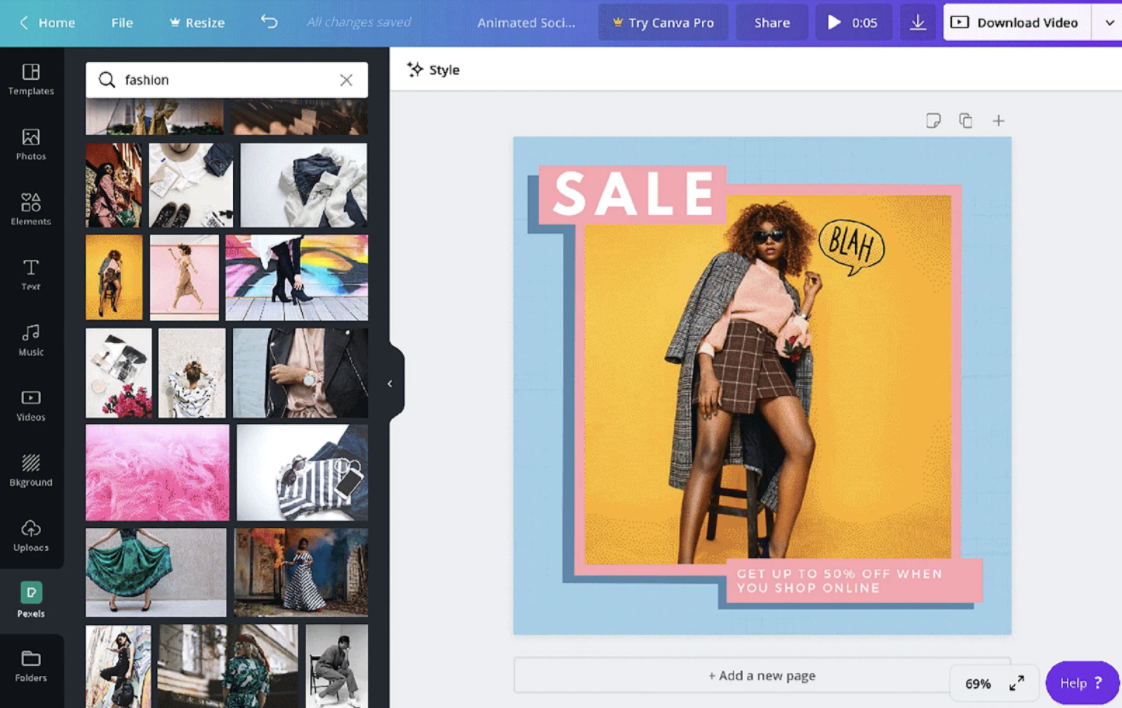
With your content roadmap, decide what visuals need to be created for the week. Write a list of everything you need from stock photos, custom graphics, videos, Reels, cover images, etc.

Once you have the list, it’s time to start creating. For custom branded graphics, you can use a tool like Canva. Create (or purchase) a library of templates you can easily customize with different content each week. This keeps your branding consistent and also saves you time as opposed to starting designs from scratch each week.

Photo by Canva.

Step 3: Write All Captions

Captions do not have to take a long time to create. By batching captions and following a caption formula, you can quickly write captions that convert your audience. A good caption should include:

  • Hook: Grab their attention right off the bat. Think of the first 7-14 words of your caption like an email subject line. You have to inspire your audience to click “read more”.
  • Value: Deliver on what you promised in your hook and share content that educates, entertains, or sells.
  • Call to Action: Tell your audience what you want them to do next (i.e. share, like, comment, click, buy, sign up, tag, etc.). Keep your calls to action simple and fun to increase the likelihood that your audience will follow through.
Photo: Luke Southern via Unsplash

Step 4: Schedule Posts

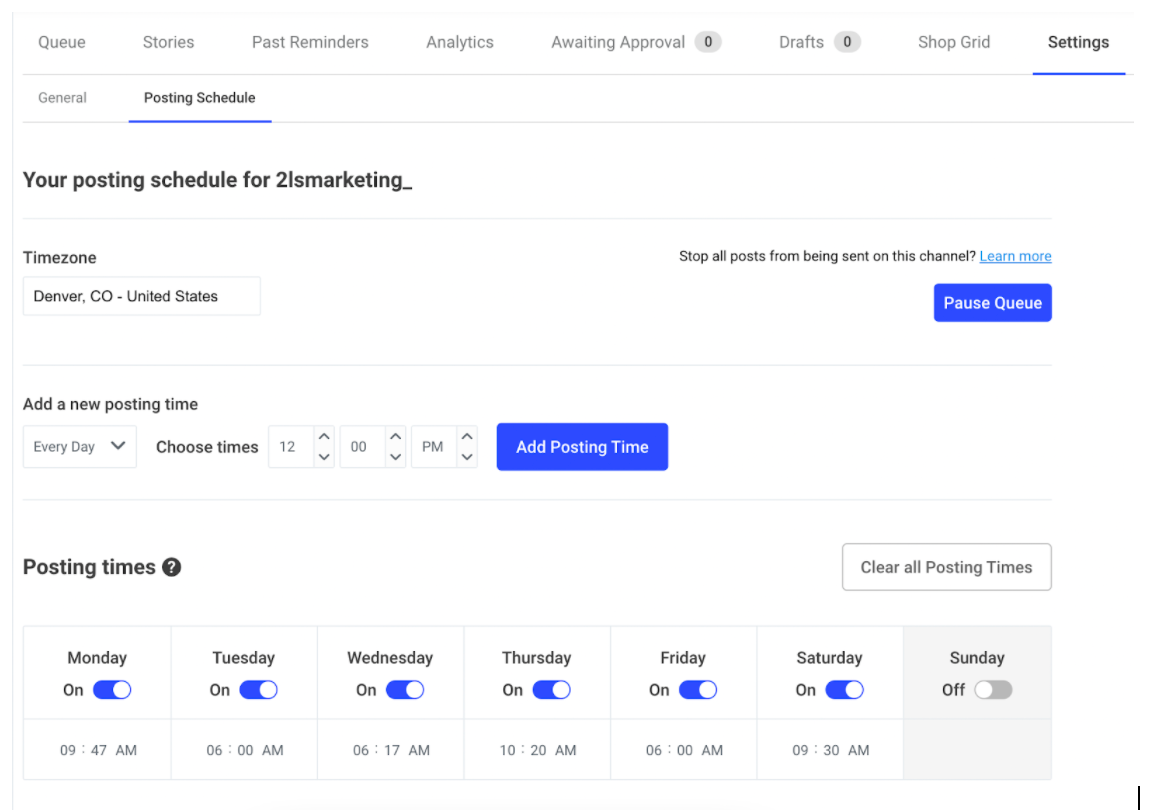
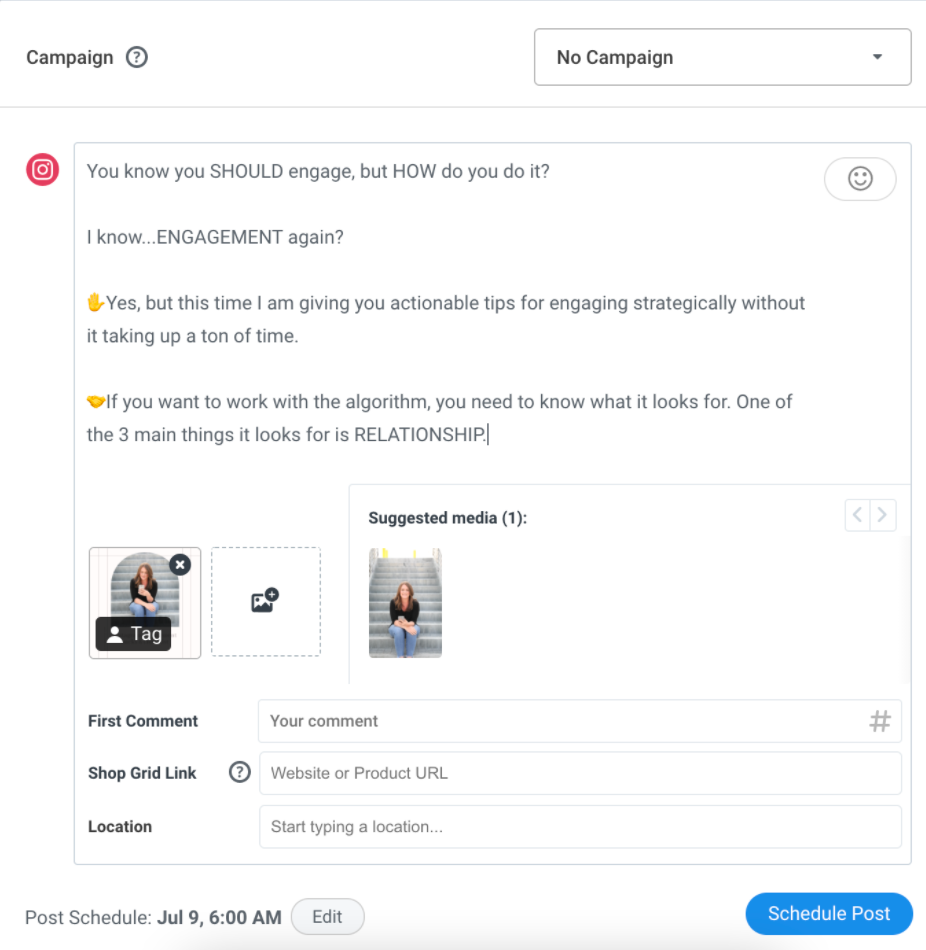
Now that you have your visuals and captions, it’s time to schedule your posts according to your content calendar. Using Buffer’s Publishing tool, go to Settings and set your posting schedule.

Then navigate to your queue, drag and drop images and copy/paste captions and click “Schedule Post” or “Add to Queue”. Depending on the type of post, your post will either automatically publish at the scheduled time, or you will receive a push notification at the scheduled time to post yourself.

Step 5: Add Hashtags (if posting to Instagram)

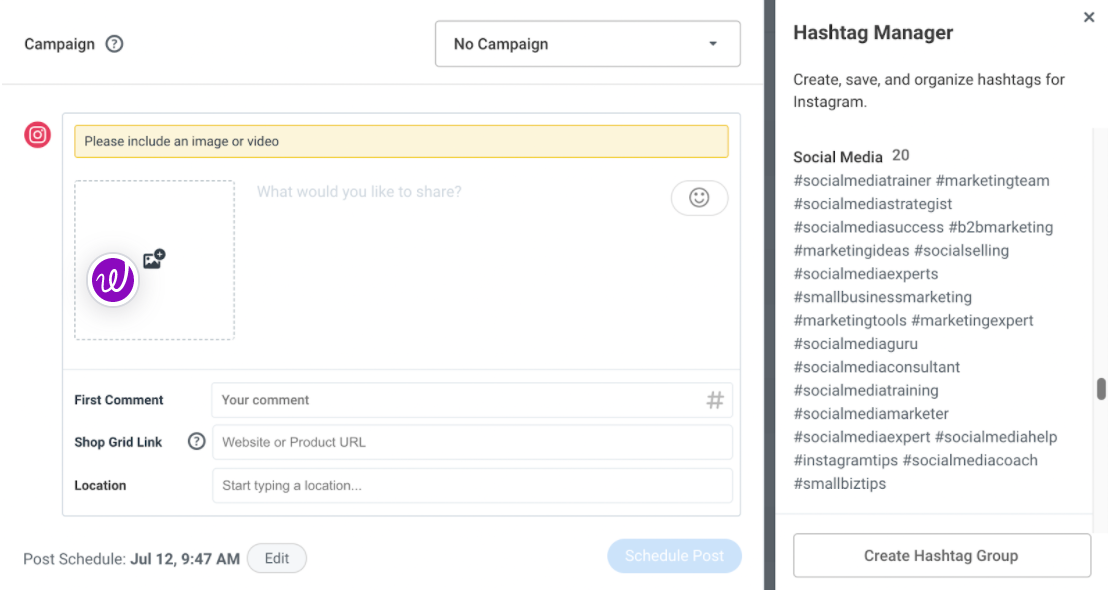
If you are posting to Instagram, when you schedule your post, you also have the option to add up to 30 hashtags to the first comment of your post. Buffer’s hashtag manager allows you to save hashtag groups right in the platform. This makes it easy to choose the right hashtag group(s) to add to your post. When used thoughtfully and strategically, hashtags are a great way to extend the reach of your content.

Enjoy The Benefits of Planning & Scheduling Your Content in Advance

Imagine not having to constantly be wondering, “What should I post?”. As you get into the habit of planning and scheduling content in advance, you will start to see your efforts pay off. Not only will your content strategy benefit you, but you will also save yourself time and reduce stress around social media content. Instead of “posting just to post”, adopting a content batching routine allows you to create high-quality content when you are in your “content zone” and schedule it according to your social media strategy.

When you plan content in advance, your content can better support your overall business goals. If you have a product or service that you want to promote, an event or a company milestone, planning in advance lets you work backward to create strategic social media content that supports those goals.

Finally, by freeing up time and energy in the content creation process, you allow yourself to spend more time in other areas of your business. That extra time can be spent building connections and relationships with your social media community, or in other areas of your business like sales, admin tasks, networking or growing your team, or even on self-care. Think about what you would spend those extra hours on each month, and use that as motivation for sticking with your new content process.

Social media is a powerful tool for businesses. By planning in advance, you can leverage social media strategically and thoughtfully.

http://feedproxy.google.com/~r/bufferapp/~3/OVtD1YpLtLM/


Facebook recalls 4 million Quest 2 VR face liners over “rashes and hives”

One day, the VR industry may be boosted with sensory tricks like smell-o-vision. That's different from the itching and burning sensations reported by Quest 2 users—unless one of Quest 2's VR zombie games is really, really ahead of its time.
Enlarge / One day, the VR industry may be boosted with sensory tricks like smell-o-vision. That’s different from the itching and burning sensations reported by Quest 2 users—unless one of Quest 2’s VR zombie games is really, really ahead of its time.
Oculus | Aurich Lawson

Facebook’s VR division is recalling every single foam facial liner included in its Oculus Quest 2 VR headset in North America, the company confirmed, as part of a US CPSC recall notice. An investigation found 5,716 reports of “skin irritation” from system owners, along with “approximately 45 reports of consumers that required medical attention.”

The recall applies to “about 4 million” customers, which is the closest public estimate we’ve yet seen for Quest 2 hardware sales in the US since the system went on sale in late 2020. Since this estimate includes standalone purchases of face covers, it’s not an exact measure, but considering how ho-hum the default face masks are, we’re confident that few people were rushing to buy duplicates of it, as opposed to superior third-party options.

In light of the recall, Facebook is also taking the extreme measure of pausing all Oculus Quest 2 sales in North America, in addition to offering silicone-liner replacements to all existing owners. This news comes after UploadVR confirmed Facebook’s plans to launch a new price point for the VR system in August: $299 for a 128GB model (up from 64GB), along with the existing 256GB model at $399. Facebook now says that the August 24 relaunch will mark the system’s return to retail outlets with an updated silicone face cover packed in by default.

One of many serious Quest 2 downgrades

Consumer complaints began piling up shortly after the system’s October 2020 launch regarding rashes, burning sensations, red facial marks, and hives experienced while wearing the VR headset. These complaints often said that the users hadn’t felt particularly warm temperature-wise, so they were not building up sweat within the VR headset’s goggle portion. (My own review of Quest 2 mentioned so many complaints that I barely touched on my disdain for the cheap-feeling foam face liner, which felt like a serious downgrade from the Quest 1’s fabric. Quest 2 is marked by a number of downgrades from its predecessor, arguably to scrape back savings to make room for its spec upgrades.) By early 2021, Facebook posted a minor acknowledgment of the issue and described the problem as affecting “about 0.01 percent” of system owners.

That Facebook post was updated in April to confirm that the company had detected in the liners “trace substances” that “were already at levels below the industry standard,” without clarifying what those substances were or what industry standard it was referencing. Did Facebook mean “as compared to commonplace facial gear like ski goggles,” or did the company mean “with regard to virtual reality masks,” an industry that has yet to receive decades of product-review scrutiny?

In either case, Facebook pledged to “change our process to reduce [trace substances] further,” but the company didn’t remove the material entirely from the liner that makes constant contact with users’ faces. That action may have still run afoul of the CPSC’s rules about appropriately labeling anything that counts as an “irritant,” which the US agency defines as something that “causes a substantial injury to the area of the body that it comes in contact with. Irritation can occur after immediate, prolonged, or repeated contact.” Facebook has yet to clarify the exact source of the existing face mask’s irritation—including whether the culprit was the foam itself or any chemical treatment sprayed onto the foam ahead of being shipped to customers.

Tuesday’s recall follows a related disappearance of Oculus Quest 2 headsets across European Union nations in May, which Facebook confirmed was related to an EU commission looking into the system’s foam face mask amid users’ reports of irritation and worse. The headset has not yet returned to European retailers as of press time.

Thanks to Quest 2’s forced integration with Facebook accounts, it stands to reason that Facebook could begin targeting all Quest 2 owners with notices or advertisements about facial irritation, rashes, and hives across all connected Facebook services, including Instagram and Whatsapp. However, Facebook says it will contact affected users about this week’s recall via email, or they can go directly to a recall-related site and request a replacement of their own.

https://arstechnica.com/?p=1783373


Facebook Pay extends its reach later this summer

Facebook Pay is one of many payment services aiming to eliminate the "phone, laptop, credit card" shuffle by offering easily accessed one-tap payment options.
Enlarge / Facebook Pay is one of many payment services aiming to eliminate the “phone, laptop, credit card” shuffle by offering easily accessed one-tap payment options.

This August, Facebook will be making its Facebook Pay payment service available outside its own platforms for the first time. Facebook’s announcement describes the move as providing a mobile-friendly seamless checkout experience for businesses that elect to use it, pointing out that Facebook users already use the service to send money and buy items in Facebook Shops and the Facebook Marketplace.

There isn’t much meat in Facebook’s announcement, which mostly rehashes feel-good bullet points that apply to the entire online financial industry, not just Facebook Pay—for example, the system’s use of encrypted storage and the fact that businesses accepting Facebook Pay don’t need to manage customers’ card or bank account numbers. While these features sound good at first blush, they’re both de rigueur, not innovations—the majority of online stores already use third-party payment processors that manage credit card and bank account numbers for them.

Facebook pledges that Pay users’ credit card and bank account information won’t be used to “personalize their experience” or target advertisements. The company also says that payments and purchases will not be shared with a user’s friends or to a user’s profile or feed. It’s worth noting that these are explicitly separate promises, though—Facebook isn’t promising that payments and purchases won’t be used for “personalization” or ad targeting.

Checking Facebook Pay’s privacy matters blog post makes that last point quite clear:

As with our other products, the actions you take with Facebook Pay can be used for purposes such as to deliver you more relevant content and ads, to provide customer support and to promote safety and integrity (e.g., to investigate violations of our payments policies). For example, if you buy a baseball glove on Facebook Marketplace, you might see an ad for a baseball bat.On the plus side, at least direct email marketing spawned by Facebook Pay activity is opt-in, not opt-out; the same blog post says that “businesses and nonprofits will only be permitted to use [your email address] for marketing purposes if you opt in.”

Facebook Pay’s first steps outside the Facebook ecosystem will be on Shopify stores only, but the service is expected to expand further to more shopping platforms and payment processors over time.

https://arstechnica.com/?p=1780591