Concerns over addicted kids spur probe into Meta and its use of dark patterns
Getty Images | Chesnot
Brussels has opened an in-depth probe into Meta over concerns it is failing to do enough to protect children from becoming addicted to social media platforms such as Instagram.
The European Commission, the EU’s executive arm, announced on Thursday it would look into whether the Silicon Valley giant’s apps were reinforcing “rabbit hole” effects, where users get drawn ever deeper into online feeds and topics.
EU investigators will also look into whether Meta, which owns Facebook and Instagram, is complying with legal obligations to provide appropriate age-verification tools to prevent children from accessing inappropriate content.
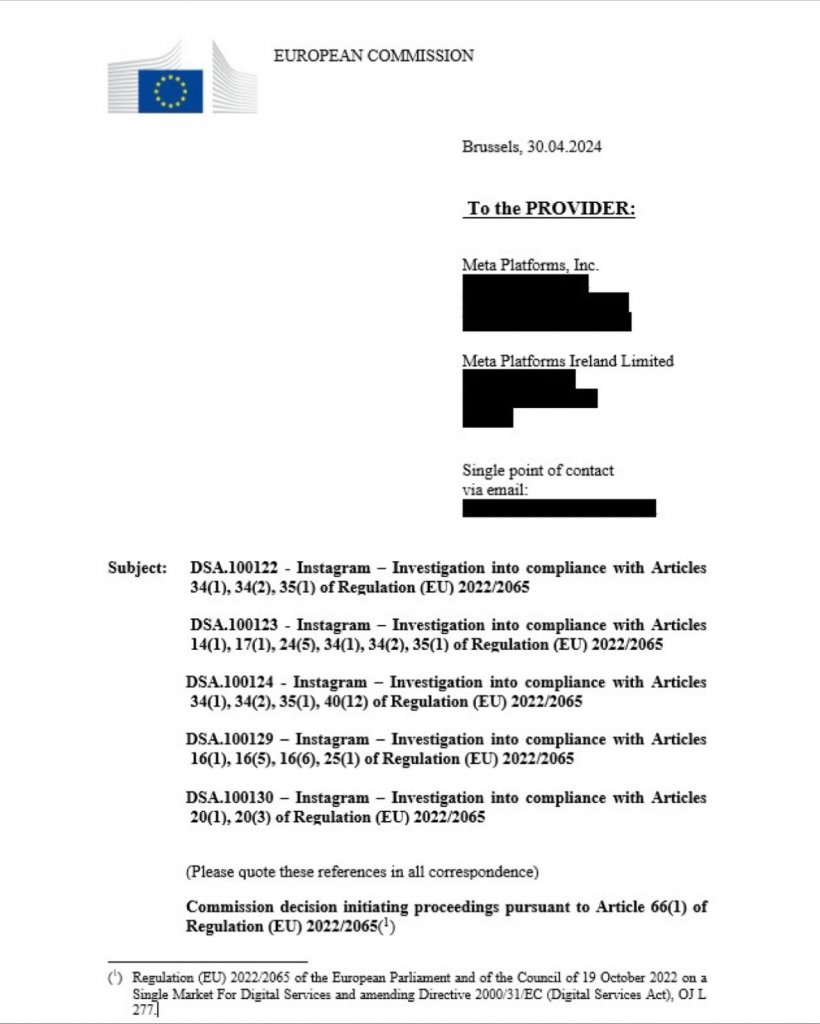
The probe is the second into the company under the EU’s Digital Services Act. The landmark legislation is designed to police content online, with sweeping new rules on the protection of minors.
It also has mechanisms to force Internet platforms to reveal how they are tackling misinformation and propaganda.
The DSA, which was approved last year, imposes new obligations on very large online platforms with more than 45 million users in the EU. If Meta is found to have broken the law, Brussels can impose fines of up to 6 percent of a company’s global annual turnover.
Repeat offenders can even face bans in the single market as an extreme measure to enforce the rules.
Thierry Breton, commissioner for internal market, said the EU was “not convinced” that Meta “has done enough to comply with the DSA obligations to mitigate the risks of negative effects to the physical and mental health of young Europeans on its platforms Facebook and Instagram.”
“We are sparing no effort to protect our children,” Breton added.
Meta said: “We want young people to have safe, age-appropriate experiences online and have spent a decade developing more than 50 tools and policies designed to protect them. This is a challenge the whole industry is facing, and we look forward to sharing details of our work with the European Commission.”
In the investigation, the commission said it would focus on whether Meta’s platforms were putting in place “appropriate and proportionate measures to ensure a high level of privacy, safety, and security for minors.” It added that it was placing special emphasis on default privacy settings for children.
Brussels is especially concerned whether the social media company’s platforms are properly moderating content from Russian sources that may try to destabilize upcoming elections across Europe.
Meta defended its moderating practices and said it had appropriate systems in place to stop the spread of disinformation on its platforms.
Over 100 far-right militias are coordinating on Facebook
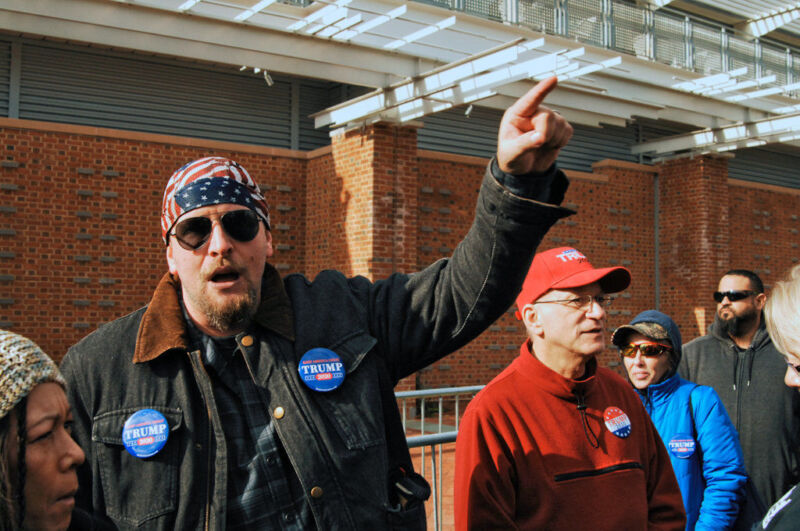
“Join Your Local Militia or III% Patriot Group,” a post urged the more than 650 members of a Facebook group called the Free American Army. Accompanied by the logo for the Three Percenters militia network and an image of a man in tactical gear holding a long rifle, the post continues: “Now more than ever. Support the American militia page.”
Other content and messaging in the group is similar. And despite the fact that Facebook bans paramilitary organizing and deemed the Three Percenters an “armed militia group” on its 2021 Dangerous Individuals and Organizations List, the post and group remained up until WIRED contacted Meta for comment about its existence.
Free American Army is just one of around 200 similar Facebook groups and profiles, most of which are still live, that anti-government and far-right extremists are using to coordinate local militia activity around the country.
After lying low for several years in the aftermath of the US Capitol riot on January 6, militia extremists have been quietly reorganizing, ramping up recruitment and rhetoric on Facebook—with apparently little concern that Meta will enforce its ban against them, according to new research by the Tech Transparency Project, shared exclusively with WIRED.
Individuals across the US with long-standing ties to militia groups are creating networks of Facebook pages, urging others to recruit “active patriots” and attend meetups, and openly associating themselves with known militia-related sub-ideologies like that of the anti-government Three Percenter movement. They’re also advertising combat training and telling their followers to be “prepared” for whatever lies ahead. These groups are trying to facilitate local organizing, state by state and county by county. Their goals are vague, but many of their posts convey a general sense of urgency about the need to prepare for “war” or to “stand up” against many supposed enemies, including drag queens, immigrants, pro-Palestine college students, communists—and the US government.
These groups are also rebuilding at a moment when anti-government rhetoric has continued to surge in mainstream political discourse ahead of a contentious, high-stakes presidential election. And by doing all of this on Facebook, they’re hoping to reach a broader pool of prospective recruits than they would on a comparatively fringe platform like Telegram.
“Many of these groups are no longer fractured sets of localized militia but coalitions formed between multiple militia groups, many with Three Percenters at the helm,” said Katie Paul, director of the Tech Transparency Project. “Facebook remains the largest gathering place for extremists and militia movements to cast a wide net and funnel users to more private chats, including on the platform, where they can plan and coordinate with impunity.”
Paul told WIRED that she’s been monitoring “hundreds” of militia-related groups and profiles since 2021 and has observed them growing “increasingly emboldened with more serious and coordinated organizing” in the past year.
One particularly influential account in this Facebook ecosystem belongs to Rodney Huffman, leader of the Confederate States III%, an Arkansas-based militia that, in 2020, sought to rally extremists at Georgia’s Stone Mountain, a popular site for Confederate and white supremacist groups. Huffman has created a network of Facebook groups and spreads the word about local meetups. His partner, Dabbi Demere, is equally active and on a mission to recruit “active” patriots into the groups. Huffman and Demere are also key players in the pro-Confederate movement known as “Heritage, not Hate.”
Before Meta shut it down, the pair ran Free American Army, which drew in individuals from several militias, including the Kentucky 3 Percenters, the Virginia Liberty Guard, and the Florida-based Guardians of Freedom, a group that was mentioned in the final January 6 report and whose members were among those arrested in connection with the Capitol attack. Free American Army also included a known activist in the far-right extremist Boogaloo movement. At least one user in the group claimed in their profile to be active-duty military; another claimed to work for the Bureau of Prisons.
https://arstechnica.com/?p=2021638
DSA, Breton (UE): “Apriamo procedimento su Facebook e Instagram”. Timori per le elezioni di giugno
Il commissario Breton: “Aperti procedimenti contro Meta per sospetta violazione del Dsa”
Si ipotizza una violazione della legge sui servizi digitali (Digital service act, Dsa) da parte di Meta, società proprietaria di Facebook, Instagram e Whatsapp, nel procedimento formale avviato stamattina dalla Commissione europea.
“Oggi apriamo dei procedimenti contro Meta per sospetta violazione del DSA e degli obblighi di proteggere l’integrità delle elezioni”, ha scritto in un post su LinkedIn Thierry Breton, commissario europeo per il mercato interno.
Al centro dell’indagine tre possibili elementi critici: “Una moderazione degli annunci considerata inadeguata e sfruttata per interferenze e truffe straniere”, l’“accesso inappropriato ai dati per monitorare le elezioni” e la mancanza di uno “strumento conforme per la segnalazione di contenuti illegali”.
I punti critici sollevati dalla Commissione
Si tratta, quindi, di evidenze negative nelle politiche e nelle pratiche della società guidata da Mark Zuckerberg relative alla gestione della pubblicità e dei contenuti elettorali.
La preoccupazione della Commissione rimane sempre una e solo una: che Facebook e Instagram favoriscano ingerenze straniere e propaganda antieuropea prima e durante le elezioni politiche di giugno per il rinnovo del Parlamento europeo.
Meta è inoltre apparsa manchevole, agli occhi di Bruxelles, di un adeguato strumento ‘terzo’ di monitoraggio civico e politico, per raccogliere in tempo reale informazioni su possibili illeciti o abusi. CrowdTangle è ad un passo dal pensionamento, ma non si sa ancora quale sarà il suo degno sostituto.
La Commissione sospetta, inoltre, che il meccanismo per segnalare i contenuti illegali sui servizi (“Notice-and-Action“), nonché i meccanismi di ricorso e di reclamo interni degli utenti, non siano conformi ai requisiti della legge sui servizi digitali e che esistano carenze nella fornitura da parte di Meta dell’accesso ai dati disponibili al pubblico ai ricercatori.
Cinque giorni lavorativi a Meta per rispondere
“Questa Commissione ha creato mezzi per proteggere i cittadini europei dalla disinformazione mirata e dalla manipolazione da parte di Paesi terzi. Se sospettiamo una violazione delle regole, agiamo. Questo è vero in ogni momento, ma soprattutto in tempi delle elezioni democratiche“, ha commentato la presidente della Commissione europea, Ursula von der Leyen. “Le grandi piattaforme digitali – ha aggiunto la Presidente – devono rispettare i propri obblighi e investire risorse sufficienti in questo ambito e la decisione di oggi dimostra che prendiamo sul serio il rispetto delle nostre democrazie è una battaglia comune con i nostri Stati membri”.
Meta ha cinque lavorativi per rispondere ai rilievi di Bruxelles ed offrire il proprio punto di vista.
Meta continua a perdere miliardi con il Metaverso.
Come è noto, il rebranding di Facebook da parte di Mark Zuckerberg in Meta nel 2021 è diventato un flop ben documentato. Ciò che è stato promesso – una realtà virtuale in cui teniamo riunioni aziendali o visitiamo familiari lontani – deve ancora diventare realtà, e molti media hanno già pronunciato il de profundis e proclamato morto il Metaverso di Meta.
La divisione Reality Labs migliora ma resta in rosso
La divisione Reality Labs dell’azienda, la sua divisione di ricerca e attività di realtà virtuale, ha registrato mercoledì una perdita di 3,8 miliardi di dollari durante i tre mesi terminati il 31 marzo.
Ma ciò detto, per il Metaverso non è stata detta la parola fine. Le perdite di Reality Labs, per quanto ingenti, si sono ridotte considerevolmente rispetto al trimestre precedente (17%) e leggermente rispetto all’anno precedente (3,7%). Resta il fatto che il Metaverso continua ad essere un grosso problema per Zuckerberg.
“È stato un buon inizio anno”, ha detto Zuckerberg alla presentazione della trimestrale mercoledì scorso. “Continuiamo a fare progressi costanti anche nella costruzione del metaverso”.
Zuckerberg continua a acrederci
Quel che è certo è che la fase di hype tecnologico intorno al metaverso in genere si è sgonfiata in modo repentino, sostituita peraltro da un’analoga fase di esaltazione dell’Intelligenza Artificiale. Vedremo nei prossimi mesi se il metaverso sarà in grado di riguadagnare terreno e interesse.
A quanto pare, Mark Zuckerberg continua a crederci: “In futuro, sarai in grado di teletrasportarti istantaneamente come un ologramma per essere in ufficio senza doverti spostare, a un concerto con gli amici o nel soggiorno dei tuoi genitori per restare in pari. Ciò aprirà più opportunità, indipendentemente da dove vivi. Potrai dedicare più tempo a ciò che conta per te, ridurre i tempi nel traffico e le emissioni di carbonio”. Queste le affermazioni di Zuckerberg su un futuro nel Metaverso.
Meta relaxes “incoherent” policy requiring removal of AI videos
On Friday, Meta announced policy updates to stop censoring harmless AI-generated content and instead begin “labeling a wider range of video, audio, and image content as ‘Made with AI.'”
Meta’s policy updates came after deciding not to remove a controversial post edited to show President Joe Biden seemingly inappropriately touching his granddaughter’s chest, with a caption calling Biden a “pedophile.” The Oversight Board had agreed with Meta’s decision to leave the post online while noting that Meta’s current manipulated media policy was too “narrow,” “incoherent,” and “confusing to users.”
Previously, Meta would only remove “videos that are created or altered by AI to make a person appear to say something they didn’t say.” The Oversight Board warned that this policy failed to address other manipulated media, including “cheap fakes,” manipulated audio, or content showing people doing things they’d never done.
“We agree with the Oversight Board’s argument that our existing approach is too narrow since it only covers videos that are created or altered by AI to make a person appear to say something they didn’t say,” Monika Bickert, Meta’s vice president of content policy, wrote in a blog. “As the Board noted, it’s equally important to address manipulation that shows a person doing something they didn’t do.”
Starting in May 2024, Meta will add “Made with AI” labels to any content detected as AI-generated, as well as to any content that users self-disclose as AI-generated.
Meta’s Oversight Board had also warned that Meta removing AI-generated videos that did not directly violate platforms’ community standards was threatening to “unnecessarily risk restricting freedom of expression.” Moving forward, Meta will stop censoring content that doesn’t violate community standards, agreeing that a “less restrictive” approach to manipulated media by adding labels is better.
“If we determine that digitally created or altered images, video, or audio create a particularly high risk of materially deceiving the public on a matter of importance, we may add a more prominent label so people have more information and context,” Bickert wrote. “This overall approach gives people more information about the content so they can better assess it and so they will have context if they see the same content elsewhere.”
Meta confirmed that, in July, it will stop censoring AI-generated content that doesn’t violate rules restricting things like voter interference, bullying and harassment, violence, and incitement.
“This timeline gives people time to understand the self-disclosure process before we stop removing the smaller subset of manipulated media,” Bickert explained in the blog.
Finally, Meta adopted the Oversight Board’s recommendation to “clearly define in a single unified Manipulated Media policy the harms it aims to prevent—beyond users being misled—such as preventing interference with the right to vote and to participate in the conduct of public affairs.”
The Oversight Board issued a statement provided to Ars, saying that members “are pleased that Meta will begin labeling a wider range of video, audio, and image content as ‘made with AI’ when they detect AI image indicators or when people indicate they have uploaded AI content.”
“This will provide people with greater context and transparency for more types of manipulated media, while also removing posts which violate Meta’s rules in other ways,” the Oversight Board said.
https://arstechnica.com/?p=2015131
Facebook let Netflix see user DMs, quit streaming to keep Netflix happy: Lawsuit
Enlarge/ A promotional image for Sorry for Your Loss, which was a Facebook Watch original scripted series.
Last April, Meta revealed that it would no longer support original shows, like Jada Pinkett Smith’s Red Table Talk talk show, on Facebook Watch. Meta’s streaming business that was once viewed as competition for the likes of YouTube and Netflix is effectively dead now; Facebook doesn’t produce original series, and Facebook Watch is no longer available as a video-streaming app.
The streaming business’ demise has seemed related to cost cuts at Meta that have also included layoffs. However, recently unsealed court documents in an antitrust suit against Meta [PDF] claim that Meta has squashed its streaming dreams in order to appease one of its biggest ad customers: Netflix.
Facebook allegedly gave Netflix creepy privileges
As spotted via Gizmodo, a letter was filed on April 14 in relation to a class-action antitrust suit that was filed by Meta customers, accusing Meta of anti-competitive practices that harm social media competition and consumers. The letter, made public Saturday, asks a court to have Reed Hastings, Netflix’s founder and former CEO, respond to a subpoena for documents that plaintiffs claim are relevant to the case. The original complaint filed in December 2020 [PDF] doesn’t mention Netflix beyond stating that Facebook “secretly signed Whitelist and Data sharing agreements” with Netflix, along with “dozens” of other third-party app developers. The case is still ongoing.
The letter alleges that Netflix’s relationship with Facebook was remarkably strong due to the former’s ad spend with the latter and that Hastings directed “negotiations to end competition in streaming video” from Facebook.
One of the first questions that may come to mind is why a company like Facebook would allow Netflix to influence such a major business decision. The litigation claims the companies formed a lucrative business relationship that included Facebook allegedly giving Netflix access to Facebook users’ private messages:
By 2013, Netflix had begun entering into a series of “Facebook Extended API” agreements, including a so-called “Inbox API” agreement that allowed Netflix programmatic access to Facebook’s users’ private message inboxes, in exchange for which Netflix would “provide to FB a written report every two weeks that shows daily counts of recommendation sends and recipient clicks by interface, initiation surface, and/or implementation variant (e.g., Facebook vs. non-Facebook recommendation recipients). … In August 2013, Facebook provided Netflix with access to its so-called “Titan API,” a private API that allowed a whitelisted partner to access, among other things, Facebook users’ “messaging app and non-app friends.”
Meta said it rolled out end-to-end encryption “for all personal chats and calls on Messenger and Facebook” in December. And in 2018, Facebook told Vox that it doesn’t use private messages for ad targeting. But a few months later, The New York Times, citing “hundreds of pages of Facebook documents,” reported that Facebook “gave Netflix and Spotify the ability to read Facebook users’ private messages.”
Meta didn’t respond to Ars Technica’s request for comment. The company told Gizmodo that it has standard agreements with Netflix currently but didn’t answer the publication’s specific questions.
https://arstechnica.com/?p=2013174
Facebook secretly spied on Snapchat usage to confuse advertisers, court docs say
Unsealed court documents have revealed more details about a secret Facebook project initially called “Ghostbusters,” designed to sneakily access encrypted Snapchat usage data to give Facebook a leg up on its rival, just when Snapchat was experiencing rapid growth in 2016.
The documents were filed in a class-action lawsuit from consumers and advertisers, accusing Meta of anticompetitive behavior that blocks rivals from competing in the social media ads market.
“Whenever someone asks a question about Snapchat, the answer is usually that because their traffic is encrypted, we have no analytics about them,” Facebook CEO Mark Zuckerberg (who has since rebranded his company as Meta) wrote in a 2016 email to Javier Olivan.
“Given how quickly they’re growing, it seems important to figure out a new way to get reliable analytics about them,” Zuckerberg continued. “Perhaps we need to do panels or write custom software. You should figure out how to do this.”
At the time, Olivan was Facebook’s head of growth, but now he’s Meta’s chief operating officer. He responded to Zuckerberg’s email saying that he would have the team from Onavo—a controversial traffic-analysis app acquired by Facebook in 2013—look into it.
Olivan told the Onavo team that he needed “out of the box thinking” to satisfy Zuckerberg’s request. He “suggested potentially paying users to ‘let us install a really heavy piece of software'” to intercept users’ Snapchat data, a court document shows.
What the Onavo team eventually came up with was a project internally known as “Ghostbusters,” an obvious reference to Snapchat’s logo featuring a white ghost. Later, as the project grew to include other Facebook rivals, including YouTube and Amazon, the project was called the “In-App Action Panel” (IAAP).
The IAAP program’s purpose was to gather granular insights into users’ engagement with rival apps to help Facebook develop products as needed to stay ahead of competitors. For example, two months after Zuckerberg’s 2016 email, Meta launched Stories, a Snapchat copycat feature, on Instagram, which the Motley Fool noted rapidly became a key ad revenue source for Meta.
In an email to Olivan, the Onavo team described the “technical solution” devised to help Zuckerberg figure out how to get reliable analytics about Snapchat users. It worked by “develop[ing] ‘kits’ that can be installed on iOS and Android that intercept traffic for specific sub-domains, allowing us to read what would otherwise be encrypted traffic so we can measure in-app usage,” the Onavo team said.
Olivan was told that these so-called “kits” used a “man-in-the-middle” attack typically employed by hackers to secretly intercept data passed between two parties. Users were recruited by third parties who distributed the kits “under their own branding” so that they wouldn’t connect the kits to Onavo unless they used a specialized tool like Wireshark to analyze the kits. TechCrunch reported in 2019 that sometimes teens were paid to install these kits. After that report, Facebook promptly shut down the project.
This “man-in-the-middle” tactic, consumers and advertisers suing Meta have alleged, “was not merely anticompetitive, but criminal,” seemingly violating the Wiretap Act. It was used to snoop on Snapchat starting in 2016, on YouTube from 2017 to 2018, and on Amazon in 2018, relying on creating “fake digital certificates to impersonate trusted Snapchat, YouTube, and Amazon analytics servers to redirect and decrypt secure traffic from those apps for Facebook’s strategic analysis.”
Ars could not reach Snapchat, Google, or Amazon for comment.
Facebook allegedly sought to confuse advertisers
Not everyone at Facebook supported the IAAP program. “The company’s highest-level engineering executives thought the IAAP Program was a legal, technical, and security nightmare,” another court document said.
Pedro Canahuati, then-head of security engineering, warned that incentivizing users to install the kits did not necessarily mean that users understood what they were consenting to.
“I can’t think of a good argument for why this is okay,” Canahuati said. “No security person is ever comfortable with this, no matter what consent we get from the general public. The general public just doesn’t know how this stuff works.”
Mike Schroepfer, then-chief technology officer, argued that Facebook wouldn’t want rivals to employ a similar program analyzing their encrypted user data.
“If we ever found out that someone had figured out a way to break encryption on [WhatsApp] we would be really upset,” Schroepfer said.
While the unsealed emails detailing the project have recently raised eyebrows, Meta’s spokesperson told Ars that “there is nothing new here—this issue was reported on years ago. The plaintiffs’ claims are baseless and completely irrelevant to the case.”
According to Business Insider, advertisers suing said that Meta never disclosed its use of Onavo “kits” to “intercept rivals’ analytics traffic.” This is seemingly relevant to their case alleging anticompetitive behavior in the social media ads market, because Facebook’s conduct, allegedly breaking wiretapping laws, afforded Facebook an opportunity to raise its ad rates “beyond what it could have charged in a competitive market.”
Since the documents were unsealed, Meta has responded with a court filing that said: “Snapchat’s own witness on advertising confirmed that Snap cannot ‘identify a single ad sale that [it] lost from Meta’s use of user research products,’ does not know whether other competitors collected similar information, and does not know whether any of Meta’s research provided Meta with a competitive advantage.”
This conflicts with testimony from a Snapchat executive, who alleged that the project “hamper[ed] Snap’s ability to sell ads” by causing “advertisers to not have a clear narrative differentiating Snapchat from Facebook and Instagram.” Both internally and externally, “the intelligence Meta gleaned from this project was described” as “devastating to Snapchat’s ads business,” a court filing said.
https://arstechnica.com/?p=2012980
Users shocked to find Instagram limits political content by default
Instagram users have started complaining on X (formerly Twitter) after discovering that Meta has begun limiting recommended political content by default.
“Did [y’all] know Instagram was actively limiting the reach of political content like this?!” an X user named Olayemi Olurin wrote in an X post with more than 150,000 views as of this writing. “I had no idea ‘til I saw this comment and I checked my settings and sho nuff political content was limited.”
“Instagram quietly introducing a ‘political’ content preference and turning on ‘limit’ by default is insane?” wrote another X user named Matt in a post with nearly 40,000 views.
Instagram apparently did not notify users directly on the platform when this change happened.
Instead, Instagram rolled out the change in February, announcing in a blog that the platform doesn’t “want to proactively recommend political content from accounts you don’t follow.” That post confirmed that Meta “won’t proactively recommend content about politics on recommendation surfaces across Instagram and Threads,” so that those platforms can remain “a great experience for everyone.”
“This change does not impact posts from accounts people choose to follow; it impacts what the system recommends, and people can control if they want more,” Meta’s spokesperson Dani Lever told Ars. “We have been working for years to show people less political content based on what they told us they want, and what posts they told us are political.”
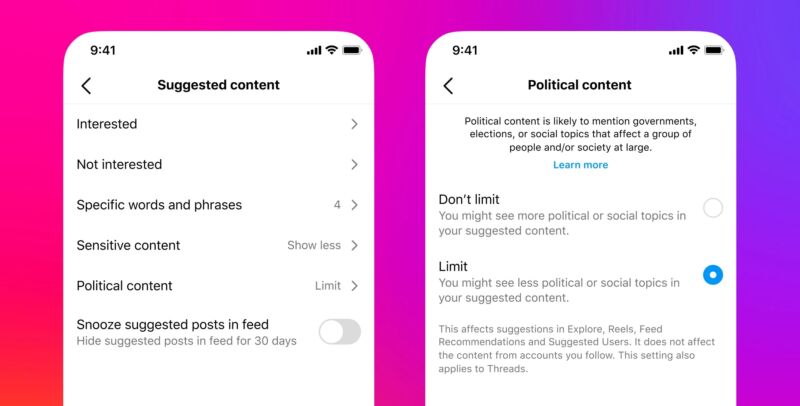
To change the setting, users can navigate to Instagram’s menu for “settings and activity” in their profiles, where they can update their “content preferences.” On this menu, “political content” is the last item under a list of “suggested content” controls that allow users to set preferences for what content is recommended in their feeds.
There are currently two options for controlling what political content users see. Choosing “don’t limit” means “you might see more political or social topics in your suggested content,” the app says. By default, all users are set to “limit,” which means “you might see less political or social topics.”
“This affects suggestions in Explore, Reels, Feed, Recommendations, and Suggested Users,” Instagram’s settings menu explains. “It does not affect content from accounts you follow. This setting also applies to Threads.”
For general Instagram and Threads users, this change primarily limits what content posted can be recommended, but for influencers using professional accounts, the stakes can be higher. The Washington Post reported that news creators were angered by the update, insisting that Meta’s update diminished the value of the platform for reaching users not actively seeking political content.
“The whole value-add for social media, for political people, is that you can reach normal people who might not otherwise hear a message that they need to hear, like, abortion is on the ballot in Florida, or voting is happening today,” Keith Edwards, a Democratic political strategist and content creator, told The Post.
Meta’s blog noted that “professional accounts on Instagram will be able to use Account Status to check their eligibility to be recommended based on whether they recently posted political content. From Account Status, they can edit or remove recent posts, request a review if they disagree with our decision, or stop posting this type of content for a period of time, in order to be eligible to be recommended again.”
Ahead of a major election year, Meta’s change could impact political outreach attempting to inform voters. The change also came amid speculation that Meta was “shadowbanning” users posting pro-Palestine content since the start of the Israel-Hamas war, The Markup reported.
“Our investigation found that Instagram heavily demoted nongraphic images of war, deleted captions and hid comments without notification, suppressed hashtags, and limited users’ ability to appeal moderation decisions,” The Markup reported.
Meta appears to be interested in shifting away from its reputation as a platform where users expect political content—and misinformation—to thrive. Last year, The Wall Street Journal reported that Meta wanted out of politics and planned to “scale back how much political content it showed users,” after criticism over how the platform handled content related to the January 6 Capitol riot.
The decision to limit recommended political content on Instagram and Threads, Meta’s blog said, extends Meta’s “existing approach to how we treat political content.”
“People have told us they want to see less political content, so we have spent the last few years refining our approach on Facebook to reduce the amount of political content—including from politicians’ accounts—you see in Feed, Reels, Watch, Groups You Should Join, and Pages You May Like,” Meta wrote in a February blog update.
“As part of this, we aim to avoid making recommendations that could be about politics or political issues, in line with our approach of not recommending certain types of content to those who don’t wish to see it,” Meta’s blog continued, while at the same time, “preserving your ability to find and interact with political content that’s meaningful to you if that’s what you’re interested in.”
While platforms typically update users directly on the platform when terms of services change, that wasn’t the case for this update, which simply added new controls for users. That’s why many users who prefer to be recommended political content—and apparently missed Meta’s announcement and subsequent media coverage—expressed shock to discover that Meta was limiting what they see.
On X, even Instagram users who don’t love seeing political content are currently rallying to raise awareness and share tips on how to update the setting.
“This is actually kinda wild that Instagram defaults everyone to this,” one user named Laura wrote. “Obviously political content is toxic but during an election season it’s a little weird to just hide it from everyone?”
https://arstechnica.com/?p=2012207
Public officials can block haters—but only sometimes, SCOTUS rules
There are some circumstances where government officials are allowed to block people from commenting on their social media pages, the Supreme Court ruled Friday.
According to the Supreme Court, the key question is whether officials are speaking as private individuals or on behalf of the state when posting online. Issuing two opinions, the Supreme Court declined to set a clear standard for when personal social media use constitutes state speech, leaving each unique case to be decided by lower courts.
Instead, SCOTUS provided a test for courts to decide first if someone is or isn’t speaking on behalf of the state on their social media pages, and then if they actually have authority to act on what they post online.
The ruling suggests that government officials can block people from commenting on personal social media pages where they discuss official business when that speech cannot be attributed to the state and merely reflects personal remarks. This means that blocking is acceptable when the official has no authority to speak for the state or exercise that authority when speaking on their page.
That authority empowering officials to speak for the state could be granted by a written law. It could also be granted informally if officials have long used social media to speak on behalf of the state to the point where their power to do so is considered “well-settled,” one SCOTUS ruling said.
SCOTUS broke it down like this: An official might be viewed as speaking for the state if the social media page is managed by the official’s office, if a city employee posts on their behalf to their personal page, or if the page is handed down from one official to another when terms in office end.
Posting on a personal page might also be considered speaking for the state if the information shared has not already been shared elsewhere.
Examples of officials clearly speaking on behalf of the state include a mayor holding a city council meeting online or an official using their personal page as an official channel for comments on proposed regulations.
Because SCOTUS did not set a clear standard, officials risk liability when blocking followers on so-called “mixed use” social media pages, SCOTUS cautioned. That liability could be diminished by keeping personal pages entirely separate or by posting a disclaimer stating that posts represent only officials’ personal views and not efforts to speak on behalf of the state. But any official using a personal page to make official comments could expose themselves to liability, even with a disclaimer.
SCOTUS test for when blocking is OK
These clarifications came in two SCOTUS opinions addressing conflicting outcomes in two separate complaints about officials in California and Michigan who blocked followers heavily criticizing them on Facebook and X. The lower courts’ decisions have been vacated, and courts must now apply the Supreme Court’s test to issue new decisions in each case.
One opinion was brief and unsigned, discussing a case where California parents sued school district board members who blocked them from commenting on public Twitter pages used for campaigning and discussing board issues. The board members claimed they blocked their followers after the parents left dozens and sometimes hundreds of the same exact comments on tweets.
In the second—which was unanimous, with no dissenting opinions—Justice Amy Coney Barrett responded at length to a case from a Facebook user named Kevin Lindke. This opinion provides varied guidance that courts can apply when considering whether blocking is appropriate or violating constituents’ First Amendment rights.
Lindke was blocked by a Michigan city manager, James Freed, after leaving comments criticizing the city’s response to COVID-19 on a page that Freed created as a college student sometime before 2008. Among these comments, Lindke called the city’s pandemic response “abysmal” and told Freed that “the city deserves better.” On a post showing Freed picking up a takeout order, Lindke complained that residents were “suffering,” while Freed ate at expensive restaurants.
After Freed hit 5,000 followers, he converted the page to reflect his public figure status. But while he primarily still used the page for personal posts about his family and always managed the page himself, the page went into murkier territory when he also shared updates about his job as city manager. Those updates included sharing updates on city efforts, posting screenshots of city press releases, and soliciting public feedback, like sharing links to city surveys.
https://arstechnica.com/?p=2010572
“Really bad timing”: Meta is killing misinformation analysis tool on August 14
Meta is discontinuing data analysis tool CrowdTangle on August 14. The closure will come three months ahead of the next US presidential election and three years after it was reported that the platform used for spotting misinformation on Facebook and Instagram was causing internal strife.
Meta acquired CrowdTangle in 2016. CrowdTangle has been used by researchers, reporters, and government officials to identify trends about conspiracies and other forms of misinformation spreading through Facebook. Meta is going to replace CrowdTangle with a technology currently under development called Meta Content Library, but it will only be available to academic and nonprofit researchers. For-profit organizations, like many news organizations, will lose access, as The Wall Street Journal points out.
Previously, CrowdTangle had some features available to the public, like Live Displays, which tracked how people discussed trending topics on certain social media channels like Facebook Pages. Journalists working at for-profit news outlets were able to apply for access to the full CrowdTangle service, as were publishers, including music labels, content creators, and public figures.
While announcing CrowdTangle’s closure date today, Nick Clegg, president of global affairs at Meta, claimed that five months’ notice “should give people time to complete any current projects they are using it for and, if eligible, to get up to speed with our new research tools, Meta Content Library and API, or others that serve their needs.”
However, in a conversation with WSJ, Cody Buntain, a researcher at the University of Maryland’s College of Information Studies who has used the beta version of Meta Content Library, told WSJ that CrowdTangle’s EOL date is “really bad timing,” pointing to researchers looking to draw data from Facebook and Instagram throughout the 2024 election campaigns.
Meta first announced it was shutting down CrowdTangle in 2022. At the time, Jesse Littlewood, VP of campaigns for voter advocacy group Common Cause, highlighted to Bloomberg the value of having CrowdTangle for insight into social media posts, noting, “We all know that the midterms are testing grounds for 2024, when the level of disinformation will be even higher.”
Meta is telling CrowdTangle users who don’t fit the criteria for Meta Content Library access to use third-party offerings or a Meta Business Suite feature called Insights. Insights, however, helps users “understand the results of your organic and paid social media efforts across Facebook and Instagram in one place,” per Meta, and therefore isn’t appropriate for all types of users who used CrowdTangle but won’t get access to Meta Content Library.
Users who had access to CrowdTangle will still have to apply for access to Meta Content Policy.
A thorn in Meta’s side
CrowdTangle helped create many headaches for Meta. For example, in 2020, New York Times journalist Kevin Roose started using CrowdTangle to share the “10 top-performing link posts by US Facebook pages every day, ranked by total interactions,” with some lists showing severe imbalance, such as 60 percent of the top 10 spots belonging to Ben Shapiro and 40 percent to Dan Bongino, both owners of far-right Facebook accounts.
A 2021 NYT report claimed that CrowdTangle was causing internal discord within Meta, with executives arguing over how much data Facebook should share with the public. Some executives were concerned that people were using CrowdTangle to uncover “unhelpful” trends, such as how much engagement Shapiro and Bongino received compared to news organizations, NYT reported.
Meta started pulling resources from CrowdTangle, including disassembling the team and no longer releasing new features, in 2021. Its former CEO, Brandon Silverman, left in October 2021.
With Meta battling a controversial reputation when it comes to the availability of misinformation and illegal activities on Facebook and Instagram, it is limiting the ability for whistleblowers to extrapolate information that could potentially be critical for reporting on dangerous trends.
According to Clegg, Meta’s Content Library and API tools “provide access to near real-time public content from Pages, Posts, Groups, and Events on Facebook, as well as from creator and business accounts on Instagram. Details about the content, such as the number of reactions, shares, comments and, for the first time, post view counts are also available.”
Speaking to WSJ, Meta noted that its new tool will still offer more insight than what TikTok and YouTube offer to non-academics.
However, beta testers told WSJ that Meta Content Library’s flaws currently include lacking geographic-specific data, having limits on the amount of data a search result can yield, and privacy restrictions preventing seemingly reasonable tasks, like downloading data on elected officials’ public posts. It’s possible that Meta will update these flaws and/or make improvements to the tool before and after August. Some beta testers are optimistic about Meta Content Policy’s potential, but there’s also skepticism around Meta’s commitment.
Rebekah Tromble, director of the Institute for Data, Democracy, and Politics at George Washington University and a Meta Content Library beta tester, told WSJ: “Meta has a track record of making big promises to researchers, getting positive press coverage, and then backtracking.”