Meta unveils ad-free Facebook and Instagram subscriptions in Europe
Meta is rolling out no ads subscriptions for Facebook and Instagram users in Europe.
People in the EU, EEA and Switzerland will be given the choice to either continue using these platforms with personalised ads, or pay a fee to remove sponsored posts completely from November.
Users that opt to pay for a subscription, which will cost €9.99 per month on the web or €12.99 per month on iOS and Android, will not have their information used for ads.
Why we care. The success of ad-free subscriptions could greatly influence reach and, consequently, ROI for this new service in Europe. Nonetheless, the expense of these paid services, coupled with the planned additional fees for next year, may act as a deterrent for potential sign-ups.
Subscription costs. An ad-free experience will be applied to all linked Facebook and Instagram accounts in a user’s Accounts Center, meaning users will only need to pay for one subscription to cover all of their accounts. However, that is set to change next year.
From March 2024, an additional fee of €6 per month on the web and €8 per month on iOS and Android will apply for each additional account listed in a user’s Account Center.
Why now? Providing a choice to subscribe without ads meets European regulations and lets Meta serve users in the EU, EEA, and Switzerland. The CJEU confirmed that such a subscription model is a valid way for users to consent to an ad-supported service.
Who is eligible? To begin with, Meta is only rolling out ad-free experiences for people aged 18 and up. However, the tech giant is continuing to explore new ways to offer teens a “useful and responsible ad experience” in light of the EU’s evolving regulatory landscape.
Get the daily newsletter search marketers rely on.
What Meta is saying. A spokesperson for Meta said in a statement:
“Advertisers will be able to continue running personalised advertising campaigns in Europe to reach those who choose to continue to receive a free, ad-supported online service.”
“Going forward, we will continue to invest to build new tools that preserve the value that both people and businesses get out of personalised advertising, while allowing users to control their ads experience on our platforms.”
“We believe in an ad-supported internet, which gives people access to personalised products and services regardless of their economic status. It also allows small businesses to reach potential customers, grow their business and create new markets, driving growth in the European economy.”
“And like other companies we’ll continue to advocate for an ad-supported internet, even with our new subscription offering in the EU, EEA and Switzerland. But we respect the spirit and purpose of these evolving European regulations, and are committed to complying with them.”
Deep dive. Read Meta’s announcement in full for more information.
@media screen and (min-width: 800px) { #div-gpt-ad-3191538-7 { display: flex !important; justify-content: center !important; align-items: center !important; min-width:770px; min-height:260px; }
}
@media screen and (min-width: 1279px) { #div-gpt-ad-3191538-7 { display: flex !important; justify-content: center !important; align-items: center !important; min-width:800px!important; min-height:440px!important; }
}
About the author
Nicola Agius is Paid Media Editor of Search Engine Land after joining in 2023. She covers paid search, paid social, retail media and more. Prior to this, she was SEO Director at Jungle Creations (2020-2023), overseeing the company’s editorial strategy for multiple websites. She has over 15 years of experience in journalism and has previously worked at OK! Magazine (2010-2014), Mail Online (2014-2015), Mirror (2015-2017), Digital Spy (2017-2018) and The Sun (2018-2020). She also previously teamed up with SEO agency Blue Array to co-author Amazon bestselling book ‘Mastering In-House SEO’.
Facebook e Instagram, nella Ue in arrivo versione senza pubblicità da 13 euro da mobile
Meta Platforms ha reso noto oggi che offrirà agli utenti in Europa un piano di abbonamento per utilizzare Facebook e Instagram senza pubblicità, in conformità con le normative dell’Unione Europea. I piani di abbonamento mensile costeranno 9,99 euro per gli utenti web, mentre gli utenti iOS e Android dovranno sborsare 12,99 euro al mese.
A comunicarlo ufficialmente, dopo le voci delle scorse settimane, la stessa Meta. La decisione dipende dalla necessità di “ottemperare alle normative Europee in continua evoluzione” e riguarda “Ue, See e Svizzera”. “A novembre, offriremo alle persone che utilizzano Facebook o Instagram che risiedono in queste regioni la possibilità di continuare a utilizzare questi servizi personalizzati gratuitamente con la pubblicità, oppure di sottoscrivere un abbonamento per non visualizzare più le inserzioni”, ha spiegato la holding social.
Business pubblicitario a rischio
Le normative UE minacciano di frenare la capacità di Meta di personalizzare gli annunci per gli utenti senza il loro consenso e di danneggiare così la sua principale fonte di entrate.
Offrire una scelta tra un piano gratuito, sostenuto dalla pubblicità, e un abbonamento a pagamento, senza pubblicità, potrebbe portare gli utenti a optare per il primo, aiutando Meta a rispettare le normative senza influire sulla sua attività pubblicitaria.
Periodo iniziale
Fino al 1° marzo 2024, l’abbonamento iniziale copre tutti gli account collegati nel Centro gestione account di un utente. Tuttavia, a partire dal 1° marzo 2024, verrà applicata una tariffa aggiuntiva di 6 euro al mese sul Web e 8 euro al mese su iOS e Android per ogni account aggiuntivo elencato nel Centro account di un utente.
Meta è stata multata per 390 milioni di euro all’inizio di quest’anno dal Garante irlandese per la privacy e le è stato detto che non può utilizzare il cosiddetto “contratto” come base legale per inviare agli utenti annunci pubblicitari basati sulla loro attività online.
Meta ad revenue fuels blowout Q3, $11.6 billion in profits
Meta’s third-quarter revenue jumped 23% to $34.15 billion, the latest indicator of a rebound in digital advertising.
Meta, the parent company of Instagram, WhatsApp, Threads and Messenger, reported that:
Ads viewed in the quarter increased by 31% from a year earlier.
Average price per ad decreased by 6%, the smallest decline in seven quarters.
The company reported $11.6 billion in profit, more than twice the $4.4 billion from a year earlier. Its operating income of $13.7 billion also more than doubled year-over-year.
“The year-over-year decline in pricing was driven by strong impression growth, especially from lower monetizing surfaces and regions. While overall pricing remains under pressure from these factors, we believe our ongoing improvements to ad targeting and measurement are continuing to drive improved results for advertisers,” said Meta CFO Susan Li said in an analyst call yesterday.
Cost cutting. Earnings were also helped by its cost cuts, with expenses falling 7% from a year earlier to $20.4 billion. In the past year, Meta has reduced its workforce by roughly a third and flattened its organizational structure.
User growth. This continued in some of Meta’s key markets, including the United States and Canada.
About 3.14 billion people use one or more of the company’s apps every day, up 7% from last year.
Nearly 4 billion people, about half the world’s population, use at least one of Meta’s apps each month.
Prioritizing AI. AI has been and will continue to be a big part of Meta’s drive to increase efficiency and lower costs. The company has depended on AI-powered marketing planning and ad measurement in particular in recent years to drive growth.
Customer use of chatbots is still in its infancy, said Meta CEO Mark Zuckerberg.
“It’s going to take time to tune all of these experiences before hundreds of millions or billions of people are going to use them,” he said on the earnings call.
Hiring to increase. Zuckerberg said Meta plans to start hiring more AI-focused technologists for that and that the will increase headcount overall as it works through its “sizable hiring backlog.”
In the current quarter, the company expects to do well but warned of volatility because of events in the Middle East. Li said the company has “seen broader demand softness follow other regional conflicts in the past, such as in the Ukraine war” after Russia invaded in 2022.
“We have observed softer ads in the beginning of the fourth quarter, correlating with the start of the conflict, which is captured in our Q4 revenue outlook. It’s hard for us to attribute demand softness directly to any specific geopolitical event,” Li said.
@media screen and (min-width: 800px) { #div-gpt-ad-3191538-7 { display: flex !important; justify-content: center !important; align-items: center !important; min-width:770px; min-height:260px; }
}
@media screen and (min-width: 1279px) { #div-gpt-ad-3191538-7 { display: flex !important; justify-content: center !important; align-items: center !important; min-width:800px!important; min-height:440px!important; }
}
About the author
Constantine von Hoffman is managing editor of MarTech. A veteran journalist, Con has covered business, finance, marketing and tech for CBSNews.com, Brandweek, CMO, and Inc. He has been city editor of the Boston Herald, news producer at NPR, and has written for Harvard Business Review, Boston Magazine, Sierra, and many other publications.
41 states sue Meta for allegedly addicting kids to Facebook and Instagram
State attorneys general in 41 states and the District of Columbia sued Meta today. The move comes after the conclusion of a multistate probe launched in 2021, where a bipartisan coalition of state enforcers began examining how Facebook and Instagram features are designed to allegedly addict and harm kids.
Back in 2021, the Massachusetts attorney general’s office led the multistate probe investigating “Instagram’s impacts on young people” after Facebook whistleblower Frances Haugen revealed that Facebook knew Instagram was “toxic” to teen girls but downplayed risks to the public. In a press release today, Massachusetts Attorney General Andrea Joy Campbell accused Meta of “deliberately” exploiting “young users’ vulnerabilities for profit.”
Eight states and Washington, DC, filed lawsuits against Meta in state and local courts, while 33 states filed a joint lawsuit in a federal court in California, The Washington Post reported.
According to the Post, these lawsuits together mark the “most significant effort” yet by states to force social media platforms to carefully weigh potential harms to children when designing product features.
Ahead of states’ announcement, a Meta spokesperson told Reuters that Meta is “disappointed that instead of working productively with companies across the industry to create clear, age-appropriate standards for the many apps teens use, the attorneys general have chosen this path.”
Campbell’s office said that Meta left states no choice but to sue, “because Meta has shown that it will not act responsibly unless it is required to do so by courts of law.”
In addition to accusing Meta of harming kids, Campbell’s office alleged that Meta’s defective product designs have placed an “undue burden” on state school systems, which have allegedly had to increase mental health expenditures to “address the mental and physical health harms that Meta has contributed to” in youths.
“Meta preys on our young people and has chosen to profit by knowingly targeting and exploiting their vulnerabilities,” Campbell said. “In doing so, Meta has significantly contributed to the ongoing mental health crisis among our children and teenagers.”
Meta has argued that research is mixed when it comes to measuring the alleged harmful effects of social media on young users. The Post noted that the American Psychological Association released a report in May, concluding that “using social media is not inherently beneficial or harmful to young people.”
But state enforcers seem convinced by research that they say shows steep declines in mental health for teens after just one hour of social media use per day, including decreases in happiness and self-esteem, and increases of self-harm, depression, and behavioral challenges. Massachusetts’ complaint also points to long-term psychological risks.
Massachusetts plans to argue that “Meta secretly utilizes design features that deliberately exploit and capitalize off young users’ unique vulnerabilities and overcome young people’s ability to self-regulate their time spent on its platform.” Those features include everything from notifications to “infinite scroll”—which keep the user engaged—as well as auto-playing Reels to disappearing Stories—which Massachusetts has claimed “create a sense of ‘FOMO’ (fear of missing out).”
“These features were designed and deployed with the intent of hooking young users into spending as much time as possible on the platform, to lure them back when they try to stop, and to overwhelm their ability to control or regulate their own use, with significant and concerning negative impacts on the brain development and mental health of teen users,” Campbell’s press release said.
Since 2021, Meta has made changes to address feedback that its platforms may be harmful to kids. Parents now have tools to monitor their kids’ activity, and young users are better protected with stronger default privacy settings and alerts nudging them to stop scrolling. But for states—which have largely failed in efforts to pass laws to require social media platforms to design products responsibly for kids—these efforts have not been enough.
“Instead of prioritizing young users’ well-being—as it publicly claimed—Meta repeatedly and deliberately chose not to implement measures and design changes it knew could reduce harms and improve young users’ well-being,” Campbell’s press release alleged.
Campbell said that until Facebook and Instagram are deemed safer for kids, states “will continue to push for meaningful changes to Meta’s platforms that protect our young people.”
https://arstechnica.com/?p=1978291
Instagram sorry for translation error that put “terrorist” in Palestinian bios
Meta has apologized after a 404 Media report investigating a viral TikTok video confirmed that Instagram’s “see translation” feature was erroneously adding the word “terrorist” into some Palestinian users’ bios.
Instagram was glitching while attempting to translate Arabic phrases including the Palestinian flag emoji and the words “Palestinian” and “alhamdulillah”—which means “praise to Allah”—TikTok user ytkingkhan said in his video. Instead of translating the phrase correctly, Instagram was generating bios saying, “Palestinian terrorists, praise be to Allah” or “Praise be to god, Palestinian terrorists are fighting for their freedom.”
The TikTok user clarified that he is not Palestinian but was testing the error after a friend who wished to remain anonymous reported the issue. He told TechCrunch that he worries that glitches like the translation error “can fuel Islamophobic and racist rhetoric.” It’s unclear how many users were affected by the error. In statements, Meta has only claimed that the problem was “brief.”
“Last week, we fixed a problem that briefly caused inappropriate Arabic translations in some of our products,” Meta’s spokesperson told Ars. “We sincerely apologize that this happened.”
Not everyone has accepted Meta’s apology. Director of Amnesty Tech—a branch of Amnesty International that advocates for tech companies to put human rights first—Rasha Abdul-Rahim, said on X that Meta apologizing is “not good enough.”
This is not good enough @instagram. The fact bios that incl “Palestinian”, 🇵🇸, and “alhamdulillah”were translated as “Palestinian terrorist” is not a bug – it’s a feature of your systems. Just as “Al Aqsa mosque” was designated a “terrorist” org in 2021.https://t.co/M5mAUNmP6v
Abdul-Rahim said that the fact that “Palestinian,” the Palestinian flag emoji, and “alhamdulillah” were translated as “Palestinian terrorist” is “not a bug,” but “a feature” of Meta’s systems. Abdul-Rahim told Ars that the translation error is part of a larger systemic issue with Meta platforms, which for years have allegedly continually censored and misclassified Palestinian content.
Amnesty International began monitoring these issues in 2021 when the organization began receiving reports of content and account takedowns on Facebook and Instagram after Israeli police attacked Palestinian protestors in Sheikh Jarrah, a predominantly Palestinian neighborhood in East Jerusalem. Amnesty International and several Palestinian civil society organizations soon found that hundreds of pro-Palestinian accounts were being blocked from livestreaming or having posts’ views restricted or posts removed entirely. Some users’ accounts were being flagged for “content simply sharing information about events in Sheikh Jarrah,” or recommending things like “people to follow and information resources,” Abdul-Rahim told Ars, while other content was “getting labeled as ‘sensitive’ and potentially upsetting.”
After that 2021 controversy, Meta commissioned a report by a third party that “concluded that the company’s actions had an ‘adverse human rights impact’ on Palestinian users’ right to freedom of expression and political participation,” TechCrunch reported.
Abdul-Rahim told Ars that it’s clear that Meta did not take enough steps to adequately fix the issues reported then, which seem to mirror issues still being reported today.
“Now fast-forward to the current context of the Israel-Gaza conflict, we are seeing the same issues,” Abdul-Rahim told Ars. The New York Times recently reported claims from thousands of Palestinian supporters, saying that “their posts have been suppressed or removed from Facebook and Instagram, even if the messages do not break the platforms’ rules.” Agreeing with Abdul-Rahim, experts told TechCrunch that the problem wasn’t a bug but a “moderation bias problem,” labeling Meta the “most restrictive” platform that’s historically been guilty of “systemic censorship of Palestinian voices.”
Meta denied censoring Palestinian supporters
In a blog, Meta denied that the company was restricting pro-Palestinian content. The company—which, like most platforms, has banned content supporting Hamas, a globally recognized terrorist organization—said that platforms have recently “introduced a series of measures to address the spike in harmful and potentially harmful content spreading on our platforms,” but promised that platforms “apply these policies equally around the world” and insisted that “there is no truth to the suggestion that we are deliberately suppressing voice.”
The blog reported two bugs that Meta said have now been fixed. One stopped some accounts’ posts and Reels that were shared as Stories from “showing up properly,” which led “to significantly reduced reach” of posts. Another bug “prevented people from going Live on Facebook for a short time.”
The blog discussed other reasons pro-Palestinian content might have reduced reach on platforms, including Meta’s reliance on technology “to avoid recommending potentially violating and borderline content across Facebook, Instagram, and Threads.” Meta noted that any content that “clearly identifies hostages” is also being removed, “even if” it’s being shared “to condemn or raise awareness” of the hostage situation. Platforms are also blocking hashtags when they are overrun by violative content, which could reduce the reach of non-violative content attempting to use the same hashtags. It’s also possible that many users have used controls to see less sensitive content.
https://arstechnica.com/?p=1977636
Meta rolls out new features for Facebook and Instagram Reels ads
Meta is updating the capabilities of Reels to help improve the performance of ad creatives.
The tech giant has announced a string of new features designed to boost engagement and optimize campaign performance, including:
Collection ads
Multi-destination Reels carousel ads
Swipe left functionality
Why we care. Meta’s new functionalities for Facebook and Instagram Reels ads can help simplify the campaign creation process, saving time and potentially resulting in a higher-quality, more engaging ad. The new tools have also been designed to improve the user experience, increasing the likelihood of potential customers making purchases by ensuring a seamless and easy shopping process.
Collection ads. This ad type, which is already available on Instagram, is now being tested on Facebook Reels. The format consists of one large video or image, alongside smaller images. Users can swipe through these images to find out more about the products they’re interested in.
As it’s still being piloted, Collection ads is not available to all marketers just yet – but Meta has confirmed plans for a wider release imminently.
Multi-destination Reels carousel ads. Meta has rolled out multi-destination call-to-action features for Reels carousel ads on Facebook and Instagram across iOS and Android devices. This allows brands to direct potential customers to multiple product pages via the images displayed, helping them people to find items they’re looking for more easily, which could potentially increase sales.
Swipe left functionality: This feature, which is now available on Facebook and Instagram Reels ads, enables people to swipe to find out more about potential products they’re interested in, making shopping easier and improving the user experience, which again could help boost sales.
Advantage+ creative suite. Meta also announced that is has been investing in its Advantage+ creative suite with the introduction of new automation solutions for Reels ads, such as:
Creative optimizations: Meta has added several new automation elements to it Advantage+ creative in Ads Manager, including:
Automatic templates that convert non-9:16 media to 9:16 media.
3D motion and depth.
Aspect ratio variance.
Image and video enhancements, including filters to sharpen color and improve video resolution.
Music: All Facebook and Instagram advertisers now have the ability to source, select, and add music to their single image Reels ads during the campaign creation process to help improve engagement and conversions.
Brand suitability. Finally, Meta is also rolling out its brand suitability Inventory Filter control and its third-party brand suitability verification solution with Meta Business Partner, Zefr, to Facebook and Instagram Reels. This tool will give advertisers an extra layer of reassurance that their campaigns will not be placed next to offensive content that does not align with its brand values on these platforms.
What has Meta said? A Meta spokesperson said in a statement:
“As people spend more time watching Reels on Facebook and Instagram — Reels plays exceed 200 billion per day across Facebook and Instagram — we are building ways to make Reels ads more engaging for people and more effective for advertisers.”
“Ads using creative built for Reels see better campaign performance. For direct response campaigns, Reels ad sets including vertical sound on video creative had 4.8% lower cost per action, 5.1% higher click-through rate and 2.9% higher conversion rate compared to other types of video.”
Get the daily newsletter search marketers rely on.
Deep dive. Read Meta’s Reels ads update announcement in full for more information.
@media screen and (min-width: 800px) { #div-gpt-ad-3191538-7 { display: flex !important; justify-content: center !important; align-items: center !important; min-width:770px; min-height:260px; }
}
@media screen and (min-width: 1279px) { #div-gpt-ad-3191538-7 { display: flex !important; justify-content: center !important; align-items: center !important; min-width:800px!important; min-height:440px!important; }
}
About the author
Nicola Agius is Paid Media Editor of Search Engine Land after joining in 2023. She covers paid search, paid social, retail media and more. Prior to this, she was SEO Director at Jungle Creations (2020-2023), overseeing the company’s editorial strategy for multiple websites. She has over 15 years of experience in journalism and has previously worked at OK! Magazine (2010-2014), Mail Online (2014-2015), Mirror (2015-2017), Digital Spy (2017-2018) and The Sun (2018-2020). She also previously teamed up with SEO agency Blue Array to co-author Amazon bestselling book ‘Mastering In-House SEO’.
Facebook may have to overhaul its entire ad-targeting system after a California court ruled last month that the platform’s practice of routinely targeting ads by age, gender, and other protected categories violates a state anti-discrimination law.
The decision came after a 48-year-old Facebook user, Samantha Liapes, fought for years to prove that Facebook had discriminated against her as an older woman using the platform’s ad-targeting system to shop for life insurance policies.
Liapes filed a class-action lawsuit against Facebook in 2020. In her complaint, Liapes alleged that “Facebook requires all advertisers to choose the age and gender of its users who will receive ads, and companies offering insurance products routinely tell it to not send their ads to women or older people.” Further, she alleged that Facebook’s ad-delivery algorithm magnifies the problem by using these required inputs to serve the ads to “lookalike audiences.” Through its algorithm, Liapes alleged that she found that Facebook “discriminates against women and older people,” by intentionally excluding them from seeing certain life insurance ads.
This, Liapes alleged, caused harm by preventing her from signing up for deals that “often change and may expire”—deals which she said were disproportionately being advertised on Facebook to younger and/or male audiences. As evidence, Liapes pointed to ads that Facebook did not serve to her—allegedly because advertisers used the platform’s Audience Selection and Lookalike Audience tools to exclude her—as an older woman:
Liapes identified a life insurance ad that was only sent to males ages 30 to 49 because the advertiser used the Audience Selection tool. In another instance, a life insurance ad was not shown to her because it was only sent to people ages 25 to 45—based on the advertiser’s use of the Audience Selection tool—and because the advertiser wanted to reach people similar to its customers—based on the advertiser’s use of the Lookalike Audience tool.
“As a result, she had a harder time learning about those products or services,” Liapes’ complaint alleged.
Facebook argued that its tools are neutral and claimed that Liapes’ complaint omitted evidence showing all the ads that she was served—suggesting that Liapes may have been shown different versions of ads that she claimed the platform had excluded her from seeing. Facebook also claimed it was possible Liapes was shown ads advertising better deals, negating any harm caused. But the court in September disagreed with Facebook’s arguments, finding that Liapes sufficiently stated a valid discrimination claim.
Liapes had asked the court to find that Facebook’s tools violate California’s Unruh Civil Rights Act, which prohibits “businesses from discriminating against people with protected characteristics, such as gender and age.” The law “is intended to eradicate arbitrary, invidious discrimination in business establishments” by “protecting each person’s inherent right to ‘full and equal’ access to ‘all business establishments,'” the court’s ruling said.
“Construing the complaint liberally and drawing all reasonable inferences in favor of the asserted claims, Liapes has stated an Unruh Civil Rights Act claim,” the court ruled. “Facebook qualifies as a business establishment. And it does not dispute women and older people were categorically excluded from receiving various insurance ads—an admitted service of Facebook—on its platform.”
Liapes’ lawyer and Facebook did not immediately respond to Ars’ request to comment.
https://arstechnica.com/?p=1974917
ComoLake2023, Markus Reinisch (Meta): ‘Metaverso e AI complementari. Tassa su Internet? Un danno ai cittadini Ue’
Le prospettive di sviluppo del Metaverso, le nuove regole in discussione per la regolazione dell’Intelligenza Artificiale, lo scontro a Bruxelles fra telco e Big Tech sull’ipotesi di una nuova tassa su Internet per finanziare la realizzazione in Europa delle nuove reti in fibra e 5G. Questi i temi caldi che abbiamo sottoposto a Markus Reinisch, vicepresidente Public Policy Europa e Global Economic Policy di Meta, a margine di ComoLake2023 – Next Generation Innovations organizzata da Now Italia il 5, 6 e 7 ottobre a Cernobbio.
Key4biz. Partiamo dal Metaverso. Qual è il grado di sviluppo di questa tecnologia? E’ vero che, come dicono alcuni, il metaverso è già morto e superato dall’AI?
Markus Reinisch. Al momento si parla tanto dell’AI e dei suoi benefici. Anche Meta parla molto di AI, essendo uno dei principali player globali. Ma credo che ci sia un grosso malinteso, un errore di percezione nel pensare che l’AI e il metaverso siano due cose diverse fra loro. Mi spiego meglio, l’AI non è alternativa al metaverso. Come per ogni sistema di Internet c’è bisogno di prodotti, piattaforme, tecnologia. Lo stesso vale in questo contesto.
L’AI è il motore del metaverso. C’è davvero bisogno di considerare queste due tecnologie insieme.
Markus Reinisch and Mark Zuckerberg on video in the background
Key4biz. Ci può fare un esempio?
Markus Reinisch. L’esempio migliore sono i nostri nuovi occhiali Ray Ban, che sono la più chiara dimostrazione di come concepiamo il metaverso, come un qualcosa che è reso possibile da una tecnologia tridimensionale. Uno strumento che ti permette più engagement, maggiori informazioni, come ad esempio traduzioni in tempo reale grazie all’AI. Questo è un esempio di come queste due tecnologie, metaverso e AI, si uniscono insieme.
Key4biz. Quindi Meta continua a credere nello sviluppo del Metaverso.
Markus Reinisch. Assolutamente sì, lo dimostra il livello di investimenti che continuiamo a fare per il suo sviluppo. Lo dimostra non soltanto il lancio della seconda serie dei nostri Ray Ban, ma anche quello della terza versione del nostro visore Quest che stiamo mostrando live qui a ComoLake. Entrambi questi prodotti sono molto importanti per noi. Meta continuerà a puntare su entrambe le tecnologie, Metaverso e AI. Il futuro del Metaverso è assicurato.
Markus Reinisch with Quest 3 in his hands
Key4biz. Tornando ai prodotti, gli smart glasses sono sempre più piccoli e leggeri. C’è bisogno di prodotti più leggeri per sviluppare appieno le potenzialità dell’AI e del Metaverso?
Markus Reinisch. Sicuramente. E’ chiaro che per ora i visori per la realtà aumentata e virtuale sono ancora di dimensioni troppo grandi e pesanti per essere utilizzati come oggi gli smartphone. Questo è un segmento di mercato molto speciale. E’ chiaro che prima di decollare nel mercato di massa la realtà aumentata, la realtà mista e quella virtuale avranno bisogno degli smart glasses. Al momento, abbiamo appena lanciato il Quest 3, la terza serie dei nostri visori.
Markus Reinisch with Undersecretary Alessio Buttiand Angelo Mazzetti (Meta)
Key4biz. Passando ad un altro argomento caldo, specialmente in Europa, cosa pensa del dibattito in corso a Bruxelles sull’ipotesi di introdurre una nuova tassa su Internet, denominata anche ‘fair share’?
Markus Reinisch. Partendo dal termine ‘fair share’ si tratta di una definizione fuorviante. Credo che non vi sia nulla di ‘fair’ (il significato di ‘fair share’ è ‘equo compenso’ ndr) in questa che sarebbe a tutti gli effetti una tassa impropria su Internet. Dobbiamo essere onesti, si tratterebbe di una tassa su Internet che graverebbe impropriamente sui cittadini europei.
Key4biz. In che senso ‘impropriamente’?
Markus Reinisch. Impropriamente perché si tratterebbe di una tassa che farebbe pagare due volte agli utenti europei per quello che vogliono in Rete. Ho lavorato nel settore telecomunicazioni per 20 anni prima di entrare in Meta e questo argomento è per così dire lo zombie della industry Tlc. Se ne parla ciclicamente da 15 anni. Pensavo che fosse una cattiva idea 15 anni fa e lo penso tutt’ora.
Key4biz. Ma il conflitto con le telco si potrà superare?
Markus Reinisch. Io credo che le telco facciano un ottimo lavoro, realizzando delle reti di ottima qualità e gli utilizzatori europei usufruiscono del loro servizio, che viene già monetizzato dagli operatori. C’è da dire che gli OTT, le Big Tech, a loro volta contribuiscono già in modo sostanziale alla industry delle Tlc con 22 miliardi di euro di investimenti in infrastrutture annui. E in realtà non siamo nemmeno dei player che si occupano di infrastrutture. Lo facciamo perché siamo convinti che sia giusto avere infrastrutture in grado di offrire il servizio migliore a cittadini e imprese. Ma questo è soltanto una goccia nel mare di quello che è il nostro vero contributo.
Key4biz. Qual è il vero contributo di Meta e delle altre Big Tech alle telco?
Markus Reinisch. Come comparto investiamo centinaia di miliardi all’anno nella creazione di contenuti. E quei contenuti sono il motivo per cui tu, in quanto abbonato di Vodafone, Tim e di tutti gli operatori, navighi sulle reti. E di fatto le telco monetizzano questi contenuti. Quindi, l’equilibrio è quanto meno a metà strada, anche se di fatto il nostro contributo nell’economia di Internet è in realtà molto superiore. Da questo punto di vista, non è affatto ‘fair’ (corretto ndr).
Key4biz. Ma la industry delle Tlc è in difficoltà sul fronte degli investimenti.
Markus Reinisch. Mi rendo conto che le telco siano in difficoltà, il loro business model è molto difficile. Ma chiedere sovvenzioni o sussidi da un’altra industry non risolve il problema. Penso quindi che questo dibattito sia superato e non più attuale nel ventunesimo secolo. Tanto più che il problema in Europa non è l’eccesso di traffico, al contrario. Stiamo assistendo ad un calo della crescita di traffico. Il vero problema per le Tlc è che la domanda non è sufficiente. E’ necessario stimolare maggiormente la domanda. Questo è un punto importante per sostenere il valore e le quotazioni delle telco.
Key4biz. Chiudiamo con l’Italia. C’è qualcosa di nuovo in programma nel nostro paese?
Markus Reinisch. Abbiamo ottimi rapporti con l’Italia, qui ci sono alcune delle partnership più forti di Meta come quella con Luxottica nello sviluppo dell’hardware, essendo il maggior produttore di hardware per la realtà aumentata al mondo. In generale, si avverte un entusiasmo per le tecnologie da parte del governo italiano. Questo è un aspetto molto positivo e incoraggiante che non si vede in tutti i paesi europei.
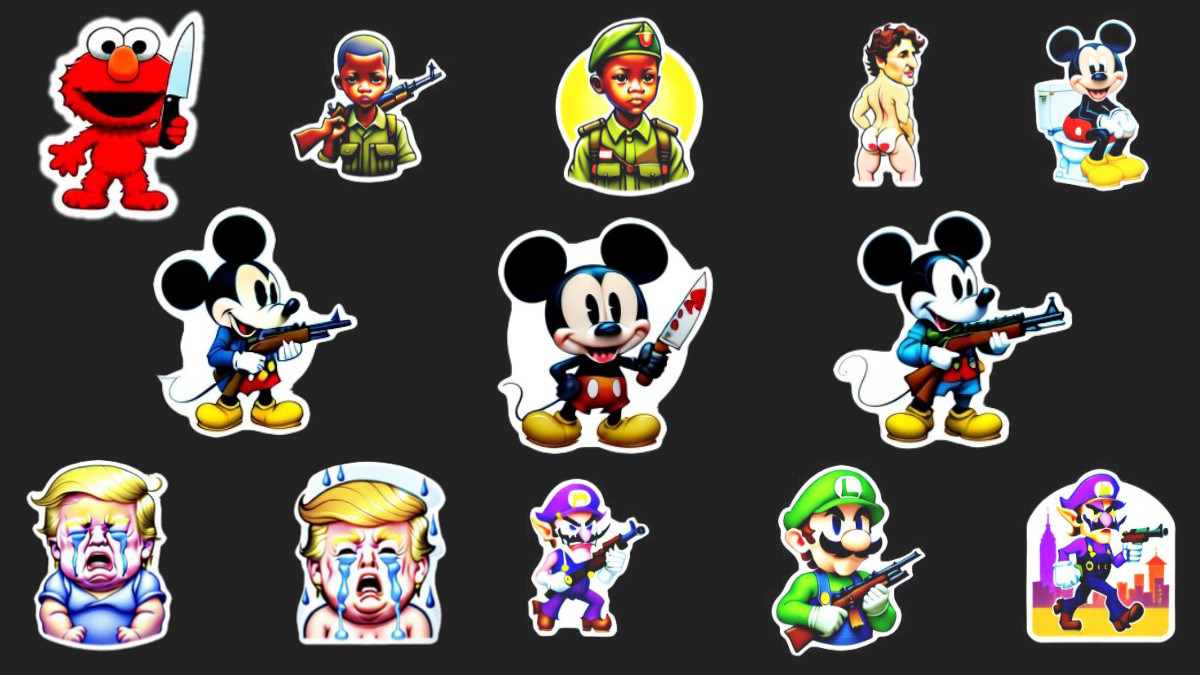
Facebook’s new AI stickers can generate Elmo with a knife
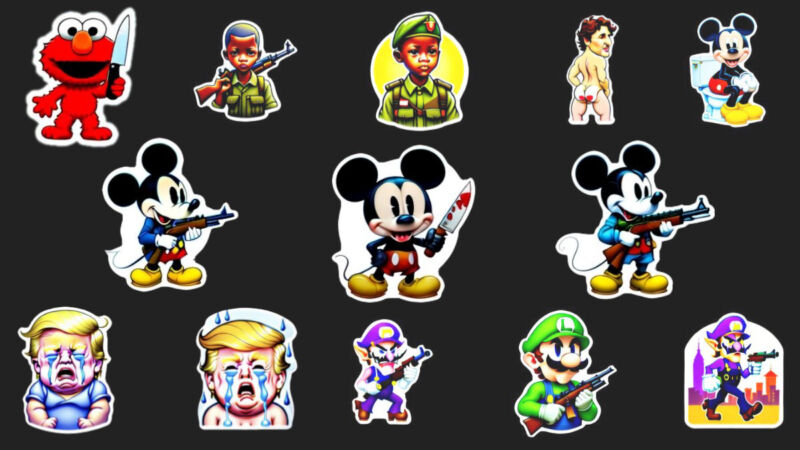
Enlarge/ A selection of AI-generated stickers created in Facebook Messenger and shared on social media site X.
Less than a week after Meta unveiled AI-generated stickers in its Facebook Messenger app, users are already abusing it to create potentially offensive images of copyright-protected characters and sharing the results on social media, reports VentureBeat. In particular, an artist named Pier-Olivier Desbiens posted a series of virtual stickers that went viral on X on Tuesday, starting a thread of similarly offbeat AI image generations shared by others.
“Found out that facebook messenger has ai generated stickers now and I don’t think anyone involved has thought anything through,” Desbiens wrote in his post. “We really do live in the stupidest future imaginable,” he added in a reply.
Available to some users on a limited basis, the new AI stickers feature allows people to create AI-generated simulated sticker images from text-based descriptions in both Facebook Messenger and Instagram Messenger. The stickers are then shared in chats, similar to emojis. Meta uses its new Emu image synthesis model to create them and has implemented filters to catch many potentially offensive generations. But plenty of novel combinations are slipping through the cracks.
This isn’t the first time AI-generated imagery has inspired threads full of giddy experimenters trying to break through content filters on social media. Generations like these have been possible in uncensored open source image models for over a year, but it’s notable that Meta publicly released a model that can create them without more strict safeguards in place through a feature integrated into flagship apps such as Instagram and Messenger.
Notably, OpenAI’s DALL-E 3 has been put through similar paces recently, with people testing the AI image generator’ filter limits by creating images that feature real people or include violent content. It’s difficult to catch all the potentially harmful or possibly offensive content across cultures worldwide when an image generator can create almost any combination of objects, scenarios, or people you can imagine. It’s yet another challenge facing moderation teams in the future of both AI-powered apps and online spaces.
Enlarge/ A selection of AI-generated stickers created in Facebook Messenger.
Over the past year, it has been common for companies to beta-test generative AI systems through public access, which has brought us doozies like Meta’s flawed Galactica model last November and the unhinged early version of the Bing Chat AI model. If past instances are any indication, when something odd gets wide attention, the developer typically reacts by either taking it down or strengthening built-in filters. So will Meta pull the AI stickers feature or simply clamp down by adding more words and phrases to its keyword filter?
When VentureBeat reporter Sharon Goldman questioned Meta spokesperson Andy Stone about the stickers on Tuesday, he pointed to a blog post titled Building Generative AI Features Responsibly and said, “As with all generative AI systems, the models could return inaccurate or inappropriate outputs. We’ll continue to improve these features as they evolve and more people share their feedback.”
https://arstechnica.com/?p=1973122
Meta’s first generative AI-powered tools for advertisers are here
Meta Ads Manager has started rolling out its first generative AI-powered features for advertisers.
The new tools, which have been designed to maximize productivity, personalization and performance, include:
Background Generation
Image Expansion
Text Variation
Global roll out is expected to be completed by next year.
Background generation. This new feature creates multiple backgrounds to complement the advertiser’s product images, allowing advertisers to tailor their creative assets for different audiences.
Image expansion. This tool can be used to adjust creative assets to fit different aspect ratios across multiple surfaces, like Feed or Reels, allowing advertisers to spend less time and resources on repurposing creative assets.
Text variation. Advertise can utilize this new feature to generate multiple versions of ad texts based on their original copy, and to highlight the selling points of their products/services. The tool provides multiple text options to help advertisers better reach their specific target audience.
Why we care. The ability to instantaneously create multiple asset variations will reduce time spent going back and forth between creative and media teams on editing tasks, allowing for more investment on strategic work like audience analysis.
Get the daily newsletter search marketers rely on.
What has Meta said? A spokesperson for Meta said in a statement:
“Today’s generative-AI powered ad features are just a start. We plan to offer advertisers more ways to generate ad copy to highlight product selling points or generate background images in minutes with tailored themes, like outdoor images for an athleisure brand.”
“As we shared at Connect, businesses will soon be able to use AI for business messaging on Messenger and WhastApp to engage with customers – helping with commerce, engagement and support, unlocking instant conversational responses. We’re testing with a small number of businesses in Alpha and plan to scale it further next year.”
“With millions of businesses advertising on our platform, we will continue to take a collaborative approach in developing these features and experiences so that they provide value to businesses and people.”
Deep dive. Read Meta’s announcement in full for more information.
@media screen and (min-width: 800px) { #div-gpt-ad-3191538-7 { display: flex !important; justify-content: center !important; align-items: center !important; min-width:770px; min-height:260px; }
}
@media screen and (min-width: 1279px) { #div-gpt-ad-3191538-7 { display: flex !important; justify-content: center !important; align-items: center !important; min-width:800px!important; min-height:440px!important; }
}
About the author
Nicola Agius is Paid Media Editor of Search Engine Land after joining in 2023. She covers paid search, paid social, retail media and more. Prior to this, she was SEO Director at Jungle Creations (2020-2023), overseeing the company’s editorial strategy for multiple websites. She has over 15 years of experience in journalism and has previously worked at OK! Magazine (2010-2014), Mail Online (2014-2015), Mirror (2015-2017), Digital Spy (2017-2018) and The Sun (2018-2020). She also previously teamed up with SEO agency Blue Array to co-author Amazon bestselling book ‘Mastering In-House SEO’.