Warren Buffett’s Berkshire Hathaway Just Made a Major Change to Its Leadership
Buffett has been CEO and chairman of Berkshire Hathaway since 1970.
Copied to clipboard
Key Takeaways
Berkshire Hathaway filed to formally separate Warren Buffett’s current two roles, CEO and executive chairman, to pave the way for a new top leader.
Buffett informed investors in May that he was stepping down as CEO, effective Jan. 1, 2026.
Greg Abel is expected to take over as CEO of Berkshire.
Warren Buffett’s Berkshire Hathaway is getting ready for a change in leadership.
The investing conglomerate, based in Omaha, wrote in a new regulatory filing that its board voted earlier this week to formally separate the roles of chairman and chief executive officer, effective immediately, per CNBC.
Buffett has been CEO and chairman of Berkshire Hathaway since 1970.
In May, Buffett, 95, announced at Berkshire’s annual shareholder meeting that he would be stepping down as CEO on Jan. 1, 2026, and named Greg Abel as his successor.
Abel, 63, has been Berkshire’s vice chairman for non-insurance operations since 2018. Buffett will keep the Executive Chairman title.
Greg Abel during a shareholders’ shopping day ahead of the Berkshire Hathaway annual meeting in Omaha, Nebraska, U.S., on Friday, April 29, 2022. Dan Brouillette/Bloomberg via Getty Images
Berkshire is the No. 11 most valuable company in the world, at press time, with a market cap of $1.081 trillion.
Buffett is also in the eleventh spot, personally, on the world’s richest people list, with a net worth of $149 billion, according to the Bloomberg Billionaires Index. The majority of his fortune is tied to his stake in Berkshire.
Earlier this week, Buffett led Berkshire’s biggest deal in three years, and likely his last as CEO, to buy OxyChem, a petrochemical unit within Occidental Petroleum, for $9.7 billion.
Berkshire Hathaway filed to formally separate Warren Buffett’s current two roles, CEO and executive chairman, to pave the way for a new top leader.
Buffett informed investors in May that he was stepping down as CEO, effective Jan. 1, 2026.
Greg Abel is expected to take over as CEO of Berkshire.
Warren Buffett’s Berkshire Hathaway is getting ready for a change in leadership.
The investing conglomerate, based in Omaha, wrote in a new regulatory filing that its board voted earlier this week to formally separate the roles of chairman and chief executive officer, effective immediately, per CNBC.
Buffett has been CEO and chairman of Berkshire Hathaway since 1970.
Trying to Break Your Organizational Silos? You’re Probably Focusing on the Wrong Thing.
Opinions expressed by Entrepreneur contributors are their own.
Key Takeaways
We talk about silos like they’re a structural issue, but they’re actually a cultural problem.
To successfully break down silos, you must use moments of change to reassess culture, aim for purposeful collaboration (not more meetings), build trust through intentional routines and treat culture as a living system.
Somewhere along the way, collaboration became its own full-time job. Back-to-back meetings, 47 Slack channels and a growing sense that decisions are happening somewhere. Everyone’s busy, everyone’s “collaborating,” but somehow, things still aren’t moving forward.
That’s the thing about silos: They rarely announce themselves. They slip in quietly as companies grow, teams get bigger and processes get heavier.
In December 2023, for example, Tesla had grown to more than 140,000 employees — nearly triple its size from just five years earlier. That kind of scale creates new complexity, and if culture doesn’t evolve with it, coordination suffers. Just a few months later in April 2024, Tesla recalled nearly 3,900 Cybertrucks due to an unapproved assembly change involving the accelerator pedal.
At first glance, it looked like a simple engineering oversight. But beneath it was a broader cultural signal: Critical decisions were being made in isolation, bypassing checks that would have caught the issue. It wasn’t just a flaw in the system; it was a breakdown in cross-functional communication, a sign that the company’s ways of working hadn’t kept pace with its growth.
We talk about silos like they’re a structural issue, but when communication breaks down and critical decisions bypass the right checks, that’s a cultural problem. Culture acts as the invisible force that either enables strategy to take hold or causes it to unravel. The mindsets, habits and unspoken norms that guide how people work can quietly accelerate progress or derail it.
Even in high-performing organizations, silos can take root. On the surface, teams seem aligned. But underneath, miscommunication, eroded trust and clashing processes expose a culture that hasn’t evolved with the strategy. The result? A facade of productivity where teams are busy but misaligned.
If you want to bridge your organizational silos, here’s how to read the cultural signals and reset the habits holding you back.
According to Deloitte, 75% of global organizations operate in a matrix. In these environments, authority is shared and people take their cues from what leaders do, not just what they say. In the moments that matter — how priorities are set, how feedback is delivered, how conflict is handled — what leaders choose to do either reinforces culture or erodes it. This is especially true during moments of change. When teams are navigating a merger, reorg or shift in strategy, there’s a temptation to double down on structure. But the smarter move is a cultural one.
In a recent engagement, my team supported two communications firms merging to form a stronger, unified business. Like many leaders in that situation, they faced a choice: default to one company’s legacy culture, or use the moment to shape something new. They chose the latter.
Rather than preserving old ways of working, they asked: “What culture will best support the strategy we’re building together?” That one question led to real alignment. By co-defining shared norms and addressing siloed habits — such as relying on personal networks for decision-making — they laid the groundwork for a culture that could successfully carry the business forward.
We saw this play out at a global cruise company as well. What began as a leadership development program to support the rollout of new leadership behaviors became a broader cultural reset. Leaders didn’t just learn new skills; they practiced new behaviors: modeling curiosity in meetings, giving feedback that built trust and surfacing tensions without blame. Those moments, repeated over time, became the building blocks of a culture that supported real collaboration, not performative alignment.
You’ve likely seen moments like this in your own organization, when growth or disruption reveals the need for more than a structural fix. These are inflection points. And when you use them to revisit how people work together — not just where — you turn culture into a strategic advantage.
2. Aim for purposeful collaboration, not more meetings
When collaboration stalls, the instinct is often to add more: more meetings, more shared docs, more people in the room. But these fixes often mask the real issue.
Instead of breaking down silos, they create new ones under the surface. Here’s how it happens:
Everyone is involved, but no one is accountable. Without clear roles or decision rights, people default to their own teams or networks.
Work becomes fragmented. Different groups contribute in parallel, but without shared context or ownership, efforts duplicate or stall.
Momentum slows. Meetings feel collaborative, but decisions drag, execution slips and frustration builds between functions.
It looks like cross-functional teamwork, but it functions like a silo.
Deloitte encountered this challenge when launching Pixel, its open innovation platform. Initially met with internal resistance, Pixel didn’t succeed because of new structures. It succeeded because of cultural alignment. Leadership prioritized trust-building, clarified participation roles and aligned incentives to encourage adoption. By engaging early internal champions and focusing on shared outcomes, Deloitte fostered collaboration that was rooted in shared purpose rather than forced process.
This approach highlights a key truth: Collaboration should feel purposeful, not performative. Teams don’t just need more connection. They need clearer alignment on who decides what, how success is measured and when input is truly needed.
In fast-moving, high-pressure environments, rituals often get cut in the name of efficiency. But without them, something more costly slips away: trust.
Siloed work doesn’t always come from a lack of collaboration — it often comes from a lack of connection. When people don’t see or celebrate progress together and when priorities shift without shared context, trust quietly erodes. That’s where intentional routines come in.
At one global entertainment company, urgency was the default. Leaders jumped from one launch to the next, skipping reflection and recognition. While productive on the surface, it left teams feeling unseen and disconnected. By introducing small but consistent rituals, such as cross-functional retrospectives, milestone celebrations and weekly shoutouts for collaborative wins, leaders began to rebuild what was missing: a shared sense of progress, belonging and momentum. These routines didn’t just boost morale. They reset the team’s cultural rhythm.
Trust is built in the rhythms of daily work: who’s recognized, who’s included and how people show up when things get hard. In distributed or hybrid environments, where work naturally splinters, these routines become the glue. They’re how culture is built and how siloes start to come undone.
4. Treat culture as a living system (and your strategy’s strongest ally)
Culture doesn’t shift once — it evolves constantly. And organizations that track those shifts intentionally outperform those that don’t. Microsoft offers a compelling example. Instead of relying solely on engagement surveys, the company measures “thriving,” a nuanced, human-centric signal of where energy is building or slipping. It’s a reminder that staying aligned with your culture isn’t about sweeping overhauls. It’s about small, deliberate adjustments that keep momentum moving in the right direction.
Silos, after all, aren’t merely structural. They’re cultural. They take root when leaders default to outdated habits, when collaboration is performative and when trust is too fragile to support shared ownership. They persist in rooms where everyone has a voice, but no one feels accountable.
Reinvigorating culture doesn’t mean starting over. It means leading differently. It means recognizing that when collaboration stalls or strategy slips, silos aren’t the root cause but the signal. By resetting how people work together, especially in moments of change, leaders turn culture into a living, strategic advantage. That’s how progress sticks and silos don’t.
The result? Faster decisions. Deeper engagement. A culture that evolves as fast as your business does — and one where silos don’t stand a chance.
Key Takeaways
We talk about silos like they’re a structural issue, but they’re actually a cultural problem.
To successfully break down silos, you must use moments of change to reassess culture, aim for purposeful collaboration (not more meetings), build trust through intentional routines and treat culture as a living system.
Somewhere along the way, collaboration became its own full-time job. Back-to-back meetings, 47 Slack channels and a growing sense that decisions are happening somewhere. Everyone’s busy, everyone’s “collaborating,” but somehow, things still aren’t moving forward.
That’s the thing about silos: They rarely announce themselves. They slip in quietly as companies grow, teams get bigger and processes get heavier.
In December 2023, for example, Tesla had grown to more than 140,000 employees — nearly triple its size from just five years earlier. That kind of scale creates new complexity, and if culture doesn’t evolve with it, coordination suffers. Just a few months later in April 2024, Tesla recalled nearly 3,900 Cybertrucks due to an unapproved assembly change involving the accelerator pedal.
I Turned a Side Hustle Into $20,000 a Month — Working Part-Time Without a College Degree
Key Takeaways
Rocklein dropped out of community college before the second semester to pursue her passion for content creation.
She charged about $25 an hour at the start — now her rate is $175, and one contract can pay her up to $20,000 a month.
This as-told-to story is based on a conversation with Kelly Rocklein, an Oregon-based entrepreneur who dropped out of college to pursue a career in user-generated content (UGC). Rocklein, 30, broke six figures with her UGC side hustle in 2022, at one point earning six figures on top of $160,000 in her full-time corporate role. She’s since transitioned into creative strategy consulting to focus on building her business, UGC Pro. The piece has been edited for length and clarity.
Image Credit: Miranda Kelton Photography. Kelly Rocklein.
Want to read more stories like this? Subscribe to Money Makers, our free newsletter packed with creative side hustle ideas and successful strategies. Sign up here.
I grew up in a single-parent household, so it was my mom raising me, my brother and my sister. My dad basically left us in financial ruin just because of how the divorce played out. I was a free lunch kid going into high school. I knew that a four-year state college was not on the table because I couldn’t afford it, and I didn’t want to take out student loans.
So, in 2013, going into my senior year when all of my friends were excited about where they were going to school, I was trying to get creative and figure out an alternate path. I worked three jobs my senior year to afford my first semester of community college; I enrolled, but very soon it dawned on me that I was just following societal norms and working so hard for something that wasn’t my passion.
I wanted to get into content creation. Instagram was still very new. Stories and reels didn’t exist. When I thought about what I wanted to do, I didn’t have a term for it, but it was user-generated content (UGC) — I wanted to work with brands on Instagram. I wanted to do a barter deal, which is what I did, where I would say, “Hey, if you send me this product that I want but don’t want to pay for, I can make a really cool video about it, and then you could post it to your socials.” I did that for a long time while working as a part-time tour guide at Disney when I lived in Orlando.
It wasn’t until 2018, when I worked at a digital marketing agency, that I realized I’d been creating UGC for these brands.
I worked really hard to build a portfolio between 2014 and 2015. In those early days, I charged about $25 an hour for my work. I was still living at home. I would stay up all night after my day job. Also, when I decided to start building my portfolio, I didn’t tell my mom that I wasn’t enrolling in community college for the second semester. I told myself I’d give it one year to make content creation work.
About eight months in, I got my first contract with Proctor Gallagher Institute. Bob Proctor from The Secret was my first client. He has since passed away, but it was an incredible first contract, and at the time, paid about $30,000 for that quarter of that year. That was the most money I’d ever seen in my entire life.
That afforded me the luxury of being able to move to the West Coast. I wanted to move to Los Angeles to expedite my learning curve, the real-life experience. I knew that if I didn’t have a degree to point to, I had to have a portfolio jam-packed with incredible work. In LA, I fell into the influencer world. I was doing creative directing, video editing. Essentially, I was doing creative strategy — focused on how to get people to stop scrolling and watch a video. It was kind of like the Wild West because many of those influencers weren’t operating with an HR helmet on.
By fall of 2018, I was ready to leave that world and go into corporate. I wanted work-life balance to an extent, and to make a salary I could count on with health benefits. Because of the real-life experience that I collected between 2014 and 2018, I got my first agency job at MuteSix. I didn’t realize how much of an opportunity it really was, but similar to how people in tech will say they’re ex-Twitter or ex-Meta, in the marketing space, to say you’re ex-MuteSix carries a lot of weight.
Even though I had mostly organic social experience up until this point, thankfully they saw what I was capable of and realized my skills translated to direct-response marketing. Then I learned that the content I was editing for these brands is UGC, and I’d been doing it for more than four years. I also continued doing one-off UGC products as a side hustle while working my full-time corporate role.
I finally felt like I was getting more financially stable. I no longer had to rely on my credit card just to get by. I had the luxury of being able to pay off my debts and start building wealth. I earned $70,000 at that full-time corporate job and took on UGC projects as they came, but it wasn’t until about 2020 that the side hustle became a consistent opportunity with the potential to make real money — and basically double my salary.
After MuteSix, I worked in a senior producer role at a women’s clothing brand, but a week before the pandemic hit, I resigned from the position because it wasn’t a good fit. Without a corporate income stream, I started to build up my UGC consulting services. By fall of 2021, I’d taken another full-time creative strategy job, but all along I’d been building my UGC side hustle business and continued to do so even when I started work as creative director of another brand in 2023. At that point, I was making $160,000. I’d even moved out of LA, but the company continued to pay my competitive salary. I’d also officially hit over $100,000 in annual revenue with my UGC side hustle.
So I had this six-figure side business that I worked on for 10-15 hours a week. It was steady work with three main clients and occasional one-off projects. Once I projected I’d do more than $300,000 that year, it made sense to go into work for myself. The more money I could make for my clients, the more leverage I’d have to charge more. I could choose UGC projects willing to pay higher rates. With just two or three contracts, I could make a full-time creative director’s salary working part-time.
That decision ended up being the best one I’ve ever made: I’ve never felt more financially secure than when I’ve been working for myself.
I’m currently solely focused on one contract. I have never before wanted to focus on just one brand, but at this point, it’s such an incredible opportunity — the monthly take-home is up to $20,000 a month. My hourly rate is $175, but if clients commit to 10 hours per week, it drops to $150. I can focus on this creative strategy client, take on my UGC projects that I want to work on and still have the mental capacity and energy to be able to build UGC Pro.
UGC was never a talking point on social media until the summer of 2022, when everyone and their mom was talking about it on TikTok‘s For You page. It got to a point where people were talking about it in a way that I was like, Why does it sound like an MLM? This is weird, guys. It’s a service like graphic design and video editing are services. You don’t need to be an influencer. You just need to be good at content creation. UGC Pro was born when UGC went mainstream on TikTok. It was because of all the misinformation floating around that I made the account to reset expectations and help train the next wave of creators and strategists for performance marketing. So this business popped up organically as a creator resource.
Even though there are more UGC creators than there have ever been before, it’s still an incredible opportunity: More direct-to-consumer brands are popping up every single day.
And the beauty of UGC is you don’t need to be a 20-something pretty blonde girl to be successful. I have students who are Gen X creators who have built six-figure businesses and have now transitioned to TikTok shop, and they’ll come to me and say, “Kelly, I’m leveraging the best practices that you taught me for TikTok shop”— and these creators are in the top 1% of TikTok shop. They’re now making up to six figures a month.
When I decided to drop out of college in 2014, it felt like such uncharted territory. With the exception of my mom, everyone asked me what I was going to do and thought that without a degree, I wouldn’t make it. Even a family friend who was a serial entrepreneur asked me what my Plan B was. Fast forward to today, and taking alternative paths that don’t involve college is more widely accepted.
If you’re someone interested in taking a different route, it’s so important to get as much real-life experience as possible. Focus on strengthening your skill sets and building a portfolio that showcases your capabilities. It can all feel overwhelming; my journey was not easy by any means. There were a lot of roadblocks, times in my career when I didn’t know why I continued to pursue it. But, ultimately, if you keep putting one foot in front of the other, you’ll look up one day and be like, How did I get here? I don’t know, but I’m really grateful I never gave up.
This article is part of our ongoing Women Entrepreneur® series highlighting the stories, challenges and triumphs of running a business as a woman.
Key Takeaways
Rocklein dropped out of community college before the second semester to pursue her passion for content creation.
She charged about $25 an hour at the start — now her rate is $175, and one contract can pay her up to $20,000 a month.
This as-told-to story is based on a conversation with Kelly Rocklein, an Oregon-based entrepreneur who dropped out of college to pursue a career in user-generated content (UGC). Rocklein, 30, broke six figures with her UGC side hustle in 2022, at one point earning six figures on top of $160,000 in her full-time corporate role. She’s since transitioned into creative strategy consulting to focus on building her business, UGC Pro. The piece has been edited for length and clarity.
Image Credit: Miranda Kelton Photography. Kelly Rocklein.
Want to read more stories like this? Subscribe to Money Makers, our free newsletter packed with creative side hustle ideas and successful strategies. Sign up here.
I grew up in a single-parent household, so it was my mom raising me, my brother and my sister. My dad basically left us in financial ruin just because of how the divorce played out. I was a free lunch kid going into high school. I knew that a four-year state college was not on the table because I couldn’t afford it, and I didn’t want to take out student loans.
5 Red Flags That Should Eliminate a Job Candidate — and 5 Green Flags That Mean ‘Hire Now’
Opinions expressed by Entrepreneur contributors are their own.
Key Takeaways
Bad hires weaken culture, slow execution and set your company back months, sometimes years. Good hires multiply value and amplify everything you’ve built.
Red and green flags in candidates appear early, but leaders are often too rushed, too optimistic or too emotionally invested to see them.
Look out for these five red flags that signal a bad hire and the five green flags that tell you who you should hire immediately.
Hiring is war. Every decision either strengthens your army or weakens it. The wrong hire doesn’t just drain resources — it poisons culture, slows execution and sets your company back months, sometimes years. One toxic or underperforming employee can undo the progress of five great ones. But the right hire? They don’t just add value — they multiply it. The right person amplifies everything you’ve built, brings clarity where there was confusion and elevates the performance of everyone around them.
Most CEOs and founders think they’re good at spotting talent. They trust their gut. They like to believe they can see through resumes and interview polish. But too often, that confidence ends in regret — hours lost, money burned and teams demoralized. Ask any founder, and they’ll have a story about “the one they gave a chance” who turned into a six-month distraction. The truth is, mistakes in hiring are rarely surprises. Red flags almost always show up early. The problem? Most leaders are too rushed, too optimistic or too emotionally invested to notice.
And here’s the flip side: The best green flags are just as obvious. The candidates who are going to become culture-drivers, problem-solvers, and long-term assets usually show their hand in the first conversations. But you have to know what signals to look for — and just as importantly, which signals to ignore. That’s where experience makes the difference.
Enter Shayna Dekel — Head of HR, entrepreneur and author of Things Your Parents Should Have Taught You: A Beginner’s Guide to Getting the Job. She’s seen it all from both sides of the table: the star hires who transform a business and the mis-hires who quietly (or loudly) corrode it from within. She’s interviewed thousands of candidates, advised countless founders and built teams that thrive. Her perspective bridges the gap between what job seekers think they’re showing and what founders actually need to see.
What follows isn’t theory or vague advice; it’s a practical cheat sheet for founders, CEOs and leaders who can’t afford to get hiring wrong. Because when the stakes are this high, you don’t need another “hiring philosophy.” You need battle-tested tools that keep you from making the mistakes that every other founder has already regretted.
The 5 red flags (never hires)
1. Disrespecting “non-decision makers”
If a candidate treats your receptionist, HR coordinator or junior staff as “less important,” cut them loose. How they treat people they don’t think matter is how they’ll treat your clients.
2. No research, no effort
Showing up clueless about your company screams laziness. If they didn’t care enough to Google you, why would they care enough to grind for you?
3. Blame-heavy language
Listen carefully. If every career story they tell is about a “toxic boss,” “bad culture” or “stupid management,” guess what? You’re next on that list.
4. Entitlement without proof
Asking about title, pay bumps or remote perks before proving value is an instant signal they’re in it for themselves, not the mission.
5. Reschedule rage
Interviews move around — it’s the reality of executive calendars. If a candidate throws a fit over it, imagine their reaction to an actual startup fire drill. Pass.
They know your product, your competitors and even your recent press. That shows not just interest — it shows initiative.
2. Referrals and networks
Top talent gets referred. If one of your trusted people vouches for them, it means they’ve already been pre-screened for reliability.
3. Authentic curiosity
They don’t just answer your questions; they ask insightful ones back. Candidates who want to understand your business usually want to grow with your business.
4. Polished but real
They overdress a little, they show up early and they still manage to be authentic. That balance of respect and realness is rare — and worth grabbing.
5. Storytelling that sticks
When their resume lines up with a compelling, human narrative — including relevant hobbies or passion projects — you remember them. And people you remember are people you hire.
The difference between a great hire and a disaster isn’t subtle; it’s glaring. Red flags scream, green flags shine. The leaders who pay attention, who trust the signals instead of their wishful thinking, are the ones who win. Bad hires almost always come with warnings; the best ones leave no doubt. Hiring is less about luck and more about discipline — knowing when to walk away and when to double down on someone who clearly raises the bar.
Bad hires weaken culture, slow execution and set your company back months, sometimes years. Good hires multiply value and amplify everything you’ve built.
Red and green flags in candidates appear early, but leaders are often too rushed, too optimistic or too emotionally invested to see them.
Look out for these five red flags that signal a bad hire and the five green flags that tell you who you should hire immediately.
Hiring is war. Every decision either strengthens your army or weakens it. The wrong hire doesn’t just drain resources — it poisons culture, slows execution and sets your company back months, sometimes years. One toxic or underperforming employee can undo the progress of five great ones. But the right hire? They don’t just add value — they multiply it. The right person amplifies everything you’ve built, brings clarity where there was confusion and elevates the performance of everyone around them.
Most CEOs and founders think they’re good at spotting talent. They trust their gut. They like to believe they can see through resumes and interview polish. But too often, that confidence ends in regret — hours lost, money burned and teams demoralized. Ask any founder, and they’ll have a story about “the one they gave a chance” who turned into a six-month distraction. The truth is, mistakes in hiring are rarely surprises. Red flags almost always show up early. The problem? Most leaders are too rushed, too optimistic or too emotionally invested to notice.
Jeff Bezos Explains Why the AI Bubble Exists, and What’s Going to Happen When It Bursts
Amazon founder Jeff Bezos said that investor overexcitement and inflated valuations are evidence of an AI bubble.
Copied to clipboard
Key Takeaways
Jeff Bezos said on Friday that the “AI bubble” exists because of overexcitement and overinvestment in the technology.
Bezos said that “the benefits to society from AI are going to be gigantic,” even if the bubble bursts.
Research firm MacroStrategy Partnership claims that the AI bubble is 17 times the size of the dot-com bubble, per MarketWatch.
Jeff Bezos thinks AI technology is in an “industrial bubble.”
On Friday at Italian Tech Week in Turin, Italy, Bezos said that the hype and investment currently defining the sector are bigger than the proven profitability of all of the companies within it, CNBC reported.
“People get very excited, like they are today, about artificial intelligence,” Bezos said at the event.
Bezos said that bubbles happen when stock prices are “disconnected” from the core of a business, and become overinflated compared to what’s produced. So valuations rise much higher than what those companies are actually worth. In the infamous dot-com crash in the early 2000s, Internet-based companies attracted investments, despite not making a profit or having viable business plans. When reality set in, the market crashed, leading to significant losses for investors and bankruptcies for many startups.
Bezos explained that during a boom, every experiment or idea ends up getting funded because investors “have a hard time” choosing good ideas over lackluster ones during the excitement.
Still, Bezos said that industrial bubbles are “not nearly as bad” because the underlying technology developed in one can benefit society — even when the bubble bursts. He gave the example of the biotech and pharmaceutical bubble of the 1990s, which resulted in the creation of life-saving medicines, even though some companies went under.
“When the dust settles and you see who the winners [are], societies benefit from those inventions,” Bezos said. “That is what is going to happen here, too. This is real, the benefits to society from AI are going to be gigantic.”
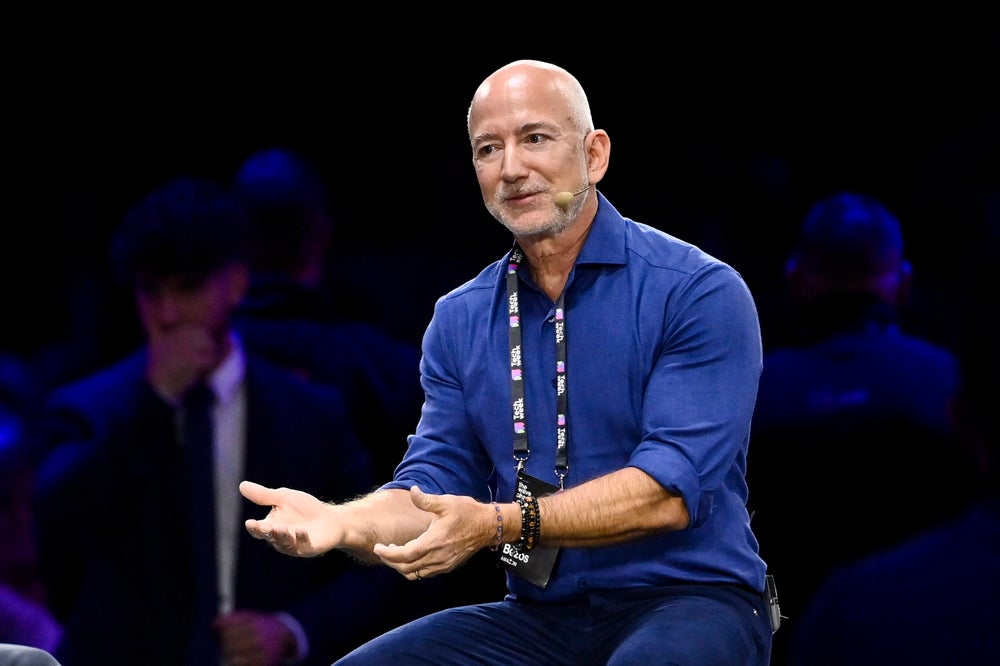
Jeff Bezos speaks on stage during the Italian Tech Week 2025 at OGR Officina Grandi Riparazioni on October 3, 2025 in Turin, Italy. (Photo by Stefano Guidi/Getty Images)
Meanwhile, AI startups are receiving more money now than ever. PitchBook data shows that AI startups raised $104.3 billion in the U.S. in the first half of 2025, almost as much as all startups raised the entire previous year.
Bezos isn’t the only tech billionaire cautioning about an AI bubble — OpenAI CEO Sam Altman, whose company was just valued at $500 billion, the highest for any private company ever, said in August at a press dinner that he thinks “investors as a whole are overexcited about AI,” leading to overfunding.
Further, research firm MacroStrategy Partnership claims that the AI bubble is 17 times the size of the dot-com bubble and four times as big as the 2008 real estate one, per MarketWatch.
Jeff Bezos said on Friday that the “AI bubble” exists because of overexcitement and overinvestment in the technology.
Bezos said that “the benefits to society from AI are going to be gigantic,” even if the bubble bursts.
Research firm MacroStrategy Partnership claims that the AI bubble is 17 times the size of the dot-com bubble, per MarketWatch.
Jeff Bezos thinks AI technology is in an “industrial bubble.”
On Friday at Italian Tech Week in Turin, Italy, Bezos said that the hype and investment currently defining the sector are bigger than the proven profitability of all of the companies within it, CNBC reported.
“People get very excited, like they are today, about artificial intelligence,” Bezos said at the event.
This Popular Acai Franchise Is Expanding Fast. Is It Coming to Your State Next?
A refreshed C-suite and strong franchisee buy-in are setting the brand up for its most ambitious expansion yet.
Copied to clipboard
Key Takeaways
Playa Bowls has overhauled its leadership team with a new CEO and multiple C-suite hires.
Under private equity ownership, the brand plans to have opened 90 new stores by the end of 2025, with a focus on entering West Coast markets.
The expansion will not only test consumer demand but also the scalability of the brand.
Playa Bowls is entering a new chapter. The New Jersey-based acai and smoothie chain, which ranked #304 on the Franchise 500, has revamped its executive team and set ambitious growth goals under the ownership of private equity firm Sycamore Partners. The company plans to have opened 90 new stores by the end of this year, with a special focus on the California, Oregon and Washington markets.
The changes go far beyond adding stores. Playa Bowls recently appointed John Cappasola, former CEO of Del Taco, as its new chief executive. He’s joined by a slate of senior leaders, including a new COO, CFO and general counsel. Together, the refreshed C-suite is tasked with scaling a brand that already boasts more than 300 locations nationwide. The new CEO, aided by some personal knowledge, is confident in the move.
“As someone who grew up and spent most of my life in Southern California, I know how naturally our surf-inspired brand will resonate on the West Coast,” Cappasola told Entrepreneurin a statement. “It is an inspiring opportunity to work alongside our team and franchise owners to bring that experience to new communities and continue building a brand that is built to last.”
Private equity has become a powerful force in franchising, and Playa Bowls offers a prime example of how investment firms approach growth. New ownership often means leadership shake-ups, capital for expansion and a push to enter new markets quickly. Although that strategy can produce rapid results, it also tests the resilience of the franchise system.
In Playa Bowls’ case, franchisees appear eager to keep pace. The company says 85% of its new store agreements come from existing operators. That level of buy-in suggests confidence from the people on the ground — the franchisees who know the model best. “The fact that the overwhelming majority of our growth comes from existing franchise owners is the strongest endorsement of our model,” Jayson Tipp, CDO, told Entrepreneur in a statement, “and it’s what gives us confidence in sustainable nationwide expansion.”
Still, the West Coast presents a new challenge. The question is if the brand’s aesthetic and menu will resonate in California and beyond, where the health food market is both crowded and competitive.
Industry analysts have seen this playbook before. Private equity firms have fueled the rise of brands across food and beverage, from Nothing Bundt Cakes (where Cappasola was an executive) to Tropical Smoothie Cafe. The formula is familiar: Install seasoned leaders, double down on franchising and set aggressive growth targets. When it works, the results can be transformative. When it doesn’t, expansion risks outpacing operational support.
Playa Bowls’ story isn’t just about an acai chain trying to grow. It’s a case study in how private equity is reshaping the franchise landscape. Capital, experience and aggressive targets can accelerate success, but they also create pressure points for franchisees, who shoulder much of the execution.
As the New Jersey brand looks to plant its flag in western markets, the company will test not just consumer demand but also the scalability of its systems and support. Franchisees are clearly optimistic, but the brand’s ability to balance growth with sustainability will determine if this expansion delivers long-term rewards.
Regardless, the next year will be telling, because Playa Bowls is no longer just a regional chain with beach-town roots — it’s part of a bigger private equity story playing out across franchising.
Playa Bowls has overhauled its leadership team with a new CEO and multiple C-suite hires.
Under private equity ownership, the brand plans to have opened 90 new stores by the end of 2025, with a focus on entering West Coast markets.
The expansion will not only test consumer demand but also the scalability of the brand.
Playa Bowls is entering a new chapter. The New Jersey-based acai and smoothie chain, which ranked #304 on the Franchise 500, has revamped its executive team and set ambitious growth goals under the ownership of private equity firm Sycamore Partners. The company plans to have opened 90 new stores by the end of this year, with a special focus on the California, Oregon and Washington markets.
The changes go far beyond adding stores. Playa Bowls recently appointed John Cappasola, former CEO of Del Taco, as its new chief executive. He’s joined by a slate of senior leaders, including a new COO, CFO and general counsel. Together, the refreshed C-suite is tasked with scaling a brand that already boasts more than 300 locations nationwide. The new CEO, aided by some personal knowledge, is confident in the move.
“As someone who grew up and spent most of my life in Southern California, I know how naturally our surf-inspired brand will resonate on the West Coast,” Cappasola told Entrepreneurin a statement. “It is an inspiring opportunity to work alongside our team and franchise owners to bring that experience to new communities and continue building a brand that is built to last.”
The streaming giant posted an opening on its internal job board on September 23 for a generative AI product manager, and the position is still “actively recruiting,” according to the job post. In the description, Netflix wrote that the position “plays a pivotal part” in selecting and implementing the generative AI products Netflix uses internally, and “guides products from vision to execution.”
The role requires a Bachelor’s degree and at least six years of product management experience, with a focus on enterprise applications and proven experience creating and launching generative AI solutions.
Netflix’s role pays a range of $240,000 to $700,000, which is much more than what’s typical for similar positions, though it seems to be on par with other tech companies’ over-the-top payouts.
Still, Netflix’s compensation package consists only of an annual salary; the company does not pay out bonuses. Every year, employees decide individually how much of their compensation they want divided between salary and stock options.
Meanwhile, the average AI product manager in the U.S. earns about $159,495 a year, per ZipRecruiter. Glassdoor reports that product managers, in general, make around $147,000.
The role is part of Netflix’s plan to use AI internally for everything from content recommendations to production, per Fortune.
Netflix is already putting AI to work in TV production. During a July earnings call, co-CEO Ted Sarandos shared that the company used AI to generate a building collapse scene for the Argentine sci-fi series “El Eternauta,” which hit Netflix on April 30. Sarandos said the process was not only faster, 10 times quicker than traditional visual effects, but also made a complex, Hollywood-style moment possible on a more modest $15 million budget.
Netflix currently has 300 million paying members, it claims. In its second-quarter 2025 earnings report, released in July, Netflix beat analyst expectations with $11.08 billion in revenue. The company will report its third-quarter earnings on October 21.
Key Takeaways
Netflix is hiring a generative AI product manager, a fully remote role that pays up to $700,000.
The role is part of Netflix’s bigger plan to fold AI into its operations.
Netflix is actively recruiting for the position, which was posted in late September.
The streaming giant posted an opening on its internal job board on September 23 for a generative AI product manager, and the position is still “actively recruiting,” according to the job post. In the description, Netflix wrote that the position “plays a pivotal part” in selecting and implementing the generative AI products Netflix uses internally, and “guides products from vision to execution.”
An AI Company Just Made Its $200-a-Month Product Totally Free
Perplexity, valued at around $20 billion, launched its Comet browser in July.
Copied to clipboard
Key Takeaways
Perplexity just made its $200-a-month search engine completely free.
‘Millions’ of people were on a waitlist for the AI browser, Perplexity had claimed.
Comet offers AI summaries from “high-quality” sourcing with an “assistant” built in.
In July, AI startup Perplexity, valued at around $20 billion, launched an AI browser called Comet. The $200-a-month service offered a search engine with AI-generated summaries (focused on high-quality sources) and an “assistant” built into the browser that can automate web searching and other tasks.
Now, it’s free. Perplexity CEO Aravind Srinivas told Business Insider on Wednesday: “We want to build a better internet, and that needs to be accessible to everybody.”
Comet can access apps like Gmail, LinkedIn, and your calendar to automate everyday tasks, including drafting replies to emails and scheduling appointments. Srinivas told The Verge’s “Decoder” podcast in July that he believes the browser can become your personal or executive assistant.
Meanwhile, this week, Meta and OpenAI each launched AI-generated video feeds, which are being called creative “AI slop.” OpenAI’s Sora 2, for example, allows users to create videos of themselves doing anything, basically creating a collection of on-purpose deepfakes.
Srinivas thinks Comet can stand out based on its “research paper quality” sourcing, and partnerships with top journalism outlets. At one time, Perplexity said Comet had “millions” on a waitlist.
“I think slop is fundamentally going to be easier to create now, and it’s going to be hard to distinguish if something is AI or human on the internet,” Srinivas said, per Business Insider.
Google has also deployed AI additions into its Chrome browser with “AI mode” and “AI search,” which TechCrunch notes has a “striking resemblance” to Perplexity.
Key Takeaways
Perplexity just made its $200-a-month search engine completely free.
‘Millions’ of people were on a waitlist for the AI browser, Perplexity had claimed.
Comet offers AI summaries from “high-quality” sourcing with an “assistant” built in.
In July, AI startup Perplexity, valued at around $20 billion, launched an AI browser called Comet. The $200-a-month service offered a search engine with AI-generated summaries (focused on high-quality sources) and an “assistant” built into the browser that can automate web searching and other tasks.
Now, it’s free. Perplexity CEO Aravind Srinivas told Business Insider on Wednesday: “We want to build a better internet, and that needs to be accessible to everybody.”
Comet can access apps like Gmail, LinkedIn, and your calendar to automate everyday tasks, including drafting replies to emails and scheduling appointments. Srinivas told The Verge’s “Decoder” podcast in July that he believes the browser can become your personal or executive assistant.
Baby Boomers Still Rule Real Estate, Owning Twice as Much Property as Millennials, According to a New Report
Baby boomers hold 51.7% of the nation’s wealth, more than any other generation.
Copied to clipboard
Key Takeaways
Although Boomers make up less than 20% of the population, they own nearly 41% of all real estate in the U.S., according to a new report.
Real estate accounted for 22.7% of Boomers’ total wealth.
Gen X owns 12.2% less real estate compared to Boomers at the same age, per the report.
Baby boomers may account for less than a fifth of the population, but they own almost 41% of all real estate in the country — nearly $20 trillion worth, according to a recent study from the financial services company Self Financial.
Millennials own 20.4% of all real estate in the U.S., or just shy of $10 trillion, according to the report. Meanwhile, Gen X owns 29.4% of the country’s real estate, worth about $14 trillion. The study found that Gen X owns 12.2% less real estate compared to baby boomers when they were the same age.
The study analyzed data and population statistics from the Federal Reserve on millennials (born 1981–1996), Generation X (1965–1980), and baby boomers (1946–1964). Gen Z was excluded due to limited available data.
The study also revealed that baby boomers are 5.2 times wealthier than millennials, due to owning the largest slice of real estate in the U.S. and other factors, like corporate equities and mutual funds. Real estate is just 22.7% of Boomers’ total wealth, according to Self Financial.
Millennials, on the other hand, hold 40.8% of their collective wealth in real estate and only 15.5% in corporate equities and mutual funds.
Overall, baby boomers possess a disproportionately large share of America’s overall wealth, accounting for about 51.7% of the nation’s total assets. Generation X holds approximately 25%, while millennials control close to 10% of U.S. wealth.
Meanwhile, a new report released earlier this week by wealth intelligence company Altrata suggests that those with at least $30 million in assets, including real estate, will increasingly be part of a younger generation. By 2040, millennials and Gen Z are expected to gain wealth due to the “great wealth transfer.” Experts estimate that about $84 trillion will eventually pass from Boomers to their heirs over the next couple of decades, which could dramatically shake up the way wealth is distributed across generations.
Although Boomers make up less than 20% of the population, they own nearly 41% of all real estate in the U.S., according to a new report.
Real estate accounted for 22.7% of Boomers’ total wealth.
Gen X owns 12.2% less real estate compared to Boomers at the same age, per the report.
Baby boomers may account for less than a fifth of the population, but they own almost 41% of all real estate in the country — nearly $20 trillion worth, according to a recent study from the financial services company Self Financial.
Millennials own 20.4% of all real estate in the U.S., or just shy of $10 trillion, according to the report. Meanwhile, Gen X owns 29.4% of the country’s real estate, worth about $14 trillion. The study found that Gen X owns 12.2% less real estate compared to baby boomers when they were the same age.
The study analyzed data and population statistics from the Federal Reserve on millennials (born 1981–1996), Generation X (1965–1980), and baby boomers (1946–1964). Gen Z was excluded due to limited available data.
She Started a Business That Broke the Mold for NYC Cafés — And Grew It Into a Multi-City Brand
Opinions expressed by Entrepreneur contributors are their own.
This article is part of the America’s Favorite Mom & Pop Shops series. Read more stories
Key Takeaways
Small details deliver big experiences.
Every customer is an influencer.
Consistency and feedback fuel growth.
For Elisa Marshall, co-founder of Maman cafés, entrepreneurship started in childhood—helping her parents sell antiques on eBay at 13 and running lemonade stands. Torn between multiple passions, it wasn’t until she moved to New York City that a longing for home sparked the idea for Maman, a coffee shop rooted in nostalgia but built for the bustle of the city.
Marshall designed a space that broke the mold of “industrial chic” New York City cafés. Wanting to create a welcoming space that felt like home, she named the business Maman (“mother” in French) and drew from her skills in fashion, food and interior design to transform the typical café experience.
“A lot of people in New York City don’t have dining room tables for four, let alone [the space to host] a big group of people. Sometimes they don’t even have kitchens in their apartments. So we really wanted to create that extension, that home-away-from-home vibe,” Marshall says.
From the very beginning, attention to detail set Maman apart from its competitors. Despite the upfront cost, Marshall insisted every cup, plate and chair be different — painstaking for her suppliers but crucial for the signature “lived-in” look she was going for.
Scaling that highly personalized feeling was a challenge as Maman grew. Marshall had to decide what to standardize and what to keep personal when she opened new locations. Chairs and tables became uniform, but Marshall still scours antique fairs and garage sales to maintain Maman’s iconic, mismatched china.
This hand-crafted ambiance extends to Maman’s digital presence. Every touchpoint, whether email, Instagram or Uber Eats packaging, reflects the brand’s aesthetic.
“Everything from fonts to tone of voice to color palettes that we use [contributes to brand consistency],” she says. “Anyone can send out a basic email, but we have an incredible graphic design team and marketing team that appreciate and understand finding the beauty and telling our brand story throughout.”
Another challenge is meeting customer demand while still innovating and keeping the menu fresh. About 60% of Maman’s offerings are core classics that regulars expect, but there’s always room for creativity, trends and seasonality. This willingness to experiment keeps both the team and customers engaged.
“No one wants to have a hot butternut squash soup in August in Miami,” Marshall says. “So making sure that what we offer is relevant to the location and season [is important]. [There are also] a lot of opportunities to work with local farms [and] get much better produce when you’re working with seasonal ingredients.”
In terms of advertising, Marshall knows there’s nothing better than word of mouth. When Maman’s honeycomb tahini latte became a viral sensation, it wasn’t a paid marketing blitz that started the craze but an ecstatic fan posting about it online.
“We believe in very organic advertising, and we don’t do any paid influencer advertising,” Marshall shares, emphasizing that any customer can be a brand ambassador.
“Our moms who come in, who will talk to the other moms and carry their Maman cup to school pick-up — those are our true influencers. Those are the ones who end up driving the traffic and planning the after-school dates and the after-drop-off coffee meetups with the girlfriends.”
Maman also enhances its customer experience through in-person and online feedback. From reading every Yelp review to empowering her team to gather and track both customer and employee input, Marshall keeps a keen eye on areas for improvement.
“Cultivating a positive environment about reviews is very important,” Marshall says. “On the flip side, I think it’s equally as important to receive feedback and reviews from our employees. Because they’re the ones who are front-of-house. They’re the ones who know the most, and we have them send reports weekly to us as a store.”
For example, when Marshall heard from a busboy that customers weren’t eating the mixed greens that came with sandwiches, she removed them to prevent food waste, reducing prices as a result. Small changes like this can not only save the company money but also reduce environmental impact and increase customer satisfaction.
With cookies that made Oprah’s favorites list and a brand that treats each guest like family, it’s clear Marshall’s “home away from home” is a movement more than a menu.
Key lessons from Marshall’s journey with Maman include:
Standardize where it matters; personalize where it counts. Not every detail can scale, but the ones that define your brand should never be compromised.
Treat reviews and feedback as gifts. Not every comment demands change, but every pattern can point to improvement.
Community is your best marketing. Build a space that people want to talk about, photograph, and share to build word of mouth. Influencer marketing can be powerful, but any customer can be a brand ambassador.
Watch the episode above to hear directly from Elisa Marshall, and subscribe to Behind the Review for more from new business owners and reviewers every Wednesday.
Editorial contributions by Kristi Lindahl and Emily Moon
This article is part of our ongoing America’s Favorite Mom & Pop Shops® series highlighting family-owned and operated businesses.
Key Takeaways
Small details deliver big experiences.
Every customer is an influencer.
Consistency and feedback fuel growth.
For Elisa Marshall, co-founder of Maman cafés, entrepreneurship started in childhood—helping her parents sell antiques on eBay at 13 and running lemonade stands. Torn between multiple passions, it wasn’t until she moved to New York City that a longing for home sparked the idea for Maman, a coffee shop rooted in nostalgia but built for the bustle of the city.
Marshall designed a space that broke the mold of “industrial chic” New York City cafés. Wanting to create a welcoming space that felt like home, she named the business Maman (“mother” in French) and drew from her skills in fashion, food and interior design to transform the typical café experience.