Loyalty Is the New Brand Currency — Why Storytelling Beats Out Advertisements
Opinions expressed by Entrepreneur contributors are their own.

Not long ago, digital advertising was all about polish — sleek campaigns, flawless visuals and copy carefully crafted to persuade. But in 2025, that playbook is losing its edge. Audiences are looking for something different: authenticity.

We’re now in what some are calling the “trust economy,” where people connect more with raw, relatable stories than with glossy ads. Brands that lean into founder-led storytelling, show what’s happening behind the scenes and let their communities speak for them are winning out over those that pour money into traditional ad spend.

In this environment, trust has become the real currency — and authentic storytelling is how you earn it.

Why consumers are tuning out traditional ads

Decades of banner ads, pop-ups and influencer promotions have left digital audiences fatigued. Ad-blocker usage remains high, and younger generations — particularly Gen Z and Gen Alpha — show greater scepticism toward traditional advertising.

According to Deloitte’s Global Marketing Trends, authenticity is now a core purchasing driver, with consumers more likely to buy from brands they perceive as transparent and real. This generational demand for “truth over polish” means over-engineered campaigns often fail to resonate, while candid, story-first content builds affinity.

Storytelling as the new trust signal

Storytelling has always been persuasive, but in today’s digital economy, whose story and how it is told matter more than ever. Founder-led narratives — think entrepreneurs sharing their struggles, pivots or even failures — create intimacy and relatability that generic brand messaging cannot match.

Similarly, behind-the-scenes videos showing product development, employee culture or sustainability efforts foster a sense of inclusion and honesty. Harvard Business Review notes that brands leaning into authentic narratives see measurable improvements in consumer trust and loyalty.

Unlike ads that push products, stories invite audiences into journeys. This subtle distinction transforms transactional relationships into communities of shared values and beliefs, something especially powerful when building long-term loyalty.

The ROI of authenticity versus ad spend

Traditional ads are expensive, and their returns are diminishing. As algorithms raise the cost of digital placements, brands are seeing declining ROAS (return on ad spend). By contrast, community-led and authenticity-driven campaigns often require smaller budgets but deliver outsized impact in engagement and word-of-mouth.

For example, Nielsen’s Trust in Advertising report highlights that recommendations from “people like me” remain the most trusted source of brand information, vastly outperforming paid ads.

The economics are clear: investing in authentic storytelling – whether through organic social content, community amplification or transparent campaigns – can yield stronger engagement at lower cost. It isn’t about eliminating ads, but about recognising that in the attention economy, trust compounds faster than impressions.

Related: Why Well-Meaning Leaders So Often Make Things Worse, Not Better

Gen Z and Gen Alpha: audiences that demand truth

Generational differences are stark. Gen Z and Gen Alpha, raised in hyperconnected environments, can easily detect inauthenticity. They prefer raw, unedited content on platforms like TikTok or BeReal, where imperfection feels more trustworthy than glossy campaigns. According to Sprout Social’s Index Report, 64% of Gen Z consumers are more likely to trust brands that show authentic, behind-the-scenes content. This aligns with their wider cultural values around transparency, inclusivity and ethical practices.

For brands, this means success isn’t just about what you sell but about how you show up. Community engagement, user-generated content and storytelling rooted in honesty all become pivotal in winning over the next generation of consumers.

Related: How to Avoid the Pitfalls of Overdone Authenticity

Building community-driven narratives

Community has become the multiplier effect of authenticity. Platforms like Discord, Reddit and TikTok communities allow brands to co-create narratives with their most engaged supporters. By elevating user-generated stories, responding candidly to feedback and showcasing real customer experiences, brands tap into trust networks far stronger than ad impressions.

The critical shift here is control: brands no longer script every message but instead create frameworks where community voices thrive. This decentralisation mirrors broader societal shifts away from hierarchy and toward collaboration, which resonates strongly with digital-native generations.

Transparency as a loyalty driver

Authenticity without transparency is hollow. Brands that openly share both achievements and shortcomings earn more credibility than those that remain silent or overly polished. Transparency reports, live Q&As with leadership and candid founder reflections all contribute to building long-term trust. The Edelman Trust Barometer shows year after year that transparency is now a baseline expectation, not an optional extra.

In effect, trust becomes a self-reinforcing loop: the more open a brand is, the more consumers believe in its authenticity, and the more likely they are to advocate on its behalf.

Related: 10 Ways Entrepreneurs Can Build the Mental Toughness of an Elite Athlete

Toward a trust-first marketing playbook

As the digital economy evolves, marketers must rebalance spend between performance-driven ads and authenticity-led storytelling. The latter builds durable brand equity, while the former delivers short-term conversion. A trust-first playbook combines both but prioritises narratives that audiences can believe in and share. Key elements include:

  • Empowering founders and employees as storytellers.
  • Sharing behind-the-scenes processes with humility and candour.
  • Investing in community platforms where dialogue is two-way.
  • Measuring not just impressions but sentiment, advocacy and trust.

The future isn’t ad-free — it’s ad-light, and story-rich.

In the trust economy, storytelling is a strategy. As consumers tune out polished ads, they lean into narratives that reflect transparency, relatability and shared values.

Authentic content delivers not only stronger ROI but also more enduring loyalty, particularly among Gen Z and Gen Alpha audiences who demand truth above all. For brands, the path forward is clear: build trust first, and transactions will follow. In a world where anyone can buy attention, authenticity is what earns it.

Not long ago, digital advertising was all about polish — sleek campaigns, flawless visuals and copy carefully crafted to persuade. But in 2025, that playbook is losing its edge. Audiences are looking for something different: authenticity.

We’re now in what some are calling the “trust economy,” where people connect more with raw, relatable stories than with glossy ads. Brands that lean into founder-led storytelling, show what’s happening behind the scenes and let their communities speak for them are winning out over those that pour money into traditional ad spend.

In this environment, trust has become the real currency — and authentic storytelling is how you earn it.

https://www.entrepreneur.com/growing-a-business/why-strong-storytelling-beats-out-good-advertisements/497088



Here’s How a Government Shutdown Affects Small Businesses, From Loans to Foot Traffic

The federal government shut down on Wednesday.

Key Takeaways

  • The federal government shut down at midnight Oct. 1.
  • A government shutdown can affect small businesses in unexpected ways.
  • The U.S. Chamber of Commerce estimates small businesses could lose $100 million in loan financing per day.

At midnight on October 1, the U.S. federal government shut down while elected politicians continued to debate the provisions in a funding bill. It’s the 15th time the government has shut down since 1981.

The White House has a detailed list posted on its website of the agencies urging politicians to stop the shutdown, including the U.S. Chamber of Commerce. The organization’s Executive Vice President and Chief Policy Officer, Neil L. Bradley, wrote to the U.S. Senate urging them to come to a resolution.

“History warns us that even a partial government shutdown has ripple effects on the U.S. economy,” Bradley wrote. “Shutdowns are harmful to the economy, the American people, and our national security.”

Related: A Guide to State Chambers of Commerce

Bradley noted in the letter that, when the U.S. government partially shut down from December 2018 to January 2019, analysts estimated the U.S. economy lost $3 billion that was never regained. He also pointed out that economic output was reduced by $11 billion during the two quarters following the shutdown.

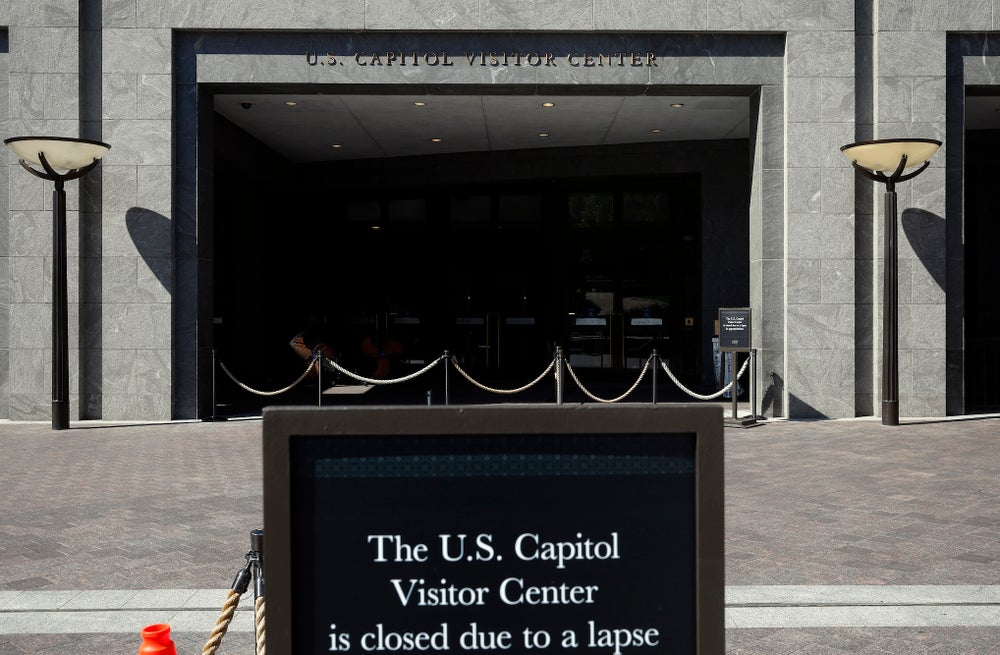
The U.S. Capitol Visitors Center is closed to visitors during the federal government shutdown on October 01, 2025, in Washington, DC. (Photo by Kevin Dietsch/Getty Images)

Here are four ways a government shutdown affects small businesses:

No New Small Business Administration (SBA) Loans

The SBA’s website currently reads: “As a result of the shutdown, we wanted to notify you that many of our services supporting small businesses are currently unavailable.”

During a shutdown, new SBA 7(a) or 504 loans are not processed, which could affect other areas, impacting new purchases, upgrades, and investments. According to the U.S. Chamber, small businesses could lose $100 million in loan financing per day.

The shutdown could also impact some areas of home lending.

“Borrowers who are taking FHA or VA loans or need flood insurance can expect delays in closing,” Melissa Cohn, a regional vice president of William Raveis Mortgage, told Entrepreneur in an email.

Joe Raedle/Getty Images)

Passport delays

If you are planning to travel for business and need to update your passport, you may be out of luck. In past shutdowns, an estimated 200,000 applications were delayed or went unprocessed. The Department of Homeland Security also suspends Global Entry applications during the shutdown.

Related: Most Companies Stop at Good Service — But the Real Growth Multiplier Is Something Else

Loss of foot traffic

The U.S. Chamber warns that businesses located near government agencies or national parks are likely to experience a decline in traffic and, consequently, revenue.

Loss of government contracts and permits

Small businesses that rely on government contracts will likely experience delayed payments or could even see contracts fully canceled.

Key Takeaways

  • The federal government shut down at midnight Oct. 1.
  • A government shutdown can affect small businesses in unexpected ways.
  • The U.S. Chamber of Commerce estimates small businesses could lose $100 million in loan financing per day.

At midnight on October 1, the U.S. federal government shut down while elected politicians continued to debate the provisions in a funding bill. It’s the 15th time the government has shut down since 1981.

The White House has a detailed list posted on its website of the agencies urging politicians to stop the shutdown, including the U.S. Chamber of Commerce. The organization’s Executive Vice President and Chief Policy Officer, Neil L. Bradley, wrote to the U.S. Senate urging them to come to a resolution.

“History warns us that even a partial government shutdown has ripple effects on the U.S. economy,” Bradley wrote. “Shutdowns are harmful to the economy, the American people, and our national security.”

Related: A Guide to State Chambers of Commerce

https://www.entrepreneur.com/business-news/government-shutdown-what-it-means-for-small-business-owners/497819


5 Lessons for Leaders in the Age of Constant Change

Opinions expressed by Entrepreneur contributors are their own.

Key Takeaways

  • To lead effectively in the age of constant change, you must understand that clarity wins, trust is everything and stability fuels growth.
  • It’s also important to understand that adaptability is a superpower and that purpose is the fuel that keeps you moving when you’re leading through chaos.

You can’t wait for things to “settle down” anymore. Leadership is now a full-time job in uncertainty. Whether you’re building a company, leading a team or navigating a personal career pivot, the ability to adapt, stay grounded and bring others with you is essential.

I’ve spent my career leading through change. I’ve been a homicide detective, a founder, a fintech executive and a security leader at Meta. Now, I’m helping scale Sui, a leading blockchain built for mass adoption, where my role spans guiding internal teams and working directly with builders, brands and users to shape what comes next. Every one of those chapters looked and felt different, but the same leadership principles kept showing up again and again.

Here are five of those principles that have helped me stay effective, even in environments where the only constant is change.

Related: 5 Principles for Dealing With Constant Change

1. Clarity wins

When you’re surrounded by complexity, people crave simplicity. Whether it was coordinating an operation as a detective or leading infrastructure security at Meta, I learned that teams move faster and with more confidence when they’re clear on what matters.

At Meta, where I oversaw security for large-scale systems, it was easy to get lost in the noise. But I always came back to one thing: protect the core. That clarity became a North Star my team could rely on.

Today, the Sui Foundation is scaling a network that supports millions of transactions per day. Clarity remains essential. Internally, I work to guide our team to stay focused on the core priorities that drive long-term value. Externally, I spend just as much time in conversation with enterprise leaders and everyday users to understand their challenges, goals and where they see real gaps. Those inputs help shape our path forward.

True clarity comes from listening, refining and adjusting. It means understanding what people truly need, not just what we assume they want.

2. Trust is everything

In high-stakes environments like SWAT, trust is the foundation. Without it, even the best strategy falls apart. You had to trust the person next to you with your life. That kind of trust is built slowly and only through consistency.

The same thing applies in business. People don’t trust titles or talk. They trust patterns. Do you show up when it’s hard? Do you follow through? Do you listen? If the answer is yes, they’ll follow you.

The Sui Foundation is building trust into its systems, too. This digital infrastructure is designed for other people and businesses to depend on. That means performance, security and reliability aren’t features — they’re promises. And keeping those promises builds real trust both internally and externally.

Related: 3 Qualities of Leaders Who Succeed During Uncertain Times

3. Stability fuels growth

The tech world loves speed. And speed is great, until it causes you to crash. During my time at Meta, I learned that real growth only works when it’s matched with real stability. Security, for example, can’t be an afterthought. It has to be built in, from day one, or the whole system is at risk.

That mindset has carried into how I help scale Sui. As supporters of one of the fastest-growing blockchains in the world, Sui Foundation is not chasing vanity metrics. We’re building in a way that serves long-term needs for the ecosystem, for developers and for the enterprises and consumers who are starting to rely on this infrastructure.

Every leader should be thinking this way. Don’t just ask “How fast can we grow?” Ask, “Can we handle the growth if it shows up tomorrow?”

4. Adaptability is a superpower

I’ve gone from the world of finance, to homicide investigations, to building tech companies, to securing some of the world’s most complex digital infrastructure, to now helping lead a major blockchain ecosystem. It wasn’t a textbook career trajectory, but each shift deepened my ability to adapt and lead through change.

Here’s what I’ve learned: Change forces you to grow. It keeps you humble. And it sharpens your ability to listen, observe and learn fast. Leaders who resist change become irrelevant. Leaders who embrace it — and learn to thrive in it — are the ones who survive and evolve.

Adaptability isn’t just about career pivots, though. It’s about mindset. It means staying open, being willing to admit when something isn’t working and being fast to reorient when the world shifts around you.

5. Purpose beats burnout

When you’re leading through chaos, purpose is the fuel that keeps you moving. It’s what keeps teams from falling apart when things get hard. It’s what brings people back after a failure or a setback. And it’s what makes the work feel worth it.

At Sui, the purpose is clear: building the infrastructure for a more open and equitable digital future. Sui is designed to give people ownership over their data, their assets and their digital identities. Behind all the systems and protocols is a simple idea: Technology should serve people, not the other way around.

Leaders who can articulate a clear purpose will always have an edge. People want to be part of something bigger than themselves. Your job is to give them that something.

Related: Don’t Neglect This One Crucial Step of Leading Through Constant Change

Leadership today doesn’t require that you’re the smartest person in the room or have a perfect plan. Instead, the best leaders stay centered in the storm. They build trust, embrace reinvention and keep people focused on what matters most.

If you want to thrive as a leader in this new era, start by asking yourself: Am I clear? Am I trustworthy? Am I building for the long term? Am I open to change? And, most importantly, do I know why I’m doing this?

Because when you have a true purpose, everything else gets easier.

Key Takeaways

  • To lead effectively in the age of constant change, you must understand that clarity wins, trust is everything and stability fuels growth.
  • It’s also important to understand that adaptability is a superpower and that purpose is the fuel that keeps you moving when you’re leading through chaos.

You can’t wait for things to “settle down” anymore. Leadership is now a full-time job in uncertainty. Whether you’re building a company, leading a team or navigating a personal career pivot, the ability to adapt, stay grounded and bring others with you is essential.

I’ve spent my career leading through change. I’ve been a homicide detective, a founder, a fintech executive and a security leader at Meta. Now, I’m helping scale Sui, a leading blockchain built for mass adoption, where my role spans guiding internal teams and working directly with builders, brands and users to shape what comes next. Every one of those chapters looked and felt different, but the same leadership principles kept showing up again and again.

Here are five of those principles that have helped me stay effective, even in environments where the only constant is change.

https://www.entrepreneur.com/leadership/5-lessons-for-leaders-in-the-age-of-constant-change/497250


Why Gold’s Record Run Signals a Global Crisis of Confidence

Opinions expressed by Entrepreneur contributors are their own.

Key Takeaways

  • Gold’s surge signals global doubts about debt sustainability and fiat stability.
  • Central banks increasingly buy gold, diversifying away from traditional currencies.
  • Financial repression and currency debasement drive structural reassessment of value.

In the often-abstract world of modern finance, the relentless ascent of an ancient, tangible asset is sending shockwaves through the global economy. Gold, the perennial store of value, has once again seized the spotlight, with its price surging from $2,300 per ounce to unprecedented heights, breaching the $3,700 mark.

This isn’t merely a spike; it’s a profound statement. It is a signal — one that points to a deep, systemic loss of confidence and a looming tectonic shift in the very foundations of the world financial architecture.

A longitudinal analysis of asset performance reveals that gold has been a notably strong performer over an extended multi-decade horizon. Data compiled since mid-1967 shows that gold has appreciated by over 8,300%, a figure that exceeds the 6,600% return of the S&P 500 index during the same period. This outperformance is analytically significant as it challenges conventional asset allocation frameworks.

Related: How Much Are Costco Gold Bars Worth Today?

Traditionally, equities are categorized as growth assets, expected to generate real returns over the long term through earnings and expansion. Gold, conversely, is typically classified as a defensive asset, a store of value intended to preserve capital and hedge against volatility. Its ability to outperform a major equity index over half a century suggests its role may be more complex and its drivers more powerful than simple risk-off sentiment.

The defining characteristic of the current bullish trend for gold is its breadth. Unlike periods where gold strengthens solely against the US dollar due to specific US-centric economic issues, the current appreciation is observable against a broad basket of major global currencies.

This includes the euro, the Japanese yen and the Swiss franc — a currency historically viewed as a haven asset itself. This uniform strength indicates that the driving forces behind gold’s demand are not isolated to a single economy’s policies or weaknesses.

Instead, it points to a systemic, global phenomenon, suggesting a widespread reassessment of value and risk across the entire fiat currency system.

Related: The Market’s Silent Warning: What Bonds and Gold Reveal

Debt and policy constraints

The primary macroeconomic factor underpinning this reassessment is the unprecedented global debt environment. Sovereign, corporate and household debt levels have reached historic highs, creating a constrained landscape for policymakers. In the United States, corporate debt stands near $14 trillion, household debt exceeds $20 trillion, and federal debt has surpassed $37 trillion. Globally, when accounting for both explicit and implicit obligations, total debt is estimated to exceed $300 trillion.

This debt saturation has critical implications. It severely limits the scope for traditional fiscal and monetary responses to economic contractions. In a recession, automatic stabilizers and stimulus measures would typically increase deficit spending.

Given the already elevated debt-to-GDP ratios, such a response could cause sovereign debt levels to expand at an accelerated pace. The market’s concern, therefore, is not merely the absolute level of debt, but the perceived lack of a credible path to its stabilization or reduction without resorting to policies that compromise currency integrity.

Adding to market uncertainty are questions surrounding the accuracy of key economic data. The recent announcement by the U.S. Bureau of Labor Statistics (BLS) that it overestimated job creation figures for the end of March 2025 by nearly one million positions is a pertinent example.

The BLS data is a foundational input for critical decisions made by the Federal Reserve, fiscal authorities and market participants. Revisions of this magnitude can undermine confidence in the economic narrative and complicate the policy calibration process.

When the reliability of core data is questioned, it fosters an environment of uncertainty, often driving capital towards assets perceived as more transparent and less susceptible to revision, such as gold.

The prospect of financial repression and currency debasement

Faced with these constraints, the likely policy response, as anticipated by many economic analysts, is a prolonged period of financial repression. This term describes a set of policies where interest rates are held artificially below the rate of inflation. This effectively creates negative real yields, transferring wealth from savers to borrowers and gradually eroding the real value of outstanding debt over time. While this manages the debt burden, it simultaneously debases the currency, reducing its purchasing power.

In this environment, fiat currencies are no longer seen as a perfect store of value. Gold, with its finite supply and independence from any government’s promise to pay, becomes an attractive alternative. Its recent price action is widely interpreted as a market hedge against this very outcome—a sustained period of currency devaluation across major economies.

This macroeconomic outlook is driving discernible shifts in institutional behavior. Central banks, particularly those in emerging markets seeking to diversify their reserve assets away from traditional fiat currencies, have been consistent and material net buyers of gold. This institutional demand provides a solid foundation for the market that goes beyond speculative retail investment.

It is also important to note that a rising gold price can coexist with a strong equity market. Indices like the S&P 500 may continue to perform well driven by liquidity inflows and other factors. However, some analysts caution that such performance may become increasingly disconnected from underlying economic fundamentals, potentially indicating asset price inflation driven by monetary expansion rather than organic growth.

A signal of structural shifts

The significant and broad-based appreciation of gold is not an isolated event but a pronounced market signal. It reflects deep-seated concerns about the global debt supercycle, the limited policy tools available to manage it and the consequent high probability of sustained financial repression and currency debasement. The metal’s price movement represents a collective market action to hedge against these systemic risks. It indicates a growing preference for non-liability-based stores of value and suggests an ongoing, structural reassessment of the global financial landscape by institutional and private investors alike.

Monitoring flows into gold and its performance relative to currencies will remain a critical exercise for gauging confidence in the prevailing monetary system.

Key Takeaways

  • Gold’s surge signals global doubts about debt sustainability and fiat stability.
  • Central banks increasingly buy gold, diversifying away from traditional currencies.
  • Financial repression and currency debasement drive structural reassessment of value.

In the often-abstract world of modern finance, the relentless ascent of an ancient, tangible asset is sending shockwaves through the global economy. Gold, the perennial store of value, has once again seized the spotlight, with its price surging from $2,300 per ounce to unprecedented heights, breaching the $3,700 mark.

This isn’t merely a spike; it’s a profound statement. It is a signal — one that points to a deep, systemic loss of confidence and a looming tectonic shift in the very foundations of the world financial architecture.

A longitudinal analysis of asset performance reveals that gold has been a notably strong performer over an extended multi-decade horizon. Data compiled since mid-1967 shows that gold has appreciated by over 8,300%, a figure that exceeds the 6,600% return of the S&P 500 index during the same period. This outperformance is analytically significant as it challenges conventional asset allocation frameworks.

https://www.entrepreneur.com/money-finance/why-golds-surge-signals-a-global-crisis-of-confidence/497217


AI Can Already Outperform Even Your Smartest Hire — Here’s What You Need to Set Your Dream Team Apart

Opinions expressed by Entrepreneur contributors are their own.

Key Takeaways

  • With AI surpassing human intelligence in many domains, the value of emotional intelligence, or EQ, in the workforce is rising as a key differentiator.
  • High-EQ teams can navigate and flourish in dynamic market conditions, fostering lower turnover, faster pivots and stronger collaboration.
  • Hiring for EQ is critical for founders and leaders, ensuring that their teams not only excel in technical skills but also in empathy, adaptability and communication.

Artificial intelligence is eating its way up the skills ladder. What started with the automation of repetitive tasks has now moved into areas like data analysis, market forecasting and even creative ideation. With the advent of agentic AIs, AI processes will percolate even deeper across organisations and more sectors, reducing the need for human labour. AI’s raw processing power can outthink us already and we’re barely scratching the IQ frontier of AGI/ASI.

Being blunt, IQ in less than a decade will be commoditized.

This is a profound shift for founders and leaders. If software can already outperform in quality and speed your “smartest” hire, what qualities will set your dream team apart?

The answer: emotional intelligence (EQ).

Related: Why We Need to Become More Emotionally Intelligent In An AI World

Why IQ alone no longer wins

For decades, companies hired for IQ. I remember during my banking days, when we’d be interviewing MBA graduates for potential roles; solid GMAT, GPAs and psychometric testing dominated the hiring process. Elite schools, perfect test scores and razor-sharp technical ability were considered foolproof indicators of success. But now, even the most intelligent employee is competing with tools that don’t sleep, don’t burn out and can absorb terabytes of information in seconds. And we’ve barely scratched the surface of where AI is headed over the long term.

The cost of accessing such intelligence is dropping at profound rates. This means access won’t be an issue. Therefore, the future advantage won’t belong to teams that simply think harder; it will belong to teams whose members exhibit ownership, humility, see over the horizon and creatively assimilate with the higher intelligence that looms.

What EQ actually means in business

EQ is the ability to understand and manage your own emotions while navigating and influencing the emotions of others. It’s about connection and collaboration rather than pure computation. Key EQ traits include:

Empathy: The ability to understand your customer’s pain points.

Self-awareness: Identifying your blind spots and/or biases.

Adaptability: Keeping your ego in check and the ability to execute on needed change.

Conflict resolution: The ability to identify conflicts early and resolve issues before they snowball.

Communication: Inspiring a team, rather than just delegating tasks.

AI can diagnose a market problem. It can’t, however, walk into a room of exhausted employees and re-inspire them to keep building (yet). This is where our edge (i.e EQ), as a species, comes in.

The culture multiplier effect

Hiring for EQ is about much more than team harmony. It directly impacts business outcomes:

Faster pivots: High-EQ teams don’t get paralysed by sudden market shifts. And we know a thing or two about pivots.

Lower turnover: People stay longer when they feel understood and valued.

Stronger collaboration: Teams with high EQ share information and ideas instead of hoarding them. Silos can be toxic to corporate development.

Customer success: Teams who value empathy create experiences that resonate, not just products.

Culture, often dismissed as “soft,” is in reality the hardest competitive advantage to copy.

Related: Why Emotional Intelligence Is the Key to High-Impact Leadership

Does EQ-led leadership really work?

Some of the best-known business turnarounds were powered by EQ:

Satya Nadella’s transformation of Microsoft wasn’t just technical; it was a total cultural rewiring. His emphasis on empathy, learning, humility and growth mindset revitalised the company.

Howard Schultz at Starbucks built a global brand by prioritising emotional connection — with both customers and employees. I prefer Pret, but the point stands.

I’ve seen startups implode despite brilliant ideas and top-tier IQ, simply because the founders lacked the ability to manage conflict or communicate effectively. On the flip side, I’ve watched less “technical” teams dominate their industries by rallying around a shared vision and high-trust culture.

How founders can hire for EQ

Ask behavioral questions: Instead of only testing technical knowledge, ask about the hardest failure they’ve overcome or how they resolved a team conflict.

Look for empathy: Can they see things from a user’s or colleague’s perspective?

Assess communication skills: Can they explain complex ideas clearly and calmly under pressure?

Prioritise collaboration over ego: Watch how candidates talk about past teams. Do they share credit or claim it all?

Importantly, as the head of your company, ask yourself, “Would I work for this person someday?” Don’t take it from me, but arguably one of the most prolific entrepreneurs of our time, Mark Zuckerberg, agrees. And remember, it’s not that he doesn’t value IQ; in fact for his AI super-intelligence team, he has spent over a billion dollars.

However, a single low-EQ hire, at a higher rank, can quietly poison a company culture. Founders should treat EQ as non-negotiable for leadership roles — and a serious consideration for every role.

Cultivating EQ inside your startup

Even if you hire smartly, you need to build an environment where EQ can thrive:

Lead with vulnerability: Admit when you don’t have all the answers — it gives your team permission to do the same. Ownership of tasks is of equal importance as ownership of one’s mistakes.

Create feedback loops: Normalize open and constructive feedback.

Reward soft skills: Honor the teammate who mentors others, not just the one who hits technical milestones.

Invest in training: If your operating cash flows allow it, invest in workshops on communication and conflict resolution.

Related: Why More ‘Emotional Intelligence’ Means More Money for Entrepreneurs

The future edge

As AI continues to handle the “thinking,” what will remain unique to humans (for now) is our ability to be creative and care. Businesses that win will be those that can balance technical horsepower with emotional depth.

While intelligence can help you build a product, emotional intelligence will help you build a company. In the age of AI, that distinction is everything.

Key Takeaways

  • With AI surpassing human intelligence in many domains, the value of emotional intelligence, or EQ, in the workforce is rising as a key differentiator.
  • High-EQ teams can navigate and flourish in dynamic market conditions, fostering lower turnover, faster pivots and stronger collaboration.
  • Hiring for EQ is critical for founders and leaders, ensuring that their teams not only excel in technical skills but also in empathy, adaptability and communication.

Artificial intelligence is eating its way up the skills ladder. What started with the automation of repetitive tasks has now moved into areas like data analysis, market forecasting and even creative ideation. With the advent of agentic AIs, AI processes will percolate even deeper across organisations and more sectors, reducing the need for human labour. AI’s raw processing power can outthink us already and we’re barely scratching the IQ frontier of AGI/ASI.

Being blunt, IQ in less than a decade will be commoditized.

This is a profound shift for founders and leaders. If software can already outperform in quality and speed your “smartest” hire, what qualities will set your dream team apart?

https://www.entrepreneur.com/leadership/dont-just-hire-the-smartest-candidate-look-for-this/495079


Meta Is Using Your AI Chatbot Conversations for the Ad Algorithm on Facebook and Instagram

Key Takeaways

  • On Wednesday, Meta announced that it would use conversations with its AI chatbot to tailor ads.
  • Advertising is a core business for Meta, comprising over 97% of its revenue in 2023 and 2024.
  • Meta AI has more than one billion monthly active users across the company’s apps.

Your conversations with Meta AI will now shape the ads you see on your Facebook newsfeed.

Meta announced on Wednesday that its recommendation system will soon display ads and suggested content to users based on their interactions with Meta AI, the company’s digital AI assistant with more than one billion monthly active users across Facebook, Instagram and WhatsApp. Ads will soon be crafted based on conversations with Meta AI via text and audio.

Meta will also use voice recordings, photos, and videos acquired through footage from Meta’s Ray-Ban smart glasses to create ads. The ads will display on Facebook and Instagram feeds, but will not surface on WhatsApp unless users link their accounts to Instagram or Facebook.

Related: Meta Just Unveiled New Smart Glasses With an Embedded Display — and an iPhone 17 Price Point. Here’s How They Work.

The new AI-based ads start on December 16 globally, except for Meta users in South Korea, the United Kingdom and the European Union, where laws prohibit companies from this level of data collection. Meta will notify global users of the change earlier, beginning October 7.

The tech giant noted that users cannot opt out — if they want to stop AI-chat-based targeted ads, they have to stop interacting with Meta AI.

Meta explained how the new AI content will be shown in feeds across social media. For example, if a user talks to Meta AI about where to take a vacation, they will receive ads and suggested content on their Facebook and Instagram feeds based on that conversation. They could receive a suggested Instagram Reel about where to travel and ads on their newsfeeds for hotels.

Meta’s Privacy and Data Policy Manager Christy Harris told CNBC during a media briefing that the ad initiative was an expected next step in Meta’s AI strategy — and that people already thought Meta was using AI conversations to tailor ad experiences.

“We want to be super transparent about it and provide a heads up before we actually begin using this data in a new way, even if people already thought that we were doing this,” Harris told the outlet.

Related: AI Contractors at Meta Could See Users’ Personal Data, Including Selfies

Meta isn’t alone in sharing AI data for other purposes — your ChatGPT conversations aren’t private either. OpenAI CEO Sam Altman shared on an episode of the “This Past Weekend” podcast in July that, though a growing number of users are relying on ChatGPT as a “therapist” and “life coach,” conversations with the chatbot lack legal protections.

“If you talk to ChatGPT about your most sensitive stuff and there’s a lawsuit, we could be required to produce that,” Altman said on the podcast.

Meta’s AI-based ad initiative is part of the company’s ongoing effort to use AI and user data (detailed descriptions of users, their likes, browsing histories, and more) to help sell ads. The company’s revenue almost entirely consists of advertising dollars, with ads accounting for over 97% of Meta’s revenue in 2023 and 2024.

Related: Mark Zuckerberg Does a Better Job Than His Rivals at Explaining AI — And It’s Helping Meta Outperform Alphabet, Amazon and Microsoft

For its most recent quarterly earnings report, released in July, Meta reported revenue of $47.52 billion, a 22% year-over-year increase. Advertising accounted for $46.56 billion of that total, or about 98%.

The double-digit revenue growth aligns with Meta’s growing user base — Meta’s products have billions of users. For example, as of last week, Meta disclosed that Instagram now has three billion monthly active users, up from 1.21 billion users in 2021.

Key Takeaways

  • On Wednesday, Meta announced that it would use conversations with its AI chatbot to tailor ads.
  • Advertising is a core business for Meta, comprising over 97% of its revenue in 2023 and 2024.
  • Meta AI has more than one billion monthly active users across the company’s apps.

Your conversations with Meta AI will now shape the ads you see on your Facebook newsfeed.

Meta announced on Wednesday that its recommendation system will soon display ads and suggested content to users based on their interactions with Meta AI, the company’s digital AI assistant with more than one billion monthly active users across Facebook, Instagram and WhatsApp. Ads will soon be crafted based on conversations with Meta AI via text and audio.

Meta will also use voice recordings, photos, and videos acquired through footage from Meta’s Ray-Ban smart glasses to create ads. The ads will display on Facebook and Instagram feeds, but will not surface on WhatsApp unless users link their accounts to Instagram or Facebook.

https://www.entrepreneur.com/business-news/meta-is-using-ai-to-shape-ads-on-facebook-instagram/497824


College Side Hustle Started With $50 Is About to Hit $500,000

Key Takeaways

  • Campbell and Kramer started a womenswear basics apparel brand out of a UCLA dorm room in 2019.
  • Here’s how they transformed a $50 thrift store purchase into a successful brand on track for $500,000.

This Side Hustle Spotlight Q&A features Los Angeles, California-based entrepreneurs Presley Campbell, 25, and Alden Kramer, 25. Campbell and Kramer are the co-founders of womenswear basics apparel brand Campbell&Kramer, which they launched out of their college dorm room in 2019. Responses have been edited for length and clarity.

Image Credit: Courtesy of Campbell&Kramer. Alden Kramer, left, and Presley Campbell, right.

Want to read more stories like this? Subscribe to Money Makers, our free newsletter packed with creative side hustle ideas and successful strategies. Sign up here.

What was your day job or primary occupation when you started your side hustle?
Presley:
When Alden and I started our side hustle, we were both college students, freshmen at UCLA. I also worked in sales and consulting at a secondhand fashion resale app.

Alden: I also worked in real estate investing, architecture and design.

Related: Couple’s Side Hustle Surpassed $1,000 a Day Fast — With ChatGPT’s Help

When did you start your side hustle, and where did you find the inspiration for it?
Presley:
We started our side hustle in the spring of 2019, sewing thrifted fabrics out of our UCLA freshmen year dorm room. I initially found inspiration to start a sustainable line while in a sustainability course. I learned about the horrors of fast fashion in depth for the first time, and it completely altered my perception of the fashion industry. Since I was little, I looked up to my mom and aunt, who both worked in designer fashion and have the most iconic taste and vintage archives, and my dad, who’s an entrepreneur.

Alden and I were also in a sustainable fashion internship for a resale app freshman year, and we watched The True Cost, a documentary that focuses on fast fashion, together. We created our brand mission and a logo that night, sitting on our twin XL dorm beds. We wanted to build a brand that repurposed existing materials, creating pieces women our age wanted to wear at an affordable price point.

Image Credit: Courtesy of Campbell&Kramer

Alden: I have always wanted to create a fashion brand — since third grade. It’s an obsession that stems from really ordinary and scattered muses: from films like The Lizzie McGuire Movie and Confessions of a Teenage Drama Queen to toys like Polly Pockets and Barbies to music from Taylor Swift and Lana Del Ray to magazines and books like Teen Vogue and The Clique. Also, my grandmother taught home economics and was a talented seamstress. She had a sewing room stuffed with fabrics, trims and all types of machines. Naturally, I asked my grandma to teach me to sew; her lessons didn’t refine my technical talent, but they fostered more interest in the end product. When I met Presley during our freshman year at UCLA, I was so grateful that someone else loved fashion as much as I did. More importantly, Presley brought a new perspective that added to my own, and she was just as eager to do something about the passion: She also wanted to build something.

What were some of the first steps you took to get your side hustle off the ground? How much money/investment did it take to launch?
Presley:
We were 19-year-old college students with no prior business experience, but we immediately took action toward our idea and never looked back. We took very small, actionable steps to start, bringing $50 to the local thrift store and purchasing some larger blankets and old rolls of fabric to sew our designs. At the time, this felt like a lot of money to us. We sold these pieces to family and friends around campus. Family friends then donated old UCLA gear to us, and we upcycled it into game day apparel, which we sold around campus and at our sororities. Our community truly was everything to us, and still is.

During the pandemic, we had a local Orange County influencer, Ella McFadin, post in our hand-dyed tie-dye thrifted sweat sets. The impact was enormous. We instantly sold out and had an influencer and celebrity domino effect ensue. Huge names were sliding in our DMs left and right, and we couldn’t keep up with the demand. We were hand-dyeing and hand-sewing hundreds of pieces out of our family homes in Orange County during lockdown, and eventually raised enough to partner with a local LA factory to help us keep up with demand. Once we graduated, we really wanted to re-focus the brand on our original vision of elevated basics made from pre-existing materials such as deadstock or recycled fabric. There is enough amazing, beautiful fabric already in circulation, and we strongly believe there’s no need to make anything “new.”

If you could go back in your business journey and change one process or approach, what would it be, and how do you wish you’d done it differently?
Presley:
This is a hard one because at the end of the day, I’m grateful for all the mistakes we’ve made. They’ve taught us invaluable lessons that have led us to where we are today. However, we partnered with a few questionable factories when we first started due to a lack of knowledge. We were students with no prior experience and were cold-calling any factories in LA that would entertain such low minimum quantities. After a few very wrong turns, we finally found a patternmaker who’s very well connected with factories in LA. She completely changed the game for us, and we couldn’t be more grateful to learn from and grow alongside her. I would recommend speaking with multiple professionals in the industry so you know what to look for and vetting any potential partners extensively.

Alden: I am someone who has to learn from experience rather than just follow advice. Mistakes have brought us a lot of perspective, and I believe that knowing what doesn’t work is just as valuable as knowing what does work.

Related: His Salty Side Hustle Saw Revenue ‘From Day 1’ and Hit $10 Million Last Year

When it comes to this specific business, what is something you’ve found particularly challenging and/or surprising that people who get into this type of work should be prepared for, but likely aren’t?
Alden:
Fashion always seemed more frivolous and artful to me instead of data-driven and operationally advanced. That’s obviously not the case. In order to have a successful business, you need a strong and modern operational foundation, and in order to grow, you need metrics and insights, regardless of what industry you’re in. That’s something that we’re adjusting to. We did business quite casually and didn’t have organizational systems or key metrics that we tracked. But as we grow, we understand the need to streamline operations, centralize data collection and critically compare revenue and expenses.

Presley: When we first started, we were very focused on our designs and establishing our website and social media presence. We didn’t think through establishing the organization behind it all, the number of SKUs we would go on to have, tracking inventory across numerous locations now that we work with boutiques, showrooms and stylist loans, tracking data from our audience behaviors, etc. This is something we are continuously improving, and anyone looking to start a brand should make it a priority from the beginning.

Image Credit: Courtesy of Campbell&Kramer

Can you recall a specific instance when something went very wrong? How did you fix it?
Presley:
Quite a few. But it never feels dire because Alden is there for me (and I her). We accept the issue and immediately propose solutions. The first factory we paired with produced our units several sizes too small. They fit my elementary school-aged siblings. And it was such a large amount of money for us. This mistake really taught us to perfect patterns, run that extra sample rather than jump to production and only work with partners we really trust.

Alden: To second Presley, any time an issue does come our way, we really try to rationally work through it and not panic: We both understand that stressing out about something isn’t going to solve it.

How long did it take you to see consistent monthly revenue? How much did the side hustle earn?
Presley:
For the first few years, we had sporadic revenue. We were full-time students, so sometimes we would have more time to focus on C&K than others. Some months we made $25,000 (and had to hand-sew/dye hundreds of pieces ourselves), and others $2,000. We ran every single part of the business ourselves. In the past two years, we’ve started seeing consistent monthly revenue. This past year, our monthly revenue has significantly increased as we’ve taken the leap into wholesale.

Alden: Inconsistent revenue was also a result of inconsistent product and timing. We’ve really focused our product selection on womenswear basics and have a more consistent supply than in our earlier years.

Related: This Mom’s Garage Side Hustle for Kids Became a Business With $1 Billion Revenue

What does growth and revenue look like now?
Presley:
This past year, we’ve experienced significant growth. We began experimenting with wholesaling earlier this year, and we landed our first major retailer wholesale collaboration with Urban Outfitters and began selling to quite a few boutiques around the country. We bootstrapped our first wholesale market ourselves, and it went very well. Now we have wholesale partners and are excited to continue growing that side of the business. Our projected revenue for 2025 is around $500,000.

Alden: Growth looks like steadily scaling our existing channels: direct to consumer, boutiques and larger retailers. We like working with boutiques and want to expand that channel. The orders are more casual, frequent and flexible, and we love having our product in hyper-local places.

What do you enjoy most about running this business?
Presley:
I love every aspect of running this business with my best friend. I find myself reflecting on how grateful I am to be working toward my dream every day. We are both so passionate about this brand, so it never truly feels like work. Building Campbell&Kramer is the most fun journey. It’s beautiful to watch the entire creative process come to life, from a sketch or vintage inspo to first samples to photoshoot concepts to social strategies and launch events. I love seeing our customers in the pieces we’ve worked so long on. I love designing for other women our age, and every age. It’s so fulfilling to know we are helping women feel their most confident and that people all over the world are strutting around in C&K, making memories in their pieces.

Alden: First, sharing this journey with my best friend. We both push each other. We celebrate our successes together. We share failures and motivate each other to move on. In general, I’m so thankful for someone who cares as much about a passion as I do and with whom I can work so compatibly and trust. Second, developing a vision and watching it come to life. That is so fulfilling. We have so much fun sourcing and bringing on other talent to help execute the vision, too. Finally, the mission. We truly believe in creating hyper-wearable garments that really flatter the customer, don’t sit in your closet, complement what you already have and, most importantly, come from existing materials only.

Image Credit: Courtesy of Campbell&Kramer

What is your best piece of specific, actionable business advice?
Presley:
There will never be a perfect time to start. So start now. Dive in headfirst and never look back. Even if it’s the smallest step, create a logo (you can always change it later) and make the Instagram account. Start posting about what you’re building so people can get invested early on, and draw upon your community for support. You can’t be afraid to put yourself or your ideas out there and to reach out to everyone in your network or people online who are knowledgeable in the space. Learn from them and ask so many questions (even ones you may think are obvious). Everyone is capable of achieving their dreams if they act on their ideas and never give up. Pivot when you fail until you find what works. Most importantly, find a partner or team who you adore, trust and want to spend immeasurable amounts of time with. Write down your goals and actively work toward them day in and day out.

Related: This Mom’s Creative Side Hustle Started As a Hobby With Less Than $100 — Then Grew Into a Business Averaging $570,000 a Month: ‘It’s Crazy’

Alden: One thing I need to remember is that everything comes from one small step forward. I tend to build a huge scope in my head and create something audacious and impossible to tackle, to the point where I’m left asking, Where do I even start? Start small. Just do one thing at a time, and everything will compound.

This article is part of our ongoing Young Entrepreneur® series highlighting the stories, challenges and triumphs of being a young business owner.

Key Takeaways

  • Campbell and Kramer started a womenswear basics apparel brand out of a UCLA dorm room in 2019.
  • Here’s how they transformed a $50 thrift store purchase into a successful brand on track for $500,000.

This Side Hustle Spotlight Q&A features Los Angeles, California-based entrepreneurs Presley Campbell, 25, and Alden Kramer, 25. Campbell and Kramer are the co-founders of womenswear basics apparel brand Campbell&Kramer, which they launched out of their college dorm room in 2019. Responses have been edited for length and clarity.

Image Credit: Courtesy of Campbell&Kramer. Alden Kramer, left, and Presley Campbell, right.

Want to read more stories like this? Subscribe to Money Makers, our free newsletter packed with creative side hustle ideas and successful strategies. Sign up here.

https://www.entrepreneur.com/starting-a-business/friends-college-dorm-room-side-hustle-is-on-track-for-500k/497771


Unchecked Stress Is Killing Your Business Fast — And Only One Thing Can Save It (It’s Not HR)

Opinions expressed by Entrepreneur contributors are their own.

Key Takeaways

  • Stress is often a sign of broken systems, not weak people — clarity, structure and empowered leadership are the real solutions.
  • Wellness perks won’t fix burnout, but thoughtful organizational design and proactive feedback loops can prevent it.

It rarely starts with a loud alarm. More often, it’s a subtle shift in the atmosphere. A deadline is missed. A team member snaps in a meeting. Someone who used to speak up goes quiet. These small signs are easy to overlook — but over time, they form a pattern: a team running on fumes, morale dipping, performance falling short of its usual standard.

As leaders, we’re quick to explain it away.
“It’s just a busy quarter.”
“We’re growing fast—some chaos is normal.”
“People need to toughen up.”

And somewhere in the middle of those justifications, we quietly pass the issue to HR. Maybe there’s a wellness webinar, a mental health day or a motivational talk. We treat the symptoms and move on, assuming the problem is under control.

But stress doesn’t stay hidden for long. It starts leaking into the way teams communicate, how they collaborate, how they deliver. And by the time leadership truly sees it, it’s already costing the business — not just in burnout, but in productivity, innovation and retention.

Related: Your Employees Are Struggling — and It’s Only Getting Worse. Here’s What You Can Do About It.

The real problem isn’t stress. It’s how we lead

Employee stress isn’t a wellness issue — it’s a leadership issue. More specifically, it’s a structural one. And in most cases, it’s a symptom of how decisions are made at the top, not a reflection of employee resilience at the bottom.

In high-growth environments, stress is often worn like a badge of honor. Founders chalk it up to the hustle. Teams accept it as the price of success. But sustained stress is not an inevitable byproduct of growth — it’s a direct result of how that growth is being managed. And if the systems behind the scenes aren’t designed to support the pace, stress will silently multiply until the organization begins to crack.

Rather than focusing on spotting burnout after the damage is done, leaders should be examining what’s causing it to emerge in the first place. In startups, for example, reduce stress by giving employees clearer roles and decision-making authority, not just more work. Use frameworks like RACI (Responsible, Accountable, Consulted, Informed) to ensure people know exactly where they stand and what’s expected of them.

Burnout doesn’t always announce itself

One of the most dangerous things about stress is how invisible it can be. On the surface, everything might seem fine. Deadlines are still being met. Targets are still being hit. People are smiling in meetings.

But beneath that facade, the damage is accumulating. Mental fatigue sets in. Creativity fades. Top performers begin to mentally check out. And eventually, they leave — often without ever saying what pushed them away.

We tend to assume that burnout comes from having too much on our plate. But in reality, people are far more often drained by a lack of clarity than by hard work. It’s not the effort itself that’s exhausting — it’s the constant reactivity, shifting goals, poor communication and lack of direction that sap motivation and drive.

Introduce simple, proactive tools like monthly team health checks or anonymous one-question surveys to identify what’s slowing people down. These can surface systemic issues early and help you fix them before they grow into cultural rot.

You can’t use mindfulness to fix a broken system

Wellness initiatives have their place — but they’re not a substitute for good leadership. Meditation won’t fix a system that overwhelms people with ambiguity. Gratitude journals won’t solve broken communication. Mental health days won’t correct a lack of autonomy or structure.

Leadership needs to go beyond surface-level solutions.
Simplify operations. Set clear and consistent priorities. Build systems designed for sustainability — not just speed.

People don’t burn out because they’re disengaged. They burn out because they’re deeply invested in a system that gives them no control, inconsistent guidance and no clear path forward. Emotional intelligence is more than a buzzword — it’s a strategic imperative. Listen to your people. Implement what you hear. Build belonging through action.

Related: Here’s How Business Leaders Can Cultivate Happiness in the Workplace

Managers aren’t meant to absorb the shock

Nowhere is this more evident than in the middle. Middle managers are often the most stressed people in the organization. They’re expected to hit ambitious targets, translate shifting executive priorities into actionable plans and hold emotional space for struggling teams—all without the support they need themselves.

Don’t just tell managers they’re leaders — treat them like it.
Give them real authority to make decisions, allocate resources, build teams and influence how work gets done. When managers feel empowered, they spread that stability to their teams. And when they don’t, the stress flows downward, eroding morale from the middle out.

Culture isn’t defined in calm — it’s revealed under pressure

Leadership, especially in startups, sets the emotional tone. When founders are scattered, reactive or emotionally detached, that becomes the emotional norm for the company. And when stress is constantly dismissed or minimized, teams learn to hide it — until it’s too late.

Culture isn’t built in branding exercises or value statements. It lives in the day-to-day experience of your team—especially in how the organization handles stress, conflict, and change. These moments matter more than any all-hands slogan or company offsite.

If it’s draining your team, it’s hurting your business

Long-term success doesn’t belong to the companies that work the hardest. It belongs to those who build systems where people can thrive — not just survive. Stress is not just a personal issue — it’s early feedback that your business systems are misaligned.

Create a feedback loop inside your organization by appointing “change agents” or internal advocates who surface emerging issues. Empower them to act—fast. That responsiveness builds trust and preserves energy where it matters most.

The future of leadership is conscious by design

The next wave of leadership isn’t about being the toughest or the most charismatic — it’s about being intentional. It’s about designing systems where people can do the best work of their lives without burning out in the process.

Great leaders don’t just react to stress—they design organizations that prevent it.

In the end, that’s not just good for people. It’s how resilient, high-performing and truly sustainable companies are built.

Key Takeaways

  • Stress is often a sign of broken systems, not weak people — clarity, structure and empowered leadership are the real solutions.
  • Wellness perks won’t fix burnout, but thoughtful organizational design and proactive feedback loops can prevent it.

It rarely starts with a loud alarm. More often, it’s a subtle shift in the atmosphere. A deadline is missed. A team member snaps in a meeting. Someone who used to speak up goes quiet. These small signs are easy to overlook — but over time, they form a pattern: a team running on fumes, morale dipping, performance falling short of its usual standard.

As leaders, we’re quick to explain it away.
“It’s just a busy quarter.”
“We’re growing fast—some chaos is normal.”
“People need to toughen up.”

And somewhere in the middle of those justifications, we quietly pass the issue to HR. Maybe there’s a wellness webinar, a mental health day or a motivational talk. We treat the symptoms and move on, assuming the problem is under control.

https://www.entrepreneur.com/growing-a-business/unchecked-stress-is-killing-your-business-fast-and-only/495739


Lyft’s CEO Drives for the Company Incognito Every 6 Weeks. Here’s Why.

There are two million Lyft rides taken every day. Sometimes, CEO David Risher is behind the wheel.

Key Takeaways

  • David Risher, 60, has been CEO of Lyft since 2023.
  • Risher recently shared that he drives incognito for the company every six weeks.
  • In its latest earnings report released in August, Lyft “delivered off-the-charts performance” resulting in the company’s strongest quarter ever.

Every six weeks, Lyft CEO David Risher, 60, gets in his car to go to work. But instead of heading to the office, he starts picking up passengers.

In an interview earlier this month with the Wake-Up Call at Work newsletter, Risher said that he regularly drives for Lyft to “learn, not to earn.” The CEO’s trips are part of the two million rides taken every day and 800 million given annually.

“Like most leaders, I need to spend most of my time at high altitude,” Risher told the newsletter. “But sometimes you’ve got to dive deep, like a falcon spotting its next meal.”

Related: Uber’s CEO Says Drivers Will Be Replaced By Robotaxis in About 10 Years: ‘This Is Going to Be a Real Issue’

Risher, who joined Lyft as CEO in 2023, said that his Lyft rides gave him deeper insight into riders and drivers, and have even led to the creation of a new product, such as Price Lock, a $2.99 subscription service that caps prices to avoid surge pricing during peak demand, which Lyft launched in September 2024.

Price Lock originated from a conversation he had with a customer on one of his Lyft trips, who said that price surging “impacted her daily stress levels.”

Lyft CEO David Risher. Photographer: Michaela Vatcheva/Bloomberg via Getty Images

“This interaction is a big part of the reason why we built Price Lock,” Risher said, adding that “it was listening to this woman” that helped him understand why riders “hated” surge pricing.

Lyft competitor Uber launched its own Price Lock feature in May.

Meanwhile, Lyft’s business is booming. The rideshare company achieved record financial performance in its latest earnings report released in August, setting all-time highs in key financial metrics.

Risher stated in a press release that the company “delivered off-the-charts performance, resulting in our strongest quarter ever” with record gross bookings of $4.5 billion, up 12% year-over-year. Revenue for the quarter hit $1.6 billion, up 11% year-over-year.

Related: Uber Will Soon Offer Female Riders and Drivers the Option to Avoid Being Paired with Men

Key Takeaways

  • David Risher, 60, has been CEO of Lyft since 2023.
  • Risher recently shared that he drives incognito for the company every six weeks.
  • In its latest earnings report released in August, Lyft “delivered off-the-charts performance” resulting in the company’s strongest quarter ever.

Every six weeks, Lyft CEO David Risher, 60, gets in his car to go to work. But instead of heading to the office, he starts picking up passengers.

In an interview earlier this month with the Wake-Up Call at Work newsletter, Risher said that he regularly drives for Lyft to “learn, not to earn.” The CEO’s trips are part of the two million rides taken every day and 800 million given annually.

“Like most leaders, I need to spend most of my time at high altitude,” Risher told the newsletter. “But sometimes you’ve got to dive deep, like a falcon spotting its next meal.”

https://www.entrepreneur.com/business-news/lyft-ceo-david-risher-secretly-drives-for-the-company/497776


Most Workers Would Take a Pay Cut for Two Major Job Perks, According to a New Report

A more flexible schedule might outweigh a higher paycheck.

Key Takeaways

  • A new questionnaire of 1,000 workers found that almost half would accept a lower salary for a four-day workweek or a fully remote role.
  • Remote employees reported feeling more inspired at work than in-person employees. 

A new report from Youngstown State University (YSU) revealed how employees really feel about the salary versus flexibility debate — and it turns out most would rather be at home longer, even if it means making less money.

Last month, YSU researchers asked 1,000 employed Americans for their perspectives on salary, workplace flexibility, and modern job benefits. The newly published report found that more than half of current full-time, in-person employees (55%) would accept a pay cut in exchange for permanent remote or hybrid work. On average, respondents said they’d take 11% less pay.

Related: Here’s What Happened When Thousands of Workers Tried a Four-Day Workweek in the Biggest Trial Yet

About half (47%) of the questionnaire participants worked in an office five days a week, 32% were on a hybrid schedule, and 21% were fully remote. Most respondents were millennials (38%) and Gen X (35%), while 19% were Gen Z and 8% were baby boomers.

Of all workers surveyed, 40% would take a pay cut for remote work, while two in five workers claimed to have turned down a job offer due to a lack of flexibility.

Surprisingly (for CEOs, we guess), fully remote employees reported feeling more inspired while working (36%) than hybrid employees (35%) and fully in-person employees (27%). Fully remote workers also did not want to go back to the office — 30% said they’d “consider” quitting if mandated to do so, while 13% would “definitely” quit, according to the report.

Related: How Financial Priorities Shift From Boomers to Gen Z

Of course, a higher salary was reported as the top career motivator across all generations, especially for Gen Z (66%) and millennials (61%), the report found.

About half (47%) of the questionnaire participants worked in an office five days a week, 32% were on a hybrid schedule, and 21% were fully remote. Most respondents were millennials (38%) and Gen X (35%), while 19% were Gen Z and 8% were baby boomers.

Click here for the full report.

Key Takeaways

  • A new questionnaire of 1,000 workers found that almost half would accept a lower salary for a four-day workweek or a fully remote role.
  • Remote employees reported feeling more inspired at work than in-person employees. 

A new report from Youngstown State University (YSU) revealed how employees really feel about the salary versus flexibility debate — and it turns out most would rather be at home longer, even if it means making less money.

Last month, YSU researchers asked 1,000 employed Americans for their perspectives on salary, workplace flexibility, and modern job benefits. The newly published report found that more than half of current full-time, in-person employees (55%) would accept a pay cut in exchange for permanent remote or hybrid work. On average, respondents said they’d take 11% less pay.

Related: Here’s What Happened When Thousands of Workers Tried a Four-Day Workweek in the Biggest Trial Yet

https://www.entrepreneur.com/business-news/would-you-take-a-pay-cut-for-a-remote-job-or-4-day-workweek/497775