Why a Strategic Bitcoin Reserve Is Just What America Needs Right Now

Opinions expressed by Entrepreneur contributors are their own.

On July 30, the U.S. released its most sweeping digital-asset policy framework to date: a 160‑page U.S. Crypto Playbook. While the report steers clear of new promises regarding a federal Bitcoin acquisition program, it renews attention on the Strategic Bitcoin Reserve, first announced in March — an initiative that could reshape America’s financial posture.

The newly published Crypto Playbook is the most comprehensive digital asset policy guide the U.S. has ever produced. The report outlines strategic goals around stablecoin regulations, DeFi innovation, digital infrastructure, consumer protections and financial literacy.

Highlights include endorsement of the bipartisan GENIUS Act, laying regulatory ground rules for crypto exchanges; clarification of jurisdiction between the SEC and CFTC via the proposed Clarity Act; and recommendations for tax treatment of staking income, mining equipment depreciation, and wash-sale exemptions.

But the most headline-grabbing omission? No fresh policy announcement regarding the Strategic Bitcoin Reserve. Despite speculation, the Playbook simply restates the administration’s March 6 directive to consolidate all seized Bitcoin into a national reserve, while remaining silent on future acquisitions.

For many in the crypto community, the message is clear: the idea isn’t dead, but it’s still taking shape.

Related: Why Not Owning Bitcoin is Making You Poor

What we know about the reserve so far

In March, an executive order directed U.S. agencies to begin aggregating all federally seized Bitcoin into a single account under the Department of the Treasury. The U.S. currently controls an estimated 200,000 BTC, mostly obtained through forfeitures linked to cybercrime and darknet operations.

Rather than liquidating these holdings at auction (as has been common practice for years), the White House policy marks a significant pivot: treat Bitcoin like a sovereign asset, not a liability.

While today’s Playbook did not mention any direct purchases or operational updates, the crypto industry remains optimistic.

As one policy advisor put it, “They’ve already laid the foundation. We’re just waiting for them to build the house.” According to a reporter present at the event, the Treasury Secretary emphasized the growing role of digital assets in global finance and outlined the administration’s commitment to regulatory modernization.

A key theme from his speech was the need to “reinforce dollar dominance through stablecoins and modernize banking regulations for digital assets.”

His comments reflect the administration’s broader strategy, as outlined in the newly released U.S. Crypto Playbook, to position the United States as a global leader in blockchain innovation while safeguarding national financial stability.

The event drew senior policymakers, industry leaders, and regulatory officials, many of whom welcomed the remarks as a turning point in the federal government’s tone toward crypto. This affirmation of support marks a pivotal moment, suggesting that Washington sees the maturation of Bitcoin and stablecoins not as a threat to the dollar but as a tool to strengthen its role in a rapidly digitizing global economy.

Related: Exploring Bitcoin As a Retirement Investment Avenue

Why America needs a Bitcoin reserve

At a time of rising geopolitical friction, debt uncertainty and de-dollarization efforts by global rivals, a Bitcoin strategic reserve offers the U.S. several vital advantages. Just as gold once anchored the monetary system, Bitcoin now serves as a decentralized, censorship-resistant store of value. A sovereign reserve positions the U.S. to weather inflation, monetary dilution and foreign central bank diversification.

Nations like China and Russia have been quietly offloading U.S. Treasuries and accumulating gold. If a currency crisis or dollar liquidity shock ever emerged, a Bitcoin buffer could serve as a geopolitical hedge with instant global liquidity.

America’s dominance in technology is already being challenged by decentralized finance and token-based commerce. A strategic reserve signals leadership in digital capital formation, making the U.S. more attractive for Web3 entrepreneurs and fintech investment.

While U.S. sanctions have long used the dollar as a weapon, adversaries are actively seeking alternatives. A Bitcoin reserve gives the U.S. a tool of resilience, rather than dependence on legacy systems vulnerable to fragmentation.

By leveraging forfeited BTC from criminal seizures, the reserve grows without costing taxpayers a cent — a rare bipartisan win with massive asymmetric upside. In short, a Bitcoin reserve isn’t about speculative gain. It’s about future-proofing national strength.

Related: A Bitcoin Hot Girl Summer — Will Bitcoin’s Success Continue?

Skepticism — and strategy — remain

Of course, not everyone is on board. Economists have voiced concern that Bitcoin’s volatility makes it an unstable strategic asset. A recent University of Chicago poll found that over 70% of economists do not believe such a reserve would reduce national economic risk. Global reaction has also been cautious. European and Asian officials have warned that a U.S. crypto reserve could destabilize existing foreign exchange reserves and provoke retaliatory monetary policies.

And then there are the technical and ethical questions: Who controls the keys? Can sovereign actors manipulate Bitcoin? Should the reserve be disclosed in real time? The answers remain murky.

What happens next

Under the March order, agencies have until late September to deliver implementation frameworks to the Treasury. Legislative allies in Congress have already floated the BITCOIN Act, which would authorize a broader reserve and explore alternative funding strategies, potentially including gold-for-BTC swaps.

Until then, the Strategic Bitcoin Reserve will remain more symbol than substance. But for crypto advocates, that symbol is growing heavier by the day.

On July 30, the U.S. released its most sweeping digital-asset policy framework to date: a 160‑page U.S. Crypto Playbook. While the report steers clear of new promises regarding a federal Bitcoin acquisition program, it renews attention on the Strategic Bitcoin Reserve, first announced in March — an initiative that could reshape America’s financial posture.

The newly published Crypto Playbook is the most comprehensive digital asset policy guide the U.S. has ever produced. The report outlines strategic goals around stablecoin regulations, DeFi innovation, digital infrastructure, consumer protections and financial literacy.

Highlights include endorsement of the bipartisan GENIUS Act, laying regulatory ground rules for crypto exchanges; clarification of jurisdiction between the SEC and CFTC via the proposed Clarity Act; and recommendations for tax treatment of staking income, mining equipment depreciation, and wash-sale exemptions.

The rest of this article is locked.

Join Entrepreneur+ today for access.

https://www.entrepreneur.com/money-finance/america-needs-a-bitcoin-reserve-heres-why/495267


This CEO Took a Cult-Favorite Bagel Brand National. Here’s the Top Lesson He Learned.

PopUp Bagels has grown fast — 300 franchise units sold in less than a year — but even CEO Tory Bartlett, a franchise veteran brought in to oversee just such growth, can still learn lessons from the process. Although the rollout of PopUp Bagels stores has gone well, Bartlett told Entrepreneur there’s one thing he would change if he could go back.

“I would’ve brought on resources sooner than I thought I needed them,” he says. “It’s tempting to wait, to try to time those hires just right. But if you believe in the brand, you need to invest in the people to support it — ahead of time.”

Related: Considering franchise ownership? Get started now to find your personalized list of franchises that match your lifestyle, interests and budget.

Bartlett joined PopUp Bagels in September 2024, just as the brand — founded by Adam Goldberg — was preparing to franchise. The model was simple: limited hours, no seating, no soda machines or fryers and a rotating menu of high-quality bagels and “schmears” —spreads — that generated social media buzz and long lines. The low-overhead concept was designed to scale, and investors had big plans.

Related: After Decades of Hard Work, This Couple Is Living the Entrepreneurial Dream. Here’s How They Achieved Generational Wealth

Still, as the first stores outside New York opened, Bartlett realized that lean operations only get you so far without the right infrastructure in place. “Anytime you do something for the first time, you’re going to have bumps,” he says. “But my lesson learned there was: If I had brought on the training person a little bit sooner, he could have worked some of these things out.”

“If you’re somebody that’s introverted, we’re looking for somebody else.”

PopUp’s approach to franchising has been unconventional by design. The company awards large territories to a small group of experienced operators who know their markets intimately and are committed to brand stewardship. “We want operators that have skin in the game,” Bartlett says. “In our stores, you’ve got the music pumping; we’re yelling ‘Hot bagels!’ If you’re somebody that’s introverted, we’re looking for somebody else.”

The model is working. With small footprints, low build-out costs and a menu that keeps operations tight, PopUp Bagels is scaling quickly. In addition to its seven New York locations, the brand has multiple stores open in Connecticut and Massachusetts. By the end of 2027, the company expects to have 100 PopUp Bagels open across at least 10 states, including California, Florida and Texas, reflecting its rapid national expansion and growing brand appeal.

But Bartlett says even a simplified, growing concept needs a strong support system to scale sustainably — and that means building the internal team ahead of demand. “Don’t bootstrap it,” he says. “If I was to rewind the tape, I would accelerate the timing I brought in those resources.”

Join top CEOs, founders and operators at the Level Up conference to unlock strategies for scaling your business, boosting revenue and building sustainable success.

https://www.entrepreneur.com/franchises/300-units-sold-1-critical-lesson-learned-for-this-ceo/495350


Hot Coffee, Zero Distractions: Ember Mug 2 Is Built for Focus

Disclosure: Our goal is to feature products and services that we think you’ll find interesting and useful. If you purchase them, Entrepreneur may get a small share of the revenue from the sale from our commerce partners.

If your coffee’s going cold while you’re on your third call of the morning, it’s time to upgrade your setup. The Ember Mug 2 is a tech-forward solution for professionals who demand focus — and hot coffee. For a limited time, you can get an open-box model on sale for $69.99 with free shipping (MSRP $129.95).

The Ember Mug 2 isn’t just another desk accessory. It’s a purpose-built tool for those who need uninterrupted focus — and their beverage exactly how they like it. Whether you’re in back-to-back virtual meetings or deep in a project, Ember keeps your drink at your chosen temperature for up to 90 minutes on its own, or all day with the included charging coaster.

Control every detail via the Ember app, which lets you set your ideal temperature (anywhere between 120°F and 145°F), get alerts when it’s ready, and even personalize your mug’s LED color. Prefer to keep it analog? The mug works out of the box, preset to 135°F for instant plug-and-sip use.

Made with a durable ceramic-coated stainless steel finish, this 10oz version is IPX7 rated for water resistance, meaning it’s fully hand-washable and built to withstand spills or submersion up to 1 meter. The smart auto-sleep feature conserves battery when not in use, and reawakens when motion or liquid is detected.

This model is labeled “open-box”, which just means it’s been repackaged and verified to be in excellent condition. You’ll get all original components, including a charging coaster and cable, with a third-party 1-year warranty for peace of mind.

For entrepreneurs, freelancers, or remote workers who rely on rhythm, energy, and focus, Ember is the kind of low-effort, high-payoff upgrade your workflow deserves.

Make your desk smarter with the Ember Mug 2 Smart Mug while this open-box deal lasts for just $69.99 — with free shipping included.

StackSocial prices subject to change.

If your coffee’s going cold while you’re on your third call of the morning, it’s time to upgrade your setup. The Ember Mug 2 is a tech-forward solution for professionals who demand focus — and hot coffee. For a limited time, you can get an open-box model on sale for $69.99 with free shipping (MSRP $129.95).

The Ember Mug 2 isn’t just another desk accessory. It’s a purpose-built tool for those who need uninterrupted focus — and their beverage exactly how they like it. Whether you’re in back-to-back virtual meetings or deep in a project, Ember keeps your drink at your chosen temperature for up to 90 minutes on its own, or all day with the included charging coaster.

Control every detail via the Ember app, which lets you set your ideal temperature (anywhere between 120°F and 145°F), get alerts when it’s ready, and even personalize your mug’s LED color. Prefer to keep it analog? The mug works out of the box, preset to 135°F for instant plug-and-sip use.

The rest of this article is locked.

Join Entrepreneur+ today for access.

https://www.entrepreneur.com/living/hot-coffee-zero-distractions-ember-mug-2-is-built-for/495608


’62-Year-Old Doesn’t Want to Go Retrain’: OpenAI CEO Sam Altman Says Older Workers Need to Embrace AI — or Face Losing Their Jobs

OpenAI CEO Sam Altman acknowledges that AI can change the workforce and replace some jobs for good — but instead of focusing on AI’s effects on recent college graduates, Altman is more concerned about the technology’s impact on soon-to-be retirees.

In a podcast episode of “Huge Conversations” with Cleo Abram, released last week, Altman said that he was “more worried” about what AI meant for “the 62-year-old that doesn’t want to go retrain” than the “22-year-old” just graduating college. The reason? Young people are “the best” at readily adjusting to changes brought on by technology, even when that technology replaces jobs.

Related: Here’s What ‘Terrifies’ OpenAI’s CEO About Financial Institutions Today: ‘This Is a Huge Deal’

“I think it’s totally true that some classes of jobs will totally go away,” Altman said on the podcast. “This always happens, and young people are the best at adapting to this.”

Altman mentioned that if he were 22 years old and just finishing college, he would be excited and “feel like the luckiest kid in all of history” because of the new opportunities that AI provides. Recent grads can use AI to start new companies, write code, and fill in any gaps in their skills.

“You have access to these tools that can let you do what used to take teams of hundreds,” Altman said.

But for older workers, it can be difficult to upskill and learn how to use AI. According to an AARP survey released last year, the majority of Americans age 50 and older (85%) have heard of AI, but less than 33% are enthusiastic about it. Only two in five older workers claim to be knowledgeable about the technology. Another survey in May found that 31% of older employees see AI both as a threat and an opportunity. Under the threat category, most respondents (61%) indicated that AI had the potential to replace workers.

Even if Altman isn’t worried about AI’s impact on college graduates, other CEOs are sounding the alarm. In May, Dario Amodei, the CEO of Anthropic, predicted that AI would wipe out half of all entry-level, white-collar jobs within the next five years. Billionaire Mark Cuban had a softer prediction, stating in the same month that AI would replace jobs, but lead to more employment overall.

Altman said on the podcast that AI makes it now possible for one person to create a company entirely on their own that will reach unicorn status, or achieve a valuation of $1 billion or more, for the first time. That person can create a product or service that adds value to the world by learning AI tools and using them to formulate novel solutions, Altman said.

“You have access to these tools that can let you do what used to take teams of hundreds,” Altman stated on the podcast.

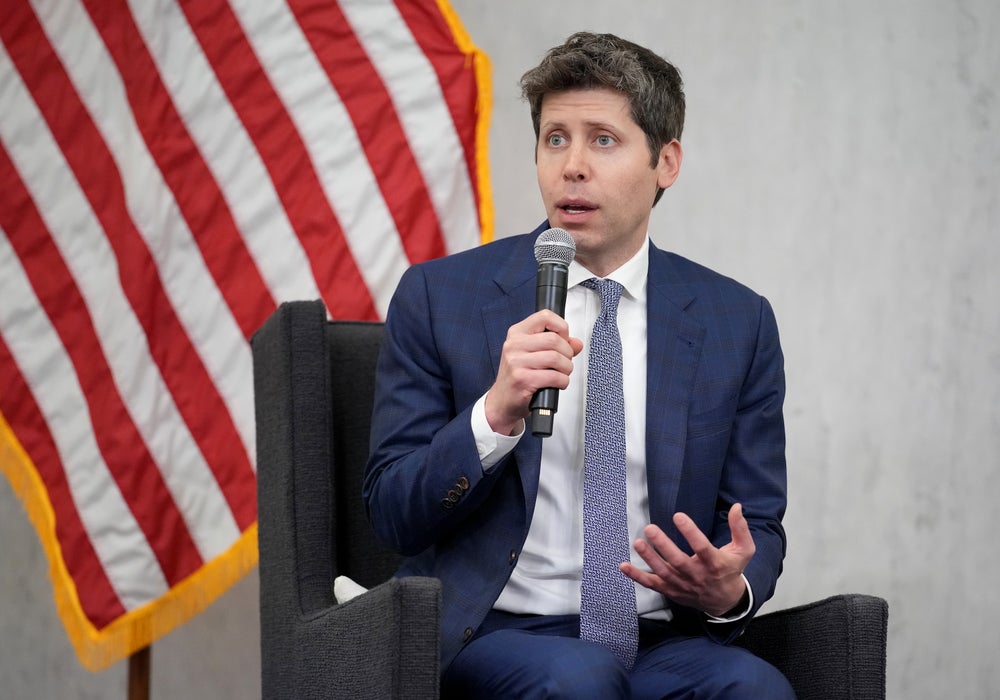
OpenAI CEO Sam Altman. Photo by Andrew Harnik/Getty Images

Meanwhile, Nvidia CEO Jensen Huang recently said that AI opens the doors to users (of all ages) by equalizing the playing field of technology, allowing anyone to create code with natural language prompts pushed through an AI code editor. He said that lets users create new products and services, and in turn creates more chances to generate revenue. Huang cautioned, though, that employees who don’t use AI will be replaced by those who can use the technology.

Nvidia, which is the most valuable company in the world by market cap, produces AI chips that power OpenAI’s ChatGPT.

ChatGPT was on track to reach 700 million weekly active users last week.

Join top CEOs, founders and operators at the Level Up conference to unlock strategies for scaling your business, boosting revenue and building sustainable success.

Related: The CEO of the World’s Most Valuable Company Says This Would Be His College Major in 2025

https://www.entrepreneur.com/business-news/sam-altman-worries-about-ais-impact-on-older-workers/495813


This 28-Year-Old’s Summer Sleepaway Camp for Adults Sold Out in 24 Hours. Here’s What the ‘Iconic’ Weekend Looks Like — And How Much It Costs.

Liv Schreiber, 28, was a recent college graduate working in New York City, building businesses and a social media following, when she noticed that a lot of content in her orbit centered on “keeping up with the Joneses” and summers spent with “slick-back buns” in the Hamptons. “I was like, You know, I really just wish I could jump in the lake and wear no makeup and go back to sleepaway camp,” Schreiber tells Entrepreneur.

Image Credit: Courtesy of Camp Social. Liv Schreiber.

Schreiber was well-positioned to bring her idea to life. In 2019, she launched Brand Caffeine, a digital marketing agency, and in 2022, she founded Hot and Social, a social community that hosts meet-up events where people in their 20s and 30s can make new friends.

Related: How to Cultivate Genuine Friendships in a Digital Age

The two-time founder already knew how to harness the power of branding and social media to forge in-real-life connections, and in May 2023, she was determined to apply that expertise to Camp Social. Schreiber’s first camp took place just a few months later, in August, with 150 women in attendance.

Image Credit: Courtesy of Camp Social

Since then, Camp Social has only grown in popularity. The upcoming camp, which cost $880 per ticket and will be held August 22-24, sold out in 24 hours. Camp Social has also expanded to offer two camps per year instead of one; the first fall weekend will be September 26-28.

“ I am firm in my belief that this is what everyone’s going to be doing in a few years.”

Schreiber has just one rule for Camp Social’s campers: Everyone comes solo and leaves as friends. “It’s a lunch table where everyone is welcome to sit,” she says.

Camp Social hosts women ages 21 and older (the oldest camper so far was 65) and bunks them by age. However, inter-generational friendships are also common, as campers meet new friends based on the activities they choose throughout the weekend, Schreiber says.

Image Credit: Courtesy of Camp Social

The cost of a ticket to Camp Social covers the weekend’s expenses, from the bus ride from New York City to the Pocononos — an “iconic” start during which people are “singing, dancing and meeting each other,” Schreiber says — to the extensive list of instructor-led activities, from boating to archery, yoga, candle-making and more, and branded goodie bags, which include a variety of merchandise.

Related: ‘They Gave Us All the Free Stuff’: A Look Inside Amazon’s Lavish Mexican Retreat for Influencers

“I  like to treat it like an influencer brand trip for the consumer,” Schreiber says. “ I am firm in my belief that this is what everyone’s going to be doing in a few years. I’ve been shouting into a black hole, trying to [get] brands to understand that influencers aren’t buying their products — consumers are.”

Schreiber stresses that Camp Social only features products that she really believes in and has turned down those that aren’t the right fit. Some of Camp Social’s sponsors include Dunkin’, fast-casual restaurant chain Dig Inn and nonalcoholic wine brand Fre.

Image Credit: Courtesy of Camp Social

Schreiber is always on the lookout for new offerings in service of what she calls “the most important” part of Camp Social: Facilitating community and new friendships. “We can offer everything and any brand in the world, but at the end of the day, it’s about the relationships,” Schreiber says.

Related: How to Build a Thriving Community That Will Skyrocket Your Business

“People need to know [that] connection is so important. Offline.”

“Community” is the new buzzword for many brands building a presence online — and Schreiber has mixed feelings about it. “It makes me both happy and sad because sometimes people go into it with the wrong intentions or the intention of creating something just to sell,” she says.

These days, it’s authenticity and storytelling that make people and brands stand out, according to Schreiber.

On her own social media accounts, Schreiber notices that the videos that perform the best are those in which she delves into the “why” behind her starting Camp Social — and the real-life connections formed. Several friends she met at Camp Social attended her recent wedding. One of them gave a speech; another signed the ketubah.

Image Credit: Courtesy of Camp Social

Related: 6 Ways Your Company Will Benefit From Better Community Involvement

In an era when many Americans struggle to cultivate meaningful relationships more than ever before — 21% of U.S. adults feel lonely, and 73% attribute it to technology, according to a recent report from Harvard Graduate School of Education — in-person connection remains Schreiber’s primary goal.

“There’s a huge brand story that we can tell here,” Schreiber says, “but the main thing that people need to know is that connection is so important. Offline. We need to utilize social media as a tool to be social and tackle the loneliness epidemic.”

This article is part of our ongoing Women Entrepreneur® series highlighting the stories, challenges and triumphs of running a business as a woman.

Ready to break through your revenue ceiling? Join us at Level Up, a conference for ambitious business leaders to unlock new growth opportunities.

Liv Schreiber, 28, was a recent college graduate working in New York City, building businesses and a social media following, when she noticed that a lot of content in her orbit centered on “keeping up with the Joneses” and summers spent with “slick-back buns” in the Hamptons. “I was like, You know, I really just wish I could jump in the lake and wear no makeup and go back to sleepaway camp,” Schreiber tells Entrepreneur.

Image Credit: Courtesy of Camp Social. Liv Schreiber.

Schreiber was well-positioned to bring her idea to life. In 2019, she launched Brand Caffeine, a digital marketing agency, and in 2022, she founded Hot and Social, a social community that hosts meet-up events where people in their 20s and 30s can make new friends.

The rest of this article is locked.

Join Entrepreneur+ today for access.

https://www.entrepreneur.com/starting-a-business/camp-social-inside-the-branded-weekend-getaway-for-adults/495755


An AI Startup Just Made an Unsolicited $34.5 Billion Bid for Chrome. Here’s Why a Sale Could Happen, Whether Google Wants It or Not.

Perplexity AI, an $18 billion startup whose AI-powered search engine links out to original sources, just made an unsolicited offer to buy Google’s Chrome browser for $34.5 billion, the Wall Street Journal was first to report.

According to the WSJ report, Perplexity said its offer to buy Chrome is “designed to satisfy an antitrust remedy in highest public interest by placing Chrome with a capable, independent operator.”

“Multiple large investment funds have agreed to finance the transaction in full,” Perplexity Chief Business Officer Dmitry Shevelenko said, per Bloomberg.

Related: Everyone Wants to Buy Google’s Chrome Browser — Including OpenAI, According to a Top ChatGPT Executive

Chrome could be valued anywhere between $20 to $50 billion according to analysts, but it isn’t exactly for sale. Google might not have a choice, though.

In August 2024, a federal judge ruled that Google illegally monopolized the online search and search ads markets, writing in a 286-page opinion that “Google is a monopolist, and it has acted as one to maintain its monopoly” through exclusive agreements.

One remedy suggested by the DOJ was for the tech giant to sell its Chrome browser. A judge is expected to decide by the end of August what Alphabet must do.

Google is appealing part of the rulings and has indicated they are not interested in selling Chrome. But that doesn’t mean there isn’t a slew of potential buyers.

In April, a judge asked ChatGPT’s Head of Product Nick Turley if OpenAI would try to buy Chrome if parent company Alphabet was forced to divest, and he said a definite yes.

Related: Firefox Would Like to Remind Everyone It Exists and ‘Isn’t Backed By a Billionaire’

“Yes, we would, as would many other parties,” Turley said in court, adding that ChatGPT and Chrome combined would give his company the chance to offer an “incredible experience” that’s “AI-first.”

Perplexity AI is based in San Francisco and was founded in 2022. The startup is preparing the wide release of its own browser, Comet, though the company said it wouldn’t make any “stealth modifications” to Chrome if the deal went through.

Perplexity’s formal bid also said it would “extend offers to a substantial portion of Chrome talent.”

At press time, Google Chrome has around 68% of the web browser market share (Safari is No. 2 with nearly 16%, Microsoft Edge has 5%, and Firefox has 2.5%).

Perplexity AI also submitted a bid of at least $50 billion to buy TikTok in January, per CNBC.

Join top CEOs, founders and operators at the Level Up conference to unlock strategies for scaling yourbusiness, boosting revenue and building sustainable success.

Related: A Big Tech CEO Just Quit to Be an Entrepreneur Again

Perplexity AI, an $18 billion startup whose AI-powered search engine links out to original sources, just made an unsolicited offer to buy Google’s Chrome browser for $34.5 billion, the Wall Street Journal was first to report.

According to the WSJ report, Perplexity said its offer to buy Chrome is “designed to satisfy an antitrust remedy in highest public interest by placing Chrome with a capable, independent operator.”

“Multiple large investment funds have agreed to finance the transaction in full,” Perplexity Chief Business Officer Dmitry Shevelenko said, per Bloomberg.

The rest of this article is locked.

Join Entrepreneur+ today for access.

https://www.entrepreneur.com/business-news/perplexity-ai-makes-34b-bid-for-google-chrome/495807


How to Understand and Extend Your Financial Runway — A Simple Guide for Small Business Owners

Opinions expressed by Entrepreneur contributors are their own.

Most small business owners are playing a game of financial chicken, and they don’t even realize it.

If you’re one of these business owners, you’re likely grinding through each month, covering expenses and hoping the next payment hits before the cash runs out. But without knowing exactly how long your current revenue and reserves will sustain you, you’re essentially flying blind. That’s where understanding your runway comes in.

Related: Spend Less Time Worrying About Your Company’s Runway — And More Time Rethinking Your Strategy. Here’s How.

What is “runway” in business?

Runway refers to how long your business can continue operating before it runs out of money, assuming no changes in revenue or expenses. It’s one of the most critical financial metrics for small business owners to understand, and yet very few track it regularly.

Think of it like this: If your checking account were a gas tank, your runway tells you how many miles you can go before stalling.

The simple formula for calculating runway

To calculate your runway, you need just two numbers: your cash reserves and your monthly burn. Simply put, your runway equals your cash reserves divided by your monthly cash burn.

If you aren’t sure what your cash reserves are, it’s just what is in your bank account. This includes whatever you have in your business checking account, savings and any short-term accessible funding sources.

Your cash burn is your average monthly expenses minus your average monthly revenue. For example, say you make $15,000 per month in your business and spend $25,000. Your burn is $10,000.

So, let’s take an example. Say that you have this $10,000 of monthly burn and you have $50,000 of cash in the bank. This means that if nothing changes (think: no growth, no cost cutting), you’ve got five months to either become profitable or raise more money.

If you are profitable already — congrats! In that case, you should have enough to extend your runway indefinitely as long as you keep an eye on your financials and pivot if that becomes necessary. Continuing to monitor your profit and loss statement each month will help you in case you do have a down month, if runway becomes a concern again.

Where most founders go wrong is assuming profitability is static. Just because you’re profitable today doesn’t mean you’ll stay that way if client churn increases, ad costs rise or your industry slows down. Runway isn’t just about surviving downturns. It’s also about having enough lead time to adapt to changes you didn’t anticipate.

Related: 3 Essential Steps for Startups to Keep Enough Cash in the Bank

Fixed vs. variable expenses

Understanding your expenses is just as important as understanding your revenue. Fixed expenses are those that don’t change month to month, regardless of your sales. Common examples include rent, salaries and software subscriptions.

Variable expenses are those that fluctuate with business activity, like contractor hours, cost of goods sold and shipping.

Fixed expenses are your biggest risk in a downturn. If revenue drops, you’re still locked into those commitments. That’s why high fixed costs can make your runway feel like it evaporates overnight.

On the other hand, variable expenses can offer flexibility. If sales slow, those expenses often decline in tandem. I’d recommend that at least 30% of your expenses stay variable, to give you flexibility in the case of a downturn.

This is also why many service-based businesses do better in uncertain economies — they can quickly adjust labor and project costs without dismantling their entire operation. If your business model is highly fixed, your job as CEO is to build in as much optionality as possible.

5 ways to extend your runway

If your current runway number feels a little too short for comfort, don’t panic. That just means it’s time to take action.

The fastest and often easiest way to extend your runway is to cut or renegotiate fixed costs. This could look like pausing subscriptions you’re not actively using, shifting team members from salaried roles to contractor-based or part-time ones, or negotiating a better lease or vendor contract. Every dollar you shave off fixed expenses is a dollar that stretches your available cash.

Another effective approach is to stabilize your revenue. Moving clients to a retainer model or incentivizing upfront payments (even if it’s with a small discount) can help reduce month-to-month revenue swings and improve cash flow. Recurring income not only helps you sleep better at night — it makes forecasting and planning dramatically easier.

You can also look at your accounts payable processes. Extending your payment windows with vendors, within reason, can give you more breathing room. If you typically pay invoices in 10 days, negotiating for 30-day terms can help you hold onto cash longer without disrupting relationships.

In some cases, it’s worth exploring a short-term capital solution. That might be a line of credit, a bridge loan or even early access to accounts receivable through invoice factoring. If you’re confident in your business’s direction but just need time to get there, having access to capital can keep momentum going without forcing desperate decisions.

Finally, focus on cash efficiency. If a part of your business consistently generates leads or revenue at a strong margin, double down on it. And if there’s something you’re doing that burns time and money without results, pause it.

Related: 5 Ways to Create Sustainable Funding and Get Your Business Out of the Hole

Why this matters more than ever

In a volatile economic climate, businesses that understand and protect their runway are the ones that survive and thrive. Growth is great, but cash is what keeps the lights on and gives you security that your business will be here tomorrow.

This kind of visibility gives you power. It lets you make decisions with confidence, whether that’s hiring, pivoting your offer or saying no to a client who isn’t a fit.

Runway is your financial reality check. The good thing is that once you know it, you can change it.

https://www.entrepreneur.com/money-finance/how-to-understand-and-extend-your-companys-financial-runway/495203


What’s Really Inside Your Supplements? This Founder Is Uncovering the Truth Behind a $180 Billion Industry

Opinions expressed by Entrepreneur contributors are their own.

I recently wrote about creatine and profiled Jeff Byers, co-founder of Momentous, for a reason: integrity matters. When it comes to what we put in our bodies, especially for entrepreneurs aiming to optimize energy, recovery and longevity, founders and consumers deserve transparency and truth.

And yet, the supplement industry is booming with very little of either.

We’re in the middle of a health optimization gold rush. Creatine gummies, NAD+ capsules, sleep pills and brain-boosting stacks are everywhere. Scroll Instagram, walk into Erewhon or search Amazon, and you’ll find thousands of options. The global supplement industry is growing fast and is expected to top $240 billion by 2028, yet many of these products do not contain what they claim to. You may be spending $30, $50 or $90 on a supplement and getting barely a trace of the active ingredient, or in some cases, nothing at all.

Unlike pharmaceuticals, supplements don’t require FDA approval before hitting the market. That creates a loophole where products can launch quickly, and claims, unless dangerously false, go largely unchecked. And it’s not just obscure or small brands. Some of the top-selling supplements on Amazon are underdelivering, misleading or worse.

That’s where Steve Martocci and SuppCo come in.

Martocci, best known for founding the music-tech platform Splice, is now on a mission to fix one of the most frustrating problems in wellness: a lack of transparency. SuppCo is a health tech startup that independently tests supplements and publishes public reports that give consumers one thing the industry often avoids: truth.

CEO and Co-Founder, Martocci, struggled with his health for most of his life, reaching nearly 300 pounds despite playing three sports and training consistently.

Martocci said to me, “Traditional medicine failed me. I remember being told my labs were on the ‘low end of normal’ and that nothing could be done. It was completely disheartening.”

After selling GroupMe to Skype, Martocci discovered functional medicine and began working with a doctor on a tailored supplement stack. He lost nearly 100 pounds over the next year and realized that even though supplements had become mainstream, there was no software actually to help people navigate this space.

The supplement industry is a $180 billion market, yet it’s filled with confusion, noise and a multitude of products that don’t deliver what they promise. With SuppCo, Martocci is on a mission to transform how people discover, manage and optimize their supplement routines.

Join top CEOs, founders and operators at the Level Up conference to unlock strategies for scaling your business, boosting revenue and building sustainable success.

I was introduced to SuppCo’s work through their recent Creatine Gummies Report. Creatine, which I personally take and have written about, is one of the most well-researched supplements for both brain and physical performance. But not all products are created equal. SuppCo tested five popular creatine gummy brands sold on Amazon. Only two passed. One contained less than 25% of the labeled amount.

SuppCo recently published a report on NAD+ supplements, a trending ingredient in the longevity and cellular energy space, which tested nine products and was even more revealing.

  • 4 passed (Double Wood, Rho Nutrition Liposomal, NatureBell and Thinbi), with Thinbi exceeding its claim at 103%.
  • 5 failed, including Maripolio, which showed 0% of its claimed NAD+.
  • Others tested at less than 3% of the listed amount on the label.

NAD+ was the perfect follow-up to the creatine testing series because it represents everything confusing about the supplement space right now. Martocci explained that NAD+ is one of the fastest-rising compounds in longevity and biohacking, endorsed by scientists and influencers, but it’s also one of the most confusing for consumers.

Martocci said, “You can supplement with NAD+ itself or its precursors like NR and NMN, and most consumers don’t understand the bioavailability differences between the three and that one of them is distinctly worse.”

When we see brands cutting corners on things we can measure, like certifications and testing transparency, they’re usually cutting corners on things we can’t see too, like what’s actually in the bottle. As NAD+ continues to trend for its role in cellular repair and longevity, the gap between marketing and reality becomes even more concerning.

Related: Why Top Entrepreneurs Are Swapping Beach Vacations for Longevity Retreats

If you’re a wellness founder, product integrity is not just a checkbox. It is the heartbeat of your brand. Jeff Byers’ company, Momentous, invests in clinical research and testing not because it is required, but because it is what builds lasting trust.

Byers told me, “That means showing the science, backing it up with testing, and being radically transparent with our consumers.”

The next generation of wellness brands will not win on hype. They’ll win on data. Consumers are becoming smarter and more demanding, and they want to see the data. SuppCo has already rated over 700 brands and 22,000+ products, and their TrustScore has become remarkably predictive of testing. Now, quality brands are reaching out not just to request a TrustScore, but to get feedback on how to improve their quality practices.

When choosing supplements, most people go wrong by treating supplements as if they were all the same. For example, they’ll buy the cheapest magnesium without realizing that magnesium oxide has terrible bioavailability compared to magnesium glycinate. Or they’ll choose a multivitamin based on how many vitamins are crammed into it, not whether those forms and doses actually work together.

Jenna Stangland, co-founder of A4 health and Dietitian for the Minnesota Timberwolves and Minnesota Wild, explains how important it is to ensure that a supplement is tested and validated, as most likely, the dose on the label may not match what is in the bottle and even worse, it could be contaminated.

Stangland personally takes NAD+ regularly to support her own energy and help her body adapt to stress and inflammation as she’s on airplanes and traveling with teams multiple times per week.

Having only tested the creatine and NAD+ categories, SuppCo is just getting started. The company plans to test every major supplement category where there’s confusion or questionable quality. This includes protein, magnesium, pre-workouts and nootropics — anywhere consumers are making decisions based on incomplete information, their aim is to bring transparency.

Related: Are Your Employees Stressed? You Need to Embrace Transparency.

A big milestone they hit recently is the launch of SuppCo Pro, a premium subscription that unlocks deep personalization features. They have received strong user response to their Personal Nutrient Plan, which creates tailored supplement recommendations based on a user’s specific goals, as well as their Product Optimizer, which suggests higher-quality, better-value alternatives to what a user is currently taking. This is where the real magic happens, as they can offer truly personalized guidance.

I personally appreciate how easy it is to understand their public reports. On the app, you can quickly see whether a product passed or failed, and why. They even launched a browser extension that flags whether the supplement you’re browsing has been independently tested. For those of us who care deeply about healthspan, recovery and long-term performance, this kind of transparency is a game-changer.

https://www.entrepreneur.com/living/whats-really-inside-your-supplements-this-founder-is/495487


Are You Using AI Effectively — or Are You Wasting Its Potential? Ask Yourself These 5 Questions to Find Out

Opinions expressed by Entrepreneur contributors are their own.

Every agency today brags about using AI. But few can show exactly how it’s fueling real growth or whether it’s helping you at all.

Is it running on autopilot, quietly optimizing campaigns while your team checks the metrics? Or is it being used to supercharge decision-making, surfacing insights, testing assumptions and driving sharper strategy?

Because the real differentiator isn’t which tools you use. It’s the mindset of the people behind them.

At AI Media Group, we’ve seen this firsthand. In one campaign, automation improved engagement immediately, but when we looked closer, we realized the system was optimizing for cheap impressions, not qualified leads. It wasn’t broken, it was just learning the wrong thing. It took human strategy to intervene and reset. That moment reframed how we approach AI: not as a shortcut, but as a strategic accelerator.

When used well, AI doesn’t replace your marketing team. It amplifies them.

AI has become the ultimate buzzword in marketing circles. But the reality is that many companies still see it as a “set-it-and-forget-it” solution rather than a dynamic growth engine. With marketing budgets under more scrutiny than ever, leaders need to ensure that AI isn’t just another shiny object but a true driver of performance, efficiency and revenue.

So how do you know if your team or your agency is using AI in a way that actually drives growth? Start with these five questions.

Related: I Teach AI and Entrepreneurship. Here’s How Entrepreneurs Can Use AI to Better Understand Their Target Customers.

Question 1: What are you predicting, and is it actually driving conversions?

Personalization used to mean changing someone’s first name in an email or serving ads based on basic behavior. That’s table stakes now.

AI enables predictive personalization, customizing content based on what users are likely to want next, not just what they’ve done. It’s about reading intent in real time, adjusting tone, timing and even emotional cues based on behavioral modeling.

For a national telecom client, we used predictive personalization to tailor messaging by local markets, drawing on live engagement signals. The result? Stronger leads, higher relevance and a 17% lift in conversion efficiency.

The key: Don’t just predict behaviors that are easy to measure; focus on those that actually lead to higher-value outcomes.

Question 2: Are you adapting journeys in real time or assuming a linear funnel?

The classic marketing funnel assumes customers move neatly from awareness to consideration to purchase. But today’s journeys are chaotic. People jump between devices, channels and decision points unpredictably.

AI helps marketers make sense of this complexity. It surfaces intent signals across platforms, identifies mid-funnel drop-offs and dynamically adjusts messaging or targeting in real time.

For a regional energy client, AI analysis quickly flagged that mobile users were dropping off at a landing page. While standard analytics might show this through bounce rates, AI surfaced it in real time, prioritized the issue automatically and provided recommended adjustments. By rapidly redesigning the mobile experience and refining our media strategy, we increased mobile conversions by 28% without increasing spend.

These insights transform customer journeys from guesswork into precision-guided experiences.

Question 3: What signal is AI detecting that your standard reports overlook?

Surface-level metrics can give you a false sense of security. Traffic may be steady. CTRs may look fine. But what those dashboards often miss is why performance is plateauing or why certain audiences underperform.

AI can detect subtle signals, changes in micro-segments, early creative fatigue or behavior patterns that typical dashboards smooth over or ignore entirely.

For one national campaign, our team used AI to analyze creative fatigue across audience segments. The topline data looked healthy, but deeper pattern recognition showed that one high-performing segment was being served a mismatched creative variant, leading to subtle but consistent underperformance. Once corrected, conversion rates jumped 15% purely by improving alignment, not budget.

These micro-adjustments can deliver macro impact.

Related: How AI Makes the Go-to-Market Process Faster — Plus the Best Ways to Use It

Question 4: How is AI helping create smarter (not just more) content?

Generative AI often gets the headlines, but some of its biggest impact is behind the scenes.

We use AI to identify trending topics, group ideas by intent cluster, optimize headlines and prioritize creative tests. Rather than replacing strategists or creatives, it helps them focus on high-value activities, move faster and avoid burnout.

In growth marketing, burnout is real. Churning out endless variations of content without a clear signal of what’s actually working can drain creative energy and budget. AI allows teams to narrow their focus to content that actually moves the needle, reducing noise and increasing impact.

The result? A more energized team that’s focused on performance over volume and a content engine that stays sharp and relevant.

Question 5: What did you learn, and how fast did you act on it?

At my company, we know that the best use of AI isn’t automation — it’s acceleration. It helps us run faster tests, adapt based on outcomes and pivot before the market shifts.

Speed of learning and speed of action are the ultimate competitive advantages in modern marketing. AI can give you more signals than you’ll ever need, but the true differentiator is having a team that’s willing (and able) to act decisively on those insights.

Brands that move quickly not only capture more immediate value but build a culture of experimentation and continuous improvement. That momentum compounds over time and becomes a powerful growth flywheel.

Related: Why Smart Entrepreneurs Let AI Do the Heavy Business Lifting

AI isn’t a strategy — it’s the engine that powers it

Growth doesn’t come from automation alone. It comes from relentless learning and the ability to turn insights into momentum, fast.

AI can’t replace human judgment. It can’t tell you which risks to take or when to pivot. But it can give you the signals and speed to make those calls with confidence.

You don’t need to be an engineer to lead in this new AI-powered marketing era. But you do need to demand more: sharper questions, clearer answers and faster action.

Start with these five questions and challenge your team or agency to turn AI from a buzzword into your business’s growth engine.

https://www.entrepreneur.com/growing-a-business/is-ai-truly-driving-your-growth-or-wasting-your-time/494379


‘You Liar’: Elon Musk and Sam Altman’s War of Words Continues as Musk Threatens Legal Action Against Apple

Elon Musk said his AI company, xAI, would be taking “legal action” against Apple in a post on X on Monday evening. Musk accused Apple of “playing politics” for not putting Grok in its “Must Have” section.

“Apple is behaving in a manner that makes it impossible for any AI company besides OpenAI to reach #1 in the App Store, which is an unequivocal antitrust violation,” Musk wrote. “xAI will take immediate legal action.”

Related: Elon Musk Warns Microsoft That Its Partner, OpenAI, Is About to Eat It Alive

Readers added community notes to Musk’s post, pointing out that other apps, including Perplexity and Deepseek, have reached No. 1. But OpenAI CEO Sam Altman responded on X with claims of his own — that he’s “heard” Musk manipulates his companies to “harm his competitors and people he doesn’t like.”

It’s the latest in the years-long, back-and-forth drama between the two tech CEOs. Apple has yet to publicly comment.

Altman then linked out to a 2023 report from Platformer, which accuses Musk of instructing engineers to boost his own reach and engagement. Musk has denied the report.

“I hope someone will get counter-discovery on this,” Altman wrote, “I and many others would love to know what’s been happening. But OpenAI will just stay focused on making great products.”

But that was not the end. At 5:26 a.m. ET, Musk responded and called Altman a liar: “You got 3M views on your bullshit post, you liar, far more than I’ve received on many of mine, despite me having 50 times your follower count!”

Related: Sam Altman Says Elon Musk Is ‘Clearly a Bully’ Who Likes to Get in Fights with Rivals

Last week, Musk and Altman traded jabs again, this time after Musk said OpenAI was “going to eat” its partner, Microsoft, alive.

When asked about Musk’s post during an appearance on CNBC’s “Squawk Box”, Altman responded with a short: “You know, I don’t think about him that much.”

Join top CEOs, founders and operators at the Level Up conference to unlock strategies for scaling yourbusiness, boosting revenue and building sustainable success.

Elon Musk said his AI company, xAI, would be taking “legal action” against Apple in a post on X on Monday evening. Musk accused Apple of “playing politics” for not putting Grok in its “Must Have” section.

“Apple is behaving in a manner that makes it impossible for any AI company besides OpenAI to reach #1 in the App Store, which is an unequivocal antitrust violation,” Musk wrote. “xAI will take immediate legal action.”

Related: Elon Musk Warns Microsoft That Its Partner, OpenAI, Is About to Eat It Alive

The rest of this article is locked.

Join Entrepreneur+ today for access.

https://www.entrepreneur.com/business-news/elon-musk-threatens-to-sue-apple-sam-altman-responds/495795