These 4 AI Tools Saved Me 20+ Hours a Week—Here’s How to Use Them

Opinions expressed by Entrepreneur contributors are their own.

Most entrepreneurs are still using AI to save time—but the smartest ones are using it to make money, scale their business, and replace entire departments with digital agents. This isn’t about ChatGPT or surface-level hacks. It’s about using AI Agents—your 24/7 Phantom Workforce—to run key parts of your business while you sleep. In this video, I’ll show you the 4 most powerful AI agents I use to save 20+ hours per week, boost revenue, and scale operations without hiring a single employee.

What You’ll Learn:

  • Revenue Agent: Turn AI into your best-performing sales rep. Discover how tools like Zapier’s Outreach Agent and Salesforce Sales AI can automate lead research, qualification, and follow-ups—so you never miss a sale again.

  • AI Executive Assistant: Inbox overloaded? Calendar a mess? Learn how to reclaim your time with tools like Motion, Reclaim, and Superhuman—AI agents that handle scheduling, approvals, and admin chaos so you can focus on growth.

  • Workflow Agent: Sick of explaining the same SOPs to every new VA? Use tools like Scribehow to auto-document your processes and delegate work in minutes—not hours. Perfect for solopreneurs scaling without the stress.

  • Pulse Agent: This is your always-on marketing analyst. I’ll show you how to use tools like Google AI Studio to analyze, test, and improve your content strategy—before you waste time launching a flop.

These are the exact tools I use to automate key parts of my business and free up my time—and I’ll walk you through each one, step by step.

Download the free ‘AI Success Kit’ (limited time only). And you’ll also get a free chapter from Ben’s brand new book, ‘The Wolf is at The Door – How to Survive and Thrive in an AI-Driven World.’

https://www.entrepreneur.com/science-technology/these-4-ai-tools-saved-me-20-hours-a-week-heres-how-to/490964


Here’s How Much You Need to Make Per Year to Buy a Typical Home in the U.S., According to a New Report

Aspiring homeowners need to earn at least $114,000 per year to buy a home listed at the national median price of $431,250, according to a study released on Thursday by Realtor.com.

That income estimate assumes a 20% down payment, a 30-year fixed mortgage, and adherence to the 30% rule, which advises that homeowners spend a maximum of 30% of their gross income on housing.

An income of $114,000 means that homeowners would earn about $9,500 per month before taxes — enough to pay the mortgage, property taxes, and insurance on their home.

However, most American households make less than $114,000. The latest U.S. Census Bureau data shows that the median household income in 2023 was $80,610, up from $77,540 in 2022 and nearly $34,000 higher than $114,000.

Related: House Hunting? $300,000 Buys Over 2,000 Square Feet in Just 1 State — Here’s What $500,000 Gets You Across the U.S.

Realtor.com notes that the national household income needed to buy a median-priced home in spring 2019 was $67,000, or $47,000 less than the current estimate. In just six years, the income required to afford a median home has increased by 70%.

A Bankrate report from March arrived at comparable figures. The report stated that homebuyers needed annual household earnings of $116,96 to afford a median-priced home, more than the $78,236 required in early 2020.

“Between elevated mortgage rates and the rise of home prices nationally to a record level, many aspiring homebuyers feel like owning a home is out of reach,” Mark Hamrick, Bankrate senior economic analyst, stated in the report.

Mortgage rates for 30-year fixed-rate mortgages are 6.76% as of Thursday, up from the below 3% rates experienced in 2020 and 2021.

Related: This Is How Much You Need to Earn to Buy a House in the U.S., According to a New Report

Even if mortgage rates and home prices are higher now than they were during the pandemic, buyers may still be enticed to buy because of a high supply of homes. Realtor.com notes that the number of homes listed for sale increased by 30.6% in April compared to a year ago. In April, there were nearly a million homes on the market, or 959,251 listings.

Daryl Fairweather, Redfin’s chief economist, stated in a Redfin blog post earlier this week that the greater number of homes on the market could give buyers “an upper hand in negotiation.”

“Now is a good time to buy, if you can afford it,” Fairweather noted.

https://www.entrepreneur.com/business-news/buying-a-home-heres-how-much-money-you-need-to-earn/491040


Jeff Bezos Is Selling Billions Worth of Amazon Stock, According to a New Filing

According to a Friday financial filing, Amazon founder Jeff Bezos is selling up to 25 million shares of Amazon stock over the next 13 months.

The shares are worth about $4.8 billion at the current value.

Related: Jeff Bezos Still Uses One of the Famous Amazon ‘Door Desks’ From the ’90s — Here’s Why

Last year, Bezos sold $13.5 billion worth of Amazon shares, which CNBC notes was the first time he sold company stock since 2021.

Bezos started Amazon in 1994 and is the company’s top shareholder. He stepped down as CEO in 2021.

It’s unclear why Bezos is selling now, but uncertainty over tariffs and the market has other billionaires hoarding cash. Plus, the Blue Origin founder’s lavish wedding to fiancée Lauren Sánchez is reportedly taking place in Venice, Italy, next month, though the couple has denied reports that the event “of the century” could cost more than half a billion dollars.

Related: Jeff Bezos-Backed Tesla Rival Launches an ‘Affordable’ and Customizable EV Truck. Here’s What It Looks Like.

Bezos is currently the No. 2 richest person in the world with a net worth of $212 billion, according to Bloomberg’s Billionaire Index. The majority of his wealth comes from his Amazon shares.

Amazon is the No. 4 biggest company in the world as of press time, with a market cap of just over $2 trillion.

https://www.entrepreneur.com/business-news/jeff-bezos-is-selling-billions-worth-of-amazon-stock/491038


6 Small Business Ideas You Can Start With Just $1,000

Opinions expressed by Entrepreneur contributors are their own.

Starting a business doesn’t have to mean raising big capital or inventing something new. Sometimes, the best opportunities are right in front of us — like helping other businesses show up online where it really counts.

In this article, I’ll give you six ideas to start a small business for under $1,000.

1. Web design service

In today’s world, almost every business needs a website — whether it’s a local hairdresser or a large company. This opens up a great opportunity to start a web design business with very little money. With just $1,000, you can begin by offering simple websites using templates or more complex, custom-built sites.

The demand for websites is huge, and finding clients is fairly easy since businesses of all sizes need an online presence. In fact, 62% of companies say that more than half of their revenue comes from their website, showing just how important it is to have a good one. Once you’ve created a website, there are also ongoing opportunities for work, like website maintenance, marketing and admin tasks, ensuring you have a steady flow of income and long-term clients.

Related: You Don’t Need Thousands to Turn Your Business Idea Into Reality — Here’s How I Did It on a College-Kid Budget

2. Media buying company

Media buying is a vital service for businesses looking to effectively reach their target audience across multiple platforms. According to Impression Media, the global media buying services market stood at $69 billion in 2022 and is expected to grow at a CAGR of 6.2%, reaching $125.9 billion by 2032.

This significant growth in the market presents a great opportunity for entrepreneurs to start their own media buying service. By helping businesses plan, execute and optimize their advertising strategies, you can offer valuable support in maximizing ad spend and ensuring campaigns are reaching the right audience on the right platforms.

3. VoIP reseller

Instead of building the entire infrastructure yourself, you can become a VoIP reseller. This means you will partner with an established VoIP provider, selling their services under your brand while handling customer acquisition, support and account management. You can start this business with minimal upfront costs — typically under $1,000. According to VoIP Tech, as of 2023, there are over three billion VoIP users globally, with businesses making up a significant portion of that figure.

With VoIP adoption expected to grow, more companies are realizing the efficiency and cost-saving potential of this technology. This presents a great opportunity for resellers to tap into the growing demand, offering businesses affordable, scalable communication solutions without the need for significant infrastructure investment.

Related: Low-Cost Startup Ideas for Aspiring Entrepreneurs

4. Very niche-specific clothing brand

Create an online clothing brand that offers designer clothes, but with a very niche and specific focus, solving a real problem. One idea for this could be creating a clothing brand for kids designed to help them sleep better. Sleep is a major issue for many children, and it’s important because they need significantly more sleep than adults. According to The Sleepy Sloth, toddlers need 11 to 14 hours, preschool-aged children need 10 to 13 hours, and elementary school-aged children should get 9 to 12 hours of sleep each day. A clothing line made with materials that enhance comfort, support better sleep and are gentle on children’s skin could help address this problem and meet a growing demand for sleep-related products.

5. Moving service that generates leads

Create a moving service by building a highly optimized website that generates leads through SEO and targeted marketing. Partner with local moving companies that have trucks or buses but lack an online presence. You act as the intermediary, driving leads to them and taking a commission for each job.

Local moving companies charge by the hour, with rates ranging from $65 up to $250 per hour, according to Storefriendly. This model allows you to start with under $1,000, focusing on online marketing and logistics. As you grow and get more leads, reinvest in buying your own vehicle and hiring a team, transitioning into a full moving company.

6. SMS marketing service

Create a bulk SMS marketing service that helps businesses reach customers directly through text messaging, a method that’s still highly effective and will remain relevant for years to come. SMS messages stand out because they have a much higher engagement rate than emails, with less spam to compete with. According to Straight Text, 75% of consumers prefer to receive promotional content via SMS over other marketing methods.

You can start by using SMS platforms like Twilio or EZ Texting (costing around $25-$50/month) and offer your service to local businesses that could benefit from direct communication, like retailers or real estate agents. Your initial costs will cover platform fees, dedicated business phone numbers and marketing (around $300 for ads and promotion). With an investment of under $1,000, you can set up and start offering a valuable, results-driven service that will grow as you gain more clients.

Related: 3 Reasons No Money Is No Barrier to Starting Your Business

Plenty of people talk about starting a business. Very few actually do. If you’re ready to move, even $1,000 is enough to get going — and you’ll be ahead of most just by starting.

If this article gave you something to think about, feel free to share it with a friend who’s been considering starting a business. What’s holding you back from starting your own?

https://www.entrepreneur.com/starting-a-business/6-small-business-ideas-you-can-start-with-just-1000/490453


‘Welcome Surprise’: More Jobs Were Added in April Than Expected, According to New Data

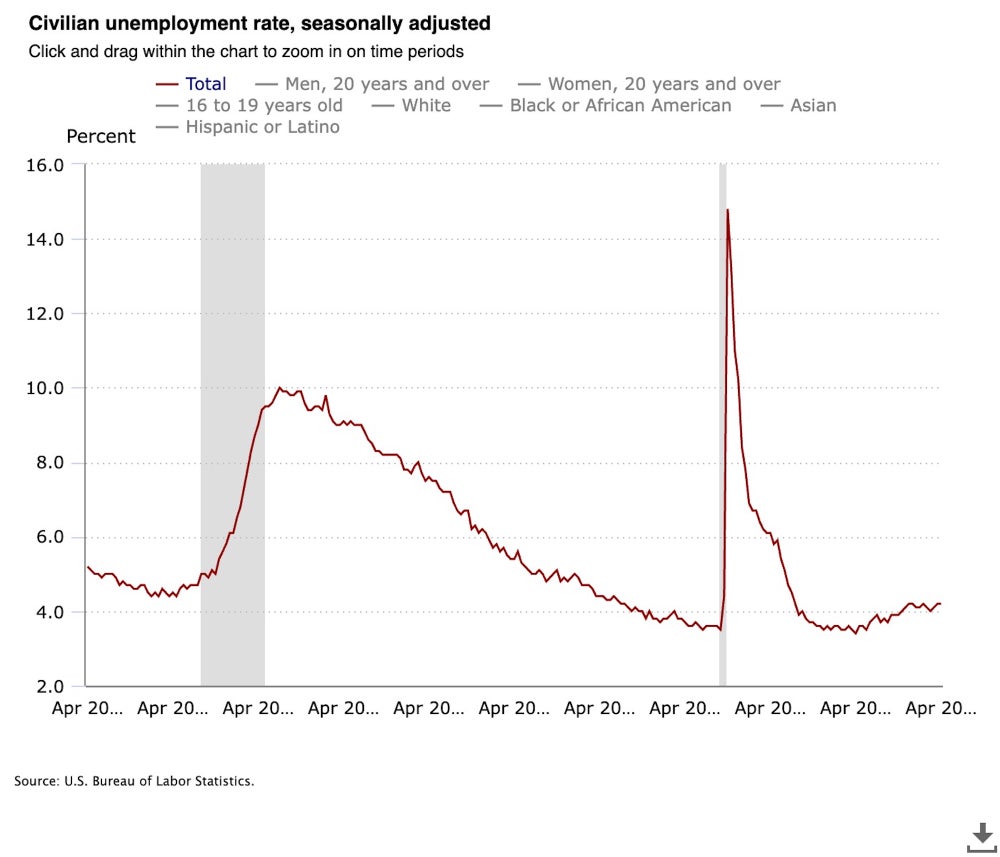
The latest report from the U.S. Bureau of Labor Statistics indicates nonfarm payrolls increased by 177,000 for the month, seasonally adjusted, above the Dow Jones estimate for 133,000. The unemployment rate stayed at 4.2%, as expected. The report notes that health care added 51,000 jobs, and transportation and warehousing, financial activities, and social assistance also trended upward, but federal government employment declined.

Employment in February and March was revised 58,000 lower than originally reported.

“Today’s report is a welcome surprise, showing a resilient labor market where employers continue to grow their workforce despite prevailing economic uncertainties,” Ger Doyle, U.S. Country Manager at ManpowerGroup, told Entrepreneur. “However, there are still cracks in the foundation that highlight signs of strain in the labor market.”

Doyle said that his company’s real-time data shows job openings down 11% year-over-year, but the labor market is not in crisis—it’s at a crossroads.

For example, Doyle says that employers are “no longer aggressively expanding” their workforce numbers, and fewer workers are leaving their jobs, while “those who do are finding it challenging to re-enter the job market.”

Will the Fed cut rates?

Elyse Ausenbaugh, head of investment strategy at JPMorgan Wealth Management, told Entrepreneur in an email that the “broad labor market remained on solid footing,” while noting that April may be “the last month when we didn’t see the aggregate impact of trade war 2.0, DOGE job cuts, and tight immigration policy.”

Ausenbaugh says the latest report is unlikely “to elicit a move from the Fed next week,” meaning a rate cut is not expected at the next meeting.

The Fed will continue its “patient, data-dependent approach,” Ausenbaugh says.

The next Federal Open Market Committee (FOMC) meeting is May 6-7.

https://www.entrepreneur.com/business-news/more-jobs-were-added-in-april-than-expected-report/491026


Here’s How Much a Typical Nvidia Employee Makes in a Year

Nvidia CEO Jensen Huang may be a billionaire because of his 3.4% stake in Nvidia, but he only recently got a raise — after making the same salary for the past decade.

The 62-year-old chief executive now makes 166 times more in overall compensation than the median Nvidia employee.

Huang received a salary just shy of $1 million, around $996,800, each year from fiscal year 2014 to 2024. In the fiscal year 2025 ending January 26, 2025, Huang’s base salary rose 50% to $1.5 million, according to a new proxy filing with the Securities and Exchange Commission on Thursday.

Nvidia’s compensation committee noted in the document that this was “Huang’s first base salary increase in 10 years” and that the move “was appropriate” considering the base salary for executives at comparable companies. For example, AMD CEO Lisa Su made a base salary of $1.26 million effective July 2024.

Related: ‘I Feel More Empowered’: Nvidia’s CEO Uses an AI Tutor to Learn New Topics. Here’s Why He Says You Should Too.

Huang’s total compensation for the fiscal year 2025 was $49.9 million. This figure includes the $6 million Huang received as part of a non-equity incentive plan, $38.8 million in stock awards, and $3.5 million for residential security, driver services, security monitoring, and car expenses.

The filing noted that the median Nvidia employee made $301,233 in fiscal year 2025, for a CEO to median employee pay ratio of 166:1.

Another SEC filing submitted last week by Google’s parent company, Alphabet, shows that the typical Google employee makes a comparable amount, with a median salary of $331,894 in 2024. Google CEO Sundar Pichai makes 32 times more than a mid-level employee at the company, with an annual compensation of $10.7 million last year.

Nvidia CEO Jensen Huang. Photo by Kevin Dietsch/Getty Images

Huang’s overall compensation has been steadily rising, even if his base salary remained stagnant for a decade. He made $34.2 million in fiscal year 2024 and $21.4 million in fiscal year 2023.

Related: AI Agents Can Help Businesses Be ’10 Times More Productive,’ According to a Nvidia VP. Here’s What They Are and How Much They Cost.

Huang is the 17th richest person in the world, with a net worth of $97.9 billion, according to the Bloomberg Billionaires Index. The bulk of Huang’s fortune derives from his Nvidia stake, which equaled $96 billion at the time of writing. The remaining $1.9 billion of his net worth is in cash.

Nvidia has become a growing AI giant after capturing 70% to 95% of the market share for AI chips. It counts Meta and Microsoft among its top customers. Nvidia stock has risen over 1,500% in the past five years and 33% in the past year.

https://www.entrepreneur.com/business-news/how-much-do-nvidia-employees-make-median-salary-revealed/491033


5 Key Leadership Principles That Drive Real Results

Opinions expressed by Entrepreneur contributors are their own.

When you read the word “leader,” you might think of the movie Gladiator, where Russell Crowe leads his people to battle to defeat the barbarians, and the army follows him without question. Or you may think about the late Queen Elizabeth II of the United Kingdom, who was revered by her people, without ruling over them. Or perhaps you think about a coach of a high school soccer team who comes up with plays, shows both soft and tough love to get their team to take on that challenge of the championship, concluding with that impressive “You’ve got this!” speech.

You can read countless books on leadership and ways to effectively exercise leadership, but I am going to share some key concepts that I have employed, which I believe are fundamentally the reason why a great leader can drive a collective to an outcome that could otherwise never be achieved.

Concepts that I won’t be highlighting are being authoritative, making all the decisions, demanding loyalty or giving false hope or magical speeches of greatness.

In fact, these principles are quite the opposite.

Related: 7 Timeless Principles That Will Help You Become a Better Leader

Being present

The Japanese have a slightly more sophisticated word called “Gemba” or “Go see,” which always resonated with me and has been at the heart of my actions in leadership.

Be present. Show your team that you are in it with them, and when you see or hear something that doesn’t seem quite right or is preventing the team or company from moving in the right direction, go and actually take a look at what is going on.

As a biotech leader, I am going to use a very specific example of this concept at one of my startups. The company I worked with was doing research and development using micro-organisms, and working with these organisms required the scientists to be diligent in their ways of working, so that the samples that they were working with remained pure and free of any contamination.

The laboratory started to experience a ton of contaminations, and the progress was stalling. The staff and team were pulling their hair out as to what was happening. Some questions were asked, but the team was stuck. So, I asked the lab manager, “Hey, could I walk around with you in the lab and let’s talk about what you are seeing and show me the process?”

For a second, the manager was hesitant, but then came a sigh of relief. We started walking around and I gently asked questions, listening and taking in what they were saying. And then I saw it … the cleaning solution they had been using had not been allowed the proper time to work, and the staff had never been trained on this particular solution, as it was new. I asked the lab manager what they thought we should do, and immediately, they wanted to implement training and get folks up to speed on this.

They went back to their desk and started the next steps.

Notice what happened here. Did I tell them what to do? Did I ask them how this could have happened and how they planned to fix it? No — I was just present and saw what was going on for myself.

Manage the task, not the person

Very rarely is a person not right for the job. Ninety-nine percent of the time, it is their readiness level in performing a specific task. This is an incredible concept, which, when executed well, can transform a person’s work output. It’s also important to know that this is an ever-dynamic process. There are four categories of task readiness.

Level 1 is if the person is unable and unwilling to do the task.

Level 2 is if the person is unable but willing to do the task.

Level 3 is the person being able but unwilling to do the task — the most difficult to manage.

Level 4 is the person being able and willing to do the task.

For Level 1, it’s important to know that the person doesn’t actually know how to do this thing that you want, and you can’t just “let them figure it out” because they likely don’t know where to start. So, this is where you actually spend some time guiding, removing their fear and being specific about each step to get the task done.

For Level 2, usually the outcome is you not getting what you want because the person is like “Yup, I’ve got this” when they really don’t, so it’s important to really make sure with some small probes as to how they might go about doing the first couple of steps of the task. If they say “I’ll figure it out,” then you know you need to provide more guidance.

Level 3 is a fun beast to tackle. The person actually knows HOW to do the task, they just DON’T WANT to do it. Are they too busy with other things? Are they holding a grudge because of their workload? Are they just fed up about something else, and you need to figure out what’s going on? This is where a good 1:1 chat can help (or maybe several of them).

For Level 4, it’s important not to micromanage this task completion — let the person get on with it and deliver, and you will be super pleased with the outcome.

Related: 8 Must-Have Leadership Qualities for Workplace Success

Be your authentic self and do the right thing

Fake it until you make it does not apply. Don’t pretend to be someone you aren’t. Every time I have been told to “do it this way” by an investor or board member or “you need to be less like this…,” it just doesn’t work out for me, usually because their request is to create a fundamental shift in my personality that is not genuine to me, not actually to help me achieve the outcome they are looking for.

Stay true to your values. Operate with integrity. Don’t lie, steal or cheat to get ahead. We all have a fundamental compass inside of us where we know right from wrong. Just do the right thing. It seems simple, but honestly, you would be surprised how many people in this world think that getting ahead comes at all costs.

Really care about your people

Unless you are operating a business fully run by AI agents, you have people doing the work to get to the outcome. Work to make sure your people feel respected, heard, mentored, appreciated and satisfied with their work.

This is hard.

You don’t have to bend over backwards to do this, but “throwing money at the problem” isn’t always the answer. If you have a small organization, this can be a more personal encounter. For larger organizations, leverage your managers. Everyone’s motivation is different, so a blanket approach won’t work. I have learned that there are quality basic areas where recognition motivates staff.

Verbal recognition: These folks like to hear “good job” and in front of others sometimes.

Support: These folks want to do a task with you or run by their progress with you, so they feel they are getting the mentorship they might need.

Development: Learning new tasks or cross-training helps some folks not feel stale. This is particularly important for more repetitive task workers. Also, external training opportunities or general workplace training can be helpful, such as how to work with co-workers.

Money: Yes, some people are primarily motivated by money — and a bonus, even a spot bonus, helps them feel appreciated.

Quality time: Some folks need structure or may just want to sit with you or have some water-cooler talk. They feel noticed when you ask about their family or that upcoming trip. Usually, these folks are looking for one of the other recognition elements as well, but this is actually their top one.

Related: 3 Principles of People-First Leadership

Take care of yourself, too

Listen, pulling all-nighters and eating McDonald’s for every meal might seem bold and a “statement of commitment” to your team, but in fact, it usually does the exact opposite in terms of motivation. I’ve found that making time with my family or for my workouts helps people see that I am human, too. This isn’t about work-life balance per se, but more about leading by example to demonstrate the things that matter most of the time. Those all-nighters certainly can and do happen, but it shouldn’t be a way of life.

Being a leader is complex. It is not simply just about the strategy, vision and mission, but more importantly, how you execute each one within a business.

https://www.entrepreneur.com/leadership/5-key-leadership-principles-that-drive-real-results/490082


How to Build a Team That Thinks and Executes Like a Founder

Opinions expressed by Entrepreneur contributors are their own.

Building a successful and thriving business is every entrepreneur’s dream. In the beginning stages, the business owner pours countless hours and sleepless nights into their venture. Before they know it, their small operation requires the support of an entire team. At this stage, the entrepreneur must shift their focus from being hands-on with every task to delegating responsibilities to others to share the load.

Delegation is not easy for most business owners. They often struggle with letting go and assume that others will fail to execute work to their standards. This is a valid concern. After all, employees don’t typically bring the same level of passion to their work as the company founder. The reason that delegation often ends in disaster is that most people think of delegation as simply assigning responsibility for tasks to employees. Instead, it’s critical for the business owner to learn how to delegate in a way that empowers their team to think and execute work like a business owner.

Related: 3 Steps That Will Empower Your Employees to Act Like CEOs

1. Transparent communication and vision sharing

As a business owner, you are likely driven to success by underlying goals, dreams and aspirations for the business. As a leader, it’s your responsibility to help the team understand and embrace your shared vision. If your team has a deep understanding of what you are trying to accomplish, you can ensure that everyone is rowing in the same direction.

It isn’t enough to simply share your vision and goals. To really get the team engaged, it’s critical that they understand the underlying “why” behind your goals and decisions. One of the best ways to do this is by being as transparent as possible, such as sharing financial data and other key business metrics. This information can help the team understand the bigger picture and connect how their individual roles contribute to the overall success of the company.

2. Empower the team to take ownership and make decisions

Many business owners stand in their own way when it comes to empowering their teams to think and execute like they do. It’s easy for entrepreneurs to micromanage and want to be involved in every minor decision. The challenge is that this encourages a culture of simply executing tasks rather than empowering the team to take meaningful action.

First, stop assigning tasks to your team. Instead, give team members ownership over entire end-to-end processes. This allows them to take full responsibility for the success of this process and help you hold the team accountable for executing it successfully. The best way to do this is by focusing on outcome-based delegation. This provides flexibility and autonomy for the team to figure out the best way to achieve the goal.

As a business owner, you don’t want the team coming to you for every little decision. Providing the freedom to make decisions on their own can streamline the process and shift responsibility and ownership to the team. Obviously, you still want to be involved in major decisions, so it’s important to set guardrails for the team to follow. For example, you might allow your managers to make financial decisions without your approval as long as they fall under a certain threshold.

Finally, you’ll want to address issues with “reverse delegation.” This happens when the team is struggling to complete a task, which then ends up being delegated upward to the manager or owner to handle. To eliminate this issue, encourage team members to recommend solutions when they are unsure of which way to proceed. This puts the ownership back on them to try and solve the problem themselves before seeking help.

Related: How to Master the Art of Delegation and Overcome the Urge to Micromanage

3. Provide incentives for the team

Let’s face it, business owners are often more motivated to help the business succeed because there is some form of reward or incentive that comes with success. Providing a paycheck likely isn’t enough incentive for your team to work with the same level of engagement and passion as a business owner. Offering incentives such as bonuses or profit sharing is a great way to tie an individual’s motivation to the company’s goals.

Keep in mind that these don’t always have to be financial incentives. For example, you could offer flexible work hours, extra vacation days, professional development opportunities and increased responsibility or autonomy as a way to reward team members for helping to achieve major company goals. It’s your responsibility to find out what motivates the team to operate at their very best.

4. Create a feedback loop

Feedback is an incredibly important part of delegation. Oftentimes, successful delegation is an iterative process. In many cases, a bad deliverable is a result of miscommunication, unclear direction or not having access to the right resources. The challenge is that many business owners give up when delegation doesn’t work the way they hoped the first time. Instead, create a process that allows you to provide feedback to the team on the results. This feedback can help them better understand your underlying thought processes and clarify expectations for future delegated responsibilities.

Related: Empowering Your People Is the Best Decision You Can Make. Here’s Why.

Delegation can be an extremely difficult process for business owners. It’s a skill that often requires practice and patience. A great way for business owners to strengthen their delegation skills is by working with a business coach. They can help guide you through the process and understand the best ways to strategically delegate responsibilities to maximize your effectiveness as a leader.

https://www.entrepreneur.com/leadership/how-to-build-a-team-that-thinks-and-executes-like-a-founder/490274


How the CEO of This Iconic Pizza Brand Is Building on 50 Years of Deep-Dish Dominance and Fueling Sustainable Growth

Opinions expressed by Entrepreneur contributors are their own.

Sitting down with Nick Scarpino, the CEO of Giordano’s, for the 50th episode of The CEO Series felt fitting — especially as the legendary Chicago pizza brand celebrates its own 50th anniversary. Nick’s story stood out immediately. Formerly the CMO at Portillo’s, another iconic brand, Nick took an unconventional path to the CEO seat, a reminder that leadership journeys are rarely linear. Throughout our conversation, it was clear that his transition from marketing executive to CEO was rooted in a consistent focus on the guest experience and a deep commitment to team development.

Related: The CEO of Thomson Reuters Is Betting Big on AI-Driven Innovation. Here’s What Every Leader Can Learn From His Approach.

One of the key takeaways from the interview was Nick’s emphasis on communication. He shared that, as CEO, every word carries greater weight — and misinterpretations can ripple quickly through a large organization. For aspiring leaders, this is an actionable reminder: Communication isn’t just about talking clearly; it’s about ensuring your message is truly heard and understood.

Another major insight was Nick’s perspective on growth. While Giordano’s plans to expand carefully into key markets like Washington, D.C. and Mall of America, Nick stressed that growth must be steady and sustainable. Scaling too quickly can erode quality, which is a death sentence for a beloved brand. In a time when rapid expansion is often glorified, his measured approach serves as an important lesson: Smart scaling beats fast scaling, especially when brand loyalty and quality are at stake.

Financial discipline was also front and center. Nick was candid about the challenges inflation and fluctuating tariffs pose to Giordano’s. Yet rather than compromising product quality to manage costs, the company leans into providing value — ensuring that even as prices rise, customers feel they are getting their money’s worth. Leaders across industries can take note: In uncertain economic times, protecting product integrity builds long-term trust.

Related: A Look Inside the Company That Is Making $500 Million a Year Serving Italian Beef Sandwiches Made Famous by ‘The Bear’

What struck me most about Nick, though, was his authentic commitment to servant leadership. When asked about his legacy, he didn’t mention personal accolades or bottom-line achievements. Instead, he spoke about creating an environment where team members could grow personally and professionally. For any executive, this mindset — prioritizing the development and well-being of your people — is not just admirable; it’s increasingly essential for building resilient organizations today.

https://www.entrepreneur.com/leadership/how-giordanos-ceo-is-leading-the-iconic-pizza-brand-forward/490745


One of Microsoft’s Most Popular Products Is About to Skyrocket in Price

Microsoft announced price hikes on Thursday for its Xbox video game consoles, controllers, and games in the U.S. The tech giant says the changes, which entail price increases as high as $130, are due to “market conditions” and greater development costs.

As of Thursday, Microsoft’s cheapest Xbox console, the Xbox Series S, costs $379.99 in the U.S., an increase of $80 from its previous price of $299.99. The Xbox Series X is $100 more expensive, going for $599.99 instead of $499.99. Meanwhile, a premium Xbox Series X with 2 TB of storage is now $729.99, up $130 or 21%.

Starting this holiday season, new games will cost $79.99 instead of the $70 Microsoft set in 2023. The special edition Xbox Wireless Controller also increased in price by around $10, going from $69.99 to $79.99.

Related: Google’s AI Is Getting Really Good at Minecraft — Without Being Trained on the Game

Microsoft stated on a support page that it made the pricing changes “with careful consideration given market conditions and the rising cost of development.” Xbox Game Pass, Microsoft’s subscription service for hundreds of Xbox games, will remain $9.99 to $19.99 per month.

Xbox Series S (white) and Xbox Series X (black). Photo by JUNG YEON-JE/AFP via Getty Images

Microsoft competitors Nintendo and Sony are also raising prices. In April, Nintendo announced that its new Switch 2 console was priced at $449.99. In comparison, the original Switch cost $300 when it launched in 2017.

Sony also said in April that it is raising prices for its PlayStation 5 console by 11% in Europe, Britain, Australia, and New Zealand due to inflation and varying exchange rates. The console now costs around $569 in Europe and Britain, but still costs $499.99 in the U.S.

Video game development costs are substantial. Microsoft acquired gaming company Activision Blizzard in 2023 for $68.7 billion. Patrick Kelly, Activision’s head of creative, has since revealed that three recent Call of Duty games cost between $450 million and $700 million to make (each), the highest development costs ever disclosed by a video game developer.

Though games may cost more to create, they are still a lucrative part of Microsoft’s business. Microsoft’s latest earnings report, released earlier this week, showed that revenue in its More Personal Computing unit, which includes gaming revenue, increased by 6% to $13.37 billion for the quarter ending March 31.

Microsoft CEO Satya Nadella told investors on an earnings call on Wednesday that Microsoft Game Pass revenue increased 45% year-over-year and that Xbox content and services grew 8% year-over-year, marking the best quarter yet in Xbox gaming history.

Related: Hasbro’s CEO Saw a ‘Clear Signal’ That It Was Time to Embrace AI for Dungeons & Dragons

Microsoft stated in 2021 that it does not make a profit on Xbox console sales, selling them at a loss. The tech giant instead generates profit from game sales and its Xbox Game Pass subscription.

Microsoft has sold 27.7 million units of the Xbox Series X and S as of February 2024, per Statista estimates.

https://www.entrepreneur.com/business-news/microsoft-hikes-prices-for-xbox-consoles-controllers-games/491028