Microsoft Closes Its Physical Libraries for AI-Powered ‘Skilling Hubs’

In a sign of the times, Microsoft shuttered its physical libraries in Redmond, Hyderabad, Beijing and Dublin this week, ending a nostalgic era where employees attended author talks and checked out CEO-recommended books. The spaces are being converted into “Skilling Hubs” for exploring emerging technologies.

The shift includes axing employee subscriptions to publications like The Information and Strategic News Service, which had served Microsoft for over 20 years. Strategic News Service didn’t hold back, telling The Verge that technology’s future depends on “flows of power, money, innovation and people — none of which are predictable based on LLMs’ probabilistic regurgitation of old information.”

Former Windows president Steven Sinofsky called the library “a crown jewel of the early days” on X, noting that Microsoft bought every PC book and acquired titles on employee request. Microsoft says it’s prioritizing digital resources employees actually use, but the closure marks the end of an era when even tech giants valued quiet spaces for analog learning.

Read more

Sign up for the Entrepreneur Daily newsletter to get the news and resources you need to know today to help you run your business better. Get it in your inbox.

In a sign of the times, Microsoft shuttered its physical libraries in Redmond, Hyderabad, Beijing and Dublin this week, ending a nostalgic era where employees attended author talks and checked out CEO-recommended books. The spaces are being converted into “Skilling Hubs” for exploring emerging technologies.

The shift includes axing employee subscriptions to publications like The Information and Strategic News Service, which had served Microsoft for over 20 years. Strategic News Service didn’t hold back, telling The Verge that technology’s future depends on “flows of power, money, innovation and people — none of which are predictable based on LLMs’ probabilistic regurgitation of old information.”

Former Windows president Steven Sinofsky called the library “a crown jewel of the early days” on X, noting that Microsoft bought every PC book and acquired titles on employee request. Microsoft says it’s prioritizing digital resources employees actually use, but the closure marks the end of an era when even tech giants valued quiet spaces for analog learning.

Read more

Sign up for the Entrepreneur Daily newsletter to get the news and resources you need to know today to help you run your business better. Get it in your inbox.

https://www.entrepreneur.com/leadership/microsoft-closes-its-physical-libraries-for-ai-powered/501980


TSA’s New $45 Fee Will Hit Forgetful Travelers Starting Next Month

Starting February 1, the TSA will charge travelers $45 to attempt security clearance without a REAL ID or passport through its new ConfirmID program. But even the fee doesn’t guarantee you’ll actually make it through security, and you should expect significant delays.

The fee aims to shift costs from taxpayers to non-compliant travelers, according to TSA officials. The REAL ID Act passed in 2005 with an original 2008 deadline that’s been delayed repeatedly over nearly two decades.

But now it’s official. For business travelers who rely on tight schedules, the message is clear: Get your REAL ID now. The requirement took effect in May for all U.S. air travelers 18 and older, identifiable by a gold star in the upper right corner of compliant licenses.

Read more

Sign up for the Entrepreneur Daily newsletter to get the news and resources you need to know today to help you run your business better. Get it in your inbox.

Starting February 1, the TSA will charge travelers $45 to attempt security clearance without a REAL ID or passport through its new ConfirmID program. But even the fee doesn’t guarantee you’ll actually make it through security, and you should expect significant delays.

The fee aims to shift costs from taxpayers to non-compliant travelers, according to TSA officials. The REAL ID Act passed in 2005 with an original 2008 deadline that’s been delayed repeatedly over nearly two decades.

But now it’s official. For business travelers who rely on tight schedules, the message is clear: Get your REAL ID now. The requirement took effect in May for all U.S. air travelers 18 and older, identifiable by a gold star in the upper right corner of compliant licenses.

Read more

Sign up for the Entrepreneur Daily newsletter to get the news and resources you need to know today to help you run your business better. Get it in your inbox.

https://www.entrepreneur.com/business-news/tsa-to-charge-45-fee-for-travelers-without-real-id/501979


I’ve Watched Natural World Factors Sink Deals. Do This Before Raising Capital.

Opinions expressed by Entrepreneur contributors are their own.

Key Takeaways

  • Founders who surface and manage nature-related risks before a raise can protect valuations and avoid costly surprises.
  • Nature-related risks now influence capital access, pricing and terms.
  • AI-powered geospatial intelligence exposes asset-level environmental risk that investors consider routinely.

As American biologist and conservationist Rachel Carson once said, “In nature nothing exists alone.” True to this, we are at an inflection point where the natural world meets AI, and investors are starting to factor nature-related risks into real funding decisions — who gets capital, on what terms and at what cost.

For years, nature risk stayed outside most funding conversations because it was hard to see clearly and harder to translate into underwriting. That has changed. Satellite imagery, on-the-ground monitoring and scientific research can now be processed through geospatial risk intelligence. Exposure can also now be traced to a single asset in a specific location.

I work with investors who are already invested in companies or considering providing credit, and nature-risk signals now feed into those processes. The questions are simple. Where are the assets? What do they depend on? What happens to output and cash flow if access to a critical resource is impeded for a week?

This information gives founders a choice. You can let diligence define the risk for you, or you can define it first, with a plan.

Nature risk is already showing up in investor decisions

Investor expectations around environmental transparency have shifted because nature risk is now showing up in financial outcomes. When disruption looks more likely, insurance premiums rise. When operating continuity looks less certain, the cost of credit moves. When supply chains break more often, cash flow becomes harder to trust.

Investor capacity has accelerated, partly because multidimensional risk can now be detected earlier. These questions are becoming standard in investment processes and credit decisions.

When location and resources become a financial liability

In one diligence review I have been close to, shareholders of a pharmaceutical company noted that a key operational location was exposed to high flood risk because mangroves adjacent to the operation had been depleted. Should flooding occur, output could halt for a number of days. Those days lead to manufacturing disruptions and higher costs, which then affect product availability and revenue.

A similar logic appears in data centre conversations. Shareholders are noting locations adjacent to areas of high water stress and scarcity; at the same time, water is required for cooling. What begins as a resource issue becomes operational risk, and then a financing variable. This is because water stress can increase insurance premiums and can push up interest rates on credit issuance as lenders consider uncertainty and risk level.

The new tools investors are using to see what founders miss

Generative geospatial AI and predictive models can now support quick checks that surface exposure at both broad and granular levels. In the last six months, models made available by NASA, among many others, have signalled how quickly this capability is progressing, and this type of analysis is already appearing in some private equity investment committee papers.

Alongside geospatial scans, AI-powered materiality assessment has matured. These tools collate and classify academic papers to identify nature-related risks, impacts, and dependencies that tend to be material for a sector, including what can hide in supply chains. This work used to focus on impact. Increasingly, it is used to understand what the business depends on from the services nature provides.

The risks founders need to surface before they raise

Best practice starts from the top. Before a raise, run an initial scan across the business and supply chain that covers dependencies, impacts, and operational location risks, then use a quick geospatial assessment to locate where exposure sits.

Then, start with resource dependency. If operations rely on clean and plentiful water for production or cooling, assess exposure to drought, scarcity, or competing demand, and what that would do to throughput and costs.

Carry on by addressing site-specific exposure and obligations. See where flooding could halt output. Inspect whether you are near protected biodiversity, and what restoration requirements could mean for cost and timelines. If the business produces harmful pollutants, model the cost of managing them under tighter expectations.

Finally, follow the risk into the supply chain. Hidden dependency often sits in inputs that are hard to substitute, from critical minerals to commodities such as coffee, soy, cacao, and timber. Acute events and chronic stress can both interrupt supply, which can raise costs and break commitments.

From an investor’s perspective, red flags are financial signals without an explanation. High insurance premiums, higher costs of credit, and supply chain disruption that have not been considered can indicate high costs that are not included in the plan.

Why managing nature risk can strengthen access to capital

There is upside to managing risk early. If you are seen to be managing these risks and disclosing key metrics to some extent, it can support a stronger view of medium- to long-term resilience. In credit conversations, that can translate into better terms, including lower interest rates when uncertainty is reduced.

Before your next fundraising, run the scan, identify nature-related risks that could realistically disrupt operations or raise costs, and put a clear mitigation plan in place. Remember, investors aren’t afraid of risk. They’re fearful of the risks you didn’t see.

Key Takeaways

  • Founders who surface and manage nature-related risks before a raise can protect valuations and avoid costly surprises.
  • Nature-related risks now influence capital access, pricing and terms.
  • AI-powered geospatial intelligence exposes asset-level environmental risk that investors consider routinely.

As American biologist and conservationist Rachel Carson once said, “In nature nothing exists alone.” True to this, we are at an inflection point where the natural world meets AI, and investors are starting to factor nature-related risks into real funding decisions — who gets capital, on what terms and at what cost.

For years, nature risk stayed outside most funding conversations because it was hard to see clearly and harder to translate into underwriting. That has changed. Satellite imagery, on-the-ground monitoring and scientific research can now be processed through geospatial risk intelligence. Exposure can also now be traced to a single asset in a specific location.

https://www.entrepreneur.com/money-finance/this-is-a-new-risk-founders-should-address-before/501412


These Are the Hidden Metrics That Separate Profitable Day Traders From Everyone Else

Opinions expressed by Entrepreneur contributors are their own.

Key Takeaways

  • A detailed trading journal reveals your personal edge faster than any outside strategy.
  • Accuracy, profit-loss ratio, frequency and consistency together define sustainable day-trading success.
  • Your most profitable patterns are already buried in your data— mine them relentlessly.

Back in the day, there was a famous speech delivered more than 6,000 times; it was called: “Acres of Diamonds.” You can look it up for all the details, but the gist of the speech was this: A guy welcomed a traveler into his house, who told him of fantastic riches. The guy then sold his house, traveled the world and died broke. It turns out that the very property he sold was later discovered to sit on diamond-rich ground.

In an earlier article, I talked about the importance of keeping a trading journal. I can literally trace my success in day trading to having a journal with all my trades logged. At a moment of desperation — when I was going to make it or wash out as a day trader — that journal saved my bacon.

Related: I Wasted So Much Money Making These 3 Mistakes As a Day Trader

Before we can talk about how to sift and sort your pile of numbers into diamonds, let’s look at how I define success in day trading. It’s definitely not the loudest mouth on social media, who brags about the latest killing he claims he made on a stock. Funny how you don’t hear these guys talking about the times they got slaughtered on a trade. And I’m here to tell you — with more than 25,000 trades under my belt — that we all have some real bad days from time to time.

The first measure of success in day trading is your accuracy. Out of your last 100 trades, how many of them made money? It’s a fundamental question, like your baseball batting average. Of all your at-bats, how many times did you score a hit? Accuracy is crucial. If you’re mostly wrong, you won’t last long.

But accuracy is only one dimension; just as important is your profit/loss ratio. Over those 100 trades (or any other time period), how large have your winners been compared to your losers? You could have fantastic accuracy and still lose a lot of money! How? Because your 90 winners were tiny, and those 10 losing trades broke the bank. This happens when traders make a few bucks, get jittery and bail out, but they ride their losers down and down. Accuracy and profit/loss ratio can cancel or amplify each other.

But let’s say you have excellent accuracy and your winners are larger than your losers; does that mean you’ll be filthy rich in no time? Hang on, because two other dimensions come into play: You need to consider trading frequency. If you’re really talented and have both accuracy and a great profit/loss ratio, you can still go nowhere if you can’t bring yourself to pull the trigger. Hey, I know all about the sweaty palms and dry mouth as I watched trades stream by, and it was up to me to take the leap.

Leap I do, these days. In a single year, I’ll take almost 7,000 trades. That’s 28 per day. Please don’t get the wrong message: When you’re starting out, you should focus on taking one single, high-quality trade each day. That’s a real accomplishment if you can pull it off. And besides, your goal as a trading cub is not to make a lot of money — it should be to learn the profession. If you don’t do that, you’ll be eaten alive. If you do steadily practice the profession and hone your skills, the fruits of your labor will come soon enough.

The final dimension I’ll mention is consistency. Do you continuously run hot and cold? You might still make money that way, but it could be an indicator that you have no solid strategy that can produce results over time. Everyone has “red days” or even red weeks; the mark of a pro is long strings of green weeks, punctuated with bits of humbling red.

OK, now that we have those measurements of day trading success, how do we apply them to our journal? Fortunately, software can slice your data every which way, and that’s what you want to do.

Related: How to Keep the Right Perspective as a Day Trader

In my case, I filtered my trading data to answer this: Of my successful trades, how did the share price break down? In other words, what was my performance measured against price? It turns out that my sweet spot was from $2-10, and not by just a little. What an eye opener! Now I had a crisp guideline to follow, based on my own history.

I did the same analysis with relative volume: How was my performance when the stocks I traded were up by various percentages versus yesterday’s closing price? Turns out I did best when they were up at least 10%. I also did the best when the relative trading volume of stocks was up 500% over the recent average. That may sound like a lot, but day traders are accustomed to seeing astronomical relative trading volumes on a few stocks on any given day.

My data mining yielded more riches: I did best on stocks with a “float” (how many shares are theoretically available for trading) under 20 million shares. And a common denominator for almost all the stocks I successfully traded was some catalyst, in the form of breaking news that first made algorithms spike the price, which then made traders sit up and take notice.

There’s no need to travel the world looking for that diamond mine. It’s buried under all the trades you’ve made — hopefully in a simulator while you are learning this profession. Once you have hundreds and soon thousands of trades logged, you’ll be able to judge your accuracy, profit/loss ratio, frequency and consistency. You’ll then be able to determine the factors most closely associated with your best performance. And you’ll be able to mine that baby for years to come.

Key Takeaways

  • A detailed trading journal reveals your personal edge faster than any outside strategy.
  • Accuracy, profit-loss ratio, frequency and consistency together define sustainable day-trading success.
  • Your most profitable patterns are already buried in your data— mine them relentlessly.

Back in the day, there was a famous speech delivered more than 6,000 times; it was called: “Acres of Diamonds.” You can look it up for all the details, but the gist of the speech was this: A guy welcomed a traveler into his house, who told him of fantastic riches. The guy then sold his house, traveled the world and died broke. It turns out that the very property he sold was later discovered to sit on diamond-rich ground.

In an earlier article, I talked about the importance of keeping a trading journal. I can literally trace my success in day trading to having a journal with all my trades logged. At a moment of desperation — when I was going to make it or wash out as a day trader — that journal saved my bacon.

https://www.entrepreneur.com/money-finance/how-to-stop-chasing-market-riches-when-you-day-trade/501413


How to Align Your Legal and Communications Teams When a PR Crisis Hits Your Business

Opinions expressed by Entrepreneur contributors are their own.

Key Takeaways

  • Your PR communications team is focused on protecting your company’s reputation in the court of public opinion.
  • Your PR legal team is focused on protecting your interests in a court of law.
  • During a PR crisis, you need both teams working in tandem to most effectively manage the situation and keep your brand image intact.

In the world of public opinion, information (and, it should be noted, not always accurate information) moves fast. Like, lightning fast. But the world of law? Not so much. When your company takes a reputation-threatening hit, your communications team might indeed be able to react swiftly and strategically to grab hold of the narrative.

But the lawyers in your corner are playing on a whole different ball team — one that is situated in a courtroom instead of a newsroom, one that moves at a markedly slower pace and one that’s geared toward the long term over short-term outcomes.

And yet you’ll need both perspectives to get you out of a jam: the agile skills of a communications specialist and the litigation tactics of a savvy lawyer. In a time of crisis, therefore, it’s essential to have both sides aligned, not in spite of their differing focus points and time frames, but because of them.

Related: What Are the Best PR Tactics to Handle a Crisis?

What you need comms for

Think of your image handlers — whether that’s an internal PR staff, an external PR firm, or yourself sitting at your desk — as being on the offense for you. The communications you make public about your company, especially when they’re crisis communications, aim to get ahead of the problem and gain control of the story being told about you by ensuring that you’re the storyteller. Not some stranger on Insta or TikTok.

Comms is focused on protecting your image, managing your reputation and sustaining or rebuilding credibility and trust when they’re at risk. All of these objectives are obviously of the utmost priority when your business is facing a significant challenge. To handle it properly and adeptly, you want nimble actions, sharp thinking and informed communication practices.

What you need legal for

Your legal team, on the other hand, plays defense for you. Heck, any lawyer’s prime objective is defending their client. In the case of defending your business reputation, this translates to having a legal ally in your corner who recognizes the value of PR crisis management and who understands the necessary steps that must be taken as the process unfolds over the long haul.

For example, you may be tempted to post “your side of the story” on your social platforms, paint yourself in the best possible light when people are questioning your integrity. But a sharp legal team knows that restraint is critical at this time and will analyze every single word of your posts to ensure that you’re not exposing vulnerabilities that can be used against you in court.

The primary distinction between your two teams, then, comes down to the specific audience they’re catering to. Your comms specialists are appealing to those who want to support you, aiming to build you up. Your legal team is on the lookout for any possible detractors, those who may have a vested interest in impeaching your character or credibility.

Bridging the gap between them

To effectively align both your offense and your defense, it’s vital that each team understands what the other is trying to accomplish. This is made more problematic because, as I said, they’re each working to target different audiences, with different objectives in mind, and on different timelines.

As the bridge between them — the glue that’s holding them together with the ultimate shared goal of protecting your company — there are steps you can take to have them meet in the middle for double the impact. These steps are intended to alleviate the friction in the midst of a live crisis, mitigate obstacles in your crisis management campaign and nurture a healthy partnership between comms and legal.

  1. Enact a timely approvals process. Once your comms team crafts the messaging it recommends, the first stop on the communications train is the desk of your legal advisor. Make sure legal reviews anything and everything you’re planning to transmit in response to the crisis. Set a deadline for when legal will either approve or amend the text to keep things moving swiftly. It’s totally worth it to devote time to this step at the outset so that both teams are aligned on any and all new language that is being prepared for public consumption.
  2. Build a repository of basic messaging and approved language. Various statements will likely be needed as the crisis situation progresses through multiple stages, so having a store of appropriate language to address these stages ahead of time will put you in the driver’s seat of your crisis trajectory. I’d advise having an approved holding statement at the ready, followed by agreed-upon baseline messaging and even a bank of FAQs. Take advantage of your new approvals process to ensure prompt response times, but only in ways that both satisfy your comms team and appease your legal team.
  3. Grant the benefit of the doubt. To avoid the common pitfall of comms and legal feeling pitted against each other, it’s vital to assume positive intent on both sides. During a PR crisis, emotions can get the better of anyone, and this can create unnecessary tension and unintentional misunderstandings. So keep in mind that different priorities don’t mean different positions. Everyone should be working together to resolve what will hopefully be a temporary situation, and to facilitate this cooperation, members on both sides need to be reframed, not as opponents, but as teammates. Each side has subject matter expertise the other needs to maximize efficiency, and giving them the benefit of the doubt of best intentions will go a long way toward improving crisis management efficacy.

Related: A Reputation Crisis Just Hit. Here’s What Smart Leaders Do in the First 24 Hours

Skillful crisis management requires both

When you encounter a PR crisis, equally value your PR communications team and your PR legal team. One working without the other is only going to lead to additional problems you don’t need right now and stymie your progress in navigating the crisis.

That said, PR crisis management is more of an art than a science, needing practice to get things in place and get things on track. With a rise in legal disputes being predicted for the immediate future, it’s more important than ever to prepare for the worst as you work toward the best possible outcome.

And the way there is to establish consistency between your cross-functional teams. Because consistency is what creates success, and internal alignment is what creates consistency.

Key Takeaways

  • Your PR communications team is focused on protecting your company’s reputation in the court of public opinion.
  • Your PR legal team is focused on protecting your interests in a court of law.
  • During a PR crisis, you need both teams working in tandem to most effectively manage the situation and keep your brand image intact.

In the world of public opinion, information (and, it should be noted, not always accurate information) moves fast. Like, lightning fast. But the world of law? Not so much. When your company takes a reputation-threatening hit, your communications team might indeed be able to react swiftly and strategically to grab hold of the narrative.

But the lawyers in your corner are playing on a whole different ball team — one that is situated in a courtroom instead of a newsroom, one that moves at a markedly slower pace and one that’s geared toward the long term over short-term outcomes.

https://www.entrepreneur.com/leadership/how-to-align-your-team-when-a-pr-crisis-hits-your-business/501252


Managing Multiple AI Subscriptions Is Costing Your Business: Consolidate With 1min.AI

Disclosure: Our goal is to feature products and services that we think you’ll find interesting and useful. If you purchase them, Entrepreneur may get a small share of the revenue from the sale from our commerce partners.

This article is part of the Spend Smart series. Read more stories

Modern businesses increasingly rely on AI tools for content creation, data analysis, image generation, and customer communication. However, maintaining separate subscriptions for each specialized function quickly becomes expensive. Between ChatGPT for writing, dedicated image generators, document processors, and video tools, monthly costs can easily stack up while creating workflow inefficiencies as teams constantly switch between platforms.

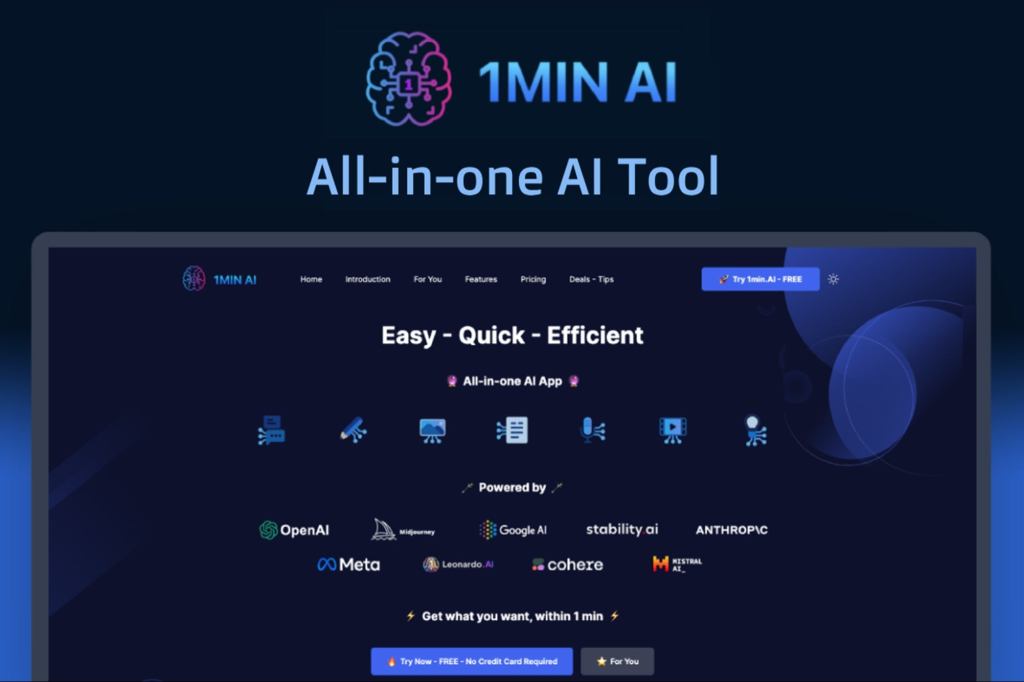
1min.AI is a new AI platform that offers a different approach. Rather than maintaining separate subscriptions to ChatGPT, Claude, Midjourney alternatives, and various other AI services, this platform consolidates access to GPT-4o, Claude 3 Opus, Gemini Pro 1.5, and other leading AI models under one roof with no recurring cost. Right now, a lifetime subscription is available for $74.97 (reg. $540), but that ends soon.

Built for business efficiency

The Advanced Business Plan includes 4 million credits monthly, enough to generate more than 1.1 million words, research nearly 6,000 SEO keywords, or create more than 1,100 images per month. For entrepreneurs who are managing content marketing, client presentations, or internal communications, this translates to significant time savings across multiple business functions. The credits roll over month to month, allowing you to build up reserves for larger projects when needed.

The platform’s AI-powered document tools handle PDF analysis, translation, and presentation generation, tasks that typically require specialized software. Audio and video tools cover everything from text-to-speech for training materials to video captions for social media content. Business owners can even add up to 20 team members, making collaboration straightforward for growing companies.

Unlike competing services that charge monthly fees indefinitely, 1min.AI provides lifetime access. While individual AI subscriptions from major providers easily exceed $100 monthly combined, this consolidates those capabilities into a one-time investment. The platform receives weekly updates with new features and improvements, ensuring access to the latest AI capabilities.

Get the 1min.AI Advanced Business Plan: Lifetime Subscription for $74.97 (reg. $540).

StackSocial prices subject to change.

Modern businesses increasingly rely on AI tools for content creation, data analysis, image generation, and customer communication. However, maintaining separate subscriptions for each specialized function quickly becomes expensive. Between ChatGPT for writing, dedicated image generators, document processors, and video tools, monthly costs can easily stack up while creating workflow inefficiencies as teams constantly switch between platforms.

1min.AI is a new AI platform that offers a different approach. Rather than maintaining separate subscriptions to ChatGPT, Claude, Midjourney alternatives, and various other AI services, this platform consolidates access to GPT-4o, Claude 3 Opus, Gemini Pro 1.5, and other leading AI models under one roof with no recurring cost. Right now, a lifetime subscription is available for $74.97 (reg. $540), but that ends soon.

Built for business efficiency

The Advanced Business Plan includes 4 million credits monthly, enough to generate more than 1.1 million words, research nearly 6,000 SEO keywords, or create more than 1,100 images per month. For entrepreneurs who are managing content marketing, client presentations, or internal communications, this translates to significant time savings across multiple business functions. The credits roll over month to month, allowing you to build up reserves for larger projects when needed.

https://www.entrepreneur.com/science-technology/managing-multiple-ai-subscriptions-is-costing-your/501857


I’ve Raised 8 Figures of Funding as a Black Founder — Here’s How to Overcome the Bias and Prejudice in VC

Opinions expressed by Entrepreneur contributors are their own.

Key Takeaways

  • Venture capital is plagued by a “herd mentality,” favoring known founders and stagnating technological progress.
  • Gatekeeping by elite institutions and academic achievements dictate funding, marginalizing unconventional talent.
  • Minority founders face significant challenges but must strategically navigate the VC ecosystem to succeed.

Venture capital is in crisis. We’re staring at the greatest technological shift in history, yet the industry reeks of laziness and stagnation. Sure, liquidity’s not great, slashing available funds for founders.

But the real killer? Economic jitters that birthed a “herd mentality” — investors are piling into the same deals and only giving capital to founders they know. VCs were meant to level the playing field — rewarding merit, ingenuity and grit. However, in 2025, it has devolved into a commingled piggybank to bankroll technofeudalist ideas from nepo-babies.

Prejudice runs deep, but inflation fears contribute to the rising terror of failure. These fears drive market participants to collude to deliver value to shareholders rather than deriving that value from bets of their own volition. Effectively, modern venture capitalists act no differently than high school mean girls in suits.

Behind the curtain: Gatekeepers exposed

“Iron sharpens iron,” implying that competition brings out the best in one another. The same applies to companies — competition breeds the best product, ultimately maximizing value delivered to end-markets. But as venture markets matured, bureaucracy crept in like a virus. Accelerators and elite programs turn raw, punchy ideas into a badge-collecting game. Want funding? Forget brilliance, stack endorsements.

Ivy League institutions, YCombinator and Forbes 30 Under 30 are a few examples of conglomerates that gatekeep capital — and indirectly — the advancement of mankind. Investors hide behind them as filters for talent when, more often than not, the scrappy, underserved founder mentality lives outside of these bubbles. Outsourcing this diligence quite literally undermines the value of a fund manager in the eyes of shareholders. After all, LPs back managers based on their unique experience and world perspective. That’s like hiring an attorney who outsources to ChatGPT.

Politics isn’t helping. Diversity programs are crumbling, destroying many bridges for non-elite founders. Minority funds are having trouble closing from LPs and big corporations like Target have done away with minority-founder initiatives well before they even took off.

The stats scream inequality: 80% of venture deals close in four states: California, Massachusetts, Texas and New York; 90% of founders are male, 72% white; 65% of unicorns in Europe are repeat founders, deeply constraining access to capital for new ones.

From personal experience, founding a startup is taxing yet exhilirating experiences; however, it’s hardly practical for 99% of people. Ironically, the same fear of loss that bred the bureaucracy amongst fund managers similarly discourages founders outside the bureaucracy from ever starting. It’s one thing to risk failure with a generational safety net; it’s a completely different thing to risk it all without it.

The slow unraveling of initiatives focused on rectifying these disparities undoes much of the “progress” we’ve made over the years. To top it off, no diverse founders means diverse problems go unsolved — leaving both opportunity and money on the table.

Beating bureaucracy: Your battle plan

There’s nothing you can do to change the game; it’s rigged. That said, it’s critical that minority founders do the following to combat — or infiltrate — the bureaucracy.

  1. Network intentionally: Investors fund good ideas; they fund people they know with good ideas. Closed mouths don’t get fed, so it’s critical that aspiring founders make concerted efforts to develop a robust set of industry connections through accelerator programs, sponsorships and more. A single referral from the right person can change everything.
  2. Learn how it all works by becoming an investor or insider: Learn how the other side evaluates businesses by working in VC (or private markets). Understanding the psychology behind capital provision will only make your future pitches more compelling.
  3. Pursue specific career paths and higher education for knowledge and expertise: Titles are cheap, yet they’re always the thing investors point to after a startup fails when questioned about the investment in the first place. In 2025, roughly half of VC firms allocated > 70% of funds to elite-pedigree founders, underscoring how biased capital deployment is in VC. A fancy MBA program may not be in the cards for many, but leveling up in the industry you care to launch a business in only helps.

Conclusion

As a first-time, African-American founder who has raised eight-figures of funding (and actively working on more), I know the game: Bias and prejudice lurk everywhere. If you don’t love and appreciate the chaos, it’ll consume you. Your “why” must be so big that doubt around you trembles in fear. Reclaim your destiny and forge your own path where none exists. As they say, nothing worth having ever comes easy. Minority founders: Push through. The future’s yours to seize.

Sign up for the Money Makers newsletter to get weekly, expert-backed tips to help you earn more money — from real people who founded and scaled successful businesses. Get it in your inbox.

Key Takeaways

  • Venture capital is plagued by a “herd mentality,” favoring known founders and stagnating technological progress.
  • Gatekeeping by elite institutions and academic achievements dictate funding, marginalizing unconventional talent.
  • Minority founders face significant challenges but must strategically navigate the VC ecosystem to succeed.

Venture capital is in crisis. We’re staring at the greatest technological shift in history, yet the industry reeks of laziness and stagnation. Sure, liquidity’s not great, slashing available funds for founders.

But the real killer? Economic jitters that birthed a “herd mentality” — investors are piling into the same deals and only giving capital to founders they know. VCs were meant to level the playing field — rewarding merit, ingenuity and grit. However, in 2025, it has devolved into a commingled piggybank to bankroll technofeudalist ideas from nepo-babies.

https://www.entrepreneur.com/starting-a-business/the-harsh-truth-about-vc-red-tape-and-what-its-costing/500478


5 Things Companies Get Wrong About Agentic AI — Are You Making the Same Mistakes?

Opinions expressed by Entrepreneur contributors are their own.

Key Takeaways

  • The efficacy of agentic AI heavily relies on the quality of data it receives, necessitating clean, well-organized data for precise insights, and it still requires human oversight to refine and guide its functionality.
  • Despite common misconceptions, agentic AI is currently active and influential within organizations, aiding in real-time analysis and decision-making, and is integral for businesses looking to stay competitive.

Agentic AI isn’t smarter AI — it’s an autonomous decision-maker that’s completely transforming how businesses operate and how employees work. Its impact rivals the rise of the internet in the 1990s or the launch of the iPhone in the 2000s. But like every major innovation, especially when it first goes mainstream, there’s a lot of confusion about what agentic AI actually is. Some think it’s an advanced version of ChatGPT, while others assume it’s a type of chatbot.

Misunderstanding around agentic AI is often caused by oversimplified explanations, marketing buzz or a lack of hands-on experience. But it also stems from common perceptions around automation, especially the chatbots that people regularly rely on for things like customer support, order tracking or making appointments. And inside organizations, agentic AI is often confused with internal systems that handle routine tasks, like chatbots designed to respond to IT support requests, track the status of purchase approvals or update employee records. While useful for simple tasks, these chatbots don’t drive outcomes on their own.

Agentic AI acts more like an autonomous digital coworker. It can analyze complex data, interpret trends, surface opportunities and proactively recommend next steps to help teams make smarter decisions. Compared to a traditional AI, which is reactive and responds to instructions, agentic AI acts independently and thinks ahead.

As CEO of Infragistics, I’m constantly speaking with leaders from established enterprises to emerging, high-growth companies about the impact of AI. The misconception that agentic AI is a chatbot can keep companies from realizing its true potential.

Here are four other common myths to watch out for.

Related: Your AI Initiatives Will Fail If You Don’t Address This Crucial Component First

1. Agentic AI is the newest version of tools like ChatGPT

Similar to the chatbot misconception, many understand agentic AI to be a more advanced version of traditional AI. While both can handle repetitive tasks and streamline day-to-day workflows, the difference between the two tools depends on what they do after that.

Tools like ChatGPT, Gemini and Grok can generate responses from data based on very specific inputs. For example, a marketing team can ask their AI tool for a subject line for an email for an upcoming campaign. The traditional tools they use will offer a few different variations of subject lines — but nothing more. Agentic AI can go a step further, analyzing what’s worked in the past, taking into account the audience they’re targeting and understanding product and shopping trends to recommend subject lines that will perform.

Or, while traditional AI tools could summarize a 30-page marketing campaign performance report, agentic AI can analyze the data, pinpoint what elements in the campaign drove the most performance (and what fell flat) and identify ways to improve future campaigns.

Both of these AI tools drive efficiencies within an organization — but agentic AI has the power to drive more meaningful impact.

Related: You Wouldn’t Hire Without a Job Description. Stop Deploying AI Without One

2. Any data is good data for agentic AI

AI runs on data, but not all data is created equally. Another misconception about agentic AI — and AI overall — is that the more information you give it, the better the insights. The quality, organization and accessibility of that data actually matter much more than the quantity of it. If the data you’re feeding into AI is bad, the results are going to be bad too.

Agentic AI is only as smart as the data it receives. When companies’ data exists in silos, scattered across disconnected CRMs, analytics tools and platforms, AI can’t see the full picture. That, paired with unclean or inaccurate data, will limit AI’s effectiveness.

The next wave of AI isn’t solely about adoption; it’s about data readiness. Organizations are quickly realizing that to unlock the full potential of agentic AI, they need more than the tools–they need centralized, clean and continuously updated data. Once that foundation is in place, agentic AI can power companies to make faster, smarter decisions — like where to allocate budgets, how to create go-to-market strategies or which initiatives will drive the best business outcomes.

3. There’s no need for human oversight

Many assume that once data is clean and centralized, AI agents can work without oversight. While AI agents are proactive and work autonomously, they need ongoing human input and feedback to be effective.

Agentic AI depends on continuous learning and refinement — guided by humans who review outcomes, correct errors and ensure recommendations remain aligned with evolving business goals. When data, direction or objectives become out of sync, even the best AI tools can start producing results that miss the mark.

AI should be treated as a collaborative partner, not a replacement for human judgment. When teams strike that balance, they’re able to sustain long-term performance, reduce risk and stay agile as markets and customer expectations evolve.

Related: Don’t Waste Money on AI. Unlock Its True Potential By Treating It Like a New Hire.

4. Agentic AI is a technology of the future

Because it still may sound futuristic, it’s easy to think agentic AI is still years away from making a real impact. But it’s already here — and already driving results.

Agentic AI is helping teams to analyze performance data in real time, identify areas for improvement and growth and make smarter decisions, without having to manually scroll through dashboards or reports. Data-driven work management platforms like Slingshot offer organizations the ability to centralize their data and workflows into one place, so AI can empower teams to easily garner insights, uncover trends and accelerate decision-making based on data.

Of course, agentic AI will continue to evolve, but it’s not something companies will have to wait to use. In fact, if they’re not using it now within their organization, they’re already behind.

Agentic AI isn’t a chatbot or a smarter automation tool; it’s the foundation for a new way of working. The organizations that understand this distinction, invest in their data and treat AI as a collaborative partner will be the ones that turn its potential into performance.

Key Takeaways

  • The efficacy of agentic AI heavily relies on the quality of data it receives, necessitating clean, well-organized data for precise insights, and it still requires human oversight to refine and guide its functionality.
  • Despite common misconceptions, agentic AI is currently active and influential within organizations, aiding in real-time analysis and decision-making, and is integral for businesses looking to stay competitive.

Agentic AI isn’t smarter AI — it’s an autonomous decision-maker that’s completely transforming how businesses operate and how employees work. Its impact rivals the rise of the internet in the 1990s or the launch of the iPhone in the 2000s. But like every major innovation, especially when it first goes mainstream, there’s a lot of confusion about what agentic AI actually is. Some think it’s an advanced version of ChatGPT, while others assume it’s a type of chatbot.

Misunderstanding around agentic AI is often caused by oversimplified explanations, marketing buzz or a lack of hands-on experience. But it also stems from common perceptions around automation, especially the chatbots that people regularly rely on for things like customer support, order tracking or making appointments. And inside organizations, agentic AI is often confused with internal systems that handle routine tasks, like chatbots designed to respond to IT support requests, track the status of purchase approvals or update employee records. While useful for simple tasks, these chatbots don’t drive outcomes on their own.

https://www.entrepreneur.com/leadership/5-things-companies-are-getting-wrong-about-agentic-ai/499929





Microsoft Office 2024 Delivers $150 in Savings for Business-Ready Productivity

Disclosure: Our goal is to feature products and services that we think you’ll find interesting and useful. If you purchase them, Entrepreneur may get a small share of the revenue from the sale from our commerce partners.

For entrepreneurs and business professionals, productivity software is infrastructure, not a nice-to-have. Proposals, budgets, presentations, and planning often still run through Office, which is why a one-time purchase of Microsoft Office 2024 Home for Mac or PC at $99.97 (regularly $249.99) is worth attention. The deal ends Jan. 25 at 11:59 p.m. PT, offering a clear opportunity to secure essential tools without committing to monthly fees.

Ownership instead of ongoing costs

Office 2024 includes the applications most businesses actually rely on: Word, Excel, PowerPoint, and OneNote. These are full desktop versions built for local performance and offline work. Instead of budgeting around a recurring subscription, you pay once and keep using the software on your Mac or PC.

For founders and small teams, that predictability matters. Subscription software can quietly turn into a permanent line item. A one-time license keeps costs contained and easier to forecast, which is often more valuable than incremental feature updates.

Built for real business work

Office remains a standard because it actually works. Word supports contracts and polished client deliverables. Excel handles forecasting, financial models, and operational tracking. PowerPoint is still the fastest way to communicate ideas clearly. OneNote keeps research, meeting notes, and planning in one place.

Office 2024 emphasizes stability and familiarity rather than constant change. That’s a benefit for professionals who want tools that behave consistently day to day, without retraining teams or chasing cloud-only features they may not need.

A practical fit for independent professionals

This setup makes the most sense for entrepreneurs, consultants, and small businesses that collaborate externally but don’t depend on shared cloud environments. Files remain compatible with clients and partners using other versions of Office, keeping workflows smooth.

At $99.97, you’re saving $150 off the regular price and avoiding future subscription costs entirely. For businesses that prefer ownership over renting software, this version of Office from Microsoft is a disciplined, business-first choice.

Get Microsoft Office 2024 Home & Business for Mac or PC for $99.97 (reg. $249.99). Deal ends Jan. 25 at 11:59 p.m. PT.

StackSocial prices subject to change.

For entrepreneurs and business professionals, productivity software is infrastructure, not a nice-to-have. Proposals, budgets, presentations, and planning often still run through Office, which is why a one-time purchase of Microsoft Office 2024 Home for Mac or PC at $99.97 (regularly $249.99) is worth attention. The deal ends Jan. 25 at 11:59 p.m. PT, offering a clear opportunity to secure essential tools without committing to monthly fees.

Ownership instead of ongoing costs

Office 2024 includes the applications most businesses actually rely on: Word, Excel, PowerPoint, and OneNote. These are full desktop versions built for local performance and offline work. Instead of budgeting around a recurring subscription, you pay once and keep using the software on your Mac or PC.

For founders and small teams, that predictability matters. Subscription software can quietly turn into a permanent line item. A one-time license keeps costs contained and easier to forecast, which is often more valuable than incremental feature updates.

https://www.entrepreneur.com/science-technology/microsoft-office-2024-delivers-150-in-savings-for/501856


Clients and Partners Will Drop You If They See This Behavior (and You Might Not Even Know You’re Doing It)

Opinions expressed by Entrepreneur contributors are their own.

Key Takeaways

  • Buyers walk away from sellers who exhibit unacceptable behaviors, and a lack of respect is the core issue.
  • However, having respect for others isn’t enough — you have to actually demonstrate respect. Buyers notice when it’s absent.
  • Respect isn’t just a soft skill. It’s one of the most impactful core competencies you can develop.

Over 75% of buyers will walk away from a seller who exhibits unacceptable behavior. And most sellers are never told that respect — or the lack of it — is the core issue.

As the founder, I’m my company’s chief salesperson. In that role, staying aligned with what clients, partners and stakeholders expect isn’t optional; it’s the difference between growing and getting ghosted.

Prospects spend significant time researching your business and evaluating whether you can address their challenges. But when they finally reach out, they’re judging something deeper than features. They’re looking for signs of competence, credibility and emotional intelligence. And they’re assessing whether you’ll treat them — and their team — with the respect they deserve.

Fail that test, and you’ll almost never get a second chance.

Related: 4 Reasons Why Rudeness Leads to Business Failure

Having respect for others isn’t enough

In a recent survey conducted by my company, SalesFuel, we asked more than 2,000 senior business leaders about the supplier behaviors that cause them to disengage, withdraw or seek out a competitor. The top responses all pointed to the same root issue: respect.

This attitude is understandable. Beginning a partnership with a new vendor is an angst-filled process for buyers. They want to feel heard. They want their opinions validated. They want to know that the person on the other side of the conversation values their time, business and goals.

Respect communicates all of that without needing to be spelled out. But it’s not just feeling respect for the other person, you have to DEMONSTRATE respect — always and in all ways.

My recent trip to Japan reinforced the importance of small gestures. In Japan, respect is not merely encouraged but deeply embedded in daily life. Even the simplest interactions reflect an awareness of how one’s behavior affects others. Public spaces are intentionally quiet. A verbal apology is accompanied by a deep bow that signals the depth of your sincerity.

In North America, for example, buyers don’t expect the same gestures. But they notice the absence of respect.

Don’t let unintentional behavior disqualify you

When suppliers fall short of expectations, buyers are quick to react. Our research reveals that the following seller behaviors can cause a buyer to move on to another potential partner:

  • Treating their support staff poorly: 39%

  • Poor etiquette or social skills: 33%

  • Ignoring emails and calls: 31%

  • Treating a buyer like they are too small to matter: 28%

  • Being late for meetings and calls: 28%

The clumsy, amateurish use of AI can also come across as disrespectful. For example, I recently received a thank‑you note after delivering a high‑scoring keynote at a conference. Its canned, templated language lacked warmth and was obviously generated by AI. The sender’s lack of effort to include important details made me question their sincerity.

Related: The Many Ways Being Kind Leads to Success

Translate intent to action

Seeing another part of the world has enabled me to see the world differently. And the research shows that people on this side of the world are ready for a culture change. It should seem obvious in theory, but it too often doesn’t carry through in practice.

My father taught me that everyone, from the CEO to the janitor, deserves to be treated with dignity and respect. I try to demonstrate respect to everyone, whether they can benefit me or not, but there is always room for improvement.

Like the trains in Japan, I’m making a greater effort to always start meetings on time — showing respect for the attendees’ busy schedules.

I take more time preparing for meetings so I can always show up when I show up. An eventual sale may be on my mind, but I show appropriate curiosity about the person I’m meeting with, not just their business. Instead of rushing in facts about my company and product line, I focus more on listening deeply and asking follow-up questions about what they’ve told me about theirs.

When I have the chance to meet with someone in person, I make greater eye contact. My phone stays in my pocket, unless I need it to get an answer for them. I focus on having a real conversation because they aren’t interested in hearing a canned pitch or information they could have easily gotten from AI.

I’ve also been coaching my staff, especially client‑facing teams, on how to engage respectfully with others — including how to stay gracious and professional when people are rude, difficult or unrealistic.

I hired a consultant to help us sharpen our social skills and business etiquette, and I feel so strongly about this that we’ve adopted a formal code of civility at my company.

These investments have paid off. We’ve noticed that taking the small amount of extra time to be respectful has allowed us to feel better about ourselves and others. And we’ve noticed that our efforts generate respectful behavior in return.

Related: 6 Ways to Exceed Your Customer’s Expectations Just With Good Manners

Why showing respect matters

People are tired of rude and uncivil behavior, especially in professional settings.

We recently posted an article about workplace civility. The high levels of traffic and click-throughs show that interest in this topic is growing.

Social norms may have changed in the past 20 years in the Western world. But few people, including prospects, will fault you for showing respect. On the other hand, plenty will walk away if you’re in any way perceived as rude, inattentive or dismissive.

Respect isn’t just about good manners. It isn’t just a soft skill. Respect is an operational asset — and one of the most impactful core competencies you can develop.

Key Takeaways

  • Buyers walk away from sellers who exhibit unacceptable behaviors, and a lack of respect is the core issue.
  • However, having respect for others isn’t enough — you have to actually demonstrate respect. Buyers notice when it’s absent.
  • Respect isn’t just a soft skill. It’s one of the most impactful core competencies you can develop.

Over 75% of buyers will walk away from a seller who exhibits unacceptable behavior. And most sellers are never told that respect — or the lack of it — is the core issue.

As the founder, I’m my company’s chief salesperson. In that role, staying aligned with what clients, partners and stakeholders expect isn’t optional; it’s the difference between growing and getting ghosted.

https://www.entrepreneur.com/leadership/75-of-buyers-walk-away-from-sellers-who-make-this-mistake/500870