Transform Text Into Professional Audio Across 32 Languages for Just $39.99
Disclosure: Our goal is to feature products and services that we think you’ll find interesting and useful. If you purchase them, Entrepreneur may get a small share of the revenue from the sale from our commerce partners.

The global content creation market is expected to reach $38.2 billion by 2030, with video and audio content driving much of that growth, according to research from Statista. If you’re creating podcasts, social media content, or training materials for a global audience, the cost of professional voice actors adds up fast. An iSpeech Plus Plan eliminates those recurring expenses, and you can currently get lifetime text-to-speech access for just $39.99 (Reg $252)..

Browser-based audio creation for any business need

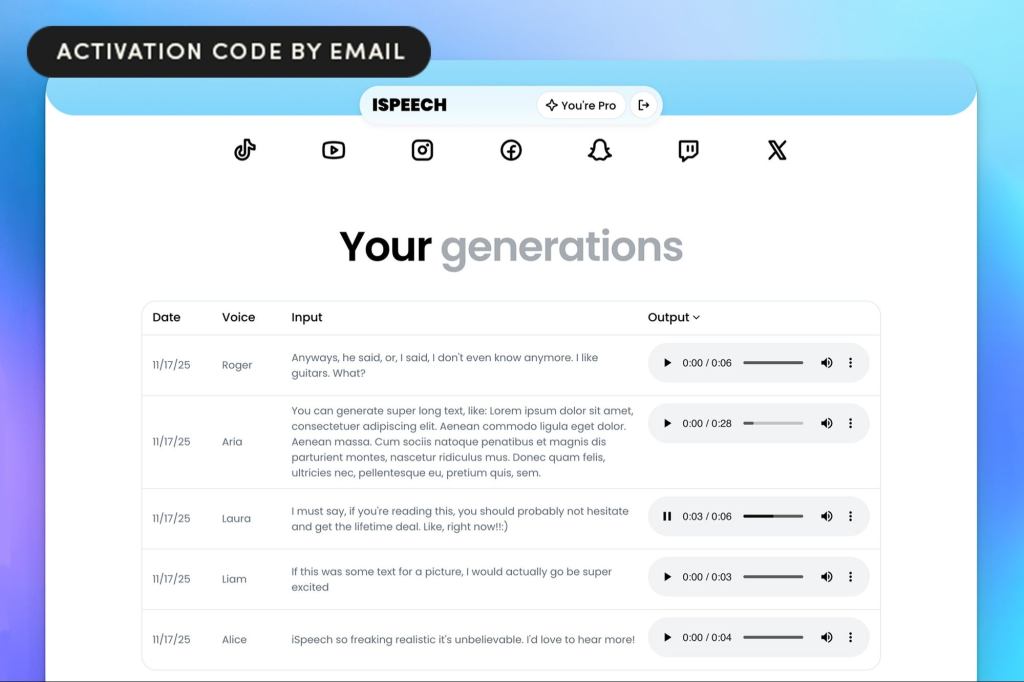
The Plus Plan provides instant access to 14 high-quality artificial intelligence (AI)-powered voices spanning 32 languages, from English and Spanish to Mandarin, Arabic, Hindi, and Vietnamese. You paste your text, select a voice and language, and download polished MP3 files in seconds. No software installation, no learning curve and no monthly fees.

The platform runs entirely in your browser, so you can generate professional voiceovers from any device – desktop, tablet or phone – without downloads or compatibility issues. Advanced neural AI produces natural-sounding speech with realistic intonation and pacing, suitable for client-facing content, internal training videos or multilingual marketing campaigns.

You can customize speaking speed and choose from conversational, professional, male or female voice tones depending on your project requirements. For entrepreneurs managing international teams or selling to global markets, the 32-language support means you can create localized audio content without hiring translators or voice talent in each region.

The unlimited device usage lets you work from your laptop, tablet or phone with the same license. Regular feature updates continuously add new voices, emotional tones and languages at no additional cost.

Content creators use iSpeech for podcast intros, YouTube voiceovers and social media video narration. Training teams generate e-learning modules and internal documentation audio. Business owners add accessibility features to websites with text-to-speech functionality that serves customers with visual impairments or reading challenges.

Get a lifetime subscription to iSpeech AI Text-to-Speech while it’s on sale for just $39.99 (Reg $252).

iSpeech AI Text-to-Speech: Lifetime Subscription

See Deal

StackSocial prices subject to change.

The global content creation market is expected to reach $38.2 billion by 2030, with video and audio content driving much of that growth, according to research from Statista. If you’re creating podcasts, social media content, or training materials for a global audience, the cost of professional voice actors adds up fast. An iSpeech Plus Plan eliminates those recurring expenses, and you can currently get lifetime text-to-speech access for just $39.99 (Reg $252)..

Browser-based audio creation for any business need

The Plus Plan provides instant access to 14 high-quality artificial intelligence (AI)-powered voices spanning 32 languages, from English and Spanish to Mandarin, Arabic, Hindi, and Vietnamese. You paste your text, select a voice and language, and download polished MP3 files in seconds. No software installation, no learning curve and no monthly fees.

The platform runs entirely in your browser, so you can generate professional voiceovers from any device – desktop, tablet or phone – without downloads or compatibility issues. Advanced neural AI produces natural-sounding speech with realistic intonation and pacing, suitable for client-facing content, internal training videos or multilingual marketing campaigns.

https://www.entrepreneur.com/science-technology/transform-text-into-professional-audio-across-32-languages/500827





The 7 Things I Do Every December to Set My Business Up for the Year Ahead

Opinions expressed by Entrepreneur contributors are their own.

Key Takeaways

  • A long-standing annual ritual helps a small business owner reflect on the past year, clarify priorities and prepare thoughtfully for what’s ahead.
  • Through deliberate planning, personal accountability and meaningful connections, the process brings perspective, stability, and renewed focus without relying on rigid systems.

I’ve been running a small business for more than two decades. Over that time, I’ve developed some routines. One routine happens each year at this time. During December, I’m looking ahead and thinking of the next year. I make my plans. I make a few resolutions. I check in with those important. The actual details change each year, but the process is the same.

Here’s what I do every year, at the end of each year.

Employee bonuses

Before the year is over, I try to make sure that all of my employees and contractors who impact my business have been evaluated, connected and receive my appreciation. I send cash bonuses to each of them. It’s a discretionary bonus that I come up with every year based on profits and I’m careful to make sure that the bonus is never less than it was the previous year, unless profits are so bad that I couldn’t afford to make the payment (which thankfully hasn’t ever happened). Even in 2025, I’m doing these bonuses by manual check, which I slip into a holiday card that includes a personal note and is deliberately delivered old school in the mail. For a few remote employees, I do the bonuses electronically, but still send the card.

Related: If You Haven’t Already Done These 7 Things to Prepare Your Business for the Holiday Season, You’re Putting Your Business Behind the 8-Ball

Employee evaluations

Because my business is entirely virtual and many of my people are located throughout the world, I’ve stopped doing holiday parties. However, I make it a point to check in before the year is over with all employees with an informal evaluation just to make sure they’re getting good (and constructive) feedback and they know where they stand going into the next year. I take this time also to establish a few goals for the upcoming calendar year (i.e., chargeability, revenue generation, client service ratings, education certificates, etc.) with each person so they are clear how they’ll be evaluated in the coming year and can benchmark themselves.

Gifts

Right after Thanksgiving, I draw up a list of people whom I want to thank for doing business with me during the year. They are clients, prospective clients, suppliers, partners and people in the media. I usually send chocolates from Godiva or a gift basket, and I keep the budget to about $35 per person. There are usually about 50 people on this list, so you can do the math. There’s also time involved by my assistant to coordinate all the ordering. Which means there’s a cost. But it’s worth it. I start with last year’s list and modify it. I get a lot of joy in doing this. And I regularly hear back from people saying thank you, and I know it’s appreciated. It’s not much, but it’s a genuine gesture and reminds me of the people who are really important for my business.

Forecast

For a business as small as mine, I don’t do a budget. But I do prepare a forecast. This is an online spreadsheet and for my eyes only. It takes me a few days to work on each year at this time. I revisit compensation and other costs to make sure my annual overhead reflects reality. I determine specific quantifiable goals for my business — chargeable hours, client project completions, new media projects and consulting clients, new client revenue, etc. — but I don’t make them excessive or out of reach. My spreadsheet takes into account a reasonable estimate of the work I can expect in the coming year and reflects both direct and administrative costs associated with that work, along with a projected net profit for the year. This way, I have my numbers clear heading into the new year and I know what I have to achieve.

Resolutions

New Year’s resolutions are corny. But they’re useful. At this time of year, I make resolutions. For example, in this coming year, I’m resolving to meet certain of my remote employees in person once a quarter, even if that means me flying out to see them. I’m also resolving to lean deeper into AI in 2026 by assessing the capabilities I can leverage in my existing software (accounting, CRM, office) and investing in training for my people to use it. I’m also going to lean heavily into an AI Assistant to assist me in all things I do in my business — right now it’s ChatGPT, but Grok is coming in as a strong contender too.

Also, I’m committing to taking on a few projects that are out of my comfort zone because — even though I’m risking profitability or even my reputation — it’s the only way to grow, and it keeps one’s mind very active with new challenges. I try to keep these resolutions to a small number so that they’re achievable.

Related: 7 Things I’ve Learned In 7 Years of Entrepreneurship

Personal goals

Besides my business resolutions, I do make a few personal goals for myself each year. That usually revolves around maintaining a certain weight, exercising regularly, playing better squash (don’t ask!) visiting a new country (my wife and I have been Airbnb-ing and working remotely three to four weeks in January in a different country each year over the past few years and love it) or taking a family vacation or taking a course in something I like. These goals not only give me something to look forward to but also keep my head balanced between fun stuff and work stuff.

Document

The most important thing about forecasting, goal setting, and creating resolutions is accountability. None of this matters if you’re not holding yourself accountable to your commitments. To that end, I create a task in my calendar application to “check in” on all of these things at the end of each quarter. I’ve come to look forward to doing this when the task comes up on my to-do list for the day. It’s a way to remind me of all that I’ve planned to do in the current year and gives me a reset as to where things stand.

By the end of the year, it’s interesting to see just how much I accomplished and how realistic all of my goals were. I keep these tasks in my history because it’s also fun to look back at what was on my mind five or ten years ago. You’d be surprised at how trivial all of those “problems” that were so important back then are today. It gives me perspective.

This is what I do every year. This is my process. It eases my mind. It gives me clarity. It helps me look forward. It helps me appreciate what’s in the past. It helps me prepare for the future. If you’re a business owner like I am, I strongly suggest doing something similar. It works.

Key Takeaways

  • A long-standing annual ritual helps a small business owner reflect on the past year, clarify priorities and prepare thoughtfully for what’s ahead.
  • Through deliberate planning, personal accountability and meaningful connections, the process brings perspective, stability, and renewed focus without relying on rigid systems.

I’ve been running a small business for more than two decades. Over that time, I’ve developed some routines. One routine happens each year at this time. During December, I’m looking ahead and thinking of the next year. I make my plans. I make a few resolutions. I check in with those important. The actual details change each year, but the process is the same.

Here’s what I do every year, at the end of each year.

https://www.entrepreneur.com/growing-a-business/the-7-things-i-do-every-december-to-set-my-business-up-for/500700


The 3 Assets You Need to Land Your First 5 Coaching Clients

Opinions expressed by Entrepreneur contributors are their own.

Key Takeaways

  • In coaching, the hardest milestone is landing the first five clients, and January is the most important month of the year for coaches who want real momentum.
  • Three core assets consistently lead to more clients: Ideal Client Profiles, sustainable value delivery and reliable client-generating actions.

December is traditionally the slowest month for coaching in the United States. Savvy coaches recognize it as preparation time for January, the true beginning of the coaching year. With the right strategy, January becomes the month that launches momentum and builds a sustainable client base.

I know because I’ve lived it, as I started my own independent life coaching practice and built it to over 40 current clients over the course of three years.

The real challenge: Your first five clients

In any service-based business, especially coaching, the hardest milestone is landing the first five clients. They form the base of your referral network and validate your offering. I lived that journey long before I began training other coaches, and I walked the same path you’re on now.

These assets I’m about to outline have proven themselves time and again, both in my own development and in the success stories of the coaches I work with today.

Related: How to Create an Endless Stream of Clients for Your Coaching Business

Why these are assets, not steps

Most articles promise “five simple steps,” but building a coaching practice is not simple. It requires courage, clarity and consistent engagement over time. That’s why I frame these as assets rather than steps. An asset is something you develop, refine and leverage, and each one becomes part of the long-term foundation of your business.

These assets grow with you. They strengthen your ability to communicate your value, understand your audience and put yourself in the spaces where coaching relationships begin. When these assets are in place, the first five clients become not just possible, but predictable.

Asset 1: Ideal client profiles

Your first essential asset is a precise understanding of the people you’re meant to serve.

When I transitioned from teaching to coaching, I initially assumed I understood what students needed. I quickly realized my assumptions missed the real pain points parents were facing. Interviewing parents transformed everything. Their worries about grades, motivation and college readiness were far different from what I saw in the classroom.

Listening — really listening — to your audience is the difference between guessing and knowing.

This asset requires deep research, real conversations and a willingness to discover that your audience’s true challenges rarely match your initial assumptions.

Asset 2: Sustainable value delivery systems

Asset two is your repeatable, sustainable way of providing value to the people you want to reach.

Ask yourself one question with two parts:

Do you have a sustainable way to consistently deliver value to your target audience, and is that delivery sustainable for you?

This might take the form of:

Write down your system. Build it so it can be repeated, refined and expanded.

For me, the system was workshops for parent groups. They allowed me to demonstrate value while giving parents a low-risk entry point into coaching. That repeatable structure became the backbone of my early business.

Your system must pass the same test: Does it truly help your target audience?

And what is the repeatable action that consistently puts you in front of your ideal clients and demonstrates value?

Once you find it, commit to it.

Asset 3: Map of your audience journey

This asset requires studying how your audience moves from recognizing a problem to becoming open to coaching.

Here’s what most new coaches misunderstand: Your biggest competitor is not other coaches. It’s indifference.

People often continue through life without making meaningful changes. They may not be in crisis, but they aren’t progressing either. Coaching asks people to set goals and take risks, which means moving toward something better.

This collides with human psychology:

  • People are naturally risk-averse

  • They are more motivated to avoid pain than to pursue potential

  • Coaching centers on moving toward goals

Understanding this paradox prepares you for the real work of inspiring action. It also explains why your marketing and coaching voice must differ.

Related: 5 Simple Strategies for Landing High-Ticket Clients as a Coach

The marketing vs. coaching disconnect

When I left the classroom to build my coaching practice, I realized I needed two skill sets.

In marketing, I spoke to parents’ fears and worries, because those motivators move people away from pain.

In coaching, the work was future-focused: goals, aspirations and possibility.

Anyone building a practice has to understand this duality. Coaching helps people undo the limiting beliefs and mental habits that come from living in risk-averse patterns.

The journey to your first five clients requires building assets, not following steps. When you identify your ideal client, create a sustainable value system, understand the audience journey and commit to a consistent client-generating action, you establish the foundation for a thriving coaching practice.

January is coming. With these assets in place, it can become the month everything starts moving forward.

Key Takeaways

  • In coaching, the hardest milestone is landing the first five clients, and January is the most important month of the year for coaches who want real momentum.
  • Three core assets consistently lead to more clients: Ideal Client Profiles, sustainable value delivery and reliable client-generating actions.

December is traditionally the slowest month for coaching in the United States. Savvy coaches recognize it as preparation time for January, the true beginning of the coaching year. With the right strategy, January becomes the month that launches momentum and builds a sustainable client base.

I know because I’ve lived it, as I started my own independent life coaching practice and built it to over 40 current clients over the course of three years.

https://www.entrepreneur.com/starting-a-business/the-3-assets-you-need-to-land-your-first-5-coaching-clients/500818


This Common Mistake Could Be Driving Users Away From Your Website. Here’s How to Fix It.

Opinions expressed by Entrepreneur contributors are their own.

Key Takeaways

  • Treating UI and UX as different priorities creates a confusing experience. Users don’t separate how a website looks from how it behaves. They only notice if the site feels easy and natural to use.
  • A logical flow won’t help anyone if interface patterns are unclear. And a strong visual system won’t rescue a navigation path that sends people in circles.
  • A unified approach removes those gaps and creates an experience that feels human and intentional, keeping the user oriented as they move through it.

In digital projects, user interface (UI) and user experience (UX) often get discussed as if they exist in separate worlds. In reality, the person using the website experiences one continuous interaction. They aren’t thinking about industry acronyms or labels. They aren’t separating what they see from how it behaves. They’re only noticing whether the journey makes sense and whether each step feels natural.

I see this pattern across redesigns of all sizes, from enterprise platforms to smaller marketing sites. Stakeholders often assume UI and UX can be divided into one handling aesthetics and the other handling logic. That separation may feel intuitive internally, but it doesn’t reflect how real people interact with a website.

The moment UI and UX are treated as different priorities, the product begins drifting away from user needs. The interface can look nice, but movement through it lacks clarity. Or the structure is solid, and the copy is coherent, yet the visuals don’t support it. Either way, the experience becomes fragmented, and users notice it immediately.

Related: Data Isn’t Always Enough for UI/UX Design. Here’s Why Intuition Matters, Too.

Where design aligns with behavior

Most teams think of UX as structure and UI as visuals, but watching a real user interact with a product reveals how tightly the two depend on each other. I tend to think of UI/UX as a full system, and that includes the technology behind the design. A logical flow won’t help anyone if interface patterns are unclear. And when data loads slowly or displays inconsistently, it disrupts the experience long before any visual decision even matters.

The opposite is true as well. A strong visual system won’t rescue a navigation path that sends people in circles. Unstructured layouts make content difficult to parse. When spacing, hierarchy and grouping aren’t intentional, the user ends up reading the page the wrong way. They skim past key actions or misinterpret what’s important. This creates unparsable data: The information is technically present, but the way it’s arranged makes it difficult to process or prioritize.

We encountered this recently on a redesign where analytics showed something interesting. Users were finding the right pages. Traffic was strong. But people weren’t taking the next step. From a UX standpoint, the hierarchy and paths were logical. Yet in the interface, everything carried the same visual weight. Calls to action blended in. Important content looked identical to secondary details. On the surface, nothing seemed broken, but the interface wasn’t directing users.

Related: Implementing Best Practices for Web Design with Iterative Methodologies

Under the hood

We dug into the UI visual layer first. The structure underneath stayed exactly as it was, but we focused on how that structure was being communicated. Hierarchy needed to work harder, so we rebuilt it with clearer entry points and natural resting places for the eye. We added subtle micro-interactions, not decorative animations, but small cues that helped people stay oriented as they moved through the page.

Spacing shifted. Groupings shifted. Even the rhythm of how elements appeared changed. Individually, these updates are minor, but together they reshape how a page feels. During testing, that shift showed up immediately. Hesitation dropped. People found essential actions faster. They processed the content without having to think their way through it.

The underlying UX map didn’t change at all. The paths and decisions were already sound. What changed was the surface layer, and that is the part that carries all the responsibility for how the experience is interpreted in real time. When that layer communicates well, the architecture underneath finally has a chance to work as intended.

And as expected, once the UI was aligned with the UX, performance moved. Conversions rose without any adjustment to the strategy. The difference wasn’t a new flow nor a new brand narrative. It was that the interface was finally expressing the strategy with enough clarity for users to follow it.

How UI and UX strengthen each other

The most effective websites blend the logic of UX with the clarity of UI so seamlessly that the user never notices the mechanics behind it. The structure gives meaning to the interface. The interface gives expression to the structure. The structure gives a framework to the interface. Each reinforces the other, reducing cognitive load, removing friction and helping people move naturally through the experience, where first impressions make sense quickly, the journey feels predictable rather than forced, content becomes easier to absorb and trust builds early and continues to grow with every interaction.

These outcomes don’t come from one side of the work. They come from both disciplines moving together from the beginning.

Related: How UI Kits Develop Design Languages

Why this matters for business outcomes

For most companies, the website is no longer a static brochure. It’s a decision point, a validation point and often the primary interaction with the brand. If UI and UX are fragmented internally, that fragmentation shows up in the experience. Users feel the gaps long before internal teams do.

A unified approach removes those gaps. It creates clarity, consistency and a sense of intention that users can follow without effort. It also reduces rework because misalignments surface earlier, not in development or after launch.

In today’s digital landscape, that alignment isn’t a bonus. It’s the cost of building an experience people trust.

A single discipline, one outcome

UI shapes what people notice. UX shapes how they understand it. But once the work begins, those lines blur. They merge into a single process focused on one goal: creating an experience that feels human and intentional, keeping the user oriented as they move through it.

When that connection is in place, the website stops feeling like a series of layouts. It behaves more like a space with built-in direction, where people instinctively know where to go next without having to think about it.

Key Takeaways

  • Treating UI and UX as different priorities creates a confusing experience. Users don’t separate how a website looks from how it behaves. They only notice if the site feels easy and natural to use.
  • A logical flow won’t help anyone if interface patterns are unclear. And a strong visual system won’t rescue a navigation path that sends people in circles.
  • A unified approach removes those gaps and creates an experience that feels human and intentional, keeping the user oriented as they move through it.

In digital projects, user interface (UI) and user experience (UX) often get discussed as if they exist in separate worlds. In reality, the person using the website experiences one continuous interaction. They aren’t thinking about industry acronyms or labels. They aren’t separating what they see from how it behaves. They’re only noticing whether the journey makes sense and whether each step feels natural.

I see this pattern across redesigns of all sizes, from enterprise platforms to smaller marketing sites. Stakeholders often assume UI and UX can be divided into one handling aesthetics and the other handling logic. That separation may feel intuitive internally, but it doesn’t reflect how real people interact with a website.

https://www.entrepreneur.com/science-technology/the-website-mistake-that-stops-users-from-becoming-customers/500483


How to Keep Top Talent When You Can’t Offer Promotions or Raises

Opinions expressed by Entrepreneur contributors are their own.

Key Takeaways

  • Schedule the mission-critical re-recruitment conversation. Remind employees why the mission still matters, why their role remains vital and how you’re committed to their success.
  • When you can’t elevate their title, elevate their impact by giving them autonomy and stability.
  • Don’t compete on salary — mission is the new compensation. Most employees don’t leave because of pay alone. They leave because the total value proposition stopped feeling compelling.

Promotion rates in the United States have entered a decisive slowdown, but the expectations of ambitious professionals have not. After peaking at 14.6% in May 2022, the promotion rate fell to 10.3% in May 2025, according to Gusto. For many high-performing employees who joined a company expecting rapid advancement, the reality is very different today.

Inside organizations, this shift isn’t just a numbers story. It’s a psychological one. When promotion timelines stretch and compensation gains stall, even your strongest talent starts questioning whether the expectations set early on still hold true or if the rules of the game have changed and the end of their career at the company is near.

For leaders, this is the moment that matters. When the original deal changes, you can’t afford to let disappointment harden into disengagement. You have to re-recruit your people quickly by reshaping the value you offer — not around pay or title, but around mission, autonomy and long-term stability. Here’s how:

Related: I Discovered the Power of Employee Engagement — and Never Looked Back. Here’s Why It Should Be a Top Priority for Every Leader.

1. Schedule the mission-critical re-recruitment conversation

The worst mistake is letting disappointment fester. Avoiding the conversation doesn’t protect morale; it actually accelerates disengagement. Address the gap directly and immediately, with relevant context around the economy, industry, company and/or resources, to help restore clarity and employee commitment.

Marti Willett, president of Digital Marketing Recruiters, a digital staffing agency with 25 years of experience in the space, captures this well: “Own the narrative early and honestly. Employees don’t disengage because growth slows. They disengage because the leaders don’t explain the ‘why’ and the actions they are going to take to get back on track. Reestablish a purpose by helping employees understand your company’s mission and long-term value, how the updated strategy still matters to the market and how their work continues to have an impact.”

One founder I worked with learned this the hard way. After delaying annual promotions, she tried to “ride out the mood” instead of naming the issue. By the time she sat down with her engineering leads, the team had developed its own story, one far more pessimistic than the truth. Once she finally reset expectations and walked them through the revised strategy, the tension began to ease. But she lost two key team members, and the repair work took months longer than the conversation she avoided.

When the deal changes, schedule the meeting within days. Explain the market reality. Describe the updated strategy. Acknowledge the disappointment without sugarcoating it. Then, shift to the core of the re-recruitment: Remind them why the mission still matters, why their role remains vital to the company’s long-term value and how you, the leader, are committed to their success along the way. Purpose, not platitudes, is what re-anchors belief.

2. Trade title growth for autonomy and stability

When promotions stall, leaders often reach for the only lever they think still carries weight: promises of future advancement. But high performers don’t want delayed dreams. They want meaningful ownership today.

The smarter move is to give them autonomy, not adjectives on a business card. Assign an initiative that reshapes part of the business, accelerates a customer outcome or reduces a critical bottleneck. Elevate their impact even when you can’t elevate their title.

This aligns with the real shift happening in employee priorities. According to McKinsey’s HR Monitor 2025, 39% of employees stay in their roles primarily for job security, making stability the top retention factor. Compensation and benefits — the previous top driver — now rank highest for only 28% of workers. When leaders can’t offer bigger paychecks, they can still offer the very thing people value most: professional stability, purpose-grounded responsibilities and continuous learning and development.

Assigning a mission-critical project communicates something essential: You are still a cornerstone of our future, even if the ladder temporarily stops moving. And for many employees, that affirmation is worth more than the missing title bump.

Related: The Power of Autonomy: Fostering a Thriving Workplace

3. Don’t compete on salary — mission is the new compensation

When leaders feel pressured to “match the market,” they often forget a powerful truth: Most employees don’t leave because of pay alone. They leave because the total value proposition stopped feeling compelling.

To reset that value, leaders can use a simple visual tool that I call the value pie. Put compensation in one slice. Then add the elements that represent the remaining 80% of someone’s total value. That might include learning velocity, cultural stability, the relationship with their manager, equity, autonomy, benefits and the ability to influence decisions. When employees see the pie drawn out, compensation becomes exactly what it is — important, but far from the whole deal. Much of what matters most is already in their hands.

Take Chipotle, for example. In the face of high turnover, the company expanded its education benefits to reinforce a broader mission of helping employees grow, not just earn. Workers who participated in the program were 2.1 times more likely to stay and 6 times more likely to become managers, according to Guild. That shift didn’t require higher wages. It required a more compelling story about growth, purpose and long-term opportunity.

Re-recruitment isn’t about convincing someone to settle. It’s about reframing value accurately, sometimes for the first time.

Related: Want to Maximize Employee Retention? Here Are 20 KPIs You Need to Track.

The real deal leaders must keep

When the compensation narrative breaks, leaders often fear losing their best people. But the truth is simpler and far more strategic: Talent doesn’t stay because the paycheck climbs. They stay because of the mission and how leadership treats them.

Re-recruiting your team requires clarity, candor and the courage to shift the deal from (only) money and title to meaning and belonging. If you can do that consistently and early, you won’t just retain your high performers. You’ll deepen their commitment to the work that matters most, even in the moments when the numbers can’t.

Key Takeaways

  • Schedule the mission-critical re-recruitment conversation. Remind employees why the mission still matters, why their role remains vital and how you’re committed to their success.
  • When you can’t elevate their title, elevate their impact by giving them autonomy and stability.
  • Don’t compete on salary — mission is the new compensation. Most employees don’t leave because of pay alone. They leave because the total value proposition stopped feeling compelling.

Promotion rates in the United States have entered a decisive slowdown, but the expectations of ambitious professionals have not. After peaking at 14.6% in May 2022, the promotion rate fell to 10.3% in May 2025, according to Gusto. For many high-performing employees who joined a company expecting rapid advancement, the reality is very different today.

Inside organizations, this shift isn’t just a numbers story. It’s a psychological one. When promotion timelines stretch and compensation gains stall, even your strongest talent starts questioning whether the expectations set early on still hold true or if the rules of the game have changed and the end of their career at the company is near.

https://www.entrepreneur.com/leadership/how-to-retain-your-top-employees-when-you-cant-promote-them/500709


Someone in Arkansas Won $1.8 Billion in Powerball — But Their Identity Will Stay Secret for 3 Years

A lucky person in Arkansas scored a miracle on Christmas Eve, winning the $1.8 billion Powerball jackpot — and they might never have to reveal their identity.

A single Powerball ticket sold at a Murphy USA gas station in Cabot, Arkansas, matched all six numbers in Monday’s drawing, winning an estimated $1.8 billion jackpot — the second largest in U.S. lottery history. The winner can choose between annual payments or a lump sum of $834.9 million before taxes. They have 180 days to claim their prize.

But thanks to Arkansas law, their name won’t become public for three years. Arkansas is one of a growing number of states allowing lottery winners to shield their identities. Since 2021, winners of prizes over $500,000 can remain anonymous, though names become public after three years. Other states like New Jersey, Georgia, Arizona and Florida offer similar protections. The gas station that sold the ticket will receive $50,000.

Read more

A lucky person in Arkansas scored a miracle on Christmas Eve, winning the $1.8 billion Powerball jackpot — and they might never have to reveal their identity.

A single Powerball ticket sold at a Murphy USA gas station in Cabot, Arkansas, matched all six numbers in Monday’s drawing, winning an estimated $1.8 billion jackpot — the second largest in U.S. lottery history. The winner can choose between annual payments or a lump sum of $834.9 million before taxes. They have 180 days to claim their prize.

But thanks to Arkansas law, their name won’t become public for three years. Arkansas is one of a growing number of states allowing lottery winners to shield their identities. Since 2021, winners of prizes over $500,000 can remain anonymous, though names become public after three years. Other states like New Jersey, Georgia, Arizona and Florida offer similar protections. The gas station that sold the ticket will receive $50,000.

Read more

https://www.entrepreneur.com/business-news/arkansas-powerball-winner-can-stay-anonymous-for-3-years/501354


Logan Paul Says Young Investors Should Skip Stocks and Buy This Collectible Instead

Logan Paul thinks your portfolio needs more Pokémon and less public equity. As proof, the influencer announced he’s auctioning off a Pikachu card he bought for $5.3 million in 2022, saying nontraditional investments like collectibles are more valuable than stocks.

“If you’re young, there are ways to spend and invest your money in ways that might mean more to you than in a traditional conservative environment like the stock market,” Paul said on Fox Business’s The Big Money Show.

Paul’s card, a Japanese promotion from 1997, is the only known Illustrator Pikachu with flawless PSA 10 grading. Even imperfect versions sell for upward of $80,000, according to Price Charting. Millennials like Paul tend to invest more in alternative assets, such as trading cards, than older generations.

Read more

Logan Paul thinks your portfolio needs more Pokémon and less public equity. As proof, the influencer announced he’s auctioning off a Pikachu card he bought for $5.3 million in 2022, saying nontraditional investments like collectibles are more valuable than stocks.

“If you’re young, there are ways to spend and invest your money in ways that might mean more to you than in a traditional conservative environment like the stock market,” Paul said on Fox Business’s The Big Money Show.

Paul’s card, a Japanese promotion from 1997, is the only known Illustrator Pikachu with flawless PSA 10 grading. Even imperfect versions sell for upward of $80,000, according to Price Charting. Millennials like Paul tend to invest more in alternative assets, such as trading cards, than older generations.

Read more

https://www.entrepreneur.com/news-and-trends/logan-paul-says-you-should-skip-stocks-and-buy-pokemon/501325


Waymo Shut Down San Francisco Robotaxis on Christmas Due to Flash Flood Warnings

The weather outside was frightful — so Waymo shut down its driverless ride-hailing service in San Francisco on Christmas. “Service temporarily paused due to National Weather Service flash flood warning,” read a customer notification in the app. The company has since resumed service.

The shutdown came after Waymo paused service during a December 20 blackout in San Francisco that left tens of thousands without power and caused some autonomous vehicles to halt mid-traffic, contributing to gridlock.

The Alphabet-owned company said earlier this week it will update its fleet to better perform during power outages. Jeffrey Tumlin, former CEO of San Francisco’s Municipal Transit Authority, told CNBC that regulators should ask “what is a reasonable number of autonomous vehicles to have on city streets, by time of day, by geography and weather” as Waymo faces increased scrutiny while expanding to five U.S. markets.

Read more

The weather outside was frightful — so Waymo shut down its driverless ride-hailing service in San Francisco on Christmas. “Service temporarily paused due to National Weather Service flash flood warning,” read a customer notification in the app. The company has since resumed service.

The shutdown came after Waymo paused service during a December 20 blackout in San Francisco that left tens of thousands without power and caused some autonomous vehicles to halt mid-traffic, contributing to gridlock.

The Alphabet-owned company said earlier this week it will update its fleet to better perform during power outages. Jeffrey Tumlin, former CEO of San Francisco’s Municipal Transit Authority, told CNBC that regulators should ask “what is a reasonable number of autonomous vehicles to have on city streets, by time of day, by geography and weather” as Waymo faces increased scrutiny while expanding to five U.S. markets.

Read more

https://www.entrepreneur.com/business-news/waymo-pauses-robotaxis-due-to-flash-flood-warning/501324


A Reputation Crisis Just Hit. Here’s What Smart Leaders Do in the First 24 Hours

Opinions expressed by Entrepreneur contributors are their own.

Key Takeaways

  • Prompt action is necessary during a reputation crisis. But not so prompt as to potentially create further damage.
  • Facts, not feelings or gut reactions, should drive crisis communications.
  • Team alignment, consistent messaging, and creating time to assemble accurate, verifiable information are key to weathering a PR crisis.

The world seems pretty fraught with all kinds of dangers out there now, doesn’t it? If you’re a business owner or company executive, a sudden hit to your own personal reputation or that of your brand is an always-looming threat, especially in these days of instantaneous news and viral social posts.

I’ve been in the PR and marketing space for more than 15 years — all the while, growing and protecting my own brand — and I can tell you that there’s never been a greater demand for crisis communications, a specialty area of public relations, than there is right now.

Having repped my fair share of celebrities and bigwigs, I’ve learned many vital lessons and have amassed much useful advice. Regardless of whether you’re a public figure or not, whether you run a large or a small operation, you can benefit from these pointers on how to best handle a reputation crisis. And it all rides on the first 24 hours.

1. Get your facts straight before making any other move

Very often in crisis management, the first impulse is to speak first, ask questions later. I’m not denying that acting quickly is critical … but you don’t want to act too quickly at the risk of exacerbating the situation. Yes, you want to reclaim the narrative as soon as possible, but making the wrong statement or taking the wrong action can be even more damaging than the original crisis.

Your very first step in reputation crisis management, then, is to go on a fact-finding mission. Find out precisely what happened, who is being affected by it, who’s aware of what’s happening and who needs to be aware. How can you craft an apology video that will land correctly or respond to media inquiries with accuracy until you know this information? You can’t and you shouldn’t.

So gather your team together right away and join forces to obtain the necessary facts. As you do so, make sure to differentiate between the story that’s being circulated or speculated upon and what is actually confirmed and verifiable. If you don’t have the answer to a question, determine who does and chase down that input pronto.

The truth is, any good reputation management strategy comes down to one thing: information. You can shape your internal strategy on what’s not known yet — like unclear details, who will be the company spokesperson, and pinpointing which audiences to target first — but your external public strategy should be driven by facts.

2. Quickly build a united front

Your second step in the first-24-hours window is getting your team aligned along the baseline of factual information you’ve established. And by “team,” I don’t just mean your employees; I mean anybody and everybody who represents you and your brand, all the channels and the individuals who have a stake in that brand’s management. You all *must* be on the same page.

Why? Because reputation management — celebrity or otherwise — lives or dies on consistency. Consistency is the antidote to mixed messaging, so you want to apply it before a dosage is even needed, before any possibly inconsistent communication can further undermine your credibility faster than it can be remedied.

How do you achieve this alignment? Well, before one word is uttered to the public, you can (a) temporarily freeze activity on your social platforms and (b) delay announcements or posts until you’re ready to address the crisis directly. In my informed opinion, it’s much better to release a statement that’s factually accurate and consistent a bit later in the process than to circulate an earliest-possible statement that can create confusion.

Bottom line: Get all your ducks in a row (i.e., all your stakeholders on board the same vessel, going in the exact same direction) before you start quacking.

3. Release your initial statement

The specific timing of this step is a bit tricky because even though I just advised holding off on going public until you’re properly equipped to do so behind the scenes, the public will be expecting you to take action almost as soon as the crisis becomes known. And yet you can’t always be ready to “take action” that swiftly.

The solution is what’s called a “holding statement,” a brief and concise message deployed within the first 12 hours of a crisis that openly acknowledges the situation and underlines your company’s commitment to managing it properly. This can be a lifeline for your reputation because it evidences accountability in the situation, which is what your audience is hankering after, but it also buys you time to get your facts straight before going into much greater detail.

When crafting a holding statement, concentrate on transparency — relay what you can about the story being told and how much of it is true — but it’s also okay to honestly admit that additional information is not available at this point, but will be made available as soon as you can look into the matter further.

This might seem like a “stalling tactic,” but if so, it’s a fair one nevertheless, as it’s often necessary due to circumstances beyond your immediate control, circumstances like leadership team members not being accessible yet (time zone differences, on vacation or out of the country, a critical voice that’s temporarily off the grid), data not being available yet, or inaccuracies that you can’t disprove yet.

So take advantage of the holding statement whenever you need to, which delivers a prompt reply that goes a long way toward sustaining or rebuilding trust, but which also grants you a bit more time to formulate the right actions to take in the right way for all involved.

4. Take a deep breath … and then proceed

Once you have undertaken your fact-finding mission, gotten your team aligned, and released an initial statement, the rest of the crisis management cycle can commence, one that indeed extends beyond the first 24 hours of exposure.

What this means is that time can be both your friend or your foe during a reputation crisis. It can degenerate your reputation if you use it imprudently, and it can regenerate your reputation if you use it wisely. And if you’re really, really fortunate (or have a really, really good PR firm in your corner), you might be able to avoid the reputation hit altogether with skillful crisis comms expertise.

Everything comes down to what you do with that time, particularly the first 24 hours. The end goal during a PR crisis — actually, the end goal during any type of PR campaign — is retaining or recapturing trust with your client base and with the wider world at large. Think about what you’d want someone to say to and do for you if you were questioning their veracity and reliability, and do and say that! Lots of PR strategizing comes from good business sense and best practices. But never underestimate the role that good heart sense and honest communication play, either.

Shape a response that is true, transparent, and relatable, and odds are, your company will stay in good shape and carry on to see another day, far longer than another 24 hours!

Key Takeaways

  • Prompt action is necessary during a reputation crisis. But not so prompt as to potentially create further damage.
  • Facts, not feelings or gut reactions, should drive crisis communications.
  • Team alignment, consistent messaging, and creating time to assemble accurate, verifiable information are key to weathering a PR crisis.

The world seems pretty fraught with all kinds of dangers out there now, doesn’t it? If you’re a business owner or company executive, a sudden hit to your own personal reputation or that of your brand is an always-looming threat, especially in these days of instantaneous news and viral social posts.

I’ve been in the PR and marketing space for more than 15 years — all the while, growing and protecting my own brand — and I can tell you that there’s never been a greater demand for crisis communications, a specialty area of public relations, than there is right now.

https://www.entrepreneur.com/starting-a-business/a-reputation-crisis-just-hit-heres-what-smart-leaders-do/500711


Stop Posting Dull Photos. This $20 App Can Level Up Your Brand.

Disclosure: Our goal is to feature products and services that we think you’ll find interesting and useful. If you purchase them, Entrepreneur may get a small share of the revenue from the sale from our commerce partners.

If you want your photos to look polished without spending hours editing—or paying monthly fees—this lifetime subscription to Luminar Mobile for iOS & Android is just $19.99 (reg. $47.99). It’s a one-time purchase for a tool that helps everyday images look sharper, cleaner, and more intentional.

Smarter smartphone editing without the learning curve

Luminar Mobile focuses on producing high-quality results without turning photo editing into a second job. Instead of complex layers or manual retouching, its AI-enhanced tools simplify tasks like adjusting brightness, smoothing skin, enhancing landscapes, or fixing color imbalances. The goal: Make your photos feel intentional rather than heavily processed.

You get a lifetime of access for just $20. This deal fully removes the subscription burden common in mobile editing apps. For anyone who takes photos regularly—travel shots, product images, portraits, social content—the cost-per-use quickly becomes negligible compared to recurring monthly plans.

Where this app shines in everyday use

Luminar Mobile is built for people who want strong visual output and predictable results. Whether you’re a creator or small business owner who needs polished images for posts, listings, or campaigns or you’re a freelance travel photographer who wants quick, atmospheric edits without relying on desktop software, this is for you. Luminar Mobile’s simplified interface and AI-led editing tools let you upgrade a photo in seconds—ideal for fast-moving workflows.

Tools like Accent AI, Structure AI, and Portrait AI reduce noise, correct light, and improve detail with minimal manual effort. Instead of toggling dozens of sliders, you rely on guided adjustments that help elevate an image while keeping it natural. The result is a streamlined mobile editing workflow that feels modern, efficient, and repeatable—especially valuable when image quality directly affects visibility or engagement.

A one-time upgrade for your visual toolkit

If you value ownership, predictable costs, and dependable quality, this deal sits in the sweet spot. Luminar Mobile for iOS & Android is $19.99 (reg. $47.99) and gives you lifetime access to tools that make everyday photos look more refined.

StackSocial prices subject to change.

If you want your photos to look polished without spending hours editing—or paying monthly fees—this lifetime subscription to Luminar Mobile for iOS & Android is just $19.99 (reg. $47.99). It’s a one-time purchase for a tool that helps everyday images look sharper, cleaner, and more intentional.

Smarter smartphone editing without the learning curve

Luminar Mobile focuses on producing high-quality results without turning photo editing into a second job. Instead of complex layers or manual retouching, its AI-enhanced tools simplify tasks like adjusting brightness, smoothing skin, enhancing landscapes, or fixing color imbalances. The goal: Make your photos feel intentional rather than heavily processed.

You get a lifetime of access for just $20. This deal fully removes the subscription burden common in mobile editing apps. For anyone who takes photos regularly—travel shots, product images, portraits, social content—the cost-per-use quickly becomes negligible compared to recurring monthly plans.

https://www.entrepreneur.com/growing-a-business/stop-posting-dull-photos-this-20-app-can-level-up-your/500965