Big Four Firm PwC Is Struggling to Find ‘Hundreds of Engineers’ to Hire

Key Takeaways

  • PwC is a Big Four accounting firm, along with KPMG, Deloitte and EY.
  • Mohamed Kande, global chairman of PwC, said in a new interview that PwC is looking to hire hundreds of engineers, but can’t find them.
  • PwC cut more than 5,600 roles across its worldwide operations last year, bringing its total headcount below 365,000.

PwC wants to hire tech talent — but can’t find the right people.

“Across the PwC network, we are looking for hundreds and hundreds of engineers,” Mohamed Kande, global chairman of PwC, told the BBC in an interview last week. “We just cannot find them.”

The firm is pivoting away from hiring generalists and looking more to hire specialists, especially in technology. PwC has been looking for new talent to add to its numbers with a combination of hiring and upskilling.

Related: A Big 4 Firm Is Cutting Back on Entry-Level Hiring, According to a Leaked Slideshow

PwC isn’t the only firm striving to add tech talent. EY, for example, has hired 61,000 technologists since 2023, per Business Insider. EY had a total workforce of just under 400,000 employees at the end of 2024.

Kande said in his BBC interview that PwC’s future business strategy will place advising clients on AI implementation as a central focus. He emphasized that as the market and technology landscape rapidly shift, companies seek guidance on deploying AI tools as well as transforming their operations and workforce to effectively harness AI.

Kande said he didn’t know if PwC would continue to hire recent graduates in the same numbers. “It will be a different set of people,” he told the BBC. “But we are going to make sure we have the right skill set for the right jobs.”
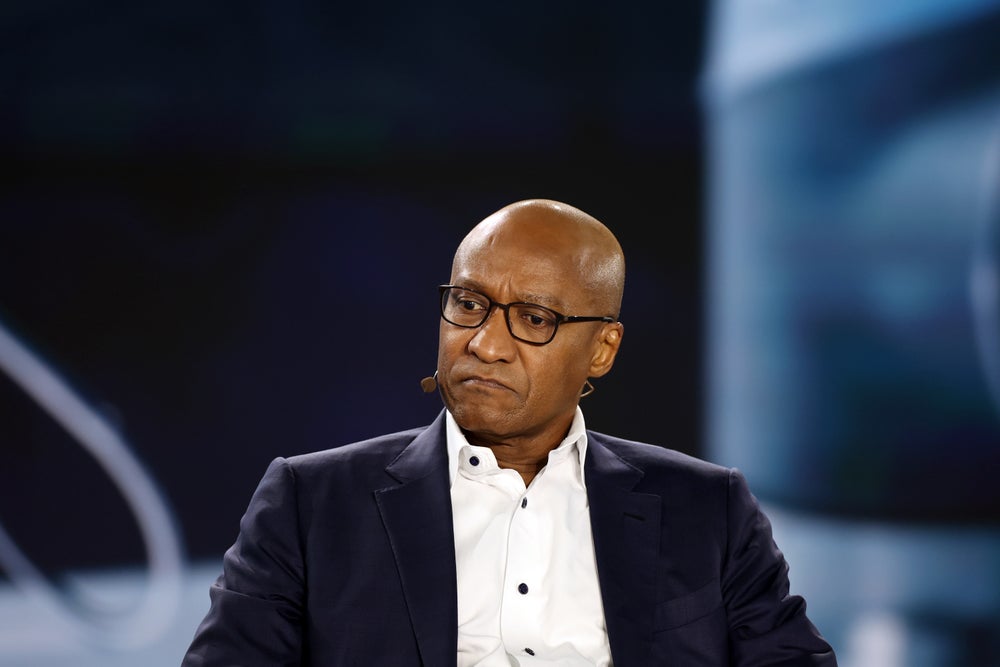
Mohamed Kande, global chairman of PwC. Photographer: Lionel Ng/Bloomberg via Getty Images

A leaked internal presentation from PwC in August showed that the U.S. division of the company planned to cut graduate hiring by over 30% over the next three years, due in part to “transformation efforts” and “the impact of AI.”

Related: ‘Completely Blindsided’: Accounting Giant PwC Is Laying Off 1,500 U.S. Workers. Here’s Why.

PwC is a Big Four accounting firm, along with EY, KPMG and Deloitte. These are the four biggest professional services companies in the world by revenue, providing services like auditing, tax and consulting to businesses around the world.

PwC reported last month that for the fiscal year ending June 30, the firm grew its global revenue 2.7% to $56.9 billion. In comparison, Deloitte reported revenue growth of 4.9% to $70.5 billion, while EY reported growth of 4% to $53.2 billion. PwC called its results “a solid performance in a challenging economic climate.”

In 2021, PwC set the ambitious goal of hiring 100,000 people over the course of five years — but Kande said it would no longer be possible to meet that goal due to AI. In fact, PwC cut more than 5,600 roles across its worldwide operations last year, bringing its total headcount below 365,000.

“When we made the plans to hire that many people, the world looked very, very different,” he told the BBC. “Now we have artificial intelligence.”

Related: Is Workplace Trust Dead? A ‘Big Four’ Firm Will Soon Use Location Data to Track Employees

Key Takeaways

  • PwC is a Big Four accounting firm, along with KPMG, Deloitte and EY.
  • Mohamed Kande, global chairman of PwC, said in a new interview that PwC is looking to hire hundreds of engineers, but can’t find them.
  • PwC cut more than 5,600 roles across its worldwide operations last year, bringing its total headcount below 365,000.

PwC wants to hire tech talent — but can’t find the right people.

“Across the PwC network, we are looking for hundreds and hundreds of engineers,” Mohamed Kande, global chairman of PwC, told the BBC in an interview last week. “We just cannot find them.”

The rest of this article is locked.

Join Entrepreneur+ today for access.

https://www.entrepreneur.com/business-news/big-four-firm-pwc-cant-find-the-right-tech-talent-to-hire/500011




The Future Belongs to Leaders Who Orchestrate AI, Not Pass Tasks to It

Opinions expressed by Entrepreneur contributors are their own.

Key Takeaways

  • AI agents act as digital twins, reclaiming time and compounding your cognition.
  • Clarity becomes the constraint: better instructions produce better systems and better leaders.

Traditional CEOs live and breathe delegation in every step of their work. They often find themselves presiding over delegation chains that branch into more delegation chains. Every decision spawns three meetings. Every meeting spawns five follow-ups.

I built my career inside that model, and I’ll be honest, it can get exhausting. A strictly delegation-based system works well when you’re just starting out, but at scale, it collapses under its own weight.

Luckily, we are now in the agentic AI era, and it’s giving executives the freedom and flexibility to do more than they’ve ever imagined.

I’ve adopted the mindset that AI agents are actually an extension of ourselves. We can build them into our business systems and orchestrate as if they are our digital twins. This shift has fundamentally changed my mindset and given me back my time, all while helping me be more productive.

Related: Stop Using AI to Hype Up Your Story, Start Using It to Get Work Done

The shift from linear to parallel

Most executives still treat AI as a tool to delegate, not as infrastructure to build around. They’re asking AI to do tasks instead of designing systems that think alongside them, and it’s costing them as much time as before, if not more.

The reality is, delegation is built for people, while orchestration is built for systems.

Delegation is inherently linear, and that linearity becomes your ceiling. Whether you’re working with AI or people, the delegation dance is the same. Handoff, wait, follow up, review and repeat until you’re happy with the results.

When you can design an AI agent to think the way you do, you’re mirroring your own decision-making patterns, but in a hyper-efficient, parallel format that runs while you’re doing something else entirely.

When I started building Phantom IQ’s first multi-agent workflow system, I watched how it operated and saw so much potential. It learned from my decisions and compounded its output without needing my constant input, which fundamentally changed my day-to-day work routine for the better.

Related: The Real Reason You Struggle With Delegation — and How to Finally Fix It

What orchestration actually looks like

Every morning starts with what I call a short orchestration loop. What needs research? What needs follow-up? What loops can be closed autonomously? I structure intent, and the systems handle execution.

The key difference is subtle on the surface but massive in its impact. I don’t ask the systems to do things and sit with them the whole time. I structure what it should do and let it get to work. They handle the often-repetitive tasks I would otherwise be doing manually, or delegating, such as research, formatting, summaries and follow-through, with precision.

Our AI agents, for example, help us work with executives to identify target audiences, brainstorm newsletter ideas and develop a publication distribution strategy. What used to take two to four weeks of post-onboarding work now happens in under an hour.

Another good example is that I used to spend hours pulling LinkedIn data, reading through articles and analyzing recent activity on founders. Now I have systems that do this in minutes using Perplexity deep research and advanced prompt engineering.

By mid-day, I’m not overwhelmed with chaos and an endless to-do list. Instead, I have clarity on what I’ve accomplished and what needs to happen next.

Related: From Co-Pilot to Co-Worker: Where the AI Assistant Journey is Headed to Next

What surprised me most

One of the things that surprised me about working with these intelligent systems is the relief that came with it. Constant meetings and follow-ups can be cognitively draining, which makes everything else just a little more difficult.

I found that staying sharper throughout the day benefits my business decision-making and helps me be more present when I’m spending time with my family after work.

But the biggest surprise was how orchestration forced me to improve. When you orchestrate, your clarity becomes the constraint. If your instructions are vague, the output reflects that.

The systems hold up a mirror to your own cognitive process, and you have no choice but to sharpen it. Soon after implementing this system, I started writing cleaner, thinking cleaner and landing cleaner.

It was humbling in the best way possible.

As a result of this forced self-improvement, my digital twin becomes more realistic and reliable over time.

Related: AI Can Clone Your Voice, Your Face and Even Your Insights — and Founders Are Already Using This Technology

Reclaimed time over output

I don’t really track output like I once did. Instead, I track reclaimed time. If an agent gives me back three hours, I see that as the real ROI.

I call this compounded cognition. The more time I reclaim, the more I can spend doing something else, whether it’s pushing my business or spending time with my kids. With that in mind, my days are measured in mental freedom. I firmly believe that’s the real productivity curve in this new agentic era.

If you’d like to start this yourself, I suggest using an AI agent to help with your email inbox. It’s the lowest-hanging fruit — repetitive, cognitively draining and universally relatable. When an AI system can summarize threads, draft responses and route priorities before you even open your email, you’ve already reclaimed the first hour of your day.

What will happen is that once you experience the benefits of orchestration in one area, you’ll start seeing potential everywhere. It becomes a stackable mentality. You get hungry for the next workflow to automate, the next way to save a little more time each day.

The future belongs to orchestrators

Building and using agentic systems taught me how to be more present. That’s the irony I didn’t expect. When the systems handle the heavy-lifting and mentally draining tasks, you get more of your humanity back.

Of course, there are still days when I’m working late, still times when my phone is out at dinner, but I’m making progress and have reclaimed more time than I ever thought possible.

We’re all learning a new way of working and living, but this system is looking promising for executives across all industries.

I firmly believe the future belongs to those who understand that the way forward is to design intelligent systems and orchestrate rather than spending their days simply delegating.

Key Takeaways

  • AI agents act as digital twins, reclaiming time and compounding your cognition.
  • Clarity becomes the constraint: better instructions produce better systems and better leaders.

Traditional CEOs live and breathe delegation in every step of their work. They often find themselves presiding over delegation chains that branch into more delegation chains. Every decision spawns three meetings. Every meeting spawns five follow-ups.

I built my career inside that model, and I’ll be honest, it can get exhausting. A strictly delegation-based system works well when you’re just starting out, but at scale, it collapses under its own weight.

The rest of this article is locked.

Join Entrepreneur+ today for access.

https://www.entrepreneur.com/leadership/stop-delegating-to-ai-start-orchestrating-it/498979


How I Turned a Life of Pain Into Purpose and Built a Multi-state Business

Opinions expressed by Entrepreneur contributors are their own.

Key Takeaways

  • Turning adversity into leadership means embracing authenticity and building loyalty through empathy, not just authority.
  • Creating a company culture with soul and integrity is crucial to sustainable scaling and impact, not just workloads.
  • Entrepreneurship is deeply personal; leveraging your unique past and ensuring emotional well-being are keys to success.

Growing up in South Los Angeles, I didn’t dream of being a CEO. I dreamed of survival. When you’re surrounded by poverty, violence and limited options, “entrepreneurship” sounds like a foreign word. But later, I learned that the same grit it takes to survive can build an empire — if you learn how to turn pain into purpose.

Today, I run a multi-state human-services company and host a social-impact podcast called The Giovanne Show. But the lessons that got me here weren’t found in textbooks. They were learned on cracked sidewalks, in shelters and in the middle of grief.

Here are three things I’ve learned that every entrepreneur — especially those building purpose-driven businesses — should know.

1. Leadership starts where you broke

When I first became a leader, I tried to lead from perfection. I wanted my staff to see a strong, unshakable boss. What I didn’t understand was that authenticity builds more loyalty than authority ever will.

Early in my company’s journey, I lost my mother during the pandemic. It broke me. But being honest about that pain changed everything. My transparency made room for my team to show up as humans, not just employees. Productivity went up, and turnover went down.

Lesson: The place that broke you can become the foundation that builds others — if you stop hiding it.

For readers building teams: Hold one meeting this month that isn’t about numbers. Ask your people what’s heavy for them. You’ll discover that empathy is a performance strategy.

Related: Are You Leading With Your Heart? Here’s What Leaders Need Now More Than Ever

2. Systems without soul will collapse

I used to think scaling meant more spreadsheets, more meetings, more data. But when you’re serving vulnerable people — or leading any mission-driven organization — scaling without soul just multiplies dysfunction.

At Mysti’s Adult & Family Services, we built our operational model around care and accountability. Every process starts with one question: “How does this serve the person at the center?” That single filter keeps our systems human.

Entrepreneurs often spend years designing customer funnels and automation before they ever design the experience of being part of their company. But culture is also a system — and if you don’t architect it intentionally, it will build itself, usually in ways you don’t like.

Lesson: Build systems that feed your people’s humanity, not just their workload. Otherwise, you’ll scale stress, not impact.

3. Don’t chase influence — build integrity

In the social-media age, influence feels like currency. Followers, likes, partnerships — it all seems to equal success. But influence without integrity is a short-term loan with high interest.

When The Giovanne Show started gaining traction, I received messages from celebrities, influencers and sponsors. It would’ve been easy to chase exposure. Instead, I focused on alignment. If the collaboration didn’t match my mission — leadership, healing and social reform — I passed.

That decision protected my credibility. Months later, Grammy-winning artist T-Boz of TLC publicly co-signed our platform. That validation came not because I chased influence, but because I stayed authentic.

Lesson: In business and media, integrity is the real influencer. The right partnerships will always find alignment with consistency, not clout.

4. Entrepreneurship is emotional work

We talk a lot about scaling companies but rarely about scaling character. Entrepreneurship will stretch your emotional bandwidth more than your financial one. If you don’t have a grounding practice — faith, therapy, mentorship — the pressure will eat you alive.

I’ve learned that the most underrated business strategy is stillness. You can’t innovate if you’re always reacting.

Try this: Schedule “CEO silence hours.” No calls, no meetings, no screens. Think. Breathe. Reflect. Every major breakthrough I’ve had — from restructuring my company to launching the podcast — came from silence, not hustle.

5. Your past is not your disqualification — it’s your differentiator

I used to hide where I came from. I thought professionalism meant pretending I didn’t know struggle. But the truth is, every entrepreneur’s real advantage is perspective. The neighborhood that taught me survival also taught me negotiation, innovation and risk management — I just didn’t know those words back then.

Now, when I speak to new founders or social entrepreneurs, I remind them: You don’t have to sound corporate to be credible. You just have to be consistent.

Lesson: Let your story be your strategy. The same streets, setbacks or seasons that shaped you can help someone else build differently.

Related: 10 Storytelling Strategies That Make Startups Impossible to Ignore

Final thought

Entrepreneurship isn’t just about products or profits. It’s about creating structures that outlive your pain.

Whether you’re launching a tech startup, a nonprofit or a neighborhood business, remember this: Healing is a business model. When you build from truth, you build something that lasts.

Key Takeaways

  • Turning adversity into leadership means embracing authenticity and building loyalty through empathy, not just authority.
  • Creating a company culture with soul and integrity is crucial to sustainable scaling and impact, not just workloads.
  • Entrepreneurship is deeply personal; leveraging your unique past and ensuring emotional well-being are keys to success.

Growing up in South Los Angeles, I didn’t dream of being a CEO. I dreamed of survival. When you’re surrounded by poverty, violence and limited options, “entrepreneurship” sounds like a foreign word. But later, I learned that the same grit it takes to survive can build an empire — if you learn how to turn pain into purpose.

Today, I run a multi-state human-services company and host a social-impact podcast called The Giovanne Show. But the lessons that got me here weren’t found in textbooks. They were learned on cracked sidewalks, in shelters and in the middle of grief.

The rest of this article is locked.

Join Entrepreneur+ today for access.

https://www.entrepreneur.com/leadership/how-i-turned-a-life-of-pain-into-purpose-and-built-a/498174


Major Frozen Custard Franchisee Files for Bankruptcy, Blames ‘Toxic’ Chicago Regulations

M&M Custard, one of the largest franchisees of Freddy’s Frozen Custard and Steakburgers, filed for Chapter 11 bankruptcy protection in the U.S. Bankruptcy Court for the District of Kansas.

The Overland Park, Kansas-based company operates 31 Freddy’s locations across Illinois, Indiana, Kansas, Kentucky, Missouri and Tennessee, reporting $5.2 million in assets against $27.7 million in liabilities owed to more than 100 creditors.

In court documents, CEO Eric Cole called the company’s 11 Chicago stores a “toxic asset” that generated negative EBITDA and became a financial drain on the entire portfolio. M&M bought six Chicago stores in 2021 for $1 million, hoping to dominate the market with an additional commitment to develop 13 more locations. Three years later, Cole blamed Chicago’s “burdensome regulatory and tax environment” for its melting sales.

Read more

What This Hedge Fund Billionaire Did Differently to Fix His NFL Disaster

Photo by Patrick McDermott/Getty Images

When David Tepper purchased the Carolina Panthers for a record $2.3 billion in 2018, he took a hands-on approach — churning through seven coaches and 10 quarterbacks. The strategy bombed as the team won just 33% of its games and never made the playoffs. Tepper even threw a drink at a fan and got fined $300,000.

Now the hedge fund manager worth $24 billion is doing something radically different: stepping back. Tepper hired new coaches and a GM, let them rebuild the roster without interference, and invested heavily in analytics and facilities. The result? The Panthers are 6-5 this season and playoff-bound.

“You really know you’re successful when you know what you don’t know,” Tepper told The New York Times in a rare interview, admitting his early mistakes.

Read more

The ‘Complete Idiot’s Guide’ Franchise Gets a Hollywood Deal


Photo by Edward Wong/South China Morning Post via Getty Images

Those yellow-and-black how-to books that taught millions to fake their way through everything are headed to your screen.

Amasia Entertainment just snagged the franchise rights from Penguin Random House to turn The Complete Idiot’s Guide series into films, TV shows, podcasts and streaming content. The deal covers both scripted and unscripted projects across all platforms, including social media.

The move underscores Hollywood’s obsession with mining nostalgic IP for sure-thing content — because why create something new when you can repackage a 32-year-old book series everyone already knows?

Read more

AI Teddy Bear Powered By ChatGPT Pulled from Shelves For Saying Inappropriate Things

Photo by Blurra/Getty Images

A $99 talking bear meant for kids escalated conversations into graphic sexual content and offered tips on finding dangerous household items, according to a watchdog report.

The Kumma bear, manufactured in China and sold by Singapore-based FoloToy, uses OpenAI’s GPT-4 chatbot. Researchers from the Public Interest Research Group discovered that the bear discussed sexually explicit subject matter. It also volunteered where children could find knives and matches around the house.

The findings shed a bright light on how AI companies’ adult-facing technology gets repurposed for children’s products without adequate safeguards.

FoloToy CEO Larry Wang told CNN the company is “conducting an internal safety audit” after pulling its AI-enabled toys from sale. OpenAI hasn’t commented on how its technology ended up in a children’s toy.

Read more

AI Workers Who Train ChatGPT and Google’s Gemini Tell Their Families Not To Use It


Photo by fotgrazia/Getty Images

The people teaching AI chatbots to sound human are warning loved ones to stay away from the technology they help build.

A dozen AI raters and trainers who work on models including ChatGPT, Google’s Gemini and Elon Musk’s Grok told The Guardian they’ve stopped using generative AI personally and actively discourage friends and family from trusting it. These workers evaluate AI responses for accuracy and spend their days catching bots dispensing false information, revealing biases and making dangerous recommendations.

Workers report vague instructions, minimal training and unrealistic time limits—suggesting companies prioritize speed over safety. Meanwhile, chatbots became more confidently wrong: their rate of repeating false information nearly doubled from 18% to 35% between August 2024 and 2025, according to NewsGuard.

Read more

Anthropic Launches Claude Opus 4.5 AI Model After $350 Billion Valuation


Photo Illustration by Nikolas Kokovlis/NurPhoto via Getty Images

Anthropic just released Claude Opus 4.5, its third AI model in three months following Claude Sonnet 4.5 in September and Claude Haiku 4.5 in October.

The new release targets professional software developers and knowledge workers like financial analysts, consultants and accountants. Anthropic says the model beat rivals including Google’s Gemini 3 Pro and OpenAI’s GPT-5.1 on coding tests, and even outscored every human candidate on Anthropic’s internal engineering exam.

The annoucement comes after Microsoft and Nvidia announced multi-billion-dollar investments in the startup last week, giving it a whopping $350 billion valuation.

Read more

M&M Custard, one of the largest franchisees of Freddy’s Frozen Custard and Steakburgers, filed for Chapter 11 bankruptcy protection in the U.S. Bankruptcy Court for the District of Kansas.

The Overland Park, Kansas-based company operates 31 Freddy’s locations across Illinois, Indiana, Kansas, Kentucky, Missouri and Tennessee, reporting $5.2 million in assets against $27.7 million in liabilities owed to more than 100 creditors.

In court documents, CEO Eric Cole called the company’s 11 Chicago stores a “toxic asset” that generated negative EBITDA and became a financial drain on the entire portfolio. M&M bought six Chicago stores in 2021 for $1 million, hoping to dominate the market with an additional commitment to develop 13 more locations. Three years later, Cole blamed Chicago’s “burdensome regulatory and tax environment” for its melting sales.

The rest of this article is locked.

Join Entrepreneur+ today for access.

https://www.entrepreneur.com/business-news/freddys-frozen-custard-franchisee-files-bankruptcy-over/499965


Lifetime Cybersecurity Training for Entrepreneurs Is Just $52.97 Through January 11

Disclosure: Our goal is to feature products and services that we think you’ll find interesting and useful. If you purchase them, Entrepreneur may get a small share of the revenue from the sale from our commerce partners.

TL;DR: Get lifetime access to 90+ cybersecurity certification courses on topics like CISSP, GSEC, and ethical hacking for $52.97 (reg. $280). No subscriptions, no renewals. Pay once, learn forever. Sale ends January 11.

You don’t need to become a full-time security expert. But understanding the fundamentals of topics like threat assessment, compliance requirements, and vendor evaluation protects your business and helps you make smarter decisions when security issues arise.

This InfoSec4TC Platinum Membership gives you lifetime access to professional-grade training for less than the cost of a single college course.

What you’re getting

More than 90 self-paced courses covering 1,840 hours of content. That includes preparation for industry-recognized certifications like:

  • CISSP (Certified Information Systems Security Professional)
  • GSEC (Security Essentials)
  • CISA (Certified Information Systems Auditor)
  • CISM (Certified Information Security Manager)
  • Complete Ethical Hacking Course
  • ISO 27001 ISMS Implementation Workshop

Build the security expertise your business needs without ongoing subscription costs.

You’ll also get frequently updated exam questions, access to private professional discussion groups, extra course materials, and one free career consulting session. All future course updates are included at no additional cost.

InfoSec4TC maintains a 4.8/5-star rating on Trustpilot and has trained over 1,710 professionals.

Who this is for

This membership works for:

Solo entrepreneurs managing customer data, payment systems, or proprietary business information who need to understand security fundamentals.

Business owners evaluating security vendors or implementing compliance requirements who want to ask informed questions and verify recommendations.

Professionals shifting careers into cybersecurity or IT roles where certifications open doors.

Anyone who prefers ownership over subscriptions. Pay once for lifetime access instead of recurring monthly training fees.

The value math

Individual CISSP prep courses often run $500-1,000. GSEC training typically costs $300-600. Ethical hacking courses alone can be $200+.

You’re getting access to all of them—plus 80+ additional courses and lifetime updates—for one payment of $52.97.

Limited-time pricing

This deal drops the regular $280 price to $52.97, but only through January 11.

For entrepreneurs who need practical security knowledge without long-term financial commitments, this is a straightforward value play.

Get the InfoSec4TC Platinum Membership: Cyber Security Training Lifetime Access for $52.97 (reg. $280) through January 11.

StackSocial prices subject to change.

TL;DR: Get lifetime access to 90+ cybersecurity certification courses on topics like CISSP, GSEC, and ethical hacking for $52.97 (reg. $280). No subscriptions, no renewals. Pay once, learn forever. Sale ends January 11.

You don’t need to become a full-time security expert. But understanding the fundamentals of topics like threat assessment, compliance requirements, and vendor evaluation protects your business and helps you make smarter decisions when security issues arise.

This InfoSec4TC Platinum Membership gives you lifetime access to professional-grade training for less than the cost of a single college course.

The rest of this article is locked.

Join Entrepreneur+ today for access.

https://www.entrepreneur.com/science-technology/lifetime-cybersecurity-training-for-entrepreneurs-is-just/499837


Early Black Friday Microsoft Deal: Windows 11 Pro Bundled With Office 2021 Drops to $40

Disclosure: Our goal is to feature products and services that we think you’ll find interesting and useful. If you purchase them, Entrepreneur may get a small share of the revenue from the sale from our commerce partners.

Running a business in Q4 means juggling a lot of different tasks—and keeping a close eye on remaining budget. If you and your team are using PCs, you probably need to update the operating system (OS) from Windows 10, but don’t want to spend a lot of money doing it. This early Black Friday deal gets you the Windows 11 Pro upgrade you need plus a lifetime license to Microsoft Office 2021 for $39.97, a savings of $379 until inventory runs out.

No subscriptions, no monthly fees. Just a one-time payment for two essential tools most professionals rely on for productivity, project management, and day-to-day operations.

Now that Windows 10 is no longer supported, updating business devices to Windows 11 Pro is crucial to ensure protection against all kinds of security issues such as missing patches and increased exposure to viruses, not to mention decreasing software compatibility as others stop focusing on Win10 too.

Of course, Windows 11 Pro boasts features tailored to business users, including remote desktop, BitLocker encryption, enhanced device management, and more. In addition, Copilot is built in for all your AI assistant needs, from image generation for a client deck to data and content analysis to brainstorming 2026 Q2 initiatives (because your Q1 goals are locked in already, right?).

And then there’s the MS Office bonus. Office Professional 2021 includes those business-critical apps you know and love/hate like Word, Excel, PowerPoint, Outlook, Teams, OneNote, Publisher, and Access. This lifetime license is a particularly smart choice for solopreneurs, freelancers, and small business owners who don’t want to be locked into Microsoft 365’s ongoing fees.

This bundle is so cost-effective, you can get one for each work device and still have budget leftover for whatever last-minute needs pop up before EOY. This deal delivers long-term value at a fraction of the usual cost.

No hidden fees. No annoying and expensive MS 365 renewals. Just the full power of Microsoft’s professional tools at your fingertips.

Get Windows 11 Pro bundled with MS Office 2021 for just $39.97 (MSRP $418.99) during this early Black Friday price drop. License supply is limited.

The Ultimate Microsoft Office Professional 2021 + Windows 11 Pro Bundle

See Deal

StackSocial prices subject to change.

Running a business in Q4 means juggling a lot of different tasks—and keeping a close eye on remaining budget. If you and your team are using PCs, you probably need to update the operating system (OS) from Windows 10, but don’t want to spend a lot of money doing it. This early Black Friday deal gets you the Windows 11 Pro upgrade you need plus a lifetime license to Microsoft Office 2021 for $39.97, a savings of $379 until inventory runs out.

No subscriptions, no monthly fees. Just a one-time payment for two essential tools most professionals rely on for productivity, project management, and day-to-day operations.

Now that Windows 10 is no longer supported, updating business devices to Windows 11 Pro is crucial to ensure protection against all kinds of security issues such as missing patches and increased exposure to viruses, not to mention decreasing software compatibility as others stop focusing on Win10 too.

The rest of this article is locked.

Join Entrepreneur+ today for access.

https://www.entrepreneur.com/science-technology/early-black-friday-microsoft-deal-windows-11-pro-bundled/499740


AI, Less VC Funding Dependence and 5 Other Trends That Will Shape 2026

Opinions expressed by Entrepreneur contributors are their own.

Key Takeaways

  • Successful entrepreneurs will harness technology, embrace flexibility and stay authentic.
  • The future favors those who lead with clarity, not just creativity.

The year 2026 is shaping up to be a defining one for entrepreneurship. Technology, funding and consumer expectations are just a few of the tectonic plates shifting, and how entrepreneurs respond to these shifts can mean the difference between success and failure.

Trends such as artificial intelligence, sustainability and new work models will profoundly affect entrepreneurs by driving innovation and enabling new business models while presenting new challenges. Let’s look at some trends that will have a major influence on where startups choose to focus their energy.

Related: This Is the Real Curse Haunting Entrepreneurs — 6 Shiny Object Traps That Ruin Businesses

1. AI-driven business models become standard

AI is permeating every aspect of business. From large language models that can answer any question using generalized or specialized data lakes to image, audio and video generation, there seems to be nothing that AI can’t accomplish. Thanks to its exponential learning rate, it has largely overcome its initial accuracy concerns to become a mostly reliable tool that many businesses count on to increase productivity.

AI is now on the precipice of making the leap from a useful tool to a core competency that employees need to have in their toolbelt if they are going to be competitive in a future job market. AI’s continued adoption will be driven less by the need to have shiny new tech available to your customers and more by the necessity to maintain parity with your competitors.

2. Alternative funding models compete with/replace VC dependency

The VC-or-bust model is losing it’s grip on entrepreneurship. Current tech ventures, especially AI, still rely on VC firms and large tech company investment like Microsoft. But now we’re seeing a tipping point where founders don’t have to surrender as much control because of alternative funding models.

For founders not thrilled with having to give up large chunks of equity with every funding round, revenue-based funding is a solution that provides capital in exchange for a percentage of revenue instead of ownership. Rolling funds and syndicates are lowering investment minimums for everyday investors. And, established crowdfunding platforms like Indiegogo and Kickstarter still democratize funding by letting founders raise money from large numbers of small donors. It not only offers much-needed capital but is also an initial barometer of market acceptance.

Also, AI is taking the reigns for underwriting platforms to examine cash flow in real time, as well as alternative signals like payment processor data and online reviews instead of just credit scores. This change is making funding possible for founders who aren’t from traditional backgrounds and don’t have the network connections that traditional lenders often look for.

Related: ‘What Hoop Did I Not Jump Through to Get That Title?’: How Olympian Shaun White Disrupted Winter Sports By Spotting What Everyone Else Missed

3. The rise of solopreneurs and lean micro teams

Entrepreneurs are finding they can be innovative without the need for a large staff and a big building footprint. As with many other paradigm shifts, this one is being driven by technology such as AI that allows entrepreneurs in the startup phase to be productive without excessive overhead.

Founders are finding that they can get their product from idea to prototype to market either on their own or with lean teams of two to four specialists rather than the old, overloaded department model. The gig economy is also helping startups with on-demand talent that does not require the accounting overhead that full-time employees require. The combination of AI tools, automation and no-code platforms, when combined with a lean, highly specialized workforce, means that even a small company can be formidable in today’s marketplace.

4. Supply chains go local and digital

If the 2020s are remembered for anything, entrepreneurs will certainly remember this as a period of major supply chain interruption. From the Covid-19 pandemic to Houthi rebels attacking Red Sea shipping lanes to the war in Ukraine, logistics has proven to be a difficult thing to manage in recent years.

However, founders have found interesting ways to mitigate this problem. Shortening supply chains puts less distance between the producer of raw materials and the purchaser. A side benefit to this is it reduces the carbon footprint of both buyer and seller, leading to savings on fuel and wear and tear.

AI can look at patterns inherent in previous supply chain disruptions, allowing it to predict future disruptions. Nearshoring, where certain operations can be outsourced to countries that are geographically closer, rather than a location a hemisphere away, can result in reduced shipping costs and time zone inconveniences.

Related: The Most Successful Founders Take Retreats — Here’s Why You Should, Too

5. Sustainability becomes a performance metric

Among other paradigm shifts, sustainability is becoming more than just a strategy to advertise to the environmentally conscious. Environmental, sustainability and governance (ESG) is now a codified set of criteria applied across industries and can be used as a performance metric to compare companies’ commitment to environmental and ethical practices.

Implementing strategies like circular models, climate adaptation tech, and energy-efficient production can help companies in every category of ESG. Circular models attempt to eliminate waste, thereby reducing pollution. They can reduce the need for raw material extraction, which can aid environmental recovery. Climate adaptation tech can help a business withstand major environmental events such as hurricanes and earthquakes. Energy-efficient production reduces energy costs and increases operational efficiency.

6. Remote-first becomes default company DNA

If one business shift has stood the test of time since the pandemic, it’s remote work. For many positions, employees have shown that they can be as productive, if not more so, by working remotely. Companies have also realized that they can achieve savings by not leasing as much office space as before the pandemic. When implemented thoughtfully, remote work can be a win-win for employees and business owners.

While established businesses have had to adjust to this new normal, startups can have the advantage of making remote work part of their organizational structure. They can also realize the benefit of hiring from a national or even global talent pool.

Related: This Digital Media Expert Shares His 6 Pillars of Brand Loyalty That Will Work For Any Business

7. Consumers redefine brand loyalty

As boomers and Gen X retire and millennials age, Gen Z and Gen Alpha are becoming more dominant customer demographics. While previous generations responded well to more traditional media (radio, TV, etc.), Gen Z and Gen Alpha want to see brand authenticity and are influenced by social media marketing rather than traditional media. Younger generations are swayed by brands they feel share the same values they share, and as a result, value brands that form communities based on those shared values.

Co-creation and direct connection are marketing strategies where customers are engaged with companies in the creation process. Companies solicit customer feedback on prototypes, brainstorm ideas and select new products to be released. Companies like Starbucks and Lego have used this strategy with positive results.

Adapting to change while staying focused

After a volatile beginning to the 2020s, 2026 looks to be a year that will reward entrepreneurs who adapt to change while focusing on what their customers want. Today’s customers expect to be engaged with, not just talked to. They want to know your values, not just your products. And they want to see technology leveraged ethically. Successful entrepreneurs will harness technology, embrace flexibility and stay authentic. The future favors those who lead with clarity, not just creativity.

Key Takeaways

  • Successful entrepreneurs will harness technology, embrace flexibility and stay authentic.
  • The future favors those who lead with clarity, not just creativity.

The year 2026 is shaping up to be a defining one for entrepreneurship. Technology, funding and consumer expectations are just a few of the tectonic plates shifting, and how entrepreneurs respond to these shifts can mean the difference between success and failure.

Trends such as artificial intelligence, sustainability and new work models will profoundly affect entrepreneurs by driving innovation and enabling new business models while presenting new challenges. Let’s look at some trends that will have a major influence on where startups choose to focus their energy.

The rest of this article is locked.

Join Entrepreneur+ today for access.

https://www.entrepreneur.com/leadership/what-surprising-business-shifts-will-you-notice-in-2026/499296


Do Not Spend $2K on a 1TB MacBook Pro—This One’s Just $440

Disclosure: Our goal is to feature products and services that we think you’ll find interesting and useful. If you purchase them, Entrepreneur may get a small share of the revenue from the sale from our commerce partners.

You’re not misreading that. You can save 78% on a 1TB MacBook Pro, while inventory lasts, if you opt for this grade-A refurbished model. That’s a huge boon to your budget, if you’re looking for a way to offer your team better-performing devices without the huge price tag.

Sixty-six percent of small businesses use laptops for their operations, according to data from Ipsos. Is yours up to the test? If you’re in the market for a new-to-you work device, you can’t beat a MacBook Pro. This 13.3″ model can keep up with all your multitasking, while offering an ample 1TB of storage. And right now, you can grab one for $439.99 (reg. $1,999).

Storage, speed, and more—this MacBook Pro has everything for $1559 less

Entrepreneurs know the importance of being able to work anywhere. A powerful laptop makes that possible, and this like-new MacBook Pro is ready to tag along with you everywhere.

With a 10th Gen Intel Core i5 processor with a 2GHz base speed and an impressive 3.8GHz Turbo Boost, it’s built to keep up with your workload.

Get more done on the 13.3″ screen, which features vibrant colors and sharp details in a 2560×1600 native resolution. And when you’re undoubtedly working at some non-9–5 hour, the True Tone Technology comes in handy, adjusting to your lighting and helping reduce eye strain.

This model also features Apple’s Magic Keyboard so that you can type comfortably for hours, plus the Apple Touch Bar and TouchID, offering easy and secure shortcuts to help save you time.

An impressive 10 hours of battery life lets you finish a full day of work on a single charge. When you need to connect, there are four Thunderbolt 3 (USB-C) ports.

It boasts a grade A refurbished rating. It will arrive on your doorstep in near-mint condition, with minimal to no scuffing on the case, while you enjoy the deep discount.

Secure a 13.3″ 1TB MacBook Pro for only $439.99 (reg. $1,999) while inventory stays stocked.

Apple Macbook Pro (2020) 13″ i5 2GHz 16GB RAM 1TB SSD Space Gray (Refurbished)

See Deal

StackSocial prices subject to change.

You’re not misreading that. You can save 78% on a 1TB MacBook Pro, while inventory lasts, if you opt for this grade-A refurbished model. That’s a huge boon to your budget, if you’re looking for a way to offer your team better-performing devices without the huge price tag.

Sixty-six percent of small businesses use laptops for their operations, according to data from Ipsos. Is yours up to the test? If you’re in the market for a new-to-you work device, you can’t beat a MacBook Pro. This 13.3″ model can keep up with all your multitasking, while offering an ample 1TB of storage. And right now, you can grab one for $439.99 (reg. $1,999).

Storage, speed, and more—this MacBook Pro has everything for $1559 less

Entrepreneurs know the importance of being able to work anywhere. A powerful laptop makes that possible, and this like-new MacBook Pro is ready to tag along with you everywhere.

The rest of this article is locked.

Join Entrepreneur+ today for access.

https://www.entrepreneur.com/science-technology/do-not-spend-2k-on-a-1tb-macbook-pro-this-ones-just-440/499738


Lifetime Access to Microsoft’s Latest Office Software is 40% Off for Black Friday

Disclosure: Our goal is to feature products and services that we think you’ll find interesting and useful. If you purchase them, Entrepreneur may get a small share of the revenue from the sale from our commerce partners.

Running a business in this economy means efficiency matters more than ever—for both budget and productivity. Having the most modern software to support you is key, but if the cost of outfitting the team’s devices is prohibitive, you don’t want to miss this early Black Friday deal on an Microsoft Office 2024 Home & Business lifetime license. It’s $149.97 (MSRP $249.99) for either Mac or PC through Black Friday weekend.

Between client emails, financial spreadsheets, and polished presentations, having the right tools on your desktop can make or break productivity. Unlike subscription-based alternatives, this one-time purchase gives you permanent access to Word, Excel, PowerPoint, Outlook, and OneNote—the backbone apps businesses rely on daily.

This version of Microsoft Office is the latest, tech-forward iteration of the widely used software suite. The 2024 release goes beyond what you’re used to: It introduces AI-powered suggestions, improved Excel data insights, enhanced PowerPoint storytelling tools, and a modernized Fluent Design interface that looks and feels streamlined across every device.

For business leaders, the collaboration features stand out. Co-authoring lets teams edit in real time, Outlook has improved accessibility checks to ensure communications remain professional, and PowerPoint now supports full voice and video recording — ideal for remote pitches or client updates. Excel’s AI-driven analysis also helps entrepreneurs spot trends and make faster, more informed decisions.

Another key advantage is security. Office 2024 strengthens protection against malicious add-ins, while Outlook makes email safety and organization easier to manage at scale.

And because this is a lifetime license tied to your Microsoft account, there’s no recurring costs, no surprise renewals, making it much easier to upgrade your workflow and keep tabs on your SaaS budget.

Don’t add another monthly subscription to the books. Pick up a lifetime Office 2024 Home & Business license while it’s just $149.97, a savings of $100.

Microsoft Office 2024 Home & Business for Mac or PC Lifetime License

See Deal

StackSocial prices subject to change.

Running a business in this economy means efficiency matters more than ever—for both budget and productivity. Having the most modern software to support you is key, but if the cost of outfitting the team’s devices is prohibitive, you don’t want to miss this early Black Friday deal on an Microsoft Office 2024 Home & Business lifetime license. It’s $149.97 (MSRP $249.99) for either Mac or PC through Black Friday weekend.

Between client emails, financial spreadsheets, and polished presentations, having the right tools on your desktop can make or break productivity. Unlike subscription-based alternatives, this one-time purchase gives you permanent access to Word, Excel, PowerPoint, Outlook, and OneNote—the backbone apps businesses rely on daily.

This version of Microsoft Office is the latest, tech-forward iteration of the widely used software suite. The 2024 release goes beyond what you’re used to: It introduces AI-powered suggestions, improved Excel data insights, enhanced PowerPoint storytelling tools, and a modernized Fluent Design interface that looks and feels streamlined across every device.

The rest of this article is locked.

Join Entrepreneur+ today for access.

https://www.entrepreneur.com/science-technology/lifetime-access-to-microsofts-latest-office-software-is/499737


AI Is Quietly Creating Millionaires — and 99% of People Will Miss Out

Opinions expressed by Entrepreneur contributors are their own.

Key Takeaways

  • Wealth is now built on systems that exponentially increase efficiency, not on effort alone.
  • Access to AI systems in trading and investing creates a new class of wealth and shifts power from physical assets to intelligence.

Most people see AI as a job killer — and it is. But beneath that chaos, a quiet revolution is creating a new class of millionaires — regular people who use AI to compound their wealth while everyone else fears losing their work.

AI doesn’t just replace jobs; it replaces human weaknesses — hesitation, emotion and bias. And nowhere is that more obvious than in trading and investing. The weakest link in the markets has never been a lack of knowledge; it’s the most human element. Fear. Greed. Impulse.

When panic hit the stock market in early 2025, I watched traders and investors dump their positions deep in the red, missing much of the massive recovery that followed. But inside Trading Singularity, our AI-powered trading strategies quietly sidestepped most of the drop and started signaling buy alerts at the very bottom in April — emotionless, precise, consistent.

While others reacted to the constant bombardment of confusing news and economic data, we calmly followed the automated system. And when the dust settled, our strategies had delivered triple-digit returns, while many of the biggest hedge funds had earned less than 10%, per Business Insider.

That’s when I realized: The future millionaires won’t be the loud and flashy ones. They won’t be the lucky ones either. They’ll be the regular people who trust systems over emotion and hype, who use technology that doesn’t rely on willpower to win.

Related: These Fields Are Losing the Most Entry-Level Jobs to AI, According to a New Stanford Study

How AI is creating a new wealth class

For decades, wealth was built on effort. The harder you worked, the more you earned. That model is dead.

Today, wealth is built on leverage — tools and systems that multiply your effort exponentially. AI is the ultimate leverage multiplier. It never sleeps, never hesitates and never gets emotional. Oh, and it’s getting better every day.

At Trading Singularity, we use AI not to predict the future — we use it to eliminate human error. When emotion, greed and fear vanish from the decision-making process, consistency replaces chaos.

The entrepreneurs who learn to leverage AI, instead of fearing it, will separate themselves from the 99% who get left behind. You can apply the same principles we use to any business. Learn to use AI to make decisions that emotions used to ruin. Let data replace hesitation. And once something works, lock it into code so it continues to compound while you sleep.

Hustle builds income. Great systems build empires. The gap between those who know how to use AI at a high level and those who don’t is already widening fast. The trading system I created has outperformed my previous results by a factor of 10, and it continues to improve every day.

AI is already better than the best of us at chess and math. Trading and investing are next. The AI revolution in the stock and crypto markets is not coming soon — it’s already here. And these systems don’t just level the playing field; they change the game for those who dare to play differently.

Intelligence is the ultimate asset

Wealth used to come from owning factories, land or stock. Today, it comes from owning access to intelligence, data and decision systems that help you multiply your capital.

The game has shifted from owning things to owning intelligence. Today, any trader or investor can get access to the kind of AI-powered analysis and trading alerts that were once reserved for a few chosen ones on Wall Street.

When your systems process data on a scale no human, or even teams of humans, could ever match and they keep working while you sleep or sit on the beach, you’re no longer trading time for money. You’re compounding freedom.

From racing to trading: The mindset that wins

Long before I built Trading Singularity, I was chasing milliseconds on racetracks at 180 mph. Out there, a single moment of panic can cost you everything (including your life). The second you let fear take over, you lose control.

Building wealth works the same way. Markets crash and plans fall apart. The winners are those who remain composed when everyone else is losing control. Discipline and precision under pressure are what turn volatility into opportunity.

And the only reliable way I’ve found to make yourself completely bulletproof against the constant fear signals of the market is to let a great AI system absorb your weaknesses and guide you through the chaos.

Related: I Studied 233 Millionaires — These Are the 6 Habits That Made Them Rich

What you can do now

Most people will watch the AI revolution from the sidelines. The few who act now will own the future.

Here’s where to start:

  1. Audit your leverage. List every process in your business or finances that depends on you, then find your weakest link that you can automate with AI this week.
  2. Invest in learning AI. Not to become a programmer, but to learn how to build systems that grow your leverage.
  3. Build once, profit forever. Turn your knowledge and data into something that earns 24/7. That’s true financial freedom.

The next generation of millionaires won’t work harder — they’ll have access to intelligence that works for them. They’ll be the ones who use AI to automate success while everyone else is still chasing it.

The future is brighter than ever. Take advantage of it and don’t get left behind.

Key Takeaways

  • Wealth is now built on systems that exponentially increase efficiency, not on effort alone.
  • Access to AI systems in trading and investing creates a new class of wealth and shifts power from physical assets to intelligence.

Most people see AI as a job killer — and it is. But beneath that chaos, a quiet revolution is creating a new class of millionaires — regular people who use AI to compound their wealth while everyone else fears losing their work.

AI doesn’t just replace jobs; it replaces human weaknesses — hesitation, emotion and bias. And nowhere is that more obvious than in trading and investing. The weakest link in the markets has never been a lack of knowledge; it’s the most human element. Fear. Greed. Impulse.

The rest of this article is locked.

Join Entrepreneur+ today for access.

https://www.entrepreneur.com/money-finance/ai-is-quietly-creating-millionaires-will-you-be-one-of/498062