Coronavirus stimulus check: IRS has new tool to help you claim missing money

The IRS is likely in the final stages of sending out the third stimulus check as the agency is now primarily sending out the “plus up” payments. There…

June 18, 2021 3 min read

This story originally appeared on ValueWalk

The IRS is likely in the final stages of sending out the third stimulus check as the agency is now primarily sending out the “plus up” payments. There are, however, still many who haven’t yet gotten the full payment they were eligible for under the first and second stimulus round, approved last year. Now, the IRS has come up with a new tool to help such people to claim their missing coronavirus stimulus check amounts from the first and second round of stimulus payments.

Q1 2021 hedge fund letters, conferences and more

New IRS tool to claim missing coronavirus stimulus check

The IRS only recently came up with this tool to help people claim the expanded Child Tax Credit money. People are set to start getting the expanded CTC in their bank accounts as early as July 15.

This IRS tool, however, isn’t only for claiming the Child Tax Credit. As per the IRS, people can also use this tool to claim the money from the first or second stimulus payments.

“If you did not get the full amounts of the first and second Economic Impact Payment, you may use this tool..,” the agency says.

However, not all who missed the payment in the first and second round are allowed to use this tool. The IRS says only those who aren’t required to “file a 2020 tax return, didn’t file and don’t plan to” can use the tool. Also, those who “want to claim the 2020 Recovery Rebate Credit and get your third Economic Impact Payment” can use this tool.

The IRS has also come up with a list of who can’t use this tool. It includes those who have filed or plan to file their 2020 tax return, as well as those who claimed all their dependents in a 2019 tax return, or have provided the information last year using the Non-Filers tool. To get more details on who can’t use this tool, visit this link.

What information do people need to provide?

Once users provide the needed information in the tool, the IRS says it will automatically determine their eligibility, both for the Child Tax Credit and the missing stimulus payment from the first two rounds.

“After giving us your information and we determine you’re eligible, you do not need to do anything to receive the advance payments,” the IRS says.

You will have to enter the following information in the tool: Name, Current mailing address, Email address, Date of birth, Social Security numbers (or other taxpayer IDs) for you and your dependents, Bank account number, and Identity Protection Personal Identification Number (IP PIN), if you have one.

This is a good opportunity for those who need to claim their money if they missed, or didn’t get the full amount, of the stimulus checks in the first two rounds. A point to note is that people can only use this tool to claim a missing payment from the first two rounds, and not the third. Since the third round of payments are still ongoing, the IRS will likely open the tool up for the third round later.

https://www.entrepreneur.com/article/375049


Forex Weekly Report: ValueWalk Insights

Welcome to our latest issue of ValueWalk’s forex update; in this week we will analyse the resulting effects and likely future consequences of the rath…

June 18, 2021 3 min read

This story originally appeared on ValueWalk

Welcome to our latest issue of ValueWalk’s forex update; in this week we will analyse the resulting effects and likely future consequences of the rather ‘hawkish’ FOMC meeting that took place, particularly in a EUR/USD context.

Q1 2021 hedge fund letters, conferences and more

EUR/USD Price Overview & Analysis

Following Wednesday’s Federal Open Market Committee (FOMC) meeting, the U.S. dollar is looking as strong as ever, with members of the committee indicating that a minimum of two interest rate markups should be expected by the year 2023.

Moreover, the Fed increased its specified inflation forecast to 3% in 2021- a perhaps potential refurbish in relation to the country’s fiscal growth and employment, however it should be noted that this approach contrasts sharply with the European Central Bank’s latest remarks, which highlighted the importance of not prematurely ending the bond-buying scheme.

Jerome Powel- who serves as the 16th chair of the Federal Reserve, commented on the sporadic “dot plot” released by the federal bank reserve, mentioning that it is likely to mean that inflation will,  in fact, transpire to be even ‘‘higher and more persistent’’ than expected; with the relevant fiscal consequences becoming exacerbated.

The euro, on the other hand, has had all of its past support blown away this week, undergoing record lows that haven’t been seen since mid-april of 2021. This is in line with a variety of other USD pairs and multi-month trading ranges which have been severed as a result of the unpredictable movement of FX volatility’s return. The abrupt sell-off by traders has meant that the situation has gotten increasingly bleak, with the 20 day simple moving average continuing to fall.

The holistic aftermath from Wednesday’s meeting has directly affected the U.S. dollar, which took a break in Asia and is currently surging, with EUR/USD hitting a value of 1.1937. Consequently, EUR/USD is now approaching the 23.6 % Fibonacci retracement of the March 2020 and January 2021 rally, which may be indicative of potential further subsequent losses in the future.

The prolific nature of the most recent sell-off has meant that EUR/USD has been significantly oversold- raising worries in relation to the seller’s future moves. Data does show that over 55% of traders are currently net-long (over 50% higher in comparison to week before), and if this is indicative of a trend it may result in EUR/USD prices continuing to fall drastically in the future.

https://www.entrepreneur.com/article/375050


Alert about increase in overdue portfolio in financial institutions

More than a year after the confinement due to the pandemic began in Mexico, there are companies that face liquidity problems and worrying levels of indebtedness, in addition they do not have credit insurance and this means that they have a high probability that they will begin to fail in their Payments.

June 17, 2021 3 min read

This article was translated from our Spanish edition using AI technologies. Errors may exist due to this process.

The recovery of the Mexican economy is progressing slowly but, although there is reactivation in most of the country’s productive sectors, there is a risk that there will be two or three surprises of significant increases in past due loans in financial institutions.

The general director of Atradius Seguros de Crédito, Karel Van Laack, explained that, more than a year after the confinement due to the pandemic began in Mexico, there are companies that face liquidity problems and worrying levels of indebtedness, in addition they do not have insurance credit and this means that they have a high probability that they will begin to fail in their payments.

Regardless of the sector, the biggest problems are faced by those companies that did not prepare and operate without credit insurance that allows them to assess whether or not they have “good clients” to provide financing and to assess default risks.

He recalled that in 2020, the banks provided facilities for companies to delay the payments of their debts, but since September of that year they began to require them to pay off the loans, with the disadvantage that some will not be able to meet their obligations.

“Something that we are seeing with great interest is the development of the overdue portfolio of banks in Mexico, I am afraid that they will give us two or three surprises, not the large banks that are very well capitalized, but there are financial institutions that do not have sufficient capital to be able to face the increase of the past due portfolio ”, commented Van Laack.

Although in general the banks are in good capitalization levels, “I am not sure that the amount of loans that will not be paid will not be so great that they will not cause surprises,” he said.

He added that Mexico had been in recession since before the pandemic; In 2020, due to COVID-19, it registered a drop of 8.5% and in 2021 the recovery is progressing slowly and much of its recovery will depend on factors such as the vaccination process against the SARS-CoV-2 virus.

Photo: Envatoelements

“We come from a deep bottom, we cannot claim victory, because although we are going up there are many challenges and after the fall of 2020 it was impossible for the Mexican economy not to grow,” said Van Laack.

In 2020 all sectors were affected, although some more than others such as construction, tourism, entertainment and restaurants; The same happened with companies: there were some that had credit insurance, while others did not, which caused greater damage due to the economic crisis.

In this 2021, in particular, the industries or segments of the Mexican economy with very strong interaction with the United States are the ones that will most quickly benefit from the economic development of the US market.

https://www.entrepreneur.com/article/374938


How to Talk About Company Finances with Your Team

June 17, 2021 7 min read

Opinions expressed by Entrepreneur contributors are their own.

Over the past year, many business leaders have had to make big decisions in uncharted waters. As a business owner and leader of a team myself, I’ve certainly had to make some difficult decisions and change course — several times — over the ups-and-downs of the past year while always considering what’s best for our employees and the future of the business overall. 

Something I’ve learned in my 10 years of leading the team at Yeti LLC, and from reading probably 100 management books, is the value in being transparent with my team, especially when it comes to the financial health of the company. 

Often, people in new leadership positions think they need to shoulder all the burden of the business struggles which leads them to refrain from discussing profit health and financial KPIs. I believe this is a mistake.

It’s important to be real with your team, and that means you have to talk about money. But how you talk about the company’s financial health with your team is extremely important. 

Talking about company finances with your team is an art and takes a very strong level of awareness. Below are some tips for successfully discussing company finances with your team:

Make sure to facilitate understanding

It’s incredibly important to put yourself in your employees’ shoes before discussing company finances. Remember they, most likely, haven’t been running a business like you have for as long as you have, which means they aren’t going to look at a spreadsheet of business numbers the same way you are. 

Dumping a big spreadsheet of numbers in front of your employees is not helpful and will most likely overwhelm them.  Not to mention it leaves a lot of room for misinterpretation. Often, employees don’t understand the true costs of running a business and may focus on the wrong things.

Your responsibility with your team is to distill the numbers in your financial reports and surface only the most important ones to your team with context. What do the numbers mean? What story do they tell? That’s what you need to focus on conveying. 

Once you are clear on the financial story you are going to tell, you can hold a meeting where you break your company finances down, at a high level, and explain how these numbers work and what is important and why. 

Remember, and I can’t stress this enough, the more clear you can make the narrative, the better. It leaves less room for misinterpretation.

Related: As a Manager, This Is What I Need To Know From My Working-Parent Employees

Show people how their work ties into the numbers

Once you’ve given your employees the lay of the land when it comes to your overall business finances, you can then take it a step further and start citing very specific examples of how the various activities your employees take contribute to that story. 

That being said, it’s crucial during this process not to single individual people out and point to their specific effort (or lack thereof.) Talking in broad strokes in a way that is easy to understand is best. The idea of showing financial numbers is to essentially show your team the scoreboard, make it focused on how the team is doing. 

For example, when referencing your timeline, you can say when a project takes two weeks longer than we scoped, here is the effect. That way you’re not placing blame or pointing to a single individual on why the project went long, if it was due to their actions, but instead focusing on keeping it at a high level. 

It’s also always good, especially during difficult conversations about projects that have cost the company money, to encourage employees by discussing a positive story about a successful project and its positive impact as well. 

Know when to talk about money

As a leader, you absolutely do not want to come across as someone who is strictly concerned with profits. But, like I mentioned, it is important to be transparent, honest and constructive with your team.

You should have a time set aside where you talk about finances with your broader team. We touch on this for five minutes in our monthly team meeting and then do a deeper dive quarterly. You can mention money outside of these times but setting aside this time to make a presentation of it and answer questions from your employees is important.

Through good times and bad, it’s important to be sharing what you know about your finances with the team. In bad times, especially, this will give your team a better insight into your plans and more confidence and understanding of your decision making.

In these meetings, do not put the onus on your team to fix your finances. As the leader of your company, you need to own the financial picture and lead your team, letting them know how to help you improve it.

Another good way to introduce finances is getting in the habit of sharing project profitability reports, if you have them, during project retrospectives for every project you complete. When everyone knows there will be a project retrospective, it is expected that profit health will come up in that meeting as a part of fully understanding all angles of how successful a project was.

We’ve made this part of our company culture here at Yeti so no one is surprised when we discuss the success, or lack thereof, of the overall profit health of a project for the company. Again, though, how you handle the conversation around a project gone wrong is important. When this happens, it is rarely ever one person’s fault. Focus on what underlying business issues created the situation for a project to go so sideways.

Related: How Successful Leaders Communicate With Their Teams

Create a structure of cascading communication

Before setting up a team meeting to discuss financials, you should align your leadership team around the narrative and be clear on how you are going to tie your numbers into that story. 

As the CEO or leader of the business, you should be delivering the high-level narrative to your company, but it’s also very important that your leadership team helps you with the details as it pertains to individuals and smaller teams.

While it’s not beneficial to overwhelm the individual contributors on your team with intricate company finances, your leadership team should be fairly well-versed and thoroughly understand the company finances and how their individual teams contribute to the overall financial story. In one-on-ones and team meetings, employees can be asked questions after a financial presentation. It’s important to make sure they know how to answer them.

So, before having that high-level meeting with your team where you showcase a few key metrics or percentages to the whole team, you should meet with your leadership team to take a much deeper dive. That way, when the leadership team has these meetings, they will be able to answer more specific questions. 

From there, it’s wise to meet with your leadership team again to receive feedback from what they are hearing so you can adjust your financial communications appropriately moving forward, focusing on whether you need to give more detail or less. 

Leadership is very much about balancing the communication you give. You want to be direct and not beat around the bush. Finances are an important part of that and dancing around them can give your employees an unrealistic expectation of what is happening at your company. Distilling and communicating your company’s finances to your team can be scary, but done appropriately, it’s a very effective way to get alignment and lead your company through good times and bad.

https://www.entrepreneur.com/article/372279



3 Sporting Goods Stocks to Buy as Summer Heats Up

Sporting goods stocks have been among the best-performing stocks since the onset of the Covid-19 pandemic. But with many of these stocks showing pheno…

June 15, 2021 4 min read

This story originally appeared on MarketBeat

Sporting goods stocks, that are part of the consumer discretionary sector, have been among the best-performing stocks since the onset of the Covid-19 pandemic. But with many of these stocks showing phenomenal gains, the question is if it’s time for fitness stocks to take a cool down period.  

The bearish argument is that as the economy reopens, many Americans will go back to gyms and fitness centers. That will take the steam away from the demand for home fitness equipment. Also, analysts are concerned that demand for exercise apparel and other workout gear has reached critical mass.  

And for their part, it appears that some sporting goods companies are forecasting a slower rate of growth in 2021. This is particularly true because they will face difficult comparisons with the pandemic fueled revenue rates of 2020.  

However, habits have a funny way of sticking around. Homes have been remodeled to accommodate at-home workouts. New habits have been established. Plus, youth sports are now back in season. And as we get into late summer, that should accelerate as the fall sports season kicks off. Sporting goods stores have, out of necessity, pivoted to an omnichannel model that is likely to hold up well.  

Nevertheless, like any sector, quality still matters. And here are three of the sporting goods stocks that still have legs.  

Dick’s Sporting Goods (DKS) 

Dick’s Sporting Goods (NYSE:DKS) stock is up 77% in 2021 and is up a whopping 155% in the 12-month period ending on June 14. And on the heels of a strong earnings report, DKS stock is up 13% in the last month.  

One reason that Dick’s Sporting Goods tops this list is that it is adopting an experiential House of Sport store-in-store concept that gives consumers a reason beyond price to choose the retailer. This idea of creating an in-store experience is also found at the company’s Golf Galaxy spin-offs. The pandemic is rekindling interest in the sport, and Dick’s is pledging to spend $20 million to capitalize on the renaissance in golf equipment.  

The analyst’s outlook is a bit tricky. Overall, DKS stock has a 12-month price target of $88.05 which is over 10% below its current price. However, the company has received several recent price target upgrades, which suggests an overall bullish outlook for the stock.  

Deckers Outdoor (DECK) 

Deckers Outdoor (NYSE:DECK) is a designer and distributor of niche footwear perhaps best known nationally as the manufacturer of the iconic UGG brand. The company is also benefiting from surging sales of its HOKA ONE running shoe.  

DECK stock is up 18% in 2021 and is up 73% in the last 12 months. However with the stock at an all-time high level, it’s fair for investors to wonder if the run is at a peak.  

Not so, say the analysts who give DECK stock a price target of $370 which is an additional 10% above its current price. If that’s not enough to whet your appetite consider that recent analyst reports have price targets that are significantly higher.  

Sportsman’s Warehouse (SPWH) 

Sportsman’s Warehouse (NASDAQ:SPWH) is a laggard among sporting goods stocks. SPWH stock has “only” posted a 41% gain in the last 12 months. And the stock is essentially flat in 2021.  

But with the stock around its 52-week high the stock price is consolidating and, from a technical standpoint, may be ready for a bullish break to the upside. Analysts give the stock an upside of approximately 12.5%. Investors should also be encouraged by the fact that the company delivered earnings and revenue that were higher than the same quarter in 2020.  

The bullish case for SPWH stock has to do with its focus on outdoor activities such as camping and fishing. These are two activities that, despite seemingly allowing an appropriate social distance, were curtailed in some regions due to pandemic mitigation efforts. The company looks to benefit as many outdoor enthusiasts get back to nature.   

Featured Article: What does a market perform rating mean?

https://www.entrepreneur.com/article/374606


Skechers Stock is a Turnaround Story

Consumer footwear and athleisure brand Skechers U.S.A. (NYSE: SKX) stock has based off its recent highs and is setting up another leg highs on the hee…

June 15, 2021 5 min read

This story originally appeared on MarketBeat
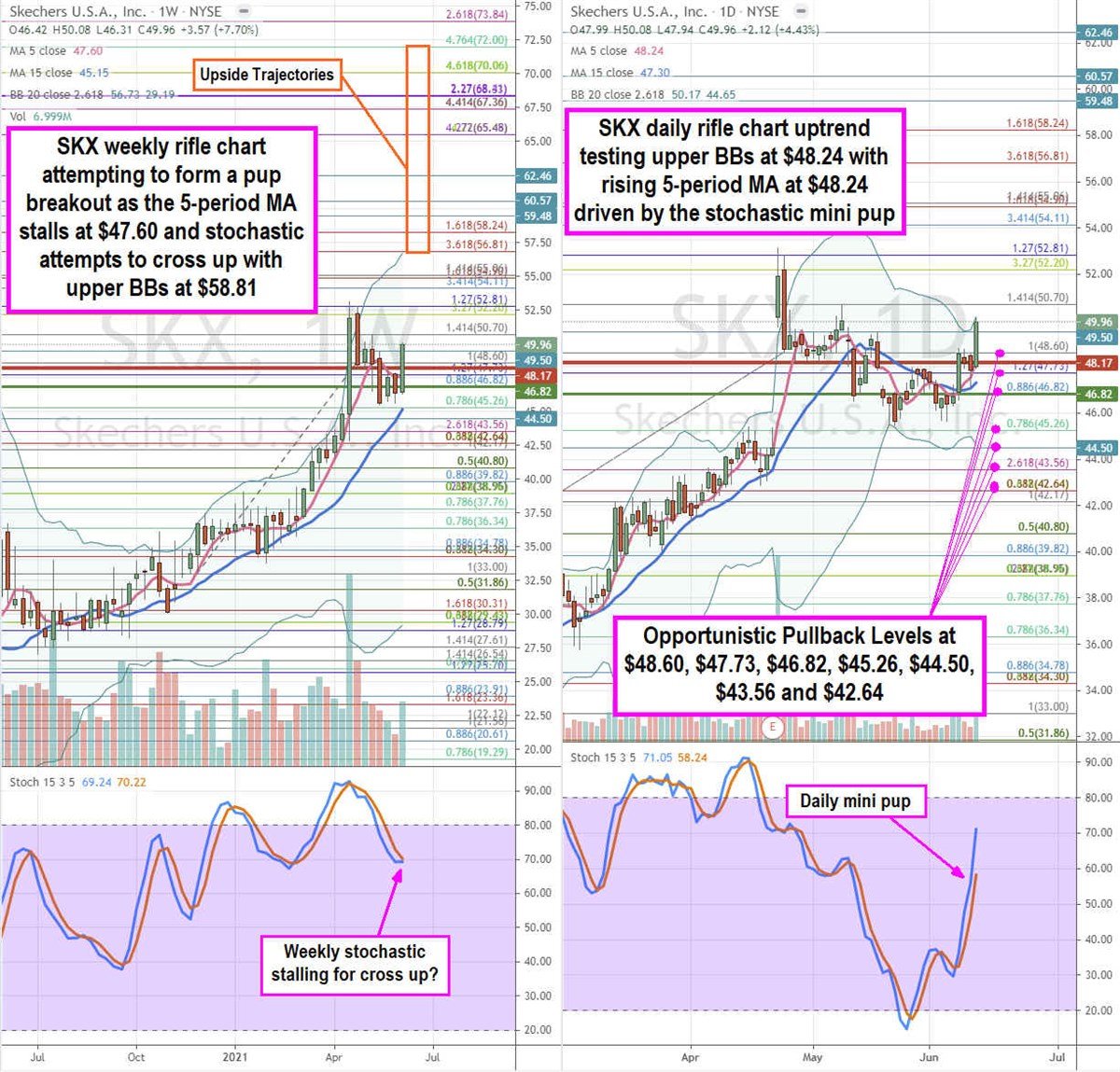
Consumer footwear and athleisure brand Skechers U.S.A. (NYSE: SKX) stock has based off its recent highs and is setting up another leg highs on the heels of a strong turnaround in the context of the reopening trend. While the Company was a winner during the pandemic as consumers immersed themselves in athleisure and comfort wear working, engaging, and entertaining from home during the lockdowns, Skechers was able to expand market share and emerge a stronger Company. It’s ready to expand as a post-pandemic play as the return to a new normal takes shape with the acceleration of COVID vaccinations in the U.S. and internationally. China is a great recovery template as its seen both revenue growth and market share expansion as consumers head back outdoors. The Company knocked it out of the ballpark in its Q1 2021 earnings release and raised estimates for Q2 2021 and full-year 2021. Shares initially peaked at $53.14 and proceeded to sell-off. Prices have been basing and setting up for the next leg up on a multiple expansion. Prudent investors can watch for opportunistic pullback levels to gain exposure on this post-pandemic recovery theme play on the reopening.

Q1 2021 Earnings Release

On April 22, 2021, Skechers released its fiscal first-quarter 2021 results for the quarter ending March 2021. The Company reported an adjusted earnings-per-share (EPS) profit of $0.68 excluding non-recurring items versus consensus analyst estimates for a profit of $0.46, beating estimates by $0.22. Revenues grew 15% year-over-year (YOY) to $1.43 billion, beating analyst estimates for $1.33 billion. International wholesales sales rose 23.8% YoY and direct-to-consumer (DTC) sales rose 18.1% YoY. The cash and cash equivalents at the end of the Q was $1.51 billion. Skechers CEO Robert Greenburg stated, “Skechers new sales record for fiscal first quarter is a remarkable achievement, especially given the lockdown measures in many key countries, including across Europe. This significant growth is a result of consumer demand for Skechers products as consumer desire comfort and quality in their footwear and walking remains a top COVID-19 pandemic activity. With warmer weather and increased vaccination rates around the world, traffic is improving in many of our retail stores, and our digital business continues to be a very strong growth driver.”

Raised Estimates

Skechers issued upside guidance for Q2 with EPS coming in between $0.40 to $0.50 versus $0.30 consensus analyst estimates. Revenues for Q2 are expected to come in between $1.45 billion to $1.55 billion versus $1.22 billion analyst estimates. The Company also raised its full-year 2021 EPS to come in between $1.80 to $2.00 versus $1.92 analyst estimates and full-year revenues between $5.8 billion to $5.9 billion versus $5.54 billon consensus analyst estimates.

Conference Call Takeaways

Skechers U.S.A. COO, David Weinberg, set the tone, “While many countries’ restrictions are easing, our thoughts are with those regions facing another coronavirus wave. As is the case with most businesses, the pandemic continues to impact Skechers, but the high demand for our comfort technology product resulted in a strong beginning to 2021 and it feels reminiscent of 2019.” The double-digit growth in international sales made up 57.8% of total sales in Q1. He noted, “Consumers are returning to a new normalcy, one that involves more walking, more comfort on the job, and a casual lifestyle mindset. We are the natural choice for any demographic worldwide with comfort technology at our core.” The record 23.8% international wholesale growth in sales are the “testament” that supports this statement. The big recovery continues to be in China with quarterly sales up 174% YoY as COVID restrictions have been eased. However, sales in the domestic wholesale business fell (-1%) in Q1 but improved 8.1% over Q1 2019. The decrease is associated with supply chain issues that negatively impacted product shipments and presented logistical challenges. The average selling prices per pair of shoes increased 2.7%, which reflects the “strength and appeal of new comfort products and technologies.” Domestic DTC grew 28.4% in the quarter thanks to 143% growth in domestic e-commerce and 13.6% growth in brick and mortar stores. DTC average selling price rose 10.9% per unit. International company-owned stores lost 37% of available selling days in the quarter due to COVID-19 restrictions internationally. This leaves more room for recovery as restrictions get lifted in the global reopening.

Sketchers Stock is a Turnaround Story

SKX Opportunistic Pullback Levels

Using the rifle charts on the weekly and daily time frames provides a precision view of the landscape for SKX stock. The weekly rifle chart has been basing around the $46.82 Fibonacci (fib) level as it becomes a very significant price level. The weekly 5-period moving average (MA) support sits at the $46.82 fib and it is also the weekly market structure low (MSL) buy trigger that is forming a pup breakout. The confirmation will form when the weekly stochastic crosses up. The weekly upper Bollinger Bands (BBs) are near the $56.81 fib. The daily rifle chart formed a breakout with a rising 5-period MA support at $48.24 as it nears the daily upper BBs at $50.10. The daily 15-period MA support is rising at $47.36. The daily BBs are starting to expand after a few weeks of contraction. Prudent investors can watch for opportunistic pullback levels at the $48.60 fib, $47.73 fib, $46.82 fib and weekly MSL trigger, $45.26 fib, $44.50 stinky 5s, $43.54 fib, and the $42.64 fib. Upside trajectories range from the $56.81 fib up to the $72 fib level.  

Featured Article: What are the FAANG Stocks?

https://www.entrepreneur.com/article/374607


How to Avoid Getting into Debt in the First Place

June 15, 2021 6 min read

This story originally appeared on MarketBeat

It seems like summer always becomes the most expensive month of the year for my family. Between summer vacations, landscaping projects (why are rocks, found in nature, so expensive?!) and more… Yikes. It’s easy to slide into debt. The truth is, no matter how savvy of a trader or investor you are, you can still end up in debt. 

When these extra expenses come rolling around, I need to add a few mental checks and practical preparation to my repertoire so I can avoid the summer slide. I thought they might help you as well.  

Here’s how not to let that gorgeous back patio trigger a few panic moments.

Tip 1: Don’t buy it if you can’t pay cash.

No matter what “it” is, don’t buy it if you can’t pay for it with a wad of cash. My dad taught me that simple trick when I was a kid. 

It’s such good advice that it bears repeating: If you don’t have the money for it or you’re tempted to buy it on credit, don’t buy it at all. A credit card might make you think you have the money for a couch, new TV or an expensive phone, but you still have to pay back that money later. It’s a simple lesson, but it’s one that so many adults never learn. No matter how much money you earn, you can still get caught up in this need to have more “stuff” — and can still go into debt.

Tip 2: Fluff up, don’t flub up, your emergency fund.

Experts recommend that you beef up your emergency fund to the tune of three to six months’ worth of living expenses. Put another way: Have at least six months’ worth of salary saved up. This will help you if you lose your job or encounter another emergency that causes you to need money quickly.

You might scoff at the idea of building up an emergency fund if you have plenty of assets. However, how liquid are those investments, really? If you’ve got money stashed away in an IRA or another type of non-liquid asset, you could pay penalties to take your money out. You may not want to do that because it could set you back even more. 

Tip 3: Pay off your credit cards every month.

This kind of goes back to the first tip. Don’t charge what you can’t afford to pay back. You probably already know about the damaging cycle of high interest rates over the course of time. But did you know that carrying a high balance on your credit card also affects your credit utilization ratio? 

Credit utilization refers to the amount of credit you have used compared with how much credit a lender gives you. That ratio helps determine your credit score. In other words, if you have a $10,000 limit on your credit card but consistently charge $9,500 on your credit card every month, you’ll have a high credit utilization ratio. 

The general rule of thumb involves keeping your credit utilization as low as possible — around 30% — and even less is better.

Oh, and by the way, never, ever use your credit card for cash advances. What a money pit!

Tip 4: Get your needs vs. wants straight.

Got a clear idea of your wants versus your needs? For example, I just bought these super cute outdoor pillows for my front porch. I thought I “needed” them because one of my neighbors has (guess what?) super cute pillows on her front porch. 

I ordered them anyway. However, could my adirondack chairs survive without the super cute pillows? Of course. (I don’t even actually need adirondack chairs, either.)

The more you get clear on needs versus your wants (no boat versus new boat) you will start to cull the debt creep. Does that mean you never satisfy your hunger for the things you want? Of course not! Take a look at the 50/30/20 rule below for more information. 

Tip 5: Standardize your budget. 

Make budgeting so normal and such a part of your life that you never buy anything without checking the budget first. Why not try the 50/30/20 rule for budgeting to get started? Here’s how that works:

  • Allocate 50% of your income toward needs (these could include groceries, rent/mortgage, utilities, car loan or other transportation costs, insurance, child care, child support, alimony, etc.)
  • Allow 30% of your income to go toward wants. 
  • Put 20% of your income toward savings and repaying debt (toward your emergency fund, retirement fund, excess debt and more).

You don’t have to categorize all of this by yourself. In fact, just go straight for the budget app. A great budget app should connect your checking, credit and savings accounts and automatically categorize your recurring expenses. Good budget apps also give you some goals by creating custom categories for short- and long-term goals. 

Tip 6: Don’t overspend on the little things. 

It’s not always the boats or the new cars that get people into trouble, though those things can be major culprits. It’s the little things (like super cute outdoor pillows for the front porch) that add up and end up causing credit card debt to balloon. 

You may have heard of your latte factor. Every little bit adds up in the form of lattes, new shoes, golf clubs and other “little” expenses. You could cost yourself hundreds of thousands of dollars when you spend. 

Don’t Start Inching Toward Debt

If you get started with a clean slate, you’ll never have to worry about inching toward debt from the very first day after you graduate from college. The earlier you start good money habits, the more likely they’ll carry you through the rest of your life. 

Just remember that you can always start over with a clean slate and get out of debt. (You can get into debt at any point in your life. After all, terrible illnesses and accidents can come out of nowhere and bankrupt you.) However, taking these tips into consideration might help you put yourself into a position where you’re never underwater again.  

Featured Article: Why Invest in Dividend Achievers?

https://www.entrepreneur.com/article/374601


3 Reasons Why You Should Be Scared Of Inflation

This is why the market should be ready for aggressive FOMC policy changes this year.

June 15, 2021 5 min read

This story originally appeared on MarketBeat

This Is Why The FED Will Hike Rates This Year

If the COVID-19 pandemic was the defining Black Swan event of our generation, rising inflation is the white swan event that will dominate our lives for the foreseeable future.  White Swan events, events that are easily predictable and easily avoided but for some reason, no one seems to be doing anything about it and in this case, it is rising prices. The FOMC has been trying to assure us that hyperinflation is transitory but we do not agree. The evidence does not suggest that recent spikes in consumer prices are transitory and will lead the FOMC to raise interest rates this year. The real question for investors is whether or not to prepare for such an event and we think the answer is yes. If you think about it, the FOMC has been begging the economy to begin raising prices for years and it finally started to listen.

Inflation Is Already Here And You Can’t Get Away From It

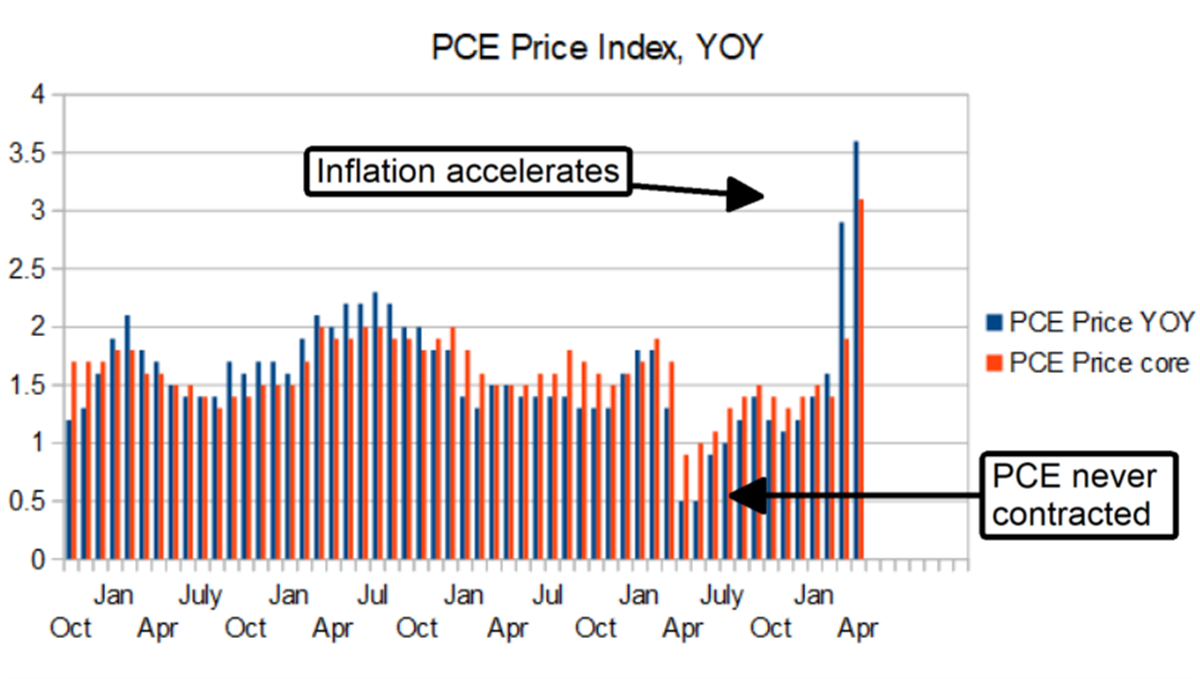
The really scary thing about the inflation picture is that Inflation is already here and nobody’s doing anything about it. Starting with the Fed’s preferred measure of core consumer-level inflation the PCE price deflator, inflation spiked above the FOMC’s 2% target in March and has only accelerated in the time since. The PCE accelerated at the core level from 1.9% in March to 3.1% in April and we expected to go higher in May and June. Not one single S&P 500 company has been talking about lowering prices, if anything, they’re talking about the impact of higher input costs, higher wage costs, and higher commodity costs, and the need to raise their prices to offset these pressures. 

Three Reasons Why You Should Be Scared Of Inflation

The Consumer Price Index tells the same tale. The Consumer Price Index has come in hot and above expectation for the past 2 months and accelerated from April to May with YOY gains of 5.0%. That’s more than double the Fed’s target 2% rate and it’s accelerating. Now, if we were talking about GDP or earnings growth the hot numbers wouldn’t be such a big deal. Last year GDP shrank by 30% and earnings shrank by a high double-digit for most companies making this year’s comps incredibly good. That said, the economy and corporate earnings have only barely returned to pre-pandemic growth levels. Inflation did not contract last year. It slowed to about 0.5% and then it reaccelerated and it’s still accelerating. If there was ever a time for the FED to act to tamp down inflation we think this is it. 

Core Inflation Data Doesn’t Measure Actual Inflation

If inflation is the net result of rising prices on the consumer our core consumer inflation data isn’t measuring what it is supposed to. The two most impactful items on consumer spending are energy and food And those are the first two things taken out of the equation. When they are included, the impact of the index often does it match reality. We know from the signs out on the street and the prices that we pay that Gas prices are nearly double what they were last year. That’s a 100% increase in energy inflation that’s not being measured correctly and that cost is feeding into food prices. 

The biggest cost for food producers is energy, when it cost more for them to buy gas it’s going to cost us more to buy food and this goes for oh so many other sectors of the economy. According to the CPI, the cost of shelter only increased 2.2% over the past year but we know the price of lumber and construction materials and houses are up at least 20% YOY and that’s a very generous estimate. Home prices are up at least 20% based on the Case-Shiller report and lumber prices are up triple digits. In our view, true consumer inflation is already running at a double-digit pace.

The FED knows More Than It’s Letting On

You’d have to be pretty naive to believe that the FOMC doesn’t know more than it’s letting on. We believe this is evident in the abrupt shift IN stance that we’ve seen within the committee over the past six months. At the beginning of the year, even as late as March, the FOMC was projecting at least two years of zero interest rate policy, no need for taper, and no need for interest rate hikes. Now, 6 months later, the group of them are babbling on about “talking about talking about the taper”, along with their buddy, Secretary of the Treasury Janet Yellen (Cough cough the x-FOMC chief), who thinks a rate hike could be needed. The questions for us about the June FOMC meeting aren’t about if they will change what they say in the statement but what is it they change and how will it affect the market. In our view, the market needs to be prepared to be put on a firm track towards tapering and rate hikes.

Featured Article: What is Net Asset Value (NAV)?

https://www.entrepreneur.com/article/374598


2 Specialty Retail Stocks to Add to Your Shopping List

We discuss 2 specialty retail stocks that stand out at this time.

June 13, 2021 4 min read

This story originally appeared on MarketBeat
Let’s face it – retail is one of the most competitive industries out there. Consumer preferences are constantly changing and it takes a lot for these types of businesses to earn shoppers’ hard-earned cash. That’s one of the reasons why investing in specialty retail stocks can be a great long-term strategy if you choose wisely. Since specialty retailers focus on specific product categories, like office supplies, furniture, or men’s or women’s clothing, they are oftentimes able to carve out a unique niche and stand out among their competitors.

Thanks to all of the stimulus that has been added to the economy over the last year and the fact that a newly vaccinated population is getting back to shopping in person, we could see some strong sales coming out of the specialty retail space in the coming months. There are 2 specialty retail stocks that stand out as potential buys at this time given their unique brands and impressive earnings reports. Let’s take a further look at these intriguing stocks below.

RH (NYSE:RH)

RH, formerly known as Restoration Hardware, is a great specialty retail stock because it is doing something that is completely unique. While there are plenty of home furnishings stores out there, RH is distinctive in that it specializes in ultra-high-end luxury home goods and creating a unique shopping experience at every single store. Homeowners can find upscale products including furniture, lighting, bathware, outdoor & garden, tableware textiles, and décor at RH, and each one of the company’s showrooms offers an original and aesthetically pleasing experience.

The company counts Warren Buffett’s Berkshire Hathaway among its investors and is undoubtedly benefitting from a hot residential real estate market. With that said, RH has upside potential regardless of what’s going on in the economy, as the company doesn’t have exposure to seasonal inventory and caters to wealthy consumers that spend big year-round. The stock has been pulling back in recent months after a rally from $70 to $700 a share, but after the company’s latest earnings report it could be gearing up for more gains.

RH saw its Q1 revenues up 78% year-over-year to $860.8 million and delivered Q1 adjusted diluted earnings per share increase by 285% year-over-year to $4.89 per share. Other positives from the stellar report included an increased fiscal 2021 outlook and the fact that the company expects to be net debt-free by the end of the fiscal year. The bottom line here is that RH is a specialty retail company that is executing at a very high level, which is evident in both the earnings results and stock price.

Lovesac (NASDAQ:LOVE)

There’s a lot to love about this specialty retailer, which designs and manufactures modular couches and beanbags. What really stands out about Lovesac is how it has created a brand and product lines that have quickly become the favorite furniture of an entire generation. Millennials are among Lovesac’s most frequent customers, as they love the idea of the company’s flagship product, a unique modular furniture piece known as a “sactional”. These are couches that are easily assembled and disassembled in order to meet the needs of the consumer. There are literally dozens of different ways that sactionals can be rearranged to fit in someone’s home, and the fact that customers can continue adding on pieces and accessories over time is perfect for creating repeat buyers.

While the company has 91 retail showrooms across the United States, investors should be impressed with the progress that it has made over the last year developing its digital sales channels. E-commerce sales were up over 250% in 2020 and although the company might not be able to keep up that torrid pace, Lovesac has proved it is more than capable of finding buyers online. Also, keep in mind that those showrooms are going to see foot traffic pick up as the pandemic winds down.

Lovesac just reported very strong Q1 2022 earnings results including net sales growth of 52.5% and diluted EPS of $0.13, up 122.1% year-over-year. Analysts also love the stock, as Lovesac recently got a price target increase from Craig Hallum on Thursday. Pandemic tailwinds are continuing to help this specialty retailer grow, and that narrative should remain in place for the foreseeable future. These are all great reasons why Lovesac is a great stock to consider adding to your shopping list.

Featured Article: What is the Bid-Ask Spread?

https://www.entrepreneur.com/article/374422


3 New IPO Stocks to Check Out Now

We take a look at 3 recent IPO stocks for investors to monitor.

June 12, 2021 4 min read

This story originally appeared on MarketBeat
Last year, investors witnessed a booming IPO market that saw a record 407 companies make their public debuts. Some of that momentum has clearly carried over into 2021, as we are still seeing tons of new companies issuing shares to the public for the first time. What’s great about the current IPO market activity is that there are so many exciting new companies to choose from. Some of these stocks have the potential to become true market leaders, while others are destined to fall into obscurity. That’s why it’s so important to do your research and make sure you are on board with a company’s vision before jumping in.

It can be tough for investors to keep up with the constant flurry of new IPO stocks, which is why we’ve handpicked three that really stand out at this time. These companies all recently made their public debuts and could be worth checking out now. Let’s take a deeper look below.

Squarespace (NYSE:SQSP)

After a weak direct listing debut back in May, Squarespace stock has rallied over 16% from its $50 listing price and could be a great tech stock to watch in the coming weeks. The company offers an all-in-one website building and e-commerce platform that helps businesses and independent creators build their online presence. Squarespace’s platform makes it easy to create aesthetically pleasing websites from scratch and gives customers everything they need to sell physical products, subscriptions, content, or services online. The company also offers strong marketing solutions like email campaigns and search engine optimization tools to drive traffic.

Squarespace generates revenue with a subscription-based model and has delivered 20 consecutive quarters of subscriber growth, which is certainly impressive given that there are plenty of competitors like Wix in this space. The company saw its revenue increase by 20% year-over-year in 2020 to $621 million and has reported positive net income since 2016. This is a fast-growing tech stock to get familiar with now, and it will be interesting to see if the company’s notable growth in 2020 was a result of the pandemic or a sign of an emerging leader.

Coursera Inc (NYSE:COUR)

Sometimes, an IPO benefits from so much hype after it debuts that it surges during the first few trading sessions only to pull back sharply as early investors unload their shares. That looks to be the case with Coursera, as the stock hasn’t exactly set the market ablaze after reaching a high of $62.53 back in April. Although Coursera is well off of its highs, investors should potentially view the dip as a great buying opportunity in this innovative growth stock.

This company is aiming to revolutionize the way that we are educated, as it has developed one of the leading remote learning platforms. It provides an easy way for learners and educators to connect virtually and take advantage of educational content that is relevant and accessible. With the way that digitalization is taking over so many different aspects of our lives, it’s easy to see remote learning becoming the number one way that people are educated in a few short years. The company’s platform also has a robust career skills segment that businesses can use to keep their employees at the top of their game. Finally, Coursera is a recent IPO that is worth a look as it counts legendary investor George Soros as a buyer, and the company has seen its revenues triple between 2017 to 2020.

Monday.Com Ltd (NASDAQ:MNDY)

Another new IPO that just made its debut this week is Monday.com, a workplace management software maker based in Tel Aviv, Israel. What makes this company’s cloud-based platform unique is that it allows companies to create and customize their own applications and work management software. Most of the work management software out there is very rigid and doesn’t allow for people without serious coding experience to handle custom application development easily. With the Monday.com platform, almost anyone can build software applications and work management tools that fit the needs of an organization.

Monday.com has already received funding from Salesforce.com and Zoom Video Communications, with each company purchasing $75 million in the company’s shares. The growing company has posted impressive top-line figures over the last few years, including year-over-year revenue growth of 106% from 2019 to 2020. While the stock might be volatile during its first few weeks of trading, it’s definitely one to keep an eye on if you are a growth-oriented investor interested in a potentially groundbreaking software company.

Featured Article: How to Invest in the Dividend Aristocrat Index

https://www.entrepreneur.com/article/374408