Is Cryptocurrency Passive Income Really Sustainable?

May 25, 2021 5 min read

This story originally appeared on ValueWalk

Steve Fisher, the author of Residual Millionaire, defines passive income as money “that comes in every month whether you show up or not. It’s when you no longer get paid for your personal efforts alone, but rather, get paid for the efforts of hundreds or even thousands of others and on the efforts of your money. It’s one of the keys to financial freedom and freedom of time.”

Q1 2021 hedge fund letters, conferences and more

The idea of passive income is not new. Before the cryptocurrency industry caught the frenzy, people were already earning from traditional passive income streams such as affiliate marketing, stock investments, dropshipping, Amazon FBA, and lots more. In the cryptocurrency space, passive income sources typically present themselves in the form of mining, staking, hosting masternodes, and more recently yield farming and liquidity mining.

Following the advent of Bitcoin, mining became the earliest way to earn passive income from cryptocurrencies. Crypto mining essentially entails using computational power to secure a network and confirm transactions in exchange for a reward. Compared to its early days when Bitcoin could be mined using central processing units (CPUs), an increase in hash rate has pushed miners from graphics processing units (GPUs) to Application-Specific Integrated Circuits (ASICs).

Although Bitcoin mining is still profitable, the space is now dominated by corporations with significant resources. In March 2021, Bitcoin miners generated more than $1.5 billion in profits, with mining revenue surging to a daily high of over $52 million.

Away from Bitcoin mining, there is staking, which is a less resource-intensive alternative to mining. It often involves locking funds in a wallet and performing some certain functions to earn rewards. Ahead of Ethereum’s transition to a Proof-of-Stake network, its Beacon staking contract is currently leading the pack as the largest PoS cryptocurrency by market capitalization. More than 4.5 million ETH has also been staked on the contract. At current market prices, this is about $18 billion.

In more recent times, the market has moved away from mining and staking to yield farming and lending. This shift was fueled by the 2020 DeFi boom.

Overall, the basic principle remains the same – make your cryptocurrencies work even while you sleep.

How sustainable are passive income blockchains?

Proof-of-Stake blockchains are arguably the hallmark of passive income in the crypto space. But they also tell a tale of how unsustainable the model can become. Platforms that offer high staking rewards have no trouble attracting new users who are eager to double or even triple their investments within a short period. However, it is hard to fathom how these networks can stay profitable for long.

As the circulating supply of these projects begins to increase, everyone’s holdings quickly become diluted since most of these projects do not offer extra functionality beyond staking. Assuming the primary use case of a staking blockchain is staking, one is left to question the other utilities that these chains provide.

The bottom line is that blockchains that offer passive income either in the form of staking or mining need to offer extra products and services to stay profitable, relevant, and sustainable.

Passive Income (PSI) is one of the few blockchain projects that have come to realize this inherent challenge. The blockchain is introducing an exciting concept to the passive income niche. For one, PSI drives sustainability in passive income through several economic activities. It uses tokenization to upgrade yield generation to decentralized financial passive income. At the core of its solution, PSI wants to improve on existing passive income models, making them more affordable and adaptable to everyone.

Another project that is at the center stage of passive income in the cryptocurrency space is Uniswap. Uniswap is a decentralized exchange (DEX) that allows users to swap one ERC-20 token for another directly from a web3 wallet. The key difference between a DEX like Uniswap and other centralized exchanges such as Binance is that the swaps are facilitated by liquidity providers. Simply put, an individual can put his idle funds to use and generate passive income by becoming a liquidity provider on Uniswap.

Although there are several other blockchain projects that have distinguished themselves in the passive income niche, Yearn Finance is another worthy mention. The yield aggregator and DeFi ecosystem maximizes yields for users of the platform. The interesting thing about Yearn Finance is that it allows users to select the DeFi protocol offering the highest annual percentage yield (APY) based on their risk tolerance. Users can earn lending fees from both Yearn and Curve through the yPool feature.

Passive income blockchains are still very much alive

Passive income in the cryptocurrency space is like a hydra. If one shuts down, there are several others to take its place. So, in reality, the niche may never go out of style.

Take staking blockchains, for instance, the total market cap of all PoS coins currently stands at around $12.6 billion. About $8 billion out of this figure is locked up in staking wallets. This confirms the fact that a lot of crypto users are still actively staking. But should any of these projects become unsustainable and close shop, you can be certain that there will be ten more to take their place and offer similar or better promises.

The real solution

The real problem is not in staking or any other passive income models. The problem lies in the sole reliance on a single income stream. That being said, a project built around transaction fees with no complementing economic activity is bound to fail.

Passive income blockchains need to look beyond transactional fees and the holding-to-earn concept. Their first steps should be to “build.” And this means having a minimum viable product, a strong community, progressive partnerships, and a diverse ecosystem of network participants.

https://www.entrepreneur.com/article/372885



Pershing Prime Services – Hedge fund Market Observations

Counterparty Risk and Revisiting the Hedge Fund/Prime Broker Relationship Q1 2021 hedge fund letters, conferences and more Every now and then a market event occurs that forces a wholesale reevaluation of how hedge funds manage their businesses. This time around the focus is on the relationship between prime brokers and their clients, the former’s risk […]

May 24, 2021 4 min read

This story originally appeared on ValueWalk

Counterparty Risk and Revisiting the Hedge Fund/Prime Broker Relationship

Q1 2021 hedge fund letters, conferences and more

Every now and then a market event occurs that forces a wholesale reevaluation of how hedge funds manage their businesses. This time around the focus is on the relationship between prime brokers and their clients, the former’s risk management and the latter’s leverage.

Pershing Prime Services places the utmost importance on both risk management and transparency. As such, we have continued to see strong demand for our complementary offering as a prime broker that’s part of a clearing firm. Given there is no centralized depository of leverage in the financial system, prime brokers need a holistic view of a manager’s leverage. Managers should be regularly reviewing their counterparty risk and spreading their risk across a suitable number of prime brokers that have the necessary expertise and experience in supporting their investment strategies.

Discussions With Pershing Prime Services’ Clients

In recent discussions with clients, the main topic of conversation has been how can they better prepare for these types of market disruption events. Regardless of the cause, the most prudent approach is to work with your prime broker to understand the liquidity of your portfolio versus the redemption cycle of your investors versus the funding you have lined up with financing counterparties. Hedge funds should be doing significant due diligence on their prime brokers to understand everything from their risk controls and median client size down to their organization chart.

So, what might be the most immediate change in the industry following these recent events? One change might be that it adds fuel to the trend of institutional investors moving away from commingled funds and towards separately managed accounts for the added transparency.

More generally, we are approaching a strong first half of the year for hedge funds, where the HFRI Weighted Composite Index shows performance of +8.40% YTD for the sector as of 5/20/21. Markets have continued to trend upward with the exception of sell-offs in high-growth technology stocks. Vaccines are now in play, and the beginning of a return to normal is in sight. However, there is still a level of economic uncertainty, inflationary fears, volatility and associated dislocations which can create a ripe environment for many different hedge fund strategies. While the conversation surrounding SEC oversight on swap derivatives will likely continue after recent events, several topics of conversation have come up repeatedly with Pershing Prime Services hedge fund clients:

Hedge funds remain a key part of institutions’ allocation roster

Investors’ interest in hedge funds is still primarily focused on equity long/short managers, simply because they historically represent the largest strategy and are primed to benefit from today’s volatility and subsequent dislocations. Sector-based funds are also in high demand as there is still a rotational period while the market hesitantly prices in a post-COVID world. Furthermore, interest in ESG strategies continue to grow, with electric vehicles as one example of an extremely hot sub-sector.

Back-to-office remains uncertain

While it seems some cities such as Miami might be returning to a normal way of living, there is still a lot of ambiguity as to what will be on the other side of the pandemic for New York’s financial services industry. With tax rates likely to rise, the move to lower tax states is a topic of conversation that many managers are having right now. Based on our conversations, it also seems as though most firms will not be returning to the office until Fall. Managers remain hyper-focused on the logistics of what back-to-office looks like and where employees will work in the future.

Managers are still adapting to COVID-19 challenges

Beyond the “getting back-to-normal” questions, managers have other concerns on their plates. The first being that capital introductions and fundraising is harder because the industry has become burned out on virtual events. Additionally, market movements are also not matching economic fundamentals, making it harder to short effectively. Outsourcing and co-sourcing of certain middle- and back-office functions is a growing theme as well, and prime brokers have stepped up to provide more support to managers. Prime brokers have been widening their value proposition beyond core services such as securities lending to become data providers as well, and not just to the fund itself, but to its third parties and fund admins too.

Article By Mark Aldoroty, Head of Prime Services and Collateral Funding & Trading

https://www.entrepreneur.com/article/372764


The DeFi Industry Needs To Address Inflation Without Compromising Liquidity

Yield farming is an essential part of decentralized finance. Enthusiasts want to put their crypto assets to work to generate a passive revenue stream. However, the inflationary nature of yield farming may not be sustainable for much longer. Q1 2021 hedge fund letters, conferences and more The Current State of DeFi Yield Farming The main […]

May 24, 2021 4 min read

This story originally appeared on ValueWalk

Yield farming is an essential part of decentralized finance. Enthusiasts want to put their crypto assets to work to generate a passive revenue stream. However, the inflationary nature of yield farming may not be sustainable for much longer.

Q1 2021 hedge fund letters, conferences and more

The Current State of DeFi Yield Farming

The main appeal of yield farming is how cryptocurrency enthusiasts can stake their assets into lending pools with other users. As other participants borrow from these pools, their repayments and fees go back to the pool. For lenders, this equates to receiving decent compensation regardless of how quickly the loan is repaid. It is a viable concept on paper, but there are certain inflation risks to take into account.

The inflation problem in this industry occurs when more investors join the liquidity pool. As all participants receive tokens depicting their investment, the token also represents the market value of the liquidity pool. When tokens rise in value, there is a new revenue stream for investors. However, it is impossible to remove tokens from the liquidity pool without reducing the overall liquidity itself.

Solving this aspect will require a very different approach to yield farming compared to current projects. Introducing a deflationary aspect to the platform’s tokens is one option to explore, although it can be difficult to introduce such a change. Burning a supply of the existing tokens while maintaining overall liquidity is a big hurdle to overcome.

The Multi-Pronged Approach To Inflation

To introduce a deflationary aspect to an inflationary token, there are multiple options to explore. Most tokens opt for a “burning mechanism”, in which the developers reduce the overall supply by buying back tokens from the secondary market and sending them to a wallet for which no one has the private key. Another option is to introduce a “transaction tax”, for every sale or trade, reducing the circulating supply and giving back to those who prefer to hold the asset for longer periods.

It is often better to attempt a multi-pronged approach instead of focusing on one option that may have little to no impact. For example, Cafeswap employs a total of five different burn mechanisms to address the inflation issue.

The core aspect of this burning method is how Cafeswap will burn tokens from its dev fund and lottery. Additionally, the goal is to buy back tokens via the fees from the decentralized exchanges and the smart vaults. With continuous pressure on the token supply, it becomes possible to reduce the supply without removing liquidity from the pools.

All yield farming platforms must come up with ways to help address inflation without being detrimental to pooled liquidity. If decentralized finance is to be taken seriously by the mainstream, issues like these need to be taken care of as quickly as possible. Even platforms such as bZx, PancakeBunny, Ferengi Vaults, and other providers of yield farming and AMM DEX solutions will need to step up their game. The current rate of inflation in DeFi has become problematic, and introducing additional burn mechanisms will become a necessity, rather than a luxury.

It is interesting to see how DeFi projects aim to tackle the inflation problem. Projects acknowledging this problem can gain a competitive edge over those who are not too bothered by it. Cafeswap is heading in an interesting direction to help deflate its current token supply. There aren’t many details on how this will all work, however, leaving some questions unanswered.

Closing Thoughts

The current generation of decentralized finance solutions will need to cope with the concept of inflation in one way or another. It is essential to prioritize liquidity over the supply of one’s native token. Those tokens are an incentive to be earned by investors; having too much of a circulating supply can be counterproductive to yield farming. Token burns remain the most viable way of removing tokens from the market permanently.

Using a combination of different burn mechanisms under the same umbrella can prove beneficial to the industry. Experimenting with various options will give developers insights as to which option works best for specific DeFi platforms. Once that has been established, the developers can look at making the anti-inflation mechanism more fluent and streamlined.

https://www.entrepreneur.com/article/372765


These Are the Top Ten Women in Hedge Funds in 2020

The hedge fund industry is for the most part male-dominated, but like other industries, the number of women in the hedge fund world is also growing. Moreover, data suggests that a hedge fund firm with women in the top management performs better than others. For instance, an analysis of the S&P Composite 1500 found that […]

May 20, 2021 5 min read

This story originally appeared on ValueWalk

The hedge fund industry is for the most part male-dominated, but like other industries, the number of women in the hedge fund world is also growing. Moreover, data suggests that a hedge fund firm with women in the top management performs better than others. For instance, an analysis of the S&P Composite 1500 found that companies with women at the top are worth $40 million more on average than others, as per the hedge fund journal. Against such a backdrop, let’s take a look at the top ten women in hedge funds in 2020.

Q1 2021 hedge fund letters, conferences and more

Top Ten Women In Hedge Funds In 2020

We have referred to The Hedge Fund Journal to come up with the list of top ten women in hedge funds in 2020. The list is in no particular order, rather lists the top females in the hedge fund world. Following are the top ten women in hedge funds in 2020:

  1. Maureen D’Alleva

Maureen is the Managing Director at Angelo, Gordon & Co. She is also part of the firm’s Executive Committee and Partnership Advisory Board. Maureen has been with the firm for over 18 years now. Prior to this, she was the Vice President at Morgan Stanley Capital International, where she worked for about 15 years. Maureen holds a B.A. degree from Baruch College.

  1. Louisa Church

Louisa is the Executive Managing Director and Head of Investor Relations (Europe and the Middle East) at Sculptor Capital. Prior to this, she worked for more than nine years at BlueMountain Capital Management as CEO Europe, Partner and Co-CEO Europe, Partner. She also worked at Ferox Capital Management for more than four years. Louisa holds a Master of Arts in History of Art from Edinburgh University.

  1. Kathy Choi

Kathy is a Portfolio Manager at Beach Point Capital Management. At Beach Point, she focuses on opportunistic credit mandates. Prior to Beach Point, she was the Managing Director at Post Advisory Group. Kathy has also worked at DDJ Capital Management and Salomon Brothers. She got her MBA from Harvard University and holds a bachelor’s degree in Economics from the Wharton School.

  1. Natalia Chefer

Natalia is the Managing Director at The D. E. Shaw Group. She joined D. E. Shaw in 2001 and initially worked in the corporate credit division before moving to Discretionary Macro in 2009. Natalia is also part of the Federal Reserve Bank New York’s Foreign Exchange Committee. She has an MS in Public Financial Policy from the London School of Economics.

  1. Arancha Cano Miro

Arancha has been a Portfolio Manager at Wellington Management for the past two years. Prior to this, she worked at Balyasny Asset Management L.P. as a portfolio manager, and before this, she worked for over seven years at Moore Capital Management. Arancha has worked for more than 12 years at UBS in various positions, including Portfolio Manager (MD), Managing Director and Sales Specialist on Iberian equity. She holds a BA in European Business Administration from Universidad Pontifica Comillas.

  1. Mary Ann Betsch

Mary is the Managing Director of Finance Control at Citadel. She joined Citadel in 2018. Before joining Citadel, she was a partner in PWC’s Financial Service practice. Mary is a certified Public Accountant in New York State and holds a BS in accounting from Fordham University.

  1. Samantha Bower

Bower is the Head of Business Development, Macro Investment Business at M&G Investments. She had been with M&G Investments for over 13 years now. Prior to joining M&G Investments, she worked at ABN AMRO Asset Management in various roles. Samantha started her finance career in 1995 in Fixed Income Sales at PaineWebber. She has a Bachelor of Arts, with honors, in International Business and Modern Languages from London South Bank University.

  1. Janet Joyce Arzt

Janet is the CEO at Mudrick Capital Management, where she oversees non-investment functions, including operations, accounting and more. After she joined the company in 2014, the firms’ asset under management (AUM) has grown from $900 million to over $2 billion. She sits on the company’s management committee and reports to founder Jason Mudrick. Janet has also worked for four years as vice president (Client Advisory) at York Capital Management.

  1. Sarah Alfandari

Sarah is the CEO of Dalton Investments, where she joined in June 2020. Prior to this, she was the Managing Partner with Longchamp Asset Management, a French asset management that she co-founded in 2013. Sarah started her career as a sales analyst within Société Générale Corporate & Investment Banking’s Equity Derivatives division, and then worked at Morgan Stanley. She has a master’s degree in Business Administration from ESCP Business School.

  1. Kathryn Alexander

Kathryn is the head of data initiatives and relationships at Global Quantitative Strategies at Citadel LLC. She joined Citadel in 2016 and worked at Quant Strategy Development. Prior to this, she was the global head of sales at WeConvene. For six years (from 2008 to 2014), she worked with Two Sigma Investments’ Alpha Capture business as its vice president. Kathryn did her graduation from Columbia University.

https://www.entrepreneur.com/article/372547


Sustainable and Ethical Fashion: Market Overview and Latest Trends

May 20, 2021 4 min read

This story originally appeared on ValueWalk

The sustainable and ethical fashion market is growing at a rapid clip despite the pandemic as shoppers turn to online channels to find clothing, they wouldn’t be able to find in a brick-and-mortar store. The growth is expected to continue despite the high costs associated with ethical fashion.

Q1 2021 hedge fund letters, conferences and more

The ethical clothing market is growing

Data from ResearchAndMarkets tracks the growth rate between 2019 and 2021 and expected growth rates through 2030. The global ethical fashion market was worth almost $6.3 billion in 2019 after a compound annual growth rate of 8.7% since 2015.

The firm expects the market to grow from $6.3 billion in 2019 to $8.2 billion in 2023, marking a compound annual growth rate of 6.8%. Then between 2023 and 2035, ResearchAndMarkets expects a compound annual growth rate of 9.1%, bringing the market up to $9.8 billion. Between 2025 and 2030, the firm predicts a growth rate of 9.1% again, reaching a total of $15.2 billion.

Experts say the growth is primarily due to growing awareness about sustainable and ethical clothing. The ethical clothing market consists of sales of clothing by entities primarily engaged in designing, producing, selling, and purchasing ethical apparel.

Ethical fashion includes designing and manufacturing clothing while caring for the people and communities involved in the process. It is also sustainable, which means it looks to improve the social and environmental impacts of fashion by working to improve laborers’ working conditions and reduce the impact on the environment.

What’s driving the growth?

According to ResearchAndMarkets, growth in emerging markets and rising foreign direct investments have been driving the growth in the ethical clothing market. However, it didn’t grow as much as possible due to the high costs associated with ethical fashion.

Farah Naz

Looking into the future, growing awareness, social media, e-commerce growth and government initiatives are likely to drive the market. However, a reduction in free trade, impacts from COVID-19 and lack of standardization could restrain the ethical clothing market.

The creative director Farah Naz from FARAH NAZ New York, an ethical fashion brand, cited online shopping as the one main contributor to growth in their business over the last year or so. The pandemic has accelerated online shopping, driving more consumers to ethical clothing choices not available in brick-and-mortar stores.

“Online shopping is increasing, and consumers are more interested in online shopping rather than going back to traditional brick-and-mortar stores after the pandemic,” they said.

They added that the pandemic offered an excellent opportunity for online fashion brands and retailers to flourish.

More details on the ethical fashion market

The market is segmented according to product into organic, man-made, recycled, and natural. The man-made segment was the largest part of the ethical fashion market, accounting for more than half of the total market in 2019. ResearchAndMarkets expects the organic segment to become the fastest-growing segment of the market going forward with a compound annual growth rate of 16.2%.

Experts also divide the ethical fashion market into type based on fair trade, animal cruelty-free, eco-friendly, and charitable brands. The animal cruelty-free segment was the largest division with more than 40% of the market in 2019. Looking ahead, eco-friendly products are expected to grow the fastest, with a compound annual growth rate of 11.6%.

There is also a third way the ethical fashion market can be divided, which is by end-user based on women, men, and children. The women’s segment was the largest division, with more than half of the total market in 2019. However, looking ahead, the men’s segment is expected to be the fastest growing with a compound annual growth rate of 10.2%.

The ethical fashion market is extremely fragmented, with a large number of small players in the market. Some major players include Reformation, Tentree, Everlane, Alternative Apparel, which includes Hanes Brands, Eileen Fisher, and H&M Conscious;  All of the above points to room for ambitious new competitors looking to enter the space.

https://www.entrepreneur.com/article/372548


How Businesses Are Using QR Codes To Boost Engagement

May 19, 2021 7 min read

This story originally appeared on ValueWalk

Quick response (QR) codes are square images, and colorful patterns optically scanned using a smart device like a mobile phone. App developers can rely on this digital tool to increase the number of downloads. At the same time, marketers can leverage it to reach a target audience for higher sales.

Q1 2021 hedge fund letters, conferences and more

The QR code is a 2D barcode with stored information like URLs. Marketers can use it to promote brands and product categories with ease. They can attract prospects and achieve a higher conversion rate. Besides, they can design cost-efficient ad campaigns to boost organic business growth.

How are QR codes useful?

The quick response codes are easier to design using tools. Alternatively, you can partner with a QR solution provider for an advanced custom QR code. A simple QR code with contact details or a preferred URL takes less than a minute to get generated. You can also save it in different formats like PNG, SVG, EPS.

But do not market or share the code before testing it. Use multiple devices from Android and Apple for reassurance. Check if the code works or not to prevent errors in real-time usage. If you do not test, then the marketing campaign will fail to generate sufficient leads. Do these four steps:

  • Open the built-in camera app on the Android or Apple device.
  • Point the camera at the QR code and adjust for full capture.
  • Next, tap the banner that appears on the phone’s screen.
  • You will get redirected to the next screen for the sign-up process.

QR codes can be useful in different ways to achieve diverse objectives. You can easily promote an app among your niche audience. Also, marketers can use the code to send prospects to a website’s landing page or mobile app’s website. It can also be inter-linked to social media accounts or other URLs.

In-app shopping experience

The popular social media platforms include Facebook, Instagram, Twitter, and YouTube. In the past, these platforms were just for informal communication and relationship building. Later, marketers took it to advertise their brands and content promotion. The next step was maintaining customer relationships with social media.

Today, the experts are using these platforms to sell their products and services. Selling through social media platforms is just a one-click process for buyers. However, driving those audiences to the landing page is the hurdle here. And, let us see how QR codes can simplify this process.

Lanai Moliterno CEO and founder of Sozy says, “We try to make the shopping experience as easy as possible for our customers. A lot of sales come from social media since we are super engaged with our audience there and constantly hosting live events and giveaways. So we try to drive traffic to our social media pages just as much as our actual site.”

Retail businesses can boost their in-app sales using social media shops. For example, Nike opened a Facebook shop with product pictures and tags. It also provides all the details like product name, prices, and description. Users can discover new items and buy them without leaving the app. They have to scan the QR code on the tag, read the details, and add it to the cart for purchase.

Efficacy of QR codes on social media

Remember that a QR code is not the only way to sell on social media. There are several traditional options and contemporary advancements along the way. However, businesses believe QR codes to have higher ROI, especially in social selling. The QR code is efficient only if the customer scans it and becomes a lead.

Lauren Sommer, director of Moi Moi Fine Jewellery, Australia’s leading jeweller for Moissanite and Lab Grown Diamonds says that, “QR codes have been a great way for us to bridge the user journey from offline to online. We believe our customers value experiencing our brand physically, through handwritten letters to receiving physical ring sizers in the mail. We now include QR codes that allow customers to easily access up to date catalogues or information videos easily, with a simple scan on their phone.”

So, marketers have to come up with effective strategies and promote attractive products. They should focus on engaging the prospect with accurate details. And the codes have to get shared to influence purchase decisions. Here are some ways you can use social media to attract users to diverse products:

1. Run an ad campaign

Consumers use different types of devices to access social media. So, companies can initiate a campaign to target such users. Facebook and Twitter facilitate such marketing campaigns at very little cost. You can create exclusive QR codes for laptop or tablet users. You can also use trackable QR codes to appraise your campaigns and make strategic decisions.

2. Hold a game contest or Facebook quiz

Even if you market or share QR codes, scanning is not guaranteed. Every brand is sharing its QR code, and thus, the social media platforms have these codes from top to bottom. It is time to make your approach a little interesting.

Some brands offer small games that would generate the QR code only for those who win those games. The QR code thus generated can lead the customers to a landing page with a considerable discount. Also, you can try interesting tactics like holding a quiz. First, share the code on Linkedin or Twitter with prospective customers.

Hide the QR codes in images and organize a quiz to arouse their interest. Please encourage them to find the code and scan it for traffic diversion. Share the QR code with mobile phone users along with a call to action option. Such an alternative is necessary to make them notice the code for quick scanning.

3. Link to social media profiles

QR codes are the ideal tools that can get linked to social media profiles. They increase brand visibility and create a buzz around products. You can increase the number of likes and shares of a product.

When your page is blooming with traffic, you automatically increase your brand reputation, which leads to a sale. Even a couple of sales in a social circle will cause an avalanche of purchases due to social peer pressure.

Following the Snapcodes, Instagram is now offering Nametags, which the users can scan with their cameras. Businesses can use this name tag to connect with other social media profiles, increasing the number of followers.

4. Mobile ad links

The quick response code can be displayed on a variety of print and digital media. You can post them on the website, social media platforms, and mobile ads. The most common option is using QR codes on business cards. For example, Verizon Wireless displayed QR codes on iPad ads.

The user who scanned could download a specific app. Alternatively, he could visit a mobile site to browse and shop for top apps. Businesses can also implement this strategy to promote the sale of other branded products in a seamless fashion.

E-commerce platforms like Shopify have come up with their QR codes. So, marketers can explore their integration with social media platforms like Facebook without losing any target audience. They can use connect buttons and lead the customers to an in-app shopping experience like never before.

https://www.entrepreneur.com/article/372416


4 Tips for Turning Connecting into Investors

Finding investors is crucial to moving your business forward.

May 18, 2021 3 min read

Opinions expressed by Entrepreneur contributors are their own.

Whether you’re building a company or seeking investors, it’s important to use your connections. When it comes to networking, it’s not what you know, it’s who you know. If you surround yourself with good people, it attracts more good for everyone.  

Seventy-two percent of people say their first impressions are impacted by how personal appearance and a person’s handshake. When it comes to seeking out investors, the way you  — and how you find them — is crucial for the success of your

So how can you network your way to success and end up with a solid list of investors? Here are four tips.

1. Find the right people

Generally, your friends are in the same boat as you, and they want to make connections too. Start with connections that can be introduced to you through your network. If you have no network, jump into online forums and groups, and, once in-person events start again, go to conferences or try to get into accelerator programs. The key is to just get out there and align yourself with people who hold similar values. This takes a lot of time and effort, but you should try to meet people every day. You’ll see your network build slowly over time. 

Related: Common Mistakes That May Cause Investors to Walk Away

2. Focus on them, not yourself.

It’s best to have other people introduce you if you can, so lean on your connections. If you can’t, then just say hi and be genuine. When you’re meeting someone for the first time, it’s important to be authentic and grateful for the conversation. Give a casual one-liner about yourself and then turn the conversation around to focus on the other person. Get to know people on a personal level, inject humor into the conversation, and open up. Ask a lot of questions and offer ideas focused on what they’re doing.

Once you have the network, you need to be able to offer something that people need and see the value in. Initially, think about how you can pay it forward by helping that person with their goals.

When you’re trying to meet investors, know that it takes time. The circle gets smaller the higher up you go. Once you’re in the conversation, you can open up and speak boldly about your company. Talk about your failures and your successes, share the mission of your company, and show tangible results about how you’ve made traction.

Related: How Networking and Relationships Propel Entrepreneurs to Succeed

3. Ask for the right things

Just as you start with your circle to network, you can ask for an introduction to one of their connections that you’ve always wanted to talk to. Often, investors love to introduce you to their network too, and it goes back to the principle of paying it forward. Never ask for money. If your idea resonates, investors are not shy to ask how they can get involved. 

4. Know when it’s right

If there’s a spark, then they will see the value. These conversations take time, but it’s worth it because people are the biggest asset you have. You can’t teach people to care. You’ll know when you have the right investors in place because it will show up in their work. 

loading…

https://www.entrepreneur.com/article/369589


These Are the Top Ten Corporate Bonds Funds

Those who don’t want to take the risk of investing in equities, as well as want reasonable returns, can go for corporate bonds. Such bonds carry more credit risk than government or agency-backed bonds, but are less risky than equities. Moreover, you can also invest in a portfolio of these bonds through mutual funds. To […]

May 17, 2021 4 min read

This story originally appeared on ValueWalk

Those who don’t want to take the risk of investing in equities, as well as want reasonable returns, can go for corporate bonds. Such bonds carry more credit risk than government or agency-backed bonds, but are less risky than equities. Moreover, you can also invest in a portfolio of these bonds through mutual funds. To help you choose, detailed below are the top ten corporate bonds funds.

Q1 2021 hedge fund letters, conferences and more

Top Ten Corporate Bonds Funds

We have used the past one-year return data (from money.usnews.com) of these funds to rank the top ten corporate bonds funds. Following are the top ten corporate bonds funds:

  1. John Hancock Managed Account Shares Investment-Grade Corporate Bond Portfolio (JMABX, 13%)

During normal times, this fund invests a minimum of 80% of its assets in investment-grade bonds. JMABX has $24.95 million in total assets. The fund’s top three holdings are Broadcom, Micron Technology and Credit Agricole.

  1. Delaware Investment Grade Fund (FIIGX, 14%)

FIIGX normally puts at least 80% of its assets in investment-grade debt securities. It has given a return of 6.40% in three years and 4.48% in the past five years. FIIGX has a net expense ratio of 0.92 and total assets of $227.21 million. The fund’s top three holdings are Bank of America, Verizon and Crown Castle International.

  1. Federated Hermes Corporate Bond Strategy Portfolio (FCSPX, 14%)

FCSPX normally invests in a diversified portfolio of investment-grade, corporate fixed-income securities. It has given a return of 7.44% in three years and 6.41% in the past five years. FCSPX has $147.55 million in total assets. The fund’s top three holdings are Us 2yr Note (Cbt) Mar21, Us 10yr Note (Cbt) mar21, and General Electric.

  1. Calvert Income Fund (CFICX, 14%)

CFICX may invest up to 65% of its net assets in investment grade, U.S. dollar-denominated debt securities, and up to 35% in below-investment-grade, high-yield debt instruments. It has given a return of 6.11% in three years and 5.09% in the past five years. CFICX has a net expense ratio of 0.94% and total assets of $703.39 million. The fund’s top three holdings are Seagate HDD Cayman, Capital One Financial and BAMLL COMMERCIAL MORTGAGE SECURITIES TRUST.

  1. Western Asset Corporate Bond Fund (SIGAX, 15%)

SIGAX, during normal times, invests at least 80% of its assets in corporate debt securities. Also, it may put up to 25% in non-U.S. dollar-denominated fixed income securities of foreign issuers. It has given a return of 6.24% in three years and 5.72% in the past five years. SIGAX has a net expense ratio of 0.93% and total assets of $977.03 million. The fund’s top three holdings are Western Asset Prem Instl Govtt Rsrv Pref, U.S. Treasury Bonds and General Electric.

  1. Invesco Corporate Bond Fund (ACCBX, 15%)

ACCBX may invest at least 65% and up to 100% of its assets in investment-grade securities, U.S. government-issued securities and more. It has given a return of 7.08% in three years and 6.09% in the past five years. ACCBX has a net expense ratio of 0.80% and total assets of $2.58 billion. The fund’s top three holdings are Corning, U.S. Treasury Bills and United States Treasury Notes 0.38%.

  1. Lord Abbett Income Fund (LAGVX, 16%)

LAGVX normally invests at least 65% of its assets in investment-grade debt securities. It has given a return of 5.47% in three years and 5.45% in the past five years. LAGVX has a net expense ratio of 0.76% and total assets of $2.91 billion. The fund’s top four holdings are United States Treasury Notes 0.38%, United States Treasury Notes 0.63%, General Electric and U.S Treasury Bonds.

  1. Ivy Crossover Credit Fund (ICKAX, 19%)

ICKAX normally invests a minimum of 80% of its assets in bonds. It primarily put money in the corporate debt fixed-income securities. It has given a return of 7.68% in three years. ICKAX has a net expense ratio of 0.90% and total assets of $64.97 million. The fund’s top five holdings are State Street Instl US Govt MMkt Premier, 10 Year Treasury Note Future, Netflix, PVH Corporation and Imperial Brands Finance.

  1. Western Asset SMASh Series C Fund (LMLCX, 19%)

LMLCX usually invests in debt obligations of various maturities, including corporate obligations and derivatives. It invests only in the U.S. dollar-denominated investment-grade debt obligations. LMLCX has given a return of 5.05% in three years and 5.20% in the past five years. The fund’s top five holdings are Mexico (United Mexican States), Indonesia (Republic of), State of Qatar, Morgan Stanley and the Republic of Colombia.

  1. Miller Intermediate Bond Fund (MIFIX, 31%)

MIFIX usually puts at least 80% of its assets in bonds having a maturity between three and ten years. It has given a return of 7.74% in three years and 7.02% in the past five years. MIFIX has a net expense ratio of 0.95% and total assets of $107.44 million. The fund’s top five holdings are BlackRock Liquidity T-Fund Instl, United States Treasury Notes, Wells Fargo Finance LLC, NuVasive and Citigroup Global Markets Holdings.

https://www.entrepreneur.com/article/372138


3 REITs to Buy and Hold for the Long Term

It’s also nice that you can take advantage of their liquidity and buy and sell shares of REITs on a stock exchange instead of buying and selling property directly. If you are interested in these types of investments, check out our list of 3 REITs to buy and hold for the long term below.

May 15, 2021 4 min read

This story originally appeared on MarketBeat
Buy and hold investing certainly has its advantages, but you need to make sure you are choosing only the best stocks for your portfolio to ride out any volatility. If you select too many high-risk companies for your portfolio, you might find that it is difficult to sit tight over the years during declines. On the other hand, choosing stable securities such as REITs is a nice way to generate competitive total returns over the long term without having to worry as much about big drawdowns in your accounts.

Real estate investment trusts, or REITs, are attractive to buy and hold investors for several reasons. They typically compensate investors with high dividend yields that are secured thanks to stable rents from long-term leases. REITs also provide an easy way to diversify your portfolio since they offer exposure to real estate. It’s also nice that you can take advantage of their liquidity and buy and sell shares of REITs on a stock exchange instead of buying and selling property directly. If you are interested in these types of investments, check out our list of 3 REITs to buy and hold for the long term below.

Federal Realty Investment Trust (NYSE:FRT)

This is a high-quality REIT that specializes in the ownership, management, development, and redevelopment of shopping centers, street retail properties, and mixed-use developments. With properties that are concentrated in some of the biggest metropolitan markets in the country including Los Angeles, Washington D.C., New York, and Silicon Valley, Federal Realty Investment Trust is a great option for the long term because it is focused on only owning properties in highly desirable areas with strong growth. That means the company has tons of properties in affluent areas that retailers want to lease, which is a strong selling point.

While you might be thinking that retail is going to have big problems over the next few years due to the rise of e-commerce, Federal Realty Investment Trust has a lot of tenants like grocery stores, restaurants, fitness centers, and other service-based businesses to attract people to their properties. It’s also worth mentioning that the increasingly competitive retail industry is forcing retailers to only go with the best properties, which is another great reason to consider adding this REIT. Federal Realty Investment Trust currently offers investors a 3.8% dividend yield and is a fine choice for buy and hold investors.

Innovative Industrial Properties (NYSE:IIPR)

If you are a big believer in the burgeoning U.S. cannabis industry for the long-term, Innovative Industrial Properties is a nice choice. It’s the only NYSE-listed REIT that specializes in medical-use cannabis growers. Medical cannabis is already a multi-billion-dollar industry that is expected to grow to roughly $34 billion by the year 2025. When you consider how much space these growers need to harvest their product, owning shares of a company with a portfolio of 66 properties and 5.4 million square feet specifically intended for that makes a lot of sense.

Investors should also consider the fact that more states are expected to legalize cannabis use in the coming years, which would be another positive for Innovative Industrial Properties. New tenants and more properties will allow the company to continue to increase the dividend, which has grown by over 60% in the past 3 years. This REIT currently offers investors a 3.16% dividend yield and is a smart way to play the cannabis industry for the long term.

STAG Industrial, Inc. (NYSE:STAG)

Finally, we have STAG Industrial, a REIT that is a great way to play the trend in e-commerce growth. STAG invest in warehouses across the country and about 40% of its portfolio is leased to e-commerce tenants. We know how important large warehouses are for e-commerce companies as they fulfill millions of orders every day, and STAG Industrial’s properties offer approximately 92.3 million rentable square feet. The company’s biggest tenant is Amazon (NASDAQ:AMZN), which tells investors a lot about the quality of this company’s portfolio.

It’s also worth mentioning that STAG Industrial is one of the only REITs that offer monthly dividends, which is great for buy and hold investors that want constant payouts. What’s also impressive about this REIT is that it has grown its dividend every year since going public back in 2011, a testament to its financial strength. STAG Industrial currently offers a 4.11% dividend yield and is a great addition to any long-term portfolio.

Featured Article: What are gap-up stocks?

https://www.entrepreneur.com/article/372052


Look For Fortinet To Post Double-Digit Earnings Growth In Next Two Years

May 14, 2021 4 min read

This story originally appeared on MarketBeat
With cybersecurity in the news lately, are stocks like Fortinet (NASDAQ: FTNT) well-positioned for gains?

The stock rebounded Thursday, along with the broader market. 

In addition to the hacking of the Colonial pipeline, the growing work-from-home movement shed light on cybersecurity risks for enterprise. This week, President Joe Biden signed an executive order designed to strengthen the nation’s cybersecurity. 

Fortinet has specialized in core firewall protection, but it’s expanding into a new networking technology called SD-WAN. 

Analysts have great expectations for the company for the next two years. Unlike many companies whose revenue and net income hit the skids in 2020, Fortinet saw annual earnings growth of 35% and revenue growth of 20%. 

This year, Wall Street expects earnings per share of $3.74, up 12%. Next year, that’s expected to be $4.35, a gain of 16%.

At the company’s virtual investor day in March, Fortinet said it expects revenue to reach $4 billion by 2023. 

SD-WAN is short for “software-defined, wide-area network” technology. It serves a need very much in demand these days: Connecting a company’s various offices, as well as at-home workers. 

Corporations Change Approach To Security

This business line ramped up fast, with events of 2020 boosting Fortinet’s SD-WAN revenue. Billings in the category nearly doubled, to $355 million. 

Enterprise customers are changing their approach to cybersecurity and connectivity. That bodes well for Fortinet, whose firewall products have built-in SD-WAN. 

In addition, the SD-WAN rollout is a good move for Fortinet, as firewall business is slowing industrywide, as more and more enterprise users switch to cloud storage. 

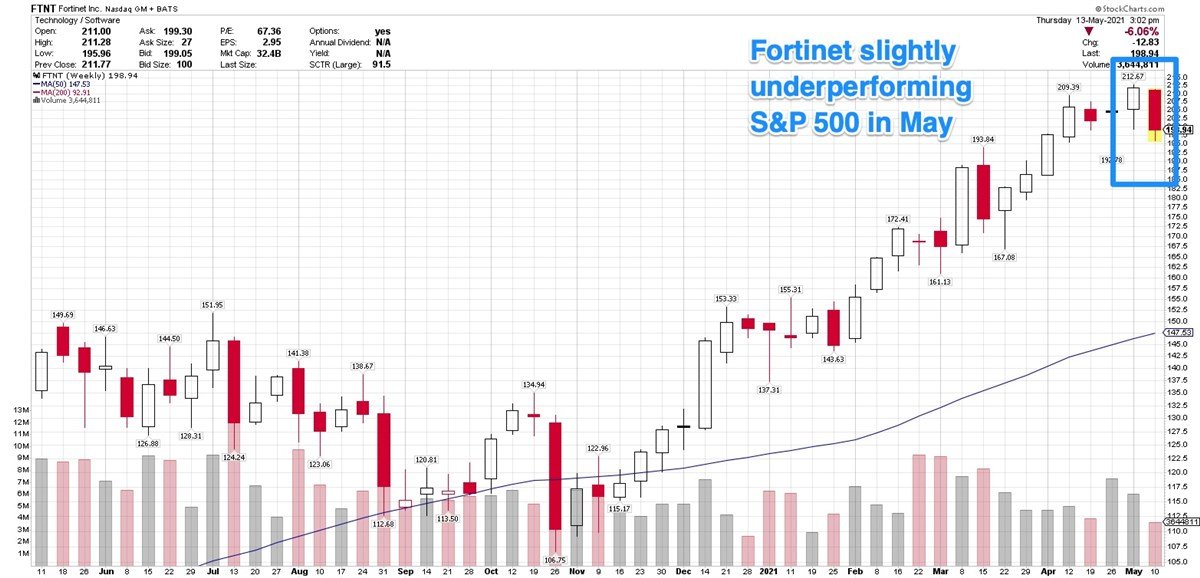
Fortinet’s trade has been choppy since its earnings report after the close on April 29. However, much of that chop was due to a decline in the broader market. Fortinet, as a large cap, is part of the S&P 500 index, so it’s appropriate to gauge its performance to the broader index. 

Fortinet is down 2.78% in May, trading Thursday at around $198. As a point of comparison, the S&P 500 is down just 1.54% this month. 

That’s not a big enough discrepancy to become concerned about, especially with a company that’s situated in a growing industry, and one that’s in the spotlight these days. 

What Does Chip Shortage Mean?

One potential headwind is the global semiconductor shortage. In the April earnings call, chief financial officer Keith Jensen addressed that challenge. He discussed the products themselves within Fortinet’s inventory mix.

“One thing about Fortinet, in addition to having different form factors, is the inventory balances that we carry, a two times inventory turns, you’re looking at basically six months of inventory that we’re carrying on our balance sheet,” he said.

However, he acknowledged that supply chain issues related to chips will be a constant this year and into next year. “But I think in terms of when we sit down and talk about our expectations for the year, I think we have a fairly good understanding of how to work that in,” he added. 

Although this stock has a lot going for it, this is not the right time to buy, especially with the broader market in a correction. Downside volume has been lower than upside volume lately, which is a great sign for the stock. However, more selling could be ahead. 

There’s a great deal of chatter right now about investors being spooked by inflation, but the reality is: The stock rallied 42.37% over the past year and 32.65% year-to-date. After those rallies, it’s not surprising to see institutional investors take some profits and prepare for the next run-up.

The industry outlook is good, as well. Rivals in the firewall space include Palo Alto Networks (NYSE: PANW) and Checkpoint Software (NASDAQ: CHKP). Smaller cybersecurity stocks include Identiv (NASDAQ: INVE) and Proofpoint, which is being acquired by private equity firm Thomas Bravo.
Look For Fortinet To Post Double-Digit Earnings Growth In Next Two Years

Featured Article: What is the Ex-Dividend Date in Investing?

https://www.entrepreneur.com/article/371968