3 Disruptive Stocks to Buy on Sale Now

While we don’t know how long the selling will persist in growth, it might pay off to start adding shares of innovative companies that have huge long-term potential at this time. Let’s take a look at 3 disruptive stocks to buy on sale now.

May 14, 2021 5 min read

This story originally appeared on MarketBeat
We are privileged to be living in a time when there are so many different companies that are changing our lives for the better. Every year, more and more businesses come along with an innovative product or service that takes the world by storm. These disruptive companies use technology and non-conventional business models to create something truly unique and that has the potential to turn an entire industry upside down. If you can find these companies early or on sale, they can end up being some of the best investments you can make.

What’s important to note about most disruptive companies is that they are high-growth businesses. That means that many of these stocks have been victims of the recent market selloff and are essentially on sale at this time. While we don’t know how long the selling will persist in growth, it might pay off to start adding shares of innovative companies that have huge long-term potential at this time. Let’s take a look at 3 disruptive stocks to buy on sale now.

Tesla (NASDAQ:TSLA)

Whether or not you are a fan of this company’s eccentric CEO Elon Musk, you have to admit that he has disrupted the entire automotive industry with this iconic electric vehicle company. Tesla is a company that designs, develops, manufactures, and sells electric vehicles as well as solar energy generation and storage products. It was the first company to commercially produce a federally compliant electric vehicle, which offers a market-leading range on a single charge. Tesla has essentially made electric and sustainable vehicles attractive for the mainstream thanks to its innovative and high-performance cars, and it’s hard to not be on board with a company that promotes environmentally-friendly values.

While you might be thinking that it’s only a matter of time before competitors start to take market share from Tesla, one could argue that other companies will have a hard time replicating the technology, design, and innovativeness of Tesla vehicles. The stock has been falling hard after the company’s latest earnings report and is down over 36% from its 52-week highs. There’s a chance that the selloff is overdone, and Tesla’s revenue could see huge growth this year if the company can continue to ramp up its China factory. Tesla stock is currently dancing around the 200-day moving average, which might be a great place to consider adding shares but be careful with your position sizing amidst the current market volatility.

Etsy (NASDAQ:ETSY)

Etsy is an attractive company to consider owning if you are interested in disruptive e-commerce businesses, and the stock is down over 37% from its 52-week highs at this time. While it is still vulnerable given the current sentiment surrounding growth names, if the stock can reclaim the 200-day moving average at $169, it would provide a very attractive entry point for long-term buyers. Etsy is a rapidly growing online retailer that connects millions of buyers and sellers across the U.S. and in select international markets.

This company is a disruptor thanks to the level of personalization and custom items that are available on its platform. While there are certainly a lot of different products available on different e-commerce websites, Etsy is the only one that is focused solely on creative goods made by artists and entrepreneurs. The company recently reported consolidated Gross Merchandise Sales of $3.1 billion in Q1, up 132.3% year-over-year, and Q1 Net-Income of $143.8 billion, up 1,048.1% year-over-year. While Etsy has an uphill battle trying to beat its growth from last year, this is still a fantastic company to consider owning for the long term, especially at current price levels.

Lovesac (NASDAQ:LOVE)

While this stock hasn’t pulled back as much as many of the other names in growth, it’s still down from its recent highs and is worth a look given its relative strength and intriguing business model. Lovesac is an American furniture retailer that designs, manufactures, and sells furniture including foam beanbag chairs, seats, and accessories. It has also created a unique modular furniture product called a sactional, which is the main revenue source for the company. Sactionals are essentially a sofa with two basic pieces, seats and sides. What’s interesting about them is that customers can start with a small piece of furniture from Lovesac and then invest in additional pieces later on down the road.

There are dozens of different ways that sactionals can be rearranged to fit in someone’s home, and the company benefits from repeat customers thanks to this innovative take on home furnishings. It’s also worth noting that this company’s furniture is built to last a lifetime and is made with yarn that is produced from recycled plastic bottles, which is great for investors who value sustainable products. Lovesac has delivered four consecutive fiscal years of double-digit net sales growth or better and has expanded its digital sales channels during the pandemic, which are additional reasons to consider adding shares.

Tesla is a part of the Entrepreneur Index, which tracks some of the largest publicly traded companies founded and run by entrepreneurs.

https://www.entrepreneur.com/article/371967


Yeti Holdings Raises Guidance After Topping Q1 Expectations

Shares of outdoor gear maker Yeti Holdings (NYSE: YETI) vaulted nearly 5% higher Thursday following a better-than-expected first-quarter earnings report. 

May 14, 2021 4 min read

This story originally appeared on MarketBeat
Shares of outdoor gear maker Yeti Holdings (NYSE: YETI) vaulted nearly 5% higher Thursday following a better-than-expected first-quarter earnings report. 

The company makes drink containers, coolers, blankets, camping chairs, apparel, pet gear and other items that caught on during the pandemic as people spent more time enjoying the great outdoors. 

Earnings came in at $0.38 per share, up 245% from a year ago, handily topping views of $0.21 per share. Revenue was $247.6 million, up 42%, also ahead of forecasts, which called for $220.3 million.

In its report, Yeti cited several key metrics driving growth:

  • Direct-to-consumer, or online sales, grew 59% to $126.8 million, up from $79.6 million in the year-ago quarter. The company said drinkware and coolers were especially strong.  
  • Wholesale channel sales increased 27% to $120.8 million, up from $94.8 million a year ago. Here, too, coolers and drinkware were big sellers. 
  • Drinkware net sales came in at $148.9 million, a year-over-year gain of 32%. The company said new colors and sizes, as well as customization, were popular in the quarter.
  • Coolers and equipment net sales grew to $93.5 million, up 57% from a year ago.  

In the statement accompanying the earnings report, CEO Matt Reintjes said, “After the strong start to 2021, we are raising both our full-year net sales and earnings per share outlooks to 20% and 22% growth, respectively, versus the prior year.”

That’s higher than analysts had forecast. 

Building Upon 2020 Success

He added that momentum from 2020 carried over into 2021, “as consumers continue to participate in the significant growth in active, outdoor lifestyles. We believe we are well-positioned to generate and build upon this customer enthusiasm for the brand now and into the future.”

In the earnings call, the company said it expects the second quarter to be stronger than the first, which makes intuitive sense. With warm weather in the spring and early summer, more people are ready to get outdoors and purchase gear for their new adventures. 

Yeti went public in October 2018, so it’s still a new stock, in the zone when it’s poised for big potential gains. Shares are up 197.81% over the past year, and 18.91% year-to-date. The stock consolidated between mid-January and mid-April, clearing a buy point above $80.89 in heavy volume on April 12. 

The stock rallied to an all-time high of $90.65 on Monday, before reversing lower. The broader market attempted a rally the same day, but finished the session lower. It’s not uncommon to see any given stock trending in the same direction as major indexes. 

Earnings And Revenue Grow At Fast Clip

Yeti has all the fundamental characteristics you want to see in a growth company. Annual earnings growth accelerated over the past three years. On a quarterly basis, earnings grew at double- or triple-digit rates in the past eight quarters. Revenue grew at double-digit rates in seven of the past eight quarters, the sole exception being the quarter ended in June 2020, when sales were up 7%.

Full-year revenue also rose in 2019 and 2020. Other metrics, such as return on assets and return on equity have also been on the rise, and at 22.8% and 75.92% respectively, remain strong.

The company’s price-to-earnings ratio of 44 may give some investors pause, as it could signal a stock priced to perfection. However, many growth stocks have sky-high P/E ratios, and still go on to notch more gains. Once a stock is more mature, you’ll see lower P/Es. At this juncture, this is not something that should stop investors who may want to take a position in the stock.

However, broader market weakness and choppiness could be a concern. Strong price action today in Yeti may make it a current buy candidate, but wider market conditions warrant having stops in place, or a strong stomach to sit through another potential correction. 

Featured Article: What is the Gross Domestic Product (GDP)?

https://www.entrepreneur.com/article/371965


Quick Steps to Choosing the Right Dental Insurance

May 14, 2021 5 min read

This story originally appeared on MarketBeat
Just like choosing the right health insurance policy, why not carefully consider your options before you enroll in a dental insurance policy? 

Did you know that dental pain accounted for 2.1 million emergency room visits in 2010, according to the American Dental Association? Most of these cases could easily have been prevented with routine care and hygiene. Yikes. Makes my mouth hurt just thinking about it.

Take a look at a few steps you can use to learn how to choose the right dental insurance for your needs.    

What Does Dental Insurance Provide?

Dental insurance coverage varies and completely depends on the plan you choose. In general, you can expect to get preventive care (oral exams, teeth cleaning), basic treatments (fillings, root canals) and major restorative services (crowns, implants, etc.). 

Step 1: Think about what you need.

You may not need much coverage, or you might need a lot, depending on the dental challenges your own teeth present. If you’re in your 20s and single (with a beautiful smile), you might need less coverage than a family of five who has recurring dental issues. 

Step 2: Check out your insurance options.

Many types of dental plans provide coverage for services and treatments that go well beyond preventive care, also called full coverage dental options. You can look into a dental PPO (DPPO), dental HMO (DHMO), dental EPO (DEPO) or a dental POS (DPOS) plan. You can tap into a wide range of dental services and treatments with these coverages.

  • Dental preferred provider organization (DPPO): You will save money by choosing an in-network dentist if you choose a PPO, but you can still use your insurance benefits with dentists who aren’t within your network.  
  • Dental health maintenance organization (DHMO): DHMO plans involve networks of dentists under contract with the dental insurance company that offer dental services to insured members at predetermined rates. They usually cost a lot less than DPPOs.
  • Dental exclusive provider organization (DEPO): DEPOs don’t cover any out-of-network care. A Blue Dental EPO plan only covers services from in-network PPO dentists, which reduces costs.
  • Dental point of service (DPOS): POS policies contain terms and conditions similar to those in HMOs and PPOs. Beneficiaries usually need to visit a primary care physician (PCP), who would refer them to any specialists in the network. You usually don’t need to pay a deductible for procedures. 

Furthermore, do you need group or individual dental insurance? 

Group Dental Insurance 

Group insurance plans usually involve a dental plan that you get through your workplace. Those who enroll typically get access to dental exams, cleanings, X-rays and fluoride treatments without deductions from the annual maximum. 

Your employer generally pays for some or all of your premiums or deducts a share of your premium from your paycheck when you enroll in a group plan. 

Individual Dental Insurance 

Don’t have an employer or a way to get group coverage? Why not get an individual family policy? 

Though you’ll usually pay more for coverage with an independent plan, you can more easily customize your coverage by choosing from a larger array of dental insurance coverages. 

Step 3: Compare plan options.

You may have the option of choosing between a group or individual plan. Let’s take a look at both options. Does one type make more sense for your needs? As you probably already know, insurance options span various types of service, different costs and limitations and more between insurance carriers. 

Note: You’ll also face plan limits on the total amount of benefits that you can claim. You can’t claim any more benefits once you hit that annual limit on your plan requirements. Find out what those plan limits entail before you choose!

Step 4: Check out your network options.

A dental network comprises a group of dentists under contract with your dental insurance carrier. The dentists in the network agree to provide dental work with a set fee. An in-network dentist contracts with your insurance carrier.

Any dentist you choose to see out of the network will require you to pay more money out-of-pocket to see them. Check out which dentists fit into the network of each plan you consider. Ask around your local area — friends, colleagues, family members — to make sure you choose the right dentist within the right network.

Step 5: Evaluate costs.

Dental insurance costs vary depending on whether you cover just yourself or an individual, your location, your dental insurance carrier and how much coverage you choose. You may pay as little as $15 a month for individual insurance but if you need to seek emergency dental treatments or other expensive procedures, they can cost thousands.

Routine cleanings can also cost up to $200 without insurance. Getting the right dental insurance policy could save you hundreds or even thousands of dollars. 

Step 6: Undergo a waiting period.

You may have heard about waiting periods, and many dental insurance plans impose one before you can actually use your plan’s benefits. In other words, insurance companies don’t want you to crack a tooth and sign up for a plan the next day. You may need to wait up to three months before you can use your insurance for major services. 

Get Ready for Great Dental Insurance

One of the best things about dental insurance: It automatically covers fillings and cleanings and other basic preventive services. However, you might total up the amount you’ll pay per year for those basic services and realize you might pay more in premiums than it costs for a yearly exam. Does that make you tempted to skip dental insurance?

But what happens when you need a crown, something that can cost anywhere from $300 to $2,000 or more. Yikes. That could take a big hit out of the monthly budget.

Consider getting dental insurance before disaster strikes, so you can keep your pearly whites looking their best.

Featured Article: What is the Rule of 72?

https://www.entrepreneur.com/article/371959


Bloomin’ Brands Business Blossoms, But Shares Down In May

May 13, 2021 4 min read

This story originally appeared on MarketBeat
Restaurant chain operator Bloomin’ Brands (NASDAQ: BLMN) brands is consolidating below its April 30 high of $32.81, which it reached a day after reporting first-quarter results.

The company’s brands include Outback Steakhouse, Fleming’s, Bonefish Grill, Aussie Grill and Carrabba’s Italian Grill. 

Despite taking a drubbing during the pandemic, like all restaurants, Bloomin’ Brands has been a growth-stock success story. The company notched a series of positive returns over various rolling time frames:

  • 3 months: 25.80%
  • Year-to-date: 51.65%
  • One year: 158.11%

However, growth stocks as an asset class have been getting hammered since a late April rally attempt fizzled. The Nasdaq Composite is down 5.31% in May, slumping 5.85% as of mid-session Wednesday

As three-fourths of stocks typically follow the broader market’s direction, either higher or lower, it’s no surprise to see stocks like Bloomin’ Brands skidding as big techs lead the market lower. For example, Apple (NASDAQ: AAPL) is down 5.95% for the month, and Microsoft (NASDAQ: MSFT) is down 4.34%.

Bloomin’s earnings report offered much to cheer about. The company posted revenue of $987.5 million, down 2% from a year ago, when pandemic lockdowns struck toward the end of the quarter. 

It marked the third quarter in a row of sequential revenue gains, illustrating gradual improvement as customers return to reopened restaurants. 

The company reported a rapid increase in weekly per-store sales volume, which rose from  $21,000 to $35,000 in the four weeks prior to April 28.

Earnings per share came in at $0.63 per share, up a whopping 350% from a year ago. 

Analysts expect earnings of $2.20 a share this year, and $2.43 a share in 2022. Both numbers were revised higher recently. 

In the earnings call,  executive vice president and chief financial officer Chris Meyer said off-premise dining – also known as takeout – comprised 35% of earnings in the quarter, down only 2% from the fourth quarter, when dine-in options were more restricted. Meyer said the company is planning for takeout business to be a significant revenue stream going forward, even as indoor dining continues to reopen. 

“This occasion is proving to be highly incremental and will remain a key part of our growth strategy moving forward,” he said.

Meyer cited another milestone. “We ended the quarter with 100% of our domestic company-owned restaurants open with in-restaurant dining,” he said. 

Even as Covid restrictions ease and Americans are ready to dine in restaurants again, a fresh crop of challenges have emerged. One of the biggest is higher food prices as commodity prices rise and there’s now a shortage of chickens. Another looming challenge is higher labor expenses.

Both of those could have an impact on Bloomin’s bottom line, resulting in a potentially lower earnings number for the year. 

Of course, rival restaurant chains are facing those same headwinds. But Bloomin’ Brands may have an advantage over competitors, when it comes to staffing. 

“We did not furlough any employees during the pandemic, and this decision has contributed to low turnover,” said CEO David Deno, in the earnings call. 

“Maintaining a motivated and well-trained and engaged employee base is critical to our long-term success. As sales volumes are now exceeding pre pandemic levels, these actions provide a competitive advantage to retaining talent as the industry faces some staffing challenges,” Deno added. 

Bloomin’ shares are down 10% so far in May, underperforming the wider group of publicly traded restaurants, down just 2.6%. With a beta of 1.55, the stock is more volatile than the broader market, so it’s not necessarily a surprise to see the underperformance. 

While the stock is currently trading below its late April high, it’s not yet etching a proper base. At this juncture, the stock is still in the “falling knife” category, meaning would-be investors should track the stock, waiting until it begins its next upward trajectory before jumping in. 

In the current market environment, coupled with higher commodity prices that are a real threat to restaurant-industry profits, you also want to see a broad market rally to buoy this stock.
Bloomin’ Brands Business Blossoms, But Shares Down In May

Featured Article: What sectors are represented in the FTSE 100 index?

https://www.entrepreneur.com/article/371852


3 Reasons Roblox Stock Could Be a Huge Winner

While many high growth stocks have entered into bear market territory in recent weeks, Roblox (NYSE:RBLX) is a great example of one that is trying to buck the trend.

May 13, 2021 4 min read

This story originally appeared on MarketBeat
While many high growth stocks have entered into bear market territory in recent weeks, Roblox (NYSE:RBLX) is a great example of one that is trying to buck the trend. After beating expectations with strong earnings results in the first report since the company went public back in March, investors should be paying close attention to what the stock does in the coming weeks. 

As a company that is disrupting a growing industry and establishing itself as a leader in its respective niche, Roblox could be the type of stock that turns into a huge winner in the long run. Investors that are looking for exposure to video games and social media should also be intrigued with this company’s platform. It’s safe to say that Roblox stock potentially has the makings of a long-term winner, and here are 3 reasons why.
 
Changing the Way Video Games Are Played

Sometimes, you can get the best investment ideas just by paying attention to your everyday surroundings. Over the past few months, I’ve noticed that quite a few of my friends with children have mentioned their kids are obsessed with a new video game platform called Roblox. Their children just can’t wait to get home and play each day and won’t spend any time on other games. These parents also discussed how much money they are regularly giving their children to spend on the company’s in-game purchases, which was even more intriguing. After doing some research on the company and learning about why it’s unique, it became clear that this is a stock with heaps of long-term potential.

Roblox is a technology company that offers a gaming app for kids powered by user-generated content. It is essentially an entire universe of 3D-generated worlds where people can play together and socialize. What’s unique about this company is that all of the games on the platform are made by its users. The company wants to build a human co-experience platform that enables shared experiences among its millions of users. It’s also worth mentioning that anyone, even children, can make boatloads of money on the platform. Roblox and its games are free to join, but kids buy and spend a virtual currency called Robux to enhance their experience. It’s a unique take on social gaming that is changing the way that video games are played, which is a big reason why the stock is worth monitoring.

User Base Growing Fast

Roblox is a company that trades at a premium valuation, but it seems that investors are alright with that given how quickly the company’s user base is growing. In the company’s Q1 earnings results, Roblox saw Average Daily Active Users (DAUs) increase by 79% year-over-year which was largely driven by 87% DUA growth outside of the U.S. and Canada. This is important because it tells investors that the company is attracting an international audience and that Roblox is still a big hit even after many kids have gone back to the classroom.

DAU is a valuable metric for these types of businesses because it offers insight into how “sticky” a tech company’s platform or service is. Another interesting thing to note from the report is that Hours Engaged were 9.7 billion in the quarter, an increase of 98% year-over-year. The company also saw 111% growth in DAUs over the age of 13, which confirms that the platform is attracting older users and is a great sign that this company might have truly created something special.

Long-Term Trends Still Intact

One of the big concerns about Roblox after it went public was whether or not it would still be able to grow in a post-COVID world. If the company’s Q1 earnings report is any indication, those concerns have not come to fruition. Keep in mind that many of the long-term trends that could turn this company into a long-term winner are still intact. The gaming industry isn’t going anywhere anytime soon, and the fact that Roblox offers a safe and entertaining way for young people to interact with their friends is part of what makes this a company with massive potential.

There’s also the trend of increasing connectivity thanks to the rollout of 5G that could make Roblox accessible to more people all over the world. Finally, the fact that entertainment and social networks have become intertwined plays perfectly into this company’s business model. While the stock is certainly not cheap and the company has yet to report a profit, Roblox has all of the ingredients to become a long-term winner and is a great stock to watch going forward.

Featured Article: Profit margin is different from the revenue

https://www.entrepreneur.com/article/371851


Wolverine Worldwide, Inc Is A Buy On Post-Earnings Weakness 

Shares of Wolverine Worldwide are down more than 10% from their recent high and in deep correction despite better than expected earnings and positive guidance.

May 13, 2021 4 min read

This story originally appeared on MarketBeat

Wolverine Worldwide, Inc Forecasts Strong Rebound 

Wolverine Worldwide, Inc (NYSE: WWW) and the shoe industry at large didn’t have a fantastic 2020. Like other retailers of apparel, there was little impetus for demand due to social distancing and work-from-home trends. At least in the beginning. Now, more than a year into the crisis, not only is the shoe industry at large posting a nice little rebound but the trends are accelerating. Assuming the reopening continues unabated we expect to see Wolverine World Wide outpace even its own updated and very positive guidance. 

“We believe 2021 will be a breakthrough year for the Company, and our first-quarter performance was an excellent start,” said Blake W. Krueger, Wolverine Worldwide’s Chairman and Chief Executive Officer “ … Our brands are well-positioned in trending, performance-oriented product categories like running, hiking, and work; and their momentum remains strong. We anticipate growth to continue to accelerate moving forward.”

Wolverine World Wide Falls On Market-Beating Results 

Wolverine World Wide had a great quarter and one in which sequential growth continued for the 4th quarter. The $510.7 million in net revenue is up 16.3% from last year and beat the consensus if only by a slim 25 basis point margin. Gains were driven by strength in the company’s two top brands as well as eCommerce. The Merrel brand saw its sales surge 25% while Saucony sales jumped 55% and eCommerce 84%. 

The revenue gains were translated into higher margins as well and despite the impact of upward price pressures. The gross margin widened by 210 basis points GAAP and 290 basis points adjusted to hit 4.3% and drive operating gains of larger proportion. The operating margins widened by 760 bps GAAP and 320 bps adjusted to drive significant improvement in earnings. At the GAAP level, the $0.45 in EPS is up 200% from last year and beat the consensus by 1000 basis points. At the adjusted level the $0.40 in reported earnings is up 55% but missed consensus by a penny, that’s the only bad news we could find. 

Guidance for the remainder of the year is equally positive if a little light in regards to earnings. The company upped its target for revenue to $2.24 to $2.3 billion versus the $2.23 consensus which is estimating 25% to 28% YOY growth. The adjusted EPS target was also increased but to a range that brackets the consensus with the consensus above the mid-point of the range. In our view, the guidance but possibly cautious in light of our expectation for the economic rebound. The Fed’s GDPNow tool is tracking Q2 GDP in the double-digit range and we think GDP could accelerate from there before it cools off. 

Wolverine Worldwide Could Increase Its Dividend 

Wolverine Worldwide is not a well-recognized dividend-grower but it does have a history of increases. Based on the Q1 results, the outlook, and the balance sheet we think the company could not only sustain its current payment but increase it as well. Not only is the payout ratio very low but free cash flow is good and on the rise too. The company paid down a substantial amount of debt over the past year that has improved liquidity, leverage, coverage, and FCF. If these trends continue the next dividend increase could be substantial as well. 

The Technical Outlook: Wolverine Worldwide Enters Correction

Shares of Wolverine Worldwide shed more than 8% and are on the verge of a deeper correction because of the Q1 earnings. The earnings weren’t bad, nor was the outlook, but what they were was not enough to spark buying in the face of a broader market sell-off. What this means is share prices for this stock are going to continue falling until finding a firmer level of support that can sustain price action until market conditions improve. In our view, this stock could fall another 10% to 12% before hitting major support but, if it does, we’d be buyers. At that price point, near $34 to $36, the stock would be trading about 17.5X to 18.5X its earnings at the low end of the range and present a much better value-to-yield.

Wolverine Worldwide, Inc Is A Buy On Post-Earnings Weakness 

Featured Article: How is a buy-side analyst different from a sell-side analyst?

https://www.entrepreneur.com/article/371849


Health Insurance Tips for Gig Workers

It goes without saying that you need health insurance, even when you participate as a gig worker and take on contract work instead of working for an employer.

May 13, 2021 5 min read

This story originally appeared on MarketBeat

It goes without saying that you need health insurance, even when you participate as a gig worker and take on contract work instead of working for an employer. You might not even get that excited about paying for health insurance because you’re not sure whether you’ll make any money in the next week, let alone over the next six months.

The gig economy continues to explode. On average, one in four workers serves as a gig worker in 40% of companies. In 6% of companies, gig workers make up as much as 85% of the workforce. Finally, the workforce in the finance sector makes up 25% of gig workers, primarily independent contractors, according to ADP Research Institute’s recent report.

Curious about how to find health insurance if you live and breathe the gig economy? Take a look at a few quick tips below.

How Gig Workers Can Get Health Insurance

How do you get health insurance as a gig worker? We’ll go over a few options.

Option 1: Self-Employed Health Insurance

Self-employed health insurance, also called individual health insurance, offers a plan directly the opposite of a group health insurance plan from an employer. In most cases, you must enroll during the open enrollment period. You can take a look at the various plans available on the Marketplace, a shopping and enrollment service for medical insurance created by the Affordable Care Act through the federal government.

Option 2: Spouse or Domestic Partner’s Plan 

I recently ventured out into the gig economy and I chose this option — staying on my spouse’s plan. You can often tap into lower premiums when you hop on a spouse or domestic partner’s plan because the employer and employee split the premium cost. 

More than half of non-elderly Americans had group health insurance coverage through their employer or the employer of their family member in 2019. 

Employees with a same sex or opposite sex domestic partner can also get health and/or dental insurance for their domestic partner and family.

Option 3: COBRA 

Thinking about leaving your job to try out the big, wide world of gig working? You may want to find out if you can convert your group plan into an individual plan before you say sayonara. Your plan provider can explain how the Consolidated Omnibus Budget Reconciliation Act (COBRA) might fit your coverage options best. COBRA specifies that you can extend your health care coverage up to 18 months after you leave your job.

COBRA gives you a kind of safety net by giving you more time to look into various insurance options.

Option 4: Gig Worker Associations

Did you know that you can get insurance as a gig worker? You sure can! 

For example, the Freelancers Union offers a health insurance plan. You can also find dental coverage and life insurance. If you belong to a professional association, find out whether it offers coverage before you strike out on your own or try the Marketplace. It might offer a cheaper option.

How to Get Health Insurance 

First of all, remember that in all likelihood, you will qualify for the special enrollment period. This means you may have 60 days before or 60 days following the event to enroll in a plan. This may make it convenient for you to take some time to evaluate the right health insurance option for you. Take these two simple steps to get health insurance:

Step 1: Compare costs. 

Ask yourself these questions among each plan you consider:

  • How much do you pay for the premium per month?
  • What is the annual plan deductible? A higher deductible means you pay a lower premium and a lower deductible means you pay a higher premium. Learn more about what you need to pay out-of-pocket before your insurance plan will kick in and start paying.
  • What will you pay out of pocket for the entire year, also referred to as your out-of-pocket maximum?
  • What are the coinsurance and copayment (copay) amounts? The coinsurance percentage refers to how you and the insurance policy split the cost of care. Your copay involves how much you pay for a covered service, which you pay to your doctor before you receive the doctor’s care. 

Step 2: Sign up for a plan.

You may want to make your first stop healthcare.gov. You can find a multitude of options on the Marketplace for your state. You can also opt to use a private company if you don’t want to get insurance on the Marketplace.

All ACA plans must cover the following:

  • Emergency services
  • Hospitalization
  • Out-patient services
  • Maternity and newborn care
  • Mental health, behavioral health and substance use disorder services
  • Prescription drugs
  • Rehabilitative services
  • Laboratory services
  • Pediatric services, including oral and vision care
  • Preventive and wellness services and chronic disease management

Just know that insurance companies can choose how they handle these benefits. You still need to pay your premium to keep your plan every month and all might have various copays! 

Choose the Right Health Insurance Option for You

When you think you might be ready to jump ship from the nine to five slog, remember that you still need to think about practical matters — freedom and “being your own boss” aside.

No matter what, remember that you need to get health insurance. Don’t even think for one second that you can go for one day without health insurance. Remember, even a simple surgery like taking out an inflamed appendix can cost thousands of dollars. 

You want to do as much research in advance prior to leaving your job (if you can) so you can find the best health care option for your personal situation.  

Featured Article: What is the Fibonacci sequence?

https://www.entrepreneur.com/article/371848


2 Small-Cap Gaming Stocks With Double-Digit Growth 

While Draft Kings is the hottest thing in U.S. digital sports betting it is not the only gaming stock on the market. The two we are highlighting today have well-established businesses that are both growing at double-digits and with increasing leverage to boot.

May 12, 2021 4 min read

This story originally appeared on MarketBeat

Two Gaming Stocks With Secular Tailwinds To Drive Them 

With the legalization of online gaming slowly spreading across the U.S. gaming stocks like Draft Kings (NASDAQ: DKNG) have been getting all the attention. While Draft Kings is the hottest thing in U.S. digital sports betting it is not the only gaming stock on the market. The two we are highlighting today have well-established businesses that are both growing at double-digits and with increasing leverage to boot. On the one hand is a play on mobile and mobile gaming while on the other a play on international markets, sports betting, and the lottery. If you are a small-cap investor looking for an entry into the world of games, gambling, and gaming one of these is sure to fit the bill. 

Playtika Revenue Surges On Broad Demand 

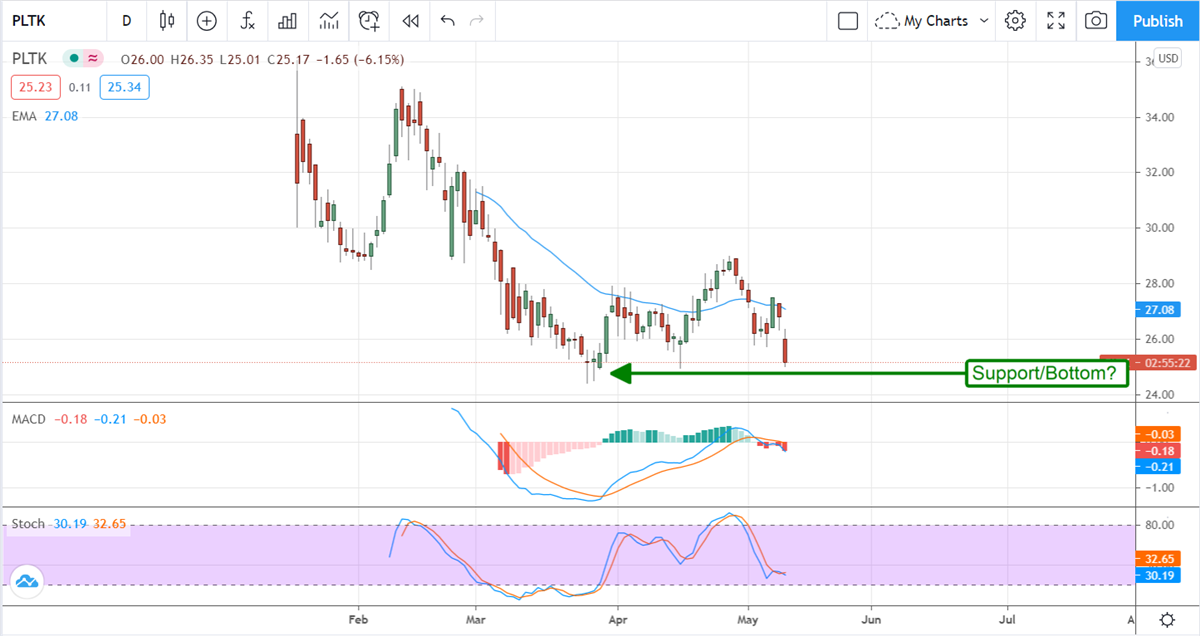
Playtika (NASDAQ: PLTK) is an Israel-based mobile gaming company with four lucrative revenue streams. The company just reported its Q1 results and the company posted double-digit gains in all of them. On the top line, the company’s revenue grew nearly 20% to $638.9 million or roughly 1000 basis points better than expected. The company’s strongest segments are Solitaire Grand Harvest and Board Kings which grew 60% and 57% respectively. The other segments of note, Bingo Blitz and Casual Games grew by 40% and 30% to help drive a 39% increase in adjusted income. Share prices are down, however, because GAAP earnings missed the consensus estimate. 

Looking forward, the company is expecting the strength to continue and guided full-year 2021 outlook higher because of it. The new guidance is not only above the previous guidance but also the analyst’s consensus and we feel it may be too low. After sampling Solitaire Grand Harvest our gamers say they’ll probably play it again. It may take a little time for the market to come back around but this stock should see a new all-time high by the end of the fiscal year. 

“Our business displayed excellent momentum in the first quarter, and we experienced strong performance across all parts of our company,” said Craig Abrahams, President, and Chief Financial Officer. “We continue to innovate within our portfolio of game franchises and delivered excellent organic revenue growth with over 40% Adjusted EBITDA margins in the quarter. We are pleased to be able to increase our financial outlook for the year, particularly of the target milestone of delivering $1 billion in adjusted EBITDA for 2021.”

Two Small-Cap Gaming Stocks With Double-Digit Growth 

International Game Technology Hits The Jackpot 

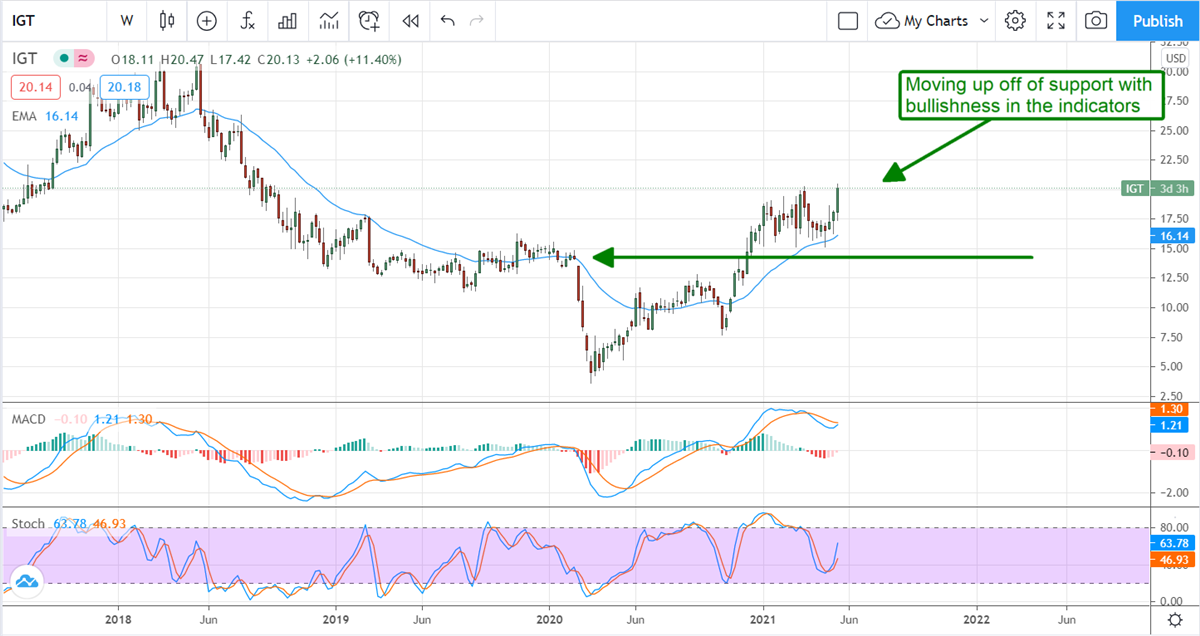
International Game Technology (NYSE: IGT) is a horse of a different color, operating as a Lottery and gaming services business. The lottery end of the business is carrying the company right now, up 48% YOY, but we expect to see gaming rebound smartly by the end of the year. The gaming segment, which services the casino and sports betting industry, saw its revenue decline by 14% YOY but far less than the analysts were expecting. In total, the company earned $1.01 billion in the first quarter or up 24% over last year and fully 1500 basis points better than the consensus. 

The revenue strength was felt all the way through to the bottom line as well. Margins not only improved but nearly doubled to drive a solid beat on the bottom line. The GAAP $0.44 in earnings beat the consensus by $0.51 and reversed an expected loss. The money is being put to good use paying down debt and improving balance sheet leverage which is another plus for this business. At the end of the Q1 period debt was down a quarter billion to just over $7.0 billion with leverage down a full multiple to 5.4X earnings. 

Shares of IGT surged more than 16% on the news to set a new 3-year high. The move is accompanied by strong signals in the indicators on both the daily and weekly charts. The indicators signals suggest a strong shift in momentum is in process and it is one that has room to run. In our view, this stock could easily be retesting the 2018 high near $30 by the end of the calendar year.

Two Small-Cap Gaming Stocks With Double-Digit Growth 

Featured Article: Float

https://www.entrepreneur.com/article/371722


3 Lumber Stocks to Consider Adding on Dips

While this trend won’t last forever, it is certainly going to benefit lumber stocks this year and perhaps for even longer. That’s why we’ve put together a list of 3 lumber stocks to consider adding on dips.

May 12, 2021 4 min read

This story originally appeared on MarketBeat
Sometimes, trading and investing don’t need to be overly complicated. For example, lumber prices have doubled so far in 2021 and are up over 300% from last year. With lumber demand expected to remain steady in the coming months, companies that are involved in producing this commodity could see strong earnings and deliver outsized returns to investors as a result.

Keep in mind that in simple terms, there is far more demand than supply for this commodity right now. The pandemic caused mills to cut back on lumber production in anticipation of a housing slump. Then, the Federal Reserve lowered interest rates. With mortgage rates at historic lows, people decided to take advantage and start looking for new homes away from big cities. This resulted in a housing market boom that has sent the price of lumber through the roof.

While this trend won’t last forever, it is certainly going to benefit lumber stocks this year and perhaps for even longer. That’s why we’ve put together a list of 3 lumber stocks to consider adding on dips.

West Fraser Timber Co (NYSE:WFG)

First up is a diversified wood products company with more than 60 facilities in Canada, the United States, the United Kingdom, and Europe. As a company that produces things like lumber, laminated veneer lumber, medium-density fiberboard, plywood, pulp, wood chips, and more, it offers investors the perfect opportunity to gain exposure to the timber products that are used in the housing market. Most of West Fraser Timber’s products are used in home construction, repair and remodeling, and industrial applications, which means this company is nicely poised to continue benefitting from a red hot real estate market.

If West Fraser Timber’s Q1 earnings are any indication, it is clearly capitalizing on rising lumber prices. The company reported that Q1 sales increased by 81% from the prior quarter to $2.3 billion and saw its Adjusted EBITDA more than double from the prior quarter to reach $1 billion. The bottom line is that the U.S. will continue looking to import lumber from Canada to deal with the heavy demand, which is why West Fraser Timber is a great stock to consider adding on dips.

Weyerhaeuser (NYSE:WY)

Adding shares of one of the world’s largest integrated forest products companies like Weyerhaeuser could be a savvy move at this time given the lumber shortages, especially since it manages more than 20 million acres of forest land. Weyerhaeuser is primarily engaged in the growing and harvesting of timber as well as producing and distributing wood and paper products. The company’s wood products segment produces softwood and hardwood lumber, plywood and veneer, composite panels, and engineered lumber, and roughly 70% of these products are used in new residential construction.

Weyerhaeuser recently reported Q1 net earnings of $681 million, or $0.91 per diluted share, which was up over 354% from the $150 million in net earnings a year ago. It’s also worth mentioning that the company reported its highest quarterly Adjusted EBITDA on record at $1.1 billion in Q1. This is another strong business that is benefitting from residential construction activity and momentum with repairing and remodeling homes, which means it’s a great buy-the-dip candidate to consider.

iShares Global Timber & Forestry ETF (NYSEARCA:WOOD)

If you are interested in playing the global timber industry but aren’t comfortable investing in individual companies, this ETF is a fantastic alternative. It offers exposure to companies that produce forest products, agricultural products, and paper and packaging products. With 25 holdings including quality names like West Fraser Timber, Weyerhaeuser, and Potlatchdeltic Corp, adding shares of this ETF on the dip is a great way to gain exposure to lumber.

It’s important to remember that timber can be used as a hedge for inflation, which is yet another reason to consider adding iShares Global Timber & Forestry ETF to your shopping list. You can also earn some extra income for your portfolio thanks to its 0.85% dividend yield. This ETF is up over 21% year-to-date and offers one of the safest ways to gain portfolio exposure to lumber at this time.

Featured Article: Why does the United States have a lingering trade deficit?

https://www.entrepreneur.com/article/371721


Life Steps: Small Steps for Overall Financial Health

May 12, 2021 5 min read

This story originally appeared on MarketBeat

When my husband’s 401(k) mailings show up in the mail, I love it because the company that takes care of his 401(k) makes all of it very interesting to read. Boy, have companies come a long way from the prospectus-like summaries of your investments. They make saving for retirement sound like a gigantic adventure. Heck, the title of his latest 401(k) summary says, “Dreams — Make it Real!” 

Of course I’m going to read it. 

An extra guide that came in the mail yesterday was called “Corona Crash” and it was a quick guide to budgeting, debt load, emergency funds, unexpected death, retirement planning and getting organized. It was full of suggestions about how much he could save based on his salary. So, let’s make up a fictitious salary: $90,000, and take you through the steps I read in this really handy pamphlet my husband gets.

First, Let’s Set Up a Family Budget

The pamphlet challenges you to break down your expenses into four different categories: “must haves,” “should haves,” “could haves” and “wants”: Of course, you can’t function without “must haves.” “Should haves” also involve items you need, and as you can imagine, “could haves” and “wants” shouldn’t show up on your “essentials” list.

The pamphlet got really cool at this point. It calculated budget basics based on my husband’s current income. Let’s use our fictitious salary of $90,000. For budget purchases, these expenses should take up no more than 50% of your after-tax income, or approximately $3,750 per month.

It says, “You should strive to save 15% of your pre-tax income ($13,500) in your retirement plan and save 5% of your post-tax income ($4,500) in an emergency fund.” 

See how it makes the numbers a no-brainer?!

Now, Let’s Look at Debt Load

Your mortgage or rent payments, car payments, student loan payments and credit card debt should not exceed 36% of your pre-tax income. Based on your salary of $90,000, your payments should total no more than $2,700.

The pamphlet warns that banks will often approve loans even if it drives your debt load higher, and might even approve your loans even if it drives your debt load up to 50%.

A few quick notes not in the pamphlet: If you want to get a loan, your lender will calculate a debt-to-income ratio (DTI) for you. You want to shoot for as low a DTI as possible. A DTI ratio of 43% is generally the highest mortgage lenders will accept for a qualified mortgage, which is a loan that includes affordability checks.

Curious about how to calculate your DTI? Simply put together a list of the payments you owe. This could involve your mortgage and rent payments, student loan and auto loan payments, credit card minimums, alimony, child support or other regular payments. 

Then, divide that total by your gross monthly income — your income before taxes.

Let’s say you have $1,000 mortgage payment, $300 in student loans and $400 in auto loan payments. Let’s say your gross monthly income is $3,000 per month. In this case, the DTI sits at 56% — high by any lender’s standards.

Establish an Emergency Fund

Putting together an emergency fund for events like COVID-19 or a health emergency goes a long way toward financial health. You should keep at least three months of total expenses in an emergency fund, then build that to six months’ worth of income as you save.

Three months’ worth of income (recommended minimum): $22,500

Six months’ worth of income (goal): $45,000

You can start by saving a small amount and build from there, a little from each paycheck.

Protect Against an Unexpected Death

Nobody really wants to talk about life insurance (at all, ever) but industry guidelines recommend having life insurance that covers five to 10 times your annual income, plus an additional $100,000 per dependent child. Breadwinners should always aim toward the higher end of the spectrum.

Death benefit (recommended minimum): $450,000 

Death benefit goal: $900,000, plus an additional $100,000 per dependent child

Plan for Retirement

This was my favorite part because everyone always wonders how much they should have saved for retirement at any given age. Naturally, anyone can look it up online but this pamphlet was custom tailored to my husband’s exact salary. What a wake-up call if you don’t quite have this down pat! You can consider yourself on track with your retirement savings if you have the following: 

Age 30

1x Annual Wages

$90,000

Age 35

2x Annual Wages

$180,000

Age 40

3x Annual Wages

$270,000

Age 50

6x Annual Wages

$540,000

Age 55

7x Annual Wages

$630,000

Age 60

8x Annual Wages

$720,000

Age 67

10x Annual Wages

$900,000

I can only imagine the scrambling at various homes when people got this little reminder in the mail. 

This section ended with a small caveat: A more comprehensive financial plan would also take into account your spouse’s annual income and all your outside assets and liabilities. It would also include analysis of college funding strategies, investment management, employee benefit elections, tax planning, estate planning and charitable giving strategies. In other words, the company wants you to drop by and invest more! 

Put Everything into Practice

So, what numbers do you have? Just remember, to calculate your percentages, you take your pre-tax salary and multiply it by the percentage you want to calculate. 

In other words, to calculate the amount of money you want to save in your retirement account (a recommended 15%), your calculation would look like this:

$90,000 x 0.15 = $13,500

Do you have a budget put into place, figure out what your debt load is, established your emergency fund, bought life insurance and planned for retirement?

You might feel as if you have to steer your money in so many different directions, and yes, you do! However, when you break it down into sections like this, based on your exact income, you can visualize how much you need to allocate to different areas of your financial life. 

Featured Article: How the Consumer Price Index (CPI) is calculated?

https://www.entrepreneur.com/article/371718