These Are the Top Ten Consumer Defensive Funds

When the overall economy isn’t doing well, one sector that usually performs better than average is Consumer Staples or Consumer Defensive. This sector primarily includes companies dealing with household goods, food, beverages, hygiene products and other items. Basically, these are the products that are hard to eliminate from a budget even in times of financial […]

May 10, 2021 5 min read

This story originally appeared on ValueWalk

When the overall economy isn’t doing well, one sector that usually performs better than average is Consumer Staples or Consumer Defensive. This sector primarily includes companies dealing with household goods, food, beverages, hygiene products and other items. Basically, these are the products that are hard to eliminate from a budget even in times of financial trouble. So, investing in them is a relatively safer option, and one can invest in these stocks through mutual funds and ETFs. Detailed below are the top ten Consumer Defensive funds.

Q1 2021 hedge fund letters, conferences and more

Top ten Consumer Defensive funds

We have based our ranking of the top ten Consumer Defensive funds on their past one-year return data. We have considered ETFs as well, and have referred to U.S. News for the return data. Following are the top ten Consumer Defensive funds:

  1. iShares Evolved US Consumer Staples ETF (IECS, 33%)

IECS normally invests at least 80% of its assets in the U.S. listed small, mid and large-cap consumer staples companies. IECS has a YTD return of 7.08%. It has $14.83 million in assets, while its net expense ratio is 0.18%. Its top three holdings are Coca-Cola, PepsiCo. and Procter & Gamble.

  1. Rydex Consumer Products Fund (RYPDX, 36%)

RYPDX usually invests in equity securities of U.S.-traded Consumer Products Companies, as well as in derivatives. RYPDX has given a return of 8.81% over the past three years, and 6.44% over the past five years. It has $109.74 million in assets, while its net expense ratio is 1.72%. Its top three holdings are Procter & Gamble, Coca-Cola and PepsiCo.

  1. Fidelity® Select Consumer Staples Port (FDAGX, 38%)

FDAGX normally invests a minimum of 80% of its assets in companies that manufacture, sell or distribute consumer staples. FDAGX has given a return of 10.42% over the past three years, and 6.77% over the past five years. It has $1.46 billion in assets, while its net expense ratio is 1.04%. Its top three holdings are Procter & Gamble, Coca-Cola and PepsiCo.

  1. First Trust Cnsmr Staples AlphaDEX® ETF (FXG, 40%)

FXG tries to match the price and yield performance of the StrataQuant® Consumer Staples Index. This fund normally invests at least 90% of its assets in the common stocks that are part of the index. FXG has a YTD return of 16.09%. It has $295.61 million in assets, while its net expense ratio is 0.63%. Its top three holdings are Bunge, CVS Health and Nu Skin Enterprises.

  1. Invesco Dynamic Food & Beverage ETF (PBJ, 42%)

PBJ tracks the investment results of the Dynamic Food & Beverage IntellidexSM Index, which includes U.S. food and beverage companies. The fund normally invests at least 90% of its assets in the securities included in the underlying index. PBJ has a YTD return of 17.01%. It has $86.30 million in assets, while its net expense ratio is 0.63%. Its top three holdings are Keurig Dr Pepper, Kraft Heinz and Mondelez International.

  1. First Trust Nasdaq Food & Beverage ETF (FTXG, 47%)

FTXG makes an effort to match the price and yield performance of the Nasdaq US Smart Food & Beverage Index. It usually invests a minimum of 90% of its assets in the common stocks and depository receipts of companies’ part of the underlying index. FTXG has a YTD return of 13.97%. It has $6.63 million in assets, while its net expense ratio is 0.60%. Its top three holdings are J.M. Smucker, General Mills and Bunge.

  1. Invesco DWA Consumer Staples Mom ETF (PSL, 55%)

PSL tries to match the investment performance of the Dorsey Wright® Consumer Staples Technical Leaders Index. It invests a minimum of 90% of its assets in the securities included in the underlying index. PSL has a YTD return of 9.19%. It has $111.68 million in assets, while its net expense ratio is 0.60%. Its top three holdings are Coty Inc, Monster Beverage and McCormick & Co.

  1. iShares US Consumer Goods ETF (IYK, 58%)

IYK tracks the performance of the Dow Jones U.S. Consumer Goods Index, and invests at least 90% of its assets in the securities that are part of this index. IYK has a YTD return of 5.27%. It has $691.74 million in assets, while its net expense ratio is 0.43%. Its top three holdings are Tesla, Procter & Gamble and Coca-Cola.

  1. Invesco S&P SmallCap Consumer Stapl ETF (PSCC, 59%)

PSCC tracks the investment performance of the S&P SmallCap 600® Capped Consumer Staples Index. It normally invests at least 90% of its assets in the securities part of the underlying index. PSCC has a YTD return of 18.71%. It has $46.39 million in assets, while its net expense ratio is 0.29%. Its top three holdings are WD-40, Medifast and Simply Good Foods.

  1. Rowe Price Global Consumer Fund (PGLOX, 59%)

PGLOX normally invests at least 80% of its assets in the companies operating in the consumer sector. Also, it usually invests a minimum of 40% of its assets in the companies located outside the U.S. PGLOX has given a 15.39% return over the past three years. It has $108.11 million in assets, while its net expense ratio is 1.05%. Its top three holdings are Amazon, Alibaba and The Home Depot.

https://www.entrepreneur.com/article/371558


How Entrepreneurs Can Manage Their Business Finances With Success

When starting or growing your business, it is important to build on your financial literacy skills to ensure that you have a solid understanding of your business numbers.

May 5, 2021 4 min read

Opinions expressed by Entrepreneur contributors are their own.

Entrepreneurship can be an enriching journey, and with the right skills, it can also be financially rewarding. With that journey comes more responsibility and hard work that, hopefully, pays off in the end. Smart entrepreneurs do what they can to ensure the success of their business. 

Related: Why Hard Work Is the Most Important Trait a Successful Entrepreneur Should Have

While working towards the success of their businesses, entrepreneurs need to be mindful of both business finances and personal finances. Many entrepreneurs need to rely on personal financing to back their businesses, especially startup business, so financial management needs to be a top priority. As Matt D’Angelo wrote for Business News Daily, “The most important step for any business owner is to educate themselves. By understanding the basic skills needed to run a small business — like doing simple accounting tasks, applying for a loan or drafting financial statements — business owners can create a stable financial future. In addition to education, staying organized is a major component of sound money management.”

Unfortunately, many entrepreneurs tend to overlook the need to manage their finances and know their numbers.  When you have this skill mastered, you will be more likely to save money and keep your business profits.

Here are some tips for managing your finances within your business:

1. Keep your personal and business bank accounts separate

Mixing these bank accounts is a big mistake that entrepreneurs often make. Not only does this get confusing for record-keeping, but it is problematic should you ever be audited. It is essential to hold a separate bank account for your business finances. It gives you a clear understanding of the cash available for the business and provides clear boundaries between the business and personal finances.

Related: 8 Books to Help You Find Financial Bliss

2. Ensure your books are kept current and accurate

Having timely and reliable financial reports requires your bookkeeping to promptly close the month. If you outsource this responsibility, ensure your bookkeeper is knowledgeable and that you can run your financial reports with confidence within a week. All too often, I see business owners rely on bookkeepers, only to find out at year-end that the bookkeeper was not qualified and made costly mistakes in their business. When searching for a good bookkeeper, I suggest you rely on referrals that other entrepreneurs have been using for over a year and are happy with. 

3. Know your business numbers

Do not put all your faith in an accountant or bookkeeper to tell you how your business is doing. You need to understand the financial health of your business at all times. Yes, you can outsource the bookkeeping, but ensure you receive valuable financial advice from your accountant and make informed financial decisions for you your business. With the proper management of your business finances, you will increase the profitability of your business.

4. Work with tax professionals who can help you save money

You may have questions about incorporating your business versus self-employment. The right financial professionals can help you make great decisions. Every business owner has a unique situation, so having a single method for all business owners does not work. It is wise to invest in a tax accountant who can show you how to take advantage of the tax opportunities available to you with your business and your personal taxes.

Related: The IRS Increases 2021 Contribution Limits to SEP IRAs and Solo 401(k)s for Business Owners

These are just a few tips on how to manage your finances. The more involved you dive into your business and personal finances, the more money-making and savings tips you will find. The surest way to build wealth for yourself and secure your financial future is to build upon financial literacy skills.

https://www.entrepreneur.com/article/358863


The Top 3 Stocks to Buy in May

If you are looking to put some money to work this month, this article is for you. Here are the top 3 stocks to buy in May.

May 1, 2021 4 min read

This story originally appeared on MarketBeat
Now that we’ve gotten several of the biggest earnings reports out of the way, it will be interesting to see where the market wants to go in May. With stocks trading around all-time highs, the ongoing reopening of the economy, and the possibility of inflation risk coming into play, investors need to stay focused and pay close attention to new trends as they are emerging. There’s also the old investment adage “Sell in May and Go Away” to keep in mind as we head into the month.

While it might be tough to predict where the overall market is heading in the short term, there are still plenty of great companies that stand out as strong buying opportunities at this time. If you are looking to put some money to work this month, this article is for you. Here are the top 3 stocks to buy in May.

Century Communities Inc (NYSE:CCS)

A lot of the homebuilder stocks have rallied substantially in 2021, but that shouldn’t stop you from seeking new buying opportunities in the sector. Case in point Century Communities, a company that designs, develops, constructs, markets, and sells single-family attached and detached homes. It’s also involved in the entitlement and development of the underlying land. With operations in some of the hottest real estate markets in the country including Atlanta, Central Texas, Colorado, Nevada, and Utah, Century Communities is benefitting from unprecedented demand in the housing market.

The company just reported blowout Q1 earnings numbers including Net Income of $101.7 million, up 289% year-over-year. Total revenues increased 67% to a company record $1 billion and the company also received a record Net New Home Contracts of 3,455 in the quarter, up 45% year-over-year. Century Communities upped its forward guidance for 2021 and the stock just broke out to new all-time highs, making it a great choice for investors that are looking to add a homebuilder stock in May.

Stericycle (NASDAQ:SRCL)

Another solid stock pick for the month of may is Stericycle, which is the largest medical waste management service provider in North America. Medical waste is any kind of waste that contains infectious or potentially infectious material, and it requires a very specific and secure method for disposal. When you think about how much of this medical waste is being produced in the COVID-19 vaccine rollout, it’s easy to recognize the potential in a company like Stericycle. 


What’s also great about this company is the fact that it only has one publicly traded competitor at about 1/60th of its size. That means it is a true market leader and that Stericycle can continue to grow by taking market share from smaller players in the industry over the years. Stericycle is rallying at this time after reporting its Q1 earnings and saw its regulated waste and compliance services organic revenues grow by 6% year-over-year. After breaking out of several months of consolidation, the stock has plenty of room to run in May, which makes it a very intriguing prospect at this time.

The Mosaic Company (NYSE:MOS)

The materials sector has been quite strong this year, and one of the names in the sector that stands out is The Mosaic Company. The stock has rallied over 48% year-to-date and could be in for more gains given strong crop prices and a positive outlook for the agriculture industry for the remainder of the year. Mosaic is one of the world’s largest producers and marketers of concentrated phosphate and potash crop nutrients. These nutrients are crucial for the global agriculture industry, as they are added to the soil to replace essential nutrients that are depleted by crops.

The company has customers in 40 different countries and is certainly benefitting from rapidly increasing commodity prices. Keep in mind that we could be dealing with inflation in the months ahead thanks to all of the recent stimulus, which is another plus for Mosaic, a company that benefits from a declining USD. It’s also nice to know that global food demand will pretty much always be strong, regardless of what is going on with the economy. Mosaic will report its Q1 earnings results on Monday, May 3rd after the market close. A strong report could be just the catalyst this stock needs to start its next leg up.

Featured Article: Buy Rating

https://www.entrepreneur.com/article/370865


Lottery Whiz Sulim Malook On Giving The Lottery Scene A 21st Century Digital Makeover

April 30, 2021 7 min read

This story originally appeared on ValueWalk

Crypto Millions Lotto, which comes under the umbrella of a UK registered PLC, is considered one of the world’s biggest digital lottery sites, where people in over 180 countries can play the numbers on seven of the world’s biggest lotteries.

Q1 2021 hedge fund letters, conferences and more

But there’s two significant differences, it is played using Bitcoin, and the jackpots on Crypto Millions Lotto are much bigger. They start at $10 million but can increase to more than $250 million. That’s bigger than any of the individual state lotteries. It’s also bigger than anything else you’ll find online.

Lucky Gift Cards provides lifetime membership of a lottery pool that plays the 6aus49 German National Lottery on Crypto Millions Lotto twice a week. Lucky Gift Cards can be gifted to friends or loved ones in any denomination. Like Crypto Millions Lotto, all winnings are paid in Bitcoin.

Founder Sulim Malook, who also serves as the first CEO of Crypto Millions Lotto is unlike many crypto founders in that he has both a solid financial background and experience in creating the most downloaded stock market app during its time, leading Malook to successfully float the company on the German Stock Exchange.

Sulim, can you tell us about your background?

I have always been fascinated by the financial markets. That probably stems from having spent 20 years as a bond trader. In the early noughties, I developed a stock market app which was eventually floated on the Deutsche Börse. As mobile phones became more widely used, I created a lotto-style gaming app based on the share price performance of the world’s largest companies.

This evolved into a lottery website where we operated online lotteries for football clubs and charities in Africa. In order to expand that business, we had to operate across borders, and that’s when we adopted Bitcoin as our standard currency. Crypto Millions Lotto was born.

Crypto Millions Lotto as its name suggests is a digital lottery, so users play with digital currency. In this case it’s Bitcoin. So, players deposit Bitcoin to play, and if they win, they get paid out in Bitcoin. One big exception is that if they’re lucky enough to win the jackpot, they have the option to claim their prize in Bitcoin or in a local currency of their choice.

How can blockchain help the gaming and prediction market industries?

Blockchain is only part of the solution for making digital lottery transparent and trustworthy. We use blockchain for all Bitcoin transactions, such as player deposits, withdrawals or purchases. But there is another, equally important, element to transparency and player trust.

In any gambling product that uses Random Number Generators, or any pooling of bets, so-called pari-mutuel prizes, where payouts depend on the number of tickets sold, there needs to be complete transparency so that people have confidence in the game.

To make prizes transparent, we don’t base them on the number of tickets sold. The amounts of our prizes are all fixed in advance, and our payouts are based on established, televised National Lottery draws, which we have no control over. To give our players complete peace of mind, we insure our jackpots with the world’s leading prize indemnity specialist. So, we guarantee that winners will get paid.

They say the lottery is a tax on the poor, isn’t this risky for users?

No, I don’t see it that way at all. Lottery is a form of entertainment. It’s no more a tax on people than buying a ticket to watch your favourite football club. People sometimes characterise it as a tax because the funds raised by governments from state-run lotteries are then re-distributed to various good causes and charities. But to call the lottery a tax on the poor because working class people are more inclined to play, is just not true. For example, in the UK, seventy per cent of the adult population play the lottery – that’s 36 million people from a wide range of ages and backgrounds. Its appeal is very broad.

But don’t listen to my words, listen to the former CEO of the UK National Lottery. This is what she said about what happens when there is a big rollover: “If we get a massive rollover jackpot, I can guarantee that my 20 best-selling lottery stores will be in the City and Canary Wharf, and usually Tesco’s (the biggest UK grocery store chain) best-selling store is in Kensington and Chelsea.”

That’s the financial district and one of the most upmarket parts of London. She goes on to say: “The City boys won’t get out of bed for £1.8 million, but when it’s a rollover, they all come out to play.”

Buying a lottery ticket is basically paying a small price for a big dream, and everyone dreams. Some dream of a promotion, some dream of a new job, lottery players dream of winning millions, or tens or even hundreds of millions.

So, we don’t acknowledge the description of the lottery as being a tax on the poor.

How dependent are your businesses on crypto prices?

Neither Crypto Millions Lotto, nor Lucky Gift Cards, are in any way dependent on crypto prices. The reason for that is all of our ticket prices and our prizes, are based on an approximate price in US dollars and then converted to Bitcoin.

On the plus side, a rise in the price of Bitcoin is a bonus to any of our players holding Bitcoin in their account. A rise also has the effect of more people getting involved in Bitcoin, which in turn increases the number of people who can play Crypto Millions Lotto.

What role does Ethereum play with your work?

Firstly, we believe it has some performance issues that make it unsuitable for the kind of thing we’re doing. But it’s also expensive to process and we understand it has issues with scaling.

Bitcoin is the leading and most widely followed cryptocurrency, hence we are totally committed to Bitcoin.

What do you see for the industry over the next five or ten years?

The biggest thing we see is a move from traditional lottery to digital lottery, and that will bring several big changes.

First, it’s much easier to scale a digital offering than one that relies on people visiting shops and paying cash. COVID has exposed the flaw in that model. Shopkeepers are resistant to digital change because they rely on the footfall, but lottery operators see digital as the future. While they argue between themselves, we’ll just bypass them.

Our vision is a lottery that’s played entirely online, from anywhere, without any paper tickets. That “play anywhere” idea, will expose the complexity of trying to use traditional currencies cross border, which in turn will usher in the need for a borderless currency, like Bitcoin.

The idea of a “national lottery” that is only open to people in that country will slowly disappear and will be replaced by a global, borderless lottery, played from anywhere, by anyone.

You claim to be giving the lottery a 21st Century Makeover. Why is there a need for that?

Lottery is one of the oldest, most popular, and widely played games in the world. Everyone understands the lottery. It was first played in the eighteenth century, but we think it’s now time for a makeover.

It is still played predominantly offline and is subject to lots of restrictions. For example, you can only play state lotteries in their home country. In some countries you can only play by going to a shop and buying a paper ticket using cash. We’re going to change that.

By making it digital, with Bitcoin at its core, we are taking all these barriers down. No queueing in a shop, no paper tickets, no missing the draw. We imagine a world anyone over eighteen, in countries where gambling is allowed, can play lotteries from all around the world, all from the comfort of their own home, with winnings seamlessly credited to their online account. That’s what a lottery should look like in the digital age.

https://www.entrepreneur.com/article/370825


Apple Faces Antitrust Charges In The EU Over Its App Store

Apple Inc (NASDAQ:AAPL) faces antitrust charges in the European Union after a complaint filed by Spotify Technology SA (NYSE:SPOT) two years ago. The iPhone maker will have to pay a sizable fine and could be forced to change its policies. Q1 2021 hedge fund letters, conferences and more Apple faces antitrust charges over App Store […]

April 30, 2021 2 min read

This story originally appeared on ValueWalk

Apple Inc (NASDAQ:AAPL) faces antitrust charges in the European Union after a complaint filed by Spotify Technology SA (NYSE:SPOT) two years ago. The iPhone maker will have to pay a sizable fine and could be forced to change its policies.

Q1 2021 hedge fund letters, conferences and more

Apple faces antitrust charges over App Store

Spotify accused Apple of stifling competition with its App Store policies. European Commission antitrust regulator Margrethe Vestager tweeted that “consumers are losing out” because Apple Music competes with other music streaming services.

However, Apple charges high commission fees on rivals in the App Store and does not allow them to inform customers of alternative subscription options.

Apple now faces charges of breaking EU competition rules over its App Store. The iPhone maker previously denied any wrongdoing in the matter.

Details on the case

The case studies how Apple’s App Store policies affect music streaming apps. It was filed originally in 2019 by Spotify co-founder Daniel Elk, who alleged that Apple was “limiting choice and stifling innovation.”

According to the BBC, the European Commission said in a statement that Apple’s rules “distort competition in the market for music streaming by raising the costs of competing music streaming app developers.” It added that the result is “higher prices for consumers for their in-app music subscriptions on iOS devices.”

Apple responded by saying that it doesn’t receive any commission on 99% of Spotify’s subscribers. The company added that the core of the case is “Spotify’s demand they should be able to advertise alternative deals on their iOS app, a practice that no store in the world allows.”

Apple accused the music streaming app of wanting all the benefits of the App Store without having to pay anything for them. It also said that the EC’s argument in support of Spotify “is the opposite of fair competition.”

https://www.entrepreneur.com/article/370836


Amazon Stock Jumps After The Company Smashes Earnings Estimates

Amazon Inc (NASDAQ:AMZN) stock jumped 2% after the company released its first-quarter earnings report last night after the closing bell. The online retailer posted $15.79 per share in earnings, smashing the consensus of $9.54 per share. Revenue came in at $108.52 billion versus the $104.47 billion that had been expected. Q1 2021 hedge fund letters, […]

April 30, 2021 3 min read

This story originally appeared on ValueWalk

Amazon Inc (NASDAQ:AMZN) stock jumped 2% after the company released its first-quarter earnings report last night after the closing bell. The online retailer posted $15.79 per share in earnings, smashing the consensus of $9.54 per share. Revenue came in at $108.52 billion versus the $104.47 billion that had been expected.

Q1 2021 hedge fund letters, conferences and more

Amazon earnings: the numbers

Amazon’s sales soared 44% year over year as the pandemic-driven surge of online shopping continued during the first quarter. The retail business wasn’t the only one that soared during the quarter. Amazon Web Services saw its revenue rise 32% year over year to $13.5 billion. “Other” revenue, which includes ad sales, jumped 77% year over year to $6.9 billion.

Amazon CEO Jeff Bezos also provided details on how Prime Video has fared during the pandemic. He said in the earnings release that more than 175 million Prime members streamed shows and movies over the past year while streaming hours climbed more than 70% year over year. Amazon now has 200 million subscribers for its Prime service, which is an increase of 50 million from where it stood at the beginning of 2020.

Sales at the company’s brick-and-mortar stores, which include Whole Foods, Amazon Books and other physical stores, tumbled 16% to $3.9 billion, excluding delivery. Amazon’s first-quarter sales grew faster outside North America, as international revenue jumped 60% year over year, compared to North America’s 40% increase.

Amazon expects its second-quarter operating income to be between $4.5 billion and $8 billion, including $1.5 billion in coronavirus-related costs. That marks a decline in COVID-related costs year over year.

Guidance

According to CNBC, the online retailer’s guidance for the rest of the year indicates that it expects the surge in sales driven by the pandemic to continue. Amazon expects its sales to amount to between $110 billion and $116 billion for the second quarter, while analysts were projecting $108.6 billion before the first-quarter earnings release.

The e-commerce giant also announced that this year’s Prime Day would be in June instead of July, which should boost its second-quarter sales and year-over-year comparisons. Last year due to uncertainty related to the pandemic, Amazon postponed the event to October.

On the earnings call, Chief Financial Officer Brian Olsavsky explained that July is vacation month in many parts of the country, so June may be a better time for customers, sellers and vendors. The company is experimenting with different timing for its Prime Day this year.

Amazon is part of the Entrepreneur Index, which tracks 60 of the largest publicly traded companies managed by their founders or their founders’ families.

https://www.entrepreneur.com/article/370837


The Personal Loan: A Necessity Or A Bad Idea?

If you’re a business owner, you’ve been there. You have a great idea and plan to take your startup to the next level, but you’re missing the cash to do it. You have no credit history and no collateral, so you can’t get a bank loan. And you don’t have any friends or family willing […]

April 30, 2021 5 min read

This story originally appeared on ValueWalk

If you’re a business owner, you’ve been there. You have a great idea and plan to take your startup to the next level, but you’re missing the cash to do it. You have no credit history and no collateral, so you can’t get a bank loan. And you don’t have any friends or family willing or able to give you a loan of some kind. Your credit rating is pretty bad, and there’s no way you can get a personal loan from anyone either.

Q1 2021 hedge fund letters, conferences and more

Things To Look Out When Getting A Personal Loan

Instead, you find yourself turning to a “personal loan” from an online lender. What seems like an easy solution quickly becomes a headache that will last for years if you don’t know what you’re getting into.

Predetermined Payments

When borrowing money with a credit card, you enjoy the freedom to take as long as you need to repay the loan. With a personal loan, you agree to pay back a fixed amount of money in regular installments. These installments typically are due every two weeks or month and range from $25 to $100 or more, depending on the size of your loan and the length of your repayment period. The typical lengths of loans range from 12 to 60 months, but no matter how much money you receive, your payments will be the same.

In exchange for the convenience of having a set payment schedule, personal loans usually charge a higher interest rate than those on credit cards. This is because lenders typically don’t have any recourse if you default on a loan. You have already guaranteed that you will make regular payments, but your lender cannot go after your credit score or take legal action to recover their losses if you fall behind. This means they must charge higher interest rates in case you default on your loan.

Origination Fees

Besides the interest you have to pay on a loan, many personal loans require that you pay origination fees to meet the cost of processing the loan. In many cases, the origination fee can range between 15 and 6% of the total amount of the loan. You must pay the origination fee upfront when you take the loan, rather than paying it back over time as part of the monthly repayments. The level of your origination fee is one of the main differences between personal loans for good credit and personal loans for bad credit. If you have a good credit score, lenders may be willing to give you a personal loan with no origination fees at all. However, if you have a bad credit score, many lenders will require that you pay an origination fee to cover the costs of processing your loan.

If you have a bad credit score, you must understand how the origination fee works on your personal loan. If your credit check is expensive or your total debt-to-income ratio is high, the lender could significantly charge you for their trouble. In some cases, this could be enough to increase your monthly payments by hundreds of dollars per month.

Higher Interest Rates

If you already have good credit, a personal loan usually comes with a lower interest rate than other types of loans. But if your credit rating isn’t attractive, a personal loan could cost you a lot in interest. It could even cost more than a credit card. In particular, unsecured personal loans tend to cost more than other types of installment loans, like home equity loans.

Lengthy Application Process

Personal loans are often a lot quicker to apply than credit loans. But you still have to go through the formal loan application process, which can be lengthy and time-consuming if you lack the required documents.

Debt Recycling

Personal loans are a good option if you intend to consolidate debt. But this is not a permanent solution because all you have done is cycled debt and transferred it from different sources to one source, your personal loan. Keep in mind that you will still be paying interest for the personal loan.

Prepayment Penalties

When you borrow money using a credit card, you can avoid paying interest by paying the full balance once you can afford it. But that is not always the case with a personal loan. Many lending institutions will charge a prepayment penalty if you repay your loan early so they can make up for the interest they will miss out on.

When applying for a personal loan, it is important to weigh the benefits and disadvantages and research the comparison interest rates. You can work out what you need and what is best for you.

Conclusion

It’s very easy to put off paying the bills and charge them on your credit cards. This is, however, not an option that most people should take since a personal loan is a short-term solution for larger debts and shouldn’t be used for long-term expenses. People who plan to use the money for long-term expenses like insurance or a mortgage should look at other ways of paying off their debts. In the end, you should always avoid taking out a loan and use other means to pay off your bills instead.

https://www.entrepreneur.com/article/370839


3 Undervalued REITs to Add to Your Portfolio

Here we highlight three undervalued companies with unique exposure to some of the faster-growing segments the REIT industry.

April 27, 2021 5 min read

This story originally appeared on MarketBeat

Real estate investment trusts (REITs) had a tough 2020 as the pandemic caused lower property valuations and a weak leasing environment across many sectors. As a result, the S&P REIT Index fell 11% and woefully lagged the S&P 500 benchmark which was up 16%.

The narrative has changed in 2021. A rebounding economy has spurred rental demand and raised property values in several corners of the real estate market. With REITs up approximately 16% year-to-date and outperforming the broader market, many investors are looking to ride the real estate recovery.

While certain groups like office REITs may have a longer road to recovery, others are getting a head start because of the types of properties they specialize in. Here we highlight three undervalued companies with unique exposure to some of the faster growing segments the REIT industry.

What is a Good 5G Infrastructure Stock?

American Tower (NYSE:AMT) is more of a play on the global 5G networking buildout than a recovery in traditional real estate. That’s because the company owns and leases wireless communications towers in addition to antenna structures used for television and radio broadcasting.

The REIT therefore has a unique tenant base comprised of telecom service providers and media companies. During COVID-19, its towers have played a key role in making sure people have access to data and high-speed internet while working and playing from home.

But looking beyond the current environment, American Tower has plenty of opportunity to build off its strong track record of profitability. It has a dominant position in the communications infrastructure market that will allow it to generate multiyear growth as the world transitions to 5G.

The company continues to acquire new assets overseas to boost its scale and allow its industry leading profit margins to go to work with tenants paying higher lease rates year after year. American Tower is trading around 27x funds from operations (FFO) and has room to expand to at least its five-year historical peak of 32x on account of its growth prospects in 5G infrastructure.

Is Digital Realty Trust a Good REIT to Own?

Another unique REIT with exposure to above industry growth is Digital Realty Trust (NYSE:DLR). Its area of expertise is developing data centers for a wide range of businesses. The company’s properties are strategically located in some of the world’s fastest growing markets where cloud computing, social media, and financial companies are a source of strong leasing demand.

The buildings contain a sea of computers, storage systems, and communications wiring that allow an enterprise to have a centralized information technology (IT) hub. And with businesses across many industries transforming their IT platforms from on-premise data centers to remote, cloud-based centers Digital Realty also stands to benefit from a multiyear growth trend.

The REIT has a strong and growing presence in the global data center space. The European market is a particularly promising growth market because data storage companies there have high pricing power and ample room for growth as the region embraces the cloud transformation. Digital Realty is in the process of integrating its latest European acquisition, Amsterdam-based data storage company Interxion, which will strengthen its presence there.

Digital Realty Trust offers one of the most stable dividends among REITs and presently has a 3.1% dividend yield. The stock trades at 30x FFO but has room for multiple expansion based on its superior growth opportunities and balance sheet relative to smaller, less geographically diverse peers.

Is American Campus Communities a Good Stock?

American Campus Communities (NYSE:ACC) is a much smaller REIT than American Tower and Digital Realty but its growth prospects are equally compelling. It is the country’s largest student housing developer with more than 200 properties that offer a sleek alternative to traditional college dorms and off-campus apartments.

Operating conditions have been gradually improving at American Campus Communities (ACC) with rent collections trending higher and refunded rent payments now a fraction of what they were at the onset of the pandemic. Another sign that the college housing market is on the mend, is that the company secured 3,600 leases for the Spring 2021 semester, about 50% above the prior year’s leasing activity.

Since most of ACC’s properties are in southern states like Texas and Florida that have reopened sooner than others, the company is expected to ride the coattails of surging college enrollments. As current and new students shift from distance learning to the in-person university experience, demand for high-quality housing is expected to rise ahead of the fall semester. Recent announcements of a return to in-person classes at major universities like the University of California and California State bode well for ACC’s future results.

ACC shares have more than doubled form their March 2020 low but still appear undervalued. Although the P/FFO ratio of 23x is near its peer group average, at 7x sales, the stock is trading at a substantial discount to peers. This along with above-average 4.1% dividend make this a REIT to own as America’s campuses return to life.

Featured Article: Outstanding Shares and The Effect on Share Price

https://www.entrepreneur.com/article/370511


Dorman Products Is A Buy For Small-Cap Growth Investors 

Shares of Dorman Products (NASDAQ: DORM) are pulling back after reporting Q1 results not because results are weak but became the analysts had been expecting a little more.

April 26, 2021 4 min read

This story originally appeared on MarketBeat

Dorman Products Pulls Back After Robust Quarter 

Shares of Dorman Products (NASDAQ: DORM) are pulling back after reporting Q1 results not because results are weak but became the analysts had been expecting a little more. What this means for investors today is a chance to buy into the stock at a lower price and there are a few compelling reasons why. Not only is this stock well-positioned for the aftermarket auto parts industry, an industry that has been booming for several years now, but it is also well-positioned for growth over the long term. With virtually no debt to speak of and ample cash, this company has the flexibility to invest when and where it wants to and it wants to invest in growth. 

Dormann Products Whiffs, Shares Down 3% 

Dorman Products whiffed in relation to the analyst’s expectations but you need to take that with a grain of salt. The consensus is based on a mere four analysts, one of whom hasn’t issued a significant note in over a year. That aside, the $288 million in revenue is up 11.7% from last year and drive-by strong demand in all segments. Better yet, the 11.7% is 100% organic growth driven by that demand and expected to hold steady at/near that rate through the end of the fiscal year. On top of that, the 11.7% is on top of a tough comp of +5% in the YOY period. The results may have missed the consensus but there are still good results. 

Kevin Olsen, Dorman Products’ President and Chief Executive Officer, stated, “I am pleased to report a strong start to the fiscal year as we continue to execute on our strategic priorities. Our net sales performance was driven by robust demand, as we saw consistent order strength throughout the quarter. While we saw modest growth with ‘Do-It-For-Me’ focused customers, we saw particular strength with ‘Do-It-Yourself’ focused customers, consistent with trends across the automotive aftermarket.”

Moving down the report the margins are equally impressive. The gross margin is up nearly 400% basis points on a GAAP basis due to cost-leveraging sales gains and internal efficiencies related to ongoing streamlining efforts. SG&A expenses also declined to help boost the operating margin and drive solid double-digit gains in earnings. The GAAP $1.02 is up 46% and the adjusted $1.04 is up 58%, both weak compared to the consensus, but once again good results reflective of a strong market. 

The only downside is that rising costs related to freight, logistics, and wages are cutting into the bottom line and that pressure is not expected to stop. The company didn’t offer any insight into future price increases to offset these costs but we think it’s only a matter of time until they do. Regardless, the company is guiding revenue higher to a range of 9% to 12% which we think too low. Not only is business momentum building but the next three quarters are relatively easy comps and there is also the possibility of expansion or acquisition. 

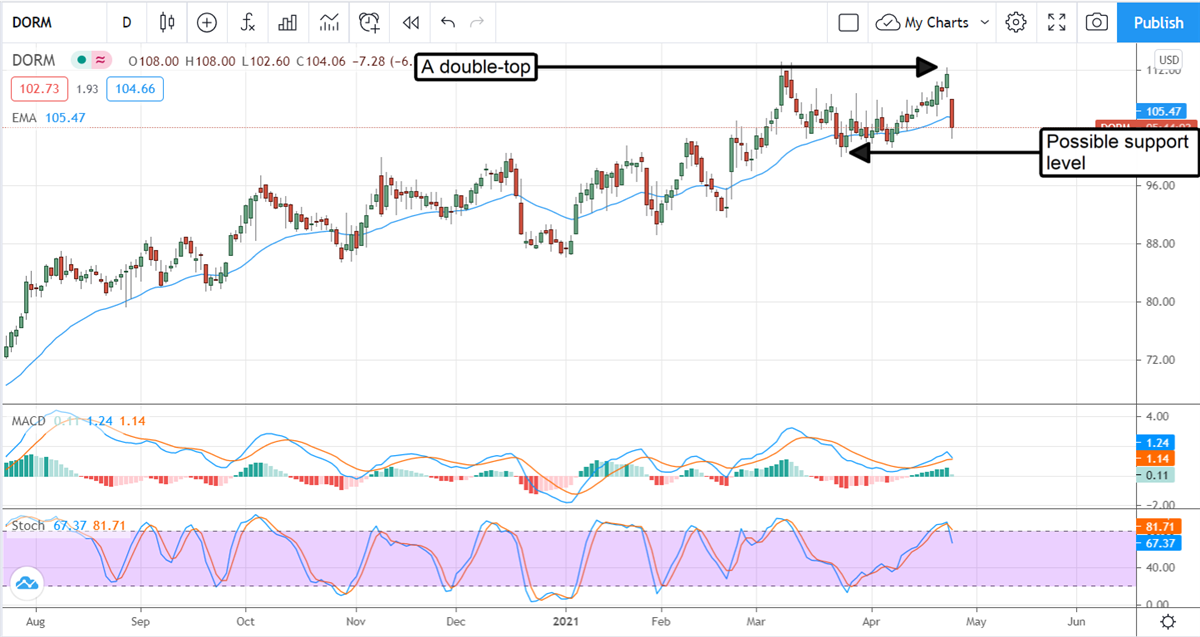
The Technical Outlook: Dorman Pulls Back From All-Time High 

Shares of Dorman Products are pulling back from the fresh all-time highs and look like they could fall further. The pattern looks like a double-top reversal, the caveat is that this reversal may be from up to sideways and not up to down. If that is the case, we expect to see support buying begin near the $100 level and push price action to the side over the next few weeks or months. The caveat is that price action may fall below the $100 in which case we would still be looking for a range to form, albeit a larger one with a possible bottom near $96. In either case, we are bullish on this stock and waiting for the next buy-signal.

Dorman Products Is A Buy For Small-Cap Growth Investors 

Featured Article: Why do commodities matter?

https://www.entrepreneur.com/article/370354


Bitcoin Corrects 27%, Oh No! (or Why It’s Time To Buy Bitcoin)

With Bitcoin down more than 25%, we’re sure there are no few Bitcoin (CRYPTO: BTC) holders wondering if this is the beginning of the end. What we want to point out is that, historically, every time Bitcoin has corrected it has always bounced back

April 24, 2021 4 min read

This story originally appeared on MarketBeat

Time To Start Buying Bitcoin Again 

With Bitcoin down more than 25%, we’re sure there are no few Bitcoin (CRYPTO: BTC) holders wondering if this is the beginning of the end. What we want to point out is that, historically, every time Bitcoin has corrected it has always bounced back to produce mind-bending returns. Even the 2017/2018 implosion driven by the Chinese regulatory crackdown, a correction that shaved 85% off the price of Bitcoin at its low, bounced back, and look how much BTC has gained since. About 2060%. That’s not something to thumb your nose at. The point we’re trying to make is that Bitcoin may be down but it’s not out. The correction may deepen but we don’t think so and here are four reasons why. 

Four Reasons Why Bitcoin Will Bounce Back Stronger Than Ever 

1) Bitcoin Is Still The Dominant Cryptocurrency – Even with Bitcoin’s dominance slipping in recent weeks it is still the leading cryptocurrency by market cap. Bitcoin, the original cryptocurrency, is worth about 50% of the $1.8 trillion cryptocurrency market and will likely remain #1 for a very long time. At worst, we expect this coin will fall to #2 or roughly equivalent with Ethereum (CRYPTO: ETH) over time but we also think these two ecosystems can exist side by side. Where Bitcoin is a very simple (relatively speaking) blockchain network with limited functionality Ethereum is intended to be and is a globally-scaled financial supercomputer. Simply put, Bitcoin is digital gold while Ethereum aims to be the infrastructure of global digital finance. Regardless, interest in both coins will rebound and one will aid the other. 

2) Bitcoin’s Hashrate Is Still Trending Higher – The hash rate, or the amount of computing power available in the Bitcoin network, is down in conjunction with price action and that is not unexpected. The takeaway is that the decline in hash power is in line with the underlying trend (strongly up) and ready to rebound as it has every other time hashing power has dipped. One reason we expect a rebound is the difficulty level. With the hash rate down so sharply the difficulty of mining a new Bitcoin is reduced and that will attract miners back into the network. Rising BTC prices will also attract Bitcoin miners back into the network.  There may be some volatility in this figure over the next month or two but by the end of the summer BTC hashing power should be back at new highs. 

3) Scarcity – Even with the ongoing mining activity Bitcoins continue to become scarcer. Not only are BTC’s lost every day they are often burned to produce value in other parts of the cryptosphere. At last look, there were about 18.7 million circulating Bitcoins of a total of 21 million Bitcoins possible to mine. Of those, at least 20% are lost or otherwise irrevocably irretrievable. What this means is that we know where these Bitcoins are, they are in a wallet recorded on the blockchain, but the keys to retrieve them are lost. There is no way to know where the wallet is, who owns it, or even how to get into it. We’re sure you’ve heard the stories. The takeaway, like most commodities the scarcer it is the higher the price. 

4) Acceptance – Bitcoin is in the midst of rapid acceptance by mainstream financial institutions. It’s been slow to build but over the past two quarters, there have been at least a dozen major financial institutions such as Morgan Stanley and Goldman Sachs who’ve come out to say they’re offering crypto-services. Along with this is the roll-out of Bitcoin/Cryptocurrency services by the likes of Paypal that includes pay-with-Bitcoin services for its 300+ million customers and 20+ million merchant clients. And then there is the Coinbase Global IP. Coinbase is the world’s leading cryptocurrency exchange and it’s only getting more popular. 

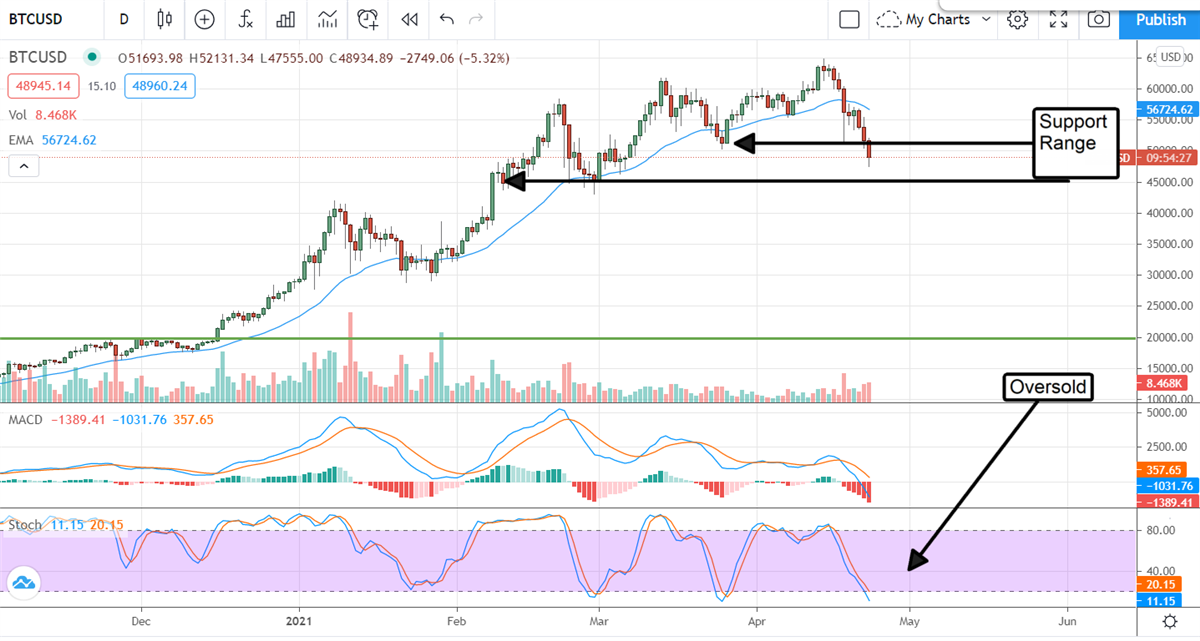
The Technical Outlook: Bitcoin Is Nearing Bottom 

The price of Bitcoin is trading at a new low right now, but inside a range that we think will produce a bottom. This support range is consistent with prior lows that should produce a strong bounce. The indicators and price action suggest price may fall a little bit more but, with stochastic so oversold, the rebound may only be days away if not closer. In the near term, we expect to see BTC move sideways and bottom in the range of $45,000 to $50,000 before moving higher. Mid to long-term we see BTC moving back up to the $60,000 and breaking out with more conviction. 

Bitcoin Corrects 27%, Oh No! (or Why It’s Time To Buy Bitcoin)

Featured Article: What is a dividend reinvestment plan?

https://www.entrepreneur.com/article/370281