What Does the Coinbase IPO Mean For Traders and Investors?

April 23, 2021 4 min read

Opinions expressed by Entrepreneur contributors are their own.

Coinbase went public last week, marking the debut of the first U.S.-listed exchange platform. Before its IPO, it was indicated at $380 and ultimately saw its first print at $381. Putting that into perspective, the original reference price for the cryptocurrency stock was $250.

Compared to when the Bitcoin pandemonium swept the market in 2018, things are much different right now. While digital currencies have been around for quite some time, Bitcoin has always been seen as the “underdog” and a form of payment only used by illicit “” owners. But the original ethos of crypto is based on getting rid of the middleman and making payment transactions quicker, and in many cases, more transparent thanks to blockchain technology.

This year has certainly seen a lot of firsts other than the COIN IPO. Non-fungible tokens (NFTs) have also grown in popularity, leaving some investors scratching their heads. We’re talking about original digital creations with current bids north of $1 million. But if you understand the digital ecosystem’s premise, you’ll start to understand what’s driving love for digital art and trading cards.

Is it time to choose sides?

If you’re new to the market, should you start choosing sides right now? In my opinion, the only side you should choose is the one that can make you the most . In this light, diversification is important right now. What’s more, having a proper understanding of how trading works and how to actually become diversified is paramount. You’ve got to be able to make money in multiple asset classes. Certain sectors will be hot and cold at different times, and being able to capitalize is the ultimate goal.

Staying diverse and sticking to a strategy is easier said than done, especially when there’s so much hype surrounding both markets right now. Whether you’re day trading stocks or looking to start investing in cryptocurrencies, staying diverse and developing a real strategy is more important than whatever the flavor of the day is in crypto or stocks.

Related: Why Coinbase Will Be the Hottest IPO of 2021

What comes next after the Coinbase IPO?

When Coinbase went public, it didn’t necessarily change the digital broker’s status among crypto traders. Will it grow? Most likely, but what will become the next evolution, and how will Coinbase and others play a role?

We’ve seen a lot happen over the last four years, with the cryptocurrency industry going through plenty of volatile times. We’ve seen the crypto crash, dark web marketplaces getting shut down and plenty of scammy bitcoin mining companies closing up shop, leaving millions in lost funds in its wake. But now, the Coinbase IPO could mark a tipping point for cryptocurrency and bring that stamp of approval so many early investors have wanted.

The next wave for digital everything

Things like cryptocurrency penny stocks remain a hot topic among retail traders. If you look at some of the lesser-known names from last year, their share prices have skyrocketed. Companies like Marathon Patent Group and even Grayscale Bitcoin Trust traded around or below the $5 mark.

While there are still plenty of high-flying names that will surely come to light in the , Coinbase has done something that not many other IPOs have done. It has bridged the gap between currency traders and traditional stock traders, and where there’s money to be made, people will find a way to capitalize.

Related: Cryptocurrencies Will Have Their ‘Amazon Moment’ After Coinbase Debuts on the Stock Market, Analyst Projects

The beginning of the beginning

Now, the world of crypto is being put front and center, with some of the biggest money managers in the world watching. As they wait in the wings and monitor the first iteration of the “digitization coming of age,” other early adopters are still expecting plenty more evolution ahead, thanks to this latest IPO.

This platform remains in its infancy as many new applications are being discovered, developed and implemented. The application in things like NFTs, for example, has become just one of these new ways a DeFi solution has been utilized. 

Right now, the Coinbase IPO has shaken up both sides of this “coin,” and it will surely be something to watch for as it relates to further disruption in the world of investing as time goes on.

Related: Coinbase (NASDAQ:COIN) IPO: 3 Things for Investors to Know

https://www.entrepreneur.com/article/369405



3 Gold Stocks That Could Regain Their Luster

Buying the actual commodity is one way to go about gaining gold exposure, but gold miner stocks are also a smart option because you get to own actual companies with growth opportunities and dividends. Let’s take a look at 3 gold stocks that could regain their luster soon.

April 23, 2021 4 min read

This story originally appeared on MarketBeat
The fact that the price of gold hasn’t rallied with so much money being added to the economy is one of the more puzzling developments in financial markets this year. This shiny yellow metal is a commodity that is typically considered to be a smart way to hedge against inflation and has seen its prices decline and stagnate for the majority of the year even with rising Consumer Price Index values and unprecedented fiscal stimulus. All of this adds up to a scenario where gold could be a sleeping giant that is just waiting to rally, which is why investors might want to look into adding exposure to gold stocks in the coming weeks.

(NYSE:GOLD)

This is one of the world’s largest gold companies based on production and reserves, which means that the company’s results and stock price are directly correlated to trends in gold production and pricing. That’s why it’s a very strong option to consider if you think that gold prices are headed higher in the coming months, especially since Barrick Gold has such a big portfolio of gold-producing assets. That includes mining operations and projects in 15 countries like Argentina, Australia, Canada, Chile, Cote d’Ivoire, Peru, the U.S., and more.

The company operates 6 “tier one” mines, which are classified as mines with a remaining life of 10 years, annual production of at least 500,000 ounces of gold, and cash cost per ounce in the bottom half of the industry range. Barrick Gold also recently announced that it is on track to meet its Q1 guidance and has produced 1.1 million ounces of gold in Q1 2021. The stock offers a 1.58% dividend yield and has one of the better risk-to-reward profiles in the gold miners at this time given that the stock price has declined over 28% from its 2020 highs.

Buying the actual commodity is one way to go about gaining gold exposure, but gold miner stocks are also a smart option because you get to own actual companies with growth opportunities and dividends. Let’s take a look at 3 gold stocks that could regain their luster soon. 

Newmont Corporation (NYSE:NEM)

Let’s face it, as long as we are facing widespread economic uncertainty and the threat of inflation, gold will be in high demand. That’s a big reason why Newmont Corporation is a great stock to consider buying at this time. It’s a mining company that is the world’s largest gold producer with assets in the U.S., Canada, Dominican Republic, Peru, Argentina, Chile, and more. Newmont is also focused on the production of and exploration for copper, silver, zinc, and lead, which means that you get exposure to several commodities that could also be strong performers in the future.

Newmont has made some strategic moves including the acquisition of Goldcorp and a joint venture with Barrick Gold that could deliver hundreds of millions of dollars in annual synergies, which is another quality that makes this a top-tier gold stock to add. The company reported a record $4.0 billion of cash from continuing operations and $3.6 billion of Free Cash Flow in 2020 and offers investors a 3.29% dividend yield at this time. Newmont Corporation reports its Q1 2021 earnings on April 29th which will provide investors an opportunity to see if gold production is picking up in some of the countries where operations were halted last year due to the pandemic.

VanEck Vectors Gold Miners ETF (NYSEARCA:GDX)

Another great option for investors that are interested in exposure to gold at this time is the VanEck Vectors Gold Miners ETF. This ETF is a strong choice because it provides exposure to the biggest gold miner stocks including the aforementioned Barrick Gold and Newmont Corporation along with some mid-tier and junior gold mining companies. That way, you can minimize your company-specific risk and gain diversified exposure to a basket of stocks in the sector instead.

Keep in mind that the smaller gold miners have been known to outperform during periods of rising gold prices, which means that this ETF could deliver strong gains if the precious metal starts to rally. VanEck Vectors Gold Miners ETF is currently breaking out of a big downtrend and is close to retaking the 200-day moving average, which would be a very intriguing entry point for long-term investors. It also pays a 0.59% dividend yield and is up over 16% since March, which tells us that money is starting to flow back into this ETF.

Featured Article: Environmental, Social, and Governance (ESG) Investing

https://www.entrepreneur.com/article/370191


3 Stocks Approaching Possible Breakout Points

April 23, 2021 4 min read

This story originally appeared on MarketBeat
Align Technology (NASDAQ: ALGN), HubSpot (NYSE: HUBS) and Trex (NYSE: TREX) are setting up in healthy areas of price consolidation, which may set the stage for fresh run-ups.

One proven strategy for grabbing a stock at the beginning of a run-up is by tracking its base. It’s frustrating for investors to see a stock pull back, but these patterns form when institutional investors sell shares, usually to take profits after a rally.

This year, you’ll likely see some profit-taking driven by capital-gains taxes. The marketwide rally in 2020 began in March, and gained steam as the year went along. Many investors like to wait until their holding is a year old before selling. At that point, they would pay long-term capital gains taxes, which are more advantageous than short-term capital gains taxes. 

Whatever the reason for the selling, a base gives a stock a chance to pause its run-up before continuing its rally. 

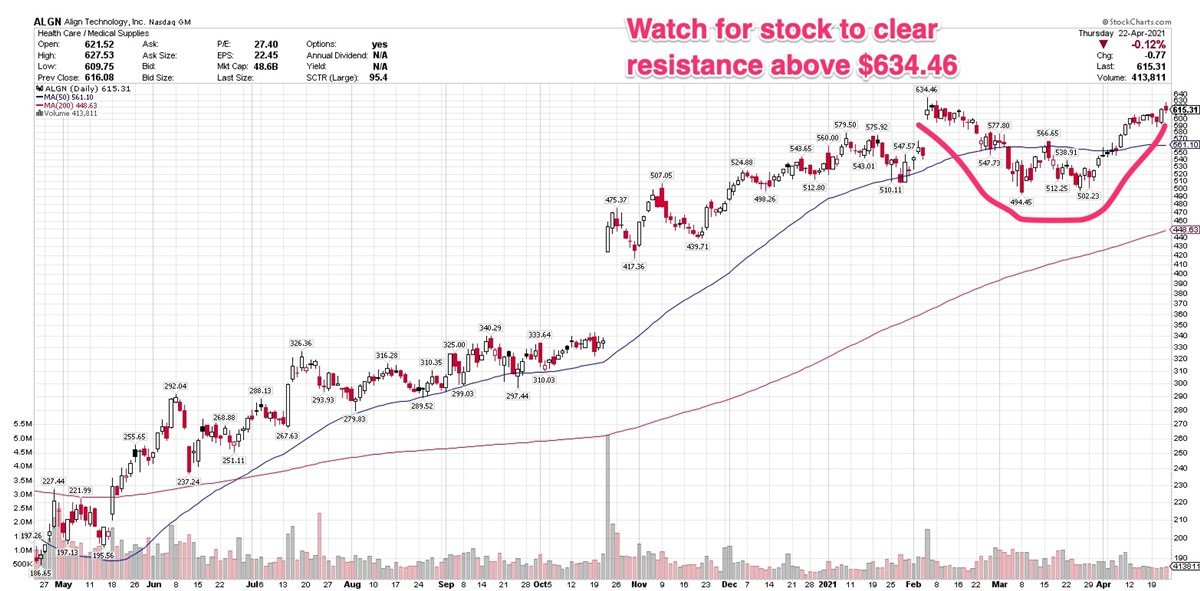
Align, whose flagship product is Invisalign, a clear dental alignment system, began shaping its current cup formation in February, around the same time as growth stocks, as an asset class, began retreating. 

Although the company was profitable in 2020, it, like so many others, saw sales and earnings decline in the first half of the year. That changed in the second half of the year, as revenue and earnings growth resumed.

The cup-shaped base corrected 21% from peak to trough, at least so far. There was some heavy-volume selling during the initial weeks, but that stabilized, and volume has been muted recently, which shows the big selling could be in the rear view mirror. 

Often, a catalyst for breaking out of a base is a better-than-expected earnings report, or at least a report that brings some kind of optimistic news. Align reports its first quarter on April 28, with Wall Street expecting earrings of $1.73 per share on revenue of $816.94 million. The company topped estimates in three of the past five quarters. 

If the stock does break out soon, watch for heavy volume as it clears resistance at $634.46. It’s currently trading at around $613. Alternatively, it may form a handle if it pulls back further. 
3 Stocks Approaching Possible Breakout Points

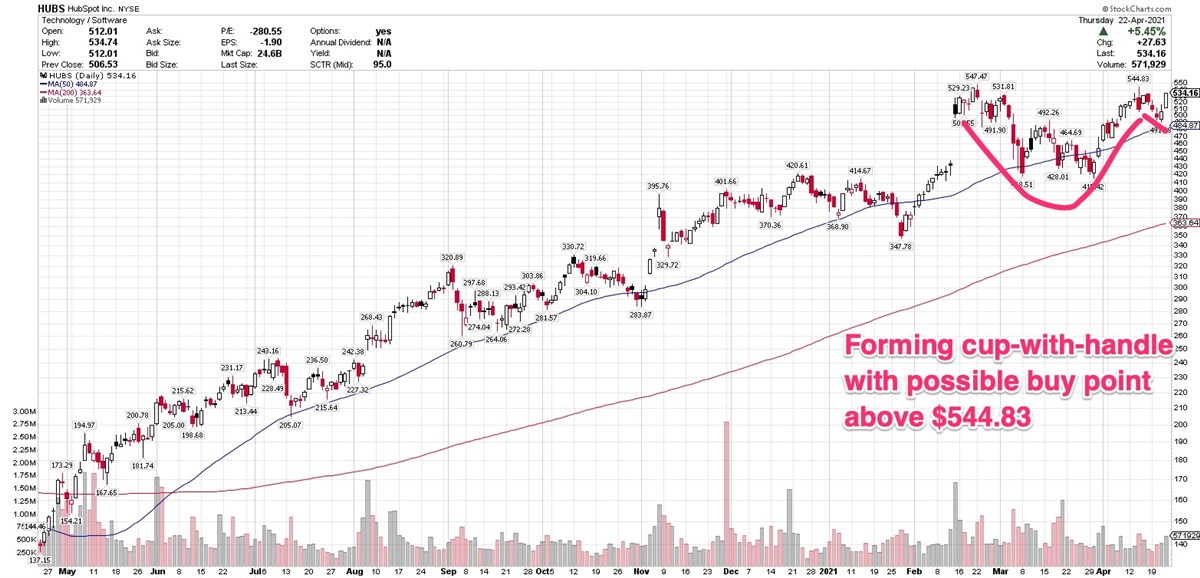
HubSpot, which makes a cloud-based customer relationship management system, is etching a cup-with-handle formation. This correction, like Align’s, began in mid-February. 

The company reports earnings on May 5. Wall Street expects a loss of $0.38 per share on revenue of $242.86 million. Hubspot has a history of beating estimates, so that’s something for investors to watch for. 

The stock has fundamental strength, which is a box to check when you’re looking at bases close to a breakout. Revenue growth accelerated in the past two quarters. Hubspot managed to grow revenue in the first half of 2020, helped by a slew of companies pivoting to derive more of their revenue online. 

In the current base, the top of the handle is $544.83, which is the price you want to see the stock surpass, preferably in heavy turnover. Trading volume during the handle area has been tepid, indicating just a mild round of selling, not a vast shakeout. 

The stock is now trading near $533. 
3 Stocks Approaching Possible Breakout Points

Another stock potentially nearing a breakout is Trex, which hails from the red-hot building and remodeling industry. The company makes engineered composite decking materials that won’t rot, stain, become termite food or require painting. 

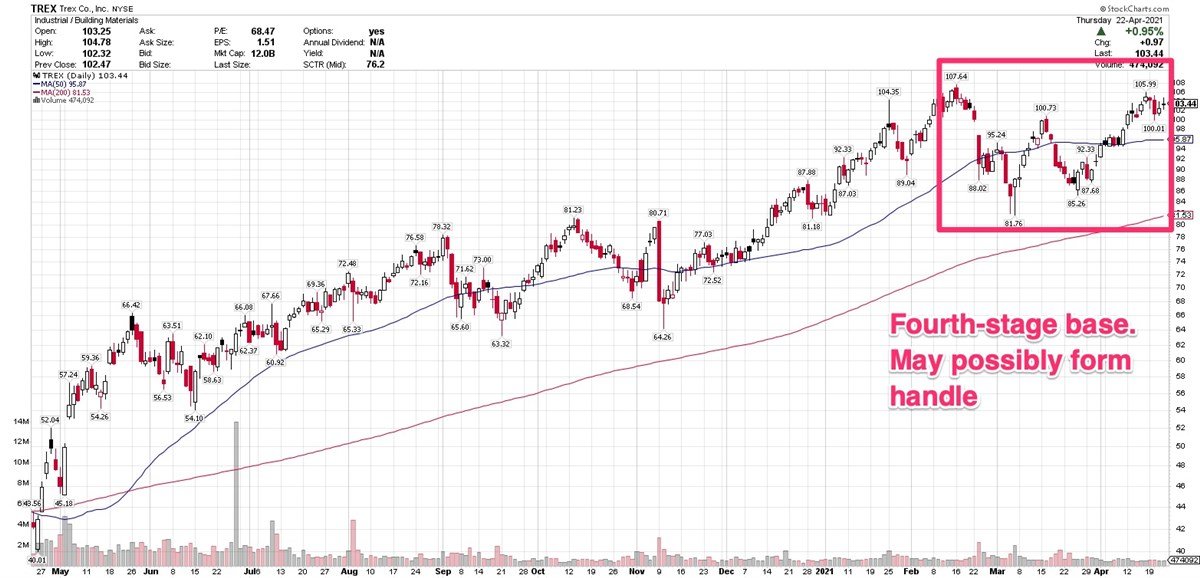
The stock is currently forming a somewhat shapeless consolidation, although it may possibly evolve into a cup with handle. An upcoming news catalyst for a breakout may be its May 10 earnings report. Wall Street is eyeing net income of $0.38 per share and revenue of $241.16 million.

Revenue growth accelerated from 7% to 39% in the past two quarters, always a sign of strong demand. Annual revenue also grew between 2018 and 2020. 

One potential warning sign about its current base: It’s the fourth time the stock has pulled into a base in the past year. A fourth-stage base often indicates the run-up is getting long in the tooth, and the stock may need to undercut a previous structure low to fully flush out weak holders or those grabbing profits.
3 Stocks Approaching Possible Breakout Points

Featured Article: Diversification For Individual Investors

https://www.entrepreneur.com/article/370192


Blackstone Group (NYSE:BX) Stock a Buy After Posting Record Profits

Are you familiar with the term “alternative asset manager” and the company Blackstone Group (NYSE:BX)? An alternative asset manager invests in things that average investors typically don’t have access to.

April 23, 2021 5 min read

This story originally appeared on MarketBeat
Are you familiar with the term “alternative asset manager” and the company Blackstone Group (NYSE:BX)? An alternative asset manager invests in things that average investors typically don’t have access to. Some examples include private equity or venture capital, hedge funds, distressed debt, commodities, and real estate. Since they are complex investments that are not regulated by the SEC and can be illiquid, alternative investments are usually held by institutional investors or high-net-worth individuals. That’s part of the reason why buying shares of a company like Blackstone Group is so intriguing.

It’s an investment firm with an alternative asset management business that includes real estate, private equity, public debt and equity, growth equity, non-investment grade credit, real assets, and secondary funds. That means retail investors can gain exposure to alternative investments through one of the global leaders in the sector by purchasing Blackstone Group shares. The company just posted record profits in Q1 and is a strong buy for several reasons. Let’s take a deeper look at what makes Blackstone Group so special below.

Global Leader in Alternative Asset Management

When it comes to finding the best companies to invest in for the long-term, it usually pays to find out which ones are the global leaders in their respective industries. Blackstone Group is compelling because it’s one of the best companies in the alternative assets industry, an area of financial services that can be incredibly lucrative. The company operates in four different segments, private equity, real estate, hedge fund solutions, and credit & insurance. That means investors will gain exposure to things like massive real estate funds with geographic diversification and private equity funds with jaw-dropping amounts of assets under management.

The company generates revenue from management and advisory fees, performance fees, investment income, interest, and dividend revenue and has a highly scalable business model, which is a great quality to look for in an investment. It’s also worth noting that Blackstone Group stands out thanks to its status and prestige. With a long track record of generating attractive returns for its customers across all different asset classes in various economic conditions, the company’s reputation as a global leader makes this a stock you can feel comfortable investing in for the long term.

Record-Breaking Q1 2021

Another strong reason to consider buying shares of Blackstone Group at this time is the fact that the company just posted a quarter for the record books. At the end of Q1, Blackstone Group reported Total Assets Under Management of $648.8 billion, up 21% year-over-year. This is big news because at this point the company has the most AUM in its history. More importantly, the company’s fee-earning AUM of $481.2 billion was up 14% year-over-year which bodes well for continued earnings growth. It’s worth noting that Blackstone is targeting an ambitious $1 trillion of assets under management within eight years, and it appears that the company is well on track to attain this milestone.

The company beat analyst estimates with Q1 EPS of $0.96 versus the $0.76 EPS consensus estimate and reported revenues of $5.29 billion, up 79% year-over-year. It’s also worth noting that Blackstone has $148.2 billion in total dry powder to use for future investments, which puts it in a great position to take advantage of the re-opening of the global economy. Blackstone has already acquired a major holiday park operator in Britain, a Japanese hotel portfolio, and a private aviation business ahead of the travel industry’s eventual recovery. It’s safe to say that Blackstone will continue to scoop up undervalued assets to take advantage of a rapidly changing global economy in the wake of the pandemic, which is another reason why the stock could be a big winner for the rest of the year.

Sophisticated Investing for the Little Guys

The bottom line here is that Blackstone Group stock offers retail investors a unique opportunity to gain exposure to investment vehicles that they normally would never have access to. The idea that some of the most sophisticated asset managers in the world are working hard to deliver outsized returns for your portfolio is simply too good to pass up. Just look at Blackstone’s private equity portfolio performance in Q1, which appreciated by 15.3% compared to a 5.8% increase in the benchmark S&P 500 stock index during the same period. Expect Blackstone to continue thriving in the current market environment and delivering strong results for the remainder of the year and beyond.

The stock also offers a 2.81% dividend yield and the company returned $1.0 billion to shareholders in Q1 2021. This is a company that is committed to rewarding long-term investors in multiple ways, which is another great reason to add shares for the long term. If you are interested in exposure to alternative assets and a global leader in capital markets, look no further than Blackstone Group stock.

Featured Article: What are gap-down stocks?

https://www.entrepreneur.com/article/370190


Can These 3 Dow Laggards Make a Second Half Comeback?

April 23, 2021 5 min read

This story originally appeared on MarketBeat

With the first half of 2021 quickly nearing its end, we’ve learned much about which Dow Jones Industrial Average (DJIA) stocks have taken the leadership reins—and which are hanging out in the back of the pack.

This time last year the Dow was down 17% amid the early gloom of the pandemic. So far this year, it is up nearly 12% with all but six of its thirty constituents in the green.

Walgreens Boots Alliance is the runaway leader followed by Intel and Caterpillar. Speaking of slow crawlers, bringing up the rear are Nike, Merck, and Procter & Gamble. But as we know, the Dow derby is a marathon rather than a sprint, so the laggards could very well turn into leaders after the second-half kickoff.

Is the Nike Dip a Buy Opportunity?

Nike (NYSE:NKE) finds itself in unfamiliar territory as the Dow’s caboose down 8% year-to-date. But it’s certainly not cause for alarm given the stock’s remarkable run from 2017 to 2020. Last year, despite many retail outlets closed for much of the year, Nike shares climbed 40% on the strength of its direct-to-consumer (DTC) business.

The stock has struggled to get past the $145 area getting pushed down on multiple occasions this year. It is now back to the $130 level where it jumped to in September 2020 after reporting blowout fiscal 2021 first quarter earnings. Based on the huge volume spike that occurred on that day, $130 should be a sturdy level of support.

Shareholders waiting for another earnings day boost will have to wait until July 1st when Nike is expected to report fourth quarter results. It wouldn’t be surprising to another big earnings beat as we’ve seen in each of the last three quarters. And those beats have been despite a bevy of challenges around shipping delays, increasing freight costs, and higher labor expenses.

It’s hard to argue with Nike’s brand strength which gives it the ability to raise prices when costs increase. This along with an improving retail environment and ongoing strength in digital channels, should put Nike on the comeback trail

What is Holding Merck Stock Back?

Merck & Co. (NYSE:MRK) is down 3% this year but unlike Nike is not coming off a big year. Shares of the pharmaceutical giant slipped 10% last year and they haven’t been able to get off the ground in 2021.

Things may be looking up, however, after the huge volume spike of March 19th. On this day Merck announced strong results from its phase 3 study of Keytruda in patients with advanced endometrial cancer. The blockbuster drug in combination with Lenmiva was found to significantly improve survival rates and reduce the risk of death compared to chemotherapy treatment.

Since then, Merck has trended higher and is up in each of the last five days. The company will report first quarter earnings next week which could be the catalyst that finally gets the stock heading back to its December 2019 record high of $92.64. The Street will be looking for EPS of $1.68 but more importantly, signs of strength in its key oncology franchise.

Much of the holding pattern in Merck’s stock performance has related to the leadership and organization changes underway at the company. CEO Kenneth Frazier is set to retire as of June 30th and will be replaced by Merck’s current CFO Robert Davis. The company is also spinning off its Organon women’s health division later this quarter. This follows similar moves by competitors that have spun off older, low growth products to focus on their higher growth, core portfolios.

Once both of these major events are in the rear-view mirror, there should be greater visibility into where Merck is headed. This should make investors happier and provide Merck’s stock price some much needed relief.  

Is Procter & Gamble a Good Buy and Hold Stock?

Procter & Gamble (NYSE:PG) is down 2% this year, a non-concerning pause given that the stock has finished higher in each of the last five years. It is 8% off its November 2020 peak and could be a good buy opportunity for a stock that seldom has meaningful pullbacks.

The pandemic-driven consumer shopping environment has been very kind to Procter & Gamble as people have stocked up on cleansers, laundry detergents, and other household essentials. But as economic conditions begin to normalize, the market is re-calibrating Procter & Gamble’s value as it returns to slower growth.

This week the company reported better than expected fiscal third-quarter earnings that increased 8% on 4% organic sales growth. These were a far cry from the figures we got used to seeing in previous quarters when people were buying paper products like they were going out of style.

But a single-digit growth Procter & Gamble should be acceptable to investors because that is what the company has always been. Since it began trading on the public exchange, Procter & Gamble has been and will continue to be one of the best defensive stocks to own.

A week prior to the third-quarter earnings report, Procter & Gamble announced a 10% dividend increase marking the 65th straight year it has raised its annual dividend. Although consumer behavior will change in the post-pandemic world, people will still have an elevated sensitivity to cleanliness and health—and therefore, continue to buy Procter & Gamble products. In the meantime, investors can sit back and collect the 2.5% dividend knowing P&G stock will keep doing what it has been doing for the last 65 years.

Featured Article: Using other technical indicators with support levels

https://www.entrepreneur.com/article/370193


3 Healthcare Stocks On The Move After Raising Guidance

We spend trillions of dollars annually on care, drugs, services, and equipment and that money is flowing right now. The company’s on our list today represent three facets of the industry and are all poised for big gains in 2021.

April 23, 2021 4 min read

This story originally appeared on MarketBeat

Healthcare Is Big Business  

Whether your interest is pharma, direct care, or the life sciences industry as a whole you have to admit that healthcare is big business. We spend trillions of dollars annually on care, drugs, services, and equipment and that money is flowing right now. The company’s on our list today represent three facets of the industry and are all poised for big gains in 2021.

Biogen Is On The Cusp Of A Revenue Rebound

Biogen (NASDAQ: BIIB) reported a better than expected quarter and raised its guidance but that isn’t what has us warming up to the stock. Biogen revenue has been coming under pressure due to the erosion of income in several key drug lines but that is about to change. While the erosion of revenue from drugs like Tecfidera and Rituxan is expected to continue, a new drug is on the verge of FDA approval. Aducanumab is a drug for the treatment of Alzheimer’s and expected to get the OK by early June. If so, the company is expecting to see a small but positive impact on earnings this year and a more substantial boost next. In addition, the company is seeking approval in other countries as well. 

Shares of the stock fell after the release of Q1 results because they were little more than what the market expected. While the $2.69 billion in revenue beat the consensus it was a slim 150 basis point margin and still down 24% from last year. Likewise, the boost to guidance only affected earnings and is still only in line with the consensus. In our view, it is the upcoming approval of aducanumab that has the market’s attention and what will drive this stock higher. Early approval or an overly positive review of the drug could send this stock back up to the $340 level. 

Three Healthcare Stocks On The Move After Raising Guidance

HCA Healthcare Moves Up On Rising Demand, Earnings Leverage 

HCA Healthcare (NYSE: HCA) owns and operates healthcare facilities nationwide. The company is not only seeing an increase in demand that is exceeding all expectations but is guiding for significant cost-leverage as well. The company beat the top and bottom line Q1 targets with ease which leads us to believe the new guidance is still cautious. Regardless, the new range for revenue has the consensus below the midpoint, and earnings are now expected well above the previous range so there should be a round of analysts upgrades to drive this stock higher if nothing else. 

Shares of the stock surged on the news gaining more than 3.5% at the high of the da. The new high is an all-time high and one confirmed by bullishness in the indicators so we see this thing moving even higher. There may be a pullback in prices near term but probably not more than enough to close the price gap formed post-earnings release. Beyond that, we see this stock moving up into the $220 range by early summer. 

Three Healthcare Stocks On The Move After Raising Guidance

IQVIA Pops On Earnings And Outlook 

IQVIA Holdings (NYSE: IQVIA) is an interesting play on the health care industry because it is a healthcare-business services company and not directly involved with med-tech or health. The company operates in several segments globally and seeing a high demand for its offerings in all markets. The company reported a 24% increase in net revenue driven by strength in Research & Development Solutions. The R&D segment saw its revenues grow 29% with an 18% increase in backlogs to sustain growth in future quarters. 

As for the guidance, the company upped its full-year guidance to a range of $13.2 to $13.5 billion in revenue and $8.50 to $8.75 in earnings and both ranges are well above the consensus. Shares of the stock are up more than 4% on the news and gaining momentum on the daily, weekly, and monthly charts. 

“We expect demand for our differentiated clinical and commercial offerings will continue to grow beyond 2021, on top of an increasingly favorable outlook for the life sciences industry,” said chairman/ CEO Ari Bousbib

Three Healthcare Stocks On The Move After Raising Guidance

Featured Article: What are momentum indicators and what do they show?

https://www.entrepreneur.com/article/370189


High-Yield Verizon Is A Buy On Post-Earnings Weakness

We’ve like Verizon (NYSE: VZ) for the last 18-months to two years for a variety of reasons that include but not limited to value, yield, growth, the consumer, digital, streaming, 5G, and the IoT.

April 22, 2021 4 min read

This story originally appeared on MarketBeat

Verizon Is A Top Pick For High-Yield Investors 

We’ve like Verizon (NYSE: VZ) for the last 18-months to two years for a variety of reasons that include but not limited to value, yield, growth, the consumer, digital, streaming, 5G, and the IoT. While the former makes the stock an attractive buy the latter makes it a must-own stock, at least in our opinion. The consumer is driving our economy, digital and streaming are high-growth markets, 5G is going to ramp all that into overdrive, and the IoT is quietly waiting for it to happen. There are others in the space but T-Mobile doesn’t pay a dividend and AT&T has too much baggage for our taste. The bottom line, Verizon is a lightly valued blue-chip company supported by secular trends and one that pays a safely growing 4.3% yield. 

Mixed Results Fail To Drive Verizon Higher 

Shares of Verizon are down following the Q1 release despite what appears to be a decent report. The two biggest negatives we see are the larger than expected declines in both post-paid and wireless customers and the fact results only barely beat the consensus. Looking at the one in light of the other, the larger than expected decline in post-paid and wireless users can be overlooked. The $32.9 billion in revenue is down from the peak holiday quarter but that was expected. More importantly, the revenue is up 4.1% from last year and 135 basis points above the consensus. 

In terms of user count, the post-paid business shed 178K users versus the 42K expected while the wireless business shed 170K versus the expectation for gains. This was offset by gains in other areas, however, the led to positive results for all three business segments. On the consumer end, revenue grew 4.7% on strength in the Fios fiber optic bundle. Fios grew by 80%. On the business end, revenue grew by 1.3% while the Media segment grew a more substantial 10.4%. Moving down to the bottom line, the company’s net income increased by 25% over the past year due to cash-saving efforts (reached ahead of target) and business strength. On the bottom line, the GAAP $1.27 is up 27% from last year and beat the consensus by a penny. The adjusted $1.31 grew by at a slower 5% rate but also beat the consensus. 

The takeaway for us is that, even with the decline in user counts, the company reaffirmed its guidance for the year. Execs are expecting to see revenue growth at a minimum of 2.0% YOY with total wireless in the range of 3.0%. This should produce earnings in the range of $5.00 to $5.15 versus the $5.07 consensus figure and we think the guidance is light. Aside from the fact that Verizon tends to beat the consensus more often than not, we don’t think this guidance takes into account the strength of the rebound and the impact of rapidly improving consumer conditions on phone, Internet, and wireless usage. 

Verizon Is A Safely Growing 4.3% Yield 

Verizon doesn’t pay as much as AT&T but once again there is much less baggage and legacy issue with Verizon. That said, the 4.3% yield is attractive from the high-yield perspective and it is backed up by some solid metrics. To start, the payout ratio is fairly low at 50% and there is room to bump it up on the cash-flow statement. Looking at the balance sheet, the company is well-capitalized with some debt but there are two things to consider. First, even at current levels the company is only moderately levered and has reasonable coverage so no threat to the distribution. Second, debt is coming down and helping to free up the cash flow. The takeaway here is the current payout is safe and the outlook for a 9th consecutive dividend is good, but we don’t recommend counting on a large one. 

The Technical Outlook: Verizon Pulls Back Into A Buying Opportunity 

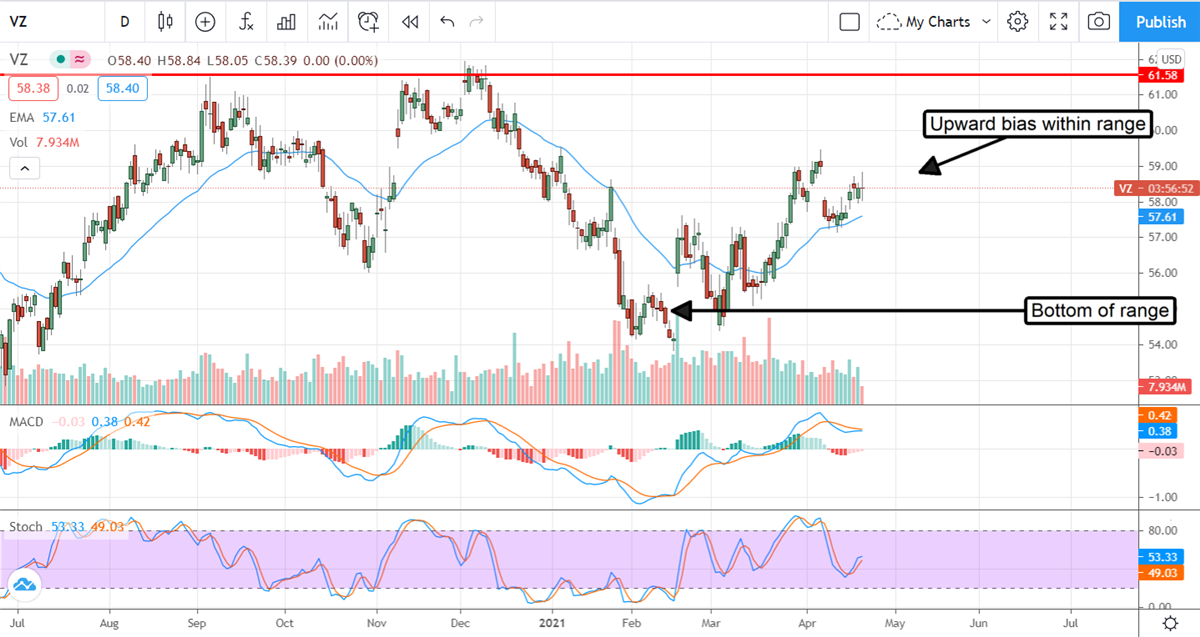
Shares of Verizon pulled back after the Q1 report but are already showing signs of support. Support appears to be near the $58 level which is consistent with past price action. The indicators are still mixed but have a bullish bias which suggests a swing in momentum is about to carry this stock higher. The next key level of resistance is at $59, once the stock gets back above there we see it moving up into the end of the year and closing well above the $62 level.

Why High-Yield Verizon Is Still A Buy

Featured Article: What is a Lock-Up Period?

https://www.entrepreneur.com/article/370082


A Rising (or Falling) Crypto Tide can Lift (or Lower) All Coins

Below is a short note on recent tides in BTC and crypto-assets from Justin Chuh, Senior Trader at the regulated digital asset investment manager Wave Financial. Q1 2021 hedge fund letters, conferences and more Short-Lived Highs Bitcoin, ether, and almost every other of the 8,000+ cryptocurrencies in the $2 trillion class enjoyed relatively short-lived highs […]

April 19, 2021 4 min read

This story originally appeared on ValueWalk

Below is a short note on recent tides in BTC and crypto-assets from Justin Chuh, Senior Trader at the regulated digital asset investment manager Wave Financial.

Q1 2021 hedge fund letters, conferences and more

Short-Lived Highs

Bitcoin, ether, and almost every other of the 8,000+ cryptocurrencies in the $2 trillion class enjoyed relatively short-lived highs last week. The main pair and virtually everything else fell over 10% during the weekend, with bitcoin back under the familiar $60k barrier, and ether fortunate enough to have maintained the new $2,000 floor.

Nearly everything’s been “mooning”, moving so fast upwards in unison that we forgot to look at the big picture, and ask ourselves what is actually going on in the crypto space now?

Bitcoin and cryptocurrencies have established themselves as a valid asset class, but every asset continues to be highly correlated to bitcoin, and sentiment can still be quite fragile. A meme now sits and ranks among the top cryptos by market cap. News of government action, whether unsubstantiated rumors of US Treasury dishing out AML charges or Turkish/Indian governments banning cryptos; or power outages in China, can make the market crash precipitously as everyone runs for the exits. But when the crypto market sells off, where does the money exit to? Back to the past and into overvalued public equities or negative-real-yielding government Treasuries?  Or does it stay in the future, but into better memes that solve the scalability problem and environmental narratives?

The Impact Of The BTC Tide On Other Cryptos

It really must be alt coin season. Many “investors” don’t seem heavy on accumulating bitcoin and ether, but building portfolios around them. We’re seeing the emergence of the “what about this token that my friend who’s been in crypto since 2017 told me about” cohort, which adds to the gut-wrenching volatility. The institutional money is still flowing into bitcoin and ethereum, and most retail investors will likely do better just buying and holding a portfolio of those two assets than aping into the latest-and-greatest tip from their crypto friend.

BTC can likely break through $60k again, but we may see some sideways action before that. Some market participants have undoubtedly bought the dip already, but others may wait to learn more about the recent crash and avoid another one, before they get comfortable buying in at these levels again. Whether the BTC tide rises organically or falls more due to news of crypto-related penalties, we can assume others will follow.


About Justin Chuh, Senior Trader at Wave Financial

Prior to joining Wave Financial Justin Chuh was at proprietary trading technology business HC Tech where he was a FX trader for 7 years. Justin is a CFA Charterholder, member of CFA Society Los Angeles and graduated from Arizona with a BS in Business Economics and Management. Justin is responsible for trading Bitcoin and other digital assets that make up Wave’s assets under management, ensuring that their trading strategies cover fund inflows and redemptions.

About Wave Financial LLC

Wave Financial LLC (Wave) is a Los Angeles and London based investment management company that provides institutional and private wealth digital asset solutions. Led by a team of highly experienced financial services professionals, Wave provides investable funds via their diverse investment strategies applied to digital assets and tokenized real assets. Wave also offers managed accounts for HNWIs and family offices seeking tailored digital asset exposure, bespoke treasury management services, and early-stage venture capital and strategic consultation to the digital asset ecosystem.

Wave is regulated as a California Registered Investment Advisor (CRD#: 305726).

W: https://www.wavegp.com/

T: https://twitter.com/wave_financial

L: https://www.linkedin.com/company/wave-financial/

https://www.entrepreneur.com/article/369764


Options For Socially Conscious Investing

Expert advice from CPA/CFP Darren Zaragola on options for Socially Conscious Investing – how to invest in companies that are looking to improve the world. Q1 2021 hedge fund letters, conferences and more An Increase In Socially Conscious Investing As more of us become concerned about climate control and environmental dangers, there has been an […]

April 19, 2021 2 min read

This story originally appeared on ValueWalk

Expert advice from CPA/CFP Darren Zaragola on options for Socially Conscious Investing – how to invest in companies that are looking to improve the world.

Q1 2021 hedge fund letters, conferences and more

An Increase In Socially Conscious Investing

As more of us become concerned about climate control and environmental dangers, there has been an increase in Socially Conscious Investing (SRI – Sustainable, Responsible and Impact Investing).

“These are companies that are looking to improve the world, or at least not allowing it to deteriorate any farther,” says Darren Zagarola, a Certified Financial Planner and CPA with the wealth management firm, EKS Associates in Princeton, NJ.  “It’s led to an increase in socially-conscious investing, often through mutual funds and Exchange Traded Funds. It’s not a one-size-fits-all approach. Some funds focus on the environment and climate change, while others concentrate on labor management, diversity, human rights, and other issues.”

Whereas SRI once focused exclusively on excluding certain companies from your portfolio – guns, tobacco, racial injustice – it now also focuses on investing in companies that are taking proactive measures to do the right thing.

But can SRI also benefit your bottom line?

In fact, recent studies from Wall Street firms and academia show these funds more than hold their own when it comes to return on investment. Sustainable funds that have been around for seven years or more had higher or equal median returns to traditional returns 64 percent of the time, according to a recent review by Morgan Stanley.  Morningstar gives a 4-star or 5-star rating to more than a dozen of these socially-conscious funds. Bloomberg counted more than 200 funds and ETFs that qualify as SRI (or ESG), and some have shown a return of 25 percent or more so far this year.

“The bottom line is you do not need to sacrifice return to combine your investment strategy and personal values,” Mr. Zagarola says.


About Darren Zagarola

Darren Zagarola, Certified Financial Planner and CPA with the wealth management firm, EKS Associates in Princeton, NJ is available about this topic and many other topics related to financial and retirement planning. For arrangements contact: Steve Clark, Andover Communications, sclark@sbhny.org.

https://www.entrepreneur.com/article/369765


3 Mega-Cap Stocks to Build Your Portfolio Around

If you are interested in some great mega-cap stocks to build your portfolio around, we have details on 3 of them to consider below.

April 17, 2021 5 min read

This story originally appeared on MarketBeat
The concept of building your portfolio around several core positions that offer upside and consistent returns is a great way to approach long-term investing. By emphasizing buying large positions in companies with stable earnings and lower volatility, you can feel more comfortable taking risks with the rest of your portfolio and won’t have to worry as much about massive drawdowns in your account.

Mega-cap stocks can be a great option for core positions since they are usually companies with a long history of success and will likely remain leaders in their respective industries for years to come. After all, a company doesn’t just grow to $200 billion or more in market capitalization overnight. The fact that these are the largest and most important companies in the world helps you to gain confidence in your portfolio and stay the course with your top holdings regardless of what the overall market is doing. If you are interested in some great mega-cap stocks to build your portfolio around, we have details on 3 of them to consider below.

Microsoft (NASDAQ:MSFT)

If you are looking to find a “big tech” stock to build your portfolio around, it’s hard to imagine a much better choice than Microsoft. This company is getting very close to joining the esteemed $2 trillion market capitalization club and has a lot of different trends that are currently working in its favor, which is a great reason to consider adding shares now. While most people are familiar with Microsoft’s enterprise software and personal computing products, investors should be most excited about the company’s burgeoning cloud solutions. With so many businesses looking to update their digital infrastructure and improve their operational efficiency, Microsoft’s commercial cloud segment is going to be a huge growth driver for the company over the next few years.

Microsoft Azure, which is Microsoft’s cloud computing platform that helps companies with their digital transformations, is arguably the most exciting reason to consider adding a core position in the company at this time. Microsoft has roughly doubled its market share to 17% of the public cloud infrastructure business over the last few years, and Azure revenue grew by 50% year-over-year in Q2. The company also has a history of making savvy acquisitions, including the recently announced purchase of Nuance Communications, and has a strong pipeline of innovative new products including Augmented/Virtual reality technology that offers a ton of upside potential in the future.

The Home Depot (NYSE:HD)

Next, we have The Home Depot, which is the world’s largest home improvement retailer and a very strong stock to consider building your portfolio around. As a market-leading company that serves do-it-yourself homeowners and professional customers, you can expect The Home Depot to consistently generate strong earnings and offer nice growth upside as well over the long term. It’s a company that has been a major beneficiary of homeowners looking to remodel during the pandemic, and it reported $132.1 billion in sales for fiscal 2020, up 19.9% year-over-year. Residential remodeling activity is expected to reach a decade high at the end of 2021, which means The Home Depot is poised for another huge year.

There’s also a lot to like about this company’s strong corporate strategy that includes expanding internationally into countries like Mexico. The Home Depot also recently purchased HD Supply Holdings Inc, which will help it become the premier provider of maintenance, repair, and operations products in the multifamily and hospitality end markets. With a tried and true brand, tons of market trends working in its favor, and the fact that the stock is breaking out to all-time highs at this time, Home Depot is a fine choice for investors that want to build around a strong blue-chip stock.

Bank of America (NYSE:BAC)

Another solid mega-cap stock to consider holding as a core portfolio position is Bank of America, which is one of the largest financial institutions in the world and a company that plays a critical role in the U.S. economy. This company serves consumers with a variety of banking, investing, asset management, and other financial and risk management products and services. It’s a nice option for any portfolio thanks to the company’s industry-leading brand and the potential for dividend increases and share buybacks in the future. It’s also worth mentioning that the company just announced a $25 billion share buyback plan last week.

Bank of America is also a good mega-cap stock to buy at this time because the financial sector is bouncing back from the impacts of the pandemic in a big way. Keep in mind that a strong economy, rising inflation, and increasing interest rates are all factors that can benefit a company like Bank of America. The stock has rallied over 30% in 2021 thus far, but that shouldn’t stop investors from adding shares of what is still very likely to be an undervalued mega-cap stock.

Featured Article: What is intrinsic value?

https://www.entrepreneur.com/article/369647