A New Commodity Super-Cycle?

April 16, 2021 5 min read

Opinions expressed by Entrepreneur contributors are their own.

While most investors have their eyes on the Nasdaq or , it is interesting to note that the best performing asset class since the beginning of the year (excluding cryptocurrencies) is commodities. The price of Brent crude oil is back above $60 a barrel, copper is at an 8-year high, and palladium is back to where it was 6 years ago.

After being shunned in asset allocations for more than a decade, the idea of a return to grace for commodities is starting to gain momentum among strategists. Indeed, JP Morgan has just published research according to which commodities have started a new “super-cycle.”

Last October, we argued that certain conditions were indeed in place for a permanent turnaround in the commodity cycle. What is the situation today?            

A brief history of commodity super-cycles

As a reminder, this asset class tends to evolve in relatively long cycles. In the 1990s, the rise of the “New ” was thought to mark the end of commodity dependency. The S&P GSCI Commodity Index experienced a spectacular bear market that began after the first Gulf War. But the bursting of the technology bubble in 2000 put an end to the bear cycle. A bullish super-cycle for commodities then began. The great financial crisis of 2008 marked a new trend reversal leading to a long period of underperformance of commodities. At the end of 2020, commodities reached a new low relative to equities.

Related: Trading in Commodity Derivatives-Benefits and Importance for Young Entrepreneurs/Traders

The relative performance of the S&P GSCI vs. S&P 500

The last decade is indeed characteristic of a “deflationary boom.” Against a backdrop of low or even negative interest rates and sluggish growth, investors rushed to invest in bonds and growth stocks in developed countries, to the detriment of value stocks, emerging countries, and commodities (except for gold).

These preferences have become even more pronounced since 2015-2016. While the should have accelerated, a series of events–Brexit, trade wars, and the pandemic–have effectively postponed the end of the deflationary cycle. Fiscal austerity in the developed world and the ‘s missteps in 2018 certainly played a prominent role in the underperformance of the real economy as excess liquidity took refuge in fewer financial assets.

Related: What Starbucks Teaches About Marketing Commodity Products

Towards a permanent trend reversal?

After the 2020 , some micro and macroeconomic indicators point to an imminent trend reversal.

Let us start with the signals emitted by the financial markets themselves, the so-called “internal indicators.” For example, copper, a metal often dubbed “Dr. Copper” by investors because of its ability to anticipate the economic cycle, is up 70% from its March lows.

Since November, the outperformance of cyclical sectors over defensive stocks is also noteworthy, particularly the energy sector, which has gained more than 50% since the beginning of November.

Also noteworthy is the very strong recovery in freight rates for containers. For example, the cost of shipping between and Europe has tripled since November due to under-capacity problems.

Finally, there is a certain macroeconomic logic that could change the game in the coming years. Of course, the global economy is far from out of the woods. Most developed countries are currently in a “K” recovery, where some parts of the economy are recovering strongly while other sectors are still in recession (e.g., tourism). But let us keep in mind that the situation is very different from 2008. Banks are in a much better situation. On the other hand, we are still in a dynamic that implies the combined effect of two essential elements for an economic recovery: the fiscal lever and the monetary stimulus. In addition, there are likely to be “white swans”: a strong recovery in consumption following the arrival of vaccines, an improvement in business sentiment and a potential recovery in world trade. Finally, the weakening US dollar and the strengthening Chinese yuan could have a multiplier effect on activity in emerging countries.

Consequences for asset allocation

A new commodity “super-cycle” would undoubtedly have major consequences for the performance of the various asset classes. It would mean moving from a deflationary regime to a “reflationary” one. In this context, the bond rally would (finally) come to an end, which would imply more complicated days for the famous 50% equity, 50% bond balanced portfolio. Asset allocators should then turn to assets that protect against such as TIPS (inflation-linked bonds), cyclical stocks and… commodities.

Regarding the latter, the Bloomberg Commodity Index seems to have broken its downward trend. While gold has performed very well in 2020, it is now the turn for industrial metals to take over in terms of performance. But it is potentially the energy sector that could surprise investors the most. While a synchronized recovery in global activity could be beneficial to demand, it is perhaps the supply situation that will most likely create the conditions for a rebound in black gold. Indeed, the “Green New Deal” has led to a very clear depletion of oil infrastructure, to the point where demand is expected to exceed supply this year. Such conditions could even create the risk of an energy crisis, triggering a strong rebound in commodities.

Of course, this new super-cycle remains very hypothetical. The gigantic amount of debt accumulated by governments and companies acts as a natural barrier to any violent rise in bond yields. Structural problems (e.g., demographics) continue to weigh on the strength of global growth. But as is often the case in history, inflation and cycle reversals often occur when least expected.

Related: Are You Facing a Commodity Trap?

https://www.entrepreneur.com/article/368703


The Big Money Index: Human Nature and Yellow Lights

April 16, 2021 5 min read

This story originally appeared on ValueWalk

In his Weekend Reading Notes to investors, while commenting on the Big Money Index, Louis Navellier wrote:

Q1 2021 hedge fund letters, conferences and more

Yellow Traffic Lights And Human Behavior

Odd as it may seem, I think yellow traffic lights sum up human behavior perfectly. When lights at intersections rolled out in 1868, yellow wasn’t part of the plan. In fact, yellow lights didn’t exist until 1920. A Detroit police officer named William Potts introduced them to warn drivers of a coming red light.

Here’s how the yellow warning light perfectly profiles our human nature: Most people’s eyes glaze over when faced with calculating risk assessment, but when it comes to zipping through a yellow light, people engage in rapid and rigorous risk assessment:

  • How many cars are at the intersection?
  • Are they stopped?
  • Is it rush hour?
  • Are cars quickly coming from the perpendicular road?
  • Are there cops around?
  • How fast am I going?
  • If I accelerate, will I make it in time?
  • How late am I for my next appointment?
  • Are there pedestrians present?

Then, most of us gun it anyway, and fly through, just as it turns red. The satisfaction of surviving this adventure, un-arrested, is undeniable.

Patience In Investing Or Traffic

But among investors, risk assessment tends to be less rigorous. Most investors let someone else, their financial advisor, drive. Hopefully, they pick safe drivers, especially as they approach some “deep amber” lights turning red.

Patience doesn’t come naturally for most of us whether it’s traffic or investing.  We just want to get there now – or at least as fast as possible. Patience pays great dividends… over time, of course

Like much in life, the older I get, the more I realize that patience is usually the best course. That’s why I dig deep into the data to give me as clear a picture as I can get. This process leads me to “outlier” stocks, the 4% of stocks that account for 100% of the market’s gains over bonds for the last 100 years.

Sometimes when all is humming along, I focus on stocks. Other times I focus on the big picture – the Big Money Index to be more precise. Right now, it’s rising, suggesting it might be worth gunning through the yellow light the market is flashing.  

But does it, really? Let’s see why the Big Money Index says stocks are on the rise . . . and why this rise may continue. 

30+ Year Chart Of The Big Money Index

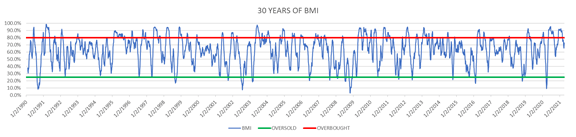
Here we find a 30+ year chart of the Big Money Index (BMI for short). Naturally, it doesn’t tell us much at first glance. And if I plot an index over it for 30 years, the time frame is too zoomed out to see anything meaningful. After all, the S&P 500 rose over 1,000% (1,048%, to be precise) in that time.

So, I dug into the data, because that’s what nerds do.

BMI

You don’t need to do the math. I did it for you.

What we can tell from that chart is that the BMI spent a vast majority of its time in the middle, between overbought and oversold. Out of 7,876 trading days (31-¼ years) the BMI was overbought 1,565 days – or 20% of the time. The BMI was oversold for only 292 days, or just 3.7% of the time. Those rare oversold instances are the golden tickets. That’s when you need to prepare to load up on outlier stocks.

Now, back to my question: Just because the BMI is rising, should we expect rising stock prices? It makes sense that we would, I mean, as big money rushes into stocks, they should go up on balance, right?

What I found was fascinating:

BMI

For 31-¼ years (7,876 days), the BMI rose for 3,706 days. That’s less than half the time, at 47%! But what’s eye catching is that on BMI up days, the S&P 500 also rose 67% of that time (2,474 days).

In contrast, the BMI fell 53% of the 31-year span (4,145 days). And on days where it fell, the index fell with it for 2,401 of those days or 58% of the time.

Fast forward to 2021. So far, the BMI only spent 25 of 67 days rising, or 37%.

Lastly, let’s take into account that the 31.25-year average for the BMI is 63%.

So where are we?

BMI

This year so far, the BMI is below average in terms of time spent rising. But it is rising now. And as it rises, we can expect nearly 70% of the time that stocks will rise too.

It’s Time To Be Bullish

Now before you skeptically tell me that “indexes usually go up,” check this out. The S&P 500 index rose only 53.5% of the time or 4,218 days of a possible 7,876. Those are good odds for a casino, but hardly great odds when assessing flying through a yellow light unharmed.

But a 70% chance that stocks rise? Those are great odds in the market. Right now, the BMI says higher highs are coming. And my approach is to find the leaders – or outliers that do even better than the market.

Nothing is certain, but using BMI history as a guide, it’s time to be bullish. The light is turning green.

Humans risk life on a split-second probability check, but we can be paralyzed when it comes to money. It seems like our priorities when it comes to money would be to be patient and purposeful and to prioritize.

As Stephen Covey put it, “The key is not to prioritize what’s on your schedule, but to schedule your priorities.”

https://www.entrepreneur.com/article/369634


7 Tips to Excel at Online Trading

How investors can excel at online trading and generate profits when buying and selling stocks, forex, cryptocurrencies, and other financial markets.

April 16, 2021 4 min read

Opinions expressed by Entrepreneur contributors are their own.

What does it take to be good at online trading and make buying and selling stocks, forex, cryptocurrencies, and other financial markets on the internet?

1. Online trading vs. investing

Online trading is a , active method for making money investing. It differs to the long-term investing approach advocated by . It is closer how the famous ‘ Wizard’ Paul Tudor Jones plays the market. Online trading offers an amazing opportunity for making an independent income using the internet, BUT it’s not for everybody. Before investing your money and time into online trading, it is worthwhile investigating first if it’s right for you.

Related: What You Need to Know Before Getting Into Online Trading

2. Find a good online trading app

Online trading can be done using your smartphone, tablet, or desktop computer. It is important to find trading companies that offer an online trading platform that can be used on any of these devices. The online broker or bank should be regulated by a government agency from a reputable country like FINMA in or the in the . Among the top online trading apps, the cost of trading is usually comparable, but you should make sure the commissions and bid/ask spreads are acceptable.

3. Take a free online trading course

There are many free online trading courses available on the internet, as well as paid options. No one course teaches you everything you need to know about online trading- most of these lessons come from experience. Learning concepts like lot size, pips, leverage, and placing an order in trading will not take long but are necessary to understand how online trading works. Ideally, choose a trading course that explains the different trading styles and trading strategies available.

Related: How to Start Investing

4. Choose a trading style

Broadly speaking, you can be a day trader who does day trading, a swing trader who does swing trading or a position trader than does position trading. You can break this down further into strategies like scalping. A scalper aims for very quick in and out trades to make a short-term profit or loss. How much time you can allocate to trading will play a big part in which trading style you choose. If you have a few hours per day, you can day ; a few hours per week would be more suited to swing or position trading styles.

5. Learn a trading strategy with risk management

It is not necessary to reinvent the wheel. Find a reputable trading mentor or trading educator that explains some simple trading strategies. Over time, you will alter the strategy to suit your own personality. Something important to get right from the start is incorporating risk management, which in simple terms is making sure you don’t risk too much on a trade. A simple strategy of buying and selling on forex signals is easy to learn, but there is no way to manage the size of the winning and losing trades. Harmonic trading is one example of an advanced trading strategy that incorporates trading risk management.

Related: How to Diversify Investments: 4 Easy Tips to Help You Get Started

6. Use a trading plan to set goals

All the best traders use a trading journal and set a trading plan. This plan can be adopted from already written trading plan templates. It will give details like how many trades to place per day, how much money you will deposit into your trading account, your financial goal for the end of the year, etc. There is also the decision over which financial markets to choose, for example, naked call options on tech stocks. Keeping this trading plan to hand will help encourage consistency in your trading.

7. Be persistent, keep your trading discipline

It is this final point that separates the consistently profitable traders from the rest. Conditions in financial markets will vary, which means your online trading results will vary too. It is important not to change trading strategy too quickly. Try to learn from your experience and use your trading journal to do more of what created winning trades and less of what led to losing trades. Whatever it takes to maintain your discipline, including some good R&R, is worthwhile.

https://www.entrepreneur.com/article/368727


David Einhorn This NJ Deli Which Has One Store, And Almost No Revenue Valued At $113M Is Proof The Market Is Broken

April 16, 2021 4 min read

This story originally appeared on ValueWalk

In his first-quarter letter to investors of Greenlight Capital, David Einhorn lashed out at regulators. He claimed that the market is “fractured and possibly in the process of breaking completely”, as exemplified by trading in GameStop and Hometown International.

Q1 2021 hedge fund letters, conferences and more

Einhorn claimed that many market participants and policymakers have effectively succeeded in “defunding the regulators.” He pointed to the actions of billionaires Elon Musk and Chamath Palihapitiya, whose actions earlier this year, helped fuel the Reddit rally in stocks, according to the value investor.

“We note that the real jet fuel on the GME squeeze came from Chamath Palihapitiya and Elon Musk,” Einhorn wrote. “Whose appearances on TV and Twitter, respectively, at a critical moment further destabilized the situation.

Greenlight’s letter went on to add:

“Mr. Palihapitiya controls SoFi, which competes with Robinhood and left us with the impression that by destabilizing GME he could harm a competitor. As for Mr. Musk, we are going to defend him, half-heartedly. If regulators wanted Elon Musk to stop manipulating stocks, they should have done so with more than a light slap on the wrist when they accused him of manipulating Tesla’s shares in 2018. The laws don’t apply to him and he can do whatever he wants.”

The letter claimed that investors could get away with these actions because there is “no cop on the beat.”

Companies and management that are “emboldened enough to engage in malfeasance have little to fear.”

Hometown International Shows The Market Is Fractured

To reinforce his point, Einhorn highlighted two other situations that have recently occurred.

The first related to a small-cap company, which appears to have little to no revenues, but yet is worth $113 million:

“Someone pointed us to Hometown International (HWIN), which owns a single deli in rural New Jersey. The deli had $21,772 in sales in 2019 and only $13,976 in 2020, as it was closed due to COVID from March to September. HWIN reached a market cap of $113 million on February 8. The largest shareholder is also the CEO/CFO/Treasurer and a Director, who also happens to be the wrestling coach of the high school next door to the deli. The pastrami must be amazing. Small investors who get sucked into these situations are likely to be harmed eventually, yet the regulators – who are supposed to be protecting investors – appear to be neither present nor curious. From a traditional perspective, the market is fractured and possibly in the process of breaking completely.”

The bizarre case of Hometown extends beyond the company’s market capitalization and lack of sales. Its chairman is Peter Coker Jr., who holds no shares in the business but has been a chairman of South Shore Holdings Limited, a Hong Kong-listed company, since 2013, according to Hometown’s annual report. He was also the managing partner of Pacific Advisers, and a partner of TDR Capital Investment Ltd. Coker was a partner at Shenzhen-based TDR capital from 2009 till 2013.

Hometown International Inc. (OTCMKTS:HWIN)’s major shareholders include several other Hong Kong and China-based businesses. One Macau-based company, VCH Limited, entered into a Consulting Agreement with Hometown in May 2020. According to the company’s own findings, VCH received $25,000 a month under the terms of the agreement.

Hometown International paid out $320,000 and $170,000 in consulting and professional fees respectively for the year ended 31 December 2020. Against the $13,976 in revenues for the year, this pushed the company to an overall net loss of $631,356.

Compared to the company’s other expenditures, these consulting fees appear outlandish. In comparison, labor costs totaled $126 last year. Food and beverage costs were $10,124.

To fund this cash outflow, the company raised $2.5 million from issuing common stock during the year.

Another recent example of the lack of regulation in the market Greenlight’s letter highlighted was the investigation of Tether by the Office of the Attorney General of New York.

Tether is one of the largest cryptocurrencies, with about $40 billion outstanding, and its value is supposed to be tied to the dollar. Each Tether is supposed to have $1 of cash backing the cryptocurrency. But when it was investigated, it didn’t.

The Office of the Attorney General investigated for two years and found that “Tether deceived clients and the market by overstating reserves and hiding approximately $850 million of losses around the globe.”

Did anyone get arrested or lose their job, the letter asked? “Of course not.” Tether was fined $18.5 million and had to agree to stop trading with New Yorkers.

This relatively small punishment was “as if Bernie Madoff had been told to pay a small fine and stop ripping off New Yorkers, but to go ahead and have fun with the Palm Beach crowd,” Einhorn summarized.

This article first appeared on ValueWalk Premium

https://www.entrepreneur.com/article/369623


5 Decisions All Responsible Entrepreneurs Make En Route to Financial Security

April 16, 2021 5 min read

Opinions expressed by Entrepreneur contributors are their own.

inherently involves financial risk. That doesn’t mean, however, that entrepreneurs can’t become financially secure. Remember, your and are not the same. Responsible entrepreneurs aren’t just focused on making their business succeed. They also take steps to achieve in their .

1. Create true separation between personal and business finances

Failing to separate business and personal accounts can create serious financial trouble in the long run. If the business were to fail, you would lose all the that is also being used to pay your rent or any other expenses. Even more troublesome, liability issues could leave you on the hook for company debts or legal troubles.

Maintaining separate personal and business accounts ensures that even if your company runs into financial difficulty, your “nest egg” won’t be compromised. Paying yourself a salary from your business account can help increase this sense of separation.

Never use a business account (including credit cards) for personal expenses.

Related: 5 Personal-Finance Mistakes That Kill Promising Companies

2. Clearly define personal finance goals

While you may have established clear growth goals for your business, you can’t afford to let personal finance goals be an afterthought.

In a recent phone conversation, Tobi Roberts, co-founder and CEO of City Creek Mortgage explained, “As a business owner, you need to plan out what you’ll do with the salary you pay yourself from your company. After all, a big part of the reason why many people go into business is to support their desired lifestyle.”

Continued Roberts, “Setting clear and meaningful goals will act as a series of guideposts to help you stay on track for reaching that lifestyle. Whether you want to move into a bigger house or buy a boat, setting a savings goal will help you better control what happens after you pay yourself.”

Your personal finance goals (such as or even building an emergency fund) can also affect how you structure your business’s cash flow. You need to find a balance between paying yourself enough to live your desired lifestyle without creating a cash crunch for your company.

3. Create passive income through investments

“Making your money work for you” may sound like a bit of a cliche, but it’s an important to-do for entrepreneurs trying to achieve financial security. Continued investments in the allow your money to grow at a much greater rate than it would if you left it in a checking or savings account.

As Investopedia reports, the more passive, long-term buy and hold strategy averages 12.1 percent returns on small stocks and 9.9 percent returns on large stocks, even when accounting for market crashes.

By simply putting money aside into an investment account each month, your money will compound, giving you an additional revenue stream beyond your salary. You don’t need to chase the latest meme stock to increase your financial standing.

4. Religiously track spending and saving

Managing cash flow is vital for any startup — and it is just as important for your personal finances. If you don’t understand where your money is going, you might find yourself running out of money as you try to attain a lifestyle you can’t quite afford.

Tracking monthly expenses is vital for identifying ways you can better use your money. This can help you identify things you should cut out of your life — like that gym membership you never use. Or, it can put the amount of money you spend on meals at restaurants into perspective.

Writing down how much you spend each month — and what you spent it on — makes it easier to compare your current habits with your long-term financial goals so you can make necessary changes. Quite often, small sacrifices now (like investing $50 toward an investment account instead of daily runs) will pay big dividends later.

5. Plan for the unexpected

You never know what life will throw your way. This is just as true in your personal life as it is in the business world. And of course, unexpected negative outcomes for your business can have a tremendous impact on your personal finances.

While times are good, you should prepare for the future by building an emergency savings fund. Financial experts generally recommend that most people have emergency savings that would cover three to six months of living expenses.

Notably, those with a variable income or less stable employment — a category that many entrepreneurs fall in — are advised to have an emergency fund that covers six months or more. Contribute a bit of money to your emergency fund each month. This way, if disaster strikes and you are no longer making any money from your business, you won’t need to liquidate investments or retirement funds to stay afloat.

Related: 5 Tips To Protect Your Company From Legal Liabilities

No matter what your business goals may be, you cannot make finances an afterthought. By taking steps to account for both your business and personal financial standing, you will have much-needed security.

Ultimately, financial security allows you to support the lifestyle you want to live while giving you one less thing to worry about in your hectic entrepreneurial life. Prioritize your finances early on so you can establish good habits that last a lifetime.

https://www.entrepreneur.com/article/367159


Where Entrepreneurs Can Find Health

April 15, 2021 4 min read

This story originally appeared on ValueWalk

When you become an entrepreneur, one of the first orders of business you must deal with is health insurance. Whether you have employees or not, health insurance is a necessity in the U.S., but it can be challenging to find a good plan. Here are some tips to help you locate health insurance for your business.

[soros]

Q1 2021 hedge fund letters, conferences and more

Health Insurance Marketplace

If you qualify for a subsidy, the first thing you should do is check the Health Insurance Marketplace at Healthcare.gov. It’s also worth a check if you’re not sure whether you qualify for a subsidy. If you’re buying insurance for your business and employees will be on the plan, then the Health Insurance Marketplace isn’t an option.

However, for solopreneurs and anyone who must buy their insurance separate from their workplace, the Health Insurance Marketplace is a good option, especially for those who qualify for a subsidy. If you don’t qualify for a subsidy, there are undoubtedly better insurance plans available outside the Marketplace. Thus, if you apply and find out that you don’t qualify, you might want to look elsewhere.

Associations

Some associations offer health insurance as a benefit of signing up. For example, the National Association for the Self-Employed or NASE offers health insurance to members. However, you should do your research to determine if the benefits offered are truly worth the fee paid for membership because not all of them are.

Association health plans are group insurance plans in which multiple employers, including people who are self-employed, unite to offer medical benefits. Joining together increases the number of participants on a plan, making the association qualify as a “large group” health plan.

Large group plans are eligible for less expensive health plans with a lower percentage of premiums spent on profits for the insurer and administrative costs. They also allow associations to design plan benefits based on best practices used by large businesses. Additionally, large group plans can negotiate better rates from healthcare insurers and providers, and self-insuring can lower your plan administration costs more and avoid a health insurance tax.

Associations could be a good option for solopreneurs or small business owners who want to offer health insurance but don’t have a lot of employees.

Professional Employer Organizations

Professional Employer Organizations (PEOs) are firms that outsource accounting, payroll and other management tasks, including health insurance. Small business owners who sign up with a PEO can buy into group health insurance for a small monthly fee.

Like associations, PEOs combine multiple employers into one large group of employees for a health insurance plan. This enables workers to access insurance plans similar to those they would receive if they worked at a big company. Unlike associations, PEOs also come with other services like payroll processing.

However, one potential problem with PEOs is the fact that many have minimal options in insurers, which means small business owners might not have access to the best plans. PEOs also require administrative fees to support their services, and these fees come out as a monthly fee per employee or a percentage of the total payroll.

Health Cost-Sharing

Health networks are another option for small business owners who want to provide health insurance for themselves or their employees. Some examples of health networks include New Health and Liberty Healthshare.

However, these health cost-sharing networks are not an option for those with pre-existing conditions, as you must be in good health to sign up for the plan. They’re also not a choice for small business owners who want to provide health insurance for their employees. On the other hand, solopreneurs in good health might be interested in health networks.

An Easier Way to Find Health Insurance

It can be a daunting task to find health insurance for you, your family, and your employees, but one other option can make the process easier. A comparison platform like the HealthMarkets marketplace enables you to compare multiple plans and receive the best recommendations from hundreds of different insurers.

To use such platforms, you just answer some questions about your needs and your current health insurance plan. They can even help you save money on health insurance.

Whether you’re a solopreneur or a small business owner with several employees, there are multiple options for seeking health insurance. You just have to know where to look.

https://www.entrepreneur.com/article/369546


10 Most Important Lessons in Economics and Finance

April 14, 2021 9 min read

Opinions expressed by Entrepreneur contributors are their own.

.” This was my condensed response to a question in a recent Publishers Weekly interview: “What could have helped improved the lives of so many people during the Covid-19 crisis?” If more people had a deeper knowledge of finance, probably there would have been more planning and saving by the masses for this unforeseen emergency. But what are some of the most important lessons that someone (especially an entrepreneur) can learn from the of finance?

The following is a small sample of 10 (out of 218 principles) of the most important lessons in finance adapted from my 2014 book The Most Important Lessons in Economics and Finance. Please note that these financial lessons are in no particular order of importance and that each one might be more or less applicable to you at different stages of your life. Which ones were (or could have been) the most useful to you during the Great Pandemic ?

1. Maximize wealth to stay alive and prosper

Principle 22: “The primary goal of any business should be to maximize the owner’s wealth.”

This lesson never seemed to sit well with many of my former finance students as it contains a sad dose of reality—without wealth, your business will eventually die. 

This concept was expanded more in my 2016 book The Survival of the Richest by listing the three major wealth management possibilities: Minimize wealth below the level of the bare minimum survival essentials necessary to survive (I called this level “the edge of survival”); Live on the edge of survival, which is where an entity has just enough wealth to survive; or to maximize wealth above the level of the bare minimum survival essentials necessary to survive (Criniti, p. 162). Out of all of these three options, maximizing wealth is the only one that will protect you and your business the best for the short and the long term.

Related: 5 Finance Tips for First-Time Entrepreneurs

Please note that Principle 22 does not give a free pass to make by all means necessary; there are other lessons on business ethics that will eventually weed out the unethical…some faster than others. This is why it is best to maximize your wealth “ethically” to ensure that you keep your good reputation (and your future wealth) in check.

2. Diversification can maximize return and minimize risk for your investments

Principle 38: “Diversification can be applied to everything.”

The vast evidence demonstrating the usefulness of diversification is one of the hallmarks of the science of finance. This subject traces its roots to the beginning of modern finance with Harry Markowitz’s Portfolio Selection book.

Mutual funds are a prime example of this concept. Why hold only one or two stocks when you can have a mutual fund with hundreds of different kinds of stocks for about the same investment amount? Diversification should not only be applied to stocks and bonds but ultimately to all types of investments (including real estate and collectibles). We can even apply diversification to other areas of life, for example, diversifying our friends and hobbies.

3. Every job can be valuable

Principle 57: “Every laborer can make this world a better place to live and love.” 

The Great Pandemic Depression has taught us to appreciate difficult jobs even if they don’t appear to be desirable. Most people want their children to become lawyers and doctors when they grow up. Let’s face it though—these occupations are not for everybody. Simple jobs like working at a supermarket or grocery store have gained the respect of many recently. If it wasn’t for these laborers (our modern heroes), who would have helped service the food that we needed for our homes while in quarantine?

4. The Great Pandemic Depression will change the financial thought process of every survivor

Principle 64: “Major economic events generally cause everlasting impressions on the future financial affairs of its survivors.”

Like many other major events before this (The Great Recession, The Internet Bubble, and, of course, The Great Depression), people are learning the true importance of financial education. 

With so many businesses that have collapsed or that have downsized their labor force, unemployment is rampant. By many people learning to live on less, these behaviors are more than likely to continue even if conditions improve. The spirit of the living is being tested daily. There is no doubt that there will be a residual of numerous financial scars to permanently remind us of these darker moments.

Related: 5 Personal-Finance Mistakes That Kill Promising Companies

5. Finance teaches you to take control of your wealth

Principle 71: “Mastering the science of finance can help you to control your own wealth.”

The first step to learn how to manage your money is to learn from experience, from what finance teaches you, or both. When you learn from science, you are learning from many others who already made mistakes and derived a solution. By studying financially successful people, you can save valuable money and time by learning the correct ways to manage your wealth. In science, we call this “standing on the shoulders of giants.” Why reinvent the wheel for no reason?

6. People who control the money are the root of most evil and good

Principle 135: “Money is not the root of all evil and good.”

Did you ever hear the expression: “Money is the root of all good and evil?” How could this be true? Money is just a tool that we use to accomplish certain tasks like buying goods or services. Money does not have a conscience — actually its power lies in our minds. Thus, it is people who control the money who can decide to do right or wrong with it; and it is people who can use their money to protect or destroy our planet.

7. Poverty experiences hold value

Principle 152: “The experience of poverty can provide a lifetime of invaluable lessons.”

In some ways, being poor is a blessing—you can learn things about money never even conceivable to those without this experience. With that said, this lesson is not an advertisement for “staying” poor, only to highlight the value gained from “being” it. Those who have been poor before in their life are generally the best prepared to deal with future unexpected major losses of wealth.

8. Rich people who help others understand the real purpose of excess wealth

Principle 163: “You can’t take your wealth with you when you die.”

Do you know anyone rich who is greedy with her or his money; you know the Ebenezer Scrooge type? This financial lesson was created especially for wealthy people who never use their money to help others. As hard as it is to believe, there are individuals worth tens of millions, even billions, of dollars who never give to charity and/ or use their money to help other people—even their own immediate family. 

When you have more assets than your “prosperity tipping point” (a concept created in The Survival of the Richest book) that highlights the exact amount where additional wealth will add little increased benefit to an entity), all of the excess wealth would be best utilized if reserved for other people or causes during your life or immediately after. With this strategy, at least you can control who gets your assets when you die. What is the point of having more money than you will ever need if you can never use it to make a positive impact on this world? The real truth is that if a rich person dies as a cold-hearted miser, then that perception will become her or his real legacy.    

9. Building families are expensive

Principle 167: “The total cost to live for an individual is magnified for a family.”

This lesson is the most beneficial to those who are planning to marry and/or have children. Life is expensive for every individual. You need money for basic necessities like food, water, and utilities. 

When you add just one more person to your family, you will now have to add all of her or his bills to yours (including potentially negative spending habits). When children are adding to this equation, many additional unique bills will need to be accounted for (especially schooling). Before you go down this path in life, it is best to set up the pieces as best as you can to weather the potential financial struggles to come.

Related: Mark Cuban Says Explosive Growth in DeFi Is ‘Like the Early Days of the Internet’

10. Save your pennies wisely

Principle 218: “Any money saved may provide you with an option to spend it later.”

The old expression “A penny saved is a penny earned” taken literally can potentially ruin your financial life. As investing is a part of saving, if you invest in the wrong financial products, then you could lose everything. Many years of saving plenty of pennies could result in zero earnings during your retirement. Also, let’s pretend that you saved all of your money for years and stored it under your bed. If your house burned down tomorrow, all of that money would be gone.

The point of this lesson is to save money for your future—but don’t just save for saving’s sake. You will also need to ensure that your investment and risk management strategy are aligned well with your goals. The more solid your investments are, the higher the chances that your pennies will be there to work for you when you need them.

Financial literacy is essential

We may never know the exact outcome of the Covid-19 pandemic if the masses were significantly more financially literate. Could many businesses have been saved? How many? However, it is certain that more financial knowledge could have helped make life a little more comfortable for many people in these uncomfortable times. The essence of finance revolves around planning for the future, especially emergencies. By studying the most important lessons in finance, you can be equipped to know how to build wealth better now and in the future. Which one of the above most important lessons in finance has made the biggest impact on your life?

https://www.entrepreneur.com/article/367561


Apis Capital Flagship Fund 1Q21 Commentary

April 14, 2021 9 min read

This story originally appeared on ValueWalk

Apis Capital Flagship Fund commentary for the first quarter ended March 31, 2021.

Q1 2021 hedge fund letters, conferences and more

Dear Partners,

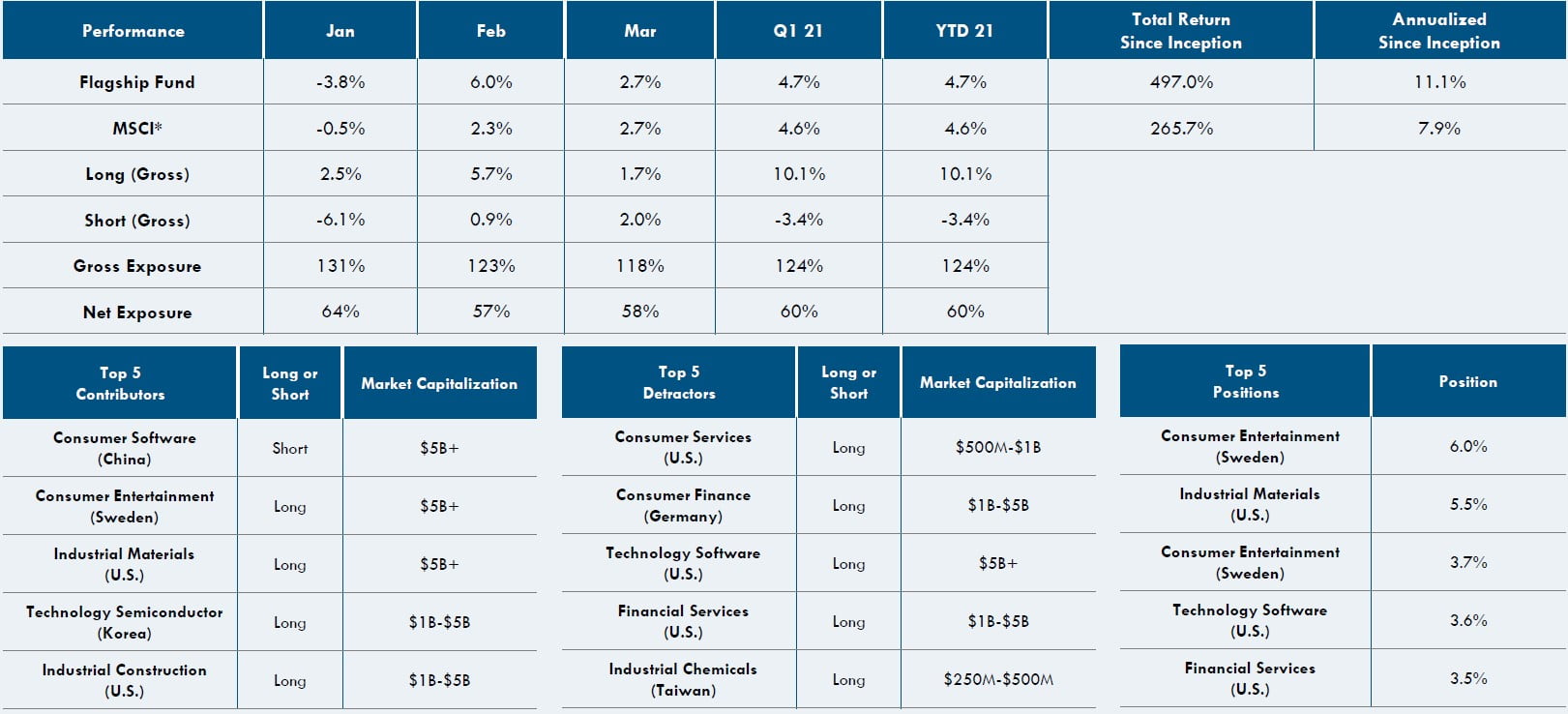
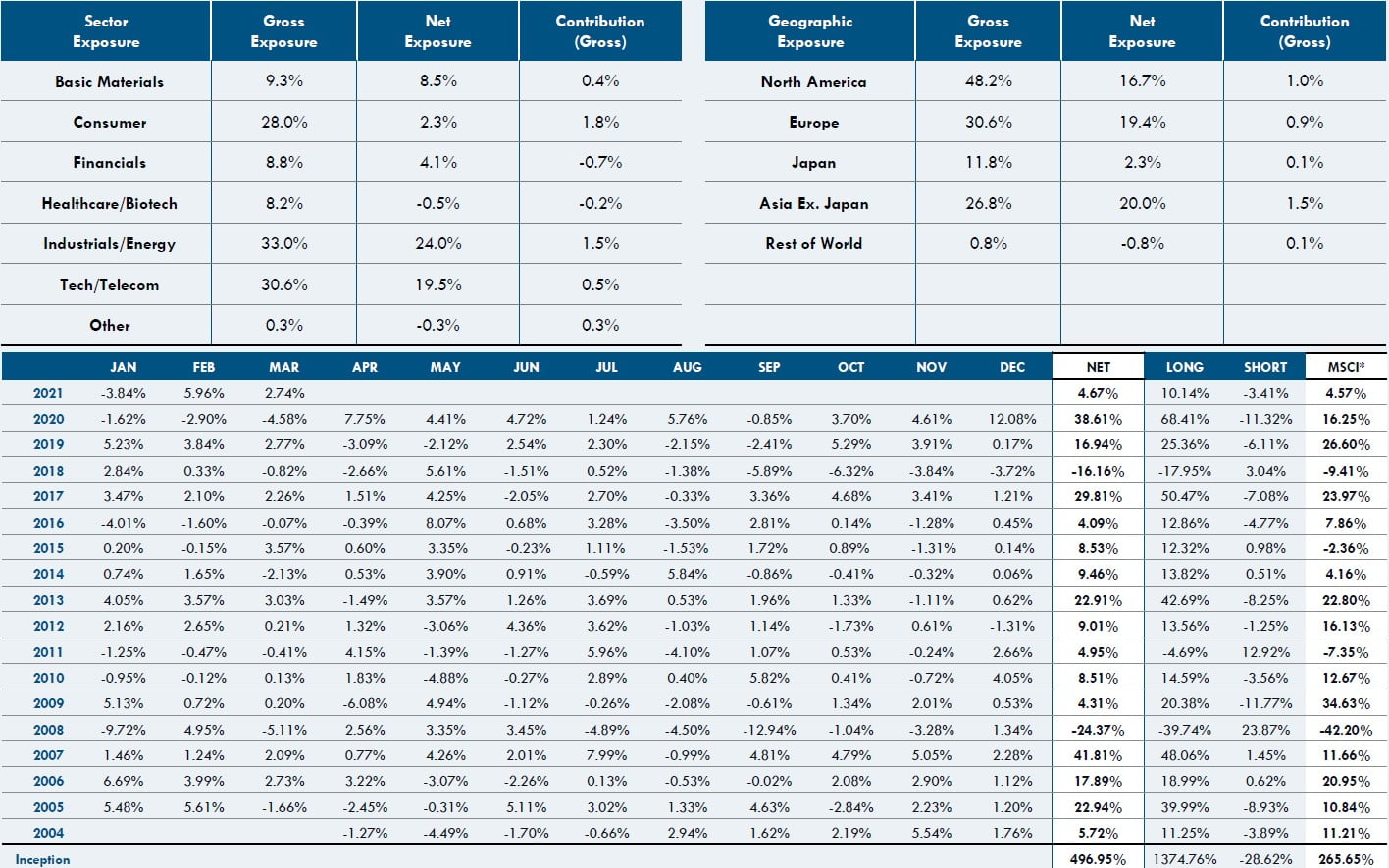
Our Flagship Fund was up 4.7% net in Q1 2021. During the past quarter, our longs contributed 10.1% (gross), while our shorts detracted 3.4% (gross). At the end of March, the Fund was approximately 58% net long with the portfolio 88% long and 30% short.

Apis Capital Flagship Fund

Performance Overview (Gross Returns)

Returns were solid for the Flagship Fund during the first quarter and roughly matched the global indices, despite our net portfolio exposure being held at approximately 60%. While tailwinds for small-cap stocks continue to be favorable, sector rotations away from last year’s tech darlings to more cyclical and industrial areas were timed well. Following a poor result for shorts in January, the “Reddit effect” softened in the last two months of the quarter, allowing for equally solid short returns in both months.

While all regions contributed in March (led by Asia), Asia contributed 3.7% to gross returns for the quarter, while Europe added about 3.1% in the same period. North America was slightly negative, still recovering from the damage inflicted by short losses suffered in January. Within sectors, Industrials and Materials stood out contributing 5.2%, while Technology added 2.7%. One notable detractor was Healthcare, which was primarily driven by adverse volatility in shorts during the last week of January.

Notable long winners were names we have highlighted previously, such as Evolution Gaming (contributing 2.2%), Darling Ingredients (1.4%) and Tokai Carbon (1.2%). Notable detractors, which had been winners last year, were Rush Street Gaming (-0.7%) or those perceived to be harmed by re-opening such as online retailer BHG Group (-0.6%). On the short side, GSX Techedu deserves specific mention. GSX started the year trading around $50 (per share) and climbed to over $140 during the month of January, only to close out the quarter at about $33. Had we held the same position throughout Q1, it would have been a nice contributor to performance, but risk management forced us to realize some losses during the epic January short squeeze. Near quarter-end, GSX plummeted when it was revealed it was part of an engineered squeeze undertaken by the now infamous Archegos Capital. Why multiple brokers would provide five times leverage to someone (who, by the way, previously pleaded guilty to wire fraud and insider trading1) to help engineer a short squeeze in a fraudulent Chinese company is beyond disappointing. Shame on all involved. Shorting is hard enough as it is without our own brokers working against us.

Portfolio Outlook And Positioning

The first quarter of 2021 has been predictably volatile. The markets are shifting focus away from safe, defensive businesses to those that have survived the lockdown and are likely to recover strongly as economies reopen. Adding a crosscurrent, however, is the ongoing effect of spectacular stimulus which has levitated all manner of speculation from SPACs to intergalactic tourism plays. During the first quarter, we witnessed the market move its focus away from these more speculative areas.

Apis Capital Flagship Fund

It appears that the prospect of re-opening will bring with it some sanity – possibly a direct result of fewer stimulus checks being sent to day traders. The outlook is hardly clear, however, as both the U.S. Federal Reserve and ECB have committed to keeping the current level of extremely low interest rates for at least another year or two. Furthermore, the bugaboo of higher inflation has already been dismissed, as any spike up (which appears to be underway) is explicitly regarded as temporary. With caution being thrown to the wind, it seems the market’s “tailwind” of central bank monetary stimulus will continue for the foreseeable future even if inflation perks up. As always, we build our portfolio bottom-up while due consideration is paid to these macro factors. With this in mind, we have leaned into our more speculative shorts as they have begun to work. We detail several of these names for your reference below.

Investment Highlights

AMC Entertainment Holdings, Inc. (U.S. – $4.3bn market cap)

Prior to COVID-19 pandemic, AMC had been a multi-year “melting ice cube” short and part of a basket of movie theater companies we have shorted (including Cineworld, Cinemark, Marcus, etc.) in the secular theme of declining movie attendance globally. Some of our best shorts have had the lethal combination of declining revenues and too much debt, with AMC being a prime example. Obviously, COVID-19 massively accelerated their problems and despite our view that it was a “zero,” we (luckily) covered in the low-single digits as short positions in penny stocks can often be tricky.

Thanks to retail enthusiasm (or perhaps more “Archegos-like” shenanigans), AMC has literally risen from the dead. The market cap today is higher than at any time in its history while debt is twice what it was two years ago, meaning the enterprise value (EV) now stands at almost $16bn, or about triple what it has been over the last several years. As a simple thought exercise, assume sales return to past peak (hard to do with fewer theaters, fewer seats, shortened or no movie release windows, improvement in home theaters, etc.) and AMC today trades at 3 times the EV/Sales multiple vs. pre-pandemic. Is AMC worth three times what it was worth two years ago? Highly unlikely!

Yamashin Filter Corp. (Japan – $570mm market cap)

Yamashin Filter’s main business is providing filters used in hydraulic excavators. This core business is niche but cyclical, growing in-line with or slightly above GDP and with decent margins. Management is destroying shareholder value, however, by getting into the consumer face mask business. Throughout 2020, the company built up grand expectations for this new business line, only to whipsaw investors with dramatic cuts to guidance just months later. Management claimed the mask business would generate ¥3bn in revenue and ¥910mm in profits, but just three months later slashed this revenue target by two-thirds and changed their profit guidance to a loss. Meanwhile, it continues to spend on expanding production capacity for this commoditized offering. At 89 times next year’s earnings, which we think have potential to disappoint, we see plenty of further downside.

Nevro Corp. (U.S. – $5bn market cap)

We are short Nevro, a medical device company specializing in spinal cord stimulation (SCS) for chronic pain conditions. Our thesis is premised on consistently negative operating margins amid flat revenue growth, limited real-world efficacy of their flagship Senza device, and evidence of a kickback scheme where they have compensated physicians to implant their devices. Perhaps the reason their devices are so difficult to place is the poor real-world results of their device. Multiple physicians confirm that patients typically respond early in treatment only to have any effect wane within about 6 months on therapy and more than 75% of patients requiring an explant of the device within a few years…not exactly the profile of the “best-in-class” device the company purports. Finally, the company appears to be engaging in a kickback scheme to drive implants as reported by European investigative journalists citing contracts showing a payment of approximately $10k per procedure to Swiss physicians. While there is no legal liability in Switzerland for medical device kickbacks until 2023, we doubt this type of behavior is limited to Switzerland. With sales over the last few years stagnating around $350-$400mm and losses mounting, we find it hard to justify the current $5bn valuation.

CD Projekt S.A. (Poland – $4.9bn market cap)

We are also short shares of CD Projekt, the Polish AAA video game developer and publisher. CD Projekt is the 11th largest company on the Warsaw Stock Exchange and the 14th largest pure play game developer in the world. The company has gained a strong reputation and cult-like following by gamers for the quality of its games, which are typically story-driven, single player games. Most notably, CD Projekt is known for its Witcher series, which has sold over 50 million copies since the first game was launched 2007. Compared to studios of similar market cap which typically own various franchises and are juggling multiple projects at a time, CD Projekt has historically only worked on a single game at a time with 4-5 years between releases. Recently, the company has made headlines for the launch of its newest game, Cyberpunk 2077. Cyberpunk was one of the most anticipated game launches in recent memory and consensus expectations firmly placed it among the highest selling launch games of all time. While our initial thesis centered on the belief that expectations were simply too high, the launch has been more disastrous than we could have possibly imagined. Reviews of the game were generally positive in the days leading up to the launch, however they were revealed to be based on the higher performance PC version of the game that CD Projekt provided to reviewers. As it turned out, the console version of the game was so riddled with bugs that the game was nearly unplayable. This was such a problem that within a week following launch, Sony removed Cyberpunk from its PlayStation Store “until further notice” and as of early April, it has yet to return. Now four months after the launch, new copies of the game can be found at a 30% discount on Amazon. CD Projekt had a lot riding on this game and will now be spending a significant part of 2021 fixing bugs and trying to regain the attention of fickle gamers instead of launching previously planned additional content and multiplayer expansions. While CD Projekt could turn it around, the industry’s history with previous botched game launches is not a good omen. By the time the company is able to right the ship, its possible gamers will have already moved on.

While shares are down over 50% from the launch, they are still trading at approximately 20 times FY21 revised consensus earnings; earnings that will likely steadily decline over the coming years (EPS declined at a 17% CAGR in the 4 years following the Witcher 3 launch) as the company moves on to its next major game. This compares to mid-20 times P/E multiples for peers like Activision and EA that have more predictable game releases and growing EPS. Furthermore, we believe consensus estimates may still be too high. By our math, they imply another 10-15mm copies of Cyberpunk to be sold in 2021, which would mean that Cyberpunk will have sold nearly as many copies in its first 12 months as the critically acclaimed Witcher 3 did after 5 years. If CD Projekt fails to resuscitate Cyberpunk, we believe that consensus estimates one and two years out could be cut by as much as 50% with a commensurate drop in share price.

Apis Capital Flagship Fund

As always, we encourage your questions and comments, so please do not hesitate to call our team here at Apis or Will Dombrowski at +1.203.409.6301.

Sincerely,

Daniel Barker

Portfolio Manager & Managing Member

Eric Almeraz

Director of Research & Managing Member

https://www.entrepreneur.com/article/369425


Signs Point To Retail Investors Taking Over Bitcoin Momentum: CoinDesk

April 13, 2021 6 min read

This story originally appeared on ValueWalk

Institutional investors have been driving the surge in demand for bitcoin and fueling the price increase for months. However, it’s starting to look like retail investors are taking back over, according to research from CoinDesk.

Q1 2021 hedge fund letters, conferences and more

That could mean the stability in the rising bitcoin price could be coming to an end, although it shows no signs of slowing down.

The great pivot

More funds and financial institutions started investing their time, money, and reputation into crypto assets during the fourth quarter. For example, Goldman Sachs Group Inc (NYSE:GS) is relaunching its crypto trading desk and will start offering exposure to cryptocurrencies to its private wealth clients.

Additionally, Deutsche Bank AG (NYSE:DB) and Bank of New York Mellon Corp (NYSE:BK) are planning to offer cryptocurrency custody. Some private banks in Europe also started offering crypto services. Further, BlackRock, Inc. (NYSE:BLK) now allows two of its largest funds to invest in bitcoin futures.

Despite all that institutional interest, CoinDesk said in a recent report that there are signs that retail investors started to take over the momentum in the cryptocurrency space during the first quarter. The report examined some market and on-chain fundamentals for the largest cryptocurrency by market cap and timelines of critical developments.

Bitcoin on corporate balance sheets

According to CoinDesk, not many predicted that significant corporations would start holding bitcoin on their balance sheets, but that trend has been picking up. MicroStrategy Incorporated (NASDAQ:MSTR) and Square Inc (NYSE:SQ) were the first to do it, although more corporations have hopped on the bitcoin bandwagon this year.

Tesla Inc (NASDAQ:TSLA) bought $1.5 billion worth of bitcoin in February, and several surprising companies followed in its footsteps. Before Tesla even dove in, Marathon Digital Holdings Inc (NASDAQ:MARA( bought $150 million worth of bitcoin in late January. The Motley Fool bought $5 million in bitcoin in mid-February, while Square bought another $170 million worth of bitcoin, followed by MicroStrategy, which bought an additional $1 billion of the cryptocurrency.

In March, Meitu Inc (OTCMKTS:MEIUF) bought $17.9 million worth of bitcoin and $22 million worth of ether, followed by Aker SAS, which holds 100% of the reserves for its new subsidiary in bitcoin. Meitu bought an additional $21.6 million worth of bitcoin and $28.4 million worth of ether in mid-March.

Seeking the first bitcoin ETF

CoinDesk notes that three bitcoin exchange-traded funds launched successfully on the Toronto Stock Exchange during the first quarter. Additionally, the over-the-counter price for the Grayscale Bitcoin Trust (OTCMKTS:GBTC) started trading at a discount to its net asset value; both of these factors are ratcheting up the pressure on the U.S. Securities and Exchange Commission to approve a bitcoin ETF in the U.S. The question now is whether Gary Gensler, who’s been nominated to lead the agency, will rule favorably on the cryptocurrency if he is confirmed. He already has ties to the industry, so that bodes well for it.

Efforts to offer a bitcoin EFT in the U.S. have already been underway. Valkyrie filed for one in January, and Bitwise filed for a “crypto innovators” ETF in February. NYDIG also filed for a bitcoin ETF in the U.S. in February. Valkyrie filed for another ETF that would invest in companies with bitcoin on their balance sheets in March. SkyBridge and WisdomTree also filed for bitcoin ETFs in March.

Additionally, Simplify filed for a bitcoin ETF that would invest in the Grayscale Bitcoin Trust, and the SEC published VanEck’s bitcoin ETF application. A Fidelity Investments affiliate also filed for a bitcoin ETF in the U.S. last month.

Bitcoin price and market cap

Bitcoin’s market capitalization surpassed $1 trillion during the first quarter, hitting $1.1 trillion at the end; this marks a significant milestone because, for many institutional investors, an asset is only worth considering when it reaches a minimum size. At a $1 trillion market cap, bitcoin could attract even more attention from large institutions, further increasing its appeal to smaller investors.

Bitcoin’s price performance has been weak for some weeks this year. However, the cryptocurrency broke that trend of weak performance in March with a 30% return, bringing its return to 100% for the first quarter. Bitcoin’s returns in January and February were also above average for those months. For the first time since 2013, has the cryptocurrency had a first-quarter with three positive months.

Bitcoin started the year at a 12-month high, but its market dominance as measured by a percentage of total market cap continued to fall, diving below 60%; This makes a difference because it indicates that the crypto industry is becoming more diversified. It’s also a healthy sign as more use cases and technologies are explored and as more investment opportunities appear.

However, when considering bitcoin’s dominance among the top 20 crypto assets by trading volume, it becomes clear that its dominance has remained stable at 73% over the last 12 months. Meanwhile, Ethereum’s influence on the crypto market is increasing.

Bitcoin trading volumes

Bitcoin spot trading volumes surged at top transparent exchanges starting in the third quarter, but that leveled off in the first quarter after hitting a record daily high of over $7 billion in January. Coinbase led the spot trading volume, followed by LMAX Digital and Kraken.

The surge in bitcoin future volumes during the fourth quarter slowed during the first quarter, although it still ended that quarter at nearly tripled the levels seen one year ago. Open interest in bitcoin futures also decelerated even though volatility increased. At the end of the first quarter, open interest in futures was nearly 350% higher than it was last year at this time.

The increased growth in open interest versus trading volume indicates an increase in leverage, which is noteworthy. The most robust growth came from offshore high-leverage exchanges Deribit, Bybit and FTX.

The CME also started the year off well, growing to become the biggest bitcoin futures exchange based on open interest, which signals the increased institutional activity. The CME has continued to grow, but more retail-focused exchanges like Binance and Bybit have overtaken it. The report predicts that the CME could see rising competition for the U.S.-based institutional market as Cboe is thinking about offering a bitcoin derivative. Meanwhile, it is widening its product set and addressable market by launching bitcoin micro futures in May.

https://www.entrepreneur.com/article/369325


London Trails Paris And New York For Property Prices

Research by Astons, the international experts on real estate, residency and citizenship has revealed that London trails New York, Beijing and Paris when it comes to property prices surrounding famous landmarks. Q1 2021 hedge fund letters, conferences and more Property Prices Surrounding Famous Landmarks Astons analysed property prices surrounding 11 famous landmarks across the global […]

April 12, 2021 3 min read

This story originally appeared on ValueWalk

Research by Astons, the international experts on real estate, residency and citizenship has revealed that London trails New York, Beijing and Paris when it comes to property prices surrounding famous landmarks.

Q1 2021 hedge fund letters, conferences and more

Property Prices Surrounding Famous Landmarks

Astons analysed property prices surrounding 11 famous landmarks across the global property market to find which attracted the highest price tag where a bricks and mortar investment is concerned.

The research shows that France, or more specifically Paris, ranks top with the average apartment-sized property surrounding the Eiffel Tower coming in at £486,244.

New York’s Statue of Liberty also places ahead of London. Although there is a distinct lack of available homes on the island itself, an apartment-sized home in the surrounding areas will set you back £478,137.

London’s Big Ben does take the bronze though, with Aston’s research showing a modest-sized home in Westminster will currently set you back £464,547.

The Sydney Opera House (£328,955) and Rome’s Colosseum (£250,678) also rank as some of the most expensive real estate landmarks around the world.

At the other end of the scale, an apartment-sized property within reach of Cairo’s Pyramids of Giza would set you back just £27,431, with the Taj Mahal (£29,706) and Rio’s Christ the Redeemer (£52,893) also presenting some far more affordable options.

Investment Opportunities In Premier Locations

Managing Director of Astons, Arthur Sarkisian, commented:

“The global property market is wonderfully diverse and allows many investors to build a wide portfolio based on their personal criteria and requirements.

Of course, investing in the global go-to destinations of Paris, New York and London will come at a considerably higher cost, but even these premier locations will offer a range of investment opportunities at varying price points.

Identifying the best option in any market will always rely on help from those operating on the ground with the local knowledge and expertise to help facilitate an investment.”

Nation Location Landmark Value of apartment-sized property in the surrounding area
France Paris Eiffel Tower £486,244
United States New York Statue of Liberty £478,137
United Kingdom London Big Ben £464,547
Australia Sydney Sydney Opera House £328,955
Italy Rome Colosseum £250,678
Russia Moscow Red Square £169,701
Greece Athens Acropolis £133,801
United Arab Emirates Dubai Burj Khalifa £113,901
Brazil Rio de Janeiro Cristo Redentor £52,893
India Agra Taj Mahal £29,706
Egypt Cairo Pyramids of Giza £27,431

  • Average size of a London flat at 43 square metres used as the comparable property size across all global markets, sourced from the Office for National Statistics.
  • Local property values per square metre around each famous landmark sourced from the Global Property Guide, Statista and the Global Cost of Living Index.
  • Astons are leading international real estate experts on residency and citizenship through investment offering bespoke residence and citizenship solutions in the UK, EU and Caribbean through property investment.
  • Astons have over 30 years of experience assisting individuals to successfully relocate their lives, lifestyles and companies through the complex world of global immigration law
  • Astons offer everything from residency and citizenship, UK visas and immigration, legal support and guidance on worldwide property investment.

https://www.entrepreneur.com/article/369208