3 Growth Stocks Displaying Market Leadership

Several standout stocks have already resumed an uptrend and are displaying incredible relative strength in the growth space, which means that savvy investors should take notice. Let’s take a look at 3 growth stocks that are displaying market leadership at this time.

April 10, 2021 4 min read

This story originally appeared on MarketBeat
What makes a true market leader? From a fundamental perspective, companies with extraordinary earnings and sales growth that are consistently taking market share from the competition certainly fit the bill, as do businesses that are leaders in their respective industries. Another way to look at market leadership is to identify stocks in strong uptrends that might signify institutional buying from mutual funds, banks, and other sophisticated investors. 


Given the big pullback in growth stocks that occurred earlier this year, it’s been quite interesting to see which companies are bouncing back the quickest. Several standout stocks have already resumed an uptrend and are displaying incredible relative strength in the growth space, which means that savvy investors should take notice. Let’s take a look at 3 growth stocks that are displaying market leadership at this time.

Shift4 Payments Inc (NYSE:FOUR)

This stock has rallied over 17% in April and hit new all-time highs last week, which is worth noting since many of the most popular growth stocks are still well off of their highs. Shift4 Payments is a leading provider of integrated payment processing and technology solutions. It’s a popular name in the payments space because it offers technology that connects both e-commerce and brick-and-mortar merchants with tons of different back-end payment processors.

This company’s technology is used to power over 350 software providers in a variety of industries. The stock is also a solid reopening play since many of its clients are in sectors that got hit hard by the pandemic, including restaurants and hotels. Shift4 Payments has seen a recent surge in transaction volume including its recently reported March end-to-end payment volume of $3.3 billion, up 40% from February and 82% year-over-year. It’s a unique growth stock that stands out given its recent market strength, which is a big reason why investors should have it on their shopping lists going forward.

Snapchat (NYSE:SNAP)

Another growth stock that has bounced back very quickly from the recent bout of market weakness is Snapchat. This is a company that has created a unique social media platform to help people communicate with short videos and images. Each one of the short videos or images captured in the application is known as a Snap, and Snapchat is constantly encouraging its users to create and contribute more content with its unique camera filters.

When you think about how advertising has moved online, it’s easy to recognize the potential of a company with a big social media platform that continues to grow at a rapid pace. Snapchat has developed a loyal following, including 265 million Daily Active Users and over 5 billion snaps created every day on average. Last quarter, the company posted 20% year-over-year growth in daily active users and saw its revenue increase 62% year-over-year to $911 million. Consider the upside potential here if Snapchat finds new ways to monetize its platform or gets acquired in the coming months. The stock is up over 16% in April and is worth a look during pullbacks or periods of consolidation.

Square (NYSE:SQ)

It’s hard to deny that Square has been one of the market leaders in growth over the past year, which is why it’s a stock that should be one of the first options on your shopping list. Square has rallied 14% in April and is an intriguing option in the fintech space for several reasons. As a company that provides payment and point-of-sale services to merchants, Square is well-positioned to benefit from the widespread shift towards electronic payments. The company’s Cash App is also an interesting component of its business, as it offers a person-to-person payment network that helps consumers handle their financial transactions with ease.

The company reported Q4 net revenue of $3.16 billion, up 141% year-over-year, and also recently announced that after one year of COVID-19 the share of cashless businesses has more than doubled. That is exactly the type of statistic that shareholders love to hear. It’s also interesting to note that Square offers investors exposure to cryptocurrency, given that the company purchased $170 million in bitcoin back in February of this year. The bottom line here is that Square is a hyper-growth company with a lot working in its favor, which is why it’s a stock that continues to be a market leader.

https://www.entrepreneur.com/article/369086



3 Stocks Near 52-Week Lows Ready to Buy

April 10, 2021 5 min read

This story originally appeared on MarketBeat

When a stock is trading close to its low of the last 12 months, it can be interpreted in one of two ways. Either it deserves to be there and has more downside, or it is oversold and has the fundamentals to stage a turnaround.

Taking the glass half full approach, we look at three mature, large cap companies that are trading near their 52-week lows. There have been times throughout their trading history that buying the dips turned out to be a good moves—and in each case the current setup doesn’t appear to be any different.

Why is Merck Stock Down?

Merck & Company (NYSE:MRK) is trading just 5% shy of its 52-week low of $71.72. The stock had rallied $20 off its March 2020 bottom to around $85 in early January only to fall back into the low $70’s. How did it get there?

Let’s just say Merck has a lot on its plate these days. The pharmaceutical giant is in the midst of reorganization which includes the ushering in of new CEO Robert Davis in June after the retirement of Ken Frazier who has been at the helm for the last 10 years.

Merck is also set to wrap up the spinoff of the Organon women’s health and biosimilars business later this quarter. The absence of this faster growth segment could certainly weigh on overall company growth and is a source of market concern.

Both events hold the potential to pull resources away from operations and could have an impact on near-term performance. Moreover, whenever a company brings in a new CEO and reshuffles its org chart, it adds an element of uncertainty as to whether the moves will bear fruit. Some investors lose patience and would rather rotate into other stocks than wait around for the story to play out.

The leadership shake-up and Organon spin-off have been distractions to the market as well. But as these issues fade, Merck should emerge as a more focused business with solid long-term growth prospects stemming from its  strong oncology portfolio. This includes its immune-oncology blockbuster Keytruda which consulting firm GlobalData has predicted will be the world’s best-selling drug by 2023.

Merck’s diabetes franchise along with its vaccine and animal health businesses should also be supportive of long-term growth. Investors that are able to see the forest from the trees have healthy upside buying Merck here. 

Is it a Good Time to Buy Verizon Stock?

Verizon Communications (NYSE:VZ) is trading about 9% above it’s 52-week low at $57. This week the stock has been under pressure after T-Mobile launched its new 5G home internet service in 49 U.S. states. The high-speed service will go for $60 a month and pit the company head-to-head against Verizon and other competitors. Rest assured, as it typically does, Verizon will probably soon throw a counterpunch that gets investors back in its corner.

This was followed by news that Verizon is recalling 2.5 million hotspot devices because of a potential fire hazard related to their lithium-ion batteries. The timing of the recall was unfortunate given how much homebound consumers are counting on mobile hotspots these days.

So, it has not been Verizon’s best week, but the good news is this too shall pass. And ultimately this price level will be looked back on as a good opportunity to have gotten in on a leading telecom behemoth whose massive, growing subscriber base will continue to generate strong revenues.

Later this month Verizon will report first-quarter results. Analysts are expecting EPS of $1.28 which would be a record performance. This should help restore the market’s faith in the company and remind it of the growth opportunity ahead in 5G infrastructure. In the meantime, investors have an opportunity to scoop up some cheap, defensive Verizon shares and enjoy the 4.4% dividend.

Is the Clorox Pullback a Buy Opportunity?

The Clorox Company (NYSE:CLX) is also less than 10% away from its 52-week low of $176.73. In hindsight, the stock was overdue for a pullback after going on a 9-month winning streak and reaching a record high of almost $240 in August 2020.

A worldwide cavalry of germophobic consumers have driven some incredible results at Clorox during the pandemic. At some point the demand for bleach, disinfectants, and laundry detergents was bound to subside and it appears the retreat from peak sales is well underway.

However, that’s not to say that Clorox won’t go on to deliver steady growth in the post-pandemic world as it has for decades. Consumers will continue to purchase Clorox’s popular cleaning and non-cleaning brands like Liquid Plumber drain un-clogger, Fresh Step kitty litter, Glad trash bags, Kingsford charcoal, Brita water filters—and yes, the seemingly out of place Hidden Valley ranch dressing.

Speaking of dips, the 20%-plus pullback from the peak appears to be a great time to buy the dip in Clorox stock. Sure, sales growth will probably continue to slow, but as far as defensive stocks go, Clorox’s diversified portfolio of leading consumer brands will make investors ‘Glad’ they own it during volatile market times.

https://www.entrepreneur.com/article/369087


Elon Musk’s Favorite Books

We were compiling a list of Elon Musk’s favorite books because Amazon is likely to have good deals on books in the coming days (last year they had $5 off $15 of books) so we wanted to add Elon to our book recommendation list (see menu bar and here for example). Love or hate Tesla […]

April 9, 2021 4 min read

This story originally appeared on ValueWalk

We were compiling a list of Elon Musk’s favorite books because Amazon is likely to have good deals on books in the coming days (last year they had $5 off $15 of books) so we wanted to add Elon to our book recommendation list (see menu bar and here for example). Love or hate Tesla stock, Elon Musk is a genius and successful entrepreneur or “swindler” according to critics, so you can learn either way how to do that although we hope our readers wont act like “swindlers”. Regardless, even if you hate Musk all his actions are in the public and if you do not like the stock you can own or short it. He does not make his money by stealing from anyone, even according to his worst critics. I digress!! – We know from a recent interview that “The Hitchhiker’s Guide to the Galaxy” is among Elon Musk’s favorite books.

Updated 04/09/2021

But first!

VALUEWALK is a participant in the Amazon Associates Program, whereby we earn a small percentage if you purchase an item (we have no idea who purchases what) Each of your purchases via our Amazon affiliation links supports quality journalism at no additional cost to you.

Specifically, “Elon describes how his existential crisis was ended with The Hitchhiker’s Guide to the Galaxy, a philosophical comedy science fiction series created by Douglas Adams. He also gives insight into first principle thinking with his process of asking what question is most important. Originally a radio comedy broadcast on BBC Radio 4 in 1978, it was adapted to other formats, including stage shows, novels, comic books, a 1981 TV series, a 1984 computer game, and 2005 feature film. A prominent series in British popular culture, The Hitchhiker’s Guide to the Galaxy has become an international multi-media phenomenon; the novels are the most widely distributed, having been translated into more than 30 languages by 2005.”

While building out Elon Musk’s favorite books we noticed CNBC compiled an awesome list from various interviews, although we know a lot of these beforehand  below are eight they listed we also did some quick research and came up with 17/18 books recommended by Elon Musk. As far as we know, this article the most comprehensive list to date of Elon Musk’s favorite books – for sources we tried to find original source and credited anyone who helped us find them, are at the bottom of the article.

Additionally, almost all the books here are available in Kindle (amazon is having a huge sale this week only on Kindle devices), and also on Audible (where you can get a 30 day free trial)

See the full Elon Musk’s favorite books list below.

  1. Structures: Or Why Things Don’t Fall Down” by J.E. Gordon
  2. Benjamin Franklin: An American Life” by Walter Isaacson
  3. Einstein: His Life and Universe” by Walter Isaacson
  4. Superintelligence: Paths, Dangers, Strategies” by Nick Bostrom
  5. Merchants of Doubt” by Erik M. Conway and Naomi Oreskes
  6. “Lord of the Flies” by William Golding
  7. “Zero to One: Notes on Startups, or How to Build the Future” by Peter Thiel
  8. The “Foundation” trilogy by Isaac Asimov
  9. The Hitchhiker’s Guide to the Galaxy  by Douglas Adams
  10. Nikola Tesla Biographies: Musk didn’t specify which one but there’s The Tesla Autobiography as well as Tesla: Inventor of the Electrical Age by W. Bernard Carlson
  11. Ignition!: An Informal History of Liquid Rocket Propellants by John D. Clark
  12. Howard Hughes: His Life and Madness by Donald L. Barlett and James B. Steele
  13. The Autobiography of Benjamin Franklin by Benjamin Franklin
  14. Catherine the Great Portrait of a Woman by Robert K. Massie
  15. by Max Tegmark
  16. Twelve Against the Gods: The Story of Adventure” by William Bolitho  – this book is now hard to find and more expensive since the Musk recommendation but Amazon has some copies
  17. The Moon Is a Harsh Mistress’ by Robert Heinlein
  18. Liftoff: Elon Musk and the Desperate Early Days That Launched SpaceX” by Eric Berger

Also see “Elon Musk: Tesla, SpaceX, and the Quest for a Fantastic Future” by Ashley Vance on Elon Musk

Sources: Amazon Review, Foundation 20, KCRW,  Forbes ,CNBC, MarketFolly, Inc, Elon’s Twitter and here and here, BI via Bloomberg,  the New YorkerThe Guardian, CNN interview, MIT, BusinessInsider, note several books were mentioned more than once by Musk – in those cases we just used the first direct source we could find.

Are we missing any? Please let us know in the comments.

ValueWalk is a participant in the Amazon Services LLC Associates Program, an affiliate advertising program designed to provide a means for sites to earn advertising fees by advertising and linking to Amazon.com

https://www.entrepreneur.com/article/369047


Lamb Weston Patiently Waiting For Reopening Surge

Lamb Weston (NYSE: LW) is among the very few consumer staples companies that have not had a fantastic post-COVID experience. The company, hampered by its exposure to restaurants and hospitality, saw its revenue drop sharply in the fiscal Q4 period of 2020

April 8, 2021 4 min read

This story originally appeared on MarketBeat

Lamb Weston And The French Fry Indicator 

Lamb Weston (NYSE: LW) is among the very few consumer staples companies that have not had a fantastic post-COVID experience. The company, hampered by its exposure to restaurants and hospitality, saw its revenue drop sharply in the fiscal Q4 period of 2020 (calendar Q2) and the rebound has been less than stellar. Now, more than a year into the crisis, the company is still struggling with COVID-related issues but there is a light at the end of the tunnel. With vaccine use spreading, the outdoor dining season upon us, and economic reopening underway management is expecting volumes to begin increasing and we think their forecasts are too cautious. Americans love to eat out and we’ve been shuttered away far too long. When we feel safe getting out to the local diner, the burger joint, the pub, the parks, and vacation spots the restaurants need to be ready for business. 

Lamb Weston, Slow Business But Not Bad Business 

Lamb Weston’s business in the Q3 period is down on a YOY basis but not bad, at least not in terms of making profits, paying the bills, delivering dividends to shareholders, and buying back stock. The $895.8 million in revenue is basically flat on a sequential basis but down -4.4% from last year and nearly 1000 basis points better than expected. The decline is driven by a -6.6% reduction in volume that was partially offset by higher prices. Moving down the report, the company saw a noticeable reduction in margin due to COVID-related supply chain issues that shaved 41% off of the bottom line. On a GAAP basis the $0.45 in earnings missed by $0.08 while the adjusted $0.45 missed by $0.06. 

Looking forward, the company is expecting the rebound to begin accelerating in the fiscal 4th quarter and return to pre-COVID levels by the end of the calendar year. The quarter-to-date results are promising and suggest this forecast is cautious. Volume in the U.S. is already running at 90% of pre-COVID levels with the EU and International markets trailing but expected to catch up soon. 

“We remain optimistic that overall demand in the U.S. will steadily return to pre-pandemic levels around the end of calendar 2021, and that global category growth will resume at historical rates soon thereafter. Our recently-announced investments to construct a new manufacturing facility in China, as well as the expansion of our chopped and formed product capacity in the U.S., underscore our confidence in the long-term health of the global category, as well as our strategy to support the growth of our customers as they continue to expand across our key markets,” 

Lamb Weston Gives Value To Shareholders

Business at Lamb Weston has been slow but not to the extent it has damaged the company’s financial position. Even at the reduced rate earnings are more than enough to cover the 1.15% dividend yield with room to spare for things like buybacks. As of the Q3 report, the annualized payout is about 42% of earnings with ample free cash flow to sustain dividend increases this year without an uptick in business. The balance sheet metrics are a little off due to the reduced cash flow but still healthy if not rock-solid. Leverage is a little high at 7.5X earnings and coverage a little low at only 4.5X debt obligation but that is mitigated by the outlook. With revenue, earnings, and profitability on track for improvement this quarter and next fiscal year both leverage and coverage are already improving. 

The Technical Outlook: Lamb Weston Falls But This Is One Hot Potato

Shares of Lamb Weston are down about 2.0% in early action following the FQ3 release but support is already evident. Buying support is showing up at the previous resistance level of $79 and is likely to be strong. The indicators are consistent with support at this level and more, stochastic is showing a clear buy signal and MACD is about to confirm it. If price action is able to move higher from here we see momentum building to drive the stock up to retest the recent highs. Once we get some positive news out of the restaurant industry we expect this stock will quickly recover the pre-COVID high of $95 and then move higher again.

Lamb Weston Patiently Waiting For Reopening Surge

https://www.entrepreneur.com/article/368941


Simply Good Foods Stock Looks Healthy

A little over a year ago Simply Good Foods (NASDAQ: SMPL) was among the least appetizing packaged food stocks. The onset of the pandemic translated to low demand for on-the-go nutrition as gyms closed and people worked from home.

April 8, 2021 4 min read

This story originally appeared on MarketBeat

A little over a year ago Simply Good Foods (NASDAQ:SMPL) was among the least appetizing packaged food stocks. The onset of the pandemic translated to low demand for on-the-go nutrition as gyms closed and people worked from home.

Since then, Simply Good Foods has simply gone about its business of making healthy bars, shakes, and snacks while it waited for its markets to recover.

Last month its stock reached a record intraday high of $35.25 thanks to a resurgence in the business and a brighter outlook for demand from fitness-minded consumers. The fundamentals are looking healthier these days but with the bar now set higher, is it a good time to snack on shares of Simply Good Foods?

 How Did Simply Good Foods Perform in Fiscal Q2?

Before the market open on April 7th, Simply Goods Foods reported fiscal second-quarter results for the period ended February 27th. It’s an unusual reporting period because it includes the holiday month of December and two months into the new year. Nevertheless, the report gave investors a good sense of how the business is doing during the economic recovery.

This was the first quarter that the Quest business factored into the full quarter and it’s a good thing it did. Quest sales were strong as was the e-commerce side of the business helping adjusted EPS grow 8.7% to $0.25 and top the Street by two cents. Sales were up a more modest 1.5% to $230.6 million with softer retail sales being helped along by a 60% jump in online Atkins and Quest brand sales.

This was a rather impressive beat considering consumers were still largely staying at home during the quarter. In a normal economic environment, Simply Good Foods relies heavily on people making on-the-go purchases as they zip around to meetings, the gym, and soccer practice. Even with fewer places to go to and fewer reasons to stop into a convenience store for a protein bar, the company was still able to deliver another decent quarter. This suggests that it is entering the post-pandemic era with the wind at its back.

Where Does Simply Good Foods Go from Here?

With two solid quarters in the books, management struck an upbeat tone in offering full year guidance. It sees fiscal 2021 sales of $930 million to $940 million which at the midpoint represents 14% year-over-year growth.

Fittingly, Simply Good Foods is a leaner business these days after shedding its SimplyProtein brand and leaving the European market. Exiting Europe may seem like a peculiar strategy in a time where packaged food companies are seeking out international growth, but it should suit Simply Good Foods well. It will allow the company to focus on its core North America business where there is still plenty of room for growth and expand in other international markets that have the potential for above-average growth.

In the back half of the year, like many food companies, Simply Good Foods will face some easy comparisons. More people are expected to be out and about as vaccines are administered and summer weather sets in. Barring a setback in the COVID fight, this should translate into more grocery store visits, more convenience store pop-ins, and greater financial results for Simply Good Foods.

 Is it a Good Time to Buy Simply Good Foods Stock?

With Simply Good Foods setup for some easy comps and consumer behavior likely to normalize as the year progresses, it wouldn’t be surprising to see the company hit it out of the park in the third and fourth quarters.

But looking past the near-term upside, let’s not lose sight of the fact that Simply Goods Foods is positioned to benefit from two of the biggest trends in the way people eat—healthy and on-the-go. The on-the-go trend will take more time to come back but as roadways gradually get busier, we will inevitably return to our convenience-hungry ways.

Much like it has sped up the transition to e-commerce, the pandemic is said to be accelerating the movement towards exercise and healthy eating. This means that greasy chips and candy bars will be increasingly replaced by nutritious snacks, bars, and ready-to-drink (RTD) shakes.

Based on management’s latest guidance for 2021 earnings, Simply Good Foods is trading at 29x earnings. This may seem like a steep price to pay for a food stock, but investors are getting 20% bottom-line growth for that price. And this growth could very well accelerate into 2022 as the company leans less on e-commerce and more on retail channels.

After doubling off its March 2020 bottom and climbing roughly 50% since late October, Simply Good Foods looks more like a ‘hold’ than a ‘buy’. However, a general market weakness that drags the stock below $30 should get investors’ attention. Given the strength of its brands, Simply Good Foods is a healthy way to play the health and wellness theme.

https://www.entrepreneur.com/article/368937


Artificial Intelligence Revolution: 3 Stocks to Automate Your Gains

With the global AI market expected to reach $267 billion by the year 2027, there’s plenty of reasons to consider investing in companies with exposure to the technology. Let’s take a look at 3 stocks to consider buying if you want exposure to the AI revolution.

April 8, 2021 4 min read

This story originally appeared on MarketBeat
Take a moment to consider all of the different applications for artificial intelligence technology in the business world. The practical applications are seemingly endless, which is why investing in companies that are involved in developing and leveraging artificial intelligence technology could be a wise decision. For example, using AI-powered chatbots to turn data analytics into a meaningful conversation can be a game-changer for companies in need of automated customer service. Intelligent cybersecurity solutions powered by AI technology can help companies to detect vulnerabilities and stay vigilant against hackers. AI can also transform the way businesses handle logistics and supply chain tasks and even improve manufacturing processes.

The bottom line is that more and more companies are going to turn to this fascinating and innovative technology to improve the way they handle business. More than half of businesses have reported a boost in productivity after implementing AI, and roughly 9 out of every 10 leading businesses have ongoing investments in artificial intelligence. With the global AI market expected to reach $267 billion by the year 2027, there’s plenty of reasons to consider investing in companies with exposure to the technology. Let’s take a look at 3 stocks to consider buying if you want exposure to the AI revolution.

Alphabet Inc. (NASDAQ:GOOGL)

First, we have Alphabet Inc., a giant technology company that owns the world’s largest online index of websites which are accessible through automated search technology. The company’s Google search engine, Google Cloud, YouTube video platform, Chrome web browser, and Android smartphones provide Alphabet with huge amounts of data that fit directly into improving and leveraging artificial intelligence technology. This is a big-tech company that is a great addition to any long-term portfolio given the massive amount of advertising revenue it generates and its growing cloud business, and there are some very compelling ways that Alphabet is using AI.

Some examples include the way that the Google search engine uses AI to automatically generate responses for each query and how Google Ads is powered by machine learning to help automate the bidding system. The company is exploring different ways to add AI techniques to the company’s mobile search platform along with incorporating AI into the home automation space. Alphabet’s rapidly growing Google Cloud segment uses machine learning to improve its cloud computing solutions and the company is investing in things like self-driving vehicles that have huge potential over the next few years.

Pinterest (NASDAQ:PINS)

You might not immediately recognize the connection between artificial intelligence and this company’s visual-based social media platform, but the truth is that AI is propelling Pinterest to new levels of success. As the owner of one of the largest social networks in the world, Pinterest’s visual discovery platform is built around each user’s personalized interests. At the heart of what makes its platform so special is how the company leverages artificial intelligence to analyze mountains of data from its millions of users. Pinterest can analyze the data from its users to tailor search results and sell products through the advertisements on its platform.

Everything from recipe suggestions based on a user’s diet to personalized recommendations for home décor is made possible thanks to deep learning, which is a subset of artificial intelligence and machine learning based on algorithms inspired by the structure and function of the brain. It seems that this unique approach to using AI is working well for the company. In 2020, Pinterest reported a 48% year-over-year increase in revenue to $1.7 billion and boosted its Global Monthly Active Users to 459 million, up 37% year-over-year.

Dynatrace (NYSE:DT)

Dynatrace offers a software intelligence platform for the enterprise cloud that helps its customers to modernize and automate their information technology operations. There are plenty of companies out there that have had to speed up the digitalization of their businesses, which means that Dynatrace has been busy helping to make that happen. What’s perhaps the most interesting thing about this company’s software is the way that it is powered by artificial intelligence. 


Dynatrace’s platform uses AI to monitor and optimize application performance and development, IT infrastructure, and user experience for companies all over the world. The company’s “Davis” AI engine automatically processes billions of dependencies to provide precise answers instantly. It’s fascinating to think that this company has created software that can assist nearly any company migrating to the cloud, and Dynatrace’s earnings have been growing substantially as a result. The company reported Q3 total revenue of $182.9 million, up 28% year-over-year, and raised its full-year fiscal 2021 guidance back in February, which is another reason why it’s a very intriguing AI stock to watch going forward.

https://www.entrepreneur.com/article/368936


3 Market-Leading Stocks to Buy on Dips

We’ve put together a list of 3 market-leading stocks to buy on dips to help you get a better sense of what companies might fit into your long-term investing plans.

April 7, 2021 5 min read

This story originally appeared on MarketBeat
While it has certainly been an eventful and volatile past year in the market given the huge selloff and subsequent rally to reach new all-time highs, investors need to avoid getting too caught up in the day-to-day movement of stocks. Instead, staying focused on identifying market-leading companies and adding shares at attractive entry points should be the priority. That way, you can avoid letting short-term volatility get to your head and always be moving forward with creating a winning portfolio.

How does one identify a market-leading stock? There are several qualities you might want to look for, yet this is more of an art rather than a science. Investors should keep an eye out for companies with strong business models that are poised for continued growth. It also helps to look for stocks that are breaking out to new highs and showing relative strength in their respective sectors. We’ve put together a list of 3 market-leading stocks to buy on dips to help you get a better sense of what companies might fit into your long-term investing plans.

Facebook (NASDAQ:FB)

This market-leading tech company just jumped out to new all-time highs and should be one of the first names on your list of stocks to buy on dips. Facebook is the world’s largest social media company that includes iconic platforms such as Facebook, Instagram, and WhatsApp. The company’s platforms have over 1.6 billion daily active users and are extremely attractive to advertisers, which is a big reason why this company is worth adding for the long term. Along with reporting 52% EPS growth and 33% year-over-year revenue growth in Q4, Facebook stock has rallied over 14% year-to-date.

The bull thesis is fairly straightforward here – with so many users spending so much time on the company’s applications, Facebook possesses a treasure trove of user data that can be leveraged to market products in unique and personalized ways. Facebook’s ad revenue per user is growing, and there are plenty of long-term opportunities for the company to continue its growth trajectory. Keep in mind that ad spending is shifting from traditional media to online/digital channels, which is a trend that should continue for many years to come. There’s also some intriguing upside potential for the company’s Oculus AR/VR goggles, the possible monetization of WhatsApp, and Artificial Intelligence technology that could be further growth drivers.

Lennar Corporation (NYSE:LEN)

The homebuilders have been some of the hottest stocks in the market lately, and it’s fair to say that Lennar Corporation is the best of the bunch. It’s one of the largest homebuilders in the United States and the number one homebuilder in the country by revenue. Lennar Corporation constructs homes for first-time, move-up, and active adult buyers and also provides various financial services such as mortgage financing. The company also has plans to spin off its start-up businesses to focus purely on homebuilding.

Thanks to a housing market boom that has created a fiercely competitive market environment, Lennar should see its homebuilding revenue increase substantially this year. In Q1 21, net order units were up 26% and the average selling price of the company’s homes increased by about 5.4%. Since Lennar has higher average selling prices than many competitors, the low supply of homes should work in this company’s favor going forward. You have to like the way that this stock continues to rally even after such a huge run, which means that dips are likely buyable for the foreseeable future.

Lam Research Corporation (NASDAQ:LRCX)

Some people say that semiconductor stocks are the heartbeat of the market, especially in the technology sector. These tiny chips are used in so many different devices and play a vital role in the overall economy, especially in today’s increasingly tech-dominated world. That’s why a company like Lam Research Corporation is a true market leader and why its shares should be scooped up on any market weakness.

Lam Research is the largest semiconductor equipment manufacturer of etch products, which are used to create integrated circuits. This etch process is used to manufacture every type of semiconductor device, and Lam has a wide economic moat thanks to its specialized technology. We know that there is a massive shortage of semiconductors at the moment, which means that this company’s products will be even more important than usual for as long as the shortage persists. There’s also the continued rollout of 5G that could lead to growth for Lam. The stock has broken out to new all-time highs this month and the company has a history of rewarding shareholders with buybacks and dividend increases, more great reasons why it’s a company to stick with for the long term.

https://www.entrepreneur.com/article/368840


3 Big-Box Retail Stocks to Buy Now

We take a look at 3 big-box retail stocks that could be worth buying now.

April 7, 2021 4 min read

This story originally appeared on MarketBeat
If you aren’t familiar with the term “big-box retailer”, it refers to a retail store that occupies a large amount of physical space and offers a variety of different products to its customers. These companies can make for great long-term investments thanks to their reliable sales, financial stability, and growth prospects in areas like emerging markets and e-commerce.

Lots of the big-box retail companies benefitted last year thanks to the pandemic-induced panic buying and because they were deemed “essential businesses”. While many of their stock prices got a short-term boost, there’s still plenty of things to like about investing in major retailers as the world reopens. Let’s take a look at 3 big-box retail stocks to buy now.

Lowe’s Companies Inc (NYSE:LOW)

The first big-box retailer that belongs in your portfolio is Lowe’s, the world’s second-largest home improvement retailer. We are currently witnessing a massive secular shift in consumer spending towards home improvement, and Lowe’s is a company that is directly benefitting. With a red hot housing market, homeowners spending a ton of time at home thanks to remote work and the pandemic, and more people tackling “Do-It-Yourself” projects, there’s plenty of things that are working in the company’s favor for the short term and beyond.

Lowe’s stock has rallied over 21% year-to-date and has been a true market leader in the consumer discretionary sector. Customers can find products for maintenance, repair, remodeling, and decorating in the company’s 1,974 stores across the United States and Canada. U.S. comparable sales increased by 28.6% in Q4 while adjusted diluted EPS increased by 41.5% year-over-year to $1.33. With about 70% of homes in the U.S. over 25 years old, it’s safe to say that Lowe’s will be helping tons of homeowners with remodeling and repairs over the next few years.

WalMart Inc (NYSE:WMT)

Walmart is the type of big-box retail stock you can add to your portfolio and hold onto it until retirement. As the largest retailer in the world, this company operates a chain of over 11,000 discount department stores, wholesale clubs, supermarkets, and supercenters all over the world. Perhaps one of the most impressive things to note about this company’s reach is that its stores are located within 10 miles of 90% of the U.S. population. It’s also a dividend aristocrat stock that has increased its dividend payment for 43 consecutive years, another truly impressive feat.

This stock is a buy at the moment for several reasons. First, the stock recently reclaimed its 200-day moving average, which can be a great entry point for long-term investors as it typically signifies that a stock is in an uptrend. The company is also seeing huge growth in its domestic e-commerce sales, which increased by 79% year-over-year in 2020. The launch of Walmart+, which is a subscription service that includes unlimited, same-day delivery on over 160,000 grocery and merchandise items, is another promising growth driver. Finally, the company announced that Indian e-commerce giant Flipkart, which is controlled by Walmart, will likely be going public later this year.

TJX Companies Inc (NYSE:TJX)

Last on our list of big-box retail stocks to buy now is TJX Companies, which is a leading global off-price retailer of apparel and home fashions. The company operates in a highly competitive apparel retail industry but stands out thanks to the fact that it offers brand name products at 20% to 60% lower than full-price retailers’ prices. The company can offer lower prices by acquiring merchandise later in the purchase cycle than other stores and also take advantage of manufacturer overruns and canceled orders. With many full-price apparel stores struggling lately thanks to the rise of e-commerce, TJX Companies is well-positioned to thrive in a post-pandemic retail world.

The company operates in four main segments, Marmaxx, U.S. Homegoods, TJX Canada, and TJX International. TJX Companies is likely going to benefit from its leverage with its suppliers and from consumers actively seeking lower-priced goods and a “treasure hunt” shopping experience over the long term. The company boosted its dividend up 13% back in November, marking the 25th consecutive year of dividend increases. As people get more comfortable with shopping in person again, TJX Companies will benefit since 80% of the U.S. lives within 10 miles of one of its physical retail stores.

https://www.entrepreneur.com/article/368841


Juniper Networks Stock is a Laggard Networking Play

Network communications company Juniper Networks (NYSE: JNPR) stock has been chopping in a trading range for nearly a decade.

April 7, 2021 4 min read

This story originally appeared on MarketBeat
Network communications company Juniper Networks (NYSE: JNPR) stock has been chopping in a trading range for nearly a decade. The legacy networker has been profitable, consistent, with a war chest of $1.78 billion in cash or $5.44 cash per share and a 3.12% dividend. The Company has been quietly gobbling up companies to bulk up its portfolio of data center and networking services trading at 2X book value. While growth has slow, it’s become a value play for those seeking steady Eddie performance. The PE 33X is cheap compared to the industry average of 43X. The 5G rollout is a major tailwind that doesn’t seem to be priced in by the markets. As COVID vaccinations accelerate and workers return to offices, Juniper’s enterprise business should see a return to normalcy as it benefits as a re-opening play.

Q4 FY 2020 Earnings Release
On Jan. 28, 2021, Juniper reported its Q4 2020 results for the quarter ending December 2020. The Company reported earnings-per-share (EPS) of $0.55 versus consensus analyst estimates for $0.53, a $0.02 beat. Revenues grew 1.2% year-over-year (YoY) to $1.22 billion, beating analyst estimates of $1.19 billion by $300 million.

Juniper Flat Q1 2021 Guidance
Juniper issued flat guidance for Q1 2021 for EPS in the range of $0.20 to $0.30 versus $0.25 consensus analyst estimates. The Company expects revenues between $1.005 to $1.05 billion versus $1.03 billion. The Company expects non-GAAP gross margins to experience normal season patterns excluding impacts of COVID-related costs, non-GAAP gross margin is approximately flat YoY.

Conference Call Takeaways
Juniper CEO, Rami Rahim, set the tone, “Focusing on our specific use cases, which include AI-driven enterprise, cloud-ready data centers and automated WAN with connected security embedded in each… We have reorganized our sales, product management and engineering teams around these business opportunities.” He went on, “Capturing the value presented by our recent acquisition and making sure 128 Technology, Apstra and Netrounds deliver similar returns on investment to what we are seeing with Mist, which continues to exceed expectations and it’s positively impacting sales of the broader Juniper portfolio.” The Company seeks to capitalize on the major tailwinds of 5G and 400 gig, which can last for several years. Enterprise growth returned in December exceeding expectations with high single digit YoY growth in line with re-openings and COVID vaccinations.

Mist and 128 Technology Growth Engines
Juniper saw particularly strong demand in North America but was widespread throughout geographies, “We secured a significant multi-year opportunity with an international global 10 account for our wireless, wired and SDRAM portfolio driven by our Mist AI differentiation.” CEO Rahim foresees the enterprise business experiencing the fastest growth in 2021, “Our optimism is fueled by the building customer response to our AI-driven enterprise offerings and specifically the momentum we are seeing around Mist, which saw logos grow by more than 125% year-over-year and orders increased by 140% year-over-year.” Mist minimizes IT costs with proactive and self-routing automation assuring secure user experiences with AI-driven support and end-to-end service levels. Gartner recently listed Juniper in the Leaders Quadrant for wireless and wired access execution. Recently acquired 128 Technology will drive the next evolution of the AI-driven vision with superior application end-user SD-WAN experience while extending the value of Mist secure AI-engine and cloud management from client to cloud.

Four Themes in One Stock
Juniper has four themes as a value play, 5G rollout play, internet infrastructure play and a re-opening play. The flat forward guidance is priced in and the bar is set rather low so any upside surprise could break shares out of a decade-long price range consolidation. Investors looking for a multi-theme player on the verge of a breakout can monitor shares for opportunistic pullback levels to gain exposure.

Juniper Networks Stock is a Laggard Networking Play

JNPR Opportunistic Pullback Levels
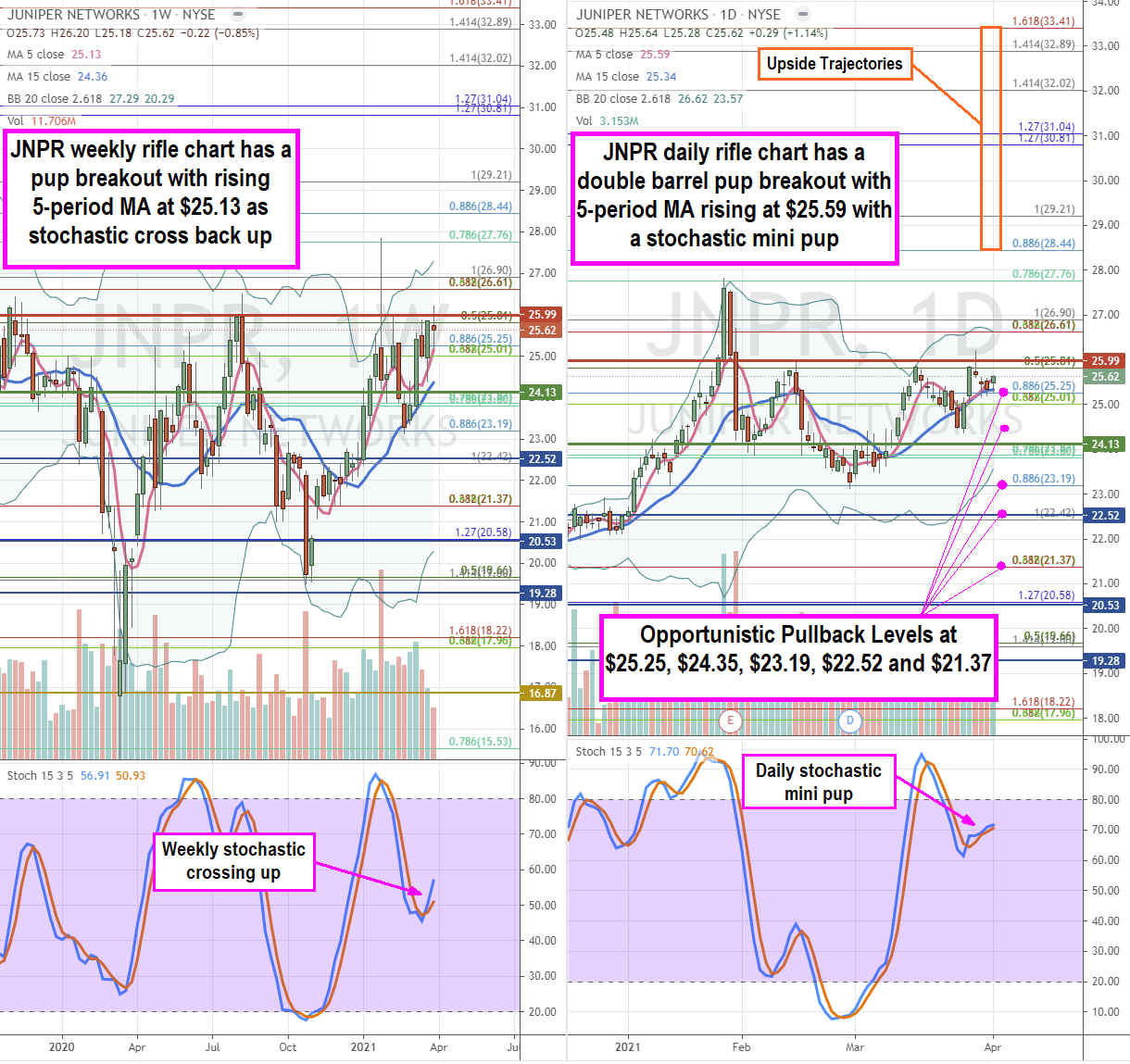
Using the rifle charts on the weekly and daily time frames provides a precision view of the landscape for JNPR stock. The weekly rifle chart has a pup breakout with a rising 5-period moving average (MA) support at $25.13 and upper Bollinger Bands (BBs) near the $27.76 Fibonacci (fib) level. The weekly stochastic crossed back up to fuel the breakout higher. The daily rifle chart formed a market structure low (MSL) trigger above $24.13 and a market structure high (MSH) sell trigger below $29.99. The daily rifle chart has a double barrel pup breakout with a rising 5-period MA at $25.59 powered by a stochastic mini pup targeting the upper BBs at the $26.61 fib. Prudent investors can monitor opportunistic pullback levels at the $25.25 fib, $24.35 fib, $23.19 fib, $22.52 fib, and the $21.37 fib. Keep an eye on peer CSCO as they tend to move together as networkers. Upside trajectories range from the $28.44 fib up to the $33.41 fib level.

https://www.entrepreneur.com/article/368842


The Moderna Pullback is Worth a Shot

April 7, 2021 5 min read

This story originally appeared on MarketBeat

A little over two years ago Moderna (NASDAQ:MRNA) was a relative unknown in the world of investing. The Massachusetts-based biotech company was making its public market debut hoping investors would take to its novel approach to drug and vaccine development. My how times have changed.

Moderna is now a household name among investors and non-investors after beating out dozens of companies vying to create a COVID-19 vaccine. Its stock price climbed to nearly $190 in February 2021 on expectations of a major windfall. It has since pulled back more than 30% presenting an intriguing entry point for a company with growth potential that goes well beyond the coronavirus.

What are Moderna’s COVID-19 Prospects?

Along with Johnson & Johnson and Pfizer-BioNTech, Moderna’s COVID-19 vaccine is one of three that have been approved in the U.S. and is being administered in other countries. It’s a remarkable accomplishment to be in the company of these pharmaceutical giants, and one that has certainly placed Moderna on the map.

With vaccine distribution well underway, the company’s upcoming financial results should be outstanding. Moderna has raked in more than $18 billion worth of purchase agreements for its vaccine and is bracing for the likelihood that many more are on the way.

This week drug manufacturer Catalent announced that it is expanding its production of Moderna’s COVID-19 shot. The agreement will almost double the output of the vaccine at Catalent’s Indiana plant effective this month to approximately 400 vials per minute. At this pace, an additional 80 million vials will be filled annually.

But Moderna isn’t stopping there. Recognizing the shortfalls of its two-dose COVID-19 regimen, it is also developing a one-shot vaccine that can be stored in a regular refrigerator. Positive results from that ongoing study could help the stock make another run at the $200 level.

So too could Moderna’s progress with yet another COVID-19 vaccine. This next-generation COVID-19 vaccine is intended to address the potential for more variants of the coronavirus. With global variants of the disease threatening to setback the economic recovery, there is a clear need for more powerful coronavirus vaccines—and Moderna is once again a step ahead of the competition.

What Other Growth Opportunities Does Moderna Have?

Moderna may forever be linked to COVID-19, but eventually, the pandemic will fade into the history books. The company will return to focusing on developing other therapeutics and vaccines based on its messenger RNA (mRNA) technology.

A mRNA vaccine is a new way to protect people from infectious diseases that it doesn’t introduce a weakened germ in the body. Instead, they train cells to make a protein that triggers an immune response. The approach has all sorts of potential for vaccinating against infectious diseases, heart disease, immune disorders, and even certain cancers.

Moderna’s development pipeline includes several promising early and mid-stage candidates. More than half of its 24 mRNA candidates are in clinical studies. Earlier this year it launched three new vaccine programs designed to target the seasonal flu, HIV, and Nipah virus. It also announced a partnership with Vertex Pharmaceuticals to develop a novel cystic fibrosis treatment.

The most exciting program underway at Moderna may be its collaboration with Merck. This involves its personalized cancer vaccine candidate that targets a patient’s specific tumor in conjunction with Keytruda. Late last year it released positive phase 1 data from a trial involving patients with head and neck squamous cell carcinoma (HNSCC).

 Is it a Good Time to Buy Moderna Stock?

Now back down to around $130 per share, Moderna’s risk-reward profile is more palatable. On the risk side of the equation, there is of course ongoing headline risk around the company’s current COVID-19 vaccine. Although things seem to be going smoothly, negative news about side-effects or production setbacks could put downward pressure on the stock. And as with any biotech company, there is the omnipresent chance that clinical development setbacks spark a selloff.

The reward part is rather straightforward. Moderna has supply agreements in place all over the world that represent hundreds of millions of its COVID-19 vaccine doses. What’s less certain is whether it will be successful in developing a one-shot vaccine. Given the high efficacy rate of its current vaccine and the money being poured into the one-dose development it’s hard to envision this not becoming a success.

As the dark horse in the COVID-19 vaccine race, the market should know better than to discount Moderna’s potential for commercializing more coronavirus solutions as the pandemic continues to take twists and turns. Looking further down the road, having greater financial resources and institutional backing should increase its chances for success in other disease and cancer areas.

Sell-side firms have a mixed view on Moderna which makes sense given the uncertain nature of its business. But while ratings on the stock are all over the place, analyst price targets are decidedly skewed to the positive. Of those firms venturing to make a price prediction, all but three have targets above the current share price. The other eleven firms (including one that has a sell rating) have targets ranging from $140 to $208 with several north of $200.

So, despite its success, Moderna still carries plenty of risk for investors. But given its potential to produce additional COVID-19 vaccines and progress its non-COVID pipeline, at this level, the stock is well worth a shot.

https://www.entrepreneur.com/article/368836