Humanity is the reimagined 3D Lemmings we didn’t know we needed

Humans walking on a 3-D cliff toward an exit point
Enlarge / You are a glowing dog. The humans lack all purpose. You must direct them to their final ascension. That’s the game.

Is it a bad time or the perfect time to release a game about humans mindlessly marching toward their doom unless an ethereal Shiba Inu guides them toward the light?

Humanity, a new puzzle-and-somewhat-platformer game from the publisher of Tetris Effect, was shown off in a trailer at Sony’s State of Play event last night, and in many ways, it stole the show from more traditional big-name titles. It was originally announced in 2019 but is looking much more defined, surreal, and beautiful ahead of its May 2023 launch. You can play a demo on PS4, PS5, PSVR, PSVR 2, and PC from now until 3 am on March 6. I highly recommend that you do.

[embedded content]
The release trailer for Humanity.

The premise will be familiar to fans of the Amiga classic Lemmings, but the execution is markedly different. You are a glowing dog. Faceless, polygonal humans—said to be “without soul, without intellect, without a will of their own”—are shambling out of an entry point in a blocky 3D landscape. You hear a voice telling you to guide them toward the light. You do this by putting various instructions onto cubic tiles, forcing the humans to turn, jump, float, and otherwise avoid their death by falling, trampling, or other means. Some amount must reach a tile that lifts them into a glowing sky, but not all of them.

Unlike its spiritual forebear, Humanity is far less punishing, and it has a whole other dimension to work with. In the demo levels, the humans are infinite, so once you figure out a path and a few of them ascend, you can either move on or try again. You are seemingly not punished for how many people die while you figure things out, which is nice, if a bit unsettling. You can improve your ratings by having your humans reach “Goldies,” marching Oscar statues that you must keep alive until the ascent.

Also unlike Lemmings, you are an entity moving about the play field, not simply a cursor. While you work out your higher-level go-here-then-there strategy, you must implement it by running or jumping to the spots where you’ll put your directives. Sometimes there are obstacles you can only surpass once your humans step on a button that unlocks them, so you must then rush to where they’ll next be, lest you lose a Goldie. You’ll also occasionally possess the spirit of one of your humans to move around since you don’t have all their long-jumping or climbing powers.

It’s important to point out how wonderful this all looks and sounds. Like Tetris Effect, the visual complications of the humans moving and flying about the level, with all their different-colored clothing, builds and builds to a kind of psychedelic crescendo. On an RTX 3070, with the graphics turned all the way up, the demo typically ran between 70 and 90 frames per second, though the fans noticeably spun up. However, this seems like a title where higher-res, ray-traced graphics aren’t necessary to enjoy the game. We’re eager to try it out with the PSVR2.

The soundtrack evokes Tetris Effect‘s ethereal but soothing tones. I can’t say for certain if it’s similarly generative or whether it ramps up with the action, but it felt wonderfully matched to the colorful, contemplative gameplay.

The demo’s levels ramp up rather quickly, though this may not reflect the final game. In level one, you are getting the humans to turn a few directions on a flat field. By the fifth level, your humans are jumping, long-jumping, floating to extend their long jumps, dispersing through liquid cubes, and often doubling back on themselves. The trailer indicates much more complexity to come, including light-stick combat, but I have faith in the experience being manageable for most.

https://arstechnica.com/?p=1919808



Rovio says paid Angry Birds had “negative impact” on free-to-play versions

Angry bird is angry.
Enlarge / Angry bird is angry.

Back in the days before practically every mobile game was a free-to-play, ad- and microtransaction-laden sinkhole, Rovio found years of viral success selling paid downloads of Angry Birds to tens of millions of smartphone users. Today, though, the company is delisting the last “pay upfront” version of the game from mobile app stores because of what it says is a “negative impact” on the more lucrative free-to-play titles in the franchise.

Years after its 2009 launch, the original Angry Birds was first pulled from mobile app stores in 2019, a move Rovio later blamed on “outdated game engines and design.” The remastered “Rovio Classics” version of the original game launched last year, asking 99 cents for over 390 ad-free levels, complete with updated graphics and a new, future-proofed engine “built from the ground up in Unity.”

In a tweeted statement earlier this week, though, Rovio announced that it is delisting Rovio Classics: Angry Birds from the Google Play Store and renaming the game Red’s First Flight on the iOS App Store (presumably to make it less findable in an “Angry Birds” search). That’s because of the game’s “impact on our wider games portfolio,” Rovio said, including “live” titles such as Angry Birds 2, Angry Birds Friends, and Angry Birds Journey.

All of those other Angry Birds games are free-to-play titles in which players can earn extra lives or helpful items by purchasing in-game currency or watching short video ads. Those changes were roundly criticized when they were introduced into the Angry Birds universe, but that didn’t stop the free-to-play games from becoming highly lucrative for Rovio.

Pure economics

In a statement on the game’s Discord server (as captured by Video Games Chronicle), Angry Birds Community Manager Shawn Buckelew reiterated that sales of the 99-cent “classic” version of Angry Birds were “negatively impacting our other games, which is what we as a company have to focus on. If those other games do not improve and grow, then the outlook of the entire company changes. It’s harder to create new games or work on new projects. I’m sure that’s not something you would want.”

That’s a striking admission considering that Rovio Classics: Angry Birds is currently the No. 2 best-selling paid download among all games on the iOS App Store, well over a decade after its initial release (and nearly a year after its rerelease). But that chart-topping position translates to just $30,000 in estimated monthly revenue, according to Sensor Tower estimates.

The free-to-play Angry Birds 2, meanwhile, attracted 900,000 new free-to-play downloads last month and raked in over $9 million in revenue, according to those same Sensor Tower estimates. But that strong revenue number is only enough to make Angry Birds 2 the 74th highest-grossing iOS game on the current iOS charts.

The difference shows how few mobile users are willing to pay upfront for their games these days and highlights the vast gulf in potential revenues between top-performing free-to-play and pay-to-own mobile titles.

If you don’t want your Angry Birds experience marred by ads or pushy microtransaction offers, there’s still hope. Apple Arcade subscribers can download Angry Birds Reloaded, which adds some new features over the original as well as Mac and Apple TV compatibility. Try doing that on Xbox Game Pass, we dare ya. https://arstechnica.com/?p=1919848


Valve used secret memory access “honeypot” to detect 40K Dota 2 cheaters

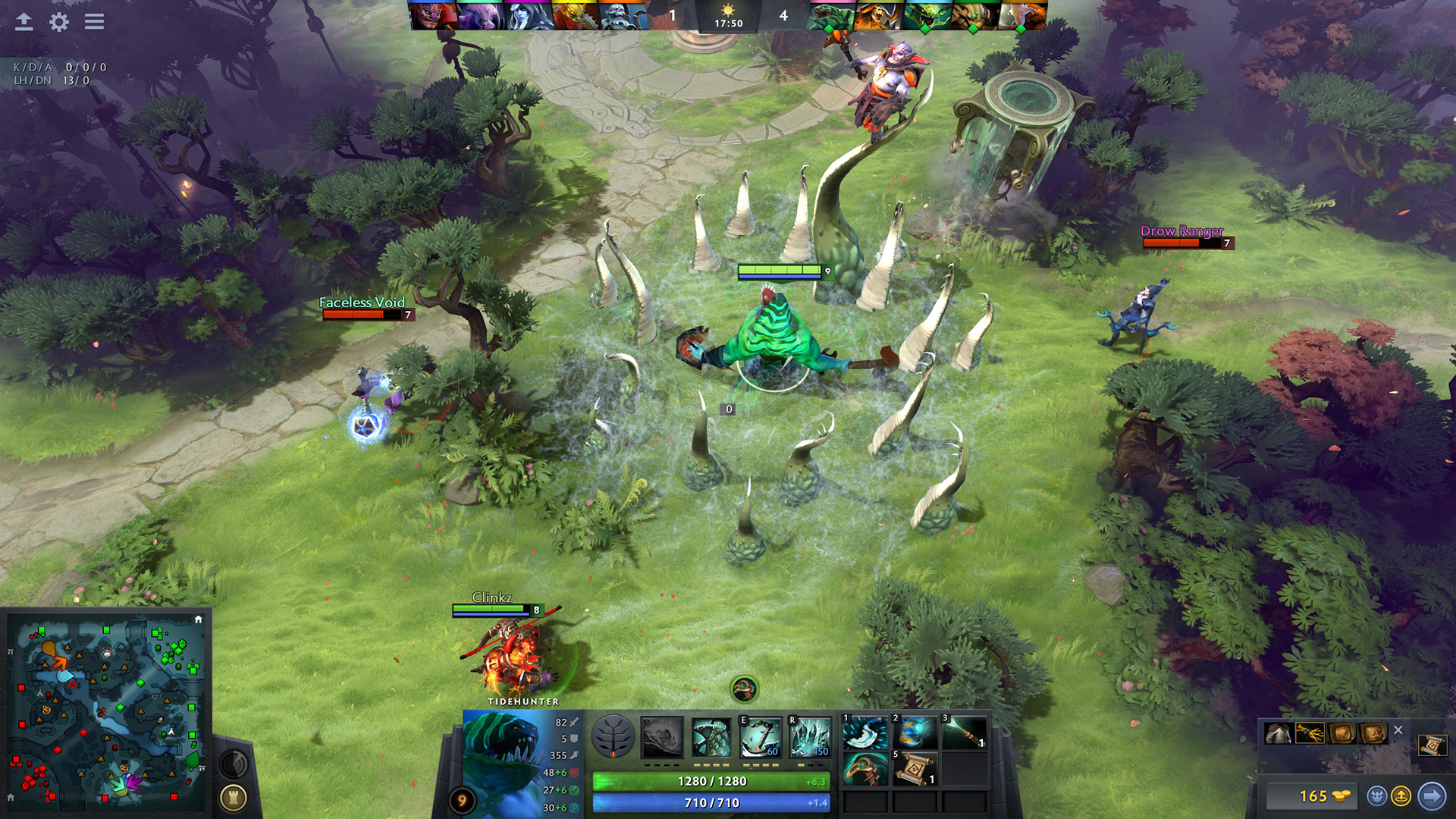
Artist's conception of Valve's anti-cheat tentacles rising up to catch those caught by its memory honeypot.
Enlarge / Artist’s conception of Valve’s anti-cheat tentacles rising up to catch those caught by its memory honeypot.


The cat-and-mouse battle between game makers and cheat makers has seen plenty of inventive twists and turns over the years. Even amid that backdrop, though, Dota 2 stands out for a recently revealed “honeypot” trap hidden inside the game’s memory buffer.

In a blog post this week, Valve revealed the existence of this trap, which was released as part of an earlier update to the game. Valve says that update included “a section of data inside the game client that would never be read during normal gameplay.” But that memory could be read by third-party cheat tools that used exploits to sniff out (and share) internal data normally invisible to players.

To activate its honeypot trap, all Valve had to do was watch for any accounts that tried to read from that “secret” memory area, an event that would lead to “extremely high confidence that every ban was well-deserved,” according to Valve.

While Valve says it has now closed the exploit that made this illicit data access possible in the first place, rolling out the honeypot first means it was able to also unleash a “particularly large” ban wave on over 40,000 accounts. The company is revealing its shadowy methods now, it says, “to make our position clear: If you are running any application that reads data from the Dota client as you’re playing games, your account can be permanently banned from playing Dota.” In doing so, Valve likely roped in a lot of players who cheat for status and in-game content, while also helping to stymie those who cheat to earn money or exert power over the game makers.

Now that Valve’s honeypot has been revealed publicly, though, similar systems seem a lot less likely to be effective at catching cheaters in the future. A careful cheat maker could likely analyze a game’s memory structure to carefully pinpoint only valid and useful memory addresses, then design their cheat tools to only access that “safe” data in a harder-to-detect manner.

Still, as a pure message-sending power play, it’s hard to beat a big reveal showing how, exactly, you caught tens of thousands of cheaters who probably thought they were untouchable. And as the cat-and-mouse battle continues, Valve promises it will “continue to detect and remove these exploits as they come, and continue to ban users who cheat.”

https://arstechnica.com/?p=1919706


Black Mesa gets shiny: Free Half-Life ray-trace mod adds subtle splendor

Ray-traced laser cutting through a Half-Life hallway (crowbar up)
Enlarge / The familiar hallways of Black Mesa can be made new with some generative lighting.

Half-Life is a legendary game, a title that was ahead of its time in its storytelling, mechanics, and technology. Graphically, though, it can’t help but look extremely 1998. A new, free ray-tracing mod makes the PC original a lot more compelling to revisit.

Sultim Tsyrendashiev, working on GitHub as sultim-t, has worked on graphics upgrades and ports of many games and tools, including the Serious Engine and Quake. The Xash3D: Ray Traced project, now ready for public use with Half-Life 1, tweaks an alternative version of Half-Life‘s Source engine to add a custom path-traced renderer. The tech that moves applications from fixed to real-time path tracing is interesting and promises even more ray-traced nostalgia kicks to come.

[embedded content]
Release trailer for sultim_t’s “Half-Life: Ray Traced” mod.

But what most of us are interested in is how it works in Half-Life. It’s very pretty, and while the effect is mostly subtle, it can steal the show in big moments (sorry, tentacle giant that needs to go). I played through the first level and a bit into the second one with the mod installed, and I visited a few other levels with map warp cheats (though I quickly died in most since I couldn’t get weapon cheats to work). The textures aren’t upgraded (unless you do so yourself with other mods), but modern-day lighting can make a big difference in how some of the game’s areas look.

My favorite part of this mod is that you can flip back and forth between the classic graphics and the new ray-traced hotness with Alt+X. It’s quite helpful if you’re wondering why so many games and graphics card makers are excited about the potential of RTX on both new games and remasters.

You’ll need a copy of Half-Life installed from Steam to use this mod. Installation consists of unzipping a few folders and transferring their content to the game’s local files. If you have an Nvidia card that can support it, an optional DLSS setting can help boost your frame rate while playing with RTX on. The game ran smoothly on an RTX 3070 at 4K, but I didn’t play many busy areas. Lowering the resolution certainly isn’t a bad idea, given that you’re not exactly working with high-res materials in the game.

If this mod makes you a ray-tracing convert or piques your interest in how other classic games might look with a path-traced spit-shine, consider checking out the original Doom, Minecraft RTX, or, back in the Valve-iverse, the free update to Portal. For a more fully upgraded Half-Life (which would be great to combine with this kind of ray tracing), the Black Mesa remake/remaster has you covered.

Listing image by Valve

https://arstechnica.com/?p=1919563


Did the UK government just accidentally leak Nintendo’s Switch successor?

The big old question mark just got a lot bigger...
Enlarge / The big old question mark just got a lot bigger…

As the Nintendo Switch approaches the sixth anniversary of its launch, Nintendo has been extremely coy about the prospects for a true successor to the console (no, the Switch OLED doesn’t count). This week, though, a stray redaction in a government document regarding the proposed Microsoft/Activision merger has some industry watchers speculating that the announcement of a Switch successor could be coming in the near future.

All that speculation focuses on a single line buried in 43 sprawling pages of appendices in a report from the UK’s Competition and Markets Authority, which recently came down against Microsoft’s planned acquisition of Activision. In discussing services that could plausibly compete with the cloud-gaming features of Microsoft’s Xbox Game Pass, the appendix notes that Nintendo Switch Online “is only available on the Nintendo Switch device and [redacted].”

That telltale “and” is interesting, of course, because Nintendo Switch Online is currently only available on the Nintendo Switch (as the name implies). The CMA redaction following that “and” could easily describe a forthcoming console that Nintendo doesn’t want formally announced via a regulatory filing (e.g., “…available on the Nintendo Switch device and [another console Nintendo is currently developing]”).

Nintendo has hinted at this kind of forward-looking online account continuity in the past, too. In a late 2020 investor presentation, Nintendo shared a slide explicitly stating that the current Nintendo Account and its “Value-added services” (e.g., Nintendo Switch Online) would continue to be available and expand through the company’s “Integrated Hardware-Software Next gaming system,” to be released in the amorphous “20XX.”

We’re waiting…

While some take this as solid confirmation of a “Nintendo Switch Pro” in the works, that’s not the only possible explanation. The redaction could be completely unrelated to Nintendo’s plans and simply be an overzealous protection of an unrelated clause (e.g., “…available on the Nintendo Switch device and [not directly competitive with Microsoft’s Game Pass]”).

Or maybe the redaction hides plans for Nintendo to extend Nintendo Switch Online’s library of classic games onto mobile phones and/or PCs (e.g., “…available on the Nintendo Switch device and [mobile/PC platforms in the near future]”).

Could a mobile or PC expansion be in the service's future?
Enlarge / Could a mobile or PC expansion be in the service’s future?

Offering “official” emulators on mobile and PC platforms would be a first for Nintendo and could provide a limited, legitimate alternative to Nintendo’s scorched earth policy on ROM download sites. It would also fit somewhat with Nintendo’s console competition—Microsoft’s Xbox Game Pass for PC has expanded the company’s Windows gaming efforts, while Sony has been porting many of its PlayStation console exclusives to the PC as well.

Regardless, the continued speculation points to how antsy many are getting for a new, more powerful console from Nintendo. And such a successor seems like it might be due: Nintendo only waited six years between the launch of the Wii and the Wii U, and less than five years between the ill-fated Wii U and the Switch itself.

The original Switch was relatively underpowered even in 2017, and years-old AAA games are often forced into a significant graphical downgrade or awkward streaming solutions to run on the console. And while the Switch hardware has set sales records for Nintendo, those sales are starting to slow slightly as the market for the system gets more and more saturated.

Until we get official word that a new Nintendo console is coming, though, hopeful gamers will continue to read the tea leaves for anything that might even hint at the company’s plans.

https://arstechnica.com/?p=1918899


Almost-unbeatable AI comes to Gran Turismo 7

A Gran Turismo 7 screenshot at Tsukuba circuit
Enlarge / A human player races against several instances of GT Sophy, a highly capable racing AI developed by Sony.

Last year, Sony AI and Polyphony Digital, the developers of Gran Turismo, developed a new AI agent that is able to race at a world-class level. At the time, the experiment was described in a paper in Nature, where the researchers showed that this AI was not only capable of driving very fast—something other AI have done in the past—but also learned tactics, strategy, and even racing etiquette.

At the time, GT Sophy—the name of the AI—wasn’t quite ready for prime time. For example, it often passed opponents at the earliest opportunity on a straight, allowing itself to be overtaken in the next braking zone. And unlike human players, GT Sophy would try to overtake players with impending time penalties—humans would just wait for that penalized car to slow to gain the place.

But in the intervening year, Sony AI and Polyphony Digital have been working on GT Sophy, and tomorrow (February 21), GT Sophy rolls out to Gran Turismo 7 as part of update 1.29, at least for a limited time. Until the end of March, players can try their skills against Sophy in the GT Sophy Race Together mode in a series of races with increasing difficulty levels. There’s also a one-versus-one match where you race Sophy in identical cars, so you can see how much slower you are than the AI.

There are four different GT Sophy challenges available to players.
Enlarge / There are four different GT Sophy challenges available to players.

“This evolution of AI is a symbolic moment across the 25-year history of Gran Turismo, and it’s as important as the evolution of the automotive physics simulation, which is at the heart and core of a racing game,” said Kazunori Yamauchi, president of Polyphony Digital.

“Unlike the conventional built-in AI, GT Sophy drives with continuity in a large variety of situations, which allows users to enjoy the excitement of a close battle as if they are playing against a professional racing driver. This is an important evolution even from the standpoint of racing game history. We will continue to evolve GT Sophy to realize our concept of “Race Together,” where we envision providing a fun opponent for players to race against and learn from,” Yamauchi said.

Although this version of Sophy will be time-limited in the game, it won’t be the last we see of the AI. Sony says it will collect feedback on this initial feature and use that to improve the AI for future updates.

I don’t know about you, but I’m looking forward to seeing how badly I get schooled. I don’t think it’s going to be pretty…

https://arstechnica.com/?p=1918444


Atomic Heart impressions: Shock-ingly good shooting

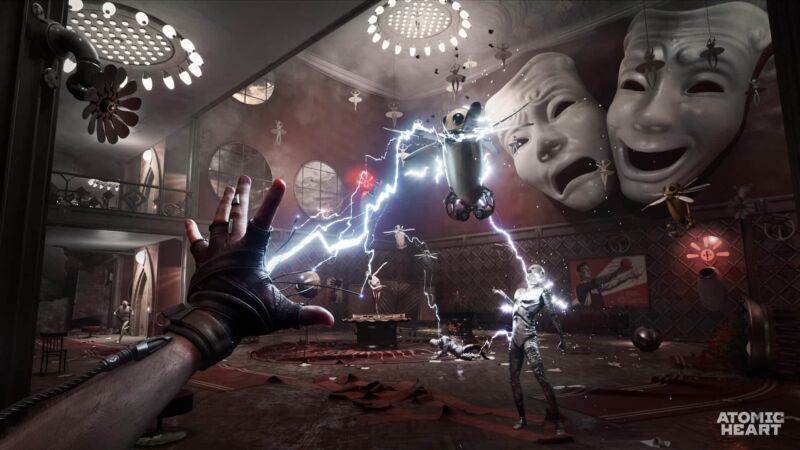
Protagonist zapping robots with his left gloved hand
Enlarge / The glorious future that awaits you in Atomic Heart involves dismantling a lot of the glorious future constructed by an alternate-history Soviet Russia.
Mundfish / Focus Entertainment

Note: Atomic Heart arrived to us in the middle of last week, with its embargo falling on a holiday Monday. What follows is not a full review but impressions of the first few hours. There are very light spoilers for the first 6-7 hours of gameplay.

One of the best things a first-person action game can have is a great kick. As a backup when ammo is scarce, or a crowd control tactic, a solid boot adds gravity to combat that can otherwise become detached crosshair clicking.

In Atomic Heart, you don’t have a kick, but the humanoid robots sure do. Give them a chance, and they’ll fling themselves into a two-footed jump-kick that hits like a fishtailing Chevy. If you don’t dash out of the way, you spin and hit the ground with a thud, slowly getting up from your hands while vulnerable to more damage. It’s some of the most visceral melee fighting I’ve seen in a first-person shooter. And the gunplay has a similar oomph.

Atomic Heart‘s kinetic combat helps distinguish it from some inevitable BioShock comparisons. Yes, you’re a skilled mercenary with a hazy past and a deep secret. Sure, you inhabit an alternate-history world where a Great Man has discovered a powerful but problematic technology that could change humankind. And, certainly, you have both mod-friendly shooter weapons and secondary powers you develop from upgrade materials.

For some people, an estimated 20 more hours of that Bioshock style, with newer graphics and competent storytelling, might be recommendation enough. But Atomic Heart is different in a few ways, some of them quite refreshing. The gunplay and melee combat are more impactful, and the encounters are set up with a bit more freedom for strategy. The retro-futurist-Communist-Russian environments and sci-fi setups are wonderfully realized, with a wealth of lived-in detail you can absorb while exploring, gathering, and zapping.

There’s a bit too much telling instead of showing and an outsize amount of cursing and crude sexual innuendo, and—seemingly inevitable for the genre—backtracking and this-machine-needs-a-part quests that drag out the game clock. Yet Atomic Heart doesn’t feel stretched thin, at least so far. There’s a lot going on here, and when the story and button-mashing are balanced, it feels fluid and fun.

Dobriy den, comrade

It’s the mid-1950s, and Soviet Russia is not just ascendant, it is literally floating. Helpful robots do most of the work, cities float, and soon every USSR citizen will be linked up to “Kollectiv 2.0” and “polymerized,” able to learn entire fields of knowledge in seconds. You are the highly trained, perpetually agitated, endlessly sarcastic Major P-3, and you’re joined by the AI that lives in your left glove, CHAR-les. You’re on a special assignment to assist the genius who made all this possible, visiting a city floating above the underground birthplace of polymers, Facility 3826. You will lightly interact with this world for at least 50 minutes before you get your first weapon, so it’s a good thing it’s spectacular looking.

Atomic Heart was five years in the making; luckily, there is a lot to show for all that time. Mundfish put in the hard work of making the humans more human and the robots off-puttingly not quite human. It almost hurts to think of the amount of work that went into designing the onion-domed corkscrew turbines on the little boat that carries you into town, the one you’re likely eager to jump off and leave behind forever. The visuals of this fantasy world are an eye-catching mix of mid-century Soviet iron and Jetsons-esque gleam. You’ll get back to some of this later, but first, you’re due for 4-5 hours of underground tunnel running.

You fool! Did you think that merely powering up the switch would do it? You need to gather the special polymers to support the Birchtree system!
Enlarge / You fool! Did you think that merely powering up the switch would do it? You need to gather the special polymers to support the Birchtree system!
Mundfish / Focus Entertainment

https://arstechnica.com/?p=1918518


Hope and doubt collide in an eventful episode 6 of The Last of Us

Will someone please get this girl an electric heater?
Enlarge / Will someone please get this girl an electric heater?

New episodes of The Last of Us are premiering on HBO every Sunday night, and Ars’ Kyle Orland (who has played the games) and Andrew Cunningham (who hasn’t) will be talking about them here right after the episodes air. While these recaps don’t delve into every single plot point of the episodes, there are obviously heavy spoilers contained within, so go watch the episode first if you want to go in fresh.

Kyle: Besides the obvious “move the plot forward” bits of the reuniting of Joel and his brother Tommy, I was surprised at how deep this episode went into the mental and physical anguish of an aging, obviously traumatized Joel. This kind of thing is hinted at in the games, especially the sequel, but it’s more of a vague undercurrent beneath Joel’s general image as “Unflappable Survivor Badass.”
Andrew: The three-month time jump following last week’s emotional wringer is enough time for Joel and Ellie to have made it from Missouri to southern Wyoming. Their dynamic doesn’t seem to have changed much, but we do see Joel struggling with something that looks an awful lot like panic attacks. And then Joel finds his brother, who it turns out doesn’t need so much saving after all.

The Jackson commune where they end up might be the only place outside of flashbacks that we’ve seen that feels genuinely safe, maybe even genuinely comfortable. There’s no FEDRA, no vigilantes waving don’t-tread-on-me flags, no sign of infected. They aren’t doomsday preppers trying to go it alone. They have Christmas lights! They have movie nights.

Something about that setting plus seeing his brother again—it’s easy to revert to a previous version of yourself when you see a close friend or family member you haven’t seen in a while—totally shatters Joel’s defenses, and all the emotional subtext of his relationship with Ellie just comes tumbling out.

She's obviously very worried about COVID.
Enlarge / She’s obviously very worried about COVID.
Kyle: Kind of a tangent, but this episode, and episode 3 before it, really hammer home how crucial consistent electricity is to a modern, peaceful society. Just having the ability to give the people some running water, heat, and movies to keep the kids busy seems to be the main difference between fascist dystopia and Jackson’s idealized commune.
Andrew: There’s some real truth to that. I was living in New Jersey (and my now-wife was out of town) when Hurricane Sandy hit, and our apartment complex took the better part of a week to get power restored. I was living a nomadic existence for a few days, bouncing between places with electricity while I waited for ours to come back. New Jersey still has these gigantic malls that are dying out most other places in the country, and you could go to one and see people gathered around those outlets they embed in the floors, all waiting for their phones to charge.

Having electricity and alcohol really seems to have taken the edge off for the people in this episode; if it weren’t for the barricades (and the handwritten labels on all the whiskey bottles at the bar, a nice touch), Jackson could almost be a normal town.

How about this for a slogan: Jackson, city of brotherly love. Is that taken?
Enlarge / How about this for a slogan: Jackson, city of brotherly love. Is that taken?
Kyle: I found myself wondering if Jackson’s example could be replicated in other far-flung communities in this world. Being in the middle of nowhere and unknown to short-wave radios seems pretty key to keeping them safe from Infected and raiders. Being a relatively small community also probably helps—harder to get up to no good if the entire town knows you by sight.

All that said, feels like a couple dozen guys from Kansas City with heavy artillery could overtake this idyllic hamlet and ruin it incredibly quickly.

Andrew: We’re just going to quietly hope that no one does that!

It also doesn’t hurt that Jackson has a consistent source of hydroelectric power, something that just won’t be possible in a lot of other places.

Kyle: Yeah, if this outbreak had just happened 20 years later there would be tons of solar panels around to repurpose!
Andrew: Giant wind farms to tap into! Not to get political, but I think renewable energy might be good?
Kyle: We need the Green New Deal to protect us from the zombie apocalypse!
Andrew: “I can’t believe these commies want to take away our right to get infected by the deadly mushroom virus” says Tucker Carlson.

https://arstechnica.com/?p=1918786


Let’s-a go to Super Nintendo World, Hollywood’s new interactive theme park

<img src="https://rassegna.lbit-solution.it/wp-content/uploads/2023/02/lets-a-go-to-super-nintendo-world-hollywoods-new-interactive-theme-park.jpg" alt="Watch out, if SMB3 is any guide, he breathes lasers…”>
Enlarge / Watch out, if SMB3 is any guide, he breathes lasers…

Nintendo is often referred to as “the Disney of video games.” But while Nintendo has long matched Disney’s reputation for family-friendly home entertainment, it had nothing that could compare to Disney’s domination in the physical world of theme parks.

That started to change in 2021, when Super Nintendo World finally opened in Osaka’s Universal Studios Japan. Now, a very similar experience is coming to America with the opening of the Super Nintendo World section of Universal Studios Hollywood.

Ars got a sneak peek at the new section of the park just ahead of its Friday opening and came away utterly enchanted by the charming interactivity and Disney-esque attention to detail apparent throughout the park’s newest themed area.

Mario Kart: The Ride

The centerpiece of Super Nintendo World is “Mario Kart: Bowser’s Challenge,” the section’s only full-fledged “motion attraction.” I was skeptical that the combination ride and augmented-reality game would come together in a satisfying way, but I came away from each of my three rides eager to go again.

The “Bowser’s Challenge” AR headset comes in two parts. First, you are handed a visor that resembles a red Mario hat; it fits around your forehead and is tightened with a rear crank (which will be familiar to anyone who has used a PSVR headset). The second part, which includes the actual AR display, stays tethered to the kart itself and attaches to the visor with a simple magnetic click. The lightweight, transparent display hovers comfortably in front of your eyes.

You view the bulk of the ride’s highly scripted interactive Mario Kart race through the ghostly images on this AR display. Everything from opposing karts to item boxes to flying enemies only exist in this view and don’t come through well in photos or ride-through videos.

The AR images—which only show up in a relatively wide strip of your vision—are decidedly low resolution, especially for objects viewed at a distance. That general fuzziness is all the more noticeable because you can compare them side-by-side with some impressive practical effects and high-resolution screens throughout the ride.

That said, the apparent position of the AR items stays remarkably stable as your viewpoint changes throughout the ride, making it easier to fool your brain into thinking these items are actually “real.”

https://arstechnica.com/?p=1918370


Geekbench’s creator on version 6 and why benchmarks matter in the real world

Geekbench’s creator on version 6 and why benchmarks matter in the real world
Primate Labs

We review a lot of hardware at Ars, and part of that review process involves running benchmark apps. The exact apps we use may change over time and based on what we’re trying to measure, but the purpose is the same: to compare the relative performance of two or more things and to make sure that products perform as well in real life as they do on paper.

One app that has been a consistent part of our test suite for over a decade is Geekbench, a CPU and GPU compute benchmark that is releasing its sixth major version today. Partly because it’s small, free, and easy to run; partly because developer Primate Labs maintains a gigantic searchable database spanning millions of test runs across millions of devices; and partly because it will run on just about anything under the sun, Geekbench has become one of the Internet’s most-used (and most-argued-about) benchmarking tools.

“I’m really glad that people seem to have latched onto it,” Primate Labs founder and Geekbench creator John Poole told Ars of Geekbench’s popularity. “I know Gordon Ung at PCWorld basically calls Geekbench the official benchmark of Twitter arguments, which is the fallout from that.”

Cross-platform right from the start

Geekbench’s cross-platform compatibility is part of its appeal, which has been baked into the benchmark since its earliest versions. It began at the height of the PowerPC Mac era when Apple’s hardware was exotic and niche and apps that ran on Mac OS X were relatively rare.

“I just switched over to the Mac back in about 2002,” Poole told Ars. “So I was getting used to that ecosystem. And then the [Power Mac] G5 came out and I thought, oh, this looks really cool. I went out, bought one of the new G5s, and it felt slower than my previous Mac. And I thought, well, this is really strange; what’s going on. … So, you know, I grabbed what [benchmarks] I could download and ran them and got really confused, because what the benchmarks were saying wasn’t jiving with my experience.

“So I actually went and I reverse-engineered one of the popular benchmarks and found that the tests were, for lack of a better word, terrible,” said Poole. “They weren’t really testing anything substantial, you know, doing really simple arithmetic operations on really small amounts of data, not really testing anything. And so I thought, how hard can it be to write a benchmark? Maybe I should write my own.”

The original Geekbench (called “Geekbench 2006” and apparently lost to time) supported Windows and macOS at launch. Geekbench 2, released in 2007, added Linux support. An official iPhone version followed in 2010, and an Android version came out in 2012. Since Geekbench 3 was released in mid-2013, a revamped version with new focus areas and reformulated tests has been released roughly once every three years or so.

And it’s not just mainstream, general-use hardware and software that can run Geekbench. Geekbench could run on the PlayStation 3’s Cell processor (“[not] all that impressive as a general-purpose CPU,” wrote Poole at the time). There was even, briefly, a version that ran natively on the short-lived BlackBerry 10. Here at Ars we’ve run it on everything from the oddball, all-open-source MNT Reform laptop, the first wave of Android Wear smartwatches, and hundreds of desktops, laptops, phones, and tablets besides.

https://arstechnica.com/?p=1916915