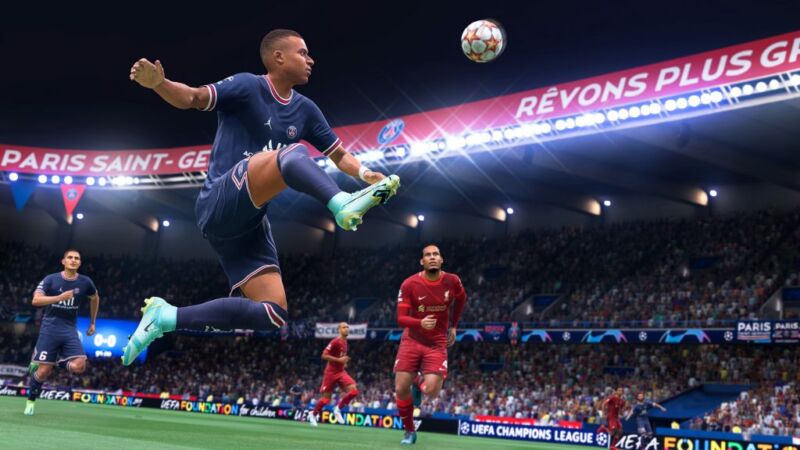
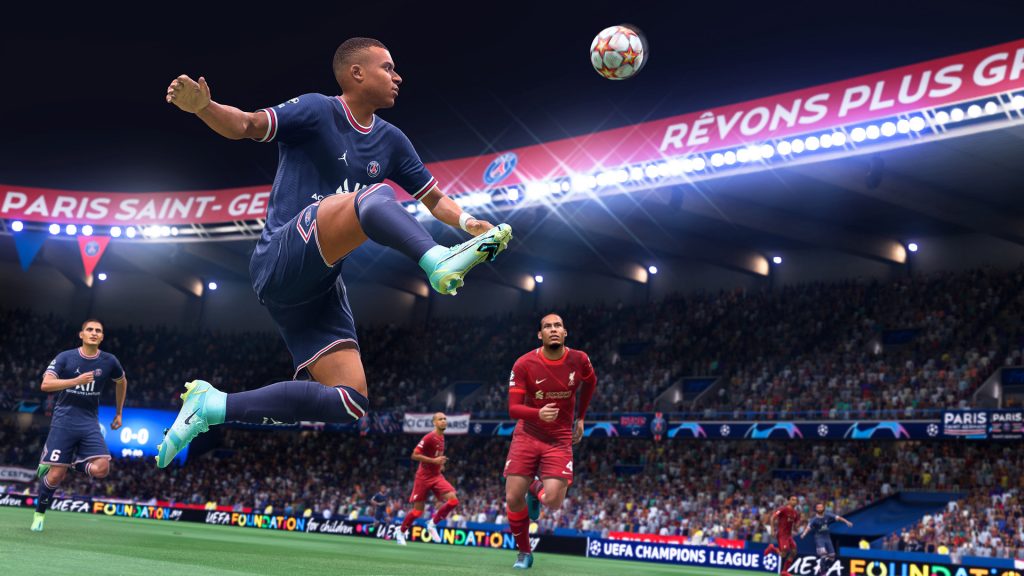
Enlarge/ The ball is the latest consoles. The player in blue is EA. The player in red is the PC.
The PC version of the upcoming FIFA 22 will be missing certain features available on the latest generation of consoles and Google’s Stadia streaming platform. The PC version will be comparable to the “last-generation” console versions on PS4/Xbox One.
Promotional materials for the newly announced game highlight “groundbreaking new HyperMotion gameplay technology,” which purportedly “combines Advanced 11v11 Match Capture and proprietary machine learning technology to deliver the most realistic, fluid, and responsive football experience… unlocking the raw emotion, passion, and physicality of the world’s game.” Unfortunately for PC players, though, that AI-powered animation is available “only on PlayStation 5, Xbox Series X|S, and Stadia,” publisher EA says.
The missing features for PC players are somewhat reminiscent of last year’s FIFA 21. For that release, console players got a free update on the PS5 and Xbox Series X/S that added advanced features like ball deformation and special camera angles. Those updates never came to the PC version of the game, though, a situation Executive Producer Aaron McHardy told Eurogamer was part of an effort to keep the PC minimum specs down “so that we can open the doors and be inclusive to everybody who wants to play FIFA.”
“When we looked at what generation to put the PC game on, we looked at our fans and what capabilities they had with the hardware they have,” McHardy told Eurogamer last year. “And we have that information to understand what the power of the PCs out there in the world are. And when we looked at that, in order to run the [PS5/Xbox Series] game, our min spec would have been at a spot that would have left a lot of people out in the cold, not being able to play the game.” The same situation likely applies to the PC version of FIFA 22.
[embedded content]
The “Hypermotion” features promoted in this new FIFA 22 trailer won’t be available on the PC version of the game.
But FIFA 21 was in a bit of an awkward position last year because it launched on PC and consoles just over one month before the PlayStation 5 and Xbox Series X/S were available. This year, all versions of the game will be launching simultaneously on October 1, but the PC version will lag well behind its current-generation console counterparts released the same day.
This lack of feature parity between PC and console FIFA players has happened in previous generations, too. Back in 2013, the PC versions of FIFA were missing many features found in the Ignite-engine-powered PS4/Xbox One games (2014’s FIFA 15 would fix this state of affairs). Before that, the PS3 and Xbox 360 versions were ahead of the PC until 2011’s FIFA 12.
EA says that FIFA 22 requires an Athlon X4 880K / Intel Core i3-6100 or better, Radeon HD 7850 / GeForce GTX 660 or better, and 8GB of RAM.
https://arstechnica.com/?p=1779590
Creepypasta and the search for the ghost in the machine
[embedded content]
Lavender Town is quite eerie, in fairness.
It was the music, they said, that drove the children to madness. The eerie, detuned soundtrack to Pokémon Red’s Lavender Town contained harmful sonic irregularities played at such high frequencies that only the youngest players could hear them. In extreme cases, these could alter brain chemistry and trigger psychosis—after playing the game, hundreds of Japanese children put down their Game Boys, climbed on to the roof, and jumped to their deaths.
None of this is true, of course. Lavender Town Syndrome is just a legend, a ghost story for the gaming generation. No cases of child suicide were ever conclusively linked to the game’s music—the closest case was a 1997 episode of the Pokémon TV show featuring strobing lights that triggered epileptic seizures.
Stories of haunted video games have circulated for decades. They were more believable before the Internet, when you could still come across a game nobody else knew. Back then, game development was the domain of hobbyists and lone programmers who could create curious experiments and distribute them at computer fairs or yard sales. It wasn’t outlandish, either, to suspect games had secrets: even on a program as unassuming as Excel 95 a particular combination of commands opens the “Hall of Tortured Souls,” a lurid, game-like hellscape within the spreadsheet that displays the names and photos of the Microsoft developers.
[embedded content]
Those poor developer souls will never see Windows 11
Since the arrival of the Internet, myths have become easier to debunk. Oral ghost stories began to evolve into “creepypasta”—paranormal tales intended to frighten readers, written in first-person and embellished as they are shared across platforms. The name is a portmanteau of “creepy” and “copypasta,” itself slang for blocks of text that are copied and pasted wholesale between forums. Creepypastas are collaborative acts of storytelling that bubble up unbidden from the Internet’s darkest unconscious.
Much gaming creepypasta revolves around cutesy games for children such as Pokémon and Mario. There is the story of Herobrine, a misty-eyed character who stalks Minecraft, only glimpsed in the distance or through fog. Another concerns a mod for fantasy adventure Morrowind named “Jvk1166z.esp” which causes characters to stare blankly at the sky while a figure with long, spidery limbs haunts the edges of your screen. Neither myth has been substantiated.
Some popular legends concern haunted games that probably never existed. Polybius was supposedly a 1980s arcade game, created as part of a US government experiment, that induced psychoactive reactions in players. More recently, a YouTube video emerged called “Sad Satan” that showed a creepy corridor in a mysterious game apparently downloaded on the dark web. Online commenters eagerly jumped on these, untangling references to serial killers and psy-ops, but both are likely hoaxes dreamt up by horror fans.
The most sophisticated gaming creepypastas reach beyond fiction to become interactive transmedia narratives. The most famous is Ben Drowned, an elaborate story told across 10 years about an evil spirit trapped in a Zelda cartridge. More recently there was Petscop, a YouTube channel sharing videos of a disturbing (and fake) game that contains references to infanticide. Audiences found these compelling because they violated the central principle that allows us to enjoy horror stories: that the game is a safe place and its horrors cannot escape the boundaries of the screen. In these stories, just like the videotape in movie The Ring a generation before, a dominant media form is recast as an unsafe space whose malevolence can spill out, contaminate your hardware, and hurt you.
In order to go viral, such stories must contain a kernel of believability. Gaming creepypastas play with familiar tropes—the gamer driven to find every last secret, the graphical glitch that seems to mean something, the hidden room a developer conceals inside a game. The idea of haunted software is really only one step away from a plausible threat like data breach, identity theft, or a computer virus.
Creepypasta is popular because it reintroduces the thrill of the unknown into a Wikipedia-mediated world. Like all folklore, it creates meaning beyond mere entertainment—through these stories, a generation of gamers is telling us its fears and asking what the digital saturation of its childhood might mean for its adult mind. The gamers are expressing anxieties about technology that advances so quickly it could usher dark, unforeseeable consequences into our lives.
The medium may be new, but the practice is as old as time. Around the digital campfire, the YouTube generation tells ghost stories that swap faeries and banshees for cursed AI and haunted programs—and finds a dark pleasure in trying to pin down the ghost in the machine.
Cheat-maker brags of computer-vision auto-aim that works on “any game”
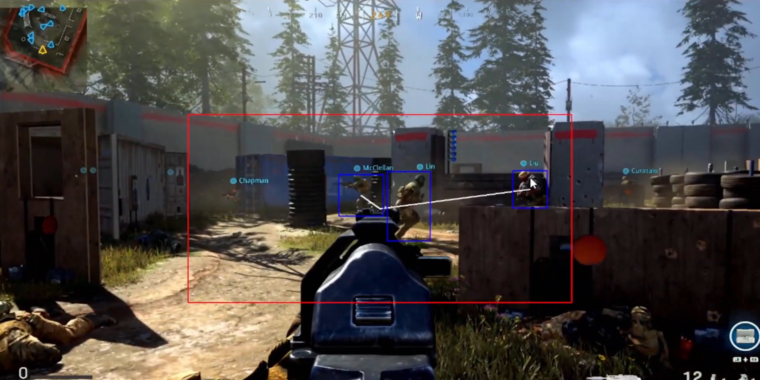
A sample video shows how computer vision (running on an external computer) detects the enemy and calculates how far the mouse needs to move to target that enemy.
Just a few frames later, thanks to inputs sent through external hardware, the cheat user automatically targets the enemy and fires.
Another demonstration of computer vision identifying multiple valid targets inside the central “kill zone”
The detection seems to work quickly in a variety of lighting and obscuring conditions.
Input devices like the Titan Two are key to making computer vision cheat tools like this work.
When it comes to the cat-and-mouse game of stopping cheaters in online games, anti-cheat efforts often rely in part on technology that ensures the wider system running the game itself isn’t compromised. On the PC, that can mean so-called “kernel-level drivers” which monitor system memory for modifications that could affect the game’s intended operation. On consoles, that can mean relying on system-level security that prevents unsigned code from being run at all (until and unless the system is effectively hacked, that is).
But there’s a growing category of cheating methods that can now effectively get around these forms of detection in many first-person shooters. By using external tools like capture cards and “emulated input” devices, along with machine learning-powered computer vision software running on a separate computer, these cheating engines totally circumvent the secure environments set up by PC and console game makers. This is forcing the developers behind these games to look to alternate methods to detect and stop these cheaters in their tracks.
How it works
The basic toolchain used for these external emulated-input cheating methods is relatively simple. The first step is using an external video capture card to record a game’s live output and instantly send it to a separate computer. Those display frames are then run through a computer vision-based object detection algorithm like You Only Look Once (YOLO) that has been trained to find human-shaped enemies in the image (or at least in a small central portion of the image near the targeting reticle).
Once the enemy is identified on the screen, these cheating engines can easily calculate precisely how far and in which direction the mouse needs to move to put that enemy (or even a specific body part, like the head) in the center of the crosshairs. That data is then sent to an input-passthrough device like the Titan Two or the Cronus Zen, which emulates the correct mouse input and fires a shot at superhuman speed.
On their own, all of these external devices and tools have legitimate uses (though the automated macros enabled by input-passthrough devices are controversial in many competitive gaming circles). Put them all together, however, and you get an effective cheating engine that doesn’t require any modifications to the software or hardware that’s actually running the game. In a way, it’s kind of like printing a gun from basic 3D-printer resin, or building an explosive from chemicals derived from legal products.
“Why create a bomb that can destroy the world?” one cheat maker asked rhetorically in a Discord conversation with Ars Technica. “But we did it.”
The cheat factory
Cheating methods based on external tools and emulated inputs aren’t entirely new. But they have gained increased attention in recent days thanks to a promotional video from the makers of a specific cheat tool we’ll be calling CVCheat (Ars won’t be naming the actual cheat tool here or linking to it in this piece). Many of CVCheat’s promotional videos were taken down from YouTube through an Activision copyright claim sometime in the last 24 hours, but the most recent is mirrored in this tweet, sans any identifying information.
The current versions of CVCheat provides some basic automation features, including a “trigger bot” that detects when an enemy is in the player’s crosshairs and automatically sends a shot command. The current tool also features automatic recoil adjustment that can steady the players’ aim by virtually moving the mouse to reverse the recoil after every shot (optical character recognition helps detect what weapon is being used for specific recoil adjustments in this case).
A mock-up of the user interface for one computer vision cheat tool, showing how it can be configured for head, body, or leg shots.
Users may need to play with detection threshholds and speed settings to get the cheat tool working correctly, the maker says.
The size of the central “kill zone” can be changed, affecting the detection speed and how far the auto-aim “snap” can go.
Access to higher “tiers” of the cheat tool is granted to users that make “donations” to the maker.
But it’s the upcoming version of CVCheat that the makers promise will take things to the next level with computer vision based “undetectable, unstoppable full auto-aim [and] full auto-shots” that works on “any game” on PC, Xbox, or PlayStation. The Pro version of CVCheat that promises these benefits is offered in exchange for a $50 “donation” to the makers; while that specific quid pro quo arrangement has disappeared from CVCheat’s website in recent days, it’s still explicit on the makers’ Discord channel.
The admin of the CVCheat Discord (who we’ll be referring to as LordofCV here to obscure the tool’s name) said their tool wasn’t intended to ruin the competitive balance of online shooters. Instead, they say it’s meant “to give console players a chance in [games] that are already overrun with hackers. Xbox players don’t stand a chance… the script would never had been created without request [from users]!”
The upcoming version of CVCheat can detect an on-screen enemy and fire in about 10 ms, according to LordofCV, and works effectively on games running at up to 240 fps. The detection algorithm currently “takes some adjusting” on the part of the user, they explained, but the threshold can be adjusted “to pick up anything that moves.”
Still, the algorithm works best when the target is a large identifiable figure on screen rather than a far off blob of tiny pixels. “Once you lock it on [it] works really good [at] close to mid-range, [and] long-range with a sniper scope it works fine,” LordofCV said.
LordofCV claimed he helped come up with the idea for the CVCheat tool and helps manage the community, while another coder does all the scripting and receives the donations. They say that CVCheat currently has about 200 users.
Detect and evade
Speaking to Ars, LordofCV expressed extreme confidence that their cheating method was completely undetectable, because “we are not manipulating any game files… it’s use at your own risk but cheat detection software can’t pick it up.”
At least one person in charge of actually protecting online games from cheaters took issue with that boast, though. “Ultimately, the ‘emulated input’ vector isn’t anything new, and the Vanguard team is very aware of it,” Valorant Anti-cheat Lead Phillip Koskinas told Ars Technica. “Cheaters are always looking for new corners to hide in, and ‘Kernel Drivers’ have never been the most important tool in our arsenal.”
Koskinas pointed specifically to a 12-month ban Riot issued for former Beşiktaş Esports player Yasin “Nisay” Gök back in February. Without going into too much detail, that ban announcement notes that Nisay was banned after “an automated system built by the [Valorant] Anti-cheat team to aid in cheat detection flagged the account for use of a cheat that reads the user’s screen before emulating corrective mouse movement with the assistance of external hardware.” Human confirmation after that automatic flagging confirmed the cheating, Riot said, suggesting a mix of software tools and human review can indeed detect these “external” cheating methods just fine.
Koskinas didn’t go into detail on Riot’s methodology: “Anti-cheat is partially a game of obscurity,” he said, “so we really wouldn’t want to bring unnecessary visibility to this topic.” But despite their “undetectable” boast, LordofCV hinted that observant players and/or analysis software could still notice the superhuman aim-and-fire speeds that show up when these cheats are used. “Kill cams are gonna be killer… meaning it’s suspect,” they said. “Humans can only do things so fast, [and] this software does it faster.”
Still, LordofCV suggested that it can be hard to differentiate between external emulated inputs and legitimate pro-level human gameplay, at least at a quick glance. “I’ve seen players that are [just] genuinely good at [the] game get banned,” they said. “You can get banned for no reason on most games.”
Whatever the case, it’s clear external computer vision-assisted techniques are going to continue to be an evolving front in the never-ending battle between cheaters and those that want to stop them. As artificial intelligence techniques continue to develop, it may get even easier for these external tools to disguise their use and harder for anti-cheat algorithms to even detect their existence. The cat-and-mouse battle continues.
https://arstechnica.com/?p=1779166
How to watch Branson’s flight, which Jeff Bezos is still hopping mad about
Enlarge/ Jeff Bezos and his girlfriend Lauren Sanchez pose for a picture during their visit at the Taj Mahal in January 2020.
PAWAN SHARMA/AFP via Getty Images
Virgin Galactic is continuing to make final preparations for the historic flight of its VSS Unity vehicle on Sunday morning, carrying the company’s founder, Richard Branson, and three other employees. To that end, on Friday, the company announced that it will have a livestream, hosted by Stephen Colbert and featuring a new song by Khalid, to publicize the flight into space.
But wait, is it really space? Amazon founder Jeff Bezos says Virgin Galactic’s flights above 80 km are not space.
In a pair of salty tweets on Friday, Bezos’ space company, Blue Origin, took potshots at Virgin Galactic and its rocket-powered space plane. “From the beginning, New Shepard was designed to fly above the Kármán line so none of our astronauts have an asterisk next to their name,” the company tweeted. “For 96% of the world’s population, space begins 100 km up at the internationally recognized Kármán line.”
From the beginning, New Shepard was designed to fly above the Kármán line so none of our astronauts have an asterisk next to their name. For 96% of the world’s population, space begins 100 km up at the internationally recognized Kármán line. pic.twitter.com/QRoufBIrUJ
The 96 percent implies that the rest of the world, aside from the United States, recognizes 100 km as the boundary of space. Both the US Air Force—which awarded astronaut wings to X-15 pilots who flew above 80 km—and the US Federal Aviation Administration have said that 80 km represents space.
Meanwhile the World Air Sports Federation, or FAI, uses 100 km to delineate the boundary of space for the purposes of establishing world records. However, the organization says it is looking at lowering this boundary from 100 km to 80 km, due to “recently published analyses [that] present a compelling scientific case for reduction in this altitude.” This reevaluation is based partly on the scholarship of Harvard-Smithsonian Center for Astrophysics scientist Jonathan McDowell.
These two tweets from Blue Origin on Friday, which to be clear had to have come from the desk of Bezos, strike us as petty. Sure, Blue Origin’s launch system goes higher. But Virgin Galactic has already flown humans to space three times. And some customers will appreciate the space plane experience more than a rocket launch.
This tone is strikingly smug for a rocket company that has yet to launch any people into space, nor put even a gram of payload into orbit after more than 20 years. At least Branson’s other space company, Virgin Orbit, has already successfully reached orbit twice, and should soon begin to do so frequently. And just what sort of image is Bezos going for here, anyway? While he is building a $500 million super yacht, his main competitor in the space race, Elon Musk, is living in a $50,000 house in South Texas so he can be near his engineering and technical teams working on his Starship project.
Most likely Bezos simply remains upset at being upstaged by Branson, who moved forward his flight on the VSS Unity spacecraft after Bezos announced he was flying into space on July 20 aboard his suborbital New Shepard system. So Bezos had his communications team put together this graphic and tweet it out less than two days before Branson’s flight. In the end, the tweets tell us more about Bezos than they do about his rocket—which is excellent—or of Virgin Galactic.
Anyway, you should totally watch the Virgin Galactic livestream, which begins at 7 am Mountain Time, or 13:00 UTC on Sunday morning. Ars will be on hand to take in the spectacle.
[embedded content]
My favorite video.
https://arstechnica.com/?p=1779127
World record for most expensive video game auction is now $870,000
Aurich Lawson | Getty Images
The world record for most expensive video game sold at auction has now been surpassed by a staggering amount, thanks to a sealed, “9.0”-rated copy of 1987’s The Legend of Zelda.
A boxed copy of the game’s first printing on the American NES sold on Friday via Heritage Auctions at a staggering $870,000, soundly surpassing the previous gaming-auction high of $660,000. That honor went to a rare, sealed copy of the original Super Mario Bros., also for the American NES, only three months ago.
This week’s Zelda auction began with an astonishing opening bid of $110,000, yet that amount was merited by its particular rarity. The copy in question was part of a late-1987 production run dubbed “NES R,” which preceded the game’s wider initial production run in early 1988 (dubbed “REV-A,” as per a marking on its box). The latter was a much wider run that coincided with the console’s explosion in American popularity, and it, too, featured a foil-gold cartridge. Thus, don’t assume that your shiny Zelda cartridge in an old drawer is somehow worth close to a million dollars—especially since this auction happens to come in a sealed, original box.
Gaming historians know of one other production run that came before NES R, but it’s unclear whether those “NES TM” copies ever left Nintendo HQ or were stored in similarly boxed-and-sealed fashion. As Heritage itself claims in the auction’s listing page: “Essentially, this copy is the earliest sealed copy one could realistically hope to obtain.” (They forgot to add the crucial “unless your Dad works for Nintendo” tag there, of course.)
This NES R copy of Zelda was the highlight in Heritage’s latest gaming auction spree, which, as of press time, includes the following jaw-dropping results, all for boxed-and-sealed gaming classics. This list of particularly high prices is largely attached to special indicators of a game’s earliest production run, with two crucial “circles” in mind: the circular Nintendo Seal of Quality on early NES games, and a round Nintendo-branded sticker that guaranteed the box in question hasn’t been opened yet.
Super Mario World, SNES: $360,000
Super Mario Bros., NES (“No Rev-A”): $228,000
Final Fantasy, NES: $204,000
Mario Bros., NES: $156,000
Contra, NES: $150,000
Super Mario Bros. 3, NES (a rare print of the “Bros.” text aligned to the left): $120,000
Final Fantasy III, SNES: $96,000
Legend of Zelda: A Link to the Past, SNES: $96,000
Mike Tyson’s Punch-Out!!, NES: $84,000
Tecmo Bowl, NES: $45,600
Battletoads, NES: $38,400
Tengen Tetris, NES: $33,600
Additionally, a rare Nintendo World Championship cartridge sold in today’s auction for $180,000, and its listing alleges that its owner traded a rare Tom Brady rookie trading card for the cart. The same listing points out that said rookie card has been sold at auction for as much as $555,000. That’s some real salt in the collector wound there, Heritage.
As of press time, the full gaming auction in question is still ongoing, and it includes every console generation imaginable, with opening bids in the tens and hundreds of thousands for the likes of Super Mario 64, Legend of Zelda: Ocarina of Time, Crash Bandicoot 1, Tomb Raider 1, and more.
https://arstechnica.com/?p=1779126
Black Widow review: ScarJo’s sendoff is MCU’s best standalone film yet
Natasha (Scarlett Johansson) and Yelena (Florence Pugh) meet after a long separation in this week’s Black Widow.
A sisterly moment between Yelena (Florence Pugh) and Natasha (Scarlett Johansson).
Natasha Romanoff (Scarlett Johansson) is going back to where it all started.
Pugh brings grit and determination to her performance as Yelena.
Marvel Studios
Family sticks together: Melina (Rachel Weisz) and Alexei, aka Red Guardian (David Harbour).
YouTube/Marvel
Taskmaster takes aim.
Marvel Studios
The Red Room trains young girls to be Black Widows.
YouTube/Marvel
The ruthless Taskmaster steps up to fight.
YouTube/Marvel
Natasha in fine combative form.
A daring rescue in a frozen setting.
YouTube/Marvel
Yelena’s pilot skills come in handy.
YouTube/Marvel
Natasha holds on during a daring midair battle.
Marvel Studios
This week’s Black Widow may have put a new hit Marvel franchise in motion.
It is intimate, aggressive, funny, and brutal in every PG-13 sense possible. It’s an Eastern European Marvel superhero tale that gives hearts to heartless characters without falling into the typical Marvel trap of ending with a neatly tied bow. And the entire cast nails this balancing act.
Perhaps best of all, star Scarlett Johansson (playing the titular character) finally gets to deliver on her Marvel hero status instead of serving as a crutch for a randomly selected male Avenger. She doesn’t waste this opportunity, yet she still proves generous as a co-star, so much so that she helps launch Florence Pugh (Midsommar, Little Women) as the Marvel universe’s most compelling new hero in years.
Stark divergence from the usual
This review includes mild plot spoilers, arguably fewer than you might ascertain from watching the film’s trailer. Ars takes care to leave as many plot points unspoiled as possible, but some are mentioned and clarified for the sake of this review’s insights.
Black Widow fits into an existing, wide-open gap in the MCU: that time after Captain America: Civil War when Johansson’s character, Natasha Romanoff, went dark for a while. She had family business to attend to, you see, and in Black Widow she gets to handle it without any previous films’ cast members or plot points getting in the way.
This week’s standalone film opens with a flashback to mid-’90s American suburbia, where childhood versions of Natasha and her younger sister Yelena alternate between play and acrimony. This pastoral scene, unsurprisingly, is interrupted by the kind of holy-cow action sequence you might expect from the first 15 minutes of a Marvel tentpole film. Among other things, the sequence explains how little Natasha eventually became a solo Russian assassin, and a mile-a-minute montage fast-forwards from that origin story to her post-Civil War escape from the grid.
Turns out, one important person has a line on Romanoff’s location even though she carefully covered her tracks. Natasha receives a mysterious package with a childhood photo of Yelena and herself tucked inside. Time for a reunion.
Sealed with a kick
Hanging on for dear life.
Running from other angry Black Widows.
More running.
“It still fits.”
The rest of the “family” disagrees.
“Your plan sucks,” Pugh remarks while making creative use of this car’s now detached door.
“Family” in Black Widow is as complicated as it is in real life. The opening sequence reveals that mom (Rachel Weisz, The Constant Gardener) and dad (David Harbour, Stranger Things) are far more than mere suburban parents, in terms of secrets and firepower. While they step aside for much of the film, their return complicates the already-strained relationship that Romanoff and Yelena must reckon with upon their grown-up reunion.
As actors, Johansson and Pugh are so good as sparring sisters that I put down my usual film-review notebook and relished their repartee whenever they shared a scene. Their dynamic immediately feels fully formed and three-dimensional, as sealed with a kick, not a kiss. Yelena’s adult version arrives in the film just as battle-hardened as her better-known MCU sibling, only with more Eastern European grit and dark humor. The character shines once she salts her wounds (both the literal and figurative ones) with vodka.
Meanwhile, Johansson bounces off of her co-stars with sarcasm, laughs, and dry humor, particularly a new, hapless assistant (O-T Fagbenle, The Handmaid’s Tale). But she’s at her best when she makes room for Pugh’s quips before delivering her own brutal rejoinders. “You left me for dead, but eff you, I couldn’t care less” isn’t the easiest relationship to sell, but Johansson and Pugh bring the receipts.
Black Widow‘s eventual “nuclear family” reunion proves even more prickly and emotionally volatile. Each family member leaves at least one encounter not only without resolution but arguably worse than if the family had never met again. It’s among the ballsiest broken-family dynamic I’ve ever seen play out in a Disney-produced “tentpole” film, and maybe this is my own dysfunctional family bias talking, but I adored the film’s willingness to commit to unease—which all four lead actors clearly relish. In particular, we watch mom and dad’s hubris and cognitive dissonance collide with decades of childhood resentment, and the results are a far cry from the bold-word cheese of an average comic book panel.
Making the most of “PG-14” action
As is typical in a Marvel film, Black Widow‘s characters vent their emotional extremes by way of wild action sequences. But unlike most Marvel films, this film lands somewhere between John Wick and the Bourne trilogy in terms of framing and brutality.
“Intimate” may seem like a strange descriptor for a Marvel film’s butt-kickings, but Black Widow‘s cinematography and directing team nail the careful balance between tight zooms, handheld cameras, and enough space to let a fight’s impact breathe. Romanoff’s first nighttime fight against the mysterious, masked Taskmaster is a highlight: all fists, kicks, and leaps, as framed in a beautifully lit scene while both characters try to wrest control over a mysterious package. Shortly afterward, another hand-to-hand battle revels in the smashing and destruction of whatever doors, cabinets, and items anyone can reach, all exploding in dust and agonized screams. (At its most intense, I’d rate the film as “PG-14” and would advise parents to think twice about bringing their youngest to the theater.)
Black Widow‘s action eventually explodes into slightly unwieldy CGI, with screen-filling explosions and skies full of debris. It’s not that these CGI sequences look bad, since Marvel continues to invest in careful rendering and framing, but that the film’s best practical effects look so good. One chase sequence follows its heroes over countless Budapest rooftops before taking to that ancient city’s streets on motorcycles and tanks. Another sequence opens with a Russian prison riot, and the prison’s dilapidated, exposed-stone interiors pop in terms of contrast levels against the sequence’s crushing punches and shoves. And a late-film dive into a secret Russian facility bursts with opulence and ’60s chic that counts as some of the MCU’s best set design yet. I wanted more of that stuff.
Also, honestly, I wanted Black Widow to be a bit longer. It’s the rare MCU film that left me wondering how much dialogue was left on the cutting-room floor, particularly among Romanoff’s family members, and I wouldn’t have minded more opportunities to see Weisz and Harbour reconcile their past selves with their present ones. Even so, Black Widow is careful to focus on that core family unit while providing just enough breadcrumbs about the film’s big bads to avoid feeling unwieldy. I like how easily the movie’s plot can be summed up and connected to emotional conversations, as opposed to the usual MCU issue of drawing a massive spreadsheet of which superhero had which connection to which organization and which double-cross.
Zigs where Captain Marvel zagged
Marvel keeps getting better at this standalone film thing. Black Panther is a fantastic execution of a full fictional universe, as connected to our modern world. Ant Man needed two tries to nail its goofy ’80s-allegiant action formula. And perhaps most comparable here, Captain Marvel offers a deft, fist-pumping origin story that specifically targets families without necessarily feeling childish. But Black Widow is easily the MCU’s most confident and palpable shot at the concept yet, and not just because it zigs where Captain Marvel zagged (as far as pushing a PG-13 rating to extremes). Rather, it successfully reckons with the tiring expectation that everything in a Marvel movie is going to turn out fine, and it shows how fantastic such a film can be when things don’t wrap up tidily for all involved.
I hope that Black Widow is just the first of many expectation-subverting experiments from the Marvel powers that be. Thankfully, Black Widow makes clear that Pugh’s scene-stealing performance isn’t her last for Marvel.
What the “OLED Model” means for the future of Nintendo Switch
A labeled mock-up of the new model shows where everything goes.
Can’t get over that amazing-looking kickstand,
The new dock moves some stuff around and just looks a bit more rounded.
Take off the entire dock backplate for easy access to the ports within.
White is the new black with the new Nintendo Switch OLED model.
You can also get more familiar Switch colors in the new model.
This is the image Nintendo used to visualize the new model’s “improved audio”
Another look at that sexy new kickstand.
It kind of looks like you can now plug in the Switch while it’s in tabletop mode, but we have yet to see confirmation on that.
Where is my 4K “Switch Pro” upgrade?
The most surprising thing about the Switch’s newly announced “OLED Model” might just be what it’s missing. Namely, it’s missing a new chipset that bumps up the processing power above what’s available on existing Switch hardware.
That lack of improved internals is surprising mainly because of a number of reports that promised the next Switch would support a bump to “4K graphics when paired with TVs,” as Bloomberg phrased it is as recently as March. Bloomberg’s reporters tend to be reliable when it comes to this kind of insider Nintendo reporting, including an early 2019 report that predicted a “lower-priced” Nintendo Switch Lite months ahead of its announcement. Bloomberg also got the other details right about the OLED Model, including the 7″ OLED screen that maintains the original Switch’s 720p resolution and the general timing of when manufacturing would begin.
Maybe Bloomberg’s reporters just got ahead of themselves on this one detail and assumed 4K support that was never really in the cards. More likely, though, is that Nintendo just changed its plans for a processing-power boost at some point after Bloomberg’s sources first leaked the information.
That theory would line up with the worldwide semiconductor shortage that has plagued the global supply chain in recent months. That’s the same shortage that Sony and Microsoft have already admitted could limit supplies of their next-generation consoles through the end of the year, suggesting that Nintendo probably isn’t immune to the same forces.
As the extent of those shortages became clear in recent months, Nintendo may have been faced with two options. The industry giant could delay its “Switch Pro” plans until the chips it needed for a more powerful system were available at an acceptable cost (likely meaning pushing back to a 2022 launch). Or it could scale back its plans, make use of readily available OLED screens, and launch a more limited redesign that kept the same basic internal hardware architecture in time for the 2021 holidays.
I don’t have access to Nintendo’s decision process here, so the actual considerations may have looked very different. But these kinds of changing circumstances would provide a plausible explanation for why expectations and early reporting on a “Switch Pro” didn’t match reality in this case.
Does the Switch really need a power boost?
Even when the Switch launched in 2017, it was underpowered compared to its console competition. Now that the console is quickly approaching its fifth anniversary, its raw hardware power is absolutely dwarfed by fully 4K systems like the PlayStation 5 and Xbox Series X/S.
Here’s the thing, though: there’s no real evidence that’s a problem for Nintendo.
Despite the lack of power, the Switch is still selling extremely well, pushing nearly 29 million systems worldwide in the last fiscal year. Bloomberg’s Takashi Mochizuki points out that it is currently on track to sell 100 million units faster than any other home console (though portable systems like the Nintendo DS sold even faster)
Those kinds of sales numbers don’t suggest an immediate need for a midgeneration power-boosting redesign. The system’s mix of first-party exclusives, a wide range of indie and third-party titles, and a hybrid portable/TV form factor is obviously still a hit with gaming audiences, even without the raw hardware power of the competition.
Sure, Switch owners miss out on some high-end blockbusters that require the latest-and-greatest processors to power their worlds. But some publishers are working around those limitations with visually downgraded ports or even streaming options that run high-end games on powerful remote servers.
Welcome to the family.
Here’s what the old Switch screen would look like on the new OLED Model…
… and here’s what the new, larger screen looks like.
OLED means brighter colors and less motion blur.
Say goodbye to that flimsy narrow stand on the standard Switch model.
Limbo lower now…
How low can you go…?
A side view of the new kickstand.
The new dock lets you fully remove the backplate for easy access to ports, including the new wired LAN port.
Another look at the improved cable management of the new dock.
A short and square box (or perhaps just a piece of box concept art?)
Don’t let your kid near that dock with markers…
Even with an upgraded system-on-a-chip, though, a 4K “Switch Pro” would still, in all likelihood, be full of visual compromises compared to the competition. These days, getting true 4K performance in a console requires a lot of space for components and heat dissipation, as we’ve seen with the relatively gargantuan PS5 and Xbox Series X. Even approaching that kind of performance on a system with the Switch’s portable form factor would have been difficult, if not impossible. That’s true even if the system leaned heavily on “smart” 4K upscaling from Nvidia’s DLSS, as reports suggested it might.
Maybe this kind of internal power upgrade (and maybe a resolution-bump for the Switch’s screen?) are still a possibility for a more full-fledged “Switch Pro” update in coming years. But there’s nothing to suggest that any of these features are necessary to keep the Switch relevant in today’s gaming market.
Is the Switch a portable first or a console first?
The value proposition of the OLED Model Switch is very different depending on how you use the system. When compared to the standard $300 Switch model, players who use the OLED Model away from the TV get an improved screen, improved speakers, and a heavily upgraded kickstand for “tabletop” play. OLED Model players who use the Switch while connected to the TV, on the other hand, get… a better-looking dock with a wired Ethernet port (both sets of players also get more internal storage).
That contrast helps cement a general impression that we’ve had ever since the release of the Switch Lite in 2019; Nintendo seems to be putting more emphasis on the Switch as a portable system than as a TV-based console these days. That’s at least a little surprising considering that, as recently as 2018, Nintendo was saying that docked and undocked playtime for the Switch was “about even” across all players.
[embedded content]
Maybe that split has changed in the intervening years. Or maybe Nintendo has simply decided to lean into the portable experience as the Switch’s key differentiator from its more powerful console competition. Either way, Nintendo apparently sees the Switch as a portable system that can optionally be plugged into a TV, rather than the other way around (and despite what Nintendo told Polygon in 2016, when the 3DS still provided Nintendo’s portable hardware focus).
Who is it for?
Even for portable users, the OLED Model’s small improvements over previous Switch hardware might make it hard for existing Switch owners to justify spending a full $350 on an upgrade. But if you’re one of the millions of people who will be in the market for their first Switch this holiday season, a $50 relative price difference for those same improvements might not seem so ridiculous.
Keep in mind that households purchasing their first Switch still accounted for 80 percent of the console’s worldwide sales in the fiscal year that just ended in March. That’s roughly 23 million of the roughly 29 million consoles Nintendo sold in the 12-month period—numbers that help explain who Nintendo probably sees as the core audience for this slightly improved top-end Switch model.
In any case, the old $300 Switch and the $200 Switch Lite aren’t going anywhere for the time being. And the new model plays the same games and uses the same controllers that already exist, meaning it won’t split the Switch hardware or accessories market in any meaningful way. That makes the OLED Model a relatively risk-free way for Nintendo to introduce a “high-end” Switch (with a bit of a high-end price point) without being too disruptive to what’s obviously working well so far.
Meet the Switch Pro: $350 “OLED Model” launches on October 8
Welcome to the family.
A short and square box (or perhaps just a piece of box concept art?)
Don’t let your kid near that dock with markers…
After months of rumors and reports of a coming “Switch Pro,” Nintendo has finally and officially revealed the upgraded version of its core Switch hardware. The “OLED Model” as Nintendo is calling it, will be available October 8 for an MSRP of $349.99.
As the name implies, the most immediately noticeable improvement is in the screen, which uses pricier OLED technology instead of the more common standard LCD found in previous Switch models. This should provide deeper blacks, better color display, and less motion blurring than existing Switch systems, if existing OLED TVs are anything to go by.
The OLED Model also expands the Switch’s screen to 7″, up from the 6.2″ of the original Switch and 5.5″ of the Switch Lite. This is accomplished without increasing the size of the standard Switch unit itself, thanks to a reduction in the space used for the black bezel around the tablet screen.
Those that use the Switch in “tabletop mode” will be happy to hear that the Switch’s incredibly flimsy kickstand has been replaced in the OLED Model with a wide adjustable stand that extends across the entire width of the system. This new built-in stand also lets players “freely tilt the system” to ensure the perfect viewing angle.
A new dock featuring a fully removable backplate, a new wired LAN port, and a light-up front logo to more clearly indicate when the docked system is on
64GB of internal memory (up from 32GB on the Switch and Switch Lite)
“Enhanced audio from the system’s onboard speakers,” whatever that means.
Nintendo says the new hardware unit will be available in two configurations: one with two white Joy-cons (and a white dock) and one with red and blue Joy-Cons and a black dock. The new system will be fully compatible with all existing Joy-Cons, Switch accessories, and games as well.
There’s no indication in today’s announcement that the actual circuitry, chips , or hardware configuration powering the OLED Model have changed at all from previous Switch hardware. That suggests there won’t be any upcoming Switch games that require the OLED Model to run, and that we won’t see notable performance improvements when games are run on the newly designed system despite earlier reports to the contrary. https://arstechnica.com/?p=1778301
Did lead poisoning cause downfall of Roman Empire? The jury is still out
[embedded content]
Ancient Rome’s emperors did some pretty bizarre stuff—bursting into uncontrollable fits of laughter, appointing a horse as a priest, dressing in animal skins and attacking people… the list goes on. Why did they act this way? Possibly… lead poisoning.
There are any number of factors that contribute to the demise of an entire civilization, like the collapse of the Roman Empire circa 476 AD. The empire’s slow decline is typically attributed to barbarian invasions, failed military campaigns, economic challenges, government corruption, and an over-reliance on slave labor, among other factors. But it’s also been suggested that the toxic effects of lead poisoning on increasingly erratic rulers may also have contribute to its demise—a debate that has been revisited in a new Reactions video from the American Chemical Society.
Lead has a number of properties that make it attractive for practical use. It’s cheap, widely available, corrosion resistant when exposed to air and water, has a low melting point, and is highly malleable, which means it’s easy to fashion into a wide range of products. But lead is also highly toxic if it finds its way into the human body, which is why we use it far less these days compared to even 100 years ago. Common symptoms of lead poisoning include anemia, nerve disorders, memory loss, inability to concentrate, and even infertility. Lead exposure may also be a factor in malaria, rickets, gout, and periodontal disease.
Since 1943, scientists have known that lead can have adverse effects on neurological development in children, leading to behavioral problems and lowered intelligence. That’s because it can easily replace calcium. Calcium is how neurons in the brain communicate, and if lead replaces it, there is either too little communication among neurons, or too much. This can cause erratic mood swings, or difficulty processing information, for instance.
As the Reactions video points out, the ancient Romans loved their lead. They used it in pipes, to line coffins, in their pots, and their utensils. They also used lead acetate as a sweetener, in an era where cane sugar and honey were quite scarce. They did have an abundance of grapes, and used to boil down the juice in their lead pots. Lead ions would leach into the juice and combine with the acetate from the grapes. The resulting syrup was very sweet and used in wines and a wide variety of foods. In fact, of the 450 recipes in a cookbook from that era (the Apicius cookbook), 100 called for those syrups. The Romans also loved their wine, with aristocrats consuming between 1 and 5 liters every day. Researchers who recreated some of the syrups found lead concentrations around 60 times higher than the EPA allows in public drinking water.
The current debate about lead poisoning’s potential role in the downfall of the Roman Empire dates back to a 1983 paper in the New England Journal of Medicine by Jerome Nriagu, who was studying the diets of Roman emperors between 30 BC and 220 AD. Nriagu noted that 19 of the 30 emperors showed a preference for “lead-tainted” food and wine, concluding many likely suffered from gout and lead-poisoning as a result.
Claudius, for instanced, is described as exhibiting “disturbed speech, weak limbs, an ungainly gait, tremor, fits of excessive and inappropriate laughter and unseemly angry, and he often slobbered.” Legend has it that Caligula once wished to appoint his horse, Incitatus, as a consul—although historians generally believe this was politically motivated gossip, or that Caligula intended it as a prank. Nero was said to mutilate people in the arena while dressed in animal skins.
But was lead poisoning the cause of all those symptoms, and hence the eventual collapse of the empire? Nriagu’s hypothesis earned the support of geochemist Clair Patterson, whose work convinced governments to ban lead in gasolines in 1975. But it was hotly disputed by others, most notably the classicist John Scarborough, who accused Nriagu of sloppy research. Nriagu in turn told the Washington Post in 2016 that Scarborough “knows nothing” about lead poisoning.
Enlarge/ Ancient Roman sewer pipes stacked against a stone wall
iSidhe/iStock/Getty Images
There have been many scientific papers in the ensuing decades looking at various aspects of the lead poisoning question. For instance, in 2014, French researchers studied how the lead pipes used in the Roman aqueducts might have contaminated the water consumed by ancient Romans. Specifically, they measured concentrations of lead isotopes in sediment from the Tiber River and Trajanic Harbor, and compared those levels to the amount of lead isotopes found in ancient Roman pipes.
While their estimates revealed that the water from those pipes could have had as much as 100 times lead than spring water from the region, the team nonetheless concluded that these concentrations weren’t likely to have caused serious health issues. The authors added that, in their opinion, Nriagu’s theory that lead poisoning led to the fall of the Roman empire had been largely debunked.
Of course, there could be other, just as likely factors for the legends surrounding the strange behavior and ailments of ancient Roman rulers, such as traumatic brain injuries, strokes, or tumors. But there is some evidence that lead poisoning was an issue for the ancient Romans, even if it didn’t directly contribute to the collapse of the empire. For instance, a 2010 study of dental enamel taken from more than 200 burials at 33 sites in Britain, Ireland, and Rome (circa the first to fourth centuries AD) found a marked increase in lead levels in the British samples, and a wide range of lead levels in the Roman enamel samples.
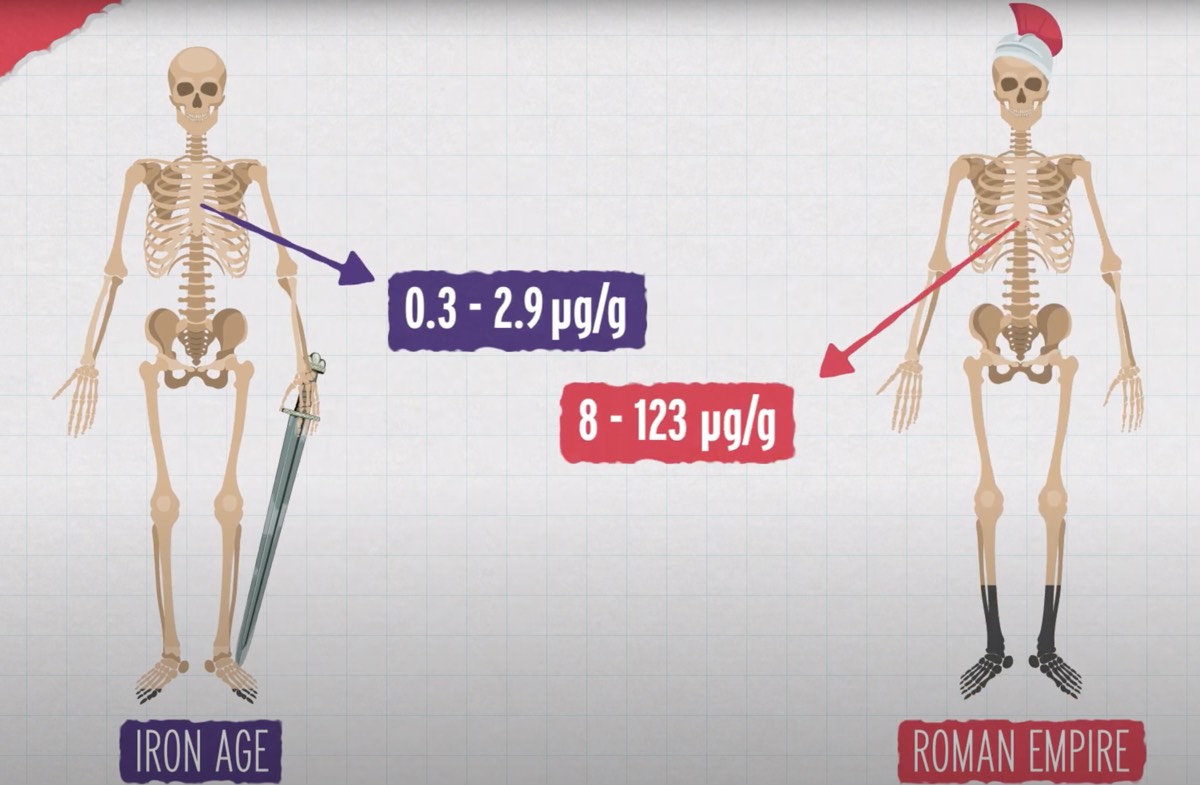
Enlarge/ A 2019 study found 400 times more lead in skeletal remains from the Roman Empire than in samples from the Iron Age.
YouTube/American Chemical Society
In a 2019 study, archaeologists examined several skeletons from London during the Roman era for signs of exposure to toxic levels of lead. The team sampled 30 thigh bones, as well as 70 bones from the Iron Age as a control. They found that the Iron Age skeletons contained just 0.3 to 2.9 micrograms of lead per gram, whereas the ones from the Roman empire had between 8 to 123 micrograms per gram. Those are sufficiently high levels to cause widespread health effects, including hypertension, fertility issues (and subsequent population decline), kidney disease, neural damage, gout, and so forth.
That said, according to archaeologist Janet Montgomery of the University of Durham, bone also absorbs lead and other metals from the soil, so it can be challenging to rule out post-burial contamination as a source for these higher levels of lead. “You do not know if the lead you are measuring [in bone] has accumulated from fairly low level exposure over a long time, or derives from one period of high exposure many years in the past, or something in between,” she told Chemistry World.
Archaeologist Kristina Killgrove, writing at Forbes, pointed out there were no lead coffins, or many lead grave goods, at these sites that could have contributed to this kind of contamination. But she did note that it’s unclear if skeletons of people who lived in Rome during the same period (as opposed to London) would also show high levels of lead, which requires additional study. “While the question of the effects of lead poisoning on the Roman Empire is far from settled, [this] research adds to the growing body of scientific data drawn from multiple sources that show human-created lead pollution was a serious problem two thousand years ago,” Killgrove concluded.
Listing image by iSidhe/iStock/Getty Images
https://arstechnica.com/?p=1778152
Old school: I work in DOS for an entire day
Sean Gallagher
Update, July 5, 2021: It’s the July 4 holiday weekend in the US, which means Ars staff gets a well-deserved holiday to catch up on this summer’s Steam sale (or maybe just to rest). As such, we’re resurfacing a few classics from the Ars archives, including this somewhat masochistic experiment. Back in 2014, Ars’ Editor Emeritus Sean Gallagher decided to celebrate the 20th anniversary of MS-DOS’s end-of-life by working in the operating system within a modern context. It… went about as smoothly as you’d expect.
Now 27 years after Microsoft announced that it would end support for the MS-DOS, we’re resurfacing this exercise (and very much appreciating our present day options as we all work from home a bit more). This story originally ran on July 3, 2014, and it appears unchanged below.
Twenty years ago this week, as Microsoft announced that it would end support for the MS-DOS operating system, James Hall announced to the world that he intended to create a public domain version of the OS in order to keep the universe of character-based DOS software alive. Hall’s “PD-DOS” project eventually became FreeDOS, which today supports an ecosystem of developers, retro gamers, and diehards who will give up their WordStar when you pry the floppies from their cold, dead fingers.
In tribute to the project’s two decades (and to those brave souls who keep the DOS fires burning), I decided to spend a day this week working in FreeDOS. I set up a machine running the latest distribution of the OS along with software from the FreeDOS Package Manager repositories. I then added whatever other software I could scrape together—open source software, freeware, and “abandonware” found on the Web, plus some software graciously sent by Lee Hutchinson from his own personal reserve of DOSware. I wanted to know if it was possible to do modern Web-based work in DOS—and just how painful it might prove to be.
I was soon rocking my computer like it was 1994. That is, I had no Twitter, Google, or anything else that used SSL, but I did have some command line TCP/IP tools, an otherwise functional Web browser, and… Gopher. Plus, I had WordPerfect 5, Microsoft Word 5, WordStar, Lotus 123, and dBase III—everything I could ever want, right?
Why FreeDOS?
Linux is free, too, and I’d rather spend any day working on an aging laptop running Debian or Ubuntu than working from the DOS command prompt. But there’s a certain insane beauty to the austerity of FreeDOS—plus, it’s an operating system that can boot from a floppy disk and run in 640KB of memory with no sweat (though it can go beyond that limit with one of several open source “high-memory” extenders).
FreeDOS has dressed up the old DOS environment a bit; for instance, with the addition of FAT32 support, FreeDOS can today support drives up to 8TB in size. An add-in module called LFNDOS adds support for the long filenames introduced in Windows 95. And thanks to a small army of open source developers and to the intellectual property gifts of two decades of commercial and academic DOS development, FreeDOS has compilers for dozens of programming languages (though, as far as I can tell, Java is not one of them).
At one point, FreeDOS became the only DOS that shipped with major PC brands, but you had to ask for it. Dell and Hewlett-Packard shipped FreeDOS with their “no operating system” machines as an alternative to Windows preconfigurations, and it became a popular option on cheap PCs, particularly in Asia, late in the last decade. The OS is still listed on the Dell and HP websites, but it seems that the option to have it shipped with new PCs is no longer available through those companies’ Web stores.
Despite its decline, FreeDOS continues to have an active user community. It’s still used as a lightweight OS for “boot floppies” needed to do network startups, to install or repair other operating systems, or to perform firmware updates. Because of its low memory and storage footprint, FreeDOS has also found a home in the virtual machine world, with ready-made images available for a variety of desktop and server VM environments.
But as was always the case with DOS, some assembly is required to get things running just right.
The official current version (FreeDOS version 1.1, released in 2011) is available as a live CD image, but the default installation lacks many of the pieces you’ll need to connect to the 21st-century Internet—including network drivers. Fortunately, another CD image is available that contains all the repository packages, including a couple of network driver options that can be installed with the FreeDOS Package Manager (FDNPKG).
I opted to install most of the packages, starting with the Crynwr packet driver—a freeware networking driver set that works with most standard network cards from the DOS era. Many DOS applications that use TCP/IP use a TCP library rather than a system driver, and FreeDOS has two that are compatible with the Crynwr packet driver: mTCP, still supported and accompanied by a handful of utilities (including an IRC client), and the venerable Waterloo TCP (WATTCP) developed in the early 1990s. The mTCP library has even been used to build a Web server—its home page is served up from an IBM PCjr.
You can also find “terminate-stay-resident” drivers for TCP/IP and other networks, which you’ll need for network file sharing. But to make them work, you’ll have to play hunter-gatherer with all the component parts, as most of these were commercial and are now unsupported. Someone on the VirtualBox forums has done a lot of that work already, fortunately. I took an alternate route: I ran FTP on my Mac OS X host and used the mTCP FTP client to shuttle files over to the DOS client. That allowed me to rather quickly add to my toolkit for a day of DOS productivity.
The land of “abandonware”
Next, I needed some content creation software. If I was so inclined, I could have foregone the luxury of a word processor and just used the FreeDOS EDIT.EXE tool or one of the many ported open source text tools. But if you’re looking for something a little closer to the “modern Office” experience, Microsoft Word 5.5 for DOS is available for free.
Before Microsoft won the desktop wars, word processors had devout followings. George R.R. Martin reportedly still uses WordStar, which I used briefly in the mid-1980s—it came bundled with my Kaypro PC. But to me, there was no other choice than the reassuring default deep blue of WordPerfect 5; I still have the function key template burned into my retinas. Fortunately, Lee Hutchinson happened to still have a copy.
Next came the choice of a spreadsheet. Lotus 1-2-3 or VisiCalc? Both are freely available off the Web. The executable version of VisiCalc that its developer, Dan Bricklin, has posted online is the original version for the IBM PC, created in 1981. Its user interface is a little primitive, but considering that it’s only a 27.5KB file—smaller than the Word document that I created to write this story—it’s a study in elegance.I don’t print things much anymore, so I didn’t have to dive into the world of printer drivers.
Unfortunately, you might as well send someone the Dead Sea scrolls as anything saved in the native file formats of these ancient spreadsheets—unless your recipients happen to have Apache OpenOffice, in which case you can send them a 1-2-3 .WK1 file, by all means.
Finally, to round out my software set, I found a .ZIP file of Ashton Tate’s dBase III and built a quick contact database. My inner Clipper programmer was happy again.
Enlarge/ WordStar, George R.R. Martin’s favorite word processor, also runs happily in FreeDos. But the default screen colors make my eyes bleed.
The Internet of 1994
But the thing is—I work for a website. And there was the small matter of actually using the Web from DOS.
Yes, Virginia, there is a DOS-based Web browser that’s still in development, and it’s open source. Arachne, which was most recently updated a year ago and is licensed under the GPL, is a full screen graphical browser that has its own built-in TCP/IP stack along with SLIP/PPP support (for those still in the world of dial-up). It even has a built-in POP/SMTP mail client, albeit a fairly primitive one.
Arachne is stable, but it’s hardly in tune with the requirements of the modern Web. For one thing, there’s no support for HTTPS, so Google, Twitter, Yahoo, and all those sites that have moved to SSL encryption in the post-Snowden era are unreachable. (Thank Bill there’s still Bing, right?) Also, it supports only the most basic of CSS style sheets, so modern websites look a little less modern. And while the mail client works, attaching files requires a bit of finesse.
I also tried Dillo, another open source browser based on FLTK, a cross-platform GUI library, which behaves like Mozilla 4.0. FLTK provides a Windows 2.0-like GUI experience. I managed to get it to work with Google (after turning off image downloads), but the mouse support was iffy, and it crashed and burned several times while loading pages.
After some pain and suffering with Arachne, I found what appeared to be a more robust mail client, called FlMail, based on the same FLTK library as Dillo. FlMail appears to support SSL, and it works with Gmail and other webmail services that support POP and SMTP. But making the mistake of clicking on an HTML-formatted message in my mailbox sent FlMail into a “preformating [sic] page” loop that gave me reason to go brew another pot of coffee. Sending a message with the first draft of this article attached? The same thing happened, before finding that the send failed. So I fled back to Arachne.
Killing things, coding things
I tried to share my pain via Twitter. Sadly, there’s no DOS Twitter client. When I tried to command-line tweet using WGET, Twitter.com wouldn’t resolve—I couldn’t figure out which network stack it was supposed to use, so I just wrote myself a reminder on a Post-It note.
Soon, I was going through copy/paste withdrawal, and it was time for a break. So I started searching through the games I had downloaded. One of the attractions for gamers offered by FreeDOS is its collection of emulators. There are a dozen or so DOS versions of classic consoles, including the NES, Gameboy, and Atari 800.
I had also installed a free mod of Doom, called (imaginatively) FREEDOOM, and I spent some time running around pixelated hell, blasting monsters. There were also two versions of Tetris, and a Mario-like side-scroller called HappyLand that I… really didn’t know what to make of. A DOS Space Invaders clone blew up the system every time I tried to load it.
After leaving a trail of VGA blood, I took a look at the developer tools. The GNU Compiler Collection was ported to FreeDOS as DJGPP. It allows for the creation of 32-bit programs that execute from DOS, and it was updated in March 2012 to include the Go programming language in addition to C, C++, and Fortran. It also includes the RHIDE integrated development environment. There are a few dozen other free and open source compilers and runtime environments as well, including one released earlier this year for the FORTH language.
Of course, there’s a lot of abandonware available for developers as well. Just for the sake of nostalgia, I downloaded Turbo Pascaland Harbour, an open-source Clipper compiler. As soon as I get my DOS contact manager app debugged, I’ll post a link to it.
At the end of the day, I was very ready to return to the comfort of a modern operating system—any modern operating system, thank you. But I did see why there’s still interest in DOS after all these years. Despite its archaic limitations, FreeDOS can turn even the oldest PC hardware into a functioning member of the Internet world, and it keeps decades of software up and running.