AtGames Legends virtual pinball review: The better pre-built choice… mostly

If you’d told me at the beginning of 2021 that I’d review not one but two virtual pinball options for the home, I would have nodded and said, sure, that sounds entirely unsurprising. A replica arcade experience seems like a great antidote for any nerd going stir-crazy in a pandemic. Yet while stand-up arcade multi-cabinets have rarely gotten me excited, virtual pinball is another story.

When I play classics like Pac-Man or Donkey Kong on a console, I generally feel like it’s the same experience as standing up with chunky joysticks (your mileage may vary, in which case, there are tons of products for you). But pinball’s orientation, form factor, and tactile nature have always precluded it from feeling authentic when virtualized on something like an Xbox. I don’t have the cash or space for a fleet of classic pinball machines, however, so I like the idea of a single system that emulates dozens of tables while maintaining the genre’s physicality—staples like flipper buttons, nudge options, and a plunger.

Last month, this led me to test the Arcade1Up Williams Pinball table, and I was left amused, if not charmed. But its great virtual table selection and solid physical construction were marred by enough issues to make it a tough sell to anyone beyond families. Still, I saw its potential as a moddable machine, whether to add more virtual tables or to use its $600 base as a cheap path to a dreamy homemade system.

Soon after, I got a friendly email from rival manufacturer AtGames that pointed to its own virtual pinball product. And after a recent testing period, I’m glad they reached out.

You want expandability? You want more options by default? The $600-and-up AtGames Legends Pinball delivers. While I would definitely recommend that savvier virtual pinball fans choose AtGames’ product between these two options, that recommendation comes with a few crucial asterisks—along with the fact that less-picky players (particularly families) may be better off sticking with Arcade1Up.

Five important differentiators

Much of the Legends Pinball setup process mirrors that of Arcade1Up’s cabinet. This set’s biggest piece arrives pre-constructed, and it’s big and heavy—a little over 100 lbs in a box meant for two people to lug through a doorway with room to spare. The box contains aluminum legs that owners must screw into the primary body to stand it up, while an additional box includes a “backglass” attachment that slaps into the body’s top to better resemble the real pinball deal.

Put it all together, plug it in, and a monitor lights up across the top to display virtual, pre-installed pinball tables. Tap some buttons to page through an on-screen menu and pick a game, then use a real, physical plunger to launch the ball and side-of-cabinet buttons to work the flippers. Now you’re playing virtual pinball.

While that basic description applies to both of the cabinets we recently tested, AtGames wastes no time differentiating itself from the competition. First, its playfield screen is 33 percent bigger: 32 inches versus Arcade1Up’s 24 inches. Second, that screen natively renders at 1080p, compared to Arcade1Up’s 720p, and it sports much better color calibration. Third, this screen is covered in a full sheet of glass, which looks handsomer than Arcade1Up’s plexiglass topper. Fourth, the flipper buttons aren’t alone; next to each is a “nudge” button, so you can virtually bonk your table and nudge a pinball where you want it to go instead of relying on an imprecise accelerometer. (Arcade1Up’s product doesn’t include these nifty nudge buttons.)

Lastly, AtGames’ backglass includes a second LCD monitor, which changes its art based on whatever pre-installed game you play. Arcade1Up’s backglass, on the other hand, has a print-out of a single, static picture. Shockingly, AtGames’ superior construction launched earlier this year at the same $600 price as Arcade1Up’s tables, but once the sets began selling out, AtGames changed its tune. The kit’s updated price at AtGames’ official store is $150 more—and that’s coincidently how much you would’ve paid for the platform’s biggest downloadable table pack, which is now included in the $750 SKU.

Yes, you can add games—in a bunch of ways

AtGames clearly wants you to add content to this thing. Paid DLC packs are the system’s most obvious path to expandability, and each pack includes roughly 11 additional virtual tables. Right now, they’re limited to tables made by Zaccaria, an Italian manufacturer that made dozens of tables in the ’70s and ’80s. Williams classics, these ain’t, but their digital versions are decent enough.

You have to go to AtGames’ website to buy these packs, and once you do, it’s a matter of claiming a DLC code from their site then tapping on the system’s unwieldy d-pad to pick through an on-screen keyboard and type that entire code out on your table. It’s certainly an inelegant solution.

Should you wish to move beyond official DLC, though, AtGames leads you there via three noticeable ports on the top of the base unit: two for USB, one for HDMI.

If you want to download official DLC, you’ll need a USB flash drive in one of the slots, since Legends Pinball comes with scant internal storage. But you only need roughly 3GB for the DLC packs that are available thus far, and you may very well have room for many, many more files on your average USB stick. Plus, if you split said stick into a smaller FAT32 partition and a larger ExFat one, the latter becomes a perfect dumping ground for games you might want to emulate.

AtGames’ interface includes a tab for “BYOG” content, or Bring Your Own Game, though the set’s instruction manual doesn’t clarify exactly how this works. Instead, you’ll have to do some online digging to find out. I relied on a comprehensive, intimidating guide from Wagner’s TechTalk, which clarifies that the Legends Pinball machine, like other AtGames Legends products, supports emulation cores from the Retroarch family. You have to create “package” files for every classic game you might want to play then put them into your USB stick’s ExFat partition.

Once you’ve done this, sync a Bluetooth gamepad, and you have a robust 32″ vertical screen to play classic games on. Most classic console games will look silly on this, since they’re cropped to landscape orientation and waste much of the screen. But MAME games that run in portrait mode (sometimes referred to in the arcade community as TATE games) look great on this set, including megaton “shmups” and classics like Ms. Pac-Man. It’s not perfect, thanks to a lack of pure integer scaling and some sound-emulation quirks, but the SoC is powerful enough for the MAME games I threw at it, and the monitor’s default color calibration is decent.

All told, I wouldn’t recommend buying Legends Pinball to play Donkey Kong in its original aspect ratio. But it’s a nice perk on top.

https://arstechnica.com/?p=1777758


Review: Warmly satirical Werewolves Within is comic horror with a heart

[embedded content]
Veep‘s Sam Richardson stars as park ranger Finn Wheeler in the comedy/horror/whodunnit Werewolves Within.

After so many years of zombies dominating the horror genre, it’s nice to see the classic werewolf making a comeback. Last year’s sleeper indie film The Wolf of Snow Hollow was a wry, clever take that mixed elements of Fargo, Scooby-Doo, and the lesser-known 1981 film Wolfen. And now we have the horror comedy (emphasis on the comedy) Werewolves Within, loosely based on the Ubisoft multiplayer VR game of the same name. I’m happy to report that the film is a worthy successor to the GOAT of the genre: 1981’s An American Werewolf in London.

(Some minor spoilers below but no major reveals.)

This is only the second feature film from Director Josh Ruben, who cut his teeth making viral video shorts for College Humor. His first feature was last year’s winsome Scare Me, about two writers holed up in a remote Catskills cabin who compete over who can tell the scariest story. Ruben, who is also an actor, wrote and co-starred in that film (opposite Aya Cash, whose portrayal of Stormfront was a highlight of The Boys S2). Scare Me earned positive reviews for its witty script and creative camera work, among other strengths. So when Ubisoft was looking for a director for its film adaptation of Werewolves Within, Ruben seemed an obvious choice.

There was already a solid draft script, penned by Mishna Wolff, and Ruben was immediately struck by its tone, which he deemed a cross between Fargo and Hot Fuzz. (I’d add Clue and the 1990s TV series Northern Exposure to those influences.) He knew he’d be able to revise and polish the script to reflect his own sensibility. There was limited shooting time because of the tight budget, and no possibility of reshoots, so the entire cast and crew had to get every shot they could in the moment. (Ruben told Screenrant he couldn’t even afford trailers; the trailer embedded above is courtesy of IFC Films, which picked up the distribution rights.)

Ruben sets the cheekily irreverent tone right off the bat, playing a deep cut from 1959, “The Phantom Strikes Again,” as Finn Wheeler (Sam Richardson, Veep) arrives in Beaverfield to take up his new post as the local park ranger. Innkeeper Jeanine Sherman (Catherine Curtin, Stranger Things, Orange is the New Black) pauses mid-debate with Midland Gas tycoon Sam Parker (Wayne Duvall, The Hunt, The Leftovers) to show him to his room. And mail carrier Cecily Moore (Milana Vayntrub, This Is Us) quickly befriends him and introduces him the rest of the residents, with a side of “hot goss” to get him up to speed on their eccentricities.

There’s gay tech-bro couple Devon (Cheyenne Jackson, Glee, Borderlands) and Joaquim (Harvey Guillen, What We Do in the Shadows) Wolfson; Gwen (Sarah Burns, Enlightened) and Marcus (George Basil, Santa Clarita Diet), who run the local garage; Pete (Michael Chernus, Manhattan) and Trisha (Michaela Watkins, Wanderlust, Casual) Anderton, and their little dog, Cha-Chi; the crusty, reclusive Emerson Flint (Glenn Fleshler, Barry, Boardwalk Empire), who chases any intruders off with his shotgun; and Dr. Ellis (Rebecca Henderson, Russian Doll, Westworld), an environmentalist staying in town who opposes Sam Parker’s plans for a new Midland Gas pipeline in Beaverfield.

Tensions are running high between the residents because of that proposed pipeline, since the decision must be unanimous, with Devon, Joaquim, and Jeanine being the remaining holdouts. It’s mostly just small-town bickering, such as Pete complaining that “Brooklyn hipsters” or “antifa” knocked down his pro-pipeline sign again. But then a blizzard blocks the only road into town and cuts off the power, and someone (or something) sabotages the back-up generators. When Finn discovers the badly mauled body of Jeanine’s husband Dave (Patrick M. Walsh, Lapsis) under the inn’s porch, it’s clear there’s a vicious predator on the loose. And those tensions flare into increasing paranoia and suspicion.

The VR game is essentially a social deduction game, where players take on cartoon avatars, sit in a virtual circle, and try to guess which of them is the werewolf terrorizing a medieval village. Werewolves Within updates the setting to a contemporary mountain town in the Hudson Valley (like Scare Me), but ultimately it’s the same premise: the people of Beaverfield have to figure out which one of their quirky neighbors is a lying, murdering werewolf.

There’s no shortage of suspects. Devon and Joaquim’s last name is “Wolfson.” Emerson is a hunter and trapper who wears the pelts of all the animals he has killed (including wolves). Dr. Ellis keeps to her room a lot and seems super concerned about the full moon. Cecily is the youngest of seven children, and in Argentinian folklore, the seventh child was usually killed at birth lest they become a werewolf, according to Joaquim. Pete is a compulsive sexual predator. Gwen and Marcus are aggressively imbalanced and prone to violence. Jeanine told everyone Dave had run off to Belize with his new girlfriend. And can we really count out the newcomer, Finn, despite his bumbling nice guy veneer? At least pretty much everyone’s packing heat in this remote mountain town (“I am yessir Amurrica!”)—except for Finn, who prefers to wield his trusty bear spray.

To say anymore would spoil the fun. Werewolves Within is first and foremost a successful comedy, and the ridiculously talented cast members all possess the skills and onscreen ensemble chemistry to make the script come alive. Granted, the characters aren’t especially deep—more akin to what you’d find in the best sketch comedy—but that suits the warmly satirical tone of the film. And there is a moral to the tale, courtesy of Finn and his role model, Mister Rogers: that at heart the town is a community, despite their differences, and everyone is at their best when they remember their common humanity.

Werewolves Within premiered last month at the Tribeca Film Festival and had a limited theatrical release. It’s now available to stream on demand. Rogen told Vanity Fair that he hopes to make a third film set in the Hudson Valley, thereby creating a trilogy in the spirit of Edgar Wright’s Three Flavours Cornetto trilogy. Personally, I can’t wait to see what he comes up with.

Listing image by IFC Films

https://arstechnica.com/?p=1778113


The comics, award-winning sci-fi, and nonfiction we’re reading this summer

Photo taken in Monopoli, Italy.
Enlarge / Photo taken in Monopoli, Italy.

If the heatwaves haven’t given it away, summer 2021 is in full swing across the US. COVID-19 robbed us of many, many things in 2020, including so much of what’s great about this time of year—travel, time in parks or at a seashore, afternoons by a pool or lake. But as vaccination rates continue to climb, there’s hope that 2021 can have a more genuine summer experience.

Venturing back into the world also means more opportunities to do so with a paperback or eBook in tow. So the Ars staff is back to provide another glimpse into what we’ve been reading and what’s on our TBR lists as of late. From graphic novels to Hugo Award-winning authors to deep dives into topics you’ve probably read about here, there’s no shortage of great 2021 options regardless of your typical reading habits. Plus, any time you can shout out a classic piece of literature by saying it’s full of “throat-jabs of prose,” you might be obligated to put together a list of book recommendations.

Note: Ars Technica may earn compensation for sales from links on this post through affiliate programs.

A protest on September 12, 2019, outside Purdue Pharma headquarters in Stamford, Connecticut.
Enlarge / A protest on September 12, 2019, outside Purdue Pharma headquarters in Stamford, Connecticut.

Empire of Pain

Because it’s impossible to ever get too angry about how the megarich abuse their power in this country, I plan on checking out Empire of Pain: The Secret History of the Sackler Dynasty, the recent nonfiction work from New Yorker staff writer Patrick Radden Keefe. As the title suggests, it follows the rise of the Sackler family, whose pharmaceutical company, Purdue Pharma, introduced and aggressively promoted the painkiller OxyContin. That went a long way toward sparking the opioid epidemic that has claimed some half-million overdose deaths and fostered countless more addicts. Purdue made billions off the epidemic, while the Sacklers increased their standing as cultural benefactors, their name adorning museums, university buildings, and the like.

The general frame of the opioid crisis is well-reported at this point, but reviews have lauded Empire of Pain for digging deeper into the history and family dynamics of the Sacklers themselves: how their legacy for melding medicine and marketing dates back generations, how far they’ve gone to avoid accountability, and how they use that wealth to indulge themselves. Naturally, people like this do not get to behave the way they do without a wider structure that enables them. So, Empire will be a hate-read. But if we can’t have their money, they might as well have our scorn.
—Jeff Dunn, Senior Commerce Editor

<a href="https://cdn.arstechnica.net/wp-content/uploads/2018/02/Falcon-Heavy-Feb-5th-2017-0187.jpg" class="enlarge" data-height="3641" data-width="5462" alt="Just two guys talking rockets back in 2018 before something called the Falcon Heavy made its debut launch.”><img alt="Just two guys talking rockets back in 2018 before something called the Falcon Heavy made its debut launch.” src=”https://rassegna.lbit-solution.it/wp-content/uploads/2021/07/the-comics-award-winning-sci-fi-and-nonfiction-were-reading-this-summer-2.jpg” width=”640″ height=”427″ srcset=”https://rassegna.lbit-solution.it/wp-content/uploads/2021/07/the-comics-award-winning-sci-fi-and-nonfiction-were-reading-this-summer-5.jpg 2x”>
Enlarge / Just two guys talking rockets back in 2018 before something called the Falcon Heavy made its debut launch.
Trevor Mahlmann for Ars Technica

Liftoff

Really, everything you need to know about Ars Senior Space Editor Eric Berger’s Liftoff can be conveyed in this excellent six-word review:

If you prefer the longer version, here goes: if following Berger’s work on Ars hasn’t given it away, he’s regarded as the best space reporter in the business for a reason. He travels everywhere from Tokyo to French Guiana to better understand today’s global space industry, and he has a deep affection for and interest in the context and lessons of human spaceflight past. So when a journalist with deep subject familiarity and an endless industry Rolodex decides to tackle the origin story of the most important company of today, you get to “just read it” territory pretty quick. Berger’s writing on SpaceX has been must read ever since he arrived at Ars, and Liftoff gives him plenty of space to fill in the blanks surrounding the company’s make-or-break early years. Seeing how far and how fast SpaceX has come will give anyone a new appreciation for the next seemingly ho-hum successful Falcon 9 launch. Plus, you may never come across a more riveting and pivotal use of a hairdryer in human history.
—Nathan Mattise, Features Editor

Used to-go cup not included, but it does make a convenient vessel for iced coffee.
Enlarge / Used to-go cup not included, but it does make a convenient vessel for iced coffee.
Nathan Mattise

Happy hour(s of reading)

The pandemic ruined so much we took for granted, and cozying up after a long workday at the neighborhood pub is something I didn’t realize I’d miss. Luckily, Cocktail Dive Bar arrived this spring to provide the best at-home facsimile.

Have you ever read a cocktail book cover-to-cover before? Me either. But I also never had a book born out of the best modern neighborhood dive bar in New Orleans (therefore the world?), Twelve Mile Limit. Owner T. Cole Newton’s first book does have plenty of recipes from his unassuming cathedral of “fancy cocktails, but we’re not fancy about it,” and it’s probably worth the cover price to have guidance on 12ML’s signature Baudin alone. But Newton is a gifted orator and storyteller—his former bar podcast on the city and industry was great. Cocktail Dive Bar breaks up recipes with loads of information for anyone interested in New Orleans or the larger beverage industry.

For instance: Newton includes classic drinks among his recipes, but he assumes anyone buying his book already knows the gist of how to make them. So his recipes reflect how he prefers to make them, with slightly different ratios or ingredients. Meanwhile, the essay that accompanies each recipe outlines an over-the-top, tall-tale backstory told with a straight face. (Did you know the Aviation, for instance, was “created” by the Wright brothers mid-Kitty Hawk flight but only surfaced after tension between the brothers led to violence that resulted in one fleeing for the South Pacific before meeting a rhino tusk in the chest? True story.)

In contrast, original drinks by Newton or the 12ML team come with backstories related to the modern bar industry, from how recipes might spread across the country without explicit consent to naming conventions to tricks for coming up with your own creations (inversions are great, who knew?). And each section of cocktail recipes is punctuated by a straight-up essay on a larger industry challenge and how 12ML approaches it, like fighting sexual harassment and assault or whether you can create an antiracist bar space these days.

The book is knowledgeable but not pretentious, entertaining but not distracting—Newton’s writing is almost as good as the drinks. Almost.
—Nathan Mattise, Features Editor

https://arstechnica.com/?p=1776798


Despite $2.1M ruling, RomUniverse owner considers bringing back ROM site

RomUniverse has been down for months, but owner Matt Storman may be considering bringing it back despite a court judgment.
Enlarge / RomUniverse has been down for months, but owner Matt Storman may be considering bringing it back despite a court judgment.

In May, a US District Court ordered former RomUniverse.com owner Matthew Storman to pay $2.1 million in damages to Nintendo for copyright and trademark infringement. Now, Nintendo is seeking an additional permanent injunction against Storman, who it says is considering bringing the ROM site back without “Nintendo content” and who has failed to make a $50-per-month payment toward those damages.

Storman—who said in court documents that his post-RomUniverse income was derived primarily from “unemployment and food stamps”—seems unlikely to ever pay even a small chunk of the $2.1 million judgment against him. Paying a token $50 a month, an amount Nintendo says Storman “proposed and agreed to,” would mean that fully covering the damages would take Storman 3,500 years, and that’s without accounting for interest.

Still, Nintendo is using the damages to its advantage, arguing that Storman’s failure to make his first $50 monthly payment “demonstrates that Nintendo has no adequate remedy at law for Defendant’s past or future infringement and underscores the need for a permanent injunction.”

Getting the site back together?

Meanwhile, in a recent filing with the court, Perkins Coie lawyer William Rava recounts a telephone call he had with Storman on June 3 after the court’s original ruling. In that call, Rava said, “Mr. Storman stated that he was still considering what to do with RomUniverse and that if he were to bring back the website, it might have video game content and ROMs from companies other than Nintendo but would not have Nintendo content.”

“The Opposition does not dispute that [Storman] is considering relaunching the RomUniverse website to continue to distribute video game ROMs,” Nintendo writes in a filing based on Rava’s deposition. “Nor does it assert that this future use will not violate Nintendo’s intellectual property rights.”

Storman’s statement brings up an interesting legal distinction between games developed and/or published by Nintendo and third-party games that merely run on Nintendo consoles. The ruling against Storman focused on 49 games from the former group; those titles were copyrighted and trademarked directly by Nintendo. But Nintendo has less of a legal claim on hundreds of other ROMs that run on Nintendo consoles but whose copyrights and trademarks are owned by other companies (which are responsible for protecting those rights).

Even if a ROM site ignored all Nintendo-published games, though, it could still face legal trouble from Nintendo for misusing trademarked console names and imagery or for suggesting a legitimate relationship with Nintendo’s console hardware that doesn’t exist. The Internet Archive’s Console Living Room project, for instance, doesn’t officially include any licensed games for Nintendo consoles out of fears of legal threats from Nintendo (though some copyrighted NES and SNES games are occasionally uploaded by Internet Archive users before being taken down).

Legal maneuvering

Nintendo initially requested a permanent injunction against “future infringement” of Nintendo’s intellectual property in its original motion for summary judgment against Storman. While any future infringement would still be illegal in any case, a preemptive injunction from the court would make it much simpler for Nintendo to quickly shut down a new ROM site if Storman sets one up (as he seems to be considering).

The judge denied Nintendo’s original request on an injunction, saying that the monetary damages and the fact the site was already shuttered weighed against the necessary argument for “irreparable harm.” Now, though, Nintendo is citing the new legal precedent of the 2020 Trademark Modernization Act in arguing for a permanent injunction. That act, which passed just before Nintendo first requested an injunction but was not considered at the time, establishes a new “mandatory presumption of irreparable harm” in trademark infringement that Nintendo says should point the court toward an injunction.

Storman, who is representing himself in the case, has meanwhile filed his own somewhat rambling motion asking the court to reconsider the statutory damages it imposed in May. “There is no legitimate, admissible evidence that the Court can reasonable [sic] construe to cause it to believe that Plaintiff, Nintendo, sustained any actual damages whatsoever as a result of any of the Defendant’s actions or inactions,” Storman writes.

In its response, Nintendo argues that it has already “presented uncontroverted evidence that there were approximately 50,000 illegal downloads of infringing ROMs at the time Nintendo filed its Complaint, and that the retail price for the Nintendo Games is between $20 and $60.”

https://arstechnica.com/?p=1777911


How a 17th-century illustration is helping archaeologists find Viking ships

How a 17th-century illustration is helping archaeologists find Viking ships

In 1650, a Danish physician and antiquarian named Ole Worm conducted the first survey of a Viking cremation burial site known as the Kalvestene. Worm created a map of the locations of all the “ship settings”—stones arranged in the shape of vessels—marking the graves. Now, a team of archaeologists has compared its own detailed surveys with Worm’s original illustrations and may have discovered two new ship settings that are consistent with that centuries-old survey, according to a recent paper published in the Journal of Island and Coastal Archaeology.

Vikings typically buried their dead, along with the deceased’s material possessions, within a wooden ship. They then covered the grave with dirt to create a raised earthen mound. The Kalvestene, on a small island called Hjarnø, is one of about 25 such sites in Denmark. Even though it’s a relatively small grave field, the Kalvestene (literally translated as “the calf stones”) was nonetheless well-known in the region. It is first mentioned in the 12th-century treatise Gesta Danorum (“The History of the Danes” or “Deeds of the Danes”) by Danish theologian Saxo Grammaticus, and there are many other references throughout medieval and early modern texts.

“It’s such an interesting site, and the fact that it is referred to in medieval sources—when other, larger monuments aren’t—demonstrates it was a significant site, too,” co-author Erin Sebo of Flinders University in Adelaide, Australia, told Ars.

Worm’s 1650 drawings—the first recorded survey of the site—indicate that 34 stone settings once stood at Kalvestene, although only 10 remain today. (Residents likely removed the other settings over the centuries for various repurposes.) In 1935, iron fragments that may have once been part of a damasked iron sword were found. The following year, archaeologist H.C. Broholm did a scientific excavation of two of the graves for the National Museum in Copenhagen. He carefully numbered the 10 surviving ship settings but mostly just found a few burnt bones, charcoal, and pottery shards dating back to 600-900 AD.

In 2009, Tatiana Smekalova conducted a limited magnetic survey of the Kalvestene on behalf of the Horsens Museum, hoping to locate the additional graves documented by Worm, in addition to any other buried remains. Nothing was found. For this latest research, Sebo and her colleagues wanted to determine the accuracy of Worm’s 1650 survey and learn more about how the Hjarnø ship settings compared to other such sites. They also wanted more insight into why the Kalvestene was so well-known to contemporaries. Sebo et al. extended their analysis to incorporate medieval records, aerial photogrammetry, and lidar data from an archaeological survey conducted by the Moesgaard Museum in 2018.

The researchers found that the Kalvestene is unusual among Viking burial sites because its stone settings are exclusively shaped like ships (this arrangement is believed to be a tribute to the Norse god of wind and weather, Njord (or Njörðr), whose symbol was a ship). Other Danish sites from the same period feature settings shaped like circles, ovals, triangles, and ships.

The researchers also identified two new raised areas that they believe could be additional burial sites. “One appears to be a typical ship setting, and the second remains ambiguous,” said Sebo. “But it’s impossible to know without excavation and further survey.”

Per Saxo’s medieval treatise, the Kalvestene’s stone settings were arranged to honor a peasant-turned-king named Hiarni. He was purportedly the author of a poem about his regal predecessor, Frothi, who died in battle on the island. Hiarni’s title was challenged, however, and he was ultimately killed and buried on the island. The authors concluded that there is no evidence Saxo’s account is accurate or that the island was named after a peasant-king named Hiarni, who likely never existed. Instead, linguistic evidence suggests Hiarni was invented and named after the island. What’s significant is that Saxo was aware of a grave monument on Hjarnø.

“Most monuments of this kind are designed to honor the power of an important individual,” said Sebo. “However, our study demonstrates that the site had a community focus and that the people of Hjarnø had a much flatter, more egalitarian social structure.”

Sebo et al.‘s findings suggest a significant Swedish presence on the island and regular contact and trade between Sweden and Denmark. Medieval ships would have passed the island frequently on their trade routes, and artifacts recovered from a hoard in 2017 provided evidence that foreign traders likely visited the island. Of course, the borders between the two countries shifted throughout the medieval period, so there were periods when parts of modern Sweden were under Danish rule.

“Not borders, but distance”

“The issue is not borders, but distance,” said Sebo. She noted that Kalvestene was built near several Danish centers of power, all of which can be reached by land, while their Swedish counterparts were farther away and required water travel. “Our study demonstrates that maritime links were strong for the Hjarnø community and reflect a profoundly maritime culture, in which the land is more of a barrier than the sea,” she said. This finding suggests that “close connections between communities were based on a range of factors and not necessarily simple proximity.”

As for Worm’s 1650 illustrations, this study doesn’t offer definitive proof of their accuracy, despite the discovery of two possible gravesites in keeping with his centuries-old survey. However, “while this study is unable to offer a conclusive understanding of the origins of the Kalvestene, it demonstrates the value of combining source criticism and analysis with archaeological data to contribute toward greater understanding about the site,” said co-author Jonathan Benjamin, also from Flinders University.

DOI: Journal of Island and Coastal Archaeology, 2021. 10.1080/15564894.2021.1900955  (About DOIs).

https://arstechnica.com/?p=1772472


Humble Bundle stops purchasers from giving full payment to charity

The kind of "everything to charity" slider option shown on the right here will soon be impossible for Humble Bundle customers.
Enlarge / The kind of “everything to charity” slider option shown on the right here will soon be impossible for Humble Bundle customers.

Since the first Humble Indie Bundle launched to much acclaim in 2010, users have been able to allocate up to 100 percent of a bundle’s pay-what-you-want purchase price to Humble’s partner charities. That option will be going away in mid-July as the company institutes a new 15 to 30 percent minimum cut that will go to the storefront itself.

If that new policy sounds familiar, it’s probably because of a test Humble Bundle in April that hid the charity sliders from some customers as a form of early user testing. In light of negative feedback, Humble Bundle apologized for not being “more proactive in communicating the test.” But at the time, the company also said it was planning to limit total charity donations to 15 percent of the user-set purchase price in the near future.

By May, though, Humble Bundle backtracked and said it was leaving the charity sliders intact and turning them back on for all customers “while we take more time to review feedback and consider sliders and the importance of customization for purchases on bundle pages in the long term.”

Today, that review seems to be over, and Humble Bundle has once again decided to set limits on the proportion of payments users can allocate to charity (though at a higher level than it publicly mulled back in April). In a blog post Thursday, the Humble Bundle team attributed the 15 to 30 percent minimum store cut (which will vary from bundle to bundle) to the fact that “the PC storefront landscape has changed significantly since we first launched bundles in 2010, and we have to continue to evolve with it to stay on mission.”

Humble Bundle says customers can still adjust their specific charitable giving within these new limits, and on-screen sliders will make any minimums clear. The team also argues that ensuring Humble Bundle itself makes some money from every bundle sale will “[let] us continue to invest in more exciting content so we can keep growing the Humble community, which will ultimately drive more donations for charitable causes.”

“… I would consider that a success”

When the Humble Indie Bundle launched back in 2010, bundle co-creator Jeffrey Rosen of Wolfire Games was clear that he considered the option for users to give all their payments to charity a feature, not a bug. “Even if no one donates to the developers and they give 100 percent to charity, I would consider that a success,” he told Ars Technica at the time.

In 2013, EA donated its entire share of the proceeds from the first Humble Origin Bundle to charity, using the offering as a PR promotion more than a direct money-maker. Humble Bundle says it will also continue to occasionally offer “100% charity” bundles, such as the recent Humble Heal COVID-19 Bundle. Humble Bundle says it has raised almost $200 million in charitable donations since it first launched.

While Humble Bundle initially launched as a true “pay-what-you-want” offering, most of the company’s bundles have long limited what’s included unless you pay a minimum price. The company has also expanded over the years to include direct, set-price game sales through the Humble Store, a Humble Choice subscription plan that offers a curated selection of games each month, and direct game publishing under the Humble Games label.

Humble Bundle was acquired by gaming and media conglomerate IGN in 2017.

Listing image by Humble Bundle

https://arstechnica.com/?p=1777653


A weird take on frame rate: How PS5’s first “40 fps” game works, runs

Panoramic screenshot from sci-fi videogame.
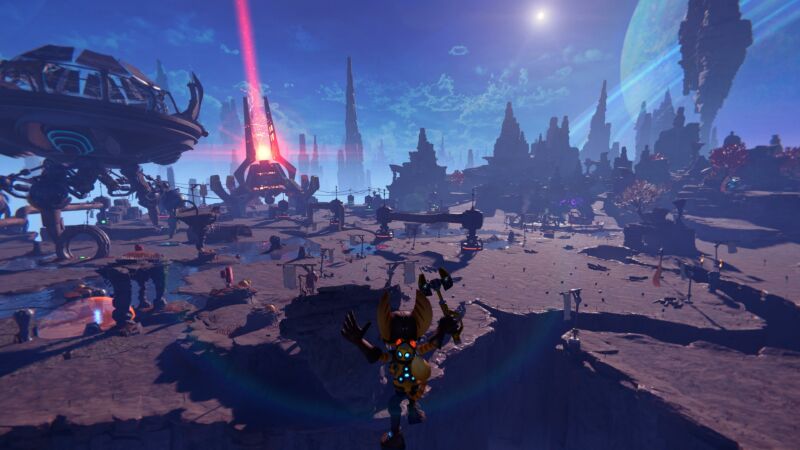
Enlarge / This Ratchet & Clank: Rift Apart image was captured while running in the game’s new 40 fps mode. It offers the same amount of resolution, image quality, and ray-tracing fidelity as the prior 30 fps “quality” mode.

When it comes to action-filled video games, frame rates matter, and up until recently, traditional “frames per second” wisdom has landed at either 30 fps or 60 fps. Thirty, the rate seen in most standard TV broadcasts, is fine for slower cinematic games, while frantic battles and twitchy fights benefit from a higher rate, since it looks smoother and reduces button-tap latency.

This week, a surprising new number enters the conversation: 40 fps, a standard previously unattainable thanks largely to TV standards. It comes courtesy of a new patch to this month’s Ratchet & Clank: Rift Apart on PlayStation 5, which already includes a 60 fps “performance” option. So why would anyone pick 40 fps instead? And how does it work?

HDMI standards, menu picking, and math

Recent titles by Insomniac Games, particularly Marvel’s Spider-Man and the 2016 Ratchet & Clank remake, launched on PS4 with a 30 fps lock, meant to guarantee higher pixel counts and more detailed shadow and level-of-detail (LoD) settings. Both of those games eventually got PS5 versions with 60 fps support, since they could leverage the newer hardware’s power. As a native PS5 game, this month’s R&C:RA launched with both 30 and 60 fps modes on day one. Its menus asked you what you preferred in your gaming: more pixels and higher image quality or more frames?

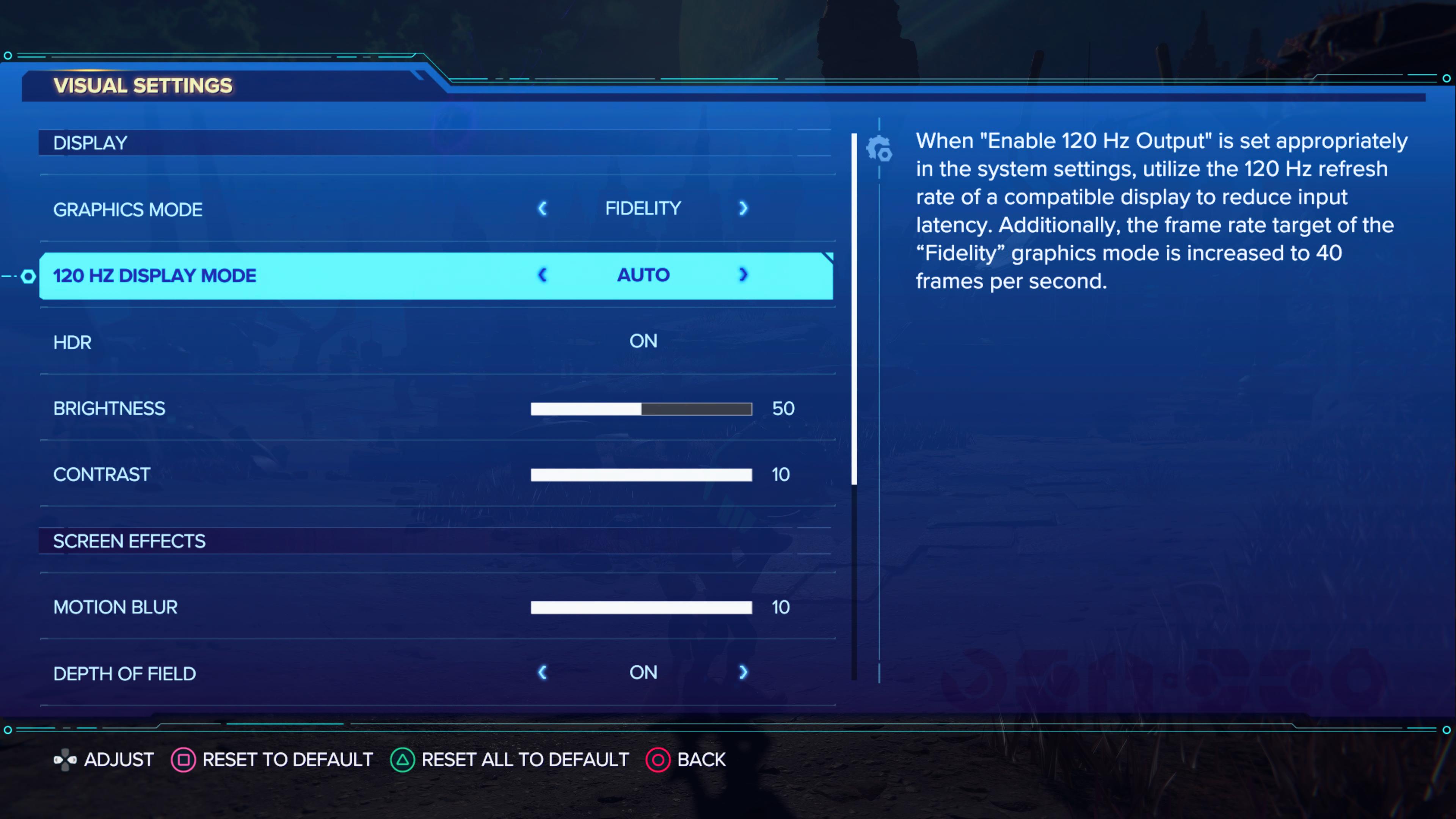
Today's update adds this menu option. Look closely, and it explains that you're not actually getting 120 fps refreshes anywhere in the game. (Sadly, this doesn't clarify that you'll need to go into your root menus and fiddle with chroma-subsampling options.)
Enlarge / Today’s update adds this menu option. Look closely, and it explains that you’re not actually getting 120 fps refreshes anywhere in the game. (Sadly, this doesn’t clarify that you’ll need to go into your root menus and fiddle with chroma-subsampling options.)
Sony / Insomniac

Tuesday’s update changes this choice slightly, albeit with a toggle that you might not notice if you skip the fine print. R&C:RA now has a “120 Hz Display Mode” toggle tucked into the graphics option menu. No, the game doesn’t run at 120 fps now (though we’ve certainly played 120 fps games on PC and console, and we’ve played higher frame rates than that). Instead, R&C:RA engages any compatible TV’s 120 Hz mode, which, at this point, becomes a matter of HDMI standards, menu picking, and math.

Both of last year’s biggest new consoles, the Xbox Series X and PlayStation 5, support 120 fps connections at 4K resolution, so long as your TV supports the HDMI 2.1 connection standard. Without HDMI 2.1 bandwidth at the ready, older TVs with 120 Hz support can only get up to 1080p resolution. I’m able to test R&C:RA on LG’s 2020 OLED panel, the CX, and I got its 120 Hz mode working… once I changed another setting in the PS5’s root menus.

Getting 120 Hz, 4K, and HDR metadata into the same signal requires reducing the system’s HDR signal to 4:2:2 chroma subsampling. This reduces the total color information sent to your panel per frame, which is arguably more noticeable when picking through lines of text than when romping through high-speed action. I don’t notice a massive difference in PS5 image quality when changing this setting, but your mileage will vary.

Why “55 fps” isn’t typically a thing

Once you’ve taken all of these steps, R&C:RA can deliver video to an HDMI 2.1-rated panel with any frame rate that divides evenly into 120. This opens up more fixed frame-rate possibilities, and in traditional video games, that matters. Tons of games have launched with apparent 60 fps refresh rates only to stutter when a console or computer can’t keep up with the game’s rendering burden. This can result in visual artifacts like torn frames (where only half of the screen changes between frames of animation) or bad frame pacing (where the refresh is inconsistent).

In other words, a traditional 60 Hz monitor can’t actually run gameplay at, say, 55 fps. Instead, it will rapidly alternate between 30 fps and 60 fps to reach that 55 fps average in a way that can feel disjointed for anyone controlling the on-screen action.

Which brings us to R&C:RA‘s 40 fps mode. Previous video analysis of the game showed that its 30 fps “quality” mode didn’t break a sweat in sticking to a consistent 30 fps refresh. Teams like Digital Foundry wondered how much more the game could be pushed while otherwise remaining locked to a comfortable, consistent frame rate. Now, that 30 fps mode—and every single bell and whistle relating to its resolution, image quality, and ray-tracing fidelity—runs 33 percent faster.

Great news, even if it’s not VRR

While I haven’t run today’s new 40 fps mode through comprehensive video analysis—I don’t have gear suited for 120 fps analysis—I did tear through an hour of the game’s campaign at this setting, and I can report that it runs smoothly on my 120 Hz panel. If there’s any frame-rate hitching, the panel may simply drop from 40 fps to 30 fps in a single-frame stutter, which I imagine is a lot less noticeable than drops between 60 and 30 or 30 and 15.

As an uncommon gaming frame rate, 40 fps is interesting in action. There’s a certain sheen to how the game runs at its native near-4K resolution, with all ray-tracing effects maxed out, that feels smoother yet still cinematic at this jump above the standard 30 fps rate. Before this patch went live, I was happy to trade details for extra frames to get to 60 fps. But now, with extra detail unlocked at a smoother combat frame rate, I think I can make 40 fps work.

If you’re the kind of home-theater savant who knows what chroma subsampling is and bristles at a downgrade from 4:4:4 to 4:2:2, 40 fps may not be for you. And this is not the same as variable refresh rate (VRR), a standard that Xbox Series X/S consoles support. HDMI 2.1-rated monitors include VRR support, and this allows computers and consoles to draw frames on your screen as soon as they’re ready, instead of dividing into a “base” frame rate (so long as the frame-rate minimum exceeds approximately 40-45 fps). But PS5 is not yet compatible with the standard for some reason, and Sony hasn’t indicated that it’ll remedy that issue any time soon—which particularly stinks for something like R&C:RA, whose “performance” modes could very well stretch into the frame rate 70s and 80s without having to divide into a number like 120.

Until then, 40 fps will have to do, and at least in R&C:RA‘s case, it’s a damned good compromise.

https://arstechnica.com/?p=1777279


What the heck’s an Intellivision Amico? Console’s leaky dev portal offers hints

The latest render of the upcoming Intellivision Amico console, with our own question marks placed in each controller's embedded touch screen. A dev portal leak has helped us answer some, but not all, of the questions that remain ahead of the product's current announced release date of October 10, 2021, for $249.
Enlarge / The latest render of the upcoming Intellivision Amico console, with our own question marks placed in each controller’s embedded touch screen. A dev portal leak has helped us answer some, but not all, of the questions that remain ahead of the product’s current announced release date of October 10, 2021, for $249.
Intellivision / Sam Machkovech

Since its announcement as a crowdfunded game console in 2018, the Intellivision Amico has had a weird public image. There have been many YouTube pronouncements about its family-friendliness, yet there are few concrete details that have convinced us it will stand out in an increasingly crowded home-gaming market. And this year, public scrutiny about the $250 system (currently open for $100 preorder “down payments” or full-price preorders, which include two controllers and six pack-in games) has grown, particularly after Intellivision joined the 2021 virtual E3-showcase fray—and did so with a resounding thud.

Thus far, the Amico has used video presentations to show what the company hopes will set this handheld apart from the pack. Those videos mostly originate from Intellivision and a few hand-picked fan YouTube channels. Until we can go hands on with live hardware ourselves, these videos leave us with question marks about dev kits and other potentially inauthentic presentations. Leaks from an Intellivision developer portal this week will have to suffice for now, as it’s a great opportunity to finally take a closer look at what the heck an Intellivision Amico actually is.

“Exactly what stock photos are meant for”

I began closely watching the Amico once I noticed that its E3 2021 presentation video included unclear footage of how the device actually works. These “live gameplay” videos hint at Amico’s central gimmick: gameplay happens primarily on a TV screen, but the device can also integrate content on an LCD screen embedded in every controller (controllers resemble Nintendo’s Wii U, albeit with smaller gamepads). However, the E3 video cuts and pans so much that we can’t tell if the Amico controllers are legitimately interacting with the nearby TV set. Older Amico videos have shown apparent lag between controller input and TV display—when those videos haven’t hidden the controller from view altogether, that is. This recent E3 presentation did nothing to reduce concern on that front.

The E3 presentation included multiple stock images of happy families playing with Amico, and Intellivision CEO Tommy Tallarico later confirmed those images were doctored—DualShock-like controllers were digitally replaced with Amico’s touchscreen-filled pads. Tallarico defended the promotional choice on Twitter by saying, “That is exactly what stock photos are meant for and why they exist.”

Next to the stock photos was direct-feed footage of apparent Amico gameplay that looked simplistic and sometimes stuttering. It didn’t inspire confidence in a price category that includes competent $200 to $300 options like the Nintendo Switch and Apple TV 4K. To picture it, imagine an online Flash gaming portal full of mostly flat, 2D game designs with a few 3D twists and visual flourishes, and you get some idea of Amico’s visual aesthetic.

Perhaps a different sizzle-reel approach would have done a better job selling the Amico concept, and I don’t envy any marketing department dealing with a pandemic-related expo drought where a physical demo might fill in these gaps. But for a console that revolves around the lukewarm Wii U concept of “gameplay on TV, extra screen in your hand,” whose last announced launch date was October 10, 2021, it sure seems like time to release more details. This is especially true for a new, unproven hardware maker, since the Intellivision brand name was acquired in 2018 by an entirely new team.

“Smart Display 200” doesn’t sound as cute as “Amico”

Intellivision has been frank that Amico was built with budget-priced gaming in mind. Its official “specs” page makes that clear, with performance numbers that resemble lower-powered Android smartphones. But this recent leak from Intellivision’s online “developer” portal provided concrete specifics about how much hardware power this $250 system and its controllers will eventually deliver.

The Intellivision developer portal was recently publicly available online, no password needed, for long enough to have the details saved at archive.org earlier this month, which we have reviewed. Sources with knowledge about Amico have confirmed to Ars Technica that the leaked specs we’ve seen were legitimate. While the specs were live as recently as June 14 and line up with Amico’s own official specs page, they could still change between now and the system’s launch.

The Intellivision developer portal includes precise specs for various system elements in order to help game makers begin building Amico software before they receive official dev kits. Before listing all of its specs, Intellivision’s own comparison makes the point more simply:

We’ve found the ZTE ZMax Pro Z981 (Snapdragon 617, Adreno 405) is a good benchmark test and runs just a little slower than the Amico hardware.

This model of ZTE smartphone debuted in 2016 at a budget price point of $100 unlocked—and that included a 13 MP camera sensor, a 6-inch, 1080p display, and a 3,400 mAh battery. In comparison, Amico works as a set-top box for your TV while embedding a 3.2-inch, 240p capacitive touchscreen into each of its controllers (two will be included in the box). Other comparable phones listed in Amico’s portal include the Honor 8C, Xiamoi Redmi Y3, and Motorola Moto G7.

The developer portal calls out Qualcomm’s Smart Display 200 platform as Amico’s retail hardware target—and specifies its “APQ8053-Lite” model, which includes a 1.8GHz Snapdragon 624, an Adreno 506 GPU, 16GB of Flash storage, 2GB of LPDDR3 DRAM, and built-in controllers for interfaces like HDMI, Wi-Fi, and Bluetooth (but not Ethernet). While prices on bulk-manufactured SoC motherboards can vary for many reasons, this one appears to be available in bulk orders at rates near $38 per board (though that one includes a camera sensor, which Amico will not have in either its primary box or its controllers).

https://arstechnica.com/?p=1776210


Xbox Game Streaming exits beta, now works on all iOS devices, web browsers

Xbox Game Streaming works on a wide variety of devices—and they all now benefit from Microsoft's upgraded servers.
Enlarge / Xbox Game Streaming works on a wide variety of devices—and they all now benefit from Microsoft’s upgraded servers.

Microsoft continues flipping crucial switches and toggles for its cloud-powered Xbox Game Streaming service, and this week’s update is easily the biggest yet. The Xbox Game Streaming service has taken an official leap onto all web browsers and iOS devices.

Should you subscribe to the Xbox Game Pass Ultimate service, priced at $15/mo, you can now visit xbox.com/play on supported web browsers (Chrome, Safari, Edge) and immediately enter a cloud-gaming instance that resembles the likes of Google Stadia, Amazon Luna, and Nvidia GeForce Now. Connect a controller to your preferred gaming device, then connect to your lowest-latency connection possible, and you’ll have access to a library of over 260 games as powered by a Microsoft Azure server instance. (Without a gamepad, many games won’t work, though some titles have received Xbox Game Streaming updates to add virtual touchscreen controls should you play on a smartphone.) My most recent article about Game Pass clarifies how its pricing and game selection differ from aforementioned rivals.

This follows Microsoft’s late-2020 promise to get Xbox’s cloud service running via an HTML5 interface, which, among other things, would get Xbox Game Streaming to work on Apple’s otherwise restrictive iOS ecosystem. Both Xbox and Stadia faced Apple’s smackdown in terms of App Store rules that would require every game in their service to receive an individual Apple review and rating process, despite the fact that media-streaming services like Netflix and Disney+ don’t receive the same scrutiny for their individual TV series and films. (Without a dedicated Xbox Game Streaming app on iOS, you’ll need to create a web shortcut within iOS Safari to add an app-like shortcut to your iPhone or iPad.)

$5 more for Ultimate perks

Eligible Game Pass Ultimate users had previously been able to visit xbox.com/play and access this HTML5 version of the service in a “beta” program, and today’s news expands that access to anyone and everyone. This differs from the dedicated Xbox Game Pass app for Android, which has been available to all Xbox Game Pass Ultimate subscribers since last year. Should cloud game streaming not be your cup of tea, you can pay only $10/mo for a device-specific tier of Xbox Game Pass, either for consoles or PC. Game Pass Ultimate combines both of those hardware families’ access to games, then adds cloud access on top—and it’s savvy enough to sync gameplay and save progress across all three families, should you wish to carry on a gameplay campaign between your home console, your bus-riding commute on a smartphone, and your work PC when your boss isn’t looking.

All of this happens on a newly upgraded Microsoft Azure server farm, by the way, which went into effect last week and makes all games operate as if they’re running on Xbox Series X consoles. Many of these performance perks will be noticeable via streaming, particularly faster gameplay loads and higher frame rates. However, anything beyond 1080p resolution or 60 fps performance is currently capped by streaming limits. (Meaning, don’t expect to see Master Chief Collection‘s 4K, 120 fps mode working in your web browser via streaming.) Still, for much of the Xbox Game Pass library, the boosts will be immediately apparent, since this server upgrade leapfrogs past the previous performance standard of base Xbox One consoles.

Microsoft has already hinted to more bullish Xbox Game Streaming moves to come by year’s end, including a dedicated smart TV app and a dedicated app for base Xbox One consoles and Windows PCs.

https://arstechnica.com/?p=1776840


We finally have a release date and new teaser for Apple TV+ series Foundation

This fall is shaping up to be a good one for fans of classic science fiction. Not only are we getting Denis Villeneuve’s film adaptation of Dune on October 22, but Apple TV+ has finally announced the premiere date for the streamer’s hotly anticipated Foundation, a TV adaptation of Isaac Asimov’s hugely influential series. The first three episodes will debut on September 24, 2021, with weekly episodes released after that.

“In the decades since the Foundation series first saw print, Asimov’s prophetic science-fiction work has never been more relevant than it is now,” said showrunner David Goyer in a statement. “Growing up, I devoured Foundation and dreamed of one day seeing it on screen—but a feature film didn’t seem big enough to embrace the ambition. Thanks to the broader landscape of streaming and a valuable partnership with Apple and Skydance, we are able to bring the series to the screen in a way that truly does it justice.”

Per the official premise:

When revolutionary Dr. Hari Seldon (Jared Harris) predicts the impending fall of the Empire, he and a band of loyal followers venture to the far reaches of the galaxy to establish The Foundation in an attempt to rebuild and preserve the future of civilization. Enraged by Hari’s claims, the ruling Cleons — a long line of emperor clones—fear their grasp on the galaxy may be weakening as they’re forced to reckon with the potential reality of losing their legacy forever.

Harris plays Seldon, with Lee Pace co-starring as Brother Day, current emperor of the galaxy and part of a long line of emperor clones (the aforementioned Cleons). Lou Llobell plays Seldon’s mathematical genius protegé, Gaal; Leah Harvey plays a gender-swapped Salvor, warden of Terminus; and Laura Birn plays Eto Demerzel, aide to Brother Day.

Other listed characters include Brother Dusk (Terrence Mann), the ruling family’s oldest living member, and Brother Dawn (Cassian Bilton), the youngest member and heir apparent to Brother Day. There’s also Daniel MacPherson as Hugo, T’Nia Miller as Halima, Pravessh Rana as Rowan, Kubbra Sait as Phara, Mido Hamada as Shadow Master Obrecht, Amy Tyger as Azura, and Buddy Skelton as Keir.

It has been more than a year since we got the first teaser, unveiled in June 2020 at the Worldwide Developers Conference (WWDC). That included some brief commentary from Goyer, noting all the past efforts to adapt Foundation over the last 50 years, as well as the enormous influence the series had on Star Wars. There were some accompanying behind-the-scenes photographs, too, but mostly it just introduced the basic premise, along with some visually stunning shots of the scenes that had been completed before the pandemic shutdown. Since then there has been nothing, save for a few brief glimpses earlier this month when Apple TV+ released its “summer and beyond” preview trailer.

This new two-minute teaser opens with a lone figure walking through a dark corridor to a secret laboratory where cloned fetuses are suspended in fluid. It’s Brother Dusk. “You can’t be here,” Eto tells him. “I can’t be the first person who wanted to see my youngest self,” he replies. “Strange, watching yourself being born.” Next we cut to Brother Day bragging about how their genetic dynasty has reigned for over four centuries, bringing peace to thousands of worlds. But he rants that this stability is now being threatened by a single man.

That would be Seldon, of course, who insists in his defense that he is not a revolutionary. Furthermore, his alarming calculations about the demise of civilization are deemed correct by Gaal. “Order will vanish,” Seldon insists, as scenes of chaos and destruction play out. “Wars will be endless. You can’t save yourselves. But you can save your legacy.” It’s a doom-and-gloom message, but, nonetheless, Seldon amasses a following, much to Brother Day’s chagrin. And as Brother Day knows all too well, “Words have a way of fanning into wildfires. “

Foundation will premiere on Apple TV+ on September 24, 2021. Again, after those first three episodes, new episodes will follow weekly, every Friday.

[embedded content]
The Galactic Empire has brought peace to thousands of worlds, but the beliefs of one man now threaten their very existence. Foundation premieres September 24, only on Apple TV+.

Listing image by YouTube/Apple TV+

https://arstechnica.com/?p=1776719