How SNES emulators got a few pixels from complete perfection
We're so close to having an emulator that can perfectly recreate every single function of real SNES hardware and software.
Enlarge / We’re so close to having an emulator that can perfectly recreate every single function of real SNES hardware and software.
Aurich Lawson

Update, June 28, 2021: Ars was saddened to learn that the author of this piece, who also used the handle Near in online interactions, reportedly took their own life over the weekend. We’re republishing this piece today in memory of their towering contributions to the classic gaming emulation community and to Ars. You can also read their 2011 piece on the quest for accuracy in bsnes development.

If you or someone you know is struggling with suicidal thoughts, please contact the National Suicide Prevention Lifeline at 800-273-8255, or reach out to a similar international hotline. We’d also encourage readers to donate to the American Federation for Suicide Prevention if they’re so moved.


As the lead coder of bsnes, I’ve been attempting to perfect Super Nintendo emulation for the past 15 years. We are now at a point where that goal is in sight, but there we face one last challenge: accurate cycle timing of the SNES video processors. Getting that final bit of emulation accuracy will require a community effort that I hope some of you can help with. But first, let me recap how far we’ve come.

Where we are

Today, SNES emulation is in a very good place. Barring unusual peripherals that are resistant to emulation (such as a light-sensor based golf club, an exercise bike, or a dial-up modem used to place real-money bets on live horse races in Japan), every officially licensed SNES title is fully playable, and no game is known to have any glaring issues.

SNES emulation has gotten so precise that I’ve even taken to splitting my emulator into two versions: higan, which focuses on absolute accuracy and hardware documentation; and bsnes, which focuses on performance, features, and ease of use.

Some amazing things have come out of SNES emulation recently, including:

… and much more!

So that’s it, right? Kudos on a job well done, thanks for all the fish? Well… not quite.

Today, we enjoy cycle-level accuracy for nearly every component of the SNES. The sole exception is the PPUs (picture processing units), which are used to generate the video frames sent to your screen. We mostly know how the PPUs work, but we have to make guesses for some functionality that result in less than total perfection.

The remaining issues are relatively small ones, in the grand scheme of things. If you’re not interested in the pursuit of one hundred percent faithful emulation perfection for its own sake, I am not going to be able to convince you of the need for improving SNES PPU emulation further. As with any goal in life, the closer we get to perfection, the smaller the returns.

I can tell you why this is important to me: it’s my life’s work, and I don’t want to have to say I came this close to finishing without getting the last piece of it right. I’m getting older, and I won’t be around forever. I want this final piece solved so that I can feel confident in my retirement that the SNES has been faithfully and completely preserved through emulation. No stone was left unturned, no area left unfinished. I want to say that it’s done.

If you’re still intrigued, read on for a deep dive into the background of the problem and my proposed solutions.

Modeling the SNES design

Let’s start by taking a look at the components that make up the SNES:
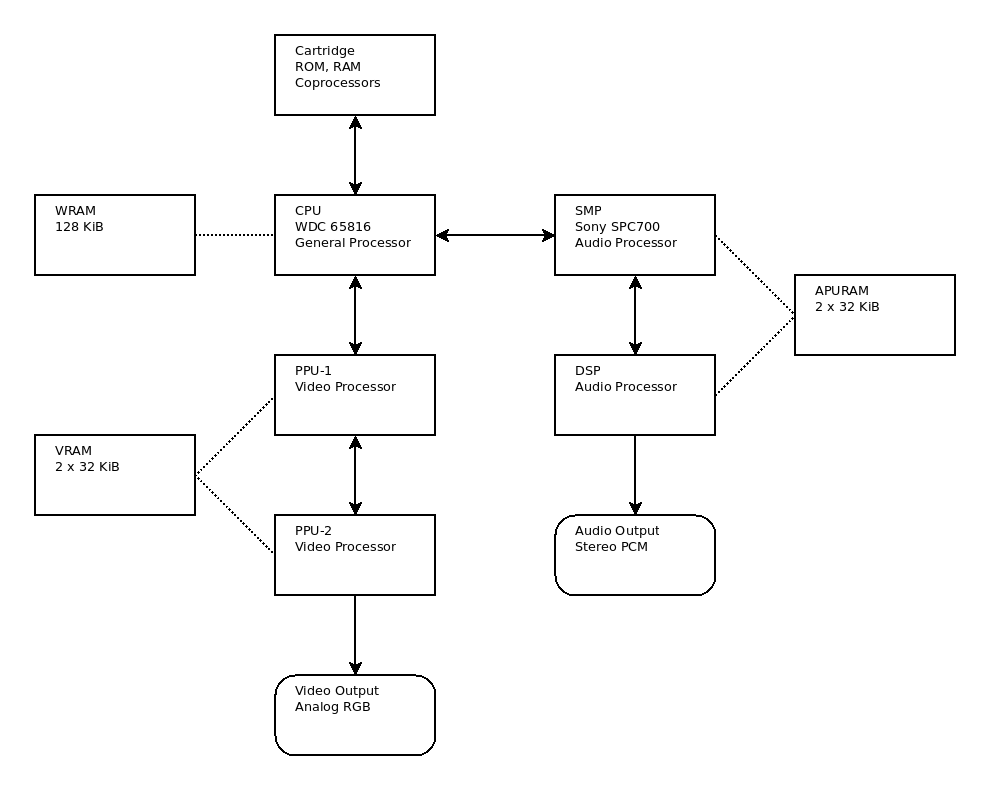
Super NES system diagram.
Enlarge / Super NES system diagram.

The arrows indicate the direction that the various processors in the SNES can communicate with one another, and the dotted lines represent memory chip connections.

The key thing to take away right now is to note that the video and audio output are sent directly from the PPU and DSP specifically. That means they function like “black boxes” where we don’t have any visibility into what happens inside. This will be important later on.

Correctness

Imagine you are emulating a CPU’s “multiply” instruction, which takes two registers (variables), multiplies them together, and produces a result and some flags that represent the status of the result (such as overflow).

We could devise a software program that multiplies every possible value from 0 to 255 as both the multiplier and multiplicand. Then we could output both the numeric and flag results of the multiplication. This would produce two 65,536-entry tables.

By analyzing these tables, we could determine exactly how and when the CPU results were set certain ways. Then we could modify our emulators so, when running the same test, we produce exactly the same tables at the same times.

Now let’s say the CPU had 16-bit x 16-bit multiplications. Testing every possible value would generate 4 billion results, which is starting to push what is practical to test in a reasonable amount of time. If the CPU had 32-bit x 32-bit multiplications, it wouldn’t be practical to test all combinations of inputs before the heat death of the universe (with current technology, at least).

In cases like this, we would have to get more selective with our tests and try to determine exactly when flags might change, when results might overflow, and so forth. Otherwise we’d have tests that would never complete.

Multiplication is a fairly trivial operation, but this is the general process behind reverse engineering, and it extends to more complex operations such as how the SNES’ horizontal blanking DMA (direct memory access) transfers work. We create tests that try to detect what happens on edge cases, then confirm that our emulation behaves identically to a real SNES.

Oscillators and cycles

The SNES contains two oscillators: a crystal clock that runs at ~21MHz, which controls the CPU and PPUs; and a ceramic resonator that runs at ~24MHz, which controls the SMP and DSP. Cartridge coprocessors will sometimes use the ~21MHz CPU oscillator and sometimes include their own oscillators that run at different frequencies.
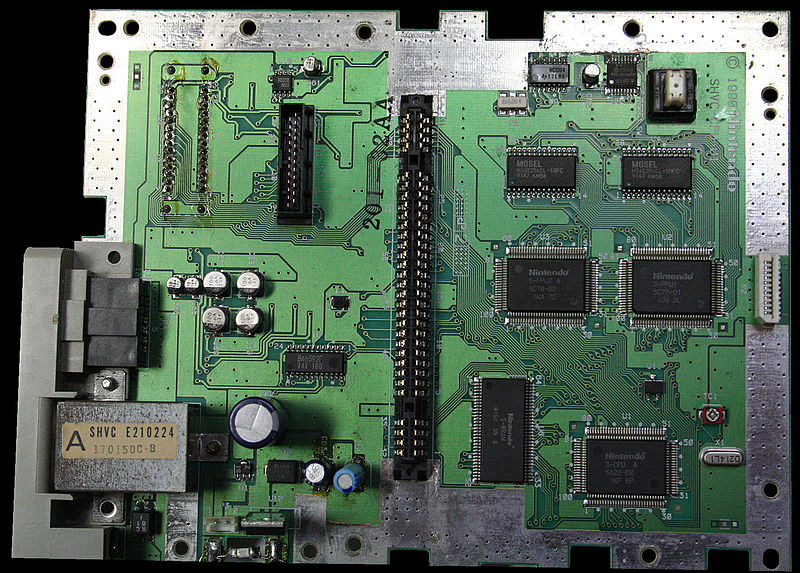
Recreating this original Super Famicom circuit board purely in software is harder than it looks.
Enlarge / Recreating this original Super Famicom circuit board purely in software is harder than it looks.

A clock is the core timing element of any system, and the SNES is designed to perform various tasks at certain frequencies and times.

If you imagine a 100Hz clock, it is a device with a digital pin that transitions to logic high (+5 volts, for instance), and then back to logic low (0 volts, or ground) 100 times per second. So every second, the pin voltage will fluctuate 200 times total: 100 rising clock edges and 100 falling clock edges.

A clock cycle is generally treated as one full transition, so a 100Hz clock would generate 100 clock cycles per second. There are some systems that require distinguishing between rising and falling edges, and for those, we break this further down into half-cycles to denote each phase (high or low) of the clock signal.

The key goal of an authentic emulator is to perform tasks in exactly the same ways and at exactly the same times as the real hardware. It doesn’t much matter specifically how the tasks are performed. All that matters is that the emulator, when given the same inputs, generates the same outputs with the same timing as real hardware.

Timing

Sometimes, operations happen over time. Take SNES CPU multiplication, for instance. Rather than pausing to wait for multiplication to complete, the SNES CPU calculates the multiplication result one bit at a time in the background over eight CPU opcode cycles. This allows your code to possibly do other things while waiting on the multiplication to complete.

Any commercially released software is likely to wait those eight cycles, because if you try to read the result before it’s ready, you will get a partially computed result instead. Yet earlier SNES emulators gave correct results immediately, without waiting these extra cycles.

When hobbyists started creating and testing homebrew software via emulators, this discrepancy started to cause some problems. Some of this software, such as many early Super Mario World ROM hacks, only worked correctly on these earlier emulators, and not on real SNES hardware. That’s because they were designed with the emulator’s immediate (and inauthentic-to-real-hardware) multiplication results in mind.

As emulators improved, this old software broke, and we have had to subsequently offer compatibility options in our newer emulators in order to not lose this software to time. Yes, as surreal as it is to say, these days our emulators have to emulate other emulators! How meta!

The nice thing about the CPU multiplication delay is that it’s very predictable: the eight computation cycles start immediately after requesting a multiplication. By writing code to read the results after every cycle, we were able to confirm that the SNES CPU was using the Booth algorithm for multiplication.

Clock Synchronization

Other operations are not so simple to model, since they happen asynchronously in the background. The SNES CPU’s DRAM refresh is one such case.

During the rendering of every scanline, at a certain point, the entire SNES CPU freezes for a short duration as the contents of the RAM chip are refreshed. This is needed because, as a cost-cutting measure, the SNES used dynamic RAM (rather than static RAM) for its main CPU memory. Dynamic RAM must be periodically refreshed in order to preserve its contents over time.

For a truly perfect emulator, just making ~3,500 commercially released SNES games playable isn't enough. Every function of the system has to be simulated with cycle-perfect accuracy, too.
Enlarge / For a truly perfect emulator, just making ~3,500 commercially released SNES games playable isn’t enough. Every function of the system has to be simulated with cycle-perfect accuracy, too.

The key insight to figuring out the precise timing of these operations was to take advantage of the SNES PPU’s horizontal and vertical counters. These counters advance and are reset after each horizontal and vertical blanking period. However, their precision is only a quarter of the SNES’ CPU oscillator frequency; that is to say, the horizontal counter increments only once every four clock cycles.

By reading the counters multiple times, I was able to determine which quarter of a clock cycle the counter was aligned with. By combining that insight with a specially crafted function that could step by a precise, user-specified number of clock cycles, it became possible to perfectly align the SNES CPU to any exact clock cycle position I wanted.

By iterating over a range of clock cycles in a loop, I could determine exactly when certain operations (such as DRAM refresh, HDMA transfers, interrupt polling, etc.) would occur, and I was able to reproduce this precisely under emulation.

The SNES SMP chip has its own timers as well, and similar reverse engineering was successful against that processor as well. I could spend an entire article talking about the SMP TEST register alone, which allows coders to control the clock divider of the SMP and its timers, among other horrible things. Suffice it to say that, while it was not an easy or fast process, we were ultimately victorious.

Collecting coprocessors
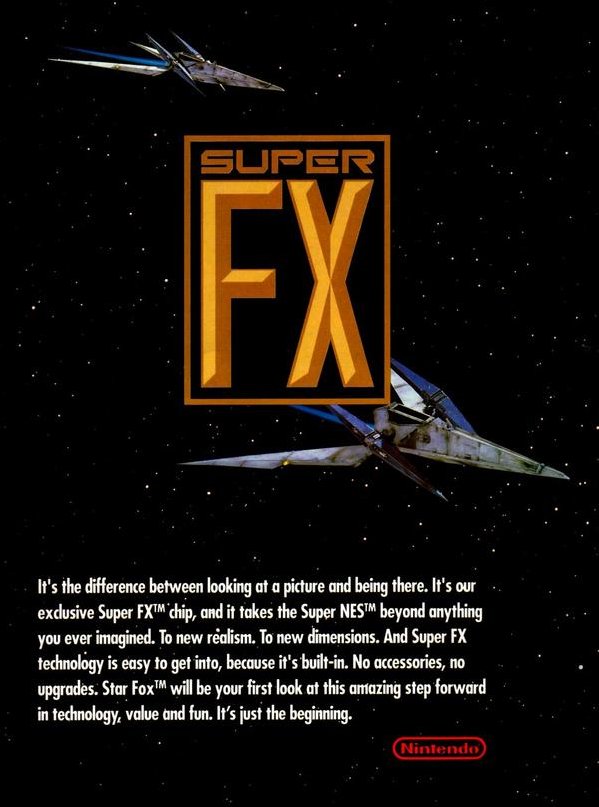
The SuperFX chip is just one of many cartridge coprocessors that an SNES emulator has to handle correctly.
Enlarge / The SuperFX chip is just one of many cartridge coprocessors that an SNES emulator has to handle correctly.

There were a whole host of SNES coprocessors used inside various game cartridges that needed to be tamed as well. From dedicated general-purpose CPUs like the SuperFX and SA-1, to digital signal processors like the DSP-1 and Cx4, to decompression accelerators like the S-DD1 and SPC7110, to real-time clocks from Sharp and Epson, and more…

That means an SNES emulator needs to be able to handle the instruction and pixel caches of the SuperFX; the memory bus conflict arbitrator of the SA-1 (which allowed the SNES CPU and SA-1 to share the same ROM and RAM chips simultaneously); the embedded firmware of the DSP-1 and Cx4; the prediction-based arithmetic coders of the S-DD1 and SPC7110; and the odd BCD (binary-coded decimal) edge cases of the real-time clocks. Slowly but surely, by applying the above techniques to determine correctness and timing, we were able to near-perfectly emulate all of these chips.

It actually took a massive effort and thousands of dollars to decap and extract the programming firmware from the digital signal processors used in various games. In one instance, emulation of the NEC uPD772x led to code from higan being used to save the late professor Stephen Hawking’s voice!

In another case, we had to reverse-engineer the entire instruction set of the Hitachi HG51B architecture, because this architecture was never publicly documented. In yet another, one game (Hayazashi Nidan Morita Shougi 2) ended up containing a full-blown 32-bit, 21MHz ARM6 CPU to accelerate its Japanese chess engine!

Preserving all of the SNES coprocessors alone was a multi-year journey full of challenges and surprises.

Processing digital signal

Not to be confused with the DSP-1 cartridge coprocessor, the Sony S-DSP (digital signal processor) chip is what generated the distinctive sound from the SNES. This chip combined eight voice channels with 4-bit ADPCM encoding to produce a 16-bit stereo signal.

On the surface, and per the system diagram from earlier, the DSP initially looks like a black box: you configure the voice channels and mixer settings and sit back as it generates sound to be sent to your speakers.

But one key feature allowed a developer by the name of blargg to fully reverse-engineer this chip: the echo buffer. The SNES DSP has a feature that mixes the outputs from previous samples together to produce an echo effect. This happens at the very end of the audio generation process (aside from one last final mute flag that can be applied to silence all audio output.)

By writing carefully cycle-timed code and monitoring those echo results, it became possible to discover the exact order of operations the SNES DSP would take to generate each sample and to produce cycle-accurate, bit-perfect audio.

https://arstechnica.com/?p=1662472


Circling—or cycling—the track at F1’s famous Circuit of the Americas

AUSTIN, Texas—As we rolled our road bikes toward the entryway, the friend who convinced me to do this shared a conversation he had earlier in the day: “When I said we were biking at Circuit of the Americas tonight, the first thing Mike asked was if that first turn is as steep as it looks on TV. Time to find out.”

I don’t follow Formula 1. I don’t follow NASCAR. But I do live in Austin, Texas, and I regularly ride a bike. So the concept of Bike Night at the Circuit of the Americas (COTA)—an event series where this famed US racetrack invites local cyclists out on Tuesday nights to try two wheels where four usually roam—seemed cool enough. A June evening in Central Texas easily exceeds 90° F, even before you consider humidity or proximity to asphalt. But what harm could some casual riding on a fancy car circuit do? I could taste the postgame Kölsch before l took my bike off the rack.

Then, of course, came Turn 1. Whoa. Quickly, I learned why COTA’s starting stunner lives in racing infamy. It doesn’t look that bad when you’re peering down from the Observation Deck, but on the ground, this 133-foot climb at the start of the 3.4-mile track really sets a tone for every lap. That tone: COTA will kick your butt. 

This F1 fansite claims that cars can get to around 110 km/h (~70 mph) climbing this thing, which we very much did not achieve. It took me about two minutes. And while F1’s top drivers can push through a lap in almost a minute and a half, my sorry self had an unofficial time closer to 13 minutes. (I ride a Motobecane Vent Noir I bought used five years ago; the guys who loaded up top-end tri bikes likely fared better.)

Still, Bike Night ain’t no competition. An entry price of $10 brings out all sorts of cyclists for a pretty unique riding experience. You’ll see peddlers who look fresh out of training wheels and others who make you murmur something about wanting to be that fit at their age. My road bike was not out of place in a sea of cycles that included fixed gears, recumbent rides, tandem bikes, and a bike with one of those baby trailers attached (only it definitely carried a retriever of some sort). The COTA team builds in some shortcuts for those who would like to not climb Turn 1 four times in an hour or two, and ample break and water stations are strategically placed throughout the course.

By the final time that I approached the grandstands to turn in for the night, navigating the course firsthand had given me a genuine appreciation for those who do it at higher speeds. My friend’s Strava app readings reported that the quickest pace we reached was just over 40 mph, coming off the (literal, physical) high of Turn 1 through a flat stretch leading to Turn 5. F1 cars push 200 mph on this course, yet I felt like I was flying. It took us multiple laps to really get the hang of turns like the hairpin Turn 12, even at those slower speeds. And how pros race two or three cars wide on something like Turn 15 is beyond me; it felt hard to fit even that many bikes with anything resembling genuine momentum.

Bike Night has been a staple around here since 2017, and the event even successfully navigated the pandemic last fall. It has consistently attracted a few hundred riders every night for a reason. So, if you’re in Austin next week or sometime this September, know you don’t get the opportunity for a ride like this very often. If you go, just remember to start the night in your lowest gear available.

https://arstechnica.com/?p=1775718


We have our best look yet at supervillain Mandarin in new Shang-Chi trailer

Marvel’s official trailer for Shang-Chi and the Legend of the Ten Rings is here to give us a bit more of the title character’s backstory. The trailer also serves up glimpses of classic villains the Mandarin and Abomination and a supporting (yet crucial) character from 2016’s Doctor Strange.

Directed by Destin Daniel Cretton, Shang-Chi and the Legend of the Ten Rings is the first Marvel film to feature an Asian lead—Simu Liu, best known for his role as Jung Kim on the sitcom Kim’s Convenience—as well as a predominantly Asian/Asian diaspora cast and crew. Marvel continues to keep plot details tightly under wraps, except to say that the main character gets drawn into the clandestine Ten Rings organization and must confront his past. “Shang-Chi’s main problem in his life is rooted in not knowing who he really is,” Cretton has said. “He has to learn how to own every part of himself. If he doesn’t allow himself to look at all of it—the good, the bad, the light, and the dark—and to own it all, he won’t be able to reach his full potential.”

The “ten rings” of the title refers to the Marvel Comics supervillain Mandarin’s Ten Rings of Power (worn on the fingers in the comics and shown as arm bracelets in footage from the Marvel film), each with a different powers: ice blasts, flames, or mind-control, for instance. As we’ve reported previously, Marvel created an entirely new character, Wenwu, who has gone by many names over the years, including the Mandarin, who made an appearance in Iron Man 3—or rather, Ben Kingsley played Trevor Slattery, an imposter posing as the Mandarin.

In addition to Liu, the film stars Awkwafina (Crazy Rich Asians) as Shang-Chi’s best friend Katy and none other than Hong Kong superstar Tony Leung (Hard Boiled, Chungking Express, Hero) as his father Wenwu, aka the Mandarin. Meng’er Zhang plays Xialing, Shang-Chi’s estranged sister; Florian Munteanu (Creed II, Borderlands) plays Razor Fist; Ronny Chieng (Crazy Rich Asians, Bliss) plays another pal, Jon Jon; and Fala Chen (The Undoing) plays Jiang Li. Michelle Yeoh (Star Trek: Discovery) plays a character named Jiang Nan; Yeoh previously played a different MCU role (Aleta Ogord) in Guardians of the Galaxy Vol. 2. There’s also a masked character called Death Dealer; Marvel has not yet revealed who plays him.

In April, Marvel released the first teaser, which focused on the character’s present life. The teaser featured Leung’s voice as the Mandarin in a voiceover, admonishing his son for “wasting” the last ten years. Shang-Chi has been working as a parking valet for a posh hotel in San Francisco when he isn’t hanging out with Katy singing karaoke tunes. That carefree existence is about to end. “I trained you so the most dangerous people in the world couldn’t kill you,” the Mandarin continued. “But it’s time for you to take your place by my side. You can’t outrun who you really are.”

This full trailer delves a bit more deeply into Shang-Chi’s backstory, with another voiceover from Wenwu explaining how the Ten Rings have long conferred power on his family. “If you want them to be yours one day, you have to show me you are strong enough to carry him,” Wenwu tells his son. We learn from Jiang Li that Shang-Chi is a “product of all who came before you, the legacy of your family”—and that includes not just his gentle mother but also his ruthless father, whom Shang-Chi witnessed murder someone when he was a child.

We get several shots of young Shang-Chi training, interspersed with his present-day battles against assassins—apparently sent by his father to test whether he’s still as formidable as he used to be. We also get to see him channel the Ten Rings’ elemental power as he faces off against Wenwu. And yes, that’s Doctor Strange‘s Wong (Benedict Wong) battling Abomination (played by Tim Roth, last seen in 2008’s The Incredible Hulk) in front of a crowd.

Shang-Chi and the Legend of Five Rings hits theaters on September 3, 2021, so you have plenty of time to get vaccinated in order to enjoy it on a big screen.

[embedded content]
Official trailer for Shang-Chi and the Legend of the Ten Rings.

Listing image by YouTube/Marvel Studios

https://arstechnica.com/?p=1776441


Fast 9 film review: Fast and furious enough, but buckle up for potholes

A few months ago, ahead of this week’s launch of Fast 9, I began pulling myself out of the wreckage that was the COVID-19 pandemic by going to… let’s all say it with Vin Diesel’s emphasis… the moo-vies. I cite Diesel because my 2021 moviegoing spree began with Fast Fridays, a free once-a-week opportunity to relive his massive The Fast & The Furious oeuvre on the big screen.

Over the years, I’d never felt the need to become Fast in theaters or catch up with a growing pile of Furiosity on VOD and streaming services. But the idea of riding with the entire series in theaters, once a week, as a newly vaccinated member of society, itching for something to safely do outside my home? Especially as a fun alternative to the somber, straight-to-streaming likes of the Snyder Cut? Sure, brah.

This differed from my colleague Peter Opaskar’s 2019 experiment, which saw him shotgun the full series on his couch over the course of two days. I arguably had a much better time, as my once-a-week pacing helped me savor the films’ shameless constructions. I’ve never seen a film series do a better job stringing together such artfully crafted stupidity over so many hours, all aided by scripts full of big heart, and action sequences full of sensational practical effects.

Eight weeks and nine films later, I’d turned into a guy with F&F expectations. I’d teared up about the films adapting to the real-life tragedy of series star Paul Walker passing away. I began coming up with MST3K-style jokes about the characters’ obsessions with Corona Lite. I’d grown to genuinely like Tyrese as a comedic actor. I bristled at the stumbles of 2019’s spin-off film Hobbs & Shaw (“This isn’t familia,” I truly said out loud). And I loved seeing so many very, very nice cars go zoom, boom, and kapow for the purpose of my amusement.

Tantalizing brah-canon, at a cost

I’m confident that my bias had some impact on how I cheered, laughed, and groaned through the whopping 2 hour 27 minute runtime of Fast 9, which I saw ahead of its domestic release this Friday, June 25. But even I could see this sequel’s glaring issues through my Stock-racing-holm syndrome.

If you’re looking for sheer action-movie spectacle and can stomach some of the series’ worst logical stretches (which, for F&F, is saying something) to connect each frenetic car chase and fist fight, you’ll be right at home. And if you’re familiar with the series’ cast and back story, you can expect some tantalizing brah-canon completions. But watching Fast 9 feels like getting season tickets to a sports team’s “rebuilding” year long after they’d won the world championship, and the result will be a tough watch for anyone who has never seen one of these films before.

My issue largely boils down to the writing, which, to some of you, might seem like reviewing the cleanliness of a table at a McDonald’s. But this sequel’s writers were clearly in over their heads, as they were tasked with keeping a massive cast of existing characters together while introducing a pair of new villains and bringing at least one major series character back. (Those writers include Justin Lin, who is also in the director’s chair for his fifth F&F film.)

Another Death Star—this time, with spinner rims

The series began in 2001 as a “car culture” excuse to race a quarter-mile at a time and engage in petty crime, and each film sought to ramp up the stakes: bigger heists, bigger investigations, and bigger surprise-twists where heroes and villains swapped places. These days, the franchise’s characters have a reputation as the world’s foremost not-very-secret agents, able to drive into any mastermind’s plot and foil it whilst drifting.

For some ridiculous reason, the Fast 9 writing team felt compelled to maintain a chain of believable, even-bigger-bad guys and girls. The resulting plot, which Fast 9 spends way too much time explaining and clarifying, feels like the car version of Darth Vader building another Death Star. (In F&F terminology, we’re in “God’s Eye” territory again. Yawn.)

Yet the film itself suggests that it could have revolved around a leaner, back-to-basics conflict: one between longtime series lead Dom Toretto (Vin Diesel) and a former colleague-turned-villain from his teenage racing days, Jakob (John Cena). Fast 9‘s flashback sequences show teen versions of these characters facing off in ways that recall the focused, cars-and-family stuff that pumped surprising heart into a street-racing motif. I’m a fan of how teen-Diesel and teen-Cena turned out, honestly, and wouldn’t mind seeing more of their teen-angst burn up future films’ roads.

In order to connect those compelling flashback sequences to a modern-day excuse to blow stuff up real good, however, Jakob emerges as a petulant, sullen superspy with zero charisma or compelling interactions. Fast 9 weights Cena’s bulky shoulders with two villains at his side: the very punchable face of an egotistical rich brat (Thue Ersted Rasmussen) who funds Jakob’s efforts and the return of F8‘s overwrought hacker Cipher (Charlize Theron). The film never offers a good answer to why Jakob bonded with either of these heels, and their cheesy bad-guy energy, while laughable, feels unnecessary. In execution, every time the camera moves from Dom’s crew to Jakob’s, the fun and energy gets sucked out of the theater.

The core cast hits on all cylinders

I’ve seen Cena absolutely slay in terms of physical comedy and snappy dialogue timing, and I got my hopes up that he would add new, subversive bravado—complete with his signature wink and smile—to fill the gap left by Dwayne “The Rock” Johnson skipping this entry. But Fast 9 doesn’t budget Cena enough time to bounce off of the film’s established, charismatic players. If we’d seen him contend with Tyrese’s silliness or Michelle Rodriguez’s wooden-yet-electrifying motivational speeches, then he might have been more fun to watch.

Forget Hobbs & Shaw. These two have the repartee, the heart, and the camaraderie.

Most of the returning protagonists hit their marks, at least. Diesel and Rodriguez cheesily weigh their newfound lives as parents with their heritage as adrenaline junkies. Jordana Brewster and Nathalie Emmanuel finally step up from their previously meek roles to fight and drive in their best F&F action performances yet. And Chris “Ludacris” Bridges and Tyrese, whose characters had playfully sparred in past films, have transitioned into an official series pairing. Forget 2019’s Hobbs & Shaw. These two have the repartee, the heart, and the camaraderie that I want to see in a spin-off film—and one that could very well benefit from escaping the mainline series’ increasingly bonkers stakes.

In the case of one major returning character, however, those same stakes wear him down in a way that feels more like a fan-service check mark. The character in question famously kept his cool in prior films in a way that the rest of the cast bounced off of. That’s lost here—and it’s yet another symptom of Fast 9‘s writers not necessarily understanding how to stitch the series’ dumb plots and dialogue together.

Practical effects (mostly) save the day

In very good news, Fast 9‘s fast cars, big booms, and increasingly zany sequences mostly rely on practical effects. It’s easy to spot a few exceptions, where clearly faked rows of cars bounce around in a cheap, CGI-rendered mess, but for the most part, Fast 9 spends its massive budget on believable bombast.

Without spoiling anything, the final sequence is an excuse to slam real cars together up and down busy streets. It’s a brand-new gimmick in the action film universe. The filmmakers double down on the sequence with gorgeous long shots, instead of fast-cutting the hell out of it. And the results rank up there with F5‘s breathtaking bridge-driving showdown.

By the way, that’s only one half of the film’s climax. The other half revolves around a modified Pontiac Fiero, and you can probably imagine what it would take for such a mid-’80s throwback to merit inclusion in a F&F action sequence. It joins the series’ usual rainbow of sensational, gas-guzzling beasts, including Dom’s switch to a modified 1968 Charger, a drift-filled frenzy courtesy of a Noble M600, and a tanks-jeeps-and-bikes romp through a massive field of landmines, because… why not.

The good parts of Fast 9 are enough to live up to the usual series expectations at this point: the action is somehow bigger than last time, and the people pulling it off work together with a believable amount of heart, pride, and loyalty. Diesel remains the series’ rock (pun intended), and whether a scene calls for grit or goofiness, he’s on it like go-fast stripes on a muscle car.

But if you’ve never seen a F&F film, you’ll miss out on the fan-service bits that make up for this sequel’s bloat and failings, all while watching the filmmakers clearly set the series up for its “mainline conclusion” (currently set to wrap up with two more sequels). There’s fun to be had here, and the results are better than Hobbs & Shaw. But make your peace with this return to theaters merely being a good F&F entry, not the best yet.

Listing image by Universal Pictures

https://arstechnica.com/?p=1775692


Xbox cloud upgrade is live: Series X power on your browser for over 260 games

Xbox Game Streaming works on a wide variety of devices—and they all now benefit from Microsoft's upgraded servers.
Enlarge / Xbox Game Streaming works on a wide variety of devices—and they all now benefit from Microsoft’s upgraded servers.

Microsoft’s bullishness about Xbox as a cloud-gaming platform got a lot bolder on Tuesday with the surprise launch of a previously teased change: an upgrade to the server farm that powers the cloud portion of Game Pass Ultimate. Long story short, it’s now much more powerful, enough to make Xbox’s $15/month Game Pass Ultimate an increasingly attractive subscription option.

Xbox Game Streaming, which was previously known as Project xCloud, works much like Google Stadia, Amazon Luna, and other cloud-streaming options. Pick a game, and a server farm will spin up a personal instance and beam its gameplay video to your preferred Internet-connected device while tracking your local button taps. The concept is a downgrade from locally owned hardware for a few reasons, including button-tap latency and hits to any ISP bandwidth caps. But it’s also arguably easier for some households than buying a new console.

The Xbox version has been quite attractive thanks to its value proposition. It includes over 260 games as part of a $15/month subscription, as opposed to a smaller Luna library, service-compatibility issues with Nvidia GeForce Now, and the a la carte pricing universe of Stadia. (Game Pass also comes in $10/month flavors, meant specifically for local hardware.) Up until now, however, the catch has been measly power on the server-farm side, since its cloud instances regressed to the “base” Xbox One console spec. Earlier this month, Xbox execs confirmed that its server fleet would begin upgrading to the Xbox Series X spec, which supports higher frame rates, higher pixel resolutions, faster loading times, and advanced rendering features.

Today, Microsoft flipped the switch. More power is now live for a large number of titles on Xbox Game Streaming, now running on your Android app or web browser as if they had booted on a Series X console.

Great showing immediately, blank spots will likely be remedied

Depending on the game in question, the upgrade is apparent across the board. In particular, the Series X port of 2020’s Yakuza: Like a Dragon now loads nearly instantly and includes menu toggles for either higher resolution or higher frame rates, just like its Series X sibling. Other games appear to need further optimizations to juggle the specific specs of these Series X server blades, particularly 2020’s Ori and the Will of the Wisps, which has a bizarre 1 minute 44 second loading time before the game’s main menu appears. Some Series X-compatible games don’t currently notice the server upgrade, particularly the next-gen version of NBA 2K21, while Xbox console exclusives like Gears 5 aren’t currently on the Xbox Game Streaming interface.

Since the upgrade isn’t yet formally announced by Xbox’s news feed or major company executives, today’s blank spots are likely to be remedied soon enough. We’re also keeping an eye on other major infrastructure updates coming at some point to the Xbox Game Streaming ecosystem, including a native console app that will turn the base Xbox One into an optimized streaming box and similar apps coming to smart TVs. All of that has been given a vague “2021” release window. Hopefully, more native apps will mean further optimized visuals and performance, since the web browser version currently caps at 1080p resolution and doesn’t support HDR. (Want more power and performance in the meantime? There’s an Xbox for that.)

Higher performance on cloud-gaming services isn’t currently a Microsoft exclusive, though neither Luna nor Stadia supports anything that resembles “next-gen” rendering. GeForce Now includes a higher subscription tier that unlocks “RTX” server access, which adds ray tracing and other bells and whistles to a compatible library (though, again, this is limited to some extent by licensing agreements there). And Xbox Game Streaming is poised to show off a major ray-tracing title in the near future, with Doom Eternal‘s Series X/S patch coming June 29. From the look of things, its streamed version will function in kind starting on that day (and won’t require users to download an additional patch, which is a nice cloud-streaming touch).

In a different year, the argument against cloud gaming would be a lot easier. Why stream a game—and deal with issues like bandwidth caps, image compression, and button-tap latency—when a perfectly fine home console can handle a ton of games? But in the chip-shortage nightmare of 2021 (and beyond), cloud gaming can sound a lot better than waiting for next-gen consoles to return to stock—or at least tide over interested gamers and families while they wait for either a Series X/S or PlayStation 5. And that may be the perfect window for Xbox to strike with its Game Pass Ultimate value proposition.

https://arstechnica.com/?p=1775411


The “loser, B-grade supervillains” are back in new The Suicide Squad trailer

Australian actor Jai Courtney introduces a new “early access” trailer from Warner Bros. for director James Gunn’s forthcoming The Suicide Squad, in which Courtney reprises his role as Captain Boomerang from 2016’s Suicide Squad. It’s got quite bit of new footage and some small additional details (such as why Idris Elba’s Bloodsport is in prison in the first place). Each of the three trailers released so far has been better than the last, so we have high hopes for this film.

As I’ve written previously, The Suicide Squad is not a direct sequel to the 2016 film; Gunn has said he wanted to take the franchise in a new direction and introduce new characters. He drew inspiration from writer John Ostrander‘s original 1980s Suicide Squad comics. (Ostrander has a small role in the final film.) Gunn has described his R-rated film as a superhero version of the classic 1967 film The Dirty Dozen, selecting characters he described as “loser, B-grade supervillains.”

Joel Kinnaman and Viola Davis reprise their 2016 roles as Col. Rick Flag and Intelligence Officer Amanda Waller, respectively, with Steve Agee playing John Economos, prison warden and aide to Waller. The squad this time around includes Elba’s Bloodsport, Peacemaker (John Cena), Courtney’s Captain Boomerang, Ratcatcher 2 (Daniela Melchior), Savant (Michael Rooker), King Shark (voiced by Rooker’s Cliffhanger co-star Sylvester Stallone), Blackguard (Pete Davidson), Javelin (Flula Borg), and everyone’s favorite psycho, Harley Quinn (Margot Robbie).

Other cast members include Polka-Dot Man (David Dastmalchian), whose trademark polka-dotted suit is actually a collection of gadgets; Weasel (Sean Gunn, James’ kid brother), an anthropomorphic weasel; Sol Soria (Alice Braga); TDK (Nathan Fillion); Mongal (Mayling Ng); Flo Crawley (Tinashe Kajese); and Thinker (Peter Capaldi). Storm Reid plays Bloodsport’s daughter Tyla.

Each of the prior trailers (released within a week of each other) had a very distinctive tone—a deliberate choice by Gunn. The first was a red-band trailer (pretty tame as these things go) that played up the humor. It opened with a plan for Flag and his team to rescue Harley Quinn, who thwarted it by rescuing herself. Then there was some standard exposition to set up the basic story: namely, that the Suicide Squad members get the same deal as before: 10 years off their sentence if they successfully complete their mission, with a nanite injection that will explode should they disobey orders in any way.

The second trailer, released on April Fool’s Day, dispensed with the jokey tone and running gags of King Shark’s gruesome eating habits (“num-num”) in favor of a darker, more ominous tenor. We got to see Polka-Dot Man in action, and TDK revealed a surprising ability to separate his arms from his body. Bonus: we got a good look at the writing on the back of Harley Quinn’s jacket: “Live Fast Die Clown.”

This latest trailer falls somewhere between jokey and dark. It focuses more on Bloodsport, opening with him scrubbing floors in prison as Waller tries to recruit him for the squad. Waller uses Bloodsport’s daughter’s upcoming court case as leverage. “I wouldn’t take such extreme measures if this mission weren’t more important that you could possibly imagine,” Waller assures him. We also learn that Bloodsport is in prison because he put Superman in the ICU with the help of a kryptonite bullet, so he’s got legit badass bona fides.

In terms of new footage, we get an inter-squad debate over what kind of dog Weasel might be—TDK guesses Afghan hound, Harley is hoping for werewolf—with Flag assuring them Weasel is harmless. (“I mean, he’s not harmless, he’s killed 27 children, but you know…”) We also learn that our heroes’ mission is to destroy all evidence of the mysterious “Project Starfish,” which probably explains the colorful giant starfish-like kaiju they end up battling.

The Suicide Squad hits theaters and debuts on HBO Max on August 6, 2021. If you’re fully vaccinated, I think this is one to see on the big screen, if you safely can. And expect to see more from this refreshed franchise in the future. HBO Max has already ordered a Peacemaker spinoff straight-to-series, with Cena and Agee reprising their roles.

[embedded content]
Director James Gunn was inspired by The Dirty Dozen for his latest, The Suicide Squad.

Listing image by YouTube/Warner Bros.

https://arstechnica.com/?p=1775366


The Hitman’s Wife’s Bodyguard is the raunchy action/comedy we need right now

[embedded content]
Ryan Reynolds, Samuel Jackson, and Salma Hayek reunite for more madcap hijinks in The Hitman’s Wife’s Bodyguard.

It took a little while for Ryan Reynolds to find his true cinematic niche—one that makes good use of his rare combination of leading-man looks, self-deprecating amiability, and smartly sardonic sense of humor. He was sheer perfection in 2016’s raunchy, R-rated blockbuster, Deadpool. Reynolds is at his best when he has a strong co-star to play off of as a foil, and he has that in Samuel L. Jackson and Salma Hayek, his co-stars in The Hitman’s Wife’s Bodyguard. Yes, it’s an awkward title for this sequel to 2017’s action/comedy, The Hitman’s Bodyguard. But if you liked that movie (I thought it was a blast), chances are you’ll enjoy this latest flawed-but-fun outing.

(Spoilers for first film below. Only mild spoilers for new film; no major reveals.)

In the first film, Reynolds plays ambitious, tightly controlled, triple-A rated “executive protection agent” Michael Bryce, who finds his professional life in shambles after one of this clients is assassinated on his watch. Two years later, his ex-girlfriend (an Interpol agent) reluctantly hires him to protect hitman Darius Kinkaid (Jackson). Darius is a key witness in the trial of the ruthless dictator of Belarus (Gary Oldman), agreeing to testify in exchange for the release of his con-artist wife, Sonia (Hayek), from prison. Michael has to get Darius from London to the International Criminal Court while being pursued by all the crack assassins and firepower the Belarus dictator can muster. Do they ultimately succeed and save the day against nigh-impossible odds? Do you really need to ask?

The Hitman’s Bodyguard grossed $176.6 million globally—not a bad showing—but it received decidedly mixed reviews. Although almost everyone praised the onscreen comic chemistry between Reynolds and Jackson, much of the criticism targeted the fairly generic, cliché-ridden script. Audiences were more forgiving. One person’s tired cliché is another’s time-honored trope, after all, and raunchy, entertaining, R-rated comedy/action flicks are in short supply these days.

The Hitman’s Wife’s Bodyguard brings us more of the same. We find Michael still in bodyguard exile, despite his successful mission with Kinkaid. Even his therapist can’t wait to get rid of him, suggesting he take a sabbatical to Capri. He just wants to lounge poolside and read The Secret in peace, but fate (in the form of Sonia) intervenes. Per the official premise:

The world’s most lethal odd couple—bodyguard Michael Bryce and hitman Darius Kincaid—are back on another life-threatening mission. Still unlicensed and under scrutiny, Bryce is forced into action by Darius’s even more volatile wife, the infamous international con artist Sonia Kincaid. As Bryce is driven over the edge by his two most dangerous protectees, the trio get in over their heads in a global plot and soon find that they are all that stand between Europe and a vengeful and powerful madman (Antonio Banderas). Joining in the fun and deadly mayhem is Morgan Freeman as… well, you’ll have to see.

The screwball/slapstick comedy aspects are more pronounced this time around, as is the cheese factor. Once again, it’s the on-screen chemistry between the three leads that makes the movie work. Reynolds and Jackson settle smoothly into their usual bickering interplay, and having Michael insist upon not carrying a gun—relying on pepper spray and his trusty Swiss Army knife (“they never see it coming”) because his therapist advised against it—makes for a solid running gag. Hayek once again shows a real gift for physical comedy, as well as impressively long, profane rants in Spanish (often left untranslated).

Among the supporting cast, Tom Hopper—best known as Luther in Netflix’s The Umbrella Academy—steals his scenes as Magnusson, a superstar bodyguard who is Michael’s arch-rival. Banderas gleefully camps it up as villainous Greek shipping tycoon Aristotle Papadopoulos, and Richard E. Grant is back for a brief cameo as the flamboyant, drug-addicted corporate executive Mr. Seifert. (It’s always nice to see Frank Grillo, but he is wasted as Interpol agent Bobby O’Neill.)

You could level many of the same criticisms against The Hitman’s Wife’s Bodyguard as its predecessor; many reviewers already have. Is it ridiculously over the top at times? Sure, although director Patrick Hughes leans into the sillier aspects with tongue firmly in cheek. Does it follow a familiar action/buddy comedy formula? Yes, complete with car chases, explosions, a spot of torture, and double-crossing twists. The first act is kind of clumsy—although the film finds its footing by the second—and it’s not that difficult to predict how (almost) everything plays out. None of that matters, because ultimately the movie is just a fun, wild ride with three terrific, hugely charismatic leads carrying it through any rough spots.

The Hitman’s Wife’s Bodyguard is now playing in theaters. We strongly recommend only returning to theaters after being fully vaccinated.

https://arstechnica.com/?p=1774623


Sweet Tooth review: Evidently The Walking Dead just needed a deerboy

[embedded content]
The trailer for Sweet Tooth.

Netflix’s new fantasy series, Sweet Tooth, first looks like a crudely fictionalized version of 2020. A disease colloquially referred to as The Sick spreads rapidly among humans while overwhelming infrastructure, grinding daily life to a halt, and racking up a body count. When this story begins, society tries to put itself together again. An unnamed narrator calls it “The Great Crumble.”

This disaster, however, can’t be contained even to the extent of COVID-19. No cure or vaccination has been discovered, so most humans opt to live in isolation either as individuals or as disease-free groups. This withdrawal has allowed nature to essentially step into the void—animals previously only seen in a zoo roam free, and landscapes grow out in full to replenish what society previously destroyed for resources.

Oh, and in Sweet Tooth, the next generation of kids appears to include half-animal/half-human individuals called Hybrids. The ratio of column A to column B varies—some talk, some don’t; many look like traditional kids with small animal features; all retain abilities like heightened hearing or smell—but no one seems to know anything for sure. Why did this evolution happen? How many are there? And, most pertinent, what makes Hybrids immune to The Sick? In the face of all that mystery, some portions of this new world look at Hybrids as a hopeful evolution of humanity, a group of individuals society should protect and help thrive. Others, though, see Hybrids as a hindrance to humanity getting past The Sick and returning to normalcy. In particular, Hybrids’ immunity to The Sick has swaths of this new world curious about whether their DNA can be harvested for treatment or prevention.

In the middle of this whole mess sits Gus, a deerboy Hybrid who simply lived a quiet life in an isolated Yellowstone cabin with his father until, well, you can probably see where this is headed. Luckily, that predictability doesn’t make the journey ahead any less fun.

Grin, grim, grin again

So, our Tom Sawyer-loving deerkid has to set off on a country-traversing adventure of his own, and throughout, he’ll encounter numerous individuals with unknown motives who may want him dead or may partner up to become a found family of sorts. I watched a large portion of the series with a teen sibling, and needless to say they were able to call out many of the individual episode’s twists and turns. Sweet Tooth covers a lot of well-worn movie and TV territory, but it will still likely have you in for the long haul if you’re fond of any of the numerous kids-versus-the-world adventures of yore (from The Goonies to Harry Potter).

That said, I was amused by the series’ unique approach to some common aspects of its intersecting genres (kid adventure, post-apocalypse). When Gus and his first new partymate (a former football player turned hunter/assassin named Tommy Jeppard, aka Big Man) inevitably encounter a militarized group of people, that community isn’t full of former cadets or marines. Instead, this amateur army learned its tactics because they were previously a devoted group of friends who played games like Overwatch or Halo. And the scientists who remain and must sort out this disease mess aren’t former government lab jockeys; they used to be regular-old medical care providers. They very much continue to grapple with the trauma of watching all these patients of The Sick deteriorate as this new world asks them to step up and lead, so these docs have their humanity in tact rather than operating only with some “anything for the greater good” mentality.

It would be very, very easy for Sweet Tooth to become too dark, too emotionally heavy, or too tiresome for viewers who have lived some of this stuff IRL in the last 16 months. Again and again, the show gave me flashbacks to when I used to follow The Walking Dead, which I had quit watching entirely after hours and hours of despair. Like TWD, Sweet Tooth has our heroes going through cycles where they encounter many different groups of people who initially seem nice and helpful only to reveal themselves to be something else later on, often with tragic results. (When will people in TV and film learn that there may be no scarier, more dangerous place than white picket fence-lined suburban neighborhoods? Sigh.) In another notable zombie-brains-show similarity, the bad guys (whether that’s a disease or a disassociated lunatic military man) seem to come out on top more often than not, at least in these first eight episodes.

Despite that, Sweet Tooth never veers entirely into ruin porn or nihilism. Mostly, that’s because of its central figure. Unlike Rick Grimes (The Walking Dead), June (Handmaid’s Tale), or many other characters existing in an apocalyptic new reality, Gus is still a kid. The world hasn’t beaten him down into expecting the worst all the time, and his general optimism and wonder keep this story feeling light enough despite many gut punches along the way. Sweet Tooth‘s source comic wrapped in 2013, and production on this Netflix series began long before COVID-19 took over. The creative team had already made a few decisions to tone down the bleakness of the source material, and the benefits of those choices are only amplified by the context viewers bring to the show in summer 2021.

I have yet to actively seek out any pandemic-related pop culture. Maybe my appetite for it will eventually change, though let’s revisit that in a decade. But given how all-encompassing this ongoing global situation has been, of course you can’t help but consume some of it, even by accident. For me, the stuff that works so far has had some degree of optimism or hope underneath the adversity, chaos, and tragedy. The risotto episode of How to With John Wilson, for instance, includes overrun grocery stores and scenes from hospitals, but it ends by underscoring our need for human interaction and the newly realized immense value in it.

On the surface, Sweet Tooth isn’t about the pandemic at all. This show is for teens, and it is not subtle about hammering home a central idea regarding humanity’s role in destroying our planet through climate change and an insatiable thirst for more. However, the show’s plot prominently features a worldwide pandemic, making it impossible to not think about that through the lens of these eight episodes. Ultimately, Sweet Tooth points to a few positive messages amid the disease darkness.

First, don’t be jerks to the youngest generation. We don’t yet know how this will impact them, and they are the future who will unravel this mess and navigate its lasting impact. Additionally, pushing forward necessitates extending kindness to others. The weight of the world is emotionally on everyone’s shoulders (if not physically, to a large extent). And when it’s impossible to know when your next event, trip, family reunion, or whatever thing you look forward to will happen, some other kind of hope must exist for you to believe in if you want any chance at emotional and mental survival. Gus gives that hope to admittedly broken-down individuals like Big Man, and it’s easy to imagine him spreading that optimistic outlook wider in S2 given the pessimistic way things wrap this time around.

Traditionally, summer always felt like a dumping ground for networks to try unusual things as people vacation or generally get out more; bigger series headliners tend to wait for fall returns or premieres accordingly (see Y: The Last Man or The Foundation in 2021). But recent years have seen surprises emerge at the end of spring and become their own critical darlings (HBO’s Los Espookys) or megafranchises (Stranger Things). Whether Sweet Tooth can travel the same surprise path to stardom remains to be seen, but it’s at least nice to have a new show worth following as we enter another summer where travel might be complicated (though, mercifully, not as complicated as it is in Sweet Tooth).

Listing image by Kirsty Griffin / Netflix © 2021

https://arstechnica.com/?p=1774575


Test out next-gen space tech in Kerbal Space Program

Promotional image for video game Kerbal Space Program.

Most games lose relevance after a few years, but the indie rocket-building game Kerbal Space Program is a bit different. It’s a glitchy, 10-year-old underdog of a game with a cult following of programmers, engineers, astronaut candidates, and your typical lay explosion enthusiasts, and it has a unique and active community of modders who’ve been fixing bugs, adding new features, and generally keeping the game fresh for nearly a decade.

In the game, you are the omniscient director of a space program composed of literal little green men (and beloved little green woman Valentina Kerman—we see you, trailblazer) that you send skyward in spacecraft of your own design. It often feels like watching those blurry old videos of rockets launching only to come straight back down in an explosion of fiery schadenfreude: you feel a little bit frightened, a little bit sadistic, and you really want to try it again.

Art imitates life

One of the most prolific Kerbal modders is Chris Adderley, Nertea in the game, who is an engineer at the Canadian space company MDA by day, designing ground-based systems that retrieve data from spacecraft. But in his off time, Adderley gets into the pilot’s seat himself. He started playing Kerbal Space Program soon after its release, and in 2013 started building his first mod for the game—a pack of spare parts, including a xenon fuel tank and a magnetoplasmadynamic thruster (just try saying that three times fast).

Since then, he’s designed dozens of additional mods, including a Mark IV Spaceplane and space station add-ons like centrifuges and inflatable habitats.

“I build stuff that I’d like to see us as a species build in the future,” says Adderley.

Recently, Addlerley decided to take some of the most plausible far-future theoretical rocket engine concepts and build them in the game—introducing a way for gamers to try out these sci-fi concepts in a simulated environment that can teach us how they might actually work, on a more practical level, in the future.

Adderley combed through dozens of scientific papers that outlined theoretical blueprints for these ultra-advanced propulsion systems, looking for those that were most realistic.

“Everybody tries to sell their project as the propulsion system of the future,” says Adderley. “You need to kind of think a little bit critically about what people have hand waved.”

He crunched the numbers, considered how much power a specific engine would need, how to deal with the heat produced, and how you’d harness the energy to propel the virtual rocket further. “That was superfun, which might be a supernerdy statement, but you know.”

In the end, he built out 13 different engine concepts, including fusion engines—like The Expanse‘s Epstein drive is theorized to be—fission engines, and antimatter rockets.

Though we don’t yet have the technology to implement these specific-impulse demons, there is some real world value in being able to simulate advanced engines in a low-stakes environment. In fact, it’s such a great sandbox that engineers at SpaceX and the Jet Propulsion Laboratory have used Kerbal graphics in their presentations. In 2018, NASA released Open MCT, a telemetry data visualization software designed for operating spacecraft, to the public on Github. It’s costly and time-consuming to test these systems on real spacecraft, so some participants ran their programs through Kerbal instead.

For Sumontro Sinha, an aerospace engineer and fusion researcher at the Propulsion Research Lab at the University of Alabama in Huntsville, Kerbal is the go-to for testing out new ideas and training new engineers.

“Instead of Powerpoint slides and pages of equations, just make the ship and see how it works,” he says. “If it works in Kerbal, then it has a good chance of working in real life.”

Donut power

The spherical tokamak fusion engine is based on the fictional spaceship in 2001: A Space Odyssey, sans HAL the killer AI. Adderley found the actual science behind it in a NASA study, in which the paper’s lead author, Craig Williams, says NASA funded a number of projects focused on developing advanced propulsion systems. Williams’ team designed an engine that uses the energy produced by a fusion reaction to generate thrust. Fusion occurs naturally in the interior of stars like our sun, where lightweight atoms are superheated to the point where their electrons and neutrons decouple and neutrons, normally repellant to one another, fuse together and produce massive amounts of energy. One of the biggest challenges in producing this energy on Earth is that you need a way to confine the resultant plasma and harness its power.

One way to do this is with a tokamak, a device that generates a donut-shaped magnetic field that keeps the superheated plasma in place. In Williams’ engine prototype, this tokamak would be nearly spherical—more like a donut hole. The exhaust produced would propel the vehicle to over 166,000 mph, taking passengers to Jupiter in just under 4 months. To put that into perspective, the deep space probe Voyager is traveling away from our solar system at 35,000 mph.

When Williams’ paper came out in 2001, the authors wrote that the capability to produce this type of engine might be 30 years out. Now that it’s 2021, Williams is revising his estimate. “We’re probably not any closer,” he says. His paper came out in an era of enthusiasm for advanced propulsion, but much of that zeal has waned until recently. “You can’t really make much progress when there’s no active program going on, “ he says. “Until you start the clock again, that 30-year projection will just keep moving forward.” Bummer. But in the decades between now and humanity’s era of two-week Saturn vacations, you can still try out your own digital version of Williams’ engine.

Ride the nuclear lightning

The Afterburner fission fragment rocket engine is based on another NASA-funded engine concept study from 2011 that utilizes the energy created in nuclear reactions to propel a spacecraft forward. Reactors filled with Americium, a highly radioactive rare material that is a byproduct of uranium-driven nuclear reactions, generate fission products that flow down a chamber. This chamber is injected with hydrogen gas, which gets intensely excited when it meets up with the fission fragments and generates a plasma that is funneled through a powerful magnetic nozzle as thrust.

With this breakthrough, a round trip to Mars would take 292 days, including a 60-day stay on the planet. While the engine is slower overall than a fusion engine would be, it’s far closer to what we’re technologically capable of at present.

“The nuclear thermal rocket is a technology that is getting developed, and it’s already been demonstrated,” says Jason Cassibry, who leads the Propulsion Research Center at the University of Alabama in Huntsville. In April, DARPA selected three contractors to demonstrate the first phase of a nuclear thermal rocket, and NASA and the DOE put out a call for similar preliminary designs in February. Cassibry says fission fragment and nuclear pulse engines are not far behind, but they have additional engineering hurdles to face, including figuring out how to divert all that energy away from the hull of the spacecraft so it doesn’t burn up in space.

This story originally appeared on wired.com.

https://arstechnica.com/?p=1774406


Archaeologists recreated three common kinds of Paleolithic cave lighting

Spanish archaeologists recreated three common types of Paleolithic lighting systems.
Enlarge / Spanish archaeologists recreated three common types of Paleolithic lighting systems.
Medina-Alcaide et al, 2021, PLOS ONE

In 1993, a media studies professor at Fordham University named Edward Wachtel visited several famous caves in southern France, including Lascaux, Font-de-Gaume, Les Combarelles, and La Mouthe. His purpose: to study the cave art that has justly made these caves famous.  Wachtel was puzzled by what he called “spaghetti lines” on the drawings, partially obscuring them. There were also images of, say, an ibex with two heads, a mammal with three trunks, or a bull drawing superimposed over the drawing of a deer.

His guide for the La Mouthe tour was a local farmer, and since there were no electric lights in this cave, the farmer brought along a gas lantern. When the farmer swung the lantern inside the cave, the color schemes shifted, and the engraved lines seemed to animate. “Suddenly, the head of one creature stood out clearly,” Wachtel recalled. “It lived for a second, then faded as another appeared.” As for those mysterious spaghetti lines, “they became a forest or a bramble patch that concealed and then reveled the animals within.”

Wachtel subsequently published a paper entitled, “The First Picture Show: Cinematic Aspects of Cave Art,” in which he concluded that the cave drawings were meant to be perceived in three dimensions—one of them being time. These could have been the first “protomovies,” he thought.

It’s an intriguing take, although it must be said that Wachtel’s ideas are speculative. There is no way to definitively prove what those prehistoric cave artists intended, and therefore it’s unwise to draw strong inferences about these being cinematic in nature, or to assume that this tells us anything about prehistoric artists’ conception of time. But his point about the importance of viewing cave paintings under the lighting conditions in which they were created and viewed in prehistoric times is sound.

La Mouthe: (left) Painted etching of a hut (or an animal trap). Edward Wachtel found that a moving, flickering light source would cause the colors of the hut to change, and the animals around it to appear and disappear. (right) A sketch shows "spaghetti lines" over various animals
Enlarge / La Mouthe: (left) Painted etching of a hut (or an animal trap). Edward Wachtel found that a moving, flickering light source would cause the colors of the hut to change, and the animals around it to appear and disappear. (right) A sketch shows “spaghetti lines” over various animals

Wachtel’s story recently resurfaced in a Twitter thread, and it couldn’t be more timely. Lighting sources could indeed hold vital clues to the different ways prehistoric peoples used caves, according to a new paper by a team of Spanish scientists, published in the journal PLOS ONE. They conducted in situ experiments with three different kinds of Paleolithic lighting sources, in the hopes of shedding some light (pun intended) on what those various illumination methods might tell us about the emergence of “human symbolic and artistic behavior” in the form of cave art.

There are nearly 350 such prehistoric caves in France and Spain alone, including the oldest cave painting yet known: a red hand stencil in Maltravieso cave in Caceres, Spain, likely drawn by a Neanderthal some 64,000 years ago. (The oldest known depiction of an animal was discovered in 2018 on the island of Borneo in Indonesia, dating back 40,000 years.) The Spanish team chose to conduct their experiments at the Isuntza 1 Cave in Spain’s Basque country, and selected two distinct spaces in particular.

The first was a large, wide chamber with walls of bedrock, with 99.7 percent relative humidity and an average temperature of 17.6 degrees C (63.6 degrees F).  They thought it would be ideal as a “staying chamber” for the experiments The second space was a second, slightly smaller chamber with similar relative humidity (99.9 percent) and average temperatures (14.2 degrees C, or 57.5 degrees F) similar to the first space. The two spaces are connected by a rough passage 40 meters long (about 131 feet).

Upper Paleolithic cave paintings in Altamira Cave, Spain.
Enlarge / Upper Paleolithic cave paintings in Altamira Cave, Spain.
DEA Picture Library/De Agostini/Getty Images

The Spanish researchers chose lighting types for their eight experiments based on known archaeological data: five torches tested in both spaces and the passage, as well as two stone lamps with animal fat, and a small fireplace, both tested just in the first space. All the torches were made from dry juniper branches joined together, like the remains of ancient torches found in the Aldene and Reseau Clastres caves. The researchers included a bit of birch to act as tinder, and added pine resin, animal fat, or a combination thereof to assess how well different fuel types worked.

The lamps were replicas of a sandstone lamp found in La Mouthe Cave in Dordogne, France. They used bovine animal fat as fuel, with three juniper wicks, arranged in a teepee shape inside the lamp. They also built a small fireplace on a clay substrate in the first chamber with juniper and oak as wood fuel.

For all the lighting experiments, the team measured how long the lighting source lasted (duration); the total amount of light reaching a specific surface or point relative to the human eye (illuminance, or lux); how much illumination was emitted in certain directions (luminous intensity); the minimum distance between the light source and total darkness (action radius); and luminance, which connects light intensity with the surface of the source. They also kept track of the highest temperature reached by each type of lighting source.

Those measurements showed that the various lighting sources had very different characteristics, and thus were probably used in different contexts. The wooden torches, for instance, emitted light in all directions, up to nearly six meters (19.6 feet), and lasted an average of 41 minutes. The torches exhibited uneven light intensity, and often needed to be relit by waving them from side to side, and they produced a lot smoke. So they worked best for exploring caves or crossing wide spaces. The team also found that adding resin intensified the flame, while adding animal fat extended its duration.

In contrast, the grease lamps emitted weaker light akin to the intensity of a candle, over a span of three meters (9.8 feet) or so. They burned consistently, and didn’t smoke, for over an hour, but they had a dazzling effect if the person was moving and didn’t illuminate the floor very well. Also, “It was necessary to maintain constant control over the wick to prevent it from sinking into the fatty fuel, causing the flame to be extinguished,” the authors wrote. This makes the lamps better suited for lighting small cave spaces over a longer period, complementing the advantages of the torches.

As for the fireplace—the only truly static system—its illumination covered a range of 6.6 meters (21.6 feet). However, it burned for just 30 minutes and gave off a lot of white smoke, making it unsuitable for use unless there were strong enough air currents to disperse that smoke. “The fireplace location was not appropriately placed regarding air currents,” the authors noted, which are “essential to achieving a prolonged stay underground. However, in the case of large fires, convection currents are produced, and they would be efficient enough to evacuate gases outside of the cave.”

The Spanish team also built a virtual 3D model of a section of the Atxurra cave known as the Ledge of the Horses. It’s a naturally formed platform just above a passage floor, with two panels of about 50 animal engravings: bison, goats, horses, and hinds, many of them overlapping. The ledge was also littered with scattered charcoal, lithic tools, and ashes from three probable fireplaces. In the virtual model, they conducted a spatial analysis of all three tested lighting sources.

The modeling showed that the decorated panels would be “barely perceptible” to someone standing in the lower parts of the gallery, even if that person were carrying a lamp or a torch. It would need to be illuminated from the top of the ledge to be seen. In contrast, the fireplaces appeared to be strategically located to illuminate the entire decorated space. Torches did prove to be a good lighting source for accessing that space, however, with an estimated travel time of 38.39 minutes—in line with the measured duration of the torches. “It does not seem by chance that the optimal routes estimated to access this space are covered with scattered charcoals, surely fallen from the torches used in the Magdalenian period,” the authors wrote.

The findings have no direct bearing on Wachtel’s speculation about prehistoric cinematic art. But the more archaeologists learn about Paleolithic lighting sources, the more we will understand about how those lighting sources affect human perception in a cave environment, with implications for the emergence of cave art. That’s why the Spanish team thinks it is essential to continue conducting these kinds of experiments.

“Only with a large corpus of archaeological remains, including different types of lighting systems (and fuels), studied through an interdisciplinary approach, will it be possible to adequately reproduce Paleolithic light resources,” they concluded in their paper, “Our experiments in Paleolithic lighting point to planning in the human use of caves in this period, and the importance of lighting studies to travel the activities carried out by our ancestors in the deep areas of caves. “

DOI: PLOS ONE, 2021. 10.1371/journal.pone.0250497  (About DOIs).

https://arstechnica.com/?p=1773827