Arcade1Up pinball cabinet review: Fine for families, interesting for modders
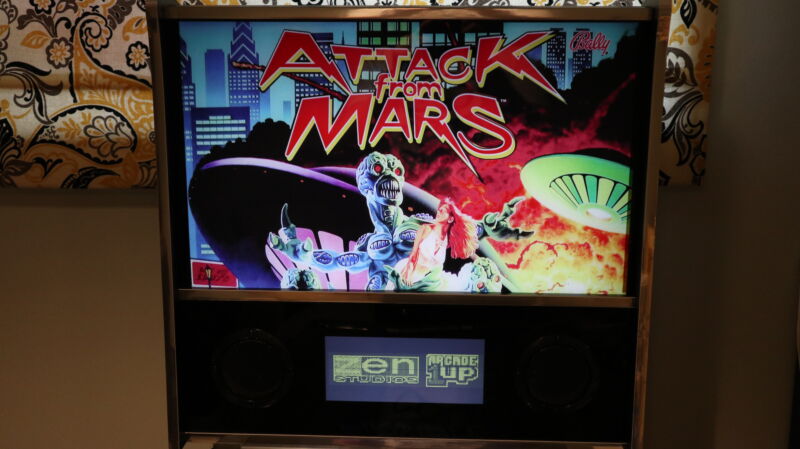
Say hello to the Arcade1Up Attack From Mars physical pinball cabinet. The chassis is physical; its games are all virtual. Read below to understand what the heck that means.
Enlarge / Say hello to the Arcade1Up Attack From Mars physical pinball cabinet. The chassis is physical; its games are all virtual. Read below to understand what the heck that means.
Sam Machkovech

If you’re of a certain generation, chances are you have imagined (or, at this point in your adulthood, built) your own home arcade that resembles something out of the golden ’80s era. One useful path to making this a reality, especially in tighter quarters, is the “multicade,” an invention that squishes multiple games into a single cabinet.

But what if your old-school gaming dreams revolve around something bigger and bulkier, particularly pinball? Until recently, your options were either buying a bunch of original pinball cabinets or building your own ground-up emulation solution. And the latter is complicated by the realities of how pinball plays and feels.

I’ve wondered how long it would take for that to change in the gaming-nostalgia market, especially as companies like Arcade1Up produce and sell more multicade cabinets for home use. The time for change is now, evidently, thanks to a handful of manufacturers producing pinball multicades. Arcade1Up in particular launched three distinct pinball emulation cabinets this year, each revolving around a different license.

Thanks to Arcade1Up, I’ve gone hands-on with arguably the most interesting product in its 2021 pinball line: a collection of 10 classic tables, all created by Williams during its arcade heyday but emulated for more convenient home play. What exactly does $600 get you in terms of emulation and build quality?

Time to get Mad and Medieval

Arcade1Up Digital Pinball (Attack from Mars) product image

Arcade1Up Digital Pinball (Attack from Mars)

(Ars Technica may earn compensation for sales from links on this post through affiliate programs.)

The Arcade1Up pinball system is largely the same across all three models released this year. Most of the physical cabinet is preassembled inside its box, and finishing the construction—which resembles a classic pinball machine, complete with buttons and a plunger—is simple enough with a standard screwdriver. The biggest catch will be getting the cabinet’s biggest, heaviest piece through doors or over stairs. This portion measures 34 inches long, 17 inches wide, and 16.5 inches tall. (Luckily, you can unscrew this base chunk in a pinch.)

Once fully built, this cabinet’s tallest backplate gets up to 60 inches in height, while the default legs bring the flippers up 35 inches from the floor. These include twistable feet that you can adjust to even out the set’s balance. At roughly 65 percent the size of a standard pinball cabinet, the Arcade1Up version will more likely fit in your favorite playroom, though it looks better in isolation rather than sitting next to an official table of the era.

Peek over the fake coin doors, and you’ll quickly see where Arcade1Up’s system differs hugely from the real thing: a 24-inch LCD panel, offset by a significant bezel all around (wood on top and bottom, aluminum on the left and right). Beneath the screen, Arcade1Up relies on an Android-fueled SoC, which pumps a 720p video signal to the screen, along with an analog receiver for the plunger, an accelerometer to sense your real-life “tilts,” and four solenoids that thump along with your gameplay. Two of them are positioned near the flipper buttons to replicate the sense of striking a pinball, while two fit deeper inside the chassis to replicate midgame bumps.

With the backplate attached and a single AC adapter plugged into a wall outlet, the machine is ready to rock. The backplate offers two crucial pieces to the pinball-emulation puzzle: a smaller LCD screen, which provides score information and midgame animations, and a pair of surprisingly robust speakers.

My virtual choice: The real classics

The backplate, by the way, is a printed poster that doesn’t change regardless of which virtual game you’re playing. My cabinet highlights the original Williams table Attack From Mars, while Arcade1Up’s two other 2021 models are decorated with Star Wars and Marvel characters, respectively. Sadly, for the Attack From Mars cabinet, Arcade1Up didn’t get a great source for the side cabinet art (especially on the backplate’s sides). Those images are a bit warped and low-res. Should your default home arcade have dim lighting, you may not even notice.

Power the system on, and after an admittedly overlong loading screen, Arcade1Up’s interface pops up, revealing a selection of 10 games as powered by Zen Studios’ digital-pinball ecosystem. The Williams machine I tested includes the following:

  • Attack from Mars
  • Fish Tales
  • The Getaway: High Speed II
  • Junk Yard
  • Medieval Madness
  • No Good Gofers
  • White Water
  • Red & Ted’s Road Show
  • Hurricane
  • Tales of the Arabian Nights

Should you purchase either of the other two 2021 models, you’ll get 10 virtual tables created by Zen Studios for previously released console and PC game collections, as opposed to recreations of real-life classics. That’s why I requested this model in particular. I was more interested in recreating familiar classics than playing Zen Studios’ digital-only inventions.

https://arstechnica.com/?p=1774443



Game Boy Advance game gets split-screen multiplayer through new FPGA core

[embedded content]
Developer Robert Peip shows off some split-screen Game Boy Advance multiplayer gaming through his new FPGA core.

Here at Ars, we’re big fans of situations where emulation creates a classic gaming experience that’s actually better than what you could get with original hardware in some way or another. In the past, that has meant upsampling rotated sprites in SNES’ “Mode 7” games or adding “widescreen” support to NES games or mitigating the controller lag that was built into certain older consoles or overclocking an emulated SNES to remove slowdown without ruining gameplay timing.

The latest emulation-powered retro-gaming upgrade to cross our paths greatly simplifies an oft-overlooked capability built in to many Game Boy Advance titles. Namely, it adds the ability to play multiplayer titles in split screen on a single display.

This upgrade is the work of Robert Peip, a developer who’s spent years working on field-programmable gate arrays (FPGAs). These days, Peip works primarily on the MiSTer FPGA an open source project that recreates classic gaming hardware extremely accurately through emulation “cores” that replicate every single logic gate involved in the schematics of the original system (most of Analogue’s high-end retro hardware is similarly powered by FPGA cores). Such cores are currently available for consoles ranging from the Odyssey 2 through the Neo Geo era and more.

Peip’s new “special version” of the Game Boy Advance FPGA core works relatively simply, running two GBA cores in a single MiSTer. As Peip explains, “you get 2 raw GBA cores, one connected to SDRAM, one connected to DDR3, communicating directly inside the FPGA. Sound is used from Core 1 only.”

Thus, games originally designed to be played on two consoles connected via link cable can now be played in split screen on a single MiSTer with a single connected display, as shown in this demonstration video. Peip says that “most multiplayer games should be supported,” a statement that presumably includes original Game Boy games (which work on a GBA link-cable through a supported secondary mode).

Playing these multiplayer GBA games on original hardware required two separate consoles, two copies of the game, and a GBA link cable, ensuring most casual players probably never even bothered (some GBA games offered limited multiplayer with just one cartridge). And while previous GBA emulators have offered link-cable support, even that required a LAN or Internet connection between two separate machines with two separate displays. While some RetroPie users have done a bit of finagling to get multiplayer games for the original Game Boy working via split screen, we’ve never seen a similar one-machine, one-display solution for Game Boy Advance multiplayer games before this.

Peip’s turnkey test core for multiplayer GBA emulation is currently only available by supporting his Patreon, and it is currently missing features like savestates, fast forward, and visual filters available on other GBA cores. Still, we’re excited to have a new, easier-to-use method to try the oft-ignored multiplayer modes in some classic portable titles. Now if we could only get split-screen support for those four-player GBA titles…

Listing image by Nintendo

https://arstechnica.com/?p=1774517


Peter Jackson’s 6-hour Beatles documentary confirmed for Disney+ this November

Peter Jackson’s next six-hour epic is finally coming out this year—and in a first for the acclaimed director, the film will launch directly to a streaming service. It will also be broken up into episodes.

The Beatles: Get Back, an expansive documentary originally announced for a theatrical run this August, has had its release strategy tweaked. On Thursday, Jackson and Disney confirmed that the entire project will launch exclusively on Disney+ during this year’s American Thanksgiving holiday. Each third of the documentary will launch on the streaming service on November 25, 26, and 27. As of press time, Disney hasn’t said how the film will reach audiences outside of Disney+’s supported territories. Neither Jackson nor Disney clarified how the original theatrical run might have worked or whether the global pandemic forced anyone’s hand.

Today’s news confirms that Jackson had an abundance of footage to work with. Roughly three years ago, the remaining Beatles handed him access to a musical holy grail: over 60 hours of previously unseen video recordings, mostly capturing the Beatles working on the album Let It Be and rehearsing for, and then performing, the band’s legendary 1969 rooftop concert in London.

Jackson stitched the footage together with access to what Disney calls “over 150 hours of unheard, restored audio”—meaning yes, somehow Apple Corps. still has some tapes in hiding after this many Beatles special edition albums, anthologies, video games, and Cirque du Soleil collaborations. For further context on the Let It Be recording sessions, the film will be paired with a physical book full of photos and original interviews, now delayed to an October launch.

Jackson’s comments in today’s news, as provided by Disney to members of the press, imply that he indeed sought to release a long documentary: “I’m very grateful to the Beatles, Apple Corps., and Disney for allowing me to present this story in exactly the way it should be told.” He also commented on the original documentary footage, filmed by Michael Lindsay-Hogg, as something that is “not nostalgia—it’s raw, honest, and human.”

The Beatles: Get Back will launch on a Thursday, thus breaking Disney+’s latest initiative of launching new series episodes on Wednesdays instead of Fridays. If anyone can break a newly sacrosanct Disney+ rule, it has to be the Beatles.

Listing image by The Walt Disney Company / Apple Corps / Wingnut Films

https://arstechnica.com/?p=1774274


Bethesda exec says he’s “sorry” for lack of PS5 Starfield

[embedded content]
Bethesda Senior Vice President of Marketing and Communications Pete Hines talks to GameSpot about Starfield.

This week, Microsoft and Bethesda confirmed that Starfield will be coming exclusively to Xbox Series X/S and PC next year. And while that kind of exclusivity deal had been hinted at and heavily suspected by many since Microsoft’s $7.5 billion acquisition of Bethesda’s parent company, the announcement still came as sad news for PlayStation 5 owners hoping to play the upcoming space epic.

Bethesda Senior Vice President of Marketing and Communications Pete Hines said he can certainly understand how PS5 owners must feel. In a video interview with GameSpot Wednesday, he offered his sympathy and an apology to PS5 owners upset about the move.

“I don’t know how to allay the concerns of consumer and PlayStation 5 fans other than to say I’m a PlayStation 5 player as well, and I’ve played games on that console, and there’s games I’m going to continue to play on it,” Hines said. “But if you want to play Starfield, [it’s] Xbox and PC. Sorry. All I can say is I apologize because I’m certain that that’s frustrating to folks, but there’s not a whole lot I can do about it.”

Look on the bright side

At the same time, Hines seemed to suggest that Xbox Cloud Gaming could provide a way for players who don’t have an Xbox or a gaming PC to access Starfield through the “Xbox ecosystem.” Hines mentioned that Xbox chief Phil Spencer “has talked about how they’re looking to expand that and… looking to bring Xbox games to folks who don’t own a Series S or X or even a PC but want to play the games that we’re bringing to Game Pass.” That’s an apparent reference to Microsoft’s recently announced plans to expand Xbox Cloud Gaming to many Smart TVs and generic web browsers like Chrome, Safari, and Edge.

Hines also said Starfield‘s exclusivity could help its developers focus on the gameplay experience rather than compatibility with additional platforms. “I’m here to tell you, and any [developer] will tell you this, [when] you go to fewer platforms, your development gets more streamlined,” he said. “You’re not worrying about, ‘Well, how does it work on this box versus how does it work on that box…’ We’re not making it on that box, so it just needs to run as well as possible on this one [and] on a PC. A narrow focus always helps…”

That statement echoes comments Bethesda producer Todd Howard made to The Telegraph this week, when he said that, “by focusing on those platforms [Xbox and PC], you really get to lean in a lot on making it the best it can be for those systems.”

In that interview, Howard also said he had “a little bit” of reservation about not having a PS5 version of Starfield. “You don’t ever want to leave people out, right?” But Howard also suggested that Xbox Cloud Gaming means “we see it actually opening up more and more and more so that people’s ability to play our games—via Game Pass and other things—their ability to play our games doesn’t go down. It goes up dramatically… I will just say I want everybody to have the ability to play it in some fashion.”

Back in October, Howard said it was “hard to imagine” a game like the upcoming Elder Scrolls VI being exclusive to Microsoft’s platforms. But that was before Microsoft’s acquisition of Bethesda was finalized in March, at a time when Howard admitted the two companies hadn’t fully discussed the details of any multiplatform publishing agreements. “We haven’t gone through all of that, to be honest,” he said at the time. https://arstechnica.com/?p=1774277


Medieval people suffered for fashion with their extremely pointy shoes

Detail showing fashionable pointed shoes of two English courtiers of Richard II, 14th century. One has two different colored shoes and chains hanging from his knees. Hand-painted copy of 14th-century art (c. 1847).
Enlarge / Detail showing fashionable pointed shoes of two English courtiers of Richard II, 14th century. One has two different colored shoes and chains hanging from his knees. Hand-painted copy of 14th-century art (c. 1847).

As many as one in three Americans suffer from bunions, those painful bumps that form on the outside of the big toe. Wearing high heels or ill-fitting shoes that cramp the toes can make the pain even worse, since constrained spaces increase pressure on the big toe joint. That doesn’t deter people from wearing them, however. It’s a well-established maxim that sometimes one must suffer in order to be fashionable.

According to a recent study published in the International Journal of Paleopathology, people in the European Middle Ages also endured pain in the name of fashion—in this case, with shoes with exaggerated pointed toes. University of Cambridge archaeologists studied skeletal remains excavated from Cambridge and found evidence that bunions were far more prevalent in remains from the 14th and 15th centuries than in those from earlier centuries, when more pragmatic footwear was popular. This may have increased the risk of suffering fractures from falls.

“We were quite fortunate that we happened to be studying a time period where there was a clear change in shoe fashion somewhere in the middle of our sample,” co-author Piers Mitchell told The Guardian. “People really did wear ridiculously long, pointy shoes, just like they did in [the] Blackadder [TV series].” (You can see series star Rowan Atkinson sporting such shoes below and in this clip from the season 1 episode “Born to Be King.”)

<a href="https://rassegna.lbit-solution.it/wp-content/uploads/2021/06/medieval-people-suffered-for-fashion-with-their-extremely-pointy-shoes-2.jpg" class="enlarge" data-height="798" data-width="1200" alt="Rowan Atkinson's Edmund Blackadder routinely wore dramatically pointed shoes in The Black Adder, set in medieval England.”><img alt="Rowan Atkinson's Edmund Blackadder routinely wore dramatically pointed shoes in The Black Adder, set in medieval England.” src=”https://rassegna.lbit-solution.it/wp-content/uploads/2021/06/medieval-people-suffered-for-fashion-with-their-extremely-pointy-shoes-1.jpg” width=”640″ height=”426″ srcset=”https://rassegna.lbit-solution.it/wp-content/uploads/2021/06/medieval-people-suffered-for-fashion-with-their-extremely-pointy-shoes-2.jpg 2x”>
Enlarge / Rowan Atkinson’s Edmund Blackadder routinely wore dramatically pointed shoes in The Black Adder, set in medieval England.
YouTube/BBC

The shoes in question are known as crackows because they were thought to originate in the capital of Poland. They are also called pikes or poulaines (which can also refer just to the long pointed toe instead of the entire shoe). They came into fashion around 1382, when Richard II married Anne of Bohemia. Both men and women wore them, although the aristocratic men’s shoes tended to have the longest toes, sometimes as long as five inches. The toes were typically stuffed with moss, wool, or horsehair to help them hold their shape. There is evidence in the literature from that period that people sometimes tied the toes up to the leg in order to walk more freely, although no archaeological evidence of the practice has been found.

It was a controversial fashion choice, with one 1388 English poem lamenting that men could no longer kneel in prayer because of the long beaks on their shoes. Charles V of France banned poulaines in Paris outright in 1368. And by 1463, English King Edward IV was so annoyed by the trend that he passed a law restricting anyone who was not nobility from wearing poulaines of more than two inches. The shoes were banned altogether two years later, and the trend died out completely by 1475 in favor of wide box-toed shoes.

The clinical term for bunions is hallux valgus, in which the joint connecting the big toe to the foot deforms because the big toe is bending too much toward the other toes. What causes this issue is not entirely clear. Some people might have a genetic propensity to bunions (because they have flat feet, for instance). But the condition can be exacerbated by tight shoes, high heels, and rheumatoid arthritis, among other factors, all of which can affect the biomechanics of how you walk, increasing pressure on the toes. Because the hallux plays a key role in maintaining upper-body stability, that joint deformity can impair balance and lead to an unstable gait pattern. (“Bunionettes” can also form on the outer base of the pinky toe.)

Back in 2005, archaeologist Simon Mays examined the skeletal remains of two British skeleton series; one was from the early medieval period, and the other was from the late medieval period. Mays found evidence of bunions only with the later remains, “consistent with archaeological and historical evidence for a rise in popularity, during the late Medieval period (at least among the richer social classes), of narrow, pointed shoes which would have constricted the toes.”

The Cambridge team applied a similar osteological analysis to its own sampling of remains, since there is evidence that the medieval inhabitants of Cambridge also favored poulaine-tipped shoes by the late 14th century. The researchers also looked at whether there is a correlation between bunions and fractures likely resulting from falls.

The team examined the skeletal remains of 177 adults recovered from four cemeteries around Cambridge: 50 from a parish cemetery of All Saints by the Castle, 69 from one by the Hospital of St. John the Evangelist, 21 from one by the Augustinian friary, and 37 from a burial ground associated with Church End in Cherry Hinton. The examination focused on assessing the skeletal elements of the big toe for evidence of bunions. The researchers also looked for evidence of fractures, with the objective of establishing a possible link between bunions and injury from falls.

The results: 18 percent of all the skeletons the researchers examined showed evidence of hallux valgus. Among the remains that could be accurately dated, 27 percent of those from the 14th and 15th centuries showed evidence of bunions, compared to just 6 percent of skeletons that were buried between the 11th and 13th centuries. The highest prevalence was found among remains from the friary: 43 percent, compared to just 3 percent for the rural parish cemetery.

“Rules for the attire of Augustinian friars included footwear that was ‘black and fastened by a thong at the ankle,’ commensurate with a lifestyle of worship and poverty,” said Mitchell. “However, in the 13th and 14th centuries, it was increasingly common for those in clerical orders in Britain to wear stylish clothes—a cause for concern among high-ranking church officials.”

As for evidence of fractures, the Cambridge team found that fractures consistent with falls were far more common in the remains of those with bunions than those without, as well as being more common in the remains of older people with hallux valgus than those of the same age with normal feet. This is in keeping with modern studies.

“Modern clinical research on patients with hallux valgus has shown that the deformity makes it harder to balance and increases the risk of falls in older people,” said co-author Jenna Dittmar. “This would explain the higher number of healed broken bones we found in medieval skeletons with this condition.”

“Overall, the findings… would be compatible with the hypothesis that foot problems caused by the adoption of fashionable footwear had an impact on mobility and balance that resulted in an increased risk of falls within the community of medieval Cambridge,” the authors concluded.

However, they acknowledged some limitations to their study. For instance, like similar studies that try to analyze and interpret fractures in human bones, such trauma accumulates over a person’s life. Older people also often experience age-related bone loss, which brings a higher risk of fractures. So the high rate of fractures in the older samples could have had multiple contributing factors, not just falls caused by awkward, pointy-toed shoes.

“A narrow toe box can apply further pressure to the toes and push them into a different shape, much like wearing a corset,” Emma McConnachie, a spokesperson for the College of Podiatry, told The Guardian. “The findings of the Cambridge team highlight these issues have been around for quite some time. It would appear that the fashion choices of the 14th century inflicted similar issues from footwear as we see presenting in clinics today.”

DOI: International Journal of Paleopathology, 2021. 10.1016/j.ijpp.2021.04.012 (About DOIs).

https://arstechnica.com/?p=1773236


Todd Howard is finally ready to share some Starfield details

[embedded content]
“Into the Starfield” promo video.

Over the weekend, Bethesda revealed the first pre-rendered trailer for Starfield, giving us a glimpse of a game that has existed publicly as nothing more than a title since 2018. While the atmospheric trailer effectively establishes mood and hints at the wider universe of Starfield, it offers few details of how that universe works or what the player’s role in it will be.

Luckily, Bethesda Director Todd Howard has offered additional details through interviews to The Washington Post and The Telegraph. In those interviews, Howard describes Starfield as being set “300-ish” years in the future, and he says the team has taken pains to map out a “what happens every decade” history that gets humanity from now to then.

That kind of attention to detail was a recurring theme in Howard’s new interviews. “We start with the world and questions like ‘What do they eat? What do they write with? How do they order their books?'” Howard told The Telegraph. He also noted that “we want to know what all the buttons do” on the complicated control panel shown in the trailer. “We model all the buttons… every button, I think, is labelled in the ship.” That doesn’t mean players will necessarily be responsible for flipping all those toggles, but it’s nice to know someone is thinking about them.

Lead artist Istvan Pely told the Post that the game’s aesthetic could be summarized as “NASA punk.” The style of Starfield‘s first trailer is an explicit homage to the look and feel of NASA from the 1969 space landing era, Howard said. He also called back to a long-standing interest in space travel rooted in the sci-fi media he grew up with in the 1970s: Star Trek, Star Wars, and Battlestar Galactica.

Why are we here?

Howard also alluded to some heady themes for the game beyond simple exploration and/or conquest. “When you look up in the sky, there is this drive to know, what is out there?” he told the Post. “Are we alone? What are the origins of space and time and all of those things? What role does religion play in some of that as well? So we do get into some big questions. I think a game like this is a good place to do that.”

“We get into science, we get into religion,” Howard expanded to The Telegraph. “I really enjoy thinking about those big questions. I see them in other [forms of] entertainment, and I think we have a unique way of presenting it with a game like this, where maybe we don’t have all the answers, but I think it’s good to get people thinking.”

More prosaically, the game will focus on the player as a member of Constellation, the “last group of space explorers” heading off into the cosmos. The game’s structure is “kind of like Skyrim… where you’re going to be who you want to be, and then there’s different factions that you can join and really carve your own path,” Howard said. Players will be able to choose a specific background for their character at the outset and make customization choices “that will impact how some things in the game unfold,” according to The Washington Post write-up.

An accompanying “Into the Starfield” promotional video waxes poetic on a lot of the same themes from Howard’s interviews, and it says players can “be who you want, go where you want, experience our stories, and forge your own.” That video also includes an intriguing Easter egg: an in-universe memo that can be seen at the 0:57 mark on the computer of one of the developers. As transcribed by GamesRadar, the memo warns the recipient of problems with interstellar piracy, and it seems to name a few of the factions and governing bodies that will feature in the game.

Is this an accurate leak of a fragment of in-universe lore (either intentionally or unintentionally)? Or did Bethesda simply throw together a fake work-in-progress for attention-obsessed viewers? We’ll hopefully find out on Starfield‘s planned November 11, 2022, release date, of which Howard told the Post, “We’re confident in the date. Otherwise, we wouldn’t be announcing it.”

Listing image by Bethesda

https://arstechnica.com/?p=1773383


Halo Infinite multiplayer news: Bots, split-screen, free-to-play clarified

After releasing a sizzle-reel of Halo Infinite this weekend, developer 343 industries on Monday provided a deep-dive video on the game’s upcoming multiplayer mode. The showcase explains what we should expect from the series’ first cross-platform, free-to-play shooter later this year. The best news echoes a 2017 Microsoft pronouncement: Split-screen gameplay is back.

Microsoft has tucked the split-screen news away as a single line of text in this week’s blog post on the video reveal. The post also confirms that Halo Infinite, like Halo 5, will support LAN play across all compatible platforms (Windows PC, Xbox One, Xbox Series X/S) via a dedicated “local server” app on PC. And the video reaffirms 343 Industries’ promise that the series’ first-person games “will always have split-screen support going forward.” 343 Industries chief Bonnie Ross made that statement in 2017 after Halo 5 took considerable lumps from the community for cutting that support.

Today’s update only says that split-screen support is available for “Xbox.” It does not clarify whether the feature will support fewer players on a single screen on weaker Xbox One consoles or whether such a feature will work via Xbox’s burgeoning cloud-gaming options. (Also, can we seriously toggle split-screen options on PC already? We plug computers into big-screen TVs now, 343.)

Academy fight song

In a first for the mainline Halo series, bots will be available inside a new tutorial-filled mode dubbed the “Halo Academy.” You’ll face off against bots during bespoke training-style missions (which weren’t shown to fans just yet), while players can also fill out any “custom game” with bots of varying difficulties. In previous games, the closest that players got to such an option was to spin up a “Firefight” battle against AI grunts. Otherwise, no Halo game has gone to the trouble of providing AI foes designed specifically for its option-rich versus modes.

There’s probably a reason: Halo combat can get complicated. Will Halo Infinite‘s bots truly be up to the task of splitting their attention between Halo classics like weapon-respawn control, managing tunnels with grenades, rushing to claim vehicles, and dual-wielding weapons in select scenarios? And how will new series elements like a grappling hook further complicate those AI demands? Yes, I’m looking a gift horse in the mouth here, and even the dumbest AI peons will still be a massive upgrade over none at all.

This week’s blog post also hints at how the new game will onboard novices: “improved systems that deliver better communication of key info to players during a match.” This, of course, could mean a million things: a new “ping” feature like in Apex Legends or color-coded indicators of objectives—or maybe the classic Halo announcer voice shouting turn-by-turn directions for what to do, Waze style.

Speaking of announcers, the series will continue its commitment to deep customization by allowing you to swap out the default battle announcer, dubbed “AI,” via a chip inserted in the back of your Spartan armor’s helmet. While the Master Chief Collection already includes swappable in-game announcers, Halo Infinite hints at an even more customizable system that lets your in-game voice have its “personality” tweaked however you see fit. Could more snark be an option?

The feature sounds intriguing. Unfortunately, 343 didn’t say exactly how this new voice system will coexist with default series announcer Jeff Steitzer shouting things like “killtactular!” mid-match.

F2P without the FOMO

Halo Infinite‘s multiplayer mode will launch as a free-to-play title, and you can look at Master Chief Collection‘s free “battle pass” system for a peek at how the new mode may work.

Infinite will offer similar experience-driven cosmetic unlocks, though real-world money will be required to open the full selection. As in MCC, Infinite‘s battle passes will operate without any FOMO monetization. You can purchase and highlight any battle pass, present or past, to drive your progress toward its unlocks, should you show up late to a certain shiny armor add-on or take a months-long break from the game.

A quick series of images shown on Monday confirms even more Spartan armor customizations this time around, including the series’ first prosthetic limbs. But if you want to pay zero dollars and zero cents and blow people up using a simple, default suit, you can certainly do so. Infinite‘s multiplayer maps, modes, weapons, and other gameplay-related content will be available for all players, whether they spend money or not. (Further nitty-gritty details: No loot will be unlocked via surprise systems like loot boxes. And if a weapon can be earned via experience, it cannot be purchased outright, and vice versa.)

As far as how the game differs mechanically from existing Halo entries, we get a few looks at changes big and small. The new grappling-hook ability appears to be the biggest change, though Monday’s video didn’t clarify anything beyond the Sunday reveal’s glimpse at crazy new maneuvers like the “grapple-jack.” (That move rewards players for grappling up to a midair vehicle, then punting its pilot to the ground below.) And we’re still waiting to see what the grappling hook’s recharge meter looks like or whether it can be further limited or outright banned in certain Infinite multiplayer modes and custom games.

Did I mention the brand-new Razorback four-wheeler? It resembles the Warthog, but the new cargo bay in its trunk is meant to carry heavier weapons, flags, and other objective-specific objects. 343 has yet to clarify how this very useful vehicle has been balance-adjusted compared to other driving options, though a new anti-armor weapon (the Skewer) seems like an obvious counter. That’s especially likely when you consider that Infinite will include newly destructible elements for vehicles that you can individually target. (If you’re looking for other solid firepower options, the “smart scope” semi-zoom returns to classic Halo weapons like the assault rifle.)

Big Team bucks? Campaign?

While we assume classic combat modes will fill out Infinite‘s public matchmaking queues over the course of its seasons, we don’t yet know what new or existing modes will be the focus at launch beyond confirmation that Halo 5‘s Big Team Battle will return. Sadly, 343 didn’t go into detail about whether or how the Halo 5 system of BTB “requisitions” may return to Halo Infinite and its free-to-play economy. (Requisitions are in-game cards that can be purchased with real money and have an impact on combat.)

If you’re keeping score, some other nagging questions remain unanswered. How many maps, weapons, and vehicles will the game ship with? When might classic maps appear? The series’ famed “Forge” mode—meant for building new maps and modes—will return, but how exactly will it work? How will players share their customized content with friends and the community? And will Halo Infinite eventually give in and do a battle royale mode?

Clearly, the development team at 343 Industries has more to reveal between now and the game’s “Holiday 2021” launch window, especially since Sunday’s splashy trailer included zero new footage of how the game’s campaign mode will look. We saw no new biomes, no new vehicles, and no new ways that the campaign’s emphasis on open-world exploration will play out (and we’d sure like to see some updates there). As soon as we do, we’ll report back, fellow Spartans.

[embedded content]
Halo Infinite multiplayer breakdown, June 2021.

Listing image by Xbox Game Studios

https://arstechnica.com/?p=1773257


Ubisoft at E3: Mario Rabbids sequel, Rainbow Six: Extraction, more

On Saturday, Ubisoft joined the E3-timed announcement fray with its latest Ubisoft Forward video presentation, complete with a mix of familiar and brand-new game announcements.

The showcase kicked off with Rainbow Six: Extraction, a three-player co-op battling game that drops an alien invasion on top of Tom Clancy’s tactical-combat universe. (Did I miss that particular subgenre of Clancy books? No matter.) The game will launch on PC and most consoles on September 16.

A meaty gameplay preview video showed a three-player squad moving through one of the game’s combat levels, which will combine bespoke architecture with random alien placements—and Ubisoft’s reps hinted to the aliens being able to create walls, gates, and restrictions to randomly redefine your descent into each level’s belly.  The resulting gameplay resembles Left 4 Dead, with a mix of weak and superpowered aliens (dubbed “Archies”) potentially splitting squads up as they battle and survive.

[embedded content]
Rainbow Six: Extraction gameplay reveal

Ubisoft didn’t clearly answer how the game’s ongoing experience and ability systems will work, but Ubisoft’s reps hinted to this including a severe risk/reward structure. If you progress more deeply into a particular level, you’ll be able to score more rewards, but if any player in a squad is left behind in a mission, that player will lose progress. And these levels are even tougher thanks to the fact that you’ll need to melee-kill certain enemies to extract “tissue data,” instead of merely killing from afar and running away.

Exactly how much progress will players lose upon death? And how much will this resemble permadeath and thus result in stressful online griefing opportunities for strangers? Those issues remains unclear. But Extraction does look like a potentially interesting twist on co-op alien battling, especially with R6: Siege‘s gadgets and destructible walls figuring into the genre in seemingly unique ways. Plus, announced cross-play support has us thinking this game might have significant online-play legs.

One of the event’s biggest (albeit unsurprising) stories leaked hours before the conference: Next year, Ubisoft will continue its partnership with Nintendo and release a sequel in the Mario + Rabbids crossover franchise. The new game, titled Mario + Rabbids: Sparks of Hope, sticks to the series’ weird premise of original Super Mario characters joining forces with Rabbids, giving them all guns, and making them fight bad guys using turn-based, XCOM-like tactics.

This time, the crossover universe borrows from Super Mario Galaxy‘s canon by sending the combined battling forces across multiple planets, and introducing Rabbid-ized versions of Rosalina and Luna. Unsurprisingly, the sequel will continue the crossover series’ streak of remaining a Nintendo Switch exclusive.

Another Saturday morning leak revolved around today’s announcement of Rocksmith+, a new “live” version of Ubisoft’s “Guitar Hero, but with real guitars” series. Like last time, you can connect your favorite real-life guitar to your console or computer to enable a mix of guitar-playing tutorials and rhythm-gaming strums through familiar songs… only this time, you’ll pay a subscription-service fee for the privilege. This follows Ubisoft’s decision last year to sunset the existing Rocksmith service, which had revolved around individual DLC purchases of add-on songs.

If you’ve never bothered with Rocksmith before, a subscription service may ultimately make more sense than lump-sum purchases of individual songs to strum to. But it’s unclear whether Ubisoft will maintain enough content and variety to make the new game’s version worth investing in for the longterm, especially for those who already dumped plenty of cash into Rocksmith‘s seven-year-old last-gen structure (or prefer the older PC version’s support for user-made add-ons). Today’s announcement of a free beta will at least let those with compatible guitars try before they might one day subscribe—and see whether the new game’s mobile app version holds up in terms of using your phone’s mic to track your guitar strumming accurately.

We now know that Riders Republic, announced during an E3-timed event last year, will launch later this year on September 2. But its newest trailer did more to obfuscate and confuse than it did to clarify exactly how this extreme sporting smorgasbord will play out on our own PCs and consoles.

On one hand, it includes 64-player races where everyone can pick between wingsuits, bikes, snowboards, and more. On another, it includes team-based score-control online modes that resemble turf acquisition modes in older Tony Hawk games. And beyond that, it lets players switch between first-person and third-person bicycling on top of massive mountains, or parachute and glide over the top of its massive worlds, or even attach a rocket-powered backpack to a glider and ride wherever players please.

Hence, it clearly follows the DNA of “ride as you see fit” in 2018’s The Crew 2—and thus you should probably set your expectations accordingly.

After showing off footage of existing and previously revealed games, Ubisoft teased a Far Cry 6 season pass that will put players in control of various series villains, all connected in a new, wacky metaverse. Then the show concluded with a peek at Ubisoft’s upcoming game based on the Avatar film franchise, titled Avatar: Frontiers of Pandora. The game is slated to launch in “2022,” which could very well place it alongside Avatar 2‘s theatrical launch, and it will apparently include a mix of Avatar’s alien creatures facing off against aggressive human invaders while riding dragons. But it only appeared as an apparently pre-rendered sequence (labeled “powered by Snowdrop,” as if to imply it was made inside a real game engine, but if that’s real gameplay, then my name is James Cameron).

Listing image by Ubisoft

https://arstechnica.com/?p=1772743


Kena: Bridge of Spirits hands-on premiere: As good as “Legend of Pikmin” sounds

Until I played Kena: Bridge of Spirits this week, I wondered why I would carve time out of my gaming schedule to play yet another third-person adventure game. Sure, the game looked cute, but who the heck is this new studio, Ember Lab? And why should I assume this upstart has anything to add to a crowded genre beyond a stylish mystical-forest aesthetic?

One Parsec demo session later, my tune changed entirely.

I was invited to test the new game, slated to launch August 24 on PC, PS5, and PS4, as part of its inclusion in this week’s first-ever Tribeca Games Festival. The title is a serious coup for the fest (especially in a month full of online game reveal “events”). My hands-on hour with the game’s opening quests suggests that Ember Labs may indeed deliver on its promise of presenting a refreshing Zelda-like adventure with a tasteful sprinkling of Pikmin‘s minion-control systems.

Rot the night away

Hero Kena’s moves feel punchy and powerful, whether she’s running and jumping, swinging a staff, lining up bow-and-arrow blasts, or activating her cute-yet-deadly “Rot” powers. Her quest involves picking up little Rot creatures—furry little blobs, like Ewoks crossed with black cats—and using them to overpower her foes.

The below gallery shows a few ways the Rot contribute to Kena’s powers. Like in the Pikmin series, they can become helpful lifters and pullers, but they can also turn into temporary forms, like a snake-slug that you can maneuver with one joystick while moving Kena with the other. When in this form, the Rot can destroy poisonous barriers or open up paths until their snake-slug timer runs out. And when you rack up enough damage, you earn a charge—represented by golden orbs in the game’s UI—that allows you to use Rot-specific abilities. Stun a foe, super-charge your staff for extra damage and reach, activate a one-time healing beacon, and more—and with limited golden orbs, you’ll have to make tough spur-of-the-moment decisions in how you allocate your blobby pals.

Plus, yes, they get individual hats.

Ember Labs has pulled off a pretty impressive transition from CGI-animation studio to fully fledged console game-maker. Its founders, brothers Josh and Mike Grier, confirmed in an interview with Ars that they had to fight their instincts as an animation-first production house to serve the game’s mix of melee, ranged, and magical combat. “That was our battle the first couple of months [of production],” Josh Grier said. “We had all these key frames [of animation], and then we found the balance. The rule was “it’s going to be snappy, so the key frames have to move quickly.” That’s where the stylized look helps. We can squish and stretch Kena on a dime, and it doesn’t look or feel weird.”

As a result, Kena can cancel and transition between moves mostly seamlessly. You’ll have to wait for a “heavy” attack animation to play out if you whiff, and the combat has nothing close to the deep combo system of Devil May Cry. But the game feels very satisfying, especially when you nail the timing for “parry” blocks or slow down time to line up a precise bow-and-arrow strike. Meanwhile, the game’s mix of chunky sound design and particle-swirling magical attacks add considerable weight to Kena’s successful staff strikes against the game’s corrupt-tree monsters.

The above galleries don’t necessarily sell the full aesthetic package. For one, they don’t show how delightfully the Rot tag along and run ahead of your path to sit on nearby rocks as a cute and organic way to make clear that you’re on the right path to something. As this is a “wide linear” game, you’ll usually find some tucked-away side trails to explore for upgrades and bonuses while otherwise barreling ahead, though you also have access to a central hub world and warp gates for the sake of returning to past zones once you unlock new powers. In one example of the game’s Metroidvania stylings, I unlocked a bow halfway through my demo, which, among other things, lets Kena shoot at distant, magical flowers and turn them into grappling hooks to access new zones.

The other aesthetic touch missing from the above gallery is the woodwind-heavy soundtrack, complete with dynamic rise-and-fall reactions to increasing dangers as battles ignite. Ember Labs was kind enough to send me some OST cuts after the demo concluded, and they’ve served as pleasant background music for writing up my impressions.

Enchanted

I was told my hour-long demo represented “one-third of one-third of the game,” which suggests there are ten hours of adventuring across three discrete zones, along with some massive boss battles yet to be revealed. Given my lowering tolerance for lengthy games, that sounds pretty good—though I wonder whether the full game will ultimately line up with its $40 price point. We’re getting a tightly constructed adventure game with memorable, beautiful zones and a brief runtime, along with a Pikmin-like twist that hopefully won’t get too cute or gimmicky and thus wear out its welcome. (I’m optimistic on that latter point, as the Grier brothers confirmed that they scaled back their original plans for Rot-like twists when they got in the way of accessible fun.)

Obviously, we’re in the hype cycle of not-quite-E3, so promising reveals and teaser trailers are the order of the day, but I left my 60 minutes with Kena: Bridge of Spirits enchanted and eager to return. Its mix of unique and familiar reminded me of Beyond Good & Evil—a game from a devoted team bringing their passion and fandom to the Zelda-like genre and delivering something that instantly grabbed me. We’ll definitely have more on this game when it launches in August on PC and PlayStation consoles.

Listing image by Ember Labs

https://arstechnica.com/?p=1772313


Review: Our favorite trickster god is charismatic as ever in Loki premiere

<img src="https://rassegna.lbit-solution.it/wp-content/uploads/2021/06/review-our-favorite-trickster-god-is-charismatic-as-ever-in-loki-premiere.jpg" alt="Tom Hiddleston stars in the latest MCU series, Loki, which premiered last night on Disney+.”>
Enlarge / Tom Hiddleston stars in the latest MCU series, Loki, which premiered last night on Disney+.

It’s hard to write a killer TV pilot that compels viewers to come back for more. You have to establish a fictional world, introduce the main characters and core premise, and set up a compelling trigger for the subsequent chain of events—all without making things seem frenetic or incoherent and without employing labored explanatory riffs. That’s true even in the case of a well-established fictional universe like the MCU. Fortunately, the first episode of Loki, Marvel’s new series reviving Tom Hiddleston’s beloved Asgardian trickster god, mostly gets it right—even if it does occasionally lapse into lecturing narrator mode (“talky, talky”).

(Only mild spoilers below, with a bit of spoiler-y speculation below the gallery.)

We all remember that scene in Avengers: Endgame when a 2012 version of Loki snags the tesseract containing the Space Stone and vanishes through a portal. That’s where the series opens, with our trickster materializing in the middle of Mongolia’s Gobi Desert, much to the bemusement of a gaggle of locals. It’s not long before another portal opens to bring forth a team of armed guards who “arrest” Loki on behalf of an entity known as the Time Variance Authority (TVA). TVA agents are the so-called “custodians of chronology” in the MCU, monitoring violations to the timeline. Catch their attention by trying to change history, and you just might meet the wrong end of the Retroactive Cannon (Ret Con) and have your entire history deleted from the historical timeline.

By using the tesseract to escape his original timeline, this Time Variant Loki has violated the established chronology. He is chagrined to find that his powers do not work within TVA headquarters, while TVA agents all wield time-twister devices to keep inmates like himself under control. Even Infinity Stones are useless in the TVA, where bureaucratic office drones use them as paperweights.

A judge, Ravonna Renslayer (Gugu Mbatha-Raw), explains the situation to an unrepentant Loki, who is facing being Ret-Conned. But another TVA agent, Mobius M. Mobius (Owen Wilson, wow) intervenes. He wants Loki’s help tracking down another “Time Variant” who has escaped and gone rogue, jumping around through time and disrupting everything by causing so-called “Nexus Events.” The remainder of the episode shows Loki’s initial reluctance and eventual change of heart—even though his trustworthiness is still very much in question.

(Warning: Some spoiler-y speculative elements below the gallery.)

The best thing about Loki is the undeniable on-screen chemistry between Hiddleston (as charismatic as ever in the role he defined) and Wilson, both of whom engage in genuinely witty banter, as opposed to the forced “bro” moments between Sam and Bucky in The Falcon and the Winter Soldier. It’s easy to see how they might eventually bond into true compatriots—assuming Loki’s mercurial nature doesn’t get the best of him. This could be a fascinating character arc for Loki, since this Variant was removed from the timeline right after the events of the first Avengers movie. So he hasn’t experienced all the heartbreaking trauma and subsequent growth of the Loki from the original timeline.

But he does get the chance to see the outcome of that timeline—including the demise of his mother (Frigga) and father (Odin) and the original Loki’s death at the hands of Thanos in Infinity War—thanks to the Time Theater. The Time Theater factors heavily into his decision to work with Mobius. It’s also a fun narrative device, especially since, to keep things fresh, it also includes at least one “memory” from Loki’s history that Marvel fans haven’t seen before. Specifically, Loki is shown to be D.B. Cooper, a mysterious man who hijacked a Boeing 727 in 1971 and escaped by jumping out of the plane, never to be seen again. (It’s a callback to a popular fan theory that Mad Men‘s Don Draper was supposed to be Cooper.) Loki claims he did it because he was young and “lost a bet with Thor.” We would love to hear the backstory on that one.

The episode closes with a brief visit to 1658, where a mysterious hooded figure takes out a band of TVA agents with fire. The culprit is probably the “rogue Variant” Mobius has been hunting, and the encounter has sparked speculation that this might be “Lady Loki” from the comics—a female incarnation (possibly played by Sophia Di Martino) of the trickster god, who has often been portrayed as gender-fluid, given his shapeshifting abilities. That means Variant Loki might be hunting yet another version of himself. I sense an identity crisis in the offing, especially since director Kate Herron has said that identity and self-acceptance are major themes for the series.

In short, the pilot episode did everything it needed to do and did it with a welcome soupçon of whimsical swagger, as befits a trickster god. Whether Loki can develop and sustain this promising start remains to be seen, but I am optimistic that this will be the Marvel series we all so badly want it to be. And with its emphasis on alternate timelines and portal jumps, it should be the perfect set up for Doctor Strange in the Multiverse of Madness, currently slated for release next March.

New episodes of Loki will air on Wednesdays on Disney+ through July 14.

https://arstechnica.com/?p=1771834