Elden Ring shows off first gameplay footage, confirmed for Jan. 2022

Over two years have passed since From Software first shared a prerendered tease for Elden Ring at Microsoft’s E3 2019 press conference. During a streaming Summer Game Fest event on Thursday, publisher Bandai Namco showed the first gameplay footage from this collaboration between Dark Souls creator Hidetaka Miyazaki and Game of Thrones scribe George R.R. Martin and announced a release date of January 21, 2022, for “next-gen and current-gen” consoles.

The trailer below (and the screenshots above) speak for themselves, and the Dark Souls vibes are apparent throughout. That means a lot of dodge-rolling out of the way of some massive attacks from beasts many times the player’s size, including a prominent dragon. It also means a smörgåsbord of dramatic magical effects, including telekinesis, fire, and thrown stone amid the vaguely medieval setting.

A voiceover gives some hints about the “tarnished” protagonist, who has returned “in search of the Elden Ring, emboldened by the flame of ambition.” The protagonist is shown summoning a ghostly horse and fighting against mounted enemies. At one point, the mount leaps straight up a sheer cliffside. It looks like you can also summon a ghostly companion to fight alongside you to attack from multiple angles.

[embedded content]

The Elden Ring reveal capped off a trailer-filled “Summer Game Fest” kick-off event that assaulted us with upcoming games, never-before-seen footage for previously announced games, and new content for games that are already available. Among the highlights (with links to relevant trailers):

Expect many more game announcements in the coming days as companies—including Microsoft, Nintendo, Ubisoft, Square Enix, Warner Bros., Take-Two, Capcom, and more—host their own streaming reveal events as part of a virtual E3 show.

Listing image by Bandai Namco

https://arstechnica.com/?p=1772252


The Anacrusis: Left 4 Dead + sci-fi + persistent AI, coming to PC, Xbox this fall

SEATTLE—The makers of new game The Anacrusis, as revealed during today’s Summer Games Fest presentation, are happy for you to mistake it for something like Left 4 Dead, only transported to a ’70s sci-fi universe. The new game’s co-creator, former Valve designer and writer Chet Faliszek, is banking on it.

“I was the project lead on Left 4 Dead 1 and Left 4 Dead 2, and those are two of my favorite games ever made,” Faliszek says from his home office in Seattle. “Clearly they’re influential to me in deciding what does and doesn’t work in co-op games. Having done those, and having worked on Portal 2‘s co-op mode, I have a good understanding of how players interact and talk, and mistakes we made, in ensuring that people work together. If you like those games, I had a close seat on them, and we’re taking that to the next level.”

The resulting project, which Faliszek is leading alongside Kimberly Voll (Riot Games, Fantastic Contraption) at their indie studio Stray Bombay, is slated to launch “this fall” on Xbox Series X/S, Xbox One, Steam, Windows Store, and Epic Games Store. All versions will be connected with cross-play. In a conversation ahead of today’s reveal, Faliszek emphasized the game’s social thrust, along with a new AI “director” that expands on a similar concept from the L4D series. The director’s goals are to satisfy players and scale to various play styles.

“A million aliens on the other side of the door”

Much like L4D, The Anacrusis is broken up into multilevel “episodes” that are meant to be played in groups of four, and the object is to survive while dealing with monsters (aliens, this time, instead of zombies) via first-person combat. While the levels are prebuilt and bespoke, various elements are mixed up in every playthrough, and Faliszek insists that this part of the game is more evolved than 2009’s L4D2.

“You can do so much more with AI that you couldn’t do back in the day,” Faliszek says, and he says this will happen in a few ways. One is a smarter interpretation of players’ prowess, which will affect dynamic enemy and item placement differently than in his older games. On a beat-by-beat basis, Anacrusis will resemble other co-op combat games, like when useful items are harder to find for “good” players. But the game will add a more persistent understanding of players’ abilities, with their prowess being calculated not only through multiple levels within an episode but over weeks and months of play.

If your crew has been dominating previous levels in an episode, The Anacrusis will go so far as to dump “a million aliens on the other side of the door” in the next one, as opposed to resetting its player understanding between loading screens. And in matchmaking, The Anacrusis will try to determine “social compatibility,” as opposed to versus games’ “rankings.” If a player constantly has their teammates quit before a campaign ends, The Anacrusis will acknowledge that. And if a player prefers to explore every corner of a level, they probably won’t be paired with players who beat episodes more quickly.

For now, enemy types break down similarly to L4D, with weaker aliens appearing in easy-to-shoot waves while interspersed with stronger super aliens. The Anacrusis includes a “brute,” which today’s trailer jokes about and works like L4D‘s “tank.” But two quirkier super aliens got reveals today, too: the “flasher,” whose bursts of white light can temporarily blind players if they’re not killed quickly enough, and the “spawner,” which generates obnoxious turrets until killed.

“You can’t do that in beta tests”

The game’s reveal hints to higher-powered, sci-fi-worthy weaponry, including a “stasis” grenade that slows down enemies, a “vortex” grenade that generates an enemy-sucking black hole, and an arc rifle that shoots chains of electricity. Players should also expect randomly generated “mods” that can be equipped mid-mission, which can either upgrade your existing weapons, give you perks for weapons you haven’t picked up yet, or supercharge the game’s new standard-for-everyone “pulse” ability, which pushes nearby foes back and requires a brief time to recharge.

Faliszek says his team is still experimenting with how “fantastical” the final game’s weapons, items, abilities, and super aliens will turn out, and he is frank: Anacrusis needs more firm, in-the-wild player feedback as soon as possible in order to tune it beyond the L4D formula.

“We need to release the game, have it in players’ hands, and understand those things,” he says. “We can make some assumptions ahead of time, but for us, it’s about trying to get as little of the game out as soon as possible so we can listen to feedback from players, see how they play, hear what they’re saying, and make changes that are more impactful in the long term. You can’t do that in beta tests.”

As a result, this fall’s game launch will neither be labeled as “early access” nor something that’s fully locked down. Faliszek says he likes an “episodic” game release approach, with a whole universe of sci-fi lore being teased out between character banter and episode-ending cliffhangers. But he is also mindful of fans’ perception of a retail-priced game: “Amy Hennig [Uncharted] dared me to release just one episode to start,” he laughs. “That’s too little content, though. Players want to have something to be excited about.”

“Remembering how much I like playing co-op games with strangers”

So The Anacrusis will split the difference when it launches. The game will start with a small amount of replayable co-op content followed by a release plan for more free episodes over time. Along the way, we’ll get “prevalent mod support,” which Faliszek isn’t ready to clarify (but will likely align with his prior employer’s bullishness about community add-ons).

Faliszek has been eager to engage with the co-op-shooter community during The Anacrusis‘ development. He says the most surprising thing about testing other major co-op options in the current marketplace—like GTFO, Killing Floor 2, and Deep Rock Galactic—has been “remembering how much I like playing co-op games with strangers.” And from the look of things, The Anacrusis will primarily differentiate itself by using its AI systems to “stress the co-operative side,” he says. “No competition with each other. Ensuring replayability. We want you to come into that space again and again and make it different every time.”

And with access spread out across many platforms (including the highly popular Game Pass service) and cross-platform online play built-in on day one, the future looks bright in terms of possible player population. But will Faliszek’s ambitions line up with the actual playable game? I have already begun pestering him about going hands-on to find out, and I’ll report back whenever he gets fed up with my nagging emails and lets me play Anacrusis.

[embedded content]
Anacrusis reveal trailer.

Listing image by Stray Bombay

https://arstechnica.com/?p=1772104


GameStop stock falls sharply amid 5M-share sales plan, SEC investigation

Benjamin Franklin continues to be bemused by the seemingly irrational movements of GameStop's stock price.
Enlarge / Benjamin Franklin continues to be bemused by the seemingly irrational movements of GameStop’s stock price.

GameStop’s quarterly earnings report, released last night, contained relatively good news for the embattled retailer, including a smaller-than-expected operating loss and the company’s first year-over-year increase in quarterly revenues in years. But GameStop’s heavily inflated stock price is down significantly in morning trading on news that the company plans to sell more shares and the announcement that it is cooperating with a Securities and Exchange Commission investigation into the “meme stock” phenomenon.

In what CEO George Sherman called a “strong start to the year,” GameStop’s net sales were up over 25 percent to $1.3 billion in the fiscal quarter ending on April 30. That’s despite “a roughly 12 percent reduction in the global store fleet due to our strategic de-densification efforts and the continued store closures in Europe during the quarter due to the COVID-19 pandemic.” The increased sales weren’t enough to make GameStop profitable again, but they were enough to reduce quarterly losses to $66.8 million (or $29.4 million if you take out one-time payments), down from $108 million a year ago.

If they want to buy, we want to sell

More than that, the last quarter saw GameStop’s bottom line buoyed by the sale of 3.5 million shares of additional stock—$551 million worth—to a rabid market willing to pay an average of nearly $160 per share (compared to the sub-$20 share price at the beginning of the year). Thanks largely to that infusion of cash, GameStop has eliminated $504 million in long-term debts it had on its balance sheet a year ago, and it is now sitting on $770.8 million in cash on hand, up from $583.9 million a year ago.

In this way, the meme-driven investors driving up GameStop’s stock price have provided a genuine financial cushion that the company can use to weather the prospect of more difficult quarters ahead, at least in the near term.

GameStop’s recent stock offering was so successful, in fact, that the company now says it’s hoping to sell up to 5 million more stock shares “for general corporate purposes as well as for investing in growth initiatives and maintaining a strong balance sheet.” While that stock would be worth over $1.5 billion at yesterday’s near-record close of $302.56 per share, there’s no guarantee that the stock price will stay so high by the time GameStop manages to make its next at-the-market offering.

Indeed, as of this writing Thursday morning, GameStop stock is hovering around $256 a share, off over 15 percent despite the stronger-than-expected earnings report [Update: Gamestop stock closed Thursday at $220.39, down over 27 percent from the previous day’s closing price]. That could reflect a market realization that all the extra stock GameStop is selling dilutes the ownership stake represented by the company’s existing stock. Then again, GameStop’s stock price has been untethered from the company’s fundamental earnings potential for months now. And while GameStop stock lost about 33 percent of its value the day after its worse-than-expected 2020 fiscal earnings report, it gained back all that value and more the very next day.

SEC probes and new executives

The market could also be reacting to GameStop’s announcement that the SEC asked the company on May 26 to produce documents and information as part of an investigation into the “meme stock” trading that has driven such volatility for the stock this year. “We are in the process of reviewing the request and producing the requested documents and intend to cooperate fully with the SEC staff regarding this matter,” GameStop said in a statement. “This inquiry is not expected to adversely impact us.”

GameStop also followed the official naming of Chewy co-founder Ryan Cohen as chairman of the board with the appointment of two Amazon veterans in its executive team, Matt Furlong as CEO and Mike Recupero as CFO, effective June 21. That could be a good sign for Cohen’s stated goals of “building a powerful e-commerce platform that provides competitive pricing, broad gaming selection, fast shipping, and a truly high-touch experience that excites and delights customers.”

But Cohen yesterday refused to lay out any details of his plans for making that pivot, saying instead that “you won’t find us talking a big game, making a bunch of lofty promises, or telegraphing our strategy to the competition.”

That hasn’t impressed at least some of the few analysts that are still tracking the volatile stock. “Investors deserve more than memes to value a company’s fundamental, long-term prospects,” Baird analyst Colin Sebastian wrote in a note to clients.

https://arstechnica.com/?p=1772099


Don’t look now, but GameStop stock is approaching record highs again

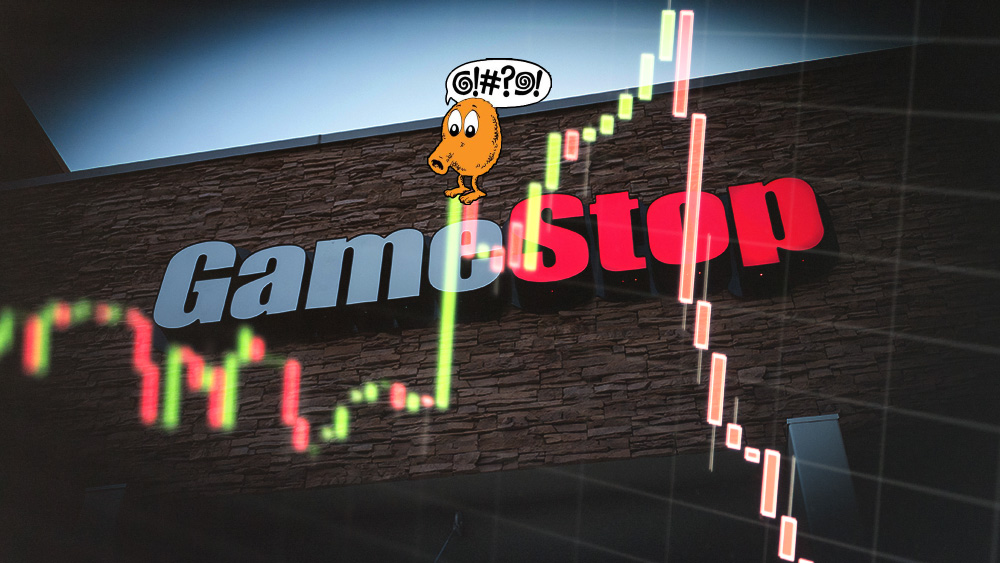
Q-Bert can't tell what the @!#?! is going on with GameStop stock, either...
Enlarge / Q-Bert can’t tell what the @!#?! is going on with GameStop stock, either…

GameStop’s stock price is approaching the historic highs it reached during the zenith of its meme-stock volatility in January. The stock’s steady increase over the last months comes as the company prepares to announce its quarterly earnings after the market closed Wednesday evening. Shareholders, meanwhile, officially elected Chewy co-founder Ryan Cohen as chairman of the board.

As of Wednesday afternoon, GameStop stock is trading at around $325 per share, up nearly 10 percent from a Tuesday closing price of $300. That number is off slightly from the stock’s all-time high closing price of $347.51 on January 27 (though the stock spiked very briefly to an all-time high of $483 in intra-day trading on January 28). Today’s close could easily approach or surpass the January 29 closing price of $325, which was the stock’s second-highest point in history.

After the historic highs of January, GameStop stock plummeted to under $60 per share by the time February rolled around, and it sank as low as $40.59 by February 19, just after it was a central subject in a House Committee on Financial Services hearing. By early March, though, enthusiastic retail investors had once again bid the price up to around $260, after which it slowly sank back down to a recent minimum of $143.20 just a month ago.

GameStop’s business is still struggling

GameStop stock’s most recent rise comes ahead of this evening’s quarterly earnings report, during which the few analysts still tracking the highly volatile stock expect the company to announce its fourth operating loss in five quarters. But those same analysts say the expected quarterly loss of $67 million should be lower than it was a year ago ($98.8 million) amid what could be the company’s first year-over-year quarterly revenue gain in nearly three years.

In March, when GameStop announced worse-than-expected fiscal 2020 earnings, its stock price quickly dipped from $181.75 to $120.25, losing roughly a third of its value in a single day. But those who held onto the stock earned it all back—and more—the very next day, when the stock closed at $183.75 on March 25.

That should be ample evidence (as if more is needed) that GameStop’s stock price still has little if anything to do with the day-to-day fundamentals of its retail business. For context, when GameStop announced fiscal 2018 revenues of $8.3 billion in April 2019, its market cap was $1.3 billion, or about 15 percent of annual revenues. Today, that market cap is just over $22 billion, or roughly five times its fiscal 2020 revenues of $5.43 billion.

The fact that those depressed earnings officially ended the company’s 14-year run on the Fortune 500 doesn’t seem to have fazed retail investors. “As long as retail investors largely remain enthusiastic about GameStop’s prospects, however, the major question marks don’t matter much in terms of share price action,” Wedbush Morgan analyst Michael Pachter wrote in a recent note to investors, in which he set a $39 price target for the stock.

The future’s so bright… ?

So what is driving all the investor excitement, if not fundamental business success? Part of the movement is due to exuberance over Ryan Cohen, who is ascending to chairman of the company’s board of directors less than a year after he bought a 10 percent stake last August. Though Cohen’s new position atop the company’s board has been expected for months, it became official after a vote at a shareholder meeting today.

While Ryan has made vague gestures toward “building a powerful e-commerce platform that provides competitive pricing, broad gaming selection, fast shipping, and a truly high-touch experience that excites and delights customers,” he failed to outline any specific strategy for realizing that vision at today’s shareholder meeting.

“You won’t find us talking a big game, making a bunch of lofty promises, or telegraphing our strategy to the competition,” Cohen told the investors gathered in GameStop’s hometown of Grapevine, Texas (as reported by Bloomberg). “We’re fortunate to have such a special group of investors holding the company’s shares. You guys inspire us to think bigger, fight harder, and work longer each day. We have a lot of work in front of us. Moving forward, we want you to judge GameStop based on our actions, not our words.”

Some investors see newly named GameStop board chairman Ryan Cohen as the troubled company's potential savior.
Enlarge / Some investors see newly named GameStop board chairman Ryan Cohen as the troubled company’s potential savior.

Management moves aside, the potential for a short squeeze is also playing into GameStop’s stock price, as was the case in January. Once again, many retail investors seem to be betting that pessimistic short sellers could be forced to purchase more shares or abandon their positions at a huge loss—if the stock price stays high enough for long enough.

Short interest in GameStop stock (i.e., the percent of all outstanding shares being borrowed for short selling) is currently hovering around 19 percent. That’s way down from the 141 percent at the height of the GameStop stock boom, when short shares were being reborrowed by other short sellers in a virtual frenzy that retail traders helped exploit. But the current short interest is still high enough that some stock-watchers think there’s potential for a squeeze that could drive the price even higher.

Whatever happens to GameStop as a stock in the medium term, GameStop as a company has already benefitted from the recent mania. The company recently banked $511 million by selling additional shares of stock to rabid investors. If anything, that should mean existing shares will be worth less, since they now represent a smaller slice of the company as a whole. But if that’s the case, no one has told the people continuing to buy GameStop stock at ever-higher prices.

https://arstechnica.com/?p=1771837


The world is rocked by the arrival of aliens in Invasion teaser trailer

[embedded content]
Sci-fi drama Invasion follows multiple storylines across different continents, providing “a global look at how one alien invasion would affect us all.”

Apple TV+ has a solid hit with its alternative-history sci-fi drama For All Mankind, which just wrapped its second season, and the streaming platform clearly hopes to repeat that success with a new forthcoming sci-fi drama Invasion.

Don’t confuse this ambitious project with the 2005 ABC series of the same name about water-based creatures taking over the bodies of people living in a small Texas town after a severe hurricane (basically an aquatic riff on Invasion of the Body Snatchers). Apple TV+’s Invasion is more of a 21st-century riff on War of the Worlds. Shot on four locations on four different continents—New York, Manchester, Morocco, and Japan—the series is intended to “make you question what you would do under extraterrestrial threat,” per the official premise, and “takes a global look at how one alien invasion would affect us all.”

Sam Neill (Jurassic Park, Peaky Blinders) plays Sheriff John Bell Tyson, described as “a weathered rural lawman on the verge of retirement.” Shamier Anderson (Awake, Wynonna Earp) plays Trevante Ward, a soldier stationed in Afghanistan. Golshifteh Farahani (Extraction) plays Aneesha Malik, a first-generation Syrian immigrant living in Long Island, while Firas Nassar (Fauda) plays her Syrian immigrant husband Ahmed Malik, a successful businessman. Shioli Kutsuna (Deadpool 2, The Outsider) rounds out the main cast as Mitsuki, who works in mission control in Japan’s space program, JAXA.

The trailer opens with a glimpse of the Maliks’ seemingly idyllic domestic life on Long Island, as the kids jump on their sleeping father while demanding, “Wake up, monster!” Cue the dramatic music, because monsters are about to awaken for real. We are then introduced to the protagonists in the other three locations: a London schoolboy, Ward on duty in Afghanistan, and Mitsuki preparing for a launch in Japan.

Neill’s character, Tyson, is clearly the folksy philosopher of the bunch, providing a voiceover of suitably vague observations about our purpose on Earth. Plot specifics are sparse, but like Tyson, we can follow the signs: a nosebleed outbreak during band class in London; exploding windows in the Maliks’ well-appointed kitchen; a catastrophe aboard the JAXA space mission; a mysterious symbol; soldiers in combat in Afghanistan—and a short, brief glimpse of what just might be a giant alien invader.

Invasion has had its share of production rough patches, with original showrunner Chad Feehan (Banshee) departing last fall, purportedly because co-creators Simon Kinberg (The Martian) and David Weil (Hunters) had some issues with the finished scripts. And, of course, there were production delays due to the global pandemic. For all the behind-the-scenes upheaval, however, the trailer makes this look like a promising series. I’ve held off on subscribing to Apple TV+, given my many other streaming subscriptions, because it got off to a sluggish start in terms of original programming. But between Invasion, the upcoming Foundation, Lisey’s Story, and all the positive buzz surrounding Ted Lasso, I’m probably going to rethink that decision.

Invasion debuts on Apple TV+ on October 22, 2021. The first three episodes will air all at once, with subsequent episodes airing every week.

Listing image by Apple TV+

https://arstechnica.com/?p=1771751


Battlefield 2042 will host 128-player combat on PC, next-gen consoles Oct. 22

As part of this week’s E3-like dump of game news and reveals, EA has announced one of its most unsurprising games of the year: Battlefield 2042. But don’t get too excited. The word “reveal” should be taken with a grain of salt, as we don’t know much about how the game will work—and we expect that EA will tease fans with a slow news trickle until the game’s launch on October 22 on PC, Xbox, and PlayStation.

For now, the game’s developers at DICE have confirmed that the game is indeed a recognizable Battlefield title, complete with massive team combat, the return of popular objective-based modes, and aspirations to deliver the series’ biggest battle arenas yet. I’ve been at Ars long enough to hear that very promise three times, and to its credit, DICE tends to deliver on an increased battling scope with every major installment.

The most significant change? The developer is finally—fiiiiinally—raising the maximum player count to 128 combatants on a single, super-sized map in the game’s PC, Xbox Series X/S, and PlayStation 5 versions. The series has famously maxed out at 64 players since its very first entry, and over the years, DICE reps have explained away the limitation by saying that more players doesn’t always mean more fun. But those statements largely came before a certain 100-player genre changed everything, and last week, DICE showed high-level pans of a few upcoming maps to showcase its design philosophy: providing discrete zones that teams can divide and conquer throughout, instead of lumping that many players into hallways of death.

But EA isn’t ready to ditch the previous console generation, and that means PlayStation 4 and Xbox One versions of the new game will launch with a 64-player maximum per match. EA and DICE did not confirm how cross-platform play will work between last-gen and next-gen consoles or between the platforms compatible with 128-player maps, but this technical limitation on two generations’ worth of BF2042 will certainly split its player base to some extent.

Join the weaponized mob of garbage-town nomads

That deficiency will feel more severe with BF2042 than in other games in the series, since the title will ship without any campaign content to speak of. Instead, EA and DICE recommend that fans who want a break from online combat should play the game’s multiplayer modes against AI bots, either alone or with real-life squadmates.

In an attempt to downplay the lack of a campaign, DICE’s developers said that plot nuggets would appear in the ongoing multiplayer modes. But these plot points fit into what is arguably the series’ most cockamamie story yet. In BF2042‘s version of the near-future, a climate crisis in the early 2030s forces millions of people out of their homes around various parts of the world. Due to geopolitical somethings-or-other, no nations take these teeming masses in as refugees. So they become a weaponized mob of nomads who are eventually conscripted to fight as existing nations’ forces when a massive world war erupts in 2042 (yes, I’m serious).

DICE’s developers followed up that story reveal by showing some of the game’s high-tech weaponry and vehicles, which these war-nomads presumably construct on their post-climate-collapse rafts and towns made of floating plastic garbage.

Four of the game's ten new "specialist" classes. The medic can now shoot a syringe from a long distance to heal downed allies.
Enlarge / Four of the game’s ten new “specialist” classes. The medic can now shoot a syringe from a long distance to heal downed allies.

But EA didn’t show off many specific weapons or vehicles beyond the unsurprising inclusion of tanks and helicopters, and we got to see only four of the game’s ten new “specialist” classes, expanding on the series’ traditional breakdown of four classes. It appears that some major combat abilities—like using zip lines, grappling hooks, and wingsuits to get around the game’s huge maps—will be restricted to a few specialists each, but exactly how those abilities will play out remains unclear. While the series will get its first-ever paid “battle pass” in BF2042, it won’t apply to specialists or their abilities; EA insists that this additional paid content will be entirely “cosmetic.” Additionally, like 2019’s BFV, BF2042‘s future map content will be part of the retail purchase price, with no additional DLC purchases required.

The rest of the event contained a lot of announcements that led to unanswered follow-up questions. Dynamic weather events will appear on every map, and we saw a tornado lift and carry players across at least one of the game’s seven launch maps, but what other natural disasters may befall combatants? Players can use a special ability to phone in the delivery of a tank or fighter plane, but what other wacky, Call of Duty-like abilities and gadgets will players get access to? Destructible buildings will return, but what will they look like, and could they be as massive as fully collapsible skyscrapers? Two brand-new gameplay modes have been teased, but EA slapped both of them with massive “stay tuned” stickers, along with seven versions of a warning: “These are not battle royale.”

For now, we have the above gallery of “cinematic” shots to at least hint at the size and scope of the game’s combat arenas. While we saw what EA and DICE called “real-time gameplay footage” during last week’s presentation, it’s being held for public reveal until a later date, and what we saw doesn’t look nearly as polished as the above screens. We’ll see more as EA releases morsels of BF2042 information over the next four months.

[embedded content]
Battlefield 2042 reveal trailer (cinematic, not gameplay)

Listing image by EA / DICE

https://arstechnica.com/?p=1771667


Apple TV’s summer preview includes tantalizing glimpses of Foundation series

Last summer, we got our first glimpse of Apple TV’s hotly anticipated adaptation of Isaac Asimov’s Foundation series of novels when Apple released a teaser trailer during the 2020 Worldwide Developers Conference. Production on the new show, which stars Jared Harris and Lee Pace, shut down last March due to the pandemic, but filming resumed last October. No official air date besides “late 2021” has surfaced, but there are a few tantalizing extra glimpses in the streaming platform’s new summer (and beyond) preview trailer, per the eagle eye of The Spaceshipper on Twitter.

Mild spoilers for the first book in the Foundation series below.)

The series started as eight short stories by Asimov that appeared in Astounding Magazine between 1942 and early 1950. Those stories were inspired in part by Edward Gibbons’ History of the Decline and Fall of the Roman Empire, and the first four were collected, along with a new introductory story, and published as Foundation in 1951. The next pair of stories became Foundation and Empire (1952), and the final two stories appeared in 1953’s Second Foundation. Asimov’s publishers eventually convinced him to continue the series, starting with two sequels: Foundation’s Edge (1982) and Foundation and Earth (1986). Next came a pair of prequels: Prelude to Foundation (1988) and Forward the Foundation (1993), the latter published posthumously (Asimov died in 1992).

The original trilogy centered on mathematician Hari Seldon, who has developed a mathematical approach to sociology that he calls “psychohistory.” Psychohistory enables him to predict the future of large populations—like the Galactic Empire, which incorporates all inhabitants of the Milky Way. Unfortunately, Seldon’s theory predicts an imminent collapse of the empire—well, in 500 years, which is certainly imminent on galactic time scales. This will usher in a Dark Age lasting 30,000 years, after which a second empire will arise. The news is not received well by the members of the Committee on Public Safety, who essentially rule the empire, and Seldon is forced to stand trial for treason, along with a brilliant young mathematical protégé named Gaal.

In his defense, Seldon argues that he cannot stop the collapse, but there is a way to limit those Dark Ages to just 1,000 years. He proposes creating a Foundation, a group of the most intelligent minds in the empire, charged with preserving all human knowledge in the Encyclopedia Galactica. Rather than executing Seldon, the committee decides to exile him, along with the members of the new Foundation, to a remote world called Terminus, where they can begin compiling the encyclopedia. Much of the first book in the trilogy follows the establishment of the colony on Terminus and the various political machinations that shape its early history, along with a startling revelation: unbeknownst to the committee, Seldon has established a second Foundation at the other end of the galaxy.

We don’t yet know how much of this history will be included in the TV adaptation or how closely the show’s narrative will follow the books.

As the premise for Foundation says, the series “chronicles a band of exiles on their monumental journey to save humanity and rebuild civilization amid the fall of the Galactic Empire.” Harris plays Seldon, with Pace co-starring as Brother Day, current emperor of the galaxy. Lou Llobell plays Gaal; Leah Harvey plays a gender-swapped Salvor, warden of Terminus; and Laura Birn plays Eto Demerzel, aide to Brother Day.

Listed characters include Brother Dusk (Terrence Mann), the ruling family’s oldest living member, and Brother Dawn (Cassian Bilton), the youngest member and heir apparent to Brother Day. Other cast members include Daniel MacPherson as Hugo, T’Nia Miller as Halima, Pravessh Rana as Rowan, Kubbra Sait as Phara, Mido Hamada as Shadow Master Obrecht, Amy Tyger as Azura, and Buddy Skelton as Keir.

We do know where some of the filming took place: Limerick, Ireland; the island nation of Malta; and the Canary Islands, particularly its largest island, Tenerife. The filmmakers make good use of the Canaries’ volcanic landscapes, such as the Caldera de los Arrabales and Granja de Pozo Negro, while Malta is ideal for scenes set on a water planet. Meanwhile, showrunner David Goyer said in a recent interview that the locations in Malta have expanded to cover scenes set on another world as well.

Addressing prior failed attempts at adapting Asimov’s series to film, Goyer (co-writer of Batman v Superman and Chris Nolan’s Dark Knight trilogy) said the rise of streaming TV has made it easier to do justice to such sprawling epic tales. “Now with Foundation, we can tell the story hopefully over the course of 80 episodes, 80 hours, as opposed to trying to condense it all to two or three hours for a single film,” he said.

[embedded content]
Apple TV+ Summer 2021 & Beyond: Official Preview.

Listing image by YouTube/Apple TV

https://arstechnica.com/?p=1771482


Schumacher, Senna, and co-op multiplayer are new additions for F1 2021

<img src="https://rassegna.lbit-solution.it/wp-content/uploads/2021/06/schumacher-senna-and-co-op-multiplayer-are-new-additions-for-f1-2021.jpg" alt="This year's installment of the official Formula 1 game, F1 2021, arrives on PCs and consoles on July 16.”>
Enlarge / This year’s installment of the official Formula 1 game, F1 2021, arrives on PCs and consoles on July 16.
Codemasters

If you’ve ever wanted to race with Formula 1 legends like Michael Schumacher or Ayrton Senna, your wish could come true later this summer—sort of. The iconic drivers and their driving styles have been put into F1 2021, which arrives on consoles and PCs in July.

“We’ve always spoken about ‘wouldn’t it be cool to have as your teammate the drivers that we all remember?’ And that’s exactly what we’ve done,” said Lee Mather, franchise game director at Codemasters, who briefed Ars on the new game recently.

Mather’s team started programming the game’s AI to race like the sport’s current stars in last year’s F1 2020. “We put so much time and effort and science into how you do driver ratings [for F1 2020] and how you manage those on a race-by-race basis. So we built the data [ranking different attributes for each of the current F1 drivers] and then we updated every three or four grands prix,” Mather explained.

Codemasters took a similar approach to adding the stars of yesterday. “Essentially, we still build them with the same parameters and skills, and a lot of that comes from research. We find where they talked about their driving style and how they drove the car,” Mather told me, offering Michael Schumacher as an example. “Michael had a very distinct way of using the throttle, where he was always just over the limit. So we can understand whether they were stronger on the throttle or the brakes, and we can build those codes into them as we did with the other drivers. And unlike [with] the current drivers, those statistics won’t change, because they’re set in time,” he said.

Schumacher and Senna are joined by Alain Prost, Jenson Button, Nico Rosberg, David Coulthard, and Felipe Massa, and (assuming you can afford them) they’ll only drive for you as your teammate in the driver-manager MyTeam mode—they won’t race for your competitors. The inclusion of these new teammates and some of the game’s other additions mean that the historic F1 cars I’ve rhapsodized about in recent Codemasters F1 games are taking a break.

Braking Point

While some will mourn the loss of the older cars, Codemasters has made up for the cuts by adding some new game modes. A story mode, called Braking Point, develops on the idea briefly explored in F1 2019, bringing back Devon Butler as the AI rival you’ll love to hate. It’s a more scripted way to play the game than MyTeam (where you act as a driver and team boss) or just playing as a driver for an existing team. “We dipped our toe in the water in 2019 with that—we did the feature series. And we’ve always been interested in giving it a go because Formula One is about the characters, the stories, and what goes on around it,” Mather said.

“We always talk about how when you’re playing in the career or MyTeam from last year, you’re building your own story, building your own journey. And that’s all very cool, but some people want something a little bit more cinematic. And obviously we can’t react to what somebody is doing throughout their career in every area, but if we know what that journey is going to be, we can really embellish it and elaborate on it,” he explained.

<a href="https://cdn.arstechnica.net/wp-content/uploads/2021/06/PJ_F121_BAH_RAI.jpg" class="enlarge" data-height="1080" data-width="1920" alt="F1 2021 will allow a lot more granular control than previous versions when it comes to setting up a championship.”><img alt="F1 2021 will allow a lot more granular control than previous versions when it comes to setting up a championship.” src=”https://rassegna.lbit-solution.it/wp-content/uploads/2021/06/schumacher-senna-and-co-op-multiplayer-are-new-additions-for-f1-2021-1.jpg” width=”980″ height=”551″>
Enlarge / F1 2021 will allow a lot more granular control than previous versions when it comes to setting up a championship.
Codemasters

Co-op multiplayer

Another new addition to the franchise in 2021 is a cooperative (online, not local) multiplayer mode. “You know, racing games are a very solo experience, and we’re super into trying to make it a more social experience in the coming years. That’s something we’re really pushing for,” Mather said. In the multiplayer mode, you and a friend can work as teammates, competing against the rest of the grid or as rivals on different teams. In either case, the other 18 cars on the grid are AI opponents.

The tricky part, according to Mather, was making sure that all the activities, like R&D, get matched for both players. “It is technically very, very difficult to have two players doing the same things at the same time outside of the race,” he told me. “So obviously, if one player is doing R&D… you need to keep the other player abreast of what that player is doing. There’s a lot of systems in place that keep the two synced and also keep you aware of what the other player is doing.”

F1 2021 comes out on July 16 for PC, Xbox One, Xbox Series X/S, Playstation 4, and Playstation 5. Ars should have a full review of the game around that time.

[embedded content]

https://arstechnica.com/?p=1770450


Woman in Motion tells story of how Star Trek’s Uhura changed NASA forever

[embedded content]
Actress Nichelle Nichols’ role as a NASA ambassador to bring diversity to the space program is the subject of the documentary Woman in Motion, now streaming on Paramount+.

Actress Nichelle Nichols will forever be remembered for playing Uhura in Star Trek: The Original Series—one of the first Black women to play a prominent role on television—as well as engaging in the first interracial kiss on scripted television in the US. Less known is her equally seminal role as an ambassador for NASA  in the 1970s, working tirelessly to bring more diversity to the agency’s recruitment efforts. That work is highlighted in Woman in Motion, a new documentary directed by Todd Thompson that is now streaming on Paramount+.

Thompson himself was not a hardcore Star Trek fan growing up, although he had seen most of the movies and was certainly familiar with Nichols’ portrayal of Uhura. His producing partners were fans, however, and when they told him about Nichol’s contributions to NASA, he decided it was a story that had to be told. Over the course of production, he interviewed dozens of people about how Nichols inspired them, and also spent a considerable amount of time with the actress herself, now 88.

“She’s the definition of Hollywood royalty for me,” Thompson told Ars. “How she carries herself, how she treats others, how she engages with you—she’s so incredibly magnetic. What she did was so paramount to giving us a blueprint of where we need to go, how we need to be, if we’re going to make any sort of progress here on Earth and beyond the stars. I was very humbled by the responsibility to tell her story and tell it the right way.”

Woman in Motion starts out as a fairly standard biopic, exploring Nichols’ early days as a dancer and singer. She had wanted to become the first Black ballerina, and by age 14 landed her first gig at the Sherman Hotel in Chicago. She subsequently toured the US, Canada, and Europe with Duke Ellington and Lionel Hampton, before settling in Los Angeles in 1960 to pursue acting. “Her journey wasn’t a straight line,” said Thompson, “It was very zig-saggy, and yet it had a definite direction, unbeknownst to her at the time. All the stars lined up in a very nice way.”

Among Nichols’ first roles was playing a Black soldier’s fiancee on a short-lived series called The Lieutenant, produced by Genre Roddenberry. The episode (which never aired) was entitled “To Set It Right,” and dealt explicitly with radial prejudice. So when Roddenberry began developing a new series, originally titled Wagon Train to the Stars, he thought of her for one of the roles. That show became Star Trek, and Nichols made history as Uhura. (In her autobiography, Nichols revealed that she had been romantically involved with Roddenberry before he met his wife, Majel Hudec, although the affair ended well before she was cast in Star Trek.)

Nichols very nearly quit the series after the first season, frustrated with what she perceived to be a constantly diminished role. But a chance encounter with Martin Luther King, Jr. changed her mind. “You cannot, you cannot,” she recalled him saying when she told him she wanted to leave the series. “For the first time on television, we will be seen as we should be seen every day, as intelligent, quality, beautiful people, who can sing, dance, and can go to space, who are professors, lawyers. If you leave, that door can be closed because your role is not a Black role, and it is not a female role, he can fill it with anybody, even an alien.”

After the original series ended, Nichols attended a 1975 Star Trek convention, where NASA’s director of science was also speaking. He expressed his admiration for Uhura. She in turn spoke about her love of space and NASA, but also of her sense of disenfranchisement: “I didn’t see me” in the modern space program, she recalls in the film. When NASA claimed they couldn’t find qualified Black people, Nichols didn’t buy it, insisting that Black people and women weren’t applying to the program because they didn’t believe NASA was serious about giving them a chance. So she became a NASA spokesperson through her company, Women in Motion.

Nichols spent a whirlwind four months traveling all over the country, trying to recruit women and minorities to the shuttle program. When she started, 100 of NASA’s aspiring recruits were women, and just 35 were minorities. By the time she submitted her final report, those numbers had swelled to 1649 women and 1000 minorities in a group of 8000. “That’s so Nichelle,” said Thompson. “Whatever she puts her mind to, she’s going to go after it.”

Among those recruits were Sally Ride and Judith Resnick—the first and second American women in space, respectively—as well as Guy Bluford Jr., and Ron McNair, the first and second Black astronauts in space, and Ellison Onizuka, the first Asian-American in space. Col. Frederick D. Gregory also heeded the call, and wound up serving on three shuttle missions, before becoming NASA Deputy Administrator.

Nichols’ story is not without its share of tragedy. McNair, Resnick, and Onizuka were all crew members on the Space Shuttle Challenger for the doomed mission STS-51-L. The shuttle broke up in the air just 73 seconds after launch on January 28, 1986, killing everyone on board. Nichols was devastated by the loss, particularly of Resnick, with whom she had become quite close. In fact, she can’t bring herself to talk about it on camera in the documentary, all these years later, briefly breaking down and stopping the interview for a time to regain her composure.

“I think she has a sense of responsibility for that, because she was the one on the road recruiting them and encouraging them to get involved,” said Thompson. That loss is offset somewhat by an interview with Resnick’s brother, who spoke of how proud he was of Nichols and how she opened the door for his sister to fulfill her dream of being an astronaut, with no regrets. For Thompson, the Challenger disaster serves as a reminder that space exploration carries considerable risks, and that those who take on such missions believe the rewards to be gained far outweigh those risks.

Nichols suffered a mild stroke in 2015, and was diagnosed with dementia in 2018. She no longer makes public appearances, so it’s wonderful to see her smiling and laughing, engaging the camera with her usual zest and warm humor in Woman in Motion. “We haven’t even begun to begin” to realize the future of diversity that Star Trek put forth, she says at the end.

Thompson hopes the documentary will inspire others to follow in her trailblazing footsteps. “I really want people to walk away from this film feeling energized, feeling hopeful, and most importantly, realizing that anyone can make a difference,” he said. “We don’t have to be TV actresses, astronauts, or scientists. We can just be who we are with a huge conviction to help make the world a better place.”

Woman in Motion is now streaming on Paramount+.

Listing image by Paramount+

https://arstechnica.com/?p=1770220


There’s hope for American movie theaters after all

Screenshot from A Quiet Place II trailer
Enlarge / Don’t make a sound.
YouTube/Paramount

A year ago it would’ve seemed unfathomable: Over the Memorial Day holiday, a single film had a good opening weekend at the North American box office. After 15 months of COVID-19 theater closures, delayed release dates, and general anxiety about the future of moviegoing, A Quiet Place Part II is projected to bring in north of $57 million. That’s the most any movie has made during the pandemic and far outpaces the last record holder: Godzilla vs. Kong, which snagged $32 million in March.

To be clear, $57 million isn’t what Hollywood insiders would definitely call “boffo”—previous Memorial Day weekends have seen openings that top $100 million. But for the past year and change, as theater chains have faced bankruptcy and scores of movie lovers have hunkered down with a buffet of streaming services to fill their needs, there has been genuine concern about whether theater-going, as it has existed for a century, would survive. A Quiet Place Part II’s opening shows that it might.

The sequel to 2018’s A Quiet Place isn’t the only bright spot. Disney’s Cruella de Vil origin story, Cruella, is projected to rake in more than $26 million for the four-day weekend—a total that comes despite the film also being available to Disney+ subscribers for an additional $30 fee. (For comparison, Disney’s live-action Maleficent: Mistress of Evil, which was released in theaters only, brought in $37 million domestically during its pre-pandemic opening weekend.) As the coronavirus pandemic stretched through 2020, and many studios opted to put their big releases on streaming platforms, many wondered if audiences would return to theaters when they could watch the same films at home. Cruella’s modest, but strong, opening illustrates that they will.

The big box office news comes amidst a glimmer of hope for theaters themselves. Cinema chain AMC Theatres revealed Monday that it’s raising some $230.5 million to acquire additional theaters and expand its business. The company, which was facing a grim future this time last year, is now raising money through the sale of 8.5 million shares of its stock to Mudrick Capital Management, LP and is considering purchasing the locations previously held by ArcLight Cinemas and Pacific Theaters—a move that could give new life to the iconic Cinerama Dome, which, back in April, ArcLight said wouldn’t reopen post-COVID. “With our increased liquidity, an increasingly vaccinated population, and the imminent release of blockbuster new movie titles, it is time for AMC to go on the offense again,” the company’s CEO, Adam Aron, told Variety.

A Quiet Place Part II and a sign of life from AMC are just the beginning, though. Movie theaters, and moviegoing, still have a lot of recovering to do. COVID-19 changed how people live their lives, and while it left some of them (or at least me) clamoring for the theater experience, others likely found they were just as happy to stream at home. In a Monday column for Variety, film writer Owen Gleiberman noted that “what’s now clear is that the way this is going to play out, over the next year and maybe the next decade, already has the overheated dimension of a culture war. To go or not to go?” Gleiberman concluded by saying that this past weekend proved the love for theater-going is still out there but that nothing in pop culture is ever for certain. This, of course, is the most salient point. Uncertainty has been one of the most prevalent, nonmedical side effects of the coronavirus. It’s created a world where nothing is predictable—not even, ironically, the outcome of Cruella.

This story first appeared on wired.com.

https://arstechnica.com/?p=1770060