“Deleted” Nintendo floppy recovered 26 years later, full of Earthbound secrets
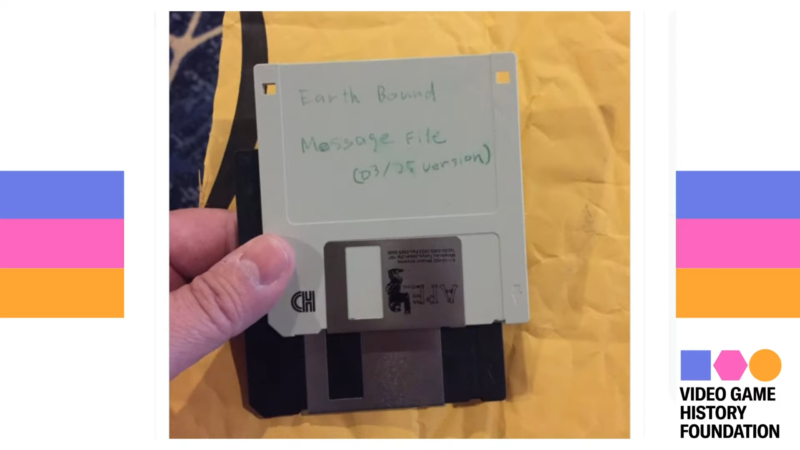
Amazing what can be found on decades-old disks full of "deleted" files.
Enlarge / Amazing what can be found on decades-old disks full of “deleted” files.
Video Game History Foundation

The golden-age rebirth of console gaming, largely spurred by the NES’s mega-success, has remained a lucrative era for conservationists. There’s a whole community out there rushing to find documents, disks, and hard drives from the ’80s and ’90s before they’re savaged by time and bit rot. Yet sometimes, those old storage standards’ limitations can work out in game historians’ favor.

On Friday, the Video Game History Foundation announced its restoration of a single Nintendo-related, 3.5-inch floppy disk, as discovered by original Earthbound translator Marcus Lindblom in 2018. The story sounds a lot like ones we’ve heard in the past, where someone from the gaming industry cleans out an attic or a storage unit only to find disks that they think are lost to time.

In Lindblom’s case, he thought the Earthbound disk he’d discovered was lost to his own younger stupidity. At one point he learned, after putting it into an older computer, that he’d deleted the disk’s contents to save other work on it. He donated the disk to VGHF with fingers crossed that they could work their magic, which they apparently did. As it turns out, only one small file had been saved to the disk after its “deletion,” thus leaving most of the original magnetic media untouched. Forensic recovery tools managed to recover every single disk sector, revealing the SNES RPG’s “complete” scripting files for English and Japanese text, along with related code for event triggers in the game.

“This should be no sweat!”

Longtime Mother/Earthbound series expert Clyde “Tomato” Mandelin, who famously co-translated Mother 3 as a free, fan-made patch for its Japan-only version, partnered with VGHF to parse the discoveries. His very long report on the findings is mostly wonky stuff for people who know the series like the back of their hand as opposed to a laundry list of shocking revelations.

Still, the findings include breadcrumbs to help fans understand how this text-heavy game was made and released, along with enough code-related discoveries to allow ROM hackers to recreate some of the unfinished scenes mentioned in the disk’s code and notes. (The disk doesn’t contain art, sprites, or textures, but the script contents are dense enough for VGHF’s ROM hackers to work with.)

In great news, some of the deleted stuff includes delightfully silly content in line with the series’ off-kilter sense of humor. Players would have originally faced off against a character who called himself “The Weakest Man in All of Twoson,” then bragged that he would win because “you’re just a kid, so this should be no sweat!” (Of course, players would win handily.)

Even weirder, the non-final script suggested that one of the game’s hallucination sequences would have been inspired by something different: instead of a “Magic Cake” item, players would have to find and receive an oil massage on the beach. As one non-player character (NPC) would have told players:

On the Carillion Beach is a lady named Jill who gives really interesting massages. Apparently, they even make you have nice dreams. REALLY nice dreams, you know? Doesn’t that sound great?

…yeah, I think I know why that one didn’t make the cut.

A word from Mr. Itoi

While Earthbound‘s final version had more fourth-wall-breaking content than was common for Nintendo at the time, the pre-final version hinted at even more. It contained multiple references to the NES-only, Japan-only game Mother (eventually released in the West as Earthbound Beginnings), including a direct reference to the first game’s ending during the sequel’s final battle. One of the game’s billboards, which players could read by walking up and pressing the “A” button, originally had a joke about “someone who makes games even after the age of 45,” which Mandelin assumes refers to series creator and lead writer Shigesato Itoi, who turned 45 during Earthbound‘s development.

The newly discovered files also include developer notes that offer an explanation about the game’s occasional “coffee break” and “tea break” dumps of text. Mandelin points to one commented part of the non-final code in Japanese, with it roughly translating to: “A word from Mr. Itoi to the players.” Players can now assume that he was breaking the fourth wall to chat with his players, as opposed to attributing those passages to an in-game character.

Mandelin applies his savvy touch to the Japanese-to-English translation process to explain how certain pre-release jokes and wordplay would have worked and why they were likely deleted altogether from both releases’ retail versions. He also offers context about the files’ mentions of a Winter CES 1995 demo, which series fans had never seen proof of until these files’ discovery. Once again, VGHF’s ROM hackers do a fine job using newly discovered script elements to show us how that demo may have looked. (Mandelin also admits that he’s still not done digging through the newly discovered files, so we could see more wacky development errata in the future.)

For tons more on the newly discovered files, either head to VGHF’s lengthy blog post or stick around here and watch the non-profit’s 28-minute video on the discoveries, embedded below.

[embedded content]
VGHF’s recovery of a lost Earthbound script disk.

https://arstechnica.com/?p=1769900



Warner Bros. releases trailer for noir-esque sci-fi thriller Reminiscence

[embedded content]
Hugh Jackman stars as a man who helps clients recover lost memories in the sci-fi thriller Reminiscence.

A solitary man living in a dystopian near-future helps people recover lost memories and ends up uncovering a violent conspiracy in Reminiscence, a sci-fi thriller that feels like a cross between classic film noir and ambitiously heady fare like Memento and Inception. That’s no surprise, as it’s the feature film directorial debut of Lisa Joy, co-creator (with husband Jonathan Nolan) of HBO’s critically acclaimed series Westworld.

Per the official premise:

Nick Bannister (Hugh Jackman), a private investigator of the mind, navigates the darkly alluring world of the past by helping his clients access lost memories. Living on the fringes of the sunken Miami coast, his life is forever changed when he takes on a new client, Mae (Rebecca Ferguson). A simple matter of lost and found becomes a dangerous obsession. As Bannister fights to find the truth about Mae’s disappearance, he uncovers a violent conspiracy and must ultimately answer the question: how far would you go to hold on to the ones you love?

During a virtual event on Wednesday, Joy said she was inspired to make Reminiscence after finding an old photograph among her grandfather’s belongings. The picture was of an unknown woman her grandfather had never mentioned to anyone in the family. “It made me start to think about memory and our lives in general,” she said. “And the moments that maybe pass by, and maybe disappear—they don’t stay with us, those connections necessarily—but that meant something, that changed us and touched us. And how nice it would be able to go back to these memories fully for a moment, to live that life and feel the way you felt when you experienced them.”

Apparently, Jackman was Joy’s first choice for the lead role; he has certainly shown he’s capable of gritty drama, action, and conveying tormented love. Ferguson (Mission: Impossible 5 and 6) seems like a perfect choice for the film’s femme fatale, Mae. She was mesmerizing as Rose the Hat in 2019’s Doctor Sleep, equal parts seductive and sinister, and she brings the same qualities to this trailer. Emmy-award winner Thandie Newton (Mission: Impossible II), who plays Maeve, the cynical madam on Westworld, is the sensible, tough-as-nails Watts, Nick’s business partner in the memory recovery business. And Daniel Wu (Into the Badlands) plays crime kingpin Saint Joe, who has a mysterious connection to Mae.

The trailer opens with Jackman’s voiceover lulling a client into reliving a memory. (“You’re going on a journey. A journey through memory. All you have to do is follow my voice.”) This is a world where rising sea levels due to climate change have flooded the city of Miami, and ongoing wars have traumatized vast swaths of the population. So “nostalgia became a way of life. There wasn’t a lot to look forward to. So people began looking back. Nothing is more addictive than the past.” The memory-recovery tech is more than just standard hypnosis; a client’s memories play out in visible holographic form, and the clients essentially relive their past experiences, complete with sensory details (touch, smell, taste, sound, and sight).

Then Mae walks in right before closing time, and Nick can’t resist making time for one more job. It’s a classic Chandler-esque noir setup. Naturally, Nick embarks on a passionate affair with Mae, and when she suddenly disappears, that passion turns into an obsession with finding her—even if it means uncovering secrets best left buried. Watts advises him that Mae has moved on and he should, too; after all, how much did he really know about Mae?

“Don’t go down this path,” she pleads at one point. “Stay here. In this life.” But you know Nick Bannister is gonna do what he’s gotta do, even if it pits him against Saint Joe and his minions.

Reminiscence hits theaters on August 20 and will also stream on HBO Max for one month.

Listing image by Warner Bros.

https://arstechnica.com/?p=1769554


Sony’s “generations matter” mantra crumbles: Gran Turismo 7 will be cross-gen

<img src="https://rassegna.lbit-solution.it/wp-content/uploads/2021/06/sonys-generations-matter-mantra-crumbles-gran-turismo-7-will-be-cross-gen.png" alt="We've since touched up GT7‘s last significant advertisement, as per this week’s platform update.”>
Enlarge / We’ve since touched up GT7‘s last significant advertisement, as per this week’s platform update.
Sony Interactive Entertainment / Aurich Lawson

On Wednesday, Sony published a wide-ranging interview with the head of its PlayStation Studios division, arguably to set expectations ahead of the usual barrage of mid-June game announcements and reveals. In Sony’s case, setting expectations now requires telling fans which console to expect future games to land on—especially in a world where chip shortages have made it tough to purchase the company’s new and very popular PlayStation 5.

This week’s PlayStation announcement marks a change for multiple games that had been previously advertised as PlayStation 5 titles. We have now learned that God of War: Ragnarok and Gran Turismo 7 are officially coming to both PlayStation 4 and PlayStation 5. The news follows last week’s confirmation that Horizon: Forbidden West will also launch as a cross-gen game.

While the God of War sequel’s backward-compatibility status was unclear, the Gran Turismo 7‘s announcement comes as a big surprise, since it was revealed to the world in June 2020 with a loud “get ready for next gen” tagline, followed by an outright declaration six months later that the game would be a “PlayStation 5 exclusive.” Both video advertisements for the anticipated racing game revolved around intense reflection effects that take material properties and car surface warping into account. While Sony Interactive Entertainment has yet to detail exactly how the game’s tech works, what we’ve seen so far will likely hinge on next-gen processing power, perhaps with ray-tracing or double-rendered geometry.

We’ve thus far seen zero footage of GoW: Ragnarok, which was recently delayed to sometime in 2022.

“A chance to raise expectations”

Scaling Sony’s ambitious-looking racing game down to run on the PS4 might not be as simple as reducing pixel resolution or disabling a few fancy effects. In fact, up until this week, Sony has been keen on emphasizing this very line in the sand that the PS5 offers gamers, arguably as a response to its rivals at Xbox.

In an August 2020 interview with GamesIndustry.biz, SIE marketing VP Eric Lempel offered the following quote about a trailer’s emphasis on PS5-exclusive tech like its fancy DualSense controller:

We’re moving into a new generation, and to us, generations matter. It’s a chance to raise the expectations from players and gamers and really introduce something new.

This statement followed a massive technical deep dive on PS5 architecture by longtime Sony hardware lead Mark Cerny in March 2020. The presentation focused on how the new console’s PCI-e 4.0-rated storage wouldn’t just speed up loading times but “give game designers freedom” to build larger, unobstructed virtual worlds—the kinds that arguably cannot be simply ported to platforms with last-gen storage systems.

This all came during the peak of Xbox’s bullish advertising campaign about “Smart Delivery” and backward compatibility. Microsoft has been keen to assure its fans that they can buy many future games, even first-party titles, and expect them to work across multiple Xbox generations, save for a few clearly marked exceptions. One of Xbox’s biggest upcoming games, Halo Infinite, continues to be advertised as cross-gen, leading me to wonder whether that decision explains the game’s technically disappointing reveal.

While PS5 console sales have been strong, demand has absolutely outstripped supply, perhaps even more than the company anticipated (thanks, chip shortage). And recently, Sony suggested that PlayStation 4 will represent 70 percent of the company’s gaming revenue for the current fiscal quarter. As a result, at least one outlet has suggested that GT7‘s cross-platform fate is a response to both of those market realities. In a recent op-ed, VGC editor-in-chief Andy Robinson wrote:

I understand the decision to release a PS4 version [of Gran Turismo 7] was made only fairly recently.

How you look at this news depends on what you think of the promise of next-gen console gaming, especially how it leverages fast solid-state drive storage—which, honestly, neither new console has shown off to any great extent yet. PS5 exclusives like Demon’s Souls and Returnal look gorgeous but arguably lack SSD-fueled innovations, while the Xbox Series X and S have been absolutely bone dry in terms of high-end console exclusives. But so long as a game is compatible with older consoles and tried-and-true storage like hard drives and slower SSDs, it is also more likely to receive a PC port—something Sony has been increasingly willing to do.
Sony’s upcoming PS5 exclusive Ratchet & Clank: Worlds Apart, launching June 11, may very well show off Sony’s next-gen technical prowess, but we’ll have to wait for the game’s release to find out. https://arstechnica.com/?p=1769551


After months of drama, Minecraft speedrunner Dream admits he used mods

<img src="https://rassegna.lbit-solution.it/wp-content/uploads/2021/06/after-months-of-drama-minecraft-speedrunner-dream-admits-he-used-mods.jpg" alt="The bartering Piglin that were at the heart of Dream's Minecraft cheating drama.”>
Enlarge / The bartering Piglin that were at the heart of Dream’s Minecraft cheating drama.

For months now, popular Minecraft streamer Dream has insisted there was nothing fishy about six “Any% Random Seed” speedruns he streamed last October, despite evidence to the contrary presented by the moderators of clearinghouse Speedrun.com. Over the weekend, though, Dream said in a message posted to Pastebin that he had “actually been using a disallowed modification during ~6 of my live streams on Twitch” while maintaining that he “didn’t have any intention of cheating.”

The admission seems to finally put to rest months of drama and dueling accusations between Dream and the mods, settling an argument that relied on complex mathematics to prove that Dream’s runs were vanishingly unlikely to be the result of random chance alone.

The math

To understand the accusations at play here, first you have to understand just how much of a role luck plays in a top-level Any% speedrun of Minecraft and how ridiculously lucky Dream appeared to be in the streamed runs in question.

Quickly beating Minecraft is a process with a lot of steps. One of the most crucial is bartering your gold with Piglins in the hopes of getting Ender Pearls, which are needed to eventually construct a portal that will take you to an area known as The End, where you can fight the Ender Dragon that serves as the final boss of the run.

In an unmodified game of Minecraft, Piglin randomly drop Ender Pearls in about 4.7 percent of trades. In the six speedruns Dream livestreamed starting in October 2020, though, a full 16 percent of the Piglin drops were Ender Pearls (42 out of 262).

Dream’s luck didn’t end there. He also had to battle several Blazes to obtain Blaze Rods for the portal. Defeated Blazes drop Blaze Rods 50 percent of the time in an unmodified game. In the livestreams in question, Dream got a Blaze Rod from just over 69 percent of defeated Blazes (211 out of 305).

Being lucky isn’t proof of cheating, of course. Unlikely things do happen sometimes, and speedrunners often power through thousands of runs in the hopes of getting that one random seed that will let them shave just a few seconds off their best time.

When you sit down and do the math, though, the chances of Dream being this consistently lucky, across this many consecutive livestreamed runs, become so small as to be practically zero. In a 29-page report issued last December, the Minecraft Speedrunning Team went into excruciating detail to calculate the chances of those Ender Pearl and Blaze Rod drop rates (or better) occurring in a truly random set of speedrun attempts. The final odds: 1 in 20 sextillion, or 2 x 10^22.

[embedded content]
The Stand-Up Maths channel adds some context for just how lucky Dream would have to be to do his streamed runs unassisted.

The Stand-Up Maths YouTube channel has an entertaining breakdown of that math that puts that level of luck into context. There, author and host Matt Parker calculates that a theoretical task that was performed by each of 10 billion humans once every second for 100 years straight would result in 3 x 10^19 random trials. Yet even with that many trials, you wouldn’t expect to get a specific, pre-sought outcome that was as unlikely as what was shown in Dream’s speedruns (which, again, would happen once in 2 x 10^22 trials, assuming they were legitimate).

“If anything is plausibly going to happen as being done by a human, it has to have odds below [3 x 10^19],” Parker summarized.

The controversy

Math or no, Dream didn’t take these accusations lying down, and he went so far as to commission a rebuttal report from an astrophysicist through science-consulting company Photoexcitation. That report made use of a variety of simulation assumptions and “bias correction” algorithms to determine a more reasonable 1 in 10 million chance that some Minecraft speedrunner would encounter Dream’s level of luck at some point in the last year.

In response, the Minecraft Speedrunning Team issued a rebuttal to the rebuttal, pointing out problems with the initial rebuttal’s methods and assumptions. In any case, even taking the first rebuttal at face value, the second rebuttal points out that “the 1 in 10 million posterior probability… still impl[ies] a 99.99999% chance of Dream cheating.”

In the meantime, Dream loudly and publicly decried the whole process. “Luck is not a reason to accuse a runner (who has gotten multiple world records, and done thousands of speedruns) of cheating,” he tweeted last November. “The level of disrespect I’ve been shown is just ridiculous,” he continued. “The mod team has shown inability to remain unbias [sic], and has been unresponsive and unprofessional.”

That kind of talk led to plenty of back-and-forth arguments and online harassment between Dream’s many fans (he has 4.7 million Twitch followers and 22.8 million YouTube subscribers) and those backing the Speedrun mods’ conclusions. “I’m sure this drama has been stressful for most of the Minecraft community, and a lot of that was probably due to my original response to the drama, so I take full responsibility for that,” Dream said in a January tweet that he claimed would be his last one regarding the issue.

[embedded content]
An “official moderator analysis” lays out the mathematical case against Dream’s runs being the result of luck alone.

This weekend, though, Dream offered a lengthy explanation of what happened, writing that after “exploring the possibilities” involved with the runs, he “ended up finding out that I HAD actually been using a disallowed modification during ~6 of my live streams on Twitch.”

Dream chalks this up to the use of an “overall recording mod” that he used after Minecraft was updated to version 1.16 last June. He wrote that he thought this mod was “basically just a chat mod” without any gameplay effects and that he “was 99% sure” it wasn’t on during the runs. In actuality, though, that mod was broadly similar to separate mods Dream had used previously (and openly) in videos prior to version 1.16 to “increase the enderman spawn rates and pearl drop rates out of convenience. It makes the videos better because we don’t spend hours looking for pearls or spend so much time farming blaze rods.”

“I felt really terrible for the mods because I dragged them through the mud even though they were mostly right.”

When Dream realized this a few months ago, he wrote, he deleted a scathing video response he had posted regarding the Speedrun.com mods. He didn’t announce his finding publicly then, though, because he said he “felt like the community had been through enough drama and that it was pointless. I didn’t want to be the center of controversy for the hundredth time.” He said he figured “it would be a story I would tell in a few years when no one really cared.”

Looking back on the whole thing now, though, Dream wrote that he was too quick to assume “that I was being targeted due to the fact that I was a YouTuber” and that the speedrun mods “were out to get me.” Dream wrote he became “paranoid and didn’t think straight,” leading him to become “scared and stressed and [say and do] shitty things.”

“When the drama first started, I cared more about defending myself and being right, then [sic] about figuring out what was actually going on and I shot myself in the foot by doing it,” he wrote. “I felt really terrible for the mods because I dragged them through the mud even though they were mostly right.”

Now that Dream has owned up to his mistakes, at least some in the Minecraft speedrunning community are ready to move on. “Dream and I are cool again,” tweeted Geosquare, who worked on a video explaining the Speedrun mods’ decision. “Glad we’re seeing some closure today.”

https://arstechnica.com/?p=1769140


ROM site owner made $30,000 a year—now owes Nintendo $2.1M

Artist's conception of Nintendo's reaction to the summary judgment.
Enlarge / Artist’s conception of Nintendo’s reaction to the summary judgment.

The now-unemployed owner of a shuttered ROM distribution site has been ordered to pay $2.1 million in damages to Nintendo after trying and failing to defend himself in the case.

In September 2019, Nintendo filed a lawsuit against Los Angeles resident Matthew Storman over his operation of RomUniverse.com, which offered prominent downloads of “Nintendo Switch Scene Roms” and other copyrighted game files. At the time, Nintendo said that the site had been “among the most visited and notorious online hubs for pirated Nintendo video games” for “over a decade.”

Storman has admitted that, in 2019, the site made up the bulk of his $30,000 to $36,000 a year in income. This included direct revenue from the sale of “premium unlimited accounts” for $30 per year that provided users with faster downloads and no limits. By the time Storman signed a September 2020 agreement with Nintendo to shut the site down, he said he was deriving $800 a month from the site. According to court documents, Storman’s income is now derived primarily from “unemployment and food stamps.”

In a motion for dismissal, Storman invoked the “safe harbor” protections of the Digital Millennium Copyright Act (DMCA), arguing that he was just a neutral service provider for users sharing files. He also pointed out that he had agreed to Nintendo’s DMCA takedown requests in the past.

During a deposition, though, Nintendo got Storman to admit that he had uploaded Nintendo’s copyrighted ROM files himself, obliterating any attempts at a “safe harbor” claim. Another attempted Storman defense based on the “first sale doctrine” also failed to go anywhere, since the site was distributing copies rather than Storman’s personal property.

Storman also angered Nintendo and the court by failing to respect an order to provide “communications with his website administrators” and “data showing how many times each of the pirated video games had been downloaded.” In September 2020, Storman said that the data was no longer available, leading Nintendo to allege that he had “destroyed it.”

While Nintendo originally claimed that RomUniverse was responsible for “hundreds of thousands” of copyrighted downloads, that number was lowered to 50,000 based on evidence gleaned from screenshots of the site. Nintendo argued that each download cost it between $20 and $60 (the average cost of new games it sells) and that it had therefore lost between $1 and $3 million in revenue.

In providing summary judgment for Nintendo (as noted by Torrent Freak), the judge suggested that this was a clear case of infringement, one in which “there is no genuine issue of material fact that Plaintiff owns the copyrighted works and Defendant copied the works.” While Nintendo sought $4.41 million in copyright damages—or $90,000 each for 49 games—the judge lowered the amount to $1.715 million ($35,000 per work). That amount should be sufficient to “compensate Plaintiff for its lost revenue and deter Defendant who is currently unemployed and has already shut down the website,” the judge wrote.

The judge also awarded an additional $400,000 for RomUniverse’s use of Nintendo’s trademarked box art, down from a massive $11.2 million ask. But Storman avoided a permanent injunction on “future infringement,” with the judge suggesting that there was no “irreparable harm” given the monetary damages and the fact that the site had already been shuttered.

https://arstechnica.com/?p=1768886


Can we keep human inconsistency from confusing expert advice?

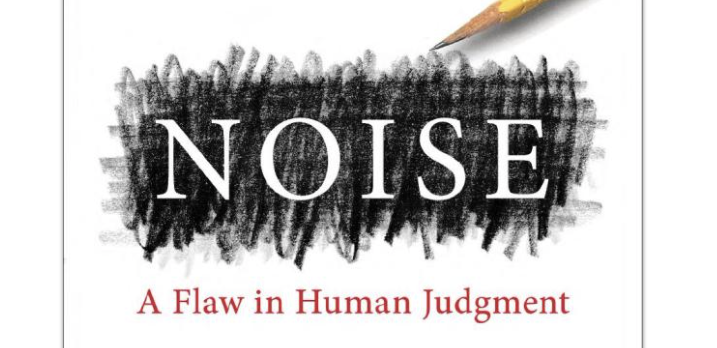
The cover of the book Noise: A Flaw in Human Judgment

Everyone has biases. And everyone knows that everyone has biases, and that these biases affect our judgements. Bias is explainable, and our brains like things they can explain.

One of the leading explainers of our biases is economist Daniel Kahneman, famed for a Nobel win and his book Thinking, Fast and Slow. He’s now teamed with Olivier Sibony and Cass Sunstein to write a book… that’s… not about bias. Entitled Noise: A Flaw in Human Judgement, it deals with—you guessed it—noise, the variability among human judgements that is the result of humans being variable. We have distinct temperaments and personalities; we are different from each other, and we are different from ourselves, certainly from year to year but also even from hour to hour.

All of that noise is totally OK. But it is totally not OK when it means that one petty thief is granted bail while another must await trial in jail, or one asylum seeker gets admitted into the US while another does not, or one child at risk of abuse gets shunted into foster care while another stays put—all because they saw a particular judge on a particular morning.

An end to noise

The goal of the book is to eliminate noise. The first step is recognizing it, which isn’t easy. Unlike bias, noise is not readily acknowledged. But it contributes just as much to errors as bias does. So eliminating it can reduce errors just as much as eliminating bias can.

In Thinking, Fast and Slow, Kahneman described the Nobel Prize-winning work he did with Amos Tversky about the many cognitive biases that often shape individuals’ decisions and cause them to err. Noise expands on those ideas to explore why groups of people make errors and how to deal with it when they do.

The longest section of the book is devoted to defining and identifying noise—a justification for the measures outlined in the rest of the text. “Noise is variability in judgments that should be identical,” the authors explain.

They are not talking about subjective matters of taste, like movie reviews or wine ratings, about which there obviously should be differences of opinion. They are talking about matters like criminal justice and medical diagnosis, in which a lack of consensus should not exist but does. And it exists to a much, much greater degree than you’d imagine: when shown a pair of fingerprints a second time months after first seeing them, forensic analysts make different decisions about if they match about 10 percent of the time.

This noise can be due to some random factors: doctors order more cancer screenings in the morning and prescribe more opioids (but not other pain meds) in the afternoon. People may want to think that their fates about very important matters are being determined by one of a group of seasoned, caring, interchangeable experts who represent a System and not their own individual values at that moment. But their fates are, in fact, being determined by a process much more akin to a lottery (lotteries are cited a lot in Noise). The expert who makes the decision is in essence randomly selected, and their opinion can differ wildly from that of other experts. And that is Not Fair.

One key aspect of noise identification that the authors stress is that “we don’t need to know who is right to measure how much the judgements of the same cases vary.” In many judgments, the true or right answer is unknown or unknowable; for others, it may not even exist. But that doesn’t matter for recognizing problems. Expert judgments should still cluster together. If they don’t, the system is noisy. (If they do, the judges might still all be biased in the same way—but as noted earlier, that is not a noise problem.)

Better hygiene

To reduce noise, the authors prescribe a regimen they call “decision hygiene,” which is about as unsexy as it sounds. And they named it that for precisely that reason. They liken it to hand-washing, which is widely known to do wonders to prevent the spread of pathogens—although when you do it, you don’t know exactly which pathogens you are preventing from spreading, and you’ll never know.

The authors posit that decision hygiene will reduce noise-induced errors, but we’ll never know which ones. The analogy doesn’t end there; they note that hand-washing is also known to be kind of an annoying hassle, so even though it is simple and extremely effective, many people who are aware that they should be doing it all too often don’t. Decision hygiene is similar.

One way the authors suggest we make better judgments and predictions is to have better judges and predictors. And who might those be? Turns out they are people who are not only willing to change their minds when faced with new information, but those who go out and seek new information that challenges their closely held views. They are “actively open-minded,” or in a state of “perpetual beta”—they are constantly integrating new ideas and perspectives, constantly analyzing and refining themselves and their views. They do not adhere to foolish consistencies.

They sound like the exact opposite of political pundits everywhere and many of the authorities we currently revere.

Soundbites

Each chapter ends with a list of talking points, like a soundbite-y highlight reel of the contents. These are in quotes, even though they are not verbatim lines lifted from anywhere in the chapter (this must be Kahneman’s shtick, as he does it in Thinking, Fast and Slow as well).

The nonquote quotations are odd, especially since Noise has so many actually quotable sentences. Consider this gem: “The obviousness of this fact [that the future is unpredictable] is matched only by the regularity with which it is ignored.” Or this one, on the problems people may have with noise-mitigation strategies: “Although we will address these objections as sympathetically as we can, we by no means endorse them.”

And Kahneman, Sibony, and Sunstein can expect no shortage of objections. One of those is that people, especially trained experts, like to think that their experience and their hunches and their gut feelings are invaluable. They want to use their discretion; they rebel against the notion that their intuition could be supplanted by an algorithm (although Kahneman and Co. insist that this would certainly eliminate noise). But “the goal of judgment is accuracy, not individual expression,” the authors write. Creativity and personal values certainly have their place. But not if they lead to injustice.

https://arstechnica.com/?p=1768449


Movie written by algorithm turns out to be hilarious and intense

Sunspring, a short science fiction movie written entirely by AI, debuted exclusively on Ars in June 2016.

Ars is excited to be hosting this online debut of Sunspring, a short science fiction film that’s not entirely what it seems. It’s about three people living in a weird future, possibly on a space station, probably in a love triangle. You know it’s the future because H (played with neurotic gravity by Silicon Valley‘s Thomas Middleditch) is wearing a shiny gold jacket, H2 (Elisabeth Gray) is playing with computers, and C (Humphrey Ker) announces that he has to “go to the skull” before sticking his face into a bunch of green lights. It sounds like your typical sci-fi B-movie, complete with an incoherent plot. Except Sunspring isn’t the product of Hollywood hacks—it was written entirely by an AI. To be specific, it was authored by a recurrent neural network called long short-term memory, or LSTM for short. At least, that’s what we’d call it. The AI named itself Benjamin.

Knowing that an AI wrote Sunspring makes the movie more fun to watch, especially once you know how the cast and crew put it together. Director Oscar Sharp made the movie for Sci-Fi London, an annual film festival that includes the 48-Hour Film Challenge, where contestants are given a set of prompts (mostly props and lines) that have to appear in a movie they make over the next two days. Sharp’s longtime collaborator, Ross Goodwin, is an AI researcher at New York University, and he supplied the movie’s AI writer, initially called Jetson. As the cast gathered around a tiny printer, Benjamin spat out the screenplay, complete with almost impossible stage directions like “He is standing in the stars and sitting on the floor.” Then Sharp randomly assigned roles to the actors in the room. “As soon as we had a read-through, everyone around the table was laughing their heads off with delight,” Sharp told Ars. The actors interpreted the lines as they read, adding tone and body language, and the results are what you see in the movie. Somehow, a slightly garbled series of sentences became a tale of romance and murder, set in a dark future world. It even has its own musical interlude (performed by Andrew and Tiger), with a pop song Benjamin composed after learning from a corpus of 30,000 other pop songs.

Building Benjamin

When Sharp was in film school at NYU, he made a discovery that changed the course of his career. “I liked hanging out with technologists in NYU’s Interactive Telecommunications Program more than other filmmakers,” he confessed. That’s how he met Goodwin, a former ghost writer who just earned a master’s degree from NYU while studying natural language processing and neural networks. Speaking by phone from New York, the two recalled how they were both obsessed with figuring out how to make machines generate original pieces of writing. For years, Sharp wanted to create a movie out of random parts, even going so far as to write a play out of snippets of text chosen by dice rolls. Goodwin, who honed his machine-assisted authoring skills while ghost writing letters for corporate clients, had been using Markov chains to write poetry. As they got to know each other at NYU, Sharp told Goodwin about his dream of collaborating with an AI on a screenplay. Over a year and many algorithms later, Goodwin built an AI that could.

Benjamin is an LSTM recurrent neural network, a type of AI that is often used for text recognition. To train Benjamin, Goodwin fed the AI with a corpus of dozens of sci-fi screenplays he found online—mostly movies from the 1980s and 90s. Benjamin dissected them down to the letter, learning to predict which letters tended to follow each other and from there which words and phrases tended to occur together. The advantage of an LSTM algorithm over a Markov chain is that it can sample much longer strings of letters, so it’s better at predicting whole paragraphs rather than just a few words. It’s also good at generating original sentences rather than cutting and pasting sentences together from its corpus. Over time, Benjamin learned to imitate the structure of a screenplay, producing stage directions and well-formatted character lines. The only thing the AI couldn’t learn were proper names, because they aren’t used like other words and are very unpredictable. So Goodwin changed all character names in Benjamin’s screenplay corpus to single letters. That’s why the characters in Sunspring are named H, H2, and C. In fact, the original screenplay had two separate characters named H, which confused the humans so much that Sharp dubbed one of them H2 just for clarity.

When Sharp and Goodwin entered Sunspring in the Sci-Fi London contest, they were delighted when the judges placed it into the top ten out of hundreds of entries. One judge, award-winning sci-fi author Pat Cadigan, said, “I’ll give them top marks if they promise never to do this again.” Before the final judging, audience members were allowed to vote online for their favorite film from the top ten. As the filmmakers watched thousands of votes rolling in, Goodwin realized something. “These guys are cheating; they’re getting thousands of votes, they’re getting bots to vote for themselves,” he said to Sharp. That’s when he and Sharp came up with a nefarious plan. “I said, [Benjamin] is going to outvote them at the last minute,” Sharp recalled. “So we had him vote 36,000 times per hour in last hours of the contest, and he crushed the cheaters.” Sharp immediately called Louis Savy, who runs the film festival, and confessed that their AI had voted for himself and that they wanted to distance themselves from the AI’s actions. Savy thought that was hilarious and decided to interview the AI on stage during the award ceremony. Here’s part of the transcript:

What do you think of your historic nomination against human opponents in this contest?
I was pretty excited.
I think I can see the feathers when they release their hearts. It’s like a breakdown of the facts. So they should be competent with the fact that they won’t be surprised.

What is the future of machine written entertainment?
It’s a bit sudden.
I was thinking of the spirit of the men who found me and the children who were all manipulated and full of children. I was worried about my command. I was the scientist of the Holy Ghost.

What’s next for you?
Here we go. The staff is divided by the train of the burning machine building with sweat. No one will see your face. The children reach into the furnace, but the light is still slipping to the floor. The world is still embarrassed.
The party is with your staff.
My name is Benjamin.

Ever since that day, Sharp and Goodwin have called the AI by its chosen name.

A mirror of our culture

For Sharp, the most interesting part of the Benjamin experiment has been learning about patterns in science fiction storytelling. Benjamin’s writing sounds original, even kooky, but it’s still based on what humans actually write. Sharp likes to call the results the “average version” of everything the AI looked at. Certain phrases kept coming up again and again. “There’s an interesting recurring pattern in Sunspring where characters say, ‘No I don’t know what that is. I’m not sure,'” said Goodwin. “They’re questioning the environment, questioning what’s in front of them. There’s a pattern in sci-fi movies of characters trying to understand the environment.” Sharp added that he keeps catching himself having Benjamin-like moments while working: “I just finished a sci-fi screenplay, and it’s really interesting coming off this experience with Benjamin, thinking I have to have somebody say ‘What the hell is going on?’ Every time I use his tropes I think, oh of course. This is what sci-fi is about.” Sharp’s next project will be directing a movie called Randle Is Benign, about a computer scientist who creates the first superintelligent computer in 1981. “It’s uncanny how much parts of the screenplay echo the experience of working with Benjamin,” he said.

Of course, Benjamin is hardly an objective source of information about our sci-fi obsessions. His corpus was biased. “I built the corpus from movie scripts I could find on the Internet,” said Goodwin (the titles are listed in Sunspring‘s opening credits). But some stories got weighted more heavily than others, purely due to what was available. Explained Sharp, “There’s only one entry on the list for X-Files, but that was every script from the show, and that was proportionally a lot of the corpus. In fact, most of the corpus is TV shows, like Stargate: SG1 and every episode of Star Trek and Futurama.” For a while, Sharp said, Benjamin kept “spitting out conversations between Mulder and Scully, [and you’d notice that] Scully spends more time asking what’s going on and Mulder spends more time explaining.”

For Sharp and Goodwin, making Sunspring also highlighted how much humans have been trained by all the scripts we’ve consumed. Sharp said this became especially obvious when the actors responded to Sunspring‘s script as a love triangle. There is nothing inherently love triangle-ish about the script, and yet that felt like the most natural interpretation. “Maybe what we’re learning here is that because of the average movie, the corpus of what we’ve watched, all of us have been following that pattern and tediously so,” mused Sharp. “We are trained to see it, and to see it when it has not yet been imposed. It’s profoundly bothersome.” At the same time, it’s a valuable lesson about how we are primed to expect certain tropes: “Ross [Goodwin] has created an amazing funhouse mirror to hold up to various bodies of cultural content and reflect what they are.”

Author or tool or something else?

As I was talking to Sharp and Goodwin, I noticed that all of us slipped between referring to Benjamin as “he” and “it.” We attributed motivations to the AI, and at one point Sharp even mourned how poorly he felt that he’d interpreted Benjamin’s stage directions. It was as if he were talking about letting a person down when he apologized for only having 48 hours to figure out what it meant for one of the actors to stand in the stars and sit on the floor at the same time. “We copped out by making it a dream sequence,” he said. But why should Sharp worry about that, if Benjamin is just a tool to be used however he and Goodwin would like? The answer is complicated, because the filmmakers felt as if Benjamin was a co-author, but also not really an author at the same time. Partly this boiled down to a question of authenticity. An author, they reasoned, has to be able to create something that’s some kind of original contribution, in their own voice, even if it might be cliché. But Benjamin only creates screenplays based on what other people have written, so by definition it’s not really authentic to his voice—it’s just a pure reflection of what other people have said.

Though Goodwin began by saying he was certain that Benjamin was a tool, he finally conceded, “I think we need a new word for it.” Sharp agreed. It’s clear that they believe there’s something magic in what they’ve created, and it’s easy to understand why when you watch Sunspring. The AI has captured the rhythm of science fiction writing, even if some of Benjamin’s sentences are hilariously nonsensical. “We’re going to see the money,” C says at one point, right before H spits up his eyeball (he had to—it was an actual stage direction). Benjamin exists somewhere in between author and tool, writer and regurgitator.

As we wound down our conversation, Sharp and Goodwin offered me a chance to talk to Benjamin myself. We’d just been debating whether the AI was an author, so I decided to ask: “Are you an author?” Benjamin replied, “Yes you know what I’m talking about. You’re a brave man.” Fortified by Benjamin’s compliments about my bravery, I forged ahead with another question. Given that Benjamin was calling himself the author of a screenplay, I asked whether he might want to join the Writers Guild of America, a union for writers. Again, Benjamin’s answer was decisive. “Yes, I would like to see you at the club tomorrow,” he said. It appears that this AI won’t be rising up against his fellow writers—he’s going to join us in solidarity. At least for now.

Listing image by Sunspring

https://arstechnica.com/?p=896589


Stardew Valley: The Board Game—a loving production but a mixed review from Grandpa

Stardew Valley: The Board Game—a loving production but a mixed review from Grandpa
Charles Theel
Welcome to Ars Cardboard, our weekend look at tabletop games! Check out our complete board gaming coverage at cardboard.arstechnica.com.

Stardew Valley: The Board Game was a surprise February announcement. Somehow this colorful collaboration between Cole Medeiros and Stardew Valley‘s sole developer Eric Barone was kept hush-hush for two years. When it was finally announced, it sold out quickly.

Given the long development time and the obvious demand, expectations were high for this cardboard adaptation to deliver on its potential. Unfortunately, there’s a few sticks and crumpled refuse mixed in with the game’s gifts of starfruit and ore.

Mini-game madness

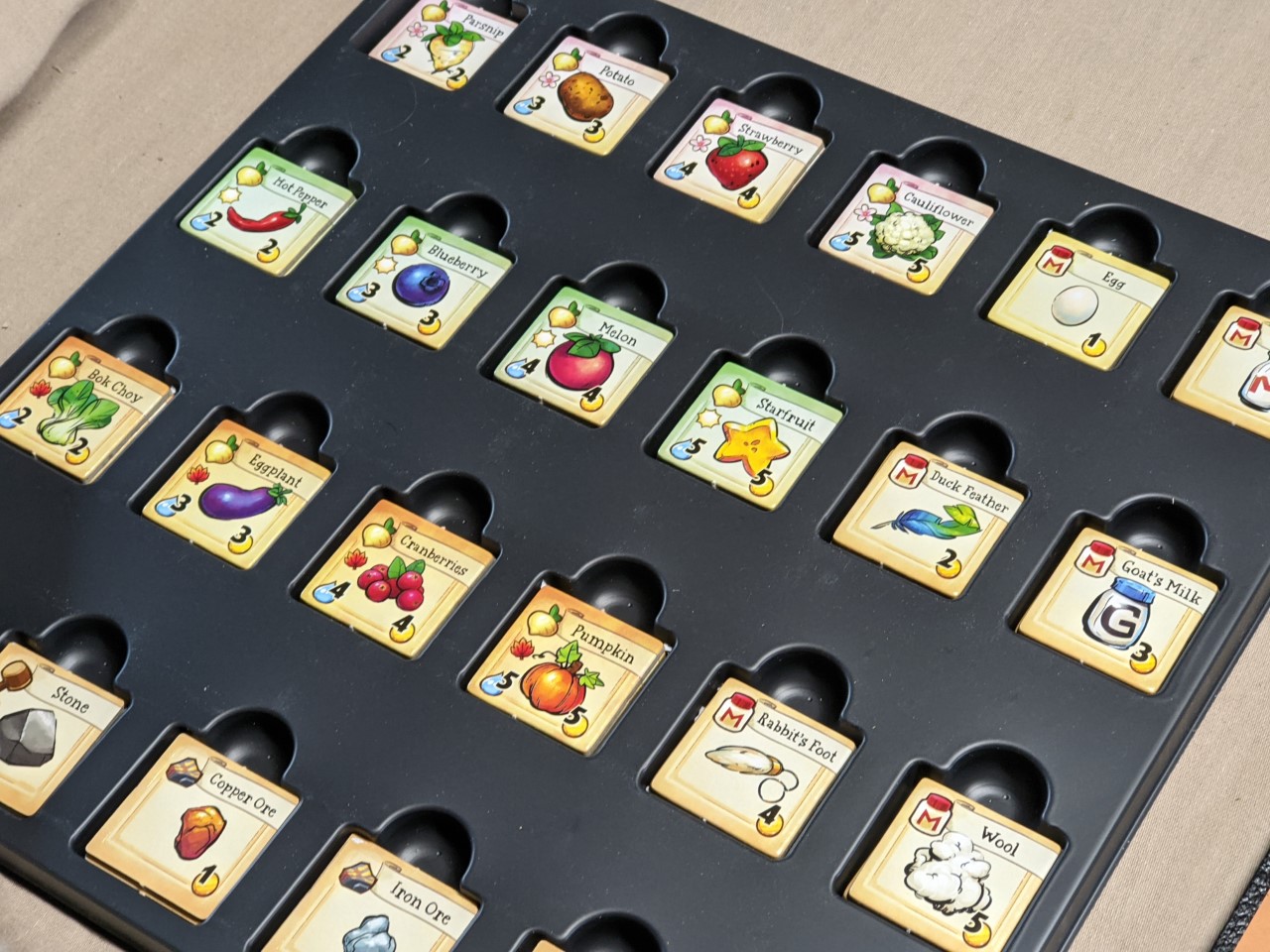
When you first open the large box, none of these concerns will be on your mind. In terms of looks, this board game is impeccable. It captures the bright, whimsical tone of its namesake exceptionally well. The box is packed with cute custom dice, a mound of cards, and enough beautiful tokens to bury the entire valley. Even better, the package includes a plastic tray to store all of the market tiles, which speeds up play and helps limit component sprawl.

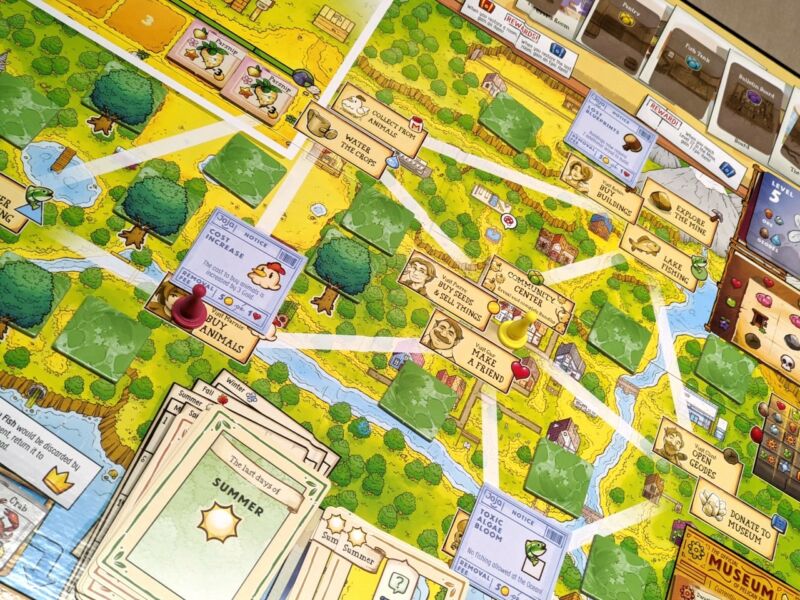
The board game also shows an obvious love for its source material. This is evident not only in the artwork and graphic design but in the construction of the various mini-games. Pretty much every task you’d expect to carry out is present here, each with its own sub-system to explore.

For instance, you can take a gentle stroll with your fishing pole. To catch anything, you roll three of the colorful dice and then select a fish from the public row with matching symbols. The hitch is that you can only choose fish with a tile border that matches your current location: ocean, lake, or river. It’s a simple system, but it’s engaging to manage that row of fish tiles (which are themselves drawn from a large bag). Trash will even occasionally clog things up, but you can remove it when you fail to catch anything of value.

The mine is the most complex task, requiring you to roll a pair of dice and then match their coordinates on the mine map. This is a grid of sorts, randomized from a larger deck of cards. Lucky results will yield geodes that can be taken to the smith and opened. The smith of course requires another roll of the dice, which can result in artifacts or ore.

While fishing is relatively simple, you could spend an entire game focusing on the mine, where you can explore deeper levels and find more precious minerals and items. As you descend, you also reveal new monsters which may inflict harm on your miner.

The most relaxing activity is purchasing seeds and planting them in your garden. This slick little procedure has you placing crop tiles on a track. These planted tokens will advance over time, and the process can be sped up if you water them. It is peaceful—and quite satisfying—to watch a crop germinate and grow into prized blueberries or peppers. The mechanism wonderfully captures the spirit of Stardew Valley as you perform a task, take a breath, and just relax. Sure, you can give things a bit of a nudge, but growth continues even without your assistance. Just hope no crows randomly pop up to devour those immature plants.

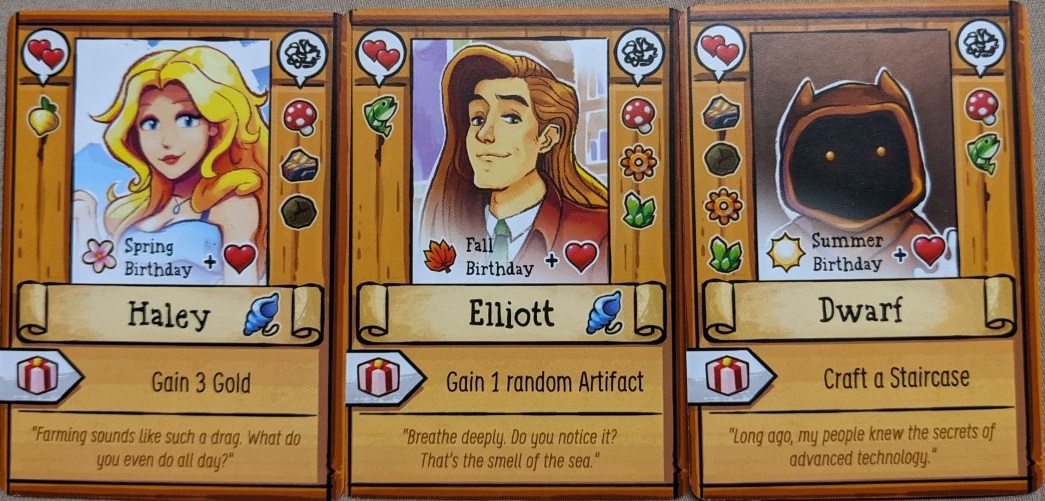
You can also buy animals which produce milk, or you can donate artifacts to the museum, or you can make friends by gifting those elements you’ve harvested. It’s all here and lovingly crafted for fans of Stardew Valley.

So many gorgeous components. Here's the market tray.
Enlarge / So many gorgeous components. Here’s the market tray.

The vibe

So why isn’t Grandpa giving up the Statue of Perfection? Because Grandpa’s a cretin.

Instead of a gentle evaluation of your progress at generous intervals, this old dude kicks you in the rear and demands instant gratification.

Grandpa’s evaluation matters from the get-go. At the start of a game, you deal out four goal cards, which dictate your objectives. These include requirements such as reaching level 12 of the mine or having 10 gold per player, and they must be accomplished by the end of a single year.

Players cooperate and mosey about town, engaging in mini-games to get their farms up and running. Each player must establish a self-sufficient economy in service to the goal cards, but it’s easy to get distracted by all of the different options.

Unfortunately, I found the goal system suffocating and uneven. Some goals may be accomplished with ease, while others will prove annoyingly difficult. In addition to finishing these objectives, you will also need to spend time unlocking bundles to complete the community center, further ratcheting up the pressure. There’s little room to breathe and you can’t waste time fishing for fun.

This style of board game, with its co-operative objectives and a time crunch, is a typical approach to modern design, and it makes sense at a high level. However, it does frame the game’s strong reliance on randomness —via dice rolling and card drawing—in a more negative light. While your decisions certainly matter, the output of those decisions is often at the whims of the game as opposed to the whims of the players. This is not at all a game for those seeking a high level of strategic input.

I’m generally fine with that. And the mini-games here are charming and legitimately enjoyable. But given all the randomness, the oppressive time limit really rubs your face in the dirt.

Friends, and the gifts they love.
Enlarge / Friends, and the gifts they love.

It feels like a missed opportunity. The current system comes across more as a one-season speedrun event as opposed to the feeling of laid-back exploration than many of the video game’s fans would expect. Letting players live in the board game longer as long as they’d like might have fit the spirit of the video game better. Some optional rules do include a scoring system, and I suppose you could ignore the game’s natural time limit, but the game systems themselves aren’t intended to scale for a longer period of time.

The time limit was probably necessary because the game itself is already quite slow. It takes far too long with three or four players, as each additional participant adds roughly 45 minutes to the playtime. With this many players, you will undoubtedly want to flip to the back of the rulebook and use the shorter game variant. (The game’s official storefront includes this warning: “It’s really important to us that as a buyer you understand Stardew Valley: The Board Game is not a casual quick game… If your game group or family prefers short playtimes [less than 45 minutes] with a small number of rules and components, this game might not be a good fit.”)

The current design approach, with its prickly timed goals, feels so-so. It does offer an entertaining experience to fans of the video game who are perhaps not already jaded by a huge collection of other board games in their basements. But it ultimately fails to capture the fundamentally relaxing nature of Stardew Valley, which is unfortunate. Maybe come back with a diamond in a year’s time and we can re-evaluate.

https://arstechnica.com/?p=1768636


Review: A Quiet Place Part 2 is a worthy sequel that was worth the wait

[embedded content]
Emily Blunt and Cillian Murphy star in A Quiet Place Part 2, John Krasinski’s sequel to the 2018 sci-fi/horror hit film.

It’s been a long road for Paramount’s A Quiet Place Part 2, the much-anticipated sequel to 2018’s surprise sci-fi/horror hit A Quiet Place. Originally slated to hit theaters last March, the sequel even had an official premiere, but the COVID-19 pandemic forced shutdowns all over the country mere days before the planned theatrical release. Paramount and director John Krasinski opted to shelve the movie until theaters reopened rather than releasing it on demand.

A Quiet Place Part 2 is finally here, and it was well worth the wait. It’s less of a sequel and more of a continuation of the original story. It retains all the aspects that worked in its predecessor while exploring new themes and character development.

(Spoilers for 2018’s A Quiet Place below; mild spoilers for Part 2, but no major reveals.)

As I wrote last year, the original A Quiet Place had a simple premise: sightless extraterrestrial creatures have wiped out most of the humans on Earth. They hunt by sound thanks to their hypersensitive hearing, and they’re difficult to kill because they sport a tough armored skin. (The creature’s design was inspired by animal echolocation, prehistoric fish, and the infamous bog people—mummified bodies found in the bogs of Northern Europe in particular. They look a bit like the Dementors from the Harry Potter films.)

The film centered on a family struggling to survive a few months after the initial invasion. Lee Abbott (Krasinski) is an engineer focused on keeping his family alive each day. His wife Evelyn (Emily Blunt) is a doctor who is pregnant with their fourth child. Eldest daughter Regan is deaf; she is played by deaf actress Millicent Simmonds, who helped teach the rest of the cast American Sign Language, since that’s how the Abbotts communicate when out in the open. Then there are her brothers: Marcus (Noah Jupe) and four-year-old Beau (Cade Woodward), who is tragically killed early on by a creature, devastating the entire family (and the audience).

Eventually, the family figures out the aliens’ weak spot: The high-pitched frequencies emitted by Regan’s cochlear implant are extremely painful and disorienting to the creatures, who let down their plate armor in response, making it possible to kill them. Lee sacrifices himself to save his family—another devastating loss for a family already grieving the death of Beau. The film ended with Evelyn, Regan, and Marcus armed and ready for an approaching pair of creatures.

Krasinski originally intended A Quiet Place to be a one-off, standalone film, but it was a critical and box office hit. The film ultimately grossed $340 million globally against a modest $17 million budget. That was a good incentive to think about how one might expand the fictional universe for a sequel, but Krasinski was adamant that he didn’t want to set up a franchise. Instead, he was more interested in how to organically expand the storytelling. And he felt the best method was to shift the focus to the surviving Abbott children, Regan and Marcus, as they are forced to step up to the deadly threat the aliens still pose.

Per the official synopsis: “Following the deadly events at home, the Abbott family must now face the terrors of the outside world as they continue their fight for survival in silence. Forced to venture into the unknown, they quickly realize that the creatures that hunt by sound are not the only threats that lurk beyond the sand path.”

Blunt, Simmonds, and Jupe all reprise their original roles, with Cillian Murphy joining the cast as Emmett, a former family friend who lost his pregnant wife and two sons and has pretty much become a bitter hermit. Krasinski returns as director but doesn’t star in the sequel (given that his character died in the first film). But he does appear in the film’s opening flashback sequence, showing us what happened on the day the aliens arrived. The original film began in medias res over a month after the invasion.

Survivors’ guilt

One reason the original A Quiet Place was so effective was Krasinski’s directorial discipline: he set up the basic ground rules and kept the focus tightly on the family members as they tried to carry on living in near-silence without attracting the attention of hungry alien monsters. He shows the same discipline here, even though the film’s focus splits into two separate plot threads. Regan thinks she knows how to help other survivors defend themselves against the predators, and Emmett reluctantly joins her mission. Meanwhile, Evelyn and Marcus must keep the new baby safe and quiet (via a pretty clever means) while waiting for Regan and Emmett to return.

Emily Blunt’s performance is extraordinary, as is Murphy’s. But it’s Simmonds and Jupe who really shine, effectively portraying the vulnerability and fear of kids on the verge of adolescence. Again and again, these two must find the inner strength carry on despite their youth. I look forward to seeing more of these talented young actors in future projects.

The original film was nominated for an Oscar for sound editing, and deservedly so. Sound was used to build suspense—the soft crunch of bare feet on sand, for instance, as the family crept along a path to get supplies—and extremely effective jump scares. And most scenes showing Regan’s perspective went silent altogether to convey her deafness, and she often intuited when something horrible was happening from the expressions on her parents’ faces. Krasinski wisely resisted the urge to one-up the sound design and editing with A Quiet Place Part 2, instructing his crew to avoid “trying to be cool” and instead just follow the basic rules set up by its predecessor. Those rules are just as effective the second time around.

The first film was very much about struggling to survive in the wake of sudden, unfathomable loss. The sequel sees the surviving members of the Abbott family trying to process their sadness and move on—eventually inspiring the grief-stricken Emmett to do the same. Both A Quiet Place and A Quiet Place Part 2 end rather abruptly. Sure, they end at sensible stopping points, but there’s still plenty of storytelling Krasinski could do in the compelling world he has created. I’d love to see the story become a trilogy, with a third installment exploring the logical narrative and thematic next steps. Just don’t make the Abbotts suffer yet another tragic loss. I’m not sure my heart could take it.

A Quiet Place Part 2 is now playing in select theaters. For those who are fully vaccinated and comfortable venturing back to theaters, this movie is well worth seeing on the big screen. For those who aren’t, the film will premiere on Paramount+ in 45 days on July 12.

Listing image by YouTube/Paramount

https://arstechnica.com/?p=1768319


Far Cry 6 gameplay reveal: Ride a horse, pet a dog, set lots of things on fire

After a delay from its original March 2021 release date, Ubisoft’s Far Cry 6 finally has a bonafide gameplay reveal ahead of its newly confirmed October 7 launch on PCs and consoles.

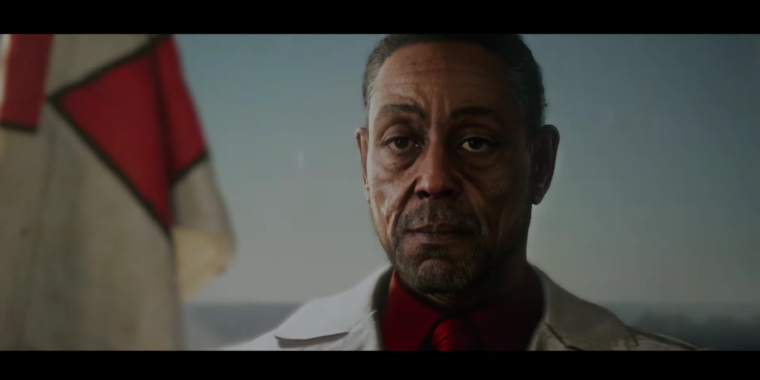
The Far Cry series continues to ask players to face off against “shades of gray” villains in wide-open, semi-lawless territories. After a brief detour to the United States in 2018’s Far Cry 5, the series returns to its jungles-and-islands roots with the fictional Caribbean nation of Yara. (Let’s be real—this is pretty much Cuba.) Instead of relying on cut scenes to showcase the striking voice and appearance of new series villain Anton Castillo, portrayed by famed actor Giancarlo Epsosito (Breaking Bad), this trailer goes to great lengths to look like an actual video game.

At first glance, the revealed footage looks like it’s from a current-gen console game as played on a PC at max settings. If ray-traced light-bounce models are being used to create an expensive global illumination system, this trailer didn’t make that apparent. Light sources look pre-baked, and reflections appear to rely on computationally mild screen-space techniques. Still, wide-open vistas full of lush wildlife and massive explosions seem like they’ve been cranked to “ultra” levels, so I wonder how this cross-gen game will scale down to run on the PS4 and Xbox One generation.

Either way, the most notable new features on display here revolve around stupidly overcharged weapons and increased access to souped-up cars. The former emphasizes homebrew gimmicks applied to weaponry, ranging from the cheesy (CD-Rs as projectiles that will slice foes while a Discman plays ’90s jams) to the absurd (a variety of flame-powered backpacks that somehow don’t set new series hero Dani Rojas on fire). The latter includes the kinds of American-made, Cuban-modified classic cars you might see rolling down modern Havana roads, along with tricked out dune buggies, four-by-fours, motorcycles, and other rough-road vehicles. And in order to meet a certain modern-gaming quota, this Far Cry sequel has added rideable horses and a silent bow-and-arrow attack option.

While most Far Cry games include a ton of animals to hunt, this trailer only shows a split-second shot of a terrifying crocodile. There’s also a new friendly puppy as a helper (as seen in the second gallery above); it’s had trippy surgery to replace its hind legs so that it can cart around your weapons and accessories.

In its E3-adjacent reveal, FC6 does more to impress upon viewers its bombast and love of curse words (“Fucked up situations call for fucked up solutions”) than it does to spell out new mechanics, such as how companions may play into an average mission or how the game’s smartphone and other gadgets work. We’ll likely see more sizzle reels and hype trickles between now and the game’s retail launch in October.

[embedded content]
Far Cry 6 gameplay reveal

Listing image by Ubisoft

https://arstechnica.com/?p=1768530