Neutrons unlock the secrets of Antonie van Leeuwenhoek’s microscopes

First microscope by Antonie van Leeuwenhoek.
Enlarge / First microscope by Antonie van Leeuwenhoek.
Tetra Images/Getty

In the late 17th century, a Dutch draper and self-taught scientist named Antonie van Leeuwenhoek earned renown for building some of the best microscopes available at a time when the instrument was just beginning to revolutionize scientific inquiry. He rarely divulged his lens-making methods, however, leading to centuries of speculation as to how he achieved such superior magnifications.

Now, neutron tomography has enabled scientists at TU Delft in the Netherlands to peer inside van Leeuwenhoek’s microscopes for the very first time. A new paper published in the journal Science Advances reveals that, far from requiring his own secret lens-crafting method, van Leeuwenhoek was a master craftsman who was able to achieve his extraordinary magnifications by honing and perfecting the typical lens production methods of his era.

It’s not entirely clear who invented the first bona fide microscope, but contenders for the claim include a late 16th-century Dutch maker of spectacles named Zacharias Janssen, a neighboring rival spectacle manufacturer named Hans Lipperhey, and a Dutch engineer and inventor named Cornelis Drebbel. Galileo noted the basic principle sometime after 1610 and built his own compound microscope after seeing one of Drebbel’s instruments on display in Rome in 1624. He dubbed it the “occhiolino” or “little eye.” 

English scientist Robert Hooke was among the first to make significant improvements to the basic design. He was a skilled lens grinder, which resulted in better magnification, and his early training as a draughtsman enabled him to render what he saw under the microscope in drawings of exquisite detail.  He published his magnum opus, Micrographia, in January 1665, illustrated with 58 stunning engravings—including his famous depiction of a magnified flea.

Van Leeuwenhoek’s own interest in lensmaking stemmed from his desire to more clearly see the quality of the thread he used in his draper business, and when he learned of the wonders of microscopy—he was a great admirer of Hooke’s Micrographia—he began making his own improvements. He built more than 500 microscopes in his lifetime, although only a handful have survived. A single lens was mounted in a tiny hole in the brass plate making up the body of the instrument, and the specimen was mounted on a sharp point just in front of it. The position and focus could be adjusted by turning two screws. The entire instrument was only 3 to 4 inches long.

Robert Hooke's famous drawing of a flea, viewed through a microscope.
Enlarge / Robert Hooke’s famous drawing of a flea, viewed through a microscope.
Public domain

Van Leeuwenhoek used his microscopes to study protozoans found in pond water, animal and plant tissues, mineral crystals, and fossils. He discovered such microscopic creatures as nematodes, as well as blood cells, and was the first to see living sperm cells of animals. By 1683, he had turned the instrument on himself to study the plaque between his teeth, and also observed teeming hordes of bacteria in the mouths of two elderly men who had never cleaned their teeth in their lives—the first observation of living bacteria ever recorded. He even experimented with using the ovum of a cod and the corneas of dragonflies as biologically derived lenses, succeeding in generating clear images of a candle flame with the latter.

His microscopes were little more than powerful handheld magnifying glasses, but they were nonetheless considered to be the best of his era. He was able to achieve magnifying power up to 270 times larger than the actual size of the sample, using a single lens, with clearer and brighter images than those achieved by any of his colleagues.

Van Leeuwenhoek was certainly skilled at grinding and polishing lenses, and it’s likely that many of his instruments contained these ground lenses. He also experimented with ball-shaped lenses early in his career, which involved melting and collecting glass on a needle tip. However, van Leeuwenhoek wrote that the glass suffered from contaminations and that he soon abandoned the method. But he also hinted that he had invented his own advanced method of glass-blowing “with which nonspherical lenses could be produced”—a remark that has led to considerable speculation over the centuries about a “secret technique” lost to posterity.

Eleven of van Leeuwenhoek’s microscopes have survived, but since he encased his lenses between two metal plates secured with rivets, with just one tiny hole about half a millimeter in diameter, one would need to take the microscopes apart in order to access the lenses—and no museum would consider damaging such a priceless artifact in this way. So the TU Delft scientists proposed using a non-invasive imaging technique called neutron tomography, similar in concept to X-ray tomography.

This makes it possible to image the entire shape of the lens, since the neutrons yield a higher contrast between the metal plates and the glass within. The object is rotated 180 degrees in a neutron beam as a camera takes multiple photographs, and the resulting 2D images can then be used to construct a 3D image of the object on the computer.

The 3D image of one of the microscopes in the Rijksmuseum Boerhaave’s collection showed that this medium-powered instrument contained a lentil-shaped lens consistent with the standard grinding and polishing methods of the time. The authors note in their paper that the data also showed the great care and precision van Leeuwenhoek brought to bear when crafting his instruments. “Judging from the preserved copies, each microscope that van Leeuwenhoek produced held a lens with a distinct curvature and magnification,” they wrote. “The tight fitting of the lens that the tomogram shows suggests that the brass plates were specially adapted to hold this specific lens.”

The TU Delft team also imaged the highest-powered known surviving microscope, housed at the Utrecht University Museum. This revealed that the Utrecht microscope does not contain a lentil-shaped ground lens; rather, it holds a ball-shaped lens with a tiny glass thread connected to it—the kind of lens produced by glass-blowing methods. What’s most interesting is that the shape of that lens fits a glass-melting lens “recipe” published by Hooke in 1678, which involved turning the end of a thin glass thread into a ball shape by melting it in a flame and using the remaining stem as a handle to mount the lens.

It was a variation of a technique Hooke had earlier described in Micrographia, which predated van Leeuwenhoek’s instruments, so the draper would have been familiar with the basic principle. Hooke’s method also produced ball-shaped lenses free of the contaminations that marred earlier glass-blowing methods van Leeuwenhoek said he had experimented with and found wanting. He was always strangely silent about Hooke’s lens-making methods.

“We may now assume that van Leeuwenhoek’s silence was a deliberate choice,” the authors wrote. “Van Leeuwenhoek adopted the very lens-making procedure by Hooke soon after he published it, and brought it to a great success but never told anyone about it. This is ironic, as Hooke always wanted to find out the secret of van Leeuwenhoek’s lenses but never managed to do so.”

Taken together, this research “has offered visually conclusive proof that van Leeuwenhoek did not limit himself to only a single lens type for making his pioneering discoveries, but adopted distinct lens-making procedures that circulated at that time, and integrated these into his microscopes,” the authors wrote. “Van Leeuwenhoek was far from the isolated scholar he is often claimed to be; rather, his secrecy about his lenses was motivated by an attempt to conceal his indebtedness to Hooke.”

Their findings also serve as a testament to his skill at pushing existing methods and designs to their full potential, honed over many years of building hundreds of microscopes. “It was craftsmanship and careful aperture control that made the difference,” the authors concluded. “Van Leeuwenhoek seems to have fully mastered these grinding and framework techniques, to have combined them with appropriate apertures, and to have brought them to perfection, resulting in the superiority of his iconic microscopes, in which all the attention and efforts were guided toward their one essential component: the lens.”

DOI: Science Advances, 2021. 10.1126/sciadv.abf2402  (About DOIs).

https://arstechnica.com/?p=1765022


GameStop FOMO inspires a new wave of crypto pump-and-dumps

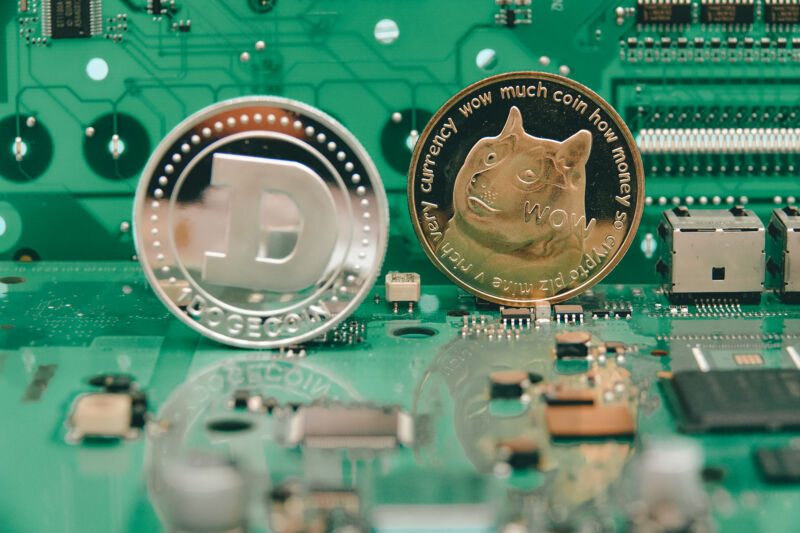
Physical representations of virtual dogecoins sit atop computer components.

After the California Gold Rush, in 1870, two Kentucky swindlers whipped up a scheme to prey on thirsty financiers’ FOMO. They invented a diamond field out West. Investors sunk millions in today’s money into the scheme. All of it, of course, was for naught—a cautionary tale about believing anyone who claims they have a surefire plan to get rich quick.

A hundred and fifty years later, a new generation of amateur investors is equally desperate not to miss the next big thing in the finance world. After watching the great GameStop stock boom play out on sites like Reddit and Discord this winter, hundreds of thousands of hopefuls are joining Discord groups that promise big earnings from manipulating the crypto market—also known as crypto pump-and-dumps. Step 1: Buy in early, when the coin is low. Step 2: convince other people to join you—the more, the merrier, the bigger the potential gains as the price of the coin goes up. Step 3: Sell out before the price tanks. Get the timing right, these groups promise, and you come out a winner (and richer). Losers are left holding the bag.

Crypto pumps have been on the rise for a few years now, thanks in part to the relative ease of making and marketing a new digital coin. In 2018, The Wall Street Journal identified 175 “pump” initiatives, moving over $825 million through 121 different crypto coins, most of them organized on Discord and Telegram. Since then, experts say, it’s only gotten bigger. Trade volume on cryptocurrency exchanges is surging, particularly with lesser-known coins that have no fundamental value outside of investing.

Originally a gaming-centric chat app, Discord has lately developed a strong culture of finance-centric servers. The app attracted tons of attention for its role in the WallStreetBets campaign to boost GameStop this January, when the meme stock rocketed from $20 to $347 in a matter of days. Later analysis attributed much of the spike to huge firms, rather than retail investors, but the spirit of the thing got people thinking: if they were in the right Discord server at the right time, maybe they could earn a buck. WallStreetBets users turned to Dogecoin next. They thought it would be funny, a good meme, to pump up the outdated and irrelevant cryptocurrency. And it worked. Doge spiked from $0.008 in late January to $0.68 on Wednesday.

According to moderators on four pump servers, a crop of new servers and social media “pump” accounts sprang up around the same time, with at least a dozen ripping off WallStreetBets’ name or logo. These accounts are not associated with the WallStreetBets subreddit or official Discord, according to a WallStreetBets moderator. (WallStreetBets only recently allowed discussions around crypto, but they are limited to Bitcoin, Ethereum, and Doge.) They are, however, cashing in on the WallStreetBets hype, advertising target gains of up to 500 percent. One of the servers has 83,000 members.

“Many young adults and others all of a sudden became extremely interested in stocks and investing, and this later also gave the crypto community and the cryptocurrencies a huge boost in popularity,” says one Discord user who goes by Alejandro. Alejandro was invited to his first crypto pump server in early February, during the GameStop hype. After making what he calls “a good profit,” 170 percent of his initial investment, Alejandro created his own group, FairPlay Crypto Pumps. It now has 10,500 members, who tune in every couple of days for a new “pump signal,” a server-wide message announcing which coin they’re pumping when. The gains, he says, comes from people who are not in the Discord. “This principle is called FOMO (fear of missing out),” he says. “Once outsiders see a sudden rise in an unexpected coin, they will buy shares. Meanwhile, the members of my group will sell their shares to the outsiders for a good chunk of profit.”

Discord is a perfect vehicle for these pumps, as a semi-public forum that allows users to advertise servers broadly, ping users about coordinated buy-ins, and discuss strategy. I’m a longtime Discord user, and anecdotally I’ve seen an enormous uptick in activity. Between early April and May, I received 47 invitations to join crypto pump groups over Discord. Eight of the groups have more than 20,000 members; the largest has over 80,000. Several of these servers’ moderators say they pay people—whom they call “advertisers”—to spam Discord users with invitations, sometimes including crypto giveaways.

New members are greeted with FAQs describing 2,000 percent pumps and the potential for hundreds or thousands in gains. That’s not necessarily the reality. “The Discord server is a casino. As the saying goes, ‘The house always wins,’ and they’re the house,” says Thomas Hurley, 21, a member of several crypto pump Discord servers. After crypto evangelists began joining his gaming servers to advertise pump groups, he tried his hand at a couple coordinated price pushes. He never made much profit, but other people did. When Hurley began looking closer at some of these coins’ market trading pages on sites like Binance, he noticed some interesting patterns.

“A few seconds before they announced which coin to pump, there would be a huge spike,” he says. It looked like someone in the know bought up a lot of the coin beforehand, hugely boosting their potential to earn big by selling early. Hurley never had a chance.

He isn’t alone. A 2018 study of Telegram-based pump groups found that five minutes before the pump signal (before the coin is even revealed), a designated coin’s price shot up about 5 percent. Back then, on average, only investors who bought in within the first 20 seconds after a pump could make a profit. Today, sources say, crypto pumps move so quickly that enthusiasts commission bots to buy and sell coins based on Discord announcements. The owner of one server, Pump It Up, says he lost several hundred dollars because he wasn’t using a bot, which can buy and sell within milliseconds. The experience prompted him to make his own group back in February.

“Crypto pumps prey on less-informed people in the space,” says Josh Kamps, a PhD candidate at University College London studying crypto fraud. People who found out about GameStop late want to jump on the next big thing. Kamps noticed, anecdotally, that a bunch of low-utility alt-coins cropped up right around then, which he says are “pretty much designed to be pumped.” For example, he says, pump groups are flocking to Shiba Inu Coin (or SHIB). One knock-off WallStreetBets pump group advertises that they pumped SHIB for more than 4 times profit. In the last 24 hours, the meme coin saw over $6.1 billion in trading volume.

“Discord welcomes a broad variety of personal finance discussions, including cryptocurrency, investment clubs, and day traders and encourages creative uses of our platform, as long as nothing compromises our values or amounts to illegal activity,” a Discord spokesperson said in an email to WIRED. They cautioned Discord users to carefully research advice they receive on the Internet.

Crypto pump schemes fall into a gray legal area. “There’s a lot of debate about whether we see cryptocurrencies as securities or not,” says Donghwa Shin, a professor at the University of North Carolina at Chapel Hill who coauthored the 2018 study. Pump-and-dumps are illegal for securities but not for cryptocurrencies. “That’s why there’s no clear regulation,” he says. Shin thinks it’s time for that to change. According to his research, these currencies’ liquidity and value increase in crypto exchanges where pump-and-dumps are banned. Not only does the market get better, it would be more challenging for the tiny fraction of people organizing these pumps—the people who most consistently make money off them—to take advantage of others.

“Unfairness exists in these markets. The winners in these markets are the insiders. All others are losers. In order to protect them, we have to regulate this market,” says Shin.

The US Commodity Futures Trading Commission warned consumers in 2018 to avoid virtual currency pump-and-dump schemes but also stated that it had limited authority over those markets. Earlier this year, however, federal prosecutors charged businessman John McAfee and an associate in connection to several pump-and-dump initiatives involving digital coins. The US alleges that between late 2017 and 2018, McAfee advertised a “coin of the day” on his Twitter account without disclosing to his million followers that the men had bought up the coin beforehand and would sell it when the price spiked. The CFTC heralded the case as its first-ever enforcement action for “a manipulative scheme involving digital assets.”

The current crypto rush is also inspiring more traditional forms of fraud. Last week, one group, WallStreetBets – Crypto Pumps, pulled off a $2 million scam, Bloomberg estimates, when it told its 340,000 Telegram subscribers it would be pumping its own coin, WSBFinance. The coin didn’t exist yet; it was allegedly a presale. Users sent money to a crypto wallet believing they would receive the WSBFinance coin. But there were never any coins.

“Sorry guys! Our bot had a small problem,” the account wrote to its Telegram members. Then, after a delay: “Buying lambo now.”

This story originally appeared on wired.com.

https://arstechnica.com/?p=1765272


The chip shortage is driving up tech prices–starting with TVs

The chip shortage is driving up tech prices–starting with TVs
Bloomberg | Getty Images

Televisions, laptops, and tablets have been in high demand during the Covid-19 pandemic, as people worked and learned via Zoom, socialized over Skype, and binged on Netflix to alleviate the lockdown blues. But all that extra screen time also helped set in motion a semiconductor supply crunch that is causing prices for some gadgets to spike—starting with TVs.

In recent months, the price of larger TV models has shot up around 30 percent compared to last summer, according to market research company NPD. The jump is a direct result of the current chip crisis, and underscores that a fix is more complicated than simply ramping up production. It may also be only a matter of time before other gadgets that use the same circuitry—laptops, tablets, and VR headsets among them—experience similar sticker shock.

Some manufacturers have already flagged potential price rises. Asus, a Taiwanese computer maker, said during a quarterly earnings call in March that a shortage of components would mean “price hikes further upstream,” which would likely affect consumers.

“Prices are definitely—unfortunately—going up,” for these components, says Michael Hurlston, CEO of Synaptics, a company that sells integrated circuits for controlling touchscreen displays to manufacturers of consumer electronics. “In certain cases we’re passing those prices on to our customers, and we’ve heard that they’re passing those increases on to their customers.”

While the supply squeeze has been felt across the semiconductor industry, those display-bound integrated circuits pose specific challenges. Since they are not especially advanced, the circuits are typically made at chip factories that are several generations behind the cutting edge. With chipmakers focused on building more advanced fabrication plants that yield more valuable components, there has been little incentive to invest in capacity at older facilities. It’s simply not possible to churn out more of them even when demand spikes.

All manner of devices have already been affected by the chip shortage. Sony told analysts this week that the PlayStation 5 would remain in short supply through 2022 due to the crunch. Companies that act as electronics component brokers say that certain components have seen prices jump orders of magnitude; voltage regulators used in countless products that normally cost 50 cents have been selling for as much as $70. But at the consumer level, products that require display integrated circuits are feeling the impact first, and hardest, because of those factory limitations.

“The word I’ve heard recently is that the inventories have depleted,” says Peggy Carrieres, a vice president at AVNet, an electronics component supplier. “So those new prices are going to hit into the retail outlets, and consumer consumption.”

While it’s one type of integrated circuit, the impact is wide-ranging. “Anything that has a screen built into it is going to be affected by these price increases,” says Paul Gagnon, senior research director for consumer devices at analyst firm Omdia. That includes PC makers, he says, which have been able to avoid increases by selling devices for the same price but with, for instance, less memory.

Electronics retailer Monoprice has been affected by the component drought, says Paul Collas, the company’s vice president of product. He claims that Monoprice won’t raise prices but it may have to cancel sales and other promotions. “In some cases we are also seeing the need to invest more in upfront payments to partners to ensure long lead parts are secured to support our supply requirements.”

A confluence of factors have contributed to the unprecedented chip drought. The pandemic sparked a boom in demand for home electronics and cloud services, and the economic slowdown also caused certain industries to badly misjudge how demand would fall.

The impacts have been felt beyond traditional consumer technology as well. Carmakers, in particular, were left flatfooted after expecting fewer sales. After preemptively canceling orders for semiconductor components, many auto manufacturers have had to stop production while they wait for supply reinforcements to arrive. Broader supply chain disruptions have hurt as well, including a fire in March that shut down a plant in Japan that makes a range of different semiconductor components—including display integrated circuits.

Geopolitical tensions between the US and China have also contributed. In the last few years, the US government has imposed sanctions on major Chinese consumer tech companies, including Huawei and ZTE, blocking their access to the most advanced chips and prompting them to stockpile as many as possible.

Many experts expect the semiconductor crunch to last for more than a year, and it may contribute to a redrawing of the global chipmaking landscape. The shortage has highlighted the importance of chip manufacturing to many industries, and the most advanced chips will be vital to progress in key areas such as artificial intelligence, 5G, and military technology.

The leading US chipmaker, Intel, has fallen behind competitors like TSMC in Taiwan and Samsung in South Korea in recent years, but the company plans to invest heavily in an effort to regain a leading position. The US government has also proposed a $50 billion stimulus for the US chip industry in an effort to bolster American chipmaking capabilities.

But this will do nothing to help with the current situation, according to Hurlston of Synaptics, the circuit maker. “It’s just simple economics,” he says. “There’s a finite amount of supply, we’re all fighting for it.”

This story originally appeared on wired.com.

https://arstechnica.com/?p=1765280


Despite big Marvel and Star Wars shows, Disney+ falls short of targets

<img src="https://rassegna.lbit-solution.it/wp-content/uploads/2021/05/despite-big-marvel-and-star-wars-shows-disney-falls-short-of-targets.jpg" alt="Meta-sitcom/adventure series WandaVision was one of Disney+’s most successful recent shows.”>
Enlarge / Meta-sitcom/adventure series WandaVision was one of Disney+’s most successful recent shows.
YouTube/Disney+

Analysts expected Disney+ to reach 109 million subscribers in Disney’s most recent financial quarter, but the streaming service fell short, landing at 103.6 million. The shortfall resulted in lower revenues than expected for the company and a small stock price stumble.

Alongside word that Netflix also saw fairly slow growth in its quarter, the news suggests that there is, in fact, a limit to the explosive growth that streaming platforms have experienced amid the COVID-19 pandemic.

Still, Disney is staying the course with its current strategy of pumping out TV series in established Disney brands like Marvel and Star Wars, as well as releasing new motion pictures on the platform at the same time they premiere in theaters.

Speaking to investors, Disney CEO Bob Chapek pointed to the Star Wars TV series The Mandalorian as evidence that launching new properties on streaming services can be successful, noting that merchandise sales related to the show were “extraordinary.” (In other words, people are buying a lot of Baby Yoda plushies and the like.)

As such, live-action Disney film Cruella, Marvel movie Black Widow, and Dwayne Johnson vehicle Jungle Cruise will be released simultaneously on Disney+ and in theaters, even as most theaters in the United States have now reopened as vaccination rates in the country rise.

At least on the business side of things, this subscriber tally is widely seen as a significant disappointment and a worrying trend for Disney’s goal of streaming dominance. For example, financial publication CNBC described Disney’s slowing subscriber growth as “Netflix-itis,” given that Netflix also has struggled to keep the wheels turning as fast as they used to.

Disney+’s situation is arguably more concerning, because Disney+’s monthly fee is already quite low at $7.99 per month, inclusive of UltraHD streaming—less than Netflix’s $8.99 for SD, $13.99 for HD, and $17.99 for UltraHD. That doesn’t give Disney a lot of flexibility.

Still, Disney+ is one of the most successful streaming services, and it’s a testament to that success that it is even compared directly to Netflix. Most other services like HBO Max or Paramount+ have far fewer subscribers than either Disney+ or Netflix.

Content offerings and prices are obviously the biggest factors in competition between these platforms, but tech plays a part, too. Streaming services have attempted to outdo one another in a sort of bitrate arms race. For example, HBO’s platforms used to be infamous for poor video quality compared to Netflix and others, but when HBO Max adopted 4K HDR streaming for the premiere of Wonder Woman 1984 in December, the company also significantly improved streaming quality overall.

https://arstechnica.com/?p=1765225


After Epic v. Apple namecheck, Itch.io runs one-day-only dev-friendly promo

After Epic v. Apple namecheck, Itch.io runs one-day-only dev-friendly promo

Itch.io, a digital download storefront that largely sells indie video games, launched its first-ever “Creator Day” on Friday. This one-day-only price promotion is aimed more at developers than consumers, as it comes with a twist: Itch.io will claim precisely zero dollars in service fees from its developers until the promotion ends at 2:59 am ET on Saturday, May 15.

The sale comes as Epic and Apple, two massive players in the digital storefront space, continue to face off in court over the percentages charged to game- and software-makers for every sale of a game. Itch.io may not have wanted to become part of that argument, but the Epic Games v. Apple court case seems to have forced the company’s hand.

Before the lawsuit’s start, Epic announced that it would allow its Epic Games Store (EGS) users to download and access Itch.io, thus publicly proving that Epic was willing to host a competitor’s storefront. Epic’s lawsuit revolves around Apple’s unwillingness to do the same on the iOS App Store—a decision that led to Fortnite‘s delisting from the platform.

Last week, Apple’s lawyers pushed back about Itch.io’s arrangement with the EGS to make a point about Apple’s walled-garden approach to App Store content approval. An Apple attorney described a single game available on Itch.io, titled Sisterly Lust, and called it a “so-called adult game” with “a list of fetishes which include many words that are not appropriate for us to speak in federal courts.” The Apple attorney then claimed that Itch.io lets EGS users access software that Epic has not double-checked or moderated.

Apple’s lawyer did not inform the court that Itch.io games with an “18-and-up” flag require a user’s age confirmation before the games’ details appear in the app or web storefront. Epic General Manager Steven Allison was also unable to clarify Itch.io’s moderation policies while on the stand. Nevertheless, the shot was fired, and Itch.io posted a joking response on Twitter soon after: “Guys, Apple’s lawyers just called. They said we need to turn off ALL the games.”

Unspeakably low fees

Creator Day includes no mention of Epic Games v. Apple, nor how Itch.io’s one-day-only promotion of zeroed-out fees compares to the 12 percent typically charged to devs via the EGS or the 30 percent charged via Apple’s App Store (or any other storefront’s charges). Instead, the promotion included a hint that it may return, with Itch.io saying, “We hope to make this a regular event to give developers an excuse to share and promote their works.”

This promotion may make zero difference for some Itch.io games because the company lets its developer community forgo the service’s per-purchase fees if they want to. The service initially launched with zero dev fees; in 2015, Itch.io began to allow devs to pick the same kind of “pay what you want slider” that it offers consumers. This dev fee defaults to 10 percent, which does not include the fixed processing fees required by payment operators (these fees are not waived as part of Creator Day).

As Itch.io wrote in 2015:

You might be saying, “that sounds pretty risky, what if everyone sets it to zero?” We think that’s a risk we’re willing to take in the spirit of encouraging the generous and supportive community that’s already developed around Itch.io.

Itch.io’s thousands of games are all over the map in terms of content, complexity, and tone. The storefront is wide-open enough to include options like visual novels, tabletop game rulesets, and award-winning indie fare like Celeste, A Short Hike, and Night in the Woods. Arguably its biggest promotion was June 2020’s Bundle for Racial Justice and Equality, which included over 1,700 games and exceeded $8 million in sales that went directly to charity.

Itch.io’s Creator Day promotion largely resembles “Bandcamp Fridays,” a first-of-the-month promotion that began waiving fees for all music purchases through that storefront once the pandemic began affecting its community of touring musicians. The promotion is slated to continue through 2021, with the company saying earlier this month that “although vaccines are starting to roll out, it will likely be several months before live performance revenue starts to return.”

Apple has had a long history of ever-changing moderation practices, and the company has made plenty of questionable decisions. It recently began telling users of the Discord chat service which “NSFW” channels could be accessed on the app’s iOS version. It rejected a speed-testing app that looked for net neutrality-based speed gates (though it later reversed the call). And in the App Store’s earliest days, Apple began a moderation crusade in response to issues with “adult” screenshots in app listings. The company is not always as forthright when the “offense” in question concerns hacks into users’ phones and whether to tell users about them.

https://arstechnica.com/?p=1765110


Steam’s “price parity rule” isn’t wreaking havoc on game prices

Coins rain on a piggy bank labeled Epic Games.

Monopoly control is a hot topic in the games industry these days. Lawsuits against Apple, Valve, and Sony all take slightly different tacks in arguing that these companies exercise unfair monopoly control over their platforms’ market for downloadable games.

Each suit also argues that this monopoly control leads to higher game prices for consumers. Platform holders charge higher commission fees than they would in a truly competitive environment, the arguments go, and those higher-than-normal publishing costs are passed on to consumers via higher-priced games.

There’s something intuitively appealing to the idea of game publishers trying to attract more market share by “passing on the savings” of lower storefront commissions by lowering the asking price for their games. In practice, though, prices for the same title tend to remain consistent across platforms, regardless of the competing platform holders’ specific revenue cuts.

Platform price parity

The Epic Games Store’s two-year-plus experiment in reduced platform fees provides plenty of evidence on this score. Just look at any of the dozens of games available on both the EGS (where Epic charges publishers a 12 percent fee) and Steam (where Valve charges a 30 percent standard fee).

In almost every case, those games will be offered at the same base price. Instead of passing on the savings, the publishers just pocket the 18 percentage-point difference between the EGS cut and the Steam cut. The only real exceptions come when a store is having a temporary sale, after which the games revert to identical prevailing pricing standards in almost every case.

This price-matching might be an artificial construct, though. In Wolfire Games’ lawsuit against Valve, the developer argues that the Steam-maker enforces a “Price Parity Rule” to make sure “Steam keys cannot be sold on other sites unless the product is also available for purchase on Steam at no higher a price than is offered on any other service or website.”

Wolfire’s David Rosen expanded on that accusation in a recent blog post, saying that Valve threatened to “remove [Wolfire’s game] Overgrowth from Steam if I allowed it to be sold at a lower price anywhere, even from my own website, without Steam keys and without Steam’s DRM.”

Prices for the same title tend to remain consistent across platforms, regardless of the competing platform holders’ specific revenue cuts.

Sources close to Valve suggested to Ars that this “parity” rule only applies to the “free” Steam keys publishers can sell on other storefronts and not to Steam-free versions of those games sold on competing platforms. Valve hasn’t responded to a request for comment on this story.

Regardless, even if we remove Steam’s alleged price-fixing from the equation, publishers still seem reluctant to pass on the savings from the EGS’s lower cut. This is apparent when you look at the Epic Games Store PC exclusives that are also sold on consoles, where the platform holders each take their own 30 percent cut.

An Ars analysis found that out of 41 such games, only five were offered for a lower price on the EGS. The rest of the games were priced identically on PC and console, except for eight that were actually cheaper on console thanks to a temporary sale. Again, publishers largely aren’t lowering their prices even though Epic has lowered its relative platform cut.

<a href="https://cdn.arstechnica.net/wp-content/uploads/2021/05/wdl.jpg" class="enlarge" data-height="900" data-width="1600" alt="Ubisoft charges the same $60 for Watch Dogs: Legion when it’s sold on Uplay (with no platform fee) or the Epic Games Store (with a 12 percent fee).”><img alt="Ubisoft charges the same $60 for Watch Dogs: Legion when it’s sold on Uplay (with no platform fee) or the Epic Games Store (with a 12 percent fee).” src=”https://rassegna.lbit-solution.it/wp-content/uploads/2021/05/steams-price-parity-rule-isnt-wreaking-havoc-on-game-prices-1.jpg” width=”640″ height=”360″ srcset=”https://rassegna.lbit-solution.it/wp-content/uploads/2021/05/steams-price-parity-rule-isnt-wreaking-havoc-on-game-prices-2.jpg 2x”>
Enlarge / Ubisoft charges the same $60 for Watch Dogs: Legion when it’s sold on Uplay (with no platform fee) or the Epic Games Store (with a 12 percent fee).

The same phenomenon remains true even if we take consoles out of the equation. Since early 2019, Ubisoft’s new PC games have avoided Steam in favor of distribution on the EGS and Ubisoft’s Uplay platform.

But even though Ubisoft doesn’t pay any platform fees for games sold through Uplay, the prices for games like Watch Dogs: Legion and Anno 1800 are the same across Uplay and the EGS. Ubisoft isn’t interested in “passing on the savings” from avoiding the EGS’s 12 percent cut in these cases, even though doing so would likely make Uplay a significantly more appealing option for cost-conscious players.

Where’s my discount?

This situation runs counter to a prediction that Epic co-founder and CEO Tim Sweeney made to Ars in an interview over two years ago.

“After you go through several cycles of game developers making decisions, you’re going to see lower prices as developers pass on the savings to customers, realizing they can sell more copies if they have a better price,” Sweeney said at the time. “This sort of economic competition is really healthy for the whole industry and will lead the industry to a better place for all developers and for gamers as well. It’s a supply-side thing, this revenue sharing. It’s some sort of business arrangement between developers and a store that [a] gamer generally doesn’t see.”

But industry analysts see digital game pricing less as “a supply-side thing” and more driven by consumer demand and willingness to pay.

“I suspect that developers and publishers see no reason to pass [reduced storefront fees] on to consumers,” F-Squared analyst Mike Futter told Ars. “Consumers believe that $60 (soon $70) is the fair market price because [development] costs went up.”

Futter pointed out that PC games used to routinely sell for less than their console counterparts, even before high-end console game prices rose to $60 in the mid-2000s. Eventually, though, “market tolerance proved $60 was fine on console, so it was fine on PC,” Futter said. “Publishers realized that the market would bear it. No reason to keep it lower, especially as costs have increased.”

Theoretically, a publisher using reduced platform fees to lower its asking price could increase the overall number of copies sold, creating a win-win situation in which the publisher makes more overall profit as well. In practice, though, things don’t tend to work that way.

Lowering the base price of a game from $60 to $50 “isn’t going to move [enough additional] people” to buy a game, Futter said. “I don’t think it would be statistically significant… even if Valve wouldn’t require price parity, the PR nightmare isn’t worth it.” NPD analyst Mat Piscatella agreed, telling Ars that “price sensitivity in games is such that lowering the base price will rarely drive enough incremental sales to offset” the lost revenue per sale.

Price sensitivity in games is such that lowering the base price will rarely drive enough incremental sales to offset.
NPD Analyst Mat Piscatella

But that general rule only applies to the base price for digital games, Piscatella added. When games go on temporary sale, as they frequently do on pretty much every digital storefront, the resulting boost in sell-through can help increase publisher profits for a time.

“Promoted short-term sales carry a sense of awareness and urgency to purchase, so they combine to boost volume,” Piscatella said. “Price changes only boost volume for a short window, then sales continue to decay… the change has a short-term impact, whether or not the price change is temporary or permanent.”

Sales aside, keeping prices consistent across different platforms (with different platform cuts) might be the simplest way to go for many publishers. “Most game publishers in today’s market seem to prefer the same pricing across many stores, no matter what platform cut they receive,” GameDiscoverCo founder Simon Carless told Ars. “Reduced platform cuts might give them more latitude for greater one-off discounts and other promotions. But price parity often appears to be a commercial decision for uniformity and ease of explanation.”

And regardless of publisher costs and consumer prices, Carless thinks some publishers may have trouble attracting enough potential customers on a relatively unestablished platform like the Epic Games Store in the first place. “Platform cut is really important, but in order to succeed as a platform, you need both a competitive cut and a mass of actual players,” he said.

None of this means that alleged monopoly pricing on digital storefronts doesn’t come at a price or that developers and publishers wouldn’t benefit from keeping a greater share of the sale price for their games. “As developers reinvest more of that 18 percent of additional revenue into building better games, that’s key to the long-term health of the game industry that we all have to look out for,” Sweeney told Ars in 2019.

But if you’re expecting that lower platform fees will lead to lower asking prices for games overall, experience suggests you’ll probably end up disappointed.

https://arstechnica.com/?p=1764632


Famed Arthurian tale comes to silver screen in The Green Knight trailer

[embedded content]
Dev Patel stars as Sir Gawain in the forthcoming epic medieval fantasy film, The Green Knight.

An ambitious young knight of King Arthur’s Round Table makes an ill-advised bargain and embarks on a personal quest in the new trailer for The Green Knight, a forthcoming film by director David Lowery (Pete’s Dragon, A Ghost Story) adapted from the famous 14th-century medieval poem, Sir Gawain and the Green Knight. Originally meant to debut at the 2020 SXSW festival, with a May 2020 theatrical release, the film was shelved in the face of the global pandemic. With theaters slowly reopening around the country (and the world), The Green Knight is finally being released this summer.

(Spoilers for the 14th-century medieval poem below.)

The original poem falls into the chivalric romance genre, relating a well-known story from Arthurian legend. (I highly recommend J.R.R. Tolkien’s translation from 1925 or Simon Armitage’s 2008 translation, recently revised.) On New Year’s Day, King Arthur and the knights of the Round Table gather at Camelot to feast and exchange gifts. A mysterious Green Knight disrupts the festivities and proposes a different kind of exchange: any one of the knights may strike him with one blow with his axe; in return, the Green Knight will come back in a year to return the blow. Sir Gawain, the youngest of the knights and nephew to Arthur, accepts the challenge and beheads the Green Knight. Everyone is shocked when the Green Knight picks up his severed head. He says Gawain must meet him at the Green Chapel one year hence to receive a similar blow, per their bargain.

As the deadline approaches, Gawain embarks on a quest to find the Green Chapel, having plenty of adventures and battles along the way. Finally, he arrives at a castle, and the lord and lady invite him to stay as their guest. The lord, Bertilak de Hautdesert, proposes another bargain: he will go out hunting every day and give Gawain whatever he catches, provided Gawain gives the lord anything he gains during the same day. And every day, the lady of the castle attempts to seduce the young knight while her husband is away. Gawain is caught between two competing codes: the code of chivalry demands that he not betray his host’s trust by sleeping with his wife, but the code of courtly love demands that he do whatever a damsel requests.

Kisses

He manages to courteously fend off the lady’s advances for two days, granting her only one and two kisses, respectively, which Gawain then passes on to the lord when he brings back a deer and a boar. On the third day, when Gawain once again spurns her advances, the lady tries to give him a gold ring. He declines the gift. But when she next offers him a green and gold silk sash that she swears will protect him from physical harm, Gawain—knowing his rendezvous with the Green Knight approaches—accepts in a moment of weakness, and the two exchange three kisses. He passes the three kisses on to the host when the lord returns with a fox, but Gawain doesn’t tell his host about the lady’s sash.

The next day, Gawain rides off to meet the Green Knight, who delivers the return blow. Gawain, who is wearing the sash, only suffers a minor nick on the neck. Technically, he “wins” their game, but the Green Knight reveals himself to be none other than Lord de Hautdesert and says that the entire yearlong scheme was meant to be a test of the Arthurian knights. Had Gawain told the lord about the sash, he would not have even suffered a slight wound on his neck. So Gawain’s victory is also a source of personal shame, even though the lord declares Gawain to be the most blameless knight in the realm.

There have been prior attempts to adapt Sir Gawain and the Green Knight for film and television, most notably director Stephen Weeks’ 1984 film, Sword of the Valiant, starring Sean Connery as the Green Knight. Both that film and Weeks’ earlier 1973 adaptation took considerable liberties with the original text—understandable, given the passage of centuries, but neither film proved successful. (Time Out’s reviewer even compared the poor production values of Sword of the Valiant unfavorably to Monty Python and the Holy Grail, although Connery received praise for his performance.)

Judging by the trailer, Lowery is also taking a few liberties with the source material. Per the official premise:

An epic fantasy adventure based on the timeless Arthurian legend, The Green Knight tells the story of Sir Gawain (Dev Patel, Slumdog Millionaire), King Arthur’s reckless and headstrong nephew, who embarks on a daring quest to confront the eponymous Green Knight, a gigantic emerald-skinned stranger and tester of men. Gawain contends with ghosts, giants, thieves, and schemers in what becomes a deeper journey to define his character and prove his worth in the eyes of his family and kingdom by facing the ultimate challenger.

Ralph Ineson (Game of Thrones, Absentia) plays the Green Knight; Sean Harris (Prometheus, The Borgias) plays King Arthur; Katie Dickie (Game of Thrones, Prometheus) plays Guinevere; Alicia Vikander (Ex Machina) is the lady; and Joel Edgerton (who played Gawain in Antoine Fuqua’s 2004 King Arthur) plays the lord. The cast also includes Barry Keoghan, Sarita Choudhury, and Erin Kellyman.

The Green Knight opens in theaters on July 30, 2021.

Listing image by A24

https://arstechnica.com/?p=1764204


Github reverses takedown of reverse-engineered GTA source code

The reverse-engineered source code for the PC versions of Grand Theft Auto III and Vice City is back online today, months after it was originally posted and then quickly taken down due to a DMCA request from publisher Take-Two.

TorrentFreak reports on the restored version of the project, which was posted as a seemingly identical fork of the original by a New Zealand-based developer named Theo. While the original GitHub poster (who goes by the handle aac) has not contested Take-Two’s original takedown, Theo told TorrentFreak he filed a counterclaim to restore his copy of the project, saying it “contained no code owned by Take Two.”

A question of law

We’ve previously looked in depth at how video game fan coders use reverse-engineering techniques to deconstruct the packaged executable files distributed by a game’s original developers. This painstaking, function-by-function process creates raw programming code that can generate exactly the same binary file when compiled (though the code as distributed on GitHub still requires external, copyrighted art and sound assets from legitimate copies of the games).

In general, reverse-engineering source code from a compiled binary is less straightforwardly illegal than simply cracking a game’s DRM for piracy purposes, for instance. As the Electronic Frontier Foundation explains, US case law includes certain fair use exceptions that can allow for this kind of decompilation work for research or interoperability purposes.

In the case of Grand Theft Auto, though, the game’s End User License Agreement specifically asks players to agree not to “reverse engineer, decompile, disassemble, prepare derivative works based on or otherwise modify the Software, in whole or in part.” Back in 2005, the 8th Circuit Court of Appeals upheld a similar anti-reverse-engineering EULA to take down BnetD, a reverse-engineered version of Blizzard’s Battle.net that allowed the service to be emulated on private servers.

Whatever the legal status of the code, Theo told TorrentFreak that he “believe[s] Take-Two’s claim to be wholly incorrect… since the code may be functionally identical, but not exactly identical, they hold no claim to the code.” So Theo filed a DMCA counterclaim requesting the affected code be reposted within ten to 14 days. When that time passed without notice of a formal legal filing by Take-Two, GitHub followed the DMCA guidelines and reposted the code nine days ago without ruling definitively on the merits of either claim.

Take-Two hasn’t responded to a request for comment from Ars Technica, so we don’t know if the publisher will go through the legal motions to remove the code again. For now, though, fans with the technical know-how can enjoy improvements made on top of the reverse-engineered code, such as bug fixes, reduced load times, improved rendering, widescreen monitor support, and a free-floating camera system, to name a few examples (not to mention derivative ports of the game to new platforms like Linux, Switch, and the PlayStation Vita).

Listing image by RockStar Games

https://arstechnica.com/?p=1764252


Our fave gentleman thief is back for revenge in trailer for Lupin part 2

[embedded content]
Omar Sy is back as Assane Diop, a modern-day gentleman thief who models himself on the classic French fictional character Arsène Lupin, in part 2 of Lupin, coming to Netflix on June 11.

The Netflix French original series Lupin proved to be an unexpected hit when it debuted earlier this year, purportedly racking up views in 70 million households in its first month. And there’s good news for those frustrated by part 1’s cliffhanger ending: we’ll soon find out what happens next, as Netflix just dropped a full trailer and release date for part 2 of the saga. Alas, the trailer is dubbed in English—quelle horreur!—which means we miss out on star Omar Sy’s dulcet tones. (Dear Netflix: it’s OK to have subtitled trailers for your foreign fare. In fact, it’s far, far preferable to bad dubbing.)

(Some spoilers for part 1 below.)

As I’ve written previously, Arsène Lupin is the creation of Maurice Leblanc, who based the character partly on a French burglar/anarchist. Relentlessly pursued by a detective named Ganimard, Lupin is captured stealing a woman’s jewels while on board a ship. Although he is imprisoned, he ultimately escapes before standing trial and goes on to pull off many other colorful heists.

The Netflix series is the creation of Louis Leterrier, who directed the 2013 heist thriller Now You See Me, in which a band of magicians pulls off ingenious robberies. So it’s easy to see why he would be drawn to this project.

We meet the Senegal-born Assane Diop (Sy) while he’s working as a janitor at the Louvre, surrounded by artwork worth millions. Currently on exhibit is a jeweled necklace that once belonged to Marie Antoinette, in advance of a public auction to sell the piece to the highest bidder. It was this recently recovered necklace that his father, Babakar (Fargass Assandé), was falsely accused by wealthy financier Hubert Pellegrini (Hervé Pierre) of stealing. Assane is out for revenge for his father’s subsequent suicide. After duping local gang members into pulling a decoy heist, Diop disguises himself as a wealthy potential buyer and crashes the auction—and ultimately walks away with the necklace.

That’s just the beginning of the story, as we learn more about Assane’s history—including his relationship with childhood sweetheart Claire (Ludivine Sagnier), the mother of his son—and why he has modeled his schemes on the exploits of Arsène Lupin. Elements drawn from various Lupin stories are cleverly woven throughout the series, most obviously “The Queen’s Necklace”—the title of the pilot episode, which incorporates several plot elements of the original story and also provides the inspiration for the name of Assane and Claire’s son: Raoul (Etan Simon). Captain Romain Laugier (Vincent Londez) and another detective, Youssef Guedira (Soufiane Guerrab), are part of the team investigating the Louvre heist, and both share traits with Ganimard.

Count me among those who thoroughly enjoyed part 1. “The series is briskly paced without sacrificing character development, capturing the essence of each character in deft strokes. The cast delivers strong performances across the board,” I wrote in my review earlier this year. “But it’s Sy’s Assane who anchors the series as the quintessential gentleman thief for the 21st century.” But I was also a fan of the original novels and short stories and was a little surprised at the huge success Lupin enjoyed around the world. And I wasn’t the only one. A bewildered French journalist interviewed me about why I thought audiences were responding so enthusiastically—while making it very clear he did not care for the show at all.

It’s partly because Netflix, in particular, has a gift for ferreting out solid foreign films and TV series likely to appeal to American tastes. And Lupin has just the right amount of universal appeal for audiences craving fresh fare while stuck at home during a global pandemic. In fact, it was a hit in households all around the world, including Germany, Austria, Italy, Spain, Denmark, Sweden, Canada, Brazil, Argentina, and South Africa.

The show even reached No. 1 in France, so that French journalist was in the minority. Who doesn’t love the dashing exploits of a gentleman thief? “This level of response is totally beyond me,” Sy told Deadline Hollywood earlier this year. “It’s great to see in Brazil or in France they loved Lupin for the same reason. There’s something universal, and that’s something I always try to achieve.”

The only bad thing about Lupin part 1 was that, at only five episodes, it was too short and ended on the mother of all cliffhangers, with Pellegrini’s henchmen kidnapping Assane’s son in retaliation for the theft of the diamond necklace and Assane’s attempt to make Pellegrini’s longstanding corruption public. Per the official part 2 premise: “Assane’s quest for revenge against Hubert Pellegrini has torn his family to pieces. With his back to the wall, he now has to think of a new plan, even if it means putting himself in danger.”

The trailer opens right where part 1 left off, with Assane’s son bound and gagged in a chair and Assane vowing revenge against Pellegrini. That’s going to be particularly difficult, since Pellegrini has used his media contacts to frame Assane for a crime he didn’t commit, and Assane is now the most wanted man in France. So Assane and his loyal ally, jeweler Benjamin Ferel (Antoine Gouy), decide to disappear for a bit to concoct a new plan while in hiding. Meanwhile, Pellegrini is setting a trap for our gentleman thief: a symphony performance in honor of Arsène Lupin. We get plenty of gorgeous shots of Paris, a car chase, and what looks like an epic showdown in the famous catacombs of Paris.

Lupin part 2 debuts on Netflix on June 11, 2021. Netflix has already renewed the series for a part 3, so we’ll be getting lots more of Assane’s dashing exploits in the future. And it’s the perfect time to binge all five episodes of part 1 if you haven’t already seen them.

Listing image by YouTube/Netflix

https://arstechnica.com/?p=1764063


It’s the battle of the alien symbiotes in Venom: Let There Be Carnage trailer

[embedded content]
Tom Hardy returns to the big screen as the lethal protector Venom, taking on Woody Harrelson’s villainous Cletus Kasady/Carnage, in Sony’s forthcoming film Venom: Let There Be Carnage.

Tom Hardy (Mad Max: Fury Road) returns as intrepid reporter Eddie Brock, infected with a parasitic alien symbiote that gives him super powers, in Venom: There Will be Carnage. Directed by motion-capture icon Andy Serkis, it’s the sequel to 2018’s box-office smash, Venom. After being delayed for nearly a year due to the ongoing pandemic, Sony just dropped the official trailer, in which Brock/Venom must battle serial killer Cletus Kasady (Woody Harrelson, Zombieland), infected with another alien symbiote dubbed Carnage.

(Some spoilers for first film below.)

A Venom film was in development at New Line Cinema back in 1997, although the project didn’t really get off the ground until Sony acquired the rights to the character, as well as Spider-Man. Sony initially planned for Venom and Spider-Man to inhabit a shared universe, given their history in the comics. (Spider-Man was Venom’s first host, before moving on to Brock, and the character gradually evolved from villain to more of an antihero.) The disappointing box office performance of 2014’s The Amazing Spider-Man 2 changed those plans, and Venom was re-conceived as a standalone film, with Tom Hardy signing on as the star and Zombieland director Ruben Fleischer agreeing to direct.

That first film served as an origin story for our antihero. A bioengineering firm called the Life Foundation discovered a comet covered with symbiotic lifeforms and brought four samples back to Earth. Brock’s then-fiancée, Anne Weying (Michelle Williams, Fosse/Verdon), shows him classified documents revealing that the foundation is conducting human/symbiote experiments. The symbiotes need oxygen-breathing hosts to survive, but they invariably end up killing those hosts.

Hot on the story, Brock breaks into the research lab and ends up infected with one of the symbiotes, named Venom. Venom reveals that the symbiotes are intent on taking over Earth by possessing/devouring all humans, but Brock ultimately strikes up a bargain with Venom, and they decide to protect Earth instead. Together, they take on Life Foundation CEO Carlton Drake (Riz Ahmed, Sound of Metal), infected with a symbiote called Riot.

Venom was released in October 2018 and was roundly panned by critics, several of whom specifically bemoaned the lack of a Spider-Man connection. Audiences, however, begged to differ. Venom racked up $856 million globally and was the seventh-highest grossing film of the year. Hardy had already committed to two sequels, and a midcredits sequence featured Harrelson’s Cletus Kasady taunting Brock (who is interviewing Kasady for a story) from his cell. Kasady vows to escape and bring “carnage,” leaving little doubt as to the villain’s identity in a sequel.

Audiences particularly responded to the burgeoning relationship between Brock and Venom, who remained secretly bonded at the film’s end as a kind of hybrid vigilante. One scene in particular—Venom giving Brock a lingering French kiss while transferring from Anne’s body back to Brock’s—launched a thousand ships for “Symbrock.” Sony embraced the fan response by marketing the home release with ads playing up romantic-comedy overtones.

The trailer for Venom: Let There Be Carnage plays up more of a bromance/odd-couple angle, opening with Brock and Venom preparing breakfast—with mixed results—as Venom raspily sings along to “Let’s Call the Whole Thing Off.” Brock’s friendly neighborhood convenience store owner, Mrs. Chen (Peggy Lu, Always Be My Maybe), is back to provide comic relief, Williams reprises her role as Anne Weying, and Naomie Harris (Skyfall, Moonlight) plays a secondary villain named Shriek—because even serial killers like Kasady need a love interest, and this one can manipulate sound.

Other than Kasady’s escape and emergence as Carnage, the trailer gives little away as to the actual plot, although there do seem to be elements from the Maximum Carnage storyline. Chances are, if you enjoyed the first Venom film, you’ll like the sequel, too.

Venom: Let There Be Carnage opens exclusively in theaters on September 24, 2021.

Listing image by YouTube/Sony

https://arstechnica.com/?p=1763740