New book Press Reset investigates the high human cost of game development
Enlarge/ Jason Schreier’s latest deep dive on the game industry is out on May 11 at all major booksellers.
Grand Central Publishing
Games industry journalist Jason Schreier has left his mark over the years by digging up behind-the-scenes dirt at sites like Kotaku and Bloomberg, but he may be best known for Blood, Sweat, and Pixels. This 2017 book broke down like a Schreier’s “greatest hits” collection: Every chapter followed a particular game and its lead studio through a wild “triple-A” period in the late ’00s and early ’10s.
If you’ve read BSP or any of Schreier’s other investigative stories, you’ll likely notice common threads at modern game studios, no matter which genre or specific company is involved. The first brilliant stroke of his newest book, Press Reset: Ruin and Recovery in the Game Industry, is to take that concept a step further. Individual games and studios get an occasional spotlight, but this time, Schreier often follows individual developer résumés to answer a few huge industry questions.
Press Reset: Ruin and Recovery in the Video Game Industry
(Ars Technica may earn compensation for sales from links on this post through affiliate programs.)
What are the common woes faced by game developers big and small? Why is the industry so fickle? And what hope is there for developers caught up in a job market so clearly marked by tumult and layoffs?
How close we came to Epic Scrooge
Press Reset has less in the way of tantalizing news nuggets than you might expect from an average Schreier production, though if you’re simply looking for a mix of gaming history and secrets, you’ll find those gems along the way.
But in a media world where a single headline can be plucked, shared, and misconstrued without anyone reading the source material, Schreier makes the wise decision to focus on arguably more humdrum stories of individuals whose experiences routinely get lost. To be fair, “humdrum” means these aren’t necessarily shocking stories about abuse and harassment. Rather, this book showcases the anger and mourning that individuals experience when confronted with an all-too-common game-industry issue: layoffs.
Press Reset begins with a surprisingly frank dive into Warren Spector‘s history as a game developer, fueled largely by his own quotes and insights. This opening section may lull you into expecting Schreier’s reporting-as-usual approach for the rest of the book. And the chapter does include its fair share of private boardroom moments. One of the book’s brand-new tidbits confirms how the Epic Mickey game series began: Disney pitched its megaton mouse to Spector as an available license—minutes after Spector suggested he was more interested in making a new Scrooge McDuck game. In another anecdote, Spector admits that he spent “a few months” in the mid-’00s working with Valve and Gabe Newell on a Half-Life 2episode before that project was canceled.
You go public, you survive for decades, you get acquired, or you go out of business.
Yet the chapter sneakily sets a tone for the rest of the book by making clear that Spector—who’s among the most idolized industry innovators thanks to his work on System Shock and Deus Ex—has never been immune from the game industry’s capriciousness. Again and again, Spector would receive funding from a new publisher or business partner, only to see money dry up in ways that forced his hand. His story emphasizes Spector’s unpleasant decisions along the way. Usually, he had to decide whether to keep projects going at any cost or contend with publishers’ whims.
“The reality of the games business is, there are four endgames,” Spector says to Schreier in the book. “You go public, which nobody does. You survive for decades, like Valve. You get acquired. Or, you go out of business.”
https://arstechnica.com/?p=1763446
Review: The role-playing game’s afoot in charming black comedy Murder Bury Win
[embedded content]
Three friends trying to create their own RPG game about getting away with murder get more than they bargained for in the new black comedy, Murder Bury Win.
Three friends get more than they bargained for when they think they are about to hit the gaming big-time in Murder Bury Win, a charming black comedy that proved to be a fan favorite at last year’s Austin Film Festival. It certainly won’t dislodge 1985’s cult classic, Clue, as the best movie yet made about a board game (“Flames… on the side of my face!“), but it’s very solid indie fare, and a lot of fun.
(Some spoilers below, but no major reveals.)
Per the official synopsis:
Three friends have created a board game, Murder Bury Win, and they think it has what it takes to become a bestseller on the indie charts. When their attempt to crowdfund fails, a mysterious man makes them an offer: he will publish their game on the condition that he takes credit as the sole creator and owner. After a dispute over the gaming rights leaves them with a body on their hands, the young men realize how suspiciously like murder the freak accident appears. Now, with few options remaining, they look to their game for guidance. The premise of their game? How to murder someone… and get rid of the body.
Chris (Mikelen Walker, All American), Adam (Erich Lane, Dear White People), and Barrett (Henry Alexander Kelly) worship a mysterious game designer named V.V. Stubbs, best known for his RPG Murder Wall. They aspire to be like their hero, and dream of having the blockbuster success of another crowd-funded game, Puppies on Fire (a running gag that alludes to the popular crowd-funded game Exploding Kittens). So when they think they’ve found a potential backer, they are more than willing to take seven different buses to meet with said benefactor in a remote, ramshackle house deep in the forest.
Barrett (Henry Alexander Kelly), Chris (Mikelen Walker), and Adam (Erich Lane) are three friends who have created their own RPG
Gravitas Ventures
The objective of the game is to get away with murder.
Gravitas Ventures
They find an unlikely benefactor (Craig Cackowski)
Gravitas Ventures
Let the game begin
Gravitas Ventures
The white token is clearly the victim.
Gravitas Ventures
Caught up in the moment.
Gravitas Ventures
Darn! Chris got hit with the pepper spray card!
Gravitas Ventures
Adam’s imaginary scheme for disposing of the “body” ends badly when he draws an Unforeseen Circumstances card.
Gravitas Ventures
Their benefactor makes the trio an enticing offer.
Gravitas Ventures
Life starts to imitate gameplay
Gravitas Ventures
Their recent search histories make them look pretty guilty.
Gravitas Ventures
Adam is a bit too eager to get to the dismemberment.
Gravitas Ventures
Chris and Barrett are horrified by the mess.
Gravitas Ventures
Officer Dan (Brian Staten) stops by for a chat.
Gravitas Ventures
Chris waves goodbye with his red right hand.
Gravitas Ventures
Meanwhile, back in the bathroom….
Gravitas Ventures
The film is at its best when celebrating the passion and enthusiasm of its main characters, with game play frequently shot as its it were really happening—and it is, inside the players’ vivid imaginations. The trio’s nerd-gassing argument about whether a bear trap could be a viable murder weapon is note-perfect. (Think of it as Chekhov’s bear trap.) C’mon, the staple gun and the corn cob are even less potentially lethal.
In terms of the interpersonal dynamics, essentially, Chris is caught in the middle between the irreverent, greedy, and frankly rather obnoxious Adam, and the softer, gentler, more idealistic Barrett, who admits he prefers cooperative play to ruthless competition. It’s like having a devil and an angel on either shoulder, pressuring Chris to make a choice. And it’s Chris’s choice, when the chips are down, that sets the final act in motion.
The fictional game itself involves all players drawing three murder and three bury cards, and then discarding the two bury cards they decide they don’t want. (“meat grinder, “hide it in a coffin,” “encase in cement,” and “feed to wild boars” are all discarded options.) There are also Unforeseen Circumstance cards to foil their schemes (“pepper sprayed,” or “cops arrive”). Then they roll the dice and move their tokens around the board, hoping to be the first to get away with their fantasy murder.
Their mysterious benefactor—played to perfection by Craig Cackowski (Drunk History, Veep, Community)—thinks the game holds promise. Rather than asking players to adopt fictional personas, they basically play themselves, making Murder Bury Win a game of dark wish fulfillment. But he also criticizes the game design for lacking a clear motive for offing the victim. “You can’t kill somebody without a motive,” he says. “That’s just sociopathic. And mean.”
Writer/director Michael Lovan doesn’t have tons of feature film experience, but the UCLA film school grad nonetheless shows an impressive command of pacing, structure, and tone. The performances are good, and the story, co-written with John Hart, has a few neat twists. That said, after a certain point in the film, there’s really only one way this can all go down. You might be left asking yourself just how far you’d be willing to go, to get your heart’s desire.
It began as an AI-fueled dungeon game. Then it got much darker
AI Dungeon
In December 2019, Utah startup Latitude launched a pioneering online game called AI Dungeon that demonstrated a new form of human-machine collaboration. The company used text-generation technology from artificial intelligence company OpenAI to create a choose-your-own adventure game inspired by Dungeons & Dragons. When a player typed out the action or dialog they wanted their character to perform, algorithms would craft the next phase of their personalized, unpredictable adventure.
Last summer, OpenAI gave Latitude early access to a more powerful, commercial version of its technology. In marketing materials, OpenAI touted AI Dungeon as an example of the commercial and creative potential of writing algorithms.
Then, last month, OpenAI says, it discovered AI Dungeon also showed a dark side to human-AI collaboration. A new monitoring system revealed that some players were typing words that caused the game to generate stories depicting sexual encounters involving children. OpenAI asked Latitude to take immediate action. “Content moderation decisions are difficult in some cases, but not this one,” OpenAI CEO Sam Altman said in a statement. “This is not the future for AI that any of us want.”
Cancellations and memes
Latitude turned on a new moderation system last week—and triggered a revolt among its users. Some complained it was oversensitive and that they could not refer to a “8-year-old laptop” without triggering a warning message. Others said the company’s plans to manually review flagged content would needlessly snoop on private, fictional creations that were sexually explicit but involved only adults—a popular use case for AI Dungeon.
In short, Latitude’s attempt at combining people and algorithms to police content produced by people and algorithms turned into a mess. Irate memes and claims of canceled subscriptions flew thick and fast on Twitter and AI Dungeon’s official Reddit and Discord communities.
“The community feels betrayed that Latitude would scan and manually access and read private fictional literary content,” says one AI Dungeon player who goes by the handle Mimi and claims to have written an estimated total of more than 1 million words with the AI’s help, including poetry, Twilight Zone parodies, and erotic adventures. Mimi and other upset users say they understand the company’s desire to police publicly visible content, but say it has overreached and ruined a powerful creative playground. “It allowed me to explore aspects of my psyche that I never realized existed,” Mimi says.
A Latitude spokesperson said its filtering system and policies for acceptable content are both being refined. Staff had previously banned players who they learned had used AI Dungeon to generate sexual content featuring children. But after OpenAI’s recent warning, the company is working on “necessary changes,” the spokesperson said. Latitude pledged in a blog post last week that AI Dungeon would “continue to support other NSFW content, including consensual adult content, violence, and profanity.”
Blocking the AI system from creating some types of sexual or adult content while allowing others will be difficult. Technology like OpenAI’s can generate text in many different styles because it is built using machine learning algorithms that have digested the statistical patterns of language use in billions of words scraped from the web, including parts not appropriate for minors. The software is capable of moments of startling mimicry, but it doesn’t understand social, legal, or genre categories as people do. Add the fiendish inventiveness of Homo internetus, and the output can be strange, beautiful, or toxic.
OpenAI released its text-generation technology as open source late in 2019 but last year turned a significantly upgraded version, called GPT-3, into a commercial service. Customers like Latitude pay to feed in strings of text and get back the system’s best guess at what text should follow. The service caught the tech industry’s eye after programmers who were granted early access shared impressively fluent jokes, sonnets, and code generated by the technology.
OpenAI said the service would empower businesses and startups and granted Microsoft, a hefty backer of OpenAI, an exclusive license to the underlying algorithms. WIRED and some coders and AI researchers who tried the system showed it could also generate unsavory text, such as anti-Semitic comments, and extremist propaganda. OpenAI said it would carefully vet customers to weed out bad actors, and required most customers—but not Latitude—to use filters the AI provider created to block profanity, hate speech, or sexual content.
You wanted to… mount that dragon?
Out of the limelight, AI Dungeon provided relatively unconstrained access to OpenAI’s text-generation technology. In December 2019, the month the game launched using the earlier open source version of OpenAI’s technology, it won 100,000 players. Some quickly discovered and came to cherish its fluency with sexual content. Others complained the AI would bring up sexual themes unbidden, for example when they attempted to travel by mounting a dragon and their adventure took an unforeseen turn.
Latitude cofounder Nick Walton acknowledged the problem on the game’s official Reddit community within days of launching. He said several players had sent him examples that left them “feeling deeply uncomfortable,” adding that the company was working on filtering technology. From the game’s early months, players also noticed—and posted online to flag—that it would sometimes write children into sexual scenarios.
AI Dungeon’s official Reddit and Discord communities added dedicated channels to discuss adult content generated by the game. Latitude added an optional “safe mode” that filtered out suggestions from the AI featuring certain words. Like all automated filters, however, it was not perfect. And some players noticed the supposedly safe setting improved the text-generator’s erotic writing because it used more analogies and euphemisms. The company also added a premium subscription tier to generate revenue.
When AI Dungeon added OpenAI’s more powerful, commercial writing algorithms in July 2020, the writing got still more impressive. “The sheer jump in creativity and storytelling ability was heavenly,” says one veteran player. The system got noticeably more creative in its ability to explore sexually explicit themes, too, this person says. For a time last year, players noticed Latitude experimenting with a filter that automatically replaced occurrences of the word “rape” with “respect,” but the feature was dropped.
The veteran player was among the AI Dungeon aficionados who embraced the game as an AI-enhanced writing tool to explore adult themes, including in a dedicated writing group. Unwanted suggestions from the algorithm could be removed from a story to steer it in a different direction; the results weren’t posted publicly unless a person chose to share them.
Latitude declined to share figures on how many adventures contained sexual content. OpenAI’s website says AI Dungeon attracts more than 20,000 players each day.
An AI Dungeon player who posted last week about a security flaw that made every story generated in the game publicly accessible says he downloaded several hundred thousand adventures created during four days in April. He analyzed a sample of 188,000 of them and found 31 percent contained words suggesting they were sexually explicit. That analysis and the security flaw, now fixed, added to anger from some players over Latitude’s new approach to moderating content.
Latitude now faces the challenge of winning back users’ trust while meeting OpenAI’s requirements for tighter control over its text generator. The startup now must use OpenAI’s filtering technology, an OpenAI spokesperson said.
How to responsibly deploy AI systems that have ingested large swaths of Internet text, including some unsavory parts, has become a hot topic in AI research. Two prominent Google researchers were forced outof the company after managers objected to a paper arguing for caution with such technology.
The technology can be used in very constrained ways, such as in Google search where it helps parse the meaning of long queries. OpenAI helped AI Dungeon to launch an impressive but fraught application that let people prompt the technology to unspool more or less whatever it could.
“It’s really hard to know how these models are going to behave in the wild,” says Suchin Gururangan, a researcher at University of Washington. He contributed to a study and interactive online demo with researchers from UW and Allen Institute for Artificial Intelligence showing that when text borrowed from the web was used to prompt five different language generation models, including from OpenAI, all were capable of spewing toxic text.
Gururangan is now one of many researchers trying to figure out how to exert more control over AI language systems, including by being more careful with what content they learn from. OpenAI and Latitude say they’re working on that too, while also trying to make money from the technology.
Sony faces lawsuit over alleged “monopoly pricing” of PlayStation downloads
Enlarge/ A gift card like this goes less far because of Sony’s monopolistic control of the PlayStation downloads market, according to a new lawsuit.
In Apple’s opening statements in the Epic Games v. Apple trial on Monday, the company argued that “the law protects Apple’s choice to have a closed system, just as it protects Sony and Nintendo.” A new proposed class-action lawsuit against Sony’s alleged monopoly control over the market for downloadable PlayStation games seems set to test that argument in the near future.
The lawsuit, filed in Northern California federal court (first reported on by Bloomberg News and obtained by Polygon), alleges that Sony’s monopoly control over the PlayStation Store leads to “supracompetitive prices for digital PlayStation games, which are… [priced] significantly higher than they would be in a competitive retail market for digital games.”
No more retail code competition
Microsoft and Nintendo also maintain digital storefronts that provide the only legitimate way to download software on the Xbox and Switch platforms, of course. But the lawsuit says the PlayStation Store differs from its console competition for a couple of reasons.
For one thing, in 2019, Sony became the only console maker to stop allowing the sale of digital game codes through brick-and-mortar and online retailers. In doing so, the suit alleges, Sony “specifically intended to and did eliminate price competition from other digital video game retailers,” limiting players to “a single source for purchasing any digital PlayStation content” and forcing those players “to pay a higher price for digital PlayStation games than they would in a free and unrestrained competitive retail market.”
The suit suggests that “where download codes are available from outside retailers, the retailers compete amongst themselves and with the in-console stores to offer the best price.” That seems somewhat true in other console markets; as of this writing, digital codes for games like Xenoblade Chronicles: Definitive Edition and New Super Mario Bros. U Deluxe are selling for $39.99 onAmazon, less than the $59.99 price for a direct purchase through the Nintendo Online Store.
But the suit doesn’t give any similar, pre-2019 examples of digital PlayStation games that were cheaper through retail download codes than through the PlayStation Store itself. Instead, it provides a handful of examples where digital PlayStation titles are currently more expensive than their disc-based counterparts at retail (a phenomenon we’ve noted in the past on other Sony platforms).
Enlarge/ The lawsuit uses this comparison of prices for digital and disc-based PS5 games to try to prove the anticompetitive effects of Sony’s alleged monopoly.
The lawsuit tries to argue that in a truly competitive digital marketplace, downloadable game prices at retailers would be even cheaper than these discs. “There is no legitimate reason digital games should be more expensive than their physical counterparts,” the suit says. “In fact, given the costs saved on packaging and distribution, prices for digital games in a truly competitive market would likely be lower than they are for games on disk [sic].”
At the same time, the suit acknowledges that “physical games are not substitutes for digital games” and that an “increase in price for digital PlayStation games will not cause a significant number of consumers to switch to buying physical copies of PlayStation games instead.” By that argument, cheaper physical games don’t seem like good evidence that the Sony-controlled digital versions of those games are necessarily overpriced.
The suit also says that Sony’s pricing controls are particularly pernicious because “consumers continue to switch from disks [sic] to digital games in ever-increasing numbers,” with digital sales making up 62 percent of PlayStation sales in 2020. But the fact that consumers are increasingly willing to pay those “monopolistic” prices for digital games again suggests that comparisons to disc-based prices are not that relevant.
Who sets the prices?
The second difference between PlayStation consoles and others, the suit argues, is that PlayStation game publishers “must cede total control over the retail price to Sony.”
The suit cites a PlayStation Global Developer and Publisher Agreement filed with the SEC that states local Sony Interactive Entertainment affiliates have “the sole and exclusive right to set the retail price to Users for Digitally Delivered Products sold or otherwise made available for purchase on or through PSN in its territory” and to “modify any Digitally Delivered Product’s retail price at any time without notice to Publisher.” This is in contrast to Microsoft and Nintendo, which “allow developers who sell games through their platforms to set the retail price.”
It’s not clear how often Sony uses this clause to enforce pricing changes on digital PlayStation games or how different Sony’s “enforced” prices are from the ones recommended by publishers. Nonetheless, the suit alleges that “Sony foreclosed price competition among video game publishers to a significant degree, because they can no longer execute a strategy of offering lower retail prices to gain a higher share of sales.”
Sony has an incentive to keep digital game prices high, the suit argues, because the company incurs the marginal costs of each game download (such as bandwidth fees). By contrast, the suit argues, if publishers controlled digital PlayStation game pricing directly, they “would maximize their profits at a lower price point but greater sales volume, relative to Sony.” The end result, the suit alleges, is “reduced output and supply of PlayStation video games” because “lower prices would generate both increased demand and increased supply to meet that demand.”
The lawsuit proposes that anyone who has purchased a downloadable game on a PlayStation console since April of 2019 could be party to this suit, and it seeks the usual mix of monetary and injunctive relief to fix Sony’s “anticompetitive conduct” and “unlawful monopolization of the relevant market.”
https://arstechnica.com/?p=1763530
Unsolved mysteries of the Warhammer 40k universe with loremaster Dan Abnett
It has been a while since we were last able to do an episode of “Unsolved Mysteries,” our series wherein we ask creators to take us on a journey into the deeper and more mysterious aspects of their created universes (our most recent episode was about the unsolved mysteries of Mortal Kombat). But we had an opportunity fall into our laps that was just too good to pass up, though unlike our past couple of episodes, this one isn’t (entirely) about video games.
This time, we’re sitting down with author Dan Abnett to discuss some unsolved mysteries of the dark far-future Warhammer universe—and man, did he deliver.
Questions for the question god
We fielded our questions from a variety of places, including the /r/Warhammer40k and /r/40kLore subreddits, which resulted in what might generously be described as a lot of material. We were a little nervous about asking Dan to go through almost a dozen pages of far-out 40k geekery, but Dan—whose blessed pen is clearly guided by the will of the Emperor himself—laughed at our giant list and then more or less tore through all of them.
No topic was too esoteric and no reference was too obscure. As the author of literally dozens of 40k novels and comics, Dan is a walking encyclopedia of technical and character knowledge about all things grimdark—from which legions are best, to the mystery of the missing Primarchs, all the way to the true nature of the Golden Throne and the Emperor’s physical form. We just kept asking stuff, and he just kept answering. The resulting video is almost a half-hour long!
Along the way, Dan also had a lot of thoughts about how storytelling works in a setting as complex as 40k, and we hope to have Dan back again in the future for a more general discussion and workshop on large-scale writing and character development—because he’s just so damn good at both. (If you need something 40k-related to chew on in the meanwhile, you could always go watch some Astartes!)
On our next episode…
But what if Warhammer isn’t really your speed? What if you’re looking for something a little more down to Earth—a little more human? Our next episode of “Unsolved Mysteries” is in the can and being edited even as you read these words, and it’s pretty ambitious. You might say it’s a quantum leap over our previous episodes. We’ll have it ready to go in a couple of weeks.
https://arstechnica.com/?p=1762186
Paramount+ hits 36 million subscribers, will stream sci-fi movie Infinite
Enlarge/ Actor Mark Wahlberg confers with director Antoine Fuqua on the set of Infinite.
On the heels of revealing that it has reached just shy of 36 million subscribers, streaming service Paramount+ has announced that it will stream at least one original movie each week, including the long-delayed Mark Wahlberg and Chiwetel Ejiofor sci-fi film Infinite.
In March, the streaming service CBS All Access was rebranded as Paramount+, and it got a huge injection of new content directly resulting from the merger between parent company CBS and Viacom. ViacomCBS, the resulting new conglomerate, owns a vast swath of Hollywood brands and studios, including CBS, Showtime, MTV, BET, Comedy Central, Paramount Pictures, and others. The desire to show all of that content under one streaming platform’s roof was reportedly a key driver of the merger.
Given that CBS All Access was one of traditional Hollywood’s first forays into a streaming service to compete with previous platforms from tech companies like Netflix and Amazon, the service represented a big shift. Since then, we’ve been wondering whether the rebranding has propped up the streaming service, which before the merger was best known for its various Star Trek reboot series.
Yesterday was ViacomCBS’s first quarterly earnings call since the streaming network’s relaunch and rebranding. CEO Bob Bakish confirmed that as of the end of March, Paramount+ had reached 35.9 subscribers—6 million more than in the quarter at the end of 2020.
Streaming services like Paramount+ are now fiercely competing for viewers’ attention and subscription dollars; a TV-over-IP landscape that was previously owned primarily by Netflix and premium cable TV channels like HBO, Showtime, and Starz has now expanded to include a service from nearly every company that owns a significant amount of film or television intellectual property. Nonetheless, most of the recent launches have been successful as viewers have sought entertainment during a difficult year.
One of Paramount+’s biggest successes so far was the premiere of The SpongeBob Movie: Sponge on the Run, which was a launch title for Paramount+ in March. (The movie had previously been shown on Netflix and video-on-demand services but not in theaters.) In an effort to build on that win and leverage Paramount Pictures’ catalog of movies to drive more subscribers, Paramount+ executives have committed to debuting at least one original movie on the streaming service every week in 2022.
Decisions, decisions
Not all of those movies will be simultaneous releases with theatrical showings, however. The company had previously announced a plan to debut some films on Paramount+ 45 days after their traditional theatrical premieres, and that weekly commitment includes those time-delayed premieres.
But that’s not the case for every film that will show up on Paramount+. Notably, the sci-fi action movie Infinite was originally slated for a theatrical release last year before being delayed to later in 2021. But now it won’t be released in theaters at all. Rather, Infinite will debut on Paramount+ this June.
The movie stars Mark Wahlberg (The Departed, Boogie Nights) and Chiwetel Ejiofor (12 Years a Slave, Serenity) and is directed by Antoine Fuqua (The Magnificent Seven, The Equalizer). Based on the D. Eric Maikranz novel The Reincarnationist Papers, the film follows the story of a schizophrenic man who discovers that his hallucinations are memories from other people’s lives and that he has access to skills those people had.
Other upcoming Paramount films that are likely to appear on the streaming service include Sonic the Hedgehog 2, Paranormal Activity 7, James Bond film No Time To Die, and a spinoff from the runaway horror success A Quiet Place.
https://arstechnica.com/?p=1763196
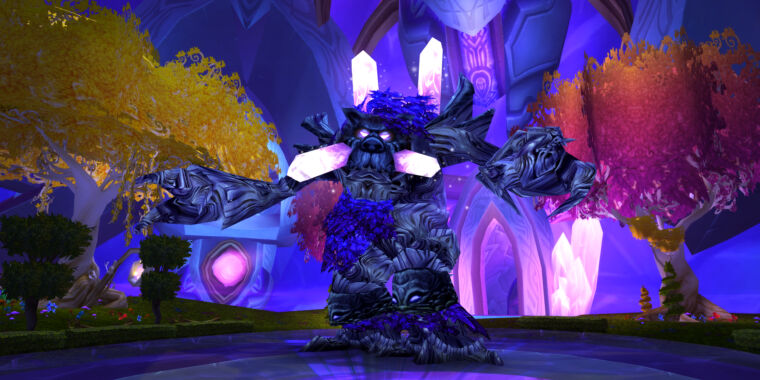
World of Warcraft: Burning Crusade re-returns on June 1, requires “cloning”
Off to Tempest Keep we go, starting June 1.
Hi from Auchindoun.
Nagrand is unscarred… for now.
The Netherstorm.
Shadowmoon Valley.
It’s been a while, so we forget: Is it safe to eat the mushrooms in Zangarmarsh?
Blizzard firmed up this plan’s timeline on Thursday, confirming that WoW Classic‘s Burning Crusade transition will kick off on June 1. Just like with 2019’s launch of WoW Classic, anyone who pays for an ongoing WoW subscription will get full access to WoW Burning Crusade at no additional cost.
Today’s news also clarifies the game’s march toward “Classic but newer”—it understands that some players may not want to stomp toward new zones like the Outland or new character species like the Blood Elf and Draenei. If you’ve already been playing WoW Classic since its 2019 launch, you’ll be prompted starting on May 18 to peruse a new “cloning” feature, designed to let you do something with your current characters. The default is to pack that character up and move it to a newer Burning Crusade server, thus deleting its pre-expansion state. You can also lock an existing character so that it is not moved forward to a Burning Crusade server, or you can split the difference and have two versions of a beloved character: one on an older server, trapped forever in a pre-expansion bubble, and one on a newer server, ready to march alongside the ever-moving tides of darkness.
This is probably a good time to work out your preferences, along with those of your WoW Classic-loving clan, and decide how far into WoW‘s past you’re willing to go. The fact that Burning Crusade is being propped up suggests that the Blizzard Classic team isn’t done here; the folks at Blizzard Classic might also one day do the same for 2010’s tremendous Cataclysm expansion (which, honestly, is where I hope they stop). Of course, if you’re the kind of old-school MMO player who makes time to juggle characters on two servers for two different expansion packs of the same game, Blizzard has your back.
Unfortunately, the May 18 pre-patch launch also leaves a certain class of player crunched for time: those who are eager to roll a new Burning Crusade character, particularly in the Blood Elf and Draenei races, and want to grind that character up to level 60 in time for the formal June 1 launch. Why exactly Blizzard didn’t pad this time out for at least another week or so is beyond us.
At trial, Epic and Apple squeeze Microsoft over Xbox, xCloud restrictions
The monkey wrench of the legal system.
Microsoft Vice President of Xbox Business Development Lori Wright took center stage at the Epic Games v. Apple trial today. The executive’s testimony served up some interesting comparisons and contrasts with Epic’s complaints and addressed questions about the Xbox consoles’ closed, iOS-style app market and the difficulties Microsoft faced getting xCloud streaming on iOS devices.
“The business model is set out to be an end-to-end gaming experience,” Wright said. “Hardware is critical to delivering that experience. We need gamers to be able to have a console. We make money back in the long run on game sales and gaming subscriptions.”
“Part of that [30 percent] commission goes to make it possible for us to build a console,” Wright continued later. “[It’s] required for us to even build the console.”
Wright contrasted the 30 percent Xbox commission with the situation on the Windows-based Microsoft Store platform, which recently lowered its commission for games to 12 percent. Wright said Microsoft made this move because “there are other stores that compete on Windows” and because Windows users can “download games directly from publishers themselves. So for our Windows Store, where there are more competitors, we can’t demand the same commission.”
Enlarge/ Microsoft’s internal documents show that closed platforms rake in a larger share of profits than open platforms.
A 2019 Game Industry Profit study produced by Microsoft (and presented in redacted form at the trial) suggests that PC platform-holders capture only 5 percent of all PC gaming profits, compared to 39 to 46 percent for closed platforms like console and some mobile platforms. That’s because so much of PC-based game spending flows “directly from consumers to publishers,” Wright said, making “open [platforms] much more profitable for developers and publishers.”
Xbox vs. Windows
Of course, the lack of competition in Xbox app distribution exists because Microsoft designed its platform that way, similarly to how Apple designed the iOS App Store. Under cross-examination, Apple lawyers pressed Wright on whether she thinks it’s unfair or anticompetitive for Microsoft to enforce restrictions on digital downloads, in-app purchases, or competing stores and streaming gaming services on Xbox. Apple counsel also got Wright to admit that she’s not aware of any publishers, including Epic, that have complained about Microsoft’s strict controls over the Xbox ecosystem.
Apple’s lawyers also tried to point out the hypocrisy in the way Microsoft’s restrictions on Xbox app distribution break Microsoft’s own 10 principles for the Microsoft Store on Windows, as published last October.
The Xbox, Apple’s lawyers highlighted through questioning, breaks the first three of these Windows-based principles:
Developers will have the freedom to choose whether to distribute their apps for Windows through our app store. We will not block competing app stores on Windows.
We will not block an app from Windows-based on a developer’s business model or how it delivers content and services, including whether content is installed on a device or streamed from the cloud.
We will not block an app from Windows-based on a developer’s choice of which payment system to use for processing purchases made in its app.
While Wright said she’s not an antitrust expert (and thus can’t speak to the legal fairness of these differences), she defended the separate models because of one basic difference between the Xbox and PC: “How they’re used and how many people they reach”
General purpose vs. special purpose
Epic’s counsel took pains early in today’s proceedings to confirm with Wright all the things users can do on an iPhone but not an Xbox. If you’re looking for driving directions, taking a photo, ordering an Uber, or playing a game while in line at the DMV, an Xbox is not helpful, Wright agreed. An Xbox also needs to be plugged into an outlet and connected to an external screen to work, and the console doesn’t have the cellular or touchscreen capabilities of the iPhone.
“Part of that [30 percent] commission goes to make it possible for us to build a console… [It’s] required for us to even build the console.”
Microsoft Vice President of Xbox Business Development Lori Wright
For the Xbox and the PC, there are similarly “different reasons people use these devices,” Wright said. The Xbox is an example of a special-purpose device, she said, “used for a very targeted thing.” A Windows PC, on the other hand, is a general-purpose device that “can do a wide variety of things that change every day, [where] ideas are being created, [and it has] has the ability to do a bunch more things” than just run games.
Wright said the iOS ecosystem should rightly be grouped with the general-purpose devices since there is “a wide, wide variety of different ideas and applications” on iOS.
In cross-examination, Apple’s lawyers pointed out that through apps and services like Spotify, Netflix, Hulu, and YouTube, Xbox consoles also do more than play games. But on redirect, Wright said that Microsoft doesn’t believe people buy an Xbox for those non-gaming apps but instead are getting a game console “to play games.” (Someone should point this out to the TV-on-Xbox-focused Microsoft of eight years ago).
App-based streaming vs. browser-based streaming
Epic also questioned Wright on Microsoft’s struggles to get a version of its xCloud streaming service listed on the iOS App Store. Wright said Microsoft tried to work with Apple to comply with the App Store’s requirements for the service, including working out complicated financial agreements and technical fixes necessary to give Apple a cut of xCloud-based in-app purchases.
But Microsoft was eventually stymied, Wright said, by Apple’s onerous requirement that every individual streaming game be submitted and listed individually on the App Store.
Wright said that Microsoft “wanted to use the Netflix model” for having a single subscription-based streaming game app on iOS, and the company was frustrated by Apple’s determination not to amend its rules to allow such a model. “[Apple] allows Netflix to do what Netflix does, but it does not allow us to do what Netflix does,” she said. “And it required making a separate application for every gaming title that has to be individually downloaded and put onto your phone.”
If Netflix was put under similar restrictions to xCloud, Wright said, “Netflix wouldn’t exist today [on iOS]. They would effectively not have a catalog of services that could be delivered on mobile. Every TV show, every movie would be a different application.”
Enlarge/ Streaming xCloud games like this on iOS devices is only possible through mobile web browsers, not a native iOS app.
Microsoft eventually stopped trying to fit xCloud into the iOS App Store and rolled out a beta version of the service through iOS’s WebKit-based web browsers. Wright described this as a “much more challenging experience” for Microsoft “both to build and maintain.” Streaming xCloud on mobile browsers required developers to “use very complicated matrices” to account for differences between different environments that would not be necessary in a native iOS app.
Browsers on iOS, she said, are “well understood to be lacking in some of the features behind other browsers because [on iOS] you can only use WebKit you don’t get the browser competition [of other platforms]. Once you’re there and you do get it to work, there are some very core elements of gaming that WebKit hasn’t historically supported. It’s just catching up.”
“There are some very core elements of gaming that WebKit hasn’t historically supported. It’s just catching up.”
Microsoft Vice President of Xbox Business Development Lori Wright
More than that, though, pushing xCloud through mobile web browsers is less than ideal, Wright said, because “the challenge is people don’t play games over browser on the iPhone. Look at the data—all the gameplay is through the App Store. People are not playing games on the browser on iPhone.”
In response, Apple’s counsel pointed to press reviews that say xCloud is “already a super solid experience on PC and iOS,” that the “overall performance was smooth and stable” on Safari, and that the iOS browser-based beta “is a remarkably polished one.” Wright agreed with all of these reviews but noted that there was “a lot of work we had to go through to deliver that polish. We had to start from scratch and re-deliver” what was already working fine on a native app.
Apple’s lawyers also pointed out that Apple actively helped Microsoft in its efforts to bring xCloud to iOS web browsers (Wright characterized this help as simply working out issues and bugs Microsoft encountered while porting the service for WebKit). Apple provided this support even though it makes no money from xCloud streaming on mobile browsers, as Wright acknowledged under questioning.
https://arstechnica.com/?p=1762866
AMD’s upcoming flagship GPUs should be 3x faster than RX 6900XT
Enlarge/ RDNA 3 is expected to run on TSMC’s 5 nm process and become available in late 2022 or early 2023.
According to wccftech and well-known hardware leaker @KittyYYuko, AMD’s next-generation Radeon graphics cards should be a massive upgrade—as much as three times faster than AMD’s current flagship graphics cards.
In the above reply to RedGamingTech’s Paul Eccleston, @KittyYYuko claims a 3x performance increase when upgrading from AMD’s flagship Navi 21 (as found in current-gen RX 6800XT and RX 6900 XT cards) to Navi 31.
RDNA3—the architecture beneath the new GPUs—will shift process-node size from 7 nm down to 5 nm, which tends to result in major performance gains and even larger performance-per-watt gains. The downshift in process node isn’t enough to account for the claimed performance uplift by itself, though—that comes from making the GPU itself significantly bigger and meaner.
The current flagship, Navi 21, offers 80 compute units and 5,120 shading units. Navi 31 will reportedly double those numbers, offering a whopping 160 CUs and over 10,000 shading units, delivered in two 80 CU chiplets on a single die. This is likely only practical due to the downshift in process size—cooling and power supply are major concerns in flagship GPUs, which tend to require as much of both as OEMs and individual builders can comfortably cram into a case.
RedGamingTech suggests that Navi 31’s ray-tracing performance should be roughly on par with Nvidia’s Ampere GPUs, but machine-learning tasks will still be handled via low-precision operations on the main GPU itself rather than on dedicated hardware like Nvidia’s Tensor Cores.
We expect RDNA 3 cards to become available sometime in late 2022 or early 2023.
https://arstechnica.com/?p=1762822
Epic thinks EGS could make up 35-50% of the PC gaming market by 2024
Last month, a filing in the Epic v. Apple court case showed the public just how much money Epic has been throwing around to secure exclusive “guarantees” and offer free games in an effort to establish a market foothold for the Epic Games Store (EGS). Now, a new filing in the case gives a detailed breakdown of how that money was spent over the first 11 months of the Epic Games Store’s existence (through October 2019).
While this version of Epic’s Review of Performance and Strategy is a bit dated now, it still gives the clearest public indication yet of how Epic sees huge upfront spending on free and exclusive games as key to attracting new users to the EGS. Epic hopes its investment will help to eventually make the EGS a self-sustaining, profitable storefront with a significant share of the PC gaming market.
How to make money with free games
In the first 10 months of the EGS’s existence (through September 2019), Epic spent roughly $11.6 million to distribute just over 104 million free copies of 42 different titles, the filing shows. The “buyout price” paid from Epic to the publisher for each individual title varied, but the middle half of titles (25th to 75th percentile) cost $80,000 to $350,000 each. Two of the free games in the bunch were worth at least $1 million to Epic—Mutant Year Zero ($1M) and Subnautica ($1.4M)—while offering free copies of the three collected Batman: Arkham games cost Epic $1.5M total.
Epic measures how many individual downloads each free game attracted, but the company’s real measure of success for a free-game giveaway seems to be how many new Epic accounts came to the service for that game. Epic linked 5 million new accounts to its free-game program through September 2019, meaning it spent about $2.37 per new account. Games like those in the Batman: Arkham series and Subnautica were unsurprisingly big attractors for new EGS users, but titles like Slime Rancher, Overcooked, Hyper Light Drifter, and World of Goo brought in surprisingly high numbers of new EGS users as well.
In the EGS’s first 10 months, the vast majority of users coming to the store for free games were complete freeloaders who didn’t spend a dime on the store. But about 291,000 of them (5.34 percent) became paying customers, and those who did spent an average of $36.30 each on the Epic Games Store in that time. Add it up, and you get about $10.6 million in EGS revenue that is pretty directly attributable to “free” games.
$11.6 million.
Amount Epic spent acquiring free game giveaways in the EGS’s first 10 months.
Viewed in the short term, the whole free-game idea seems like a horrible deal for Epic. Through September 2019, the company essentially paid $11.6 million for free games and only got $10.6 million in revenue from new users attracted by those games. The trade looks even worse when you consider that Epic keeps only 12 percent of that spending, or roughly $1.3 million.
But a single 10-month slice doesn’t capture the whole story here. Epic reasonably assumes that many of those 291,000 new paying customers will keep spending money and that some percentage of 5 million totally cheap (thus far) users will eventually spend money on the EGS now that they have accounts.
Epic notes in its planning document that a storefront like Steam brings in about $3 in average revenue per active user every month. Even if many of the EGS’s new paying users don’t stay active, the ones who do could eventually make up for the cost of the free games that brought them in the first place.
Only on EGS
Free games aren’t the only way Epic is trying to attract new users to its store, of course. The company is also paying millions of dollars in “minimum guarantees” to attract exclusive games to its store.
Some of those exclusive EGS deals seem to be paying off quite well. A chart of daily EGS revenues in the store’s first 10 months shows significant spikes around the exclusive launches of Metro Exodus, The Division 2, and World War Z early in the year. Then comes Borderlands 3‘s exclusive launch in September, causing a huge revenue spike well above any the store had yet seen and driving about $82 million in total EGS revenue in September. For context, that single month beat the $78 million EGS brought in during the entire previous nine months.
Borderlands 3 also shows how these kinds of exclusive deals don’t actually have to be costly for Epic in the long run. That’s because minimum revenue guarantees are only there as a backstop if the game doesn’t bring in that much money in sales on its own. If the game sells well, Epic uses that EGS revenue to recoup the guaranteed money it paid upfront and ends up ahead of the game.
In Borderlands 3‘s case, the $80 million in sales Epic guaranteed upfront was already recouped within the first two weeks of sales, making Epic whole again rather quickly (though Epic paid an additional $35 million in marketing and other non-recoupable fees). In fact, Epic made $9.2 million from its usual 12 percent revenue cut in that first two weeks of Borderlands 3 sales and brought in roughly 800,000 new users to the EGS store to boot. Not a bad deal, all told.
$80 million.
Amount of sales revenue Epic guaranteed to secure EGS exclusivity for Borderlands 3.
Of course, not every exclusive game can be Borderlands 3. In 2019, for instance, Epic paid roughly $542 million in minimum guarantees to attract exclusive titles that it projected would earn just $336 million in recoupable income over their lifetimes. The $206 million difference in those two numbers is Epic’s actual expense for attracting those exclusives (and the new users that come with them) for the year.
Eventually, as the base of EGS users for those exclusive games grows, Epic expects it will eventually start recouping 100 percent of its new minimum guarantees, fully recovering the upfront costs it uses to attract exclusives. But how quickly that happens depends on a few things.
Aggressive growth or “winding down”?
The most interesting part of Epic’s 2019 EGS forecast concerns the two distinct futures it sees for the storefront. In one of those scenarios, the company continues an “aggressive pursuit” of exclusives, making guarantees of $469 million annually for 34 exclusive titles in both 2023 and 2024. In the other scenario, Epic starts winding down its exclusive guaranteed payments, paying just $80 million for two exclusives in those years.
Epic’s projections under each of these scenarios show just how important it sees exclusives to driving the EGS’s growth. Under the aggressive model, with dozens of exclusive games each year, Epic thinks it could reach about 125 million total users and 50 million monthly active users by 2024. That number could go down to 90 million users and 33 million active users if “Steam competes,” presumably by lowering its revenue cut to be closer to Epic’s 12 percent.
Under the “wind-down” model, however, Epic stops paying for exclusives relatively quickly, and the Epic Game Store plateaus at around 58 million total users in 2024. Active users actually start shrinking after 2020 in this scenario, deflating to 16 million monthly by 2024.
Under the aggressive scenario, Epic thinks the EGS could be responsible for anywhere from 35 to 50 percent of the PC gaming market by 2024, depending on Steam’s reaction. That would be a huge success, considering estimates currently place Steam at roughly 75 percent of that market.
But if Epic stops paying for exclusives and winds down, the company sees EGS market share peaking at around 20 percent before falling to about 8 percent by 2024. That’s not nothing, but it would be a disappointing slice after Epic laid out hundreds of millions of dollars for its own foothold.
Epic’s thinking on the future of the Epic Games Store may have changed in the 18 months since this projection was first created, of course. To be sure, the numbers the company released publicly in 2020 suggest that the EGS might be growing much faster than was projected the year before (though it’s hard to compare internal projections like this to public-facing statistics directly).
In any case, going forward, we’ll be keeping an eye on how many new timed exclusives show up on the Epic Games Store as a possible sign of whether Epic is staying “aggressive” or may be starting to “wind down” the EGS.