New Pokémon Snap is a welcome take on the “first-person shooter”

When you get down to it, “shooting” in a video game is really just a way of projecting a directed line of intent from your character to another visible point on the map. This basic fact is a large part of why shooting a gun has become such a natural means of interacting with games from a first-person perspective. If your character is looking at something, shooting a gun lets you instantly and easily engage with whatever you’re looking at.

There’s one other major real-life action where this simple point-and-shoot mechanic applies: photography. Nintendo was among the first game-makers to realize this over 20 years ago, creating Pokémon Snap for the Nintendo 64 as a new type of first-person “shooter” (it doesn’t hurt that cameras fit much better than guns with Pokémon’s family-friendly branding). In the years since, though, only a handful of games have taken Nintendo’s lead and replaced “shoot a gun” with “shoot a photo” as the main verb.

So it’s down to Nintendo to revive and expand its own good idea with the awkwardly titled New Pokémon Snap for the Switch. Though the update can get a bit repetitive and tedious at times, this secret-packed photo safari is a great mix of chill moments and competitive personal striving for the best shots.

Ride the rails

New Pokémon Snap product image

New Pokémon Snap [Switch]

(Ars Technica may earn compensation for sales from links on this post through affiliate programs.)

If we’re comparing New Pokémon Snap to gun-based shooters, it bears less resemblance to a Call of Duty and more resemblance to an arcade light-gun shooter like House of the Dead or Time Crisis. That’s because the game, like its N64 predecessor, limits your movement to a preset path, automatically pushing you forward as you tilt and zoom your camera to try to get the best shots (the descriptor “rail shooter” is popular enough to have colonized Wikipedia).

To be fair, you do unlock a few subtle ways to change things up as New Pokémon Snap progresses. You can eventually revisit each course during the night, for instance, completely changing which pokémon are present and how they might act in front of you. You can also earn your way to higher “research levels” for each course, introducing further slight variations on the available fauna. Some courses also have branching paths, letting you see new parts of the level if you trigger a preset marker.

Still, the game’s strict on-rails design can be frustrating, especially if you’re accustomed to open-world shooters that let you explore every last nook and cranny. Pokémon will sometimes remain stubbornly far away or keep their backs turned to you, creating awkward shots that would be easy to fix if you could just take a few steps to the side. Being on rails is also frustrating if you miss a carefully planned shot, forcing you to restart the entire course from the beginning and wait to get back to that same position before trying again.

The slow-paced way the game unlocks new tools and areas seems designed to encourage these kinds of repetitive runs through its largely linear environments. This feeling is exacerbated by the limited methods for filling up your in-game Photodex of Pokémon (a photographic version of the usual Pokédex).

Getting a full Photodex requires finding at least four different photos of each monster that ranks at each level from one to four stars. This ranking process can be inscrutable, but photos of rarer poses and actions by the pokémon generally earn better star rankings. The star rankings are made even more confusing because each photo also gets a bronze-to-gold color rating as well as an individual score rating based on factors like size, centering, and the presence of other pokémon in the photo.

In any case, at the end of each run you can only choose one photo per monster to submit to the professor for final evaluation and addition to your Photodex. Even if you snap dozens of photos at every star ranking in a single run, in the end you’ll have to throw most of them out and give the course another go to capture another pose for the Photodex (you can save unused pictures in a more permanent photo album, though, just for posterity and in-game online sharing).

https://arstechnica.com/?p=1760572


Review: The Falcon and the Winter Soldier aims high but falls a bit short

Confession: I wanted to like The Falcon and the Winter Soldier more than I ultimately did. The various trailers seemed so promising, giving off vibes of a “buddy cop” action flick, with a bit more room to flesh out the character development and themes. What we got was a show that was trying to do too many things at once—including setting the stage for the Phase 4 films coming down the pike—and as a result, it never did any of those things as well as it could have.

(There are a few major spoilers below the second gallery. We’ll give you a heads up when we get there.)

F&WS picks up in the wake of Avengers: End Game, when Steve Rogers (Chris Evans) handed his Captain America shield to Anthony Mackie’s Sam Wilson (The Falcon) and Sebastian Stan’s Bucky Barnes (The Winter Soldier), having chosen to remain in the past and live out his life with Peggy Carter. Sam and Bucky must grapple with losing Steve and the burden of his legacy. Meanwhile, the US government has named its own new Captain America, John Walker (Wyatt Russell), a decorated veteran and ultimate “good soldier” who thinks he can better embody “American values” than Rogers. (The nerve!)

All three men find themselves battling a terrorist group known as the Flag Smashers, led by a woman named Karli Morgenthau (Erin Kellyman), many of whom have been enhanced with the Super Soldier Serum. Where did they get it? From a mysterious person known only as the Power Broker. The Flag Smashers are targeting the Global Repatriation Council (GRC) set up to help those who disappeared in the Snappening (or the Blip), and then returned, re-acclimate to a very different world. (Apparently the Flag Smashers liked it better before everyone came back.)  

“On a macro scale, the pilot’s plot revolves around superheroes who wrestle with personal matters while trying to make the world a better place,” Ars Tech Culture Editor Sam Machkovech wrote in his review of the first episode. “But unlike Wandavision, F&WS seems less confident in trusting its audience to immediately sink its teeth into an atypical setup.” He concluded:

This first episode is filled with moments allowing two underdeveloped superheroes to stop fighting, look up at the camera with eyes wide open, and come to terms with who they are as characters and people. Exactly how the full series will pull that off remains to be seen, but from the look of the premiere (and previous series trailers), the answer seems to be more rote than Wandavision‘s approach: some CGI-filled combat, some tenuous agreements between the titular heroes, and likely, the typical Marvel conclusion of “heroes eventually save the day, perhaps at a cost, to set up the next Big Thing.”

That pretty much sums up my feelings about the series as a whole. F&WS struck me as relentlessly formulaic, adhering so strictly to the Marvel playbook that my overall response was mostly “meh.” But as always, taste in film and TV is highly subjective; even internally, we don’t always agree. Ars Technica Creative Director Aurich Lawson was much more impressed with the full series than I was, so it’s worth sharing his general thoughts from our Slack discussion for some added perspective:

I’ve really enjoyed the transition from the MCU films to television, as someone who’s seen all of the movies, but was starting to experience burnout after Endgame. WandaVision was a really welcome change of pace, I enjoyed all of it, from the early sitcom concepts onwards. I never felt like it was too slow, or was impatient to get to a resolution. The Falcon and Winter Soldier was a shift back away from the experimental stuff to a much more by-the-numbers approach, but again, the pacing of it all has been really refreshing. If you condensed everything into a 2.5-hour movie, you would lose all of the quiet moments, the ability to slow down and let the characters breathe and feel human. Sam and Bucky’s relationship development felt natural, instead of rushed.

Comic books, as a medium, work best when they’re allowed to have an arc that doesn’t cram the three acts into a handful of issues. Television is just a much more natural vehicle for comic stories, in my mind, and if the MCU can keep delivering stories that are slower and character-driven, then I’m going to remain an interested viewer. I don’t think that the way F&WS treated the black super hero experience could have worked in a film. It would have been too superficial; the show was able to do moments that would have been cut to make runtime otherwise.

I agree with Aurich’s larger point: Marvel’s shift to a character-driven standalone series in between major film releases is a welcome move for precisely the reasons he cites: it provides the opportunity to slow down and flesh out the characters and their relationships, as well as develop and explore interesting themes. It’s why I was such a big fan of the various Marvel/Netflix series. I think it’s especially welcome given the traumatic events of Infinity War and End Game. No character emerged unscathed, and both WandaVision and F&WS are focused on exploring the devastating aftermath of those events, albeit in very different ways.

Unlike Aurich, I just don’t think F&WS pulled it off; even the treatment of the “black superhero experience” struck me as pretty superficial. If you’re not going to make the most of the extended TV format to really delve into complicated issues like that, then just make a 2.5-hour movie.

(WARNING: spoilers below. Stop reading now if you haven’t seen the entire series.)

Case in point: Sam and Bucky are both processing their grief over the loss of Steve Rogers while also navigating personal challenges (Sam’s tense relationship with his sister, Bucky’s guilt over a young man he killed while being controlled as the Winter Soldier). There are a couple of nice, introspective moments here and there, but those ultimately get drowned out by the complicated central plot of foiling the Flag Smashers and the big reveal of the Power Broker’s identity.

That’s in stark contrast to WandaVision, in which Wanda’s grief over losing Vision literally drove the entire plot and also neatly set up Phase 4, with Wanda coming into her full powers (for better or worse) as the Scarlet Witch. And frankly, Mackie and Stan just don’t have the same onscreen chemistry—as performers—as Olsen and Bettany do in WandaVision, and that makes them less interesting to watch, week after week.

The strongest parts of F&WS were those scenes delving into the nuances of Steve Rogers’ complicated legacy, post Civil War, and of Sam’s conflicted feelings about being a black Captain America. I loved the reveal of Isaiah Bradley (Carl Lumbly), a Korean War veteran who had been secretly imprisoned and given the Super Soldier Serum against his will, enduring 30 years of experimentation. He tells Sam he can’t imagine how any black man could take up Captain America’s shield because of what it represents to people like him—and can you blame him?

Bradley’s character juxtaposes beautifully with that of John Walker. Steve Rogers became a patriotic symbol during World War II, when US troops were righteous heroes beating back the Nazi scourge. But the world has changed a lot since then, and Walker is haunted by some of the morally questionable acts he committed on his country’s behalf. It is inevitable that he will crack under the pressure of trying to be the new Captain America, brutally killing a Flag Smasher with his shield in full view of public onlookers, who capture it all on their smartphones. Americans still like to think of ourselves as the righteous heroes in global conflicts, but that powerful image of blood dripping from Cap’s shield is a painful reminder of how much of the rest of the world often views us.

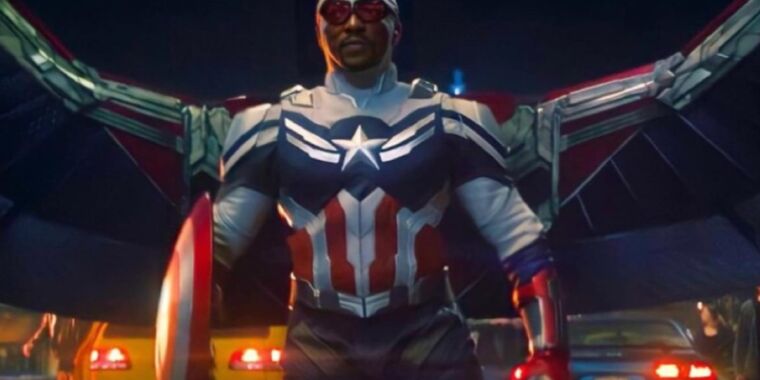
It’s a show-stopping moment that deserved sober reflection, and I wish the show had taken the time in the next episode to fully parse all the nuances engendered there. Instead, we get a knock-down fight between a serum-enhanced Walker, Sam, and Bucky, ending with Sam’s wingsuit destroyed. (Walker escapes with a broken arm, sans shield, and we see him in a post-credits scene melting down his military medals to make a new shield.)

So even here, everything else that’s going on serves to water down the overall impact, particularly in the final showdown, where Sam—in his new Captain America-themed wingsuit—gives what is supposed to be a stirring speech to the GRC members he has just rescued from assassination. Alas, the speech is not especially profound or insightful and falls flat. It’s clearly supposed to be the defining moment of the show, but Walker and his bloodied shield proved far more memorable.

I wish the writers had just fully leaned into that contrast between Sam and Walker, the way WandaVision leaned into Wanda processing her grief—no other subplots as distractions, no apologies. And I wish they had delved more deeply into Bucky’s lingering guilt; it’s treated as more of an occasional afterthought, instead of a central inner conflict that defines his personal growth over the course of the series. I mean, we’re told he’s finally made his peace in his journey to make amends, but we didn’t really experience his process.

Marvel recently announced a fourth Captain America film in development, with Mackie’s Sam in the titular role. And while F&WS was, like WandaVision, intended as a standalone series, there have been hints of a possible second season. Regardless of what Marvel decides, we’ll always have the memory of Baron Helmut Zemo (Daniel Brühl) dancing:

[embedded content]
A full hour of Dancing Zemo, courtesy of Marvel Studios, who saw all your memes.

All episodes of The Falcon and the Winter Soldier are now streaming on Disney+.

Listing image by Marvel/Disney+

https://arstechnica.com/?p=1759651


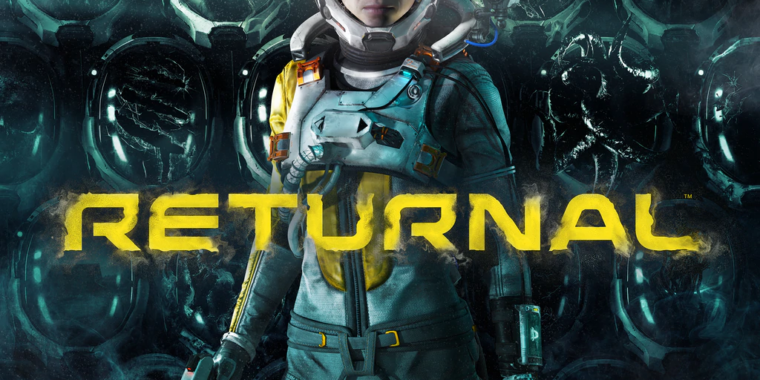
Today, watch us play the opening of Sony’s promising PS5 exclusive Returnal

Ahead of next week’s launch of the PlayStation 5 exclusive Returnal, Sony has given me an opportunity to show exactly how the game looks and plays via stream before I start writing a review.

For some video games, this kind of “Twitch it early” opportunity is a no-brainer, like when I got to test Diablo II: Resurrected ahead of its closed beta earlier this month. Returnal is a trickier one, since it’s for a console that a lot of readers say they’ve struggled to buy. And it’s a brand-new IP, so you may look at the headline and ask what the heck a Returnawhatzit is.

But after playing a few hours of the game already, I’m compelled to connect my PS5 to my streaming rig and show you what Returnal is all about. This is partially because I’ve watched the game’s official, weirdly edited video previews since its announcement last year and not understood what is going on in this procedurally generated sci-fi shooter. Seeing the game in action helps a lot. Its earliest moments feel like a refined Housemarque classic—this studio has previously impressed with games like Resogun and Nex Machina—but Returnal is supercharged with the exploration, production values, and dark mystery of Metroid Prime. Some good chocolate-and-peanut-butter right there.

[embedded content]
The live stream has concluded; this VOD will let you relive Ars Technica’s dive into PS5 exclusive Returnal.

If you’d like to wait for a more formal text take on the game, we’ll have a review for you soon. Until then, today’s lunchtime Twitch stream will kick off at 1:30 pm ET, Friday, April 23, on this very page. Come back at that time for an admittedly brief session, since Sony says we can only stream 45 minutes of the game. I’ll kick things off with a 10-minute conversation about what I know thus far about the game—call it a mission briefing, if you’d like—and then play, die, come back to life, die some more, and talk more about my 45 minutes of play after time runs out.

Update: The stream has concluded!  Subscribe to our Twitch channel to get notifications of future streams, and scroll up for the stream’s saved VOD version. With that, you can rewatch my randomly generated alien butt-kickings at your leisure.

Listing image by Sony Interactive Entertainment / Housemarque

https://arstechnica.com/?p=1759734


COVID emergency shuts Japan’s Super Nintendo World one month after opening

The highly anticipated Super Nintendo World section of Universal Studios Japan will be temporarily closing a little more than a month after its delayed opening, along with the rest of the park, due to the increased spread of COVID-19 in Osaka.

“Today, Universal Studios Japan has decided to temporarily close our park due to the substantial business shutdown request to operate with no spectators which was issued under the state of emergency for Osaka prefecture,” reads a note on the Universal Studios Japan website.

The closure comes just weeks after Universal Studios Japan was forced to limit visitor numbers amid rising case rates in Osaka. Universal Studios Japan was previously closed for COVID from February 29 through June 7 of last year. The latest closure will be effective April 25 and will last “until the request has been lifted.”

Osaka was one of four Japanese prefectures subject to a state of emergency, declared on Friday, which will be in effect until May 11 to contain the latest coronavirus outbreak in the country. Restaurants serving alcohol, as well as karaoke bars, will be fully closed, and other restaurants will be asked to close by 8 pm under the order.

Osaka has logged over 1,000 new coronavirus cases per day for the last four days, contributing to a total of 72,000 confirmed infections amid a population approaching 2.7 million people. Japan as a whole has averaged about 4,500 new cases a day over the last week, up significantly from its 1,200 new cases per day a month ago. Japan has been slow to obtain and administer COVID vaccinations so far; only about 1.3 percent of the Japanese population has gotten at least one vaccine dose as of Thursday.

The opening of Super Nintendo World, originally planned for the summer of 2020, was initially delayed to February of 2021 due to COVID restrictions. In January, the opening was further delayed before finally opening on March 18, complete with NFC Power-Up Band support and augmented reality rides.

While masks have been required at the park for the entirety of the pandemic, famed Nintendo designer Shigeru Miyamoto briefly appeared maskless in photos of the opening ceremonies on March 18.

Coronavirus restrictions have pushed back the planned opening of a Super Nintendo World area in Universal Orlando’s upcoming Epic Universe park from 2023 to 2025. Construction on a Hollywood edition of Super Nintendo World started last August, but no plans for an opening date have been announced.

Listing image by Universal Studios Japan

https://arstechnica.com/?p=1759790


Mortal Kombat film review: Why you should watch on HBO Max, not in theaters

Mortal Kombat‘s third live-action movie, launching this week after over two decades of cinematic silence, is a weird one.

It’s not good. You wouldn’t mistake this for a classic action or martial arts film, and it borrows clumsily from genre giants without building upon their shoulders in any meaningful way.

Most recent Mortal Kombat games (and a pair of Injustice games, starring DC Comics characters in MK-like fights) have impressed largely because they’re a hoot to sit back and watch, full of entertaining, tongue-in-cheek cut scenes. Strip these out and put them on a streaming service as an animated series, and you’d get hours of fatality-filled butt-kicking and silliness—all better than what’s on display in this feature.

And yet, this week’s Mortal Kombat is also not bad. As a video game translation, it’s not embarrassing. And in trying to stitch together decades of MK gaming for a zillion different expectations, the new film massively leaps past the series’ ’90s movies. (A low bar to clear, admittedly.)

As a simul-launched film in theaters and on HBO Max, I would strongly urge anyone who’s interested to stick to the home-streamed version. Keep a smartphone handy when the film gets slow and dumb, then look up for approximately 30 minutes of fair-to-awesome komb—ahem, combat.

The careful line between gory and comical

MK gets off to a rollicking start with an opening scene that its handlers at WarnerMedia were wise to debut on YouTube earlier this week. It rewinds the clock on Earth nearly 500 years and sees a Chinese ice-wielding assassin descend upon a Japanese village to battle a ninja. Game series fans will immediately figure out what this means: Sub-Zero versus Scorpion, round one, fight. Why are they fighting? They’re rivals, don’t overthink it, the scene makes clear.

[embedded content]
Mortal Kombat‘s first seven minutes

For the most part, the scene paints by the action genre’s numbers: a serene, happy family goes about its business (and the film’s called Mortal Kombat, so we know that won’t last). A few many-on-one fights play out. Rivals shout at each other, then fight to the death. The MK catch here is the sheer brutality of some of the hits. This stuff is clearly “mortal.” The special effects house in charge of the grittiest impacts (particularly heads stomped directly onto boulders and blade wounds sticking into people for a while) should be commended for rendering impacts that made me blurt a few “oooh” groans—always straddling the careful line between gory and comical, as opposed to veering into Faces of Death territory.

This scene shrugs its shoulders at establishing a plot beyond “I want to kill you,” and I wish the rest of the film did the same thing. Fast forward to the modern day, and we’re stuck following Cole Young, a flat-as-cardboard MMA fighter who follows the original Scorpion’s bloodline and is thus dragged into the latest “Mortal Kombat” tournament. This epic battle is a regularly scheduled elder-gods brouhaha between Earthrealm (our planet) and Outworld (a bad place where people have insane teeth, multiple arms, and a blood-orange sky that always looks like Los Angeles during rush hour).

Eventually, that massive battle will unfold, but in the meantime, the film grinds to a momentum halt. Cole’s only MMA fight is a remarkably lousy one in terms of film choreography. Cole’s family disapproves of his fighting, but those arguments are a snooze to watch. Classic MK characters Jax and Sonya Blade show up to recruit Cole to their Earth-saving cause, but they’re even worse in terms of wooden acting and dialogue as constructed by liberal arts college Mad Libs. (“There’s nothing here for you but death.” “Well, I’m willing to die for my family.”)

“Sorry, what’d I miss?”

As one weird waste of the film’s opening momentum, Sub-Zero descends upon our modern-day heroes with an intent to kill them all. He does this by… creating a massive hailstorm, then shooting blasts of ice at everyone. It’s arguably one of the dumbest “attacks” by a Mortal Kombat fighter I’ve ever seen in any of the games, films, and cartoons. Even this film makes that point clear by giving Sub-Zero much deadlier and visually appealing ice-murder options later.

Every MK conversation is missing a few crucial things: believability, likability, chemistry, and diversions from the ’80s B-Movie dictionary. Logic doesn’t exist for Mortal Kombat‘s heroes and villains alike, and there’s no other fun or exciting reason to listen to a word anyone has to say.

The exception is the battle-hardened character Kano, who shows up 35 minutes into the film as a rude-for-rudeness-sake antihero. The scriptwriters decided to put the film’s comic-relief duties into his bloody hands alone, but only a third of his quips land, and they all hinge on a one-dimensional trick of him getting angry and cursing up a storm. In short, the writers created a “Kano gets mad” button, then mashed it all too often. Shame, because actor Josh Lawson can be legitimately funny and entertaining.

As an example of curious meta-criticism, Kano interrupts one of the film’s overlong, boring conversations by coughing and blurting, “Sorry, what’d I miss?” Perhaps someone in the crew sneaked that in as a silent protest over how tedious Mortal Kombat can get (and typically not in an intentionally funny B-movie way).

Spines, hearts, and bowels, oh my

And yet! I used my prerelease screener access to fast-forward through the film on a second watch, and here, I found my tune changed remarkably. I watched the opening scene, then fast-forwarded past the snoozer plot explanations to one cool Sub-Zero attack in his otherwise boring early film assault. I then skipped ahead to one impressive three-on-one fight against some sort of semi-invisible lizard—a beast I didn’t recognize from the games, though I did skip the 1997 game Sub-Zero Mythologies, so that might be on me. I then fast-forwarded again to a pair of back-to-back fights, which skipped a nap-worthy “learn to discover your anger” montage.

When Mortal Kombat lets the cast have fun beating the crap out of monsters or each other, it’s mostly great. This works in part because the filmmakers lift some of the game series’ most iconic and gruesome attacks (particularly fatalities) in ways that look comical, not disturbing. Heads split open. Limbs become dislocated. Spines, hearts, bowels: they all emerge, evaporate, or get yanked, and while the violence is all clearly hard-R, the hilarious amount of blood and ooze are on par with the silly game series (though more casual viewers may be disturbed anyway).

But my fast-forward timeline skips many of the film’s fights, mostly because Mortal Kombat‘s martial arts choreography is generally disappointing. These fights are neither fluid-and-comical (like the best of Jackie Chan) nor ridiculous-and-focused (like Jean-Claude Van Damme’s Bloodsport). And the movie is particularly bad at taking advantage of the Mortal Kombat series’ fantasy edge: the fact that characters die ridiculously, then can sometimes come back to life one way or another anyway. The video games are awesome at playing with this gimmick, but this week’s live-action film is too timid to follow suit, to its detriment.

Thus, when a Mortal Kombat fight scene uses a mix of acrobatics and CGI to do crazy things—like throw Scorpion’s rope-tied knife into a foe, then fling the victim around and slam him into the ground—the results look amazing. When the same fight scene pivots to a two-on-one exchange of punches, kicks, and sweeping legs, it looks ho-hum.

Optimism for the next one, but…

Between reports about actors signing on for sequels and a ridiculously clear tease at this film’s end, WarnerMedia seems keen on keeping the Mortal Kombat live-action movie series going. And this week’s first stab at the revived Mortal Kombat film universe is just successful enough to make me eager to see what the next installment will look like.

That optimism comes in part thanks to last month’s Godzilla vs. Kong, also from WarnerMedia, finally getting the revived “monsterverse” formula right. That film did a tremendous job punting extraneous plot, adding comic relief, and maintaining momentum for the sake of dumb, cheer-worthy fun. Should this week’s MK do well enough for the WarnerMedia bean counters, I could see them greenlight every single thing needed to paint a greasy, blood-stained ramp for “MK2” to coast on.

Sadly, that doesn’t make this week’s reboot any easier to watch all 105 minutes of. Portion your time and attention accordingly, should you watch the whole thing, or roll the dice on your own fast-forwarding experiment. Definitely don’t watch it at a theater, lest you suffer an usher’s wrath for pulling out your smartphone during the copious slow-and-underwhelming parts.

Listing image by Warner Bros.

https://arstechnica.com/?p=1759201


This miniature version of Starry Night was made with a “laser paintbrush”

[embedded content]
Blurring the lines between science and art: researchers used a “laser paintbrush” to create art on metallic canvases.

Researchers at ITMO University in Russia have created a “laser paintbrush” capable of creating localized color on a metallic canvas, using their method to create miniaturized replicas of various works of art—including Vincent van Gogh’s The Starry Night. Their technique even makes it possible to change or erase or rewrite the colors several times. They described their work in a new paper published in the journal Optica.

Traditional paints get their colors from various pigments (often derived from minerals), but there are many examples of structural color in nature, like the bright colors in butterfly wings. As we’ve reported previously, those colors don’t come from pigment molecules but from how the wings are structured. The scales of chitin (a polysaccharide common to insects) are arranged like roof tiles. Essentially, they form a diffraction grating, except these naturally occurring photonic crystals only produce certain colors, or wavelengths, of light, while a diffraction grating will produce the entire spectrum, much like a prism. Alter the structure by changing the size of the tiles, and the crystals become sensitive to a different wavelength. And the perception of color doesn’t depend on the viewing angle.

Manmade “nanopillars” can also be used to generate structural colors, for instance, by illuminating nanopillar arrays with white light to produce specific colors (red, blue, and green light), simply by varying the sizes (widths) of the nanopillars. In fact, last year, scientists at the National Institute of Science and Technology (NIST) used millions of nanopillars in an array to control both the color and intensity of incident light, projecting a faithful reproduction of Johannes Vermeer’s Girl With a Pearl Earring as proof of concept.

Like the aforementioned “nano painting,” this new laser paintbrush is another form of structural color, arising from the effect on white light by the interference of two distinct waves: one reflecting from the top of a very thin metal oxide film that forms on the metal during heating, and the other reflecting from the metallic surface of the titanium canvas. “Depending on the thickness of such films, waves with different wavelengths interfere, so we can see different colors,” co-author Yaroslava Andreeva told Ars. For instance, “Increasing the thickness, one can see yellow, orange, red, purple, and blue colors in a row.”

The trick to creating these thin films lies in heating the metal to temperatures above the oxidation point; it’s different for different metals, but it is usually roughly half the metal’s melting point temperature. The scientists let oxidation occur for a specified time—depending on how thick they want the final film to be—and the oxide film will form as the metal cools down. The longer the cooling time, the thicker the resulting film. The ITMO team uses the laser for this, along with a galvanometric scanner, since it gives them better control not just over the temperature but over the time duration, thereby producing films of precisely the desired thickness for the desired color.

The nanosecond ytterbium laser’s scanning speed is linked to the cooling time: a faster scan means the metal cools faster, while a slower scan speed corresponds to a slower cooling time. “The faster we process the material, the thinner layer we heat and the higher gradients of temperature occurs [between the surface and the volume],” said Andreeva. “So the heat from the surface can spread faster into the volume, and the surface cools faster.”

It’s basically akin to the so-called “Mpemba effect,” in which hot water freezes faster than lukewarm or cool water. (It’s named after Erasto Mpemba, who, as a schoolboy in Tanzania in 1963, noticed that his homemade ice cream froze faster than his schoolmates’ batches if he didn’t cool the boiled milk before placing it in the freezer. Physicists still hotly debate the underlying mechanisms.)

The current study grew out of the team’s prior research, which used lasers to create different colors on titanium it seeded, as well as stainless steel surfaces, which proved to be extremely resistant to environmental and chemical impacts, with no need for special storage requirements. “We wanted to do more than offer a wide palette of stable colors,” said co-author Galina Odintsova. “Thus, we worked to create a convenient tool for applying them more like an artist’s brush. Increasing the laser heating range enough to create the evaporation process makes our color strokes reversible, rewritable, erasable and much more efficient. Our marking speed is more than 10 times faster than reported before.”

They were able to create nine different colors in all, as well as being able to erase or change colors with a second pass of the laser at a faster scan rate. According to Andreeva, the color change is the result of the evaporation of the previous oxide layer and subsequent reoxidization, producing a new layer of a different thickness and, thereby, a new color.

“With this approach, an artist can create miniature art that conveys complex meaning not only through shape and color but also through various laser-induced microstructures on the surface,” said co-author and research team leader Vadim Veiko. In addition to the 3 x 2 inch version of The Starry Night, the team used its technique to create its own original artworks on titanium in various styles—pop art, minimalism, and abstract art—inspired by the work of other artists.

Ultimately, Veiko et al. would like to produce a handheld tool based on their laser paintbrush system, possibly adding advanced nanostructured and hybrid materials for even more optical effects. “We hope that laser painting will attract the attention of modern artists and lead to the creation of a completely new type of art,” said Andreeva. “The approach can also be used for modern design and to create color markings on various products.”

DOI: Optica, 2021. 10.1364/OPTICA.420074  (About DOIs).

Listing image by Yaroslava Andreeva

https://arstechnica.com/?p=1758287


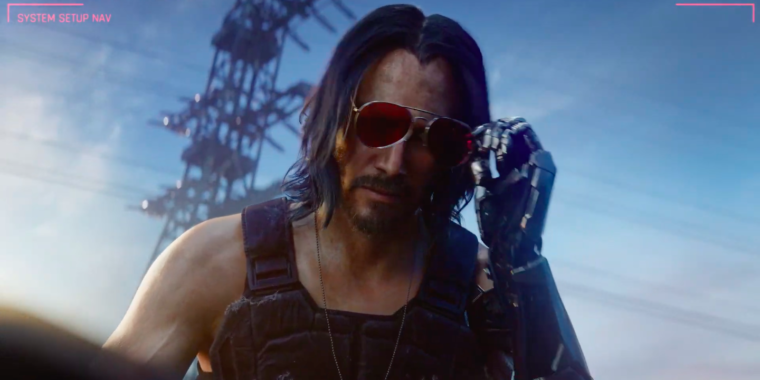
Cyberpunk 2077 refunds barely dented CD Projekt Red’s bottom line

Back in December, developer CD Projekt Red made waves by offering full refunds to Cyberpunk 2077 players who were dissatisfied with the game’s poor performance, especially on older consoles. Days later, Sony delisted the game from the Playstation Store and made its own refund offer, which was followed by a similar refund offer from Microsoft.

Today, with the release of the CDPR’s Consolidated Financial Statement for the 2020 fiscal year (which ended December 31), we know how much that refund program cost the company last year and how much CDPR expects those refunds and lost sales to cost in 2021. All told, it seems the impact will be very low to an otherwise record-setting financial year.

Buried in the “Other Provisions” section of the 90-page financial report, CDPR acknowledges about $51.2 million (194.5 million PLN) that the company says it “has recognized [as] provisions for returns and expected adjustments of licensing reports related to sales of Cyberpunk 2077 in its release window, in Q4 2020.” Translated into plain English, that number seems to include all digital and retail refunds for the game in 2020, as well as expectations for continued refunds and lost sales projected through 2021 (thanks to F-Squared’s Mike Futter for helping me parse the tortured language in the report).

Broken down, the $51.2 million in “provisions for returns” includes $10.65 million (40.4 million PLN) in refunds made through digital and physical retailers in 2020, as well as about $2.23 million (8.5 million PLN) in direct refunds made last year through CDPR’s “Help me Refund” campaign (including marketing costs for that campaign).

CDPR projects an additional $38.34 million (145.6 million PLN) in refunds and lost sales in 2021 “based on information obtained from distributors concerning sales to retail distribution networks, retail sales to end customers, number of copies present in various distribution channels and warehouses, as well as the distributors’ professional judgment concerning expected sales throughout 2021.” That seems to include the impact of the game’s continued absence from the Playstation Store, which CDPR says is close to ending now that the developer has released a number of major patches.

A drop in the bucket

Losses of over $51 million due to Cyberpunk‘s botched launch might sound significant. But that number has to be taken against the rest of the company’s record-shattering performance last year. That included about $563 million in total sales revenue (~2.14 billion PLN) and net profit of just over $301 million (~1.15 billion PLN) in 2020 alone. Even adding in the Cyberpunk refunds/losses projected for 2021 (and not including any additional Cyberpunk sales projected for 2021), that $51 million “provision” represents just 9 percent of the company’s 2020 revenue.

You can also weigh the impact of the refund program against 13.7 million total unit sales of Cyberpunk 2077 before the end of December. Assuming 2020’s approximately $12.9 million in refunds averaged out to full $60 purchases, that means CDPR refunded just under 215,000 copies, or about 1.6 percent of all Cyberpunk units sold last year.

Despite the strong financial picture, the reputational damage CDPR is facing from Cyberpunk‘s poor rollout may continue. The company’s stock price peaked at $31 a share on December 4, just a week before it announced its refund program. Yesterday, that stock closed at $11.68, down over 62 percent in about four and a half months.

Elsewhere in its financial presentation, CDPR shared additional statistics for Cyberpunk‘s absolutely massive launch, including:

  • 73 percent of all sales were digital downloads, 23 percent retail discs
  • 56 percent of sales came on the PC/Stadia, 28 percent on PS4, 17 percent on Xbox One
  • 38 percent of sales were in North America, 24 percent in Europe, 20 percent in mainland Asia
  • The game had a total budget of $315 million (1.2 billion PLN)
  • There was a team of 530 developers working on the game, plus 2,000 voice actors across 18 languages

In addition to continued patches, CDPR continues to promise that a number of free DLC offerings and optimized “new generation” editions of the game will be coming later in 2021.

Listing image by CD Projekt Red

https://arstechnica.com/?p=1759492


More than one scribe wrote the text of a Dead Sea Scroll, handwriting shows

Photographic reproduction of the Great Isaiah Scroll, the best preserved of the biblical scrolls found at Qumran. It contains the entire Book of Isaiah in Hebrew, apart from some small damaged parts.
Enlarge / Photographic reproduction of the Great Isaiah Scroll, the best preserved of the biblical scrolls found at Qumran. It contains the entire Book of Isaiah in Hebrew, apart from some small damaged parts.

Most of the scribes who copied the text contained in the Dead Sea Scrolls were anonymous, as they neglected to sign their work. That has made it challenging for scholars to determine whether a given manuscript should be attributed to a single scribe or more than one, based on unique elements in their writing styles (a study called paleography). Now, a new handwriting analysis of the Great Isaiah Scroll, applying the tools of artificial intelligence, has revealed that the text was likely written by two scribes, mirroring one another’s writing style, according to a new paper published in the journal PLOS ONE.

As we’ve reported previously, these ancient Hebrew texts—roughly 900 full and partial scrolls in all, stored in clay jars—were first discovered scattered in various caves near what was once the settlement of Qumran, just north of the Dead Sea, by Bedouin shepherds in 1946-1947. (Apparently, a shepherd threw a rock while searching for a lost member of his flock and accidentally shattered one of the clay jars, leading to the discovery.) Qumran was destroyed by the Romans, circa 73 CE, and historians believe the scrolls were hidden in the caves by a sect called the Essenes to protect them from being destroyed. The natural limestone and conditions within the caves helped preserve the scrolls for millennia; they date back to between the third century BCE and the first century CE.

Several of the parchments have been carbon dated, and synchrotron radiation—among other techniques—has been used to shed light on the properties of the ink used for the text. Most recently, in 2018, an Israeli scientist named Oren Ableman used an infrared microscope attached to a computer to identify and decipher Dead Sea Scroll fragments stored in a cigar box since the 1950s.

A 2019 study of the so-called Temple Scroll concluded that the parchment has an unusual coating of sulfate salts (including sulfur, sodium, gypsum, and calcium), which may be one reason the scrolls were so well-preserved. And last year, researchers discovered that four fragments stored at the University of Manchester, long presumed to be blank, actually contained hidden text, most likely a passage from the Book of Ezekiel.

The current paper focuses on the Great Isaiah Scroll, one of the original scrolls discovered in Qumran Cave 1 (designated 1QIsa). It’s the only scroll from the caves to be entirely preserved, apart from a few small damaged areas where the leather has cracked off. The Hebrew text is written on 17 sheets of parchment, measuring 24 feet long and around 10 inches in height, containing the entire text of the Book of Isaiah. That makes the Isaiah Scroll the oldest complete copy of the book by about 1,000 years. (The Israel Museum, in partnership with Google, has digitized the Isaiah Scroll along with an English translation as part of its Dead Sea Scrolls Digital Project.)

Most scholars believed that the Isaiah Scroll was copied by a single scribe because of the seemingly uniform handwriting style. But others have suggested that it may be the work of two scribes writing in a similar style, each copying one of the scroll’s two distinct halves. “They would try to find a ‘smoking gun’ in the handwriting, for example, a very specific trait in a letter that would identify a scribe,” said co-author Mladen Popović of the University of Groningen. Popović is also director of the university’s Qumran Institute, dedicated to the study of the Dead Sea Scrolls.

In other words, the traditional paleographic method is inherently subjective and based on a given scholar’s experience. It’s challenging in part because one scribe could have a fair amount of variability in their writing style, so how does one determine what is a natural variation or a subtle difference indicating a different hand? Further complicating matters, similar handwriting might be the result of two scribes sharing a common training, a sign the scribe was fatigued or injured, or a sign the scribe changed writing implements.

“The human eye is amazing and presumably takes these levels into account, too. This allows experts to ‘see’ the hands of different authors, but that decision is often not reached by a transparent process,” said Popović. “Furthermore, it is virtually impossible for these experts to process the large amounts of data the scrolls provide.” The Isaiah Scroll, for instance, contains at least 5,000 occurrences of the letter aleph (“a”), making it almost impossible to compare every single aleph by eye. Popović thought pattern recognition and artificial intelligence techniques would be well suited to the task.

First, Popović and his colleagues—Lambert Schomaker and grad student Maruf Dhali—developed an artificial neural network they could train to separate (“binarize”) the ink of the text from the leather or papyrus on which it was written, ensuring that the digital images precisely preserved the original markings. “This is important because the ancient ink traces relate directly to a person’s muscle movement and are person-specific,” said Schomaker.

They next created two 12×12 self-organizing maps of full-character aleph and bet from the Isaiah Scroll’s pages, each letter formed from multiple instances of similar characters. Such maps are useful for chronological-style development analysis. Fraglets (fragmented character shapes) were used instead of full character shapes to achieve more robust results.

The results indicated two different handwriting styles, an outcome that persisted even after the team added extra noise to the data as an additional check. That analysis also showed that the second scribe’s handwriting was more variable than that of the first, although the two styles were quite similar, indicating a possible common training.

“We will never know their names. But this feels as if we can finally shake hands with them through their handwriting.”

Finally, Popović et al. created “heat maps” for a visual analysis, incorporating all the variations of a given character throughout the scroll. They used this to create an averaged version of the character for the first 27 and last 27 columns, making it clear to the naked eye that the two averaged characters were different from each other—and hence more evidence of a second scribe copying out the second half of the scroll.

“Now we can confirm this with a quantitative analysis of the handwriting as well as with robust statistical analyses,” said Popović. “Instead of basing judgment on more-or-less impressionistic evidence with the intelligent assistance of the computer, we can demonstrate that the separation is statistically significant.”

The authors acknowledge that their analysis doesn’t completely rule out the possibility that the variations are due to a scribe’s fatigue, injury, or a change of pen, but “the more straightforward explanation is that a change in scribes occurred,” they wrote. The researchers concluded that their study shows the added value that scholars engaged in paleographic research can gain by collaborating with other disciplines.

The next step is to apply their methods to more of the Dead Sea Scrolls. “We are now able to identify different scribes,” said Popović of the significance of their findings. “We will never know their names. But after seventy years of study, this feels as if we can finally shake hands with them through their handwriting.”

DOI: PLOS ONE, 2021. 10.1371/journal.pone.0249769  (About DOIs).

https://arstechnica.com/?p=1758342


PS4 owners lament the shutdown of beloved “Communities” social network

Don't cry for me, I'm already dead...
Enlarge / Don’t cry for me, I’m already dead…

In the world of social media, new networks are constantly popping into existence and then fading away when they fail to become the next Facebook (or Twitter, or TikTok, etc.). Still, last week’s shutdown of the PS4’s Communities features (and the lack of a suitable replacement on the PS5) has left many PlayStation fans bitter about the death of a vibrant space they used to connect with fellow gamers.

For those who never had a chance to join a PS4 Community, the groups served as a kind of player-created and moderated message board system, accessible directly via the PS4’s system menu (and through the PlayStation Mobile app, before that connection was shut off last year). Members could share text messages, screenshots, wallpapers, and more on a shared “Community Wall” or form parties to chat and play multiplayer titles together with other online members.

Specific PS4 Communities could form around a single game or series, a geographic area, a cultural grouping, or just shared general interests (“Smoke&Play” and “Vaping Gamers” were popular Communities at one point).

“My reaction to the Communities going away at first was quite a shock if I’m honest,” said Alex Richards, who said he belonged to 15 different PS4 Communities, some with tens of thousands of users focused on PS4 trophy hunting. “Overall, I felt like it was like having to say goodbye to a virtual family of sorts, as I had met some fantastic people through being a part of the Communities, and knowing that the platform we all shared as people and gamers [would] suddenly disappear was a real shame.”

Richards was so upset by the shutdown that he put together a “RIP PSN Communities” video on YouTube, complete with maudlin music and sad gray raindrops casting a pall over the proceeding. “Thank you for the memories and the good times we shared,” he wrote in a video chyron.

A few examples of PS4 Communities that were available before their shutdown last week.
Enlarge / A few examples of PS4 Communities that were available before their shutdown last week.

Welcome to your PS4

Richards is not alone in mourning the PS4’s Community features and the unique ways they let players connect with others. “It was an extraordinarily convenient setup,” Australian PS4 owner Ian Mackinder told Ars. “If you wanted to send a picture or make a comment or whatever during play, it was just a few seconds’ work to flip from the game, do [a] post on whichever Community you chose, then return to play.”

That simplicity led to PS4 Communities forming around some interesting and unexpected shared interests. “The best example I can think of is one guy who set up a Community specifically for pictures from all PS4 games,” Mackinder said. “There was even a regular weekly competition where a theme would be specified (e.g. “emotion,” “black and white,” “heights,” etc.). Entries would come in from all games imaginable. No prizes, just… positive feedback and seeing who’d get first, second, third, etc.”

For others, the appeal of PS4 Communities was more utilitarian. “For games like Destiny 2, some [high-level] activities don’t have matchmaking, so it was the only way to squad up for endgame content,” PS4 Communities user Lesvix told Ars. “On the big Community, you had posts every minute so it was very convenient to find people.”

“Also, as an adult, I don’t like to play with children, so the community helped find people of the same age,” Lesvix continued. “When searching for people, you can mention 18+ in the post [and get] no children.”

[embedded content]
“A tribute to a fallen hero”

For many, PS4 Communities were a welcoming way to get acclimated to a new title in the same place you were playing it. “Picture yourself a new gamer with a new game. Where do you turn for info?” PS4 Communities fan Blackdwag07 (who asked to go by his PSN handle) asked rhetorically. “YouTube is great, but it’s a video, maybe years old. With Communities, you could go to them [and easily find] info, news, wallpapers, and groups and friends to play with. I could ask any questions and get answers faster than searching Google, and better answers also.”

“The Communities were a valuable means of meeting fellow players, for new arrivals seeking guidance, and for both seeking and providing general advice/assistance,” Mackinder added. He cited the PS4 Communities for No Man’s Sky in particular as “very positive places. Any newbie who fronted up asking for advice could be sure of getting a response.”

Not every PS4 Community was so welcoming, of course. Many languished from a lack of activity or quickly got filled with spam or toxic harassment. But the players I talked to suggested that the PS4 Communities they stuck with were much less prone to abuse than other online spaces.

“There were many communities where the ‘owner’ had, for some reason or another, basically abandoned the community and left it completely unmoderated, meaning that pretty much any troll or griefer with the energy would have free rein for as long as they chose,” Mackinder said. “Communities that were properly looked after had no such problem.” Mackinder suggested that a basic check-in from Sony to see if Community owners and moderators were still engaged could have prevented a lot of the worst abuses in unmoderated spaces.

“I also owned a couple of communities myself, including one called PlayStation Network Addicts, which was more of a variety community,” Richards said. “It was a safe and inclusive space for all kinds of gamers and for the time in which it existed, I feel like it served its purpose well.”

Where to now?

When Sony announced the pending PS4 Communities shutdown last month, users were left scrambling to maintain their connections to the friends they had found through the network. “We thankfully have PSN Messages, including group chats and parties, but… a group chat allows up to 100 people, whereas PSN Communities allowed up to 100,000 people,” Richards said.

Aside from personal group chats, Discord seems to be the main beneficiary of the shutdown, with many PS4 Community users telling me they had moved their social groups to the gaming-focused social service. But Mackinder lamented that these replacements are “not nearly as convenient as what we had. But there you go. Thank you, Sony.”

Many former PS4 Communities users have moved on to Discord, though some find it less convenient.
Enlarge / Many former PS4 Communities users have moved on to Discord, though some find it less convenient.

“Since I do have [other] social media, [Communities] being deleted didn’t affect me that much,” PS4 Community user Scourge HH told Ars. “But I have to imagine, people who are more wary or shy regarding social media are probably feeling it much more, since they lost a huge social interaction feature, connected to the very games they play. I used to see a lot of people posting gaming compliments or finds on the different Communities.”

In the end, many PS4 players (and new PS5 owners) may never even realize that PS4 Communities are gone—Sony’s removal of the feature certainly suggests it wasn’t popular with a critical mass of the user base. Still, among the PS4 Communities users I talked to, Sony’s decision to shutter the feature has generally left them with a more negative view of the PlayStation as a whole.

“If there is no social space on PSN, I am thinking of switching to PC, and I have been using Sony since the PS1,” Lesvix said. “It’s funny how PlayStation gave free games as part of ‘Play at Home,’ but without Communities, it is more like ‘Play alone!'”

“I’d also add that there is a lot of bitterness about Sony’s actions,” Mackinder said. “No one expected much basic consideration from them, but a very common sentiment now is ‘My next console will be Xbox.'”

“In short, Sony has removed a huge quality-of-life feature from its services and has made sure that I at least will not purchase a PS5,” Blackdawg03 said. “Honestly, [Communities] made Sony games so much better because there was this huge group you could turn to. Other players would give their time, game materials and currency, help, and friendship to help you master your ‘lifelong game.'”

“I’m sorry for being emotional, but we lost our place to belong.”

https://arstechnica.com/?p=1758966


Marvel drops first teaser for Shang-Chi and the Legend of Ten Rings

[embedded content]
Simu Liu stars as a martial artist trying to escape his past in Shang-Chi and the Legend of the Ten Rings.

A young man who once trained as an assassin for a Chinese criminal organization discovers just how hard it can be to escape one’s past in the first teaser for Marvel Studios’ upcoming film, Shang-Chi and the Legend of Ten Rings, part of the MCU’s Phase Four. Directed by Destin Daniel Cretton, it is the first Marvel film to feature an Asian lead—Simu Liu, best known for his role as Jung Kim on the sitcom Kim’s Convenience—as well as a predominantly Asian/Asian diaspora cast and crew.

The title character first appeared in a Marvel comic in 1973, after the company had tried and failed to acquire the comic book rights for the popular 1970s TV show Kung Fu (starring David Carradine). Modeled in part on Bruce Lee, Shang-Chi was originally the son of Chinese criminal mastermind Dr. Fu Manchu, trained in martial arts since childhood to become an assassin. After Marvel lost the rights to the Fu Manchu character, Shang-Chi’s paternity became murkier, but the international crime lord theme was common—although his father was revealed to be an ancient immortal sorcerer in the Secret Avengers storyline.

Shang-Chi has not traditionally had special superpowers, but his training in multiple styles of martial arts and assorted weaponry makes him a formidable opponent and a useful ally. Plus, he is a master of chi, making him even stronger and faster—fast enough to dodge bullets. When he eventually joins forces with the Avengers in the comics, Tony Stark gives him a pair of bracelets to further focus his chi (as well as some snazzy high-tech nunchaku).

Back in the 1980s, Stan Lee had preliminary discussions with the late actor Brandon Lee about portraying Shang-Chi in a film adaptation, but no concrete project ever transpired. The Ten Rings organization was briefly name-checked in 2008’s Iron Man, and the infamous Marvel supervillain the Mandarin made an appearance in Iron Man 3—or rather, Ben Kingsley played Trevor Slattery, an imposter posing as the Mandarin. For Shang-Chi and the Legend of the Ten Rings, Marvel created an entirely new character, Wenwu, who has gone by many names over the years—including the Mandarin.

In addition to Liu, the film stars Awkwafina (Crazy Rich Asians) as Shang-Chi’s best friend, Katy, and none other than Hong Kong superstar Tony Leung (Hard Boiled, Chungking Express, Hero, and so on) as his father, Wenwu, aka the Mandarin. Meng’er Zhang plays Xialing, Shang-Chi’s estranged sister; Florian Munteanu (Creed II, Borderlands) plays Razor Fist; Ronny Chieng (Crazy Rich Asians, Bliss) plays another pal, Jon Jon; and Fala Chen (The Undoing) plays Jiang Li. Michelle Yeoh (Star Trek: Discovery) plays a character named Jiang Nan, having previously played a different MCU role (Aleta Ogord) in Guardians of the Galaxy Vol. 2. There’s also a masked character dubbed Death Dealer; Marvel has not yet revealed who plays him.

Based on this teaser and what little is known so far, the film appears to borrow a few elements from the Ultimate Marvel universe, among other storylines, and possibly the wuxia-inspired Secret Wars (2015) as well. We hear Leung’s voice as the Mandarin in a voiceover, admonishing his son for “wasting” the last 10 years. Shang-Chi works as a parking valet for a posh hotel when he isn’t hanging out with Katy singing karaoke tunes.

That carefree existence is about to end. “I trained you so the most dangerous people in the world couldn’t kill you,” we hear the Mandarin say. “But it’s time for you to take your place by my side.” Shang-Chi stubbornly refuses the offer—or is it a command? He just might learn, as his father says, that “you can’t outrun who you really are.”

Shang-Chi and the Legend of Ten Rings is currently slated for release on September 3, 2021. As of this writing, it will be solely a theatrical release.

Listing image by YouTube/Marvel

https://arstechnica.com/?p=1757928