Sony reverses course, keeps legacy PlayStation online stores open
The store has received a stay of execution on the PS3 and Vita…
Just three weeks ago, Sony announced its plans to shut down the digital stores for the PlayStation 3, PlayStation Portable, and PlayStation Vita, effective this summer. Today, Sony partially reversed course, with Sony Interactive Entertainment President and CEO Jim Ryan writing in a blog post that “it’s clear that we made the wrong decision here.”
As such, the PS3 and Vita online stores will continue operations, Ryan said, while the PSP store will still shut down as planned on July 2. PS3 and Vita players will continue to be able to purchase games through the hardware itself, while web-based versions of those stores will seemingly remain closed following their shutdown last month.
“When we initially came to the decision to end purchasing support for PS3 and PS Vita, it was born out of a number of factors, including commerce support challenges for older devices and the ability for us to focus more of our resources on newer devices where a majority of our gamers are playing on,” Ryan wrote. “We see now that many of you are incredibly passionate about being able to continue purchasing classic games on PS3 and PS Vita for the foreseeable future, so I’m glad we were able to find a solution to continue operations.”
Ryan didn’t set any new timeline for the PS3 and Vita store support, so it’s not clear just how long of a reprieve this will be in the end. But nothing lasts forever in the world of corporate-controlled servers, as shown by the continuation of plans to shut down the PSP store. That will come over 16 years after the PSP launched in North America and nearly 13 years after the PSP first got support for direct game downloads through a firmware update. Sony officially stopped producing PSP hardware in Japan in 2014, while PS3 production lasted until 2017 and Vita production lasted until 2019.
As The Gamer noted, the planned Vita store shutdown also threatened to stop the production of some Vita games that were (and now are) still in development. “We’re way past the point where it makes a ton of financial sense to release on Vita, but it’s one of my all-time favorite consoles and I wanted to release a game on it before everything shut down,” Spooky Squid Games developer Miguel Sternberg told the site regarding a planned Vita port of Russian Subway Dogs.
Sony has still remained silent on a longer-term problem that could eventually make digital PS3 titles and all PS4 titles unplayable if and when Sony decides to stop supporting those consoles’ PSN connections. Recent testing by concerned players suggests that same problem could affect all digital PS5 games and some physical PS5 discs at an unknown point in the future.
Sony’s decision to change course comes months after Microsoft quickly reversed plans to raise the price of Xbox Live after strong fan backlash to the idea. “We messed up today and you were right to let us know,” Microsoft said of that turnaround.
https://arstechnica.com/?p=1758095
Novel hydrogels can safely remove graffiti from vandalized street art
Enlarge/ A five-year-old boy with boxing gloves poses in front of a huge mural of himself in Denver, Colorado.
Mention the word “graffiti,” and many people’s thoughts immediately turn to vandalism in the form of defacement of property. But there is also graffiti that rises above such negative connotations and qualifies as bona fide street art. Think of the commemorative murals created after the death of NBA All-Star Kobe Bryant and his daughter Gianna; the Black Lives Matter logos painted on the streets in New York City, and along 16th Street in Washington, DC, last year amid ongoing protests; and the works of Banksy, Eduardo Kobra, and the countless other less well-known artists around the world, who embellish our streets with their work.
Street art, in turn, is vulnerable to vandalism, posing unique challenges to those seeking to preserve these rather ephemeral creations. This week, a team of Italian scientists described its novel, environmentally friendly new method to safely remove defacing over-paintings on street art at a meeting of the American Chemical Society (ACS).
“For decades, we have focused on cleaning or restoring classical artworks that used paints designed to last centuries,” said co-author Piero Baglioni, a chemist at the University of Florence and principal investigator on the project. “In contrast, modern art and street art, as well as the coatings and graffiti applied on top, use materials that were never intended to stand the test of time.”
The Florence scientists have been pioneers in the science of art conservation for nearly 30 years, according to co-author Michele Baglioni, also with the University of Florence (and no relation to Piero Baglioni)—specifically in the areas of chemistry and colloidal science. Their interactions with restorers and conservators over the years provided useful feedback, as they built up an extensive interdisciplinary network.
Enlarge/ Art work by graffiti artist Banksy, depicting a prisoner escaping with a typewriter—a tribute to one of its famous former prisoners, Oscar Wilde—in Reading, England.
Ming Yeung/Getty Images
The challenge with preserving street art lies in the fact that the over-painting by vandals is so chemically similar to the original painting underneath. That makes it more difficult to selectively remove just the over-painting (which can be just a few microns in depth) without damaging the original.
“It’s a kind of art that is not designed to last long, so we have to know exactly what is going on at the surface of the paintings if we want to design [effective] cleaners,” said Michele Baglioni at an ACS virtual press conference. “In some respects, the chemistry is simple—we are using known surfactants, solvents, and polymers. The challenge is combining them in the right way to get all the properties we need.”
The coloration in paints comes from pigments or organic dyes, and binders (usually polymers) help bind the color particles together. There are many different kinds of binders, and the Florence team selected three classes that are used on spray paints and other paints used most frequently in street art: acrylic, vinyl, and alkyd polymers.
The scientists specifically examined three different binder brands and four different colors for this study, although their past work has included a wide range of colors and brands. That experience has revealed that there really isn’t much difference between brands, but different colors sometimes interact differently with different fluids, because sometimes the pigment used can act as a catalyst, or trigger chemical modifications in the polymeric binders. The scientists’ prior work also showed that alkyd-based paints are harder to remove than vinyl and acrylic paints, because alkyd binders tend to cross-link, thereby losing their initial solubility in organic solvents.
Enlarge/ Mural by street artist Royyal Dog in tribute to Kobe Bryant and his daughter Gianna at the Container Yard on East 4th Street, Los Angeles.
Mario Tama/Getty Images
For this latest study, the scientists first used infrared spectroscopy to characterize the binders, fillers, and pigments in all three classes. Next, they used X-ray scattering on four alkyl carbonate solvents and a biodegradable surfactant to observe how each behaved in water. From this, they devised a nanostructured fluid with the most effective combinations for cleaning, and they loaded it into a hydrogel.
The final product is not a gel like jam or a hair gel. Rather, these hydrogels are synthesized in the form of thin foil sheets. The sheets can be shaped with scissors or a knife, then placed on the surface one wishes to clean. (The gel adheres easily even to vertical surfaces like walls.) Leave a sheet for a few minutes—not too long—and then just peel it off. The over-paint will be softened and swollen, and it can be easily removed by gentle mechanical action. Should you accidentally leave the gel on too long, Michele Baglioni advised just letting it dry as the solvents and water evaporate, being careful not to try to wipe anything away. This should avoid any harm to the underlying painting.
The Florence team conducted dozens of laboratory tests on mockups of street art, successfully removing the various samples of over-paints. As a final step, the group tested the hydrogel on an actual piece of street art in Florence, successfully removing several black tags.
Different hydrogels are designed for different types of surfaces. It’s possible to “tune” the gels to make them stiffer or more elastic; the latter are better suited to rough surfaces. But it’s what’s inside the hydrogel that is most critical: the cleaning fluid. Vinyl, alkyd, and acrylic have similar solubility in organic solvents, so the best cleaning fluid is one that can interact with all three classes of binders.
Enlarge/ A massive “Black Lives Matter” runs along the block of Fulton Street between Marcy and Brooklyn avenues in Brooklyn, NY.
Spencer Platt/Getty Image
But is this really better than conventional chemical and/or mechanical methods for removing over-painting? Michele Baglioni argues that it is, even if they use the same organic solvents. In the former case, those solvents are unconfined; in the Florence group’s system, the solvent is confined in tiny droplets of water stabilized by a surfactant, all of which, in turn, is confined in a gel. In addition to reducing the amount of solvents used, this means the fluid inside is released slowly to the surface, giving better control of the cleaning action. That makes selectively removing over-painting easier, because you can better control how much the solvent penetrates, stopping the process before it reaches the underlying paint.
As for simple mechanical methods, like scalpels or abrasion, “They are either too invasive and harmful to the original art or too expensive,” Michele Baglioni said. In the case of more advanced technologies, like laser ablation, they require expensive instruments that are not easily portable and are often not as effective. “So we think that we proposed a simpler solution [that is] much more controlled and much more effective in achieving selective removal,” he said. The hydrogels are also cheaper to produce.
The two Baglionis and their colleagues are confident their system could also easily be used to repair vandalized oil paintings and other fine art, not just street art. And the hydrogels should soon be available commercially from a university consortium co-founded by Piero Baglioni: CSGI Solutions for Conservation of Cultural Heritage.
“They seem to be quite far apart, but science and art are very strictly connected,” Michele Baglioni said. “Talking about art restoration, art preservation, is like talking about materials. This is the first systematic study on the selective and controlled removal of modern paints from paints with similar chemical composition. We hope that the whole conservation community will benefit from the development of our systems.”
https://arstechnica.com/?p=1757011
DC’s Rorschach: A detective walks into a world shaped by squids and superheroes
Enlarge/ Thank you for giving me something to look forward to, DC Comics.
Nathan Mattise
Warning: Though we’ll take great pains not to spoil anything important from DC’s ongoing Rorschach comic, some of the story’s events will be lightly referenced, given this is a review of sorts.
After the magnetic nine-episode run of HBO’s Watchmen back in 2019… well, Alan Moore be damned. The creator may completely reject all adaptations of his seminal comic, but I will happily be indulging in any and all of ‘em from here on. So when DC capitalized on that goodwill in summer 2020 and announced a standalone Rorschach comic, I planned to get into an ongoing series for the first time in a decade (the New 52 Batwoman was great in 2011).
Rorschach, from writer Tom King, artist Jorge Fornés, and colorist Dave Stewart, loosely follows the formula set by HBO’s Watchmen miniseries—the original comic acts as canon, and this story takes place years later. In fact, the happenings of Rorschach appear to take place several years after the events of the TV series, too. In issue one, an investigator makes explicit reference to the popularity of Rorschach masks “even after Oklahoma.”
But halfway through the story’s 12-issue run, there’s an important distinction between Rorschach and those other two works: the superhuman element has been largely set aside. Similar to the pivot Stranger Things made when transitioning to novel form, Rorschach takes a familiar universe and applies a different genre lens. Two would-be assassins with Rorschach masks had been gunned down before they could take out the “America for Americans” presidential candidate challenging Robert Redford, and the prints on one of them seem to match the long-deceased Walter Kovacs. We the readers get to follow along with an unnamed detective taking up the case, essentially meaning this is the start of a classic detective noir packed with character interviews and flashbacks.
And in a year-plus where looking forward to anything has been rare, each subsequent issue of Rorschach has guaranteed at least one monthly bright spot on the calendar.
A familiar sight, which Fornés illustrates with love (he has said he didn’t want to mimic Watchmen artist Dave Gibbons; rather, he wanted to do an homage in the ’70s/’80s noir style).
Jorge Fornés, Dave Stewart, DC Comics
Any good detective story has the evidence room and plenty of forensics involved.
Jorge Fornés, Dave Stewart, DC Comics
One of the very first panels of the series sets the tone, both story- and image-wise. Expect to encounter a lot of stunning single panels that you’d happily frame, at least once per issue.
Jorge Fornés, Dave Stewart, DC Comics
Our unnamed detective encounters more than one bit of famous iconography.
Jorge Fornés, Dave Stewart, DC Comics
Seemingly important detail: In the Watchmen universe, Marvel et al don’t dominate the culture with superhero fiction. Instead, people really love pirates.
Jorge Fornés, Dave Stewart, DC Comics
That’s Governor Turley, but you’d be forgiven if you glanced quickly and mistook the crowd for certain real-world 2020 audiences.
Jorge Fornés, Dave Stewart, DC Comics
Squid drops, not Q drops
One of the hallmarks of any Watchmen work worth its salt is a willingness to grapple with its time. Alan Moore has explicitly said the 1980s original was a critique of the conservative politics of Reagan and Thatcher. Just a few years ago in the height of the Trump administration, the TV series explored police violence, white nationalism, and how American society at large grapples with our living history of racism.
Set in 2020, Rorschach so far appears to have conspiracy theorists and an America-first movement within its sights. Once again, the iconography of Rorschach has been co-opted by fringe groups. Instead of white supremacists, this time it’s… people who appear to believe that squids are still out there and that they have the ability to infect and corrupt a human’s mind. While you might assume the political assassination attempt playing out in the series’ first panels would involve such a nut going after the liberal ideals of long-serving president Robert Redford, well, the opposite happens. Someone in a mask tries to take down GOP presidential candidate Governor Turley, the first serious contender to Redford in decades.
Who are these masked would-be assassins, and why are they targeting the candidate with nationalist tendencies? What’s this iteration of Watchmen trying to say about present-day society? And why does this detective story even need to leverage Watchmen as its language? Through six installments, there has been plenty to think about, even if answers to those questions haven’t been entirely clear. “Like the HBO Watchmen show and very much like the original ‘86 Watchmen, this is a very political work,” King said back when the series was announced. “It’s an angry work. We’re so angry all the time now. We have to do something with that anger. It’s called Rorschach not because of the character Rorschach but because what you see in these characters tells you more about yourself than about them.”
Without any major spoilers, the identity of the two shooters isn’t secret for long, but the story of how they come together and what may have motivated their plan slowly and confidently unfolds issue by issue. (It’s very much still unfolding as issue seven drops this week.) So far, King, Fornés, and Stewart have crafted such a compelling central detective noir, the lack of definites won’t deter you. You simply trust a payoff is coming given the care being exhibited as the backstory and beliefs of these would-be assassins get fleshed out.
Reviewing an in-progress book is like trying to review a TV season after episode 5 or 6—a lot of a viewer’s ultimate feelings will be determined by how things wrap up. For now, Rorschach stays gripping and pleasurable because of the craft involved. King has long been a must-read author in modern comics, to the point that creator Ava DuVernay was set to partner with him on a New Gods film for DC and Warner Bros. His overall story and individual speech proves consistently engaging. Like the original comic and the TV series, Rorschach varies the way it conveys information to readers. There are audio tapes from a seance, letters between the two shooters, and comic panels from works in this story’s universe. I particularly enjoyed Rorschach #3, which found our detective heading to the rural hometown of one of the suspects and following their footsteps through passages of a diary. King also cleverly weaves in memorablemoments from the original Watchmen to add new context to those familiar images and connect Rorschach to its inspiring text.
And if that last aspect really appeals to you, there’s a lot of subtext in Rorschach waiting for those more steeped in comics history. Even a cursory Google search reveals that one of this series’ main characters (and their creations) seems to have been created in the image of legendary Marvel creator Steve Ditko. A certain dark-and-gritty comic creator that Alan Moore would likely scoff at also seems destined to make an appearance.
Fornés and Stewart’s art will often stop you in your tracks. Though this has the characteristic gray-and-black color palette of a gritty detective story, splashes of vibrant color regularly pop through. Every issue seems to have a full- or half-page singular panel where the art does all the talking, stopping you in your tracks to soak in a particularly “whoa” moment. After initially reading Rorschach #1 digitally, I have not regretted changing course and ordering physical copies of every issue. (Lord knows your local comics shop can use the steady visits, too; shout-out to Austin Books & Comics.)
Payday was Friday, so Rorschach #7 is now safely en route to my coffee table. If it has been a while since you took the plunge and followed a comic in real time, there’s never been a better moment to have such a regular hit of excitement you can plan on. Yes, you’ll have to get readjusted to the ol’ cliffhanger cadence of month-to-month comic reading (well, if you’re not also concurrently watching Amazon’s Invincible, that is), but each issue will reward you for taking your time and being willing to revisit certain passages and visuals. In 2021, a little positive anticipation happens to be a lot of fun.
https://arstechnica.com/?p=1755546
Valve Anti-Cheat’s “permanent” bans now have one major exception
Enlarge/ Elias “Jamppi” Olkkonen, seen here at Dreamhack’s 2019 Winter Open, may be allowed back in Valve-sponsored events despite a VAC ban.
If you know just one thing about Valve’s Anti-Cheat system (VAC), you probably know that a ban issued through it lasts forever. As Valve’s support page lays out clearly, “VAC bans are permanent, non-negotiable, and cannot be removed by Steam Support.”
The CS:GO team notes in the post that its event guidelines were initially written around the game’s 2012 release, when “all CS:GO VAC bans were relatively recent.” Now, though, the team has decided to update those guidelines to reflect the fact that “VAC bans can now be more than eight years old.” As such, VAC bans older than five years, as well as VAC bans that pre-date a player’s first participation in a Valve-sponsored event, will no longer be taken into account when assessing RMR event eligibility.
That’s a pretty big change for a system whose defining feature is consequences that are supposed to be “permanent” and “non-negotiable.” And those other VAC consequences—including the loss of a player’s purchased game library, achievements, tradable vanity items, etc.—will still remain in place. “The only change is how they influence your eligibility to play in Valve-sponsored events,” the blog post notes.
Cheater bygones?
For years now, Valve’s zero-tolerance approach to VAC enforcement has suggested how seriously it takes evidence of cheating in the hundreds of games that use the system. One verified cheating infraction was enough to ruin your in-game credibility across Steam forever, with no exceptions even considered by Valve’s enforcement team.
When it comes to CS:GO esports, though, Valve apparently now thinks suitably old evidence of cheating should be considered as some sort of youthful indiscretion that shouldn’t be held against current players. It’s a surprisingly stark and specific carve-out for a policy that was previously inviolable.
Some CS:GO watchers suspect the rule change might be targeted to affect players like Elias “Jamppi” Olkkonen, who received a VAC ban back in 2015, when he was 14 years old. Olkkonen has claimed that the banned account in question had been lent to a friend of his at the time of the alleged cheating. He sued Valve in Finland in 2019 over that ban’s impact on his professional esports career, including its role in preventing him from signing a contract with pro team OG.
Yesterday, though, Olkkonen wrote a Twitter “thank you” for his “Officially… Unbanned” status in CS:GO. Olkkonen’s father Petri added via Twitter that Valve’s legal counsel had confirmed to him that “due to the time that has expired since the infraction happened it will no longer affect [Elias]’ eligibility to be invited to a Valve-sponsored esports event.”
Back in 2016, Ars contributor Rich Stanton wrote in depth about the crowdsourced process used by the CS:GO community to reliably identify cheaters. It’s a process that involves multiple experienced human investigators agreeing on recorded evidence of cheating, Stanton writes. It’s also a process in which investigators “presume the suspect to be innocent” and where “never being wrong is more important than always being right,” Stanton wrote.
“The surety demanded by the Overwatch system creates a small slice of cases where you’re convinced the player’s hacking, but you can’t say for sure—and if there’s any doubt, you have to let it slide,” Stanton continued.
It’s unclear whether this new CS:GO policy suggests Valve might further loosen its system of VAC consequences in the future (a Valve representative has yet to respond to a request for comment from Ars TechnicaUpdate: A Valve representative told Ars Technica via email, “We are just making the changes noted – nothing else is in the works at this time.”). In any case, this is the first visible crack in a system that had previously served as an impenetrable shield against cheaters.
https://arstechnica.com/?p=1757463
NPD: PlayStation 5’s first 5 months are best ever for a US console launch
Enlarge/ The PS5 is bigger than Xbox Series X in more ways than one (at least, in the United States).
Sam Machkovech
While we’re still waiting on exact sales numbers for last year’s newest video game consoles, select stats have begun to emerge that, at least in the US, give a clear lead to Sony’s PlayStation 5. As it turns out, the lead is historically significant.
The NPD Group, a longtime retail analyst, has confirmed via brick-and-mortar and digital sales figures that the PlayStation 5 sold more units than any other console sold in its first five months in the US.
At that time, Nintendo’s announced span of sales figures included both its March 2017 launch and its subsequent holiday 2017 period. Any more granular understanding of how many of those 4.8 million Switches sold in the US in its first five months is guesswork on our part, since Nintendo otherwise lumps Switch sales in “the Americas” for its investor relations announcements. (At the 3.5-month mark, the Switch had sold 7.81 million units throughout the entirety of “the Americas.”)
And launch numbers only tell some of a console’s success story. Even the Wii U had gangbuster sales out of the gate, with a global tally in its first two months of 3.06 million. That global number for Wii U also makes me wonder: did the PS5 sell so many consoles in the US because Sony chose to prioritize the region over Japan, Europe, and other major PlayStation territories? The NPD data doesn’t say. (The same question goes for Microsoft, whose Xbox Series X/S managed to recently top India’s console sales charts—a territory that has long been known for loving the PlayStation.)
Friday’s announcement, as posted by NPD Executive Director Mat Piscatella, did not include any sales estimates for the Xbox Series X/S hardware. When we asked, Piscatella noted that the sales of both Microsoft’s and Sony’s newest consoles “lean heavily toward the disc versions,” but he did not provide additional clarification, such as percentages.
Marching toward March sales madness
Piscatella’s latest monthly report mostly screams good news for video game hardware, software, and accessory sales. The Switch is still the number-one selling console in terms of units, both in the month of March and the entire first quarter, while the PS5 claimed the highest “hardware dollar sales” for that three-month period. Americans spent $680 million on “video game hardware” in March, beating the month’s prior high of $552 million in 2008. And year-to-date hardware spending in the states is 81 percent higher this year compared to last year in the same span of time, totaling $1.4 billion.
Beyond those numbers, Piscatella’s Twitter thread breaks down digital and traditional retail sales figures for Xbox, PlayStation, and Switch games (albeit without Nintendo’s precious eShop digital sales data for its first-party games), and it points to one other interesting note about the PlayStation 5’s apparent health: the PS5-exclusive DualSense controller is the best-selling accessory “in dollar sales” for the first three months of 2021.
Kyle Orland contributed to this report.
https://arstechnica.com/?p=1757391
Almost everything we’d want in a gaming laptop—the Asus ROG Zephyrus G15
The G15 is reasonably unassuming as gaming laptops go—it doesn’t feel huge or bulky, and there’s a thankful minimum of SuPeR 31337 bling.
Jim Salter
Here’s the all-important keyboard shot. We know better than to predict readers’ reactions at this point—but the absence of a PrtScr key annoyed us.
Jim Salter
The back panel of the laptop is the most blinged-out part of it, with a slightly rainbow-y dot pattern. We didn’t love it, but didn’t find it overwhelmingly obnoxious either.
Left side: DC barrel, full size HDMI, full-size RJ-45 (yay!), USB-A, 2x USB-C, 3.5mm audio.
Jim Salter
Right side: USB-A, micro-SD, Kensington lock slot (to the right of the cooling vents).
Jim Salter
Recently, we managed to get our hands on an Asus ROG Zephyrus G15 laptop. We had to do it just like anybody else does, by finding one and buying it retail. That’s notable because this laptop combines AMD’s Ryzen 9 5900HS processor with an Nvidia RTX 3070 Mobile GPU, a combination that means this device sells out extremely quickly.
Make no mistake, the RTX 3070 in this year’s AMD-powered Zephyrus is a distinct step up. Last year, if you wanted an RTX 3000 series GPU in a laptop, you had to settle for an Intel CPU to go with it.
Overview
Specs at a glance: Asus ROG Zephyrus G15 GA503, as tested
This year’s Ryzen-powered Asus ROG Zephyrus G15 is almost everything we’d want in a gaming laptop. Beastly CPU? Check. Beastly GPU? Check. Full-size wired LAN port? Check. Loud speakers? Absolutely. 1440 p display with high refresh? Yes. Even the storage on this laptop—a model of SK Hynix NVMe SSD we’d never seen before—is blisteringly fast.
Unfortunately, this year’s Zephyrus G15 shares the same Achilles’ heel as last year’s Ryzen-powered G14: there’s no webcam.
This puzzling omission feels almost like somebody at Asus lost a bet. Not only do game streamers frequently want a cam view, we’re a year and change into a global pandemic with near-universal need for daily teleconferencing. So, why Asus… why?
Aside from that, this is a great general-purpose laptop as well as a gaming-specific beast. Even its fans were much better behaved than in last year’s G14, and this setup remained near-inaudible throughout everything but Time Spy testing.
Internals and upgrades
With the back panel removed, everything you might want to upgrade on the G15 is immediately visible. Note the single DIMM slot, populated M.2 on the left above it, and empty M.2 on the right.
Jim Salter
There are three more screws hidden beneath these pesky little rubber caps.
Jim Salter
After carefully peeling the rubber caps off with a small, sharp knife or similar tool, you’re ready to pull the last three screws and remove the back panel.
Jim Salter
Getting into the Zephyrus G15 is relatively easy. There are no individual compartment panels; the entire back plate lifts off after removing 10 visible screws and three hidden ones. (The screws in the center of the panel are the “hidden” ones, concealed under sticky rubber caps for some reason.)
Note that the lower-right screw is a captive design—although you can force it to, it’s not supposed to actually come out of the back plate entirely. The idea is that after removing the first 12 screws entirely, you can use the unscrewed-but-still-inserted thirteenth as leverage to pop the panel loose in that corner. We’d still recommend a spudger and some patience if you want to remove the panel without damage, whether or not you use the captive screw to begin.
Once you’re into the G15, everything’s easy to find and work with—there’s none of this silly “remove the keyboard to access the Wi-Fi” business. You’ll find the single DIMM slot (initially populated with an 8GiB Samsung DIMM, on our system) just left of center. The C: drive, an SK Hynix 1TB M.2 NVMe drive, is just above and to the left of the DIMM slot. A second, unpopulated M.2 NVMe slot is off to the right of the first M.2, and the Intel AX201 Wi-Fi is socketed just below that.
The only somewhat sour note here is that single DIMM slot—8GiB of the laptop’s base 16GiB is soldered to the board. This limits how far you can upgrade the RAM. The manual says it only goes to 24GiB, but we got it to 40GiB without problems using a 32GiB HyperX DIMM. Still, you’re effectively stuck in single-channel mode for 24GiB of that, since it’s not possible to upgrade both banks evenly.
Performance—multi-threaded CPU
The Ryzen 9 5900HS edges out last year’s R9 4900HS, and utterly trounces everything else.
Jim Salter
Passmark shows a massive advantage to this year’s Ryzen 9 5900HS that Cinebench R20 did not.
Jim Salter
The Tiger Lake i7 edged slightly past last year’s Ryzen 9 4900HS in multi-threaded Geekbench 5—but it can’t hang with this year’s 5900HS.
Jim Salter
The Ryzen 9 5900HS in the Zephyrus G15—to absolutely no one’s surprise—wipes the floor with every competitor in multi-threaded testing, including the unusually Intel-friendly Geekbench 5.
In Cinebench R20—generally our favorite one-size-fits-all CPU test—the 5900HS only improves on last year’s 4900HS (found in the 2020 ROG Zephyrus G14) slightly, but they both deliver roughly double the performance of their closest competitors.
Passmark shows an enormous boost to the 5900HS that didn’t show up in Cinebench R20. Finally, the 5900HS gets a modest but noticeable victory over Tiger Like i7-1185G7, our previous Geekbench 5 champion in the laptop space.
Performance—single-threaded CPU
i7-1185G7 still holds the laptop performance crown in single-threaded Cinebench R20, but by a much narrower margin.
Jim Salter
The ROG G15’s Ryzen 9 5900HS takes the Passmark laptop crown away from the Intel Tiger Lake i7-1185G7, though by a very narrow margin.
Jim Salter
The i7-1185G7 still holds top laptop honors in single-threaded Geekbench 5, though—again—by a much narrower margin than before.
Jim Salter
Single-threaded performance testing is more of a mixed bag. The fight here is entirely between the Ryzen 9 5900HS in the ROG G15 and the Tiger Lake i7-1185G7 running flat-out at 28W TDP.
In Cinebench R20, the Tiger Lake i7 and the Ryzen 9 5900HS are neck and neck, with a very narrow victory going to Tiger Lake. Passmark shows us the same situation, but with Ryzen 9 the just barely victor. Geekbench 5 grants the Tiger Lake i7 a more noticeable victory.
As usual, we caution readers not to get too excited about single-threaded numbers—the margins here are much narrower than in multi-threaded testing, and the tests themselves model a pretty uncommon workflow.
It’s much more common to bottleneck on a single thread in a multi-threaded workload than to have a truly single-threaded workload running standalone. Also, these numbers do not demonstrate “per thread performance in a multi-threaded workload;” they test true single threaded performance with all other cores idle or very near idle.
Performance—storage
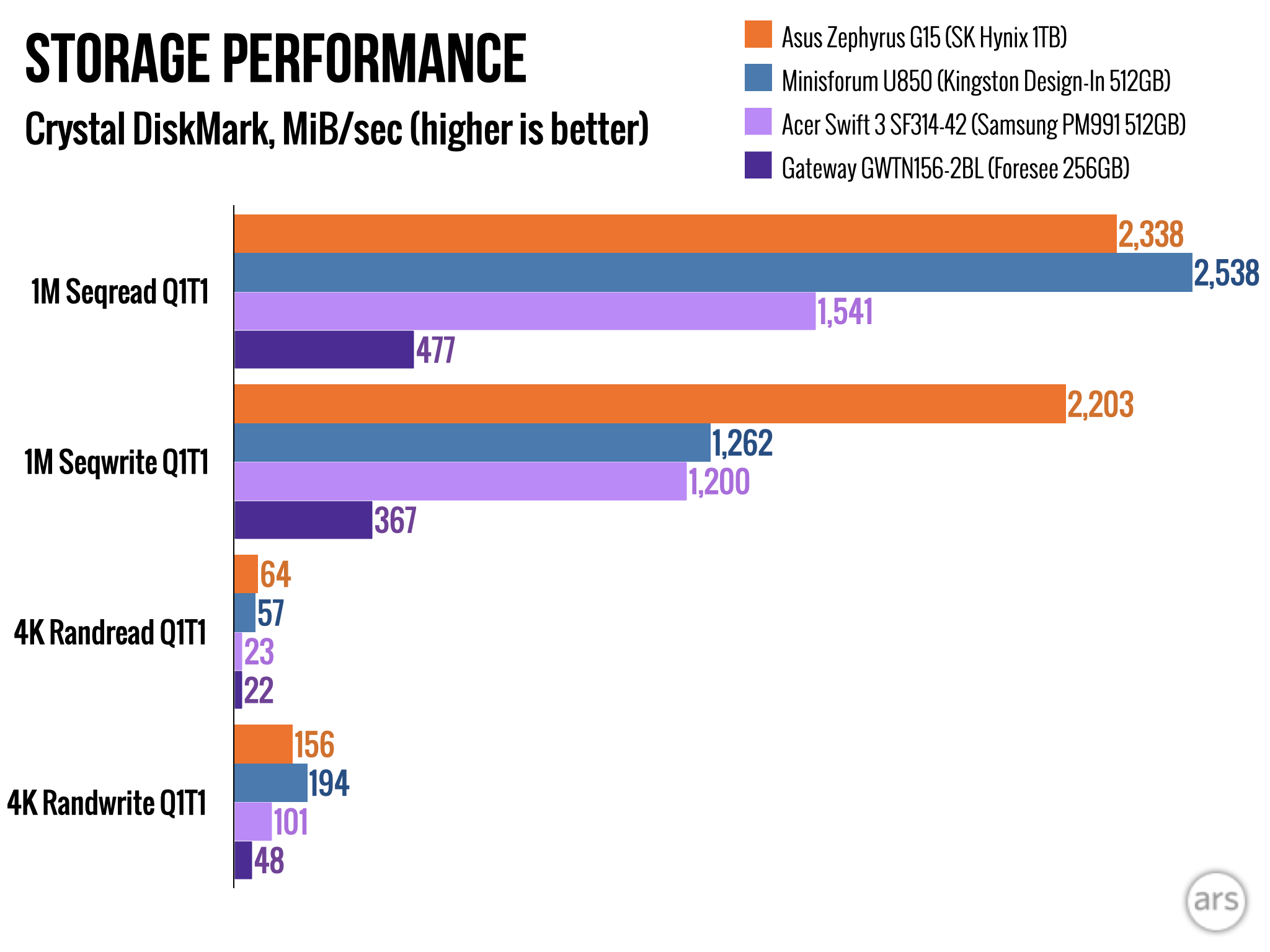
Enlarge/ The SK Hynix SSD in the G15 flexes serious storage muscle in CrystalDiskMark testing, nearly doubling competing drives’ performance in large writes.
Jim Salter
We weren’t sure what to expect from the SK Hynix NVMe SSD in the G15—that’s not a name you see often in the consumer SSD space, and the specific model seems to be new to the Zephyrus G15 as well.
CrystalDiskMark testing definitely put our minds at ease; the SK Hynix drive outperformed not only the Kingston Design-in drive from the Minisforum U850, but also the WD Black 2TB and WD SN730 512GB (not pictured) from this spring’s gaming-focused Ars System Guide.
This is a seriously fast SSD, which contributes strongly to the overall impression the ROG G15 laptop gives a new user. It’s not just a narrowly focused fps monster; it feels extremely fast in general use cases as well.
https://arstechnica.com/?p=1757001
Resident Evil 4 VR announced for Oculus Quest 2 as a first-person remake
On Thursday, Capcom announced that its megaton horror series Resident Evil will soon return to virtual reality. But instead of adding a VR mode to the upcoming Resident Evil VIII: Village, slated to launch next month, the game maker threw horror fans a curveball. The project, as it turns out, is Resident Evil 4 VR, a wildly revised port of the 2005 classic, and it appears to be an Oculus Quest 2 exclusive.
You read that correctly: Quest 2, as opposed to Rift or other PC-VR platforms. No release date or estimate has yet been confirmed.
The VR port was announced as part of the latest announcement frenzy otherwise dedicated to May 7th’s RE8, and it confirmed that Oculus Studios and Armature Studios (made up of ex-Metroid Prime developers) are leading the VR port’s production. Because of Armature’s recent ties to Oculus, in terms of releasing exclusive VR games for its Rift and Quest systems, that collaboration points to this game remaining an Oculus exclusive.
Knife in one hand, pistol in the other. It’s time to play Resident Evil 4 in VR.
Oculus / Armature / Capcom
Another angle of knifey-gunney.
Stare down the abyss with weaponry at the ready.
Why use a typewriter to save your game, when you can use it to finger-peck a masterpiece in VR?
Use both hands to reload guns. (Hopefully, this isn’t a pain in the butt to do in VR.)
Assault with a deadly weapon.
Reload with a deadly weapon.
A peek at the revised inventory interface, designed for real-world hand use.
Another angle; you’ll have to look from left to right to manage the interface’s full breadth.
This doesn’t look like a difficult puzzle. But who am I to judge?
Representatives for Oculus and Facebook have so far only described the port as a product for “Quest 2,” as opposed to a more generic platform description that might hint to the “Oculus Link” system, which streams PC games to the otherwise portable Quest headset family. If Facebook wants to clarify any additional ways to play the game, we’ll have to wait for next week’s Oculus Gaming Showcase, which will premiere on Twitch and YouTube on Wednesday, April 21.
The port appears to heavily revise the original game, which launched on Nintendo GameCube in 2005 as a third-person, over-the-shoulder adventure—and one that revolutionized how the series would play for years to come. Some of that action, particularly the twitchy gun-driven combat, will likely be a solid match for the first-person view of a VR game, but RE4‘s cinematic scenes and massive bosses are another story.
Thursday’s debut trailer avoided clarifying exactly how the original game’s more ambitious moments will translate to VR. Instead, Armature and Oculus took the opportunity to show some basic combat, including a moment where the player held a knife in one hand and a pistol in the other, along with a VR-friendly inventory management screen, a puzzle that required turning a lever with hands in virtual space, and some “reload a gun using both hands” gimmickry.
Amusingly, this port serves as a reminder that the game’s original 2004 announcement came as part of a “Capcom Five” press conference of exclusive games for Nintendo’s then-struggling GameCube platform. Months later, Capcom was forced to clarify that RE4 would indeed launch on the era’s dominant PlayStation 2 after all, and it wound up being ported to roughly 4,000 other consoles in the 16 years since. https://arstechnica.com/?p=1757320
Fast and Furious 9 drops a new trailer ahead of June 25 release
F9 was meant to hit theaters in May 2020, but then we had this whole pandemic thing.
Universal Pictures
Roman Pearce (Tyrese Gibson) and Dominic Torreto (Vin Diesel) shoot at stuff.
Universal Pictures
Letty (Michelle Rodriguez) and Mia (Jordana Brewster) talk about stuff.
Universal Pictures
Dom listens to renegade younger brother Jakob (John Cena) shout about stuff.
Universal Pictures
Dom wouldn’t be Dom without some American muscle.
Universal Pictures
Cars have a tendency to get airborne in F&F movies.
Universal Pictures
Look, if you can’t suspend your disbelief, you probably shouldn’t bother watching this film.
Universal Pictures
Tej Parker (Chris “Ludacris” Bridges) and Roman Pearce (Tyrese Gibson) wearing makeshift pressure suits.
Universal Pictures
Jakob is working with Fate of the Furious‘ Cipher (Charlize Theron).
Universal Pictures
Director of photography Stephen F. Windon and director Justin Lin, who is back at the helm having directed installments 3, 4, 5, and 6.
Universal Pictures
This past weekend, with little to do thanks to the pandemic, I marathoned through the Fast and Furious franchise. That was fortuitous timing, because on Tuesday a new trailer dropped for F9, the next installment, which arrives in theaters on June 25.
We actually got our first look at F9 well over a year ago, when the first trailer dropped at the end of January 2020. Family has been a central theme to the F&F movies, and that continues here. Dominic Toretto (played by Vin Diesel) and the gang have to confront his younger brother Jakob (John Cena), described as “the most skilled assassin and high-performance driver they’ve encountered.” He’s working with criminal mastermind Cipher (Charlize Theron), who sports a much more flattering haircut than in Fate of the Furious, the movie where she improbably hacked a bunch of old cars to drive themselves.
Also returning to the series is Han Lue (Sung Kang), who we all thought died at the end of Tokyo Drift. (This was revealed to be the work of Deckard Shaw (Jason Statham) who was bad in Furious 7 but then turned out to be good in Fate of the Furious and Hobbs and Shaw.)
Based on this second trailer, the plot for F9 appears to involve magnets, and at one point Tej Parker (Chris “Ludacris” Bridges) and Roman Pearce (Tyrese Gibson) don makeshift pressure suits and take to the skies in what might be a DeLorean with rocket boosters strapped to the roof.
[embedded content]
As my colleague Jennifer Ouellette explained last year, “F&F9 will probably make about as much sense as its predecessors—in other words, not much sense at all. And fans wouldn’t have it any other way.”
I know I wouldn’t.
Listing image by Universal Pictures
https://arstechnica.com/?p=1756953
Oculus Quest 2 gets official wireless-VR mode, 120 Hz support via patch
Enlarge/ More hidden features will soon be loosed onto Oculus Quest 2 owners.
Sam Machkovech
Last year’s Oculus Quest 2 VR headset remains one of the cheapest—though not necessarily recommended—ways to jump into virtual reality. But even I must admit its sales proposition became more tantalizing on Tuesday with a late-night announcement from reps at Facebook: two disabled features inside the headset are now being unlocked as a default option.
The first is a wireless-VR mode, which Facebook is calling Oculus Air Link, coming “soon” to headset-and-PC combos that run compatible Oculus software. The short version: you will soon be able to connect your Oculus Quest 2 to a gaming PC using nothing more than a local Wi-Fi connection. This feature will be supported within stock headset software, no extra apps required. And it will essentially make connecting to your PC’s VR apps work the same as the VR apps built directly into Quest 2’s storage.
“Not every network and PC setup will be ideal”
“We know gamers want to use Link without a wire,” the announcement says, and sure enough, that cry tends to be the loudest in our VR hardware reviews. No more wires in VR, the readers complain, and Facebook has responded with no more wires. But, gosh, do you really want to use this feature, folks?
Keep in mind that Oculus Air Link is “experimental.” As Facebook says, “Not every network and PC setup will be ideal.” Connecting your headset to a PC via a cable (as in, Oculus Link) is “the way to go” for most users and offers the “highest fidelity visuals possible.” Heck, its “known issues” list says that AMD GPUs can only wirelessly stream via Air Link at half the rate of Nvidia GPUs, even if you have AMD’s newest, highest-end products.
That abundance of caution for average users isn’t surprising, since wireless VR runs up against a significant burden of comfort and fidelity. If your local network can’t consistently deliver 72 fps or 90 fps of high-res images directly to your face, any blurriness or control lag can feel all the more severe. Some Oculus Quest owners already know this because they’ve tested wireless-VR modes as enabled through the third-party Virtual Desktop app, which has always required jumping through at least one hoop to get it working.
Still, with the right network conditions, Virtual Desktop has proven Quest 2’s ability to stream higher-end PC VR games to the cheaper Oculus Quest 2 with acceptable performance. And having those features built directly into the firmware could prove to be even more efficient—though Oculus’ notes suggest a maximum of 200Mbps of upstream-and-downstream via local wireless networks, which is far lower than Virtual Desktop’s maximum of 1,200Mbps. We look forward to testing and comparing the two options.
120 Hz: “Soon,” but when? And for what?
The other big-deal feature announced on Tuesday is Quest 2’s panel jumping to a whopping 120 Hz refresh, up from its current maximum of 90 Hz. As it turns out, Quest 2’s single LCD panel was rated for 120 Hz refresh rates all along—meaning it was likely sourced from production lines that were making displays at the same speed as a new standard for smartphone screens.
After a tease from one Facebook executive in February, longtime Oculus contributor John Carmack confirmed in March that the feature would eventually arrive. “Only a few existing games will be tweaked for 120 [Hz], but some new titles will consider it an option in their design phase,” he wrote on Twitter.
Facebook’s official 120 Hz announcement confirms this plan, albeit in different language: “Not many apps will support 120 Hz just yet,” according to the statement, and it won’t apply to the hardware’s default “home” environment. There’s no release date beyond “soon” for this feature’s rollout. When asked by Ars Technica, Facebook declined to offer a list or hints of what existing software may receive a 120 Hz refresh update at that point.
In Quest 2’s default use case, as a wholly wireless headset running internally installed software, 120 Hz mode may have limited impact. Quest 2 hardware is already pushed pretty hard by 90 Hz speeds, which is why many Quest 2 games, including the wildly popular and Facebook-owned Beat Saber, stick to its lowest 72 Hz refresh rate. Jumping further not only cranks the SoC (and its cooling system) that much more but will also hammer the system’s already capricious battery life.
Dreaming of updates for PC, plus productivity
As a connected PC-VR option, on the other hand, 120 Hz mode could be a serious treat, especially for PCs that are equipped to run VR games at such speeds. In particular, higher refresh rates seriously impact long-term VR comfort when sessions exceed 30 minutes at a time. My earliest tests of the Valve Index, which natively supports 120 Hz and 144 Hz modes, hinged on using that headset as a virtual work monitor for hours at a time, and what I said at the time still holds: higher refresh rates make juggling multiple, floating work screens and panels all the easier on the eyes.
But even though Facebook is vague about 120 Hz modes for default Oculus Quest 2 use, it’s somehow even more vague about the same coming to connected PC-VR (aka Oculus Link). That’s coming in a “future release,” as opposed to “soon.” I wish it were the other way around, assuming one will take longer than the other.
Everything I said above about using VR to run a virtual office is clearly on Facebook’s mind, as well, as Tuesday’s blog post included hints of productivity boosts built into the Quest 2’s “home” interface. Among those: the headset will soon allow you to place “a virtual desk on your real furniture,” and it will start adding support for “Bluetooth-enabled keyboard tracking” while inside of VR.
When you’re not typing, point and pinch with your real-life fingers to control Oculus Quest 2’s windows and menus.
And when you want to type, your real-life keyboard will appear inside your virtual world at what appears to be a proper size and placement. Not that you’re looking-and-pecking or anything…
This will require a compatible keyboard to start, with Logitech’s K830 being the first supported model. Facebook’s latest sample GIF shows a 3D-rendered keyboard appearing in your virtual world, along with a black-and-white glimmer of your real-life hands typing on it. Go back and forth between tapping on the keyboard and gesturing in mid-air with your fingers to control VR windows and interfaces like a mouse.
This is clearly Facebook building upon its finger-tracking system, which launched as a beta within the Oculus Quest 2 firmware in late 2019, and it’s a good hint of the company’s aspirations to make VR part of a balanced work-from-home diet—even if such features feel entirely too late to the pandemic party. I’ve gotten in touch with Logitech about the K830 and plan to test it for a future article about whether Quest 2 might fit my remote-office needs. Why buy a zillion monitors when a single VR headset, as paired with smart office hardware, could produce them virtually for cheaper? (Albeit with Facebook’s embedded Oculus cameras watching the entire time.) I’ll test and follow up. https://arstechnica.com/?p=1756909
It’s Dave Bautista and pals vs. zombie horde in Army of the Dead
[embedded content]
Dave Bautista stars in the zombie heist film Army of the Dead, directed by Zack Snyder.
Fresh off the successful release of Zack Snyder’s Justice League, we’ll soon be getting the director’s latest project: Army of the Dead, about a group of mercenaries that attempts a heist in a zombie-ridden Las Vegas. In a sense, Snyder has come full circle. His directorial debut was 2008’s Dawn of the Dead, an entertaining reboot of the original George Romero classic from 1978.
Army of the Dead started out as a joint project between Universal Studios and Warner Bros. back in 2007. But like so many films, it got stuck in development hell until Zack Snyder signed on as director in 2019. Netflix picked up the distribution rights from Warner Bros. soon after.
Per the official premise:
Army of the Dead takes place following a zombie outbreak that has left Las Vegas in ruins and walled off from the rest of the world. When Scott Ward (Dave Bautista), a displaced Vegas local, former zombie war hero who’s now flipping burgers on the outskirts of the town he now calls home, is approached by casino boss Bly Tanaka (Hiroyuki Sanada), it’s with the ultimate proposition: Break into the zombie-infested quarantine zone to retrieve $200 million sitting in a vault beneath the strip before the city is nuked by the government in 32 hours. Driven by the hope that the payoff could help pave the way to a reconciliation with his estranged daughter Kate (Ella Purnell), Ward takes on the challenge, assembling a ragtag team of experts for the heist.
They include Maria Cruz (Ana de la Reguera), an ace mechanic and Ward’s old friend; Vanderohe (Omari Hardwick), a zombie killing machine; Marianne Peters (Tig Notaro), a cynical helicopter pilot; Mikey Guzman (Raúl Castillo), a go-for-broke influencer and Chambers (Samantha Win), his ride-or-die; Martin (Garret Dillahunt), the casino’s head of security; a badass warrior known as the Coyote (Nora Arnezeder) who recruits Burt Cummings (Theo Rossi), a slimy security guard; and a brilliant German safe cracker named Dieter (Matthias Schweighöfer). Scott finds an unexpected emotional hurdle when Kate joins the expedition to search for Geeta (Huma S. Qureshi), a mother who’s gone missing inside the city. With a ticking clock, a notoriously impenetrable vault, and a smarter, faster horde of Alpha zombies closing in, only one thing’s for certain in the greatest heist ever attempted: survivors take all.
Notaro replaced comedian/actor Chris D’Elia late in the project, on the heels of a number of sexual misconduct allegations against the comedian. This required reshooting some scenes with an acting partner, which were then inserted into the film; Notaro was also inserted into several scenes via digital compositing. She has been fantastic on Star Trek: Discovery, and it will be interesting to see how she fares in Army of the Dead.
The trailer is entertaining, with Kenny Rogers’ “The Gambler” as a musical backdrop, just to set the mood. “There’s 200 million dollars in a vault beneath the Strip,” Tanaka tells Ward and his team. “This should be a simple in and out.” Of course, nothing is ever simple. Vegas is swarming with zombies—faster, smarter zombies, not the classic Romero variety. They’re smart enough to organize, and that, plus their far superior numbers, doesn’t bode well for our human protagonists. (The house, after all, always wins.) But we are definitely on board for the Zombie Elvis and zombie tiger.
Army of the Dead debuts in select theaters and on Netflix on May 21, 2021. If this is as much fun as Snyder’s Dawn of the Dead—and it looks like it could be—Army of Dead should be a huge success. There are already plans for a prequel film focusing on the character Ludwig Dieter (played by Matthias Schweighöfer) and an anime-inspired TV series, Army of the Dead: Las Vegas.
Dave Bautista plays Scott Ward, who recruits a group of mercenaries to pull off a Las Vegas heist.
Chekhov’s chainsaw?
YouTube/Netflix
Tig Notaro plays Marianne Peters, replacing Chris D’Elia.
YouTube/Netflix
Matthias Schweighöfer’s character, Ludwig Dieter, will star in a forthcoming prequel film.
YouTube/Netflix
Look at all that loot.
YouTube/Netflix
Now they just have to get out of Vegas.
YouTube/Netflix
Except the city is now completely overrun by zombies. Faster, smarter zombies.
YouTube/Netflix
Even the fake Statue of Liberty is looking a bit zombified.
YouTube/Netflix
Zombie showgirl would love to eat your brains.
YouTube/Netflix
Zombie Elvis looking for a snack between gigs.
YouTube/Netflix
Zombie tiger? “That’s crossing the line.”
YouTube/Netflix
The humans are heavily outnumbered, as always.
YouTube/Netflix
I knew that chainsaw would come in handy.
YouTube/Netflix
Good news: you won the jackpot. Bad news: you’re being eaten by zombies.
YouTube/Netflix
Ward on high alert as he explores the casino floor.